Flexibility, Efficiency or Starting From Scratch?

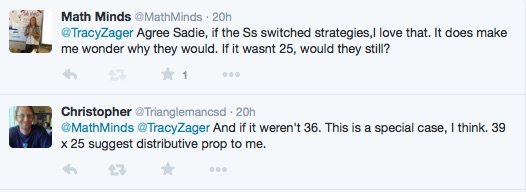
I ask myself this question numerous times during the course of school week. During number talks and in class conversations, the students show such amazing thinking and strategies in solving various computation problems. But, just when I think they are constantly thinking about the numbers, their values and sense-making, they seem to start a new problem from scratch without connecting to any of their prior reasonings. Is it flexibility in their thinking, efficiency or seeing each problem as a new one? I was SO glad to see I am not alone when I read Tracy’s tweets yesterday….

tweett3

The conversation was an interesting one that then seemed to moved into number choice and thinking about what the students were thinking and what we do as teachers from here. We all definitely had a lot more questions than answers, which is always fun to explore!

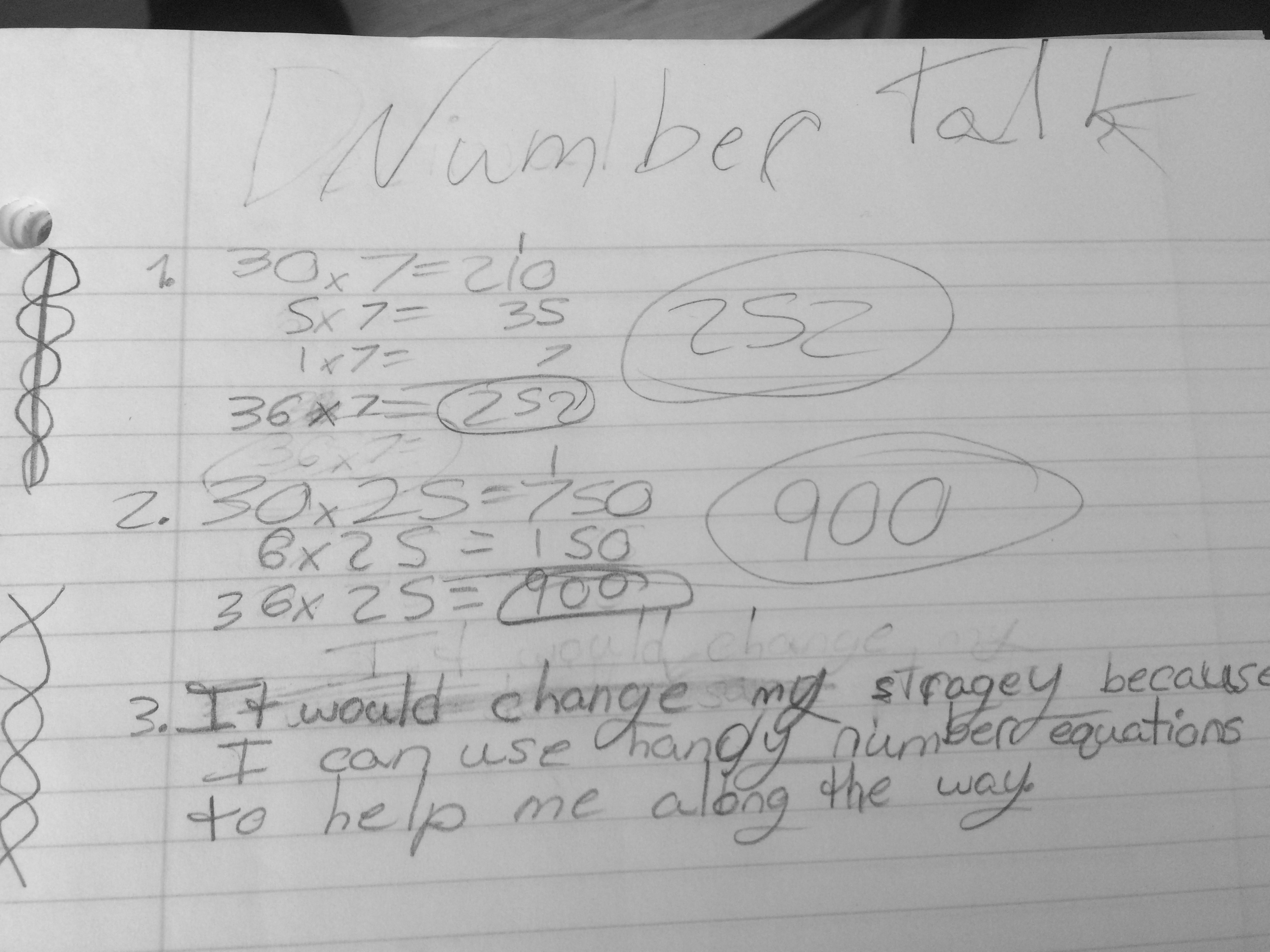
t4t5So, of course I had to test out some of our questions into my number talk today. I had the students do the number talk from their seats so they had their journals readily available. I gave them 36 x 7, asked them to solve mentally and really think about the strategy they were using. I took answers, they all got 252, and I asked them to jot down how they solved it. We shared out and the majority had solved it just as Tracy had mentioned in her tweet, (30×7) + (6 x 7). Then I gave them 36 x 25 to see if, when given a 2-digt x 2-digit, they changed their thinking. I was also interested in the influence of the number choice of 25.

I don’t think it was the two-digit  times 2-digit number that changed their approaches, but more so the influence of the 25.  A lot went to double/halving because they could get to 50 and 100 and others used the 100 made of four 25s. One student multiplied 40x 25 and subtracted 100 while a few others used the associative property that Tracy had mentioned (4×25) x 9.

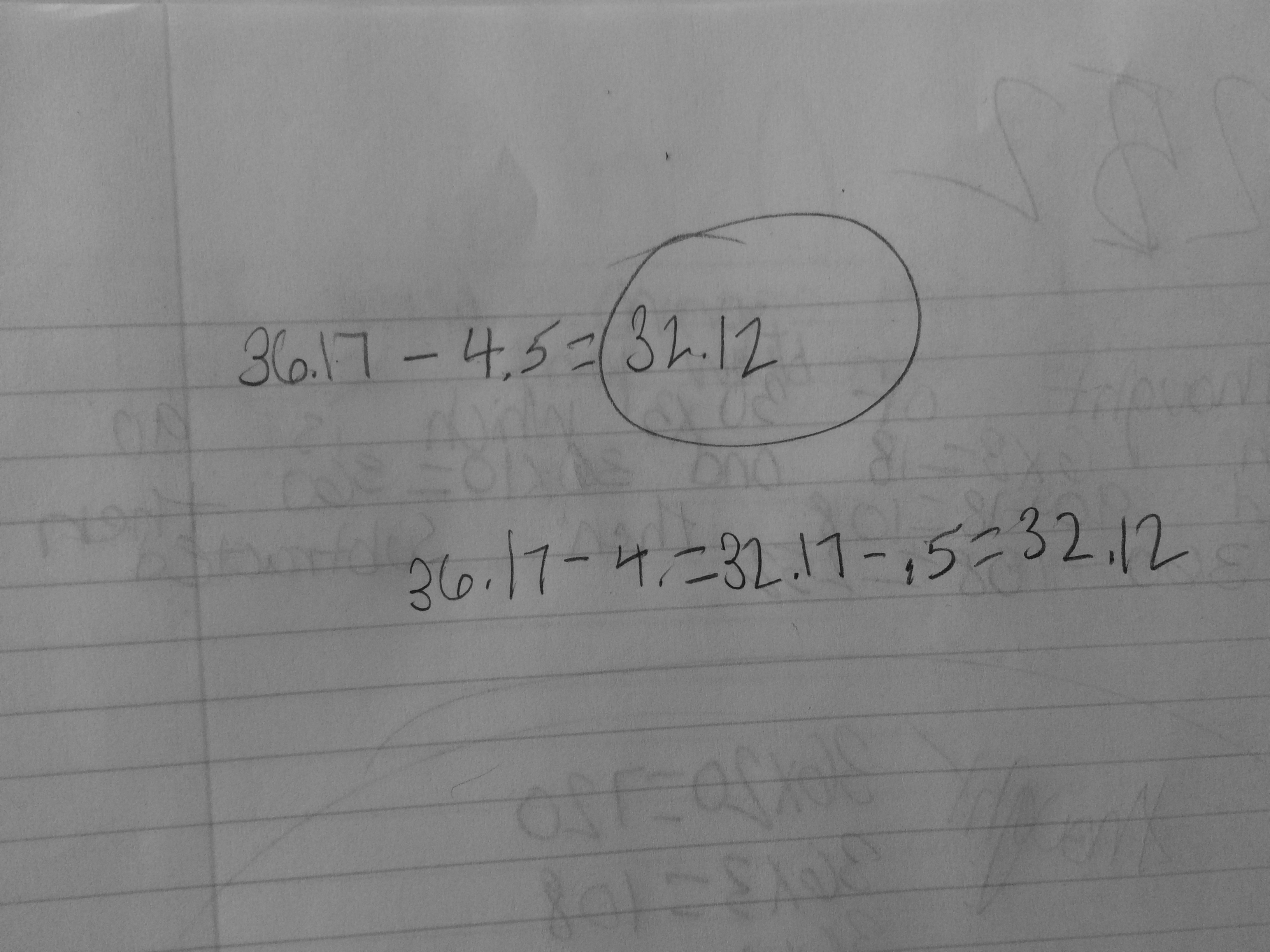
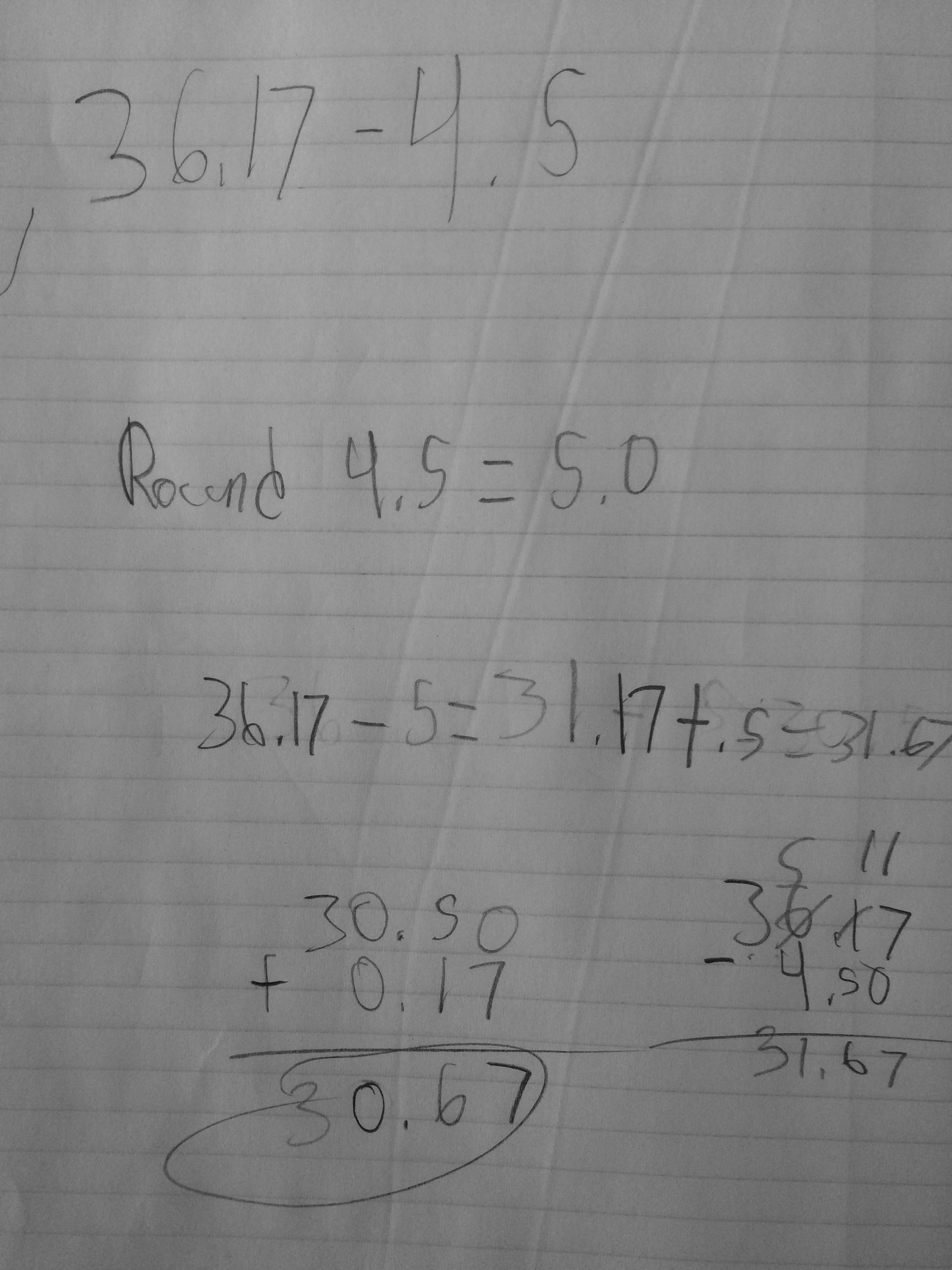
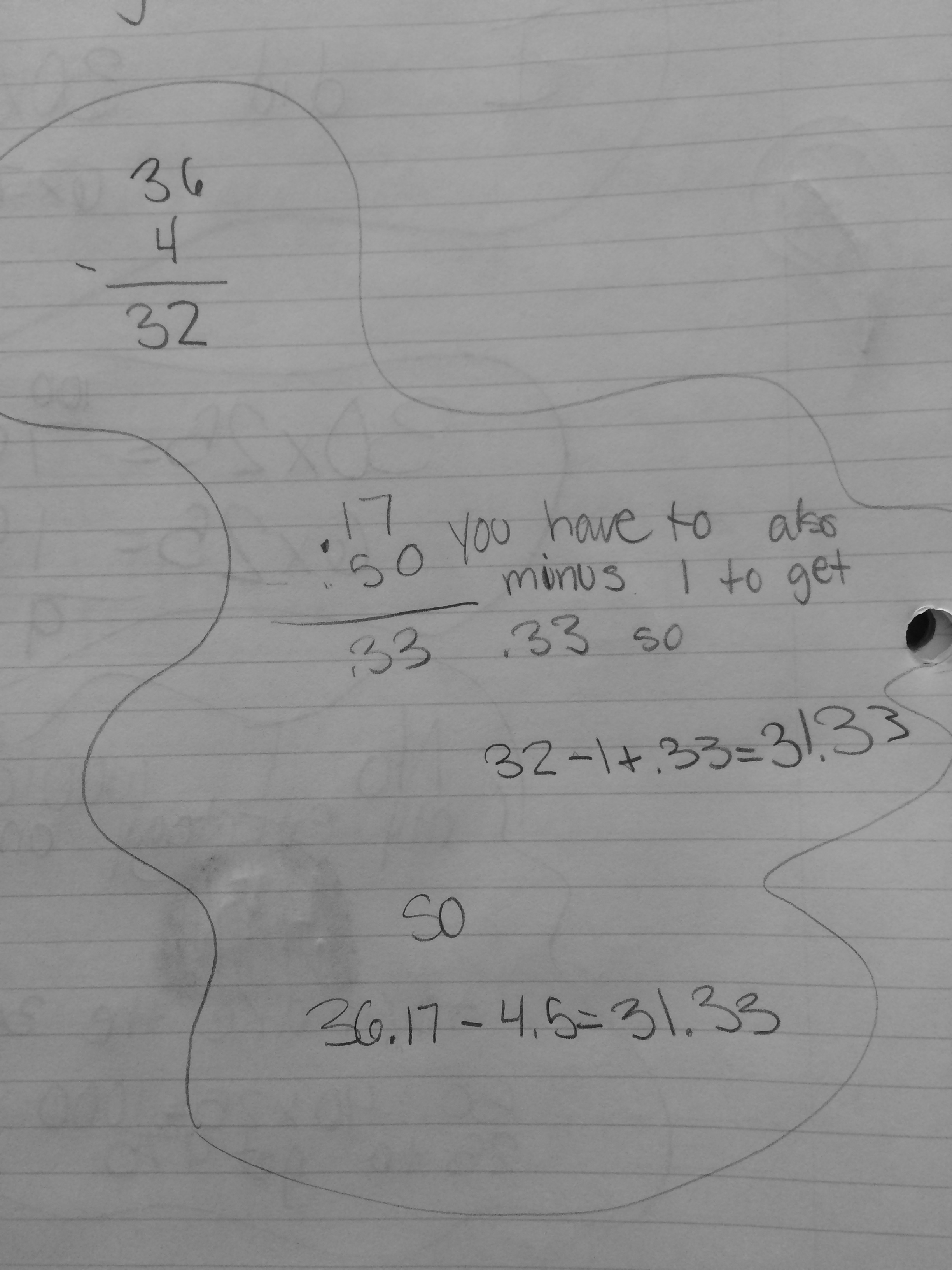
The final problem was 39 x 25. Unlike a typical number talk in which I push students to connect to previous responses in route to an answer, I instead asked them to not solve it, but just think about how they would solve the problem. After they had their thumbs up with a strategy, I asked them to complete one of the following prompts: “I used the same strategy I had used before because….” or “I used a different strategy in this problem because…” Here are some of their responses…

IMG_9614_2IMG_9615_2IMG_9616_2IMG_9617_2IMG_9619_2IMG_9620_2

IMG_9622_2IMG_9623_2

IMG_9624_2IMG_9618_2

IMG_9626_2IMG_9625_2

IMG_9627_2

My conclusion is: the more students talk about their strategies, reasonings, and choices, the more they think about the numbers and what “makes sense” in the solution pathway. I think some students definitely get into a comfort zone with a strategy that works for them, and that is ok with me, but I definitely want to expose them to other ideas and things to think about. I loved that 25 and 39 influenced their thinking about the way to approach the problems.

I am not sure this answers any questions in our Twitter conversations, but I am always SO incredibly curious to see what the students actually do after anticipating their thoughts. The even better part is, they love sharing what they were thinking without the worry of being wrong. I even had one student who said she changed her strategy for the last problem because she got the one before it wrong after solving it twice. In her words, “It definitely was not working.” 🙂

Hope this gives you something to think about Tracy, Christopher, Sadie, Simon and Kassia!

-Kristin

What Are They Really Thinking About Decimals?

Understanding student thinking is so hard. I make assumptions. I read into things. I SO want to believe there is understanding behind everything they write on their papers. However, it is so much more difficult than that and my most recent difficulty is addition of decimals.

We have talked about decimals in one frames, shaded grids, and I am confident that every student can compare decimals with understanding of place value and magnitude. They understand decimals independently. Then, enter decimal addition. What is it about computation that sends students right back to not thinking about the numbers themselves and straight back to “lining them up” and adding? I know it is not that they CAN’T think about the numbers, so then my wheels start turning…. is it just ease of use? Great. But is it ease of use with understanding? Or is it ease of use without understanding but just gets them the right answer? This is where teaching is so hard!

We do number talks at least 2-3 times per week and given a problem such as 38 + 47, the majority of the students would say 40 + 45 = 85 using a compensation strategy. Today, given 6.8 + 4.7, I got “I lined them up and added 8 and 7 and got 15, carried the one…” You can hear the rest. Wait, what? Where are the tenths? Where is the place value? Why didn’t I ask them to give me an estimate first (ugh, hindsight)? I ask for any other strategies, nothing emerges. I am left to wonder what they truly understand about addition of decimals. Is it the decimal place value that takes away from thinking about the numbers or is it simply that they see how the decimals operate like whole numbers in a base ten sense. After doing a contextual task the day before, with pencil and paper, I was excited by the outcome, there were numerous strategies. However, if pushed to solve mentally, the students reverted back to an algorithmic feel. I am not saying that it means the students do not understand the place values they are adding, but trying to bring to light how hard it is to interpret their understanding on my part.

I then gave them a problem involving three decimals and asked them to solve it two ways. I was trying to get a better feel of their understanding. The two ways would push those “liner-uppers” to work with the decimals in a different way and also allow me the time to walk around and question students about their work.  I was not shocked to see that the majority went to lining them up as their first strategy, however I was very excited by their second strategy that showed more understanding of place value.

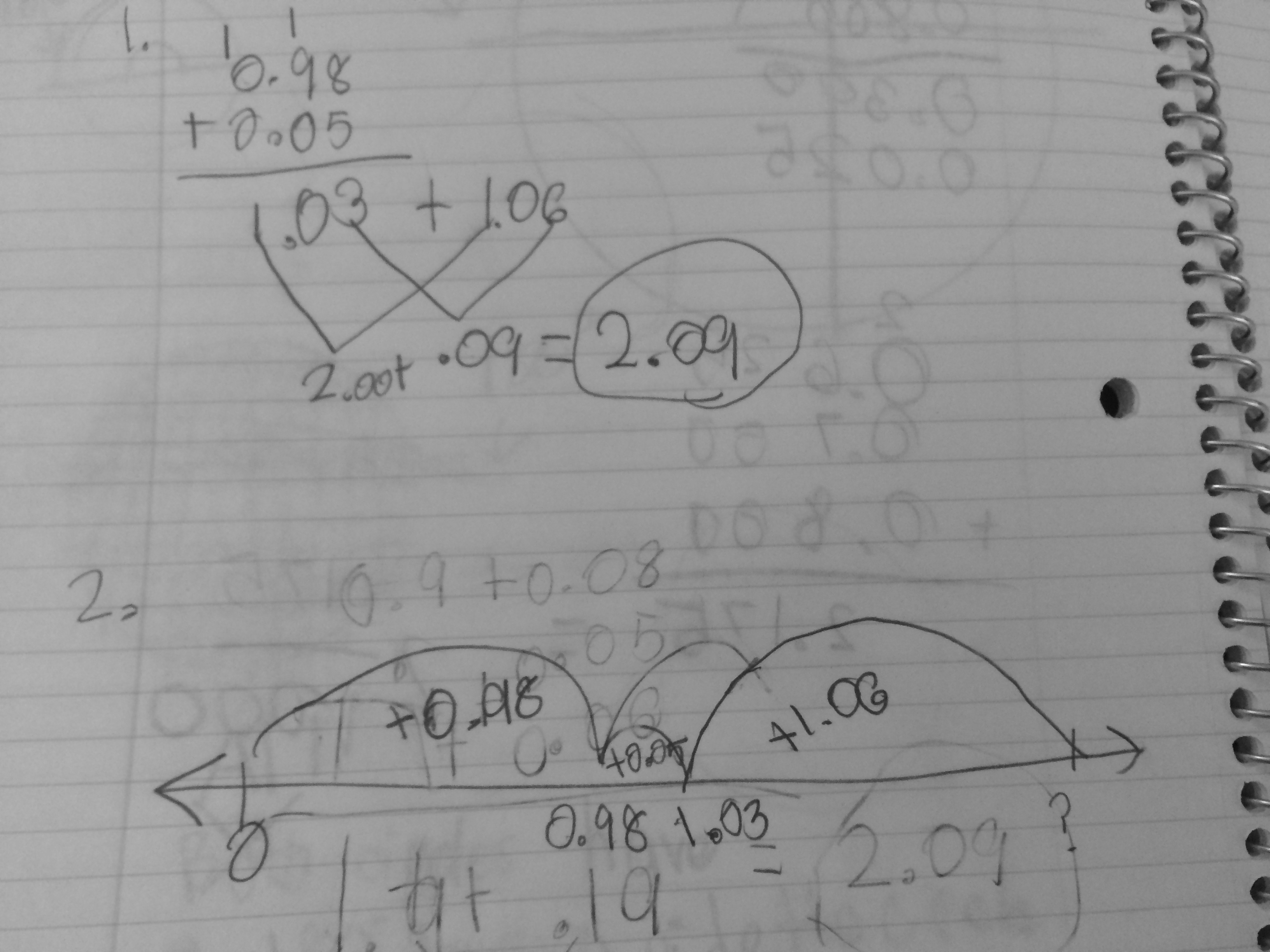
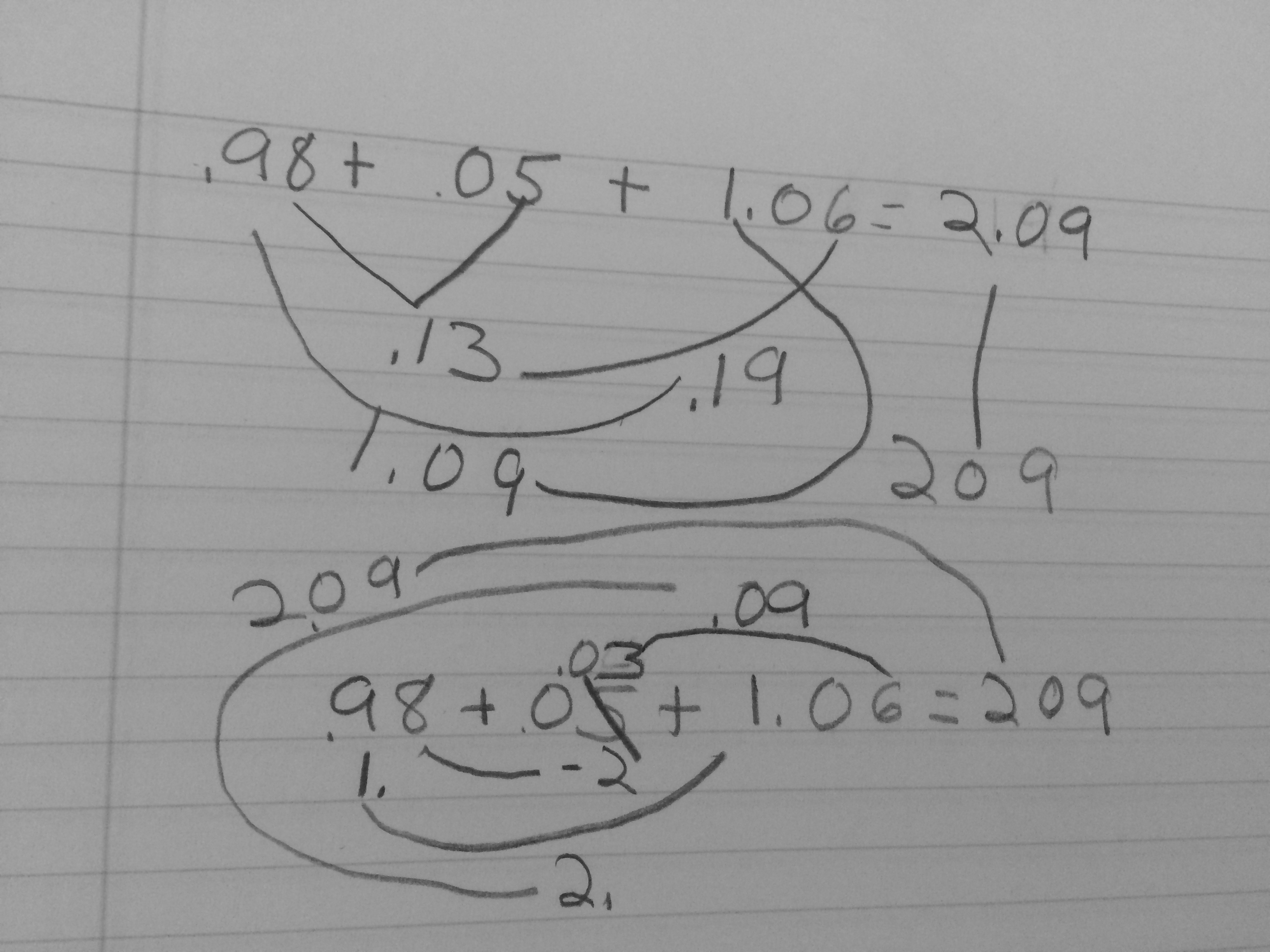
Here are some examples of the students solving 0.98 + 0.05 + 1.06

IMG_9611_2IMG_9609_2

I loved the number line in the first example and the breaking apart of the 0.05 in the second example. I was starting to see the flexibility and thinking that I want to see in my students.

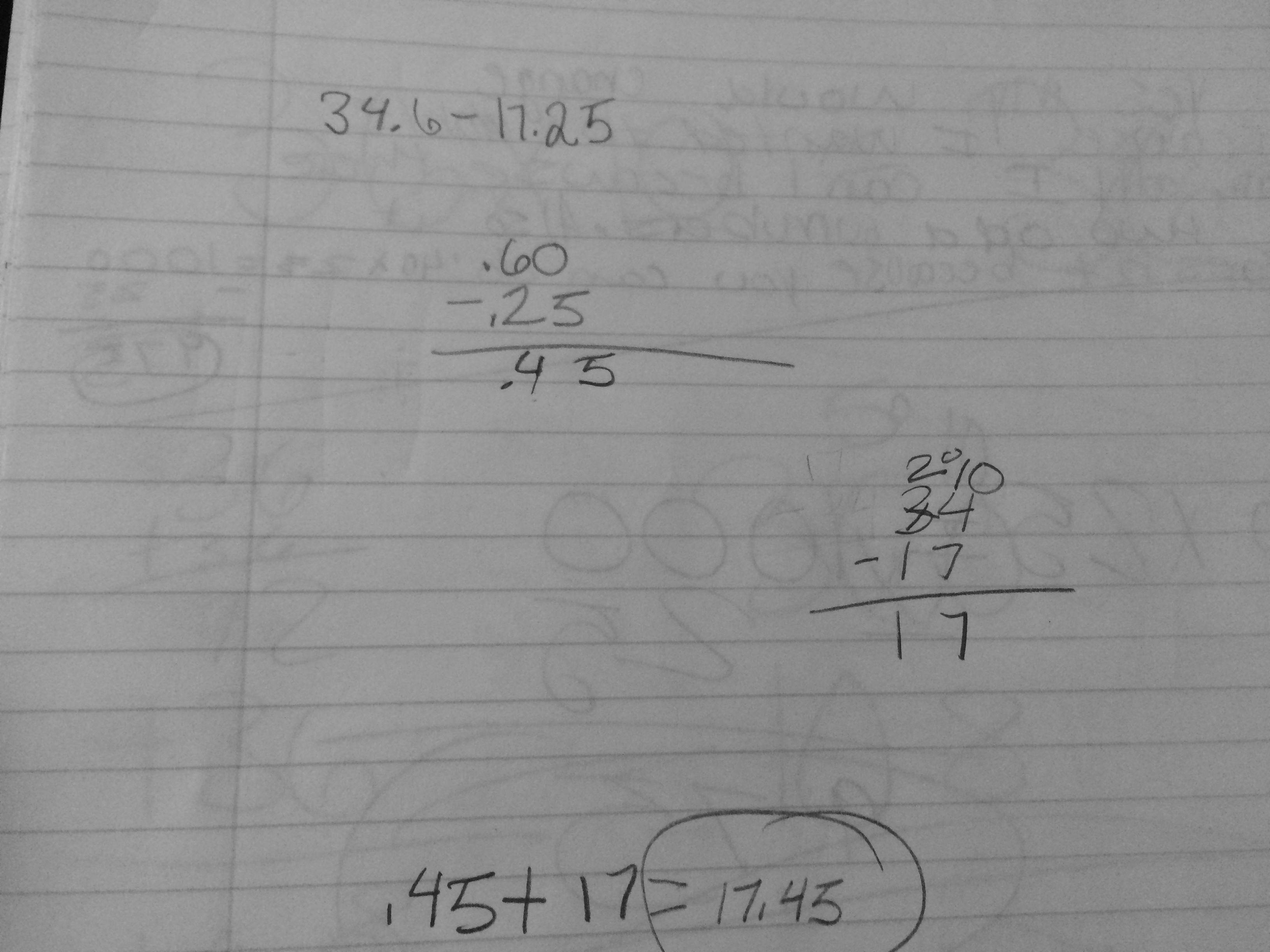
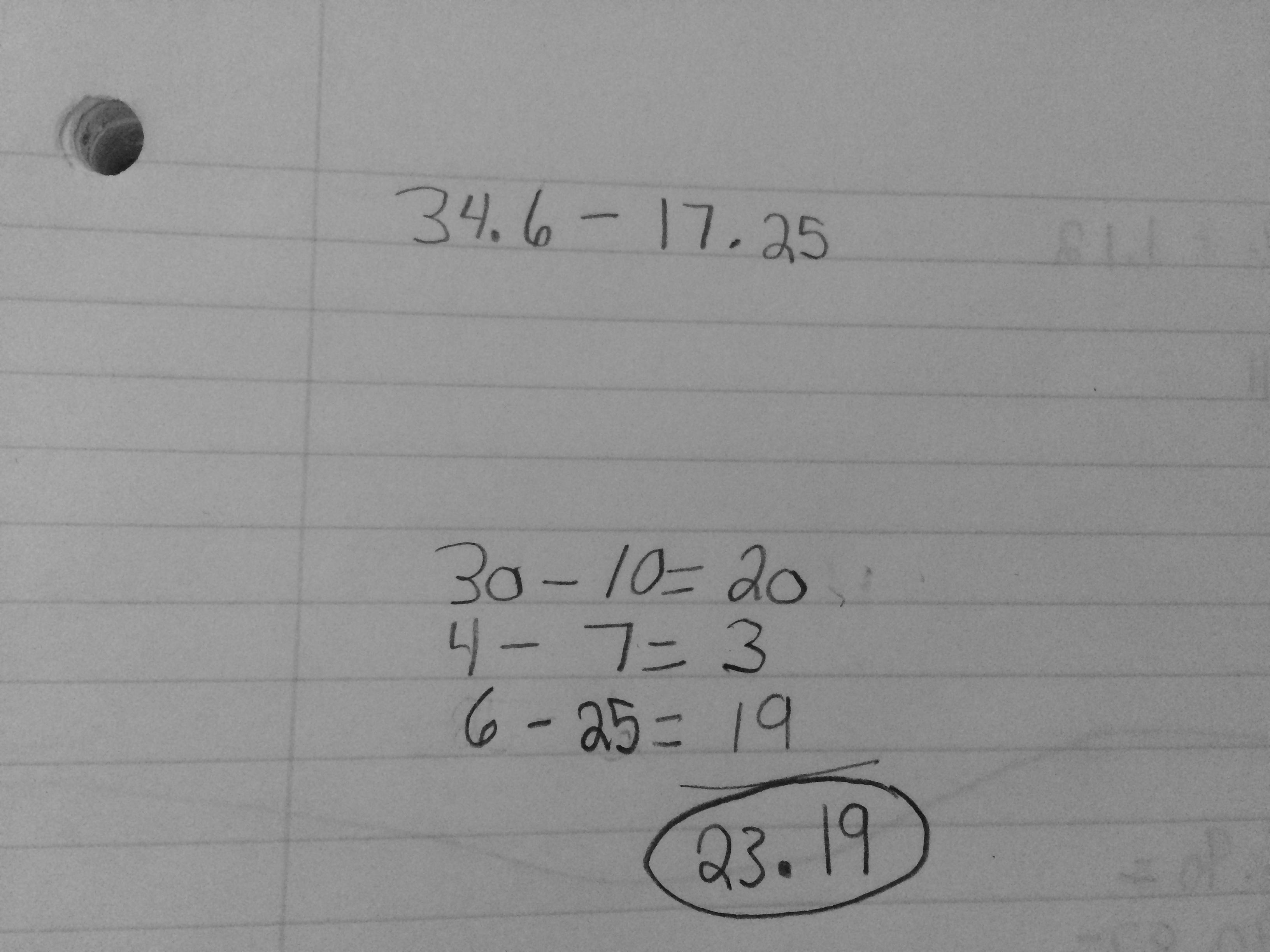
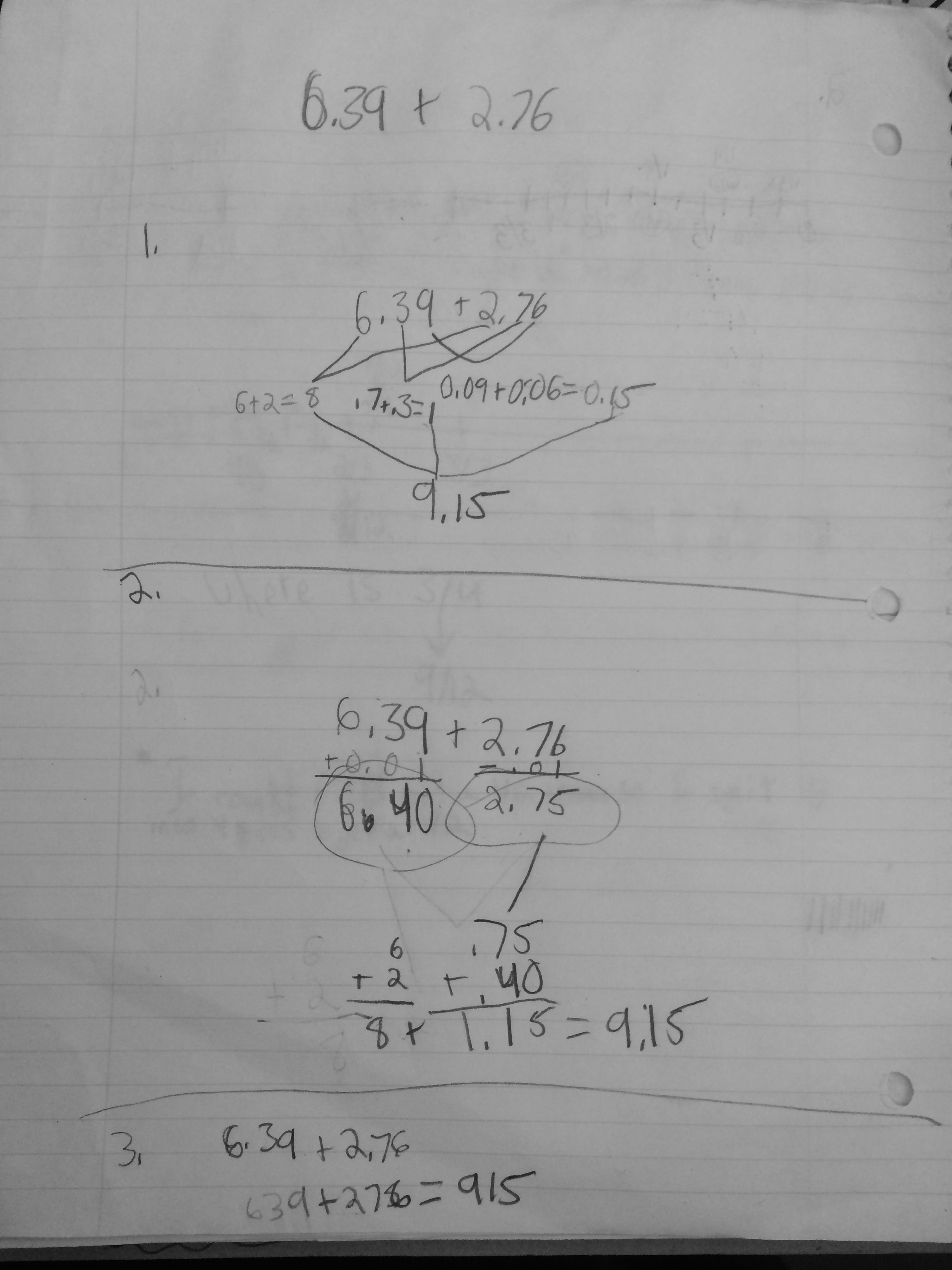
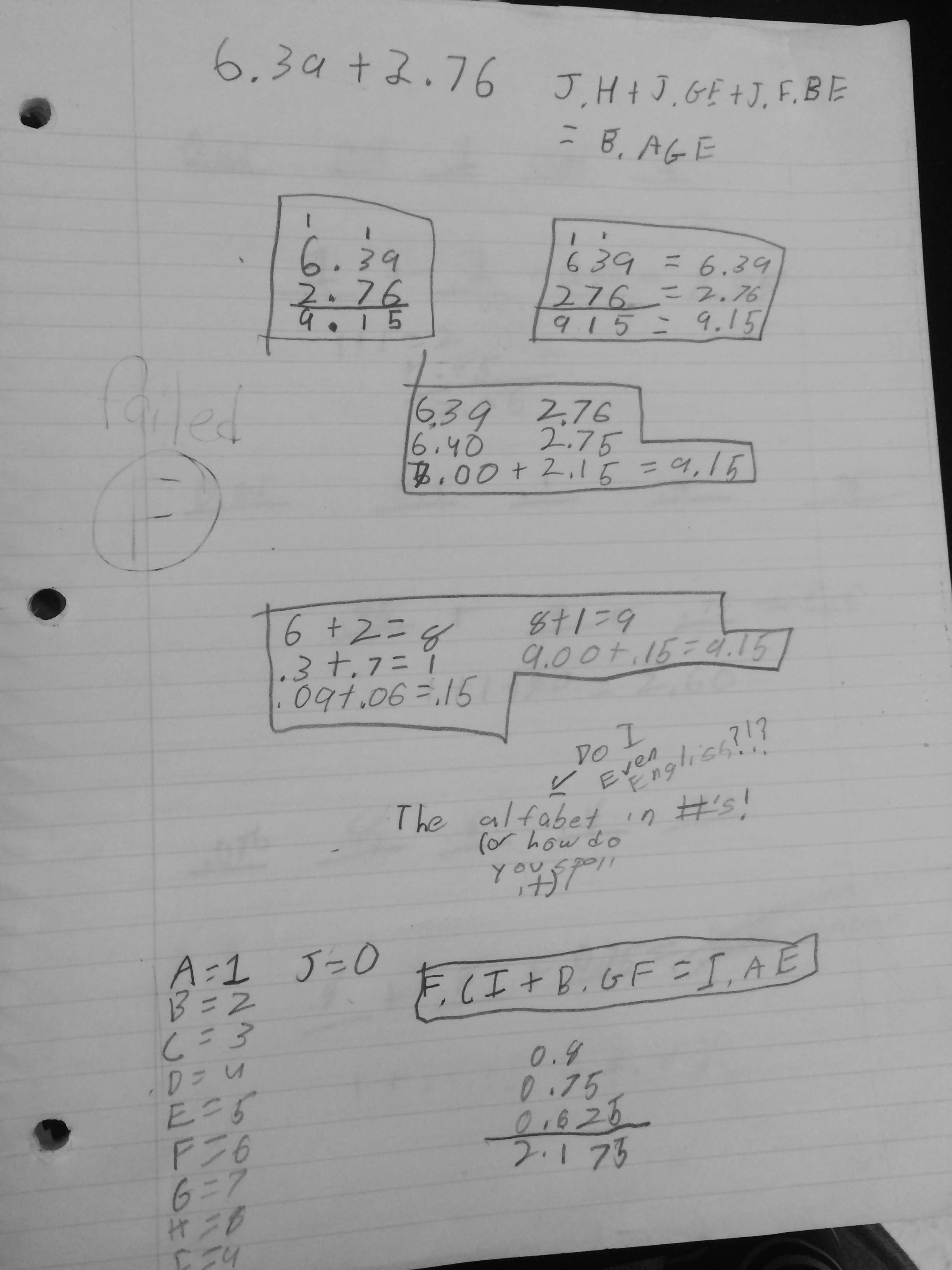
I gave my second class a different problem involving two decimals, both in the hundredths that were not as “friendly” as the decimals in the previous example. I was happy to see the variety of strategies, including my student who starts assigning letters for each digit. He said he is ready to start doing some algebra 🙂  I love it!

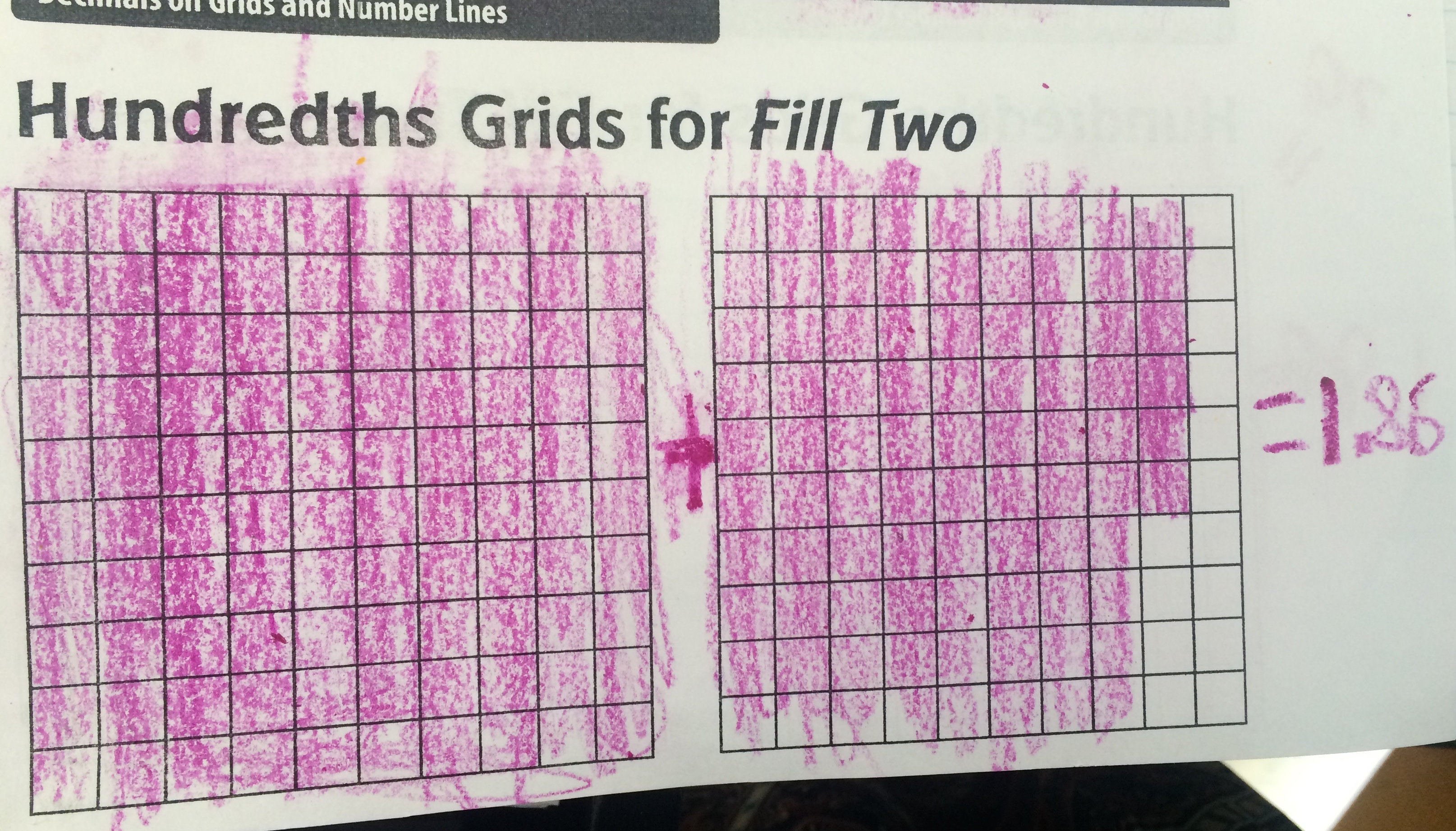
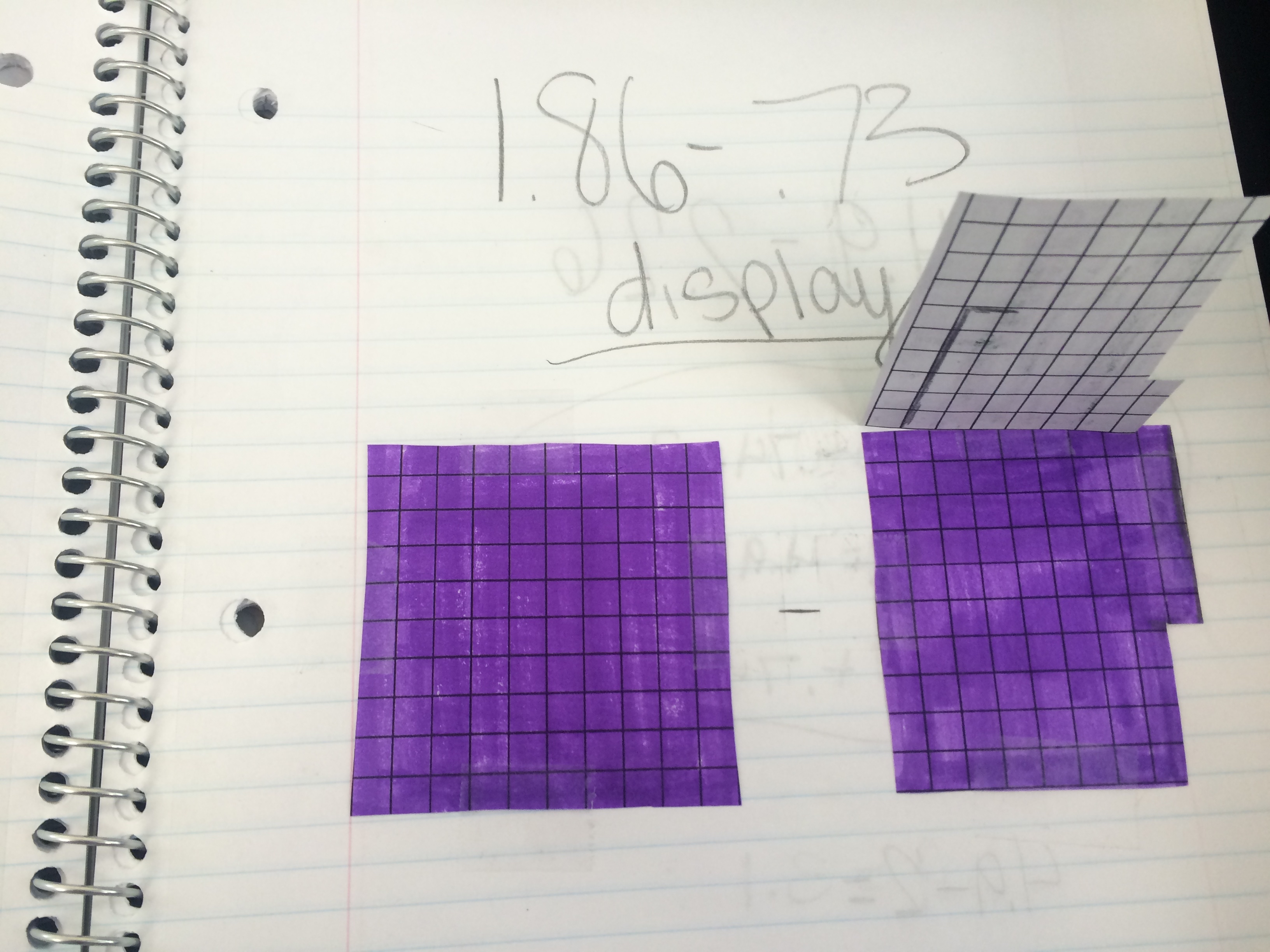
IMG_9607_2IMG_9605I had a few who finished fairly quickly, so I gave them the problem 0.8 + 0.75 + 0.625, and then they started getting creative! This is one answer that was so interesting and will be the way I kick off my class tomorrow. His reference to columns and boxes are the hundredths grids we used for the Fill Two game.

IMG_9606Today was a day that really showed me how hard it is to understand student thinking and how important it is to push students to explain their understanding in more than one way. I could have very easily assumed that every student could add decimals by place value because they lined them up and added to get a correct answer.  However, if not given the opportunity to show another way to think about the problem, how would I truly know? I still have a few students who are getting the correct answer but are not able to articulate their process, so I am going to do a lot more estimating to get them thinking about the numbers before the operation. Going to be a fun day in math tomorrow!

-Kristin
#PiDay2015…Circle Fun

Some of my students this year were excited to “celebrate” pi day and were very disappointed that it fell on a Saturday, so we decided to have some pi fun on Pi Day Eve. I am not one for “gimmicky” holiday lessons and wanted whatever I decided to do, to not just be definitions of circles and their properties or a formula for how to use pi to find measurements, but instead an activity that allowed students to discover all of the cool things about circles and patterns that arise from that work.

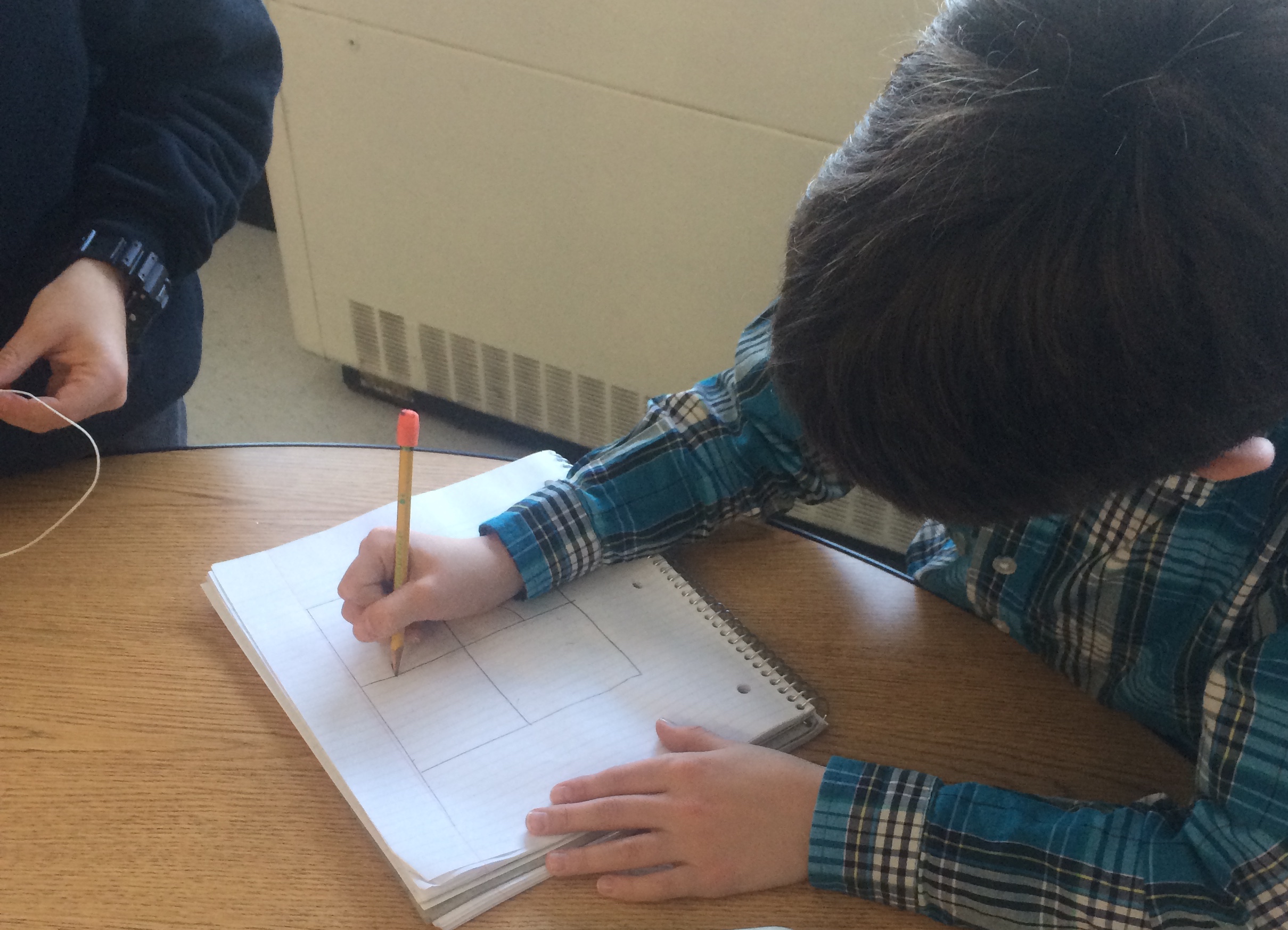
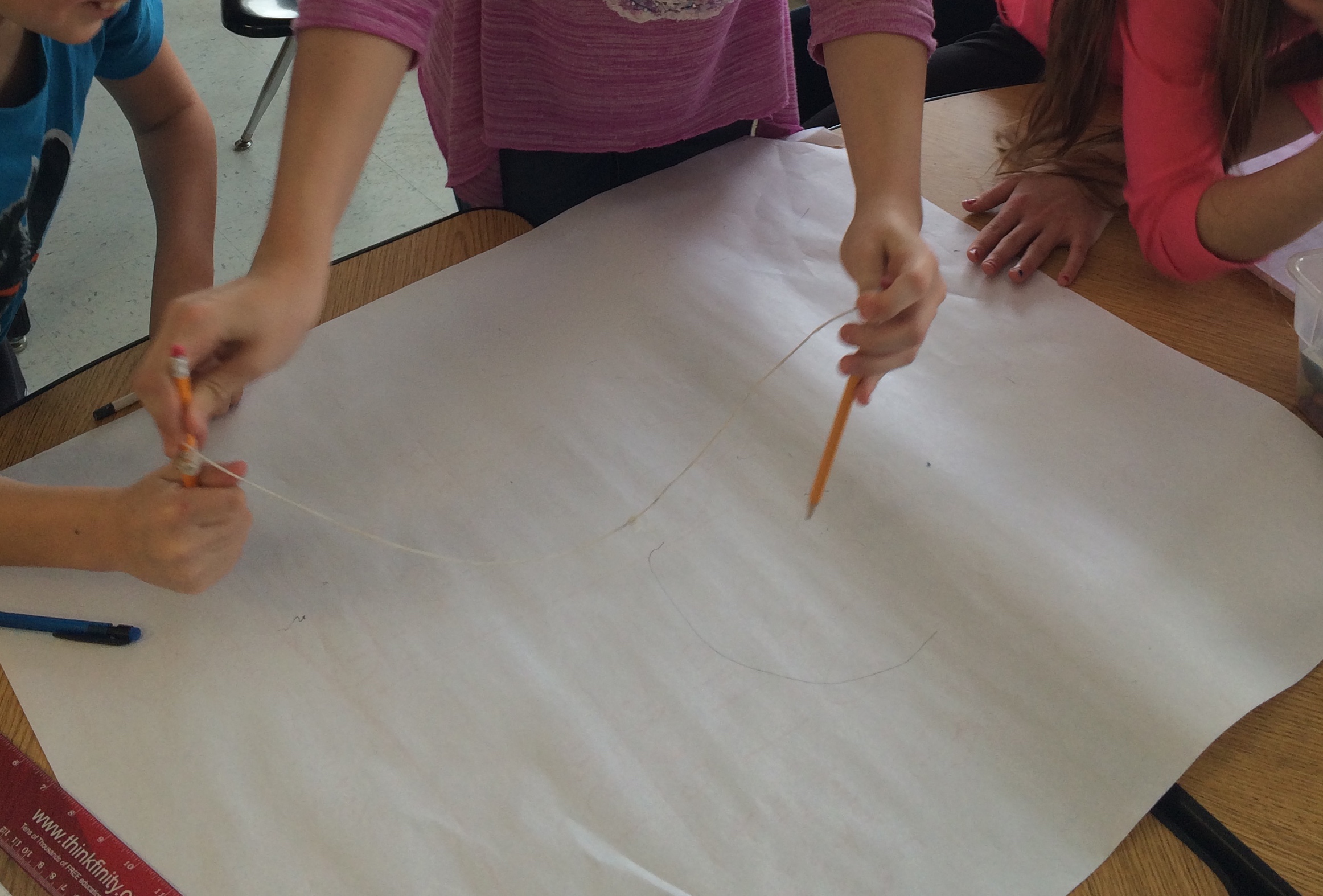
After brainstorming with a colleague, she suggested I just have the students try to create a prefect circle. Loved it. I put out tape, scissors, rulers, paper, string and told them if they thought of other tools they wanted to use, they had to pass my approval first (I wanted to keep the protractors and compasses out of the equation for right now). Off they went! It was soooo interesting to see all of the great approaches and all of the cool ideas that emerged from their work.

I found it so interesting that quite a few first drew a square and tried to find the center. They said they knew that the circle could be made inside of it because a circle is 360 degrees and each angle of the crossed lines was 90. The problem became figuring out how to get the “rounded edges to be the same.”

IMG_9519_2 IMG_9520_2

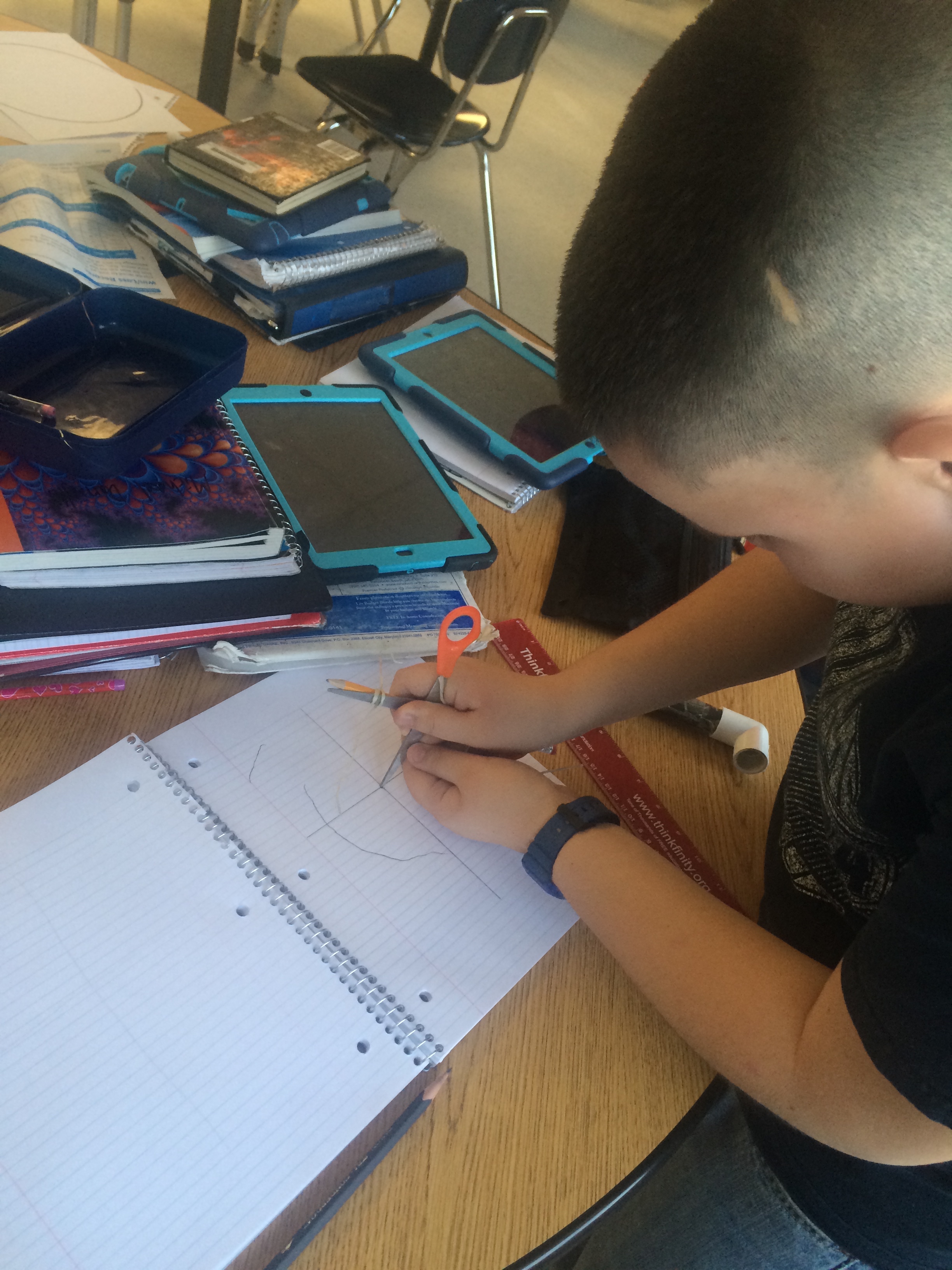
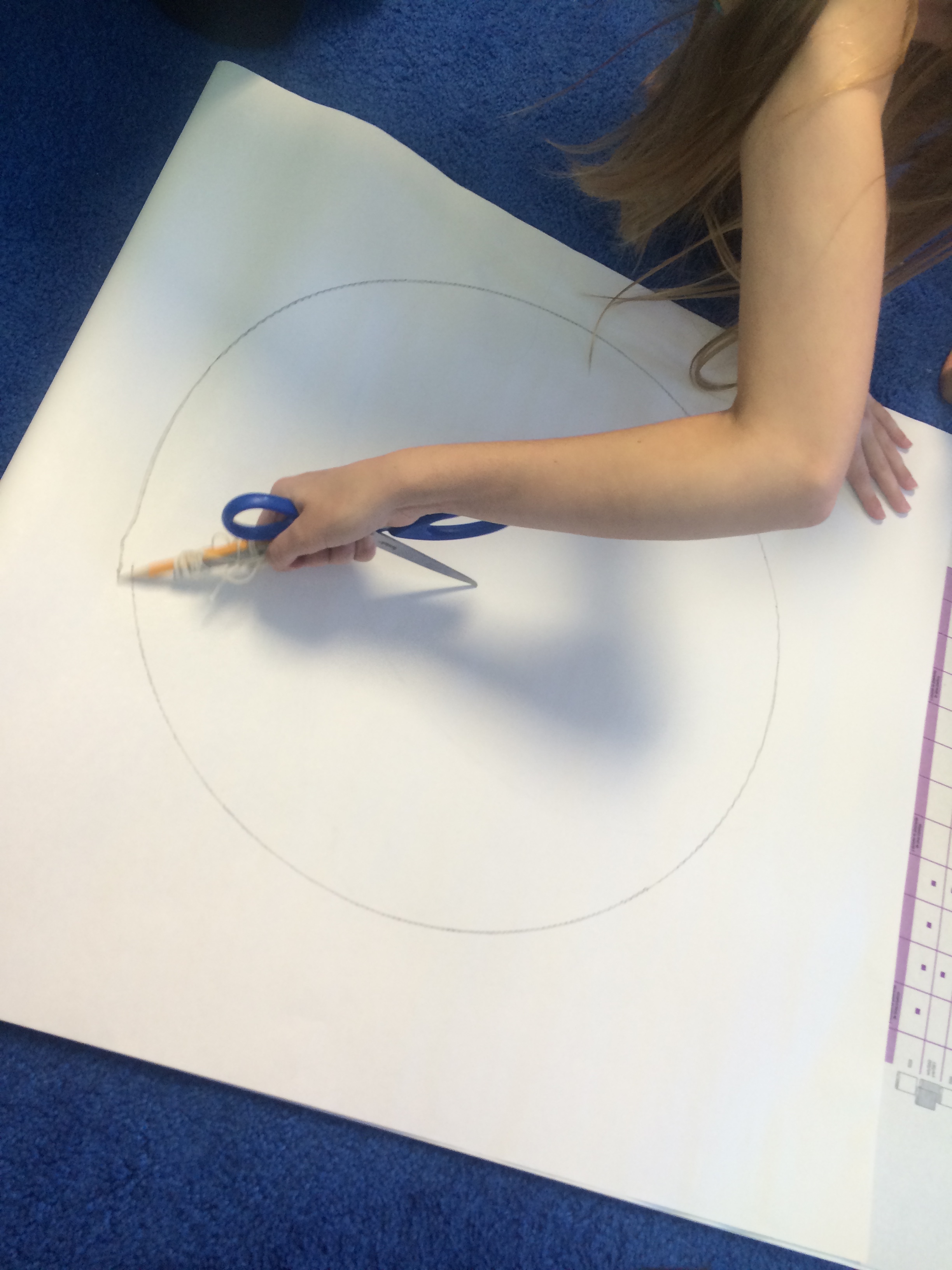
Quite a few groups had seen a compass before (but didn’t know what it was called) and tried to recreate one with the available tools. Some started from finding a center and going from there, while others created the center by just placing the scissors on the paper and going around from there. After many attempts, they were starting to realize how important keeping that constant distance in the scissor opening really was.

IMG_9528_2 IMG_9532_2

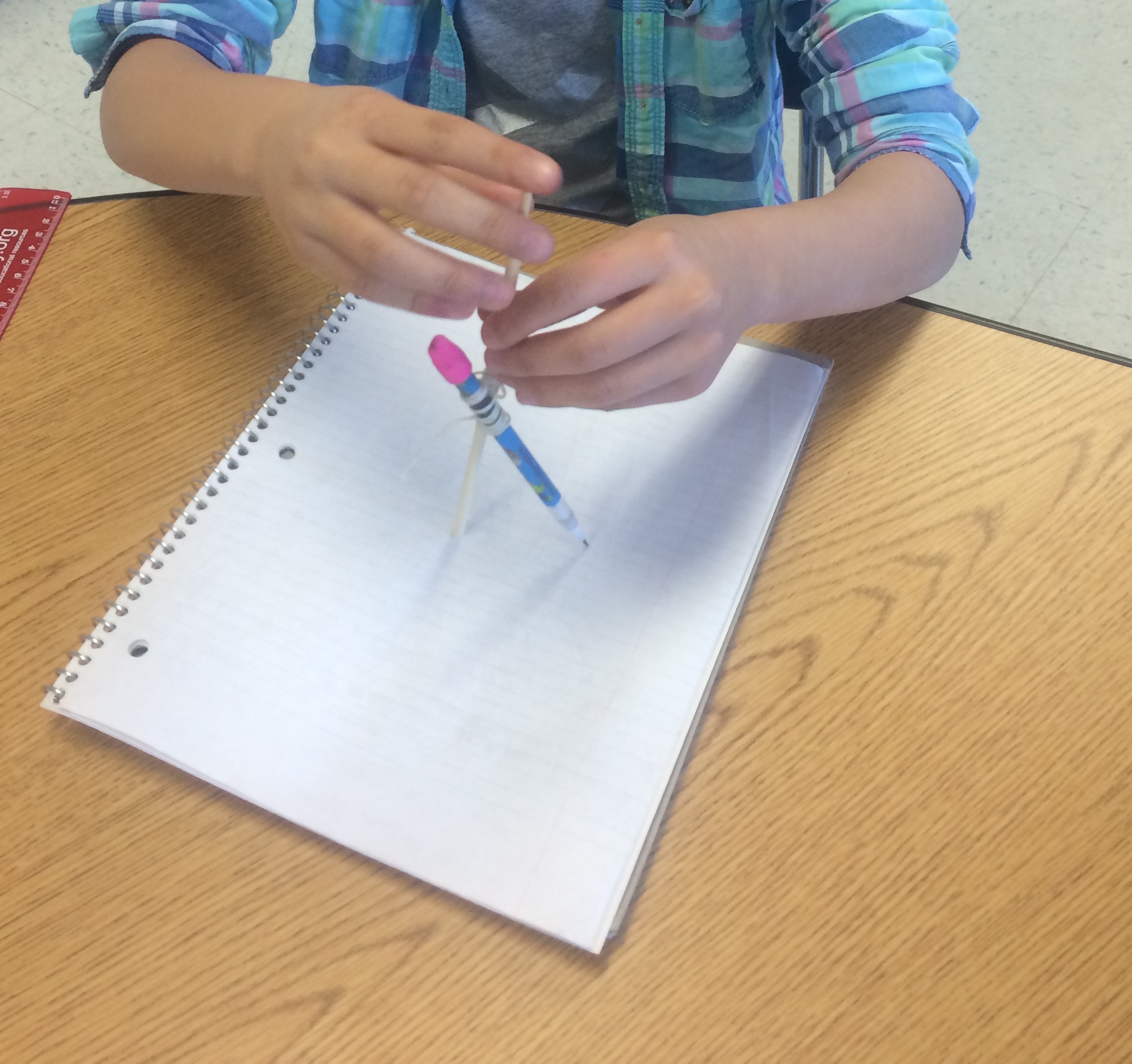
To solve the constant distance problem, one group used tape to keep it the same while another group used string (and chopsticks she just happened to have in her lunchbox that day:).

IMG_9582_2IMG_9517_2

This group solved the constant distance with two pencils attached with string. The funniest part of this one were the trials as the string kept wrapping around the center pencil as they went around and never meeting exactly back at the start. They eventually figured it out after blaming the “center holder” numerous time for “moving the pencil.” Another group kept a constant distance by taping their string to the center of their paper and putting a pencil on the other end.

IMG_9573_2IMG_9584_2

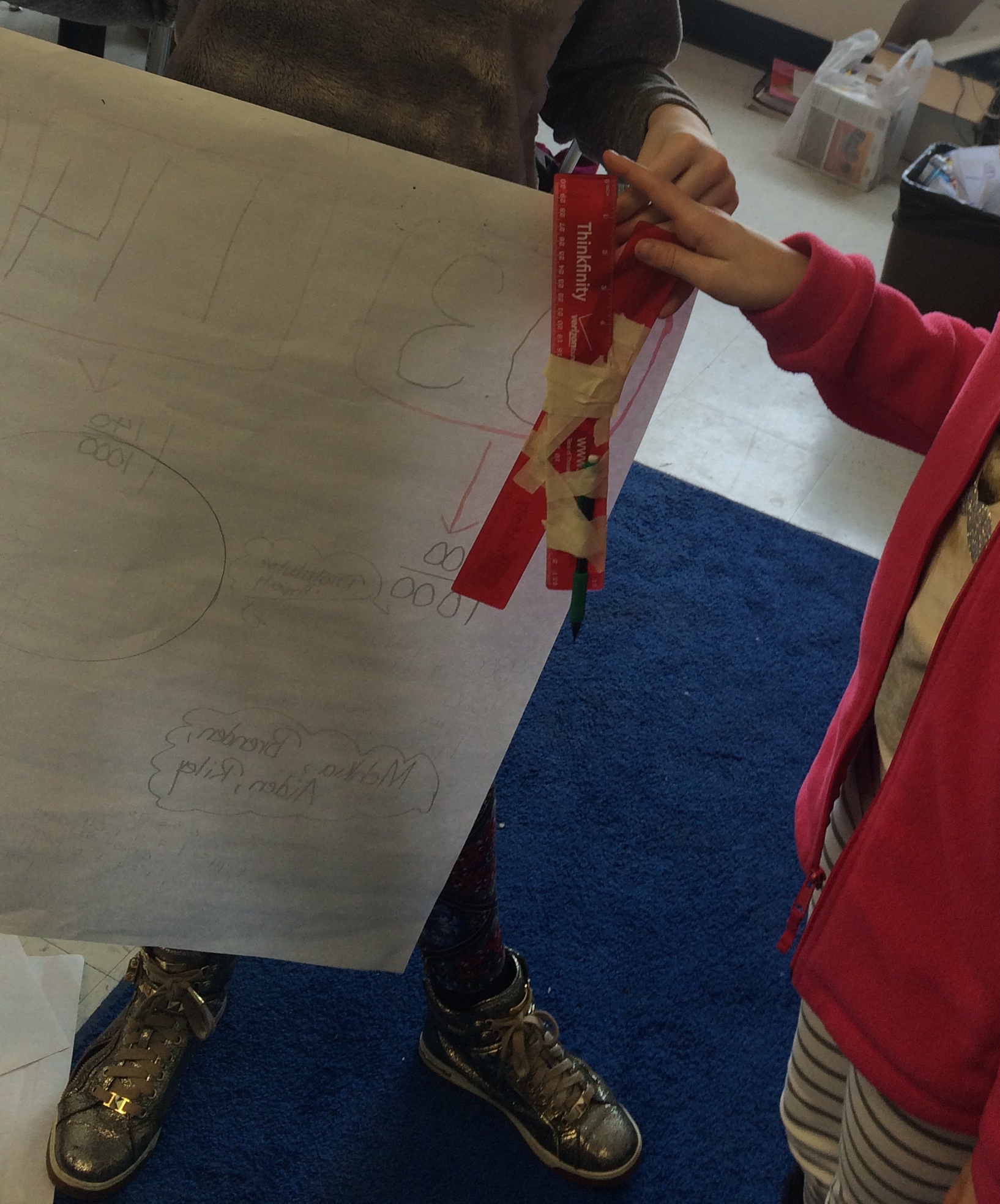
This group created a center from overlapping rulers and attempted to put string around the the ruler corners to make an arc, but couldn’t agree with how to get them all the same. While another group tried to use the ruler ends as the center but ran into the same problem with the rounded edges.

IMG_9570_2IMG_9574_2

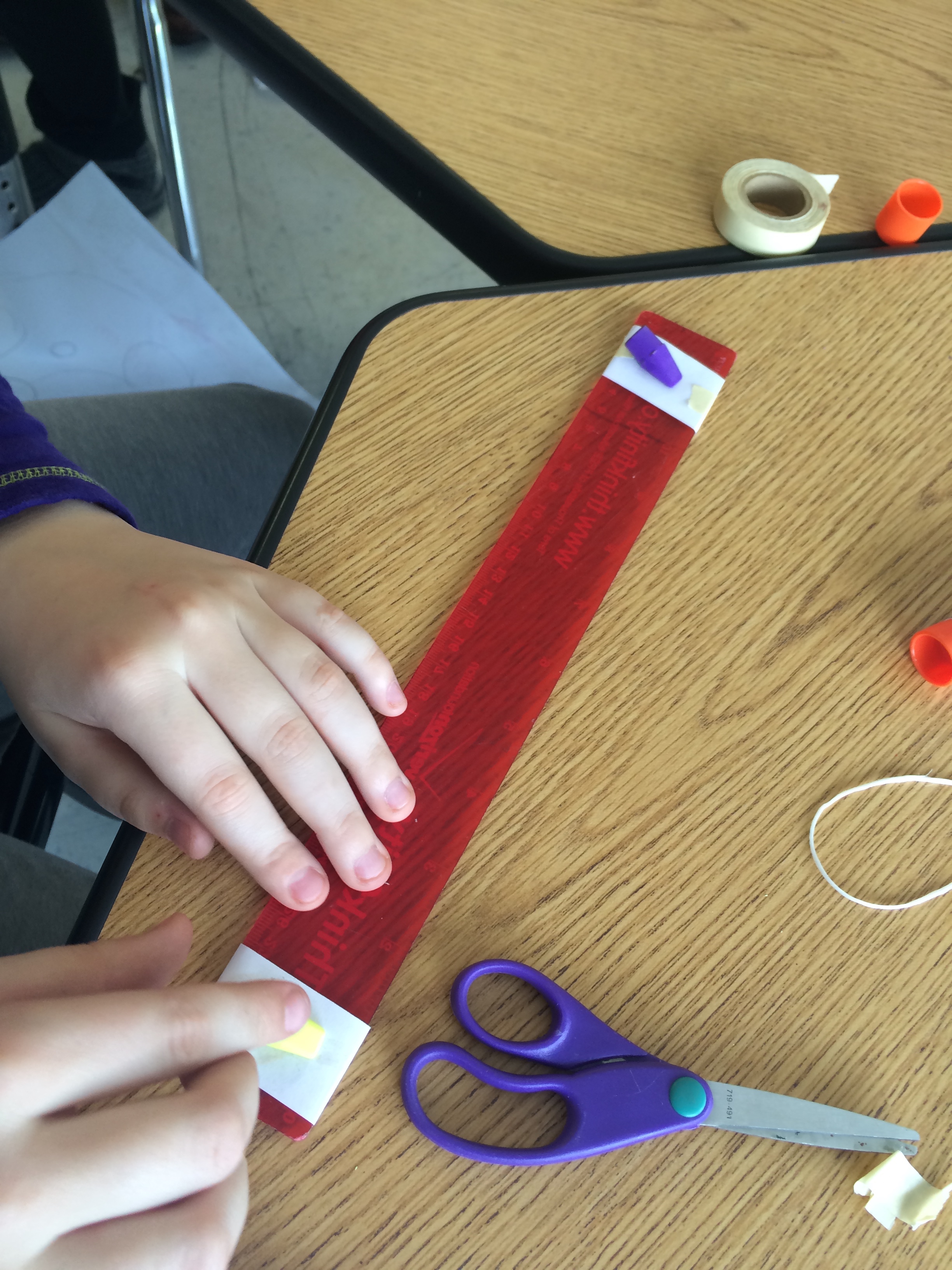
This idea was interesting to watch evolve. She had seen the group on the floor (in the pic above) and said she realized that any rectangle rotated would make a circle. She then grabbed a ruler, taped two cap erasers to each end and thought the caps would leave eraser marks she could go back and trace after rotating the ruler. That didn’t work, no marks. She then cut her pencil to get some lead and taped that to one end.

IMG_9580_2 IMG_9581_2

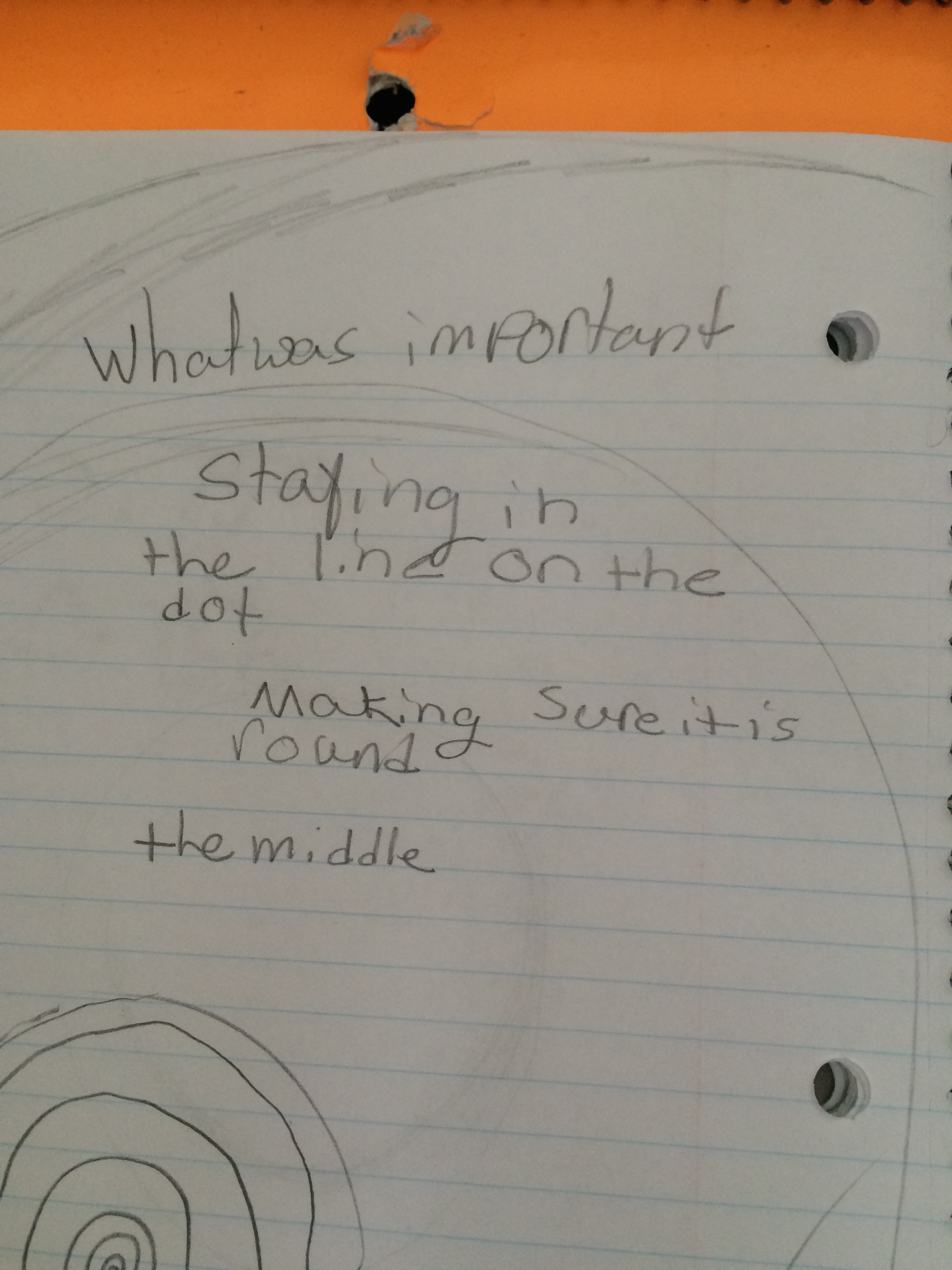
The final product…..IMG_9586_2 After sharing their circles and approaches, I had the students jot down some things that were important when constructing their circles.

IMG_9588 IMG_9589 IMG_9565_2 IMG_9569_2IMG_9590

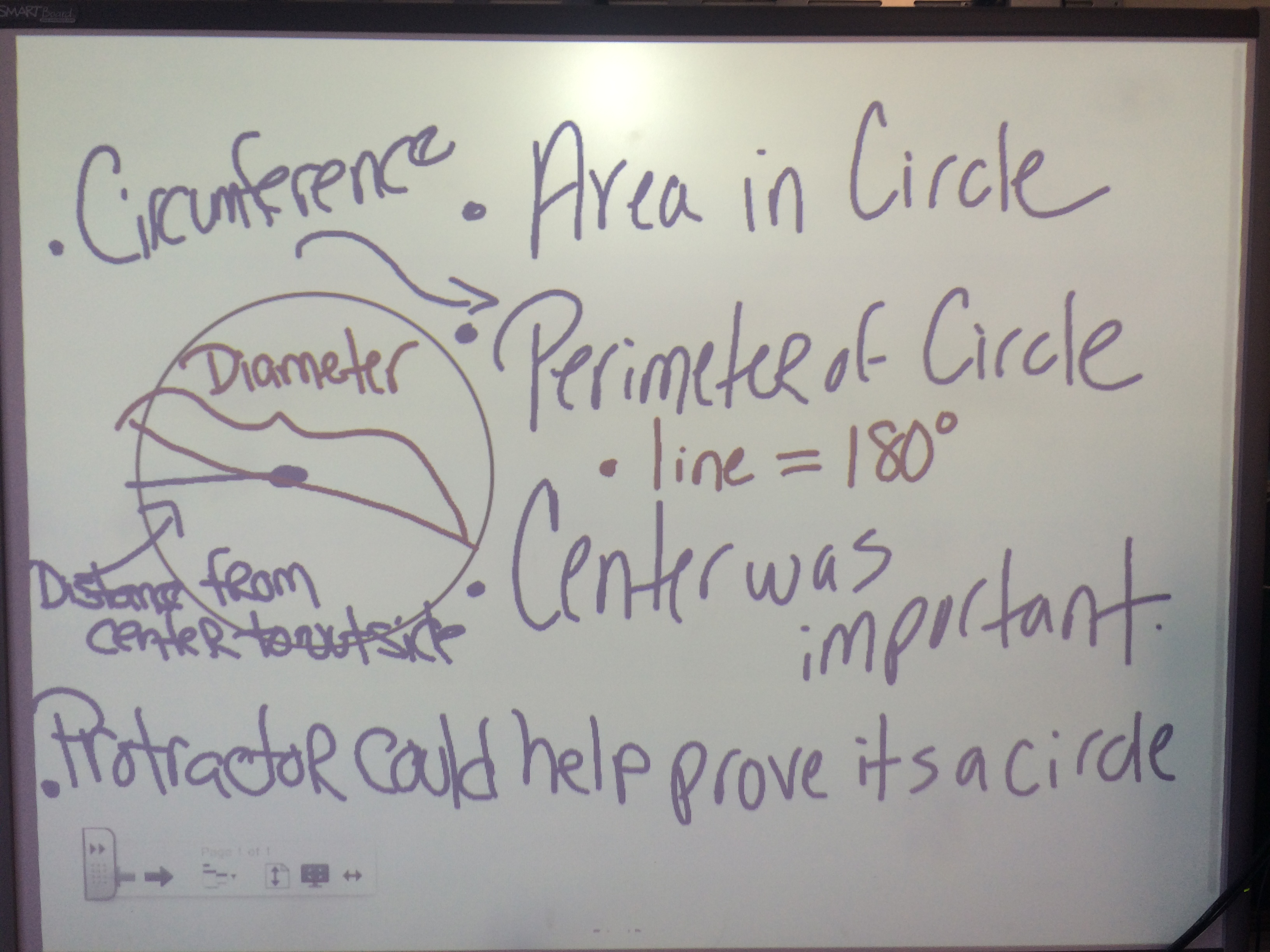
From these, I realized (and was surprised) the students have some circle vocabulary in their toolbox. I decided to get that out so we could be sure everyone in the class had exposure to all of this great stuff. I asked them to share their findings and what measurements they used or could find in their circle.

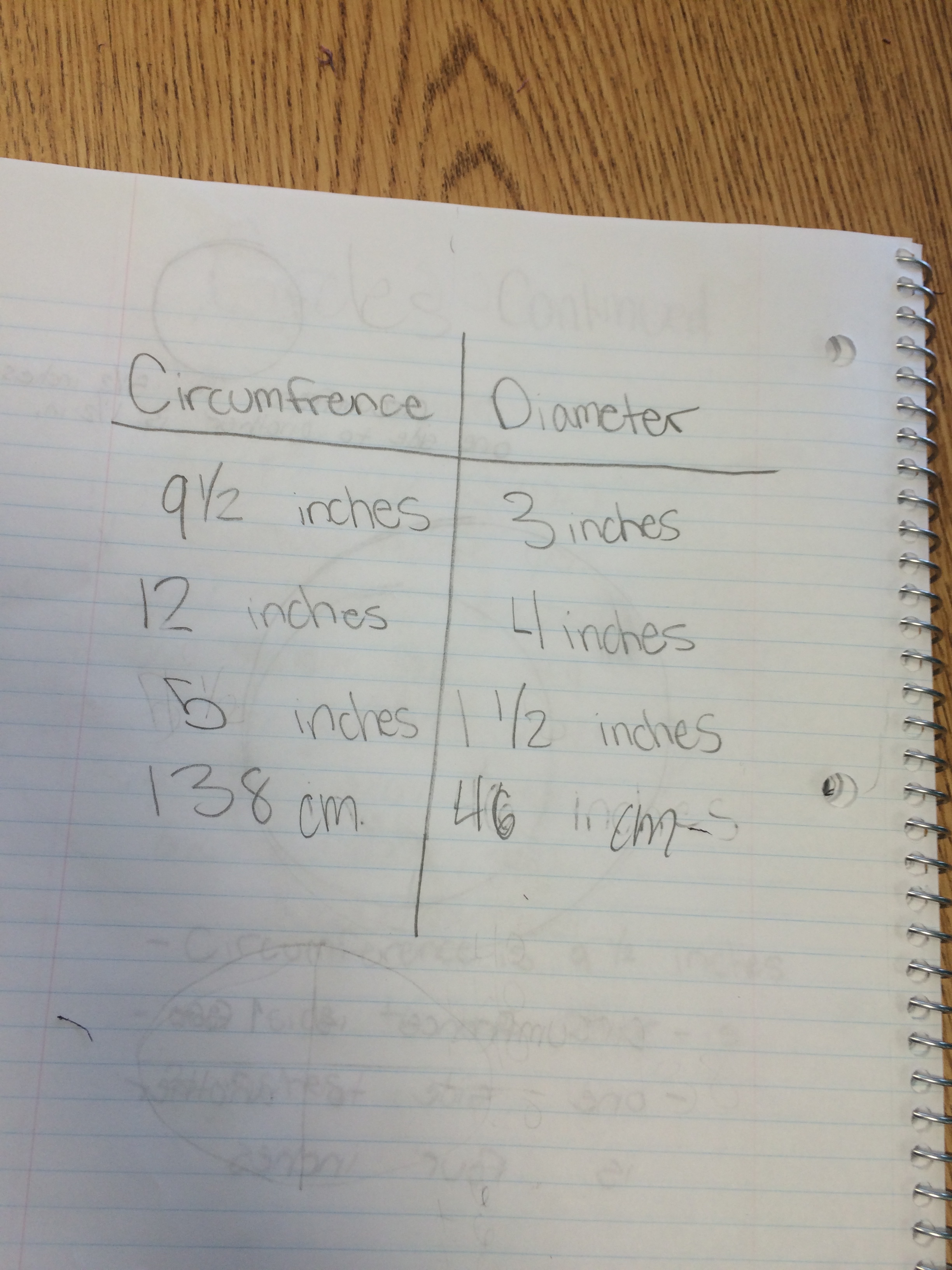
IMG_9535_2One group had finished their circle early, so I asked them to find some of these measurements. They found the diameter and circumference with the ruler and string they had used in the construction. It was so interesting to see the intuition students have around finding the diameter. They knew it had to go through the center and that no matter where they measured from, it would be the same. It makes me wonder why we, as teachers, sometimes think that we need to give students definitions for things before they get to demonstrate their intuition around these very ideas. I could have told them “diameter is distance across the circle through the center” before the lesson started, but they already knew that, love it.

After testing a few circles, this group started to see pi emerge…

IMG_9563_2 IMG_9564_2 IMG_9562_2For the the last circle in this list, they measured the diameter of their large circle they created and I asked them to estimate the circumference. After seeing that each circumference was “about 3 times as much,” they estimated 46 x 3 to be circumference. They haven’t had a chance to test it on the actual circle yet because we ran out of time, but that will be some fun on Monday!

Happy Pi Day 2015!

-Kristin
Adding Decimals to the Thousandths

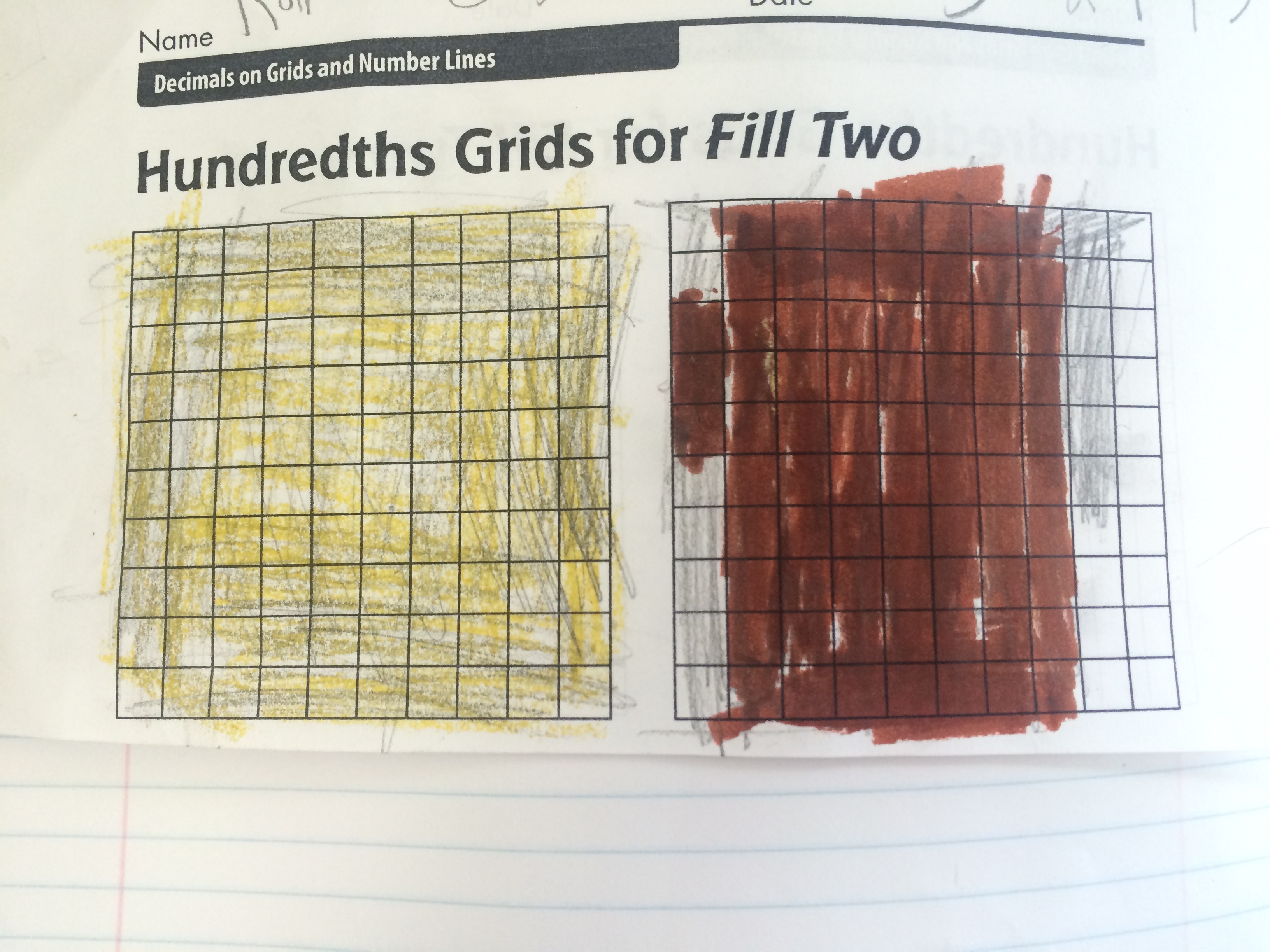
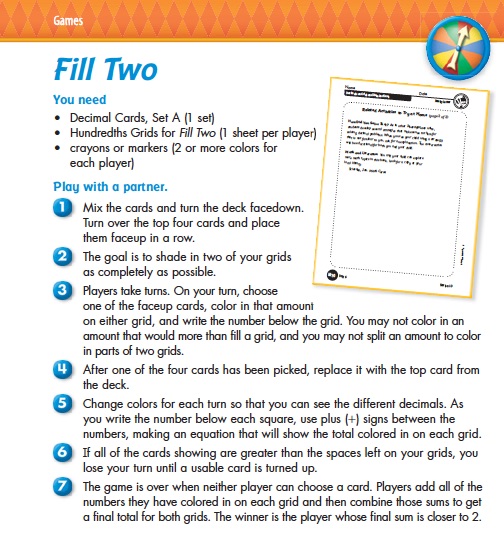
Yesterday, the students played a game called Fill 2 (shown below). Building on that game, today the students worked on their first task involving addition of decimals to the thousandths.

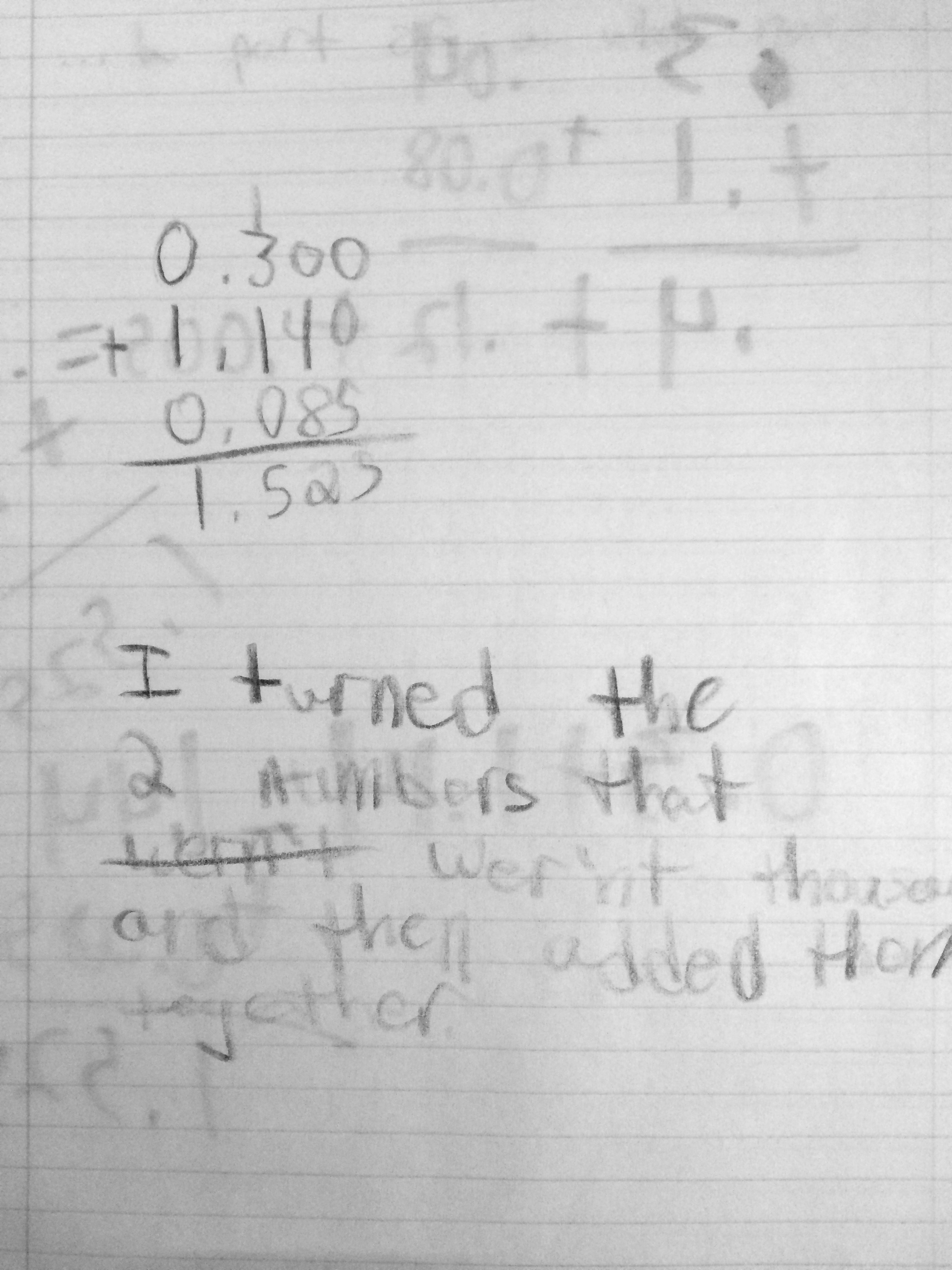
fill2The task involved a jeweler who, after making jewelry each day had pieces of gold leftover. One day she was left with 0.3 g, 1.14 g, 0.085 g and the students were asked how much gold she had left that day. I gave the students some individual time to come up with at least one way to solve this problem before they came together as a group. As always, it is so interesting that even in coming up with the same answer, there were such different approaches to the solution.

This student is interesting because she changed the decimals to thousandths in fraction notation. It definitely is her comfort zone and the conversation with her group when first comparing answers was great for them her to agree that it was equivalent to the decimal notation.

IMG_9506

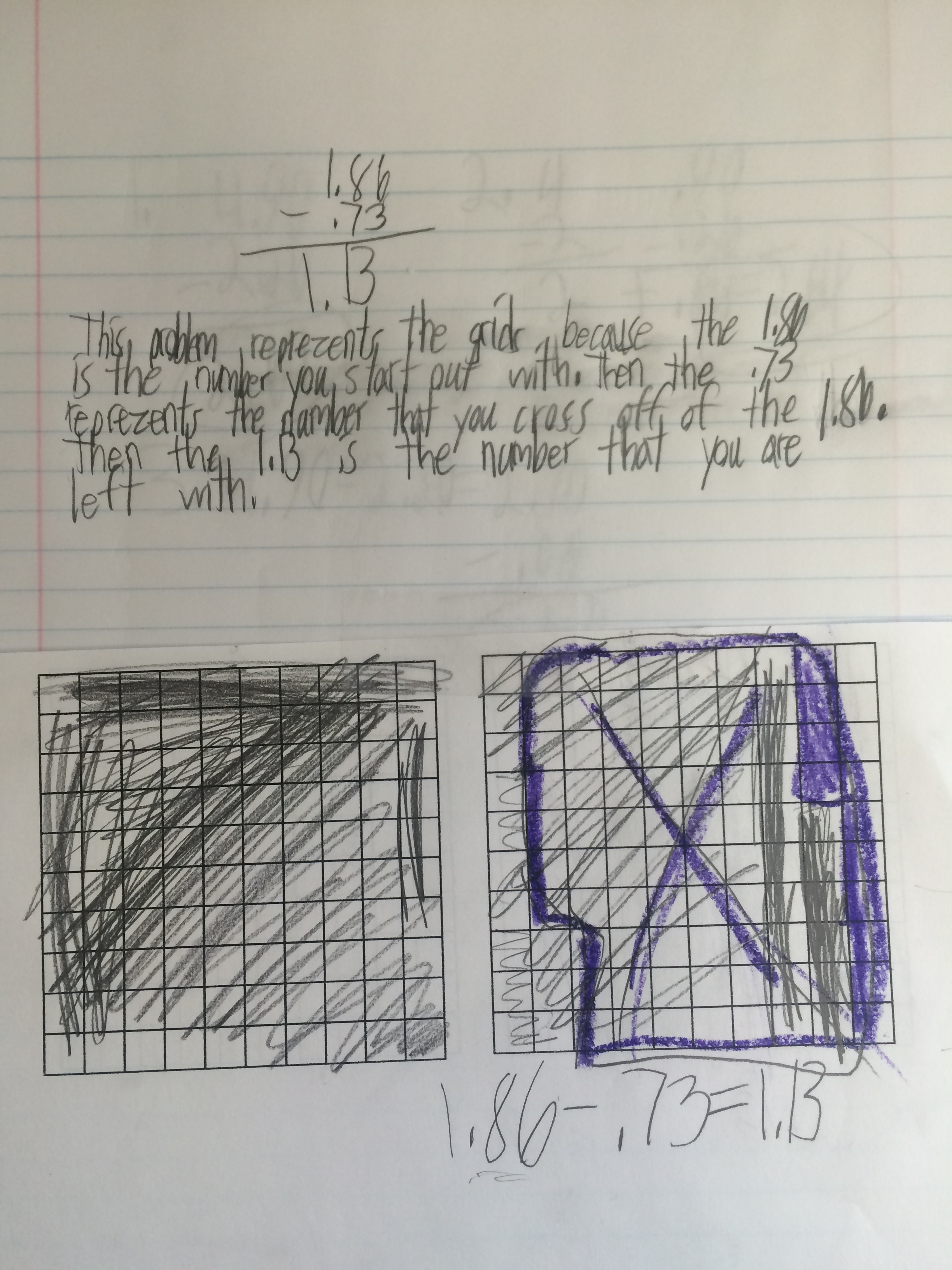
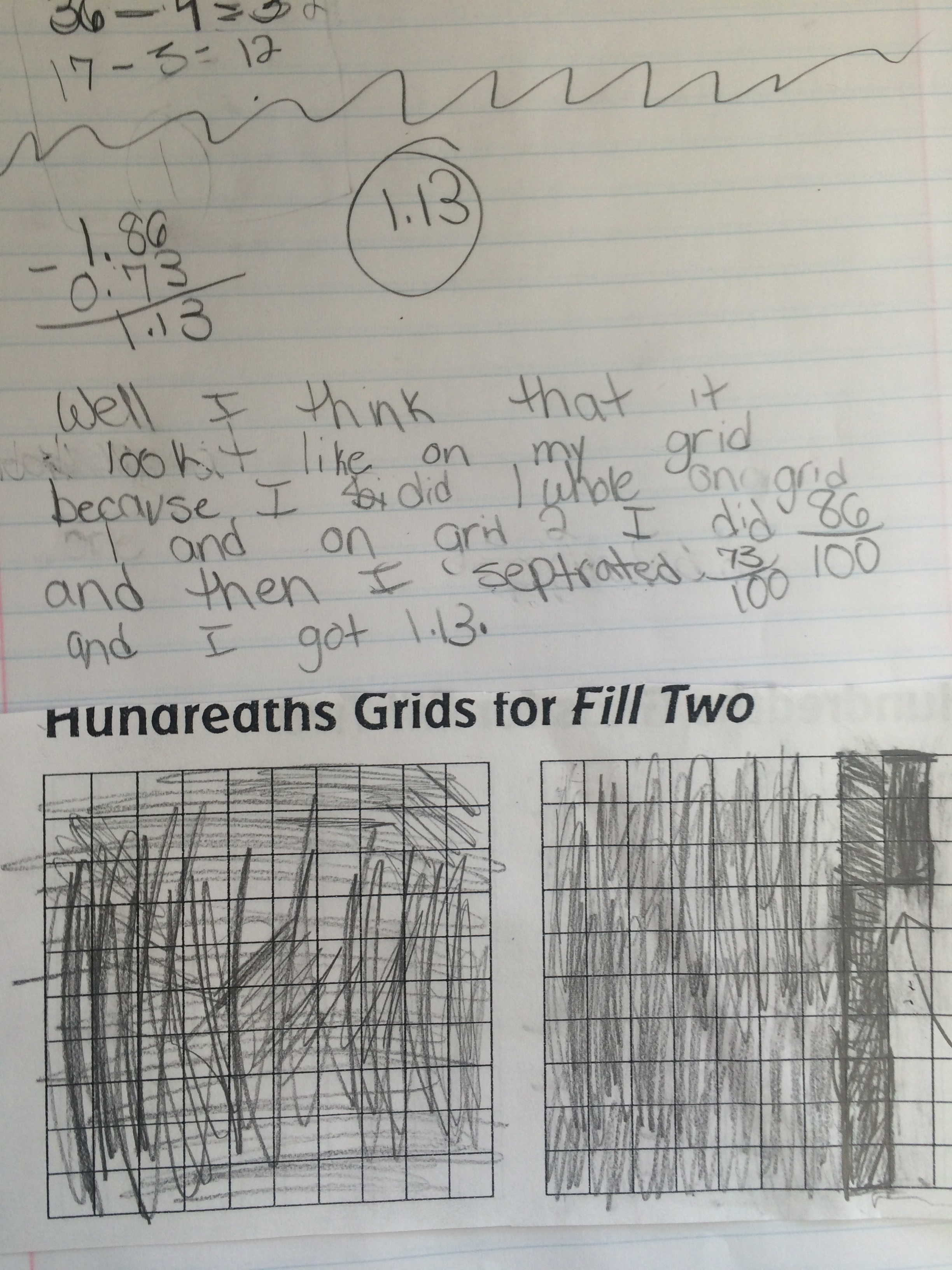
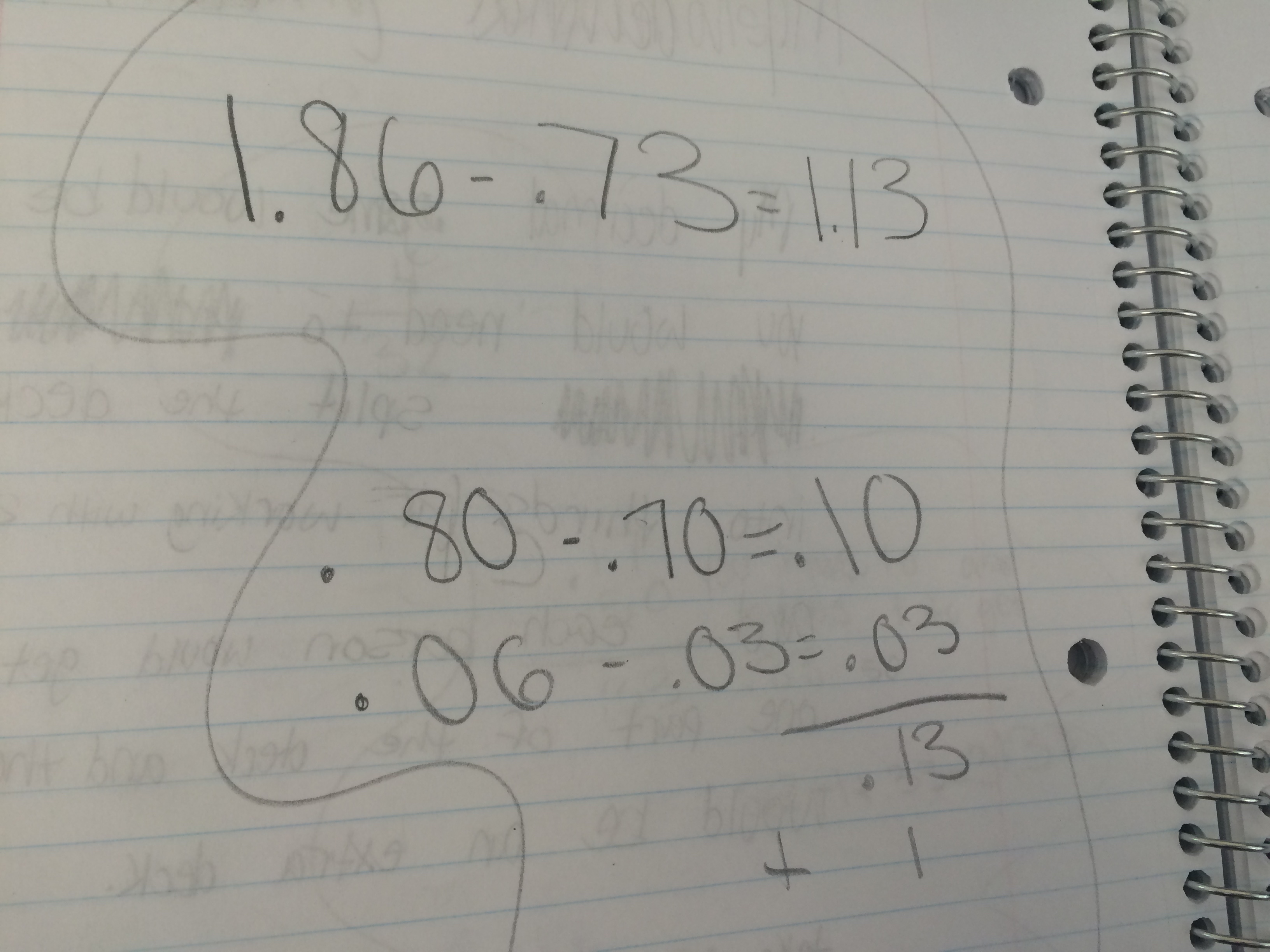
This is probably the most common approach I saw. This student put all of the decimals into thousandths and added. It was nice to see they combined the correct place values, however this is the reason I have them come together as a group. I cannot tell from this work if the student understands the combining of place values or just has learned a procedure for adding decimals (line up the decimals, put the zeros on, and add). I do, however like the written explanation of putting them into thousandths, which does indicate an understanding beyond “putting the zeros on” to add.

IMG_9510This student did a beautiful job of adding the decimals by place value and writing a description of the process. IMG_9509This one is lovely because of all of the messy work and “notes” to me:) When I walked up to her table, she was thinking about the first two decimals in terms of hundredths (in fraction form), but was struggling with the 0.085. She had written it as 85/1000 but then rounded it to 9 to add with the others, but was getting lost in the meaning of the numbers.  She couldn’t pull the numbers out of place value so well to operate with them and put them back in, but instead was struggling.  She was great in her fractions, but her notation then seemed to bounce between whole numbers and decimals. This felt like the SMP of being able to contextualize and decontextualize. I asked her to talk to me in terms of hundredths and she had no problem saying that it was 30, 14 (she had put the 1 aside) and then 8 1/2. She wasn’t comfortable putting that into fraction form, so she rounded it. After she said 8 1/2/ 100 to me, I asked her to work with that and left her to think. When I popped back into their group, she was sharing her 52 1/2 / 100 with the group and how she translated that into 1.525.

IMG_9508 The groups then came together, agreed upon an answer and then put their strategies on a chart. After each table had finished, I had them go around to each table and jot down any strategies their group had not come up with. Here are a couple of the posters:IMG_9495_2 IMG_9498_2Although the “American Algorithm” takes a lot of my attention here because I find it so cute, the bottom of the page is really an interesting visual of the students’ thinking. The decimal numbers are not in orderly rows which really shows that they were truly thinking about how many tenths, hundredths, and thousandths they had in each number. I think the arrow from the hundredths to the tenths shows nicely how ten hundredths make a tenth. The best part of this was the connection to the algorithm above. It clearly shows why there are two hundredths and 5 tenths.

IMG_9497_2Starting some decimal addition number talks tomorrow, excited!

-Kristin
Fraction to Decimal Division Table Yr 2

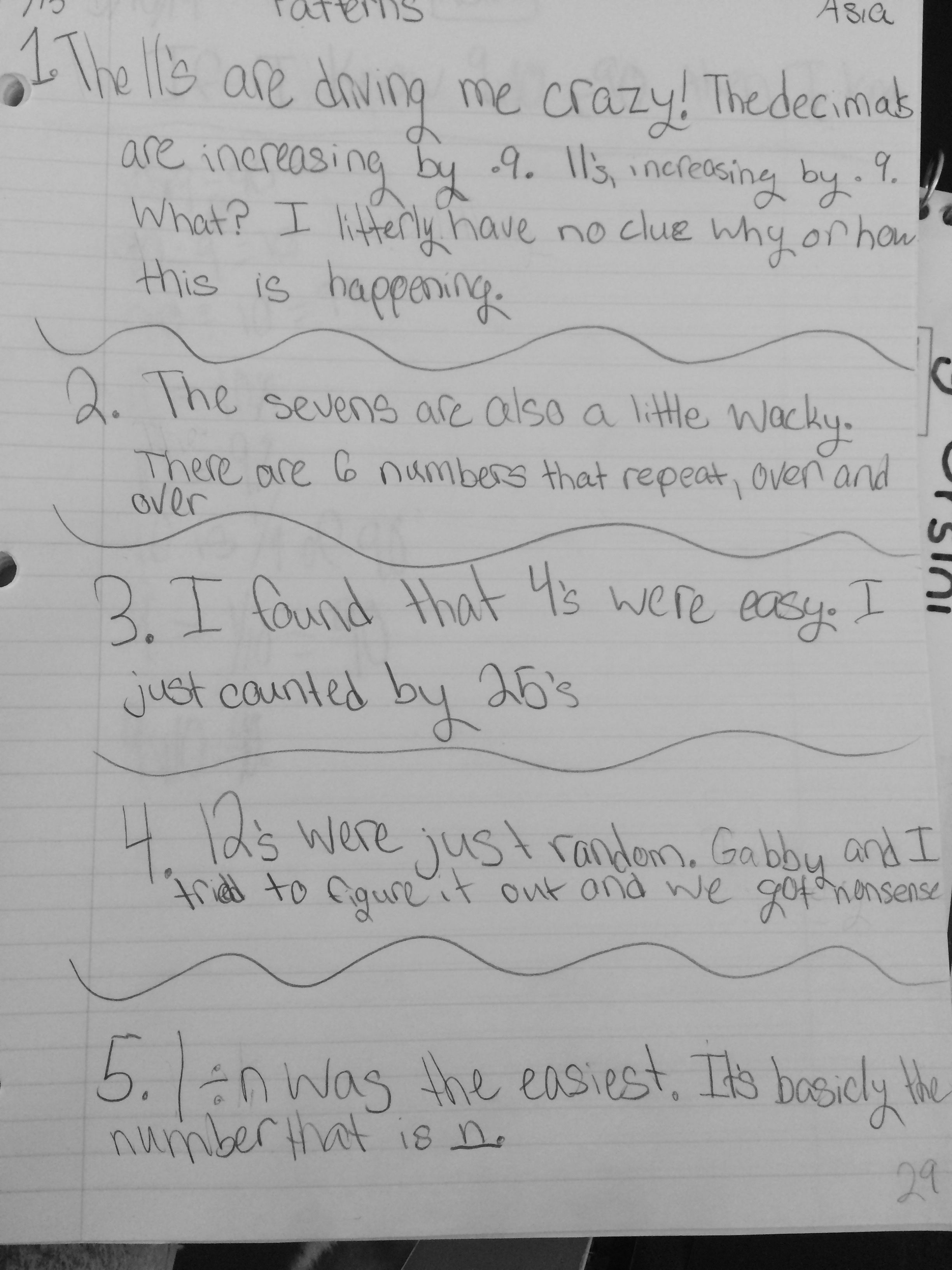
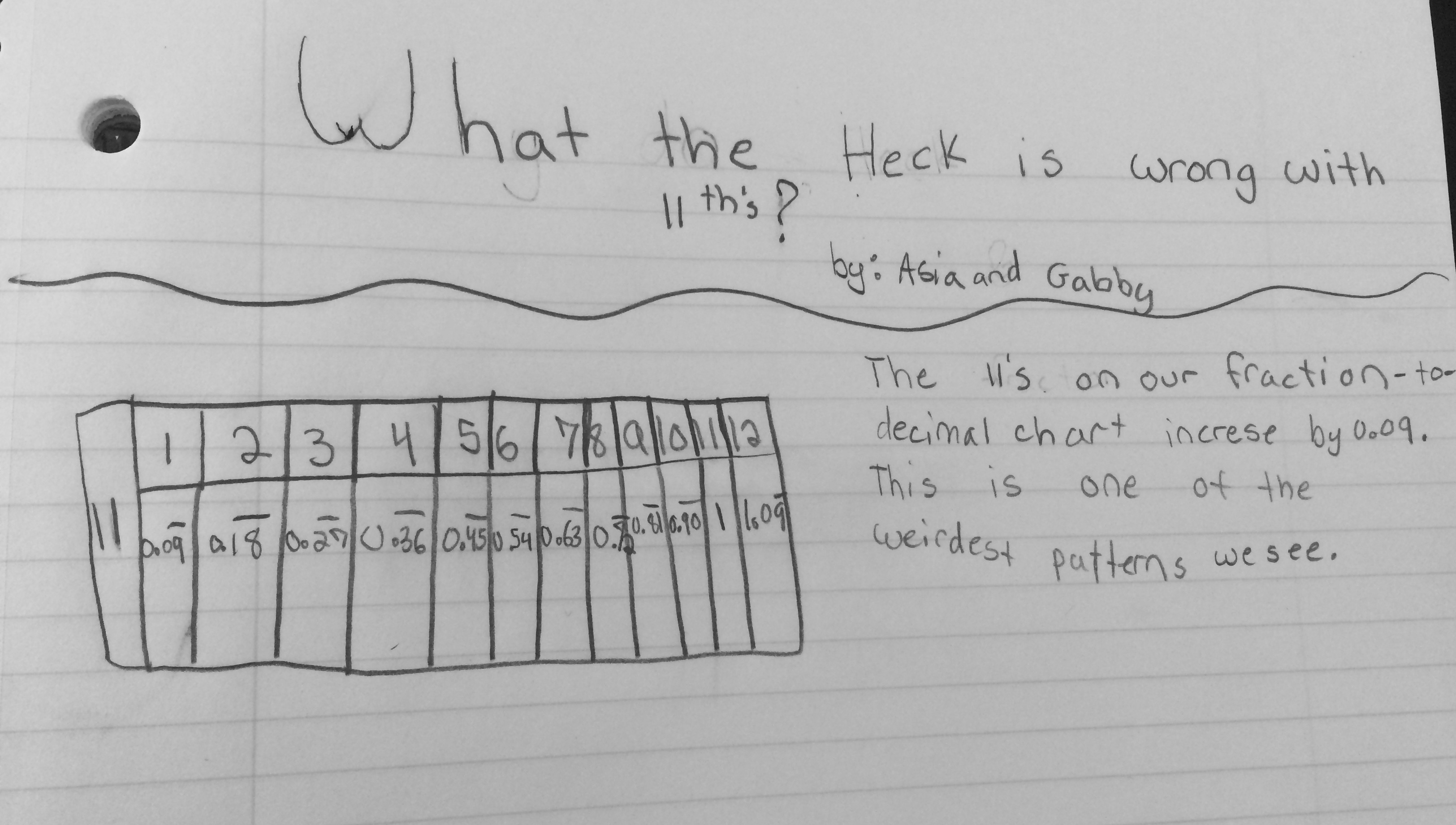
After this lesson from last year: https://mathmindsblog.wordpress.com/2014/03/18/fraction-to-decimal-division-table-noticings/ a lot of the same patterns emerged from the students. There is, however, one fraction that still drives them crazy…the 11ths.

Here it is showing up on two of the students’ papers…you can tell the 11ths are a thorn in their side!

IMG_9503 IMG_9504

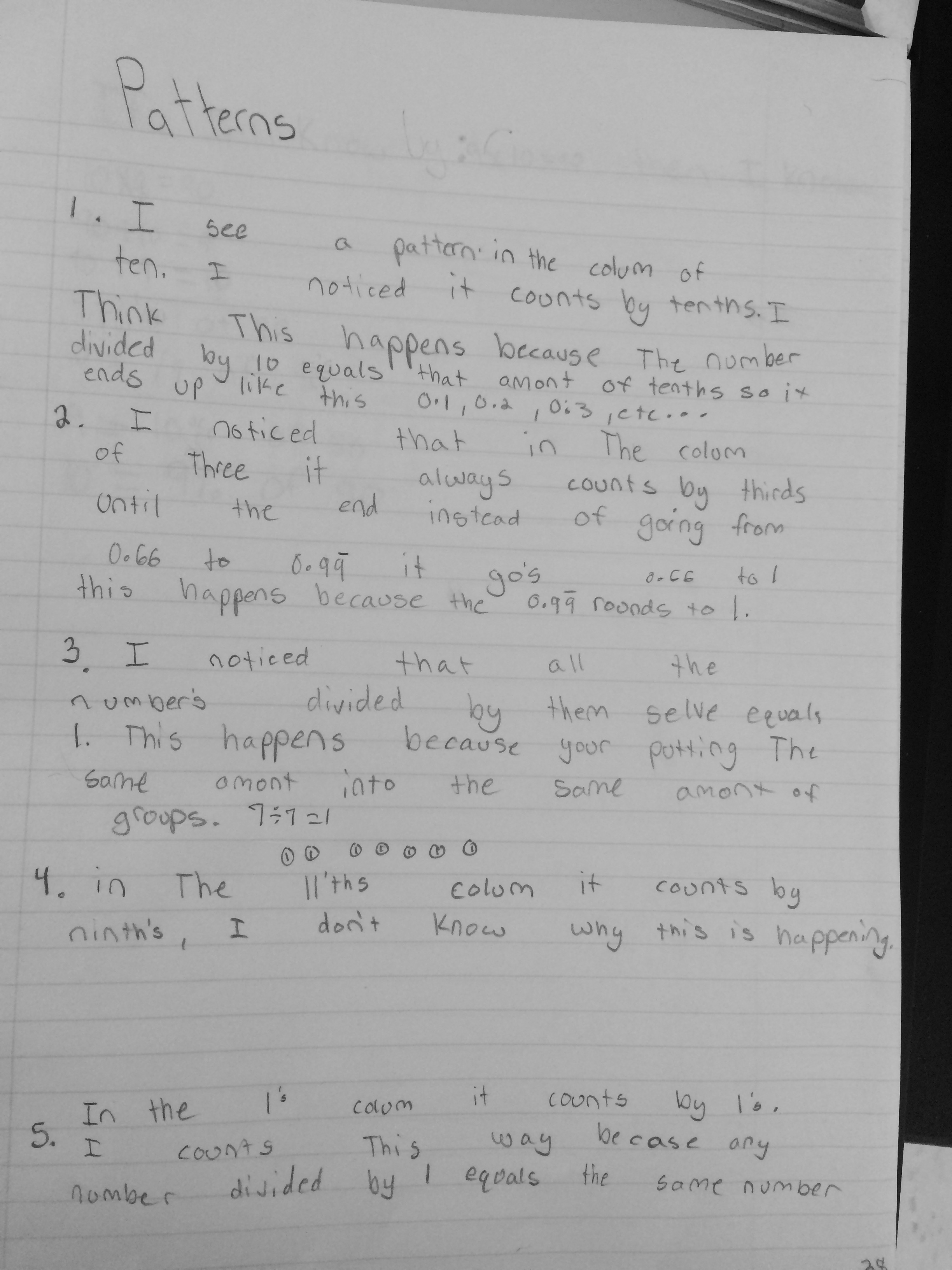
The best part of this lesson was the work I found after the lesson was over. They were working on it any free moment they could find in the day! This has become a genuine curiosity for them and I love it! They are still working, but I could not help but laugh at the heading of their work:

IMG_9505

I will keep you posted on their findings….

-Kristin
Fractions as Division…Say What?

Last year I learned to appreciate the Investigations lesson in which students explore fractions as division in a Division Table: https://mathmindsblog.wordpress.com/2014/03/18/fraction-to-decimal-division-table-noticings/. However, as I was planning this year, I thought I really missed the mark in making it an explicit understanding that fractions represent division before exploring this table. I think I completely just assumed that students understood this from previous years and investigations with sharing situations involving fractional answers. I decided to check it out this year to see what they students knew/understood before beginning the division table work. I thought it could make some really nice connections evident.

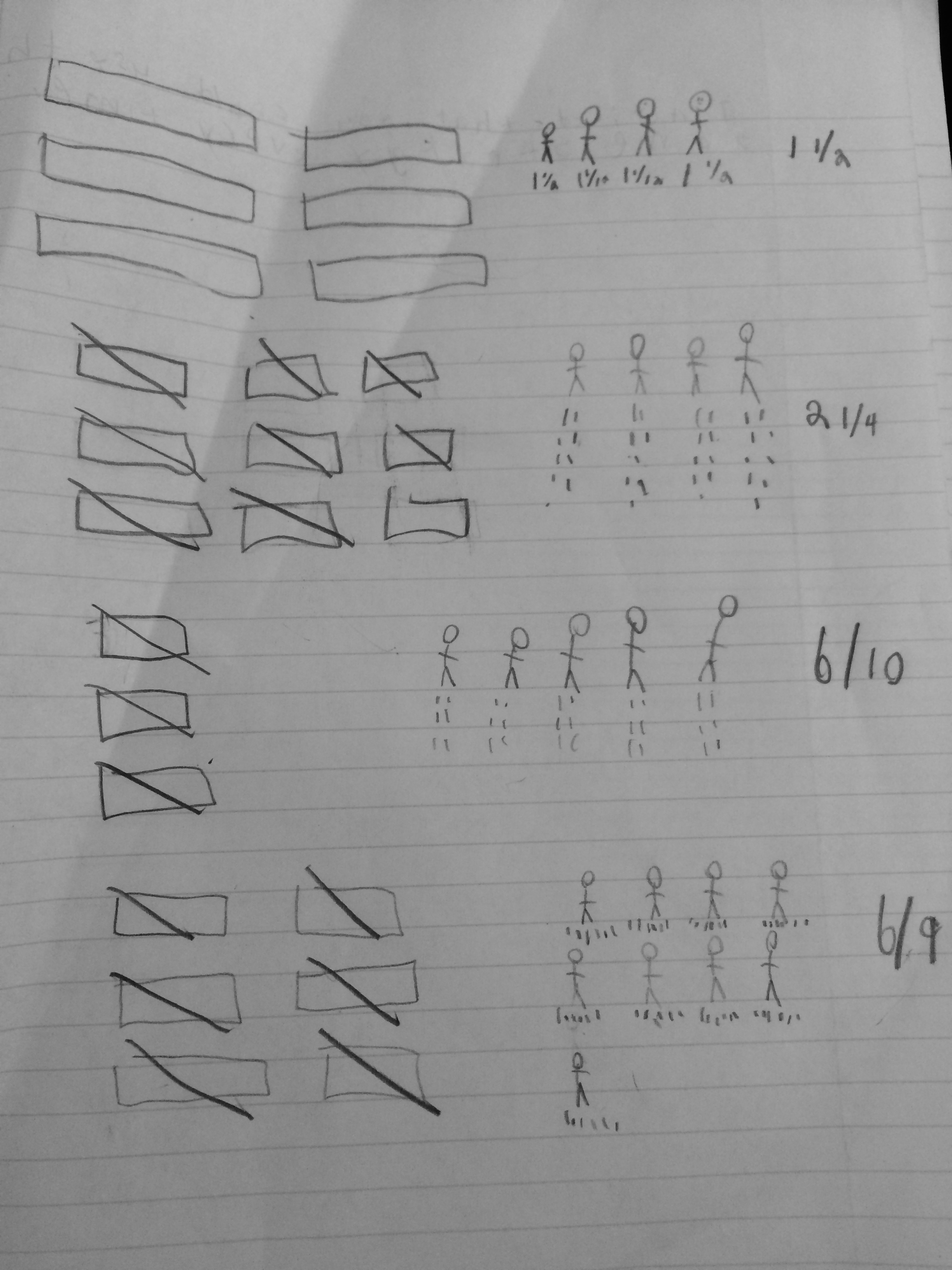
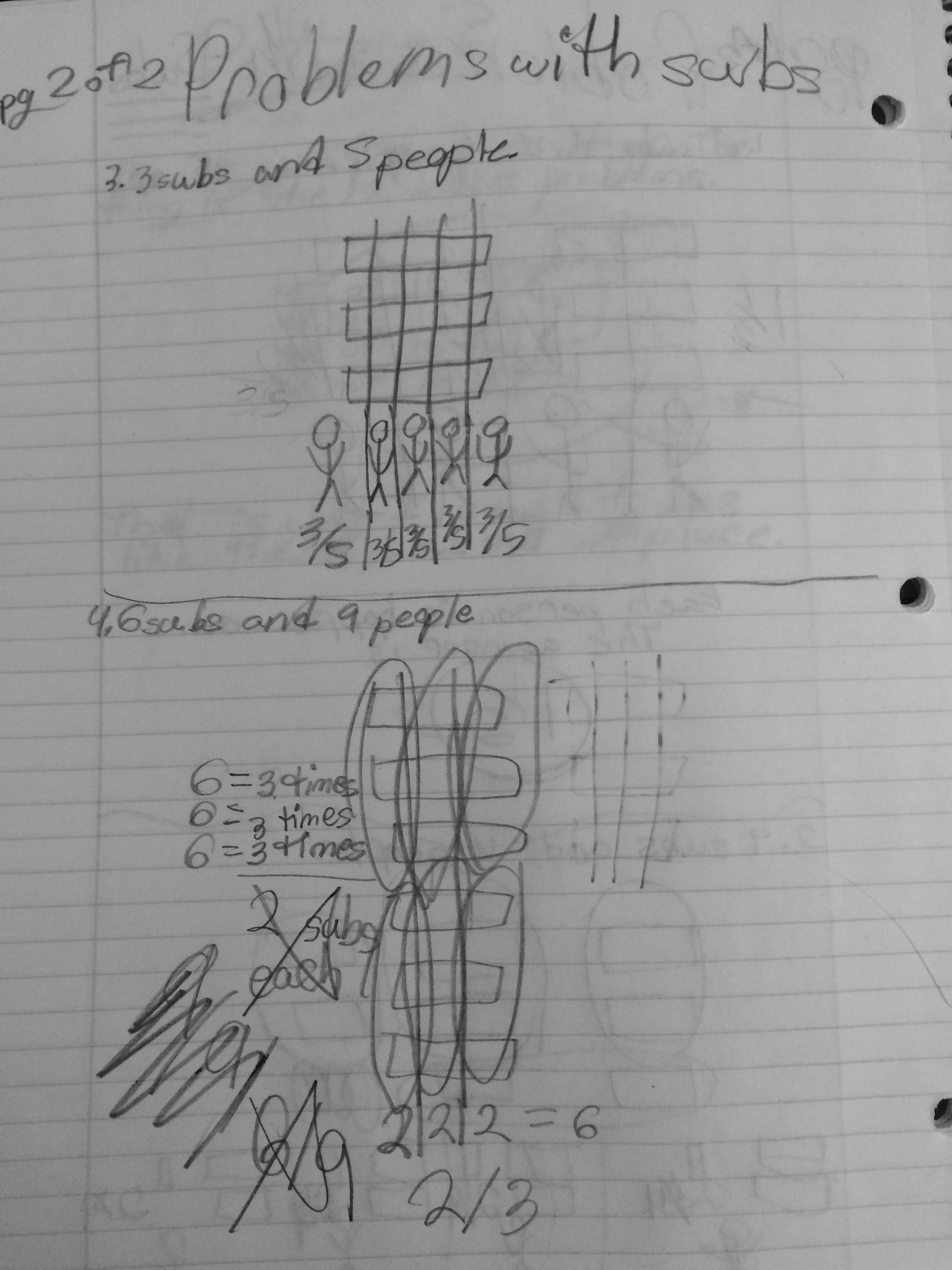
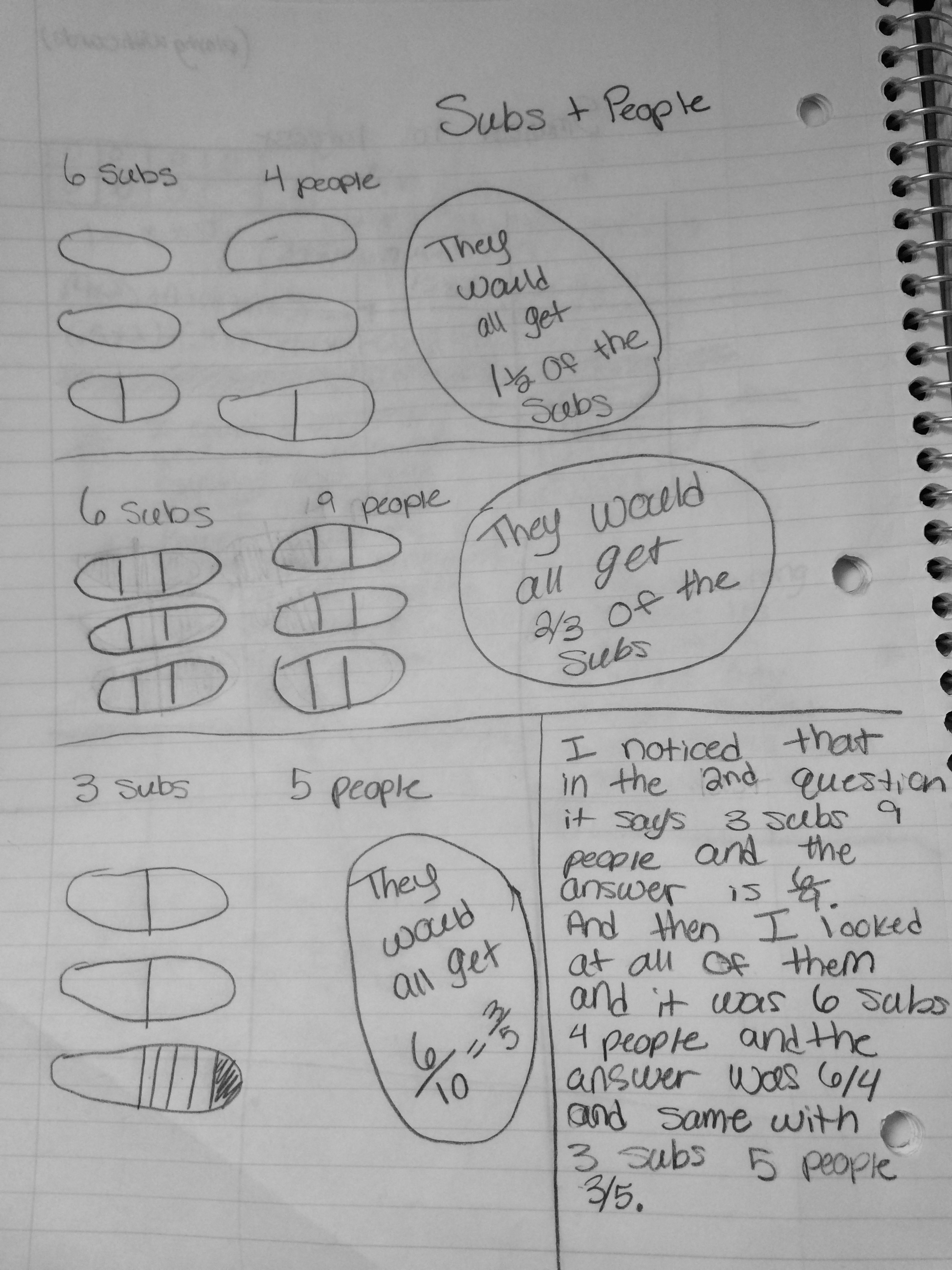
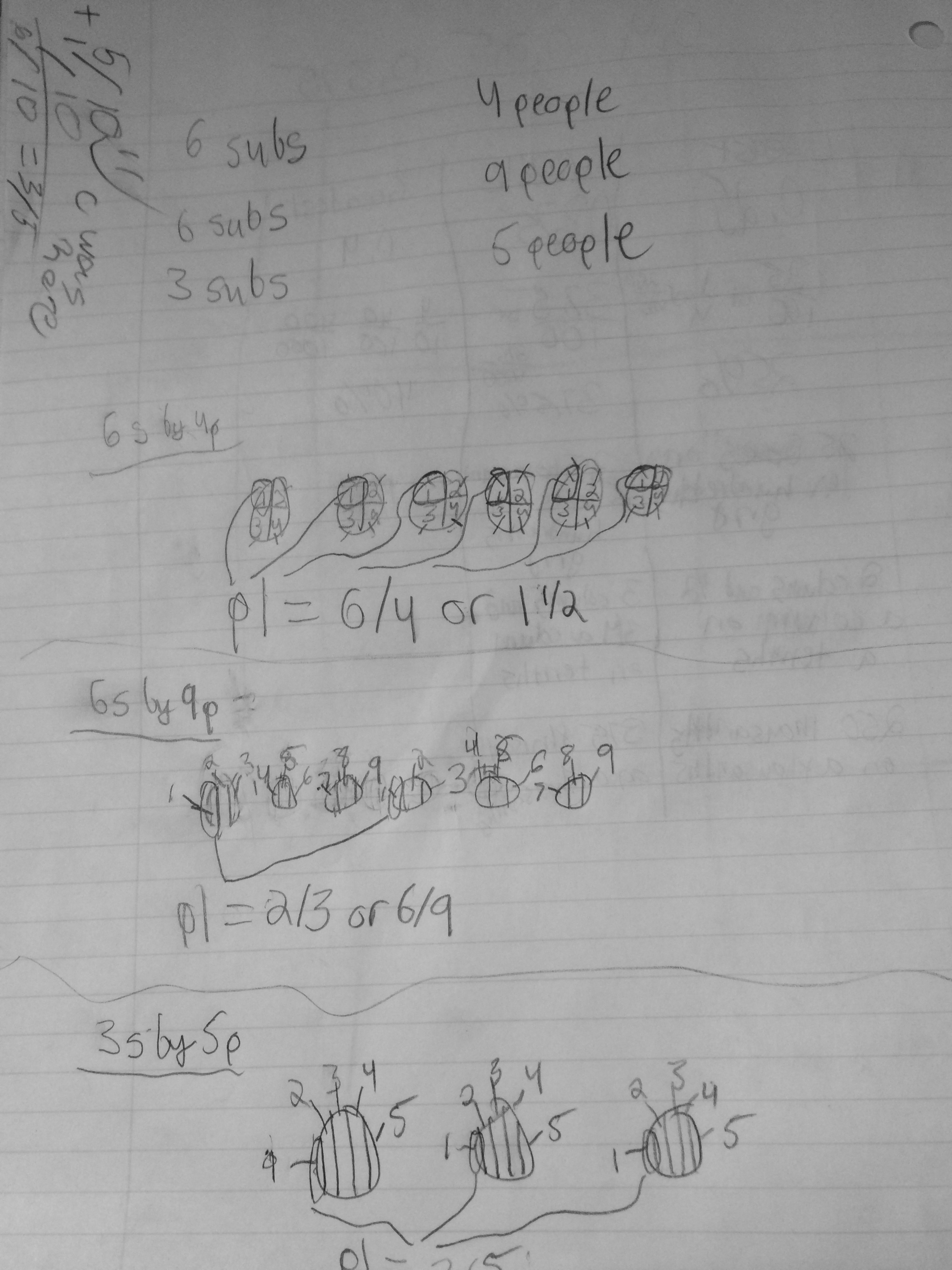
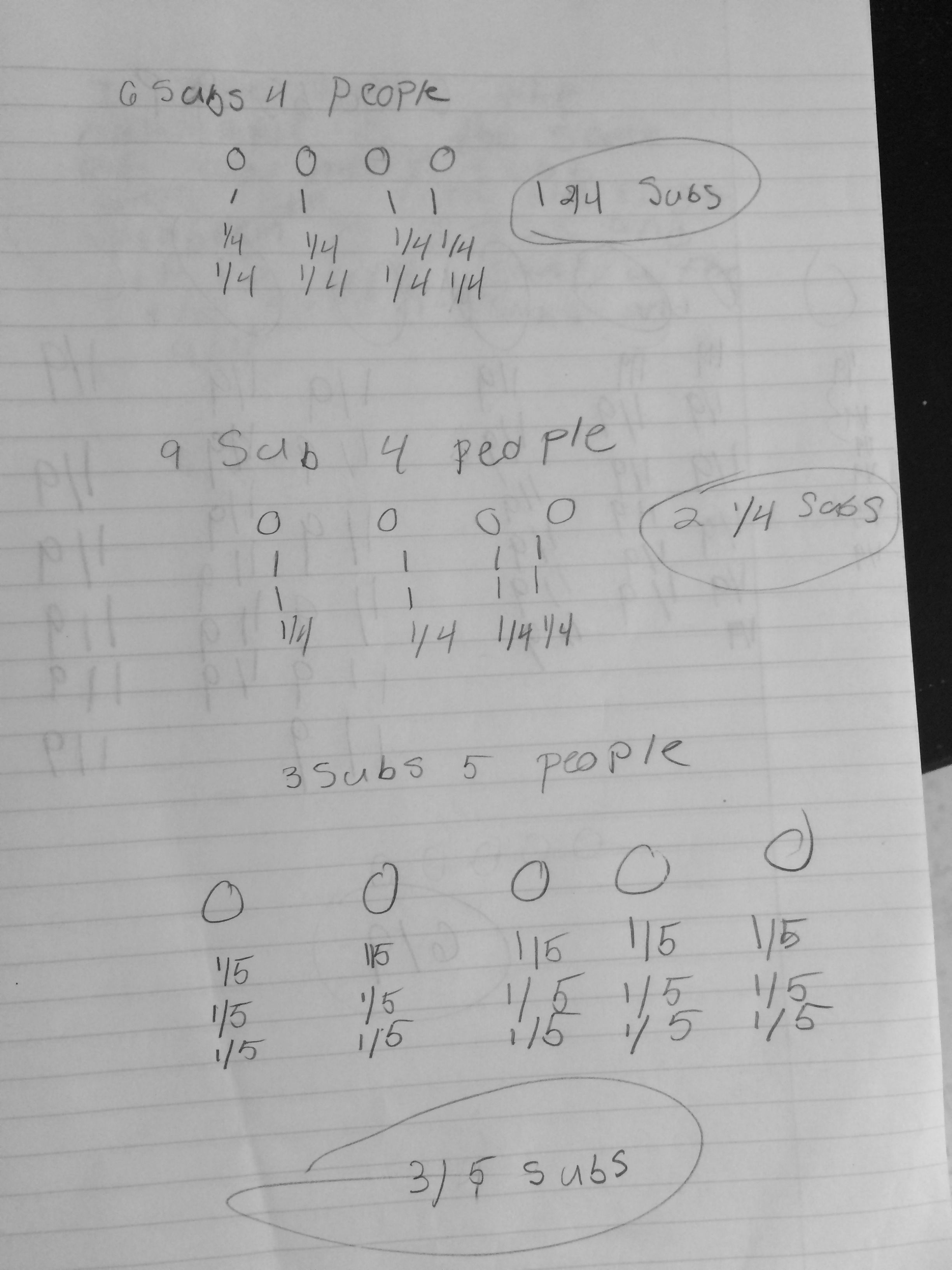
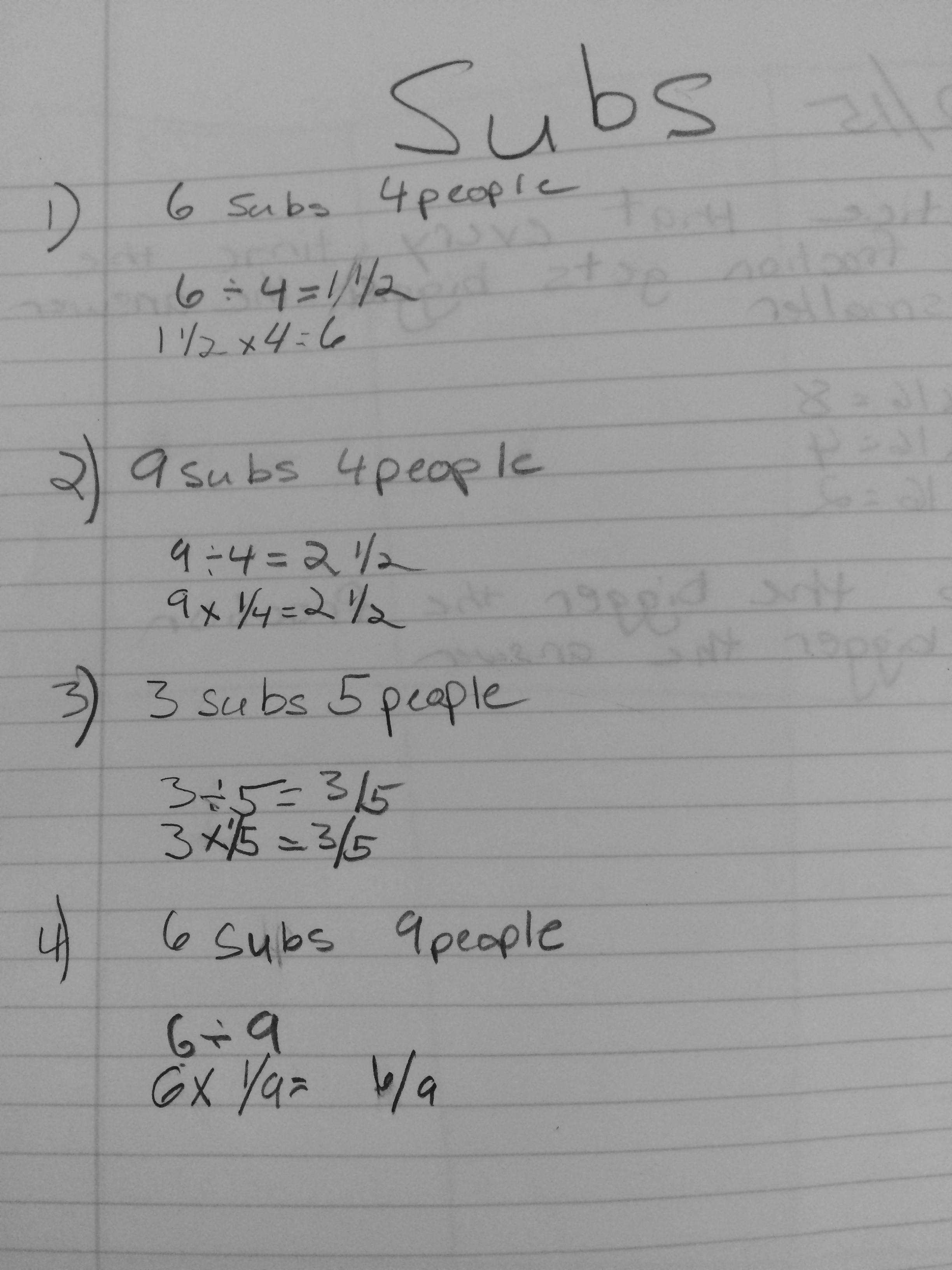
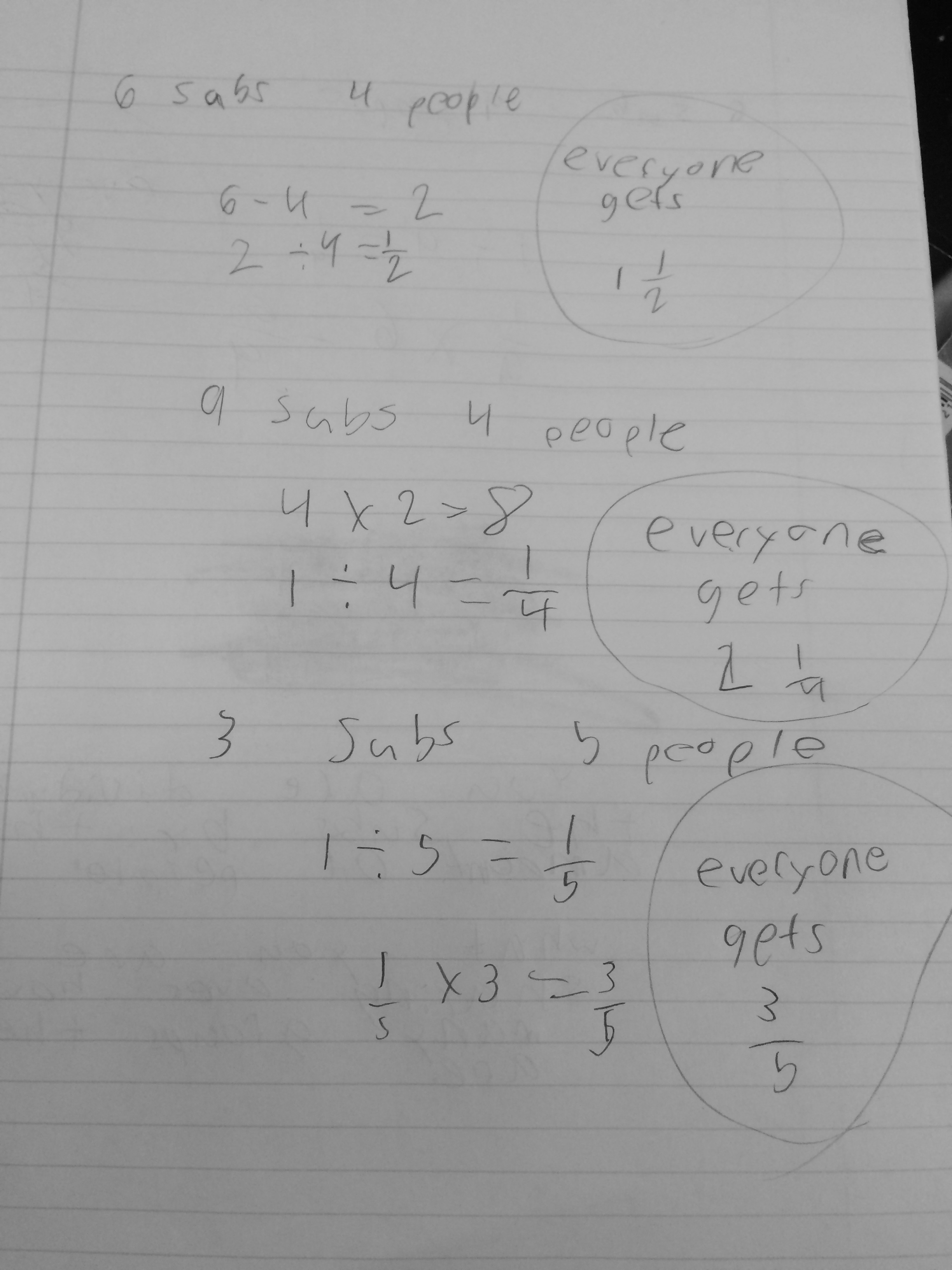
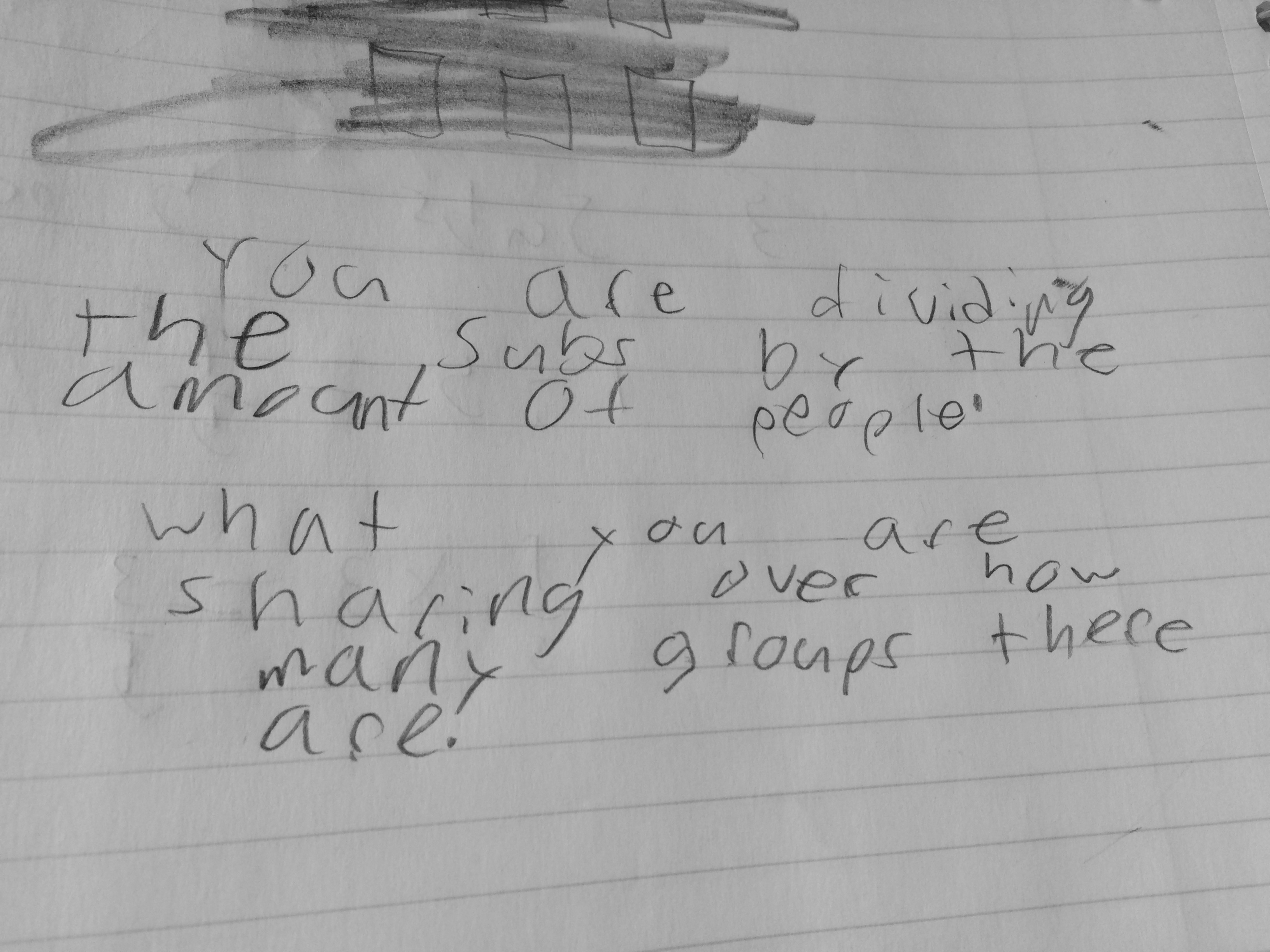
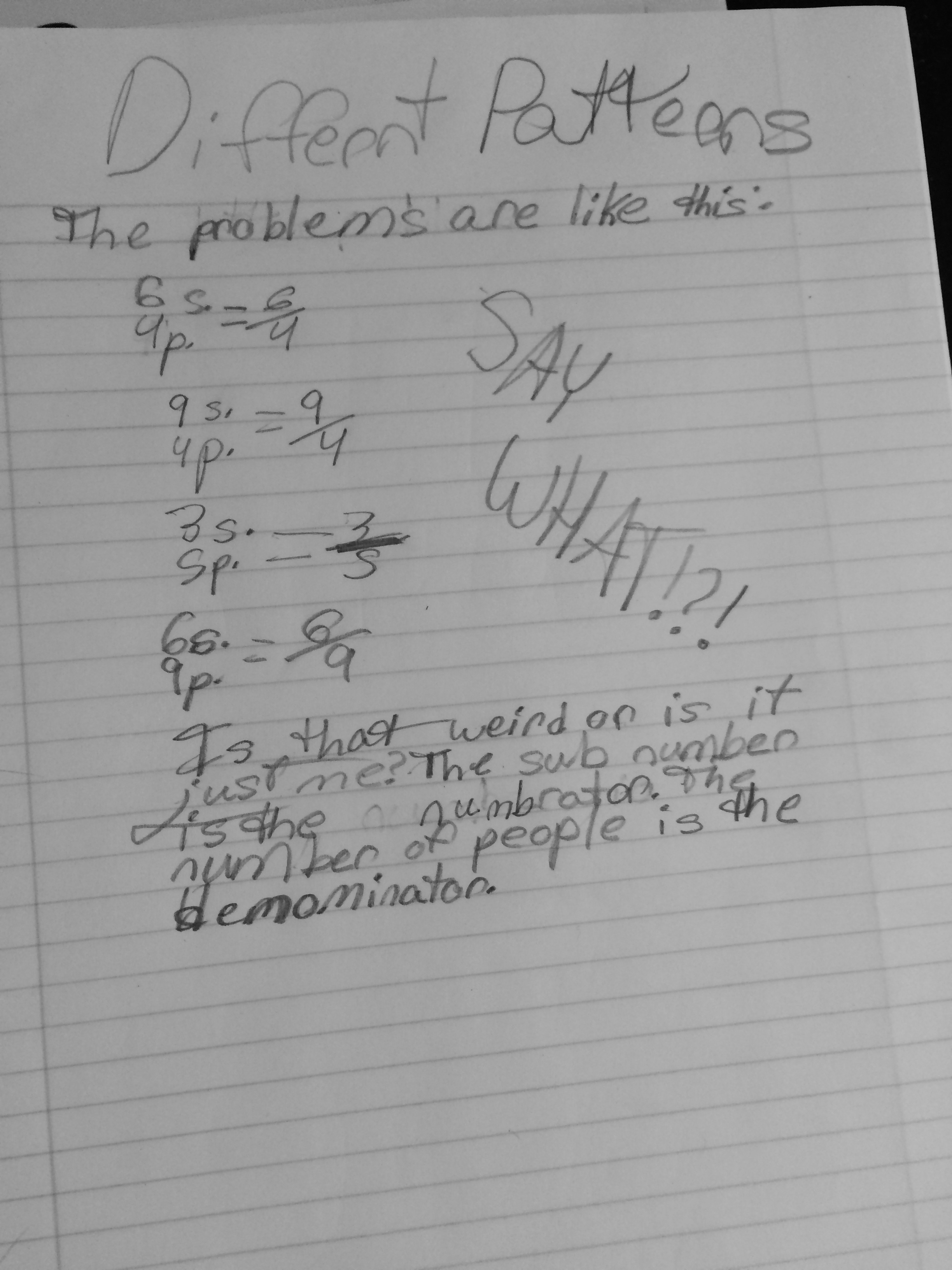
I started by putting a few sharing problem on the board: 6 subs shared by 4 people, 9 subs shared by 4 people, 3 subs shared by 5 people, and 6 subs shared by 9 people. I asked how much each person would get if they shared the subs equally.  I gave the students some individual time to work through the problems and, after that, an opportunity to share their answers and strategies with their group.  In the majority of the class, I saw the work I had anticipated based on their third grade brownie sharing work in Investigations. A lot of drawing of subs, people, and “passing out” of the pieces.

IMG_9370  IMG_9371

IMG_9382  IMG_9380

IMG_9374

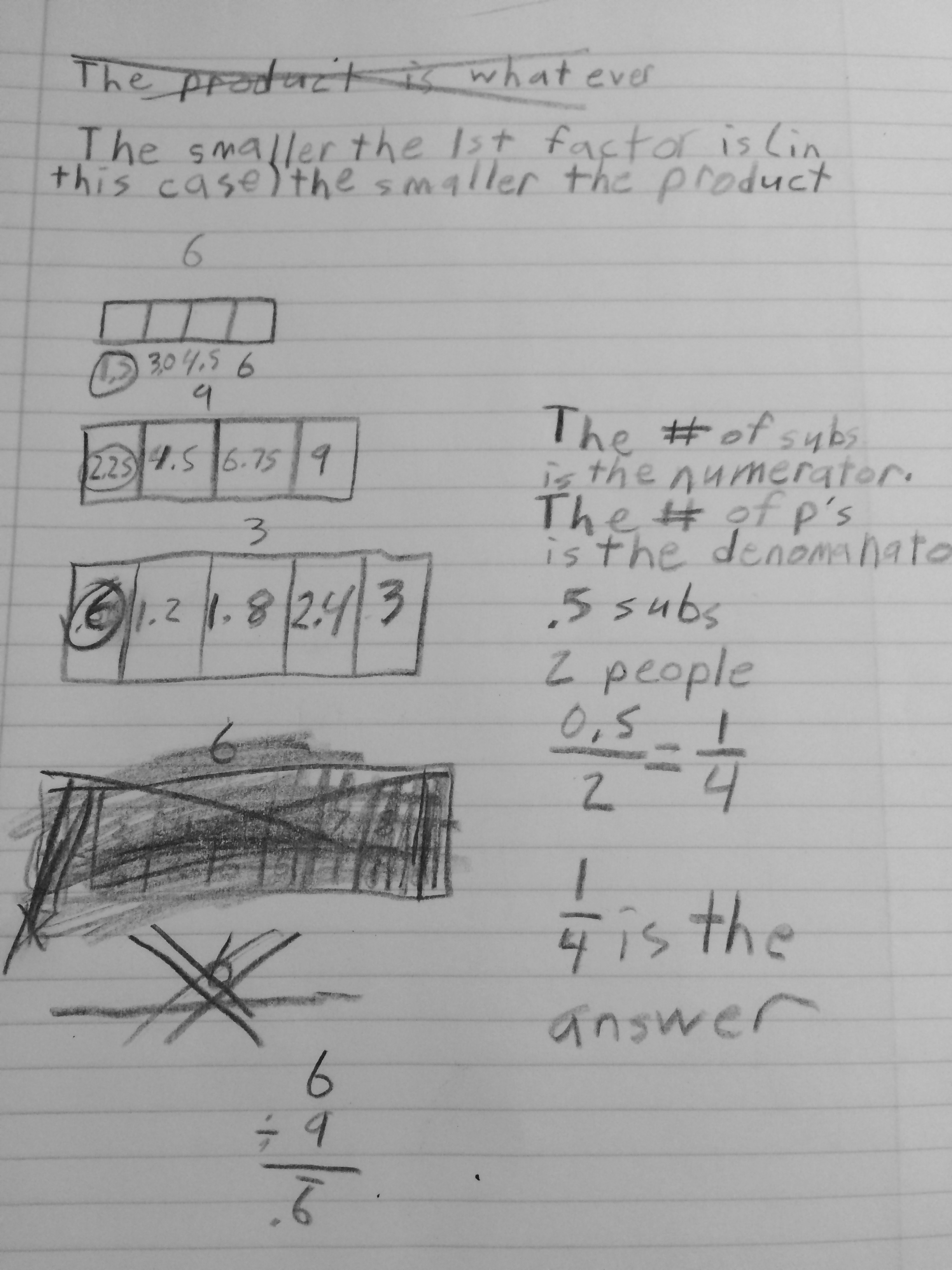
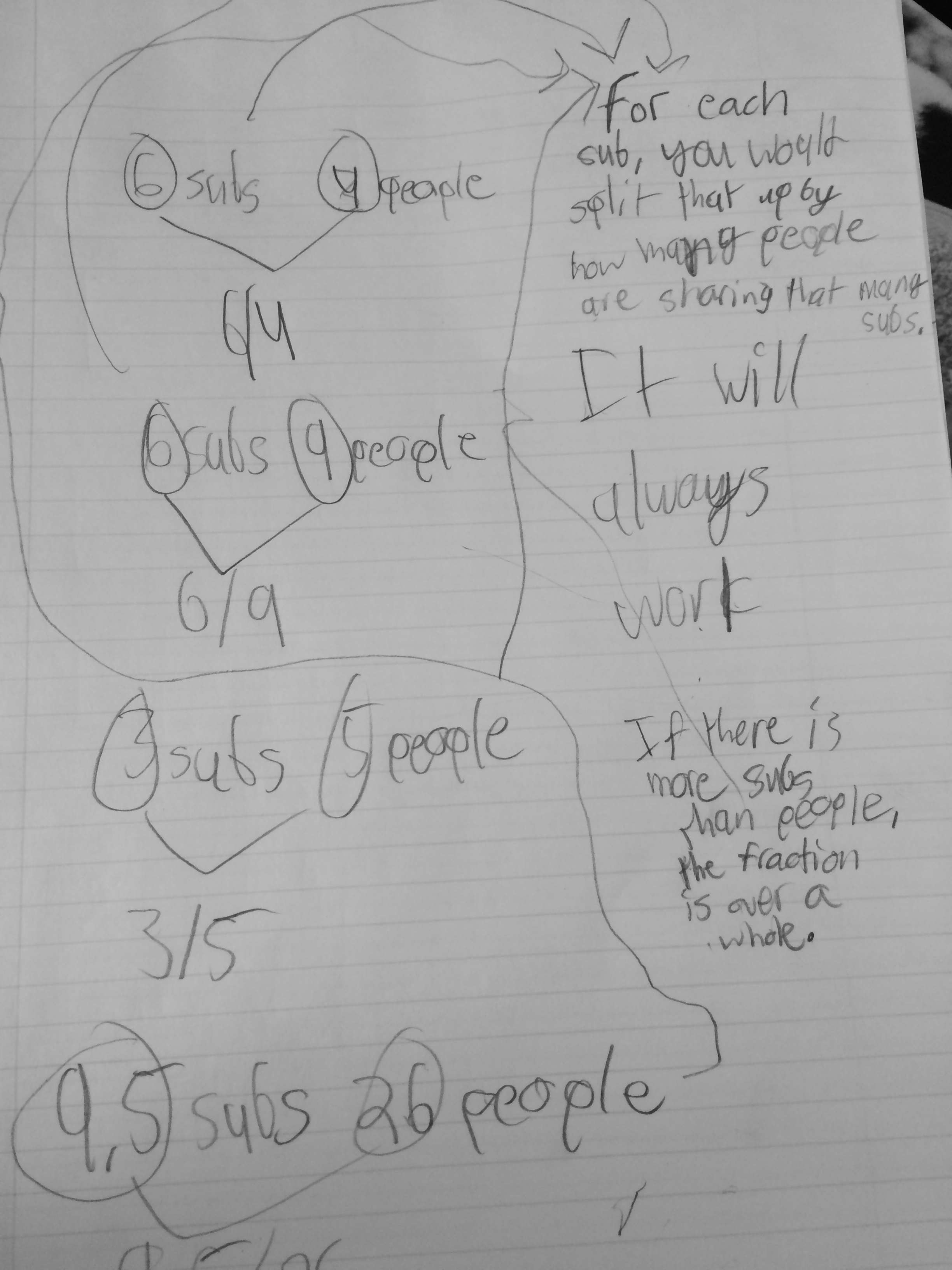
One student thought about the whole being the number of subs, divided it into the number of people sharing and arrived at decimals, however struggled when he got to the 6 shared by 9. (The side written piece is after I asked them to write what they noticed and then he proved it worked with fractional subs to start).

IMG_9375I had a few students that provided the perfect transition between the visual drawings and the fraction being division. They intuitively wrote the problem as a division problem and solved it using what they know about multiplication. After sharing some of the visual representations, I had these students share their equations. They explained to the class that is felt like division because they were dividing it up among people.

IMG_9369    IMG_9377

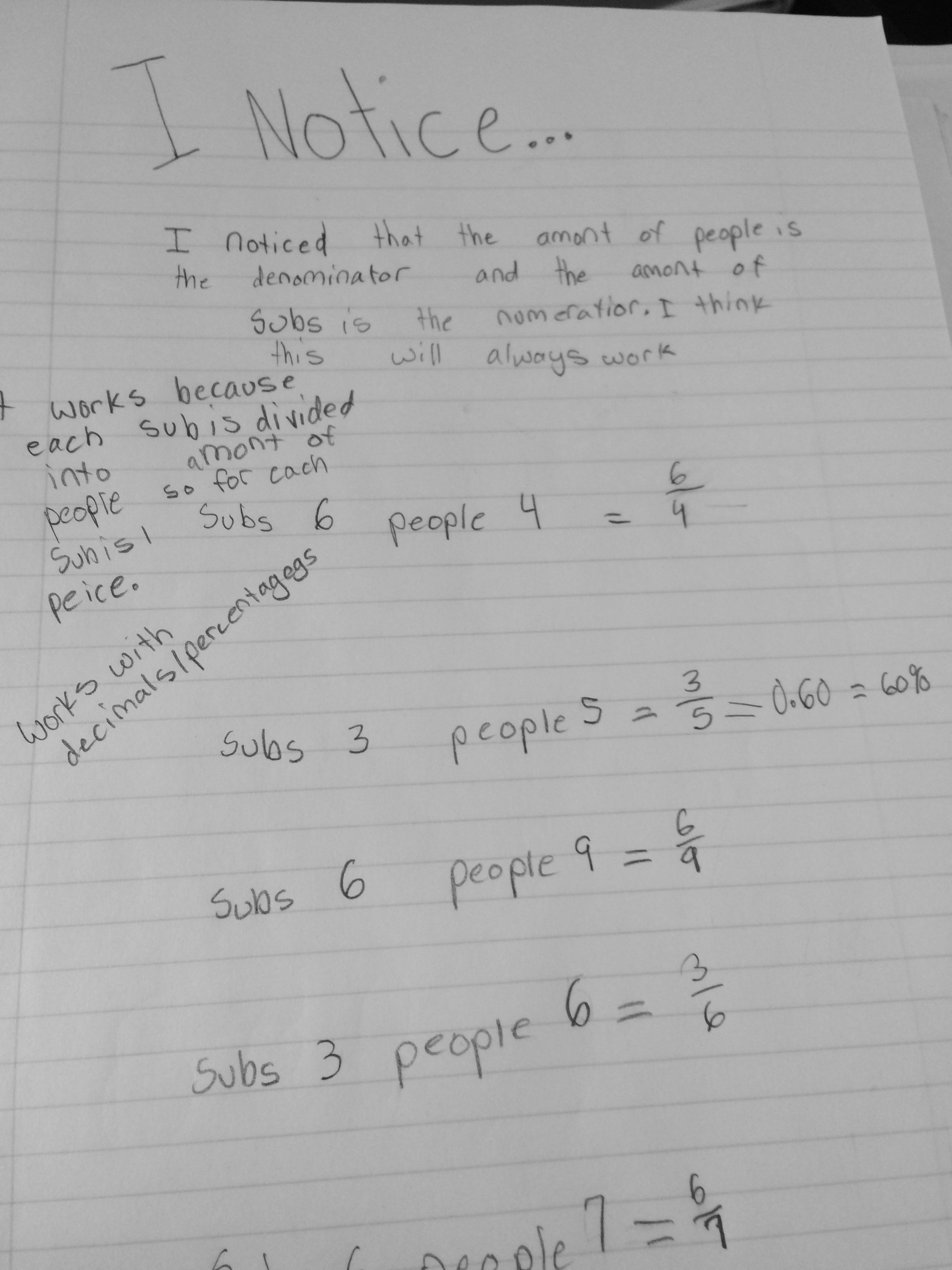
After our sharing, I revisited the original problems, with the students proven answers, and ask them to write what they noticed about the problems. After a few moments, I heard so many “Oh My Gosh”s and “It was really that easy”s echoing about the room. One student exclaimed, “Why did I do all of that work?” pointing to his beautiful sub and people drawings.

Here are some of their noticings (I love that they automatically start proving it to see if will always work without me even asking anymore).

IMG_9381  IMG_9379

IMG_9378

This one just absolutely cracked my up and proved once again that I cannot make assumptions about student understandings….

IMG_9372From this point, we tested out a bunch, talked about why it will always work and then starting looking at representing our “benchmark” answers as decimals. Tomorrow, I feel great knowing we will start looking into the division table with a deeper understanding of fractions as division. The word “explicit” sometimes makes me cringe in the way of “telling” students things, however I feel in this case the understanding of fractions as division was made explicit to the students through their own work group sharing and noticing today. I think that may be the piece I have missed before… I assumed they knew and could arrive at an answer, however never made the idea explicit as a whole group.

Today was a great day in math…Say What?

-Kristin
Comparing and Ordering Decimals

It is always so interesting to me what students take away in terms of strategies for doing various tasks in math class. In this particular case, ordering and comparing decimals. We all did the same shading activities, played the same comparing games, however the way this shading is applied to student thinking is so different among the students in the class.  In our assessment today I saw quite a variety in thinking that I just love.

These three are a sample of the most common strategy I saw in the work today. The students first thought about it in terms of how many tenths each decimal had. We talked about this a lot while shading in terms of full tenths, partial columns for hundredths and then parts of hundredths for thousandths so it makes sense that they would think about which decimal had the most tenths shaded first and move on from there.

IMG_9360_3 IMG_9363 IMG_9368

This student has a comfort in fractions and changed each to a fraction in the thousandths. It is interesting that certain students like to stay in fractions, where she could have just as easily made them decimals to the thousandths.

IMG_9362

This student explains using the hundredths grid in words. I love the use of the word blocks and 1/2 blocks. I just want to check back in on this one to see if there are connections to that 1/2 block representing 5 thousandths.

IMG_9364

“I thought about it like whole numbers.” This is something I would be extremely worried about if she had ordered them like: .6, 0.8, .55, .125, .875 because then the decimal would have been irrelevant in their reasoning in terms of “whole numbers”. She really multiplied each by 1000, which is something I would like to revisit tomorrow with her.

IMG_9366

I also had quite a few that compare using percents. This is a nice connection back to our fraction/percent work on the 100s grid earlier in the year.

IMG_9367

This was a nice way to ease back in after an extended weekend of snow and ice!

-Kristin
Fractions As the Denominator

As I was organizing my student work pictures this morning, I realized I had tweeted out this awesome work, but never blogged about it.

My students are very comfortable with putting fractions in the numerator. They use them all of time when decomposing, adding and comparing fractions like in these two examples…

IMG_8910_2 IMG_8300

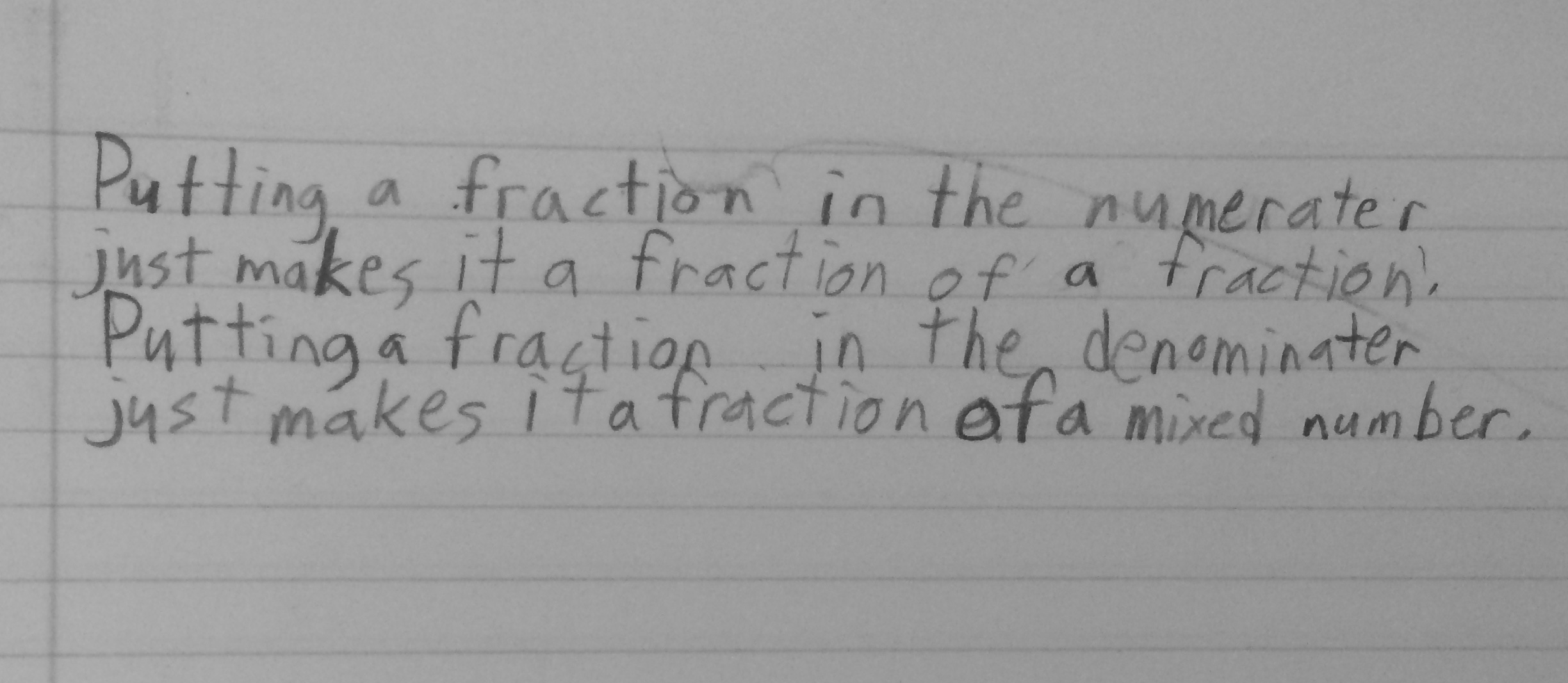
The other day, two of my students finished early and as an aside asked me if there could be a fraction as the denominator. I asked them to try it out and see what they thought.

They wrote their question and then started playing around with some fractions in the denominator. At first they were writing a bunch of fractions with a fractions as the denominator in attempt to find one that jumped out and made sense to them. They tried drawing some pictures of them along the way to see if they could illustrate what it would look like.

The first one they drew was 1/1.5 in which the rectangle was cut into thirds and had 1.5 shaded. When I asked what they would name what they just drew, they said 1.5/3. Hmmmm, back to the drawing board. They moved to 1 / 2/8, drew a rectangle cut into 8ths and shaded 2 of them. After shading, one student wrote 1, 2, 3, 4 over each 2/8 and said that there were four of the 2/8’s in his picture, so 1/ 2/8 must be 4. I asked what the whole was in the picture and left them to play around with that idea for a bit.

IMG_9035_2

I came back to these additions to the work:

IMG_9037_2

When I came back they said they realized that 1/ 2/8 was really a fraction more than 1 since 2/8 / 2/8=1. When I asked them to show me where that thinking was in their representation, they said since 2/8 was really 1 in their picture, it took four of them to make four wholes. I especially liked how they multiplied the numerator and denominator by 4 (the reciprocal of the denominator) to get to 1 in the denominator. Interesting to think about the algorithm for dividing fractions at play here.

As others in the class finished their work, they started to mess around with this question, trying to make sense of it. This student attempted to put it into a context using the meaning of a fraction we use a lot, “a pieces the size of 1/b,” however with b as a fraction, it is not helpful here.

IMG_9040_2

One student wrote this as his thought about the fraction as the denominator.

IMG_9038_2

I am left thinking a lot about the progression in which students learn complex fractions.

The “One Frame”

I love this introduction of decimal addition so much from last year, that I had to relive it again: https://mathmindsblog.wordpress.com/2014/02/19/decimals-in-a-one-frame/  It was just as amazing this time!

I opened with the same discussion about the ten frame, why we call it a ten frame, and then changed it to a one frame. We discussed the value of each box and were on our way. This year, I really pushed the students more into the equations that matched the frame on the board. We did .9 as a group in a number talk setting with a lot of revoicing and restating to be sure the students could explain how their equations matched the one frame image. I then put up a frame showing 0.7 ( four tenths on the top row and 3 tenths on the bottom row) and sent them to their journals to write some equations by themselves before sharing out. Here are some examples… (Some went crazy:) I think it is so interesting that without any formal work with decimal multiplication, students intuitively can see that any number of groups of some tenths can be written as multiplication.

IMG_9263_2 IMG_9265_2 IMG_9268_2 IMG_9270_2

The one below was so interesting when he said, “.35 x 2” I asked him how that matched the picture and he said, “..since I like symmetry, I took the fourth dot on the top row, split it in half, and put the other half on the bottom row.” I asked the class how that gave him .35 and another student explained that because half of a tenth was 5 hundredth, it became .35 on each row. YES!

IMG_9275 - Version 2I think put up two frames, one with .9 and the second with .3 and asked students to write down how much was represented in the picture. Like last year, it was a mix of 1.2, 12/20 and .12. I asked students to prove the one they got as their answer and then explain where they think someone got confused with one of the answers they do not agree with. They did a beautiful job with this.

IMG_9264_2 IMG_9266_2 IMG_9269_2 IMG_9271_2 IMG_9276 IMG_9277

It was so nice to kick off our adding decimals with students identifying what the whole it, looking at decomposing numbers, being aware of place value and reasoning about what makes sense. I am SO looking forward to the rest of this work!

-Kristin

Properties of Numbers

Earlier this year, I had a student bring up a great conversation about odd and even numbers: https://mathmindsblog.wordpress.com/2014/11/01/things-i-have-noticed-and-wondered/

After this idea about even/odd rational numbers surfaced, I started having realizations about ideas that we, as teachers, do not ever revisit over the course of a student’s learning journey. Ideas that we could be more exact in, refine, apply constraints, or just simply play around with the idea of developing working definitions for ourselves. Properties of numbers seems to be one of those ideas for me lately.

Today I did an opening activity called, Which Doesn’t Belong   and Billy’s idea resurfaced. I put the following numbers on the board and asked students which one they thought didn’t belong and why: 0.25, 3/4, 0.8. 0.5 A lot of great properties of numbers such as square, factor, multiple, even/odd, and equivalencies arose. I recorded all of their answers here, but I dug a little deeper into even/odd numbers. A student said that 0.5 doesn’t belong because it was the only one that was an odd decimal in the tenths place.

I pointed to each number one at a time, and asked for a raise of hands if they thought it was even or odd. When I pointed to 0.25 and 0.5, the overwhelming majority said odd, 3/4 they said it is neither because it is a fraction, and 0.8 was overwhelmingly even. I asked them to tell me how they determine if a number is even? I got the answers I expected, equal groups with no leftovers and looking at the last digit of a number.

I said, “So thinking about that, let’s look back at the numbers we were just discussing. Talk to your table about your thoughts now.” There were a lot of ooohs and hmmmms, and one student finally said, “Five tenths is just weird.” That statement got a lot of nods and uh huhs, but before we shared out, I wanted to get everyone’s quick initial thought on why it felt weird to call five tenths odd now since it was overwhelmingly odd at the beginning. Here are their thoughts…

IMG_9143_2IMG_9147IMG_9146IMG_9145IMG_9144IMG_9148We shared out and one student said he is going to “make a claim that all decimal numbers are even.” I loved that moment a lot! These are the working definitions that I feel are fun for students to explore. In the end, they wanted some closure and I felt they had done their due diligence, so we looked up the definition of an odd number. We talked about what an integer is and everyone felt a nice resolve to the “weirdness.”

This is something I am really interested in right now and wondering what other properties of numbers we talk about in the younger grades that don’t often explicitly resurface. Properties that apply to integers but not to rationals or even change a bit when dealing with rationals. I feel we always build on concepts as the students go through school, but do we look closely at the definitions we use and assume students don’t have more curiosities about them?

Of course I couldn’t let them leave without something to think about, so I asked them to tell me what they knew about square numbers and we listed a bunch on the board. I then put a decimal in front of each one and asked if we still called them square numbers? A few started throwing out their thoughts, but it was time to go, so more to come on that later…To Be Continued.

-Kristin