Moving Beyond ‘The Things’ in Math Class

I’ve always had such an appreciation for curriculum materials. I genuinely don’t know where I would have been as a new teacher without the Investigations curriculum. Those materials shaped my vision for math instruction and influenced not only my teaching, but my curriculum writing at Illustrative Mathematics as well. In all of my work, I continually advocate for the use of high-quality instructional materials.

At the same time, I’m not naïve enough to believe that any single curriculum—no matter how well designed—can meet the needs of every teacher or every group of students in any context. That tension is exactly why I care so deeply about adaptation.

For some curriculum publishers ‘adaptation‘ is treated as a dangerous word because it doesn’t align with the curriculum developers beliefs about how their curriculum should be used. Some worry that acknowledging the need for flexibility somehow sends the “wrong message” about the quality of the product.

What those organizations need to honor is what teachers know: their students, their prior knowledge, the ways they engage with content, and the day-to-day realities of a classroom. Pretending a curriculum is so perfect that it must be used exactly as written may keep a marketing narrative tidy, but it doesn’t support the humans doing the teaching, or the kids doing the learning.

Adaptations: The What and Why

Sometimes adaptation means shifting pedagogy.
Sometimes it means bringing in a strategically chosen resource.
Sometimes it means adjusting a task to better elicit the mathematical ideas at the heart of the lesson.

At its best, adaptation is about eliciting, honoring, and leveraging students’ ideas, curiosities, strengths, and mathematical understandings. It’s about making intentional choices that build from what students can do rather than from assumptions about what they can’t or won’t.

But over the years, I’ve noticed a pattern that feels impossible to ignore: instead of investing in thoughtful adaptation, math education has become (or always has been?) obsessed with quick fixes and flashy things.

We try them. We buy them. We’re promised they’ll solve our most persistent instructional challenges.

You’ve probably heard versions of this:

  • Students are ‘falling behind’ in grade level content → Purchase an RTI program.
  • Students aren’t being challenged → Create an accelerated track.
  • Students aren’t engaged → Make flashy digital lessons. 
  • Students still aren’t engaged → Find “fun” activities on the internet. 
  • Students aren’t writing explanations → Buy math journals.
  • Teachers don’t believe all students can learn → Hand them a book on growth mindset.
  • Teachers still don’t believe all students can learn → Hire a ‘big-name’ math ed keynoter.
  • Teachers can’t meet every student’s needs → Send them research on differentiation. 
  • Teachers don’t trust their curriculum → Replace it with a collection of random tasks.
  • Districts don’t trust any curriculum → Throw out the textbook altogether.

These moves usually come from care and urgency. When something isn’t working, it’s natural to want to fix it and in many cases, we can learn a lot from trying new things. I know I have learned a ton from the #mtbos days of old.

But these are not challenges for quick fixes. They are ‘easier said than done’ pain points. So, it’s worth pausing to ask: If these solutions are meant to produce consistent, measurable, and sustainable change…why are we still looking for solutions for the same problem?

The answer might lie in how we think about mathematics itself.

Math Is a Story. Quick Fixes Are Commercials.

When we see mathematics as a coherent story, one that builds, connects, and makes sense over time, each lesson is a chapter. New ideas grow out of previous ones. Students should feel the mathematics unfolding, connecting, and extending their thinking.

That story is already written into high-quality curriculum materials. Our role as teachers is to bring it to life, making adaptations that strengthen the narrative without breaking it.

Quick fixes, however, often come with their own storyline: their own logic, pacing, and purpose. When we drop them into instruction without careful consideration, they interrupt the mathematical story already in progress.

They become commercials.

And even when the commercial is fun, flashy, or well-intentioned, it still disrupts coherence and the learning experience. It’s unlikely, certainly not guaranteed to lead to lasting changes in teacher practice or student learning.

When teaching and learning are treated as a continuous, interconnected narrative, commercial breaks can add noise, not clarity. They leave students experiencing math as a series of disconnected activities rather than as a meaningful, connected discipline.

Thoughtful adaptation preserves the story. Quick fixes interrupt it. I even gave a talk on this exact idea at CMC-S many years ago. (minute 9:00)

The Things Aren’t the Problem , Our Lens Is

Once you start seeing instruction this way, it becomes easier to spot where coherence is preserved and where it gets disrupted. One of the clearest examples of this tension shows up in how we use math routines.

There is no shortage of powerful routines in math classrooms:

  • Number Talks
  • Which One Doesn’t Belong
  • Notice/Wonder
  • 3-Act Tasks
  • Visual Patterns
  • Counting Collections
  • Choral Counting
  • Sometimes/Always/Never
  • Talking Points
  • Open Middle

I LOVE these routines. I’ve used them in my own teaching, coaching, and curriculum writing because I deeply understand their value. Each one holds enormous potential and I have learned so much by using them. They invite reasoning, elevate student voice, and cultivate important mathematical habits of mind.

But their impact doesn’t come from the routine itself—the thing.

It comes from the things about the thing:

  • its mathematical purpose
  • how it positions students as thinkers
  • the teacher’s stance and what they notice and respond to
  • how it connects to what came before
  • how it advances what comes next
  • the opportunities it creates for sense-making

When a strong routine, activity, or other pain point solution is dropped in at random, it becomes just another commercial, well-produced and engaging, but disconnected from the larger story of the mathematics.

When that same routine (or other solution) is used with intention, grounded in the curriculum and responsive to students, it becomes part of the narrative and an agent for sustainable change.

How to Shift Our Lens

Shifting our lens doesn’t mean rejecting new ideas, routines, or resources. In fact, it requires the opposite. We try things. We study them. We learn from what happens when they meet real students in real classrooms. But instead of treating those things as replacements or fixes, we treat them as opportunities to better understand our students and the mathematics, and then adapt with intention.

This is where adaptation becomes the missing piece in effective and sustainable math instruction. Without adaptation, we swing between rigid fidelity (“just follow the program”) and disconnected add-ons (“just try this new thing”). Adaptation offers a third path: staying grounded in the curriculum’s design while making informed, purposeful decisions that support coherence and respond to students’ thinking. It asks not What can I insert? but How does this choice strengthen the mathematical story students are already experiencing?

Importantly, adaptation is not a free-for-all. As Remillard (2005) reminds us, “It would be inaccurate and irresponsible to conclude that all interpretations of a written curriculum are equally valid.” Some changes preserve the integrity of the mathematics; others unintentionally distort or fragment it. The work, then, is not simply to adapt but to learn how to distinguish between reasonable and unreasonable variations, especially those tied to the most central features of a curriculum’s design (pp. 239–240).

When we shift our lens in this way, trying something new is no longer the end goal, it’s part of a learning cycle. We try a routine, task, or approach. We notice how students engage with the mathematics. We reflect on what it revealed, what it obscured, and how it connected to what came before and what comes next. Then we adapt, not to chase novelty or flashy, fun options, but to better position students as sense-makers within a coherent mathematical storyline.

This kind of adaptation doesn’t promise instant results. But it does something far more powerful: it builds teacher knowledge, strengthens instructional decision-making, and supports math learning that is connected, meaningful, and sustainable over time.

So Where Do We Go From Here?

We don’t need to jump to new things to solve curriculum implementation challenges.
And we certainly don’t need more silver bullets.

What we need is coherence.
We need connectedness.
We need to treat mathematics as the coherent story it truly is and learn to adapt materials in ways that honor and strengthen that story.

That also means being more intentional about the curriculum partners we choose. We should be asking whether a curriculum acknowledges the professional judgment of teachers, reflects the complexity of classrooms, and explicitly supports thoughtful adaptation. The goal is not permission to change things at will, but guidance for how to adapt in ways that preserve the mathematical integrity and coherence of the design. Organizations that condemn teachers for adaptation, or frames it as a failure of implementation, misses a fundamental truth: no written curriculum can anticipate every learner, every context, or every instructional moment.

Choosing adaptations, then, requires looking beyond the thing itself and toward the things about the thing that make instruction sustainable, purposeful, and responsive to teachers and students. One way to begin is by grounding adaptations in a small set of guiding questions and principles.

First, adapt with the mathematical purpose in mind.
Before changing a task, routine, or lesson, be clear about the mathematics it is designed to surface. Strong adaptations clarify or sharpen that purpose; weaker ones obscure it. Sometimes that sharpening means being more explicit, naming an idea directly, modeling a strategy, or slowing down to highlight structure so students can actually see the mathematics you want them to see. If an adaptation makes the mathematics less visible, dilutes the focus, or shifts attention away from key ideas, it’s worth reconsidering.

Second, protect the coherence of the learning.
Ask yourself how the adaptation connects to what students have already experienced and how it sets them up for what comes next. Reasonable adaptations strengthen the storyline, helping ideas build, connect, and deepen over time. When an adaptation stands alone or introduces a competing logic, it risks becoming a commercial rather than a chapter.

Third, attend to how students are positioned.
Effective adaptations expand access to the mathematics without lowering the cognitive demand. They position students as thinkers, sense-makers, and contributors, not just followers of procedures. The question is not Is this easier or harder? but What opportunities does this create for students to reason?

Fourth, treat adaptation as learning, not fixing.
Adaptations work best when they are tried, studied, and revised. What did students understand more deeply? What surprised us? What might we adjust next time? This stance shifts adaptation from a reactive move to an ongoing professional practice.

When we adapt with these elements in mind, every instructional choice becomes part of a larger narrative: what students understand, who they are becoming as mathematicians, and how they make sense of the world.

And when we stop interrupting the story with commercials, the learning becomes clearer and the thinking becomes deeper.

Now if we revisit our initial list and reflect on the things about the thing, we move from quick fixes to thoughtful considerations. 

  • Students are ‘falling behind’ in grade level content → How is the RTI program connected to our curriculum materials? How does the program position students as knowers and doers of mathematics? How does the program build on what students know?
  • Students aren’t being challenged →What does it look like to extend student thinking? How does our current curriculum support extensions? How can we adapt our current curriculum materials and instruction to extend student thinking? How are teachers supported to address all students needs’ in the classroom? 
  • Students aren’t engaged →Why would a digital activity be more engaging? Why would the digital activity be better than a pencil/paper experience? How does it impact students collaboration? What is the cost/benefit of putting students on a device during math class?
  • Students still aren’t engaged → How do the ‘fun’ activities connect to what students are currently learning? What aspects of that activity make it fun? Which of those aspects could be implemented in our current lessons to increase engagement? Does fun= meaningful learning?
  • Students aren’t writing explanations → How do students view writing in math class? What do we do with their written explanations? How do I need to manage the journal to encourage students to write more? 
  • Teachers don’t believe all students can learn → How can we find out why teachers believe this? How can we adapt our curriculum materials to elevate student ideas to show all of the amazing things students know?
  • Teachers still don’t believe all students can learn → How can we collaborate as colleagues to learn more about how students feel about themselves as mathematicians? How can we leverage what we learn to adapt our instruction to elevate all of the knowledge students are building on.
  • Teachers can’t meet every student’s needs → What does it mean to differentiate? What are in the moment strategies we can use? How can we make the most out of any small group time we have? How can we leverage collaboration in the classroom to support differentiation?
  • Teachers don’t trust their curriculum → How can we find out why teachers don’t trust the curriculum? How can support teachers in adapting the curriculum in meaningful ways to gain trust?
  • Districts don’t trust any curriculum → What are the implications if we don’t have a scope and sequence? How does just pulling tasks aligned to standards impact student’s learning experience?

Final Thoughts

In the end, thoughtful adaptation is not about changing for the sake of change, it’s about honoring the complexity of teaching and the brilliance students bring to mathematics. High‑quality materials give us the storyline; our professional judgment brings that story to life. And that work becomes even stronger when it’s supported by curriculum partners who believe this too–partners who trust teachers, understand the realities of classrooms, and design materials that are meant to be adapted rather than protected with rigidity.When we adapt with purpose, protect coherence, and remain responsive to the learners in front of us, we create classrooms where mathematics makes sense, ideas build, and students see themselves reflected as capable thinkers. That’s the work that lasts. That’s the work that matters. And that’s the work worth investing in, not because it’s easy, but because our students deserve instruction rooted in meaning rather than momentum, in coherence rather than commercials, and in teaching that grows stronger, deeper, and more human over time.

Related posts on adapting:
Low Floor, High Ceiling, Wide Walls: Using Tasks to Elicit and Leverage Ideas

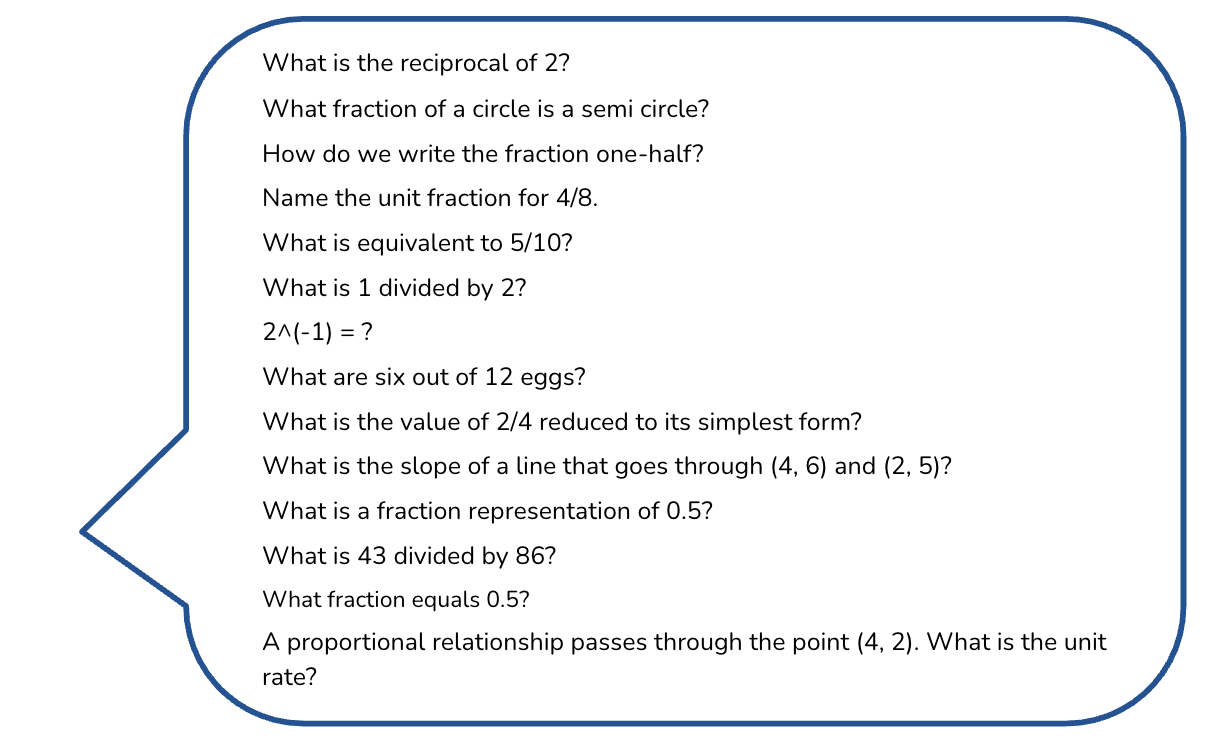
The answer is 1/2. What is the question? 

Pause for a moment to think about how you would respond to this prompt. After you have a question in mind, reflect on the thinking you did to come up with that question. What topics did you think about? Did they include mathematical representations, a real-world context, or calculations? Something else? 

Last week, we had our second book study session for NCTM’s Teaching Mathematics Through Problem Solving K–8. The focus of the session were chapters four and five around instructional tasks and teaching signposts that support students in learning through problem solving. We wanted to open the session with a good math prompt as everyone was arriving, a prompt that gave them something interesting to think about as we waited a couple of minutes and also set the tone for the learning we were going to do together. Since the session was focused on instructional tasks, we wanted to begin with one that reflected what we value in classrooms—tasks that invite everyone in and elicit a wide array of student thinking.

After a few seconds, the chat was buzzing. Here is a sampling of the amazing responses we got.

The variance in responses was so fun and got me thinking about when, where, and with whom a prompt like this might be especially powerful. I often use tasks like this to launch a unit, lesson, or activity so I can learn how students are thinking about the mathematical concept we are about to explore.

Launching a Lesson

A former colleague, Jenn, used this prompt to launch a 3rd‑grade lesson on comparing fractions. Using the task at this point in a lesson not only provided insight into students’ thinking, but also supported differentiation. Students who finished early had access to a bank of questions to evaluate, compare, and justify. Even better, those questions came directly from the students themselves.

Launching and Wrapping Up a Unit 

Building on this idea, what might it look like to use a prompt like this not just to launch a lesson, but to bookend an entire curriculum unit?

Before beginning a unit on fraction multiplication and division in 5th grade, we might pose the question, “The answer is 3/4. What is the question?” At the start of the unit, we would likely see fractional diagrams, addition expressions such as 1/4+1/4+1/4, or multiplication expressions like 3 ×1/4​. All of these responses are incredibly valuable for eliciting what students currently understand about fractions.

By the end of the unit, however, students have developed new understandings about fraction multiplication and division. Revisiting the same prompt invites them to apply those new understandings in more sophisticated ways. Building on the original list of student‑generated questions at the end of the unit could serve as a powerful formative assessment and, just as importantly, a rich anchor chart that documents students’ learning over time.

Professional Learning 

This idea also extends naturally to professional learning settings, particularly those that bring together educators across a wide range of grade levels. For example, in professional learning focused on the fraction learning progression, the list we generated at the beginning of our book study session would be invaluable.

A rough draft PD flow could look something like this: 

  1. Pose the prompt and ask teachers to write their responses on index cards. 
  2. In small groups, teachers share their questions and work together to align them to grade‑level standards.
  3. In larger groups, teachers collaborate to form a learning sequence, ordering the cards from the earliest fraction understandings to the latest. 
  4. Teachers move into grade‑level groups to identify their curriculum unit in which they could use a prompt like this. For K–2 teachers, this would mean adjusting the prompt to use the words “one‑half” instead of a numerical representation (a variation I used in 1st grade).
  5. In grade‑level groups, teachers anticipate what students might say and plan how they will leverage student understanding and use student‑generated questions.
  6. The whole group shares ideas. 

Reflection

Coming back to the book study, I found this book quote reflective of prompts like these: 

Activities that provide access and extension are often referred to as having a low-floor and high-ceiling. Meaning, the problems invite all students to engage, while also providing space for deeper exploration. These types of tasks provide accessible entry points without lowering or limiting the cognitive demand of the mathematics. Mitch Resnick (2020) takes this idea even further with the concept of “wide walls,” which reminds us that learning shouldn’t just move from easy to hard, but should also give students space to explore ideas in different ways and directions.

Coming Up

If this prompt has you thinking about your own classroom or professional learning spaces, I’d love for you to continue the conversation with us. Join me on February 9 for a free webinar with Ashley Powell and Shawn Wigg as we explore instructional tasks that invite a wide range of thinking. We will relate the ideas in the NCTM book to practical applications of tasks in the classroom. Participants will receive an excerpt from the NCTM book, and we’ll raffle off a free digital copy at the end. Hope to see you there!

Mathematizing Children’s Lit & Some of My Favorite Books: 2nd-5th Grade

In my previous post, I ran through some lessons I’ve learned about interactive read alouds and shared a few of my favorite books for K–1. And while many of those books can absolutely stretch up into grades 2–5, there are others that, because of their math content or overall reading complexity, are a better fit for this upper‑elementary grade band. So today, I’m sharing a set of book recommendations that support joyful exploration and productive mathematical discussions! These titles open space for noticing patterns, justifying ideas, engaging in debate, and connecting mathematical thinking to the world around them.

And if you’re working across multiple grade levels, you can always revisit my earlier K–1 read‑aloud list. Together, the two posts offer a collection of my favorite books that invite curiosity, support authentic access to the mathematics, and build a shared mathematical community from kindergarten all the way through fifth grade.

ConceptBook Suggestions
Number and OperationsEqual Shmequal by Virginia Kroll
One Is a Snail, Ten Is a Crab by April Pulley Sayre and Jeff Sayre
One Hundred Hungry Ants by Elinor J. Pinczes
A Remainder of One by Elinor J. Pinczes
How Much Is a Million? by David M. Schwartz
100 Mighty Dragons All Named Broccoli by Larochelle & Cho
Dozens of Doughnuts by Carrie Finison
Hello Numbers by Harriss and Hughes
FractionsThe Lion’s Share by Matthew McElligott
Fry Bread by Kevin Noble Maillard
Give Me Half! by Stuart J. Murphy
The Doorbell Rang by Pat Hutchins
How Many Ways Can You Cut a Pie? by Jane Belk Moncure
Measurement and DataSpaghetti and Meatballs For All! by Marilyn Burns
How Big Is a Foot? by Rolf Myller
The Penny Pot by Stuart Murphy
Curious Comparisons by Jorge Doneiger
Coa Chong Weighs and Elephant by Songju Ma Daemicke
Greater Estimations by Bruce Goldstone
Actual Size by Steve Jenkins
Which Would You Rather Be? by William Steig
Geometry This is Not a Maths Book by Anna Weltman (not really a children’s book, but it is sooo good!)
Which One Doesn’t Belong? by Christopher Danielson
Shapes, Shapes, Shapes by Tana Hoban
Grandfather Tang’s Story by Ann Tompert

I hope this collection gives you fresh inspiration for sparking mathematical curiosity in your classrooms. The best way to know whether a read aloud resonates with yourself and students is simply to try it. You can see how your students respond, notice the ideas they generate, and decide how to leverage their thinking toward the learning goal.

Give these titles a spin, and let me know what mathematical conversations they open up for you and your students. I’d love to hear what you try!

IG: @kgraymath and LinkedIn

Mathematizing Children’s Lit & Some of My Favorite Books: Kindergarten – 1st Grade

I had always been a fan of bringing stories into math class; however, as a fifth-grade teacher, it was hard to convince a group of almost–middle schoolers that a children’s book could be full of interesting, grade-level ideas to explore. More often than not, when I began reading aloud, I could tell right away that the vibe was off and that they saw it as too babyish.

At first, I assumed the problem was the book itself. Over time, though, as I learned more about mathematizing from Allison Hintz and Tony Smith, I came to realize that the issue wasn’t what I was reading, but how I was framing the experience. I was making the book’s concept the thing, rather than centering the story and the mathematical practices involved in mathematizing. And while the concept is extremely important when choosing a book, the facilitation really can make or break the experience.

Around that same time, I was incredibly fortunate to step into a role as a K–5 math specialist, where I had the opportunity to partner with an amazing reading specialist, Erin. Together, we tried out different books across grade levels and content areas, reflected on those experiences, and took up interactive read alouds as a way to blur the lines between content, habits of mind, and capacities. Through this work, I not only learned a great deal about teaching ELA, but also came to understand mathematizing as a way to invite students to see mathematics everywhere, including within stories that don’t appear to be mathy at all!

The Why

Mathematizing is a process of inquiring about, organizing, and constructing meaning with a mathematical lens (Fosnot & Dolk, 2001). Through mathematizing, students:

  • have access to mathematics
  • see math when and where it may not be obvious
  • see mathematics as a way to make sense of things
  • see math as a way of thinking, not solely a way of doing
  • focus on meaning-making

The What: Books

Choosing a Book

If you are a K-1 teacher, I am sure you already have an expansive book collection! As you look through your library, consider how different stories might invite mathematical thinking. Some books center math directly in the plot, others offer rich illustrations to examine, and some simply create situations that spark mathematical curiosity—even if the math lives quietly beneath the surface.

If you are having trouble choosing, I have highlighted some of my favorite books in the table below!

ConceptBook Suggestions
Counting and
Cardinality
I Spy a Dinosaur’s Eye by Jean Marzollo
Truman by Jean Reidy
Grumpy Bird
One Is a Snail, Ten Is a Crab by April Pulley Sayre & Jeff Sayre
Ten Black Dots by Donald Crews
Ten Flashing Fireflies by Philemon Sturges
Anno’s Counting Book by Mitsumasa Anno
Ten Ways to Hear Snow by Cathy Camper
One Fox by Kate Read
How Many? by Christopher Danielson
GeometryThis is a Ball by Beck & Matt Stanton
City Shapes
Square Cat by Elizabeth Schoonmaker
The Shape of Things by Dayle Ann Dodds
More-igami by Dori Kleber
Inch by Inch by Leo Lionni
Addition and
Subtraction
The Doorbell Rang by Pat Hutchins
There Is a Bird on Your Head by Mo Willems
Double Those Wheels by Nancy Raines Day
Composing Decomposing
Comparing Numbers
Lia & Luis: Who Has More? by Ana Crespo
Dozens of Doughnuts by Carrie Finison (also great for counting & add/subtraction)
12 Ways to Get to 11 by Eve Merriam
Measurement
and Data
Curious Comparisons by Jorge Doneiger
The Animals Would Not Sleep! by Sara Levine
Other Lovely Books! Count on Me by Miguel Tanco
The Look Book by Tana Hoban
Playful Puzzles for Little Hands by Taro Gomi

The How: Interactive Read Aloud

Now that you have a book in mind, it is time to structure the read aloud experience. Don’t worry, there’s no single path for engaging students in a mathematical read aloud. Instead, think of it as a series of intentional moments that help students notice, wonder, build curiosity, and explore the mathematics within a story. Here are some helpful lessons learned that helped me improve in my interactive read alouds:

Let the story be the story. The first reading is an opportunity for students to listen, imagine, and enjoy. Without pausing to analyze, students can make sense of the narrative and build a shared experience around the text.

Listen closely to students’ thinking. After the reading, invite students to share what they noticed or wondered. Their ideas, mathematical or not, offer important windows into how they are making sense of the story. Recording these thoughts allows them to remain visible and valued.

Revisit the text. Returning to the story, or to particular pages, creates space to look more closely at the mathematics that emerged. This second look helps surface relationships, quantities, and structures that may have gone unnoticed the first time. Allison and Tony give great structures for planning this in their book and in the Supporting Materials section on that same page.

Honor students as question askers. While we should have an idea of the math we want students to engage in from the book, it is also extremely important to encourage students to pose their own mathematical questions inspired by the text. When students generate the questions, the mathematics feels purposeful and connected to their own thinking.

Create time to explore the math. Follow the read aloud with an activity that either emerges from students’ questions or deepens the ideas you want to highlight.

Conclusion

Ultimately, an interactive mathematical read aloud is less about following a script and more about encouraging sensemaking. The goal isn’t to squeeze math out of a book, but to create conditions where students naturally notice, question, and explore the mathematics already living in the pages. Over time, these intentional moments help students see math as something they do and make sense of, not just something that shows up in a textbook. Try one of these ideas in your next read aloud, and let me know how it goes, I’d love to hear what your students notice and wonder!

Examples

If you want to check out some examples before jumping right in, I have blogged about it a bit in these posts! Next time I will focus on some of my favorites in grades 2-5!

Math Journals as Formative Assessment

Whenever it snows, it feels so cozy inside that I just have the urge to read and write. And nothing inspires me more to write than student thinking. And there is no better place to see student thinking than in math journals!

When I was a classroom teacher, my fifth graders wrote in their math journals almost every single day. Sometimes they used them before a lesson to record estimates or predictions. Other times they wrote during class to capture their ideas as they worked through a problem. Often, they ended the lesson with a short prompt. No matter how the journals were used, they were always a safe, ungraded space for students to put their thinking on paper. And no matter the prompt, I learned something new every day about my students’ thinking simply by reading their entries.

Later, as a math specialist, I had the opportunity to see student writing in math classrooms across many grade levels, and it was so fascinating. I could see where it all begins in Kindergarten, when students are representing ideas with drawings and numbers, and how that thinking evolves through fifth grade as students’ written reasoning becomes lengthier and the prompts become more metacognitive. In every lesson I planned with teachers, we would build in a writing prompt. Those student responses, would always give us a new window into each student’s thinking.

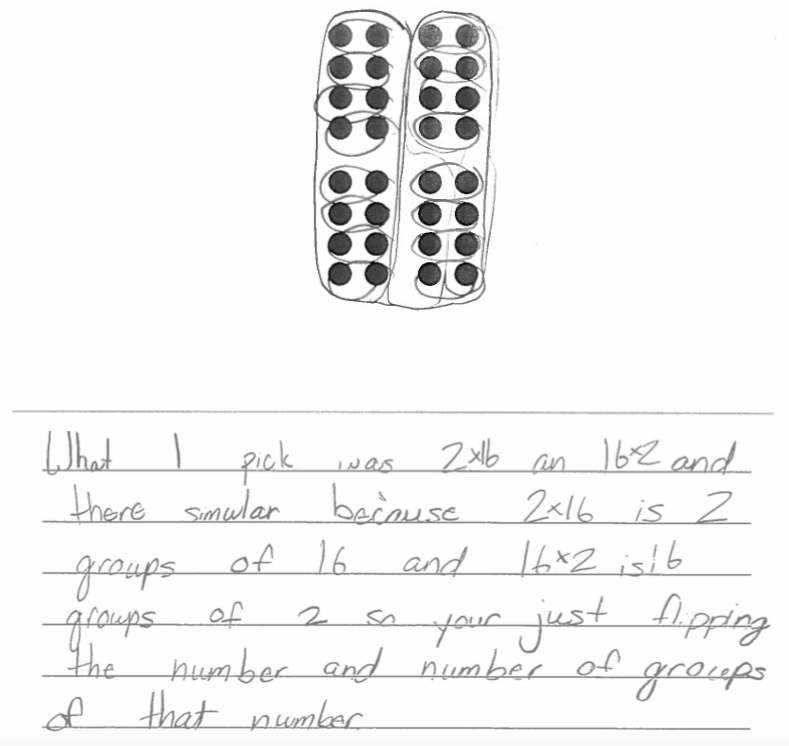
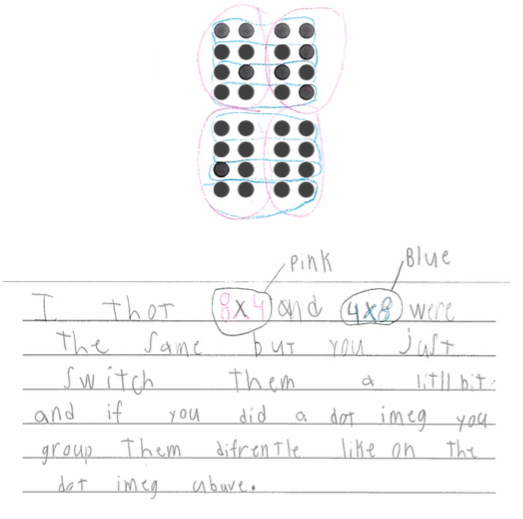
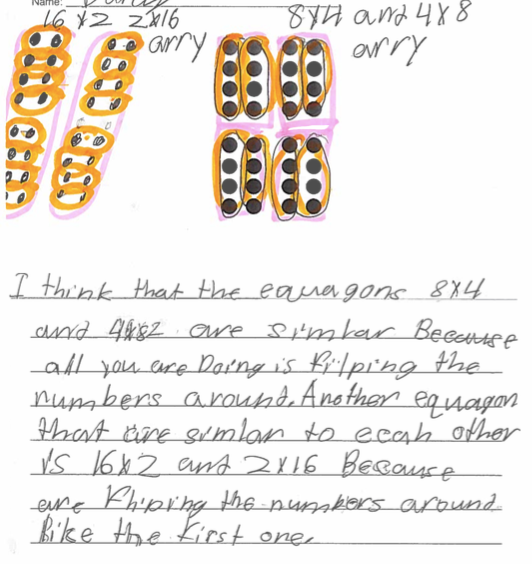
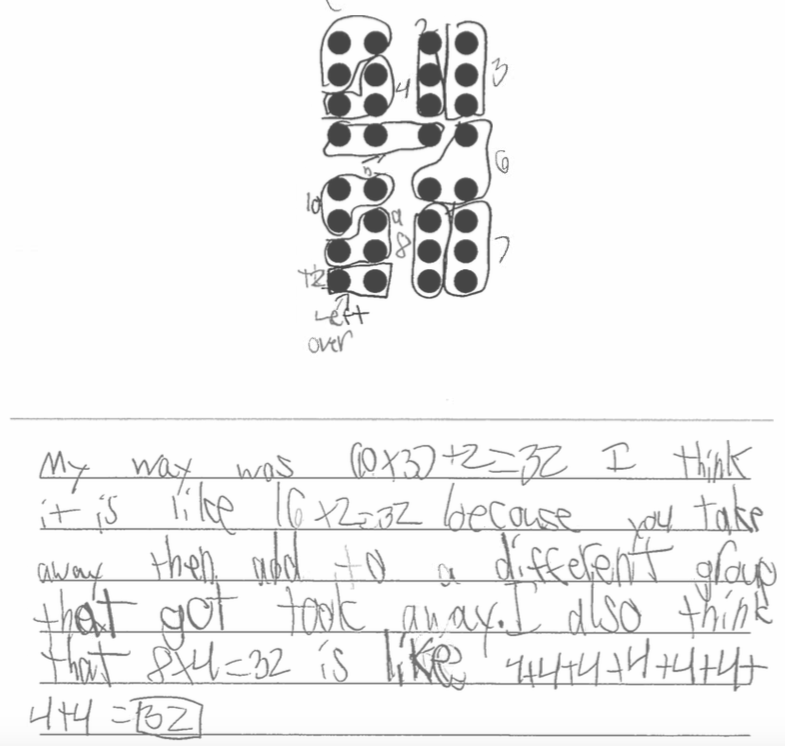
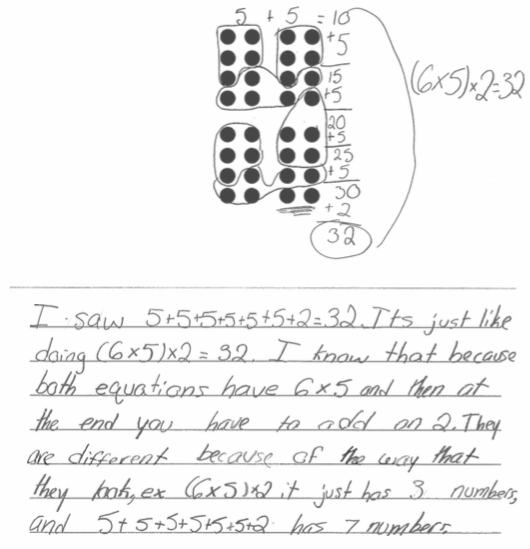
For example, when I planned a lesson on arrays with a third-grade team, we intentionally designed an exit prompt that went beyond a simple right-or-wrong answer. The lesson began with a Dot Image, and students spent the rest of the time building arrays and writing equations to represent them. At the end of the lesson, we returned to one of the dot images from the launch. Instead of asking students to write an equation, we asked them to choose two mathematical expressions that had been shared during the Dot Image discussion and explain how those expressions were the equivalent using the image.

When we later looked through the student journal responses, they became the anchor for our reflective conversation. Each journal entry revealed something a little different: how students were making sense of multiplication, the connections they were noticing, and where their thinking was still emerging.

Math journals don’t just show us what students can do; they offer a window into how students are thinking. Let’s take a closer look at some of that student work based on broader mathematical understandings.

The Commutative Property

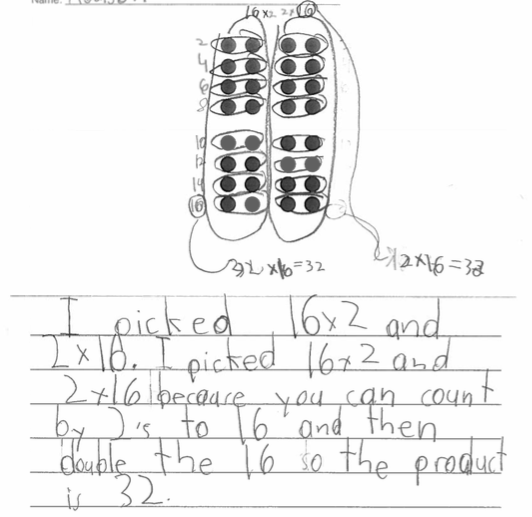
The majority of students chose two expressions demonstrating the commutative property of multiplication. Often students see that you can change the order of the numbers in a multiplication problem and the product remains the same, however in the journal entries, we were able to see student understanding of this property in a representation. 

16 x 2 = 2 x 16

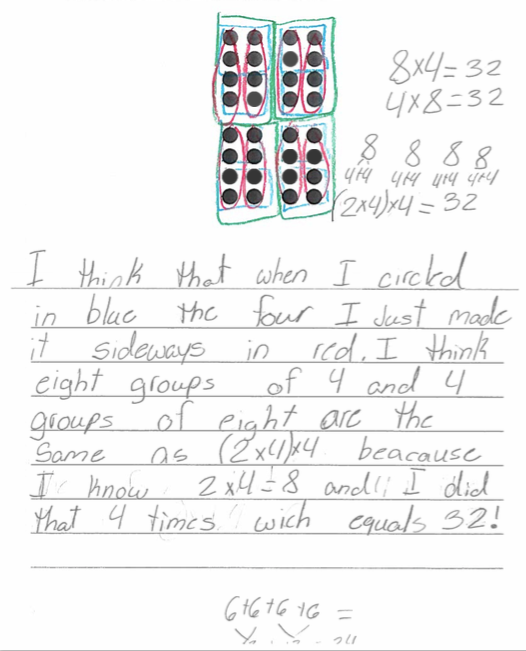
8 x 4 = 4 x 8

16 x 2 = 2 x 16 and 4 x 8 = 8 x 4 

Changing the Number of Groups and Number in Each Group

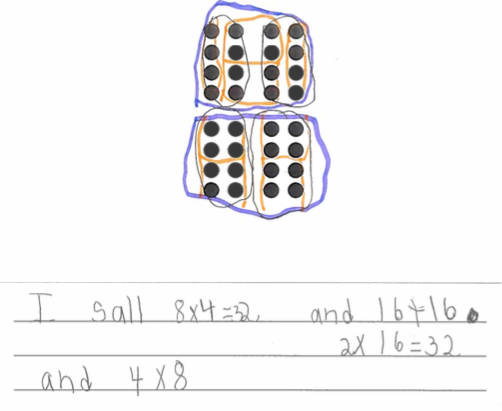
A few students noticed that when they changed the number of groups and the number of dots in each group, the product remained the same. While these students are not yet articulating how the groups are changing, this work provides a great opportunity to plan future conversations around this idea. 

Rearranging the Groups

This response is very similar to the previous responses, however this student is beginning to articulate how the groups are changing. Instead of having 10 groups of 3, the student explains he took some dots away and added them to another group to make 16 groups of 2. 

Relating Operations

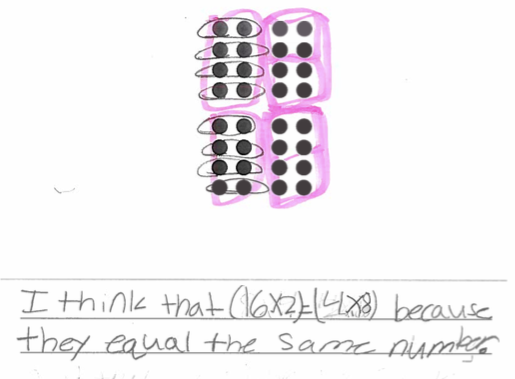
Some students related expressions based on what they understand about the operations and were able to represent these understandings in the dot image. 

While the team and I heard and observed so much interesting student thinking during the Dot Image discussion itself, the journal prompt allowed us to look more closely at each student’s understanding and see the connections they were making. It served as a important formative assessment, one that extended beyond what we could learn through discussion alone.

Math journals have transformed the way I listen to students’ thinking. I love seeing math journaling used across grade levels, from students who are just beginning to represent their ideas to those who are refining written explanations. Journals give students who may not feel comfortable sharing aloud a space for their voices to be heard, while giving teachers invaluable insight into how students are making sense of the mathematics. I encourage all math teachers to incorporate math journals into their classrooms—not just to see how students arrived at an answer, but to uncover the connections, understandings, and confusions that shape their learning. That insight truly informed every planning decision I made in my classroom and deepened my understanding of the not only the mathematics, but how students build mathematical understanding.

Now, off to make some more coffee, grab a good book, and then follow up with some Fortnite or Zelda gaming time:) Happy snowy Sunday all!

Adapting Lessons Part 3: Engaging with Word Problem Contexts

Word problems have always been challenging for me as a teacher and as a coach supporting teachers. I think part of the reason is that you can’t really teach word problems in the traditional sense. Solving them depends on students making sense of a situation and the question they are being asked to answer, and there are many factors that influence that sensemaking.

One factor is the context itself. I know how important it is for students to apply their understanding in both familiar and novel situations; however, every context will be a mirror for some students and a window for others, and when a situation is completely unfamiliar, I have seen it significantly impact how students approach the problem. Another major factor is the language of the problem itself. Many word problems include vocabulary, sentence structures, verb tenses, and multiple steps that shape how students make sense of the situation. These features require them to draw on things like reading comprehension, syntax, semantics, and sequential thinking, not just mathematical understanding and procedural skill. All of these elements influence the mental model students build based on the context and ultimately affect how they attempt to solve the problem.

Because of these complexities, it is not surprising that many students quickly grab numbers from a word problem and compute or search for key words. These strategies often worked for them in earlier grades, with one-step problems, or within curriculum units focused on particular operations. As a result, they do not always read the context as something that should make sense. Instead, they read while thinking, “Which operation do I need to use to solve this problem?” This reminds me of times when I am reading a book with something else on my mind. Even though I am technically reading the words, I can finish an entire page, or even a chapter, and realize I cannot remember anything I just read. I think this is similar to what happens when students read a word problem while also trying to figure out how they are supposed to solve it.

Understanding these challenges gives us important insight into the kinds of instructional adaptations that best support students in sensemaking. When we pause and give students an opportunity to make sense of a context before jumping in to solve, we set them up for more productive problem solving. And, the more we provide these opportunities, the more metacognitive those ‘sense-making structures’ become for students. There are some great math language routines out there, such as Three Reads and Co-Craft Questions, that are productive in a whole-group setting, but can take a lot of class time, require preparation, and may not transfer easily to a new problem for students. Because we sometimes can’t predict the problems that will be most challenging, I also like to have a few back-pocket, in-the-moment adaptations that promote the same type of reasoning and sensemaking.

These adaptations are all about helping students make sense of a word problem before they jump into solving. By giving them time to notice, wonder, visualize, and pose questions, we make the problem more accessible and give students the chance to build a strong mental model. This approach draws on both math and language skills, helping students focus on understanding rather than just grabbing numbers or looking for key words. When we use these adaptations in the classroom, students are more likely to engage in deeper, more productive mathematical thinking and problem solving.

For more ideas and examples, you can check out some related blog posts:

And of course, if you missed the first two posts in this series, you can find them here:

I look forward to hearing about what you might try! You can share here in the comments or over on IG: https://www.instagram.com/kgraymath/

Adapting Lessons Part 2: Structuring Group Work

Just like the launch of a lesson shapes how students access the mathematics, the structures we use during group work support what they do once they’re in it. In these moments, who talks, who listens, and whose ideas move the work forward can either widen or narrow the thinking that happens. Group time can be a place where rich, collaborative work happens, but it involves much more from the teacher than giving the directions ‘work with your group,’ ‘turn and talk,’ or ‘think pair share.’ While a curriculum can provide teachers with helpful suggestions, the uniqueness of each group of students places the responsibility heavily on the teacher, which makes sense. Only the teacher knows their students and the dynamics within each small group. Small shifts in how we organize students, position their ideas, and support their discussions can dramatically impact both the mathematical practices that students engage in as they work and the mathematical thinking that students bring to the whole group discussion afterward. 

After exploring ways to launch a lesson, the next opportunity for quick, high-leverage adaptations comes when students begin working together. From the moment we ask students to collaborate to the moment when we circulate and listen, the structures we choose can either uncover students’ thinking or unintentionally limit it. Thoughtful approaches to group work can support collaboration, build mathematical habits of mind, and strengthen the sense of community we hope to see in our classrooms. In this post, we’ll look at quick, in-the-moment ways to support group work so every student has an opportunity to contribute and every idea has a chance to surface.

Alternate Ways to Work in Groups

Instructional Challenges: When students jump into group work without clear structures for talking and listening, it becomes easy for one person’s ideas to dominate while others disengage. Without intentional support, some students simply “go along” with the loudest or quickest thinker, and opportunities for deeper reasoning are lost. Additionally, when students stay in the same assigned seats, groups can become static. While this consistency can help early in the year as a community is forming, it can also limit the range of perspectives and mathematical ideas students encounter over time.

Each of these routines require students to articulate their ideas and listen to the ideas of others. One routine I love to support these practices is Talking Points. It didn’t really fit with the others in the table, but I wanted to mention it here as I close out the post. This routine includes giving each group a carefully crafted statement (for example, a prompt about multiplication or division), and asking students to respond by agreeing, disagreeing, or saying they’re unsure while explaining why. Because everyone at the table gets a chance to voice their ideas, and then they collectively wrestle with different perspectives, students often reconsider or deepen their understanding about the topic at hand. Finally, when the groups come back together for a whole-class reflection, all students benefit from a wide array of reasoning. I have a collection of blogs about Talking Points  in the K-5 math classes here if you are interested in trying them out! 

Try it!

In your next PLC or planning session, review the activities in an upcoming lesson. As you read through each problem, discuss:

  • What questions should I ask students to discuss in small groups that will move their thinking toward the mathematical goal of the day?
  • What structures can I use to ensure all students have the opportunity to share their ideas and have their ideas heard by others in the class? 
  • Which of the four group work structures will you use to support students as they learn together?*

*If you’re planning with your grade-level team, each person can try a different structure and then compare the affordances of each. I’d love to see what you try! Share your ideas in the comments or on IG (@kgraymath)!

Next up will be routines for supporting student learning as they engage in problem contexts, in particularly word problem sense-making strategies.

Adapting Lessons Part 1: Launching an Activity

As a math teacher and coach, I’ve always adapted curriculum materials. I am sure we all have—it’s part of knowing our students and wanting to provide them with access to the math in ways that make sense to them. And while we have the best of intentions, sometimes the choices we make can unintentionally take the math out of students’ hands, disconnect from what they already know, or even reflect assumptions and expectations we didn’t realize we were holding.

Adapting activities is challenging for many reasons: some decisions require extensive prep, others happen in the moment, and all of them must be balanced with the pressure to keep pace while still giving students the time and space to share the incredible ideas, experiences, and mathematical thinking they bring into the classroom. I also found it difficult at times to know exactly what to look or listen for mathematically, and I sometimes interpreted students’ responses through my own assumptions and expectations. While a high-quality curriculum can provide problems that elicit student thinking, the deeper work of examining what we notice, what we value, and how we interpret and leverage students’ ideas extends far beyond even the most comprehensive teacher guide.

While thoughtful planning ahead of time is ideal, we all know it isn’t always possible. Because so much can get in the way of planning and prep time, I think a lot about how to make quick, in-the-moment adaptations based on what students are saying and doing—and on what I still need to learn about their thinking. I often wonder: What if our adaptations did more than simply “fix” a lesson? What if they opened space for deeper student thinking, a stronger sense of community, and richer mathematical understanding?

These questions keep pushing me to look closely at the flow of a typical lesson and identify the moments where even small adaptations can make a big difference. I’ve found that there are five points in a lesson where a few quick, minor changes can have a big impact:

  • Launching an activity
  • Working in small groups
  • Engaging with contexts
  • Sharing ideas
  • Synthesizing the lesson.

While it would be wonderful to have a single “right” adaptation for each of these, the reality is that different classrooms and moments call for different routines or structures. In the next series of posts, we’ll take a closer look at each of these opportunities and explore practical, in-the-moment ways to adapt them.

Ultimately, the goal of these small adaptations isn’t just to adjust an activity or lesson; they’re meant to open up richer mathematical experiences for students and provide increased insight for teachers. My hope is that these structures encourage sense-making and increase access to the mathematics; provide every student opportunities to share the amazing ideas they bring; create space for questions about one’s own or others’ thinking; build a stronger mathematical community; and support teachers in reflecting on why they’re adapting an activity and how those choices best serve students.

In this post, I’ll outline a few alternate ways to launch a lesson, and in subsequent posts, I’ll explore each of the other lesson moments listed above.

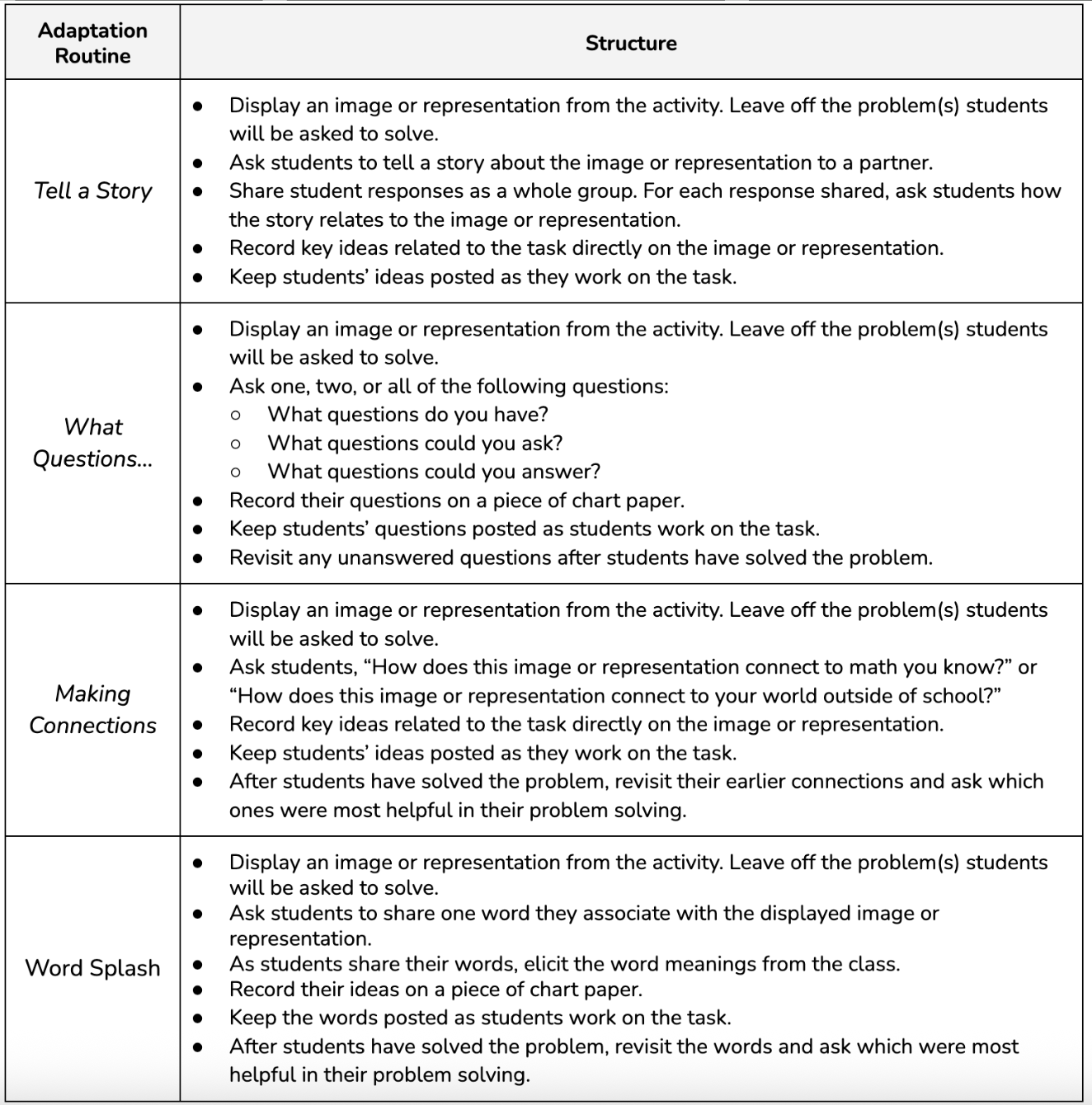
Alternate Ways to Launch a Lesson

Instructional Goal: Provide students with an entry point into the activity. 

When deciding which adaptation to use, it is helpful to think about what aspect(s) of the task might make it inaccessible to your students. For example:

  • If the context or representation of the problem might be unfamiliar to students, you could use the Tell a Story, What Questions, or Making Connections routine.
  • If the activity relies on a prior knowledge from earlier in the year or prior grade levels, it might make sense to use the What Questions or Making Connections routine.
  • If the language (including math language) adds a layer of complexity to the activity, you could use the Word Splash routine.

Try it!

There isn’t one “right” adaptation for any classroom scenario; each is an opportunity to learn more about your students. In the end, it’s not the routine itself that matters as much as what the routine affords—the ways it reveals student thinking, provides an entry point, and supports problem solving. The only way to figure out what works best is to try these structures out! Fortunately, they require little materials prep. All you need is a piece of chart paper or whiteboard and an image from the problem students will be solving.

In your next PLC or planning session, review the activities in an upcoming lesson. As you read through each problem, discuss:

  • What knowledge and experiences are your students bringing to the problem?
  • Is there an activity where students might not have access to the problem? If so, what specifically is inaccessible and why?
  • Which of the four routines will you use to launch the activity?*

*If you’re planning with your grade-level team, each person can try a different routine and then compare the affordances of each one. I’d love to see what you try! Share your ideas in the comments or on IG (@kgraymath)!

Part 2: Supporting student learning as they work in small groups

Slow Reveal Graph / Problem Posing Mashup

I have always loved, loved, loved Jenna’s Slow Reveal Graphs! They provide such an engaging structure that encourages students to explore and reason about data. If you don’t know what Slow Reveal Graphs are, it might be helpful to read up on them here before continuing.

Sense-making is so front and center in a slow reveal activity that I think it could be interesting and exciting to extend this activity with problem posing! I have been learned so much about problem posing from my friend Jinfa Cai. Problem posing is an instructional approach in which students generate and solve their own mathematical problems. In doing so, students share mathematical authority in the classroom and position students as creators of mathematical inquiry rather than solely recipients. I wrote a bit about it in the new NCTM book, Teaching Mathematics Through Problem Solving (pg 73-74).

The Mashup

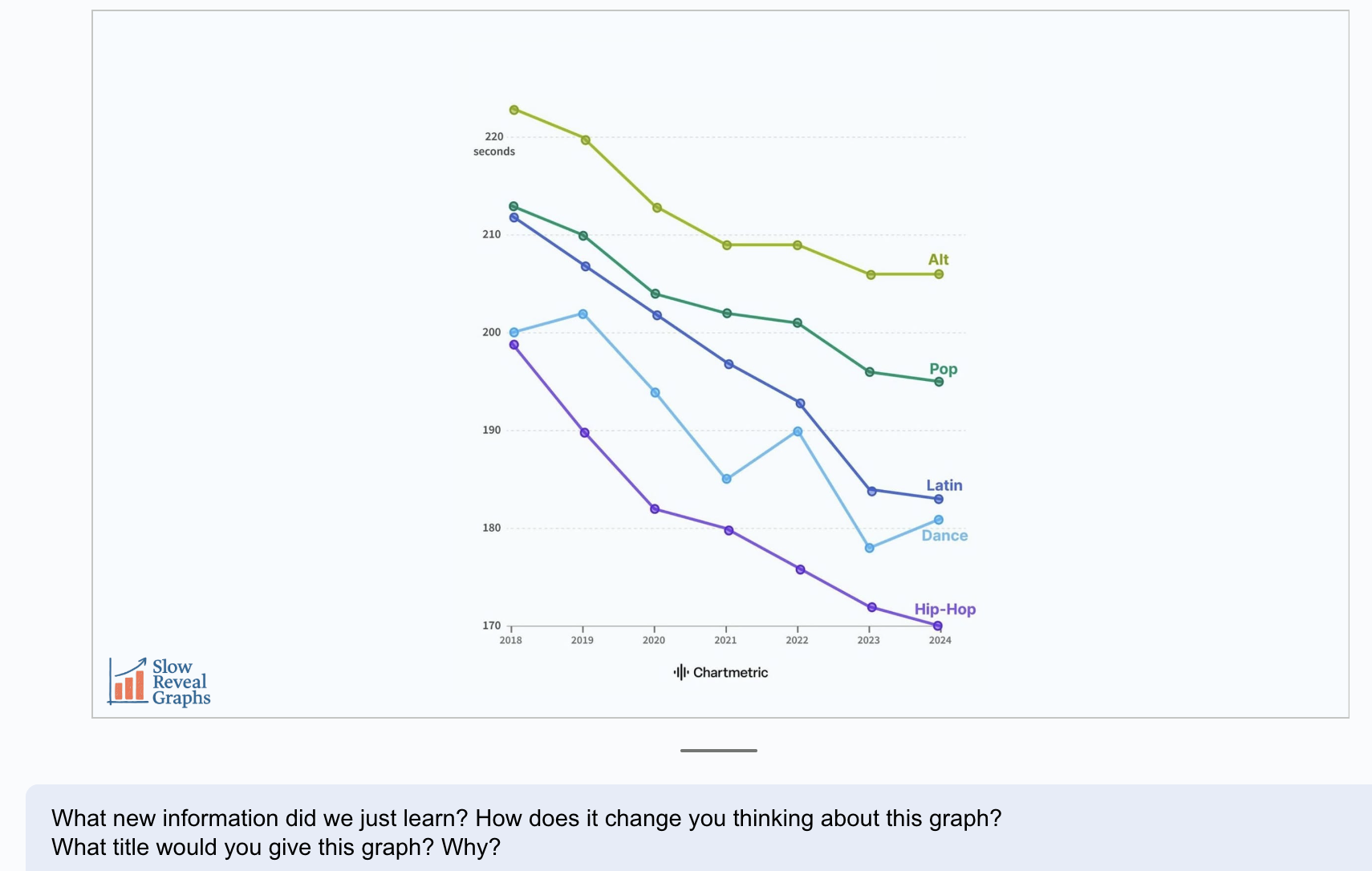
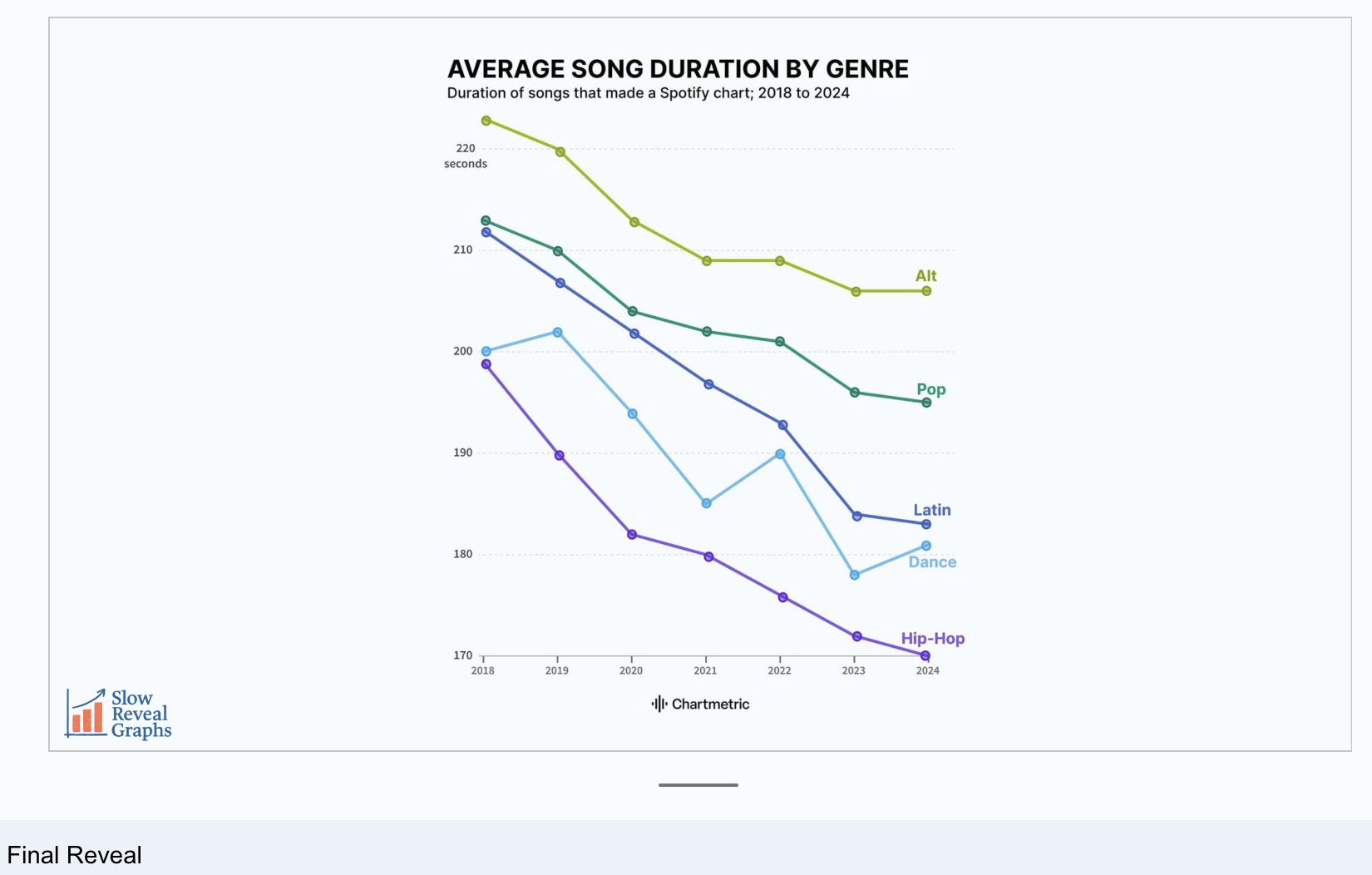
To think about what a mashup could look like, let’s go check out one of Jenna’s recent slow reveal graphs, Average Song Length by Genre. Which is so appropriate because Jenna and I love to chat 90’s hip hop artists;) Oh, and did I mention that Jenna creates a slide deck with notes for each one of these?!?

Step 1: Display the graph and ask students what they notice and wonder. (Slide 1)

Step 2: Display the graph with new information, ask questions that encourage students to interpret the new information, and make predictions about what is still missing…luckily, these directions are in the slide notes of Jenna’s slides. (Slides 2-3)

Step 3: Display the final reveal of the graph. (Slide 4)

Step 4: Problem posing: Ask students to pose problems that can be answered by information in the graph and record them on a piece of chart paper.

Students might pose many different types of problems such as:

  1. Which genre had the longest average song in 2019?
  2. About how much longer was the average latin song than hip-hop song in 2023?
  3. About how much did the average pop song duration decrease from 2019 to 2024?
  4. Which genre had an increase in average song duration? Between what years?
  5. If you listened to a dance song and alternative song in 2022, about how many seconds would you be listening? How many minutes?

This list could go on and on, but you get the point. I know it could be nerve-racking to use a graph like this because there are not definite values at every point, but I think that actually increases the reasoning element and could raise some cool points for argumentation!

Step 5: Ask students to solve their problems.

This is a choose your own adventure — you could ask students to solve all of the generated problems or you could focus attention on one or two problems aligned to that day’s learning goal. I always lean toward the latter so the activity isn’t just a one-off random activity, but instead connected to what they are learning. This also leaves me a bank of ‘if you get done early‘ problems, which was always one of the biggest differentiation challenges for me, and helps me focus the whole group discussion afterwards.

Step 6: Synthesize the learning.

This step is really dependent on the learning goal of the day. After solving, you could have students do a gallery walk to compare solutions and solution methods, representations, and reasoning. Or you could decide to have a whole group discussion based on the monitoring that you did as students worked.

I have always been such a fan of numberless word problems, notice/wonder, and the 3 Reads MLR. Problem-posing feels like it pulls the most purposeful parts of each of these routines into one. Layering problem posing on Jenna’s slow reveal structure puts such an fantastic focus on data while also supporting other areas of mathematical focus. It is also so adaptable by grade level, which makes it so flexible!

Final Problem Posing Thoughts

When students have the opportunity to pose their own mathematical problems based on a situation, they must make sense of the constraints and conditions from the given information to build connections between their existing understanding and a new understanding of related mathematical ideas (Cai, 2022). And when teachers have the opportunity to listen to connections students make, understand the math students see in situations, and make teaching decisions on how to elicit, share, and move forward with student thinking, it shares the mathematical authority in the classroom and leads to deeper, more powerful learning for all!

I have blogged a bit about problem-posing if you are interested in learning more: https://kgmathminds.com/2023/09/23/embedding-problem-posing-in-curriculum-materials/ and https://kgmathminds.com/2023/05/06/problem-posing-fun-in-fourth/.

Formatively Assessing Student Thinking

At the beginning and end of a curriculum unit, I find it valuable to learn what students already know and what questions they have, to help guide my planning and instruction. While pre- and post-assessments can provide useful information, they also tend to limit the range of students’ thinking, especially when students show minimal written work. Because of this, I began using a few key routines. One of these routines, which I call “Tell me everything you know and want to know about [topic],” invites students to share their ideas more openly.

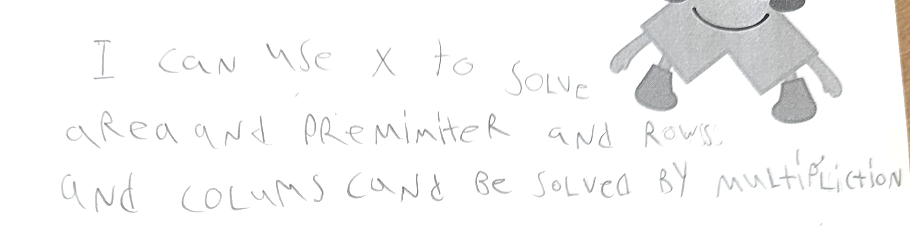
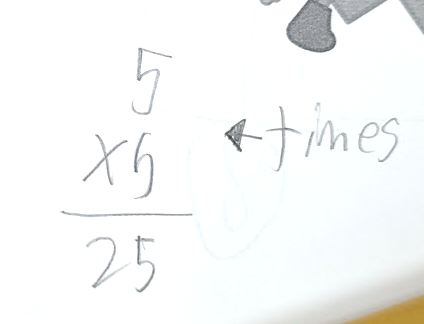
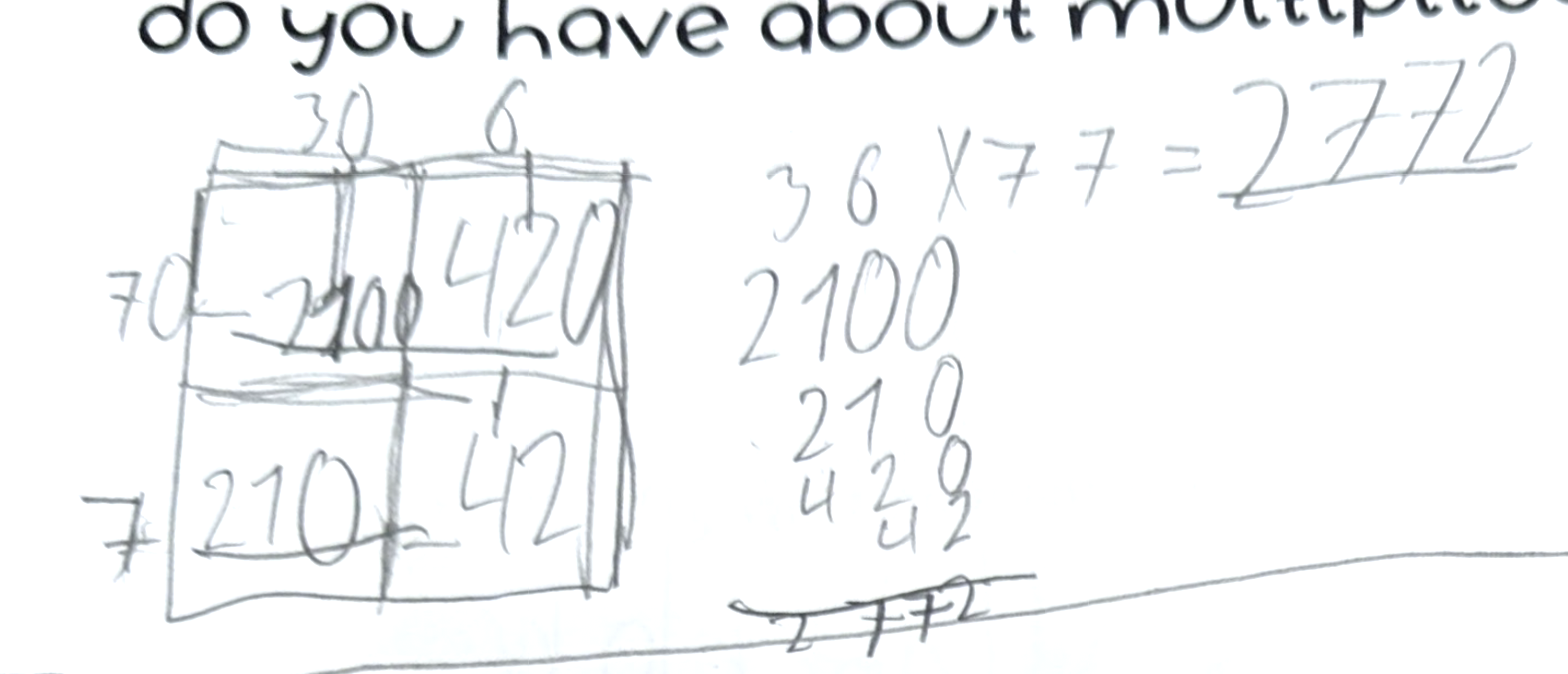
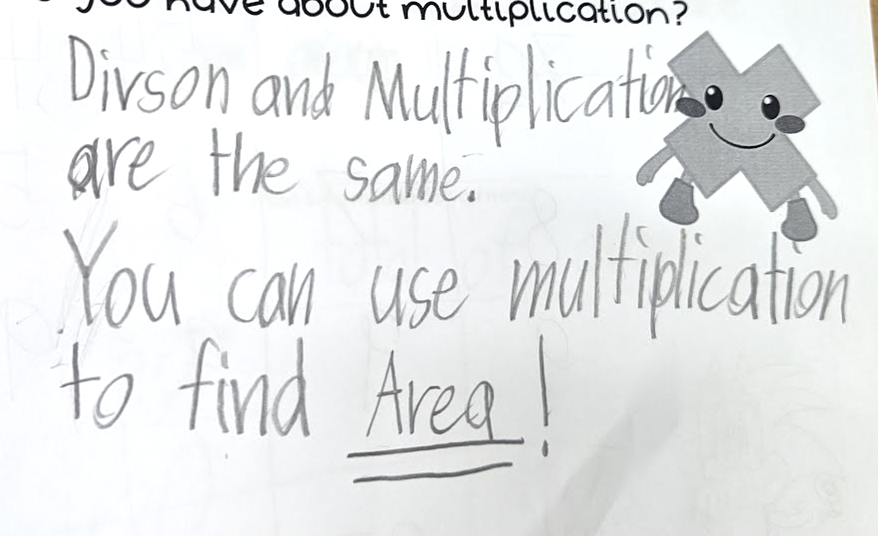
For example, after a 3rd grade unit on multiplication and division, Katie (an amazing 3rd grade teacher) and I wanted to gain insight into what students learned, in their own words. We wanted to give them some individual think time first, so we gave them this simple sheet to record their ideas. We decided to leave the page unlined so students could freely draw any representations that made sense to them. Their ideas definitely did not disappoint! (Click on each thumbnail to see the full page)

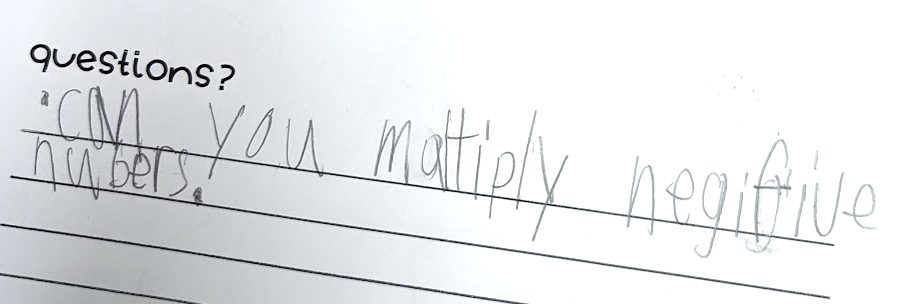
We only got one question, but it was such an interesting one!

I think since it was the first time doing this routine at the end of a unit, we didn’t get as many questions as we had hoped. I do wonder how changes in wording such as “What new questions do you have about multiplication?” or “What wonderings do you have about multiplication?” would impact the amount of questions we would get next time.

After students had their independent think time, we shared their responses as a whole class and recorded their ideas on chart paper to stay up as an anchor chart we could refer back to throughout the year!

If you would like to try this routine before the holidays to see what students have learned, I blogged the directions here. In my next blog post, I will explore another routine I love to formatively assess student thinking! Until then, I would love to hear some of your favorites in the comments!