Category Archives: 4th Grade

Division: What’s Left Over?

Interpreting remainders is something the 4th grade teachers and I talk about a lot because so many students seem to struggle with it. Students can typically determine if they need to divide and find a way to get the answer, but if the remainder impacts the response it becomes more difficult. I believe the struggle is not so much about the remainder, but more about students making sense of problems. Many students love to compute the numbers in the problem and get an answer quickly, however they rarely revisit the problem to see if their answer makes sense. I found an even more interesting thing in their work today though that left me thinking about how their solution path impacted the way they dealt with the remainder.

I launched the lesson with a story. If you read my post on numberless word problems, this will be very familiar. I posed the following story to students and asked what they noticed and wondered:

Mrs. Gannon is having a picnic and inviting some people. She is going to the grocery store to buy bottles of water and packs of hot dog rolls. 

Since the students were on the carpet in front of the SMARTBoard and there was not much space to stand and write on the board without trampling a kid, I decided to sit off to the side and type their responses.

After they shared the things they noticed and wondered (in black font below). I told them I would give them some information that would answer some of the things they wondered. After typing in the numbers, I asked if what they noticed and wondered now (typed in red font below).

Screen Shot 2016-10-12 at 12.17.08 PM.jpg

(Side note: The cost of things is something I would love to weave into a lesson in the future because that came up a lot and will be great to see what they do with some decimals.)

Since they noticed how much water Mrs. Gannon needed, I wanted to see how they dealt with the hot dog rolls because the remainder would make a difference in the answer. I asked them to find how many packs of hotdog rolls she would need.

Some divided and got 4 r 4 as their answer (the skip counting on these pages came after their chatted with their group.

Some skip counted to get the packs of water and hot dogs:

Others used some multiplying up, some right, some interestingly not:

While I could probably talk for a while about all of the interesting things they did in solving the problem, the most interesting thing to me today was looking at who got the correct answer of 5 packs on their first try.

This is what I noticed as I walked around:

  • The students who went straight to dividing said their answer was 4 remainder 4, no reference to the context, no mention of using that remainder for anything.
  • The students who skip counted nailed it on the first try. They said as they counted they knew 32 rolls were not enough for everyone so they needed to keep going to 40 so everyone got one. They mentioned the context throughout their entire explanation.

I continued the conversation with Erin, the reading specialist, when I got back to the room. We started talking about how this contrast could play out in two different scenarios:

  • On a standardized test, given this same context and answer choices of 4 and 5, the students who could efficiently divide may choose 4, while the skip counter would have gotten it correct.
  • On the same test, give a naked division problem, no context, the efficient divider gets it correct but what about the skip counter. Can they think about the problem the same when their is no context or does skip counting make most sense with a context?

Because I thought it would be interesting, before I left, I asked them how many people she could invite so she had no leftovers at all. Fun stuff to end the class…

IMG_3164.jpg

IMG_3157.jpg

IMG_3161.jpg

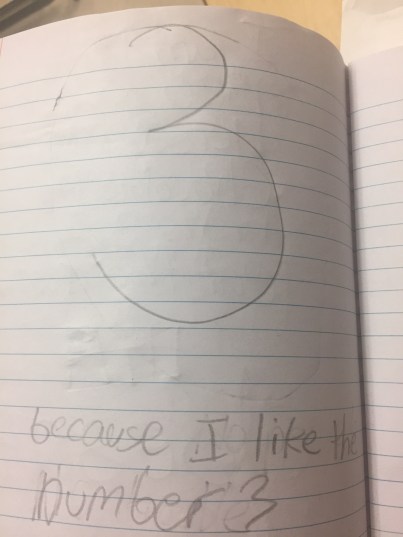
And of course, some students are just funny….
IMG_3165.jpg

What Is It About These Questions?

Today, I gave the 4th graders four questions to get a glimpse into how they think about multiplication and division before starting their multiplication and division unit. Michael Pershan had given the array question to his 4th graders last week and shared the work with me. As we chatted about next steps with his students, I became curious if the students think about multiplication differently depending on the type or setup of the problem.

Here were the questions:

After sorting 35 student responses I found the following:

  • 17 students got the area question wrong but the two multiplication problems on the back correct. Not only correct, but with great strategies based on place value.
  • 8 students got all of the problems correct, however the area was found in many ways, some not so efficient with lots of addition.
  • 10 got more than two of them incorrect. Some were small calculation errors on the back.

So, what makes almost half of the students not get the area?

Here is the perfect example of what I saw on the majority of those 17 papers:

img_3066 img_3067

Then I did a Number String with them to hear how they shared their mental strategies. I wanted to get more insight into some of their thinking because a few students had used the algorithm on the back two problems.

They did great. They used the 10 and 20 to help them solve the problems and talked about adding and removing groups of one of the factors. I was surprised on the final problem of 7 x 18 that no one used the 7 x 20 but instead broke the 18 apart to find partial products.

IMG_3062.jpg

This makes me think there is something about that rectangle that makes them not use the 10s to help them decompose for partial products. I would love others thoughts and ideas!

————————————————————————–

After reading the comments about area and perimeter, I wanted to throw another typical example of what I saw to see what others think of this (when I asked her she could easily explain partial products on the second and third problem)


One Hundred Hungry Ants – 4th Grade

Next year, we are restructuring our RTI block to be a time when students are working in small groups in their classrooms. This is a really exciting change from our previous model in which students were pulled from their classroom for intervention. This change will shift our Learning Lab focus to planning small group activities, however the first, REALLY important, piece we need to focus on is how small groups work in the classroom. I think the K-1 teachers have a much better sense of how centers work within the classroom, although we still want to move from the current centers to more strategically planned small groups. So, with only a week and a half left of school, Erin and I are playing around with some ideas in the classrooms as a part of our planning! Fun!

Erin and I planned for a 4th grade class today where we were going to test out a small group scenario. We started in a way I imagine everyone could kick off the year next year, involving students in the process. We asked them what they needed in order to learn in small groups. Below are all of their great responses, most of which were accompanied by an example of something they had experienced during small group work.

IMG_2494 (2).jpg

I launched the small group task by reading One Hundred Hungry Ants aloud, pausing occasionally to ask for predictions. After the reading, I didn’t preview the task, but instead sent them off to work in their small groups. This was for two reasons: to see if the wording of the task was clear enough for students to follow independently and to see how they worked as a small group. We choose to give everyone the same task today to see how it went but we are trying different small group tasks tomorrow.

Each group had a journal, storyboard, and this task card:

Screen Shot 2016-06-06 at 7.57.14 PM.png

They worked for about half an hour and had some great conversations. I especially liked the conversation sparked by the third question because number choice is something I find so interesting. They also had to do some serious negotiating to decide which number they would do as a group since everyone had different reasons. In one group a student wanted to pick 2 because they would “get there faster,” another wanted 75 because “it could make a lot of combinations, but be less than 100 so they could still make it in time.” In another group, a student was saying he didn’t want any prime numbers because you could only do two lines with them.

This one was great because they changed the storyline from finding a picnic to getting to Dairy Queen, but when they get there they had forgotten their money so they still got no food. Different story, same ending.

This one was so interesting because, unlike the book, they used the commutative property, seeing the arrangements as different situations, which the book did not do:

This group saw a lot of doubling going on in their arrangements when they chose 50 instead of the 100 in the book:

We came back together and talked about the patterns they saw.

IMG_2495.jpg

While the math conversation was interesting and I can definitely see some great generalizations stemming from this work, tonight I am thinking more about the questions I am left with about small group work…

  • Could a teacher work with primarily with one group, realistically, without continuously checking in on the others?
  • How can we structure the work so everyone in the group is working on the recording at the same time and can see what is being written? We saw a lot of the journal or storyboard sitting in front of one student. Not that the others weren’t contributing, but they all couldn’t see what was being written. I think dry erase boards can work well here.
  • What type of formative checkin can we do with each group that doesn’t add to an already growing pile of papers to be graded or give feedback?
  • How do we control the noise? The students were not being purposely disruptive or off-task, they were just loud and began talking louder to hear one another.
  • What does this look like at other grade levels?
  • How can we keep this interesting for students to do every day while not making it a planning nightmare?
  • How can we embed more student choice in the task?

More to come tomorrow when we tackle these tasks:

Screen Shot 2016-06-06 at 8.22.29 PMScreen Shot 2016-06-06 at 8.22.41 PM

Formative Assessment

Assessment always seems to be such a broad, hot topic  There are rubrics to help create assessments, rubrics for reviewing assessments, and tons of reading about the benefit of assessments. While I agree assessment is an important topic of conversation and all of these things can be helpful, I just lose a bit of interest when it becomes so cumbersome. I feel the longer the rubric and steps to create an assessment, the more detached the assessment becomes from student thinking.  This could be completely be my short attention span speaking, however the way assessment is discussed feels either like data (a grade or number-type of data) or a huge process with tons of text in rubrics that I really, quite honestly, don’t feel like reading. Not to mention, I just love looking at student writing and listening to student thinking when planning my immediate next steps (formative) or checking in to see what students have learned over a longer period (summative). This is why I find the work we are doing each month in our Learning Labs such a wonderful way to think about formative assessment in an actual classroom context, in real time.

This passage from NCTM’s Principles to Action really captures how I feel about the work we are doing in our Learning Labs:

Screen Shot 2016-04-06 at 2.43.31 PM.png

In this most recent Learning Lab in 3rd grade, we planned the activity together using the 5 Practices model and reflected after the lesson. Since this blog is always my thoughts about student work, I thought it would be great to hear what the teachers took away from the activities we are doing in terms of the students’ understandings and impact on their future planning, formative assessment.  

The teacher mentioned in the blog said, I was surprised by how quick many of the students defended their responses that 1/2 will always be greater than 1/3, and then proving this response using visual representation of the same whole ( which is an idea that we have made explicit). I was impressed with “skeptics” in the crowd that were looking to deepen their understanding around the concept by asking those “What if” questions.  Going forward, I want to create opportunities that push and challenge my student’s thinking. I want them to continue to question and explore math – especially when it uses the word “always.”

Another teacher who taught the same activity after watching it in action in another classroom said, “I learned that almost half of my students assumed they were comparing the same size wholes.  They agreed with the statement, and each student gave at least two different ways to prove their thinking (area and number line model were most common).  The students that disagreed almost all provided their own context to the problem, such as an example with small vs large pizzas, or a 2 different-length races being run.  I found it so interesting that almost all students confidently chose one side or the other, and were able to defend their thinking with examples (and more than one-yeah!)  I was excited to see that they could be so flexible in their arguments as to why they felt as they did.  Three students responded that they were unsure, and gave reasons to support both sides of the argument. This impacted my instruction by giving me such valuable formative assessment information with a simple, non-threatening prompt.  It took about 5 minutes, and gave me tons of information.  It was accessible and appropriate for all.  Students were comfortable agreeing or disagreeing, and in some cases, saying “unsure-and here is why.”  I was most excited about that!”

She also said, From this activity, I learned that I really needed to revisit the third grade standard to see what is actually expected.  It says they should recognize that comparisons are valid only when the two fractions refer to the same whole.  My statement didn’t have a context, so how cool that some were at least questioning this!   This impacted my planning and instruction by reminding me how thinking/wondering about adding a context to the statement would influence their responses.  I am also reminded that I need to stress that students must consider the whole in order to make comparisons accurately.”

Earlier in their fraction unit, the third grade teachers used the talking point below to hear how her students were talking about fractions. (This work is actually from another teacher’s class, but you get the idea;)

A teacher who did this activity reflected, “From this activity, I learned my students had only ever been exposed to a fraction as a part of a whole (and wanted to strictly refer to fractions in terms of pizza). This impacted my instruction by being sure to have the discussion that fractions can represent parts of a whole, but we can also represent whole numbers with fractions.”

To me, these reflections are what assessment should be….the teachers learn about student thinking, the students think about their own thinking, and what we learn helps us plan future lessons with our students’ understandings in mind!

More examples from different grade levels where the teachers and I learned so much about student thinking that impacted future instruction:

Kindergarten: Adding

Kindergarten: Counting

1st Grade: Fractions and Adding

2nd Grade: Counting and Leftovers

4th Grade: Division

5th Grade: Fraction Number Line

Rhombus vs Diamond

Every year in 5th grade, when we begin classifying quadrilaterals, students will continually call a rhombus a diamond. It never fails. While doing a Which One Doesn’t Belong in 3rd grade yesterday, the same thing happened, so Christopher’s tweet came at the most perfect time! (On Desmos here: https://t.co/rZQhu2SGnR)

Of course I had to pop into the same classroom today and try it out! The lower right was so obviously a diamond to me that I was curious to see if students saw the same thing and if it changed their reasoning about the rhombus as a diamond.

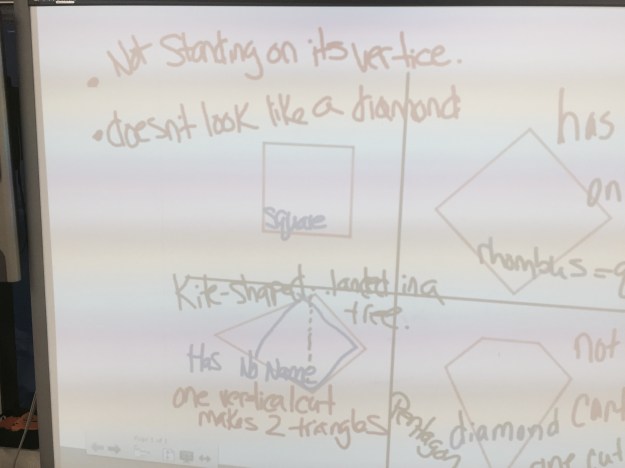
Here are pictures of the SMARTboard after our talk:

IMG_1784IMG_1783

After great discussions around number of sides, rotations, decomposition and orientation, they finally got to the naming piece. Honestly, I was surprised names didn’t come up as one of the first things. It started with a student saying the square didn’t belong because it is the only one that doesn’t look like a diamond. The next student said the lower left was the only one “that didn’t have a name.” When I asked him to explain further, he named the square, rhombus, and diamond. Because I knew at the end of our talk I wanted to ask about the diamond vs rhombus, I wrote the names on the shapes. Another classmate added on and said the lower left “may not have a name but it is kite-shaped and looks like it got stuck in a tree sideways.” I asked the class what they thought about the names we had on the board and it was a unanimous agreement on all of them. Funny how quickly they abandoned their idea from yesterday, so I reminded them….they were not getting off the hook that easy;)

“Yesterday you were calling this rhombus a diamond, what changed your mind?”

Students explained that the lower right actually looks like a real diamond and the rhombus doesn’t now that they see them together.

“Can we call both of them a diamond?” I asked. I saw a few thinking that may be a great idea. I had them turn and talk to a neighbor while I listened to them.

We came back and they seemed to agree we couldn’t call them both a diamond because of the number of sides. They were really confident in making the rule that the quadrilateral one had to be a rhombus and the pentagon was the diamond. I pointed to the kite and asked about that one, since it has four sides. “Could we call this a rhombus?” They said no because the sides weren’t equal, so not a rhombus. And because it didn’t have five sides, not a diamond either.

Thank you Christopher! All of these years of trying to settle that rhombus vs diamond debate settled right here with great conversation all around!

Next up, this one from Christopher…


Fraction & Decimal Number Lines

Recently, our 3rd, 4th, and 5th grade teachers had the opportunity to chat math for 2 hours during a Learning Lab held on a professional development day. It was the first time we had done a vertical lab and it felt like perfect timing as 3rd and 4th grade would soon be starting their fraction unit and 5th would be entering their decimal unit. Prior to the meeting, we read the NCTM article, “Identify Fractions and Decimals on a Number Line” by Meghan Shaughnessy, so we started the meeting discussing ideas in the article. We then jumped into playing around with clothesline number lines and double number lines, discussing what they could look like at each grade level based on where students are in the fractional thinking.

I have co-taught number line lessons in both 5th grade and Kindergarten this year, but both were a bit different in not only number, but organization. In 5th grade we used one clothesline with the whole class, while in Kindergarten we used tape on the floor and students worked in small groups. Leigh, 5th grade teacher, was interested in trying the small group number lines on the floor. As we planned the lesson, the one thing we thought would be difficult about having small groups is getting around to each group to hear their conversations, especially when we were planning cards purposefully to address misconceptions and misunderstandings. However, knowing we would have the two of us circulating, as well as two 3rd grade teachers who wanted to see the lesson (yeah!), we knew we had plenty of eyes and ears around the room to hear the math conversations.

During the lesson, in groups of three, students placed 24 cards on their number line. There were two sets of cards, so after placing all of their cards, each group visited a number line with a different set of cards to discuss. Instead of boring you with all of the number choices we made, here are a few of the choices in cards and the reason(s) we chose them:

1/3 and .3: Students often think these two are equivalent so before the decimal unit we were curious to see how they were thinking around that idea and how they used what they knew about fractions or percents to reason about it.

0.3, 0.33, 0.333, 1/3: The 1/3 and .333 were there to think about equivalency, while the others were there to think about what is the same in each and how much more each decimal has to make it larger. Which you can see caused some confusion here:

IMG_1729.jpg

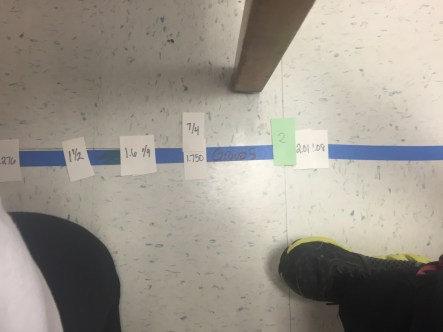
2.01 and 2.08: We were curious about the distance they put between these two cards.

1 6/9 and 1.6: We wanted to see how students compared fractions and decimals when they can’t easily convert 6/9 into a decimal. Then, if they began thinking 6/9 and 6/10, how would they decide on the larger fraction and then how much distance do they put between them?

The group below practically had them on top of one another:

IMG_1736.jpg

While this group had a bit of a space between them:

IMG_1726

2.8 and 2.80: Tenths and hundredths equivalency. They all seemed to handle this with ease.

.005 and 1/100: Curious to see the placement in relation to the other numbers. This 1/100 is close to 0 but I wonder about it in relation to the .2. Definitely a conversation worth having!

IMG_1730.jpg

2.8 and 2 7/8: To see how they compared the 7/8 to the 8/10.

After they visited other number lines, they had a chance to meet with that group and discuss card placements they agreed with and placements they did not. Groups then made adjustments accordingly…

IMG_1737.jpg

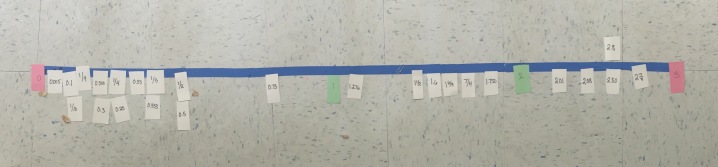
Here was a group’s completed number line and my first stab at panoramic on my phone!

IMG_1735.jpg

The journal entry we left them with was, “Which cards were the most difficult to place on the number line? Why?”  Many were just as we suspected.


The conversation as I walked back over to the other building with the 3rd grade teachers was, what does this look like in 3rd grade? Could we use array images to place on the line instead of the fractions? Could the pictures include over 1 whole? What whole numbers would we use? Do we play with equivalent pictures with different partitioning? Being mindful of the students’ second grade fraction exposure, below, we are planning on trying out something very soon! I am thinking the cards like these on Illustrative, with the pictures but no fraction names at this point.

CCSS.MATH.CONTENT.2.G.A.2
Partition a rectangle into rows and columns of same-size squares and count to find the total number of them.
CCSS.MATH.CONTENT.2.G.A.3
Partition circles and rectangles into two, three, or four equal shares, describe the shares using the words halves, thirds, half of, a third of, etc., and describe the whole as two halves, three thirds, four fourths. Recognize that equal shares of identical wholes need not have the same shape.
…and then could the journal could be, “Can you name any of the fractions on your number line? How do you know?”…or something like that!


Show Your Work vs Show Your Thinking; 4th Grade Division

The Planning

Last week, the 4th grade team and I planned during our Learning Lab for their first division lesson in Unit 3 of Investigations. The book opened with the following problem:

Screen Shot 2015-12-13 at 8.45.53 AM.png

As we talked during the lab, one of the main concerns expressed by the teachers was student comprehension of the context. This was not necessarily in reference to this specific problem, but story problems in general. This is not surprising and definitely something, I would say, we as teachers face quite often. This is why I love Notice/Wonders and offered that as an idea to take that “number grabbing and compute” feel out of the problem.

As we read the problem aloud, we anticipated how students may respond in two scenarios:

  • Keeping the numbers in the problem and taking the question out.
  • Taking out both the numbers and the question.

We opted for the second one with the thought that we could ask them to anticipate what a question may be for this problem and what information they would need from us. It felt like a bit of a mash up of noticing/ wondering and a 3 act task.

The Launch

I really want to get to the student thinking here so I will not go into the details of the N/W, but here is what we ended our conversation with…

IMG_1286 (1).jpg

After this, we gave them the original problem and sent them off too work on the problem. After 5 minutes of individual time, they came together as small groups to share their work and create a poster with all of their strategies.

*We did debate that last sentence for a bit. We didn’t know whether the rows being the same size would arise and/or if it would send the problem in a different direction. Another 4th grade teacher tried it without that sentence in a different class period and it didn’t seem to change the focus of the work so I wonder if student make that assumption? Then I wondered if we give too many problems that are arrays and maybe don’t play around more with the “extra” pieces that could be added on?

Show Your Work vs Show Your Thinking

After the lesson, I wasn’t surprised by the students’ strategies as much as I was left questioning how we posed the prompt for students to show their strategies. The teacher asked them to solve the problem and show their work. This piece is not something we talked about at all in our planning because it is what we all say, but does that make a difference in how students show their solution path? Do we ever make explicit the way we can show our thinking clearly and explicitly either pictorially or numerically?

As I walked around, I would have thought at first glance that over 50% of the students were “passing out the apples” on their paper to arrive at 14, however after asking them to explain their thinking to me, I would have completely assumed wrong.

For example, this student’s work (on the left) was just the rows and dots underneath it when I walked by. I assumed he had “passed out” 56 apples to each of the 4 rows, however when I asked him to explain his thinking to me, it was so much more than that. He said he “gave each row 10 because that would be 40 and then there were 16 left, so half of that is 8 and half of that is 4, so each row got 4 more. I asked him if we could take what he did to write an equation for it? He said 10+10+10+10 and then wrote 10×4=40 and added the 4×4=16 underneath. I asked where the 56 apples appeared in his work and where the apples in each row were. So, the thinking he explained made his understandings so much more clear than the work he had shown. I wondered if he really needed to show all of that work or he just thought he did for the teacher to see “work”? Next, I partnered him with his neighbor (work on the right) to talk about how his thinking could be show within her multiple tower.

IMG_1287.jpg


When I walked up to this student, she had everything on her paper but the equations on the right. I asked her to explain her thinking and she explained that she divided up the 56 into 4 rows. By the way it looked to me, her x’s were written going down each column which did not indicate to me that she has passed them out so I asked her if she solved using those x’s and she quickly responded, “No, I just got bored…see all of my decorations!” I pressed her a bit more to explain how she got the 14 and she said she knew 8 x 7 = 56 and she used that but was having trouble explaining it. I asked her if she thought it may help her remember if she wrote down the 8×7=56 on her paper and quickly after she wrote it she explained she had halved the 8 and doubled the four. Again, he work would not have matched her thinking. IMG_1292

Going in the other direction, this student had the 56 circles with 28 labeled at the top, 14 labeled on the right and the equations written at the bottom when I walked up. I assumed she had split the 56 in half and then in half again, using what she knew from her equations. However when I asked her to explain her thinking, I found she had drawn the circles one at a time in rows of 4. She said she split it into two groups, counted the 28 on one side and then counted how many were in one column. This was interesting to me and I am kicking myself about not asking more about the 4 rows because she counted by rows of 4 but then found her 4 rows of apples actually in the 4 columns. In this case I would have assumed things that didn’t happen from her work that really didn’t match what she was thinking.

IMG_1294

Here are some other great examples of student thinking:IMG_1291IMG_1290IMG_1289 (1)

IMG_1293 (1)

Show your work versus show your thinking…do we say both? do we make explicit what we mean by them? I am not sure, but what I do know is that we never learn more about student thinking than we do when we talk to students about their work!


4th Grade Multiple Towers – Pt 2

Due to a schedule change today because of an assembly, Malorie and I did not get a chance to sit and plan together before teaching the lesson. Luckily, she is always so prepared and had read my thoughts on the blog I did yesterday about it so we went into the lesson with a common vision and then talked our way through the shortened class period with the students.

We started with choral counting by 3 and then 30. We chose to include 5 multiples in each row in hoping the students would see a pattern in the “friendly numbers” if they struggled to see patterns in other places. After the list was up, they took a few minutes to write  down any patterns they saw in their journals and we shared out. This was the count and then notices Malorie typed as they were sharing:

IMG_1181.jpgIMG_1182.jpg


I could have stayed with these patterns all day long, but we decided to let students revisit these patterns over the course of this unit. There are some really great ones up there like adding the digits and that number is also a multiple of three and if you add any of the numbers up there, the answer will also be a multiple of 3. They made some predictions about numbers that would show up later in the list and talked about connections between the two lists. Multiplying by 10 and the zero “put on the end” was definitely the most popular noticing of the class period, which was a nice lead into our stacking of the boxes of oranges.

We explained the boxes of oranges held 30 oranges and asked them to estimate how many boxes (represented by the post-its) would be needed to stack up to Mya’s shoulder. Malorie and I quickly tried to figure out if we wanted to ask about number of boxes or number of oranges and decided to give them the option of either. It worked out beautifully because the majority of students told us boxes along with how many oranges it would be as well. As Malorie stacked the post-its, the students counted along. Some were counting post its while I heard others counting oranges. We stopped approximately halfway, took adjustments on their estimates and continued. We finished with 480 oranges, 30 boxes. As we were running out of time, we decided to end by asking if there were any equations they could think of to represent the oranges and boxes.

I was surprised to get division first…480 ÷ 30 = 16 and then 16 x 30 = 480.

This was unfortunately where we had to leave off because the classes were shortened and then next class was waiting at the door. So we met during her planning later that day to regroup and find our starting point for the next day.

Tomorrow we have decided to lead with a talk about the orange tower we built today. This is where we had a big discussion around what we want to really have students think about….the book seems to really focus on the multiplying by a multiple of 10, like what would be the 20th multiple, the 30th multiple, etc but we want to play around with the properties a bit more here.

So, we decided to ask students what equations or expressions they could use based on the tower to arrive at the 330 post it. We are thinking we may get some things like this:

30 x 11

(3 x 10) x 11

(3 x 11) x 10

(30 x 10) + 30

(30 x 10) + (1 x 30)

We want to set them equal to one another and ask how they could prove are the same answer. We are hoping to see the associative and distribute properties come out. We definitely could get some division too and that could make it really interesting!

We decided to go with this because Malorie says that she often sees students “putting one zero” on the end of any number when they multiply by any multiple of 10. For example, when multiplying 40 x 30, they will just get in the habit of putting one zero because they don’t see that 10 x10 happening. This is where being able to think about 40 x 3 x 10 is helpful for students.

Next, they will make their multiple towers based on these numbers we will assign to partners: 15, 16, 32, 28, 24, 48, 18, 36, 35, 70, 45, 14. Since Doubling/halving is coming up, we thought this could bring out some of those ideas. Then we will ask them to come up with expressions for any number they choose in their tower. We had planned for that to be in their journal, but I wonder if that is something they could hang up next to their tower for a notice/wonder walk around the room? Hmmm…have to ask Mal in the morning!

~Kristin

Follow Up…today we did a choral count 6 and then 60 and the pattern-finding was even better then yesterday. It was always amazing to me how students notice new things and then based on how we record. This time Malorie did four multiples in each row so in addition to finding new patterns, they also started comparing it back to what they noticed yesterday during the 3 and 30 count. Even though the 3 and 30 count was not up on the board anymore, they still remembered the patterns and numbers like they were right in front of them because they were so excited about them. So cool to see/hear. 

Next, we looked back at the multiple of tower to 30 on the wall. I asked the students if they could find an equation with the answer of 330 (which was on the tower) using numbers on the tower and gave them time to jot some ideas in their journal. 

As the students started to share, I realized it was a really Badly Worded Question. As they shared I was getting “ways to get 330” but not relating anything to the tower, which we were hoping would happen. We wanted to see the associative and distributive properties emerge, but were getting addition and subtraction equations. 

So, as I got “420-90=330 and 270 + 60=330…” etc, I asked “How would would you show that action on the tower….and then they were on a roll. I didn’t want them to think what they had written was not valued so we asked them to share what they had originally written and we built on from there! There is SO much to work with here so I cannot wait to plan for some exciting algebraic work. 

IMG_1184.jpg

I had to plan with another teacher so I left as the students began working on their multiple towers. After they finished their own towers, we were going to ask them write equations for a number on their tower based on moves on their tower. I have to check back in with Malorie in the morning! 

~Kristin


Multiple Towers in 4th Grade

In the Making Number Talks Matter chapter on Division, one of the strategies described was “Make a Tower.”

FullSizeRender 22.jpg

This strategy immediately reminded me of the 4th grade lesson in Investigations called just that, Multiple Towers. To make the timing even better, I am planning and teaching that lesson with a 4th grade teacher this week. The goal of this lesson is not necessarily eliciting a division strategy, but there is so much possibility for so many things in this lesson. Because of that, however, I am struggling with how we can leave it open enough for the many ideas to emerge, but focused enough to have a purpose in our planning.

The structure of the lesson, as it is the book, looks roughly like this:

Students count around the classroom by 3’s to 72 and it is recorded on the board. They then count by 30’s to 720 and it is recorded on the other side of the board, so both lists are visible. Asking students what they notice and what relationships they see. We record these noticings and leave this because the investigation of multiplying by a multiple of 10 continues to emerge throughout the unit.

Next, as a class, we introduce multiple towers through a context of stacking boxes of 30 oranges. Using post-its on the wall, students place the post-its one above the other, labeling the amount of oranges as the tower grows until it reaches the shoulder height of one student.  We then ask if there is anything in the tower that would help us figure out how many oranges are there without counting each one? They estimate how many to the top of the student’s head, ask how many multiples are there, and record equations for it.

Choosing from the list below, students work with a partner to create their own multiple towers as tall as one of them on a strip of paper:

Screen Shot 2015-11-28 at 2.58.03 PM.png

Screen Shot 2015-11-28 at 2.57.45 PM.png

After creating their tower, they answer questions in their activity book about the number of multiples, how they could find the 20th multiple without counting, and writing equations for some pieces of their work. They will continue to reference these towers in the following lessons in which they multiply 2-digit numbers and discuss various strategies and representations for multiplication.

I love this lesson, but as always, I like to play around with different ideas when I am lesson planning and these are some things I cannot wait to chat with Malorie, the 4th grade teacher, about on Monday:

  • Instead of a number talk do we open with the count around the classroom to save time for the multiple towers?
  • How do we record the multiples? Will different recordings draw out different noticings?
  • Do we start with estimation of how many cases of oranges will it be before we just start the tower? Could that draw out their use of multiplication combinations they know?
  • Do narrow the list of starting numbers to choose from so there are some really great relationships that emerge, like one factor that is 1/2 of another so the towers have a relationship? or a factor that is 1/3? or do we let them choose their own off of that list within a range?
  • Do we put the towers up, walk around and do a notice/wonder before they jump into the activity book pages?
  • Do we want to end with a journal prompt? The answer is obviously yes, but what do we want it to be?
  • How will this leave her for the next day’s lesson?

Feel free to chime in with thoughts/suggestions and I will post the plan we decide upon after our planning on Monday!

~Kristin

Follow Up Post

Commutativity in Fraction Multiplication

Think about these two expressions…

2/3 x 6              6 x 2/3

Do you think differently about each?

Does your solution approach change?

I had not really given this much thought because we do both in 5th grade, multiply a fraction by a whole number and whole number by a fraction. However, recently, when working with a group of 4th grade teachers and looking more closely at the standards and my curriculum, I am beginning to see a distinct difference. I now look at each expression from a different perspective. Not that both ideas do not arise at multiple grade levels in some form or another, but it is so interesting to me as to which thinking would come before the other.

Let’s first look at the standards…

4th Grade:

cc25th Grade:

cc1

Interesting. For me, taking a fraction of a group feels more “natural” and intuitive than multiplying a whole number by a fraction, however in the learning trajectory of multiplication and building of unit fractions composing a whole, the multiplication of a whole by a fraction feels like the natural next step.

For our upcoming Illustrative Mathematics professional development, I was collecting work samples for the following problem (thanks Jody:)

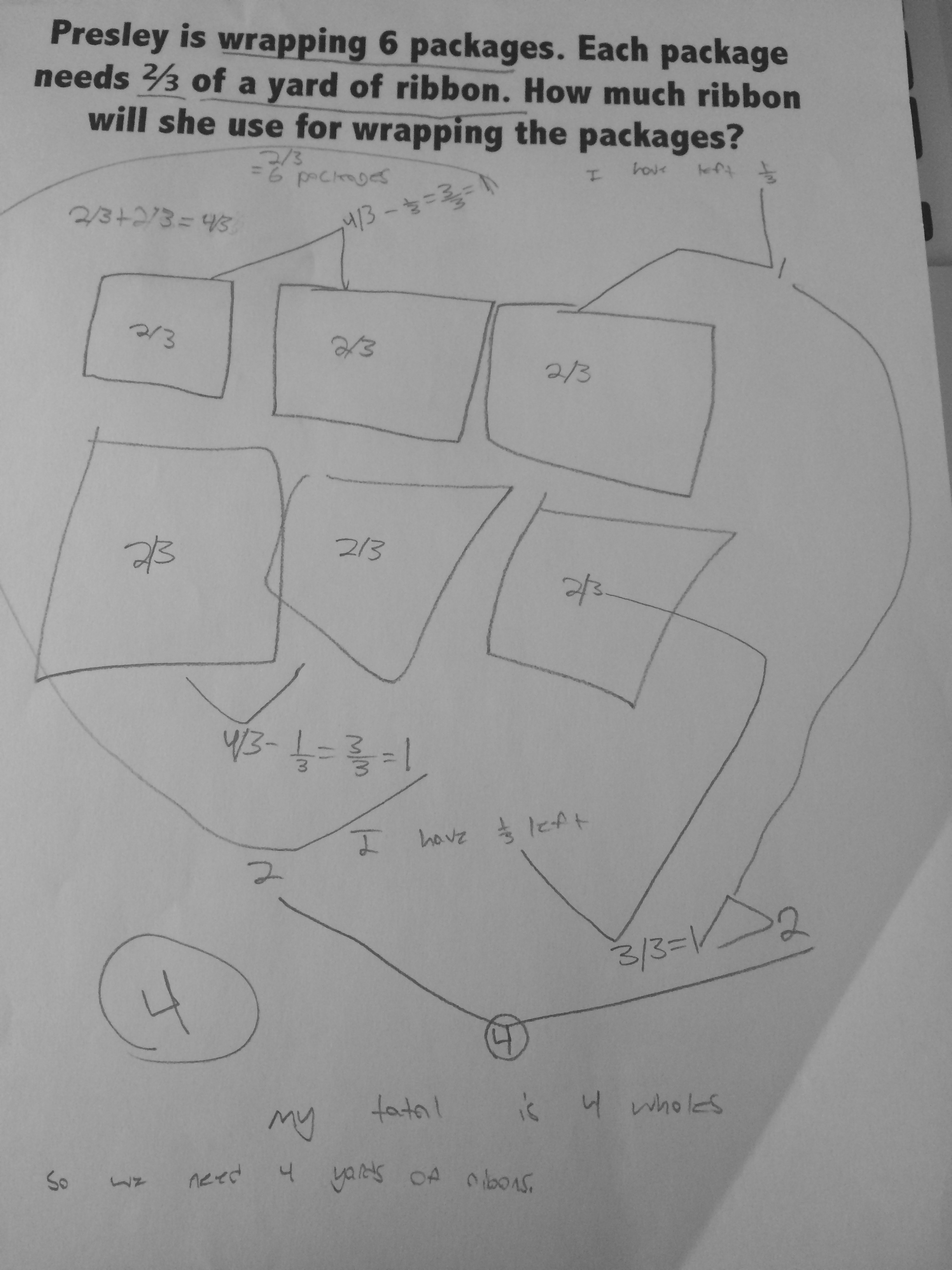
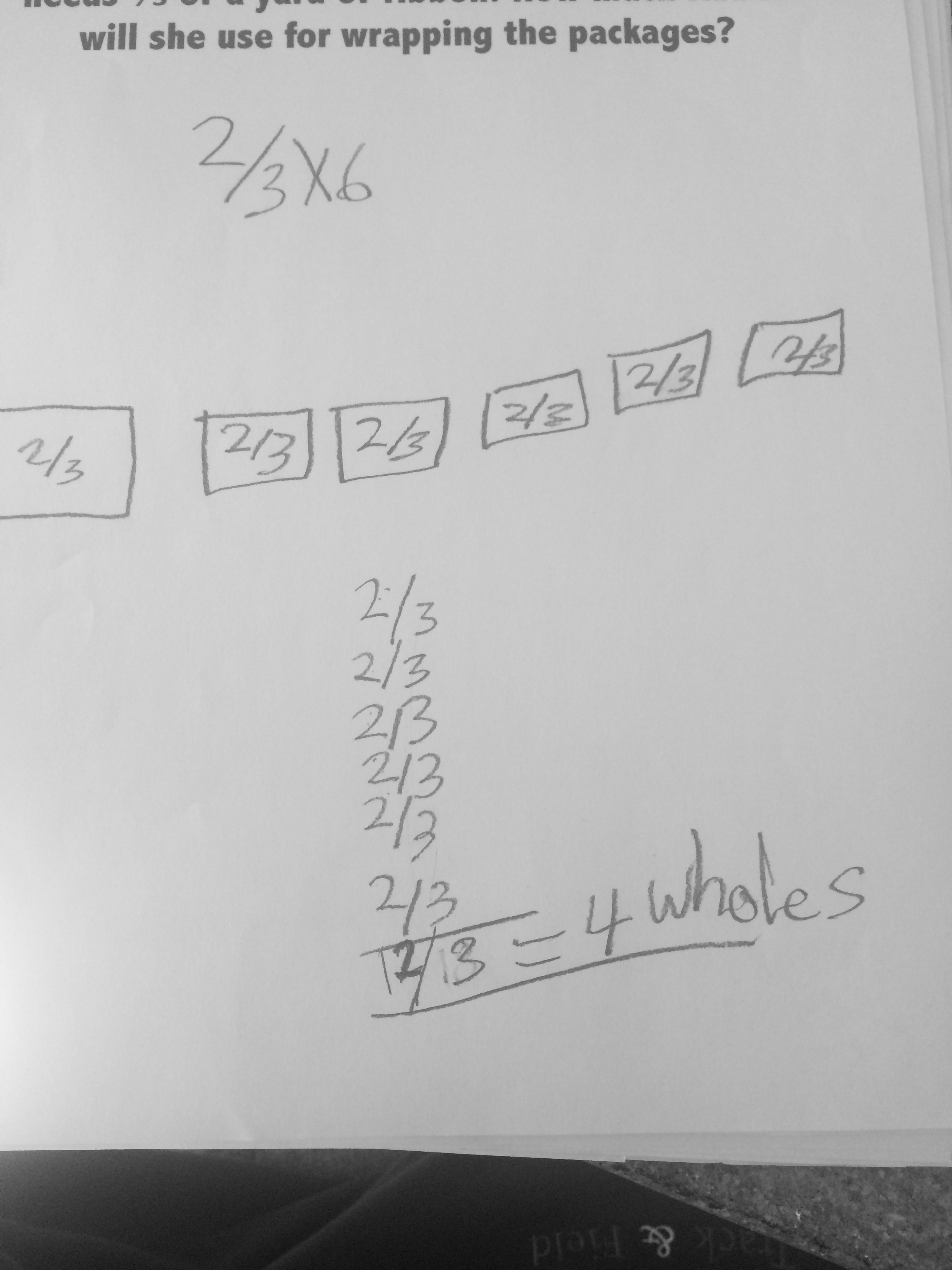
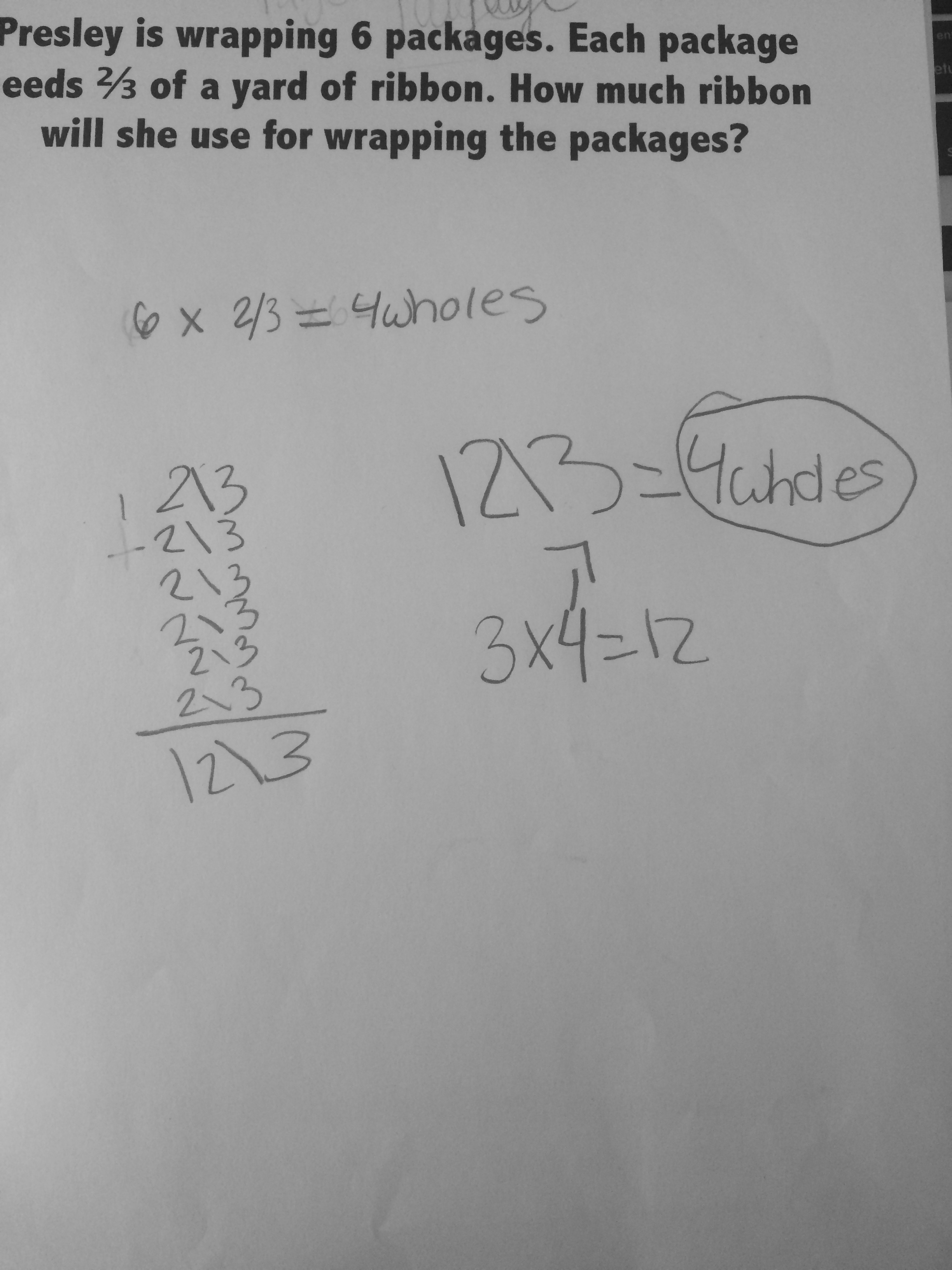
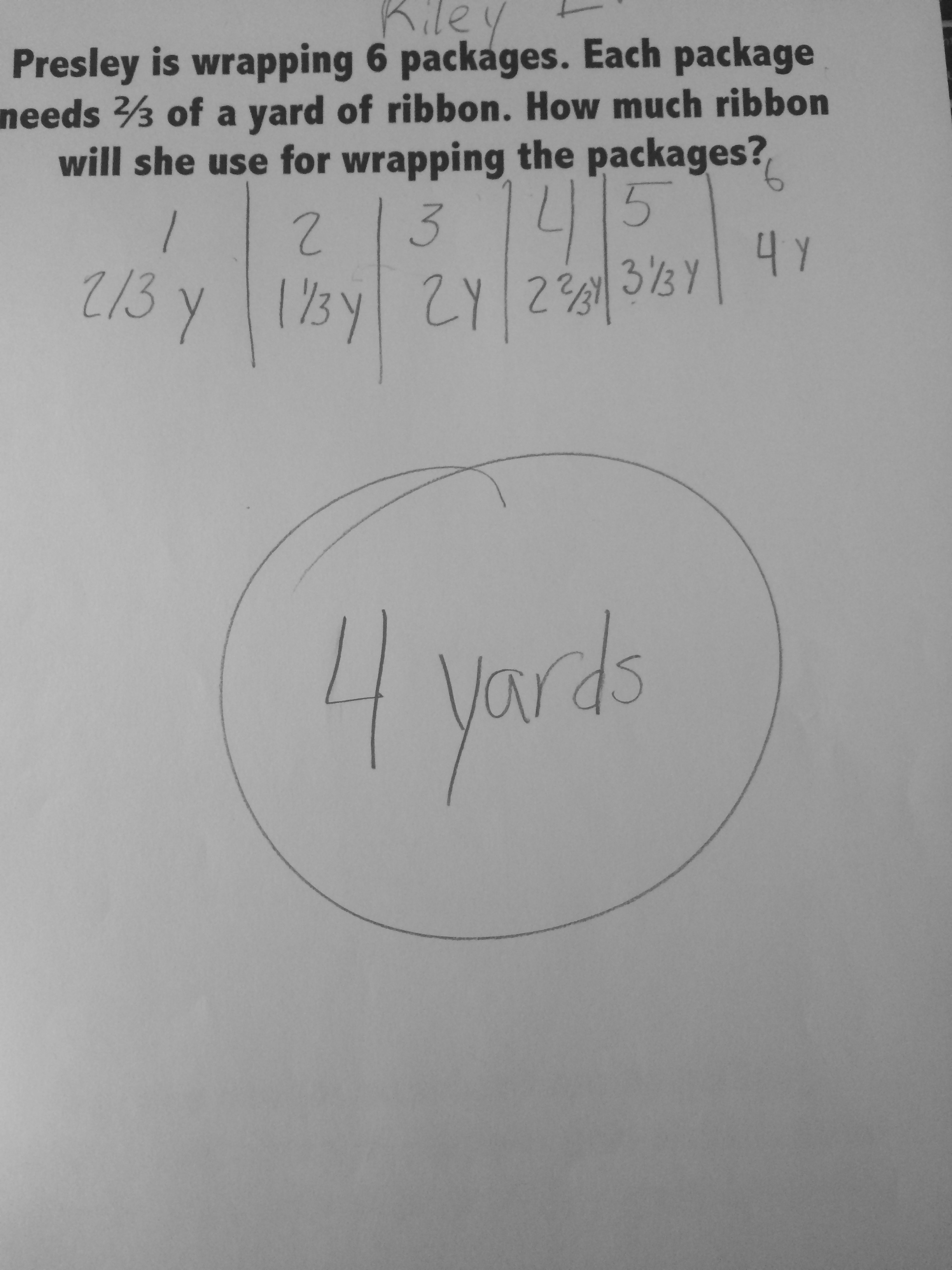
“Presley is wrapping 6 packages. Each package needs 2/3 of a yard of ribbon. How much ribbon will she use for wrapping the 6 packages?”

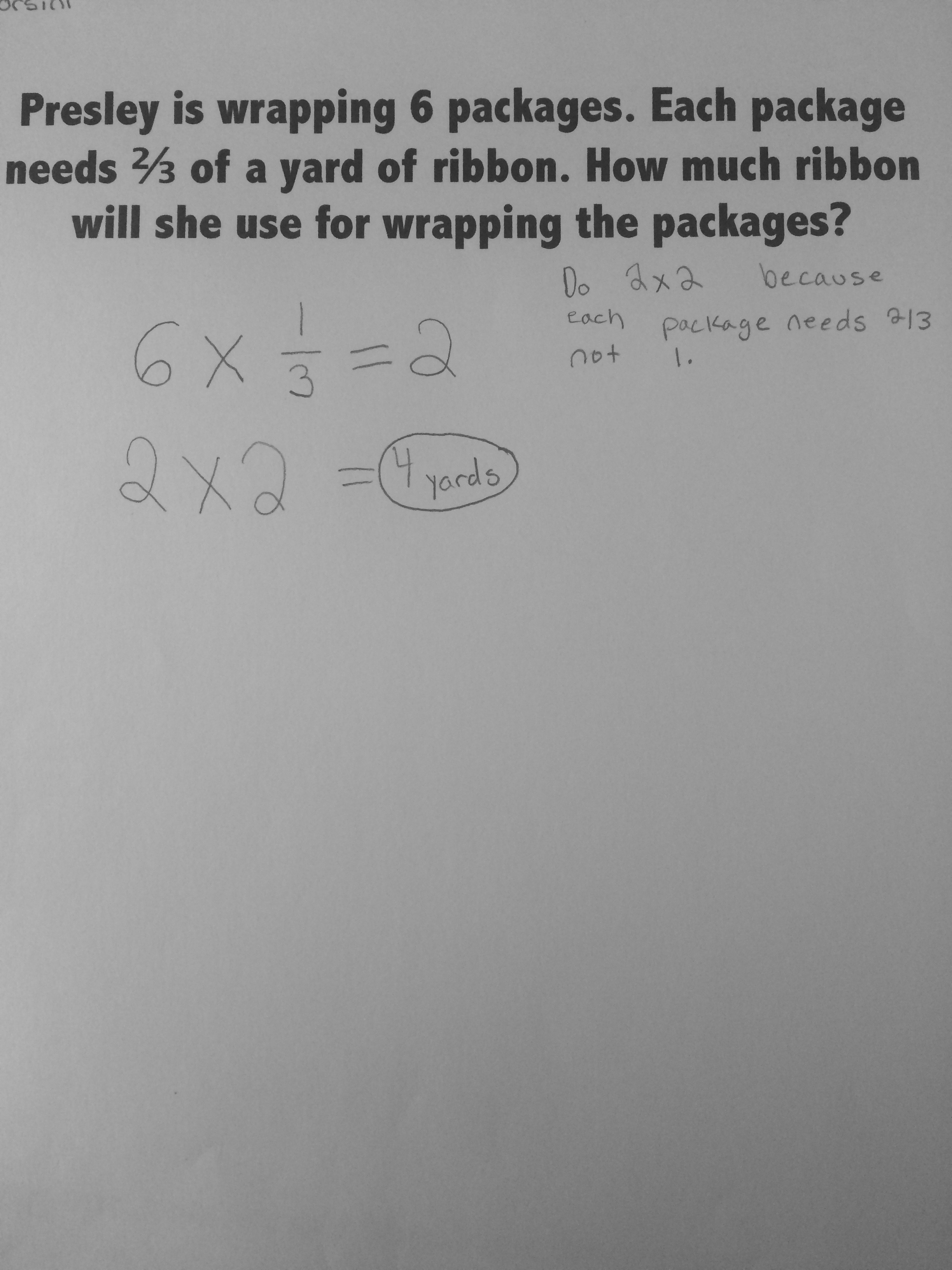
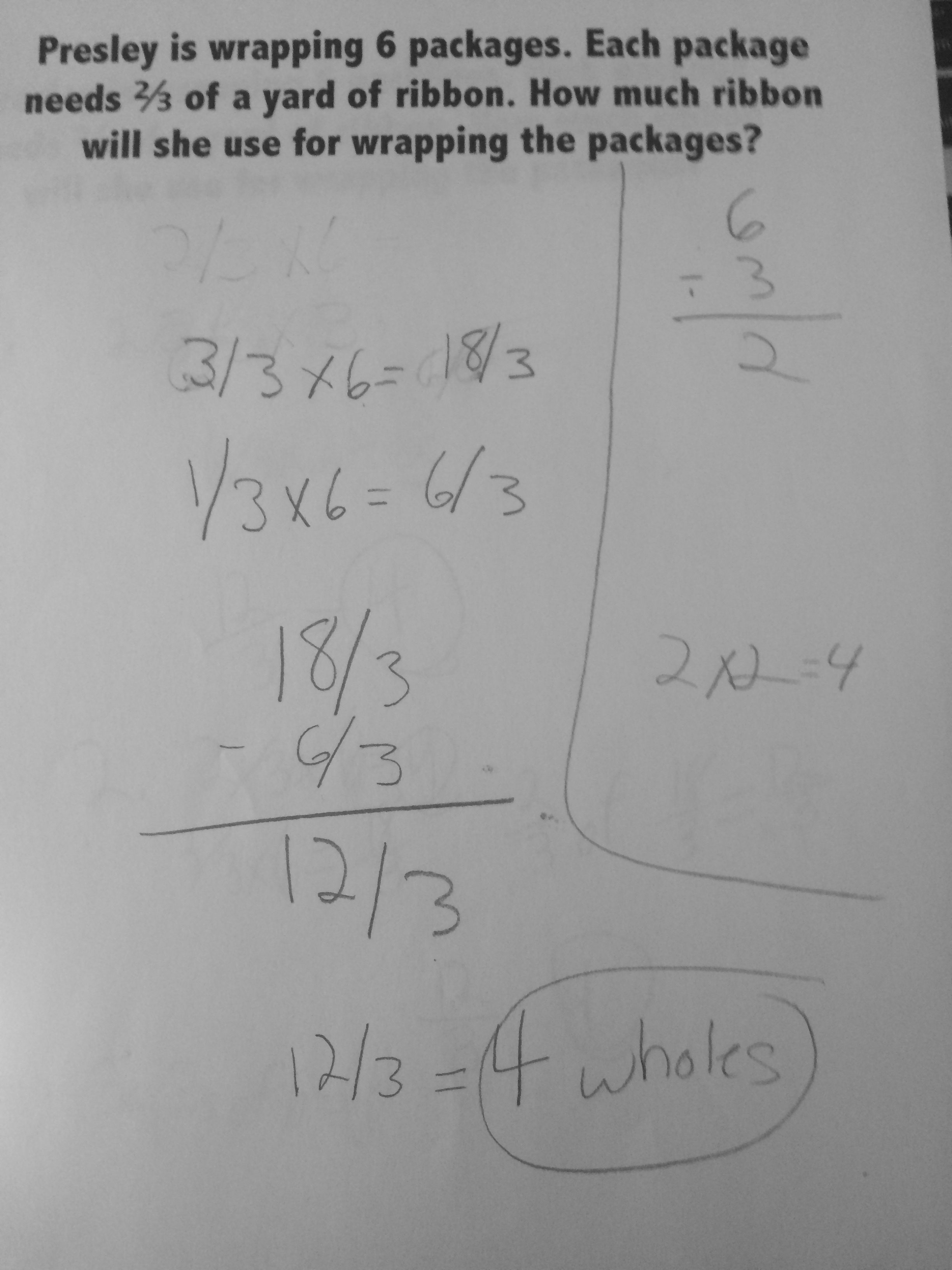
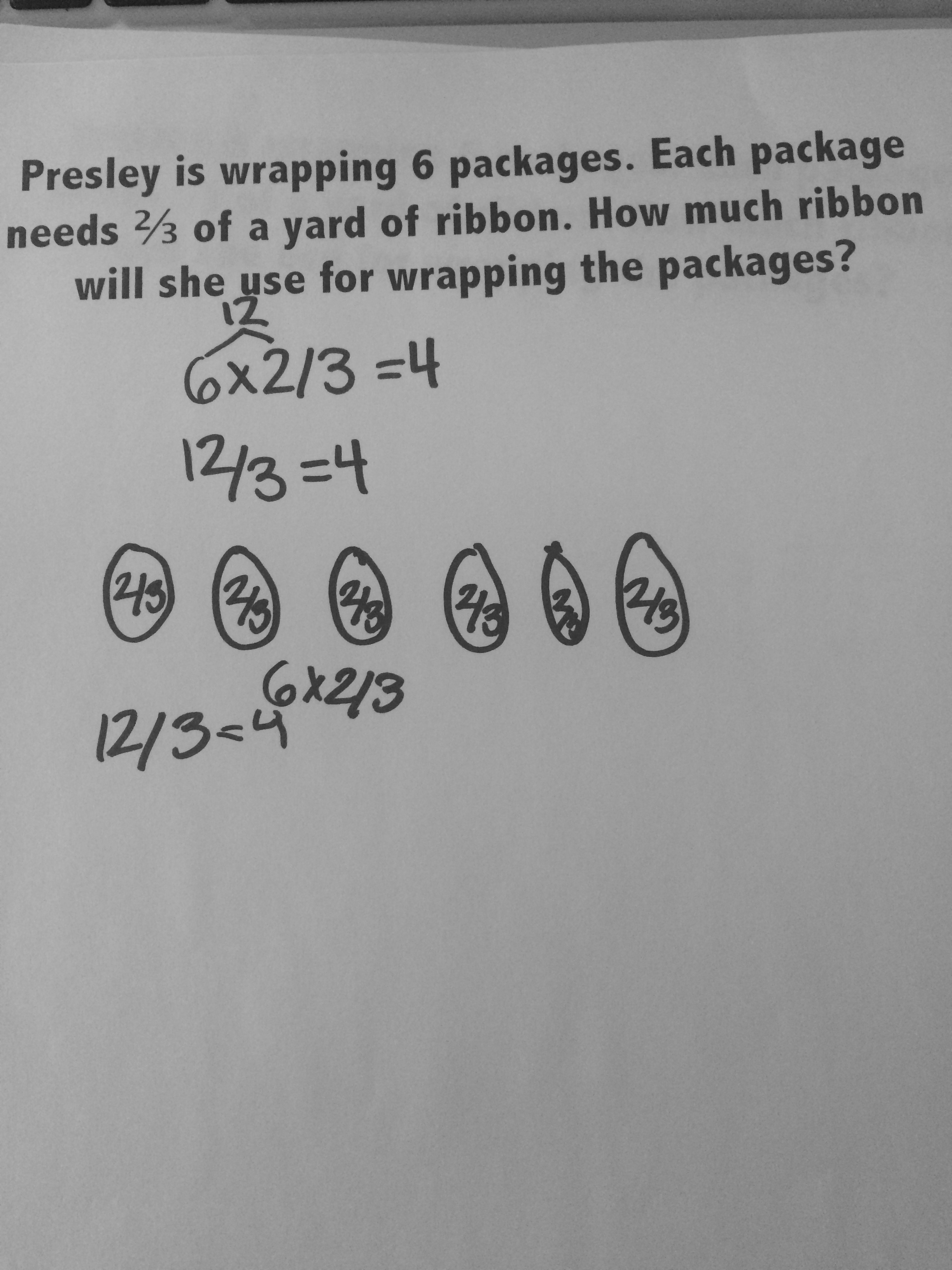
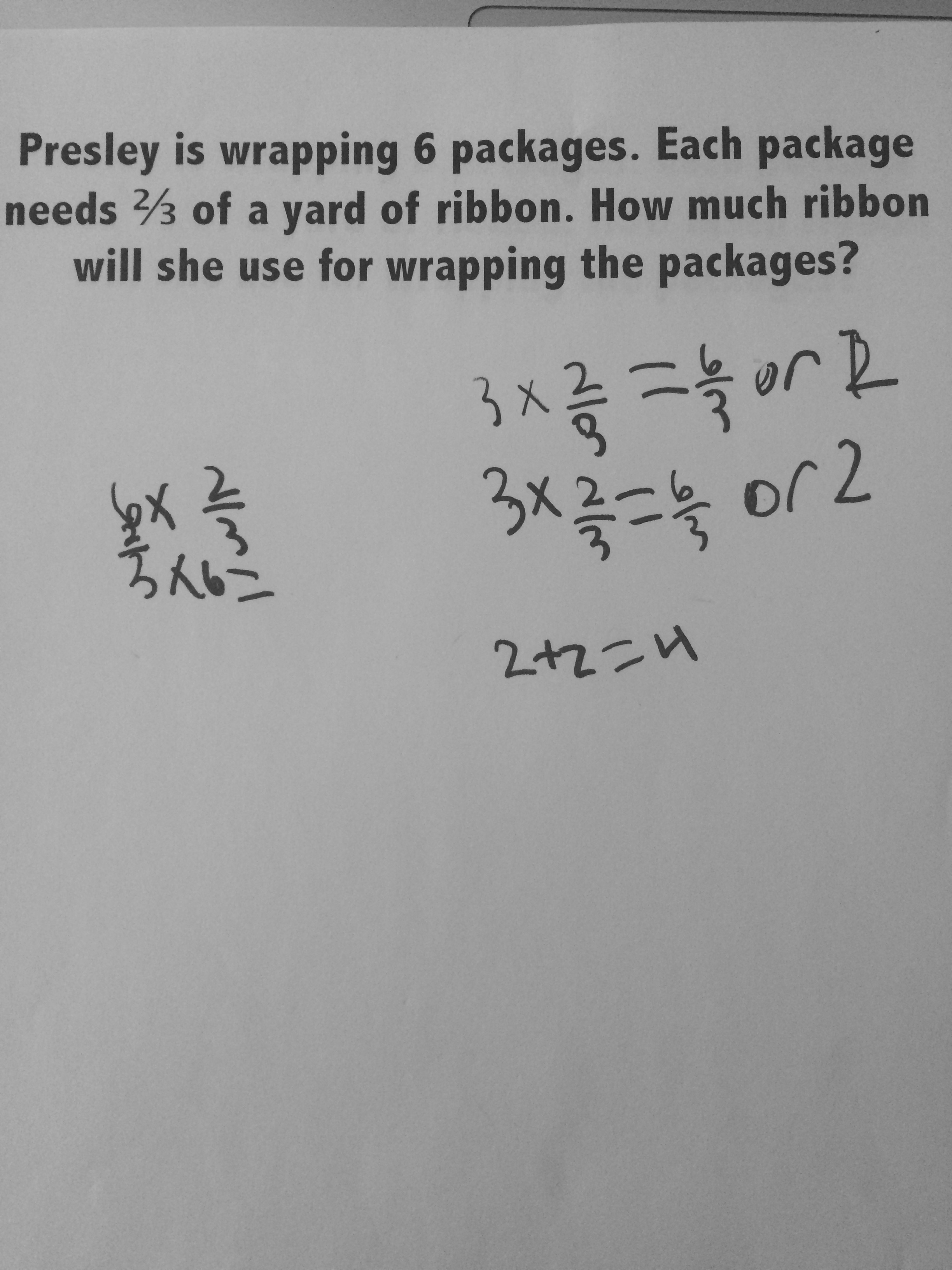
As anticipated, I received a wide variety of solutions to arrive at 4 yards of ribbon. Here are just a few examples in what I think is the progression I expect (some of them got finished  quickly and opted to show a few ways to solve).

IMG_9719_2 IMG_9720_2 IMG_9721_2 IMG_9723_2IMG_9722_2 IMG_9724_2  IMG_9725_2 IMG_9726_2 IMG_9727_2 IMG_9728_2 IMG_9729_2 IMG_9731_2IMG_9730_2

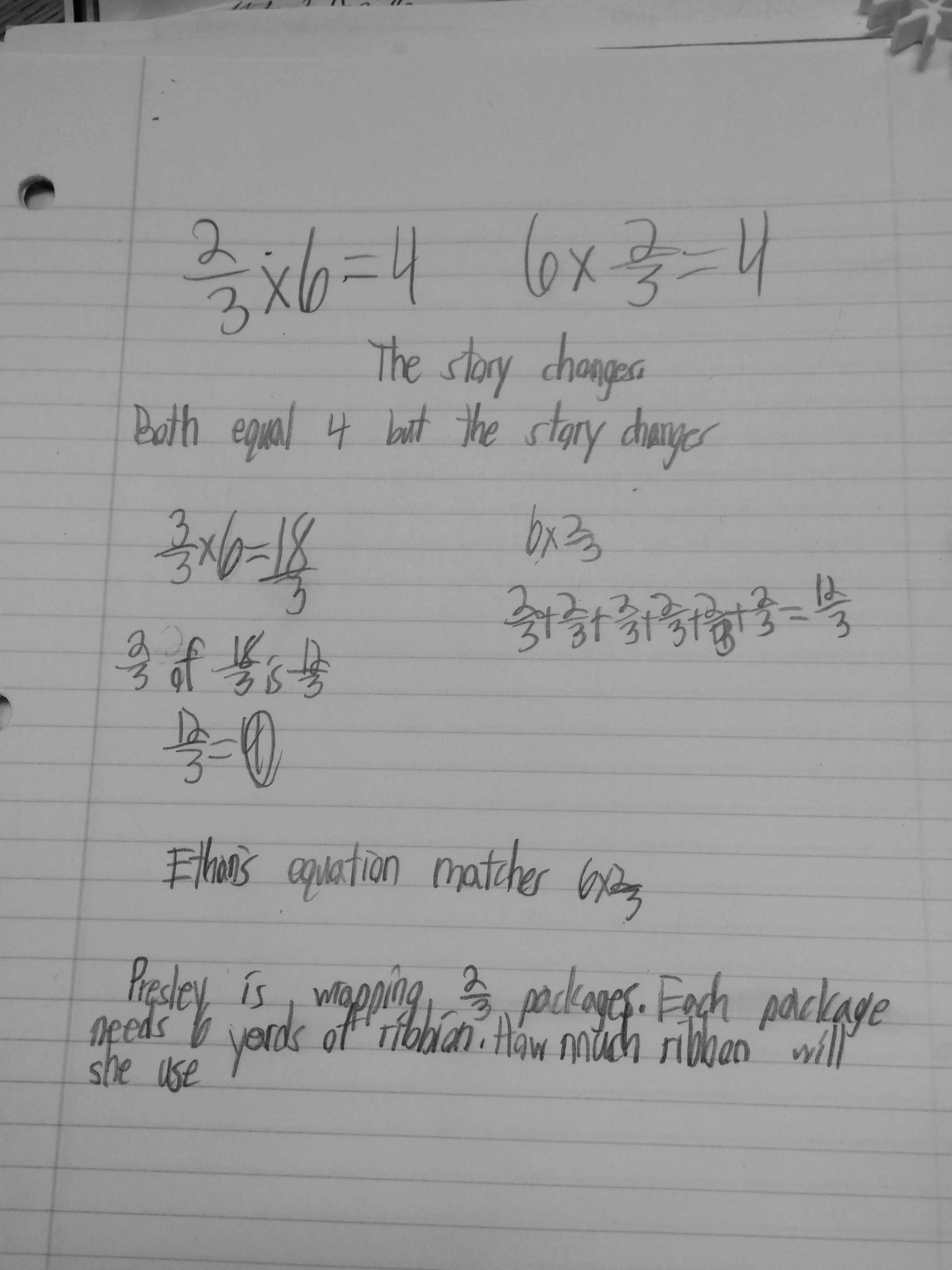
They all finished fairly quickly and as I was walking around I thought it was really interesting to see such a variety in the equations they used to represent the problem. We came together as a whole group and I asked them for the equations they thought best represented the problem. The most common answers were: 2/3 x 6 = 4, 6 x 2/3= 4 and 2/3 + 2/3 + 2/3 + 2/3 + 2/3 + 2/3= 12/3 = 4.

I asked them if there was a difference between the equations and there was a unanimous “No” because they mean the same thing. “They all get 4.” In my head I was very excited that commutativity was something they see when finding a solution, but I was also curious if it worked the same in the opposite direction. I asked if we could narrow it down to two equations and they all agreed that the repeated addition was the same as 6 x 2/3 because it was “six groups of 2/3.” Interesting, so they see that in the numeric representation but not contextually?

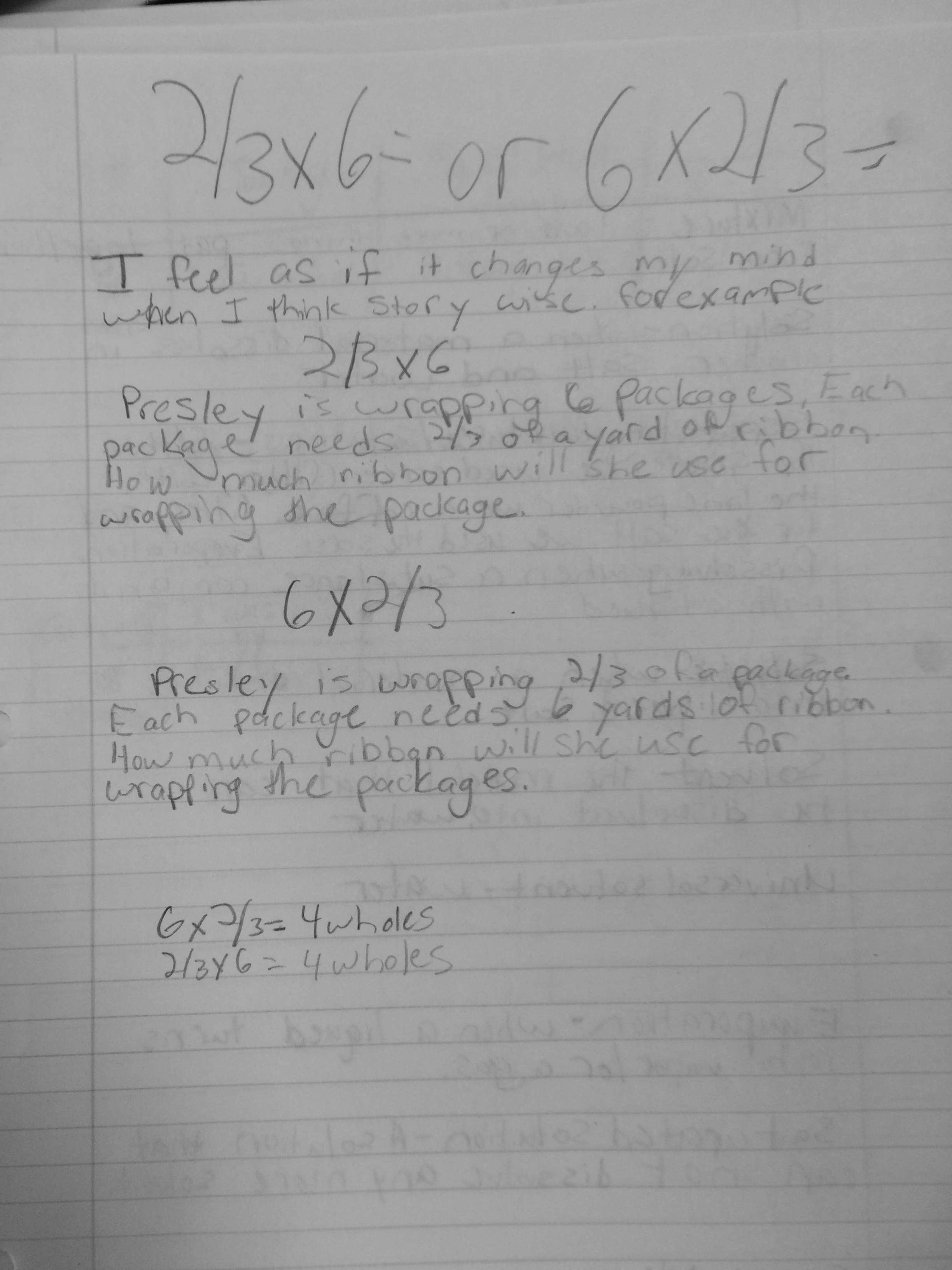
I then asked them to write 6 x 2/3 and 2/3 x 6 on the top of their journal page and think about them without the previous context.  I posed, “If I gave you these two problems to solve, would you think about them the same way? Do you think about them differently?” I was curious to hear their thoughts on the commutativity.

IMG_9692 IMG_9694 IMG_9695 IMG_9696

The conversation after was so great and interesting! There is a difference when going from number to context, however when put in context, I think students use whatever strategy is easiest for them to arrive at the answer. Is this what is truly meant by contextualizing and decontexualizing in the SMPs?

To further intrigue me, I went and pulled a few fourth graders to interview during my planning period. It was so interesting that they saw this as a whole number times a fraction because it was “six 2/3’s.” Their connection to multiplication and “groups of” was evident. I did love how they did 3 of the 2/3s first to get 2 and then doubled that to get 4.

IMG_9733 IMG_9734 IMG_9735

This 4th grader was the most interesting..

IMG_9736She solved it as 2/3 of 6 and arrived at 4. I asked her if she could write an equation for the problem she solved and she wrote 2/3 of 6 = 4. Completely because I am so nosy, I asked her to write 6 x 2/3 under that. I asked how she thought about that problem? Would she solve it the same? She said, “No, that is 6 of the 2/3’s so I have to multiply the 2 and 3 by 6.” She proceeded and ended with 12/18. She saw the numerator and denominator as numbers in and of themselves and used the distributive property to arrive at her answer instead of thinking about the 2/3 as a number. This was something I had never thought of before! I wish I had more time with her because I SO wanted to ask if that makes sense, but since my planning runs into dismissal, she had to get back to class! Argh!

This progression (to me) now seems to be more about building on student’s understanding of multiplication then about what is more intuitive for students to do. That is such a revelation to me. In second and third grade students do so much in “sharing” situations, that I had assumed it was en route to this skill of taking a fraction of a number when in fact it is more about the operations. It builds multiplication and division. Those operations then progress from operations with whole numbers to operations with fractions and from there students start to build deeper understandings of the properties of operations.

This is of course, all my interpretation based on my experiences and perspective of the student work, but how awesome! I cannot wait to share this with the 4th grade teachers along with the video of the kids chatting with me about this, awesome stuff!!

-Kristin