Category Archives: 4th Grade

Making Connections for Deeper Learning

In 3rd grade, students come to understand fractions as numbers. They count by them and locate them on a number line just like whole numbers. However, once they start operating with fractions in 4th and 5th grade, they tend to set aside everything they understand about whole number operations and treat fractions as numbers with their own set of ‘rules.’ I can think of many reasons why this happens, but my current wondering is how we can create more opportunities for students to make connections between their understanding of whole number and fraction operations.

Why Connections?

So many times I see students not realize all of the wonderful things they know that would be helpful in their new learning. I believe this is because we just don’t spend enough time making connections explicit to support this transfer.

One of my favorite papers on the importance of practicing connections (linked in the citation) describes the ‘why’ so nicely…

“Although there may have been a time when rote learning of facts and procedures was sufficient as an outcome for education, that is certainly not the case today. Anyone with a phone can Google to find facts that they have forgotten. But gaps in thinking and understanding are not easily filled in by Internet searches. Increasingly, we value citizens who can think critically, coordinate different ideas together, solve novel problems, and apply their knowledge in all kinds of situations that do not look like ones they have previously encountered. In short, we want to produce students with deep understanding of the complex domains that constitute the modern knowledge landscape (National Academies of Sciences, Engineering, and Medicine 2018).”

“Studies show that expert knowledge in a domain is generally organized around a small set of core concepts (e.g., Lachner and Nückles 2015) that imbue coherence to even wicked domains. Because they are highly abstract and interconnected with other concepts, core concepts must be learned gradually, over extended periods of time and through extensive practice. As students practice connecting concepts with other concepts, contexts, and representations, these core concepts become more powerful and students’ knowledge becomes more transferable (e.g., Baroody et al. 2007; National Council for Teachers of Mathematics 2000; Rittle-Johnson and Schneider 2015; Rittle-Johnson et al. 2001).”

Fries, L., Son, J.Y., Givvin, K.B. et al. Practicing Connections: A Framework to Guide Instructional Design for Developing Understanding in Complex Domains. Educ Psychol Rev 33, 739–762 (2021).

Subtracting Whole Numbers

In 4th grade, students have been decomposing fractions into sums of fractions with the same denominator and justifying their decompositions. They naturally leveraged their understanding of whole number decomposition, but when we gave them a problem to add or subtract, they quickly looked for a ‘rule’ to find the sum or difference. And, while we want them to generalize these operations, as the numbers get more complex –mixed numbers and unlike denominators – a memorized rule absent understanding doesn’t help students reason about the problem.

The lesson last week had students representing their fraction addition and subtraction on the number line, but that representation was causing some students more angst than support so we decided to use the problems from the lesson, but focus on the connection to whole number operations instead of forcing only the number line on them.

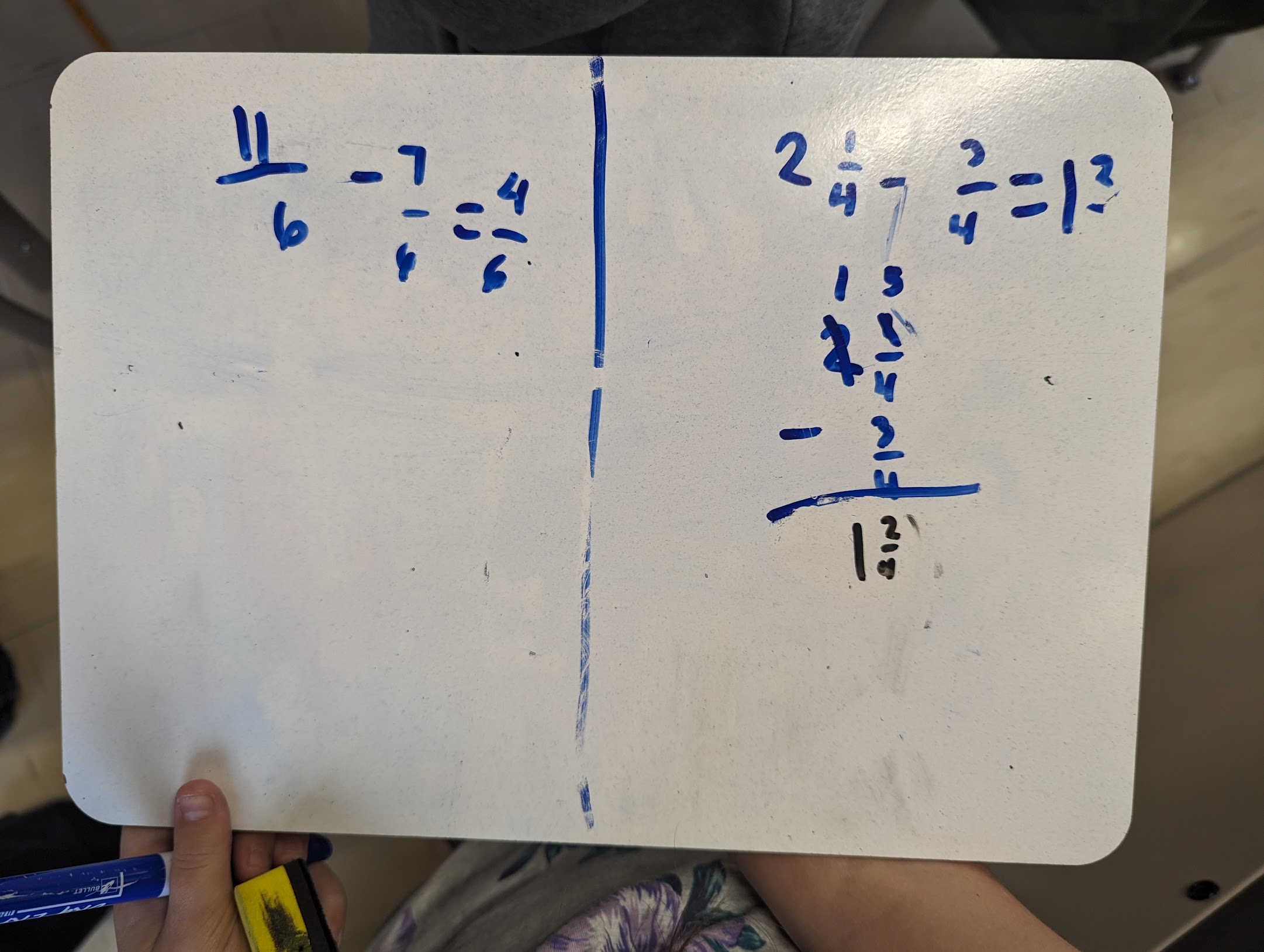
On their whiteboards, we asked them to record all the ways they think about and can represent 13–6=?. We saw a nice mix of ideas like removing items (base 10 blocks), hopping back on a number line, decomposing 6 and subtracting in parts, adding up (relationship to addition), and the algorithm – which made them all chuckle because after ‘borrowing’ it ended up being the same problem.

Connection to Subtracting Fractions

We shared these ideas out, recorded them on the board for reference, and then asked them to erase their whiteboards and do the same thing for 13/5 – 6/5=?. Students shared the methods and representations they used and we discussed how they were like the ones they used for whole numbers. It took no time for someone to say ‘It is exactly the same, just fifths.’ One student wrote it out in words so the discussion of the change in units was perfect.

Applying the Strategies

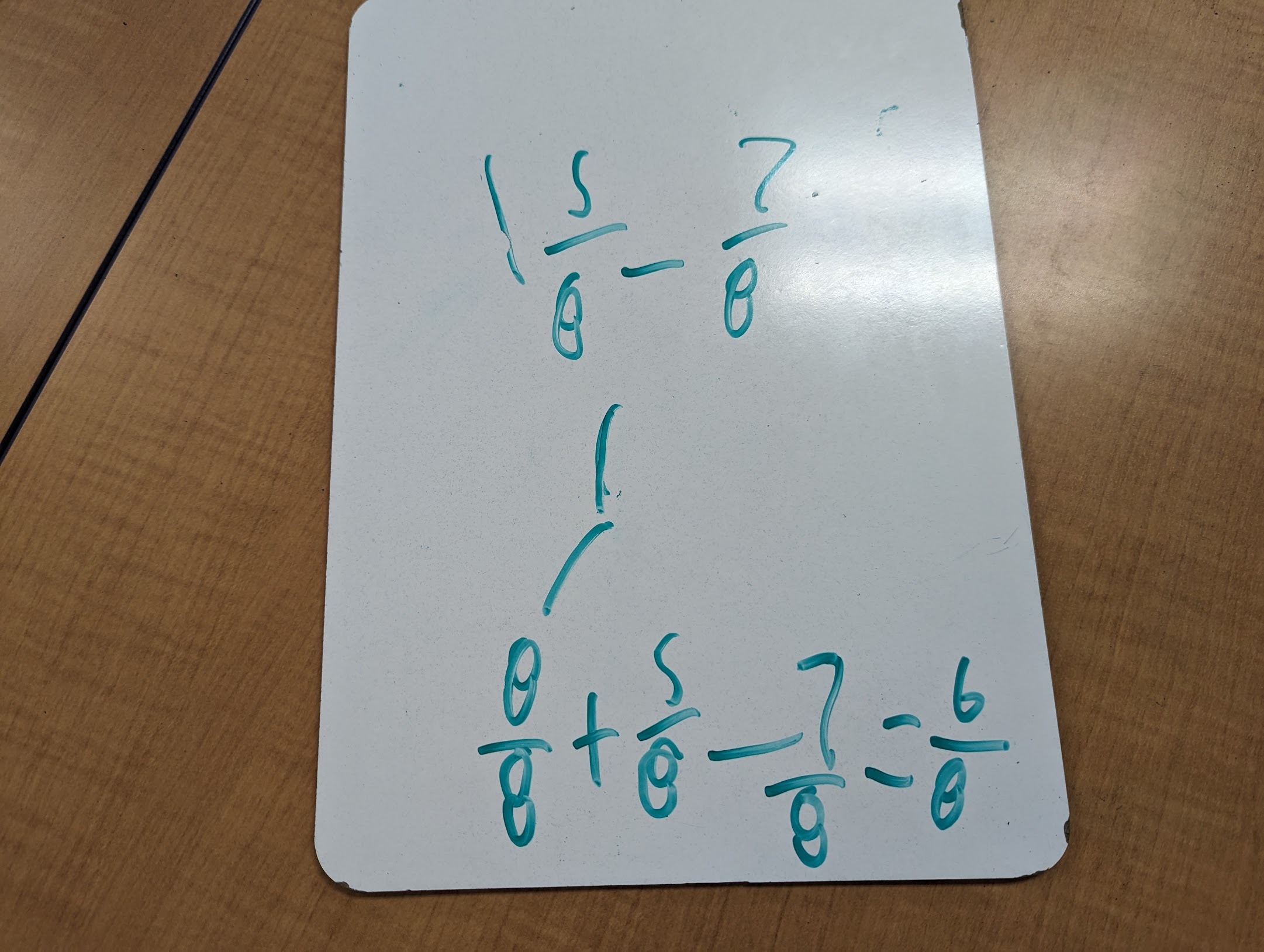
Next we wanted students to practice a couple of problems, including mixed number subtraction where the first fraction numerator was less than the second. We were excited to see many of the same methods being used and some students really got into showing it multiple ways.

Try it out!

Any 4th and 5th grade teachers out there who want to try this out, I would love to hear what you learn about student thinking and what students learn about important connections in math class!

Small Change, Big Thinking

Adapting math activities is one of my favorite parts of lesson planning. I love it so much because of the thoughtfulness, curiosity, and creativity involved in even the smallest of changes. In making any change, I have to think about what students know, the math of the activity, how the activity addresses the learning goal, ways students might engage in the activity, and questions to ask students along the way.

Fraction Activity

In this 4th grade activity, students were writing equivalent multiplication equations for a fraction multiplied by a whole number and then discussing the relationship between the different equations. The curriculum activity was good and definitely addressed the learning goal, but there was definitely an opportunity to open it up for more student reasoning and ownership. For example, in its current form, students don’t have the chance to think about which whole numbers would work in their equations or play around with the properties.

Small Change

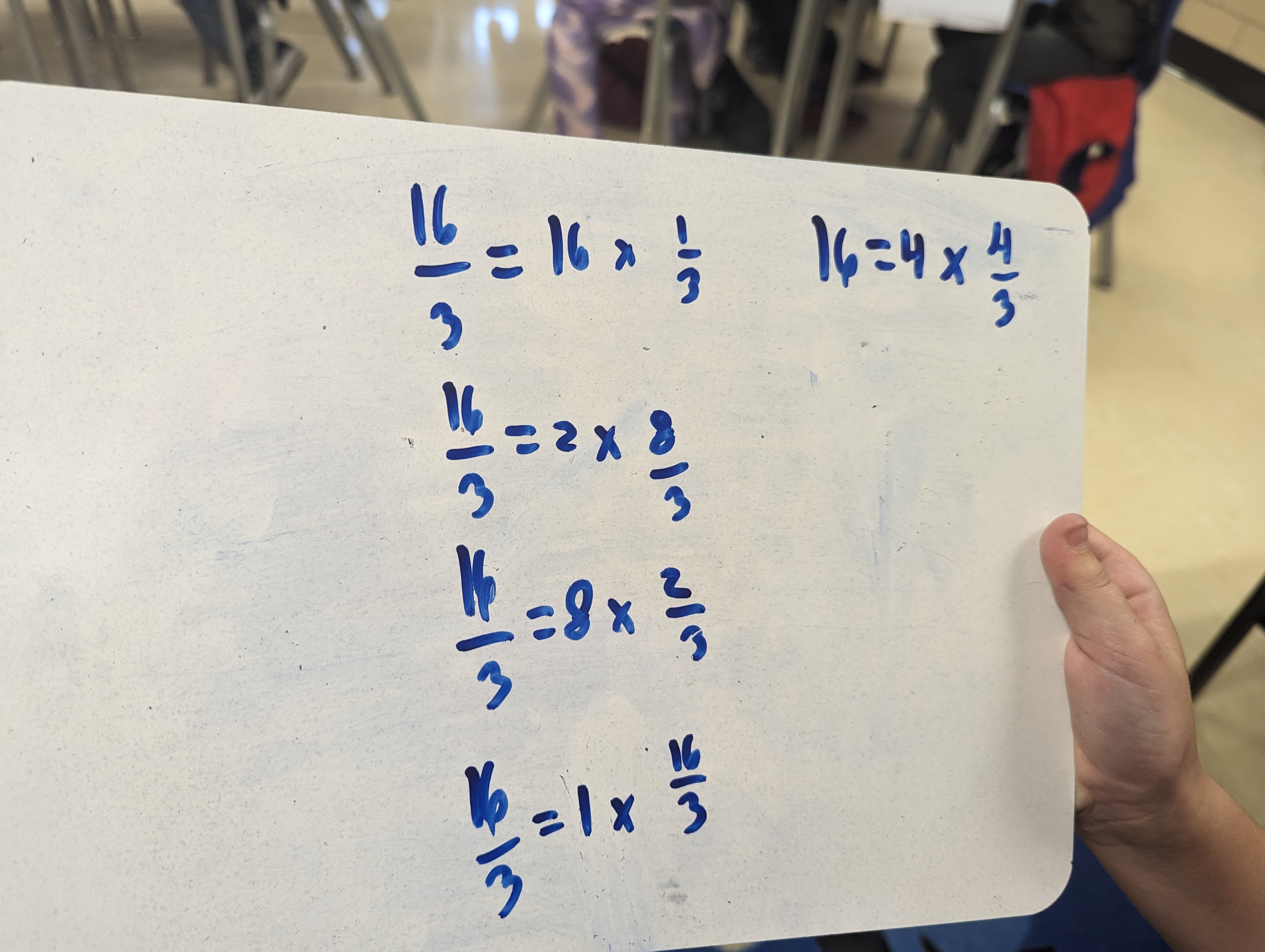
Adapting doesn’t always require huge lifts. For this activity, all we decided to do was change the prompt to 12/5 = ____ x _____ and ask them to find as many ways as they could to make the equation true. I got so wrapped up in their work and discussions, that I didn’t snag any pictures of that part of the lesson, but after they finished we pulled up polypad and asked them how we could show why they are are all equivalent using the fraction bars. We wanted to be sure they just weren’t proceduralizing it at this point of the unit, so pulling up the fraction bars felt like a nice grounding of the concept. The board looked like this before we erased to make space to circle the other expressions.

Making Connections

At this point, they couldn’t get enough and asked for another fraction to try, so we gave them 16/3. We saw so much great thinking and use of the commutative property when finding the whole number and numerator.

Their excitement alone was the first indicator that allowing more space for their choices was a great idea! And then, as I was walked around, a couple students asked if they could write division equations. Of course I said yes and walked away.

I came back to #7 and #8 on this board:

When I asked how she came up with those equations, she said she used her multiplication equations because multiplication and division are related. I left her with the question of how she might show that division on the fraction bars and class wrapped up. I can’t wait to check back in with her tomorrow to see what she came up with!

Next time you plan a math lesson, I encourage you to think about small tweaks you can make to open it up for more student voice, ownership, and opportunities to think big! And I don’t know if anyone is even talking much about math planning on Twitter (X) anymore, but if you are, I would love to think together about tweaking math activities. So, send some activity pics my way @MathMinds and we can flex our curiosity and creativity muscles in planning together.

-Kristin

Purposeful Warm-up Routines

As a teacher, curiosity around students’ mathematical thinking was the driving force behind the teaching and learning in my classroom. To better understand what they were thinking, I needed to not only have great, accessible problems but also create opportunities for students to openly share their ideas with others. It only makes sense that when I learned about routines that encouraged students to share the many ways they were thinking about math such as Number Talks, Notice and Wonder, and Which One Doesn’t Belong?, I was quick to go back to the classroom and try them with my students. It didn’t matter which unit we were in or lesson I had planned for that day, I plopped them in whenever and wherever I could because I was so curious to hear what students would say. Continue reading

Small Change, Big Impact.

The other day, Jamie tweeted about this example problem from a 4th grade program:

DUuu0UhV4AAw4pa.jpg

After looking at the Standards, Learning Progressions, and discussing the 3rd grade fraction work, all of us on the thread agreed it was an appropriate question for 4th grade but then started to question whether we would give this problem as is, or adapt it. I really appreciate these conversations because they move us beyond ‘this problem sucks, don’t do it’ or ‘do this problem instead, it’s more fun’ to thinking about a realistic thought process teachers can use when working with a text that may not be aligned to the standards or lessons that may not best meet the needs of their students.

While all of the adaptations we discussed sounded similar, I couldn’t help but wonder how each impacted so many classroom things in different ways. What may seem like a small change can easily impact the amount of time it takes in class, students’ approaches to the problem, what we learn about student thinking, and the follow-up question we could potentially ask.

There is no right or wrong adaptation here, but I wanted to sketch out how each change to the problem impacts teaching and learning.

Change 1: Remove the context and only give the expression 1 – 26. 

This would be the quickest way to do this problem in class. With this change, I would be curious to see how students think about 1 in the expression.

Do they record it as 66? Do they draw a diagram? If so, what does it look like? How is it partitioned? Are the pieces removed in the diagram or is there work off to the side? A potential follow-up could be to ask students to write a context to match the expression. I think in their contexts I would have the opportunity to see how they thought about 1 in a different way.

Change 2: Remove the expression and only give the context. 

I find anytime there is a context it takes a bit longer because of the time to read and reread the problem so this change would take a bit more class time than the first. This change would give students more access to the problem and I could possibly learn how they make sense of a context, but I wonder what I would learn about their fractional thinking. Since the context pushes students to think about 1 as the whole pizza and also tells them that there are 6 equal pieces, the diagram, partitioning, and denominator are practically done for them.

Because of this, I may not learn if they know 1 is equivalent to 6and may not find out how they represent fractions in a diagram because I imagine most would draw a circle. Since they could do the removal on the circle, I also wonder if I would learn much about how they saw this problem as an expression so I would add that as my follow-up question.

Change 3: Remove the expression and the numbers from the context.

This one ​would definitely take an entire class period as a numberless word problem and probably the longest to plan. Because it takes the longest to plan and implement I really have to think about what I learn above and beyond the two changes previously mentioned if I were to do it this way.

I imagine the scenario could sound like this:

“Sam ordered a pizza cut into equal pieces. He ate some of the pizza and put the rest away for later.” or “Sam ordered a pizza. He ate some of the pizza and put the rest away for later.” 

When I do a numberless problem, my goals are to give students access to the problem and see how they make sense of a context without the numbers prompting them to feel like they have to do something. I have to plan for how I craftily find the appropriate time to let them notice and wonder and plan questions that elicit the subtraction from 1 that I hope to see. I also like to give students a chance to choose their own numbers for problems like these in order to see how they think about the reasonableness of numbers, which adds more time. The hardest part here is getting to the fraction work because I think students could stay in whole numbers as they talk about number of pieces. I can hear them wondering how many pieces it is cut into and how many he ate – neither of which guarantees fractions. So, while this has the potential to get at everything Change 1 and 2 do, a teacher must weigh how much the making sense of context portion meets the needs of his or her students.

All of this for one problem and I haven’t even discussed the two most important questions we need to ask ourselves before even making these changes – what understandings are students building on? and what understandings are students building towards?

There is much to think about in planning that is often hard to think about all of the implications of one tiny change to a task, however, thinking about how each of these changes impacts teaching and learning is the fun and exciting part of the work!


After the post, Brian had another change that he posted on Twitter! I wanted to capture it here so it is not lost in the crazy Twitter feed:


Looking for Patterns in a Number Talk

I love when I read a blog post in which I can relate to how the teacher felt, learn from both the teacher and student thinking, want to hear what happens next, and leave with questions circling around in my head. This happened when I read Marilyn’s recent post. I really appreciated how her recount of the lesson demonstrated the importance of number choice and the honest way we all have felt when we made a decision during a lesson that we wished we hadn’t. It was really interesting to think about how changing the divisor from 4 to 5 changed what students experienced. I cannot wait to hear what they do when they try the original problem and see the remainder as 1 in the balloon context, 25¢ in the money context, 1/4 in the cookie context and .25 on the calculator. Awesome discussions could happen there!

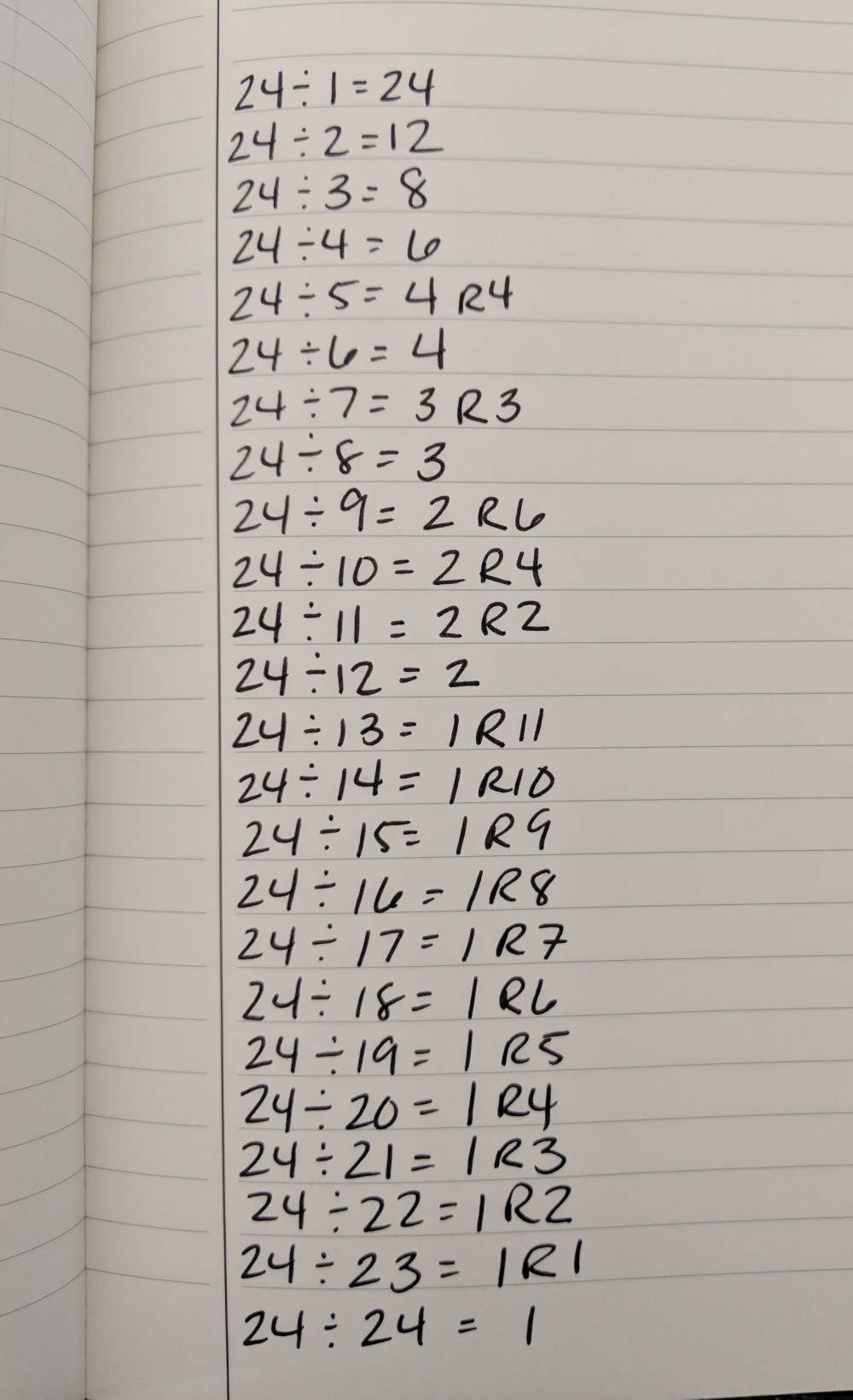
I left this post still thinking about the math talk at the launch of the lesson. I was going to tweet about it, but because it seemed long and I have many questions of my own I want to play around with and revisit, I decided to put it here. I loved the connectedness of the number talk to the division task, and wondered how the recording of those strings could impact division patterns and structure students may see in future lessons. I started playing around with it in my journal in terms of how we think about recording a choral count.

I thought about:

  • How many problems in each row?
  • Does horizontal vs vertical recording impact what we see?
  • What might students notice about the remainders in each row? column?
  • What might students notice about the change in dividends in each row? column?

MVIMG_20180102_095858.jpg

Not that I would launch the 4 Problems task with this following string, but I wondered what it would look like to change the divisor and what students might see here:

MVIMG_20180102_113214.jpg

I think the number of problems with remainders at the bottom of the list versus the top is really interesting.

THEN, I started wondering about ways we could record the remainder and how that may impact how students interpret it? Not sure how this would work in terms of launch and facilitation, but I like thinking about the pink writing here.

MVIMG_20180102_115749.jpgMVIMG_20180102_114310.jpg

Recording is one of those things I get so intrigued by and cannot wait to revisit this post, play around with patterns that could be elicited in different ways and think about tasks in which these talks could be connected.

Thank you, as always, Marilyn for sharing your work – you continue to be such an inspiration! My only hope is one day I can be in the room for one of your lessons!
 

Today’s Number: Making Connections

The Investigations curriculum and Jessica Shumway’s book, Number Sense Routines contain so many wonderful math routines. Routines designed to give students access to the mathematics and elicit many ways of thinking about the same problem. One of the more open routines, is Today’s Number. In Today’s Number, a number is posed to the class and the teacher can ask students for questions about that number, expressions that equal that number, or anything they know about that number. I love this routine, and while it is more commonly used in the primary grades, I used it often in my 5th grade classroom. While I would capture so much amazing student thinking, I always felt like all of that great thinking was left hanging out there. I could see some students were using what they knew about operations and properties to generate new expressions for the given number, however I wondered how many saw each expression as individual, unconnected ideas.

After I read Connecting Arithmetic to Algebra, I had a different ending to Today’s Number, an ending that pushed students to look explicitly at relationships between expressions. I tried it out the other day in a 3rd grade classroom.

I asked students for expressions that equaled Today’s Number, 48. I was getting a lot of addition, subtraction and multiplication expressions with two numbers, so I asked students if they could think of some that involved division or more than two numbers. I ran out of room so I moved to a new page and recorded their ideas.

After their thinking was recorded, I asked the students which expressions they saw a connection between. This is where my recording could improve tremendously, but I drew arrows between the two expressions as students explained the connection.

IMG_4399

In case the mess is hard to see, these are some connecting ideas that arose:

Commutative Property: 3 x 16 and 16 x 3, 6 x 8 and 8 x 6, 12 x 4 and 4 x 12

Fraction and Fraction addition: 48/1 and 24/1 + 24/1 and 24 + 24

Subtracting from 100 and 1000: 100-52 and 1000-952

Multiplication and Repeated Addition: 4 x 12 and 12+12+12+12

Adjusting Addends in similar ways: 38+10 and 18 + 30, 40 + 8 and 48+0

Other ideas that I don’t particularly know how to categorize:

10 x 4 + 8 = 10 x 4 + 4 x 2

58 x 1 – 10 = 58 – 10

The second page got even more interesting:

IMG_4398

“Groups of” and Decomposition: 7 x 4 + 2 + 18 = 14 + 14 + 2 + 10 + 8 . This student saw the two 14s as two groups of 7 and then the 18 decomposed into 10 + 8.

Halving and Halving the Dividend and Divisor: 192÷4 = 96÷2. This student actually used the 192 to get the expression with 96.

Another variation of the one above was 200 ÷ 4 – 2 = 100 ÷ 2 – 2.

Other cool connection: 

96 ÷2 = (48 + 48) ÷ 2; This student saw the 96 in both expressions since they were both dividing by 2.

I think asking students to look for these connections pushes them to think about mathematical relationships so expressions don’t feel like such individual ideas. I can imagine the more this is done routinely with students, the more creative they get with their expressions and connections. I saw a difference in the ways students were using one expression to get another after just pushing them try to think of some with more than 2 numbers and some division.

Number Talk: Which Numbers Are Helpful?

I think Number Talks are such a powerful routine in developing students’ fluency and flexibility with operations, but maybe not for the reason most think. One of the most highlighted purposes of a Number Talk is the ability to elicit multiple strategies for the same problem, however, an even more important goal for me during a Number Talk is for students to think about the numbers they are working with before they begin solving. And then, as they go through their solution path, think about what numbers are helpful in that process and why.

The struggle with trying to dig deeper into that thinking is simply, time. If the opportunity arises, I ask students about their number choices during the Talk but often students just end up re-explaining their entire strategy without really touching on number choices. Not to mention the other 20ish students start losing interest if they take too long. I do think it is a particularly tough question if students are not used to thinking about it and when the thinking happens so quickly in their head, they don’t realize why they made particular choices.

Last week in 2nd grade I did a Number Talk with two problems, one addition and one subtraction. During the addition talk, I noticed students using a lot of great decomposition to make friendly numbers (the term they use to describe 10’s and 100’s).

IMG_4374

During the subtraction problem, I saw the same use of friendly numbers, however in this one I actually got 100 as an answer. My assumption was because the student knew he was using 100 instead of 98, but got stuck there so went with 100 as the answer. I was really impressed to see so many strategies for this problem since subtraction is usually the operation teachers and I talk endlessly about in terms of where students struggle. I find myself blogging on and on about subtraction all of the time!
IMG_4373

When the Number Talk ended, I looked at the board and thought if my goal was to elicit a lot of strategies, then I was done – goal met. However, I chose the numbers in each problem for a particular reason  and wanted students to dig more into their number choices.

This is where I find math journals to be so amazing. They allow me to continue the conversation with students even after the Number Talk is finished.

I went back to the 100, circled it and told the class that I noticed this number came up a lot in both of our problems today. I asked them to think about why and then go back to their journal to write some other problems where 100 would be helpful.

Some used 100 as a number they were trying to get to, like in this example below. I really liked the number line and the equations that both show getting to the 100, but in two different ways.

IMG_4434

This student got to 100 in two different ways also. I thought this was such a clear explanation of how he decomposed the numbers to also use 10’s toward the end of their process as well.

IMG_4435

This student used the 100 in so many ways it was awesome! She got to 100, subtracted by 100 and adjusted the answer, and then added up to get to 100.

IMG_4428

While the majority of the students chose to subtract a number in the 90’s, this student did not which I find so incredibly interesting. I would love to talk to him more about his number choices!

IMG_4432

I didn’t give a clear direction on which operation I wanted them to use, so while most students chose subtraction because that was the problem we ended on, this one played around with both, with the same numbers. I would love to ask this student if 100 was helpful in the same or different way for the two problems.

IMG_4433

As I said earlier, this is a really tough thing for students to think about because it is looking deeper into their choices and in this case apply it to a new set of numbers. This group was definitely up for the challenge and while I love all of the work above, these two samples are so amazing in showing the perseverance of this group.

In this one, you can see the student started solving the problem and got stuck so she drew lines around it and went on to subtract 10’s until she ran out of time. I love this so much.

FullSizeRender 7

This student has so much interesting work. It looks as if he started with an addition problem involving 84, started adding, then changed it to subtraction and got stuck.

IMG_4436

This is what I call continuing the conversation. They wrote me notes to let me know Hey, I am not done here yet and I am trying super hard even though there are mistakes here. That is so powerful for our learners. So while there was no “right” answer to my prompt, I got a glimpse into what each student was thinking after the Number Talk which is often hard to do during the whole-group discussion.

If you want to check out how I use journals with other Number Routines, they are in the side panel of all of my videos on Teaching Channel. 

First Fraction Lesson of 4th Grade

The first lesson of a new unit always feels like an entire class period of formative assessment to me, which I love! I think finding out what the students know about a topic, especially if it is the first time it is introduced that year, is so interesting.

Since the first lesson of the 4th grade fraction unit starts with fractions of a 4 x 6 array, we wanted to create an introduction lesson that was more reflective of all of the great work they did with fraction strips in 3rd grade to get a better picture of what they know. In 3rd grade they do all of the cutting of the strips, and since we didn’t feel that was necessary to do again, I created a SMARTBoard file so we could build together. [the file is attached at the end of the post if you want to use it].

I posed this slide to introduce the whole:

Screen Shot 2016-11-30 at 4.59.42 PM.png

Then I asked this sequence of questions as we built them on the board:

  • If I wanted halves, how many pieces would I have? What is the size of each piece?
  • If I wanted thirds, how many pieces would I have? What is the size of each piece?
  • etc….until they were all built.

I wanted to reintroduce the language of “size of the piece” from their 3rd grade experiences. Every once in a while I would pause and ask how much I would have if I had more than 1 of those pieces to see if they could name fractions over a unit. For example, What if I had 3 of those fourths? How much would would I have? 

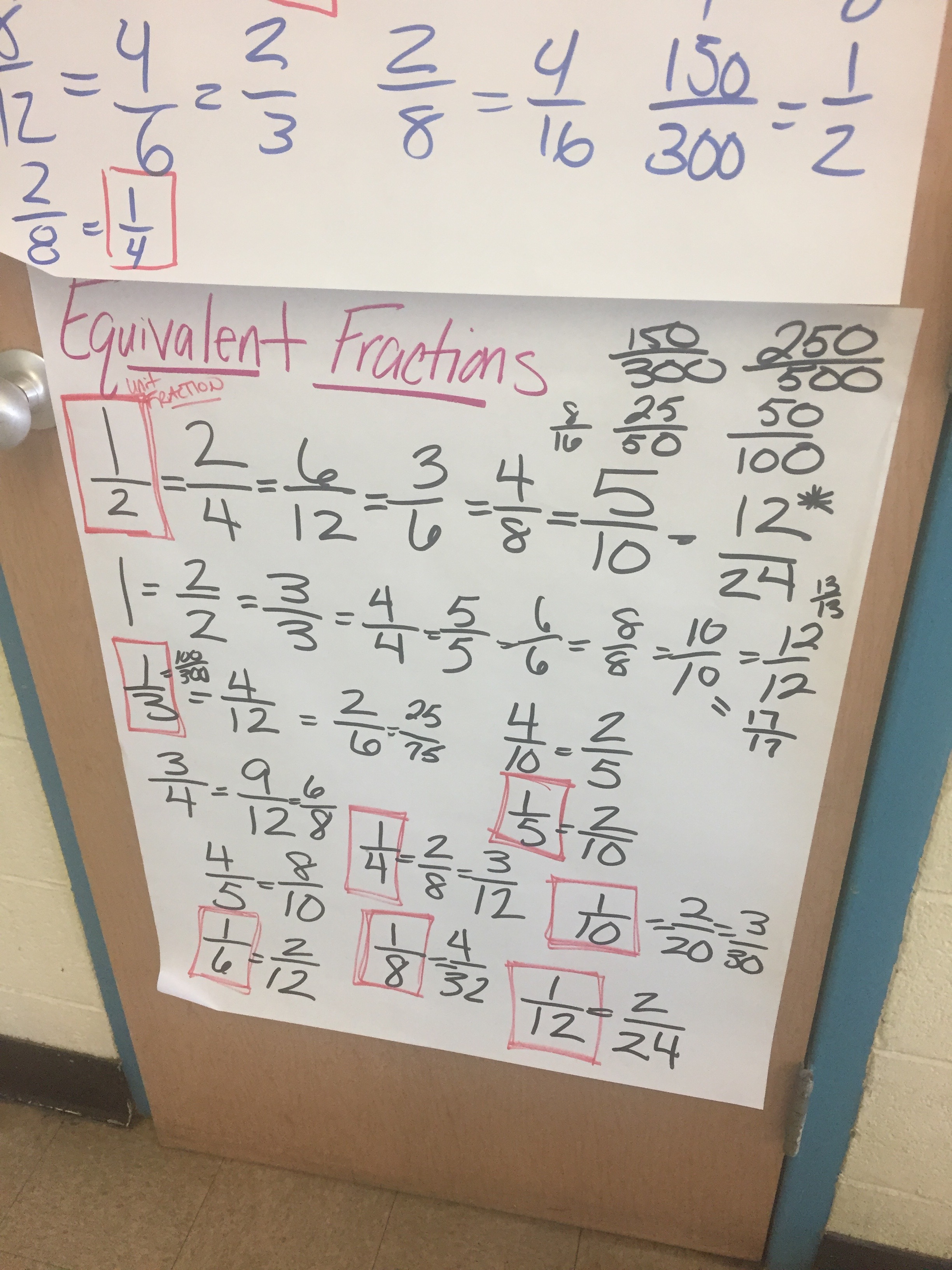
Next, we put up the following questions with the picture of the fraction strips we built:

Screen Shot 2016-11-30 at 5.00.06 PM.png

They recorded them in the journals as a group and then we made a poster to add to as the year progresses. They started with fractions they could show on the fractions strips and an interesting conversation about the fact that we couldn’t list any for 1/8 or 1/12 based on the strips, arose. After talking with their groups, they generated a couple. The conversation about the change in the size of the piece when we make equivalents and how many pieces we would have was really awesome (Yeah, 3rd grade team):)

img_3365

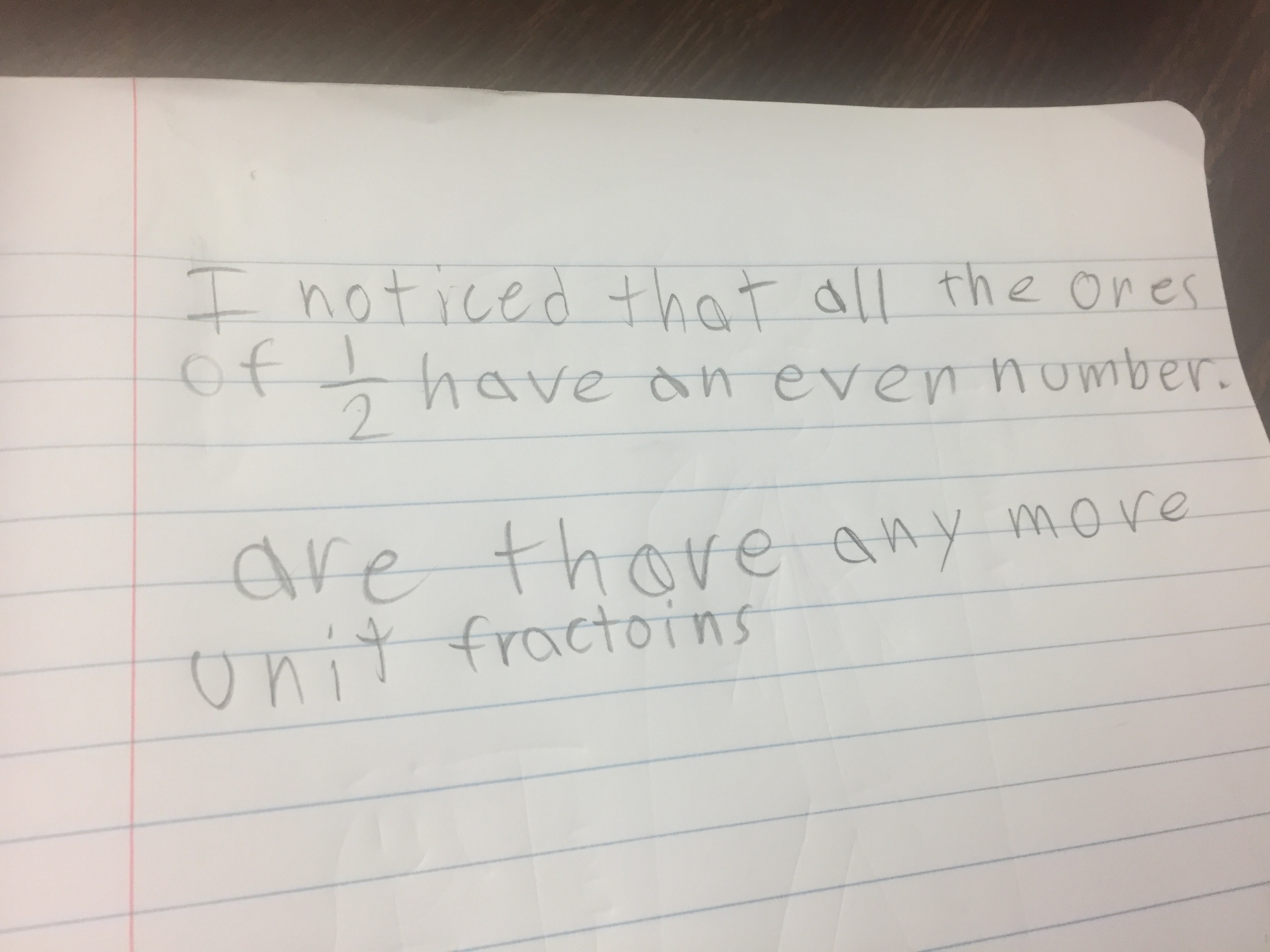
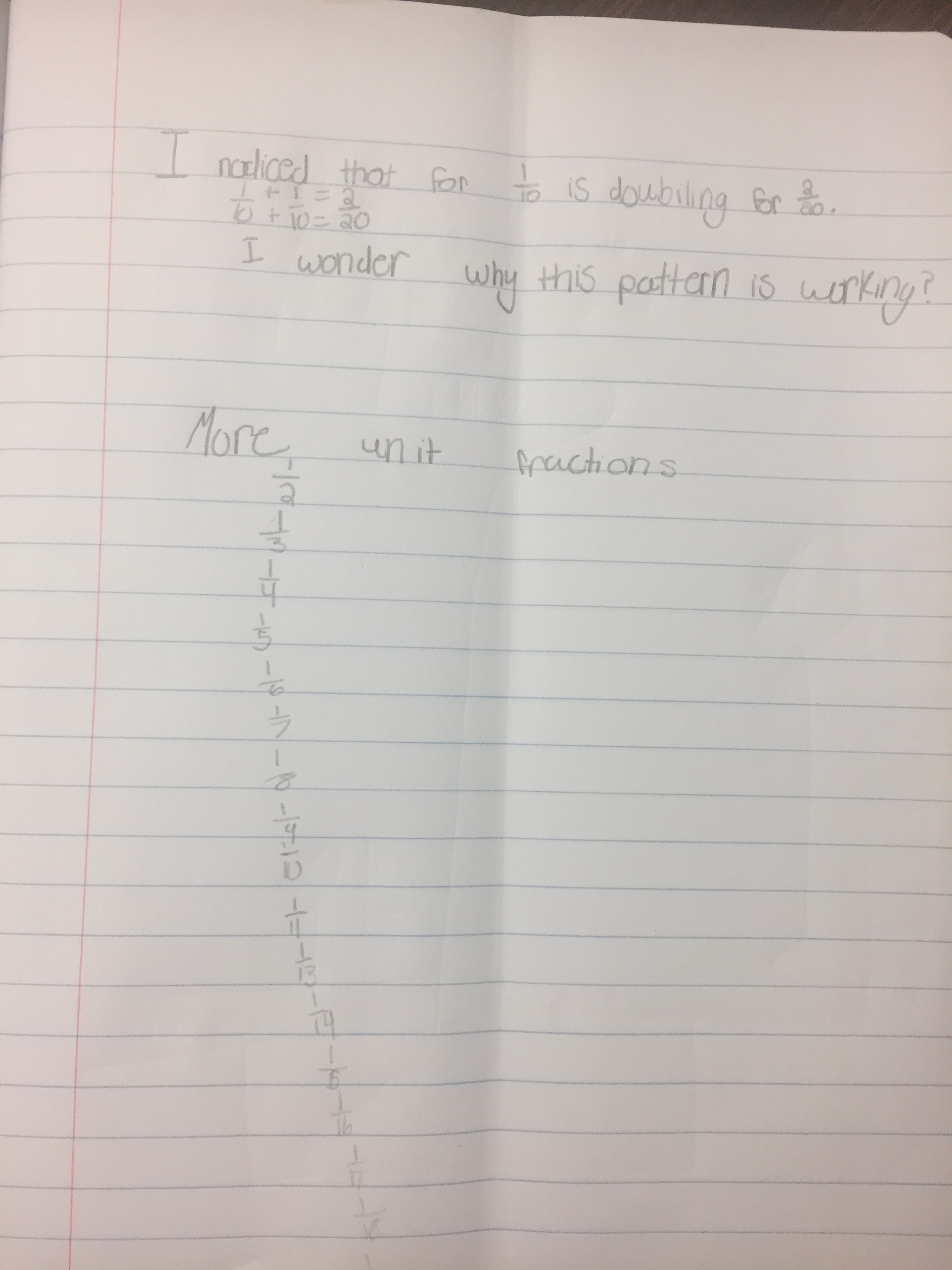
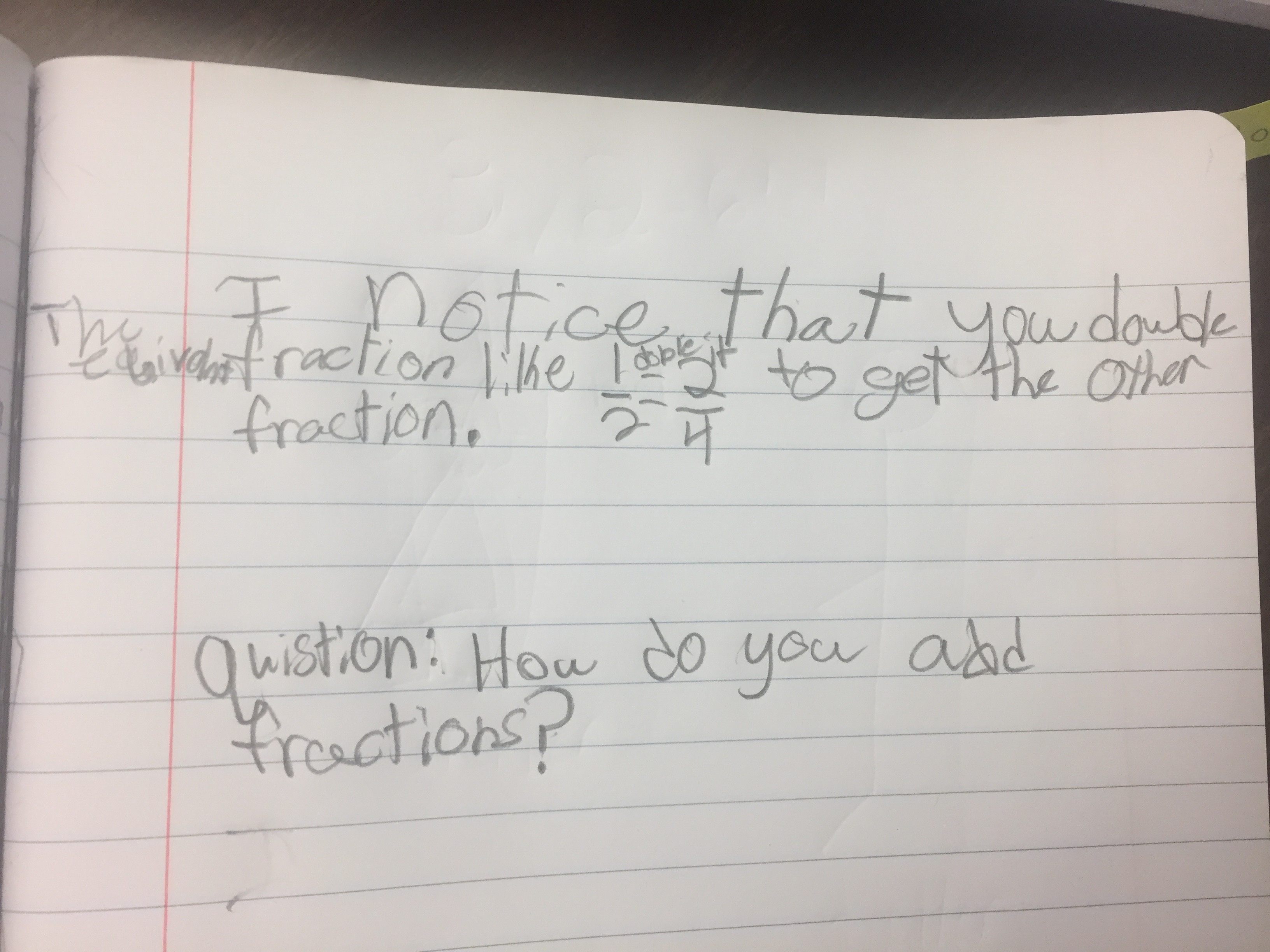
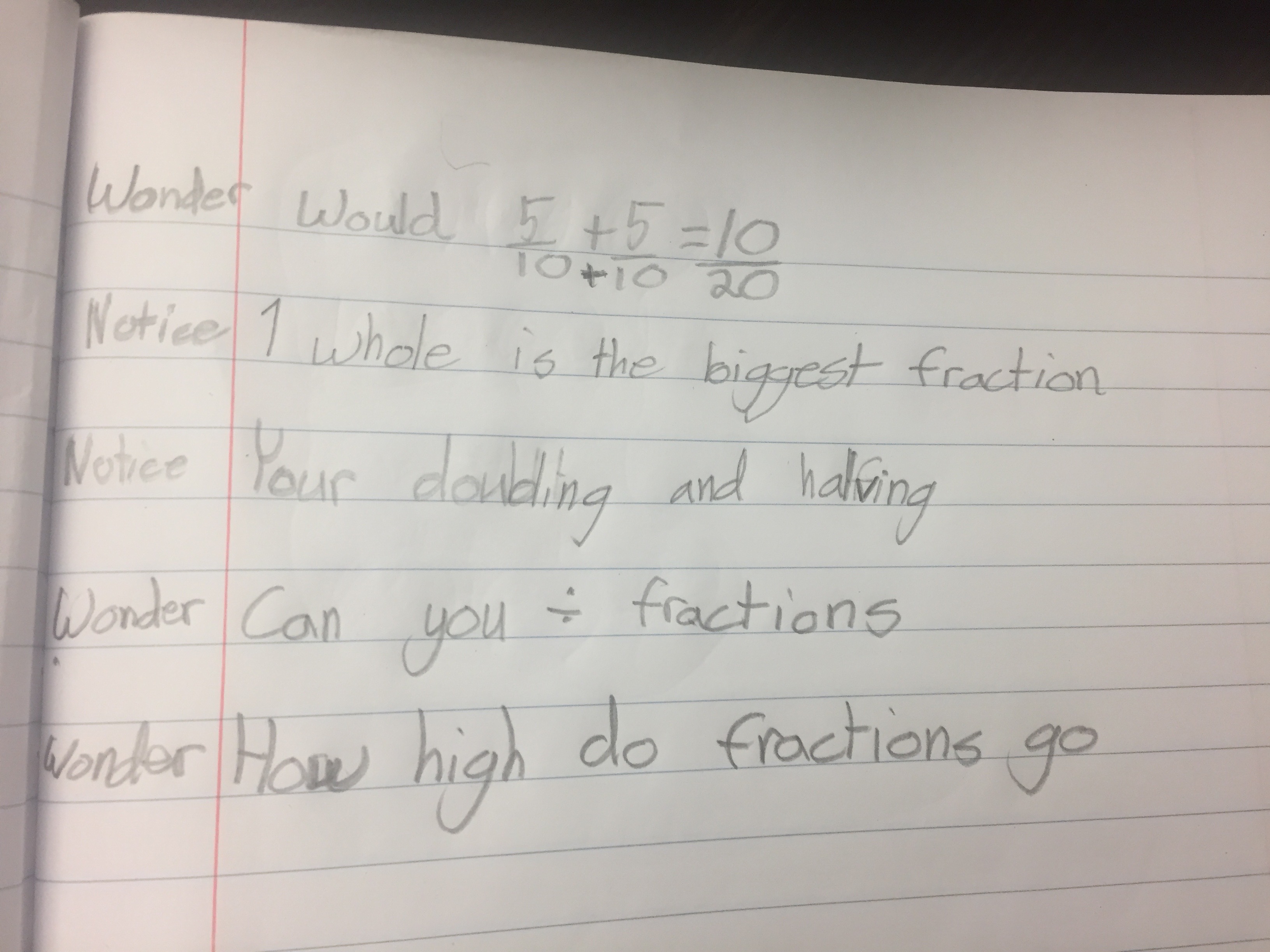
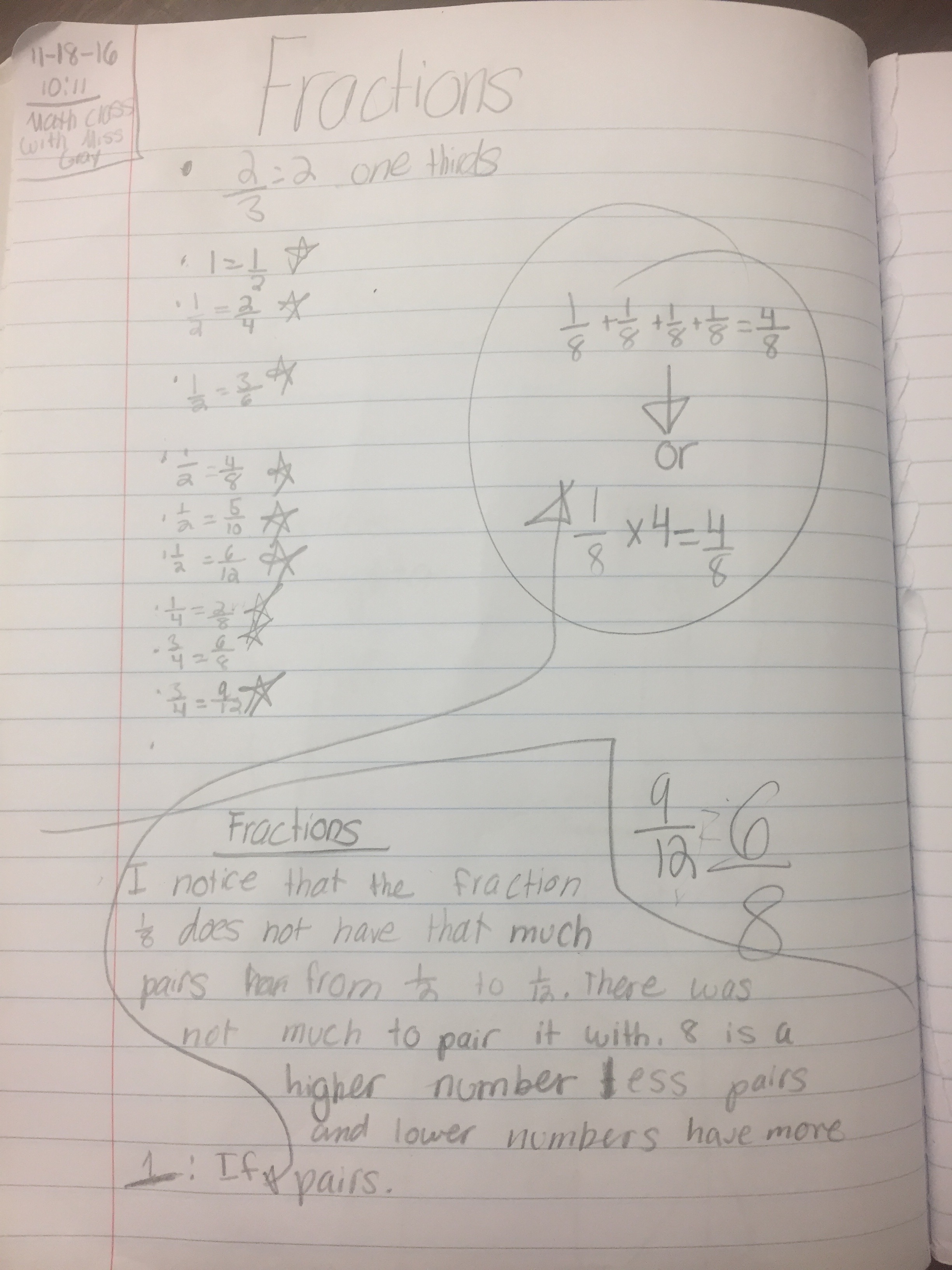
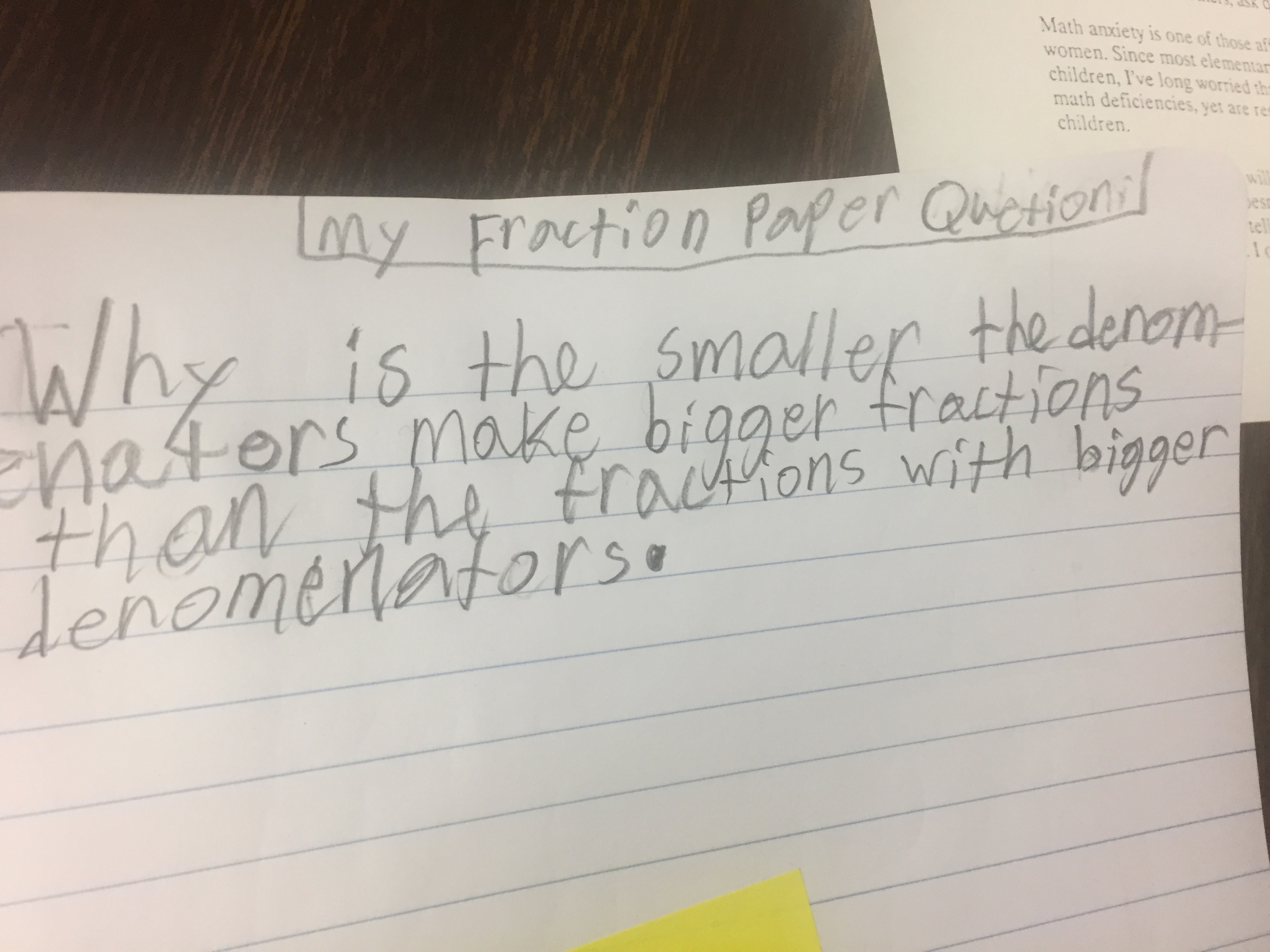
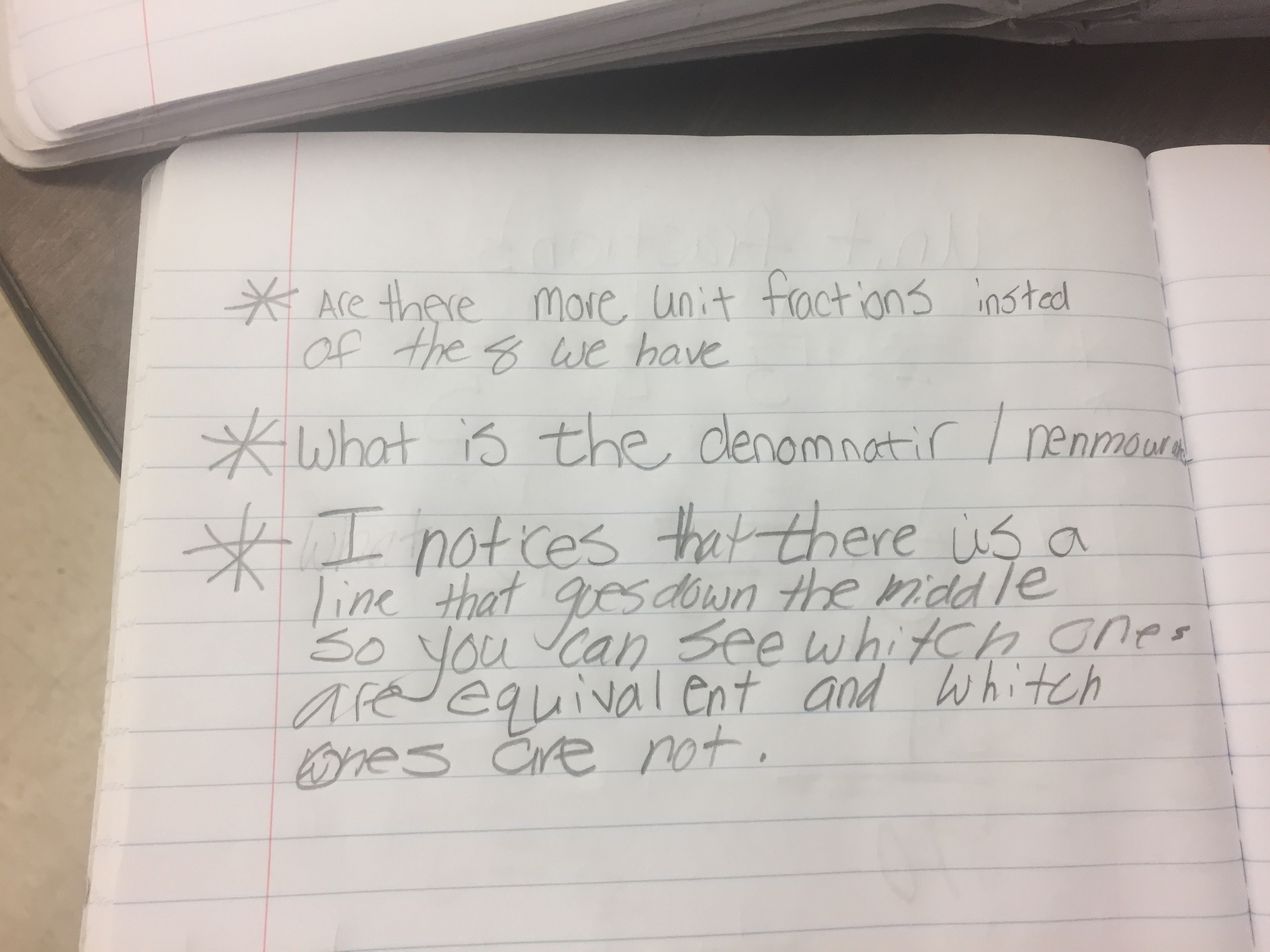
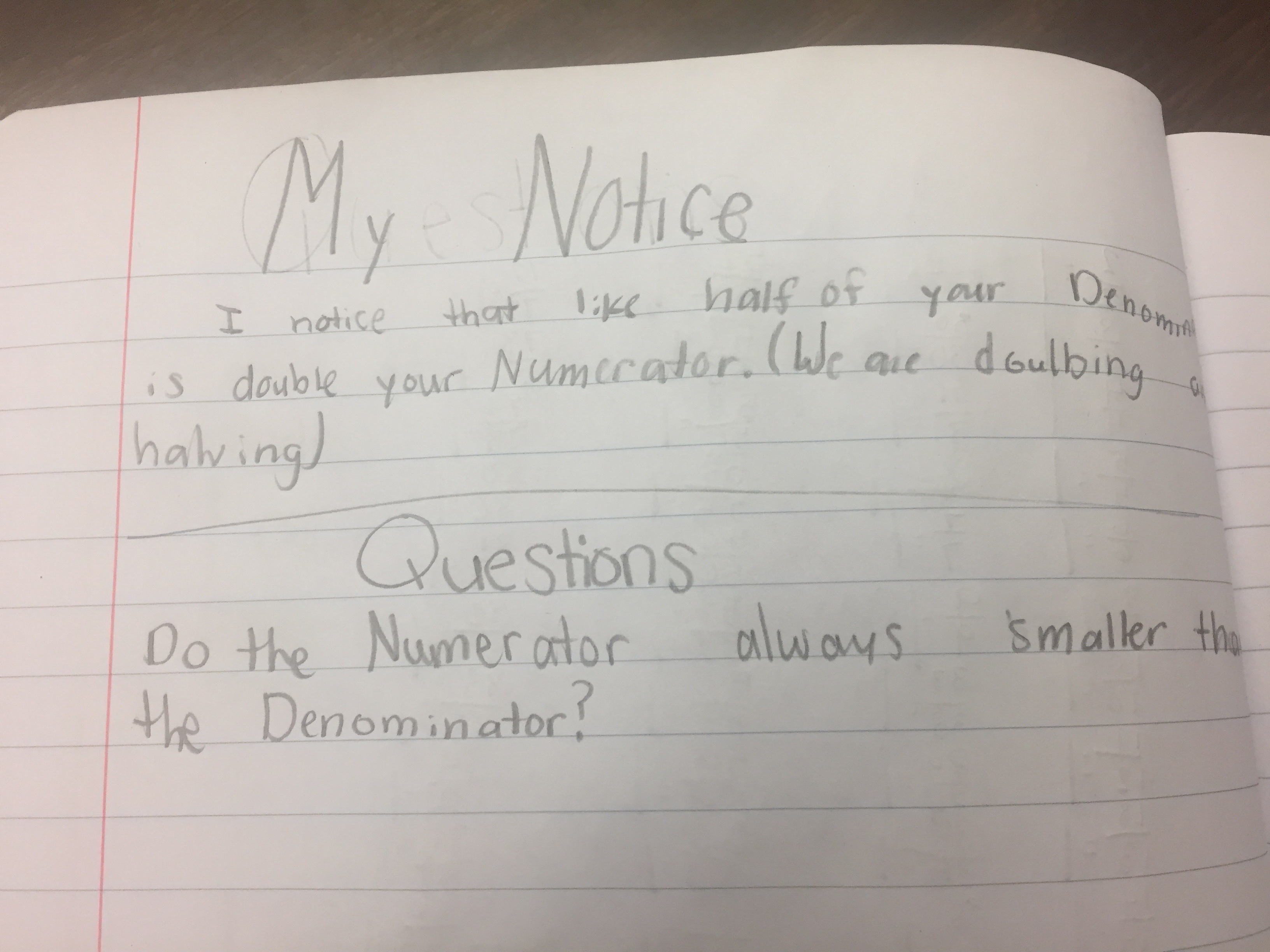
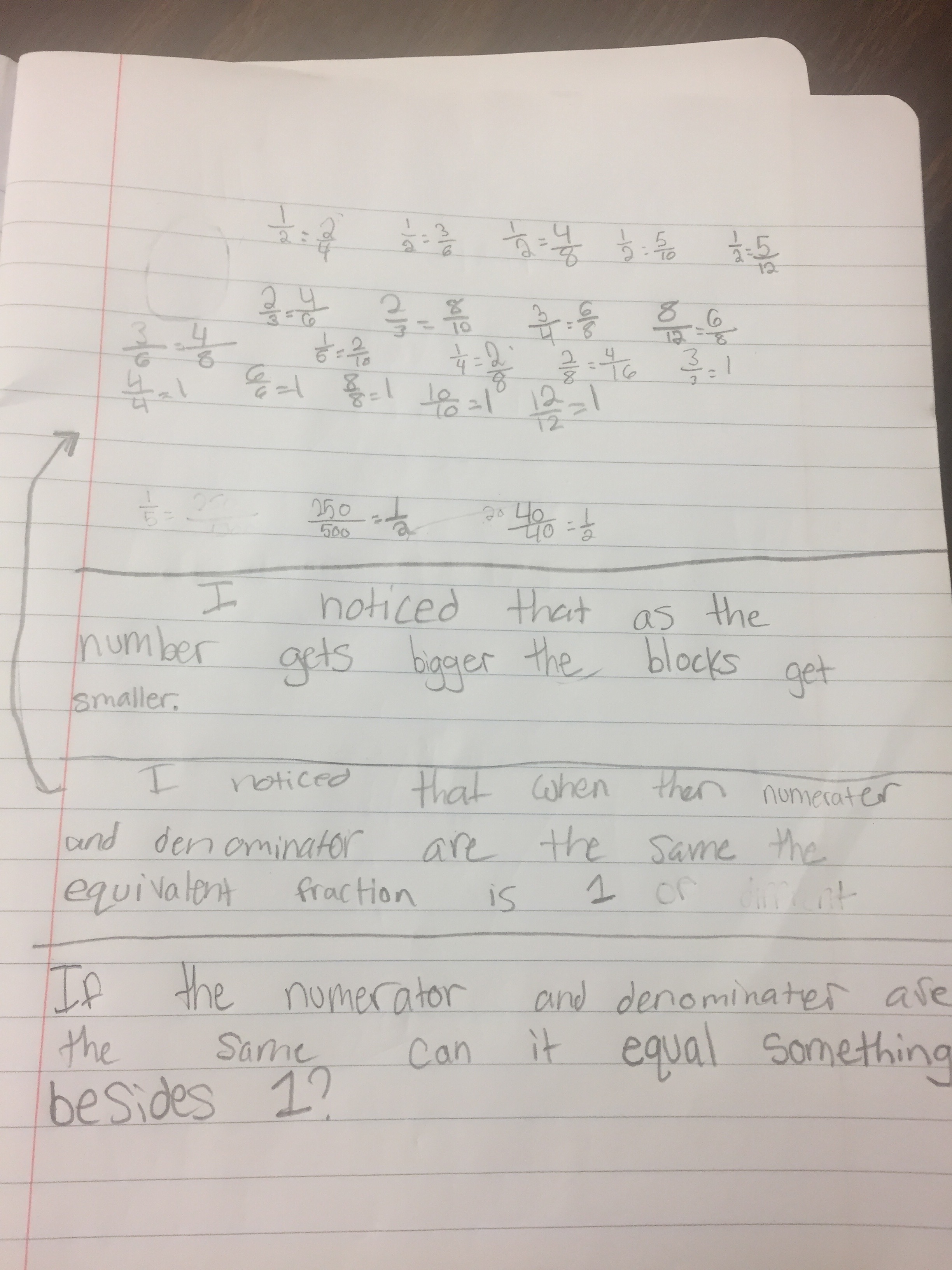
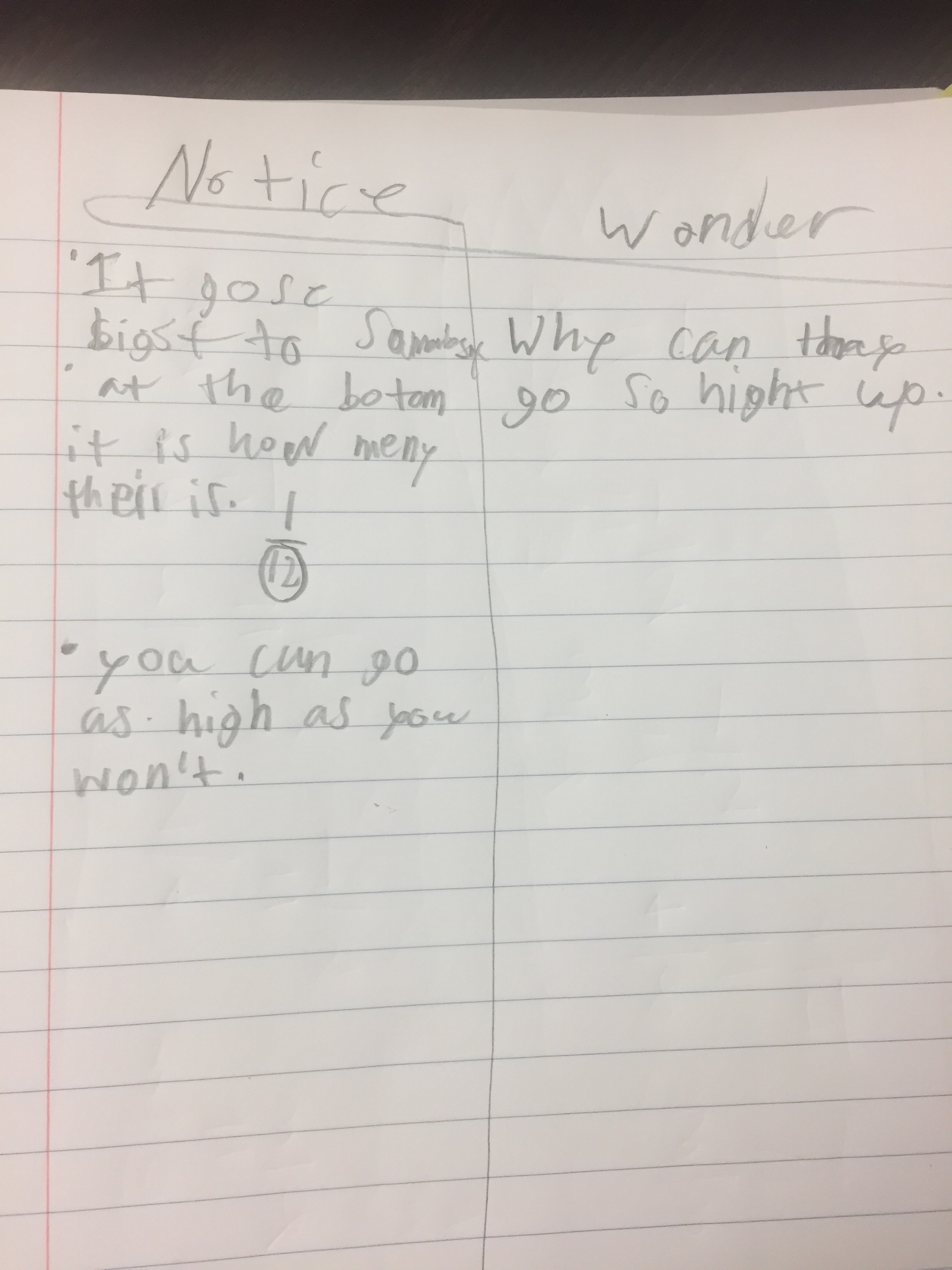
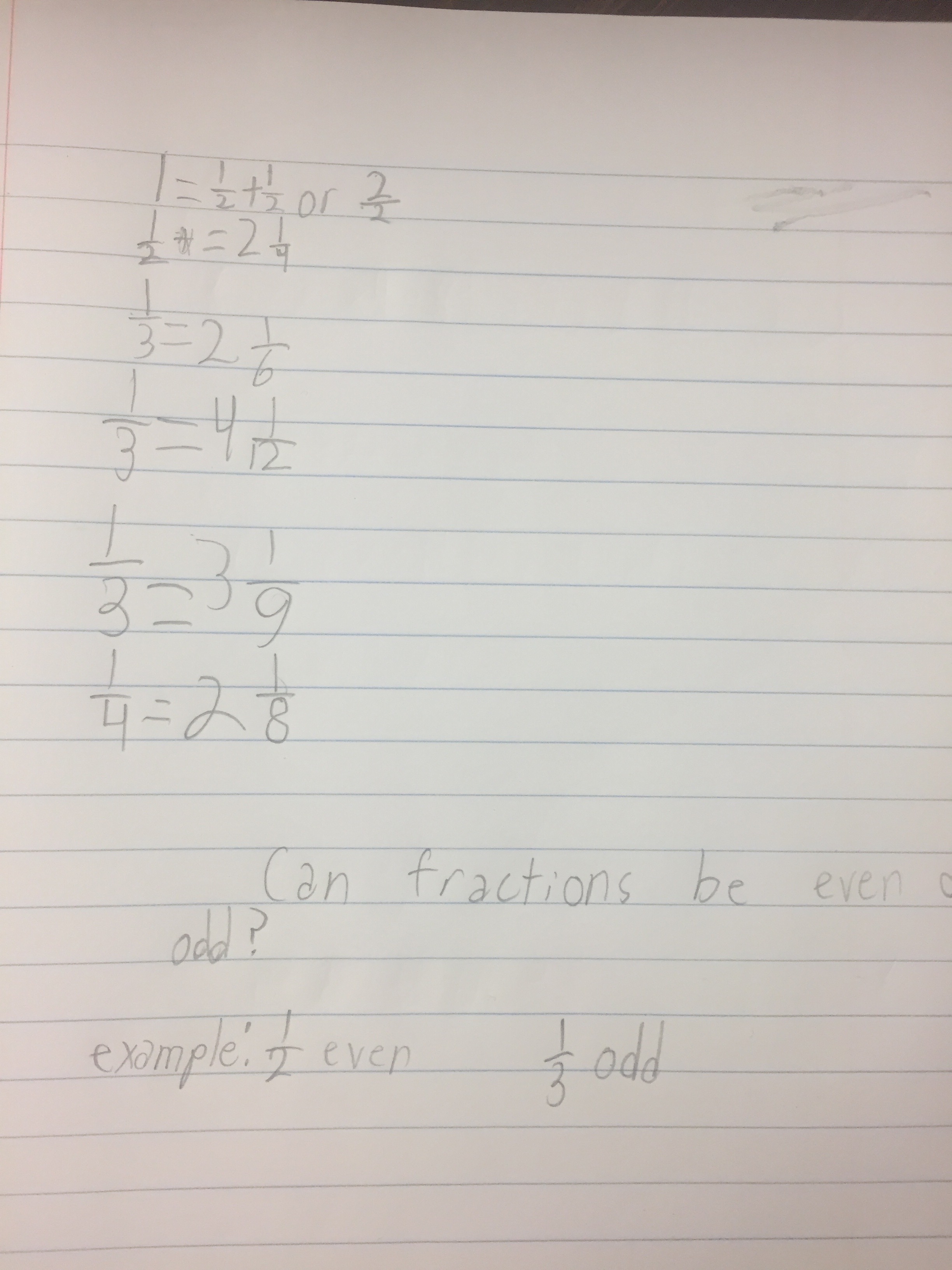
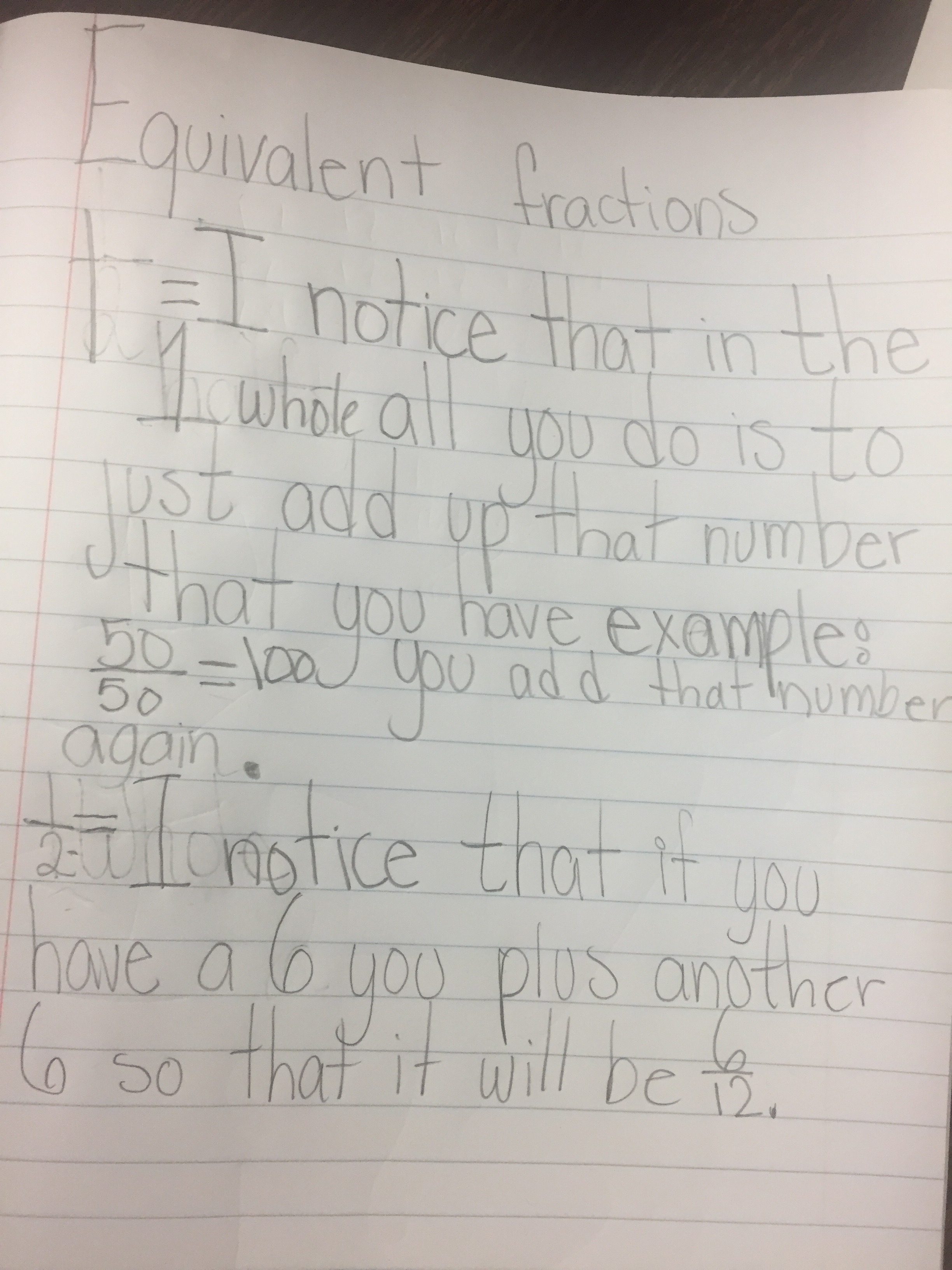
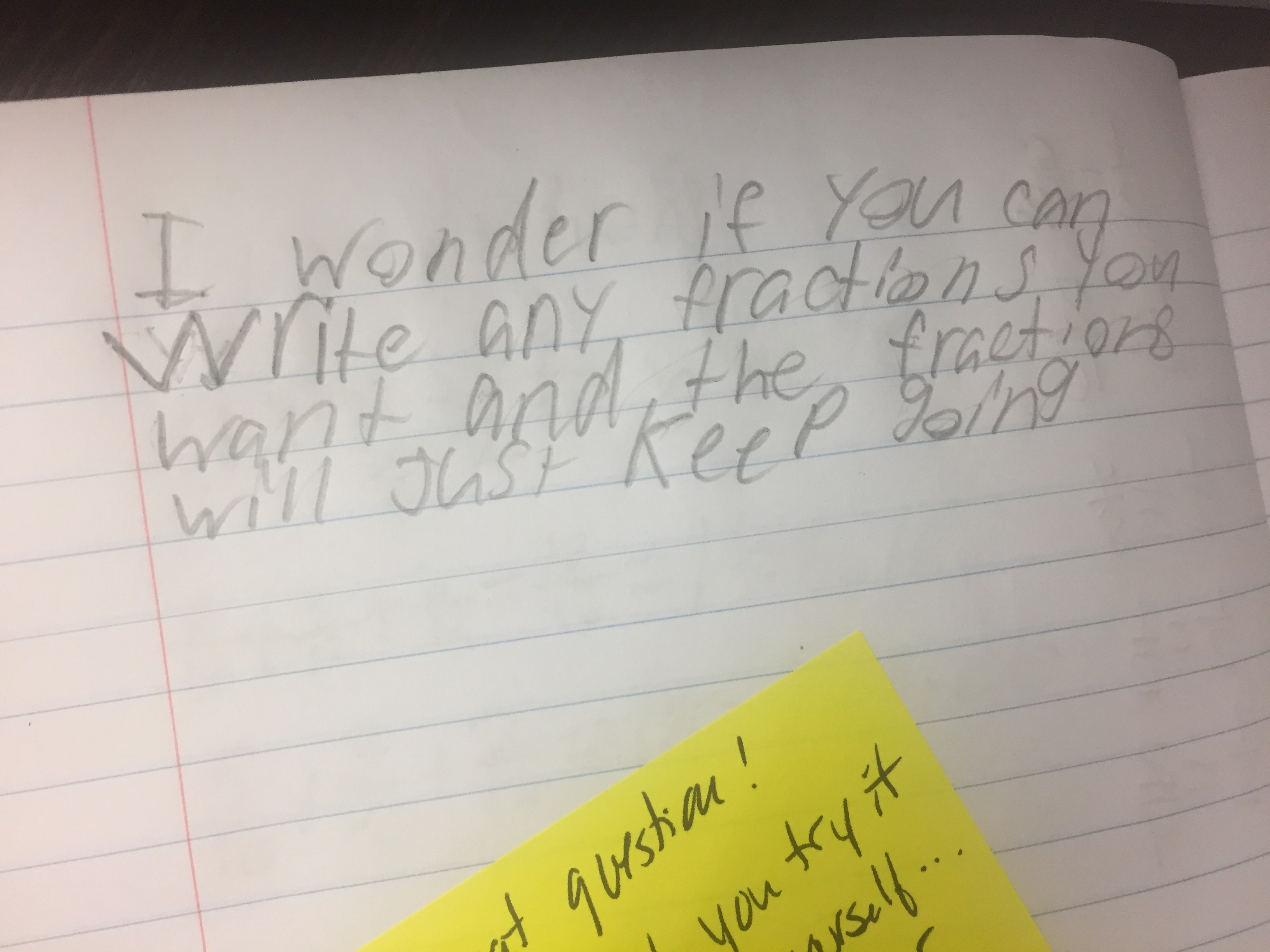
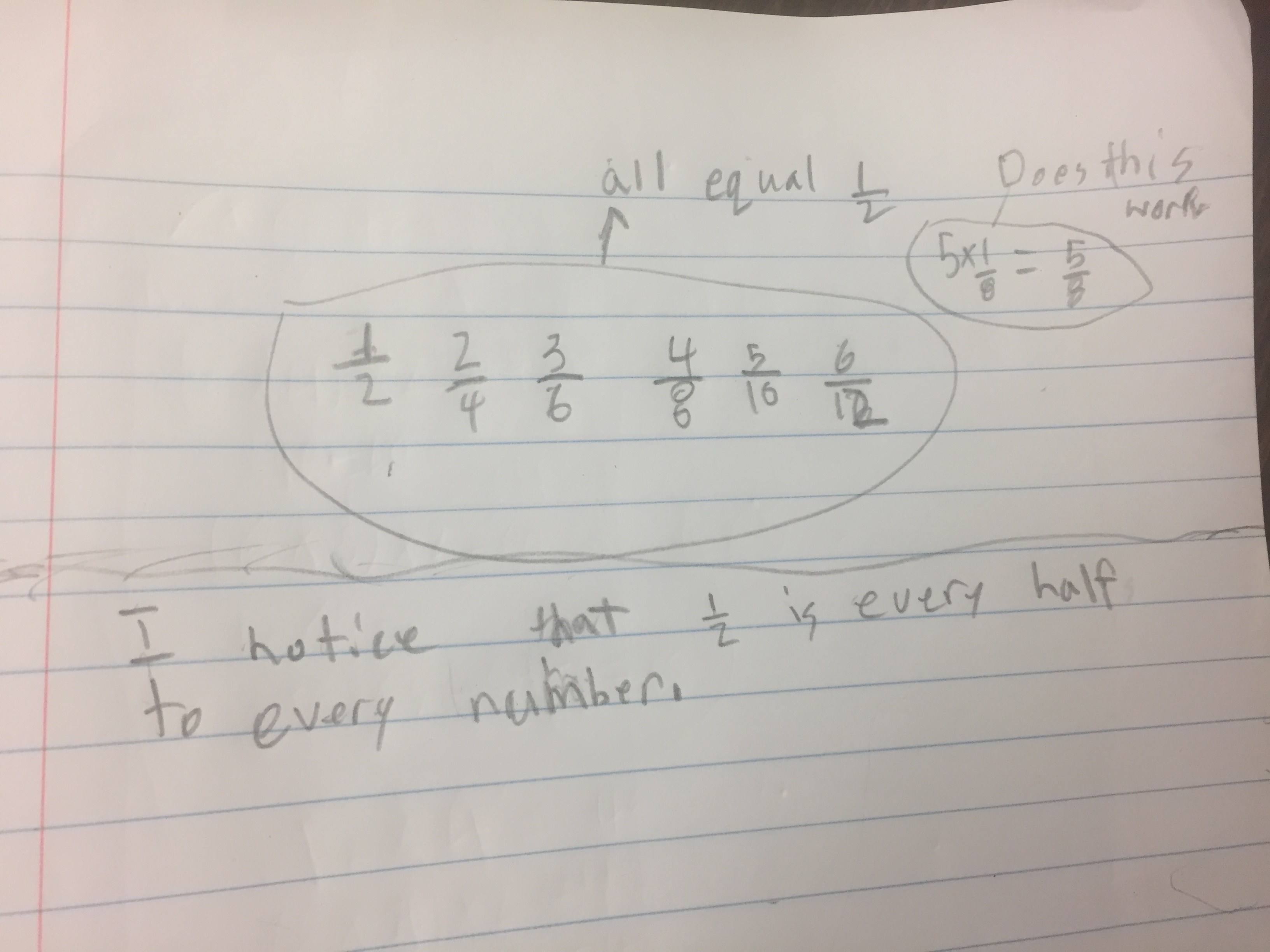
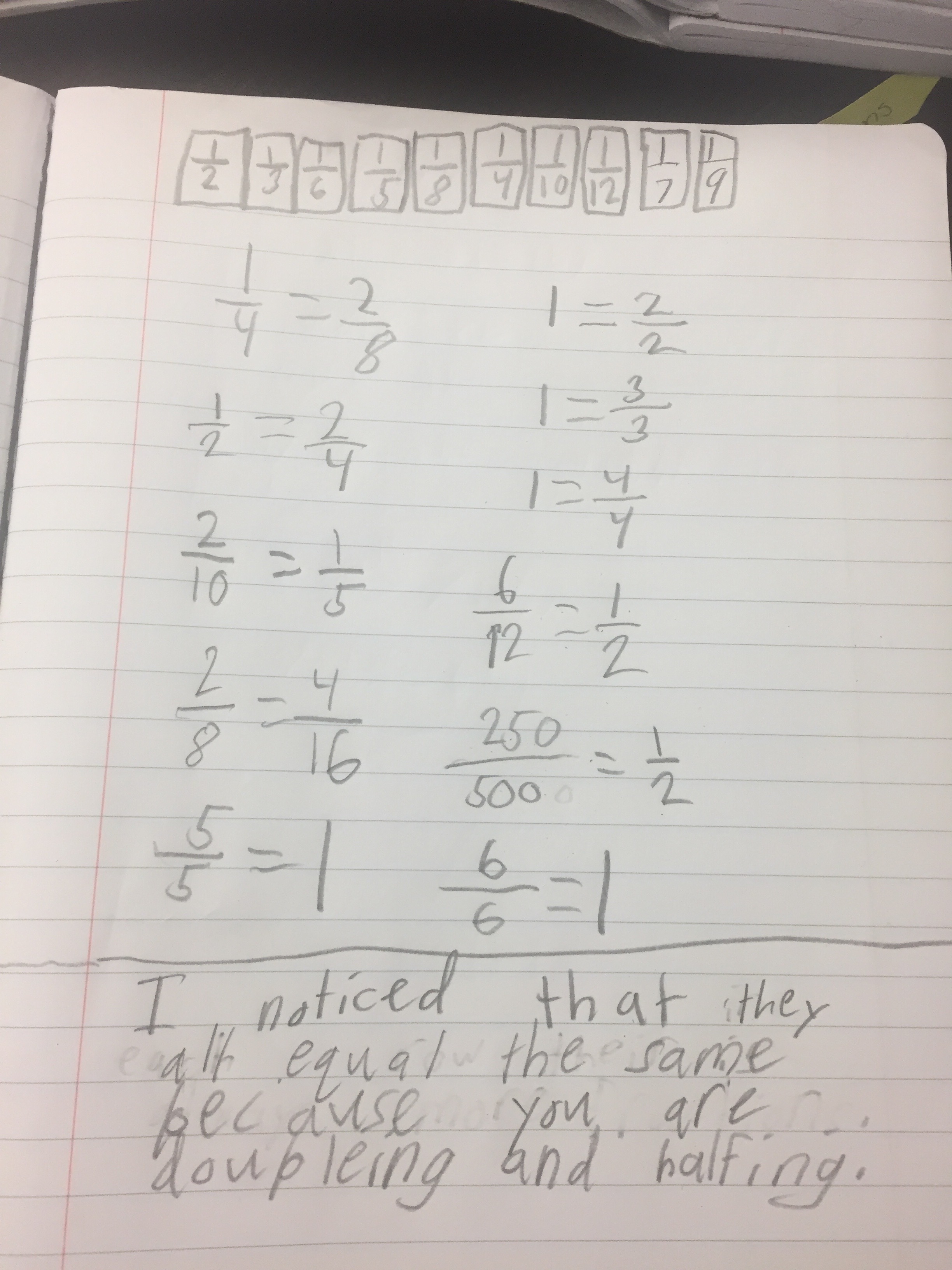
This was as much as we could fit into one class period, so we asked them to journal about any patterns they noticed or things they were wondering about fractions.

I apologize for the overload of student journals from this point forward, but there were so many great things to think about in planning the unit from here!

These are things that jumped out at me after reading and leaving notes in their journals, I would love to hear any other things that stood out to you:

  • A lot of talk about “doubling” and “halving” when naming equivalent fractions. Will want to address what is exactly doubling, what that means in terms of the fraction strips, and how it is affecting the numerator and denominator.
  • Interesting noticing and wondering about addition. Some wondering how it works and others thinking they know.
  • Love the even and odd talk throughout!
  • Some wondering about multiplication and division of fraction!
  • The range of fractions – how many we can name, how many unit fractions there are.
  • The size of a fraction in different forms – Is the whole the biggest fraction? Is the numerator smaller than the denominator?

img_3355img_3354img_3362img_3359img_3358img_3349img_3356img_3364img_3363img_3360img_3352img_3351img_3357img_3361img_3350

In case you want to try it out:

SMARTBoard file for 4th grade

SMARTBoard file for 5th grade

PDF file of the file.

Cuisenaire Rods: Fun in 4th

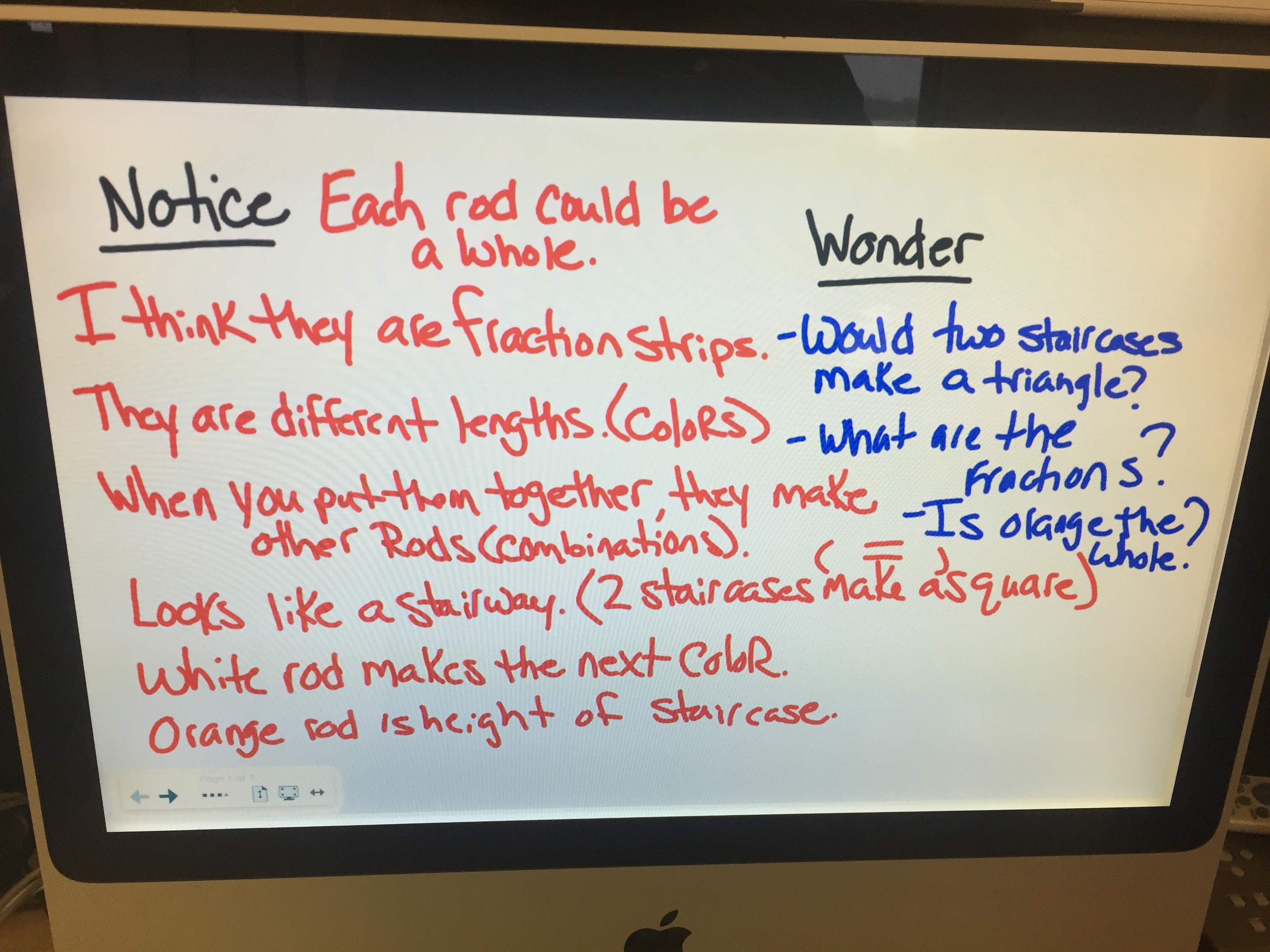
The 4th grade has just started their fraction unit, so I was curious how that may impact their work with the Cuisenaire rods. I started just like I did in Kindergarten and 3rd grade, with a notice and wonder:

IMG_3441.jpg

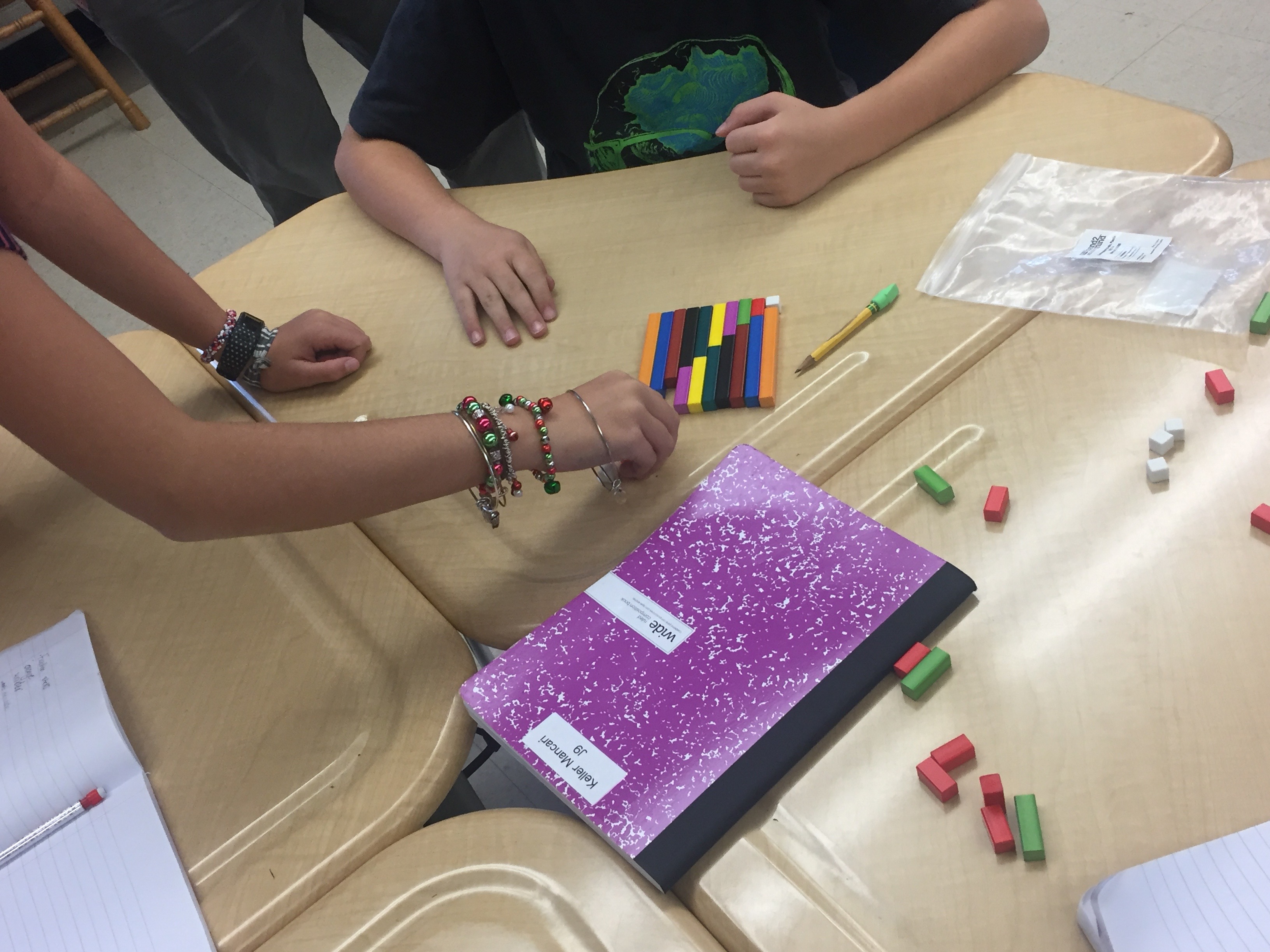
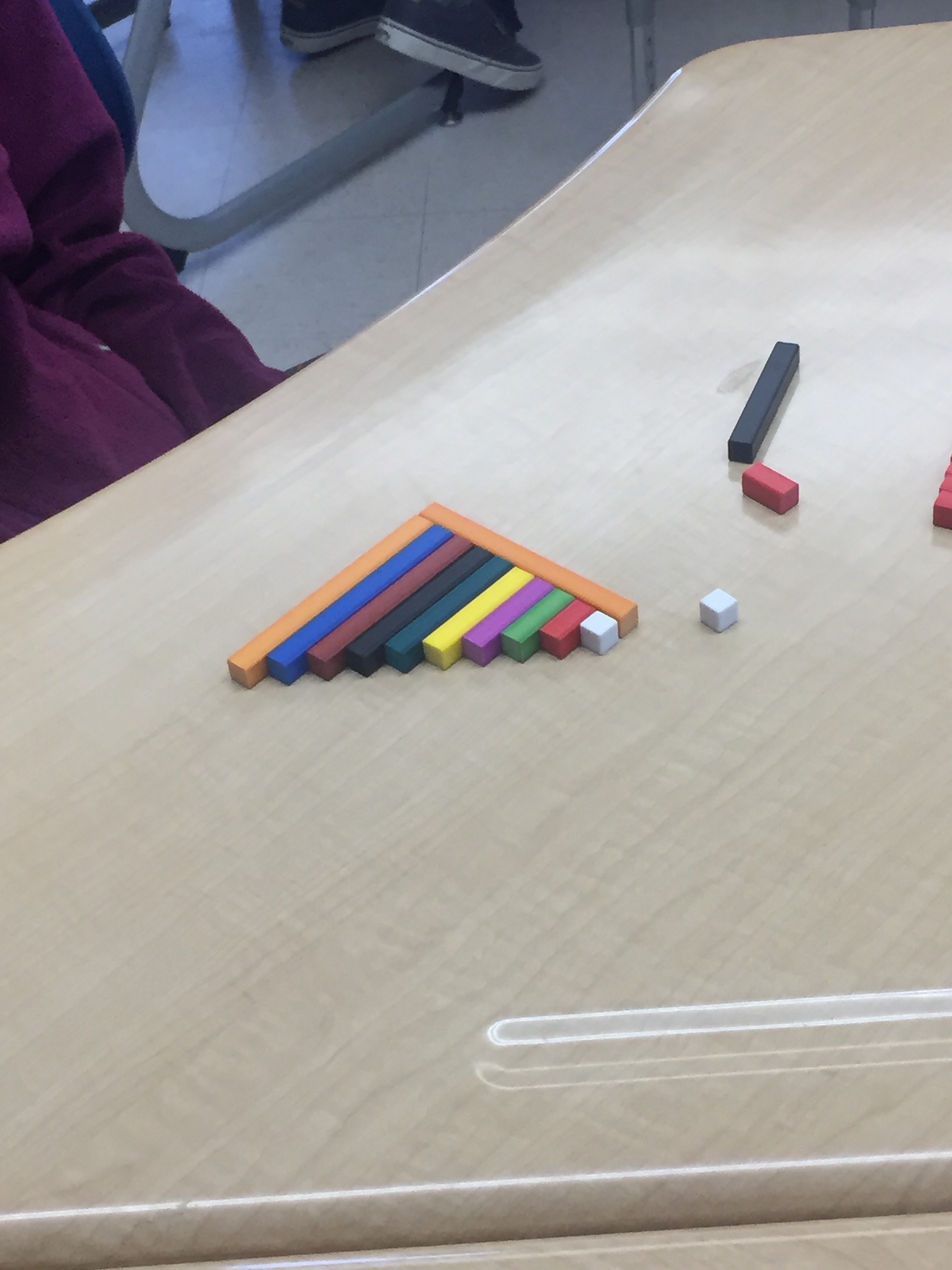
There were two of the ideas that really struck me as things I want to have the students explore further later: First was, “2 of the staircases (the staggered rods in order of size) could make a square.” They had them arranged on their desks like the picture below…but I want them to answer:

  • Is that a square?
  • If not, could we make it a square?

Then I started to wonder, do we call it a square? Should we say square face? Then what about area…would we say, “What is the area of the rectangle?”? That feels wrong because they keep calling the white rod a cube (which it is). But then asking about volume is not 4th grade. BUT, the tiles we use for area in 3rd grade are also 3-dimensional. <–would love thoughts on any of that in the comments!

IMG_3439.jpg

One student noticed that the orange rod was the height of the staircase and I thought of area again since it was said right after the comment above. This idea would be really helpful for the students above when they are determining if their figure is a square.

IMG_3440.jpg

I loved that one group noticed that any of the rods could be a whole and another group wondered if orange was the whole. Great lead into what I was thinking I wanted them to explore!

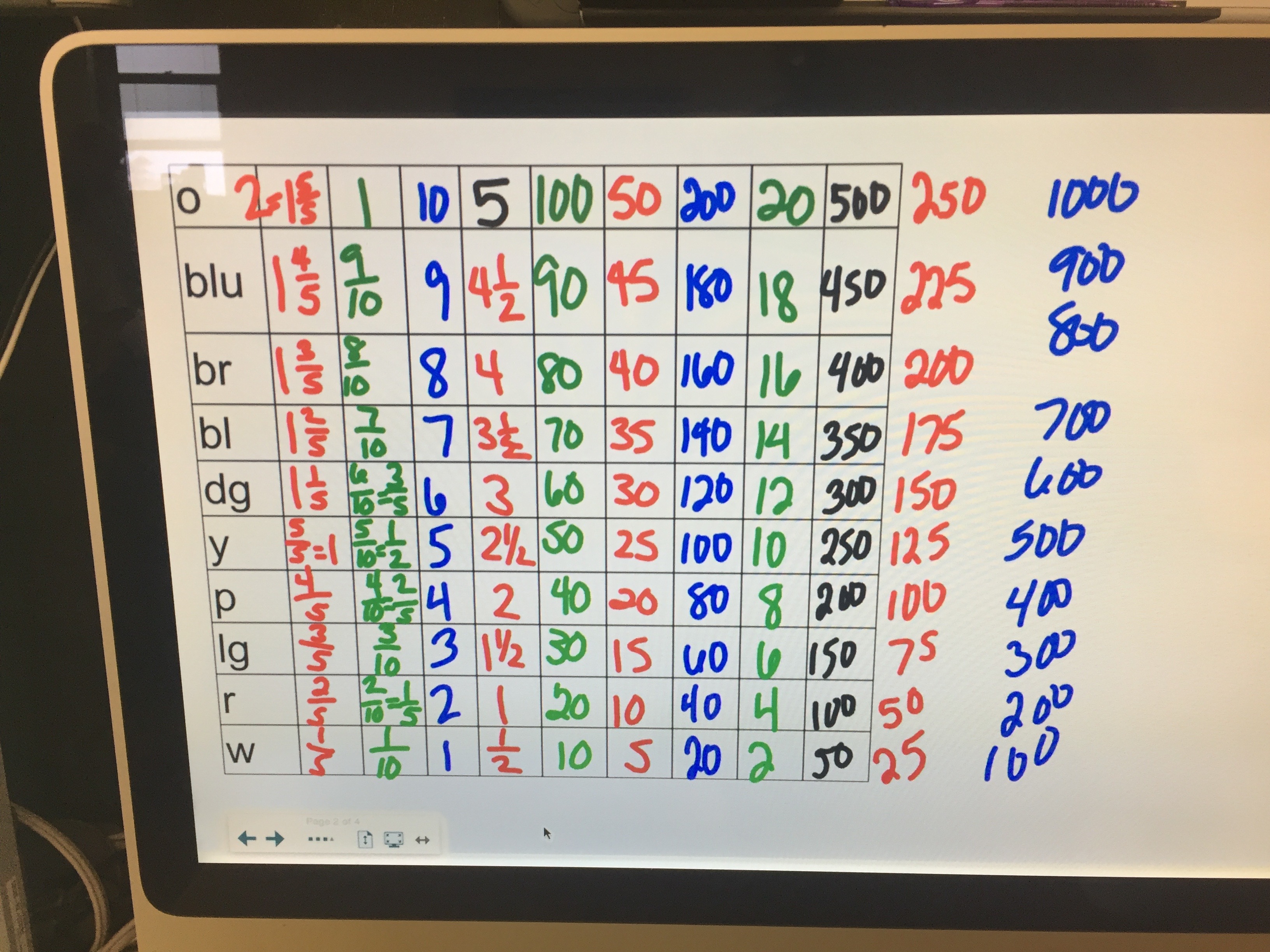
I asked them to find values for the rods based on their relationships. Of course the very first group I call on had 2 as the whole, which blew a lot of students minds, so I want to revisit that a bit later and ask them to explain how that works.

All of the other groups had orange as either 1 or 10, so I asked them to find the other values if the orange was 5 and 100. They played with that for a bit and then I began to hear a lot of aha’s, so I set them off to find more and they could have gone on forever.

IMG_3443.jpg

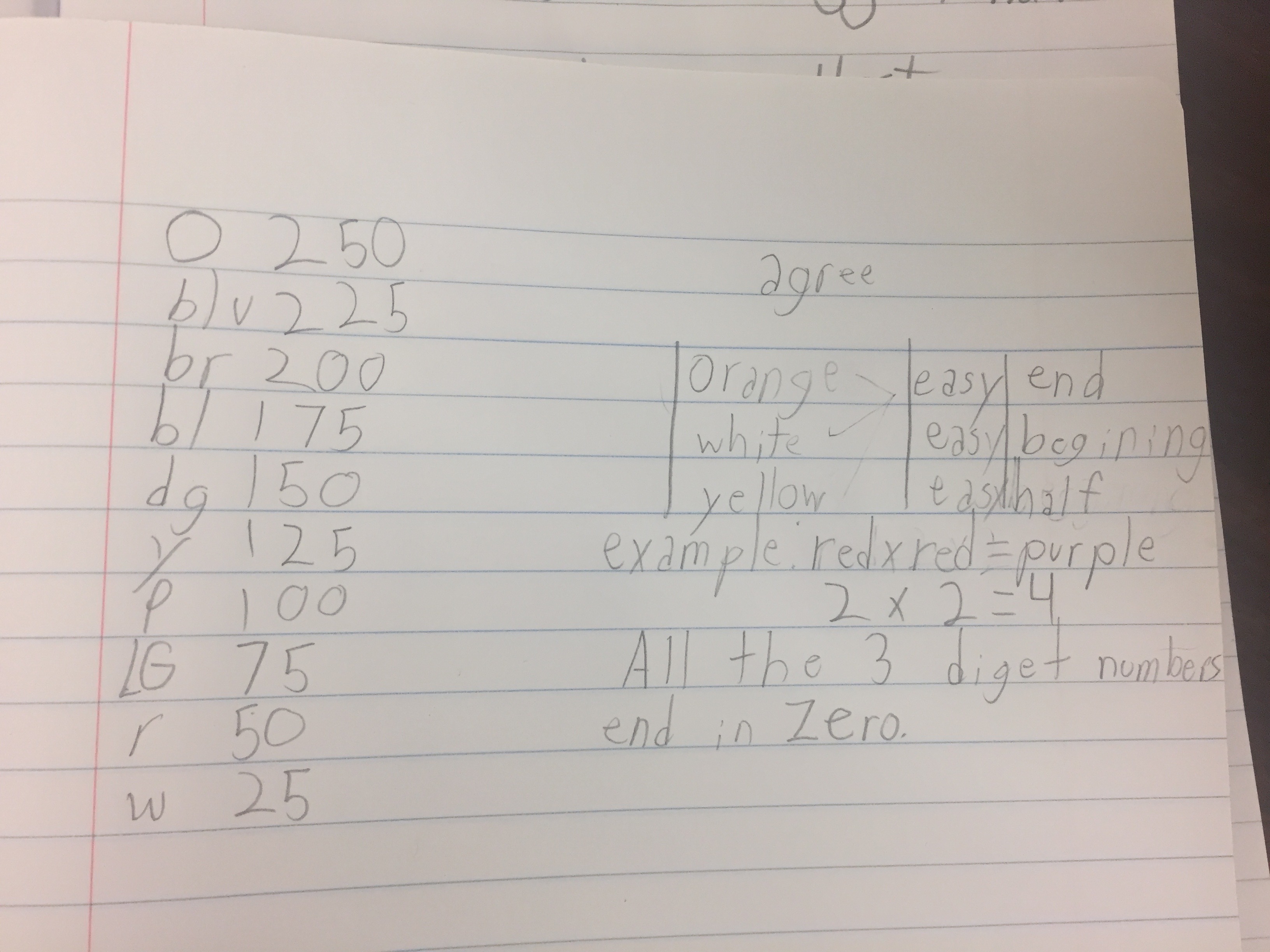
I left them with the prompt, “Tell me about the patterns and relationships you notice.” and for those who looked like they were struggling to answer that question, I added, “If you are struggling with that, tell me how you could find the rest of the values if I gave you one of them and which one would you want?”

I loved how this student chose the orange, white and yellow as the easiest end, beginning, and half. I also like the red x 2 is purple, but we need to talk through that notation a bit.

img_3445

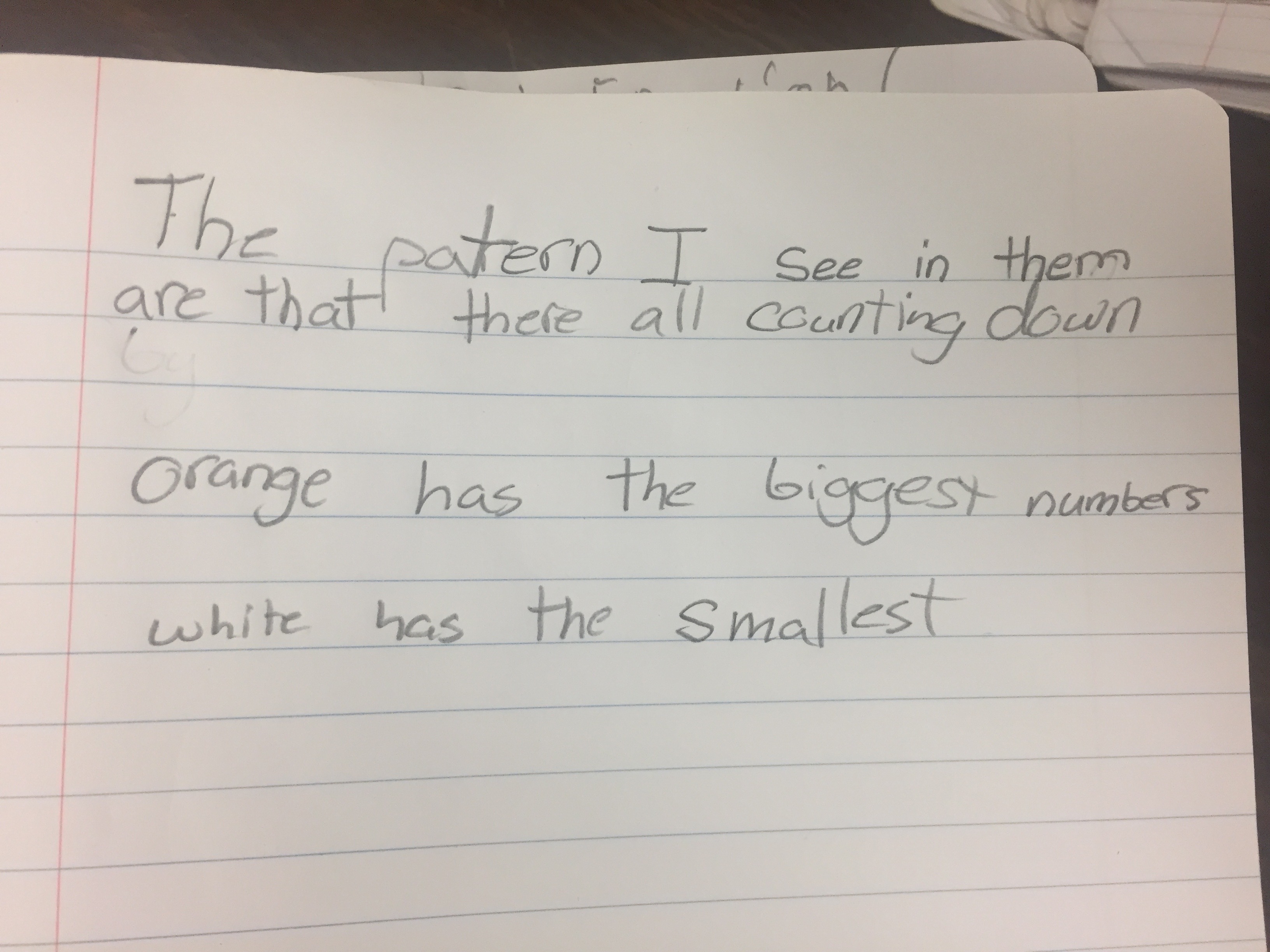
This was the most common response, seeing the numbers get smaller as the rod got shorter.

img_3446

This student’s noticing could be an interesting number choice question to pose: Why do you think groups chose numbers for orange that were doubles or halves of the other numbers we already had?

img_3447

This student disagreed with the student who gave the responses in the first column because he is determined the white is 1/10 because the orange is 1. Would be great to pair them up and have them come to an agreement.

img_3448

This student is seeing the white value adding to each value above it to get the next. I also love how she writes notes about how neat her handwriting is:)

img_3449

I would love to have them play around with this first pattern in this entry! What other relationships could they find after they explored this one?

img_3450

So much fun! Cannot wait to get into other grade levels to see if I can begin to find a progression of ideas with these rods!


Number Talks Inspire Wonder

Often when I do a Number Talk, I have a journal prompt in mind that I may want the students to write about after the talk. I use these prompts more when I am doing a Number String around a specific idea or strategy, however today I had a different purpose in mind.

Today I was in a 4th grade class in which I was just posing one problem as a formative assessment to see the strategies students were most comfortable or confident using.

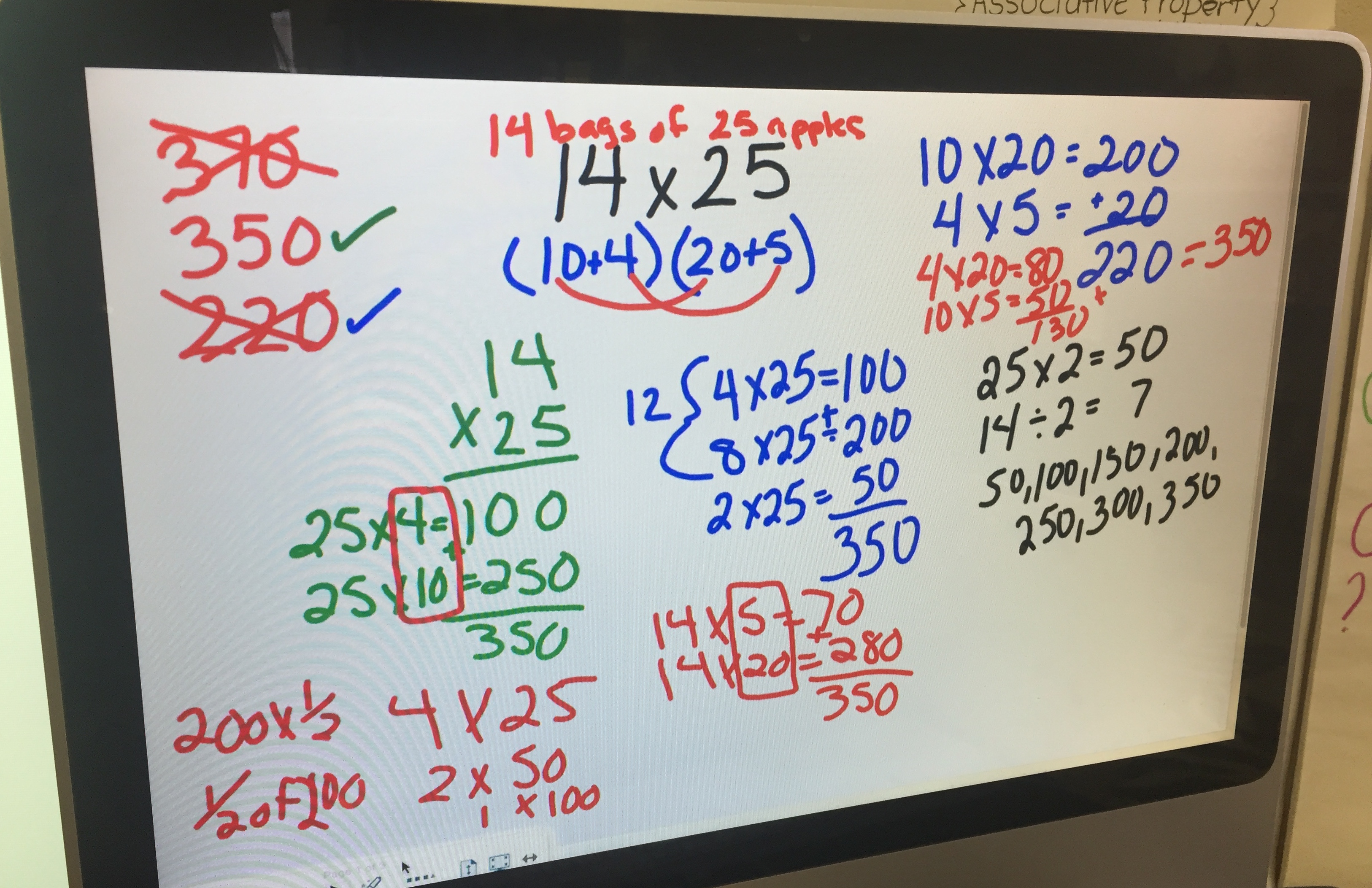
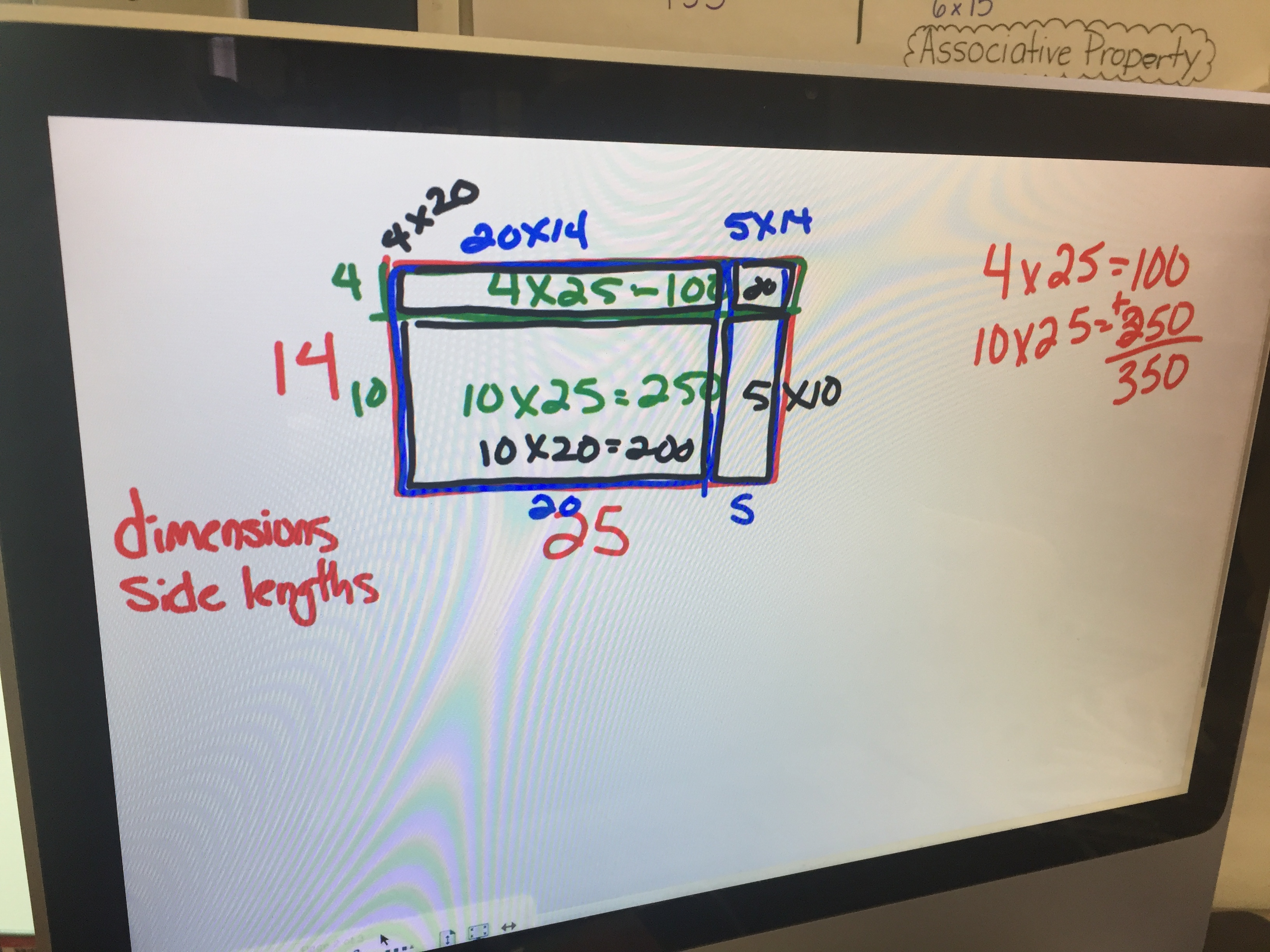
The problem was 14 x 25.

I purposefully chose 25 because I thought it was friendly number for them to do partial products as well as play around with some doubling and halving, if it arose. When collecting answers, I was excited to get a variety: 370,220, 350 and 300. The first student that shared did, what I would consider, the typical mistake when students first begin multiplying 2-digit by 2-digit. She multiplied 10 x 20 and 4 x 5 and added them together to get 220. Half of the class agreed with her, half did not. Next was a partial products in which the student asked me to write the 14 on top of the 25 so I anticipated the standard algorithm but he continued to say 4 x 25=100 and 10×25=250 and added them to get 350.

One student did double the 25 to 50 and halved the 14 to 7 and then skip counted by 50’s to arrive at 350, instead of the 300 she got the first time. I asked them what they thought that looked like in context and talked about baskets of apples. I would say some were getting it, others still confused, but that is ok for now. We moved on..

Here was the rest of the conversation:

IMG_3307.JPGIMG_3308.JPG

I felt there were a lot more wonderings out there than there was a need for them to write to a specific prompt, so I asked them to journal about things they were wondering about or wanted to try out some more.

I popped in and grabbed a few journals before the end of the day. Most were not finished their thoughts, but they have more time set aside on Wednesday to revisit them since they had to move into other things once I left.

What interesting beginnings to some conjecturing!