Tag Archives: Fractions

Making Connections for Deeper Learning

In 3rd grade, students come to understand fractions as numbers. They count by them and locate them on a number line just like whole numbers. However, once they start operating with fractions in 4th and 5th grade, they tend to set aside everything they understand about whole number operations and treat fractions as numbers with their own set of ‘rules.’ I can think of many reasons why this happens, but my current wondering is how we can create more opportunities for students to make connections between their understanding of whole number and fraction operations.

Why Connections?

So many times I see students not realize all of the wonderful things they know that would be helpful in their new learning. I believe this is because we just don’t spend enough time making connections explicit to support this transfer.

One of my favorite papers on the importance of practicing connections (linked in the citation) describes the ‘why’ so nicely…

“Although there may have been a time when rote learning of facts and procedures was sufficient as an outcome for education, that is certainly not the case today. Anyone with a phone can Google to find facts that they have forgotten. But gaps in thinking and understanding are not easily filled in by Internet searches. Increasingly, we value citizens who can think critically, coordinate different ideas together, solve novel problems, and apply their knowledge in all kinds of situations that do not look like ones they have previously encountered. In short, we want to produce students with deep understanding of the complex domains that constitute the modern knowledge landscape (National Academies of Sciences, Engineering, and Medicine 2018).”

“Studies show that expert knowledge in a domain is generally organized around a small set of core concepts (e.g., Lachner and Nückles 2015) that imbue coherence to even wicked domains. Because they are highly abstract and interconnected with other concepts, core concepts must be learned gradually, over extended periods of time and through extensive practice. As students practice connecting concepts with other concepts, contexts, and representations, these core concepts become more powerful and students’ knowledge becomes more transferable (e.g., Baroody et al. 2007; National Council for Teachers of Mathematics 2000; Rittle-Johnson and Schneider 2015; Rittle-Johnson et al. 2001).”

Fries, L., Son, J.Y., Givvin, K.B. et al. Practicing Connections: A Framework to Guide Instructional Design for Developing Understanding in Complex Domains. Educ Psychol Rev 33, 739–762 (2021).

Subtracting Whole Numbers

In 4th grade, students have been decomposing fractions into sums of fractions with the same denominator and justifying their decompositions. They naturally leveraged their understanding of whole number decomposition, but when we gave them a problem to add or subtract, they quickly looked for a ‘rule’ to find the sum or difference. And, while we want them to generalize these operations, as the numbers get more complex –mixed numbers and unlike denominators – a memorized rule absent understanding doesn’t help students reason about the problem.

The lesson last week had students representing their fraction addition and subtraction on the number line, but that representation was causing some students more angst than support so we decided to use the problems from the lesson, but focus on the connection to whole number operations instead of forcing only the number line on them.

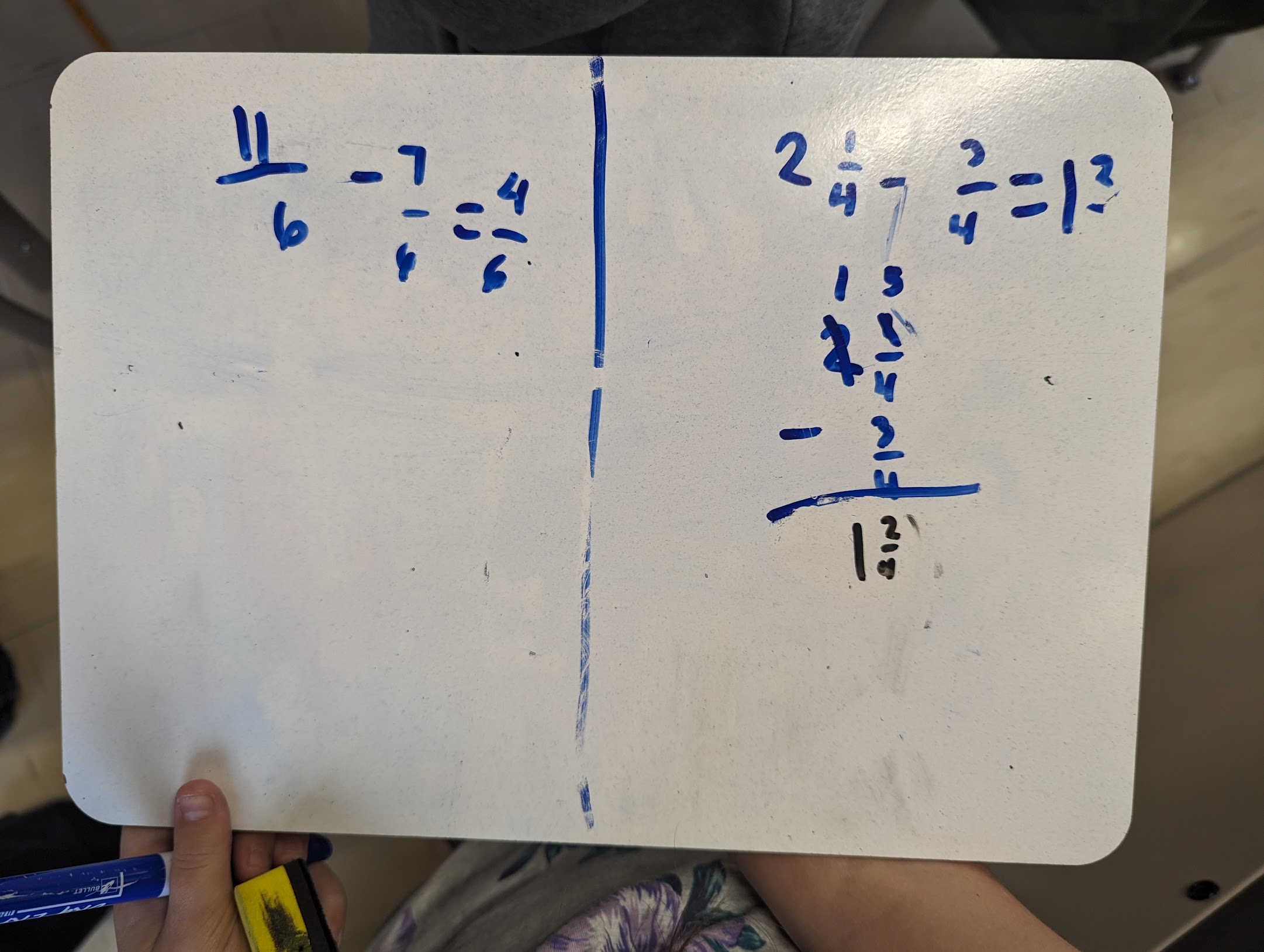
On their whiteboards, we asked them to record all the ways they think about and can represent 13–6=?. We saw a nice mix of ideas like removing items (base 10 blocks), hopping back on a number line, decomposing 6 and subtracting in parts, adding up (relationship to addition), and the algorithm – which made them all chuckle because after ‘borrowing’ it ended up being the same problem.

Connection to Subtracting Fractions

We shared these ideas out, recorded them on the board for reference, and then asked them to erase their whiteboards and do the same thing for 13/5 – 6/5=?. Students shared the methods and representations they used and we discussed how they were like the ones they used for whole numbers. It took no time for someone to say ‘It is exactly the same, just fifths.’ One student wrote it out in words so the discussion of the change in units was perfect.

Applying the Strategies

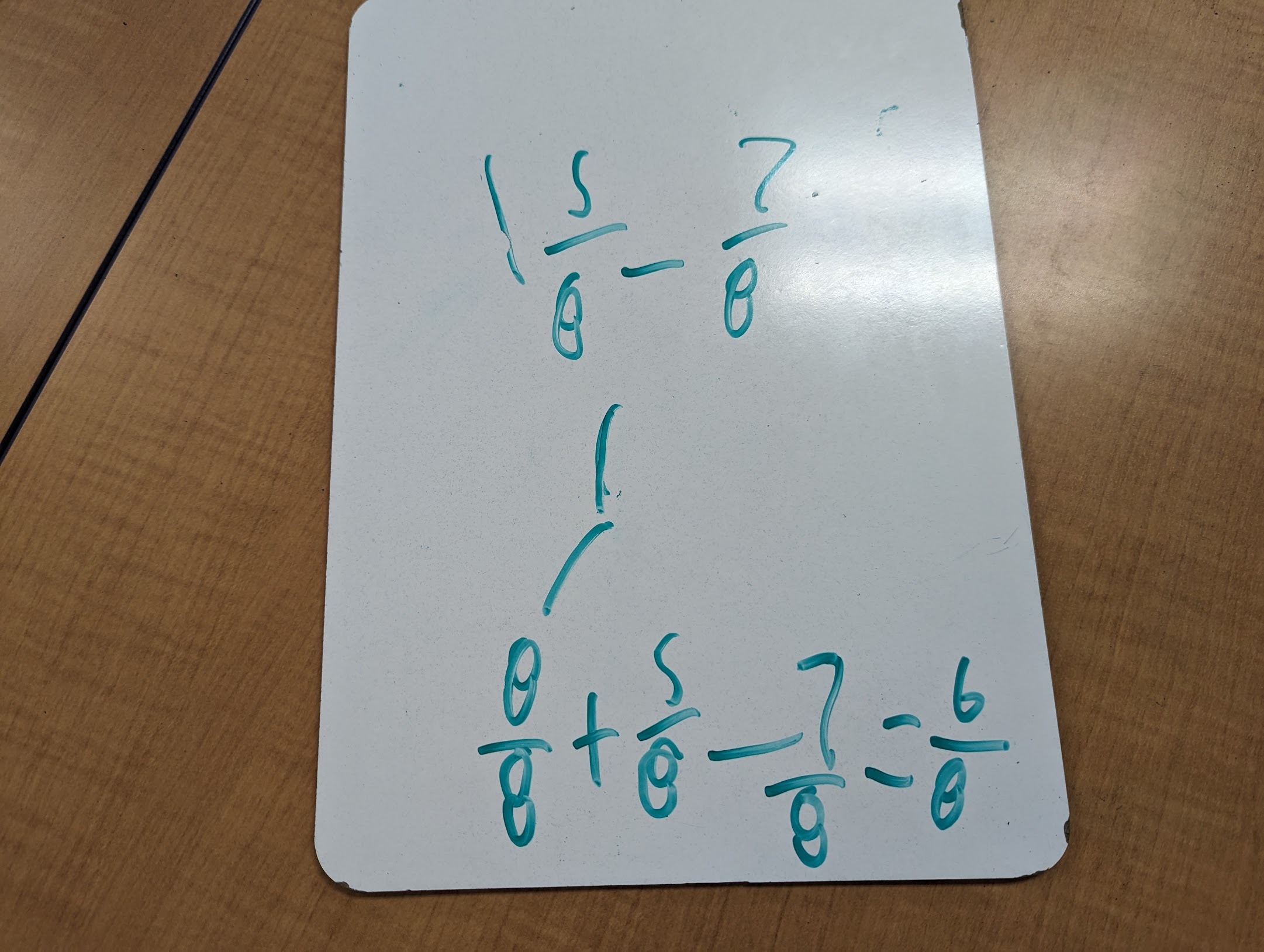
Next we wanted students to practice a couple of problems, including mixed number subtraction where the first fraction numerator was less than the second. We were excited to see many of the same methods being used and some students really got into showing it multiple ways.

Try it out!

Any 4th and 5th grade teachers out there who want to try this out, I would love to hear what you learn about student thinking and what students learn about important connections in math class!

Small Change, Big Thinking

Adapting math activities is one of my favorite parts of lesson planning. I love it so much because of the thoughtfulness, curiosity, and creativity involved in even the smallest of changes. In making any change, I have to think about what students know, the math of the activity, how the activity addresses the learning goal, ways students might engage in the activity, and questions to ask students along the way.

Fraction Activity

In this 4th grade activity, students were writing equivalent multiplication equations for a fraction multiplied by a whole number and then discussing the relationship between the different equations. The curriculum activity was good and definitely addressed the learning goal, but there was definitely an opportunity to open it up for more student reasoning and ownership. For example, in its current form, students don’t have the chance to think about which whole numbers would work in their equations or play around with the properties.

Small Change

Adapting doesn’t always require huge lifts. For this activity, all we decided to do was change the prompt to 12/5 = ____ x _____ and ask them to find as many ways as they could to make the equation true. I got so wrapped up in their work and discussions, that I didn’t snag any pictures of that part of the lesson, but after they finished we pulled up polypad and asked them how we could show why they are are all equivalent using the fraction bars. We wanted to be sure they just weren’t proceduralizing it at this point of the unit, so pulling up the fraction bars felt like a nice grounding of the concept. The board looked like this before we erased to make space to circle the other expressions.

Making Connections

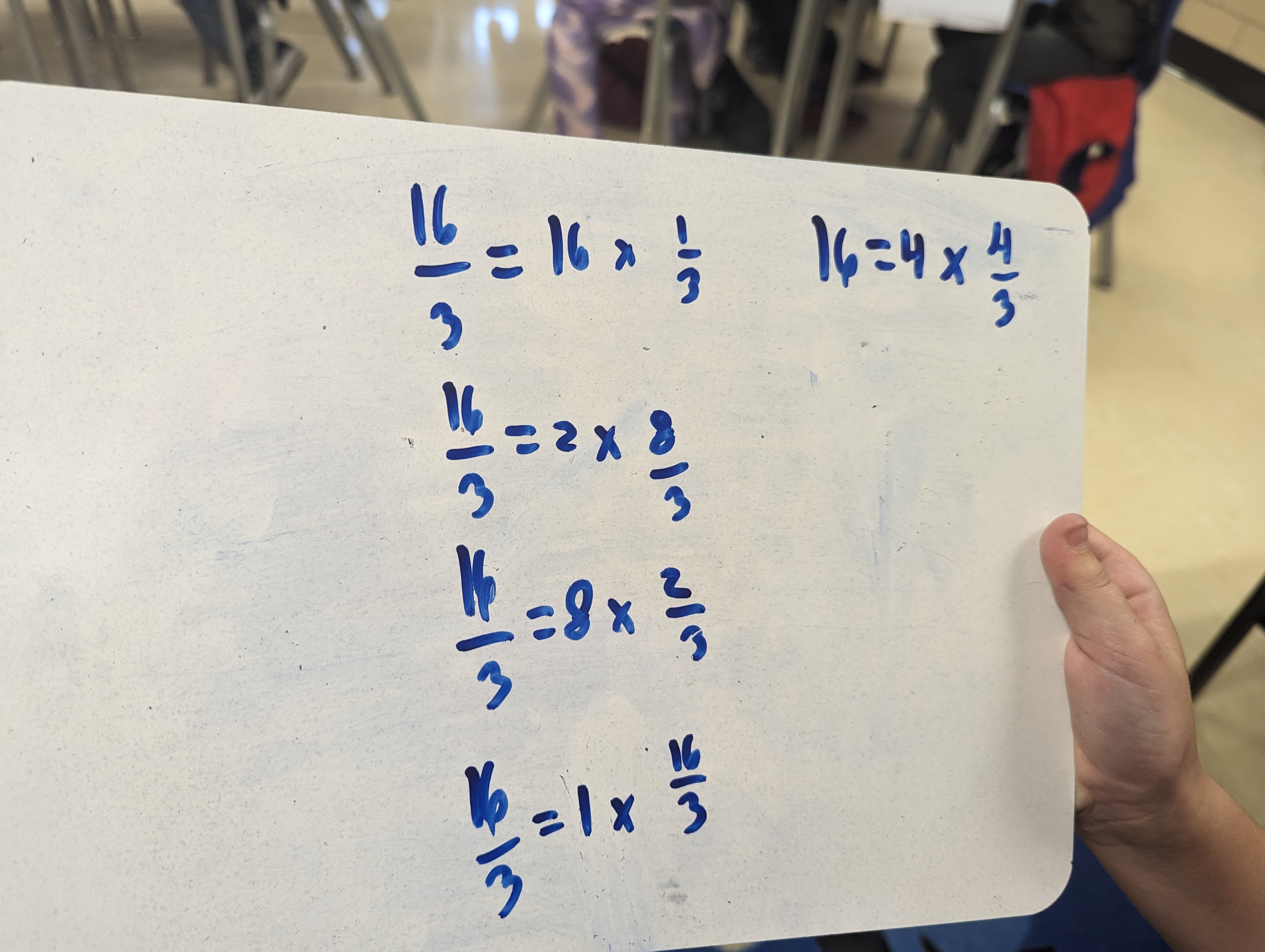
At this point, they couldn’t get enough and asked for another fraction to try, so we gave them 16/3. We saw so much great thinking and use of the commutative property when finding the whole number and numerator.

Their excitement alone was the first indicator that allowing more space for their choices was a great idea! And then, as I was walked around, a couple students asked if they could write division equations. Of course I said yes and walked away.

I came back to #7 and #8 on this board:

When I asked how she came up with those equations, she said she used her multiplication equations because multiplication and division are related. I left her with the question of how she might show that division on the fraction bars and class wrapped up. I can’t wait to check back in with her tomorrow to see what she came up with!

Next time you plan a math lesson, I encourage you to think about small tweaks you can make to open it up for more student voice, ownership, and opportunities to think big! And I don’t know if anyone is even talking much about math planning on Twitter (X) anymore, but if you are, I would love to think together about tweaking math activities. So, send some activity pics my way @MathMinds and we can flex our curiosity and creativity muscles in planning together.

-Kristin

Supporting Mathematical Habits of Mind

 “The widespread utility and effectiveness of mathematics come not just from mastering specific skills, topics, and techniques, but more importantly, from developing the ways of thinking—the habits of mind—used to create the results.

Cuoco, Al & Goldenberg, Paul & Mark, June. (2010).

Math curriculum lessons are often aligned to the Standards of Mathematical Practice. These practices can provide opportunities for students to develop the mathematical habits of mind described by Al Cuoco, Paul Goldenburg, and June Mark.

Mathematical Habits of Mind

  1. Students Should Be Pattern Sniffers
  2. Students Should Be Experimenters
  3. Students Should Be Describers
  4. Students Should Be Tinkerers
  5. Students Should Be Inventors
  6. Students Should Be Visualizers
  7. Students Should Be Conjecturers
  8. Students Should Be Guessers

The thing I love most about these habits of mind is the fact that as I read them, I can picture the math content and activity structures that could provide opportunities for students to develop these habits. I also really like the connectedness of them, where I can easily imagine how one habit leads students to engage in another. And because my favorite Math Practice is SMP7, look for and make use of structure, I am particularly drawn to the habit of conjecturing in math class. Excitingly, last week 5th graders were engaging in a topic that provided a perfect opportunity to conjecture.

Fraction Division

This past week, 5th grade students were dividing unit fractions by whole numbers and whole numbers by unit fractions. If you have ever taught this, you probably immediately picture students overgeneralizing these two different situations. In the vein of answer-getting, they often think the quotient will either always be a whole number OR always be a unit fraction – both including the product of the denominator and whole number in some way. And even though students have engaged in a lot of the habits within this work, it was with the two situation types separately.

To address the overgeneralization, we wanted them to engage in mix of the situation types in order to compare them. We launched with the following 2 problems, purposefully choosing the same numbers to elicit the difference in what is happening in the situation and the resulting quotients.

Student Thinking

As anticipated, we saw wonderful diagrams that generally matched each situation, but we could tell by the shading and erased work on Situation B that students were thinking that because they were working with fractions, their answer had to be a fraction.

We focused our discussion on the questions, “Where is 1 cake in your diagram?”, “Where are the people in your diagram?”, “Where are the servings in your diagram?”, and “Where is your answer in the diagram?”. Through those questions we saw a lot of labeling revisions to their work to make it clearer.

Mathematicians Talk Small and Think Big

“The simplest problems and situations often turn into applications for deep mathematical theories; conversely, elaborate branches of mathematics often develop in attempts to solve problems that are quite simple to state.”

Cuoco, Al & Goldenberg, Paul & Mark, June. (2010)

While the discussion was productive and we saw a ton of sense-making, visualizing, describing, and revision, I was left wondering how this moment transfers to the next time a student engages in one of these division situations.

I love this idea of tinkering around with smaller ideas to conjecture about larger ideas as a great way for students to deeply understand a concept and be able to transfer their understanding to the next time they engage in that concept.

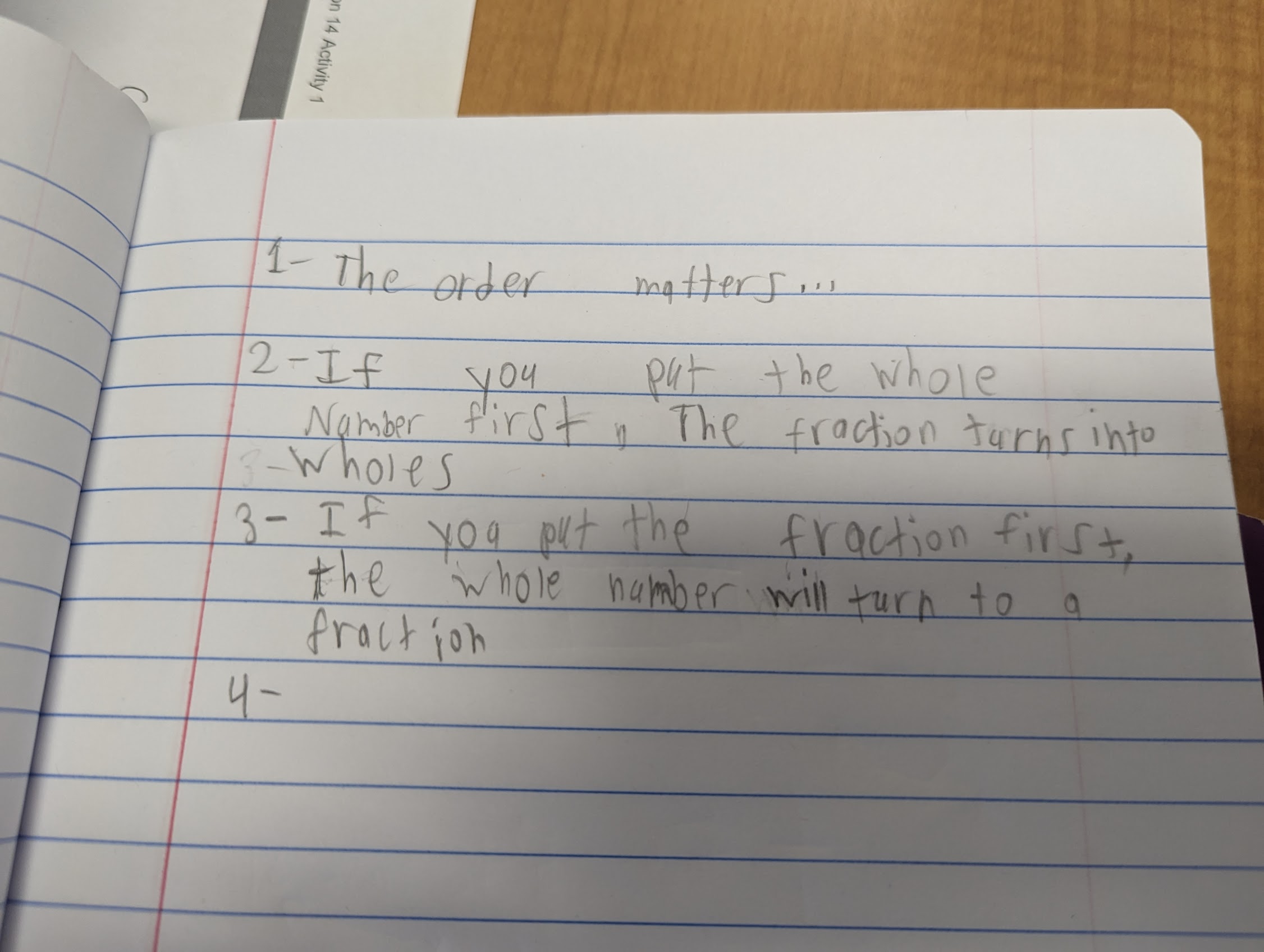
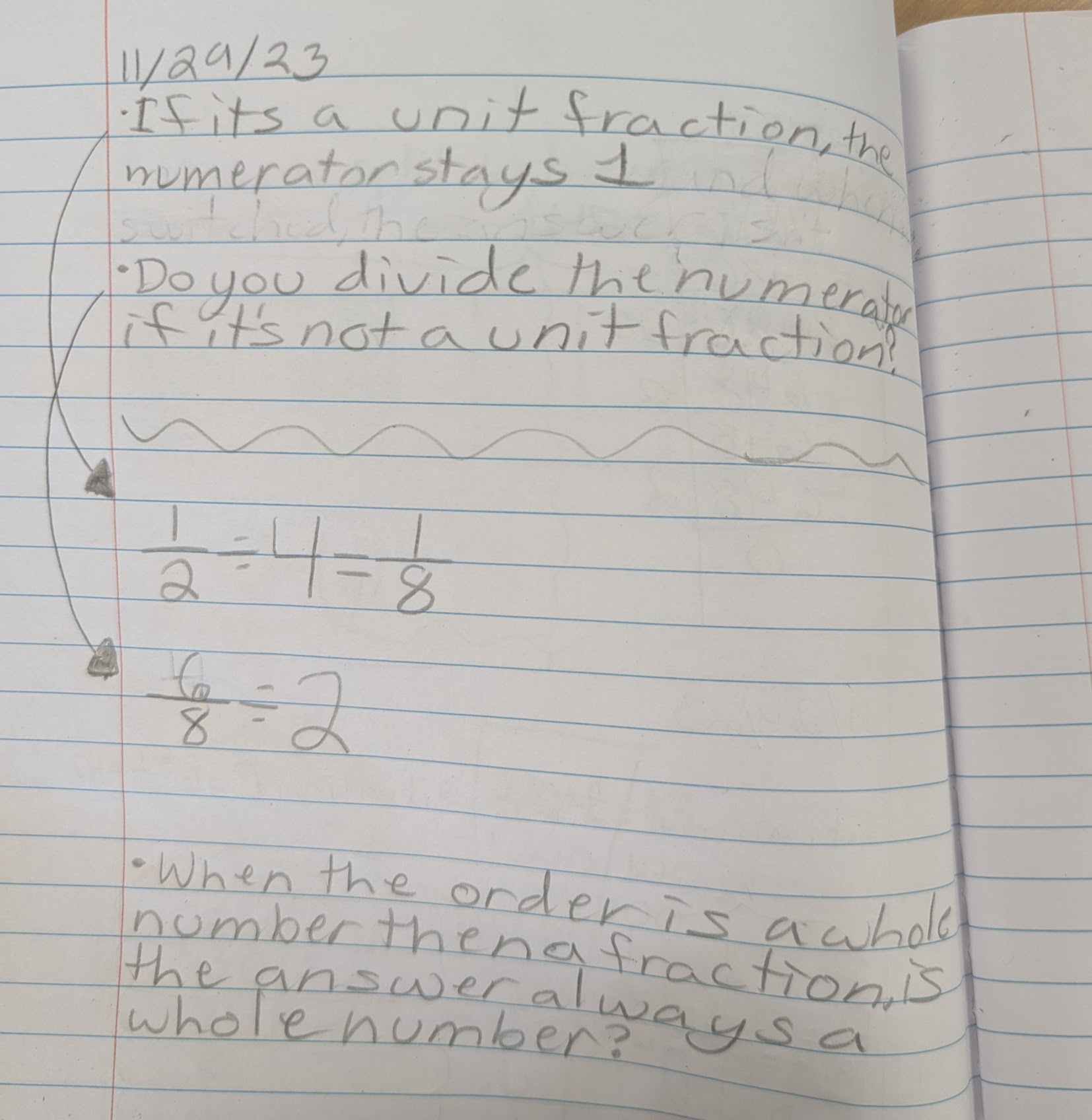
So, for the tables done their discussions early, I asked them to write things they think are true about the division and lingering questions they might have. Here are a couple examples:

Next Steps

The question I am always left with after students have such amazing insights and questions is, ‘How do I keep this math conversation alive?’ With the pacing of curriculum, it can be challenging to dig into each of these moments for an extended period, so we need ways to let this thinking extend across the year.

One thing we could do is ask students if we can launch the next class period with their ideas. For example, I might ask the first student if I could post, “The order matters in division.’ at the start of class the next day and have the class discuss if they think that will always be true and why. This would be a great way to elicit the difference in quotients when we divide a whole number by a fraction and vice versa.

Another option that I used in my classroom, was posting the ideas on what I called a Class Claim wall. When students make a claim or conjecture, we posted them on the wall and then anyone could revisit them at any point and time.

I think both of these options are a wonderful way for students to continually think small and big about concepts while allowing us the opportunity to communicate to them that just because a curriculum unit of study wraps up, the learning about that concept continues.

-Kristin

If you want to read a bit more about claims and conjectures, I was kind of obsessed with it when I was teaching and blogged a lot:

How Planning Mistakes Can Lead To Great Student Thinking….

The other day I did this fraction clothesline activity with a 5th grade class and today I had the chance to do it again with another 5th grade teacher, Leigh. It is always so nice to get to have a do-over after having time to reflect and think more about what the students thought about both during and after the activity.

I really thought the conversation was great during the clothesline activity, but it took too long the first time. We noticed that some students began to disengage. To try and improve upon that, Leigh and I decided to give only one card to every pair of students instead of each student having one. However, due to us wanting to keep a few important cards we wanted to hear them talk about, some pairs had two.

I also did not like my placement of 0 being at the very end of the left (when looking at it) end of the string. I moved it out some and talked about the set of numbers that falls on either side of the 0. I felt much better about that this time around!

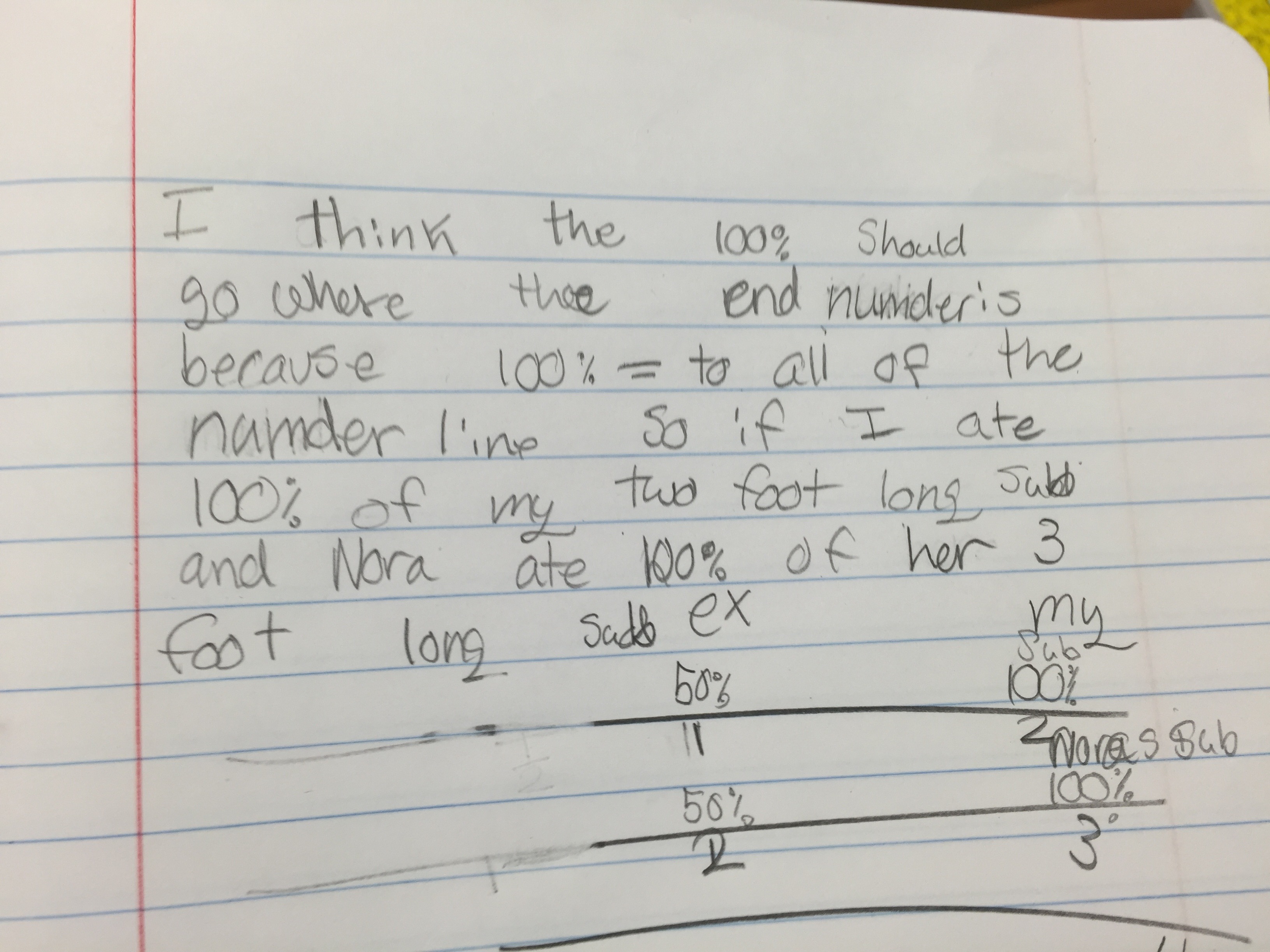
In the planning of the first clothesline activity, we took fractions from the work the students had been doing with percents and decided on putting 100% in there, completely thinking it would be at 4/4. As the student placed it, however, I started realizing that I never thought about the difference of 100% in terms of the area representations the students had been using versus 100% when talking about distance on a number line. But now, having time to reflect on the card, I thought it would make a great journal entry!

As we neared the end of the card placements, I handed the 100% card to a student and told her it was going to probably cause a lot of discussion but just put it where she thought it went. She said she got it, walked up there and placed it on top of the 2 (the highest number on the line). There were some agree signals going on and some other hands that shot right up to disagree. We talked about it a bit and then we asked them to journal their ending thoughts so we could move on with the rest of the lesson about different sized wholes.

Some thought that 100% was at 4/4 on the number line because it equals 1….

IMG_0868

Some thought it was at 4/4, but because of the conversation became a bit unclear…

IMG_0869

Some thought it goes on the 2 because it is the biggest number on the number line…

IMG_0871

IMG_0866

Some related it to different contexts with different wholes…

IMG_0870

IMG_0867

And one student said it can be anywhere with beautiful adjustments as it moves….

IMG_0864

What a great day revisiting my planning mistake!

-Kristin

5th Grade Fraction Clothesline

Today, I had the chance to plan and teach with a 5th grade teacher and it was awesome! Last week, this class had just finished a bunch of 100s grid shading in thinking about fraction/percent equivalencies, so we picked up planning the lesson in Investigations with the fraction/percent equivalent strips. Instead of the 10-minute math activity, we thought it would be really interesting to do the clothesline number line to kick off the class period.

We chose fractions (and one percent I will talk about later) based on the fractions the students had been working with on the grids. We chose fractions based on different comparison strategies that could arise such as:

  • Partitioning sections of the line
  • Distance to benchmarks
  • Equivalent Fractions
  • Common Denominator
  • Greater than, Less than or equal to a whole or 1/2

We settled upon the following cards:

1/4, 3/4, 4/4, 1/3, 4/3, 5/10, 2/5, 100%, 3/8, 1 5/8, 1 7/8, 4/5, 11/6, 1 6/10, 1/10, 9/8, 12/8, 2

To start, I put the 0 toward the left of the line (when you are looking at it) and we practiced with a few whole numbers. One student volunteered to be first and I handed her a card with the number 7. As she walked up, looked around, walked up and down the line, looked at me like I was playing some type of trick on her, we immediately had the conversation about how knowing the highest numbered card would be super helpful. She settled on putting it toward the far right side and had a seat. I gave another student the 10 card. He put that at the far right and adjusted the 7 to be “about 2 cards away” from the 10, leaving a really long distance from 0-7 for them to think about. We had some students disagree so we talked about distance and adjusted the cards to be more reflective of distance. Since the conversation of half of the distance to 10 came up, I handed another student the 5 card and he placed it right in the middle. The discussion went back to the 7 and they decided that since 7.5 would be halfway between 5 and 10 that 7 had to be a little bit less than the halfway of 5 and 10.

Then, we moved into the fraction cards. We gave each pair of student two cards. In hindsight, for times sake, I would probably only do one card per pair. I gave them one minute to talk about everything they knew about the fractions they had and then we started. I asked for volunteers who thought their card would help us get started and called on a boy with the 1 7/8 card. He went up and stood all of the way to the right and said he couldn’t put his on. I asked why and he said that since the cards were all fractions the line could only go to 1 so his is more than one and can’t go on here. I asked if anyone in the class had a card that may help us out and a student with the 2 card raised her hand. She placed her card all of the way to the right, said “maybe it goes to two” and the other student placed it just to the left of it because, “it is only 1/8 from 2.” Awesome!

We went along with the rest of the cards and so many amazing conversations, agreements and disagreements happened along the way. There are a few things that stand out in my mind as some great reflections on the activity:

  1. A student had placed 5/10 halfway between 0 and 1. The next student placed 2/5 just to the left of the 5/10 because, “I know 2 and a half fifths is a half so that means that 2/5 has to be less than 5/10. It is a half of a fifth away.” The NEXT student volunteered and placed 3/8 overlapping just the edge of the 2/5 card on the left. I was expecting percentages to come out, since that was their most recent work with those fractions, however the student said they knew 3/8 was an 1/8 from a half and 2/5 was a 1/10 from a half and an 1/8 and 1/10 are close but an 1/8 is just a little bit further away. Awesome and definitely not what I expected!
  2. I wish I had not put the zero so far to the left. Looking back I am wondering if that instills misunderstandings when they begin their work with negative numbers on a number line similar to the original misconception that launched the activity with the 1 7/8.
  3. Oh, the 100% card….complete mistake on my part, although it may have been a great mistake to have! In the first class, the student with the 100% card came up and said, “I have 100% and that is 100/100 which is 1” and put it in the appropriate place on the line. Just as she did that, I started thinking how I never really thought about the distinct difference between percent in relation to area (like the grids they had been shading) and 100% when dealing with distance on a number line. No one seemed to notice and since I didn’t know exactly what to ask at that point because I was processing my own thoughts, I waited until another student placed 4/4 on top of it and erased it from my immediate view!
    • I stayed for the next class and this time I was prepared for that card and now really looking around to see what students’ reactions were when it was placed. As soon as the student placed it at the 1 location, I heard some side whispers at the tables. I paused and asked what the problem was and they said, “100% is the whole thing.” The next student who volunteered had the 2 card, picked up the 100% card on the way to the right side and put the 2 down and the 100% on top. Lovely and just what I was thinking.

I have never had students reflect on the difference of talking about percentages with distance versus area because I had never thought about it! It definitely feels like an interesting convo to have and a great mistake that I am glad I made!!

IMG_0840

I will be back in another 5th grade class tomorrow and will see what happens…it could make for a great journal writing!

-Kristin

Fraction/Percent Equivalents

It goes without saying that I miss talking 5th grade math with my students each day. But I am so lucky this year to have a new, wonderful teacher in 5th grade who lets me plan and teach some lessons with her! This lesson was one of her first lessons of Unit 4, Name That Portion.

Since in 4th grade the students do a lot of work with comparing fractions, we designed a Number Talk string in which students were comparing two fractions. We wanted to hear how they talked about the fractions. In the string we used a set with common denominators, common numerators, and one unit from a whole. On each problem we were excited to hear talking about the “size of the piece” being the unit and the numerator telling us how many of those pieces we have. Our 4th grade teachers really do a beautiful job with this work. They also used equivalents to have common denominators to compare and a few used percents, since they had done a some grid work with that they day before.

We started the lesson by asking them how they could shade 1/4 on a 10×10 grid. The majority of the students split the grid in half vertically and then again horizontally and shaded one quadrant. We heard a lot of the “1/4 is half of a half.” As I was walking around, I heard a pair talking about shading a 5×5 in that grid. I saw this as a beautiful connection to the volume unit they just completed in which they were adjusting dimensions and seeing the effect on the volume. I had her explain her strategy and wrote 5 x 5 under the 10 x 10 that was up on the board already and asked how that could get us 1/4 of the whole thing? One student said it looks like it should be half of it because 5 is half of 10, but then one student said since we were taking 1/2 of both it would be a fourth….this is where I hope Leigh (the 5th grade teacher) and I remember to use this when they hit multiplication of fractions!

They then worked in pairs to shade 1/8 and 3/8 and we came back to discuss. We noticed as we walked around that the shading was wonderful on their papers, but when asked to write the fraction and percent, most were blank. I remember this lesson from last year during decimals where the same thing happened. So, we asked them what they thought the fraction was as we got these three answers…

12 r4/100

12 1/2/100

12.5/100

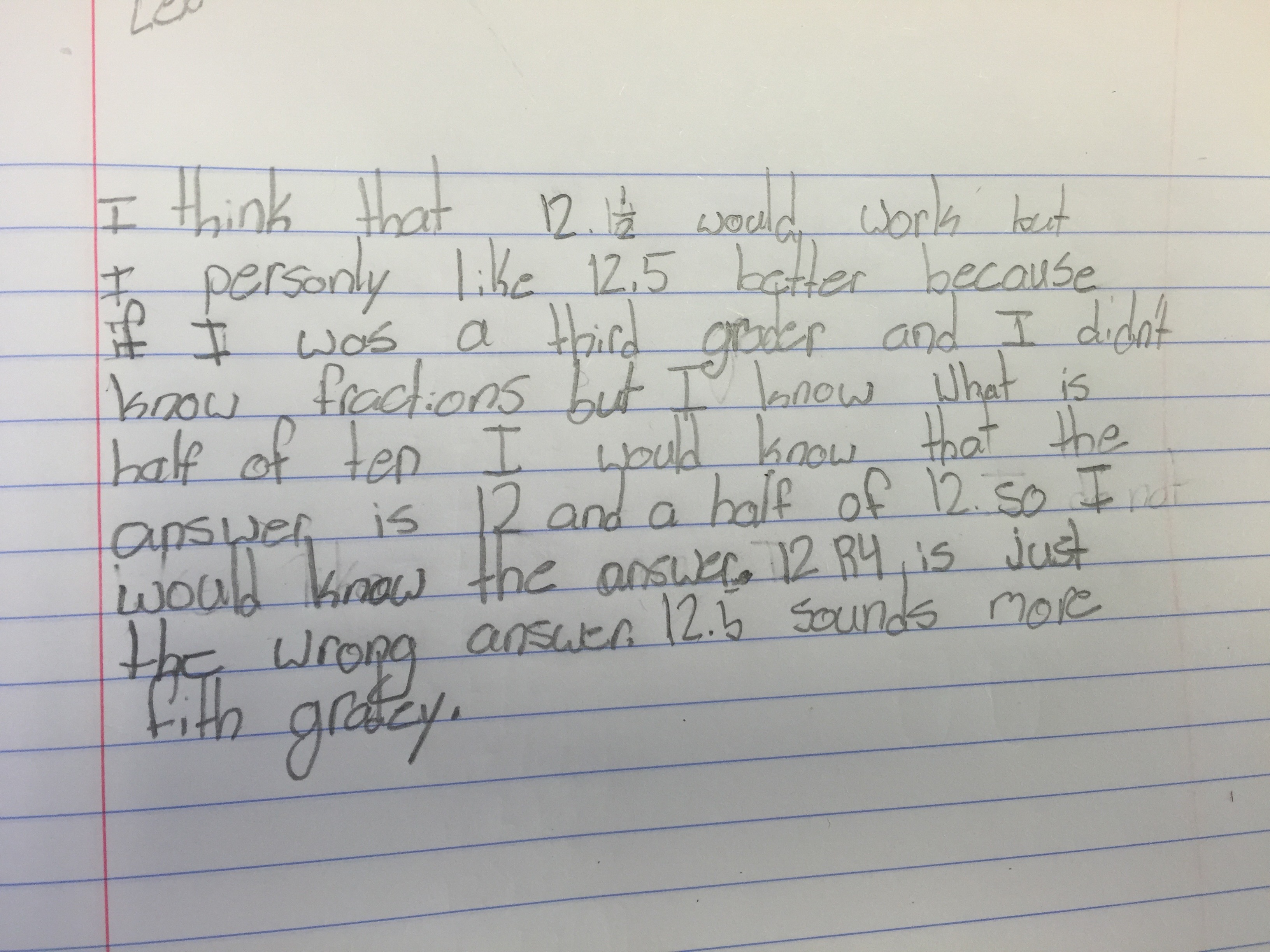
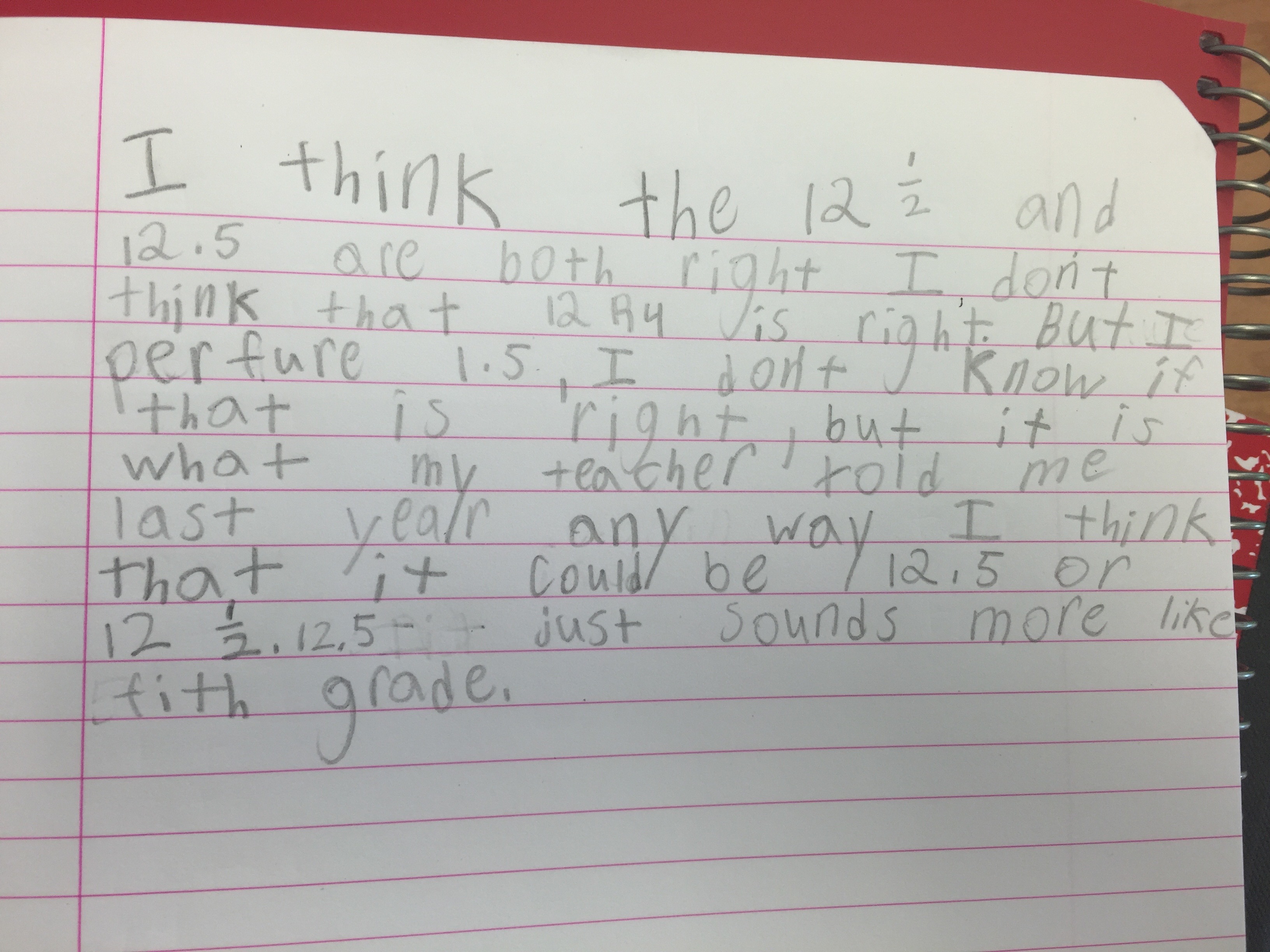
They were not overly comfortable with any of them so we asked them to journal which one “felt right” to them and why…

IMG_0789 IMG_0781 IMG_0786 IMG_0780 IMG_0779 IMG_0784 IMG_0790 IMG_0787

We loved to see what they knew about decimal fraction relations, but we especially liked the “it sounds more fifth grady to use 12.5.”

-Kristin

A Teacher & Mathematician Mash Up

One of the many things I love about Twitter is the diversity of the group in which I have the opportunity to interact. Every day, Twitter provides the space for me to move outside of my classroom happenings and connect with others of varying perspectives and insights on teaching and learning. While these perspectives are so interesting to me, if I am being completely honest, they can also be quite intimidating. Not intimidating in the sense that one person’s point of view is “better” than another, but more in the sense that sometimes math conversations go to a place content-wise or philosophically that I cannot even engage. Not because I don’t feel like I don’t belong, but simply because I don’t even know what the heck to say because I don’t understand what they are talking about or it is so far removed from where I am in the classroom, I can’t relate.

The way I feel in those situations feeds my preconceived notions I have about mathematicians. Not the type of mathematicians I would call my students because they are doing great math, but mathematicians as in, that is their job title, you know, those mathematicians. I so admire the way in which they think about math, however given a choice, I would probably shy away from a conversation with them out of shear nervousness of saying something that sounded silly, or even worse, completely wrong mathematically. That was, until I started my work with Illustrative Mathematics.

Throughout my projects with all of the wonderful people at Illustrative, I have truly seen such incredible value for the perspective each and every person, whether a teacher, a math coordinator, a mathematician, or math specialist brings to the work we do in working to improve teaching and learning. From developing tasks, to facilitating professional development, the work is such an amazing collaborative effort in which I learn SO much. During this learning, my confidence in what classroom teachers bring to a math conversation grows, as does my appreciation for our different perspectives.

Most recently, a mathematician at Illustrative, Mike, and I have been working collaboratively on tasks to be reviewed for the IM site. It has been such an amazing learning experience for me. He is wonderfully thoughtful about the math, open to any ideas and/or questions I have and possibly the quickest email responder I have ever encountered:) Throughout our work together, I felt we were on the same page as far as the content of the task as well as in our thoughts about what students would do with the math of the task. I didn’t feel at all like I was “just” speaking from experience and he was talking from this “mathematician world” in which I couldn’t relate, but that we were both thinking deeply about the math and how it looks in a classroom, it was a beautiful thing.

After our first task, I thought to myself how odd it was that we thought so much alike. I was completely anticipating having these eye-opening mathematical revelations after our conversations together. However, during our second task, the revelation(s) came rolling in and the difference in our perspectives was really interesting and valuable.

The task centers around the commutative property of multiplication with fractions in the context of wrapping packages with riboon, 6 x 2/3 and 2/3 x 6.  In my classroom, I am so wary of students strictly computing without making sense of problems that I make a conscience effort, probably to almost an extreme, to connect their representations to a context. For example, in the problems above, I really want students to “see” the story for each differently. I want them to see 6 group of 2/3 for 6 x 2/3 and 2/3 x 6 as 2/3 of 6 or an area model with 6 and 2/3 as the dimensions. My biggest concern as a teacher, is the students connecting the problem to the context and then noticing patterns that show commutativity. My questions primarily focus on connecting their representation and notation back to the context. Everything to me is focused on context because of my fear of them number-crunching their way through an algorithm they don’t have a contextual visualization. Did you happen to catch that I care about context in that paragraph:) I even blogged about it here: https://mathmindsblog.wordpress.com/2015/03/29/commutativity-in-fraction-multiplication/

Mike and I both agree all of this contextual work is super necessary and important. This past year, I think my students did a beautiful job seeing the commutative property come out through patterns and repeated reasoning, however, after talking more with Mike about this commutativity, I realized I missed such an important piece. A piece that would have really solidified the commutative property in their work through their representations themselves.

I wanted students to match one of those two equations to a context and develop a more appropriate context for the other, however that just shows they come out to the same answer. In my mind it doesn’t really show how they can be commutative within the same context. I had never thought of that so much until Mike emailed me this statement…

“… if someone arranged the pieces of ribbon appropriately they could argue for either equation. I think that what we are after is to match an expression with some kind of reasoning. In other words, the real question to ask the students is to explain their expression via a picture that accurately models the situation.”

This is the point where I completely wish I could reteach this lesson. I would do everything the same, but add this piece. I would love to see if students could see one representation in another for both 6 groups of 2/3 and 2/3 of 6. Have them defend their reasoning and/or find their reasoning within someone else’s work. That really would have proven to students how the  commutative property looks versus just seeing I get the same answer no matter the order of the numbers. Which is kind of how I felt I left it this year.

This has been, and will continue to be, such a wonderful learning experience for me. I SO appreciate the diversity of people I have worked with at Illustrative as much as I appreciate the wonderful mix of people I get to learn from on Twitter. It is enlightening to me that as open and addicted as I am to learning, there are still so many things that I have a classroom perspective on that can be improved and extended through conversations with people who I may typically have shied away from in person. Knowing they appreciate my perspective is such a wonderfully empowering thing for me as a learner. Thank you to all involved in my journey!

Collaboration As Key Work

Earlier this school year, I was involved in an amazing collaborative project with Illustrative Mathematics, The Teaching Channel and Smarter Balanced. Following that experience, I have continued to collaborate with the same wonderful people involved in the project, as well as the incredible educators in the #mtbos! So, when The Teaching Channel asked if I would blog about my collaborative experience, of course I could not resist!

The Teaching Channel Blog Post

The videos of the experience also went live today on The Teaching Channel! I had blogged about this experience twice in the fall and it is so nice to now be able to put collaborative voices to the written work. The collaboration that happens in the video is truly centered on student work, conversations, and reasonings around fractions. I have paired my previous blog post to the accompanying video so you can have a feel for the entire experience!

Background of the Project:

Collaborating Coast to Coast Blog  with this Teaching Channel Blog w/Video Links

The Project Work:

Lesson Study “Take 2” Blog with this Teaching Channel Video

I feel so fortunate to have the opportunity to grow and learn with so many amazing educators! I cannot say thank you to all of you enough!

-Kristin

Conjecture or Claim?

I have been having wonderful conversations on Twitter recently with Kassia (@kassiaowedekind), Simon (Simon_Gregg), Mike (@MikeFlynn55), Elham (@ekazemi) around the topic of students making claims, more specifically differentiating between claims and conjectures. I have to admit, I have really just formed my own idea of how I differentiate between the two, so it was nice to hear others’ perspectives around this. I consider a conjecture a noticing they think to be true, more on a case by case basis. A claim, to me, becomes more generalized and then followed with a proof. (I have also had great convo with Malke (@mathinyourfeet) around these proofs w/geometry).

The conversation last night started with Kassia…(Look Kassia, I finally learned to embed tweets:)

  Mike gave us a nice perspective of claims based on his work with Virginia Bastable….

My students have now started to say, “I have a claim to make” when they notice something happening over and over again. In those moments, I don’t really think about “what” they are calling it because I am just so excited to hear them talking about the patterns and regularities they are seeing. But is what they are saying a conjecture or claim? Does it make it to the claim wall to be revisited and proven? This year being my first work in really having students think about making “claims” beyond just noticings, I have made a “Claim Wall.” Students see things happening in certain cases and I ask them if they can write a statement for “any time we…” to see if they can make it more general. I like Simon’s idea to expand on my wall…

We all agreed that the proof piece is the difficult piece of going from being a conjecture or unproven claim to a substantiated, generalized claim. I find my students prove over and over again that it “works here and here and here…” but have trouble with the why. It is hard to do, even as adults putting it into words is difficult.

What I love most about these conversations is the fact that the next day it continues, but this time with the kids. Simon tweets this morning about a claim that two of his students made while folding paper…

Which coincidentally would help my students tremendously to think about when proving their claim from Friday’s number talk…

The coolest part about this claim was that it stemmed from a multiplication of fraction number talk, yet they proof show division. I loved that. Also loved the explanation that accompanied their statement. I did ask them if this was true for taking half of any fraction because they seemed to be just dealing in unit fractions at this point. So is this a conjecture or a claim? I am not sure. How generalized would make it a claim? Could it be “When taking any unit fraction of another fraction…”

Would love any thoughts, conjectures or claims on this…:)

To be continued…

-Kristin


Commutativity in Fraction Multiplication

Think about these two expressions…

2/3 x 6              6 x 2/3

Do you think differently about each?

Does your solution approach change?

I had not really given this much thought because we do both in 5th grade, multiply a fraction by a whole number and whole number by a fraction. However, recently, when working with a group of 4th grade teachers and looking more closely at the standards and my curriculum, I am beginning to see a distinct difference. I now look at each expression from a different perspective. Not that both ideas do not arise at multiple grade levels in some form or another, but it is so interesting to me as to which thinking would come before the other.

Let’s first look at the standards…

4th Grade:

cc25th Grade:

cc1

Interesting. For me, taking a fraction of a group feels more “natural” and intuitive than multiplying a whole number by a fraction, however in the learning trajectory of multiplication and building of unit fractions composing a whole, the multiplication of a whole by a fraction feels like the natural next step.

For our upcoming Illustrative Mathematics professional development, I was collecting work samples for the following problem (thanks Jody:)

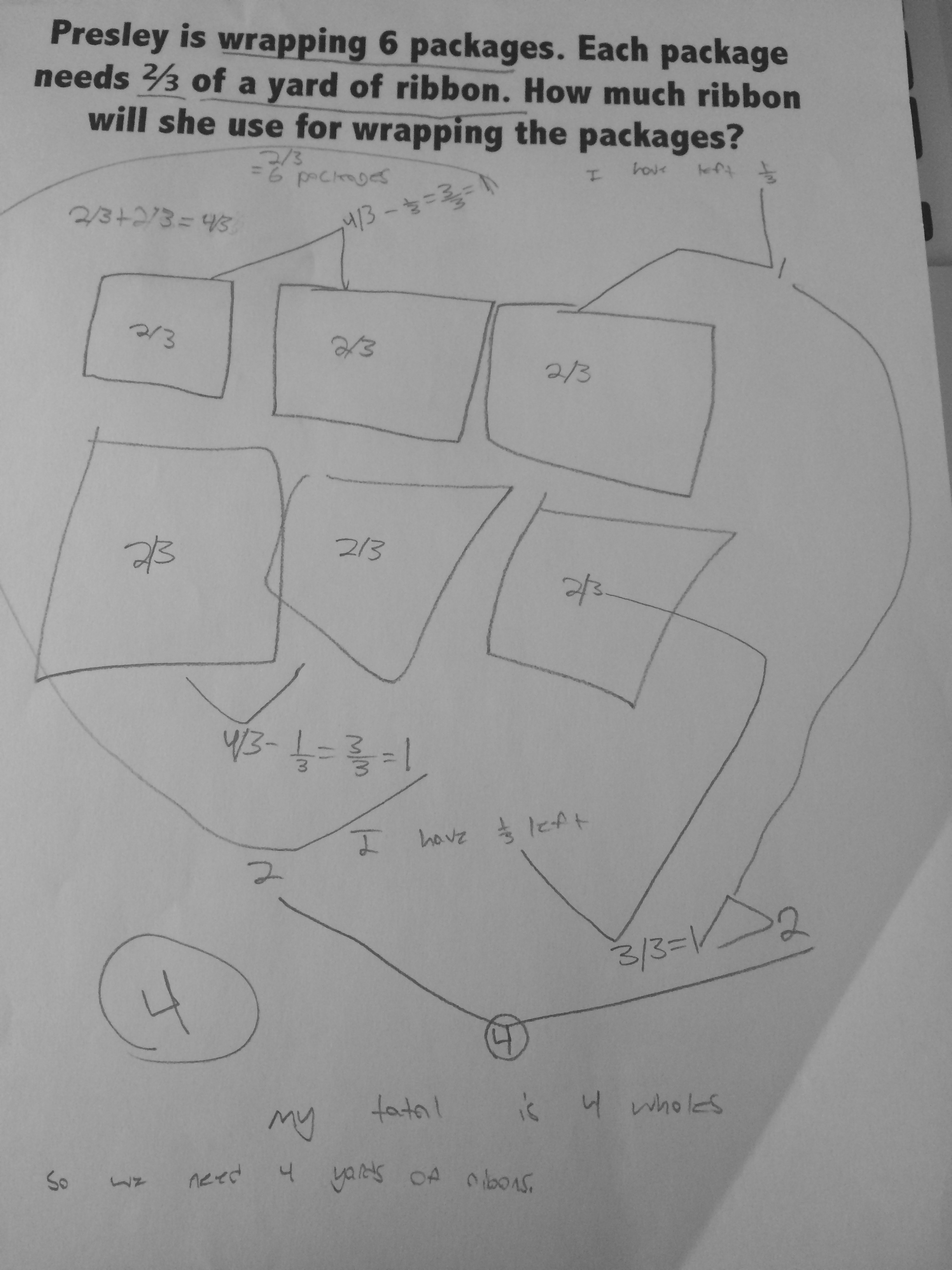
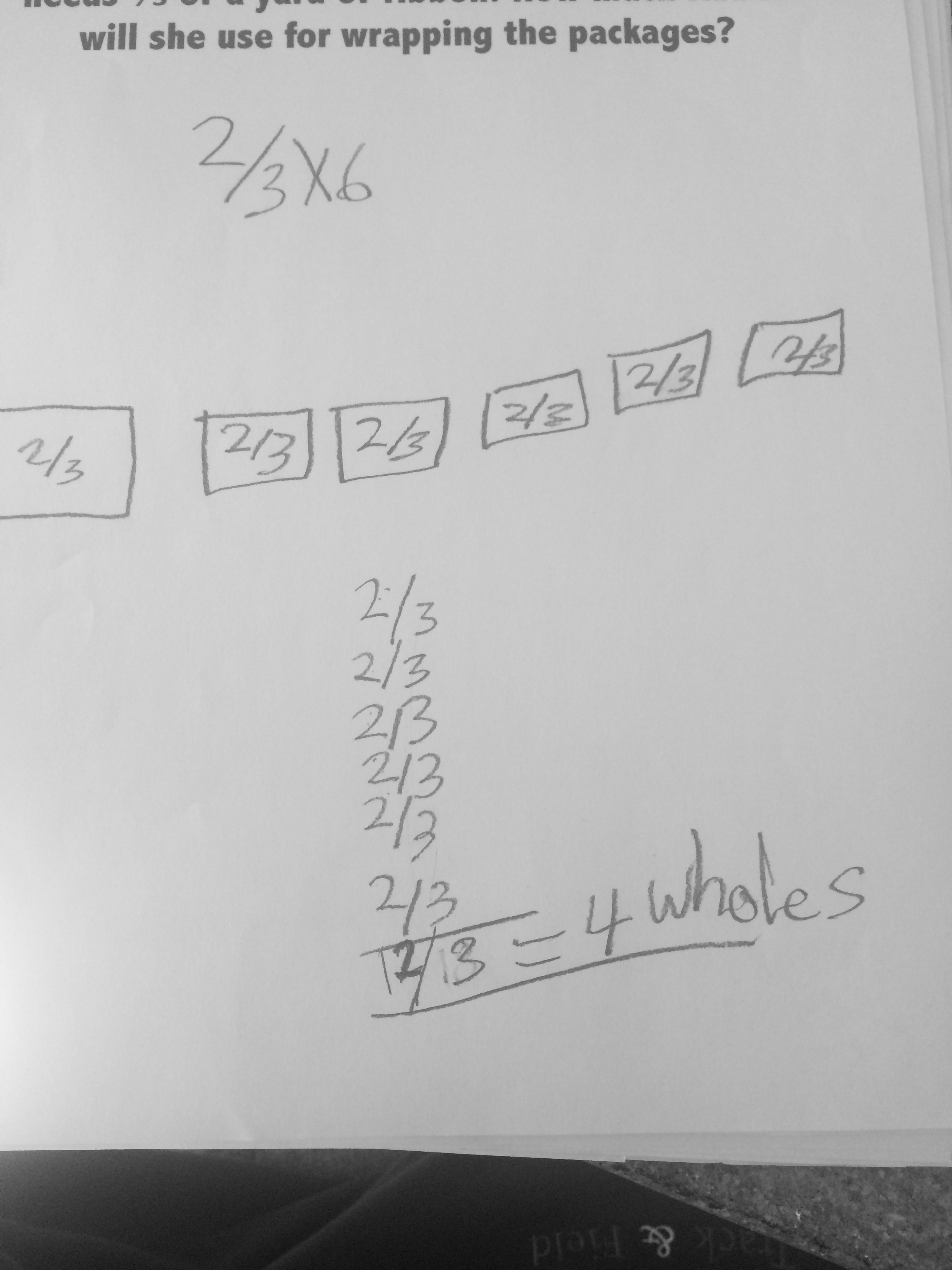
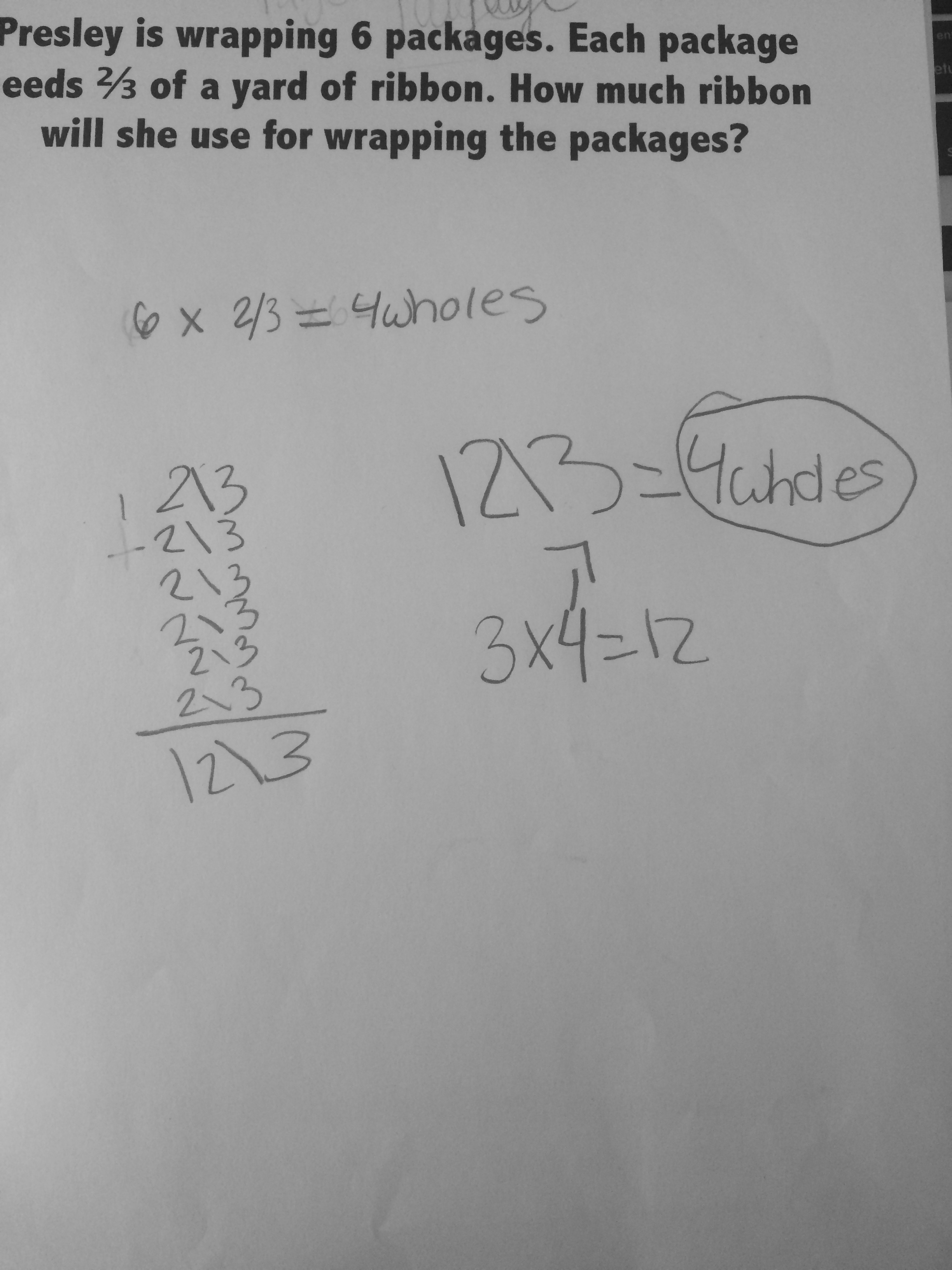
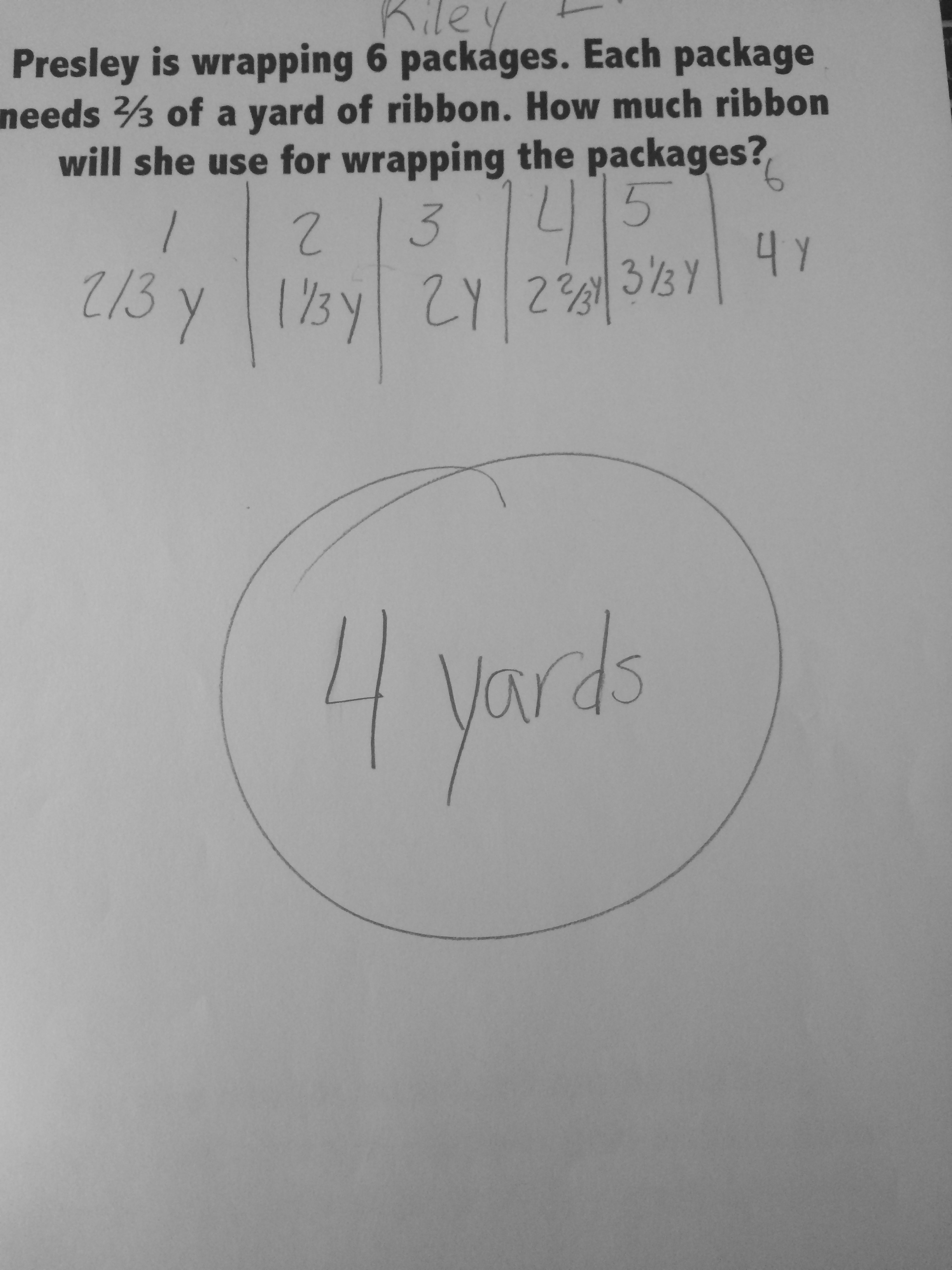
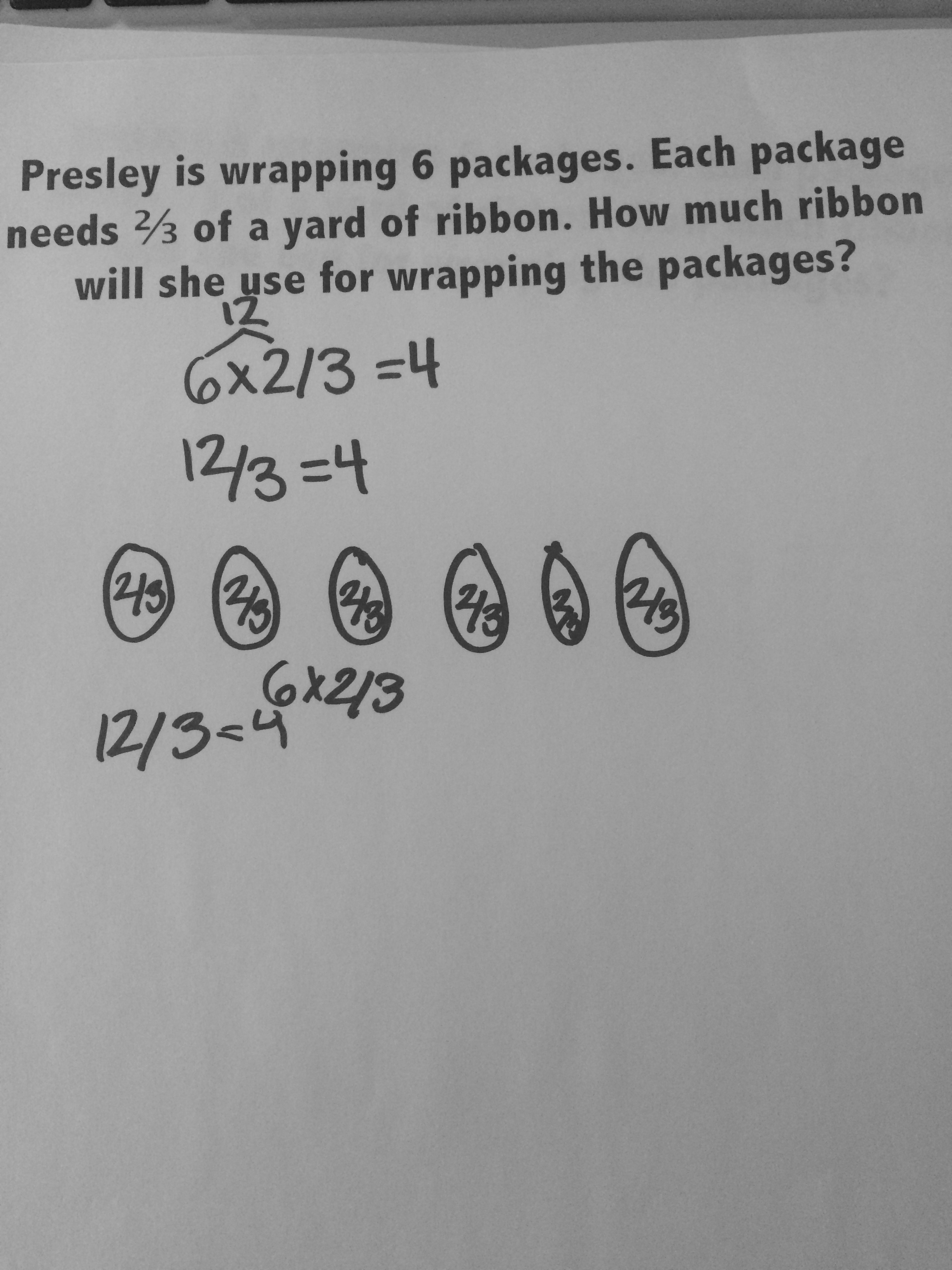
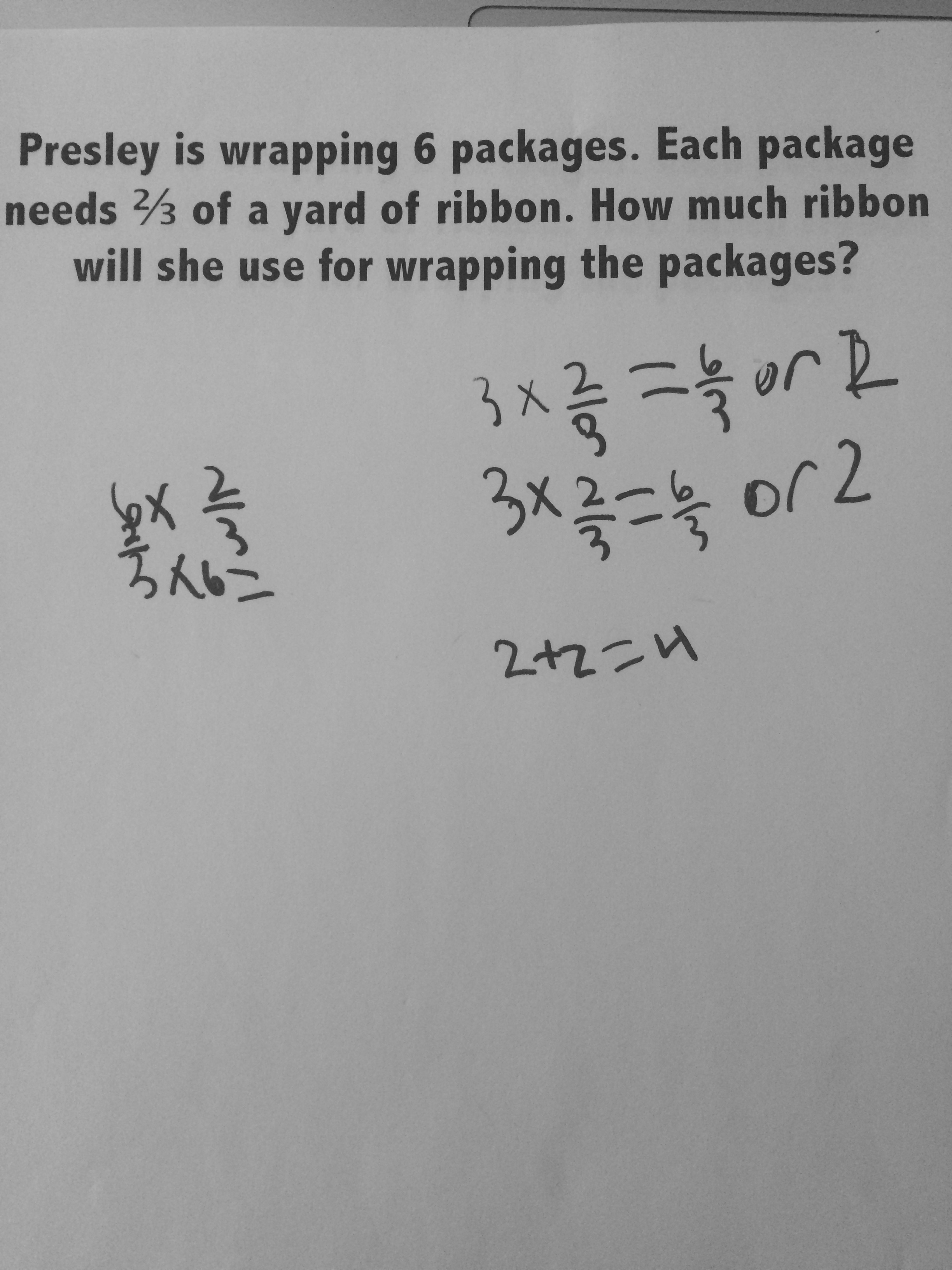
“Presley is wrapping 6 packages. Each package needs 2/3 of a yard of ribbon. How much ribbon will she use for wrapping the 6 packages?”

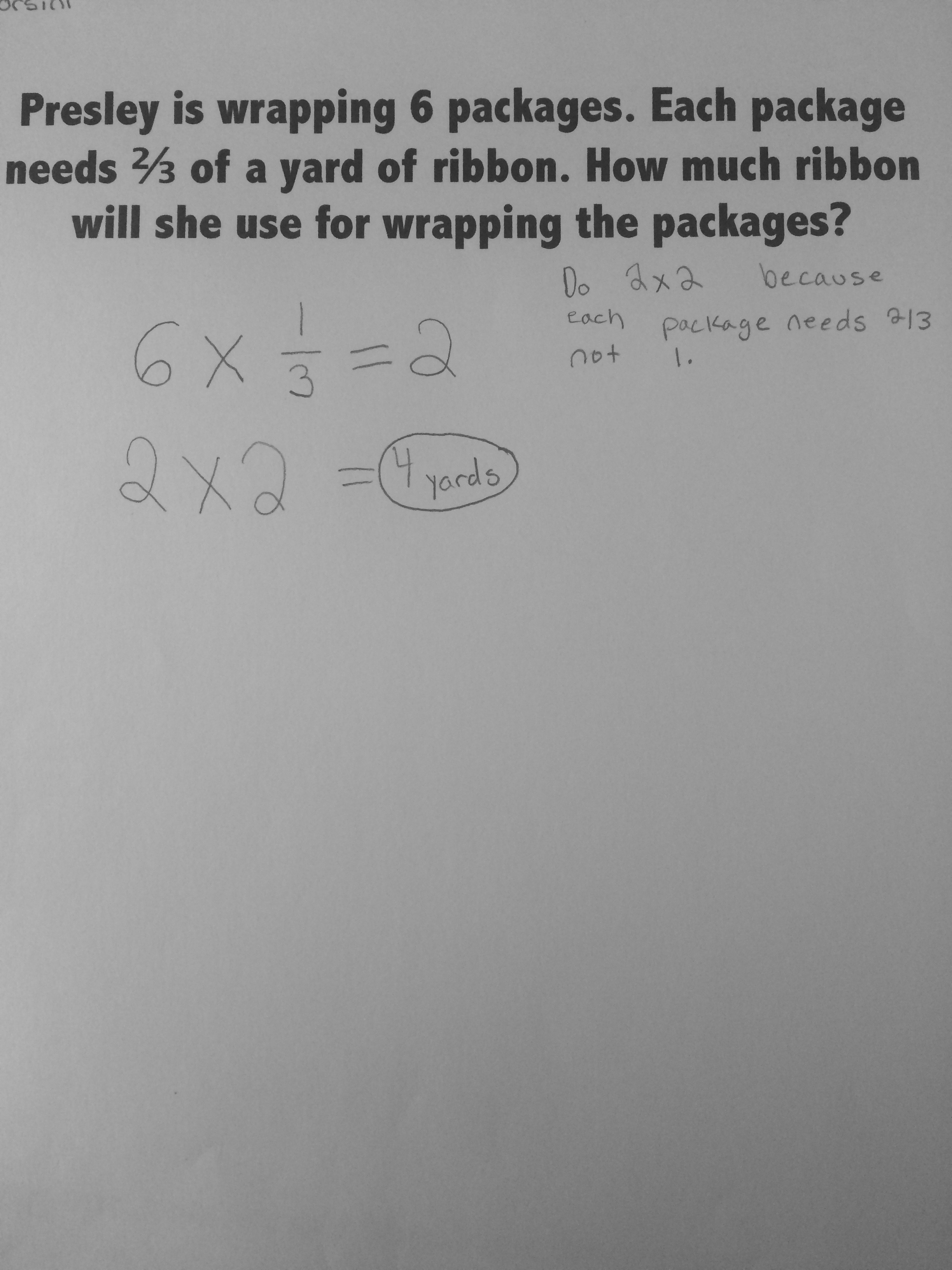
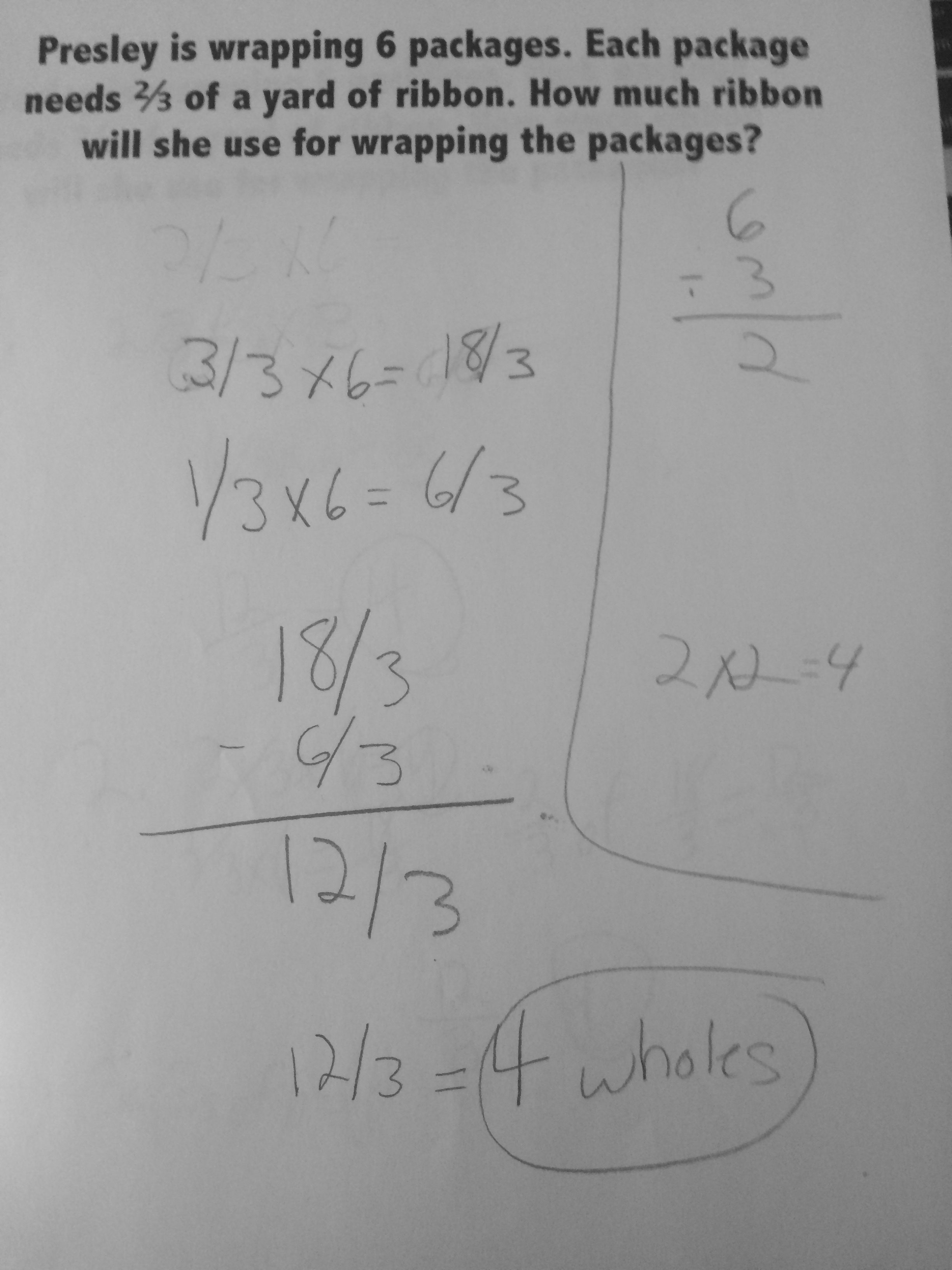
As anticipated, I received a wide variety of solutions to arrive at 4 yards of ribbon. Here are just a few examples in what I think is the progression I expect (some of them got finished  quickly and opted to show a few ways to solve).

IMG_9719_2 IMG_9720_2 IMG_9721_2 IMG_9723_2IMG_9722_2 IMG_9724_2  IMG_9725_2 IMG_9726_2 IMG_9727_2 IMG_9728_2 IMG_9729_2 IMG_9731_2IMG_9730_2

They all finished fairly quickly and as I was walking around I thought it was really interesting to see such a variety in the equations they used to represent the problem. We came together as a whole group and I asked them for the equations they thought best represented the problem. The most common answers were: 2/3 x 6 = 4, 6 x 2/3= 4 and 2/3 + 2/3 + 2/3 + 2/3 + 2/3 + 2/3= 12/3 = 4.

I asked them if there was a difference between the equations and there was a unanimous “No” because they mean the same thing. “They all get 4.” In my head I was very excited that commutativity was something they see when finding a solution, but I was also curious if it worked the same in the opposite direction. I asked if we could narrow it down to two equations and they all agreed that the repeated addition was the same as 6 x 2/3 because it was “six groups of 2/3.” Interesting, so they see that in the numeric representation but not contextually?

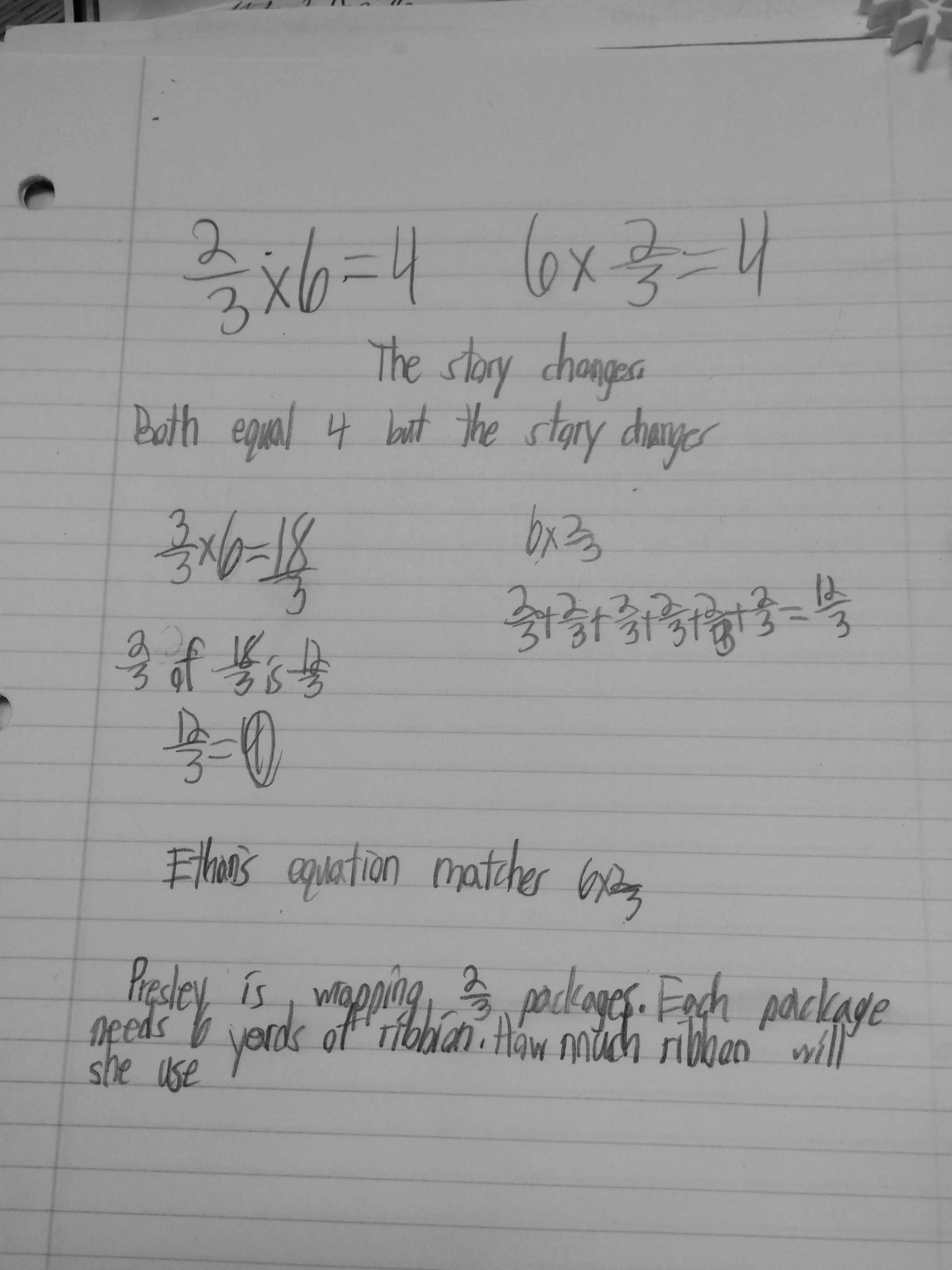
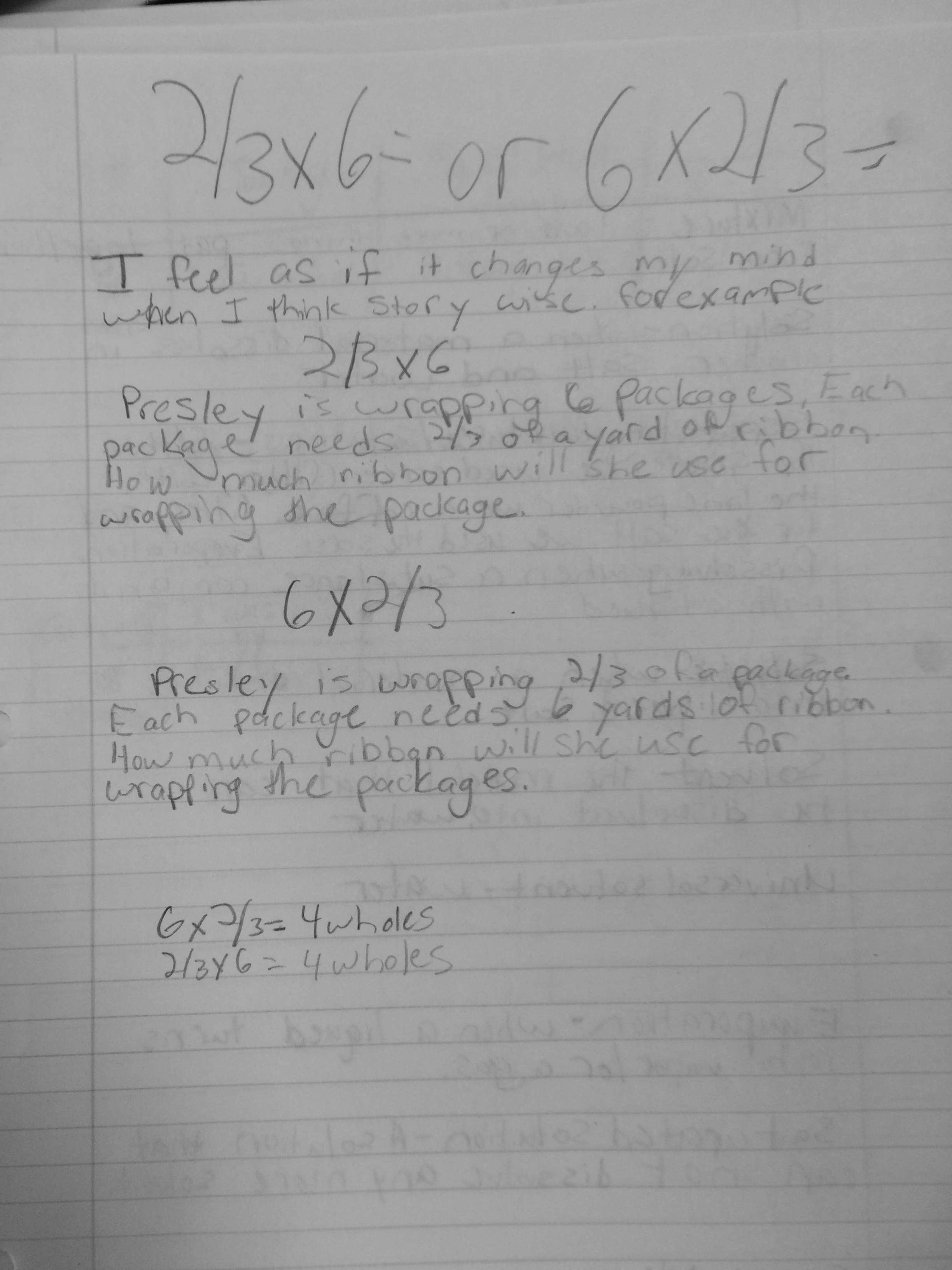
I then asked them to write 6 x 2/3 and 2/3 x 6 on the top of their journal page and think about them without the previous context.  I posed, “If I gave you these two problems to solve, would you think about them the same way? Do you think about them differently?” I was curious to hear their thoughts on the commutativity.

IMG_9692 IMG_9694 IMG_9695 IMG_9696

The conversation after was so great and interesting! There is a difference when going from number to context, however when put in context, I think students use whatever strategy is easiest for them to arrive at the answer. Is this what is truly meant by contextualizing and decontexualizing in the SMPs?

To further intrigue me, I went and pulled a few fourth graders to interview during my planning period. It was so interesting that they saw this as a whole number times a fraction because it was “six 2/3’s.” Their connection to multiplication and “groups of” was evident. I did love how they did 3 of the 2/3s first to get 2 and then doubled that to get 4.

IMG_9733 IMG_9734 IMG_9735

This 4th grader was the most interesting..

IMG_9736She solved it as 2/3 of 6 and arrived at 4. I asked her if she could write an equation for the problem she solved and she wrote 2/3 of 6 = 4. Completely because I am so nosy, I asked her to write 6 x 2/3 under that. I asked how she thought about that problem? Would she solve it the same? She said, “No, that is 6 of the 2/3’s so I have to multiply the 2 and 3 by 6.” She proceeded and ended with 12/18. She saw the numerator and denominator as numbers in and of themselves and used the distributive property to arrive at her answer instead of thinking about the 2/3 as a number. This was something I had never thought of before! I wish I had more time with her because I SO wanted to ask if that makes sense, but since my planning runs into dismissal, she had to get back to class! Argh!

This progression (to me) now seems to be more about building on student’s understanding of multiplication then about what is more intuitive for students to do. That is such a revelation to me. In second and third grade students do so much in “sharing” situations, that I had assumed it was en route to this skill of taking a fraction of a number when in fact it is more about the operations. It builds multiplication and division. Those operations then progress from operations with whole numbers to operations with fractions and from there students start to build deeper understandings of the properties of operations.

This is of course, all my interpretation based on my experiences and perspective of the student work, but how awesome! I cannot wait to share this with the 4th grade teachers along with the video of the kids chatting with me about this, awesome stuff!!

-Kristin