Tag Archives: 5th Grade

Fractions as Division…Say What?

Last year I learned to appreciate the Investigations lesson in which students explore fractions as division in a Division Table: https://mathmindsblog.wordpress.com/2014/03/18/fraction-to-decimal-division-table-noticings/. However, as I was planning this year, I thought I really missed the mark in making it an explicit understanding that fractions represent division before exploring this table. I think I completely just assumed that students understood this from previous years and investigations with sharing situations involving fractional answers. I decided to check it out this year to see what they students knew/understood before beginning the division table work. I thought it could make some really nice connections evident.

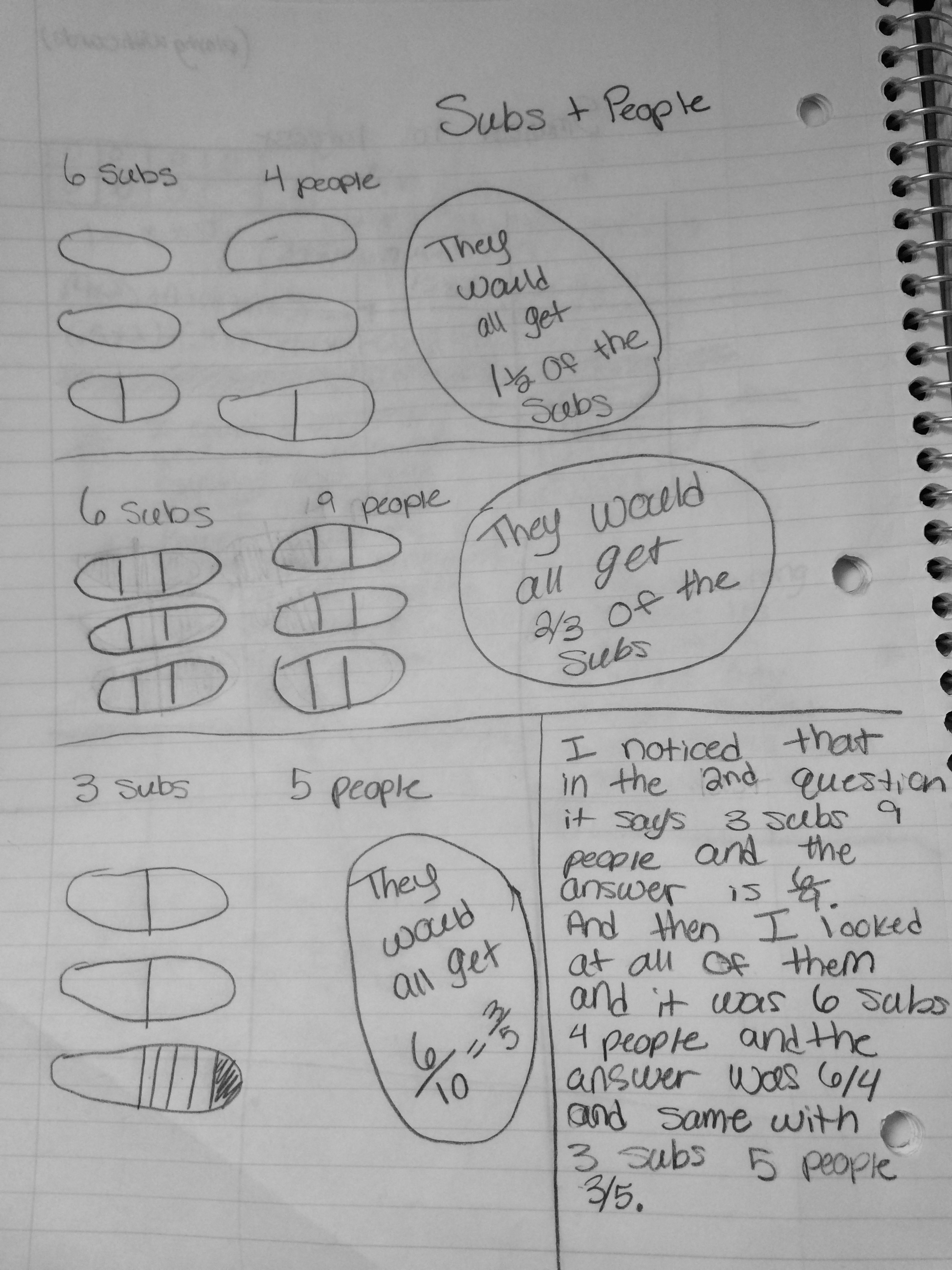
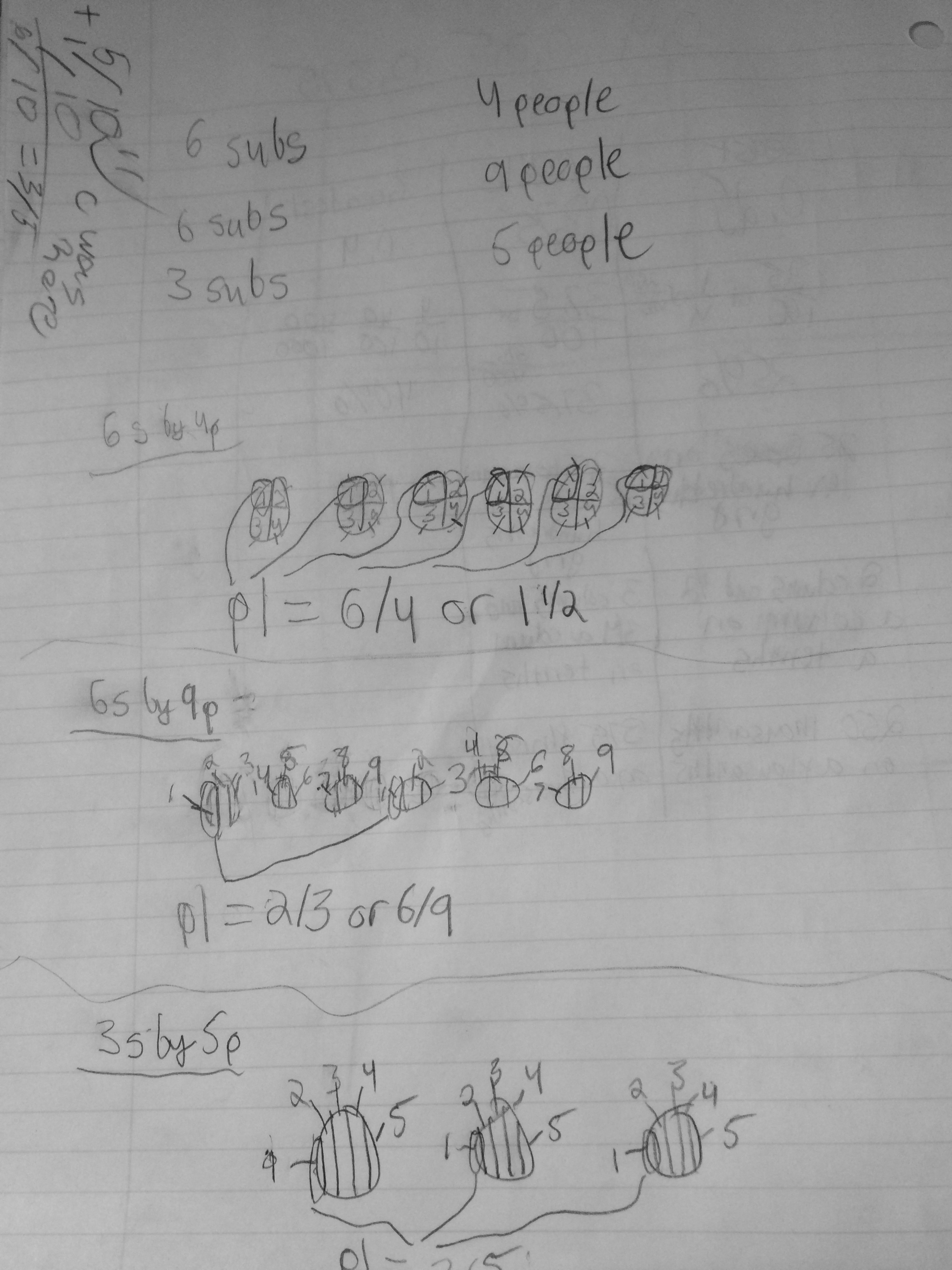
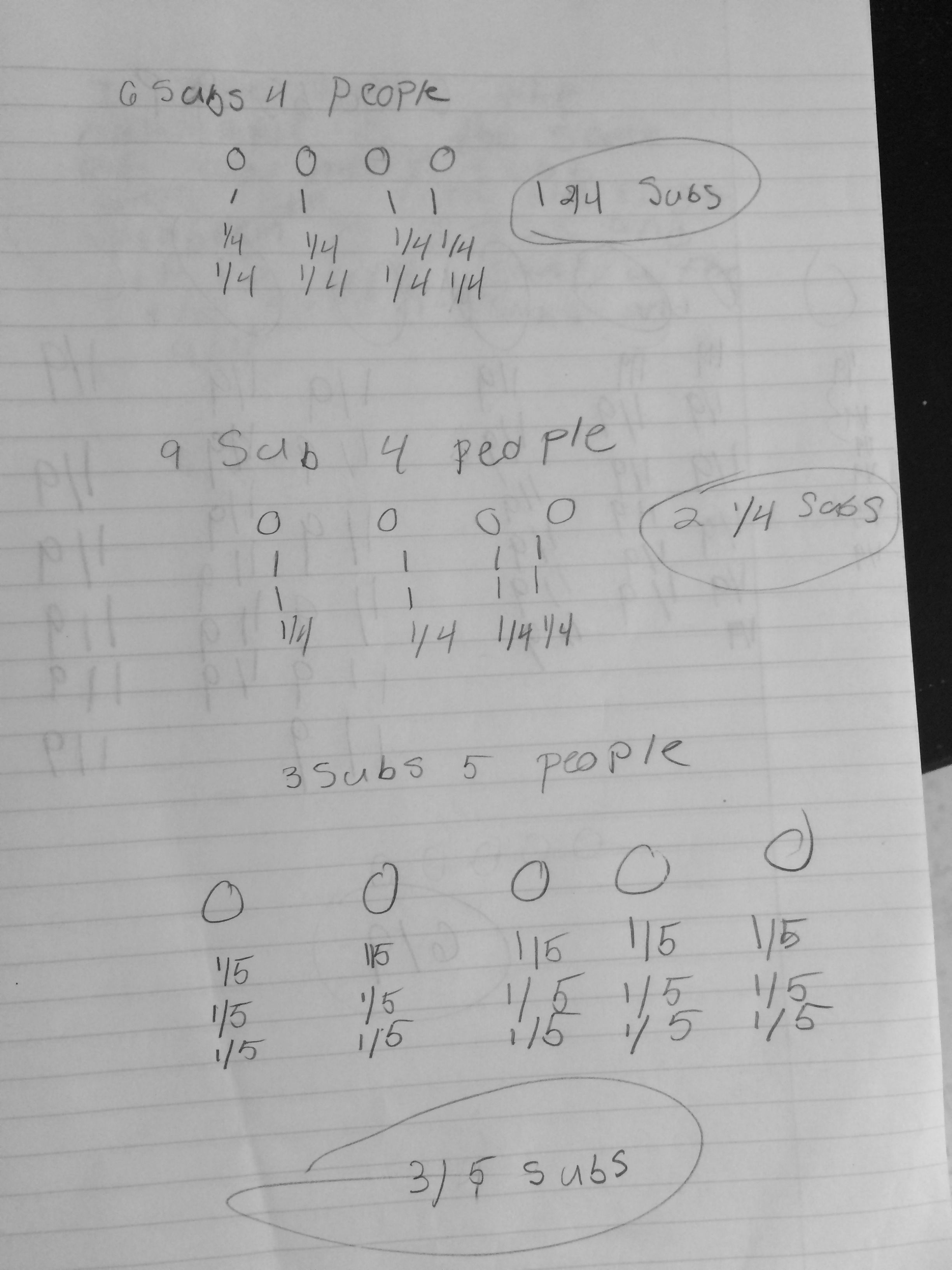
I started by putting a few sharing problem on the board: 6 subs shared by 4 people, 9 subs shared by 4 people, 3 subs shared by 5 people, and 6 subs shared by 9 people. I asked how much each person would get if they shared the subs equally.  I gave the students some individual time to work through the problems and, after that, an opportunity to share their answers and strategies with their group.  In the majority of the class, I saw the work I had anticipated based on their third grade brownie sharing work in Investigations. A lot of drawing of subs, people, and “passing out” of the pieces.
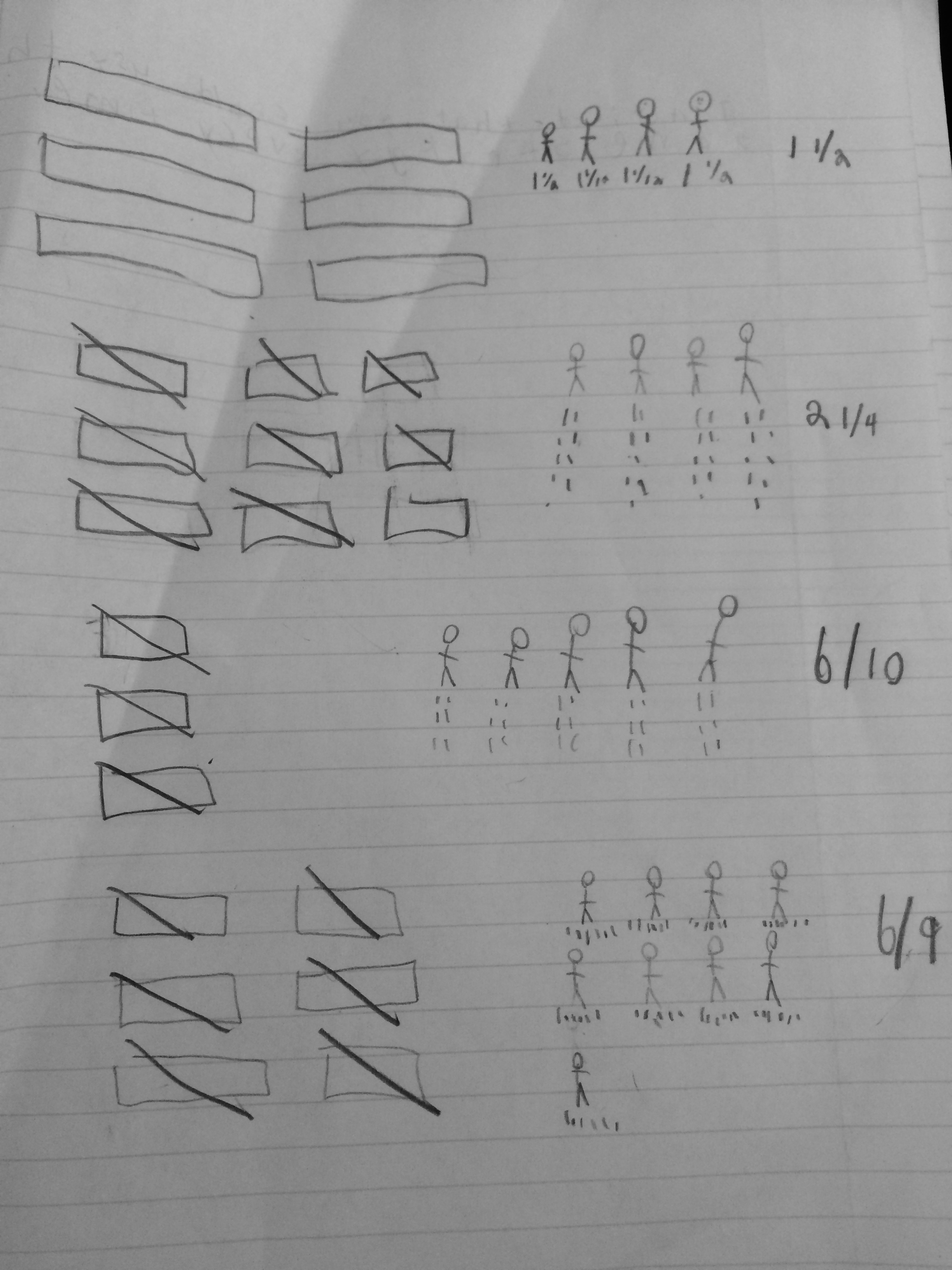
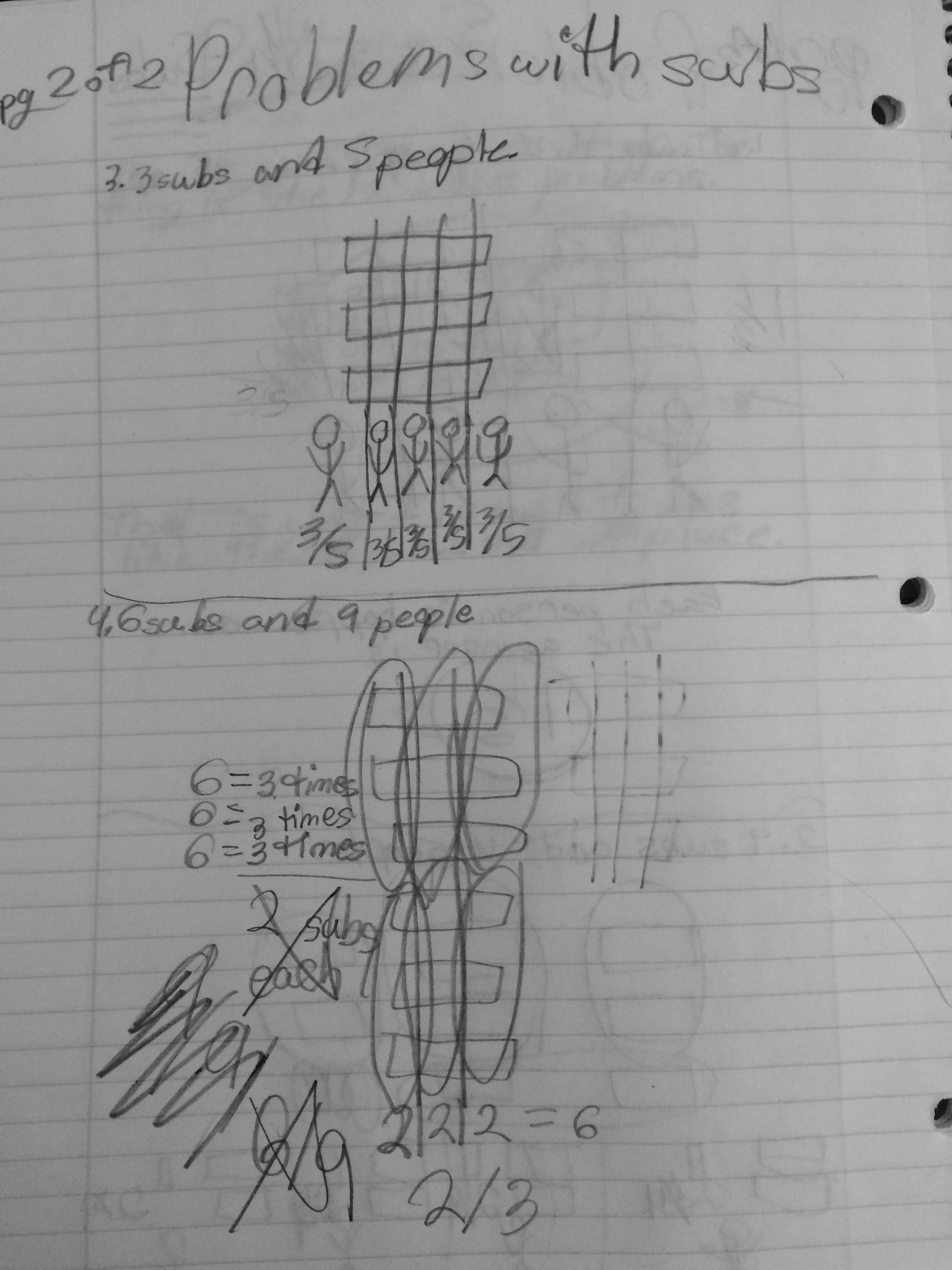
IMG_9370  IMG_9371

IMG_9382  IMG_9380

IMG_9374

One student thought about the whole being the number of subs, divided it into the number of people sharing and arrived at decimals, however struggled when he got to the 6 shared by 9. (The side written piece is after I asked them to write what they noticed and then he proved it worked with fractional subs to start).
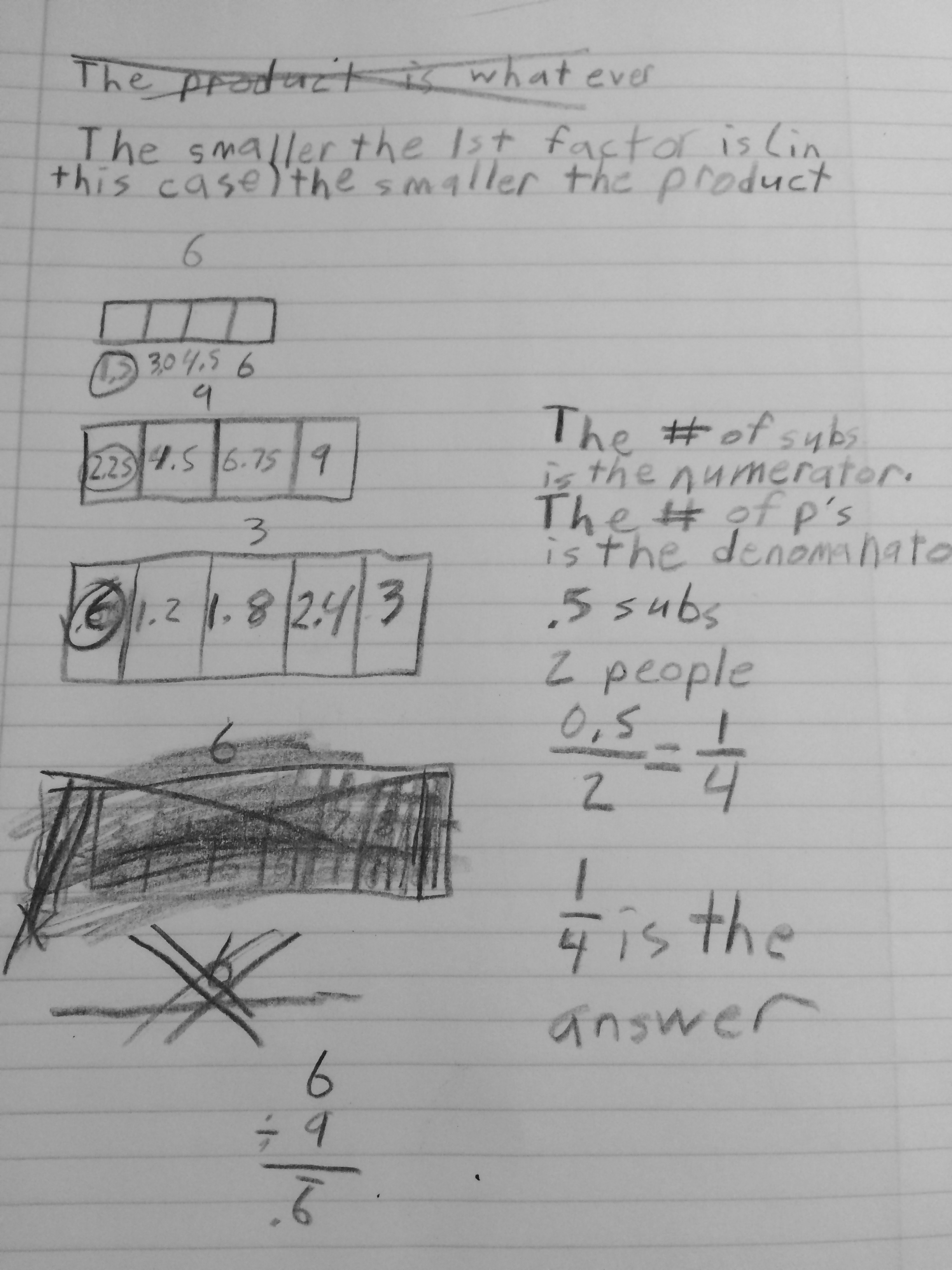
IMG_9375I had a few students that provided the perfect transition between the visual drawings and the fraction being division. They intuitively wrote the problem as a division problem and solved it using what they know about multiplication. After sharing some of the visual representations, I had these students share their equations. They explained to the class that is felt like division because they were dividing it up among people.
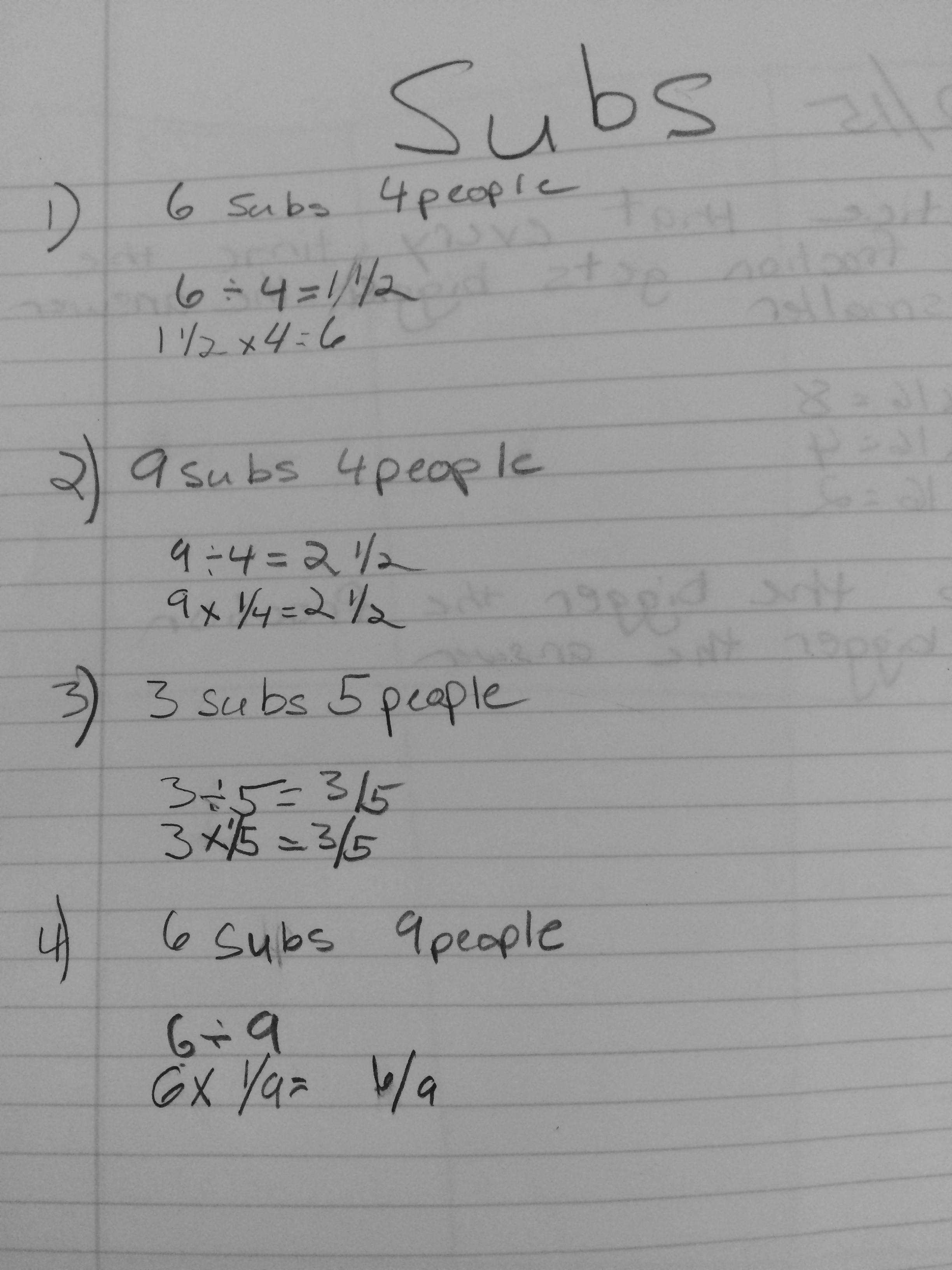
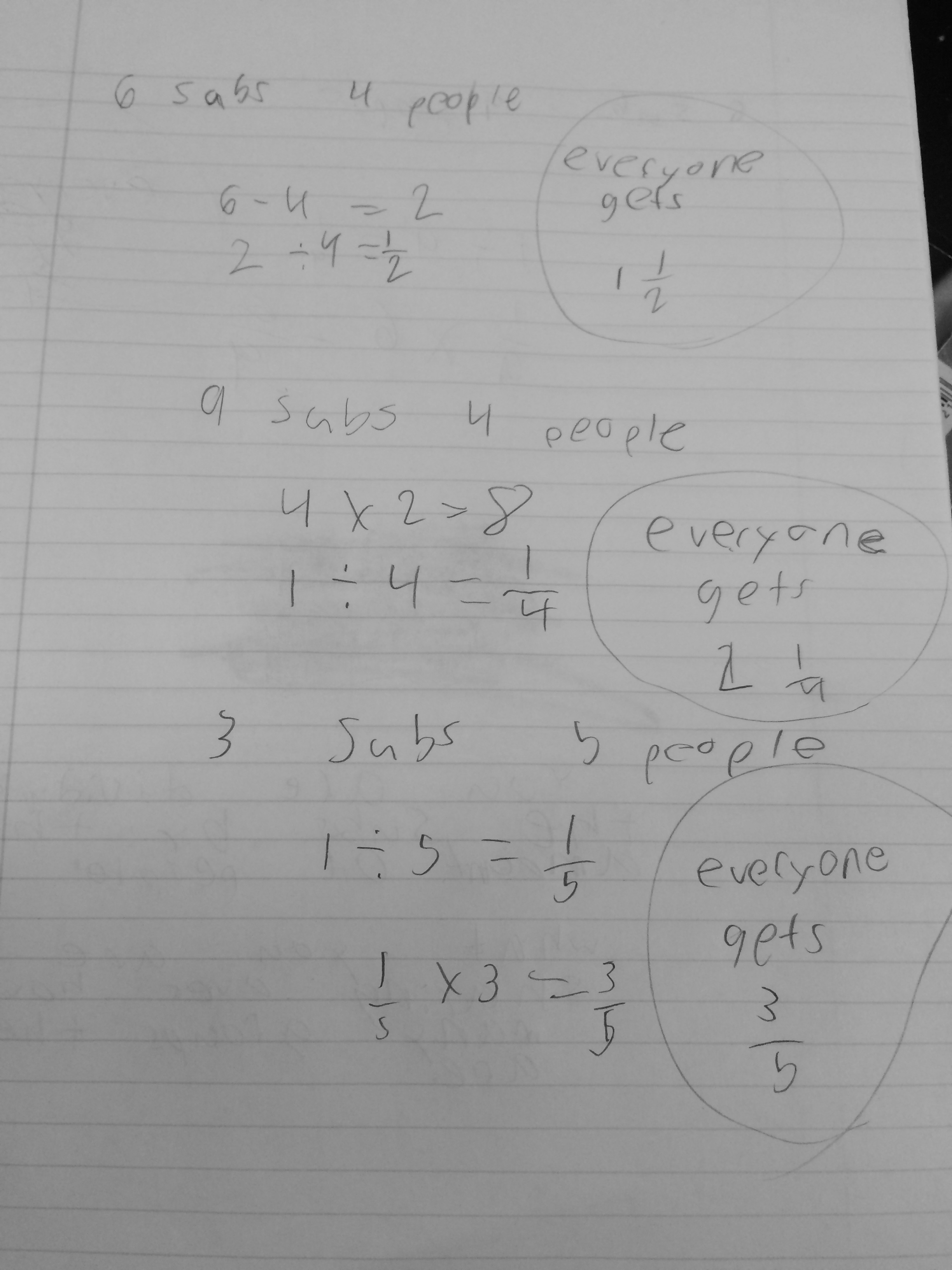
IMG_9369    IMG_9377

After our sharing, I revisited the original problems, with the students proven answers, and ask them to write what they noticed about the problems. After a few moments, I heard so many “Oh My Gosh”s and “It was really that easy”s echoing about the room. One student exclaimed, “Why did I do all of that work?” pointing to his beautiful sub and people drawings.

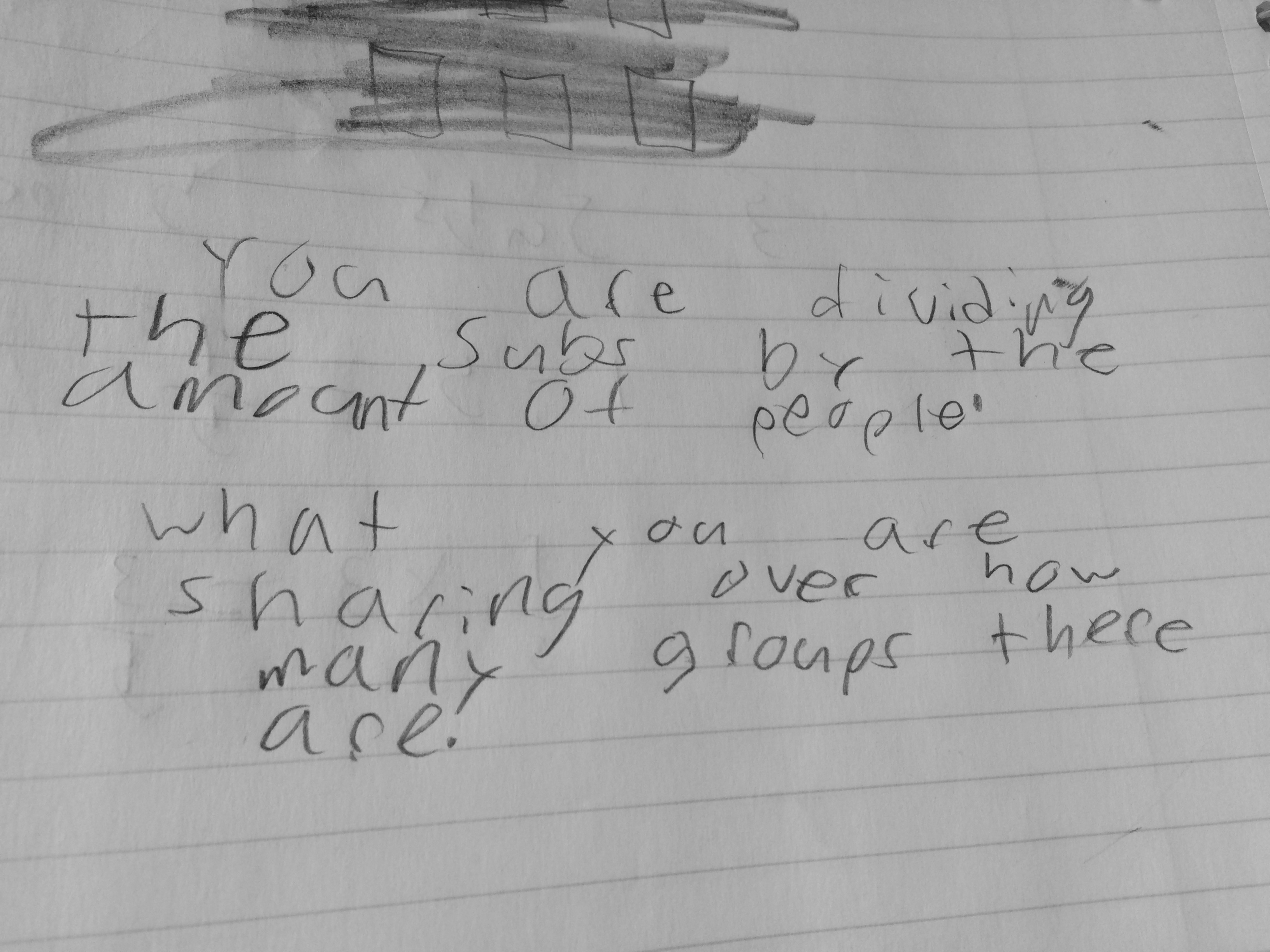
Here are some of their noticings (I love that they automatically start proving it to see if will always work without me even asking anymore).
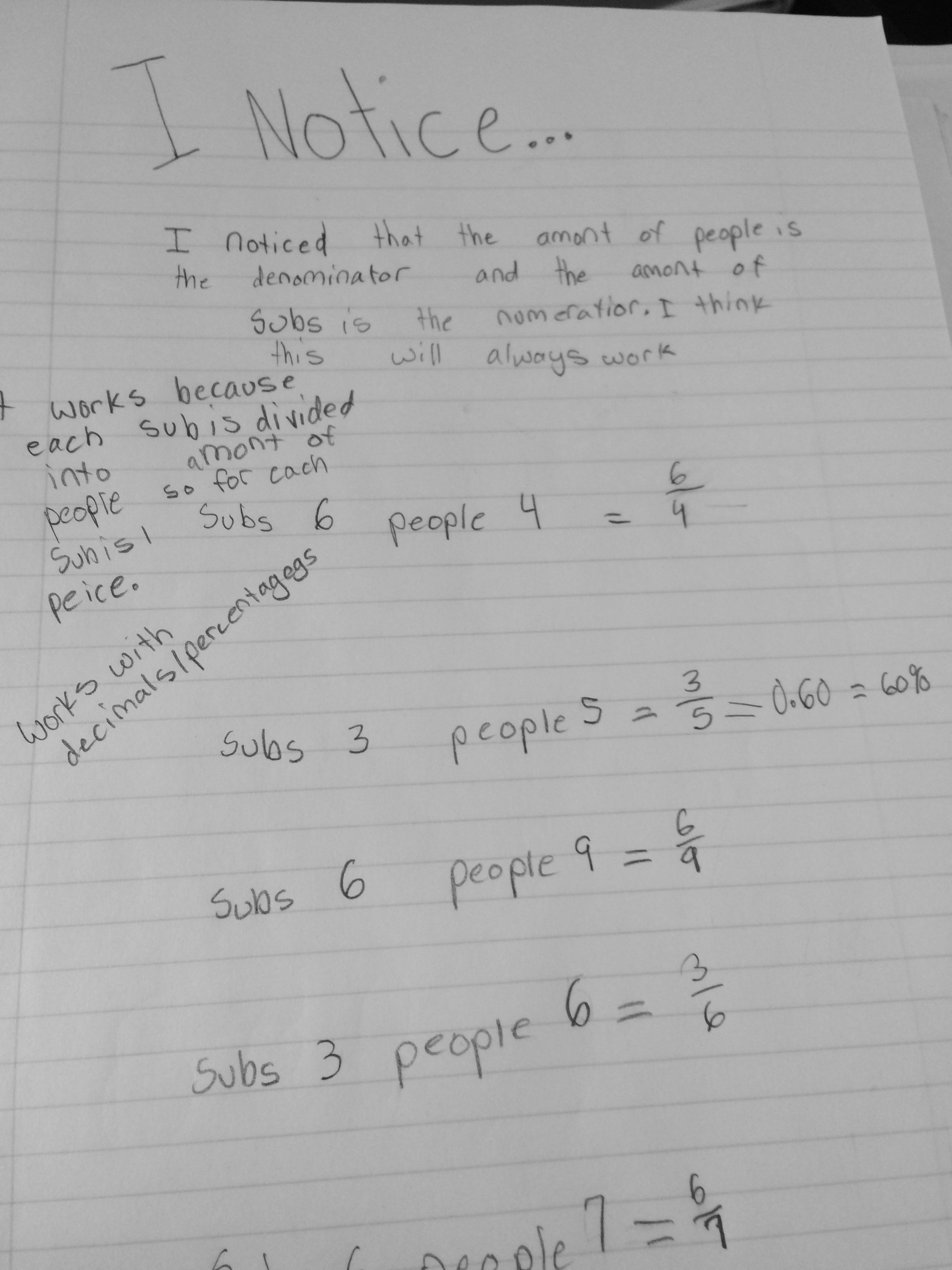
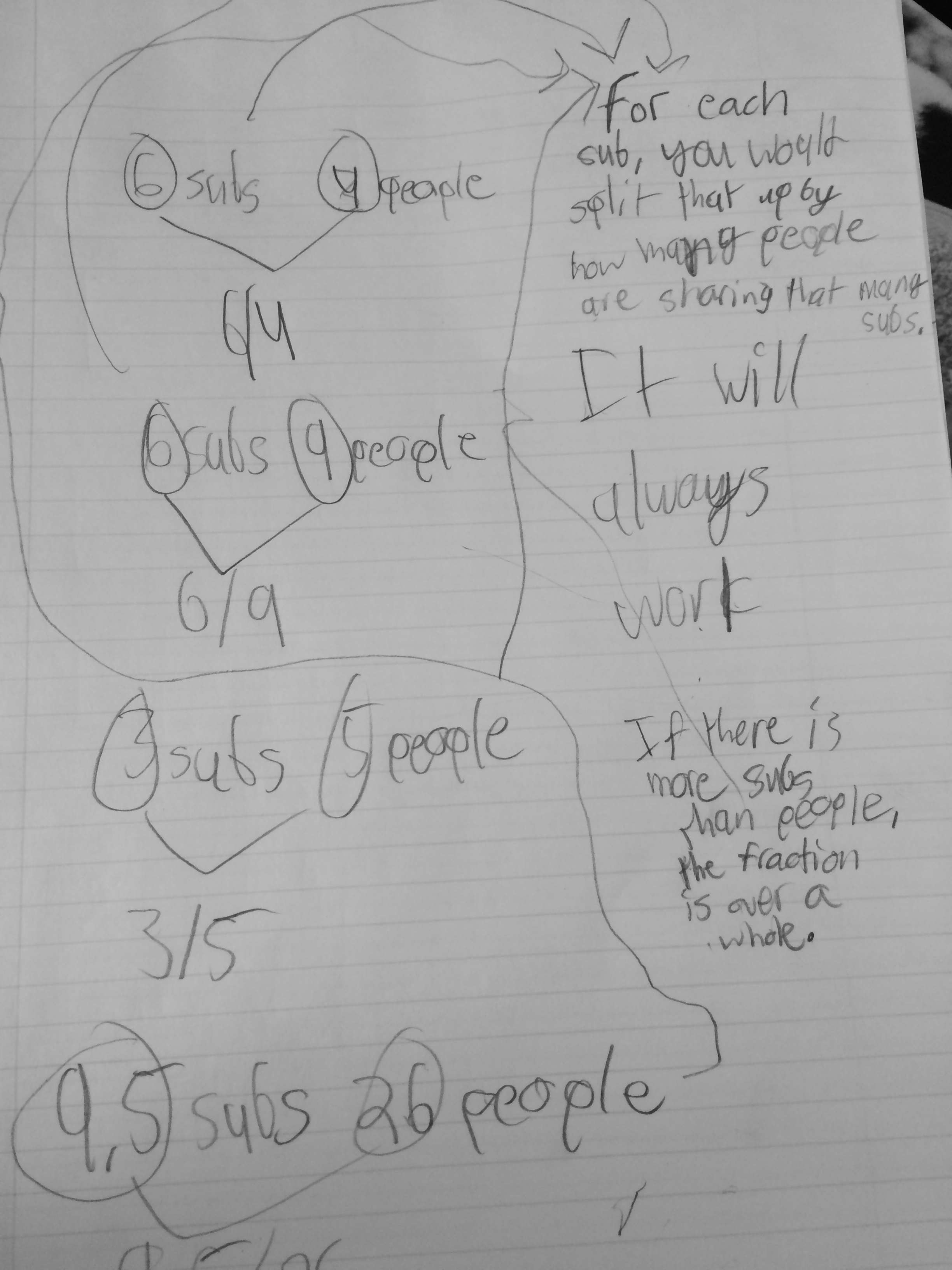
IMG_9381  IMG_9379

IMG_9378

This one just absolutely cracked my up and proved once again that I cannot make assumptions about student understandings….
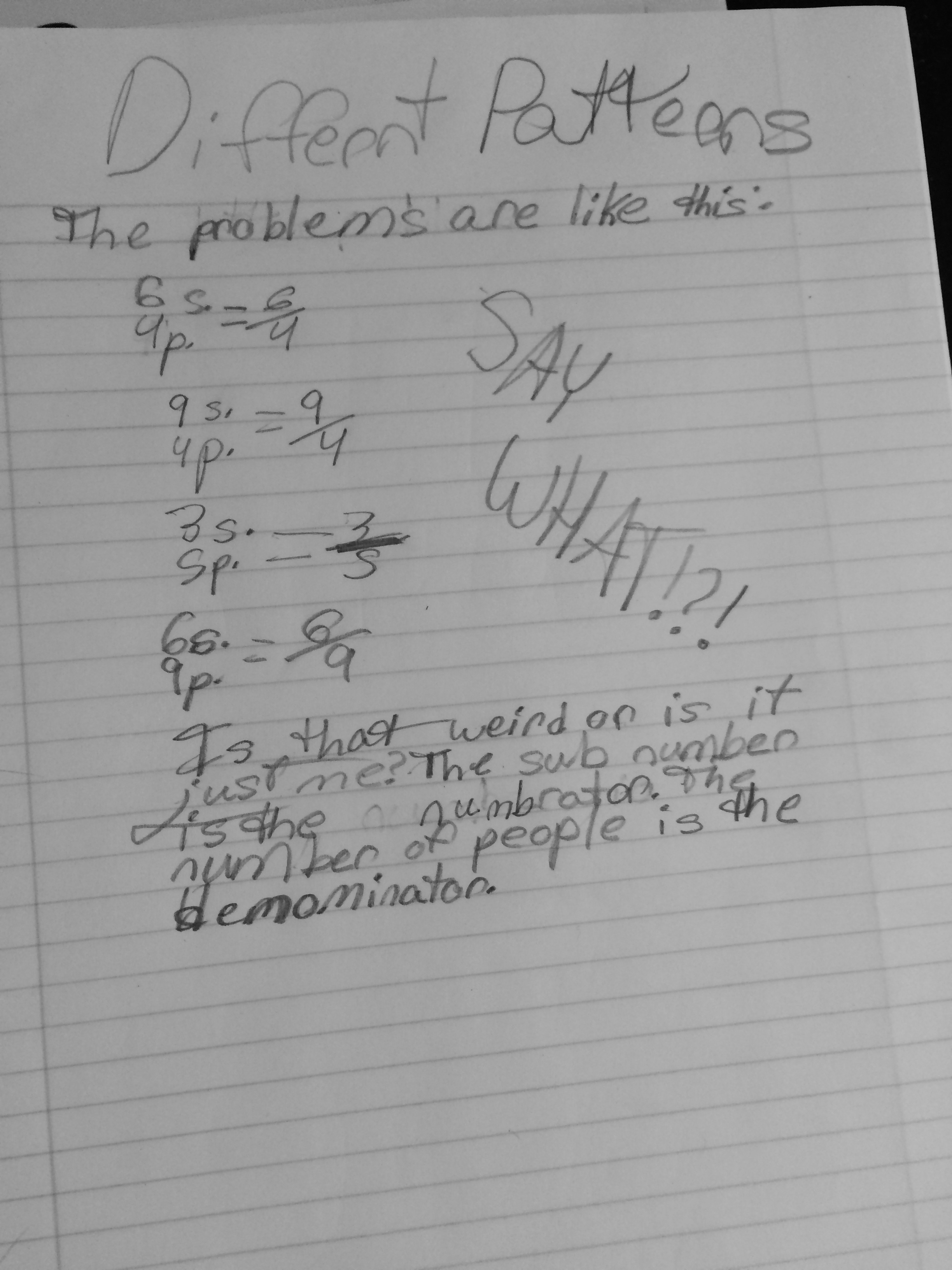
IMG_9372From this point, we tested out a bunch, talked about why it will always work and then starting looking at representing our “benchmark” answers as decimals. Tomorrow, I feel great knowing we will start looking into the division table with a deeper understanding of fractions as division. The word “explicit” sometimes makes me cringe in the way of “telling” students things, however I feel in this case the understanding of fractions as division was made explicit to the students through their own work group sharing and noticing today. I think that may be the piece I have missed before… I assumed they knew and could arrive at an answer, however never made the idea explicit as a whole group.

Today was a great day in math…Say What?

-Kristin

Comparing and Ordering Decimals

It is always so interesting to me what students take away in terms of strategies for doing various tasks in math class. In this particular case, ordering and comparing decimals. We all did the same shading activities, played the same comparing games, however the way this shading is applied to student thinking is so different among the students in the class.  In our assessment today I saw quite a variety in thinking that I just love.

These three are a sample of the most common strategy I saw in the work today. The students first thought about it in terms of how many tenths each decimal had. We talked about this a lot while shading in terms of full tenths, partial columns for hundredths and then parts of hundredths for thousandths so it makes sense that they would think about which decimal had the most tenths shaded first and move on from there.

IMG_9360_3 IMG_9363 IMG_9368

This student has a comfort in fractions and changed each to a fraction in the thousandths. It is interesting that certain students like to stay in fractions, where she could have just as easily made them decimals to the thousandths.

IMG_9362

This student explains using the hundredths grid in words. I love the use of the word blocks and 1/2 blocks. I just want to check back in on this one to see if there are connections to that 1/2 block representing 5 thousandths.

IMG_9364

“I thought about it like whole numbers.” This is something I would be extremely worried about if she had ordered them like: .6, 0.8, .55, .125, .875 because then the decimal would have been irrelevant in their reasoning in terms of “whole numbers”. She really multiplied each by 1000, which is something I would like to revisit tomorrow with her.

IMG_9366

I also had quite a few that compare using percents. This is a nice connection back to our fraction/percent work on the 100s grid earlier in the year.

IMG_9367

This was a nice way to ease back in after an extended weekend of snow and ice!

-Kristin
Fractions As the Denominator

As I was organizing my student work pictures this morning, I realized I had tweeted out this awesome work, but never blogged about it.

My students are very comfortable with putting fractions in the numerator. They use them all of time when decomposing, adding and comparing fractions like in these two examples…

IMG_8910_2 IMG_8300

The other day, two of my students finished early and as an aside asked me if there could be a fraction as the denominator. I asked them to try it out and see what they thought.

They wrote their question and then started playing around with some fractions in the denominator. At first they were writing a bunch of fractions with a fractions as the denominator in attempt to find one that jumped out and made sense to them. They tried drawing some pictures of them along the way to see if they could illustrate what it would look like.

The first one they drew was 1/1.5 in which the rectangle was cut into thirds and had 1.5 shaded. When I asked what they would name what they just drew, they said 1.5/3. Hmmmm, back to the drawing board. They moved to 1 / 2/8, drew a rectangle cut into 8ths and shaded 2 of them. After shading, one student wrote 1, 2, 3, 4 over each 2/8 and said that there were four of the 2/8’s in his picture, so 1/ 2/8 must be 4. I asked what the whole was in the picture and left them to play around with that idea for a bit.

IMG_9035_2

I came back to these additions to the work:

IMG_9037_2

When I came back they said they realized that 1/ 2/8 was really a fraction more than 1 since 2/8 / 2/8=1. When I asked them to show me where that thinking was in their representation, they said since 2/8 was really 1 in their picture, it took four of them to make four wholes. I especially liked how they multiplied the numerator and denominator by 4 (the reciprocal of the denominator) to get to 1 in the denominator. Interesting to think about the algorithm for dividing fractions at play here.

As others in the class finished their work, they started to mess around with this question, trying to make sense of it. This student attempted to put it into a context using the meaning of a fraction we use a lot, “a pieces the size of 1/b,” however with b as a fraction, it is not helpful here.

IMG_9040_2

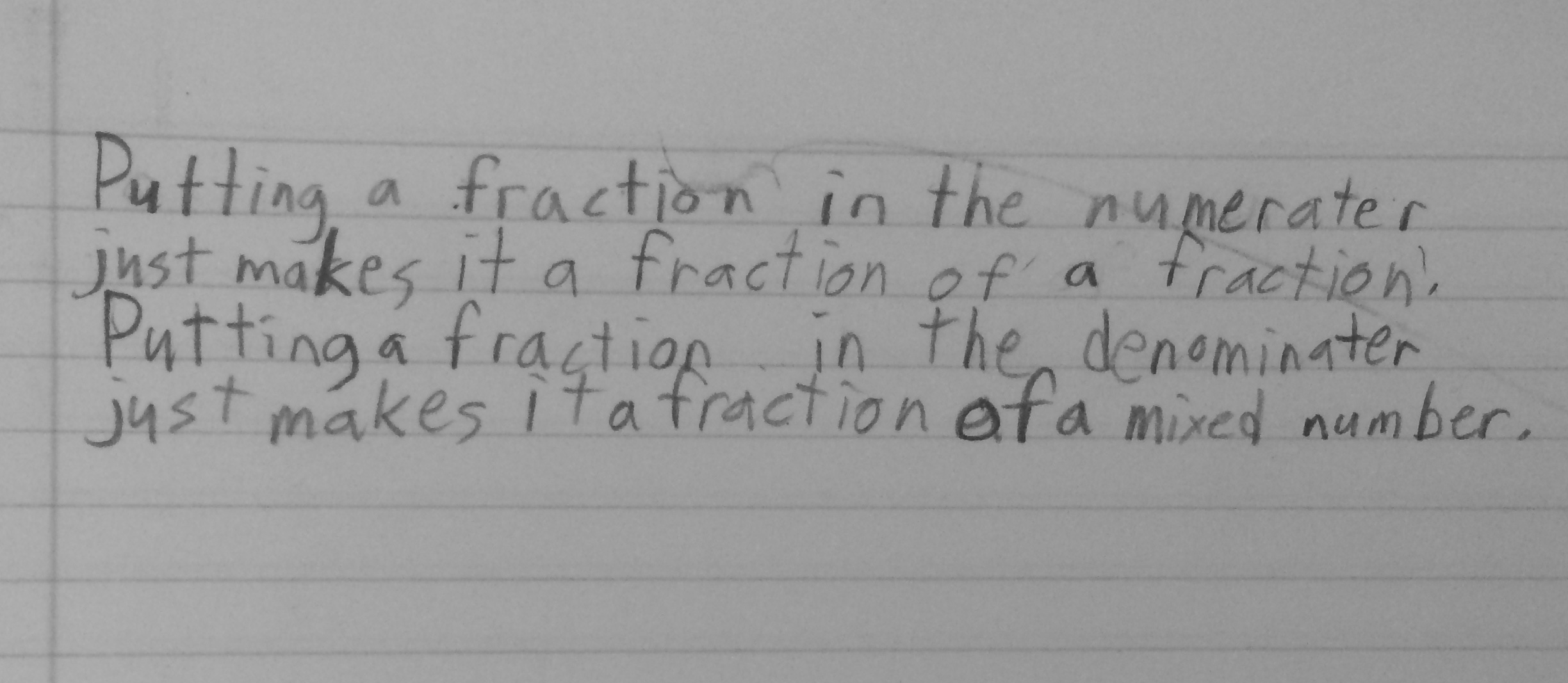
One student wrote this as his thought about the fraction as the denominator.

IMG_9038_2

I am left thinking a lot about the progression in which students learn complex fractions.

Volume with Fractional Dimensions

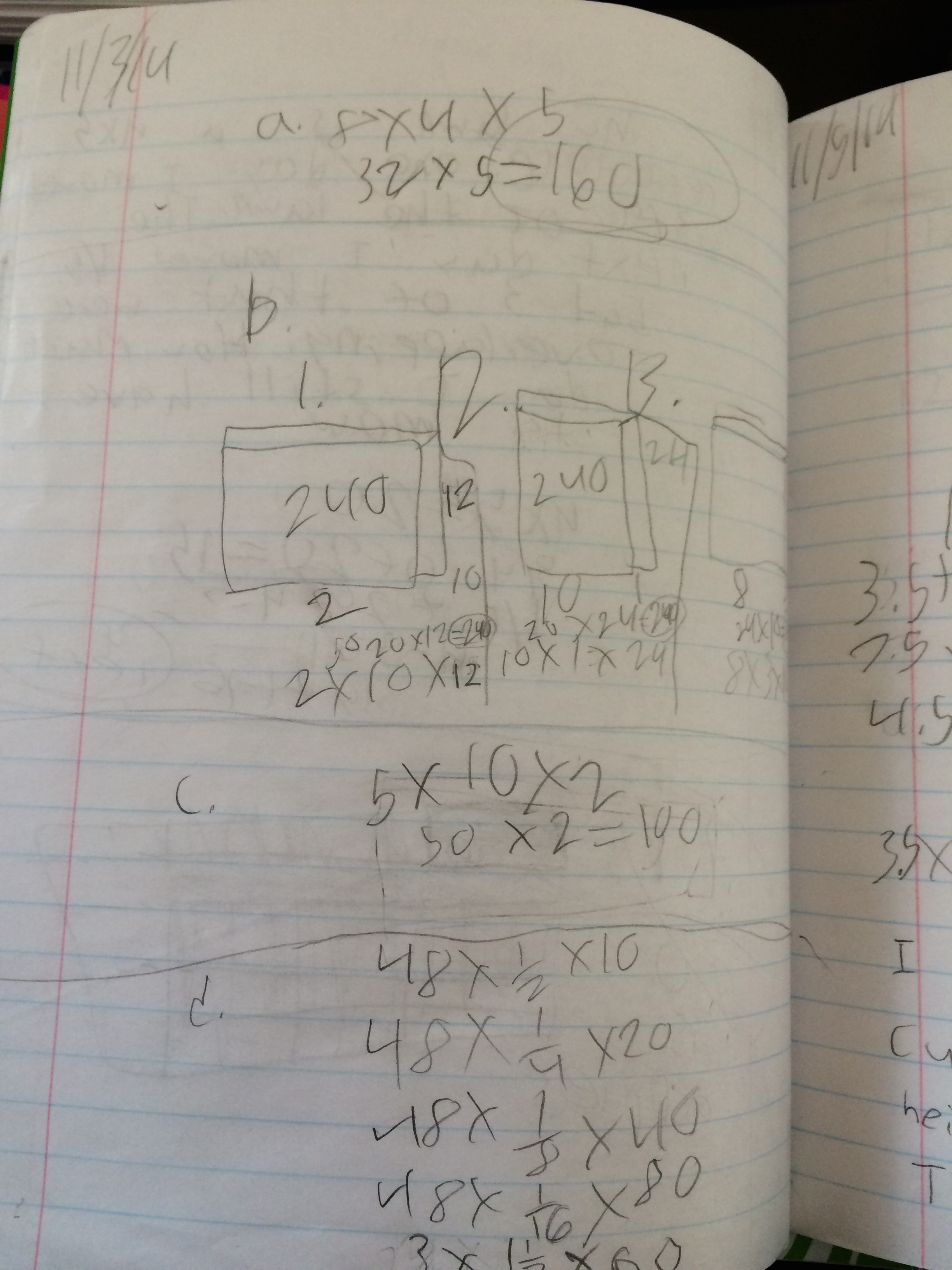
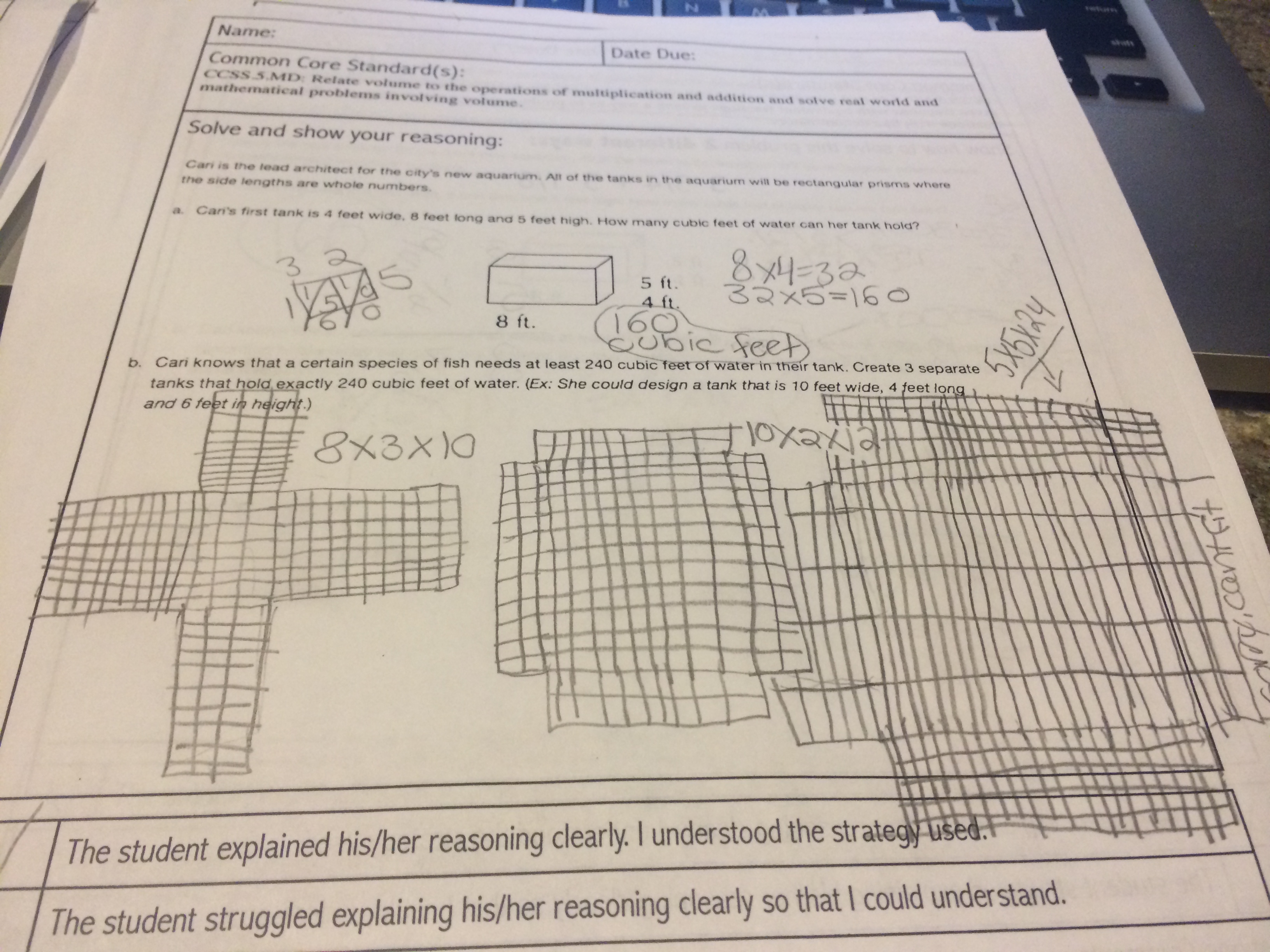
Before I began our volume work this year, I blogged about my planning process here: https://mathmindsblog.wordpress.com/2014/10/20/unit-planning/. As anticipated, I had many students who quickly developed (or already had) strategies for finding volume and could articulate a conceptual understanding of what was happening in the prism. In my previous post, I was throwing around the idea of giving those students dimensions with fractional length sides, so the other day I thought I would try it out. I did this Illustrative Task as a formative assessment of student understanding. Many students were done in a couple of minutes, with responses for part b that looked like this:

IMG_7972As I walked around the room and saw they were finished quickly, I asked them to revisit part b and think about a tank with fractional dimensions. Because of the great work they had done here I thought they would have some interesting thoughts. These are a few of the responses I got:

IMG_7976IMG_7977IMG_7973IMG_7981

So, what did I learn from this work?  I saw they had some great understandings about taking a fraction of one factor to make a number that they knew they needed to multiply by a third whole number factor to get 240.  In the first two pictures, there is a great pattern happening that I want to explore further with the whole class. I also loved seeing that a student took the question “fractional length sides” to include decimals in his work. In my question, however, I had wanted them to consider more than one side in fractional lengths, however not being more explicit, they took it and ran with one side being fractional.  In the next lesson, I thought I would push them a bit with this.

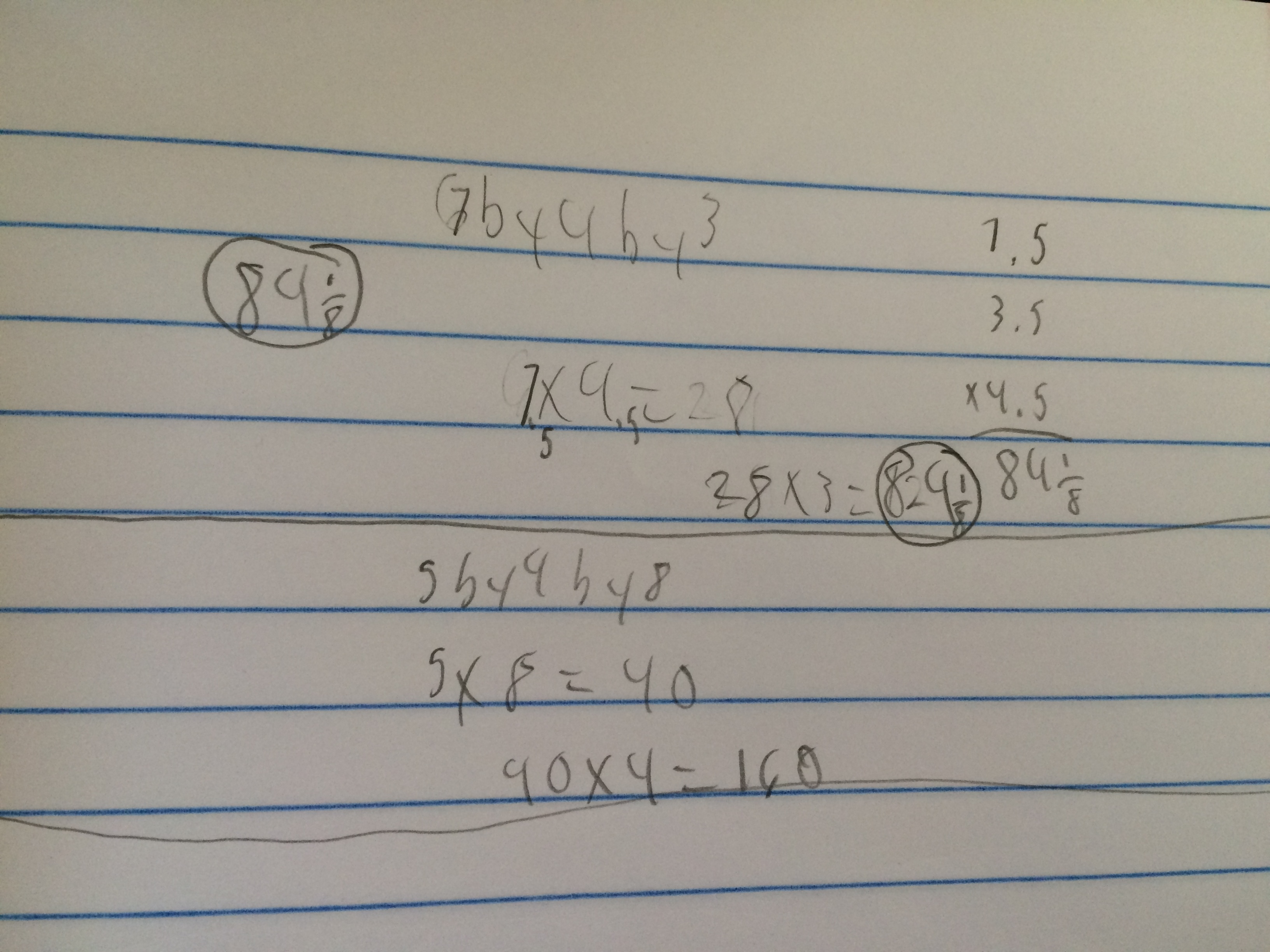
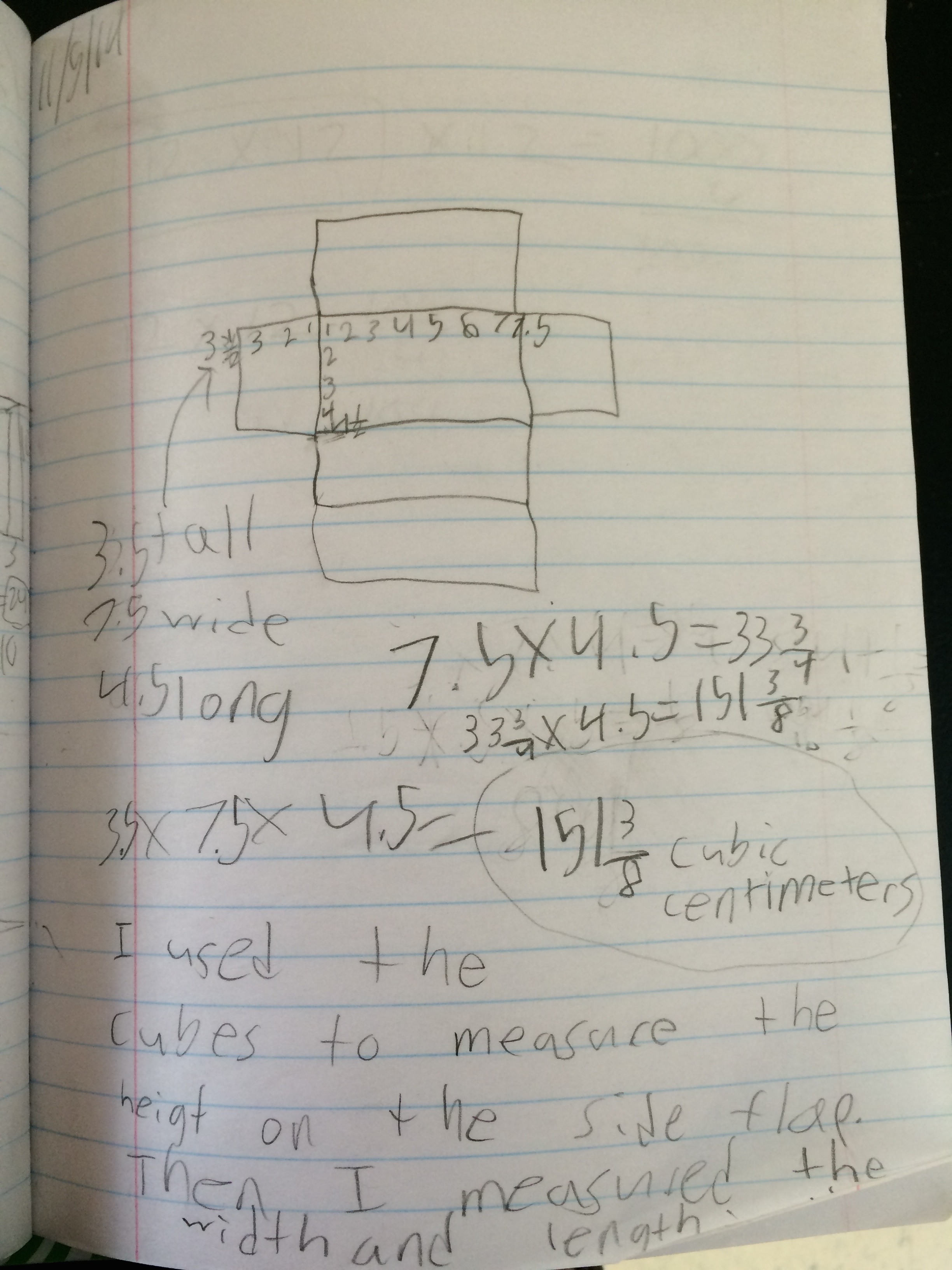
In the following lesson, students were finding the volume of an unmarked prism in cubic centimeters. They had rulers, cm cubes, and cm grid paper available to them, and went to work. Every year this happens, the Investigations grid paper works with the box to be whole number dimensions, however the cm are a bit “off” when using a ruler or cm cubes. I knew this, however, I do love the discussions that evolve from students who used different tools. I also thought this is the perfect opportunity for my students who were beginning to think about fractional sides. What transpired in the whole class lesson is a blog post in and of itself, however this is what came about from the fractional sides work…

IMG_7975IMG_7980

IMG_7979

Sooo much great stuff here! I had a group who was using the cubes, coming out with halves, but not wanting to round because it was “right in the middle” of the cube. I let them go and came back to see they were multiplying whole numbers, multiplying the fractions, and then adding them together to get their product. I asked them to think about another multiplication strategy to see if they got the same product, then came the array. Another student in the same group solved mentally to get the products. Unfortunately, the class had to leave me to go to their next class, also leaving me with so many things to think about. From here, I want to be sure students start to think about reasonableness of their solutions, compare their fraction multiplication strategy to whole number multiplication strategies, and think about how we multiply three numbers (Associative property). So much to do, I need full day math classes!

-Kristin
Decimal Multiplication: Whole # x Decimal

Through numerous Decimal Number Talks, Investigations on tenths, hundredths, and thousandths grids, and many findings about decimal operations, we are approaching our last couple lessons in our decimal unit. Not that the work with decimals ever ends, but our unit ends with decimal times decimal and the generalization of a “rule” for multiplying decimals. I have many thoughts about the new Investigations unit on multiplication of decimals but I am very excited about the connections my students have made between whole number and decimal operations. I do attribute a lot of their flexibility to our Number Talks though:)

I wanted to assess where they were before we moved into a decimal times decimal work because I think there is a lot of reasoning to do there before we come to a generalization!  I was really excited to see the use of multiple strategies!

First, I had students who were still treating the decimal operations like whole number operations and reasoning about where the decimal point “makes sense.” I do love this because it is heavy in estimation and sense making about what is reasonable. It is obviously not the most efficient strategy, but I what I truly learned from this, is that I need to do more whole number multiplication work with this student to build efficiency…

Image

I have students that love partial products….(and I cannot get some students to stop saying the “box method”….:)

Image

I loved this area model because of the size of the .4 side. She was very particular about that!

Image

Some friendly number work…I especially loved her estimation first….yeah!

Image

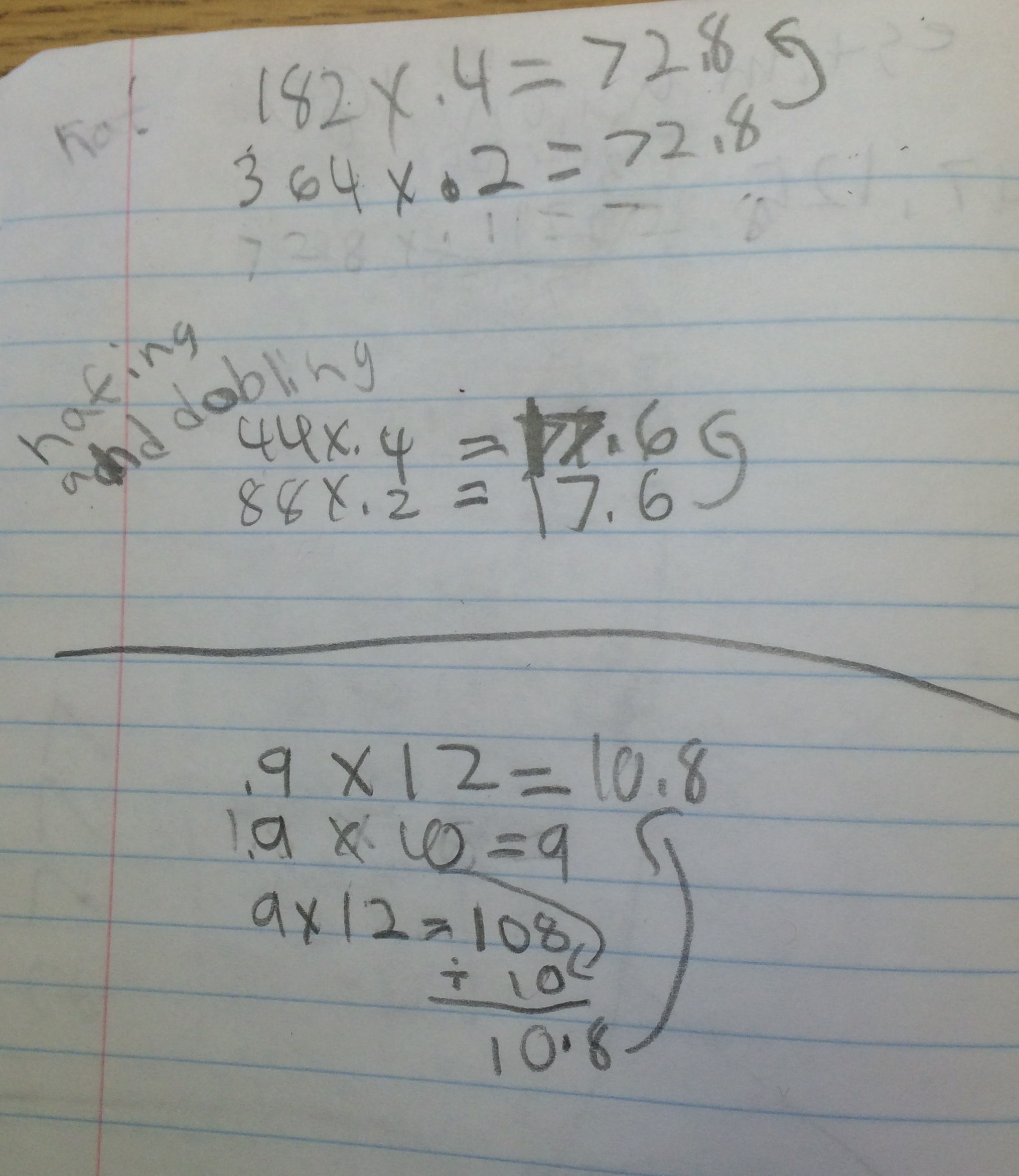
I had some who multiplied the decimal by 10 and then divided their product by 10…

Image

Saw some halving and doubling…

Image

I had a student think about the decimal as a fraction. It starts at the top and then he jumps to the bottom of the page.He said he multiplied 9 x 12 to find out how many “rows” he would have, 108. Then he divided it by ten because there were 10 rows in each grid.  It was interesting!

Image

So tomorrow we start decimal by decimal multiplication…I feel great about our start and I look forward to having them reason about decimals less than a whole times less than a whole.

-Kristin


Decimal Multiplication

This is a quick lunchtime post, so not much time to reflect or analyze, but wanted to throw it out there..

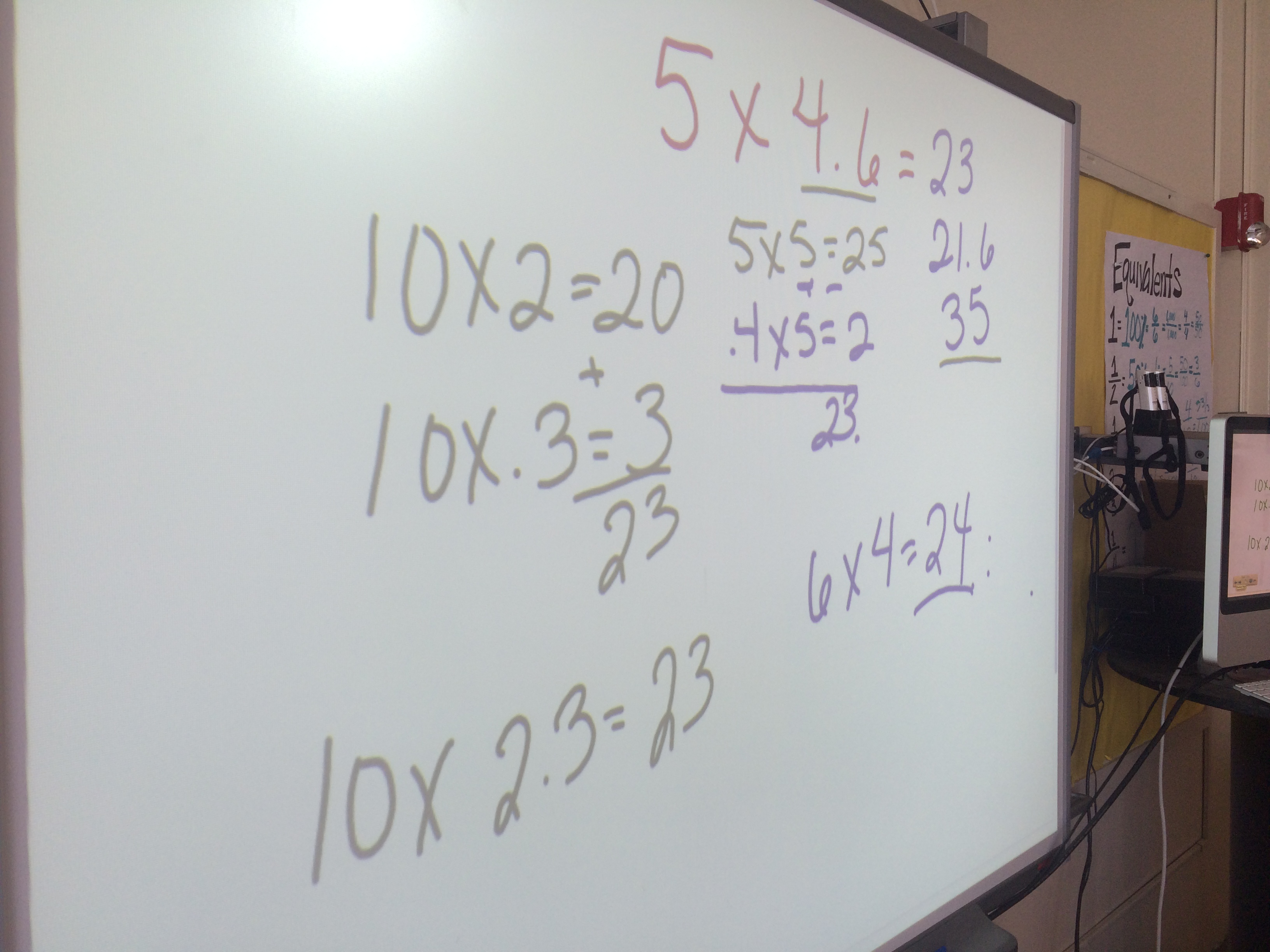
We did a Decimal number talk today and ended with the problem 5 x 4.6

I had students double half, use partial products, and use friendly numbers. (Incorrect answers were also written in case you are wondering about the 21.6 and 35…we looked for errors also)

Image

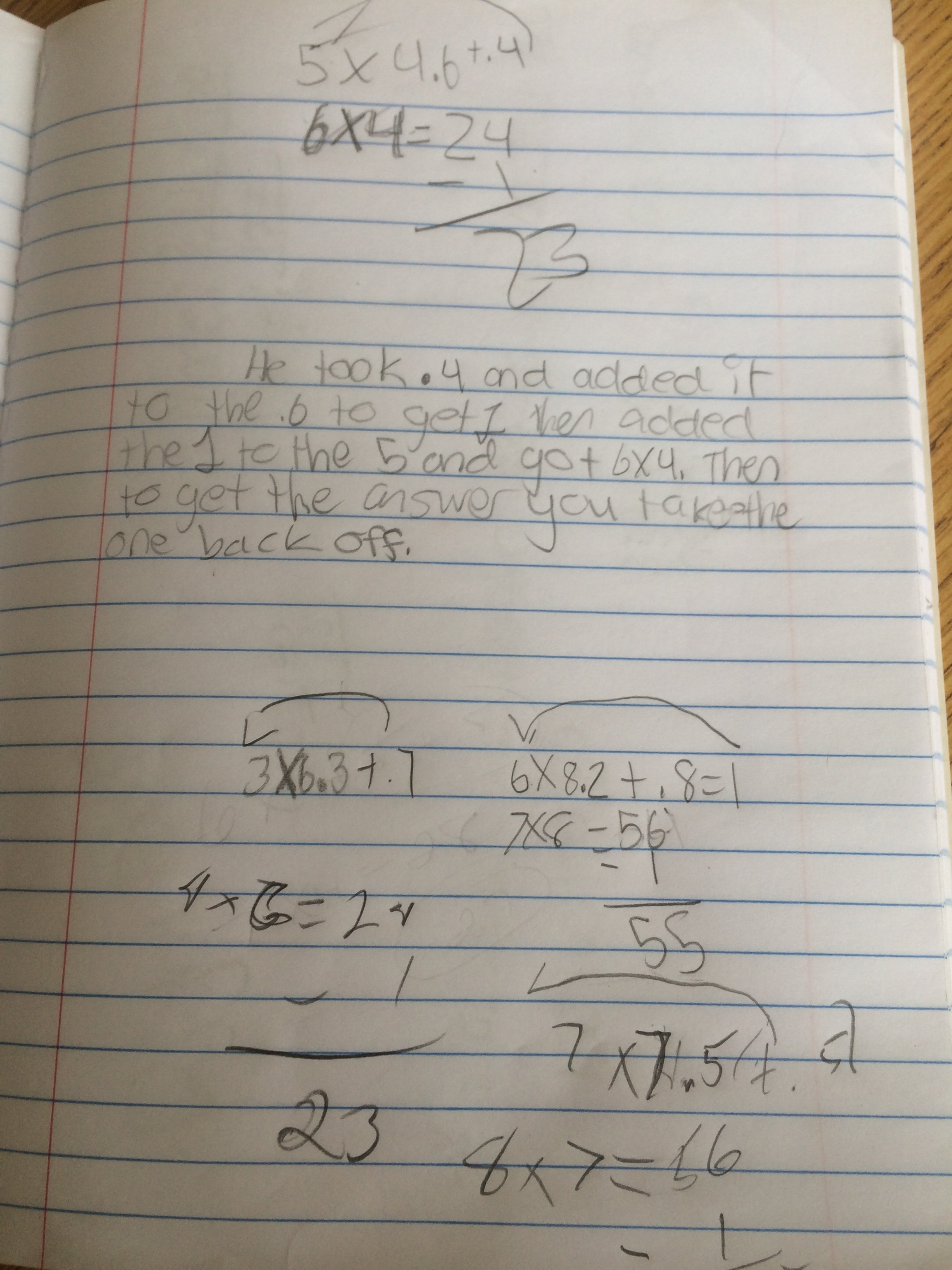
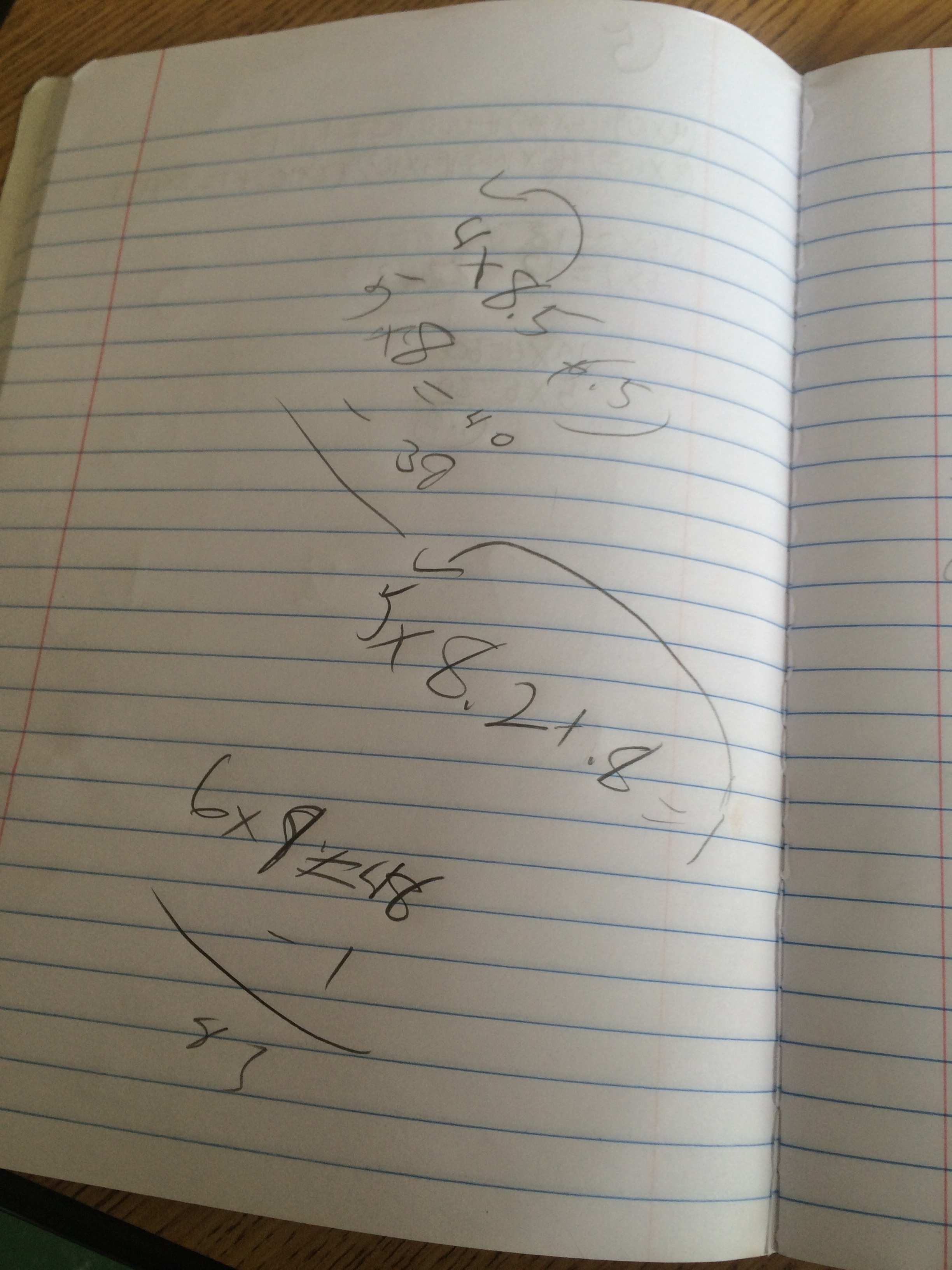
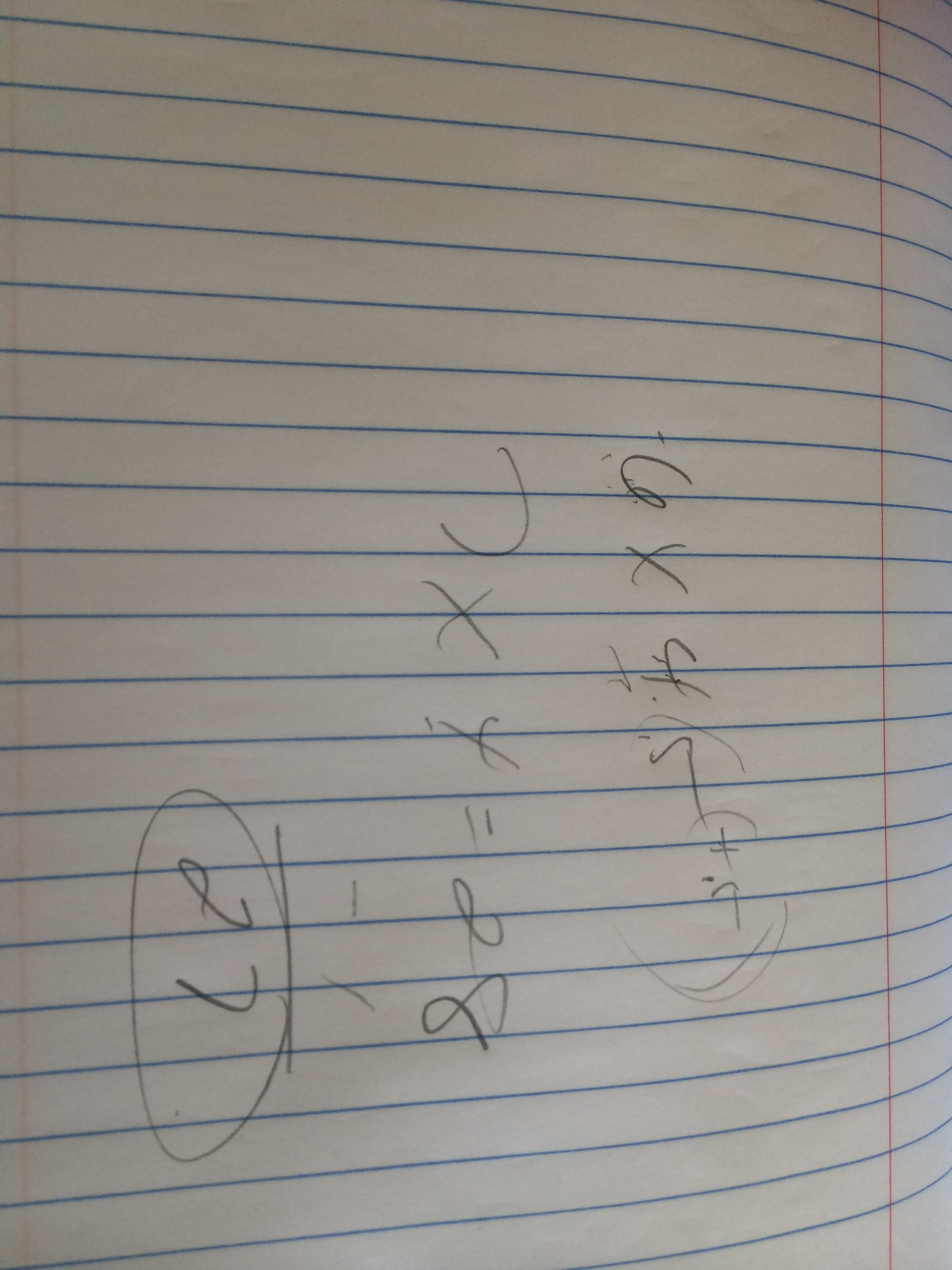
Then one student said that she bumped the 5 up to 6 and did 6 x 4 because she knew that faster, however she couldn’t figure out how to adjust her answer based on what she did. We had already had someone explain how they adjusted from 5 x 5, but this was not the same. She knew that she needed to subtract 1 (because we had already established 23 was correct) but where was that 1 coming from?

I sent them back to their groups to talk about it.

One group had this idea…

Image

I asked them if it always worked so they tried some more problems at the bottom that did not. They tried some more….

Image

They found one that worked….hehe..

Image

The class had to leave for lunch, but I will keep you posted what they come up with…

-Kristin

Area and Perimeter of Squares – Student Noticings

This will be a quick post because I have a student-posed math problem that I need some time to reason through!

Today, students found the area and perimeter of squares that increase in side length by one each time. Students used a variety of models when building their squares from Minecraft carpets, to Geoboards to graph paper. Here is the completed activity sheet from their work: IMG_3140I then gave them a few minutes to talk to their tablemates about things they notice in their work. Here are the answers they shared as a class and I recorded on the board:

“An even dimension by even dimension = an even area”

“An odd dimension by odd dimension = an odd area”

“The perimeter goes up by 4 every time the square gets bigger”

“The areas are square numbers.”

“The areas go up by odd skip counting: +3, +5, +7…”
I was pretty excited because they really pulled out some great noticings and my next step was for them to choose one and find out why that was happening.

AND THEN THIS HAPPENED…

WOW, what a noticing!

Each pair of students chose one noticing from the board and worked on figuring out why that was happening. I had groups share the even dimensions = even area and perimeter going up by four. The tables that chose area going up by “odd skip counting” and the last one, left with no answer but excited to keep trying to “figure it out.”

Now, if you know why this last one works, please let me know that you know, but keep it a secret from me for right now! I want to sit and work through this one but I also need to know who to run to if I don’t get it!

I have found that you have to add the odd dimension area to the even dimension perimeter and if you do it the other way, it does not work. Why in the world does this work every time?

Had to share because it was such great conversation and I left having the hunger to sit and work thru the math….better yet, the students did too.

Enjoy and please let me know if you know why that is working because I may be reaching out!!

-Kristin
**Follow up comment: Thanks to my Twitter buddies, I worked my way to the visual of this problem. It was much easier to make sense of this algebraically, but the “why” took a lot of square drawings and scribbles! It was hard to make the connection between perimeter being the distance around to it being one side or a square tile. Here is part of my working on my Geoboard app…
IMG_0282
So the area of a 1×1 + the perimeter of a 2×2 = the area of a 3×3.

Always, Sometimes, Never – Quadrilaterals

One of my “go to” questions for students when they are working through math in my classroom is, “Will that always be true?” I find it pushes the thinking to another level where students are looking for examples and/or non-examples.

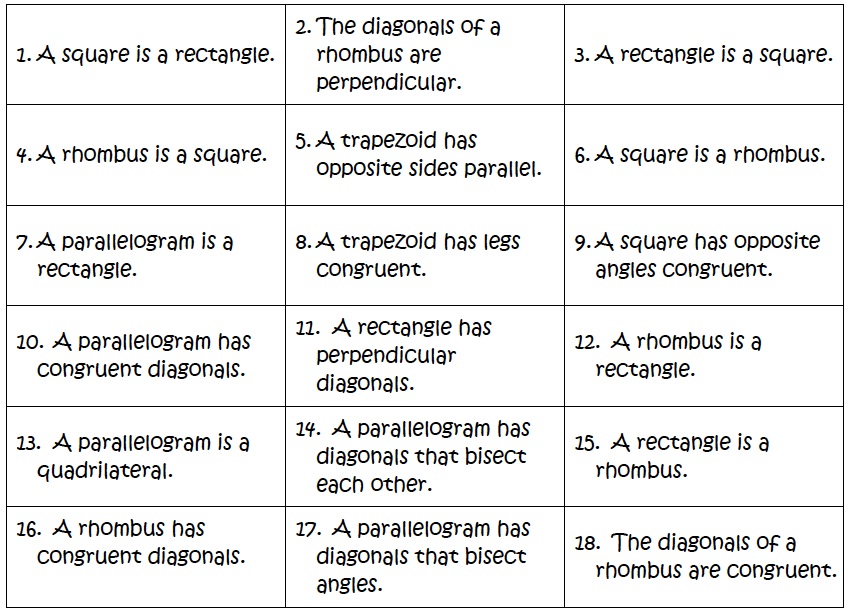
On Twitter one evening I found a blog post by @lisabej_manitou that was the embodiment of my go-to question: http://crazymathteacherlady.wordpress.com/2013/11/20/always-sometimes-never/ . Can you say perfect timing, as my class is in the midst of quadrilateral properties/classifications?

I gave each group of students Lisa’s sheet, clarified any key vocabulary questions and the conversations started rolling!

asn

We have been doing a lot of work with classifications and discussing all of the classifications polygons can have, but this activity took that to a great new level.  The “Sometimes” column has to be my favorite because it requires to think of both cases, true and not true.

One group had a very “heated” debate on the “Square is a Rectangle” card, which if you asked me ahead of time, would not have been the one I expected to hear such debate (at least in the respect that it was). I know that often students come into this unit having formed or memorized some form of the statement that “Squares are rectangles, but rectangles aren’t squares.” Whether it is taught or formed on their own, it is put to test when faced with the always, sometimes, never. Those are the words that are key in the misconceptions built around that statement. That was the conversation I expected to hear when I walked over to the group and looked at the card in question…however it was actually quite different reasoning!

One member of the group was literally “Starting to sweat” (her words) from this conversation. She was trying to explain to her group why a square is SOMETIMES a rectangle. Her reasoning was this: (I had to have her write it down so I could use it later in class and she needed a breathing moment away from her group)

IMG_3129She made an interesting point for students to reason about. If a rhombus can be a square, and rhombuses (or is it rhombi?) are not rectangles, squares can’t always be rectangles.

I pulled the class together to discuss this point because there were others agreeing with her reasoning. They SO wanted me to tell them who was right and who was wrong….um no way! I asked them what would prove or disprove this argument to them. One group said they would need her to show them an example of when a square was not a rectangle because if it is sometimes, it has to be a case of when it is and isn’t.

And, class dismissed. They left wanting to continue: creating arguments, critiquing the reasoning of other, making mathematical models, looking for patterns in their reasoning….I would say it was a great day in math!

I am SO glad they didn’t finish yet bc I am planning on recording some conversations on Monday to post.

Thanks Lisa for the great lesson!

-Kristin

Math Workshop

In my last post: https://mathmindsblog.wordpress.com/2014/01/16/rethinking-homework-pt-2/, I had a couple of tweets inquiring about how I organize my math workshops.

I am fortunate in the fact that our district uses the Investigations math program that embeds math workshops into the units. Over the years, I have learned to take what they have in the book and tweak it to meet the needs of my students. I appreciate the structure, games and activities, but I found that it could also afford me the time to work individually or with small groups of students who need the extra time. That extra time could be for an intervention or extension.

When I first started trying to use math workshops, i quickly realized that the management piece was by far the most important piece I needed to work on before we ever tried this again. It was L.O.U.D. I am all for noise that is productive, but it was definitely not that!

First step, figure out how to balance the noise so I can actually hear the students I am working with in a small group. So that everyone was not talking at the same time, I decided to make one center an individual center, one w/a partner, and one as a group. I created a template in SMART Notebook so the students knew their rotation and they wouldn’t have to ask me what they were doing next: https://www.dropbox.com/s/m3m37zelvgy70i1/MathWorkshop.notebook

Next step, I had to decide on the activities that would make the most of the time they were in each rotation. The partner activity was easy because I really like the games in Investigations.  I have just added a couple guiding questions for students to think about while they are working. The group activity, I decided to make more of a task-based problem that would require the students to work through the math. Most recently, students were trying to find unknown angle measures of polygons using angles that they knew.  The Individual activity varies, but each time I use it as a formative assessment of the work we have been doing in class. Recently, students solved two problems and did journal reflections explaining their work.

The hardest part is organizing the groups and deciding what I will be working on in the Teacher Rotation. I don’t want students to feel that when they come to my table they are “stupid” or embarrassed  because they may need extra help, so I keep the groups as heterogeneous as possible. I have learned that I need to be very thoughtful (and crafty) about the work they do when with me by embedding the concepts students have misconceptions about into work that others in the group, who do not, can still learn something from it.  It is tough and definitely the most time consuming piece of organizing Math Workshops.  Sometimes I make my table the table in which students are extending their thinking on a recent concept while other times it is meeting students where they are to try to work on misconceptions.  I have used my recent math homework as a way to choose the problems we work on at the “Teacher Center.” Looking at the homework has also made it easier for me to put the students in Workshop Groups so I have a range of strategies in the group in which to make connections.  * I don’t always have a group. Sometimes I walk around and facilitate discussions while the students work in the three centers. *

After all of that work, I set the timer on my phone for 20 minutes & run three centers for a total of an hour of Math Workshop. The students really enjoy it and have learned to work very well together.  I typically like to run the Workshop at least once every couple of weeks.

-Kristin
 

Rethinking Homework Pt 2

For those interested in the follow-up on my homework change after reading my first post: https://mathmindsblog.wordpress.com/2013/12/28/rethinking-homework/ , this is my reflection on the the process…
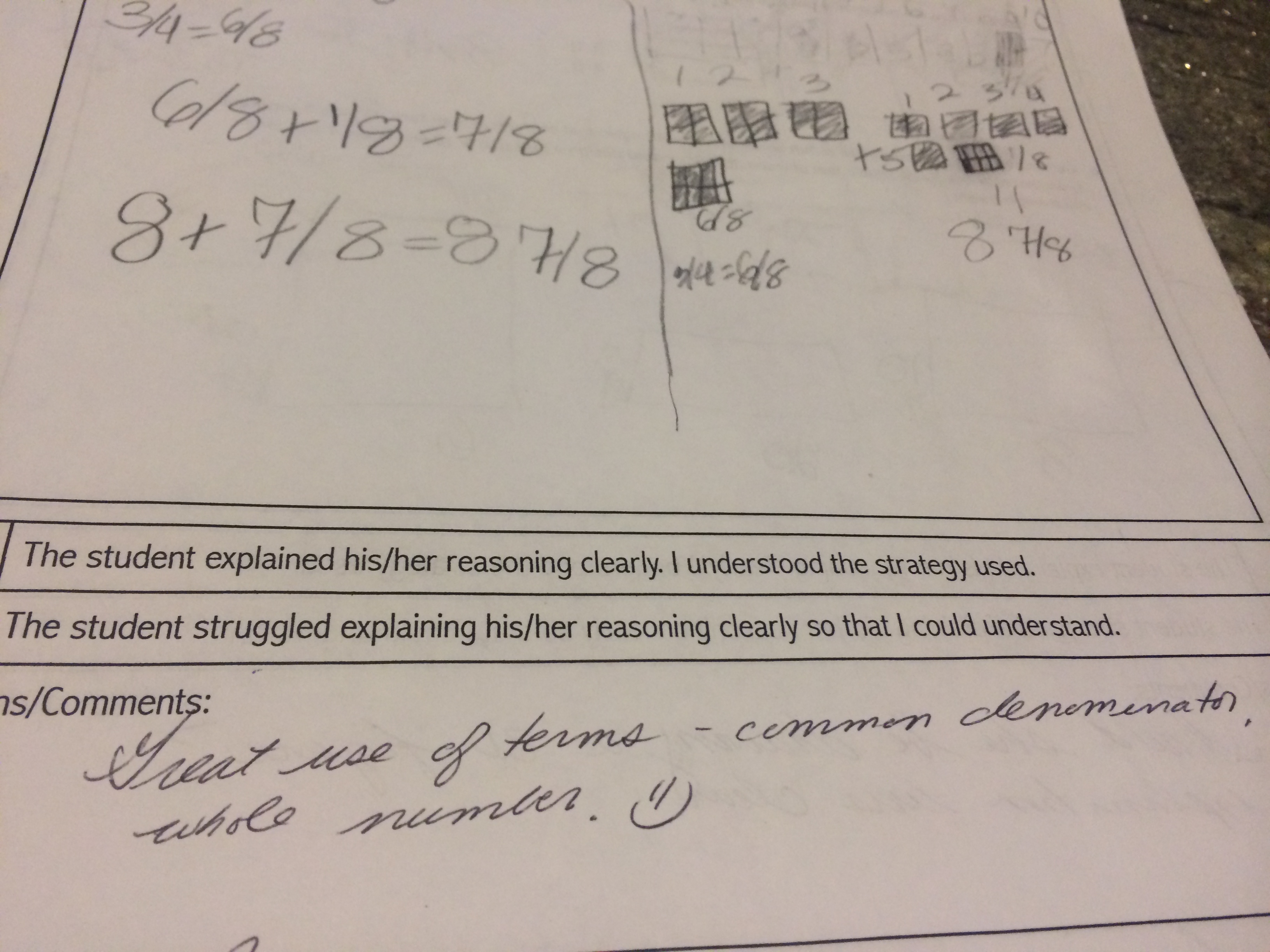
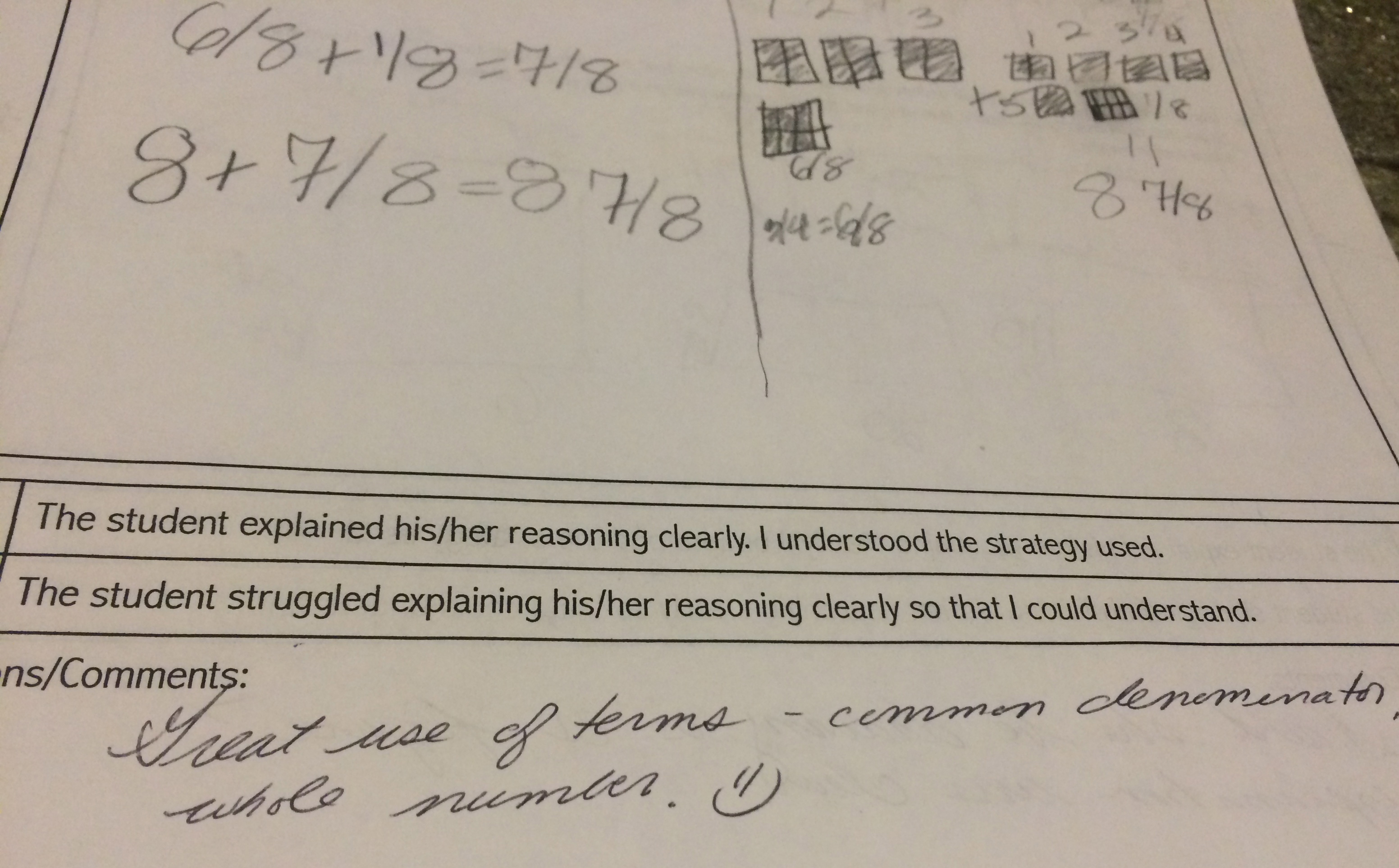
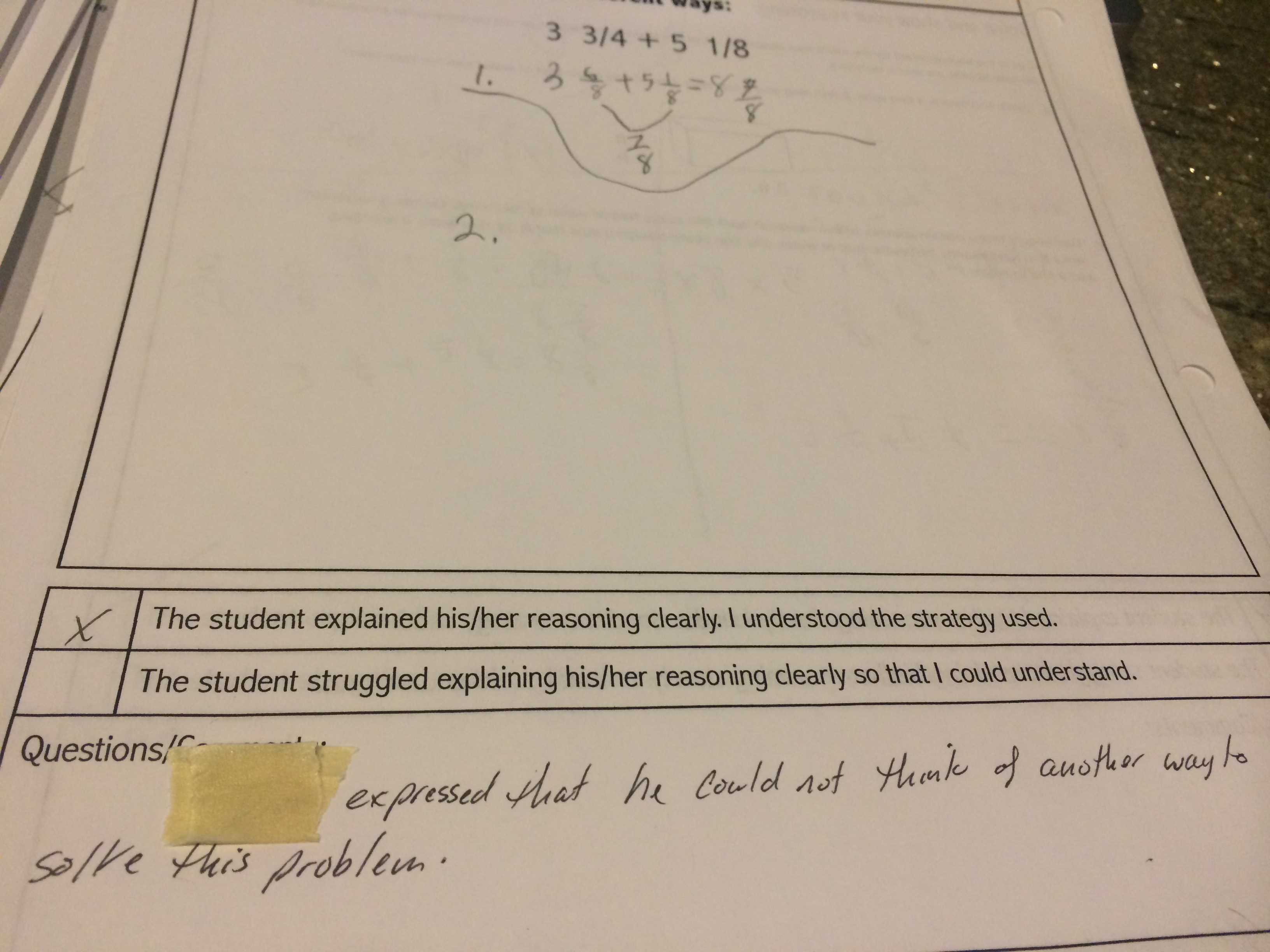
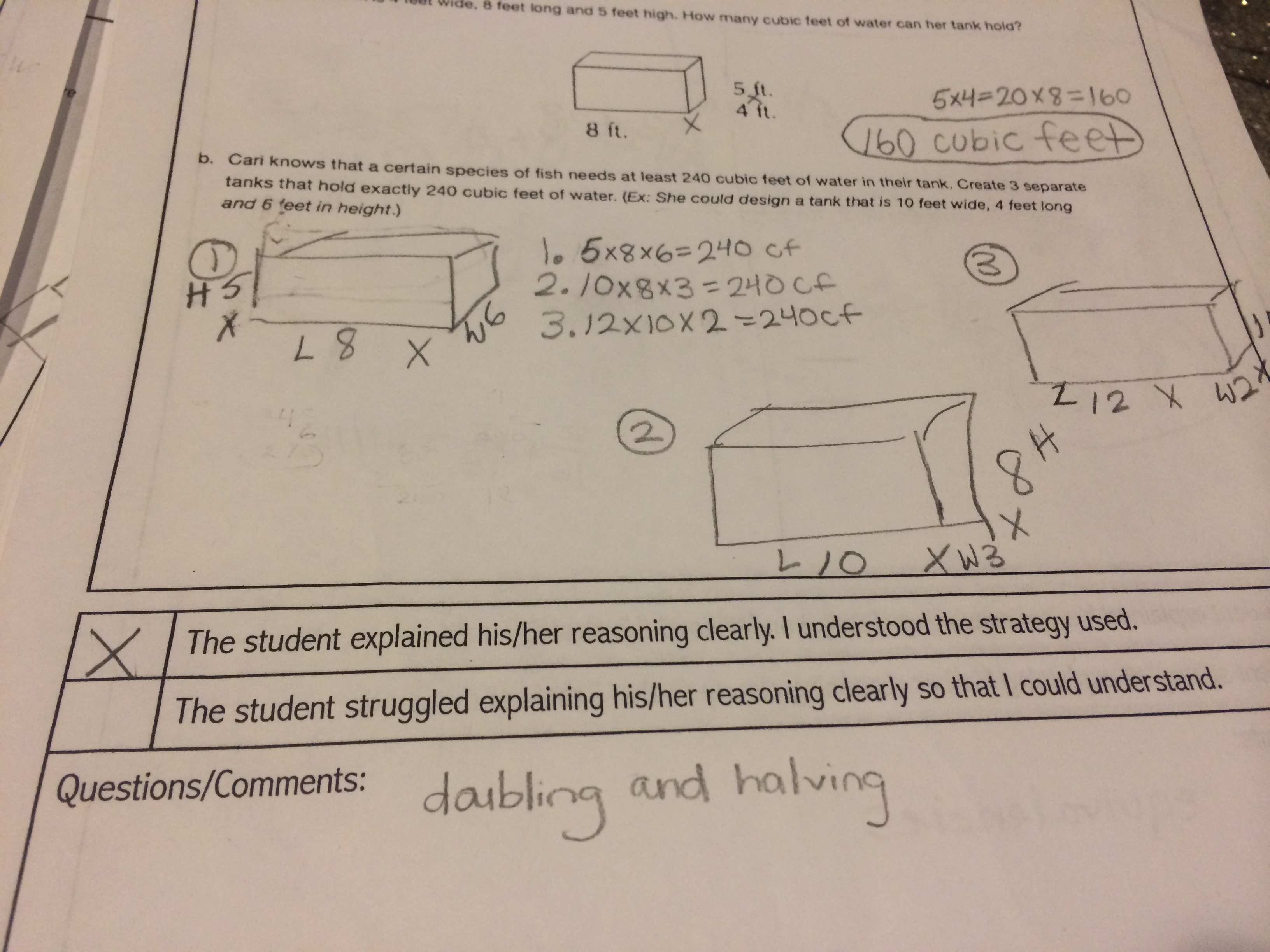
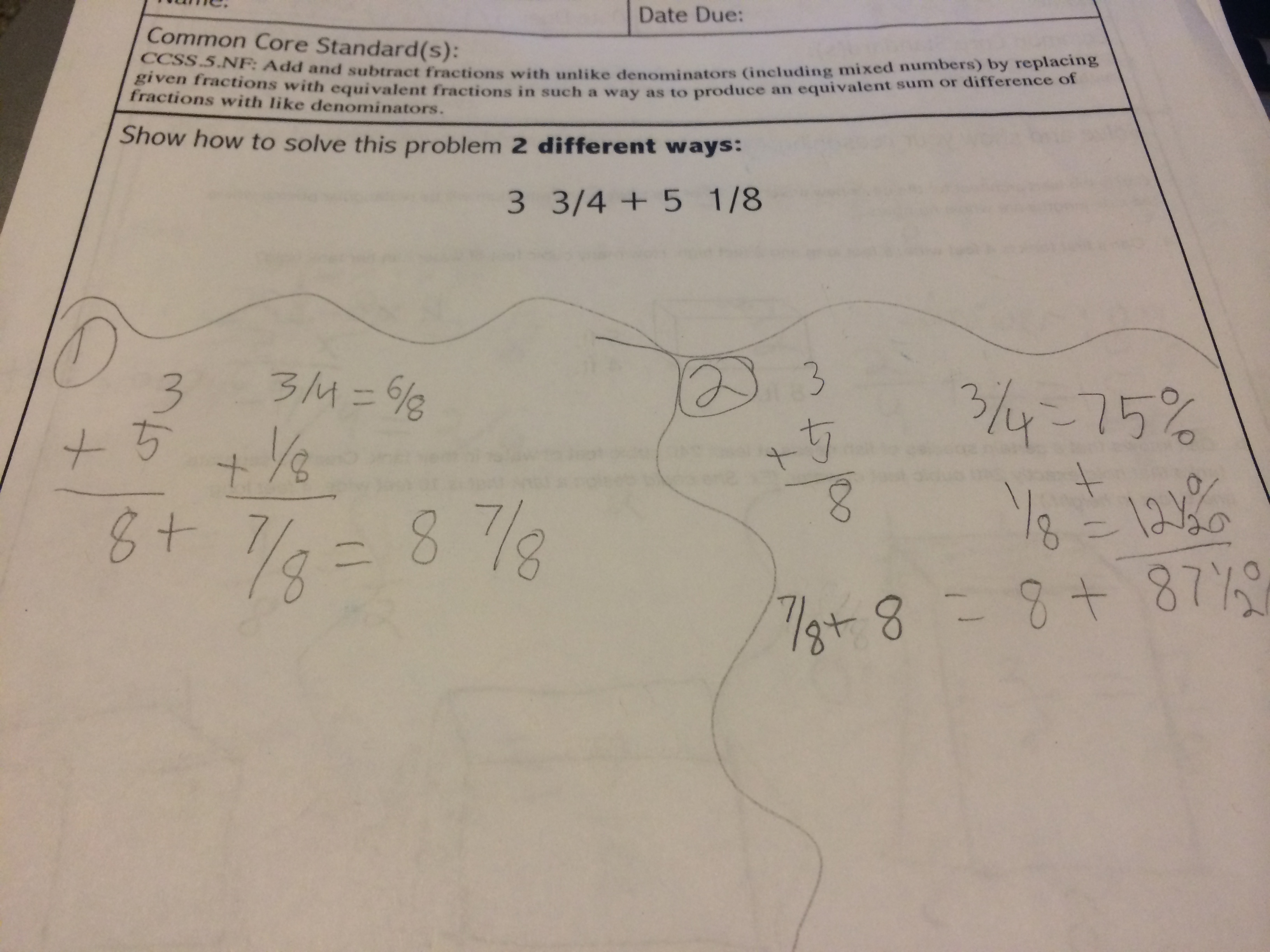
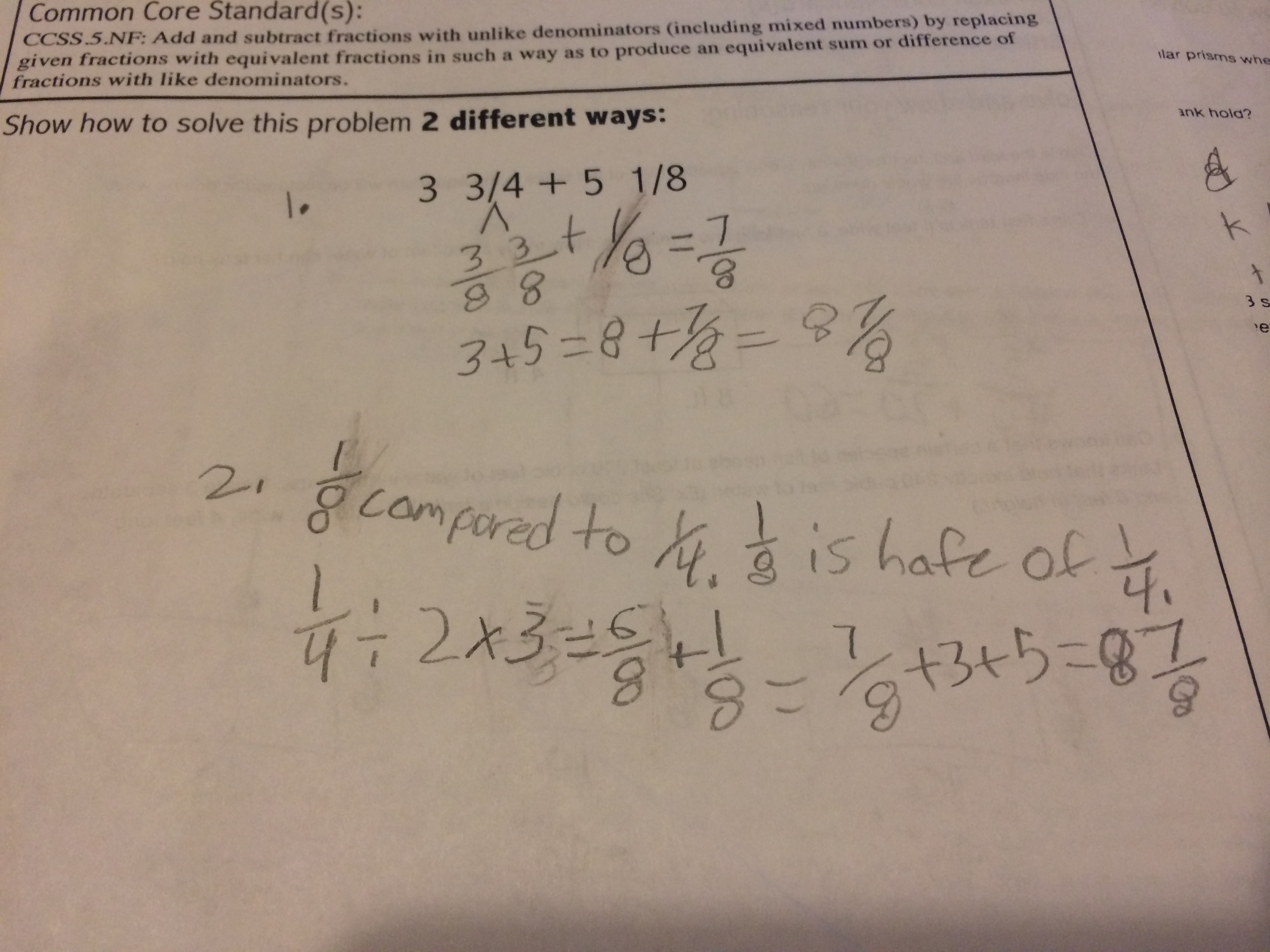
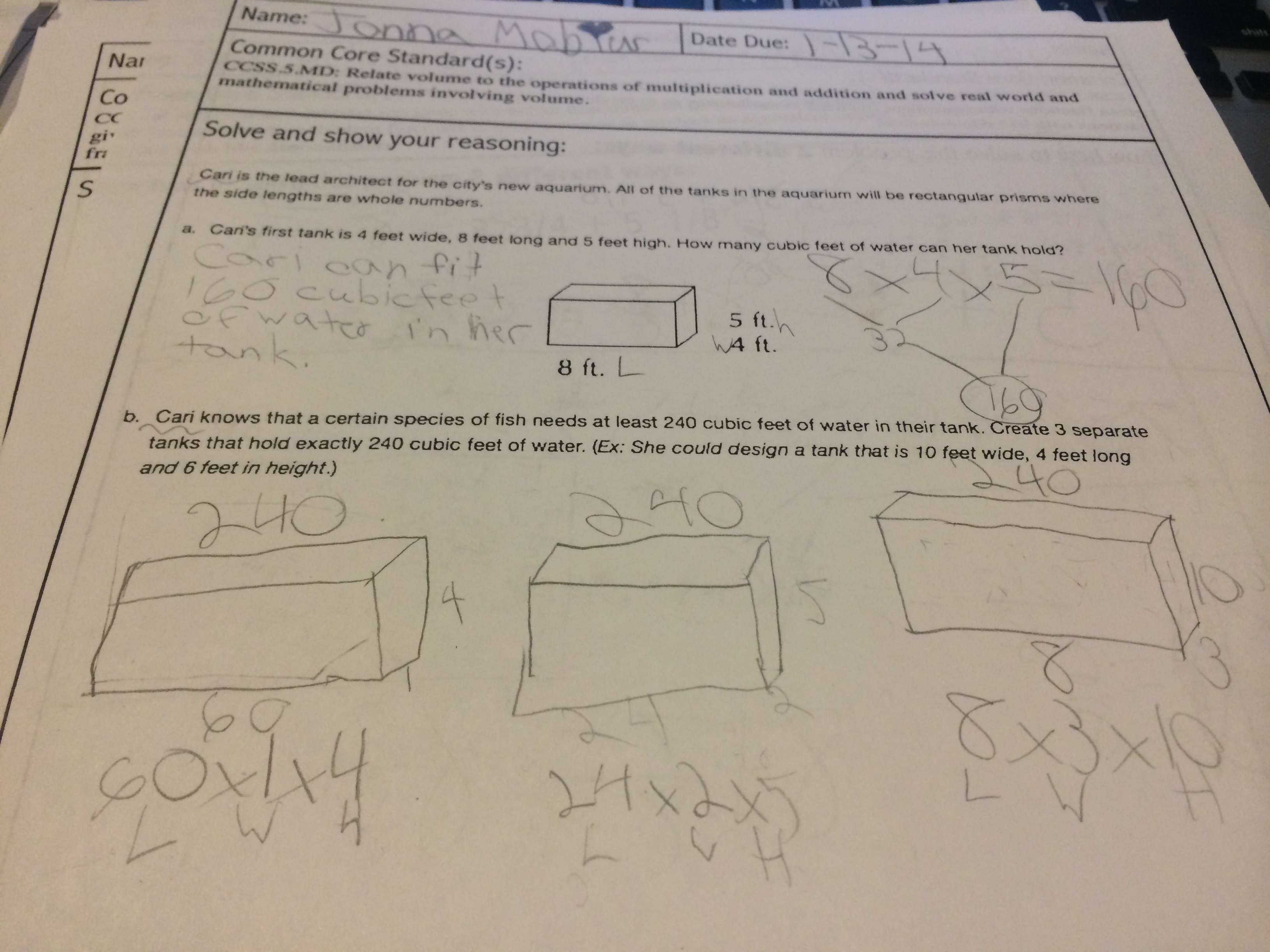
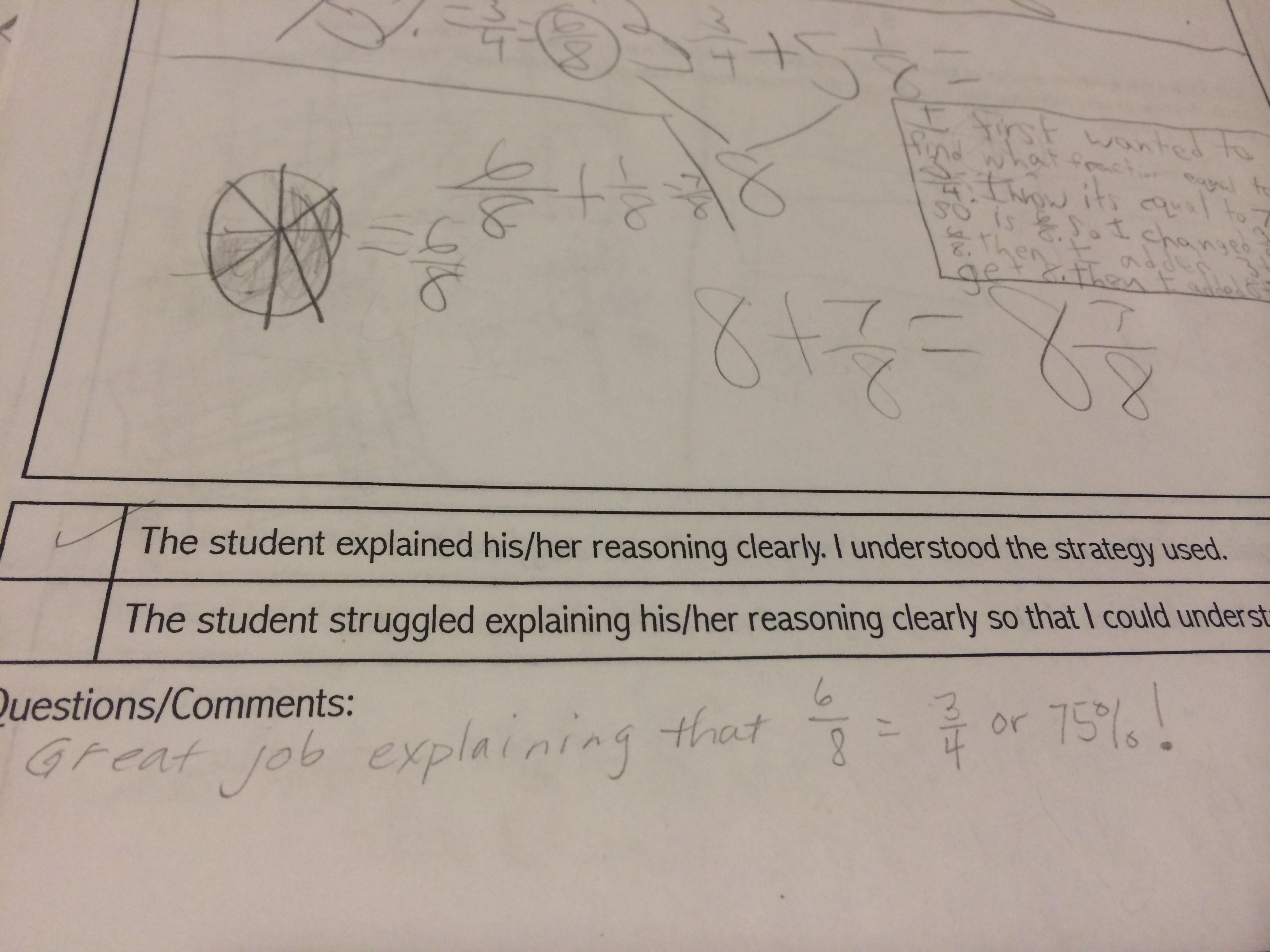
1 – Choosing the problems – I felt a bit overwhelmed with choosing the problems to put on the homework page. Who would have thought? It is just two problems, right? Unlike the “typical” homework that goes along with what we did in class that particular day, I wanted to use it more to see if students truly learned the concepts we worked with over the course of the first half of the year. With that, I chose to use a volume problem from Illustrative Math: http://www.illustrativemathematics.org/illustrations/1308  , which was our first unit of the year, on one side and on the opposite side I put the addition problem: 3  3/4 + 5  1/8, and asked students to show two different ways to solve the problem. I thought one problem in context along with one problem without context was a nice mix.

2 – Students showed great responsibility – I purposely gave the paper to the students on Thursday and assigned it to be due the following Monday so students had two nights to actually get the paper home (sometimes that is the hardest part:) and then two more nights to find an adult. I was very excited to get 98% of the papers back from the students and they seemed really excited to tell me about what their parents had said about their work. I heard everything from “They said they wouldn’t solve it that way” to “They were so proud of my vocabulary.” Loved it!

3 –Parent response – I had great parent response both on the sheet and in conversations after the fact. Here are just a few examples of comments made….

IMG_3076 IMG_3075 IMG_3074 IMG_3073 IMG_3072 IMG_3071I loved that I got praise, concerns as well as strategies! It was pretty awesome and hopefully led to some great conversations at home!

4 – My response – I wanted to take time to look through the work and plan my next steps but I also wanted to acknowledge the parents comments and/or concerns right away. That day, I sent a quick email to the parents to first thank them for taking the time to work with their child on math and to also let them know that I saw their questions/concerns and that although they may not get a direct response from me on each individual comment, I will be working with their child based on their work.

5 – My plan from here – I have math workshop planned for tomorrow in order to give me time to work with the students who may have misconceptions or maybe just not using an efficient strategy in their work with volume and/or fractions. I found the fraction work pretty amazing and, I cannot lie, it really made me feel great about the work we had just done in our fraction unit. They really used some creative thinking in looking for a second strategy!

Overall, I completely loved the homework and the result! I am in the process of creating my next one to give the students tomorrow. I don’t think I will make any changes at this point in the layout of the sheet at this point. I do think that when I give a problem with no context next time, I will ask the students to write a story to go along with it.  I did find that more struggled with the volume question, possibly because of the context, so I really want to work on the students moving in and out of context in mathematics.

– Kristin

Student samples in case you are interested:

IMG_3077 IMG_3078 IMG_3079 IMG_3080