Why My Tweeps Deserve a Hug…

By nature, I am not big “hugger” when I first meet someone. Which is why I am always so shocked that every time I meet one of my Tweeps in person, I feel the overwhelming need to give them a hug. I always wonder why that happens….I mean, I have just had online conversations with these people, right? Wrong.

Over the past month it has become crystal clear why my tweeps will always get a hug….

1 – They care about my learning. They challenge my thinking, give me wonderful new ideas, and continually make me feel like I have a team of teachers working with me to improve my practice. For example, just the other day, I threw out this tweet:

1

and what I got in return was this amazing conversation: https://storify.com/TracyZager/multiplying-fractions AND then two fantastic follow up blog posts: http://tjzager.wordpress.com/2014/09/06/elementary-teachers-as-math-learners/ and http://bstockus.wordpress.com/2014/09/07/of/ Talk about professional development at its finest! I LOVED it and left with so many ideas to think about!

2 – They care about my students as much as I do. Recently, our district is working through opening Twitter on our network. Wanting to be as informed and prepared as possible to defend the use of Twitter in schools, I reached out on Twitter with this post:

2

I tweeted it, went to bed, and woke up to over 40 notifications in response. I had teachers sharing how they use it as PD and in the classroom, as well as superintendents and principals (Thank you @gcouros and @joesanfelippo) offering to chat with my superintendent to offer their experiences. These tweeps are from all over the world, they don’t need to care if the students in my class get Twitter, but they do. They took the time. It is so touching to know that the heart of education is alive and well on Twitter with the students in the forefront.

3- They get as excited and passionate about math work as I do! You can read these fun, nerdy conversations all over my Twitter feed, passionate people talking about what we love, math. After trying Talking Points that I have blogged about recently, I could not wait to tweet @cheesemonkeysf because I was so excited about the conversations in my classroom:

4

My tweeps have become so much more than online conversations, they are my colleagues, mentors, and coaches. They are open and honest and allow me to feel safe being open and honest.

It is personal. It has changed my practice. It is hug-worthy.

I could really keep going on and on about how much I adore my tweeps, but being a school night, it is time for one more Big Bang rerun and bed!

Happy Almost Friday,

Kristin

Week One – Talking Points & Math Mindset

I continually think about how I can effectively gauge my student’s mindset at the beginning of the school year. Last year, I tried a “Get to know you” form that students completed, asking questions such as: What do you feel you are really good at in math? What do you feel you struggle with in math? Do you think you can get better at those things? etc… I didn’t feel like I got the type of insight I was looking for…partly because my questions weren’t that great and also because most students saw it as an assignment to complete and didn’t write out extremely involved answers that gave me much insight. I then took it upon myself to have inspiring growth mindset posters hanging up around the room and continually told students how mistakes help our brain grow, mistakes are good, no one is “good” or “bad” at math and all of those great things I learned! Don’t get me wrong, I love those things and will continue to do them, however it just didn’t feel like the thoughts came out organically….I felt I was trying to “teach” them how to have a growth mindset, if that makes any sense?

Now, I have found (borrowed/stole) the BEST activity to get to know student’s mindsets at the beginning of the year, called Talking Points. I blogged about them before in my Week One planning post, but I had no idea at that point how much I would LOVE them. If you haven’t heard of them before check out @cheesemonkeySF on Twitter and her blog! She adapted this activity from Lyn Dawes’ Talking Points activity… Amazing Stuff!

For those who have never heard of them, here are her directions for how they work:

tp1

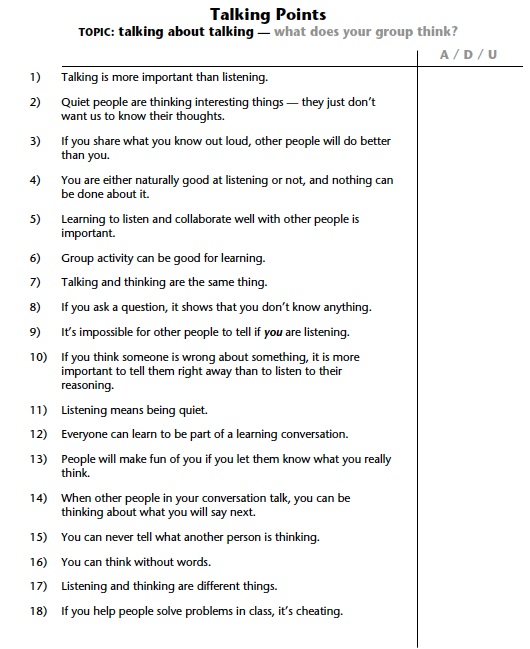
I used the following talking points because I felt it would give me insight into student mindset in regards to math and working in cooperative groups…

tp2

As a class, we reviewed the process and practiced Talking Point #1 together as as a class. From there I let them go and circulated the class to hear the conversations! It was the absolute highlight of my first week! Here are some things I heard as I went around…(waiting on a few more parent permissions to post, so had to transcribe for now)

On Doing Math Quickly….

“I disagree because you could write down a random answer but not be right.”

“If it said being good at math means being able to problems quickly AND correctly, then it’d be right”

“I mean, think about it, you can do anything quickly but it might not be right or you may never learn it. So, you have to like go deep into the problem. That’s just my opinion.”

On There Is Always One Best Way To Do Math…

“I disagree because there can be more than one way to do problems.”

“I disagree because you don’t always have to stick to one way and for one person there may be one way and they think that’s the best, but for another person, could have a whole other way to do it.”

“There is not a BEST way, any way is good, but all that matters if you get the answer right.”

“There are many different ways I use to solve problems so not one way is always going to be best.”

“….just because one way is more efficient than another way doesn’t mean its the best.”

On Getting a Problem Wrong Means You Are a Failure….

“…you learn from your mistakes, so if your not make mistakes, you’re not learning anything.”

“If there was like 20 questions and you got one wrong, that doesn’t mean you just get an F, you still get an A and then maybe one day you do that same question again, and your like, “hmmm, I got it wrong last time, let’s try a different strategy and see if you get it correct.””

“One wrong answer’s not an F, unless there’s like 2 questions on the test, because even if you get it wrong you still learn from it and next time if they ask you again, you can be like, “now I know the answer.””

There is a group assessment piece that we did not have time for that day but we did do a classroom debrief so all of the groups could hear the conversations, it gave me goosebumps hearing them talk….awesome. I learned SO much about my students from this activity and it felt so organic coming from them. I didn’t feel like it was trying to “teach” them to have a growth mindset, it was coming from them! Love. Love. Love.

Here are some of their tallies….I think this data is invaluable! I cannot wait to incorporate this routine into my math class this year!

IMG_6444

IMG_6445

IMG_6446

IMG_6447

IMG_6448

IMG_6449

IMG_6450

Happy First Week Back!

-Kristin

Professional Books #mtboschallenge

My plan was to just do the Sunday Summary #mtboschallenge, however I have been seeing some tweets lately about books for elementary preservice teachers so I thought I would compile a list of my favorites. This summer I have read more professional books than ever before so this will be a list of books from past years, this summer and my reading to-do list.

In the past years my favorite books in which I constantly reference, reread and recommend are:  Classroom Discussions by  Chapin and O’Connor,  Mindset by Dweck,  Number Talks by Parrish, Young Mathematicians at Work by Fosnot, Extending Children’s Mathematics by Empson/Levi, What’s Math Got to Do With It by Jo Boaler and Beyond Pizzas and Pies by Julie McNamara.

This summer I finally had time to dive in and had time to read more than a few books and my twitter feed:

Principles to Action, NCTM – I like it for looking at what makes a good task, what a teacher does, what students do. I have just picked and chosen things I have wanted to read about so far in this book. Have not read cover to cover.

5 Practices for Orchestrating Productive Mathematical Discussions by Smith and Stein – This is something that I think more teachers need to think heavily about…..great practices to instill in teachers planning process. Read this cover to cover.

Agents of Change by Lucy West – We are moving into a content coaching model in our schools this year and after seeing Lucy West present, I appreciated her upfront, honest approach. Her book did not disappoint.

Faster Isn’t Smarter by Seeley – This book is a great reaffirming reference for me for use with parents and teachers.

Powerful Problem Solving by Max Ray and Math Forum – Read this cover to cover. Very fast and fluent read because it is filled with interesting, applicable activities and student work.

Connecting Arithmetic to Algebra by  Bastable, Russel, Schifter – I saw Virginia Bastable speak this summer and was drawn to her message. I have read the first few chapters of her book and interested in more work with teachers this year in making claims and looking at repeated reasoning.

Future readings I have sitting on my shelf or being shipped:

Putting the Practices into Action by O’Connell and SanGiovanni

Connecting Mathematical Ideas by Boaler and Humphreys

Intentional Talk by Kazemi and Hintz

So much to learn, so little time to read coming up….I anticipate Investigations being my major reading in the near future!

Happy Reading,

Kristin

Sunday 3-2-1 Summary #mtboschallenge

MTBOSChallenge_33 Things That Happened This Week….

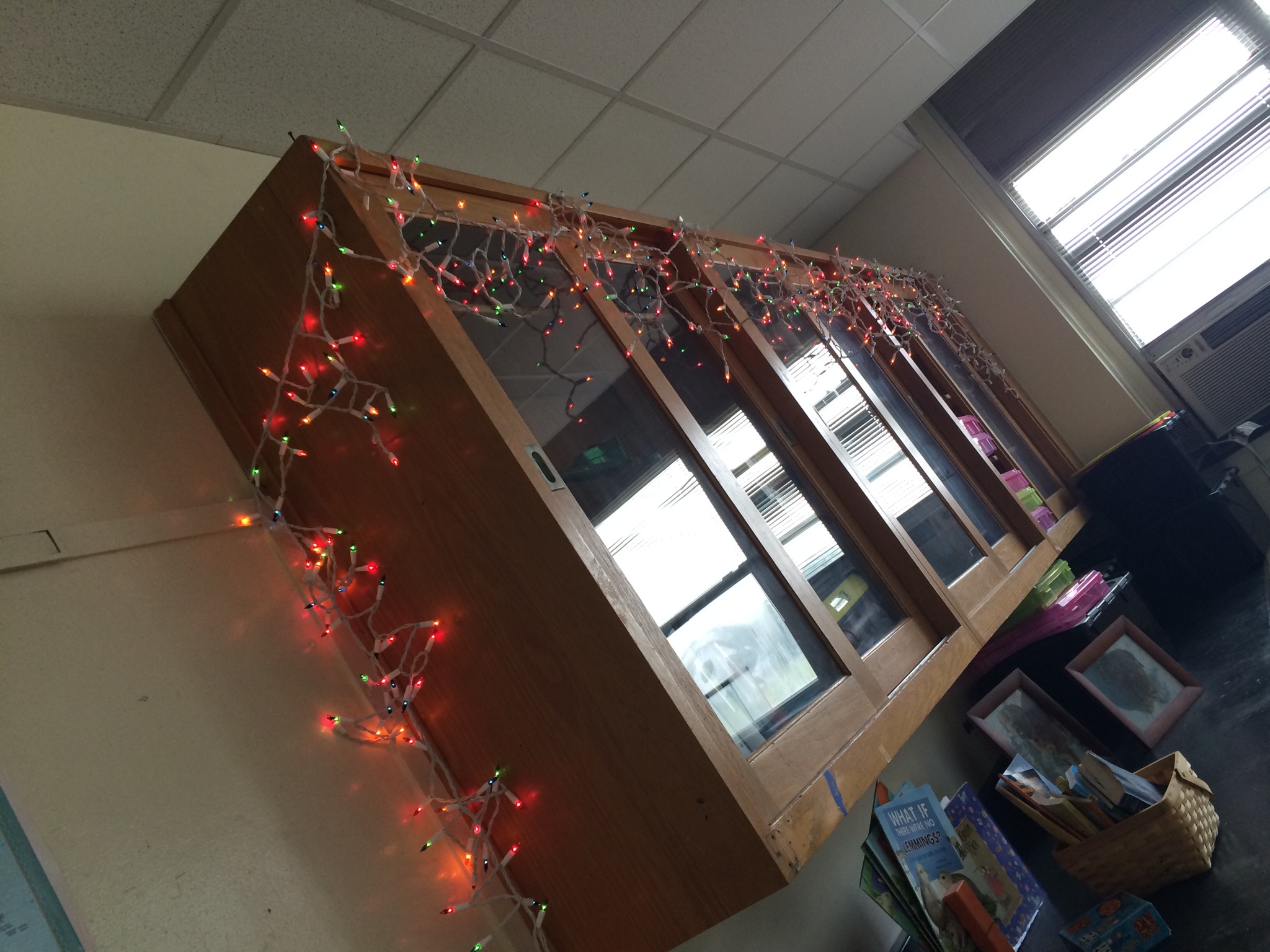
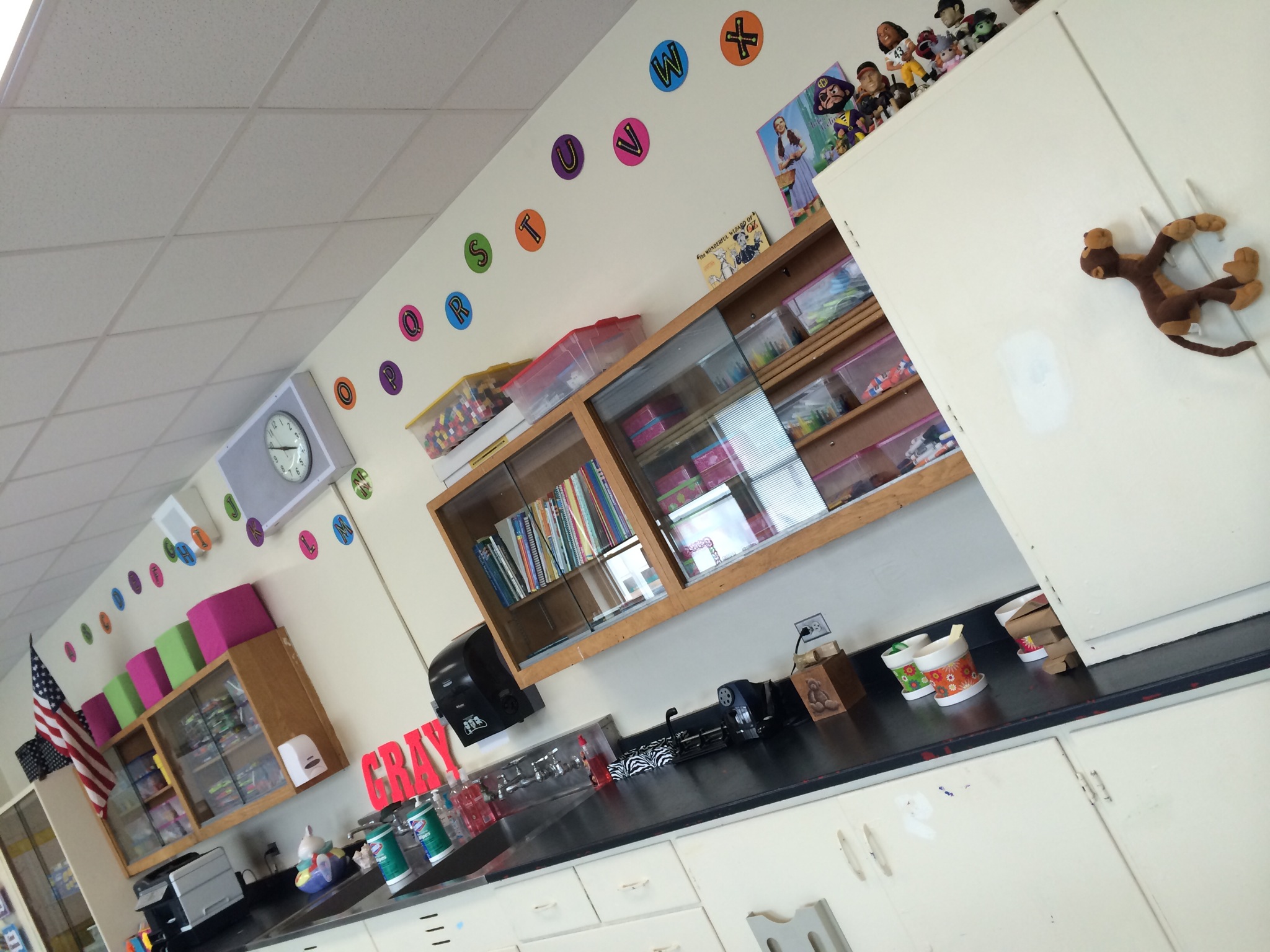
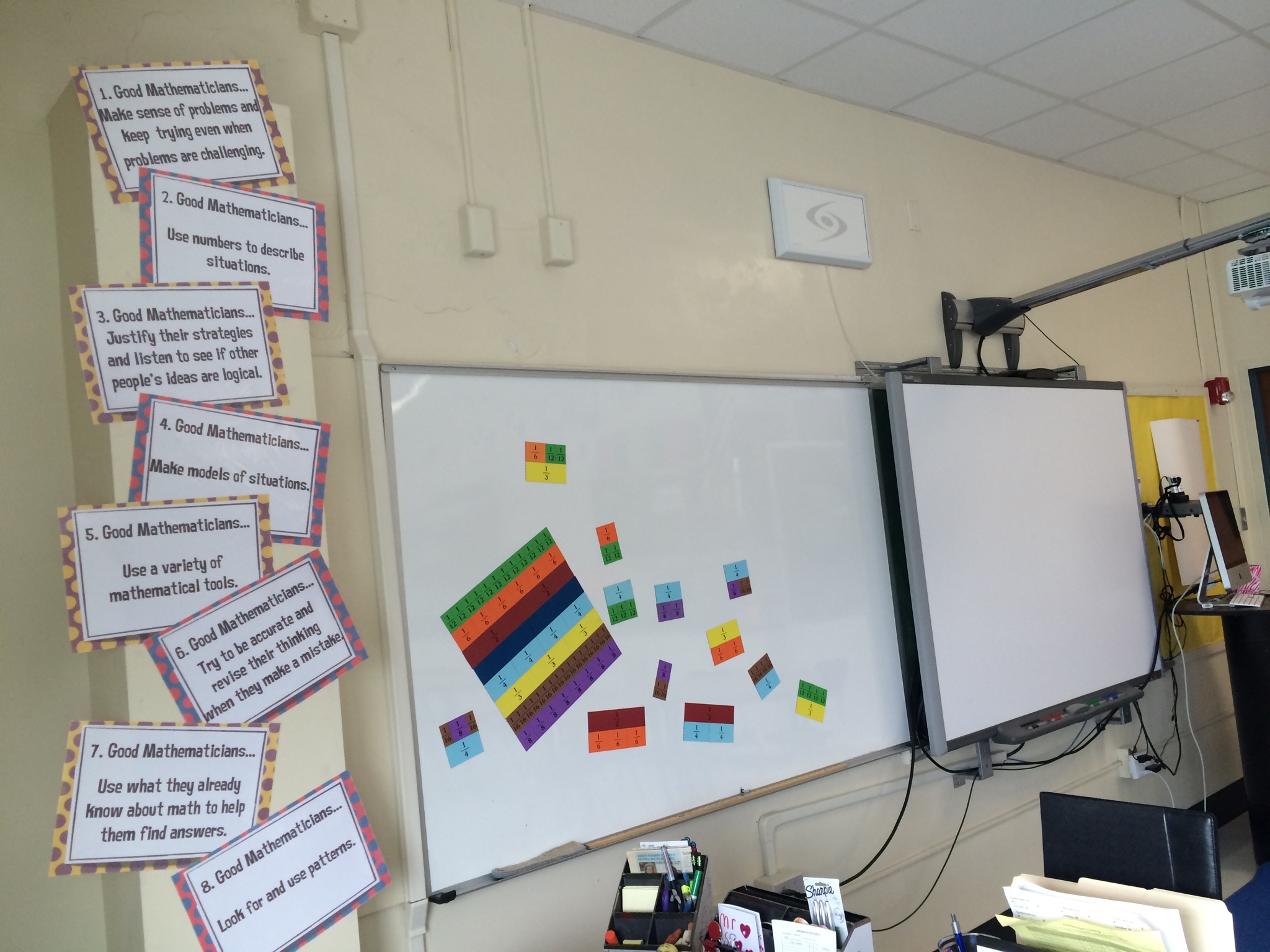
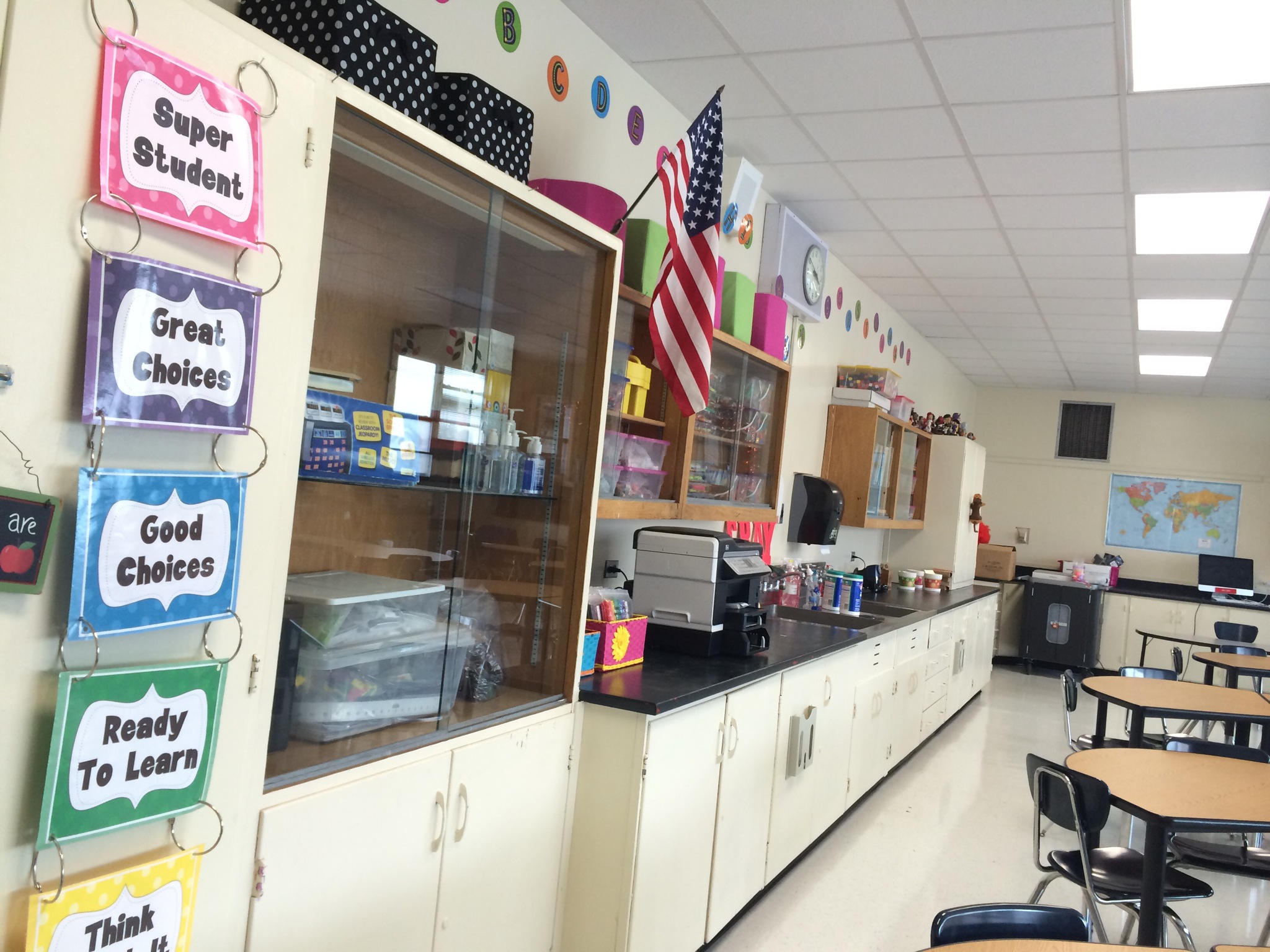
  • School started, for teachers, on Friday so I spent the entire day getting my classroom semi-organized. I really love the feeling of getting that done the first inservice day so I can begin digging into organizing my classroom activities and planning. Twitter is so wonderful, but I think it has put me on learner overload with SO MANY INCREDIBLE ideas to try this year, so needless to say, I need A LOT more time with the planning than the classroom setup! Here is a “before” with some “afters” of my room so far… photo
  • Next Tuesday, I organized to have Max Ray do professional development with our K-5 teachers, so this past week I had the wonderful opportunity to chat with Max on the phone about our vision for the PD day. Such a VERY caring and thoughtful presenter, absolutely cannot wait to meet him in person. (I am sure I will be blogging about it soon:)
  • I spent the free time of my final summer days enjoying the last weekdays with early morning runs and lounging by the pool with the pooch. photo

2 Things on my To-Do List….hard to narrow down to just 2, but here goes….

  • I MUST make myself sit and plan for my science classes! I am so naturally curious about mathematics and students thinking around it, that science has taken a backseat in my planning.  Not that they aren’t so many dimensions where the two subjects intersect/ overlap/are the same, but Ecosystems is my first unit of study and I am not finding that so easy to integrate into my first unit in Math, 3-D Geometry and Measurement. It will get done though!

1 Thing I Am Looking Forward To This Week….

  • As mentioned above, Max Ray is coming down for PD on Tuesday and I am SO excited. We are focusing on purposeful communication in the classroom. I am not only excited for my own learning, but also for that of my colleagues. Obviously, because of funding, not everyone has the opportunity to attend conferences such as NCTM or NCSM, so it is such a wonderful opportunity for the district to bring someone to us! What a way to show the teachers that the district administration cares about their learning as an educators.

Have a Great Week everyone,

Kristin

Getting Parents Involved from the Start!

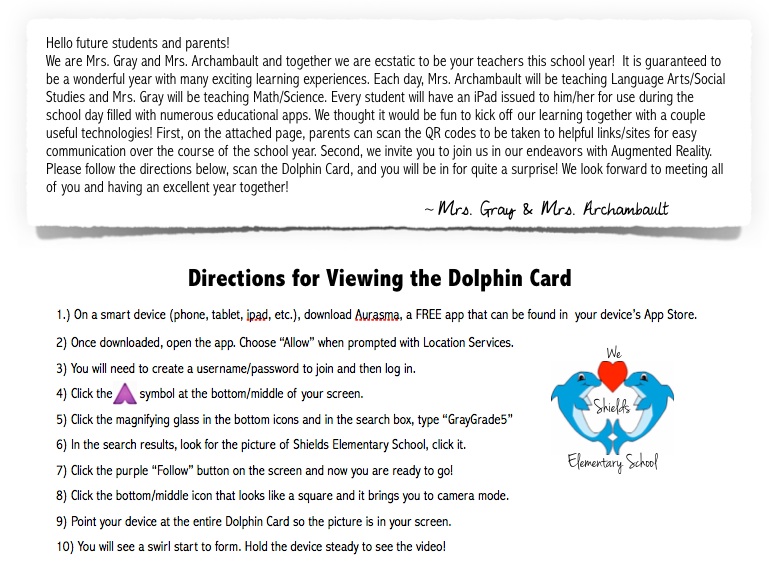
I love when I can check things off my to-do list! Today my teaching partner and I finished up our beginning of the year letter that goes home to parents before the start of the school year. With the opening letter, I wanted to give parents all of the outlets for easy communication throughout the school year as well as introduce them to a couple of the technologies we will be using this year.

We created QR codes for various communication tools and directions for viewing an image on our class Aurasma Channel. I plan on the students using that Channel for newsletters and explaining their math work! I would also like to think using it for our district science fair, but that is lower on my to-do list!

QR Codes:

5Parent Letter:

3Aurasma Dolphin Card:

4Now first week organization begins!

-Kristin


Aurasma Math Work with Decimals

Last year, I started playing around with the Augmented Reality app, Aurasma, in math class. For this particular activity, students worked in pairs to create a video of their explanation and trigger image in which to overlay their response. They swapped their creation with other groups, compared solution strategies, and discussed similarities/differences.

If you have the app Aurasma, simply follow our class channel, “Grays Class,” and scan the trigger images below to hear their explanations.

aur

If you do not have the app, download it here: Aurasma and follow the directions above.

Here are some trigger images to scan and hear solutions:

p2 p3 p4 p5 I definitely look forward to doing more of this work with my students this year and possibly embedding this into a newsletter for parents!

-Kristin

First Day(s) of School Planning Begins

During the first day(s) of school I try to design activities to get to know my students and their parents, offer opportunities for them to get to know each other, build a safe, risk-free community, start them with their ipads and establish routines….wow, that’s a lot! I keep reading blot posts and tweets trying to get some new ideas, and I have them favorited, bookmarked, Pocketed so I thought it would be most helpful for me (and maybe others) to put them all in one place.

Two things that are definitely a part of my first math class are Number Talks (to set up norms for classroom discussion) and @mr_stadel’s Estimation 180. They are such a part of my daily math class, that I want to kick off the year with them!

I want to do a community building activity that also brings out the opportunity to talk about the Mathematical Practices. I really like @fawnnguyen’s Noah’s Ark activity (https://www.dropbox.com/s/12j62b9e2yr3f2p/Noah%27s%20Ark.docx)

noahark

Then I read @cheesemonkeysf’s post on Exploratory Talk and got really interested in the idea of Talking Points: http://cheesemonkeysf.blogspot.com/2014/07/tmc-14-gwwg-annotated-references.html

She has compiled all of the resources you would need to think more about this: http://twittermathcamp.pbworks.com/w/page/82580935/2014%20Group%20Work%20Working%20Group%20-%20Exploring%20Our%20Blind%20Spots

Below is a piece of her basic format directions for the students. I am in love with the idea of starting the students with talking about talking! To get to know their mindset about math, these points are also really interesting: https://docs.google.com/document/d/1NoCcvuibW6BtlM6UDiaX3WAU3ijgZ1mgTqqPc3Tho8o/edit

talkingpointtp2Thinking about getting to know the interests and personalities of my students, I like @ddmeyer’s “Who I Am” page: http://blog.mrmeyer.com/2007/the-first-day-wiki/To involve the ipads in the opening days, I think I am going to have students complete the “Who I Am” page and create a PicStich that represents themselves, minus a selfie, (you will see why in a minute) based on their answers.

whoiamFor open house, I am looking at flipping it a bit so the parents can see a video of the classroom, have links for class schedules, specials schedule and such so we can use open house time in a more valuable way. I would like to get parents involved that night with the math we will be doing (maybe a quick number talk with them highlighting the Math Practices), the technology we will be using in class and ways in which we can easily communicate over the course of the year (class FB and Twitter).

I got an idea from @KleinErin’s site: http://tinyurl.com/lfk2msk on using Aurasma at open house. It is an intriguing way to have parents involved with the technology. On Erin’s site, she gives a parent letter template that gets sent home to parents before open house. If they don’t have the Aurasma app downloaded when they arrive, we can do it together or if they don’t have a phone to do it, I will have the student ipads available for use. I will hang the student PicStich’s in the hallway and have the parents guess which one is their child (hence, no selfies allowed) When they think they have it, they can scan it with the Aurasma app and I will have the video tagged to it of the child giving a “congratulations” message.

This will be helpful because I would love to do Augmented Reality newsletters this year in class and have students do some Aurasma math explanations with their work. If the parents have the app and understand how to use it, it will take the fear out of trying to learn it later on their own!

So, as you can tell, my Twitter PLN is ridiculously helpful and if you don’t follow all of the tweeps mentioned in this post, you must! I am looking forward to starting the year with great new things I have learned….now to just get planning!

-Kristin

2014 – 2015 School Year Goals

As the beginning of the school year quickly approaches, I am attempting to look beyond “projects” and “initiatives” I would like to implement this year and really write some overall goals for myself. I hope in writing them down, I feel more accountable than I do with “resolutions,” of which I have given up even wasting my time.

I think of my school year goals in four separate pieces: as a learner,  as a math lead learner in my district, in my classroom practice, and sustaining my mental well-being, all important in improving my practice as an educator.

As a learner, my goal this year is to really push myself outside of my elementary K-5 math realm and take a deeper look at the connections with the math instruction in the middle/high school.  I am extremely curious to dig into big ideas such as equivalence and decomposition that are evident in all of the math work we do K-5, and really see how those foundations are built upon in the secondary grades.  I have begun a lot of that work through Twitter and my state level PD I am involved in, but I would like to push myself to do more.

As a district math lead learner, I aim to do some collaborative work with a couple middle school teachers to see Number Talks (or some form of math routine) being used in their classrooms. I also would love to see our professional development running a little differently, thinking a bit outside of the box. ISTE 2014 set an amazing example of using IGNITEs, Playgrounds, and Twitter/Google Hangouts for PD that is differentiated for all teachers and meets everyone’s needs.  This year, I want to organize a small piece of this for our teachers.

In my classroom practice, I always have many goals! First, is organization! I think we all know the school year starts completely organized…materials are all in a designated place in the classroom, lesson plans are written neatly, papers are given feedback and returned in a timely manner, and office paper work is turned in on time. Then, the year gets going and it is just about keeping my head above water! Although I am sure this will continue to be the case this year, I aim to prioritize and use my time more wisely during the school day.

Secondly in my classroom practice, I want to improve on giving feedback on student assignments. Not grades, true written, focused feedback. Again, this is about prioritizing school obligations and making the time.

For my own mental well-being, running continues to be a necessity in my life! After the whirlwind that is the school day, I always need to clear my head! I have been so motivated this year by our #500in2014 Twitter running group, that I am averaging 100 miles/month and on pace to reach 1200 before January 1st. That is so exciting and something that is a continuing goal throughout the year!

Let the countdown to the school year begin!

-Kristin

Student-Led Number Talk

As I read Max Ray’s (@maxmathforum) book, “Powerful Problem Solving,” I can’t help but reflect on my own classroom experiences.

In the chapter about Communication and Community, Max writes,

“Modeling good listening skills and acting like a dinner party host (bringing together interesting people with good ideas, asking questions or providing activities to help them start talking, and then backing out of the way and encouraging them to talk to one another) go a long way in helping students pick up on the idea that their peers have useful things to say.”

At the end of the year my students began asking if they could “do a Number Talk” with the class and record it with their ipad to watch later. I hadn’t thought of this, but thought it would be interesting to see how it went so, “Sure!”  Before presenting, they had to show me the string of problems designed with a purpose and the questions they would ask the class as the number talk progressed. Wow, do you learn a lot about yourself and their role as active listeners when they start planning!

This was their string and questions….

IMG_4220When I looked at this, I was so surprised to see they DO really listen to the questions I ask during class. Don’t get me wrong, they always are such great communicators/listeners during class, but I never knew how much they internalized the questions themselves. It is my hope they keep these questions in the back of their mind as they continue future math work, both in groups and individually. How cool to think that as a student is working on any math problem, they are continually thinking things like, “What strategies could I use?” or “Does this always work?” Metacognition at its finest!

They designed a string in which they said partial products (distributive property) was the goal. It obviously was, however the decimal point movement when multiplying by 10 also arose since we had done previous work with multiplying by powers of 10. They did a beautiful job and the rest of the students were such amazing participants.

Another student had filmed the talk for them on their ipad and it was so interesting to watch them later go back, watch it, and talk about what they should have said or how funny something they said sounded. It was such a great experience for all of us and definitely something I will build more regularly into my class next year!

– Kristin

This was their revised/follow-up one since the x10 didn’t really capture their intent…they wanted to try another!

IMG_4221