Category Archives: Uncategorized

Show Your Work vs Show Your Thinking; 4th Grade Division

The Planning

Last week, the 4th grade team and I planned during our Learning Lab for their first division lesson in Unit 3 of Investigations. The book opened with the following problem:

Screen Shot 2015-12-13 at 8.45.53 AM.png

As we talked during the lab, one of the main concerns expressed by the teachers was student comprehension of the context. This was not necessarily in reference to this specific problem, but story problems in general. This is not surprising and definitely something, I would say, we as teachers face quite often. This is why I love Notice/Wonders and offered that as an idea to take that “number grabbing and compute” feel out of the problem.

As we read the problem aloud, we anticipated how students may respond in two scenarios:

  • Keeping the numbers in the problem and taking the question out.
  • Taking out both the numbers and the question.

We opted for the second one with the thought that we could ask them to anticipate what a question may be for this problem and what information they would need from us. It felt like a bit of a mash up of noticing/ wondering and a 3 act task.

The Launch

I really want to get to the student thinking here so I will not go into the details of the N/W, but here is what we ended our conversation with…

IMG_1286 (1).jpg

After this, we gave them the original problem and sent them off too work on the problem. After 5 minutes of individual time, they came together as small groups to share their work and create a poster with all of their strategies.

*We did debate that last sentence for a bit. We didn’t know whether the rows being the same size would arise and/or if it would send the problem in a different direction. Another 4th grade teacher tried it without that sentence in a different class period and it didn’t seem to change the focus of the work so I wonder if student make that assumption? Then I wondered if we give too many problems that are arrays and maybe don’t play around more with the “extra” pieces that could be added on?

Show Your Work vs Show Your Thinking

After the lesson, I wasn’t surprised by the students’ strategies as much as I was left questioning how we posed the prompt for students to show their strategies. The teacher asked them to solve the problem and show their work. This piece is not something we talked about at all in our planning because it is what we all say, but does that make a difference in how students show their solution path? Do we ever make explicit the way we can show our thinking clearly and explicitly either pictorially or numerically?

As I walked around, I would have thought at first glance that over 50% of the students were “passing out the apples” on their paper to arrive at 14, however after asking them to explain their thinking to me, I would have completely assumed wrong.

For example, this student’s work (on the left) was just the rows and dots underneath it when I walked by. I assumed he had “passed out” 56 apples to each of the 4 rows, however when I asked him to explain his thinking to me, it was so much more than that. He said he “gave each row 10 because that would be 40 and then there were 16 left, so half of that is 8 and half of that is 4, so each row got 4 more. I asked him if we could take what he did to write an equation for it? He said 10+10+10+10 and then wrote 10×4=40 and added the 4×4=16 underneath. I asked where the 56 apples appeared in his work and where the apples in each row were. So, the thinking he explained made his understandings so much more clear than the work he had shown. I wondered if he really needed to show all of that work or he just thought he did for the teacher to see “work”? Next, I partnered him with his neighbor (work on the right) to talk about how his thinking could be show within her multiple tower.

IMG_1287.jpg


When I walked up to this student, she had everything on her paper but the equations on the right. I asked her to explain her thinking and she explained that she divided up the 56 into 4 rows. By the way it looked to me, her x’s were written going down each column which did not indicate to me that she has passed them out so I asked her if she solved using those x’s and she quickly responded, “No, I just got bored…see all of my decorations!” I pressed her a bit more to explain how she got the 14 and she said she knew 8 x 7 = 56 and she used that but was having trouble explaining it. I asked her if she thought it may help her remember if she wrote down the 8×7=56 on her paper and quickly after she wrote it she explained she had halved the 8 and doubled the four. Again, he work would not have matched her thinking. IMG_1292

Going in the other direction, this student had the 56 circles with 28 labeled at the top, 14 labeled on the right and the equations written at the bottom when I walked up. I assumed she had split the 56 in half and then in half again, using what she knew from her equations. However when I asked her to explain her thinking, I found she had drawn the circles one at a time in rows of 4. She said she split it into two groups, counted the 28 on one side and then counted how many were in one column. This was interesting to me and I am kicking myself about not asking more about the 4 rows because she counted by rows of 4 but then found her 4 rows of apples actually in the 4 columns. In this case I would have assumed things that didn’t happen from her work that really didn’t match what she was thinking.

IMG_1294

Here are some other great examples of student thinking:IMG_1291IMG_1290IMG_1289 (1)

IMG_1293 (1)

Show your work versus show your thinking…do we say both? do we make explicit what we mean by them? I am not sure, but what I do know is that we never learn more about student thinking than we do when we talk to students about their work!


2nd Grade – Even and Odd

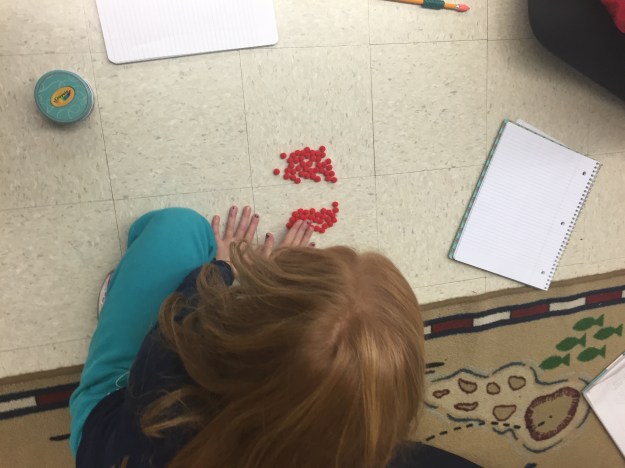
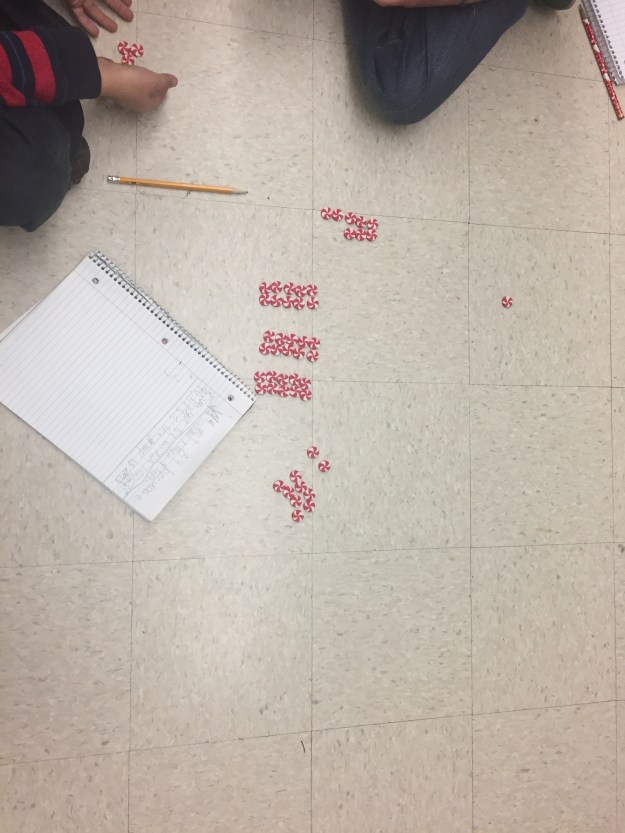
Yesterday, I brainstormed my plan for the 2nd grade lesson I taught today. I started by giving each pair of students a set of things to count and I asked them to explain how they counted and why they chose to count that way. I was excited to see such a variety of counting strategies such as 2’s, 5’s 10’s and then combinations of all of these. As I walked around, this is what I saw…

As a whole group, we shared strategies for counting and the students discussed how they combined the numbers. I then had them switch their container with another group. They were all mixed up so they didn’t know how many were in the new container. With this container of objects, I asked them to see if they could split the contents into two equal groups.

I don’t know if my thinking is even on track here, but since Tara had mentioned students were struggling determining whether a number could be divided equally into two parts without physically passing out each one, I thought having students think about the ways in which they count in comparison to splitting a number in half, could be helpful here. For example if a student is trying to divide 42 into two equal teams, he or she could think that two 20’s would be 40 and 2 left over to give to each 20 to make 21. Or even four 10’s and 2 ones, so each team gets two 10’s and then a one from the two leftover. Like I said, I could be completely off-base but it proved to be an interesting trial!

As I walked around I saw some really cool halving going on!

This group did a visual split symmetrically and then each counted their “half” and then they passed them back and forth until they had the same amount. Like a guess and check. It seems something like finding half of 46….”I know it is 20-something, so you take 20, I have 26, here take 1 of mine, now it is 21 and 25, so take 2 more of mine and now we each have 23.”

IMG_1251.jpg

I saw the completely symmetrical works. not counting at all, they just lined them up by twos and said their plan was to “push the two rows apart.” It seems like counting by 2’s to get to 46 and then seeing how many times you had to do that.

IMG_1252.jpg

This group did what I was hoping to connect to the counting they did earlier. They grouped them in 10’s and then split them in half. They ended up having an odd number and wanted to put that in decimals so bad. There was a lot of .5 talk. So interesting! IMG_1253.jpg

Then I saw a student who counted them by one’s and then divided the number he got in half. (The top part is is counting group, the bottom is the halving of a different number.)

IMG_1255.jpg

We ended with a journal entry on any similarities and/or differences we saw between the counting and the dividing into two groups. Sadly, I had to leave to go down and teach Kindergarten, so I have to pop back up to check out their journals tomorrow. I think that could be a great place for Tara to start tomorrow and then do a number talk about splitting a number into two equal groups.

I still have to think on this lesson more. I learned a lot about how the students count in 2nd grade, which after being in a Kindergarten class was really fantastic and I loved the way they saw symmetry in sets. That was beautiful. However, I think there are are some other great connections to be made here but I am not sure it was helpful connections for everyone. Most students seemed to have some great strategies for halving so I am wondering what they took away from this? I have to pop back up tomorrow and see what the journals say to see if I can get a better read on the class.


5th Grade Fraction Multiplication

Yesterday, in my planning, I was bouncing around between a couple of ideas for the lessons I was teaching today. I decided to go with this Illustrative task that was the basis for the lesson study project I did last year with The Teaching Channel and Illustrative. I though it would be a great formative assessment as students move from thinking about fraction of a fraction on a fraction bar to an area model using a square unit.

I opened with a choral count in which the students counted by 3/4. I played around with ending each row on a whole number (12/4, 24/4, 36/4…etc) or ending on something not as “nice.” I opted for the second, but in hindsight, probably should have gone with the first. I really wanted more conversation around when the whole number occurred and why and possibly the distributive property (4 x 3/4) + (1 x 3/4) = 15/4, but not as obvious as I felt the first option made it, but it didn’t happen. The count looked like this (I didn’t get a chance to take a pic of the board):

FullSizeRender 37.jpg

I asked students what they noticed and I got a variety of responses. I got many variations of equations such as 3/4 + 6/4 = 9/4 and 12 x 3/4 = 36/4, and with each one, I asked how we could show that within the count.  One student said she could see 20 x 3/4 =60/4 in the count. Just when I thought she was going to explain by saying we counted by 3/4 twenty times, she surprised me in her wording. She said, “I knew the count was a 4 by 5 array, which is 20 numbers and then each one was 3/4, so I got 60/4.” This struck me different than the skip counting or repeated addition of 3/4 that others were doing and reminded me a a bit of this diagram from the learning progressions:

Screen Shot 2015-12-06 at 3.32.17 PM.png

I think it was the way she described the size of each number in the count as 3/4 that drew me to this diagram.

Next I gave them the task to engage in alone for 5 minutes before I let them move into group work. I was really impressed by the way they jumped right in and easily could find 1/3 of 1/4. I was not surprised that many ignored the “square pan” piece and went with fraction bars. Much of the work looked like this, cut vertically:IMG_1262 (1).jpg

While there were also quite a few students who quartered it by cutting vertically and horizontally in half and then splitting that quarter into thirds:

This is something for me to think (learn) more about because if we are thinking area model, the dimensions of the piece, to me, looks like 1/2 x 1/6. That seems like it could be problematic to me when the square has dimensions in units of length.

Another interesting thing that always comes up in this work is the difference between dividing by a fraction and dividing it up into fractional parts. I saw those equations sneaking there way in like this…

IMG_1261IMG_1263.jpg

That will be something to keep in mind in future lessons. What it means to divide by a number versus divide into parts? Is it different when we are thinking about whole numbers versus fractions? Cool convos to be had around that!

There was one student who was not working with the original whole in her work. She was working with the 1/4 in the first part and then the 1/2 in the second part. When I asked her about how she was determining 12ths, she said it was just like her phone, she took the whole thing and just zoomed in (she did the fingers swipes as you would do on your phone) on the part she needed.

There was some really great proportional reasoning going on with the cost of the cornbread pieces. When the pan price changed from $12 to $24, $6, and $18, student used great reasoning in relation to $12. In the example above you can see that work as well as here:

I left them with a question about the denominator, why is not ending up in any of the denominators we are using the problem? I only had a chance to snap one pic before I headed to another classroom.

IMG_1238

Lots of great stuff to keep in mind and I think comparing the ways in which the students divided the models would be a really interesting conversation. Then after they move to an area work, I wonder if it would be great to bring that back for a comparison.

Also, I forgot to add that the substitute who was in for Leigh today was so incredible about taking notes and talking to the students because he was going to be in charge of teaching this same lesson to the next math class that came in. He said he learned so much and I thought this could be such a powerful way to have substitutes involved in learning more about the way in which math is taught.

~Kristin

Planning K-5, literally

Tomorrow I have the opportunity to teach a Kindergarten, 2nd and 5th grade class! It is so exciting and interesting to be thinking across all of the grade levels in one day of lesson planning! The most interesting part for me, in thinking through this, is the connections across all of the grades. There is so much potential for conjecture and claim-making supported by their development of proofs.

Background: The 5th and 2nd grade teachers are out at a state math teacher leader meeting so I am teaching instead of the substitute. The kindergarten teacher and I will be teaching it together. I have met with each teacher to chat about where they are within their units and what they have been seeing students do within the current work. I invited teachers both at those grade levels and at other grade levels to pop in if they have the time. I thought it would be great having more people to reflect with after the lessons!

5th Grade: They have just started working with finding a fraction of a fraction using bar models. The initial work is unit fraction of a unit fraction and then moves to non-unit. (My post on that from a couple of years ago on this work, I wish I had done that better, so here is a chance to try something new;) Leigh, the teacher, says they have been really successful in partitioning the bars and arriving at the correct answer. I am thinking about starting with a number routine of either a choral count or a number talk string like 1/2 of 12 = __ of 24… As far as the lesson, I could continue work with this and have students look at noticings after and explore them deeper.They have done these noticings with whole number times a fraction or mixed number, so this could be a revisiting of similarities or differences. OR I could do this cornbread task as a formative assessment as the next piece they will move into is an area model. It may be really helpful for Leigh to see how they are thinking about this before they jump into the work. This is my least planned because I keep bouncing all around with ideas.

2nd Grade: They have been working with even and odd numbers and counting by groups of 2’s, 5’s, and 10’s.  All of this work is within contexts of break a group of students into equal teams or everyone having a partner. Tara, the classroom teacher, said the students are really great at determining whether a number is odd or even, however when asked how many would be on each team, a lot of students struggle. They are great if they know a related double fact, however if they don’t they resort to “passing out” by tallies or drawing the picture and physically dividing the number of things in half. For example, if they do not know 11+11 is 22, then finding the number of on each team become passing out 22 things into two groups to find 11. While they are successful in this, Tara and I were wondering why they do not say 10+10=20 and 1+1=2 so 11+11=22. They are able to add 11 and 11 but unable to decompose it as fluently.

In thinking about this, I am inclined to want to connect that addition to halving. I am thinking a counting collection would be fabulous for this. Give students a collection of things to count. Share how we counted them because I am positive they will not count them by 1’s given a large set. We can share as a whole group, record ways in which we counted and determined if our number was even or odd. Then, put the collection back together, switch with a partnering team and then split the collection into two groups. The share would be, “Could you make two equal groups?” “Was your number even or odd? How did you know?” Record strategies. Ask for noticings/wonderings about how they counted and how they divided into two groups.

Kindergarten: The students in this class have been doing a lot of work with ten frames, dot images, counting jars, etc and having students counting and adding to compose a number. They have just begun working on decomposition of number so I immediately thought about the mice activity in Thinking Mathematically. Linda, the teacher, and I planned to do this activity with the students. In preparation, we read NCTM TCM’s article by Zachary M. Champagne, Robert Schoen, and Claire M. Riddell, Variations in Both Addends Unknown Problems. We are going to use 6 bunnies and see how students show all of the ways the bunnies can be inside and outside in a pen. Instead of just giving a context, I was imagining that the students may need a visual of the rabbit pen so I created this image to launch with a quick notice and wonder:

Screen Shot 2015-12-06 at 9.51.28 AM.png

We will then let the students work on finding the different ways in partners and then come back for a whole group share and record the ideas on the board. We are really looking to see two things….1-how they organize their information and 2- the strategies they use. The students will do a notice/wonder about the recorded information. If there is time it would be great to see if students, when given a different number, would apply any of the strategies and/or organizational tools shared.

Going for a run to think through this a bit more! Would love any thoughts/suggestions, as always!

~Kristin


1st Grade: 1st Day of Subtraction


This week, I planned and taught with Kala in her her 1st Grade classroom! It was the students first day of subtraction in the official “take away context type of work”sense, so it was really exciting to see what they would do with it. During our planning, Kala discussed ways in which she anticipated students would solve the problems and we thought about the framework below that is also presented in the Investigation’s Teacher Notes for that unit.

IMG_1136

Since it was their first day with subtraction, we wanted to be sure to capture their strategies as clearly as possible to help in planning future lessons. To do this, we designed a quick table with the following headings that we planned on jotting notes about the students’ work on as the lesson progressed.Screen Shot 2015-12-05 at 12.46.32 PM.png

The lesson was supposed to open with giving students the following problem:

Max had 9 toy cars. His friend Rosa came over to play with him. Max gave 3 of the cars to Rosa to play with. How many cars did Max have then?

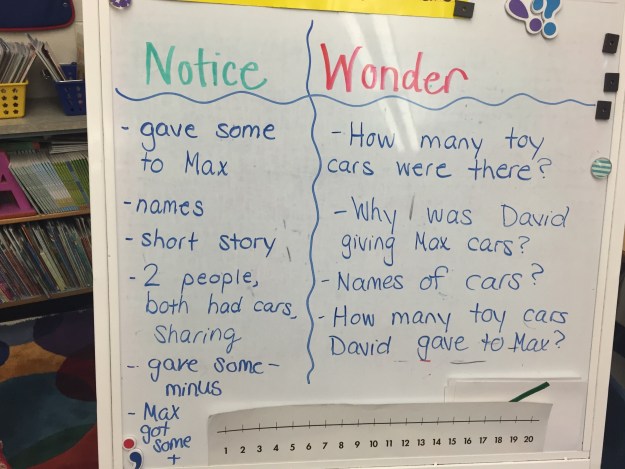
We decided to make this a Notice/Wonder to really allow students to think about what is happening in the context, over focusing on the numbers. So, instead, Kala posed this (we changed the names from above on accident):

David had some toy cars. One day his friend Max came over to play with him and David gave Max some of his cars.

Right away, they began to exclaim, “That was a short story!” As they shared, Kala recorded their noticings and wonderings. The very first notice was about not knowing how many David gave to Max because it said “some.” On the very last notice, the words subtract and minus came out. She couldn’t quite pronounce subtraction so she went with “minus” for her notice. She said David was a minus because he gave some, but Max was a plus because he got some. I loved that way of thinking and had not expected that at all! We then said we were going to answer some of their wonders….David had 9 and he gave Max 3. Then, like a Number Talk, they gave a thumbs up when they had an answer and we shared as a class. Kala and I just continually asked, how did you decide on the 9? Why did you do that with the 3? Where was that in the story? We decided not to write these strategies down because we didn’t want to influence their work during Roll and Record. We wanted to see where they were in their own thinking.

FullSizeRender 30

I then put up the game board for Roll and Record and we talked about how this was the same and different than the Roll and Record they have been playing with addition. They did notice that this board started at 1 instead of 2 and ended at 11 instead of 12. This will be something I would love to have them thinking about more in later lessons…why is this board this way? We played a few practice rounds of rolling a number cube, taking away the number we rolled on the second die, sharing how we subtracted the two numbers and recording it on our sheet.

They then went back to their seats and played with a partner. They had cubes, number lines, and 100 boards available if they chose to use them. These are a few pics I could snap before the game boards were erased.


As they played, Kala and I both walked around with our sheets and recorded the strategies we saw happening around the room. I was really amazed at the thinking in so many ways! I could tell they were comfortable using a variety of tools and by the way they could explain their thinking, it was obvious they were very used to doing that as well. This was my completed sheet at the end of the period. There were a couple of students I missed and a couple were absent, but between Kala and I, we had a really great picture of where the students were in their thinking. I was really surprised I only saw a few directly modeling the subtraction. The arrows were from me just starting to write their thinking and forgetting to put it in the appropriate column!

IMG_1226

After they finished playing, we decided to give them the original problem context with two different numbers (8 and 5) to see if they could create a written response of how they solved the problem as well as they were able to verbally explain to us. We did this because Kala had mentioned during our planning that she often sees them resort to drawing and crossing out when asked to show their work even when she knows the student has a different strategy in mind. I completely felt that same thing in 5th grade as well!

They did not disappoint in their journals! I am wondering if, in us walking around and asking them to verbalize their thinking, it helped them have a clearer picture of what they did? Just a hunch. We also asked them to “show your thinking” instead of “show your work” because we think that has something to do with the direct modeling at times too.

Here was the direct model…

FullSizeRender 34

We had some interesting counting backs. Some counted back dots, like the die. When doing this some put numbers next to the dots while others just used them as dots to count back on. I was so excited to see a student who had counted back on his fingers write out the process. He even wrote the number he started with and ended at the correct number. <- sometimes I see them count that 8 as part of the counting back process and end at 6.

We had a great variety of tools and models, whether used for direct modeling (like the ten frame and tallies) or used for counting back on the number line. The bottom papers were partners so it was interesting to see them do a jump of +3 versus -3. Just as class was wrapping up they were talking about where their answers were because the partner who subtracted 3, said it looked like her partner’s answer was 8 because he added three and landed at 8. Interesting convo to have later too! Their journals also made us realize that we didn’t use the word difference in a way that students knew the answer was called the difference and not sum (yeah, they know sum though:)! Something for us to think more about next time!

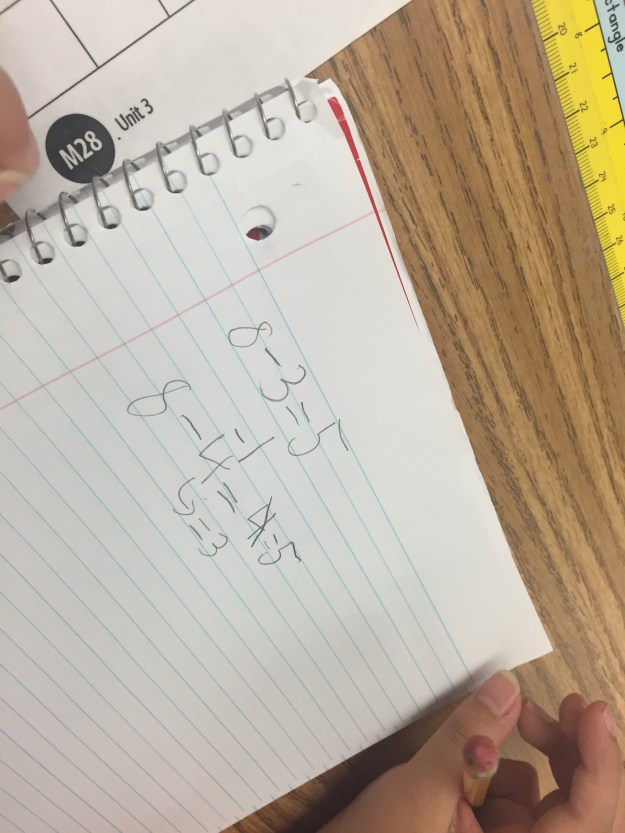
Then we saw some great related facts, like this one. I am assuming the number line above also was thinking this but put it on the number line instead of writing the fact. That is another interesting convo to have in future classes!

FullSizeRender 29

This student used a known fact to get the answer and could not have explained it more clearly. I asked her to explain to me what she did and she said, “I knew 8-4=4, if I take one away from the 4 it makes it a 3 and the answer changed to 5.” Wow. Conjectures and claims here we come!

IMG_1192

What a great day! From here, the students do “Start With/Get To” cards as their Ten Minute math that will help emerge subtraction as distance as well as reinforce the relationship between addition and subtraction. They will also play Five in a Row which will allow ideas such as 7-5=6-4 emerge when looking at expressions with the same difference. Of course, many context problems follow from here too so it is going to be so fun to watch what they do with this work!

~Kristin


4th Grade Multiple Towers – Pt 2

Due to a schedule change today because of an assembly, Malorie and I did not get a chance to sit and plan together before teaching the lesson. Luckily, she is always so prepared and had read my thoughts on the blog I did yesterday about it so we went into the lesson with a common vision and then talked our way through the shortened class period with the students.

We started with choral counting by 3 and then 30. We chose to include 5 multiples in each row in hoping the students would see a pattern in the “friendly numbers” if they struggled to see patterns in other places. After the list was up, they took a few minutes to write  down any patterns they saw in their journals and we shared out. This was the count and then notices Malorie typed as they were sharing:

IMG_1181.jpgIMG_1182.jpg


I could have stayed with these patterns all day long, but we decided to let students revisit these patterns over the course of this unit. There are some really great ones up there like adding the digits and that number is also a multiple of three and if you add any of the numbers up there, the answer will also be a multiple of 3. They made some predictions about numbers that would show up later in the list and talked about connections between the two lists. Multiplying by 10 and the zero “put on the end” was definitely the most popular noticing of the class period, which was a nice lead into our stacking of the boxes of oranges.

We explained the boxes of oranges held 30 oranges and asked them to estimate how many boxes (represented by the post-its) would be needed to stack up to Mya’s shoulder. Malorie and I quickly tried to figure out if we wanted to ask about number of boxes or number of oranges and decided to give them the option of either. It worked out beautifully because the majority of students told us boxes along with how many oranges it would be as well. As Malorie stacked the post-its, the students counted along. Some were counting post its while I heard others counting oranges. We stopped approximately halfway, took adjustments on their estimates and continued. We finished with 480 oranges, 30 boxes. As we were running out of time, we decided to end by asking if there were any equations they could think of to represent the oranges and boxes.

I was surprised to get division first…480 ÷ 30 = 16 and then 16 x 30 = 480.

This was unfortunately where we had to leave off because the classes were shortened and then next class was waiting at the door. So we met during her planning later that day to regroup and find our starting point for the next day.

Tomorrow we have decided to lead with a talk about the orange tower we built today. This is where we had a big discussion around what we want to really have students think about….the book seems to really focus on the multiplying by a multiple of 10, like what would be the 20th multiple, the 30th multiple, etc but we want to play around with the properties a bit more here.

So, we decided to ask students what equations or expressions they could use based on the tower to arrive at the 330 post it. We are thinking we may get some things like this:

30 x 11

(3 x 10) x 11

(3 x 11) x 10

(30 x 10) + 30

(30 x 10) + (1 x 30)

We want to set them equal to one another and ask how they could prove are the same answer. We are hoping to see the associative and distribute properties come out. We definitely could get some division too and that could make it really interesting!

We decided to go with this because Malorie says that she often sees students “putting one zero” on the end of any number when they multiply by any multiple of 10. For example, when multiplying 40 x 30, they will just get in the habit of putting one zero because they don’t see that 10 x10 happening. This is where being able to think about 40 x 3 x 10 is helpful for students.

Next, they will make their multiple towers based on these numbers we will assign to partners: 15, 16, 32, 28, 24, 48, 18, 36, 35, 70, 45, 14. Since Doubling/halving is coming up, we thought this could bring out some of those ideas. Then we will ask them to come up with expressions for any number they choose in their tower. We had planned for that to be in their journal, but I wonder if that is something they could hang up next to their tower for a notice/wonder walk around the room? Hmmm…have to ask Mal in the morning!

~Kristin

Follow Up…today we did a choral count 6 and then 60 and the pattern-finding was even better then yesterday. It was always amazing to me how students notice new things and then based on how we record. This time Malorie did four multiples in each row so in addition to finding new patterns, they also started comparing it back to what they noticed yesterday during the 3 and 30 count. Even though the 3 and 30 count was not up on the board anymore, they still remembered the patterns and numbers like they were right in front of them because they were so excited about them. So cool to see/hear. 

Next, we looked back at the multiple of tower to 30 on the wall. I asked the students if they could find an equation with the answer of 330 (which was on the tower) using numbers on the tower and gave them time to jot some ideas in their journal. 

As the students started to share, I realized it was a really Badly Worded Question. As they shared I was getting “ways to get 330” but not relating anything to the tower, which we were hoping would happen. We wanted to see the associative and distributive properties emerge, but were getting addition and subtraction equations. 

So, as I got “420-90=330 and 270 + 60=330…” etc, I asked “How would would you show that action on the tower….and then they were on a roll. I didn’t want them to think what they had written was not valued so we asked them to share what they had originally written and we built on from there! There is SO much to work with here so I cannot wait to plan for some exciting algebraic work. 

IMG_1184.jpg

I had to plan with another teacher so I left as the students began working on their multiple towers. After they finished their own towers, we were going to ask them write equations for a number on their tower based on moves on their tower. I have to check back in with Malorie in the morning! 

~Kristin


Multiple Towers in 4th Grade

In the Making Number Talks Matter chapter on Division, one of the strategies described was “Make a Tower.”

FullSizeRender 22.jpg

This strategy immediately reminded me of the 4th grade lesson in Investigations called just that, Multiple Towers. To make the timing even better, I am planning and teaching that lesson with a 4th grade teacher this week. The goal of this lesson is not necessarily eliciting a division strategy, but there is so much possibility for so many things in this lesson. Because of that, however, I am struggling with how we can leave it open enough for the many ideas to emerge, but focused enough to have a purpose in our planning.

The structure of the lesson, as it is the book, looks roughly like this:

Students count around the classroom by 3’s to 72 and it is recorded on the board. They then count by 30’s to 720 and it is recorded on the other side of the board, so both lists are visible. Asking students what they notice and what relationships they see. We record these noticings and leave this because the investigation of multiplying by a multiple of 10 continues to emerge throughout the unit.

Next, as a class, we introduce multiple towers through a context of stacking boxes of 30 oranges. Using post-its on the wall, students place the post-its one above the other, labeling the amount of oranges as the tower grows until it reaches the shoulder height of one student.  We then ask if there is anything in the tower that would help us figure out how many oranges are there without counting each one? They estimate how many to the top of the student’s head, ask how many multiples are there, and record equations for it.

Choosing from the list below, students work with a partner to create their own multiple towers as tall as one of them on a strip of paper:

Screen Shot 2015-11-28 at 2.58.03 PM.png

Screen Shot 2015-11-28 at 2.57.45 PM.png

After creating their tower, they answer questions in their activity book about the number of multiples, how they could find the 20th multiple without counting, and writing equations for some pieces of their work. They will continue to reference these towers in the following lessons in which they multiply 2-digit numbers and discuss various strategies and representations for multiplication.

I love this lesson, but as always, I like to play around with different ideas when I am lesson planning and these are some things I cannot wait to chat with Malorie, the 4th grade teacher, about on Monday:

  • Instead of a number talk do we open with the count around the classroom to save time for the multiple towers?
  • How do we record the multiples? Will different recordings draw out different noticings?
  • Do we start with estimation of how many cases of oranges will it be before we just start the tower? Could that draw out their use of multiplication combinations they know?
  • Do narrow the list of starting numbers to choose from so there are some really great relationships that emerge, like one factor that is 1/2 of another so the towers have a relationship? or a factor that is 1/3? or do we let them choose their own off of that list within a range?
  • Do we put the towers up, walk around and do a notice/wonder before they jump into the activity book pages?
  • Do we want to end with a journal prompt? The answer is obviously yes, but what do we want it to be?
  • How will this leave her for the next day’s lesson?

Feel free to chime in with thoughts/suggestions and I will post the plan we decide upon after our planning on Monday!

~Kristin

Follow Up Post

1st Grade Notice/Wonder

Yesterday, I had the chance to teach the 1st grade lesson I planned here. It was so much fun and SUCH a learning experience for me! After all of the conversation in the comments and on Twitter, I decided to start with the open, one sentence Notice/Wonder. Only having 45 minutes and this being the students first time doing a N/W, I decided not to begin with a number talk/routine (which I usually always do).

Screen Shot 2015-11-19 at 5.48.42 PM

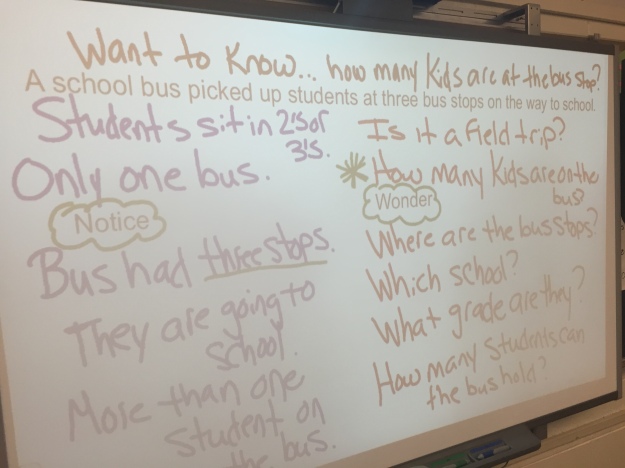
The students started on the carpet, I put up the sentence, read it and asked, “What do you notice and wonder about this sentence?” Just then a student exclaims that he just noticed that “Notice” was not, “Not Ice.” At that moment, I began thinking maybe my question had them looking at the physical pieces of the sentence/words so I quickly rephrased, “I would love to hear what you notice and wonder about what is happening in the sentence.” They used their Number Talk signals, thumbs up when they had a notice or wonder and then used their fingers to indicate more than one. I was so impressed by all of their thoughts, but I did realize that is it hard to end their wonderings! The amazing thing was how all of their wonderings really could turn this sentence into a story in their ELA class because they were all really important details they could add to it. Here was how the board ended.

IMG_1137

I asked which wonder we could work on together today in class and there was a unanimous vote for “How many kids are on the bus?” however there were a few that suggested, “How many student can the bus hold?” because “math is counting things and we could count the seats.” I starred the  wonder “How many kids are on the bus?” and told them next time they get on their bus I would love to hear how many seats and students they found are there. We discussed whether they know how many students were on the bus by reading our sentence and they said no, they only know that there were 3 stops.  I asked, what they would want to know and they wanted to know how many kids were at the stops. I wrote that at the top.

When I told them they would get to choose how many students were at each stop, they were so excited! I gave them a paper with the sentence at the top, let them choose a partner and sent them on their way.

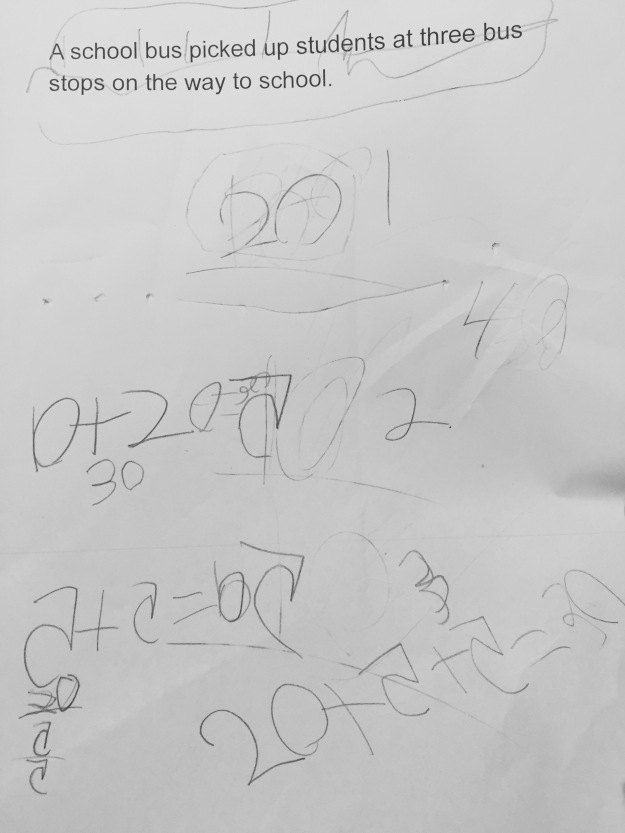
As I walked around and asked students why they chose the numbers they did, I quickly wondered how much I should have helped organize their work for them. I found so many with numbers everywhere and it was hard to see where their bus stop numbers were, let alone their total. Should I have put Bus Stop 1____, Bus Stop 2____, and Bus Stop 3_______ to have a clearer picture while also modeling for students how we can make our math work more clear? Quite a few looked like this…


IMG_1139

There were so many interesting papers, so I love WordPress’ new tiling feature for pictures to make it look less cumbersome!


Top Row, Pic 1: This student had 24 as two stops. When I asked him how many stops we noticed in the beginning, I got a “Oh gosh” and he wrote Bus stop 1, 2, and3. He then stuck with the 24 and when I came back he had 8, 8, and 8. I didn’t see this until after class so I am curious how he arrived at that answer. I also realized that these 1st graders move fast and it is SO easy to miss the cool things they do so quickly!!

Top Row, Pic 2:  They said 3 and 22 were easy to add and then they just chose another small number. The interesting thing here that I need to find out more about is the 5×6 with the one box shaded in. I loved the commutativity showing up here!

Top Row, Pic 3: This was so interesting because I had never thought that a student would first think of how many students were on the bus and divide it up from there. They thought 30 students would fit on a bus so they made the stops fit that information. (They saw the error on the last one during the share).

Bottom Row, Pic 1: This student said that because there were 3 stops, there were 3 students at each one and ended with 9.

Bottom Row, Pic 2 &3: This student wanted big numbers so his first response, after he insisted on re-writing the sentence, was 1,000 and 1,000,000 and 4. Then on the back of his paper he wanted 6 stops and chose 6 new numbers. This led to some great conversation during the share.

This student figured that if there were 1 or 2 at a seat then there would be 55 students on the bus. I love all of this work so much! Then when I asked her about the students at each stop, she said, 30, 20 and 5.

IMG_1144.jpg

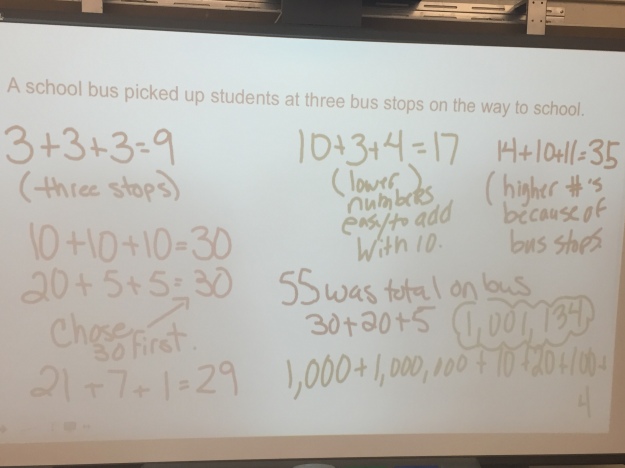
We shared as a group back on the carpet and I tried to capture why they chose the numbers they did:

IMG_1138

I then gave them the original problem and asked them to solve it individually. After seeing them work on this problem, I think there are so many interesting conversations that could happen Monday morning!

This is where I had so many questions as to how we get the younger students to make their thinking more visible. I found so much of it happens on fingers, 100s chart, and number line on their desk that I was getting an equation on the paper.  It is great when I am sitting there asking, but that cannot obviously happen when they are done so quickly and there a bunch of them! Is this something that comes with practice? I did find that once I asked them if they could explain to me on the paper how they solved it, they did a great job. My next question is, would taking the 100s charts and number lines off the desks help push students to look for friendlier numbers? I found the majority of them went left to right, counting on instead of using the 6 and 4 first. This is something that I think a structured share out on Monday could bring to light for those who never thought of it.

Here are a sampling of the papers I look forward to chatting with the teacher, Lisa, about on Monday. We can chat about how we can structure this share out.


Lisa, through number talks and investigations, has been working a lot on having students noticing number patterns leading to generalizations. It was neat to see this work of adjusting addends and keeping the same sum showing up here too. It seemed to show  up most after they had their answer and were playing around with the numbers, which I love!!

I am happy to have started with the open notice/wonder because I learned so much about how they think about problems and I think the opportunity to choose their own numbers got them thinking about the context over solving for an answer to an addition problem. I am, however, extremely curious how it would have changed the work if I had given students the problem with the 13 given and the other two missing? Would I have seen more about how they choose numbers to make the 13 easier to add a third number? I am hoping to get into another 1st grade classroom to try this out with another teacher but I would love it if any other 1st grade teachers would there would love to try it out and report back!!

I am so looking forward to Jamie’s post on this because her student work looked amazing on Twitter yesterday!!

~Kristin

Yeah, Jamie’s post is up! Check it out here! Cannot wait for our Google Hang Out tomorrow to chat all about it!

1st Grade Story Problems

Tomorrow I go into a 1st grade classroom to teach a lesson on addition and subtraction story problems. This Investigations lesson for the day centers on students solving these 6 problems, however I am looking to change it up a bit.

While reading my CGI book, Children’s Mathematics, to learn more about the trajectory in which students solve these types of problems, I found this diagram really helpful and interesting….

IMG_1136.JPG

I went into this planning thinking I was going to be looking for how students combined numbers in the context of the diagram above. From there, I was planning to have students do a structured share of their strategies, comparing and contrasting along the way. However, as I got ideas from Jamie (@JamieDunc3) on Twitter, I started to think how much more I would learn about their thinking in talking about their noticings, wonderings, and number choices. My goal has now changed to looking at not only their strategies for combining but how they choose numbers in which they will have to combine.

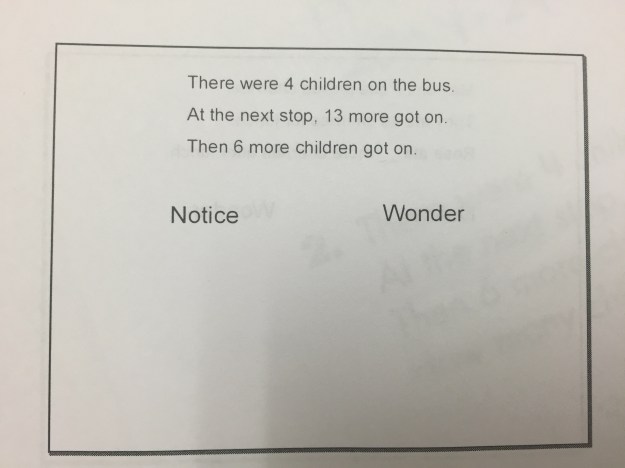
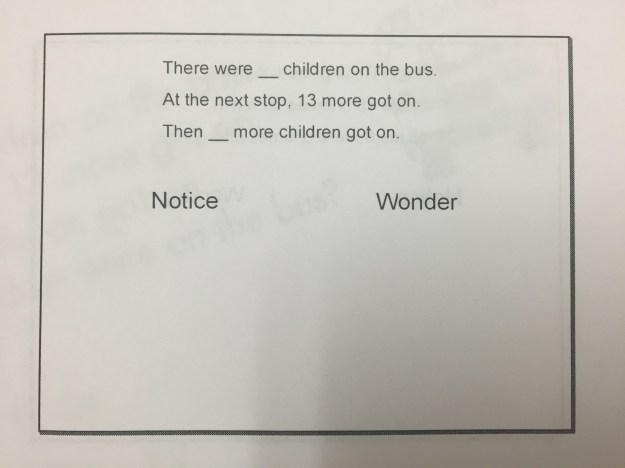
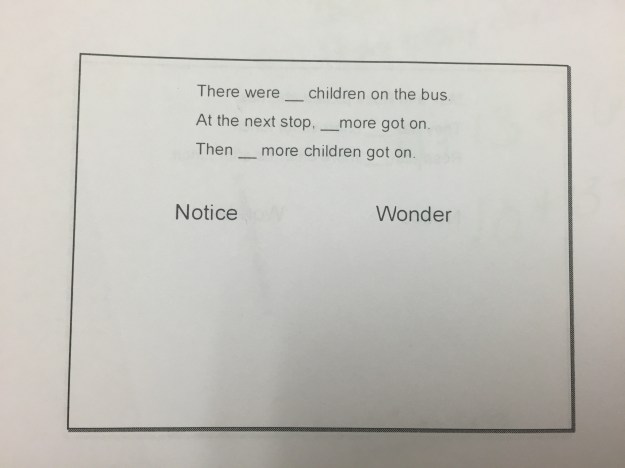
So…I took the second question, removed the actual question and made it a notice/wonder:

IMG_1132.JPG

Assuming the wonder of how many students were on the bus arose, I would see how students combined the numbers. Would they look for friendly combinations? Would they count all? Model it? Count on? or any combination of those?

Then, I thought I could keep the 13 and leave the other two numbers blank to see what numbers they chose.

IMG_1133.JPG

Did they pick a combination that was easy to add to 13, like 5 and 5? or would they keep adding onto the 13? how would they add with the 13, would they choose 7 to make 20 and then another 1 digit number? would they choose all 2-digit numbers to challenge themselves?

But then, I thought what could happen if I took all three numbers out?

FullSizeRender 22.jpg

For some reason, without the numbers it seems more “wordy” to me. I don’t know why that is? So THEN, I went to this last option….

Screen Shot 2015-11-19 at 5.48.42 PM.png

I really love this one, although, I must admit, I feel a bit out of control of the course of the lesson in choosing this one over the others. But, I think that is what makes it such a beautiful choice. After taking noticings and wonderings, I am thinking of having the students work in pairs to create their own story and solution for one of the wonderings.

In creating their stories, I am concerned that students will choose numbers such as 0 at two stops and 1 at the third and I won’t be able to get a picture of how they combine numbers, however I will have a possible picture of their number comfort level. If they do this and finish quickly, I will be ready with the second choice above to see how they deal with now having the 13 in the problem.

In their journals I will ask them to tell me why they chose the numbers they did for the problem.

I am still thinking about this, so please feel free to leave suggestions and comments! Thanks to Simon, Fran, Graham, and Bryan for their thoughts on Twitter, always appreciated!

~Kristin


2nd Grade Lesson Follow Up

Over the past few days I have been blogging about my 2nd grade planning, teaching and reflecting. Today was the follow up lesson…

This morning, I popped in the classroom to chat with Lauren, the classroom teacher, to catch her up on the lesson and chat for a bit about where we could go from here. I was so excited to hear she had read the post yesterday so we could pick up our conversation with the student work! We looked through the student work samples and struggled with how to structure the share…. should she just focus on one question or look at both? We decided to start with showing two student work examples  (and having the students explain how they solved it) from the same question that were different in how they represented and grouped their numbers to count, but ended with the same answer. After the class shared what things were the same and different about their way they solved it, we were planning on sending them off with a group who did the same question as they did and look for all the similarities and differences. In this, we were hoping students would start to notice how others grouped their numbers and move some of the students who are still drawing every picture and counting by one’s forward in their thinking.

I had to leave to go meet with another teacher, but after Lauren opened the lesson like we had planned and took her students to recess, (that is that weird split in their schedule that we usually hate but worked out well here) she came down to talk really quick. It seems that the class could not express similarities or differences beyond the “sameness” of their answers or representations they had drawn. And while, in the moment, I thought this was such a difference between 2nd and 5th graders. However, as I reflected later on, I recalled this same thing happening with my 5th graders last year!

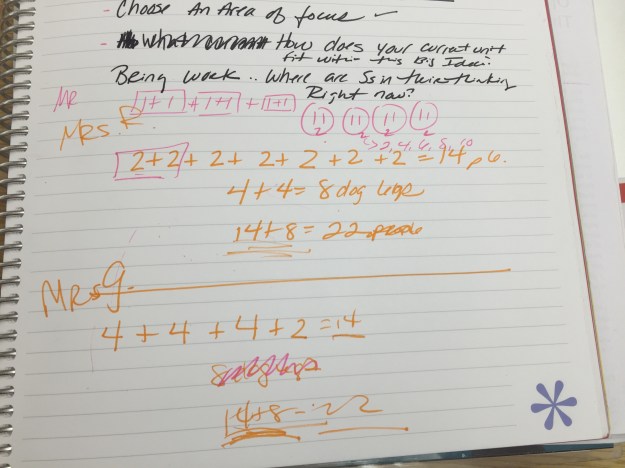
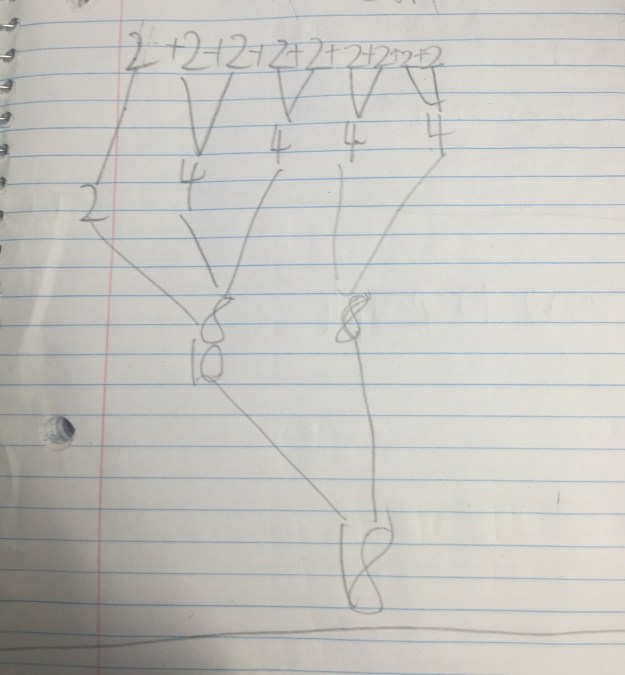
We knew sending them off, as we had planned, would be ending with the same level of conversation, so we started brainstorming! How could we get them to look at HOW the strategies varied in process and not just look at the numbers and same answer? It is such a difficult thing to relate to the thinking of others, and it probably doesn’t help that the work and drawings were all over the place! Excuse the sloppy mess, but we decided to take strategies we had seen in the students work and frame it as work that Lauren and I had done in solving the problem and ask them to connect those! Then we added in a third teacher’s thinking from across the hall. You can vaguely see the pink counting by ones, the next by 2’s and then 4’s and 2’s, hoping students would think about how the numbers formed different-sized groups.  I took a pic of this, texted it to Lauren so she could have it back in her room and she had to run to pick them up from recess! FullSizeRender 21.jpg

After my afternoon meeting, I popped back in to see what happened! She said they did so amazing seeing the similarities and differences when it was written out like we had done. For the first time we were asking them to do this work while looking at student work, I probably should have thought about how to better structure the “look” of the work.

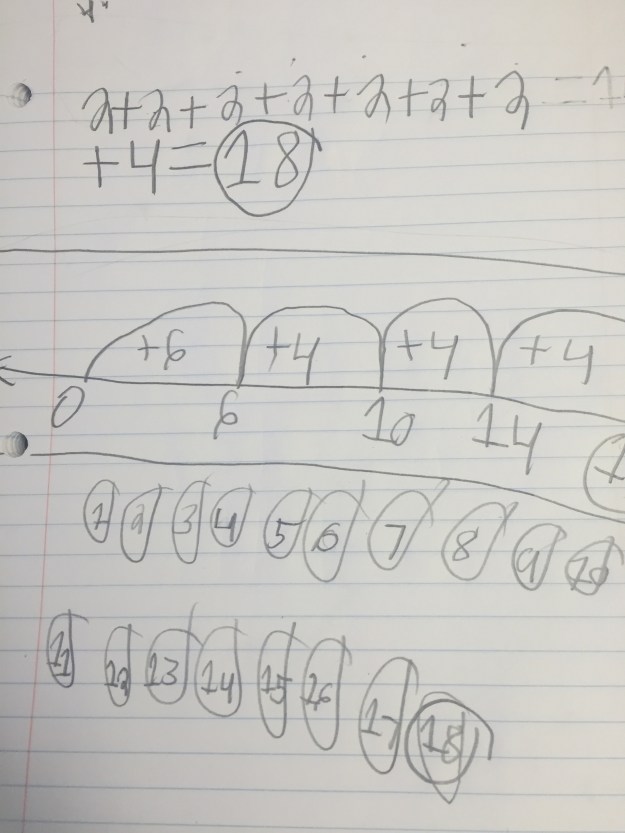
Lauren said after the share she asked them to find the number of eyes in the 7 people, 2 dog problem thinking about what they had just shared. i just got to catch a few of their work samples, but it was already so amazing to see the movement from drawing everything to different groupings. This is where I wonder if students just need to have the permission to now “show their work” in ways that are not pictures? I am not sure but something I am thinking about. Here were a few samples of the new problem, I can’t wait to chat with Lauren about it more tomorrow!

IMG_1126IMG_1125IMG_1127IMG_1124

~Kristin