Category Archives: Math

Student Work with Fractions

I do not have much time to write this morning, however I know how much I love looking at student work, so I thought I would give some of my friends who love doing the same some stuff to look at this morning!

For a future PD I am doing on fraction progression, I wanted some thinking around this Illustrative Math problem: https://tasks.illustrativemathematics.org/content-standards/3/NF/A/1/tasks/833 This is a 3rd grade CCSS, so I had some beginning of the year 4th graders this task to try out. Here are some samples:

IMG_6521 IMG_6522 IMG_6523 IMG_6552 IMG_6553 IMG_6554 IMG_6555 IMG_6556 IMG_6557

And this Illustrative task: https://tasks.illustrativemathematics.org/content-standards/2/G/A/3/tasks/827 It is a 2nd grade CCSS so I gave it to beginning of the year third graders this year.

IMG_6558 IMG_6559 IMG_6560 IMG_6561 IMG_6562 IMG_6563 IMG_6564

This task (https://tasks.illustrativemathematics.org/content-standards/6/NS/A/1/tasks/50)is a 6th grade CCSS, these are my students from last year who are now in 6th grade:

IMG_6565 IMG_6566 IMG_6567 IMG_6568

This task is 4th grade CCSS: https://tasks.illustrativemathematics.org/content-standards/4/NF/C/5/tasks/154, this is my current 5th graders:

IMG_6476 IMG_6478 IMG_6484

Same group of students on this task: https://tasks.illustrativemathematics.org/content-standards/5/NF/A/1/tasks/855

IMG_6475 IMG_6479 IMG_6483 IMG_6492 IMG_6498IMG_6569 IMG_6570

And then finally, in my class we were comparing fractions. I asked them which was greater 7/8 or 5/6 and how they knew…

IMG_0482 IMG_0479 IMG_0485 IMG_0483 IMG_0481 IMG_0484

Have fun math peeps! I would love to chat in the comments or on Twitter about any/all of them!

-Kristin

Week One – Talking Points & Math Mindset

I continually think about how I can effectively gauge my student’s mindset at the beginning of the school year. Last year, I tried a “Get to know you” form that students completed, asking questions such as: What do you feel you are really good at in math? What do you feel you struggle with in math? Do you think you can get better at those things? etc… I didn’t feel like I got the type of insight I was looking for…partly because my questions weren’t that great and also because most students saw it as an assignment to complete and didn’t write out extremely involved answers that gave me much insight. I then took it upon myself to have inspiring growth mindset posters hanging up around the room and continually told students how mistakes help our brain grow, mistakes are good, no one is “good” or “bad” at math and all of those great things I learned! Don’t get me wrong, I love those things and will continue to do them, however it just didn’t feel like the thoughts came out organically….I felt I was trying to “teach” them how to have a growth mindset, if that makes any sense?

Now, I have found (borrowed/stole) the BEST activity to get to know student’s mindsets at the beginning of the year, called Talking Points. I blogged about them before in my Week One planning post, but I had no idea at that point how much I would LOVE them. If you haven’t heard of them before check out @cheesemonkeySF on Twitter and her blog! She adapted this activity from Lyn Dawes’ Talking Points activity… Amazing Stuff!

For those who have never heard of them, here are her directions for how they work:

tp1

I used the following talking points because I felt it would give me insight into student mindset in regards to math and working in cooperative groups…

tp2

As a class, we reviewed the process and practiced Talking Point #1 together as as a class. From there I let them go and circulated the class to hear the conversations! It was the absolute highlight of my first week! Here are some things I heard as I went around…(waiting on a few more parent permissions to post, so had to transcribe for now)

On Doing Math Quickly….

“I disagree because you could write down a random answer but not be right.”

“If it said being good at math means being able to problems quickly AND correctly, then it’d be right”

“I mean, think about it, you can do anything quickly but it might not be right or you may never learn it. So, you have to like go deep into the problem. That’s just my opinion.”

On There Is Always One Best Way To Do Math…

“I disagree because there can be more than one way to do problems.”

“I disagree because you don’t always have to stick to one way and for one person there may be one way and they think that’s the best, but for another person, could have a whole other way to do it.”

“There is not a BEST way, any way is good, but all that matters if you get the answer right.”

“There are many different ways I use to solve problems so not one way is always going to be best.”

“….just because one way is more efficient than another way doesn’t mean its the best.”

On Getting a Problem Wrong Means You Are a Failure….

“…you learn from your mistakes, so if your not make mistakes, you’re not learning anything.”

“If there was like 20 questions and you got one wrong, that doesn’t mean you just get an F, you still get an A and then maybe one day you do that same question again, and your like, “hmmm, I got it wrong last time, let’s try a different strategy and see if you get it correct.””

“One wrong answer’s not an F, unless there’s like 2 questions on the test, because even if you get it wrong you still learn from it and next time if they ask you again, you can be like, “now I know the answer.””

There is a group assessment piece that we did not have time for that day but we did do a classroom debrief so all of the groups could hear the conversations, it gave me goosebumps hearing them talk….awesome. I learned SO much about my students from this activity and it felt so organic coming from them. I didn’t feel like it was trying to “teach” them to have a growth mindset, it was coming from them! Love. Love. Love.

Here are some of their tallies….I think this data is invaluable! I cannot wait to incorporate this routine into my math class this year!

IMG_6444

IMG_6445

IMG_6446

IMG_6447

IMG_6448

IMG_6449

IMG_6450

Happy First Week Back!

-Kristin

Professional Books #mtboschallenge

My plan was to just do the Sunday Summary #mtboschallenge, however I have been seeing some tweets lately about books for elementary preservice teachers so I thought I would compile a list of my favorites. This summer I have read more professional books than ever before so this will be a list of books from past years, this summer and my reading to-do list.

In the past years my favorite books in which I constantly reference, reread and recommend are:  Classroom Discussions by  Chapin and O’Connor,  Mindset by Dweck,  Number Talks by Parrish, Young Mathematicians at Work by Fosnot, Extending Children’s Mathematics by Empson/Levi, What’s Math Got to Do With It by Jo Boaler and Beyond Pizzas and Pies by Julie McNamara.

This summer I finally had time to dive in and had time to read more than a few books and my twitter feed:

Principles to Action, NCTM – I like it for looking at what makes a good task, what a teacher does, what students do. I have just picked and chosen things I have wanted to read about so far in this book. Have not read cover to cover.

5 Practices for Orchestrating Productive Mathematical Discussions by Smith and Stein – This is something that I think more teachers need to think heavily about…..great practices to instill in teachers planning process. Read this cover to cover.

Agents of Change by Lucy West – We are moving into a content coaching model in our schools this year and after seeing Lucy West present, I appreciated her upfront, honest approach. Her book did not disappoint.

Faster Isn’t Smarter by Seeley – This book is a great reaffirming reference for me for use with parents and teachers.

Powerful Problem Solving by Max Ray and Math Forum – Read this cover to cover. Very fast and fluent read because it is filled with interesting, applicable activities and student work.

Connecting Arithmetic to Algebra by  Bastable, Russel, Schifter – I saw Virginia Bastable speak this summer and was drawn to her message. I have read the first few chapters of her book and interested in more work with teachers this year in making claims and looking at repeated reasoning.

Future readings I have sitting on my shelf or being shipped:

Putting the Practices into Action by O’Connell and SanGiovanni

Connecting Mathematical Ideas by Boaler and Humphreys

Intentional Talk by Kazemi and Hintz

So much to learn, so little time to read coming up….I anticipate Investigations being my major reading in the near future!

Happy Reading,

Kristin

Student-Led Number Talk

As I read Max Ray’s (@maxmathforum) book, “Powerful Problem Solving,” I can’t help but reflect on my own classroom experiences.

In the chapter about Communication and Community, Max writes,

“Modeling good listening skills and acting like a dinner party host (bringing together interesting people with good ideas, asking questions or providing activities to help them start talking, and then backing out of the way and encouraging them to talk to one another) go a long way in helping students pick up on the idea that their peers have useful things to say.”

At the end of the year my students began asking if they could “do a Number Talk” with the class and record it with their ipad to watch later. I hadn’t thought of this, but thought it would be interesting to see how it went so, “Sure!”  Before presenting, they had to show me the string of problems designed with a purpose and the questions they would ask the class as the number talk progressed. Wow, do you learn a lot about yourself and their role as active listeners when they start planning!

This was their string and questions….

IMG_4220When I looked at this, I was so surprised to see they DO really listen to the questions I ask during class. Don’t get me wrong, they always are such great communicators/listeners during class, but I never knew how much they internalized the questions themselves. It is my hope they keep these questions in the back of their mind as they continue future math work, both in groups and individually. How cool to think that as a student is working on any math problem, they are continually thinking things like, “What strategies could I use?” or “Does this always work?” Metacognition at its finest!

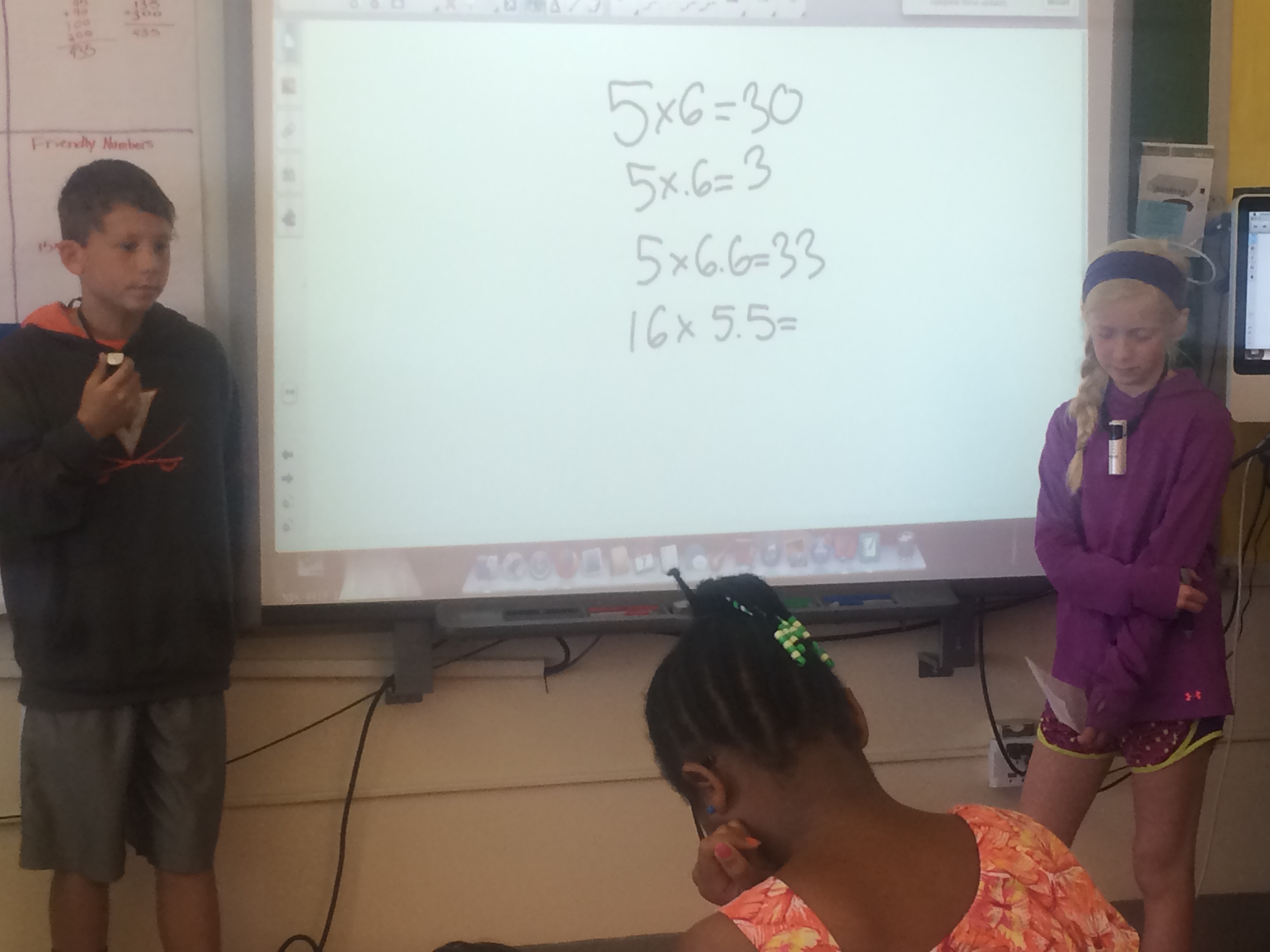
They designed a string in which they said partial products (distributive property) was the goal. It obviously was, however the decimal point movement when multiplying by 10 also arose since we had done previous work with multiplying by powers of 10. They did a beautiful job and the rest of the students were such amazing participants.

Another student had filmed the talk for them on their ipad and it was so interesting to watch them later go back, watch it, and talk about what they should have said or how funny something they said sounded. It was such a great experience for all of us and definitely something I will build more regularly into my class next year!

– Kristin

This was their revised/follow-up one since the x10 didn’t really capture their intent…they wanted to try another!

IMG_4221


Unanticipated Student Work…Always a Fun Reflection!

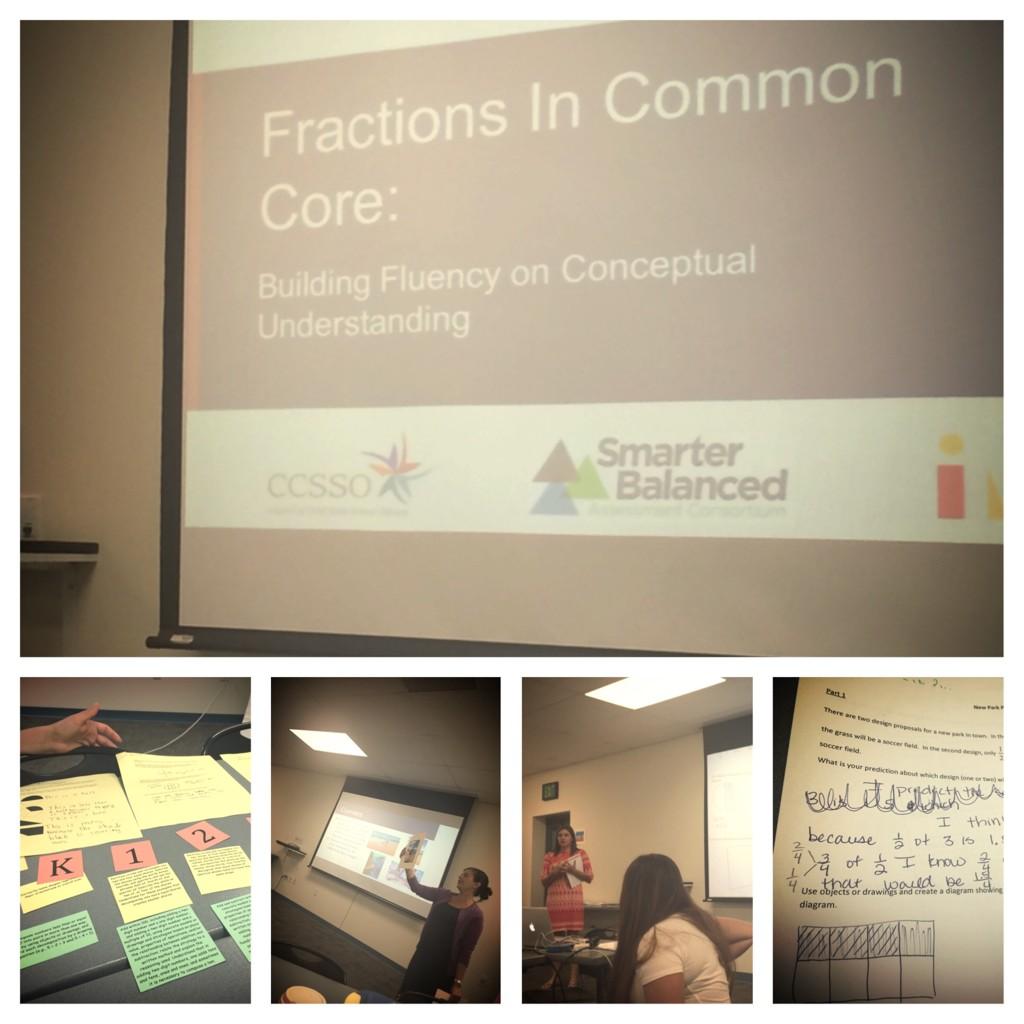
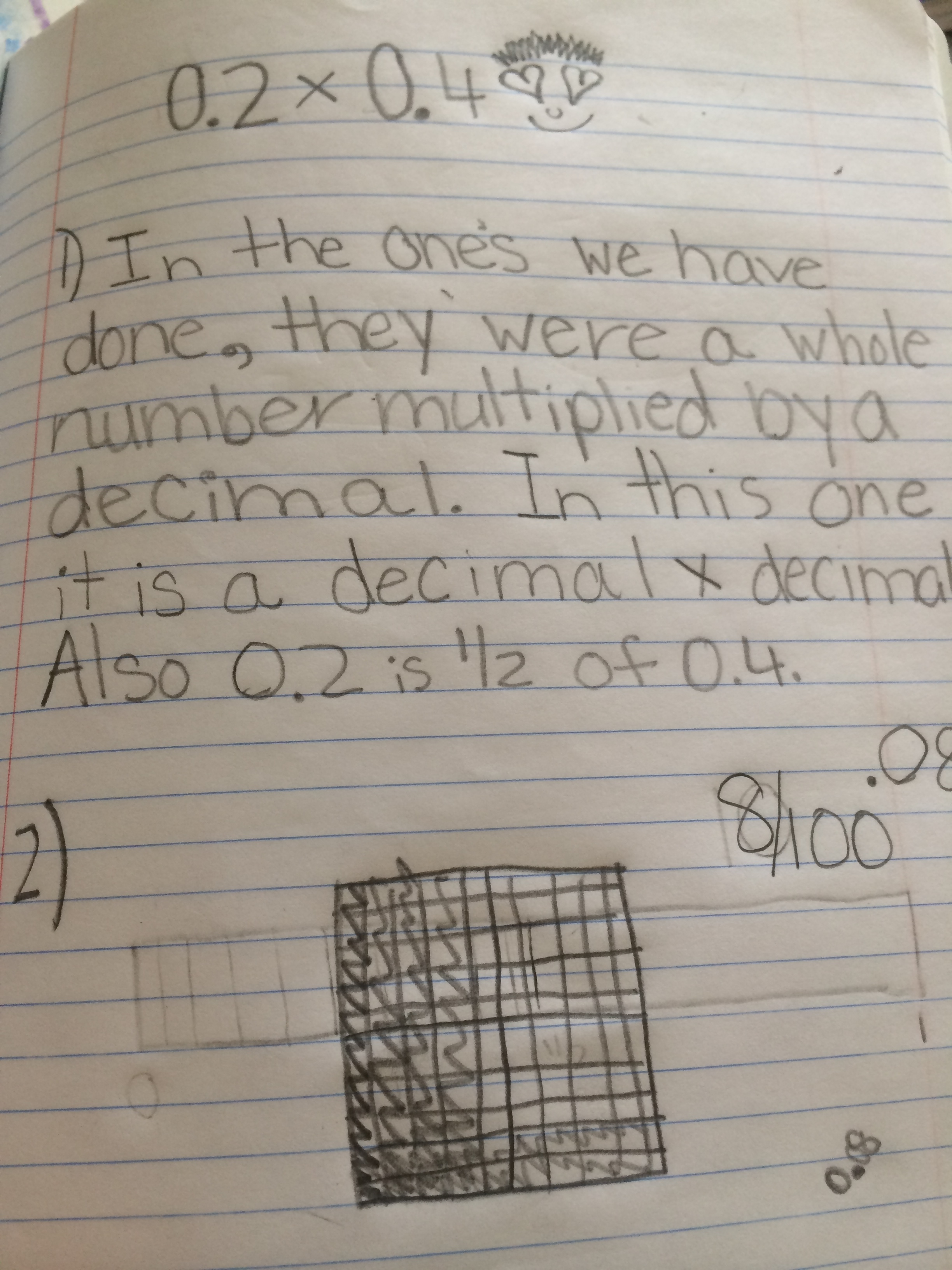
As I was planning for a summer PD, “Decimal Fluency Built on Conceptual Understanding”, I was going through pictures of my students’ work. I focused on the very first multiplication problem I had presented to them in which both numbers were less than a whole. I presented them with 0.2 x 0.4 and asked them to do a “Notice/Wonder” and think about the product. I had anticipated some may reason using fraction equivalents, some may know that .4 is close to half and take half of .2, and some may try fraction bars or arrays to solve. Here are samples of their initial work….

IMG_4323 IMG_4326 IMG_4334 IMG_4338 IMG_4341As I circulated the room, the two products that showed up were 0.8 and 0.08, as I anticipated. I put them on the board and had the students work through it as a group and try to prove the product they thought was correct and disprove the one they thought was incorrect (I did not tell them at this point, that was their job!:)

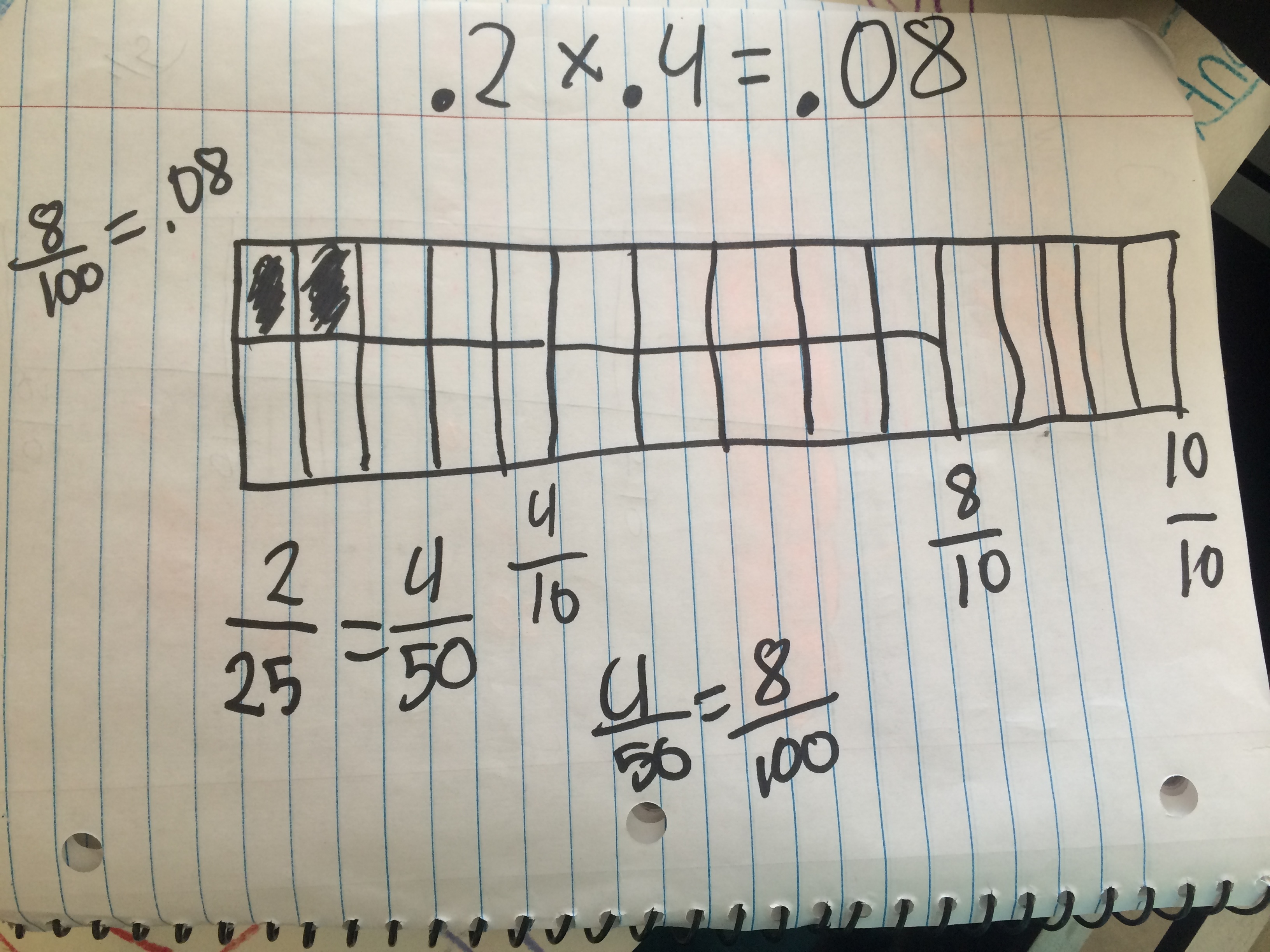
During the share out, this is the one response I did not anticipate at all and now, going back, I wish I had spent more time with…grrr….darn hindsight!

IMG_4335


For all of the nerdy math peeps, like me, who like to “figure things out” I am going to leave out her explanation here! I will gladly recap it for anyone who would like to hear it in the comments or via twitter!

Needless to say it left many students a little baffled, and we did revisit it the next day for her to re-explain her reasoning. I just wish I had extended this by asking students if this model would work for any two decimals less than one whole? Why does it work with .2 of .4?

I highly recommend snapping pictures of your students’ work all year long because reflecting back on this work over the summer has taught me a lot about anticipating student responses and how to handle those responses you just don’t expect! It also just makes me smile at the way my students reasoned about the math we were doing!

-Kristin

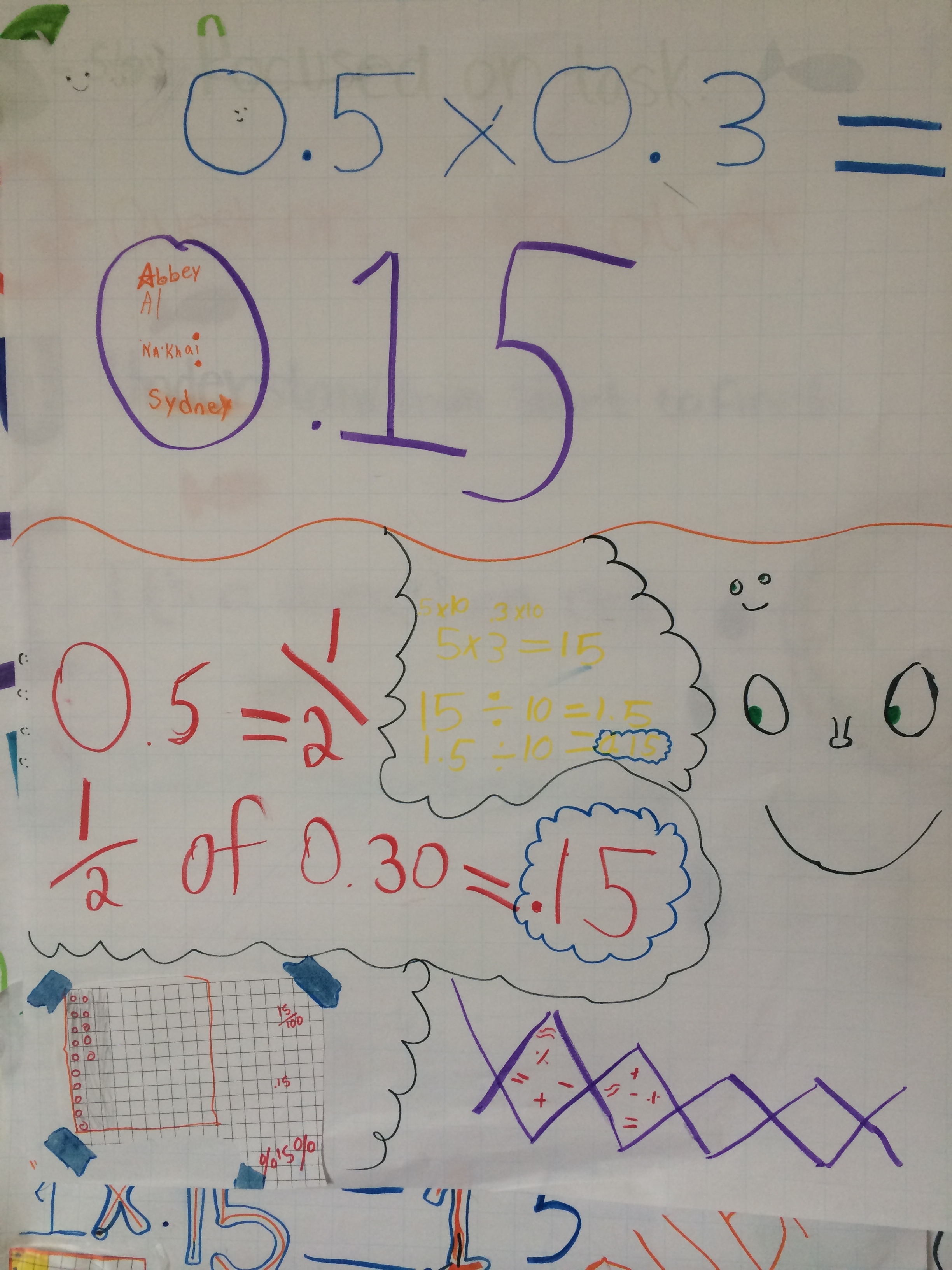
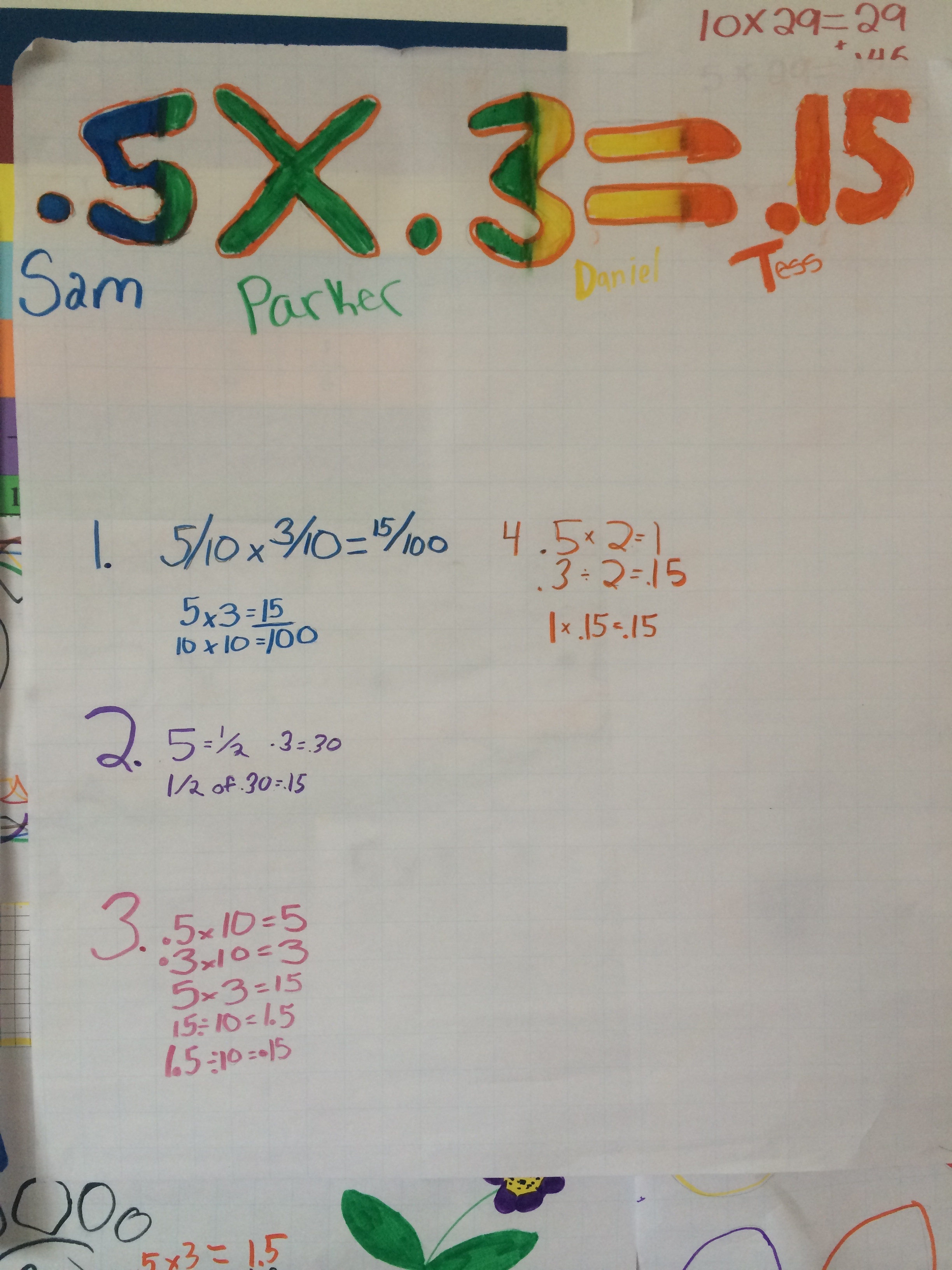
Here are a few pictures of the follow up group work and Gallery Walk they did with 0.5 x 0.3….

IMG_4228 IMG_4229 IMG_4232 IMG_4233

Inspired Thoughts on Number Talks

During the majority of the professional development planning I have been doing this summer, I feel like one of the common threads is Number Talks. After each conversation, more and more questions start spinning in my head….questions about how often to implement, questions about teacher recording, and most importantly, questions about their purpose.

I wasn’t inspired to write them all down until I read @gfletchy’s post: http://gfletchy.com/2014/07/22/on-you-marks-get-set-number-talks/.  BTW *If you do not follow his blog, you most definitely should, great stuff*

Questions/Thoughts about Number Talks:

1 – Through the math conversations, it fosters a safe, collaborative culture in my classroom.

2- Their conversations embody the Mathematical Practices in my eyes. Their use of structure of the number system, creating viable arguments, critiquing the reasoning of others and repeated reasoning is always music to my ears.

3 – I struggle with purpose…is the purpose a particular strategy? That is how Parrish’s book frames it. There is a string, centered around a certain strategy. Not that other strategies do not emerge, but the numbers are such that they lend themselves to a particular path. So, my conclusion is this – When doing a number talk string, I  am not pushing a certain strategy, but instead, encouraging the students to truly think about the numbers before simply “computing.” I do want students to think that if they are multiplying 39 x 45, to think about 40 and taking a group away rather than breaking both numbers to get 4 partial products. In thinking about the numbers more deeply, they call on their conceptual understandings to develop fluency.

4 – Is the purpose to generate connections between strategies? I do think there is a benefit to putting up one problem and recording all of the strategies to make connections between them. I use that as a formative assessment as to what my students know and also to identify misunderstandings/misconceptions that emerge.

5 – Fawn’s blog has sparked an interest to branch into more visual patterns to switch it up a bit. What that would look like in my 5th grade class, is something I need to work through but I think the algebraic reasoning behind them would be intriguing.

6 – I Completely agree with Graham, they must be a daily routine, they build computational fluency (based in conceptual understanding) and must not just happen on Fridays! Also, it is important for students to use their Number Talk reasonings in other math work.

7 – Teacher recording is something I am still trying to improve upon daily. Recording their thinking is harder than one would think! Also, I find WHAT I write can change the direction of the talk itself.

I am a huge proponent of Number Talks and would love to see our elementary work with them to start to move into the middle/high school classrooms!

-Kristin


#ISTE2014 Reflection

This was my first ISTE conference so I was first completely impressed with the sheer number of attendees and organization of such a massive conference. Throw in the number of passionate educators present and it makes for an unbelievable and somewhat overwhelming experience. I wanted to jot down some of my overall impressions, takeaways, and random thoughts before summer work kicks in and I forget everything by the time school starts! I looked at the conference from two perspectives, first as a classroom teacher and then as a person responsible for the math professional development in our district.

As a teacher…

1 – I loved, loved, loved the number of educators on Twitter. The #ISTE2014 hashtag was blowing my phone up every minute of every day during the conference.  The amount of multitasking going on everywhere was amazing! I have never seen so many people engaging in technology, learning, spreading the word to others, and walking at the same time 🙂 I felt connected to the many sessions I could not attend or that closed before it even started due to capacity (that was a bit frustrating at times). It truly demonstrated the need to be a connected educator and the value of networking with colleagues around the world.

2 – I was excited to see the focus of my sessions more about the student learning than the technology in and of itself. The tweets reflected the same emotion and I loved that!

3 – I got SOO many exciting ideas to use for Open House, management, and  parent communication (http://www.kleinspiration.com/2013/05/using-augmented-reality-via-aurasma-in.html Thanks to Erin Klein:)  however I do find I struggled just a bit to relate some of my tech learnings into my math classroom. I am not one to use technology for the sake of using it and my classroom thrives on student discourse. I LOVE to hear the students talking about the math with each other and I am not a “flipping” fan. Don’t get me wrong I love to use Educreations, Minecraft, Aurasma,  Nearpod, and Padlet on the ipads, but even then, I need to improve upon using them to make the math more authentic for the students. The presenters at ISTE definitely provided the inspiration and wealth of tools I can look into when doing my planning. Teachers are doing AMAZING work out there and it was so inspiring to see that during the Sessions.

4 – As a presenter as well, I loved all of the support in the room! From sound to video, to ISTE representatives, to Apple Distinguished Educators, there were tons of people on hand to make sure it was perfect! Well Done!

5 – The Expo was packed with exhibitors. I was excited to chat with @Schoology as a new LMS for my classroom and for my K-2 teachers, I found a great new product from a company called Osmo (https://www.facebook.com/PlayOsmo?ref=br_tf). Check them out! There were many more interesting ones I chatted with,  however after being in heels all day, my feet could not make the trek around to everyone 🙂 One thing I find intriguing at every conference I attend, is I always have to ask myself, do the vendors here convey the mission/vision of the conference organization itself. For example, at NCTM, I find vendors selling programs/products that, in my humble opinion, do not support the Mathematical Practices and vision of what best practice is in the classroom. In the case of ISTE, I saw a vendor with bubble sheet reading software that worked with any document camera (and of course his example was a math sheet…ugh) . Don’t get me wrong, it was amazing how fast it could read the bubbles and plop a grade into their accompanying grading system, but is that truly what we see as a vendor who should be at an educational conference? Just like at NCTM, do we want a timed test program to be supported by an organization who’s vision is to “…ensure equitable mathematics learning of the highest quality for all students…” I always just find that interesting.

6 – I had the opportunity to participate in a live #satchat. It was such an amazing opportunity to meet face to face with all of the avatars I chat with on many Saturday mornings! Definitely a highlight!!

From a professional development standpoint….

I was absolutely blown away by the organization and setup of ISTE. There was something for everyone and more! There were workshops, IGNITE sessions, lecture sessions (with some recorded so attendees could watch from the tv in the hallway in case of overflow), Playgrounds where teachers were encouraged to play with the technology and experience what it was like to be a student, and Poster Sessions which I can best describe as an overwhelmingly exciting “science fair” with tables set up and manned by teachers and students describing the exciting work being done in classrooms around the world!

The format of each element was genius and definitely something I want to bring back and use in my school/district. I think starting our opening district meeting with and IGNITE session showcasing district happenings would be an amazing, invigorating way to launch the school year. I also love the feel of a Playground in which teachers just play with the math and can choose the topic that best fits their needs. A district/school hashtag where we can easily share resources and ask questions would be amazing…now to just get everyone on Twitter:).

Overall it was a great experience and I still continue to learn on the #ISTE2014 hashtag! It is full of passionate educators focusing on learning, not simply the technology. Thank you all for a wonderful conference! Looking forward to Philly 2015!

Decimal Multiplication: Whole # x Decimal

Through numerous Decimal Number Talks, Investigations on tenths, hundredths, and thousandths grids, and many findings about decimal operations, we are approaching our last couple lessons in our decimal unit. Not that the work with decimals ever ends, but our unit ends with decimal times decimal and the generalization of a “rule” for multiplying decimals. I have many thoughts about the new Investigations unit on multiplication of decimals but I am very excited about the connections my students have made between whole number and decimal operations. I do attribute a lot of their flexibility to our Number Talks though:)

I wanted to assess where they were before we moved into a decimal times decimal work because I think there is a lot of reasoning to do there before we come to a generalization!  I was really excited to see the use of multiple strategies!

First, I had students who were still treating the decimal operations like whole number operations and reasoning about where the decimal point “makes sense.” I do love this because it is heavy in estimation and sense making about what is reasonable. It is obviously not the most efficient strategy, but I what I truly learned from this, is that I need to do more whole number multiplication work with this student to build efficiency…

Image

I have students that love partial products….(and I cannot get some students to stop saying the “box method”….:)

Image

I loved this area model because of the size of the .4 side. She was very particular about that!

Image

Some friendly number work…I especially loved her estimation first….yeah!

Image

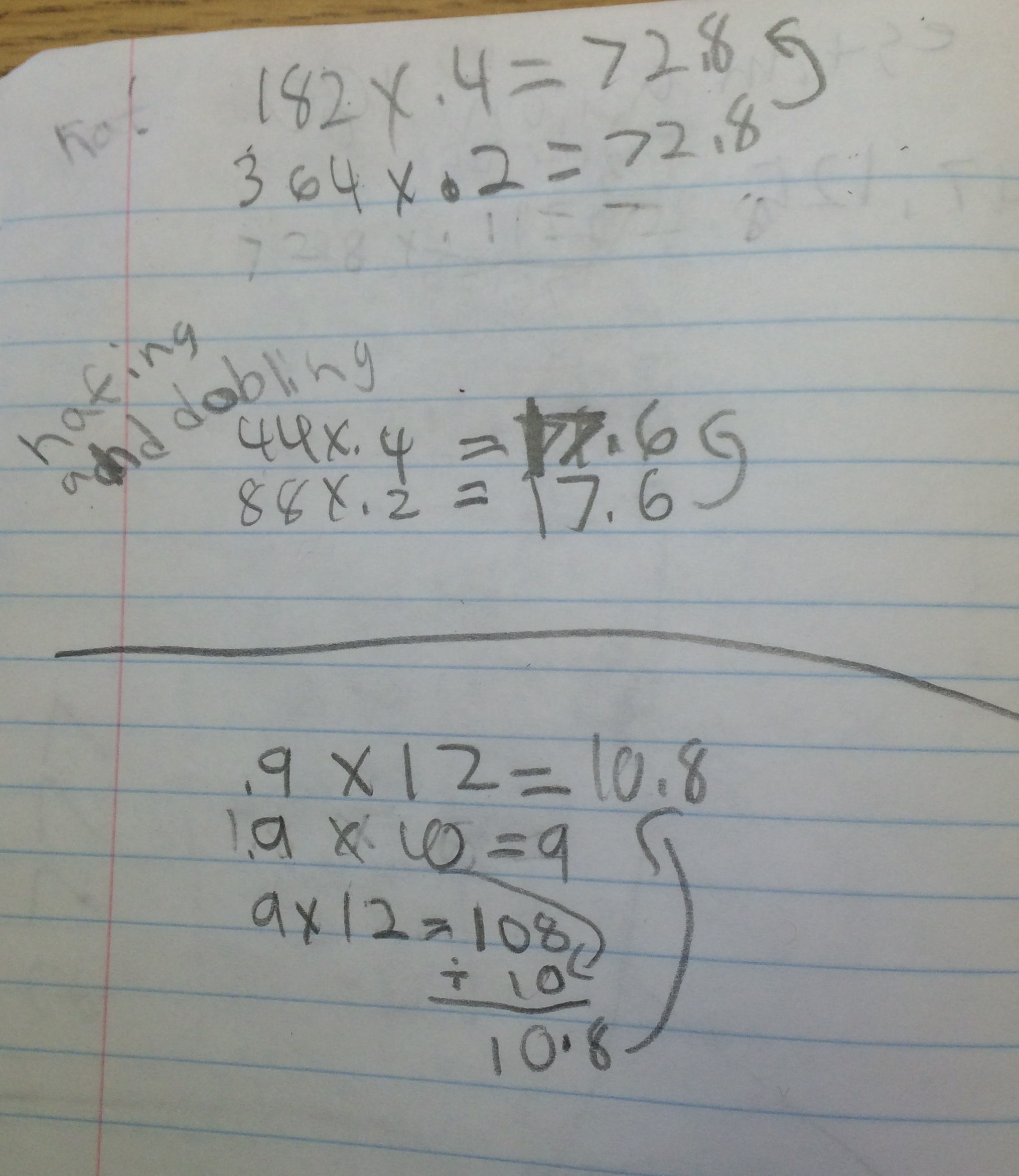
I had some who multiplied the decimal by 10 and then divided their product by 10…

Image

Saw some halving and doubling…

Image

I had a student think about the decimal as a fraction. It starts at the top and then he jumps to the bottom of the page.He said he multiplied 9 x 12 to find out how many “rows” he would have, 108. Then he divided it by ten because there were 10 rows in each grid.  It was interesting!

Image

So tomorrow we start decimal by decimal multiplication…I feel great about our start and I look forward to having them reason about decimals less than a whole times less than a whole.

-Kristin


Fraction-to-Decimal Division Table Noticings

Last week, I did an investigation on identifying fraction/decimal equivalents and interpreting fractions as division.  In previous years, I have to admit, I never fully appreciated this lesson. I could never get a grasp on how to not lose all of the great understandings students have about fractions and make it about division with the calculator. However after last week’s work, I have a new appreciation for the conversations it brought out in the classroom.

Throughout the year, we have worked with decimals, fractions and percents, so I feel my students are very comfortable moving between the three notations. They see the relationships between the decimal and percents for the /2s , /3s , /4s, /5s,  /6s , /8s, and /10s and know the percents for many (if not all) of those fractions because of our work on the 10×10 grid.

I opened this lesson with a fraction I was sure they knew the decimal for, 1/2. I asked them how they think we could use a calculator to find the decimal if we did not know it. They played around for a while and as I walked around many students could tell me they divided the numerator by the denominator. I asked if that same method worked for 1/4? As a class, they agreed it worked every time, so I asked why they thought that was so. Why are we getting a decimal? Many said with 1/2 we had “one whole divided into 2 pieces, so each piece has to be .5 so they both add to 1 whole.”  Another said we only get a whole number when “it is more on top then the bottom.”  I felt comfortable after a lot of talking from the class that they were seeing the fraction bar as division. So, we moved along to the division table. I had a student explain how a multiplication table works and then explained the numerator and denominator row and column in this decimal table. We looked at 1/2 and filled in the 0.5. I asked where else that decimal would show up in the table and they filled in the equivalents of 2/4, 4/8…etc. From there they worked with their partner to complete the table.

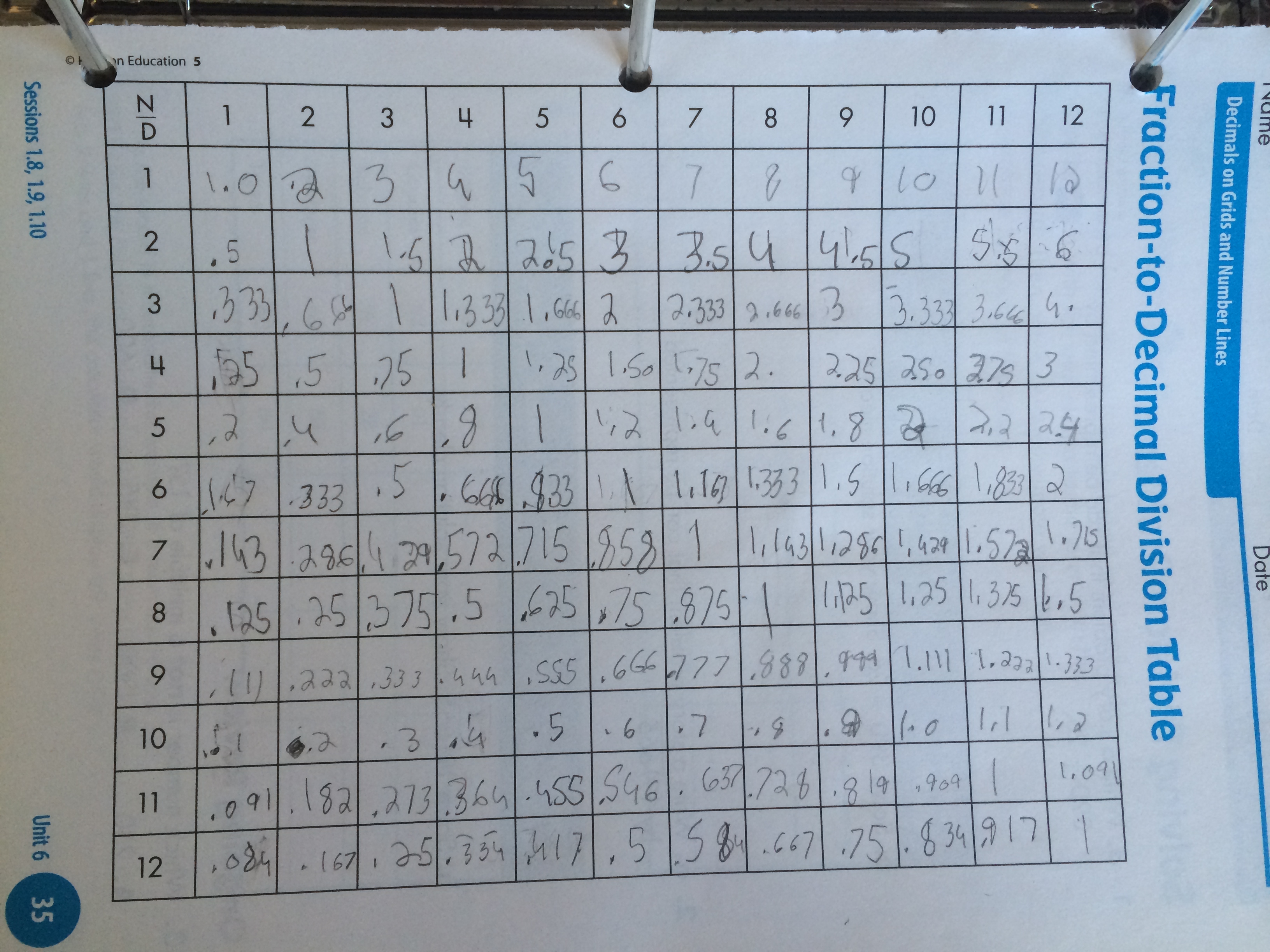
I teach two classes of math (thank goodness) so I can change up things that didn’t work as expected the first time. In the first class, I let them use their calculator from the start of the table. I realized as I walked around that students were completely losing their sense of fractions and it became a calculator exercise…exactly what I was afraid was going to happen. I saw students filling in by column and using the calculator in the tenths row! Big Fail on my part. I stopped all calculators, told them they had 5 minutes to work without the calculator to complete all of the decimals they could. The conversation took a dramatic turn for the better! They started to see that working in rows helped them see patterns and used their knowledge of equivalents to complete other cells and honestly moved along much faster! Needless to say, I started the next class without the calculator and the students liked the challenge of trying to reason about the empty cells without the calculator. Here is a sample of one of my student’s completed table:

IMG_3604

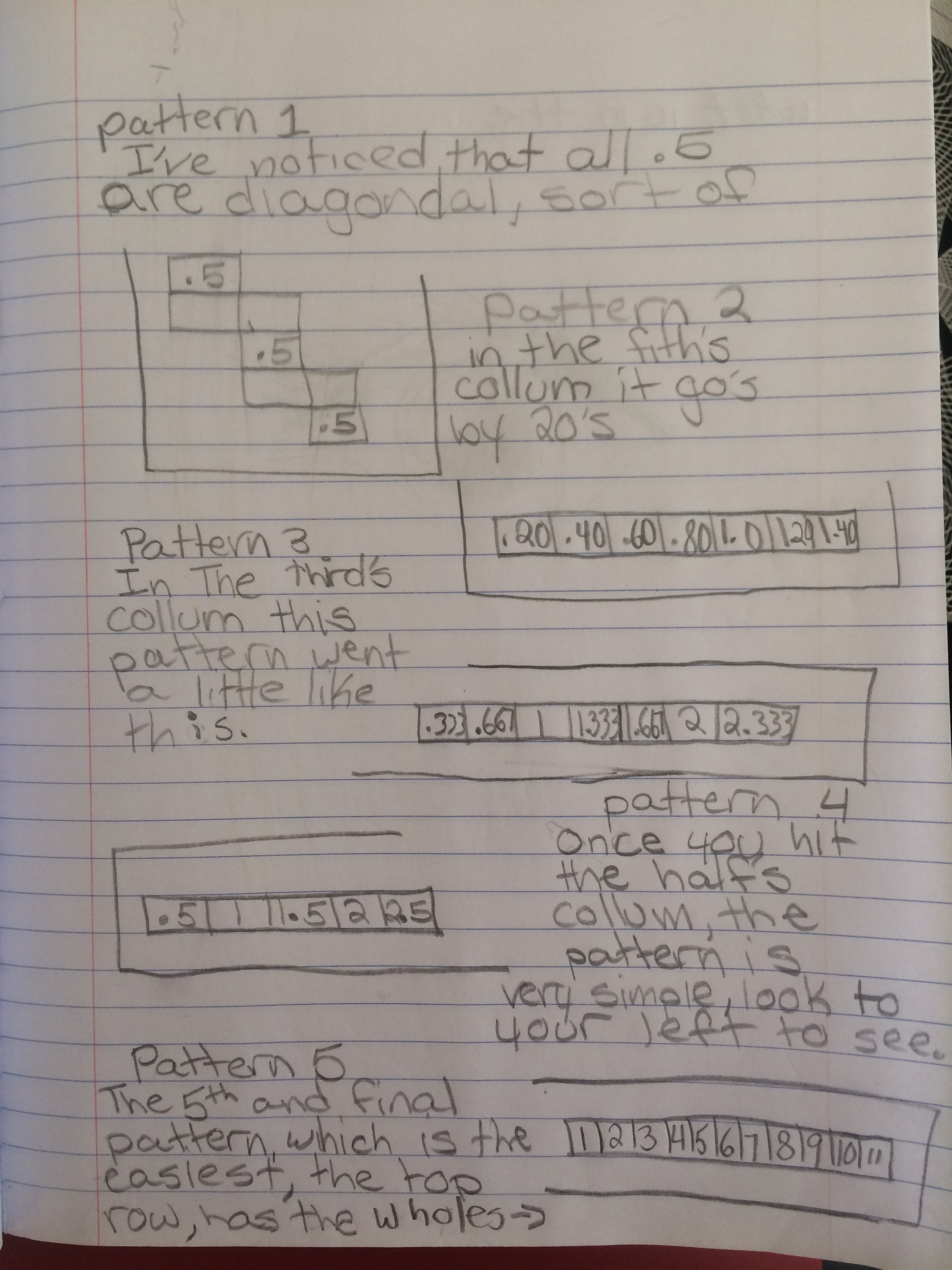
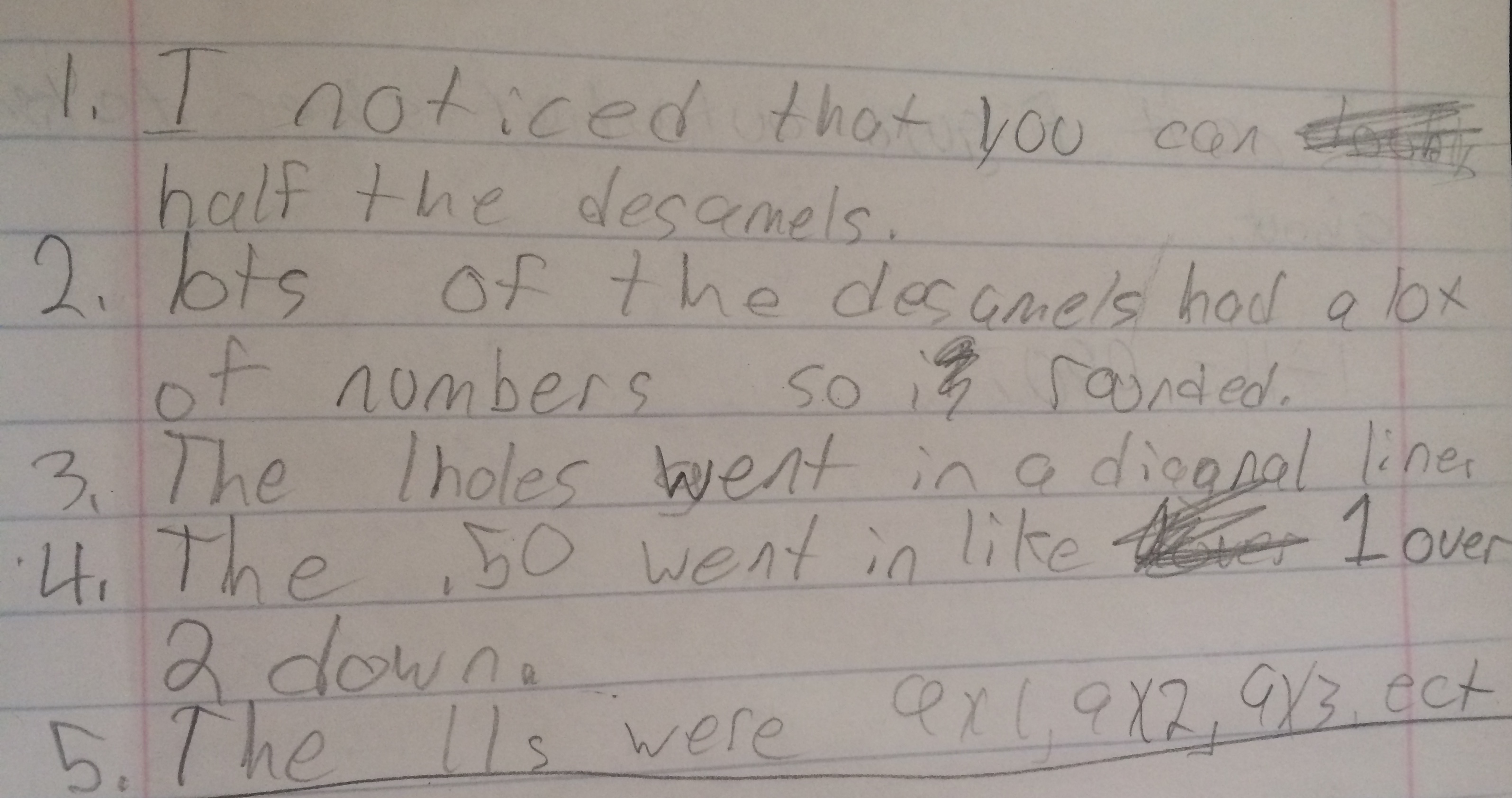
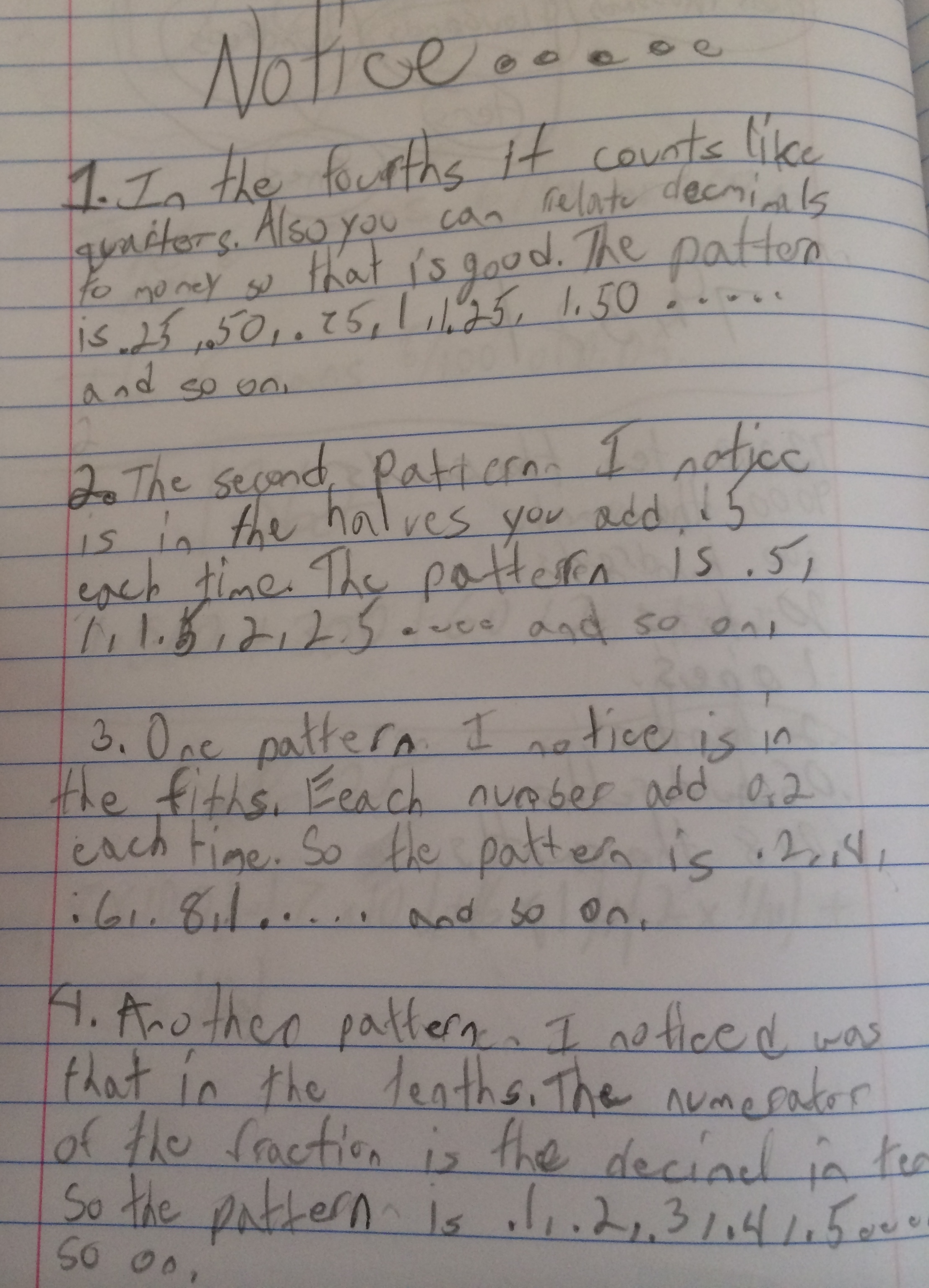
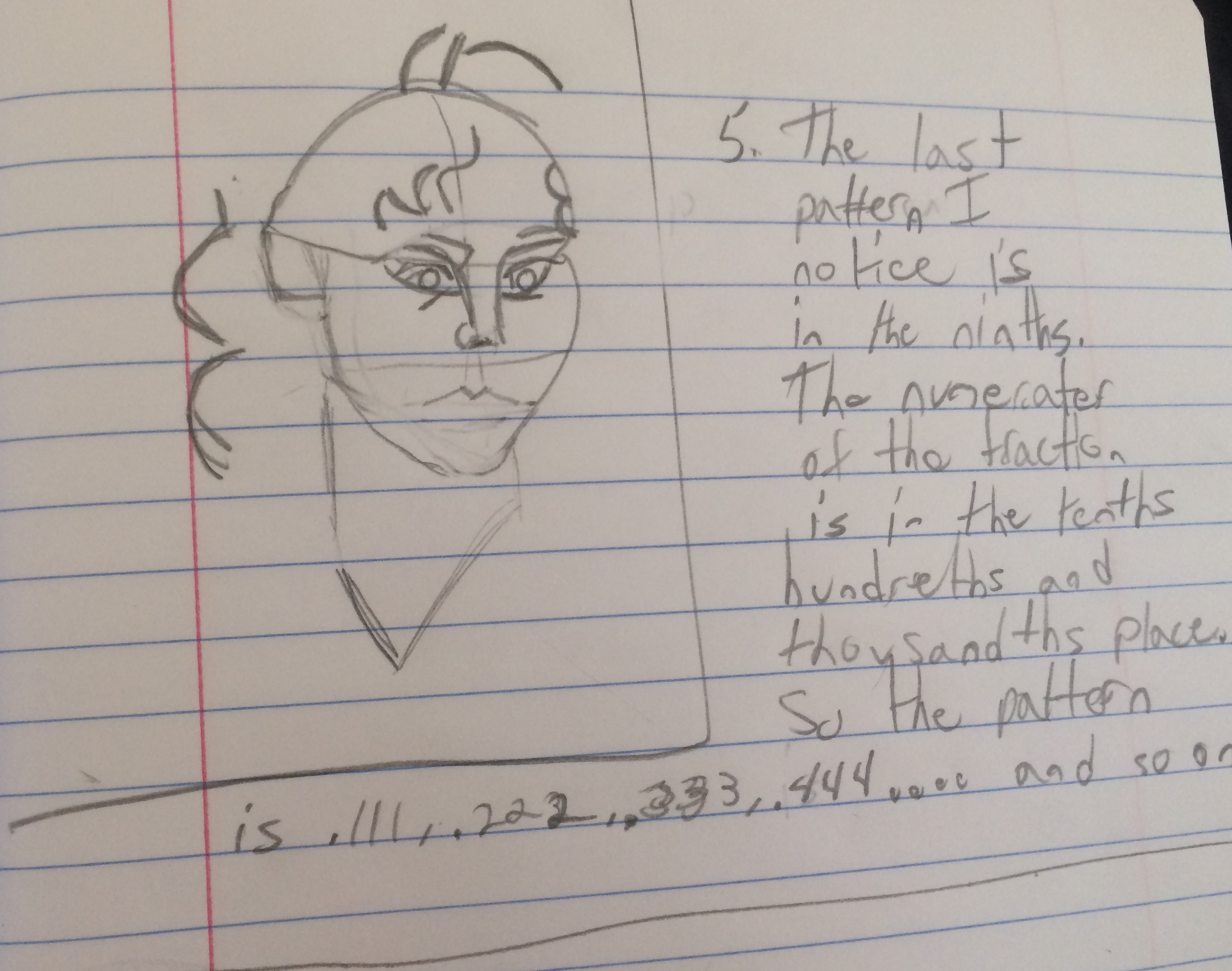
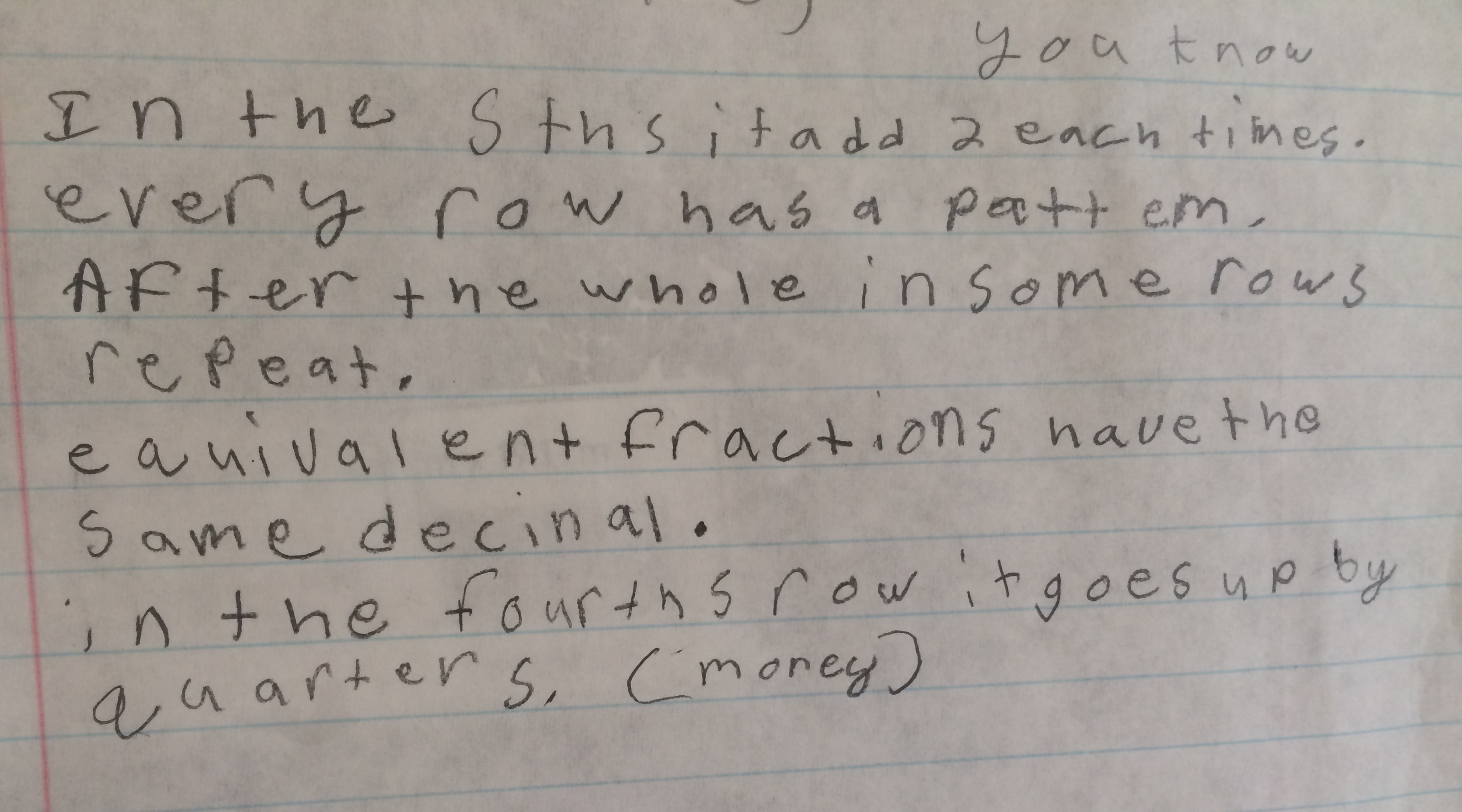
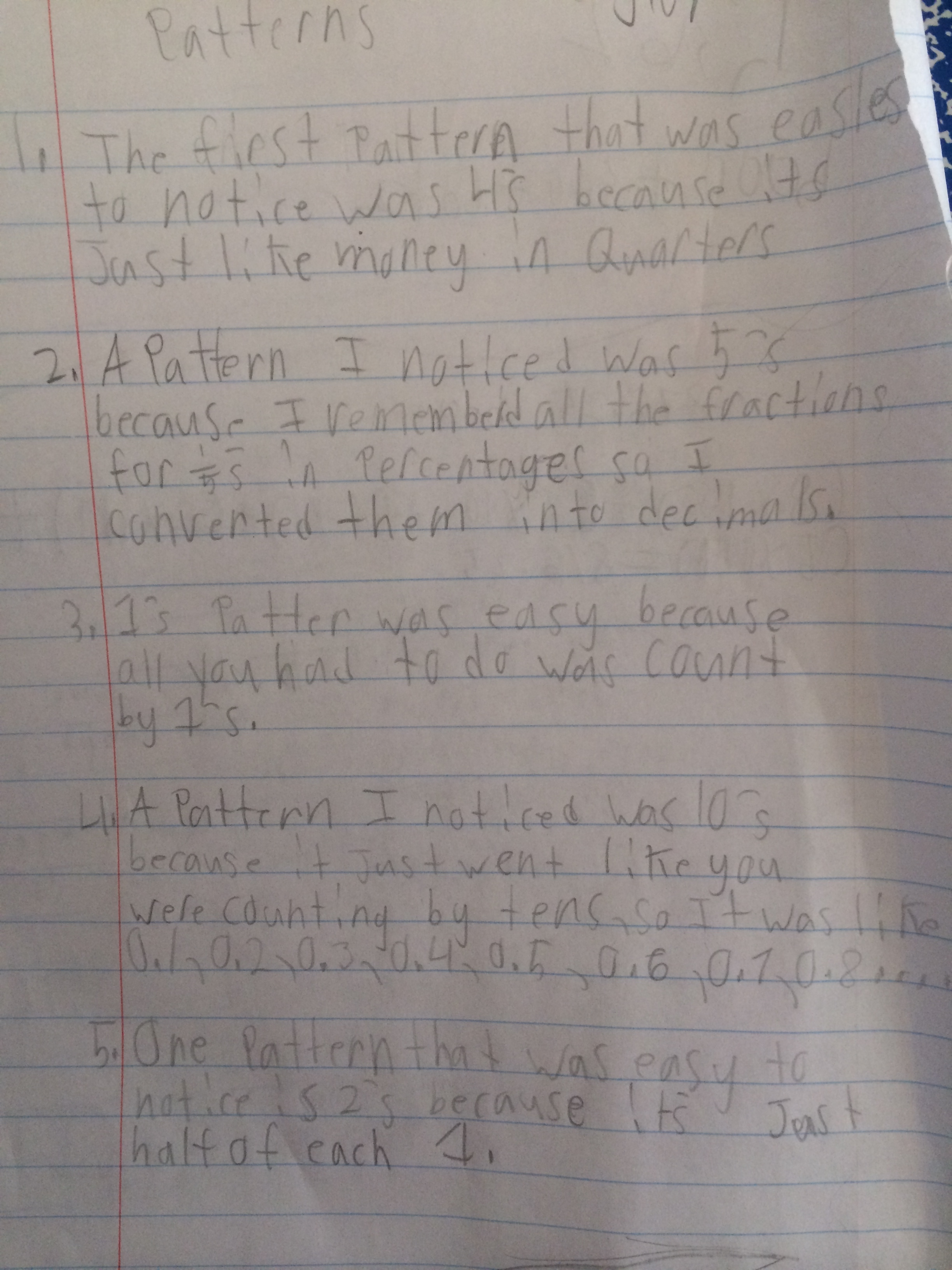
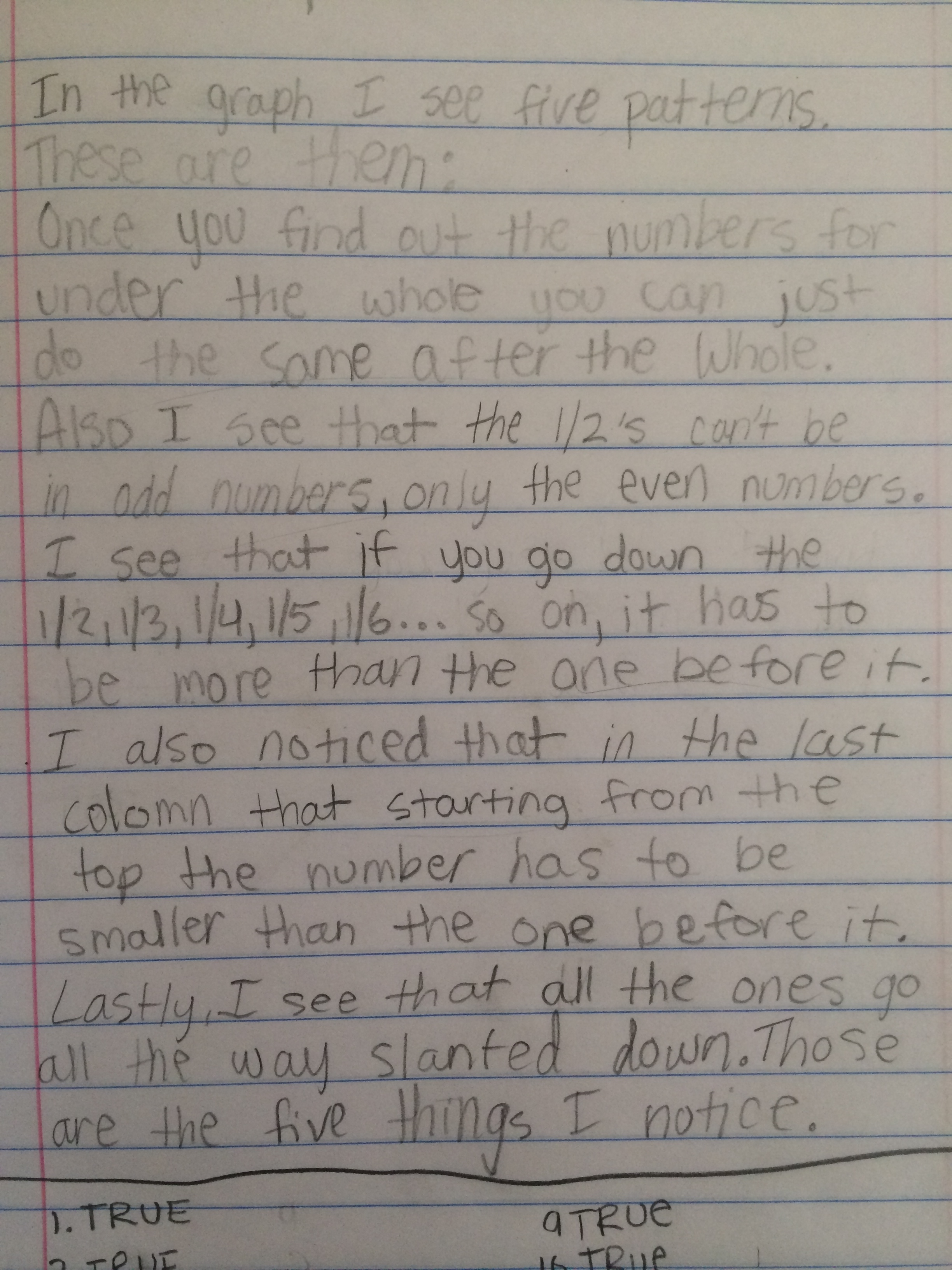
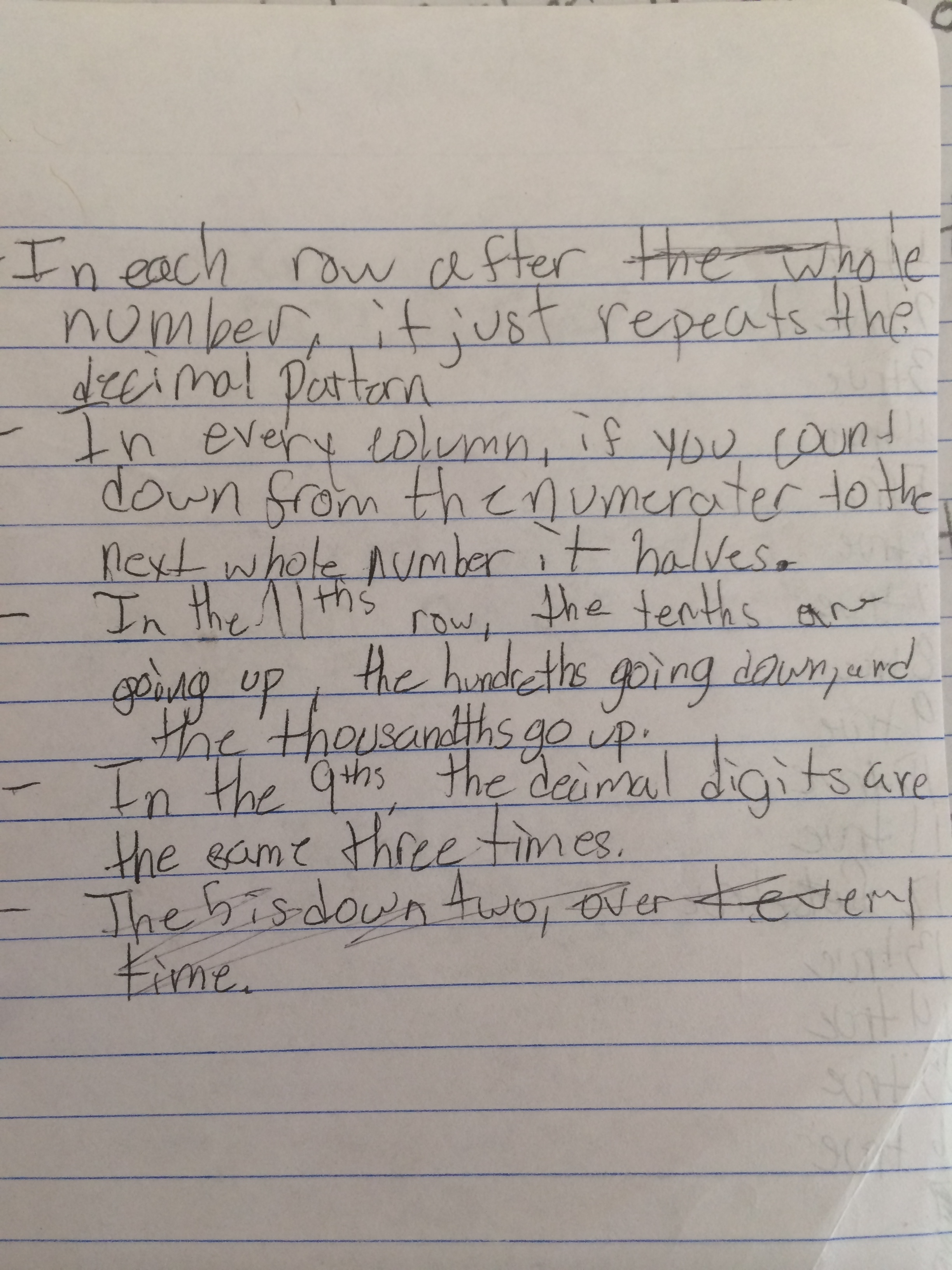
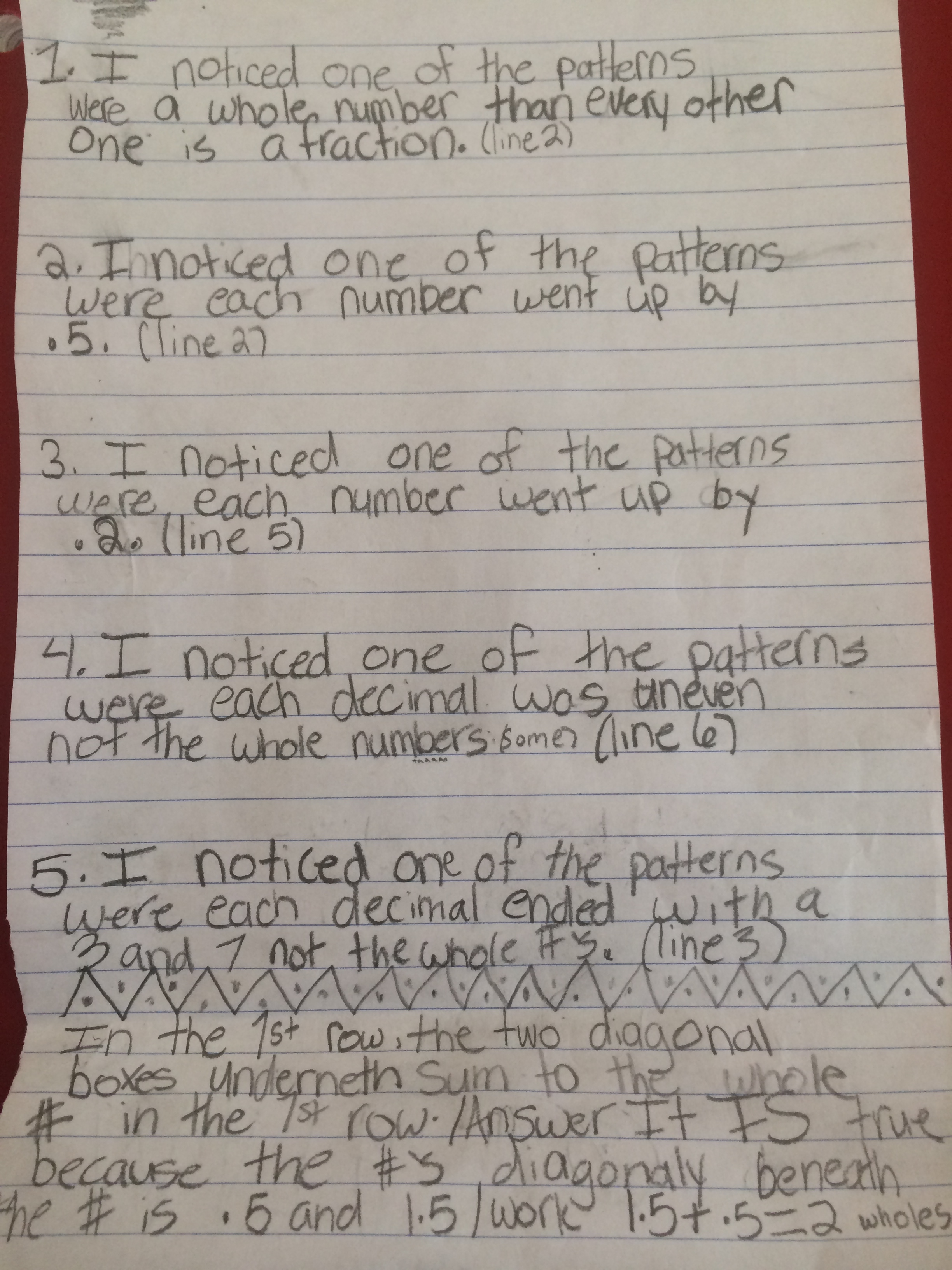
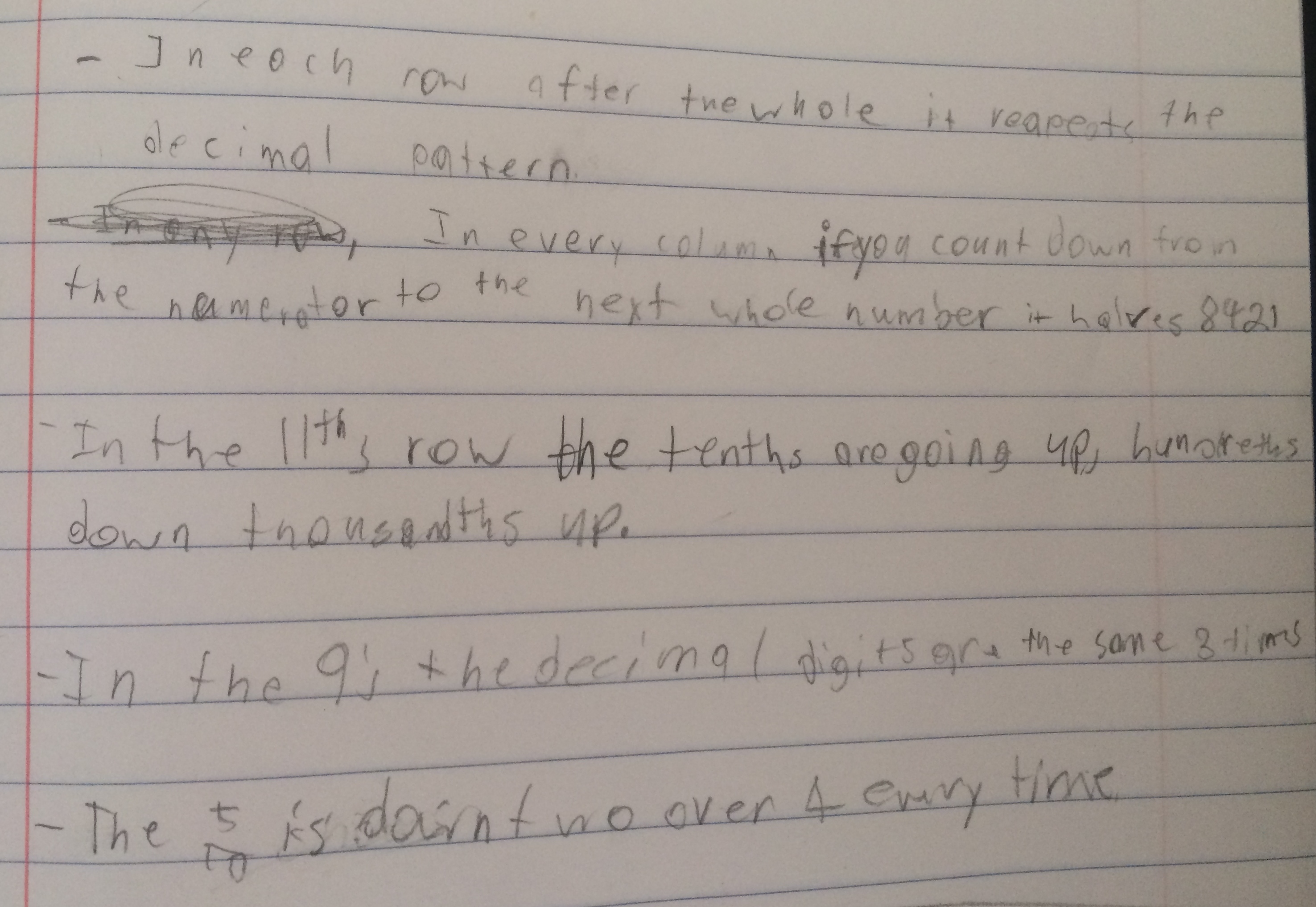
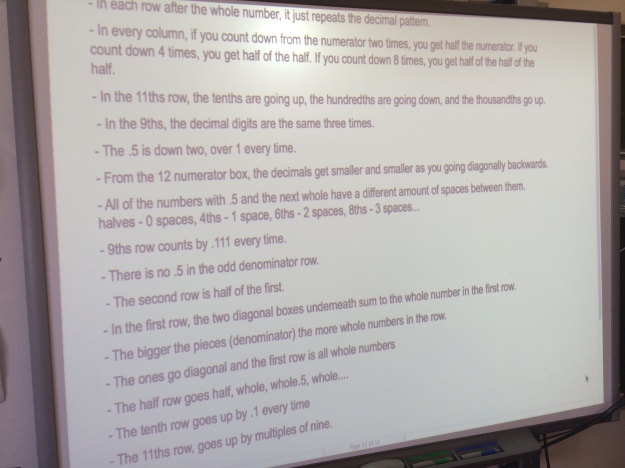
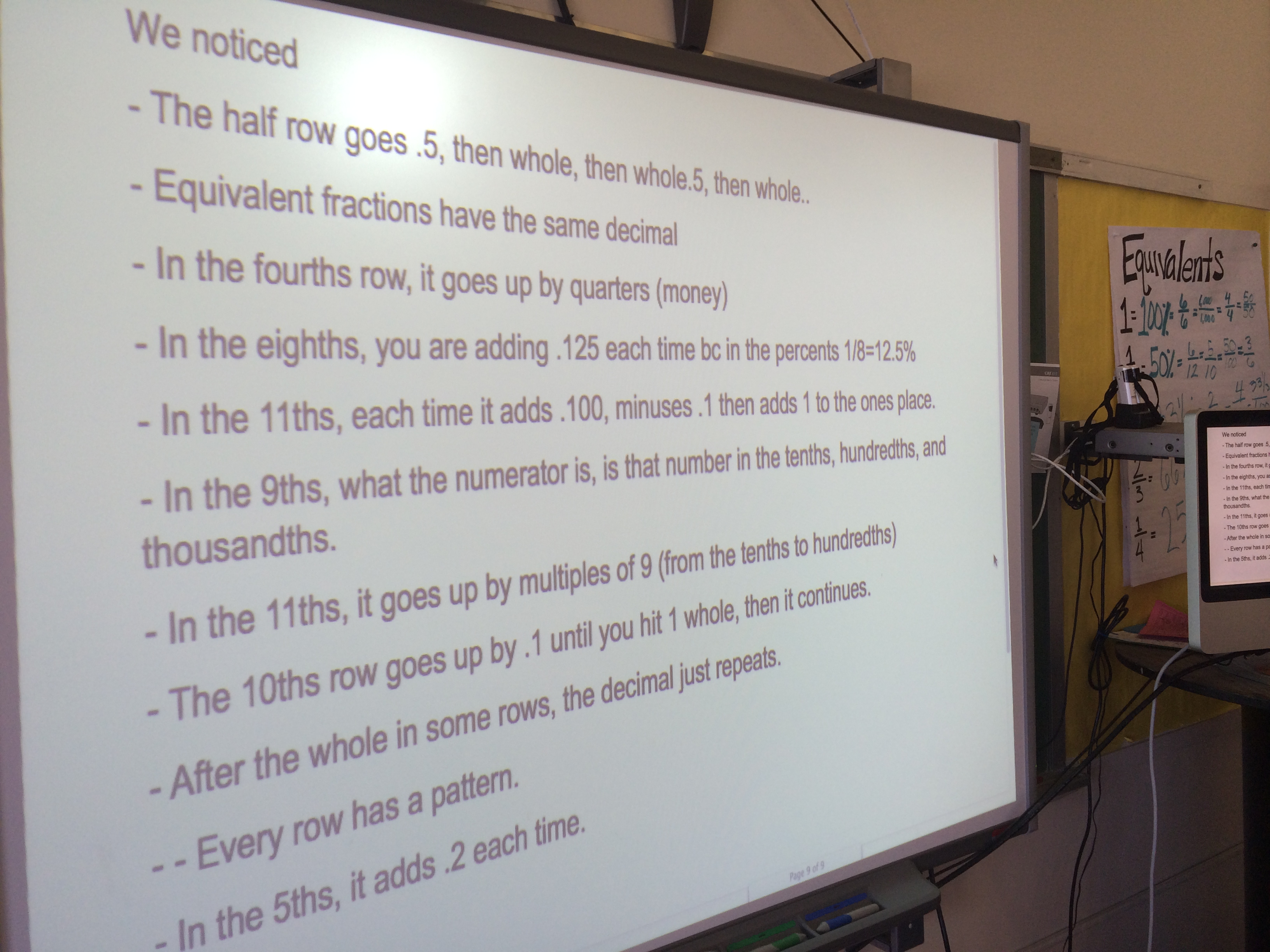
For homework, I asked the students to write at least five patterns they saw in the table, either as they were completing it or after reflecting back on it. Here are some journal entries:IMG_3662 IMG_3661  IMG_3659IMG_3660 IMG_3658 IMG_3657 IMG_3656 IMG_3655 IMG_3654 IMG_3653As a class, we came back together the next day and collected our noticings on the board:

Period 1:IMG_3605

Period 2:

IMG_3603

We had some that we agreed on, some we disagreed with and others we had to reword to make it agreeable for everyone. I found in that class period the meaning of this lesson for me…it wasn’t so much about completing the table by using division, which was my previous aversion to this lesson, but instead about finding patterns and digging into why those patterns were happening.

I would love to go through each one and tell you about our discussions, however to be honest, I have so many other things I have to get done before class tomorrow! I hope to follow up with a future post on our decimal discussions.

However I do have one thought/question I am still grappling with that I would love some thoughts on..

One student noticed that the elevenths “goes up by multiples of 9 in the tenths and hundredths.” They clarified by writing the decimals (rounded to the thousandths) on the board for us: 0.091, 0.182, 0.273, 0.364, 0.455…etc. The class could see where the multiples of 9 were showing up. Then one student noticed that the tenths was going up by one, the hundredths was going down by one, and the thousandths up by one.

At that moment, this sounded like the multiples of 9, the ones place decreasing by one and the tens place increasing by one. Now with the whole numbers you are adding a ten and taking one away to add the 9, so I see that…and for the elevenths, you are getting one more piece then tenths, so are you adding a tenth and then taking a hundredth away? Is that for the same type of reasoning? Then the thousandths? I will be busy procrastinating other work to play around with this tonight 🙂 Any thoughts welcome!

-Kristin

Why the Word “Smart” Makes My Stomach Turn…

I  used to love the word “smart.” To me, it had such positive connotations…Who doesn’t want to be thought of as smart? Who doesn’t want to think of their children as “smart”? Who doesn’t want their students leaving their classroom “smart”? Right? It is heard repeatedly in reference to students in parent conferences, PLC meetings and such. It felt like such a typical word, until now.

Over the past years, it is becoming one of my least favorite words. It literally starts to make my stomach turn. Since reading Jo Boaler and Carol Dweck’s works (http://joboaler.com/ and http://mindsetonline.com/abouttheauthor/index.html) and hearing Jo speak on numerous occasions, I have such a new perspective on the impact of the work “smart.”

I work very hard in my classroom to believe in the power of yet. There are no longer students who know something vs those who do not. It is now students who have learned something and those who have just not learned it…yet. (Great read on that:  http://www.mathsolutions.com/nl44/feature-article.html I am also trying very hard to take that perspective with teachers as well. I now am much more thoughtful in my conversations with not only my students but with colleagues/parents/administration and the impact of the words I use. I focus my words on the work, not the person. In my class, we are not “smart or not-smart”, we are all learners.

This belief that I have made part of my being as an educator was truly put to the test the other day. My students were presented with information on a program meant to help students with organization and study skills be more successful. Ok, not really what I believe makes students more successful, but they had to go, so I sat with them and listened. I could possibly write a dissertation on everything that was wrong with the presentation from my perspective, however the heart of the problem was the mindset of the person presenting.  If I had to hear the word “Smart” one more time in that 20 minutes, I was going to explode. And every time the word was used, it was in connection to grades and state test scores. As my stomach turned and knotted, I wanted to yank my entire class out of the room. I saw all of my work in trying to move every student from fixed to growth mindset slowly circling the drain.

It finally brought tears to my eyes (melodramatic, I know) when one little girl raised her hand and asked, “So do we have to have straight A’s to do this?” and the presenter responded with something to the effect of “the students in the program now are smart and have mostly straight A’s, but she understands if a “C happens sometimes.” So, this little girl who would have truly benefited from just some extra attention at school, but does not have straight A’s (whatever that really means) was deflated. What message was just sent by those words? Now does she think she is not “smart”? Now does she think she is not “smart enough” to get in? At that point I could not contain myself, I raised my hand and addressed the group, and the presenters.

I would love to quote my exact words, but I was so frustrated by that point, I do not even know the exact words that came out of my mouth. I truly was focusing on trying not to say anything rude to the presenters while making a point to the students. I can tell you it was something like this…I had to tell the group that their grades/test scores do not define them. That everyone in the room can learn, grow and improve in anything they persevere through. That I see them working hard, working together and learning every day and those things will be invaluable as they go through life. Smart is not something you are, so please do not leave here thinking it is.

After addressing the students, I left to address the adults in charge of this program. Hopefully, this will change from here…I guess if they are “Smart”, it will 🙂

A sincere thank you to the people in my PLN who have a growth mindset. I continue to learn from you every day and my students are so much better for it!

-Kristin