Category Archives: Math

#PiDay2015…Circle Fun

Some of my students this year were excited to “celebrate” pi day and were very disappointed that it fell on a Saturday, so we decided to have some pi fun on Pi Day Eve. I am not one for “gimmicky” holiday lessons and wanted whatever I decided to do, to not just be definitions of circles and their properties or a formula for how to use pi to find measurements, but instead an activity that allowed students to discover all of the cool things about circles and patterns that arise from that work.

After brainstorming with a colleague, she suggested I just have the students try to create a prefect circle. Loved it. I put out tape, scissors, rulers, paper, string and told them if they thought of other tools they wanted to use, they had to pass my approval first (I wanted to keep the protractors and compasses out of the equation for right now). Off they went! It was soooo interesting to see all of the great approaches and all of the cool ideas that emerged from their work.

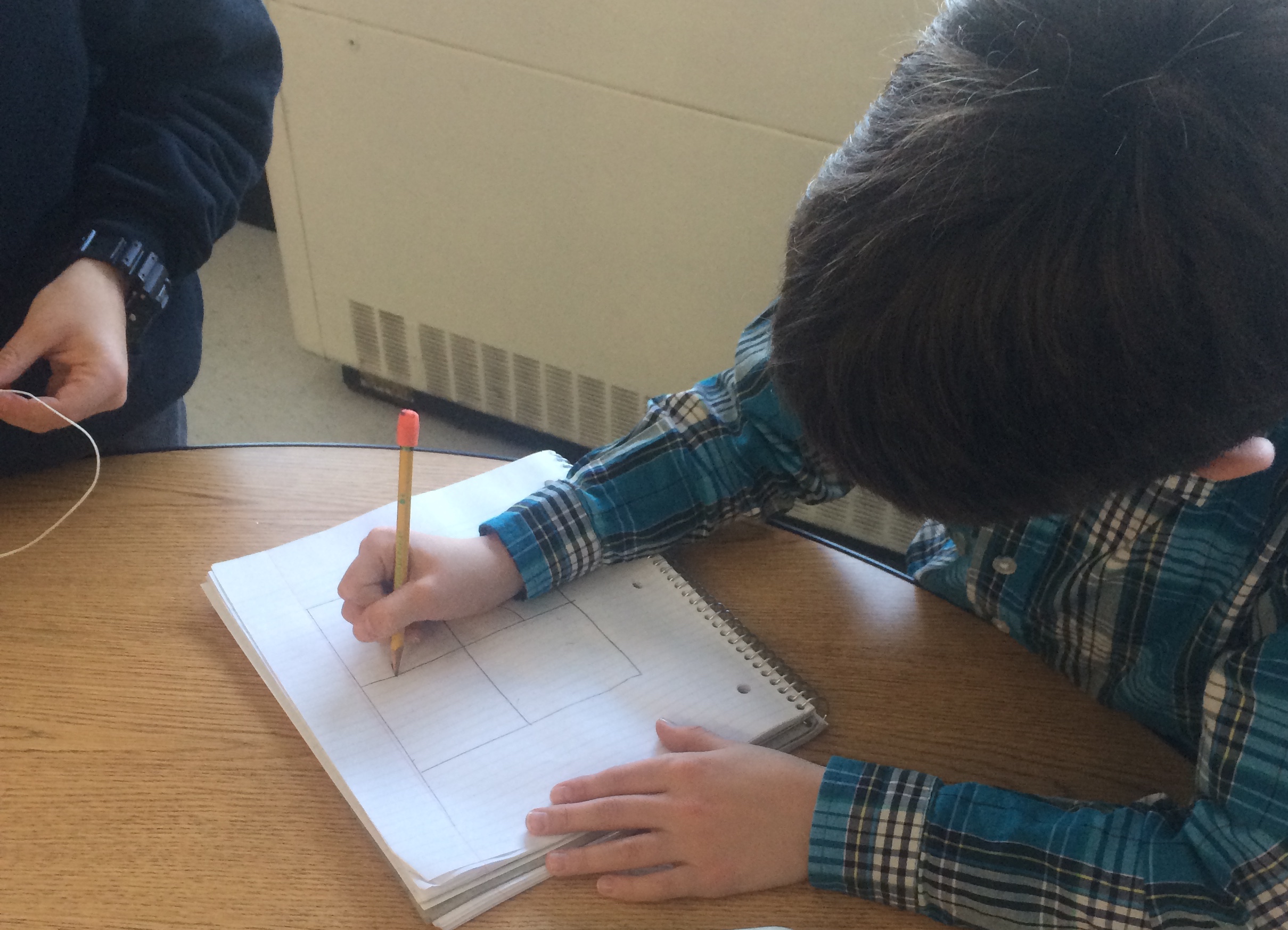
I found it so interesting that quite a few first drew a square and tried to find the center. They said they knew that the circle could be made inside of it because a circle is 360 degrees and each angle of the crossed lines was 90. The problem became figuring out how to get the “rounded edges to be the same.”

IMG_9519_2 IMG_9520_2

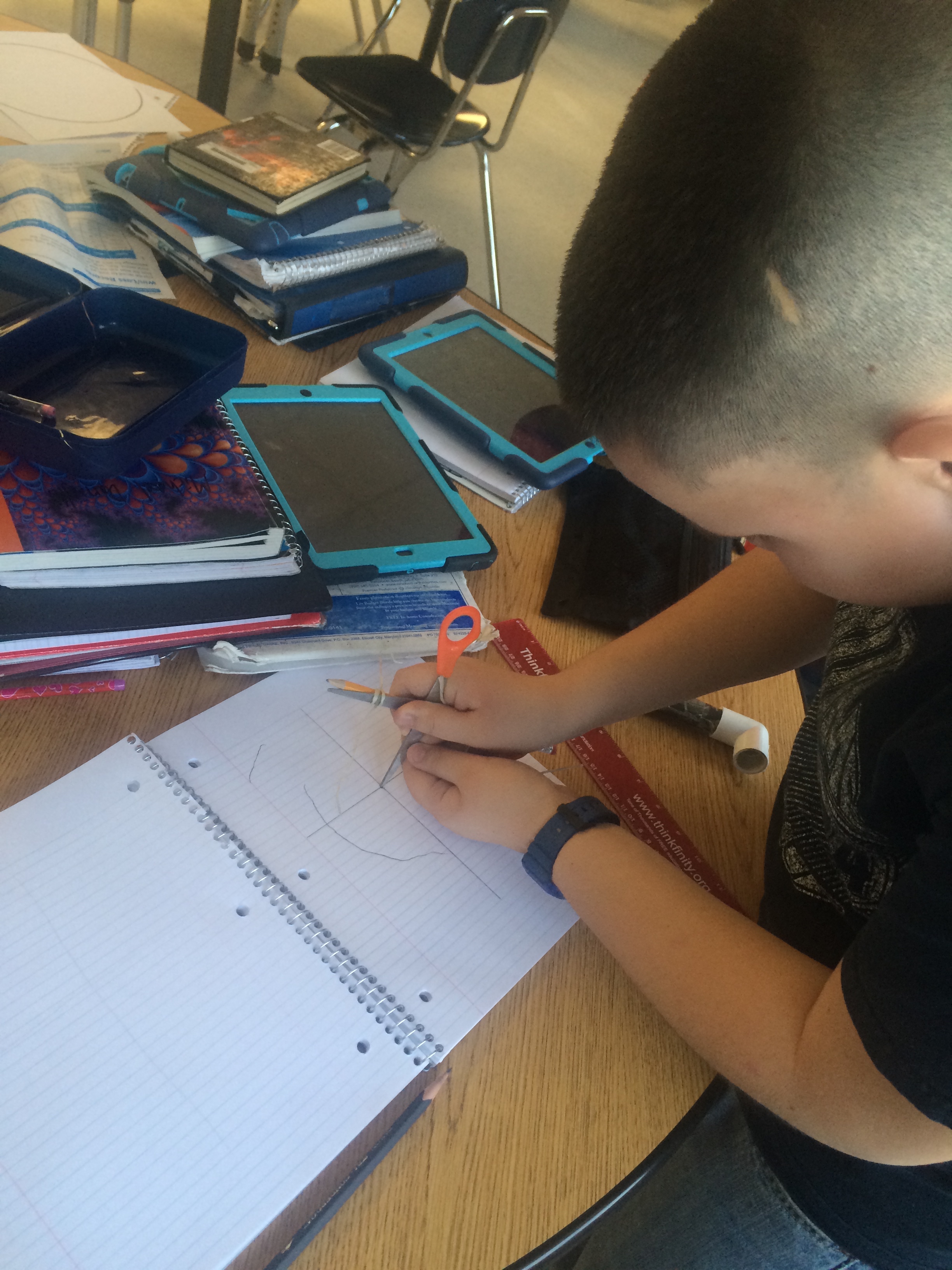
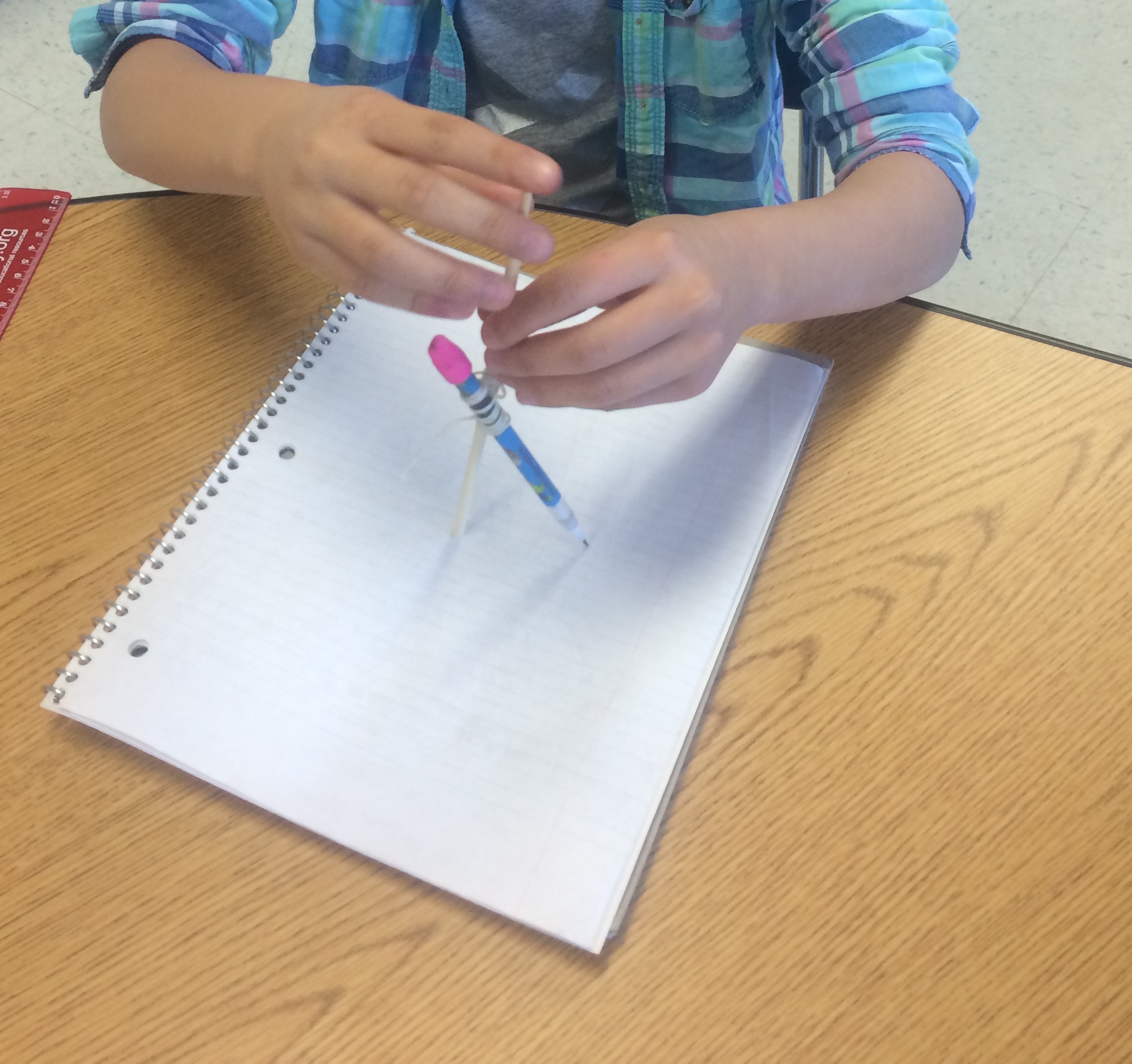
Quite a few groups had seen a compass before (but didn’t know what it was called) and tried to recreate one with the available tools. Some started from finding a center and going from there, while others created the center by just placing the scissors on the paper and going around from there. After many attempts, they were starting to realize how important keeping that constant distance in the scissor opening really was.

IMG_9528_2 IMG_9532_2

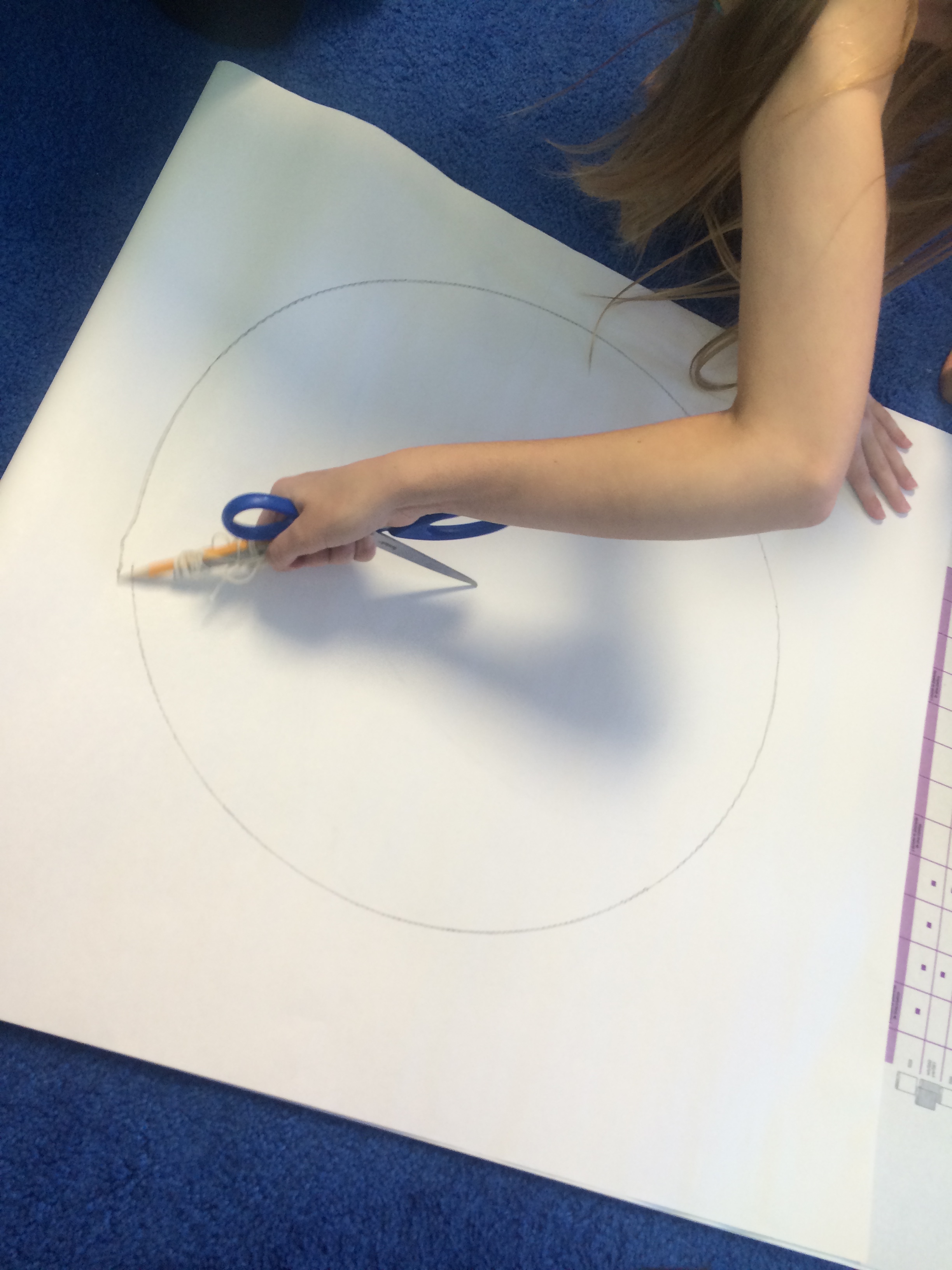
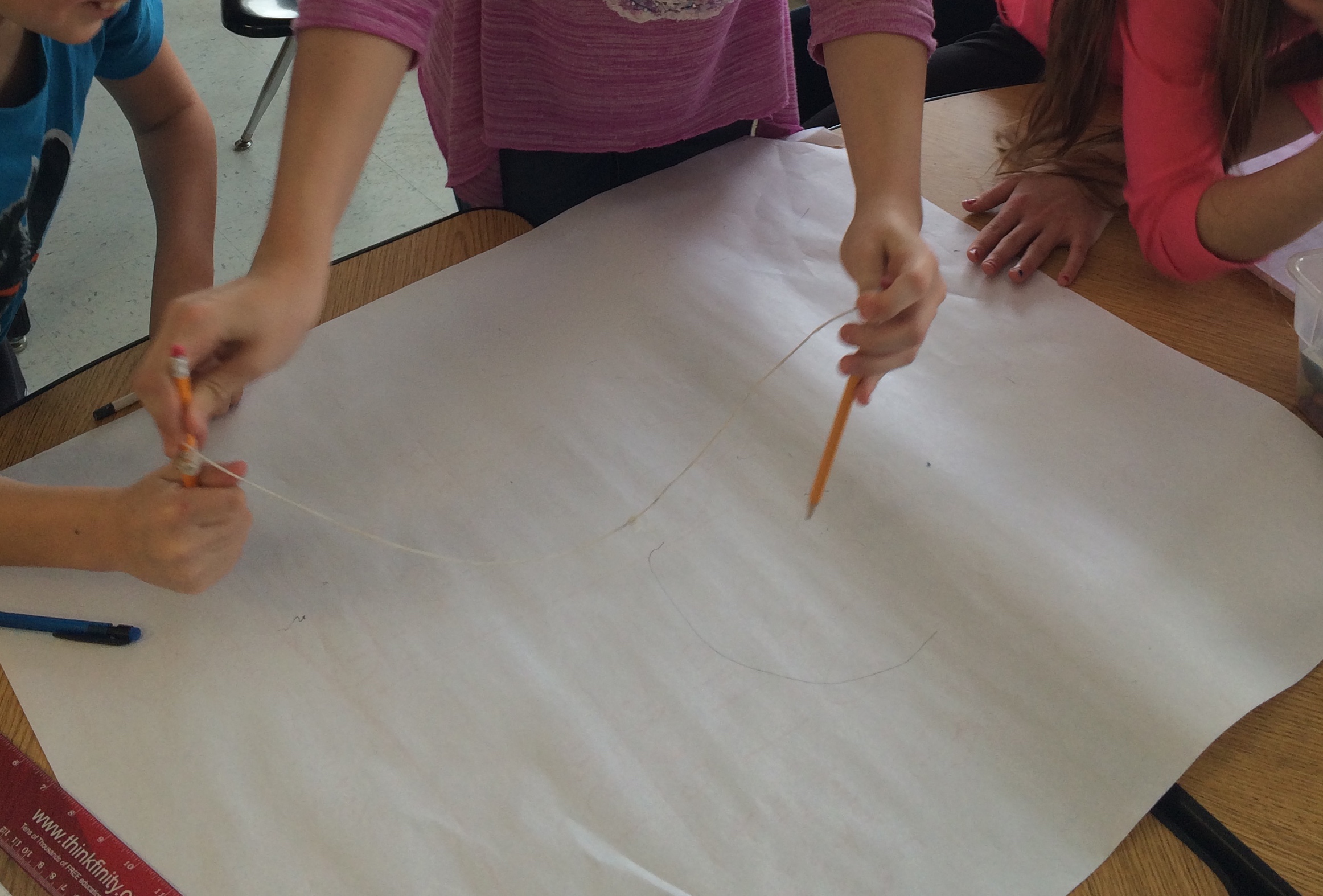
To solve the constant distance problem, one group used tape to keep it the same while another group used string (and chopsticks she just happened to have in her lunchbox that day:).

IMG_9582_2IMG_9517_2

This group solved the constant distance with two pencils attached with string. The funniest part of this one were the trials as the string kept wrapping around the center pencil as they went around and never meeting exactly back at the start. They eventually figured it out after blaming the “center holder” numerous time for “moving the pencil.” Another group kept a constant distance by taping their string to the center of their paper and putting a pencil on the other end.

IMG_9573_2IMG_9584_2

This group created a center from overlapping rulers and attempted to put string around the the ruler corners to make an arc, but couldn’t agree with how to get them all the same. While another group tried to use the ruler ends as the center but ran into the same problem with the rounded edges.

IMG_9570_2IMG_9574_2

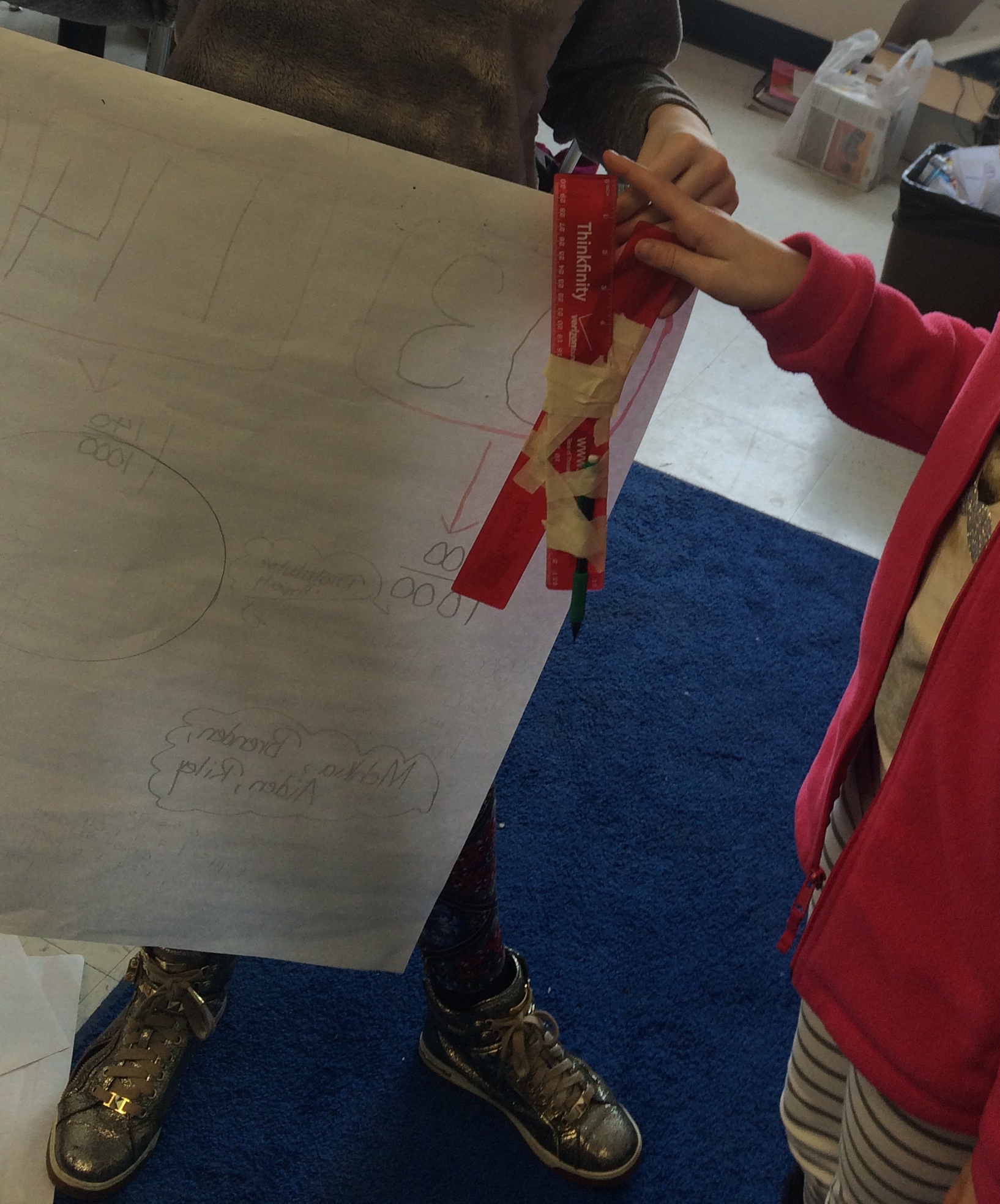
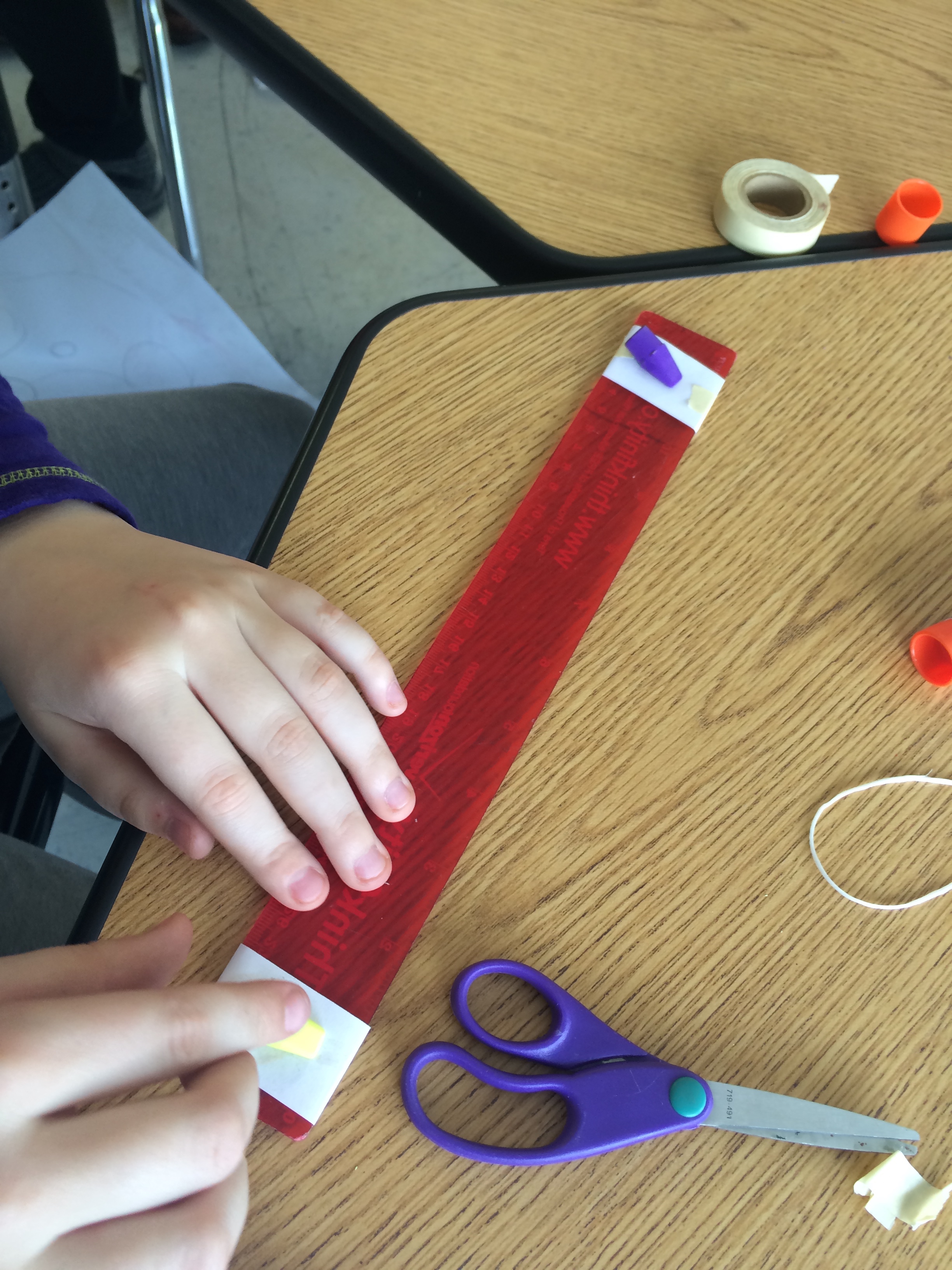
This idea was interesting to watch evolve. She had seen the group on the floor (in the pic above) and said she realized that any rectangle rotated would make a circle. She then grabbed a ruler, taped two cap erasers to each end and thought the caps would leave eraser marks she could go back and trace after rotating the ruler. That didn’t work, no marks. She then cut her pencil to get some lead and taped that to one end.

IMG_9580_2 IMG_9581_2

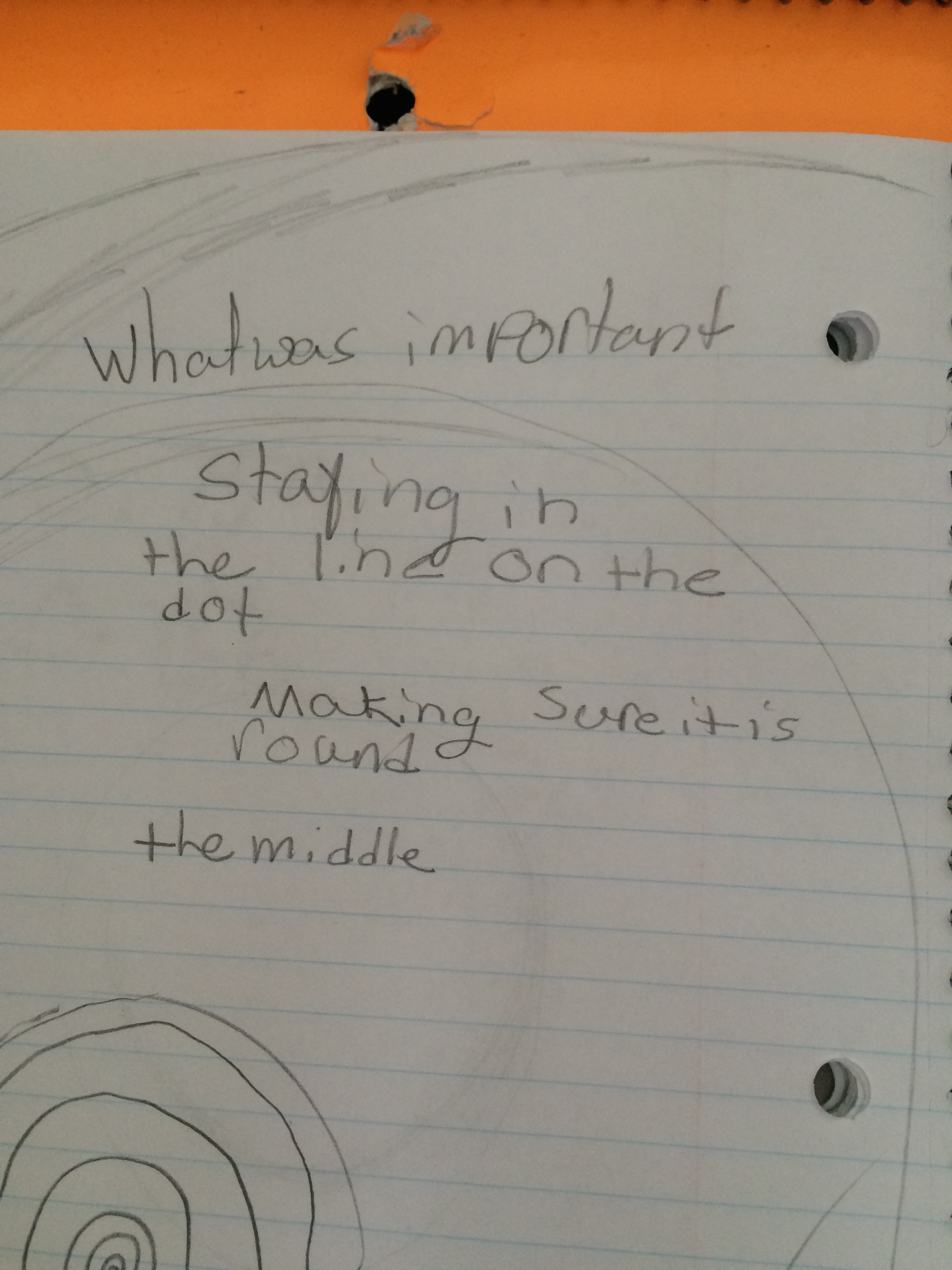
The final product…..IMG_9586_2 After sharing their circles and approaches, I had the students jot down some things that were important when constructing their circles.

IMG_9588 IMG_9589 IMG_9565_2 IMG_9569_2IMG_9590

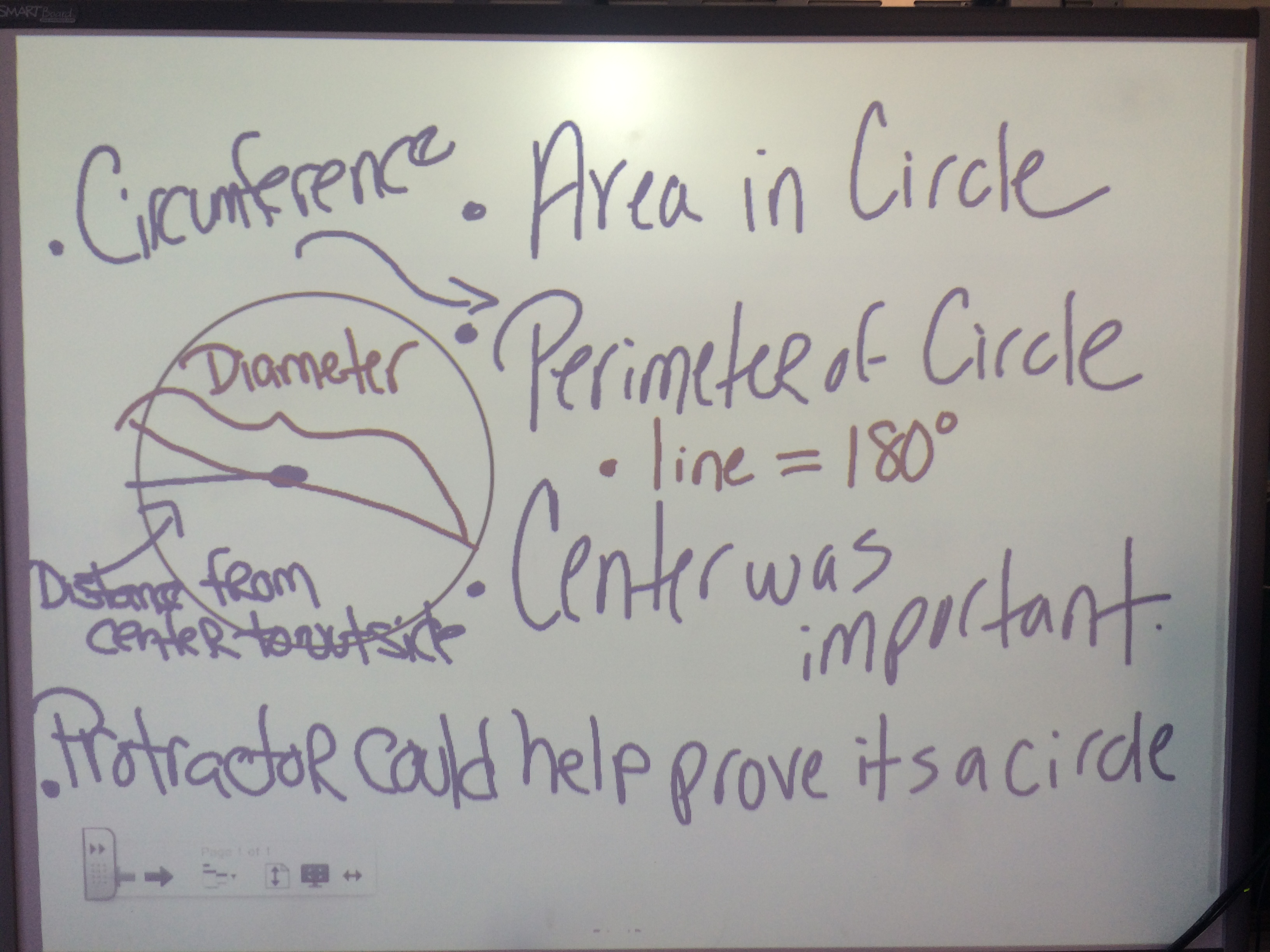
From these, I realized (and was surprised) the students have some circle vocabulary in their toolbox. I decided to get that out so we could be sure everyone in the class had exposure to all of this great stuff. I asked them to share their findings and what measurements they used or could find in their circle.

IMG_9535_2One group had finished their circle early, so I asked them to find some of these measurements. They found the diameter and circumference with the ruler and string they had used in the construction. It was so interesting to see the intuition students have around finding the diameter. They knew it had to go through the center and that no matter where they measured from, it would be the same. It makes me wonder why we, as teachers, sometimes think that we need to give students definitions for things before they get to demonstrate their intuition around these very ideas. I could have told them “diameter is distance across the circle through the center” before the lesson started, but they already knew that, love it.

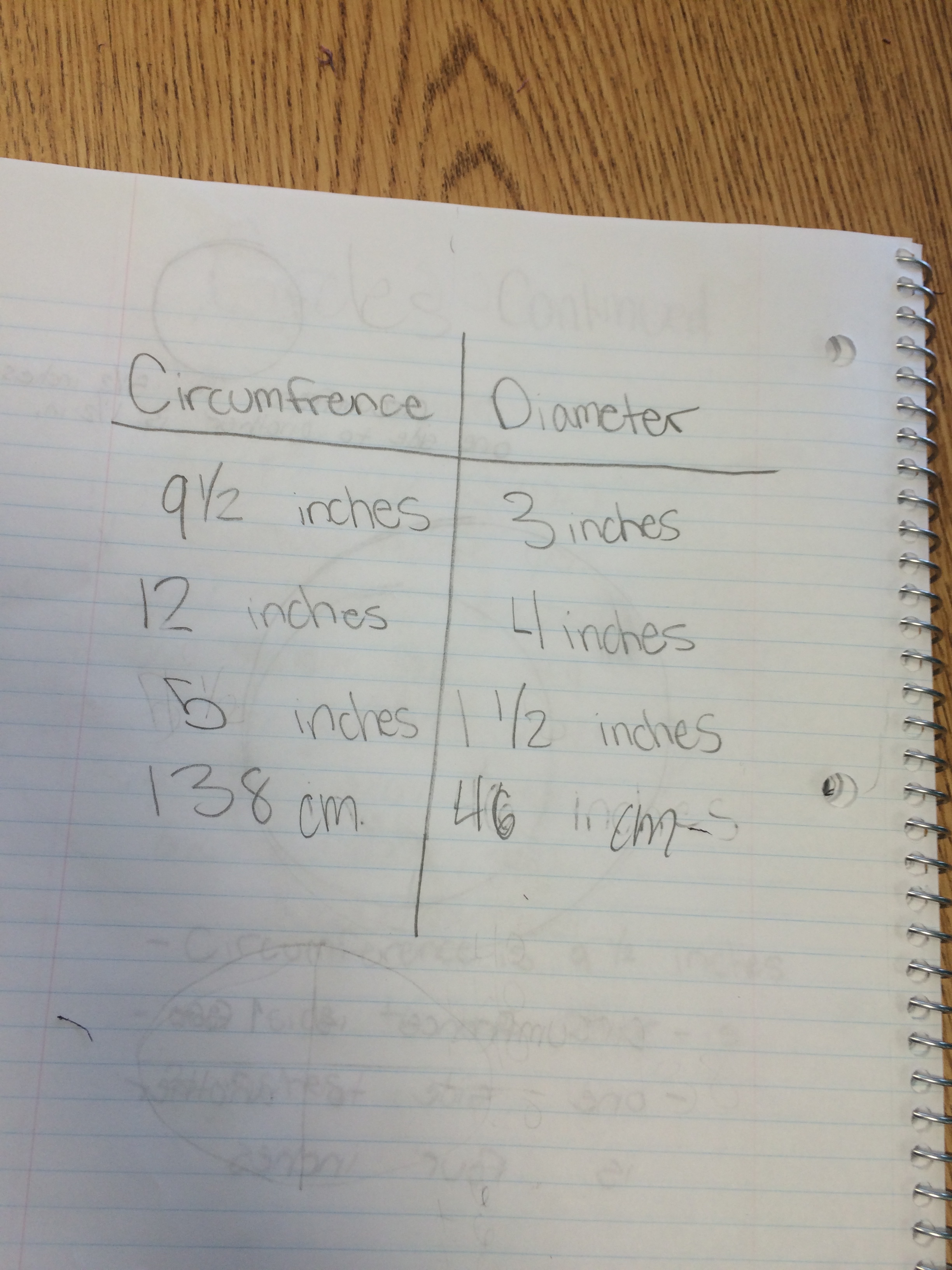
After testing a few circles, this group started to see pi emerge…

IMG_9563_2 IMG_9564_2 IMG_9562_2For the the last circle in this list, they measured the diameter of their large circle they created and I asked them to estimate the circumference. After seeing that each circumference was “about 3 times as much,” they estimated 46 x 3 to be circumference. They haven’t had a chance to test it on the actual circle yet because we ran out of time, but that will be some fun on Monday!

Happy Pi Day 2015!

-Kristin
Fractions as Division…Say What?

Last year I learned to appreciate the Investigations lesson in which students explore fractions as division in a Division Table: https://mathmindsblog.wordpress.com/2014/03/18/fraction-to-decimal-division-table-noticings/. However, as I was planning this year, I thought I really missed the mark in making it an explicit understanding that fractions represent division before exploring this table. I think I completely just assumed that students understood this from previous years and investigations with sharing situations involving fractional answers. I decided to check it out this year to see what they students knew/understood before beginning the division table work. I thought it could make some really nice connections evident.

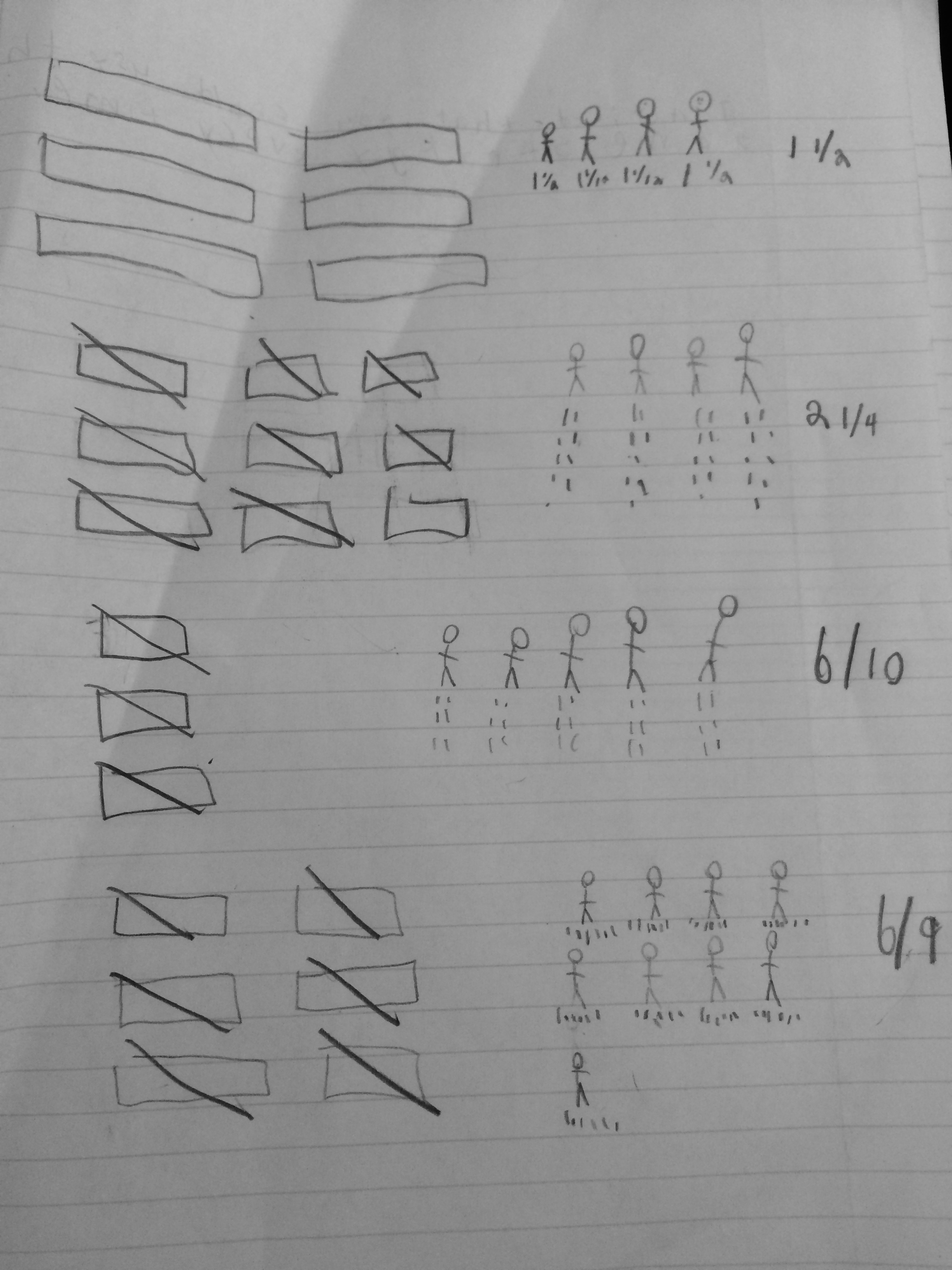
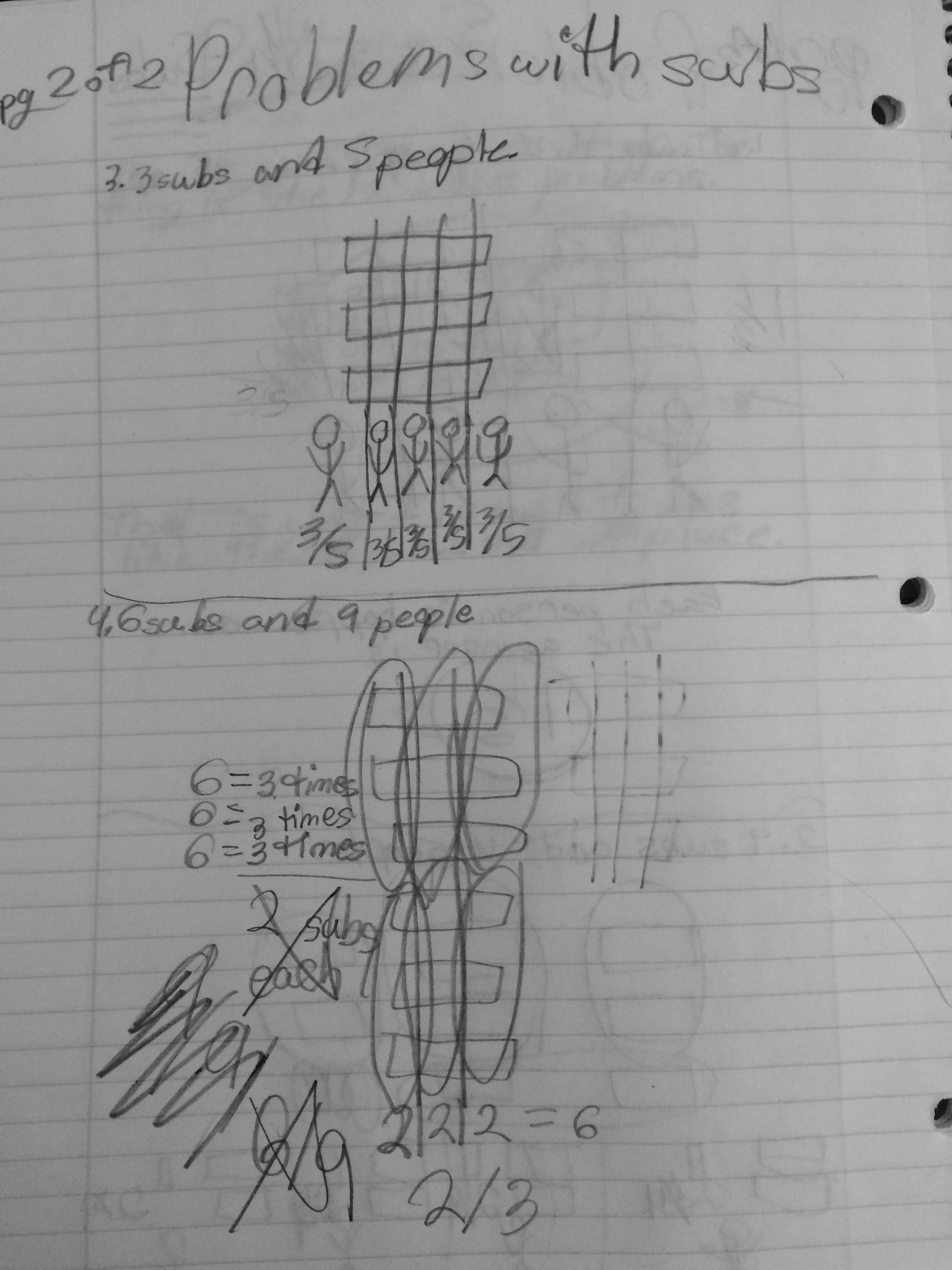
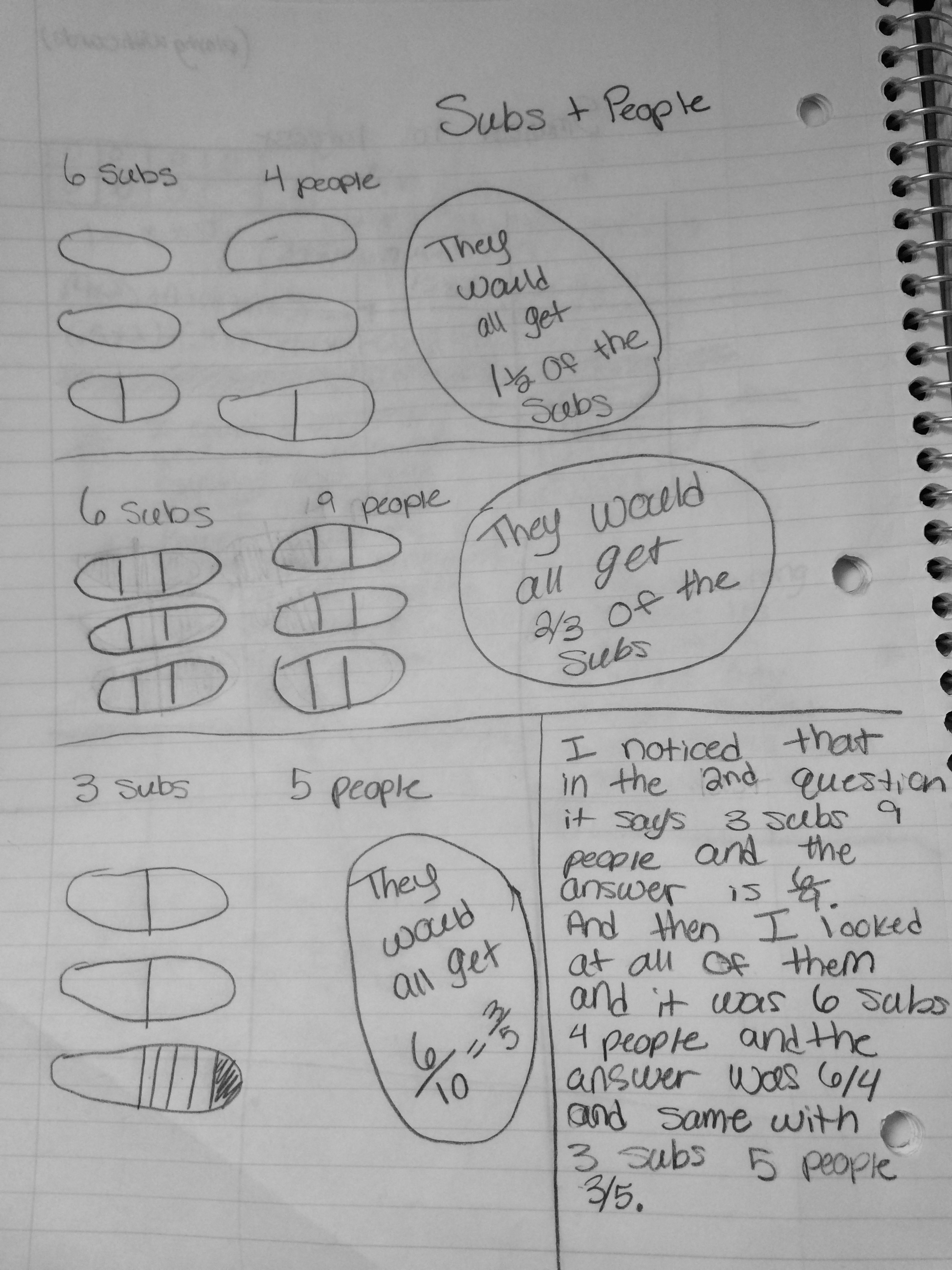
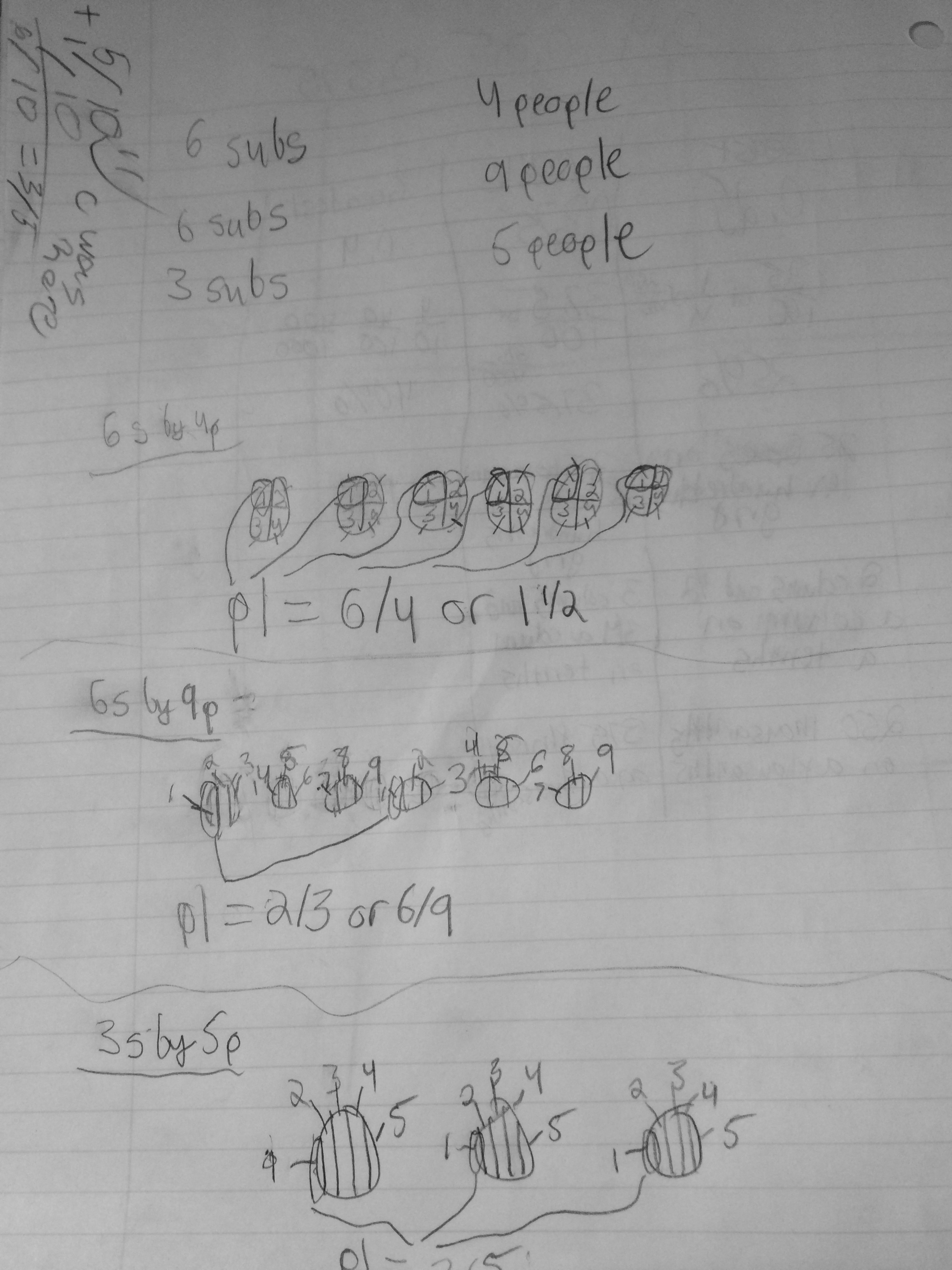
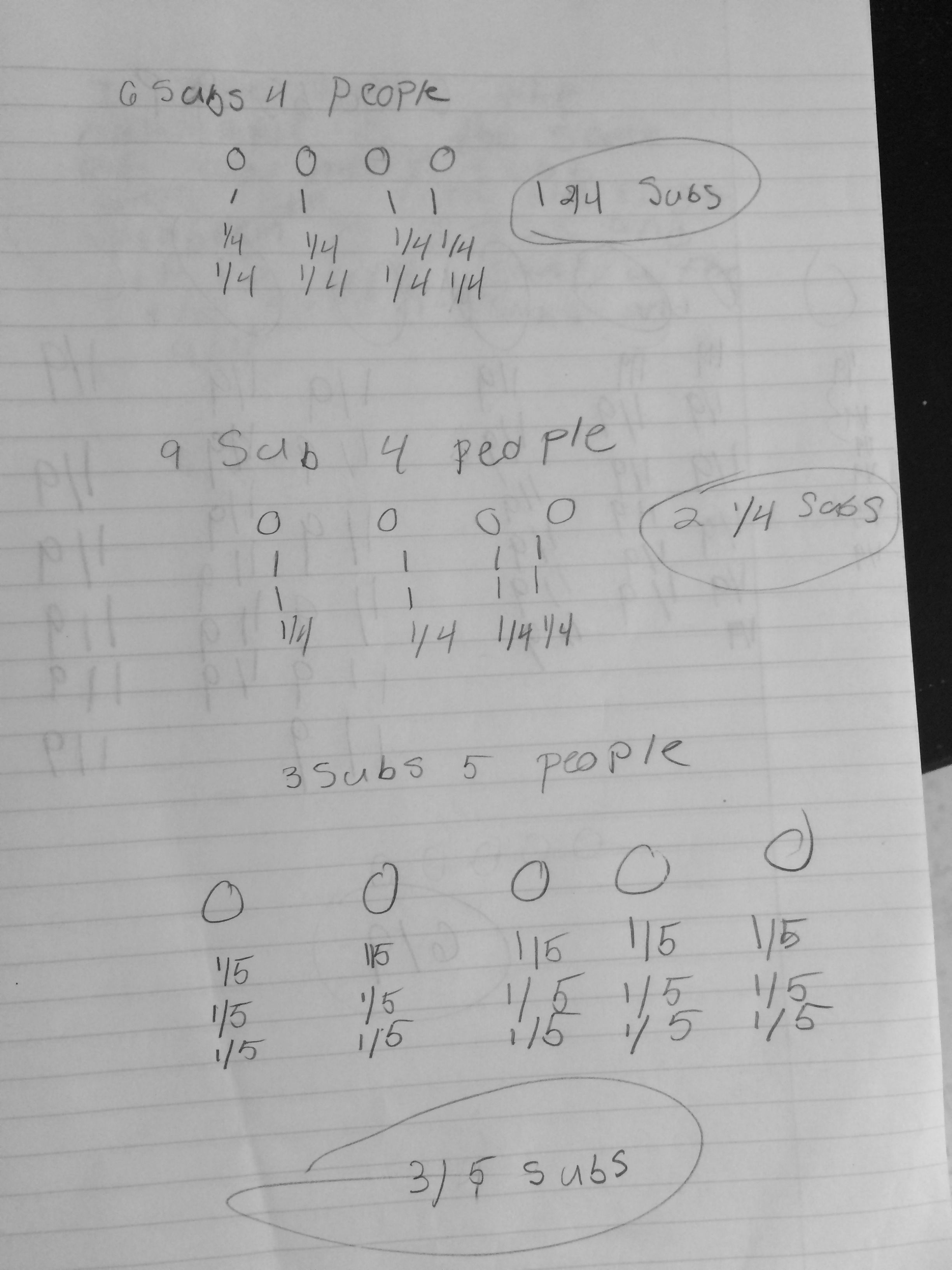
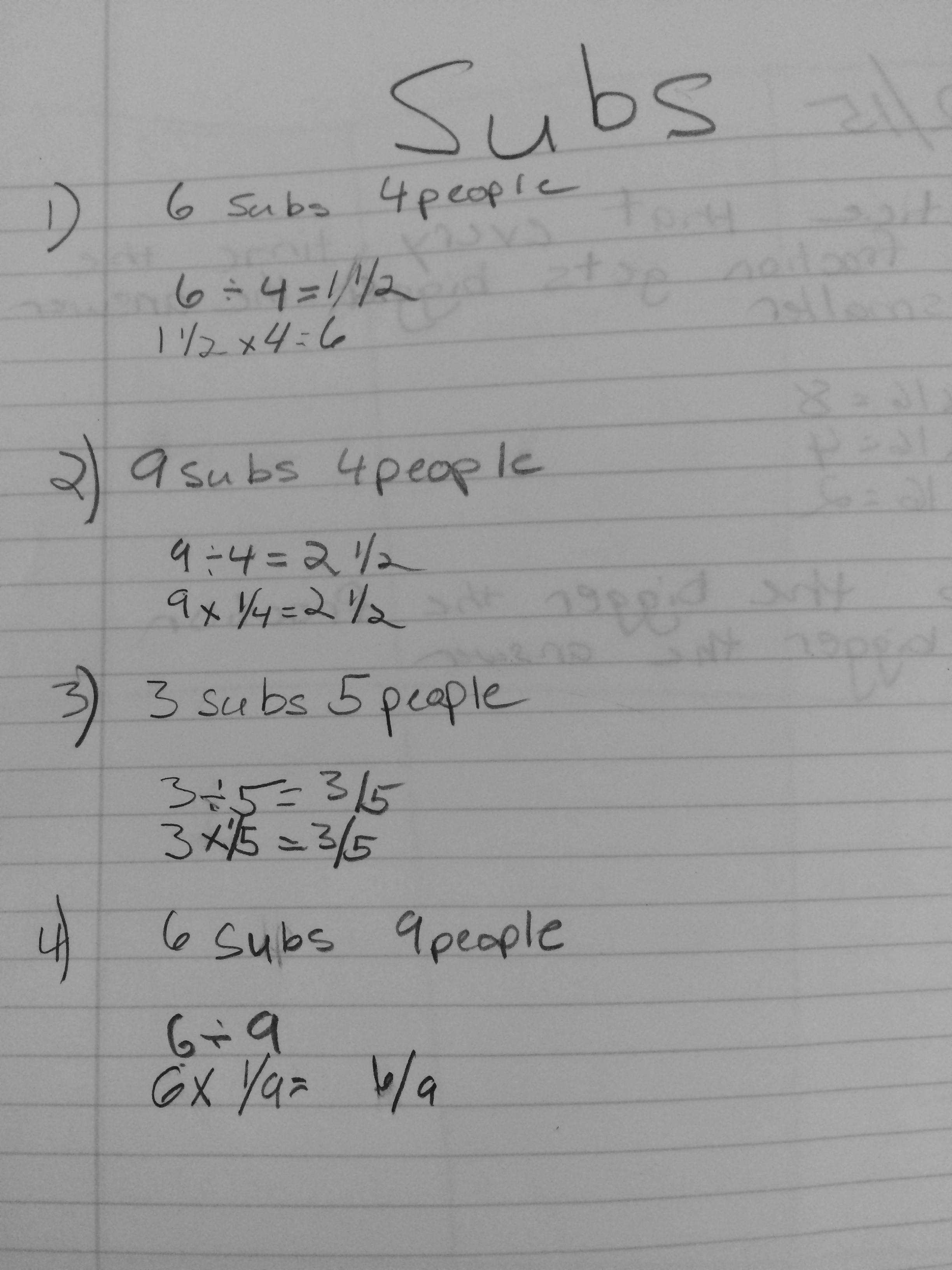
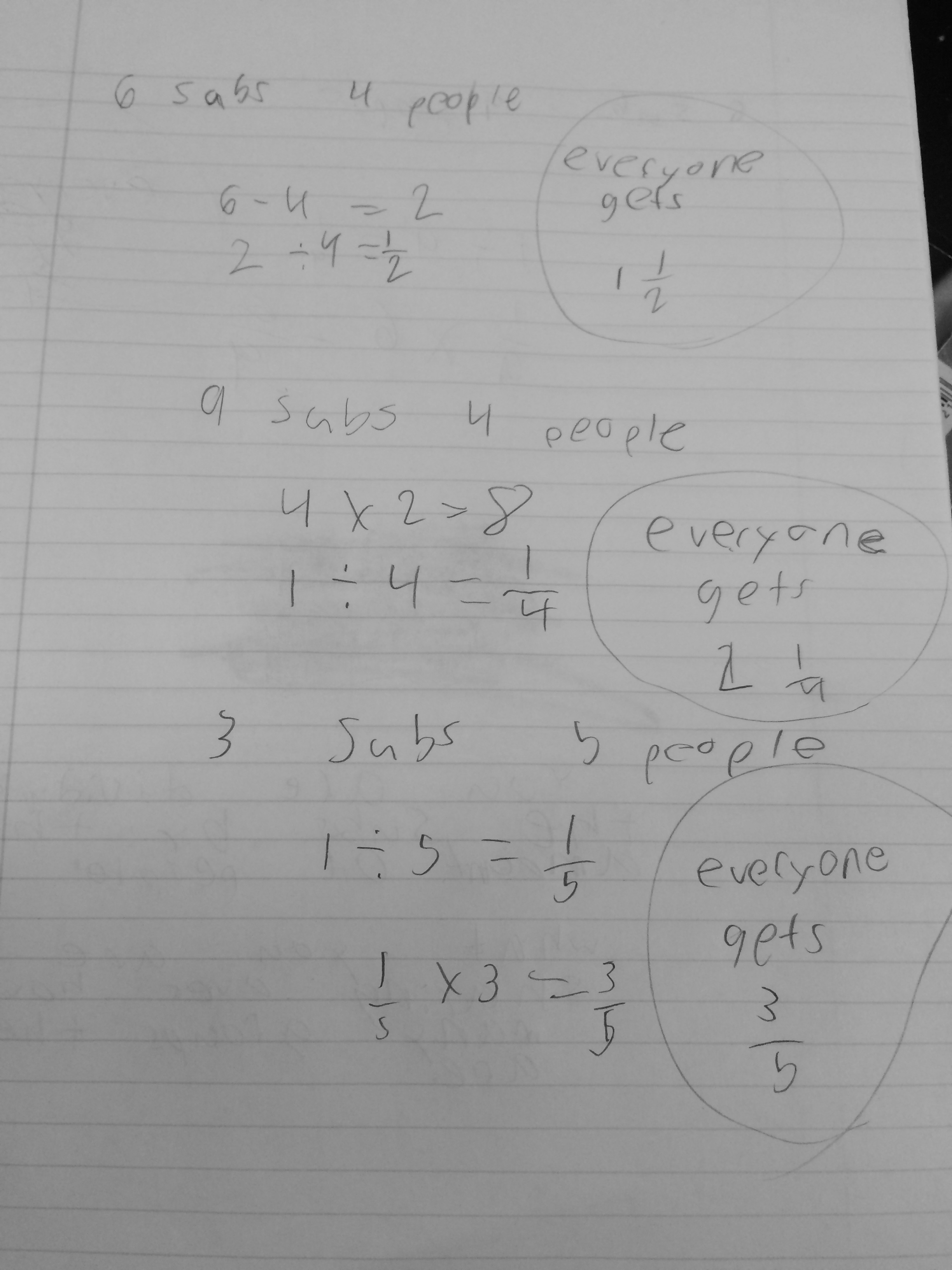
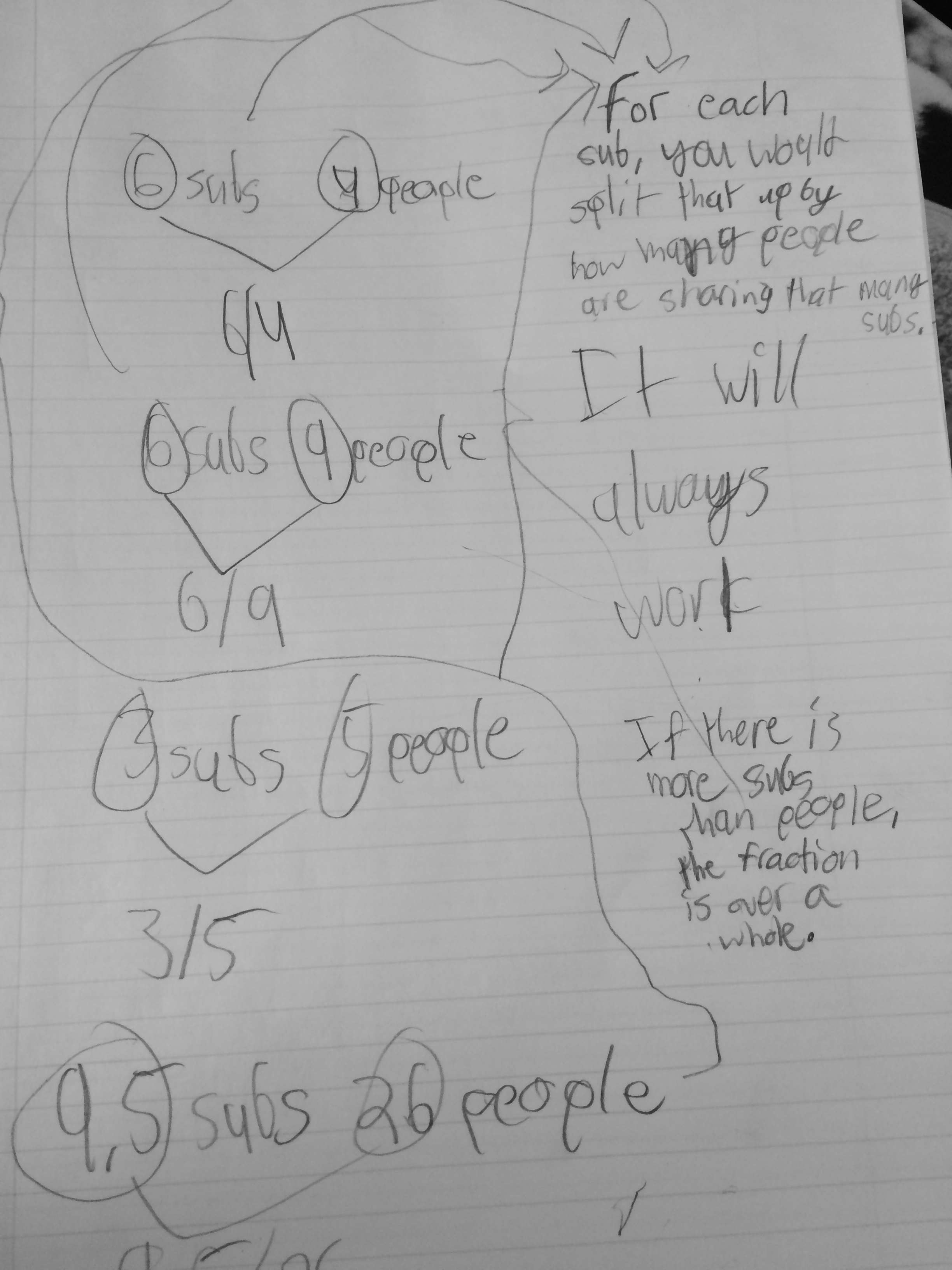
I started by putting a few sharing problem on the board: 6 subs shared by 4 people, 9 subs shared by 4 people, 3 subs shared by 5 people, and 6 subs shared by 9 people. I asked how much each person would get if they shared the subs equally.  I gave the students some individual time to work through the problems and, after that, an opportunity to share their answers and strategies with their group.  In the majority of the class, I saw the work I had anticipated based on their third grade brownie sharing work in Investigations. A lot of drawing of subs, people, and “passing out” of the pieces.

IMG_9370  IMG_9371

IMG_9382  IMG_9380

IMG_9374

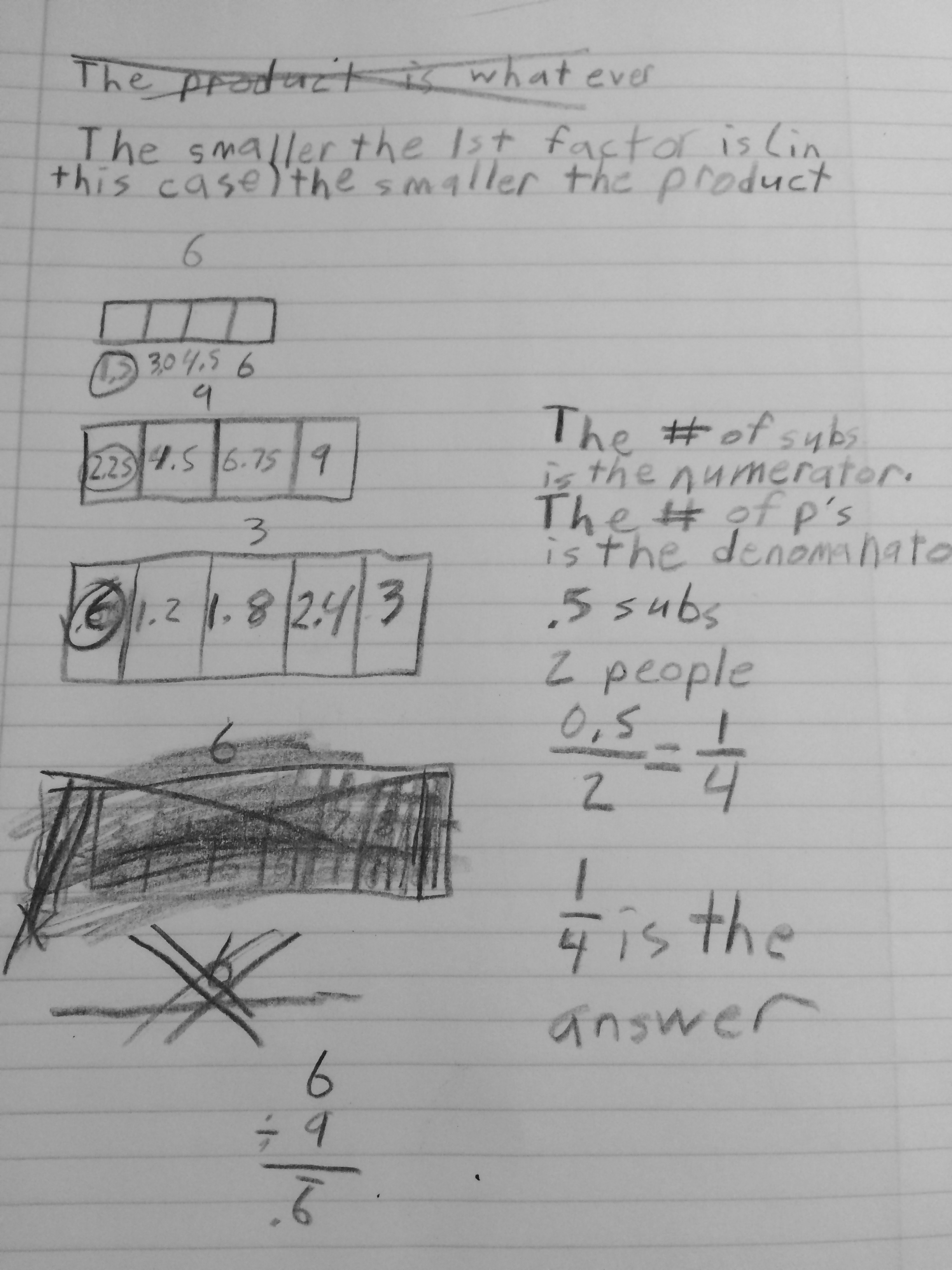
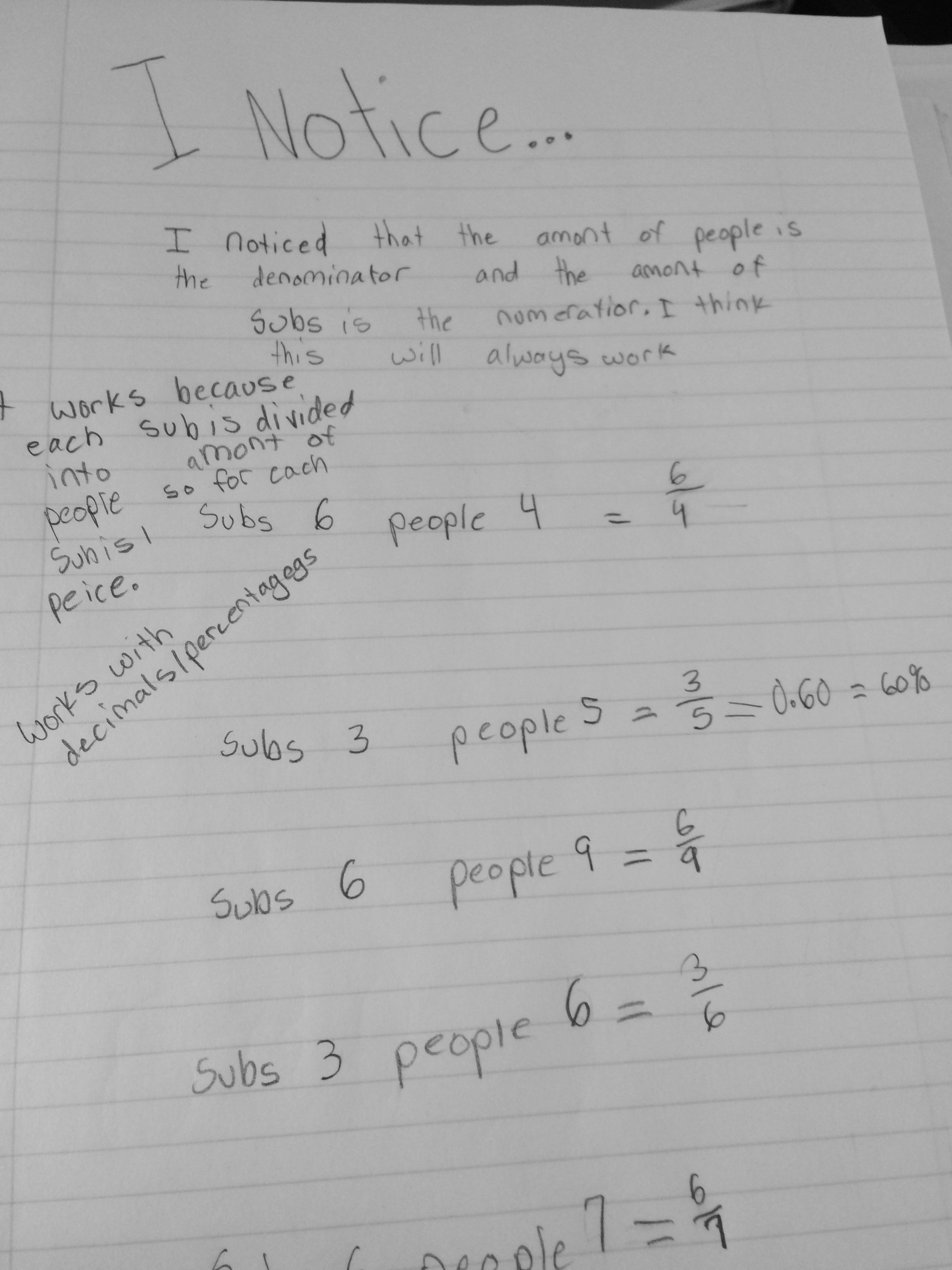
One student thought about the whole being the number of subs, divided it into the number of people sharing and arrived at decimals, however struggled when he got to the 6 shared by 9. (The side written piece is after I asked them to write what they noticed and then he proved it worked with fractional subs to start).

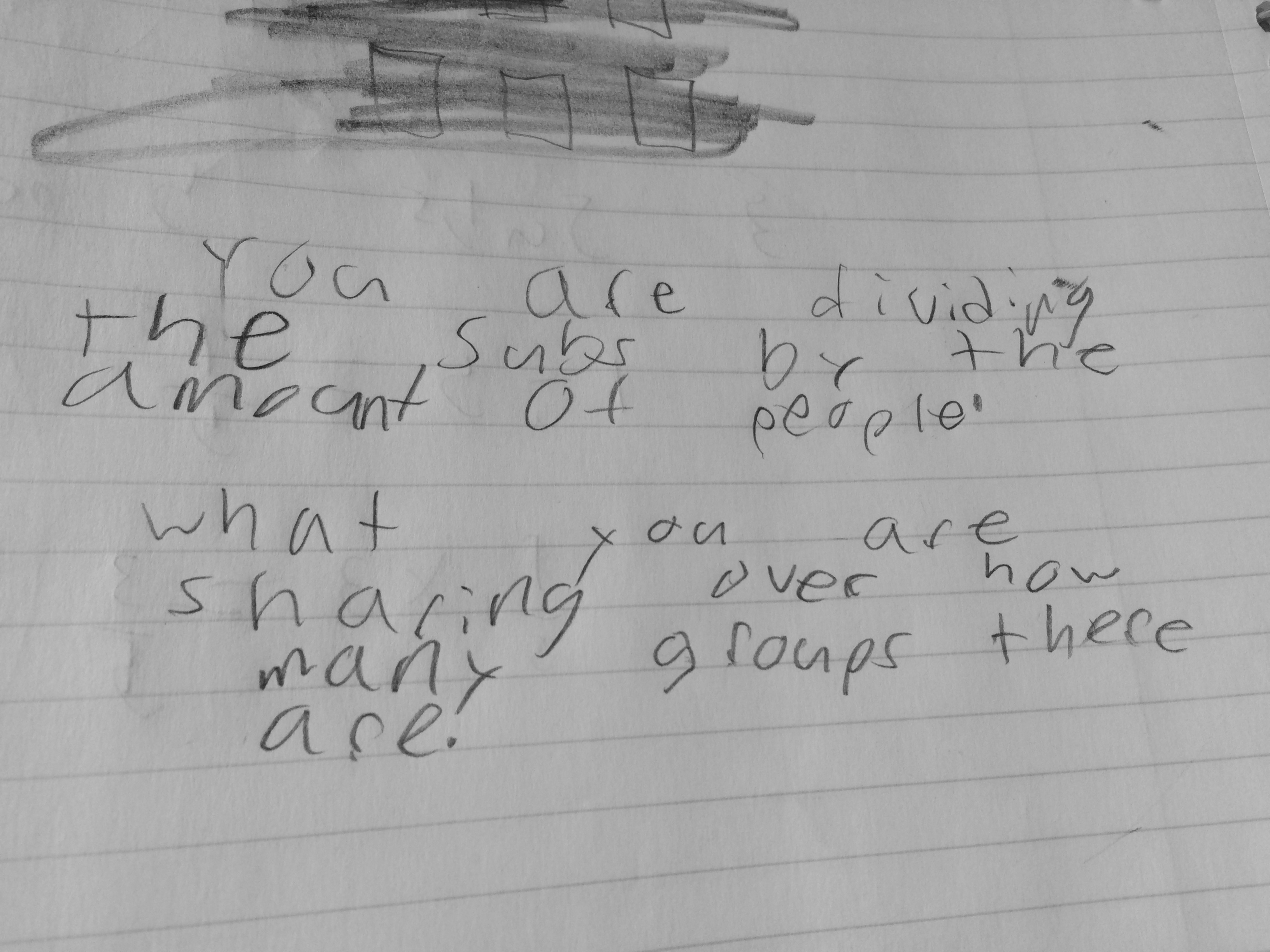
IMG_9375I had a few students that provided the perfect transition between the visual drawings and the fraction being division. They intuitively wrote the problem as a division problem and solved it using what they know about multiplication. After sharing some of the visual representations, I had these students share their equations. They explained to the class that is felt like division because they were dividing it up among people.

IMG_9369    IMG_9377

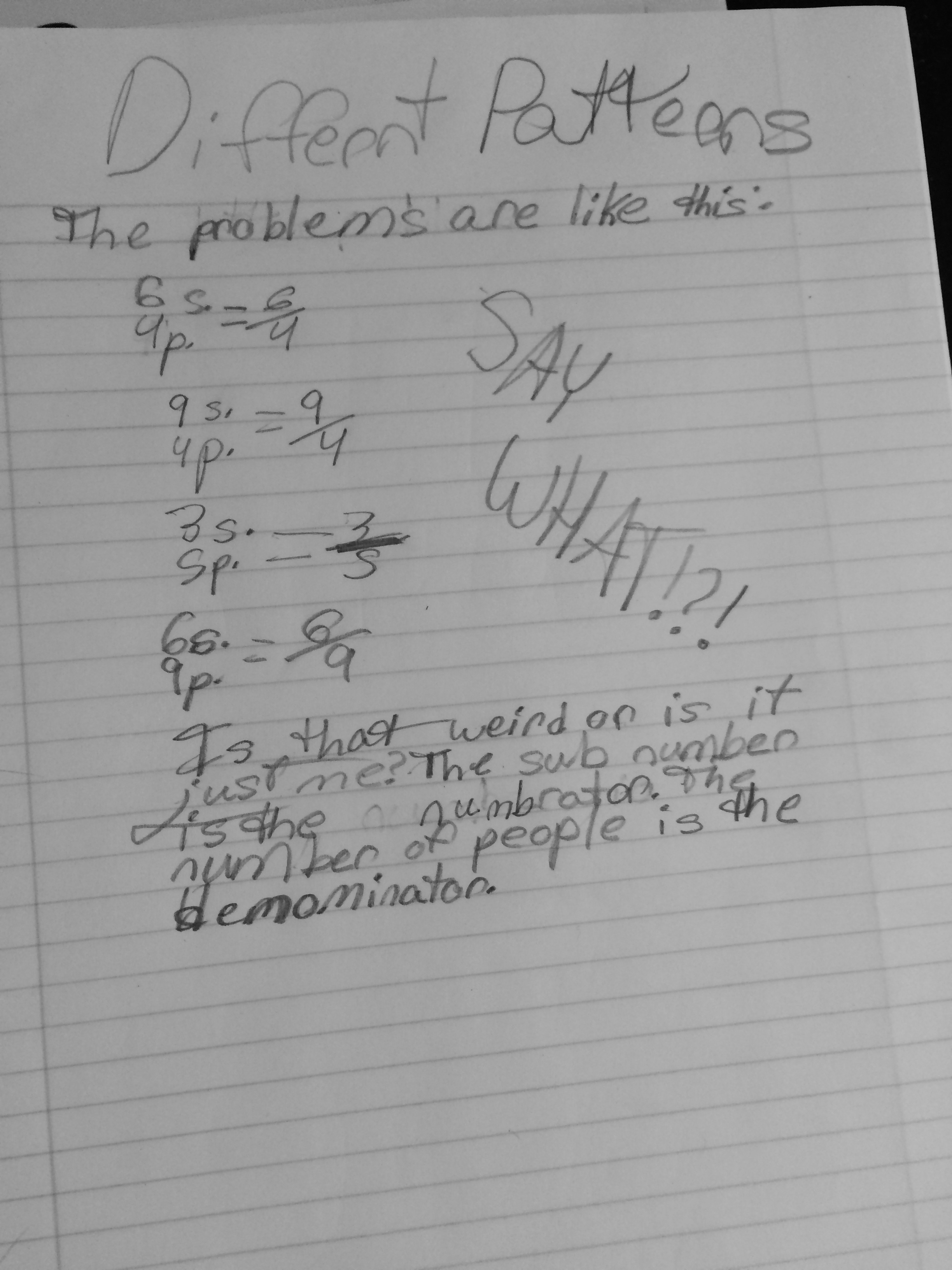
After our sharing, I revisited the original problems, with the students proven answers, and ask them to write what they noticed about the problems. After a few moments, I heard so many “Oh My Gosh”s and “It was really that easy”s echoing about the room. One student exclaimed, “Why did I do all of that work?” pointing to his beautiful sub and people drawings.

Here are some of their noticings (I love that they automatically start proving it to see if will always work without me even asking anymore).

IMG_9381  IMG_9379

IMG_9378

This one just absolutely cracked my up and proved once again that I cannot make assumptions about student understandings….

IMG_9372From this point, we tested out a bunch, talked about why it will always work and then starting looking at representing our “benchmark” answers as decimals. Tomorrow, I feel great knowing we will start looking into the division table with a deeper understanding of fractions as division. The word “explicit” sometimes makes me cringe in the way of “telling” students things, however I feel in this case the understanding of fractions as division was made explicit to the students through their own work group sharing and noticing today. I think that may be the piece I have missed before… I assumed they knew and could arrive at an answer, however never made the idea explicit as a whole group.

Today was a great day in math…Say What?

-Kristin
Fractions As the Denominator

As I was organizing my student work pictures this morning, I realized I had tweeted out this awesome work, but never blogged about it.

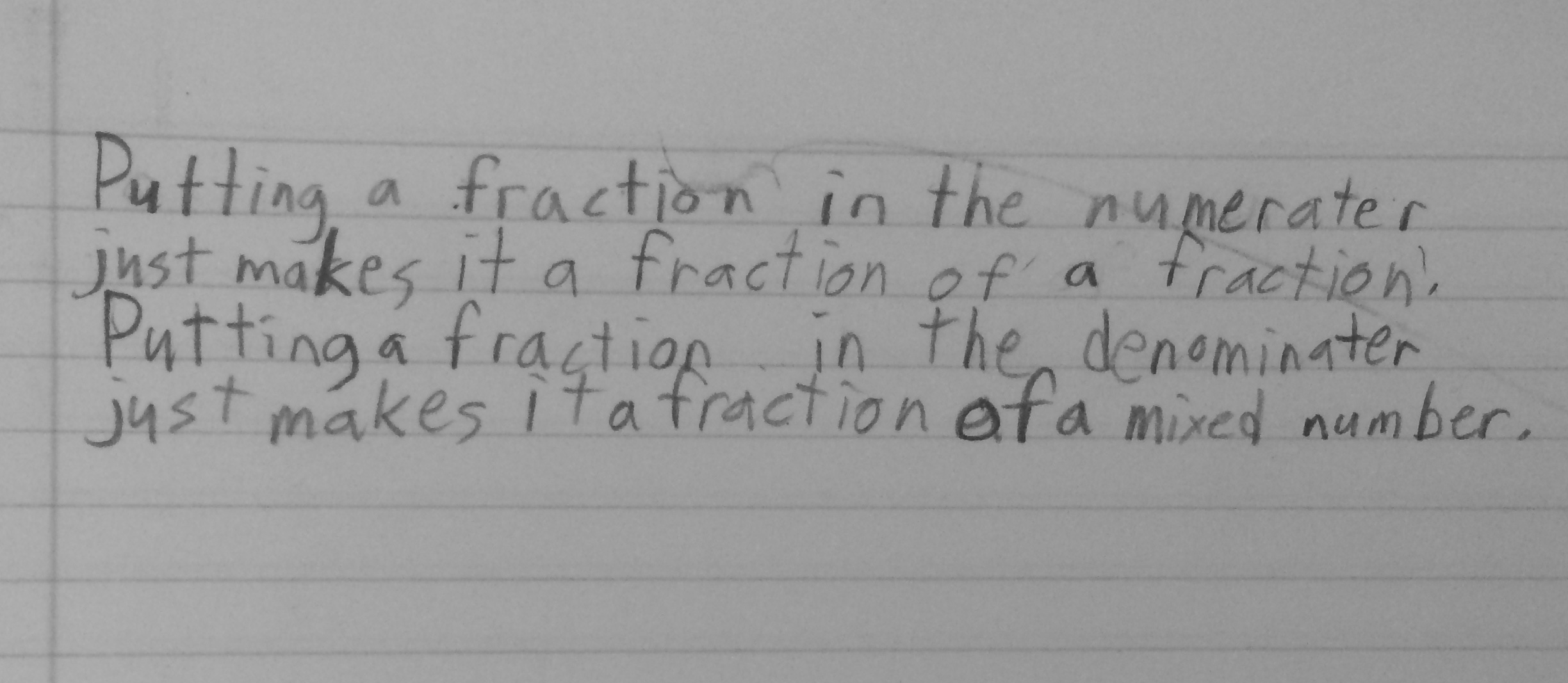
My students are very comfortable with putting fractions in the numerator. They use them all of time when decomposing, adding and comparing fractions like in these two examples…

IMG_8910_2 IMG_8300

The other day, two of my students finished early and as an aside asked me if there could be a fraction as the denominator. I asked them to try it out and see what they thought.

They wrote their question and then started playing around with some fractions in the denominator. At first they were writing a bunch of fractions with a fractions as the denominator in attempt to find one that jumped out and made sense to them. They tried drawing some pictures of them along the way to see if they could illustrate what it would look like.

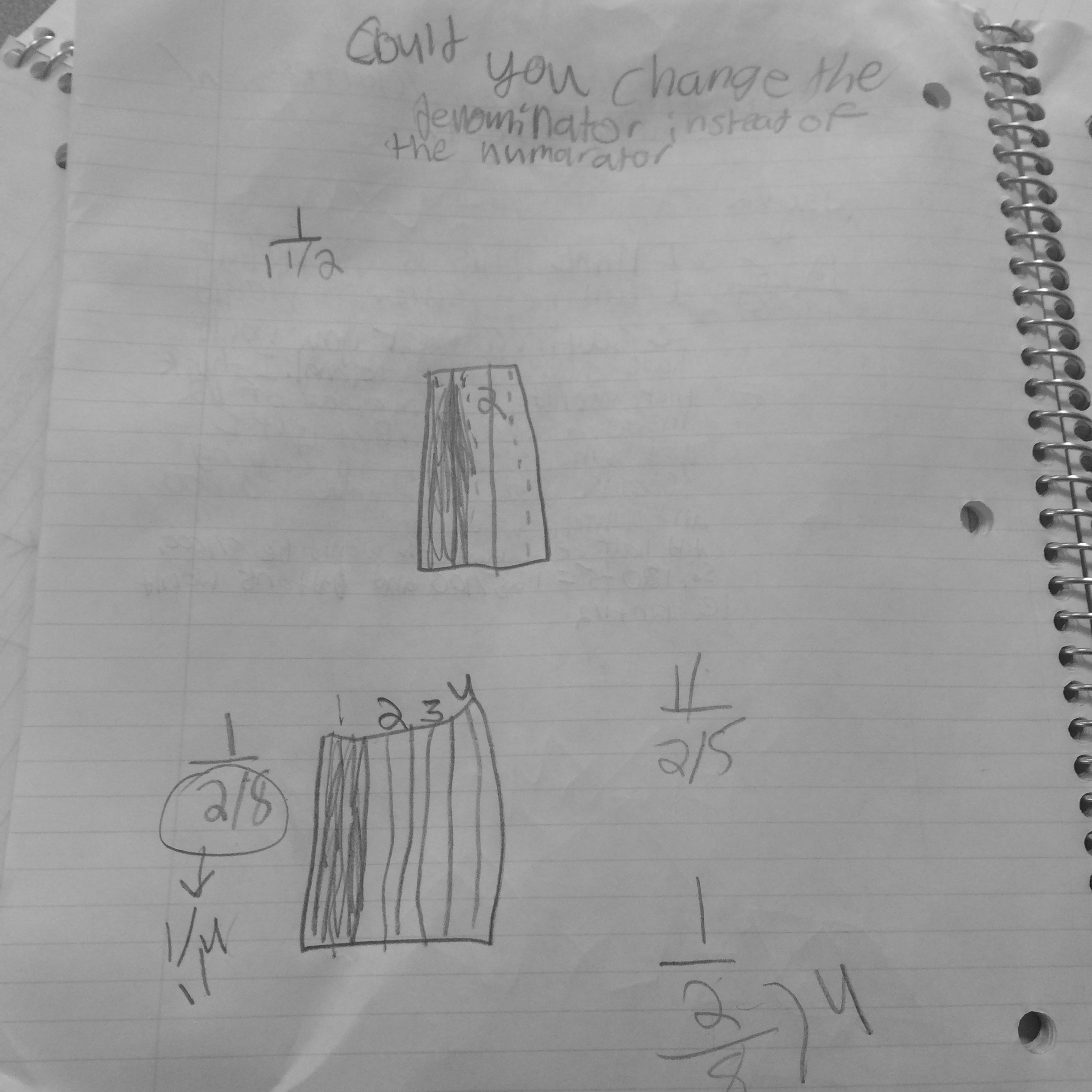
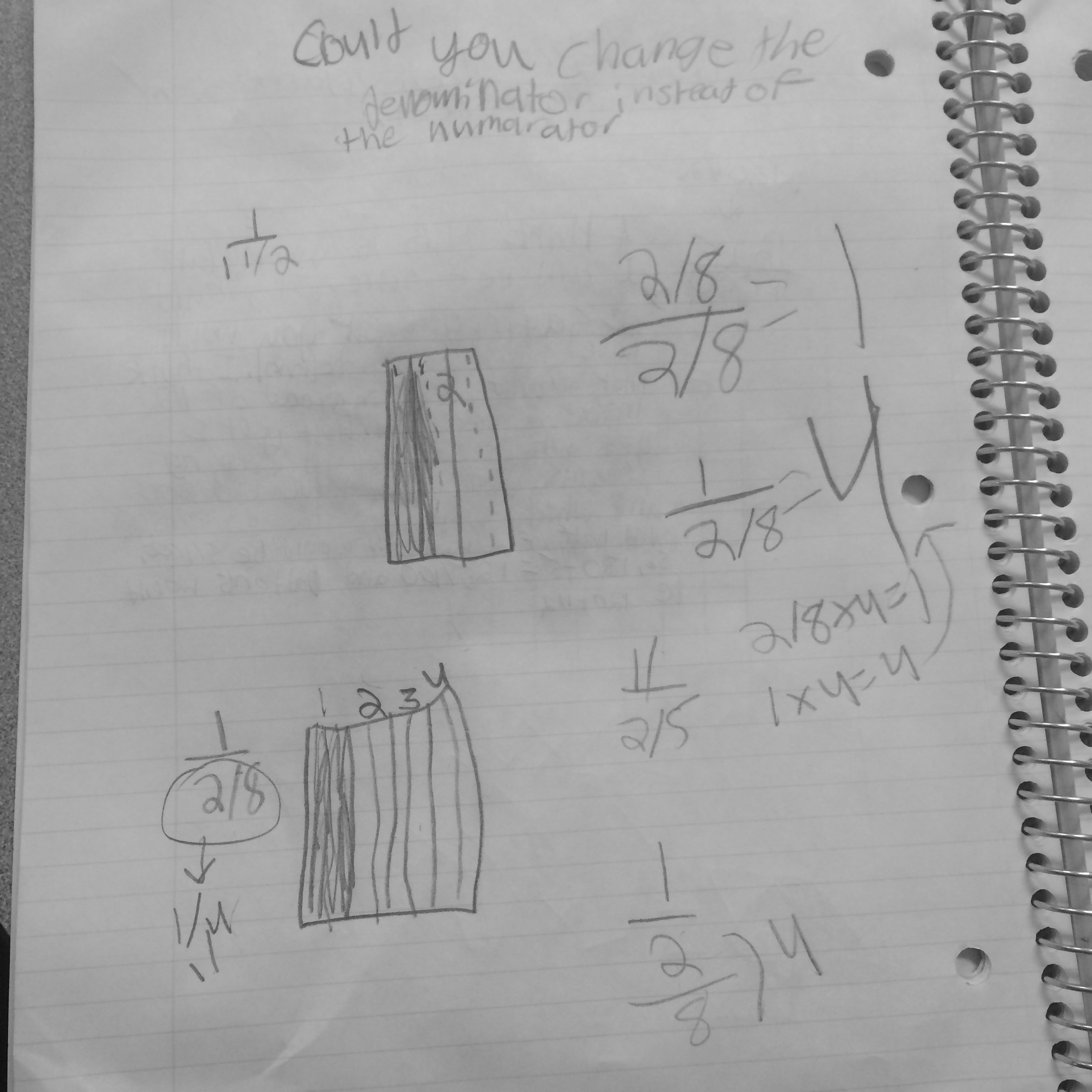
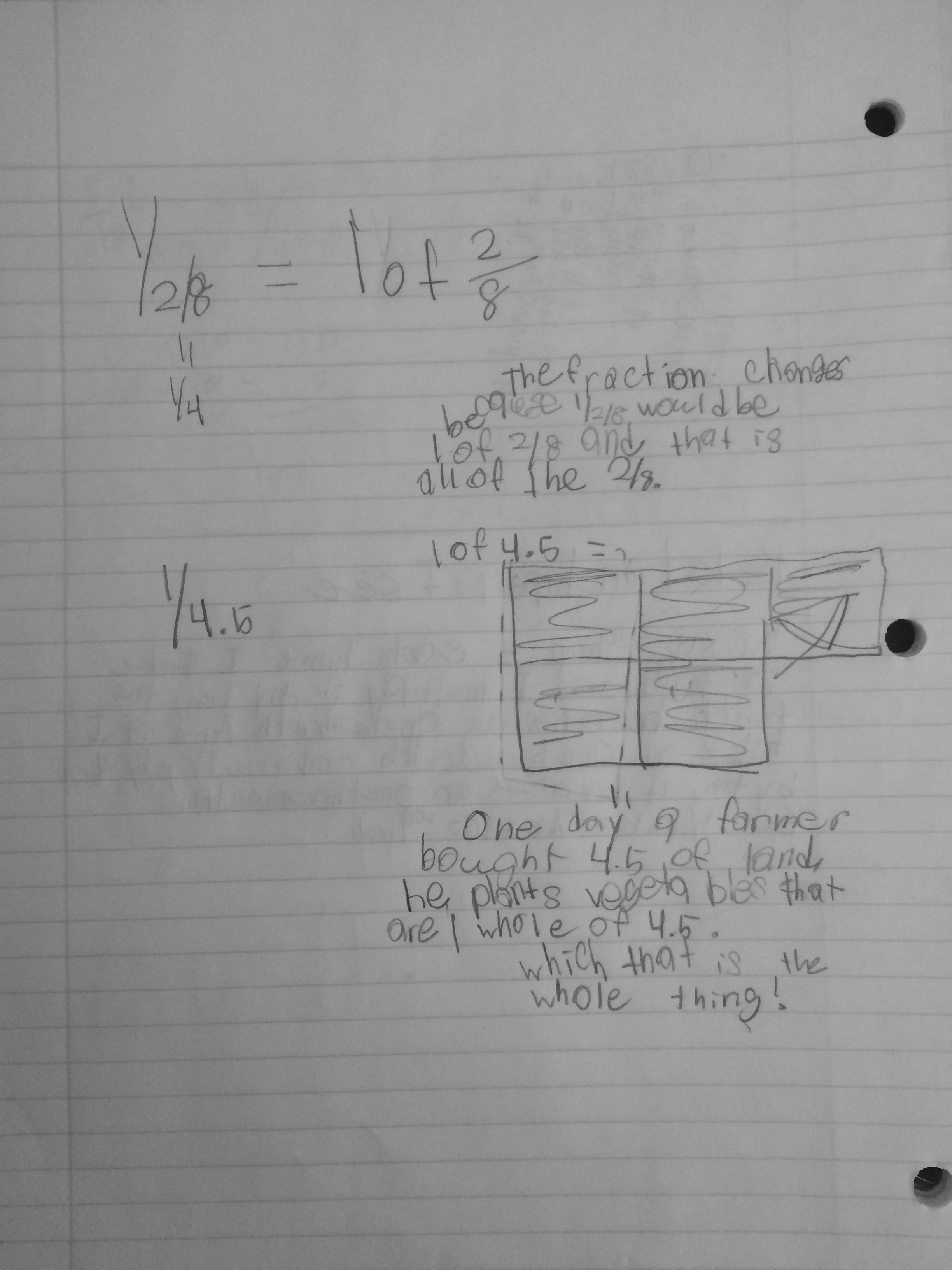
The first one they drew was 1/1.5 in which the rectangle was cut into thirds and had 1.5 shaded. When I asked what they would name what they just drew, they said 1.5/3. Hmmmm, back to the drawing board. They moved to 1 / 2/8, drew a rectangle cut into 8ths and shaded 2 of them. After shading, one student wrote 1, 2, 3, 4 over each 2/8 and said that there were four of the 2/8’s in his picture, so 1/ 2/8 must be 4. I asked what the whole was in the picture and left them to play around with that idea for a bit.

IMG_9035_2

I came back to these additions to the work:

IMG_9037_2

When I came back they said they realized that 1/ 2/8 was really a fraction more than 1 since 2/8 / 2/8=1. When I asked them to show me where that thinking was in their representation, they said since 2/8 was really 1 in their picture, it took four of them to make four wholes. I especially liked how they multiplied the numerator and denominator by 4 (the reciprocal of the denominator) to get to 1 in the denominator. Interesting to think about the algorithm for dividing fractions at play here.

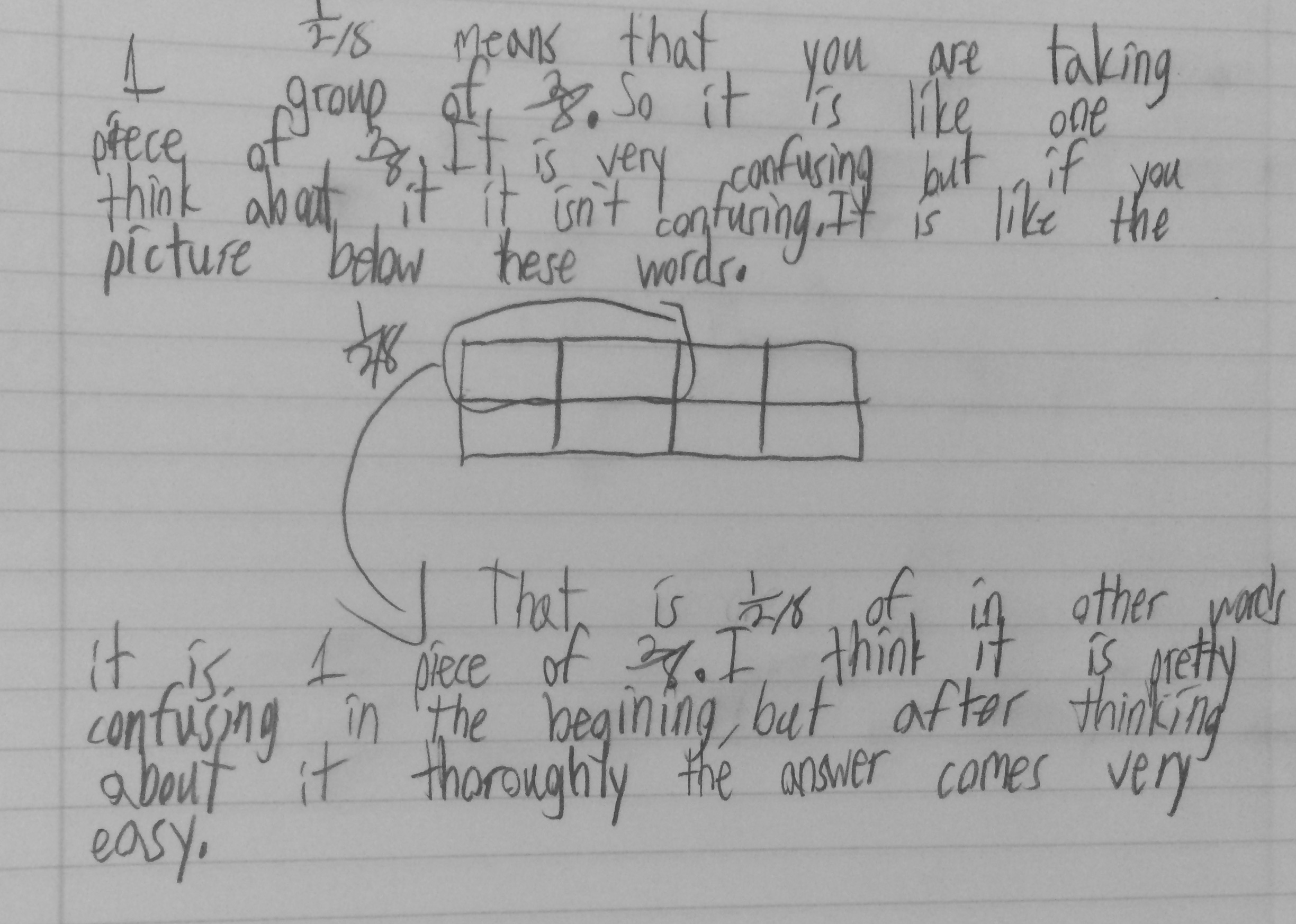
As others in the class finished their work, they started to mess around with this question, trying to make sense of it. This student attempted to put it into a context using the meaning of a fraction we use a lot, “a pieces the size of 1/b,” however with b as a fraction, it is not helpful here.

IMG_9040_2

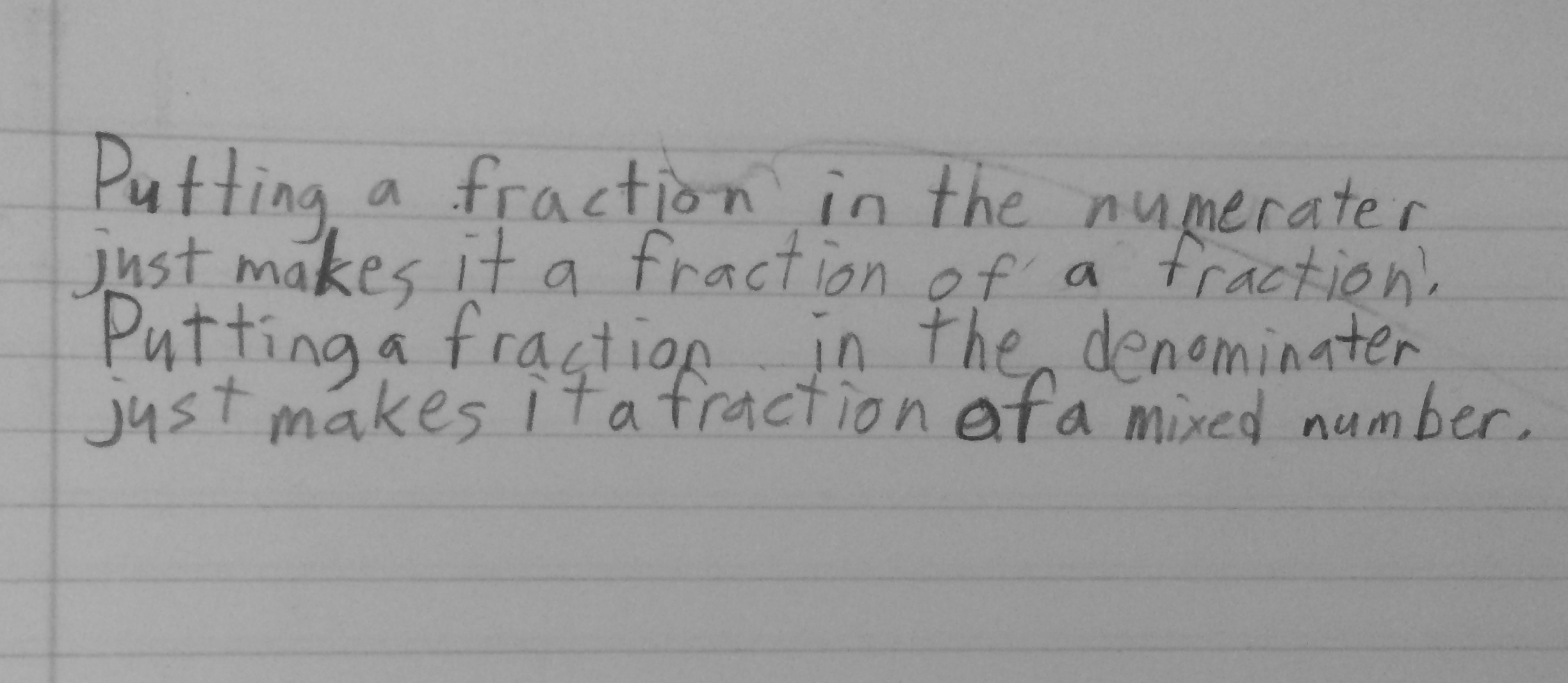
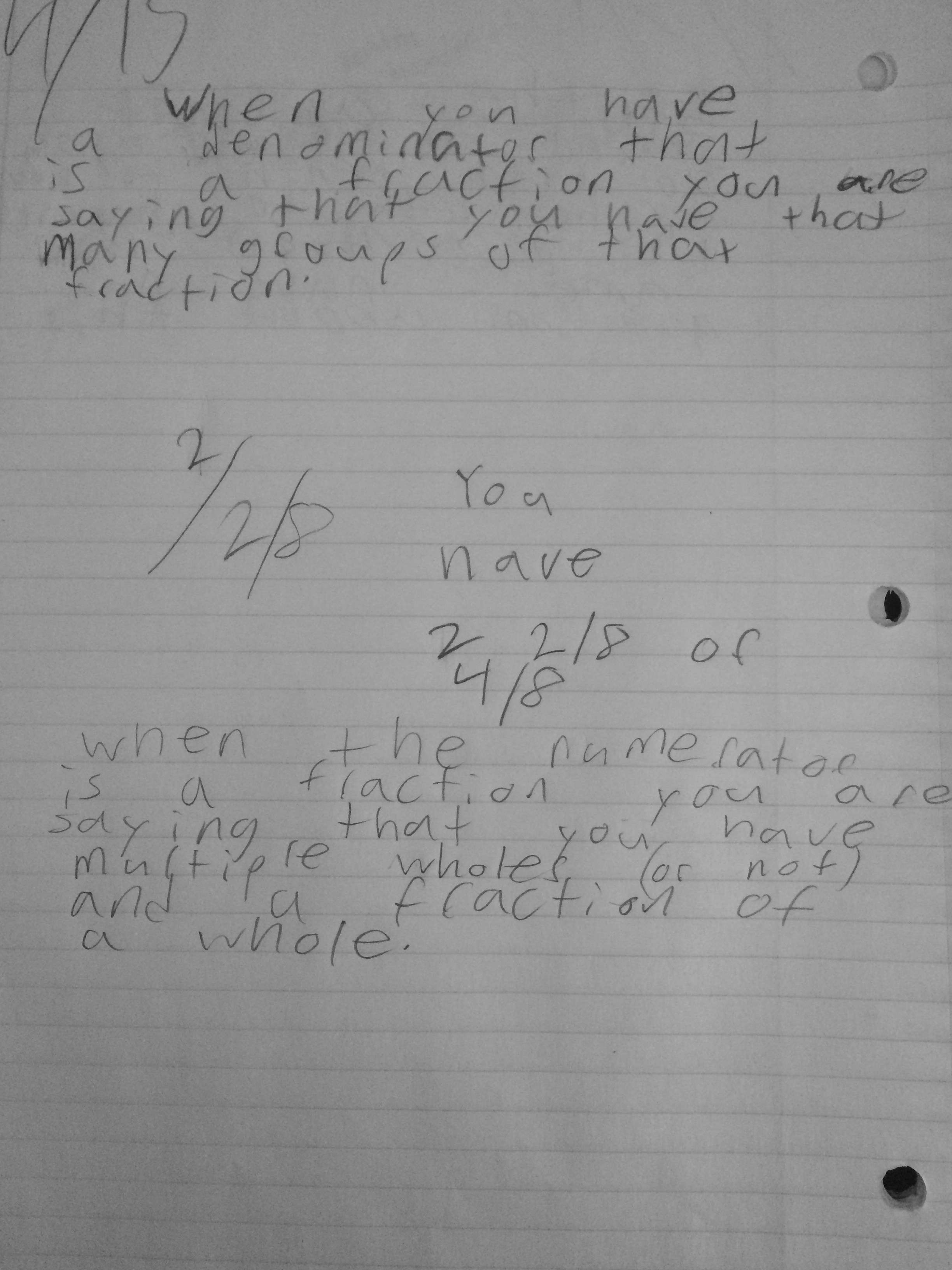
One student wrote this as his thought about the fraction as the denominator.

IMG_9038_2

I am left thinking a lot about the progression in which students learn complex fractions.

Which One Doesn’t Belong?

After all of the interesting conversation around Christopher’s (@trianglemancsd) Shapes Book and a conversation with Faith (@Foizym), I thought it would be fun to take this thought about “Which One Doesn’t Belong” into my students’ decimal work. With these decimals, I wanted to draw out reasonings about closeness to benchmarks, equivalents, and properties of numbers in relation to decimals. It did all of that and more! I wrote the following four decimals on the board and had students talk about which one they thought didn’t belong:

woIn brainstorming these decimals beforehand, I knew that 0.49 would be the most obvious because it is the only one that went into the hundredths, so I go that out of the way as the sample response and asked them to see if they could find another reason for 0.49 or any of the other three decimals. They brought out some pretty great stuff and definitely gave me insight into how they think about multiplication of decimals! It was also so nice to hear, as I walked around during their talk, the freedom students felt expressing their ideas when they knew there was no right or wrong answer!

-Kristin
Consecutive Sums – 5th Grade

We did Fawn’s Visual Pattern #8 today! http://www.visualpatterns.org/

vp

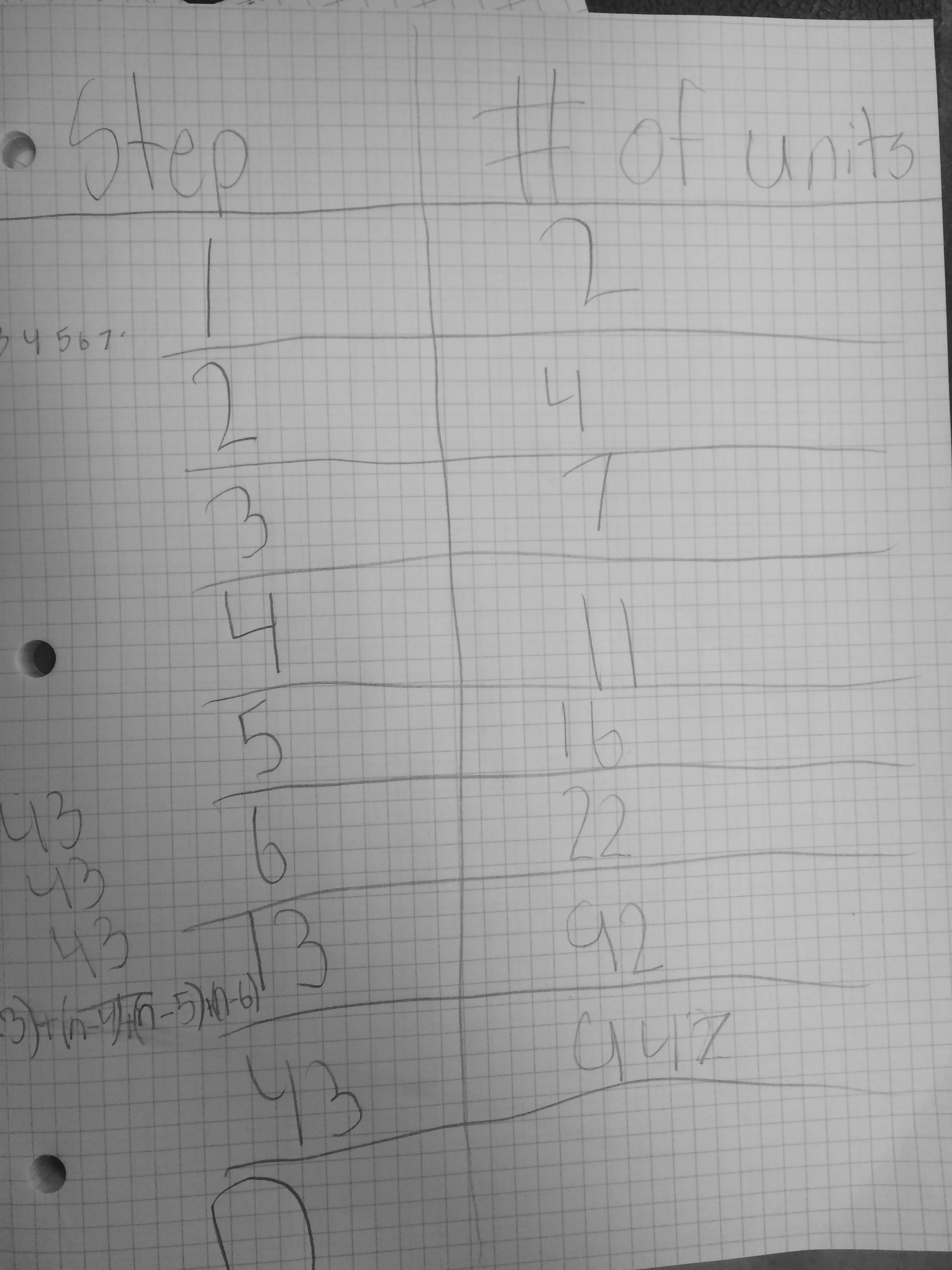
After completing steps 1-4 the class quickly saw that each time, the step added with the previous step’s unit count to get the new unit amount. From there, they struggled to get to the nth expression. They tried a bunch of different things, as you can see on this paper and saw various ways it was growing, but could not come to an agreement on this one!

IMG_9106On their calculator they could get the 43rd step, but if I asked about the 100th, they would just continue adding on the calculator. In their explanations, they kept saying that they would visually “set that one penguin on the bottom row aside and then it would be 3+2+1 or 4+3+2+1…etc” And then one student came up with this at the bottom of their paper..IMG_9107

This group also had some very nice work toward the nth expression…

IMG_9103IMG_9104IMG_9105They wanted me to tell them what it was, but of course I would not:) I will let them sit with that overnight and do a Notice/Wonder about consecutive numbers tomorrow to start our day together. I am thinking after some noticing, they will be able to apply it to this work!

-Kristin


What DO they know?

I love reading and giving feedback on my students’ journals,  I make time for it every day. But the mere thought of grading papers (feedback or not) makes me world’s biggest procrastinator. Unfortunately, my reality is that I need grades for progress reports and report cards, so I make the best of it. I try to make the assignments valuable for both the students and myself in their learning, however  I always wonder why I don’t approach the papers the same, they are both student work right?

I had a realization yesterday while I was grading, as to why I make time to read their journals vs the aversion I have to grading papers. While I was grading, my mind was focused on what the students DON’T know, what they aren’t getting, aggravation at the careless mistakes, aggravation that I didn’t “reach” that child and why they don’t all have 100%. As I graded, I was busy making notes in my own journal of the students who were missing certain items so I could make my plan for next week to help them better understand the material. And while I know this is invaluable in planning to better teach my students, I realized I was completely glancing over what they DO know. I was checking off the problems they were getting correct and focusing solely on the wrong. Don’t be mistaken, I LOVE mistakes in math, I love analyzing what students could have been thinking, misconceptions and/or misunderstandings, but when grading, the feeling is still not the same.

This focus on “wrong” wasn’t the only thing that bothered me though. I also wasn’t “feeling” my students’ voices in the assignments, like I do their journals. Maybe it is because I love hearing them talk about math so much, their journals are the next best thing when they have left class for the day.  Maybe it is the freedom for them to take more chances in their journals or simply say, “I don’t understand it from this point on..” that makes them so much more enjoyable. Or maybe it is the mere fact I don’t have to put a grade to their thinking. As I read their journals, I am looking at everything they DO know and how that led them to where they are instead of the other way around.

Their journals feel more like the way we learn then grades do. We try, we make mistakes, people help us along the way with advice, we try again, we test things out, we look back at what we did to build on it….no number is attached to that, so why grades? I would like to think I try my best to not have grades be a focus in my classroom and instead be a snapshot of where students are right now in their learning, but those assignments still do not hold the same value that their journals do for me.

Maybe someday standards based grading will make its way into our district but until then I will continue to read their journals for things just like this…

IMG_8986_2– Kristin
My Student’s Curriculum…

I am convinced that my students have another idea of what they want the 5th grade curriculum to be:) No matter how much I plan, they will always send me in a different direction, which I love. It started yesterday with these two grids and responses…

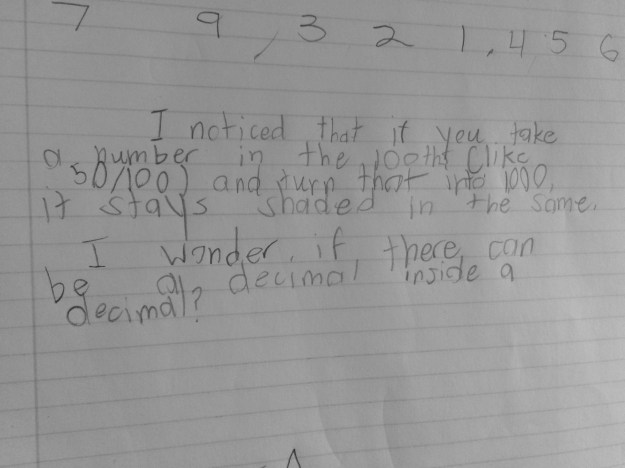
IMG_9034_2That led to these journal entries and our conversation today….

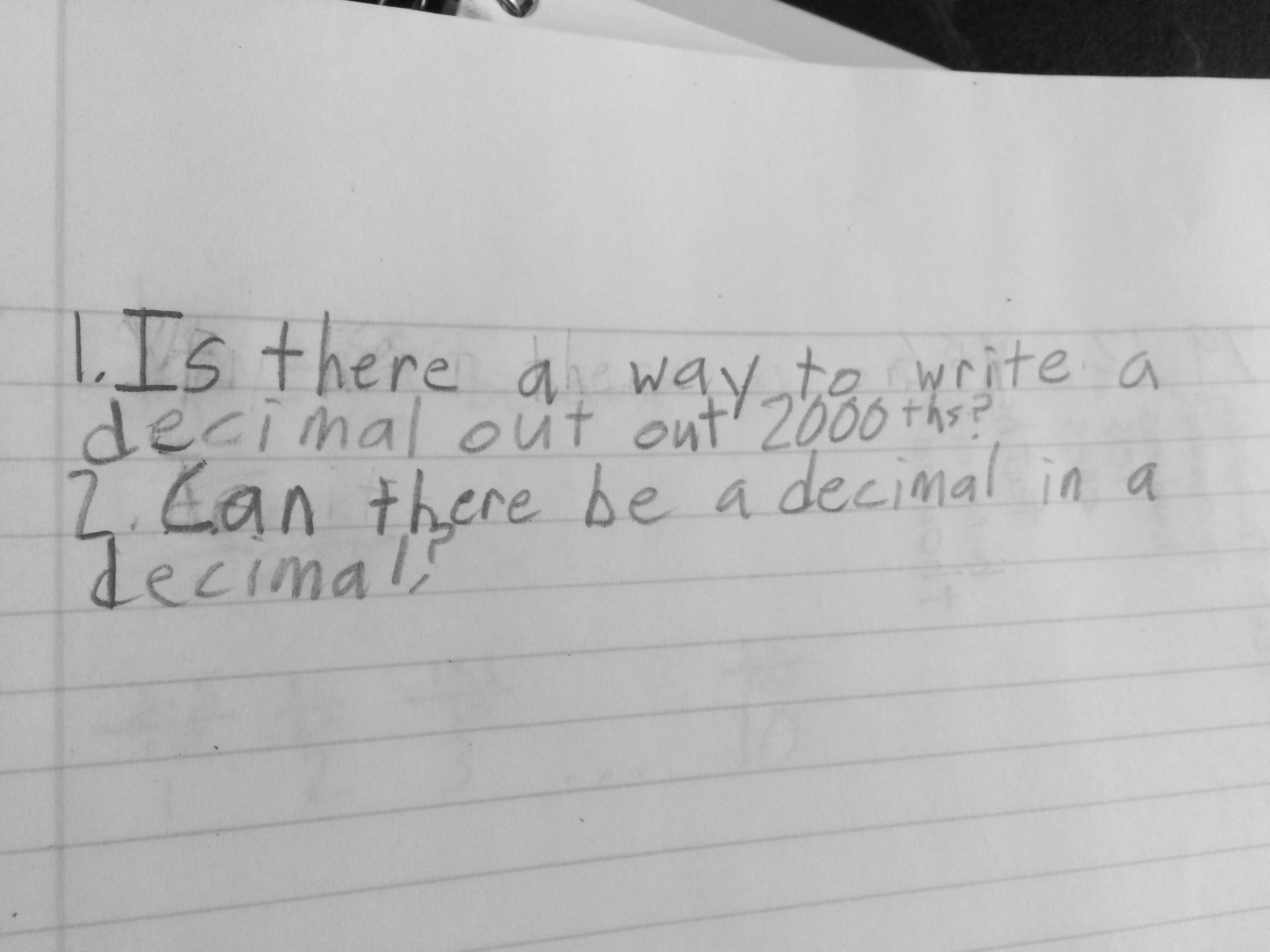
I led with thinking about the fraction (or decimal) in a decimal. We did some more grids and the students were seeing the thousandths like taking a fraction and breaking it into smaller pieces to still have equivalents, like 1.5/4 = 3/8. Then a group of students who were done with the grid work, asked me if there can be a fraction or decimal in a denominator…..here we go…

I asked them what they thought it meant and this is their starting point. They jotted some examples and started playing around with 1 / 2/8. He drew it with 2/8 size pieces, came out with 4 but said that looks the same as 1/4.

IMG_9035_2I asked him if it could be, and his intuition was saying no, but he couldn’t figure out why. I asked him what happens when a denominator number gets smaller, he says piece gets bigger. So he started with 1/4, 1/3, 1/2, 1/1, said 2/8 / 2/8 = 1. From there he realized that 1/ 2/8 was improper. Here is where he ended because class ended.

IMG_9037_2I had another working with 100 grids trying to figure percentage-wise is 1/4.5 fell between 1/4 and 1/5 and here are a few others…

IMG_9038_2 IMG_9039_2 IMG_9040_2 IMG_9042_2So much to chat about, but after a long day, my brain needs a break:)

I just love how a thousandths grid lesson can lead to this, I want my students to publish a “Kids Curriculum” as a supplement to mine, because they obviously have so many amazing curiosities! (Or maybe, Christopher, we can name it Kids Kurriculum)

-Kristin

Tenths to Thousandths Decimal Journey…

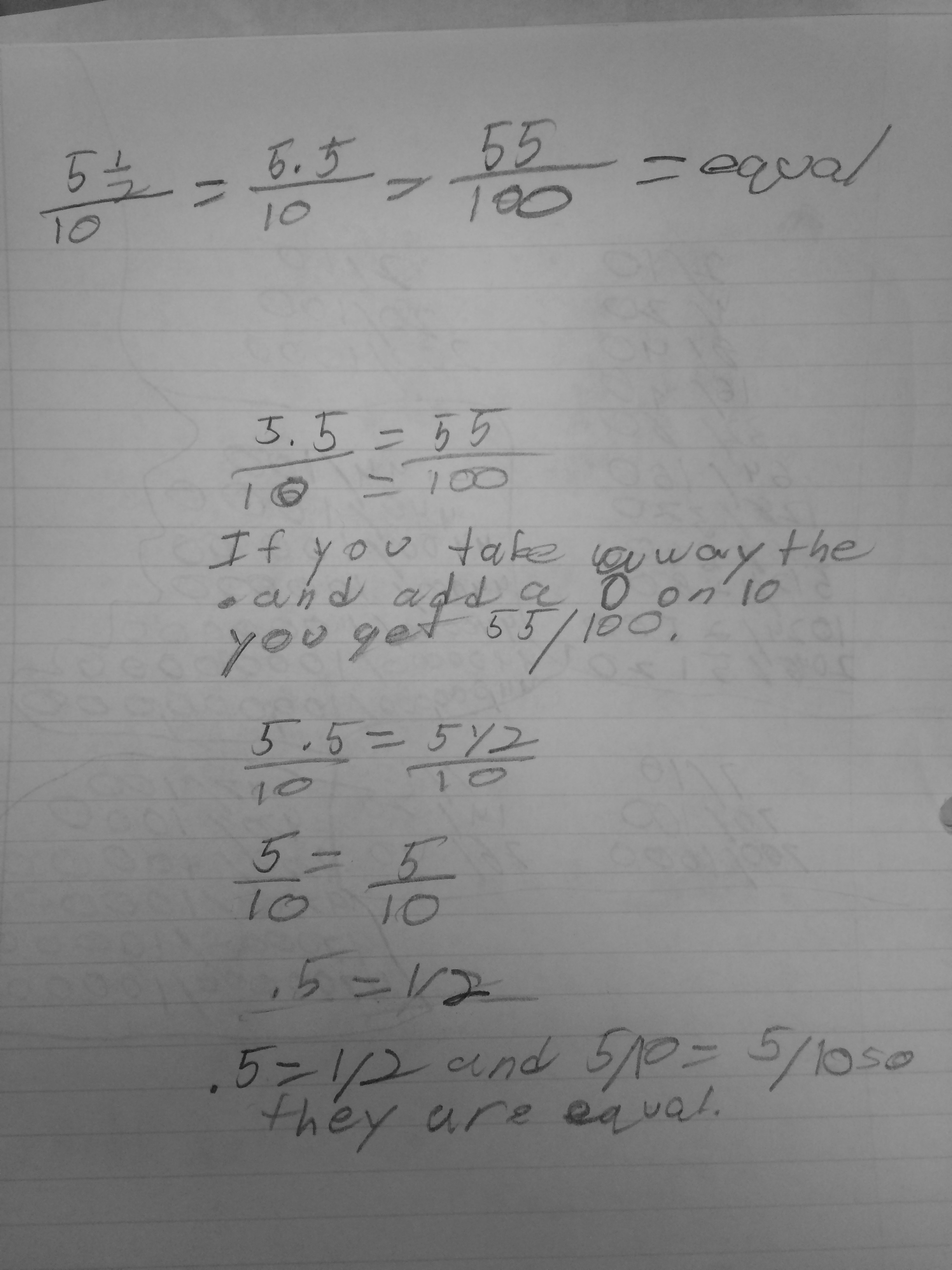
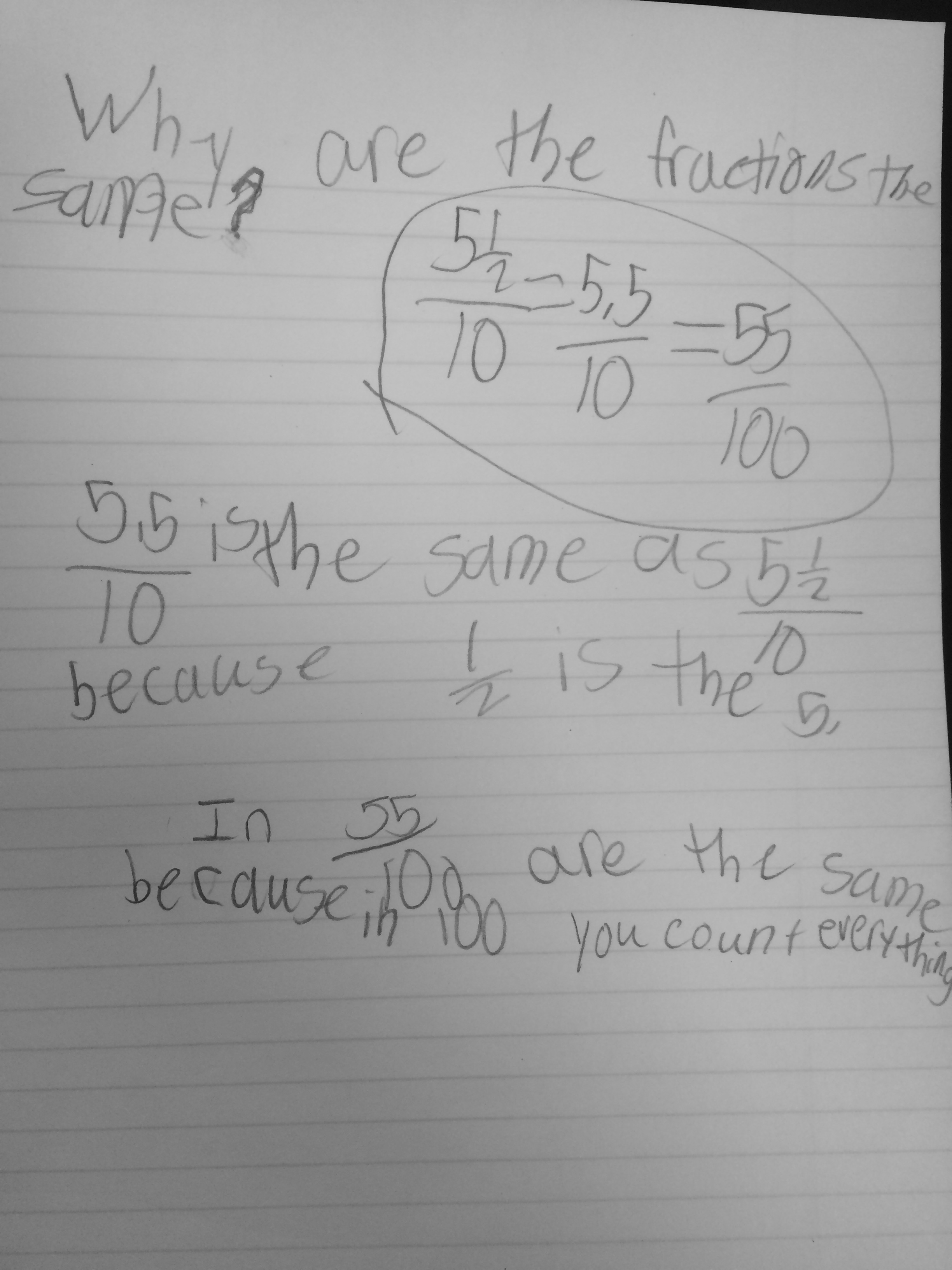
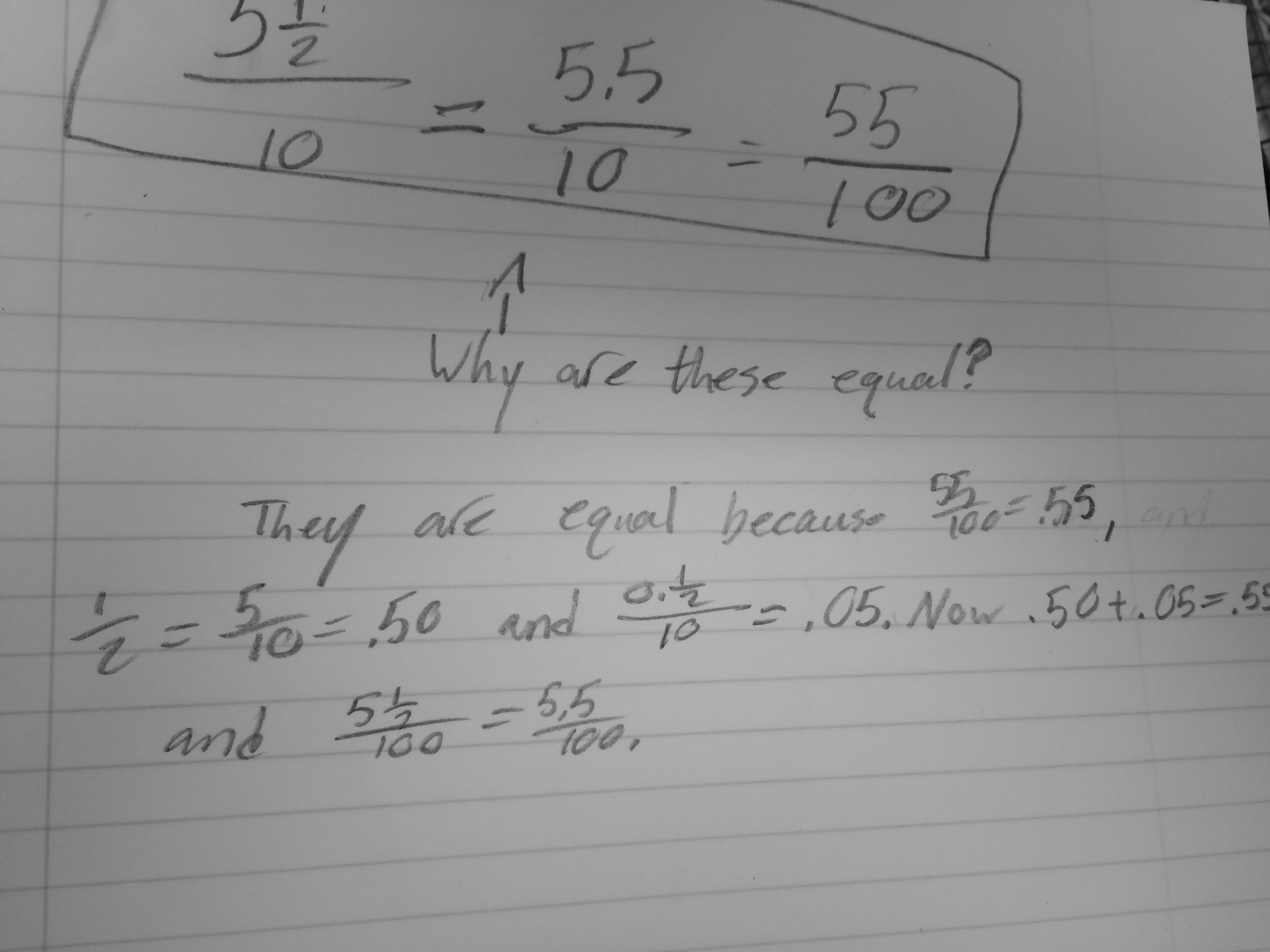
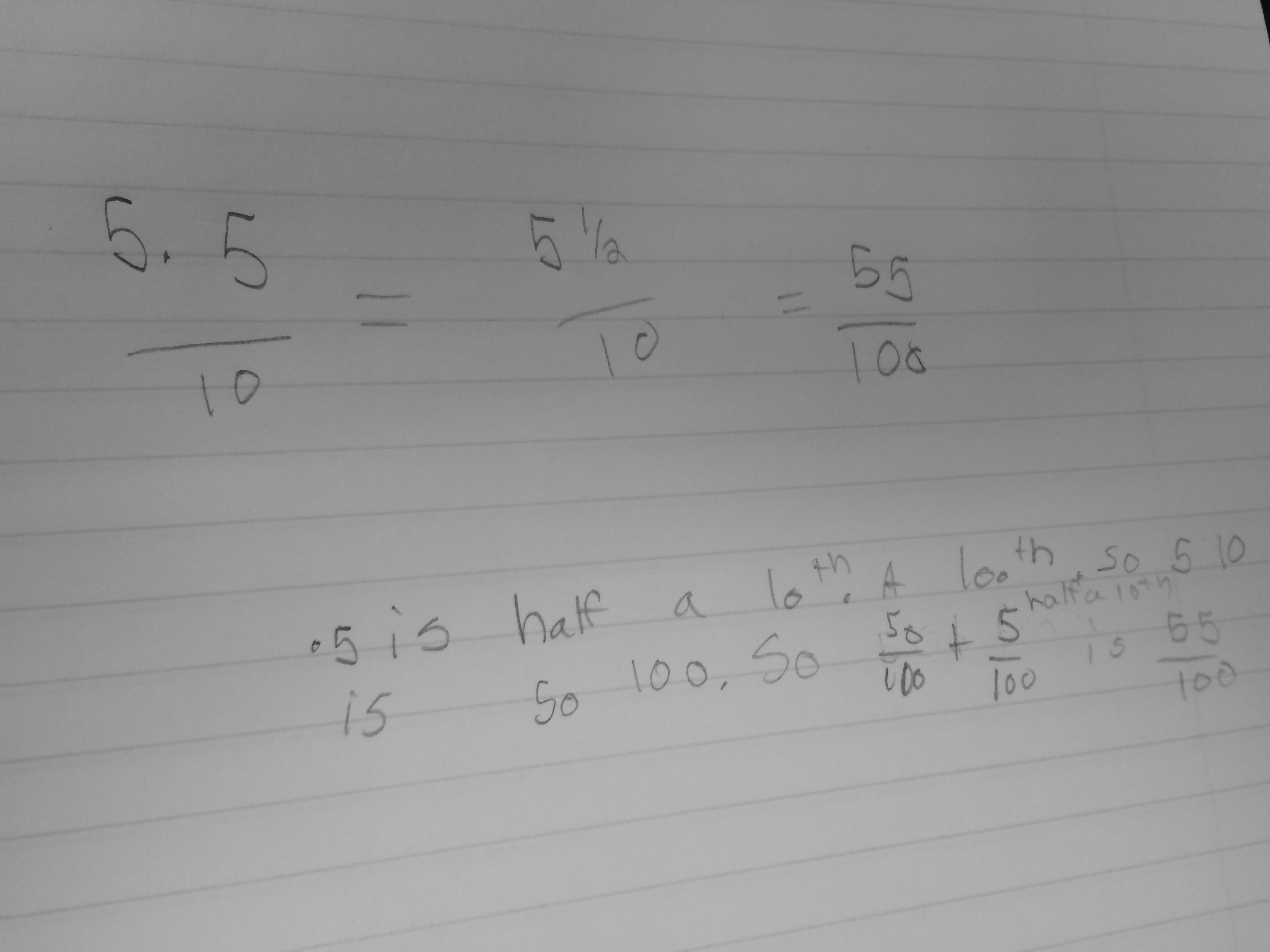
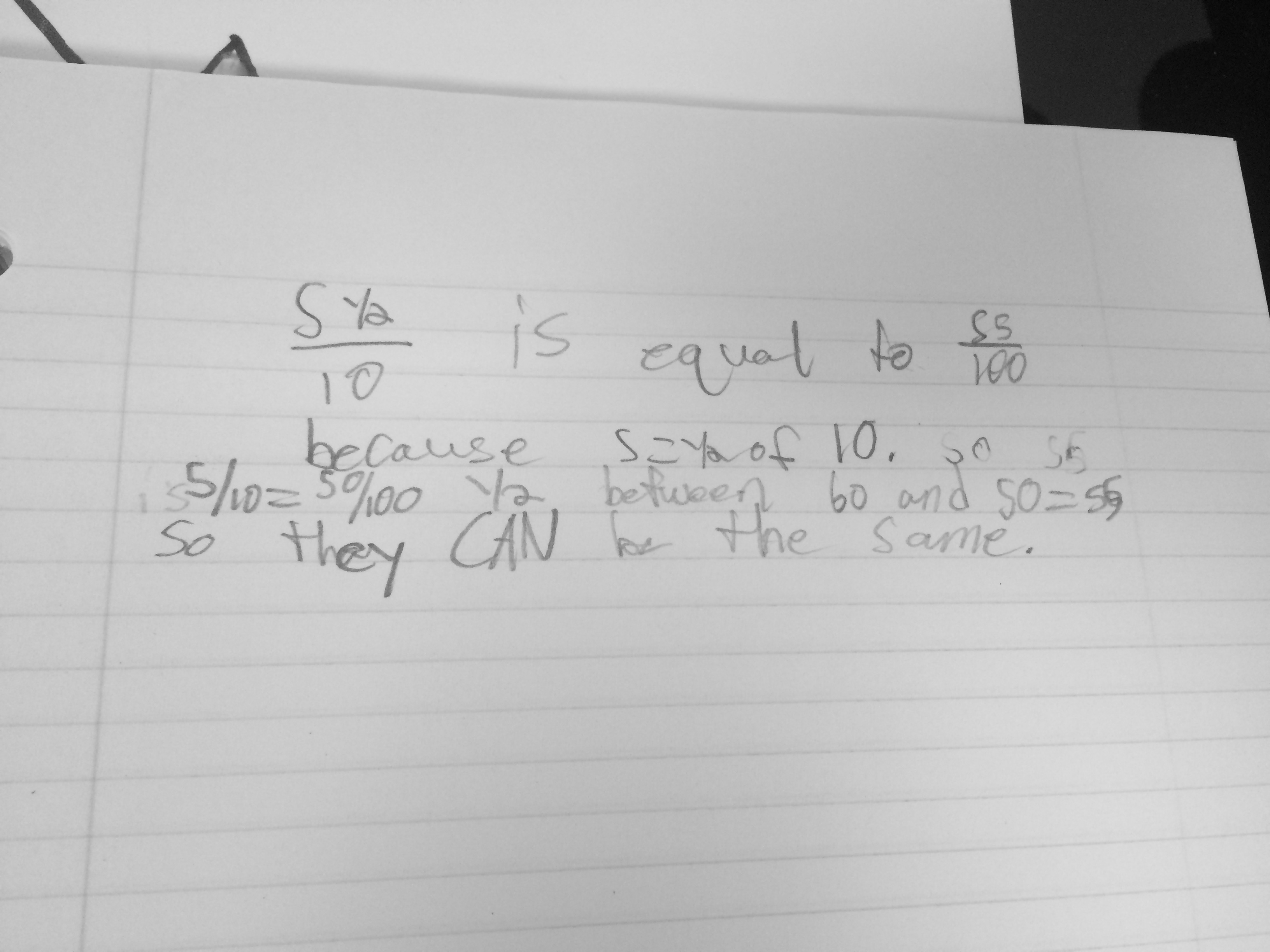
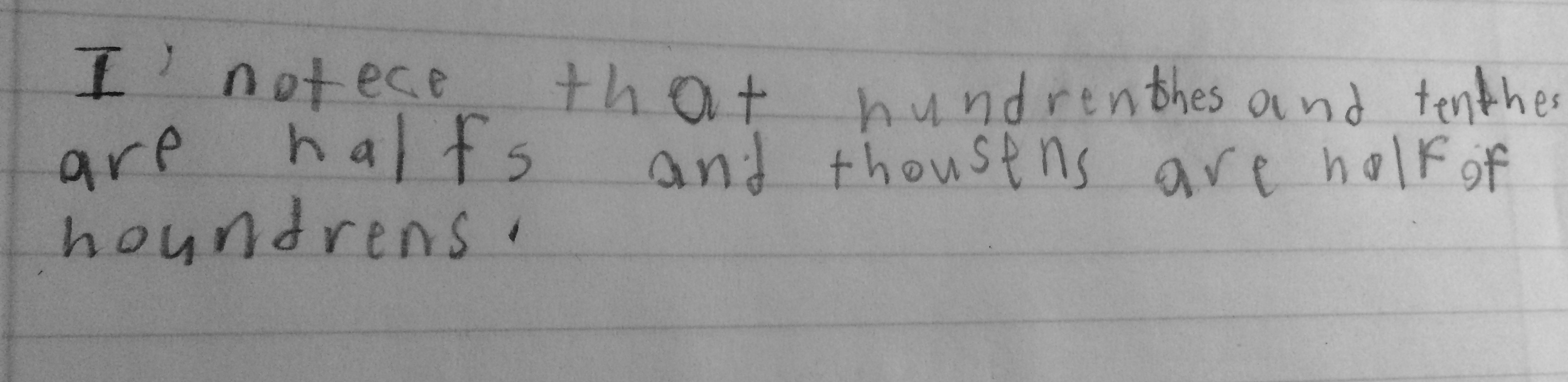
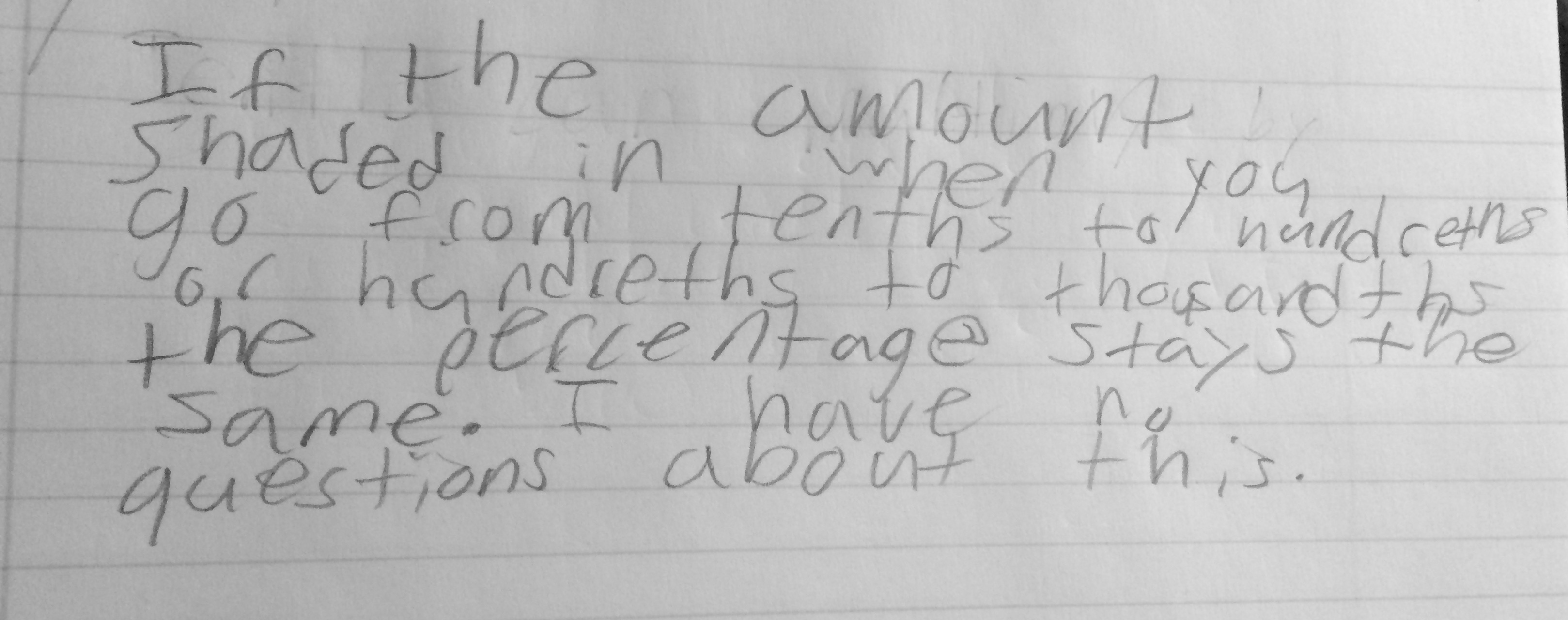
After our quick images, we moved into pre-shaded grids for students to look at equivalencies of decimals shaded on tenths and hundredths grids. We flew through until we hit the tenths grid with 5 1/2 tenths shaded and hundredths grid with 55 hundredths shaded. The students could see they were equivalent by the pictures, but many had a tough time explaining why. When someone did say “A half of a tenth is 5/100” another student said, “But I thought a half of a tenth was 1/20?” What a cool conversation! They left class yesterday with this question still lingering so I had them just jot what their group had talked about in relation to these pictures…

IMG_8997_2 IMG_8998_2 IMG_8999_2 IMG_9005_2 IMG_9007_2At this point students were starting to have trouble thinking about writing a decimal that was a half of the place value to the right, so they stayed in fractions where they comfortably can represent half a fractional piece.

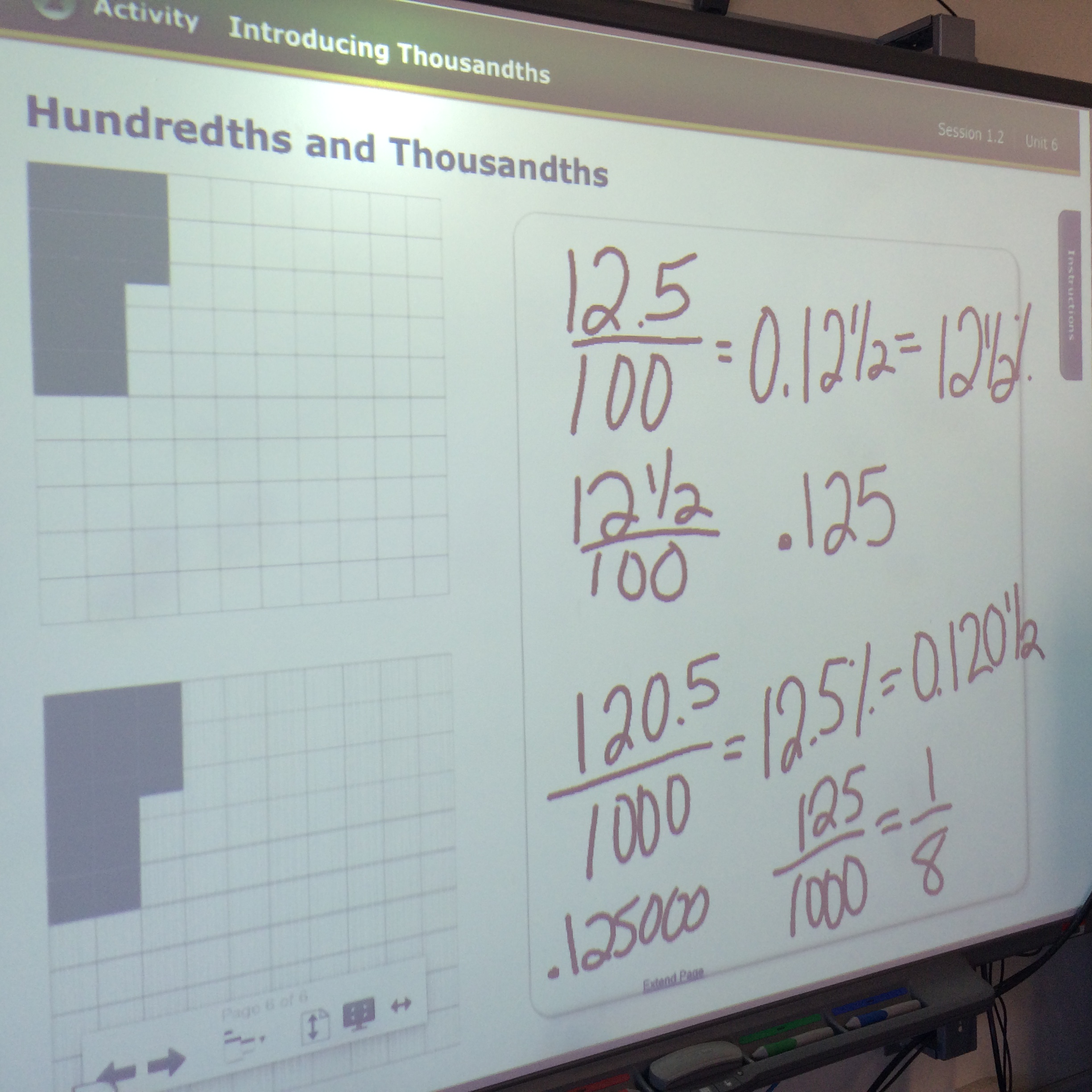
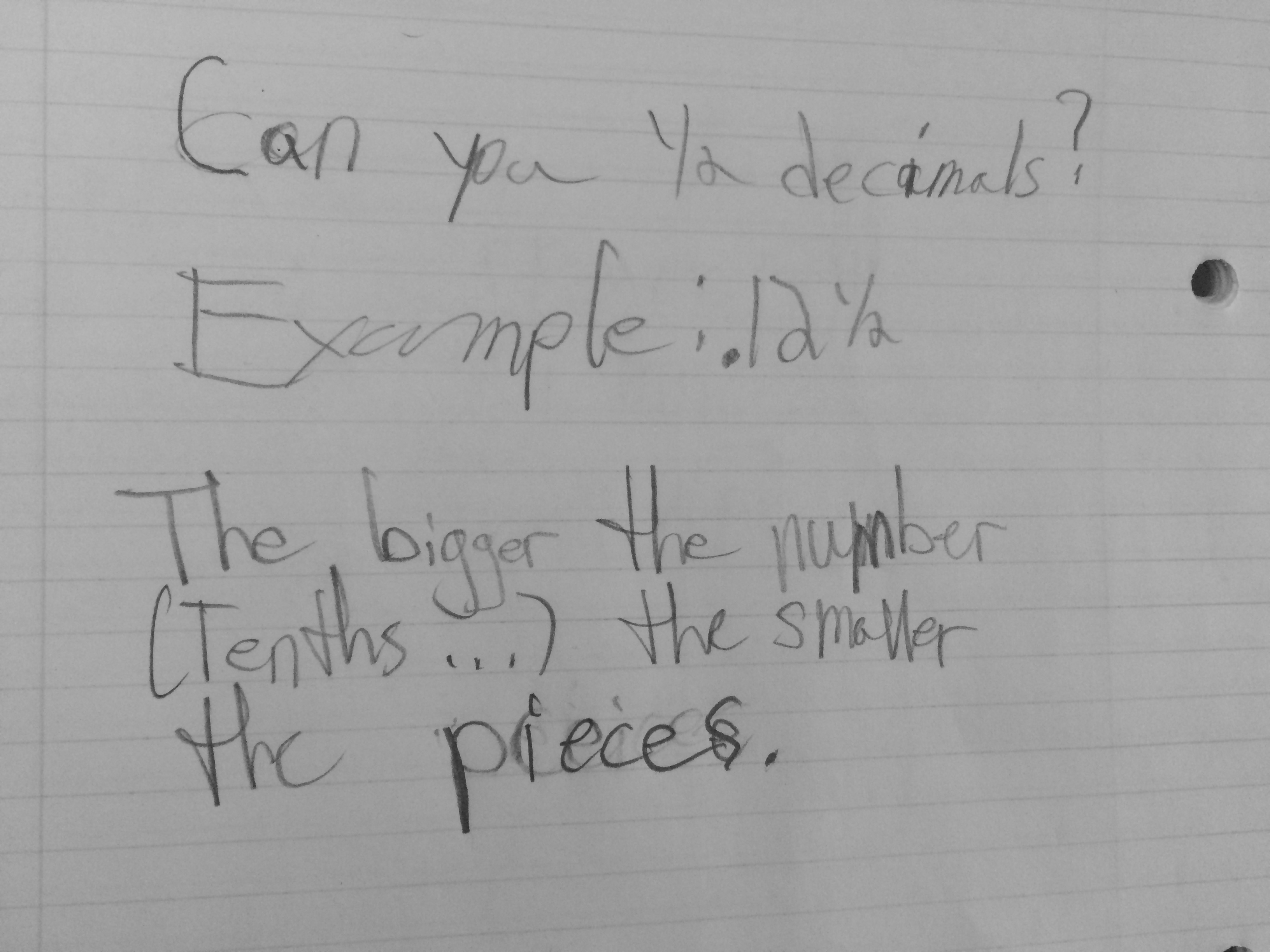
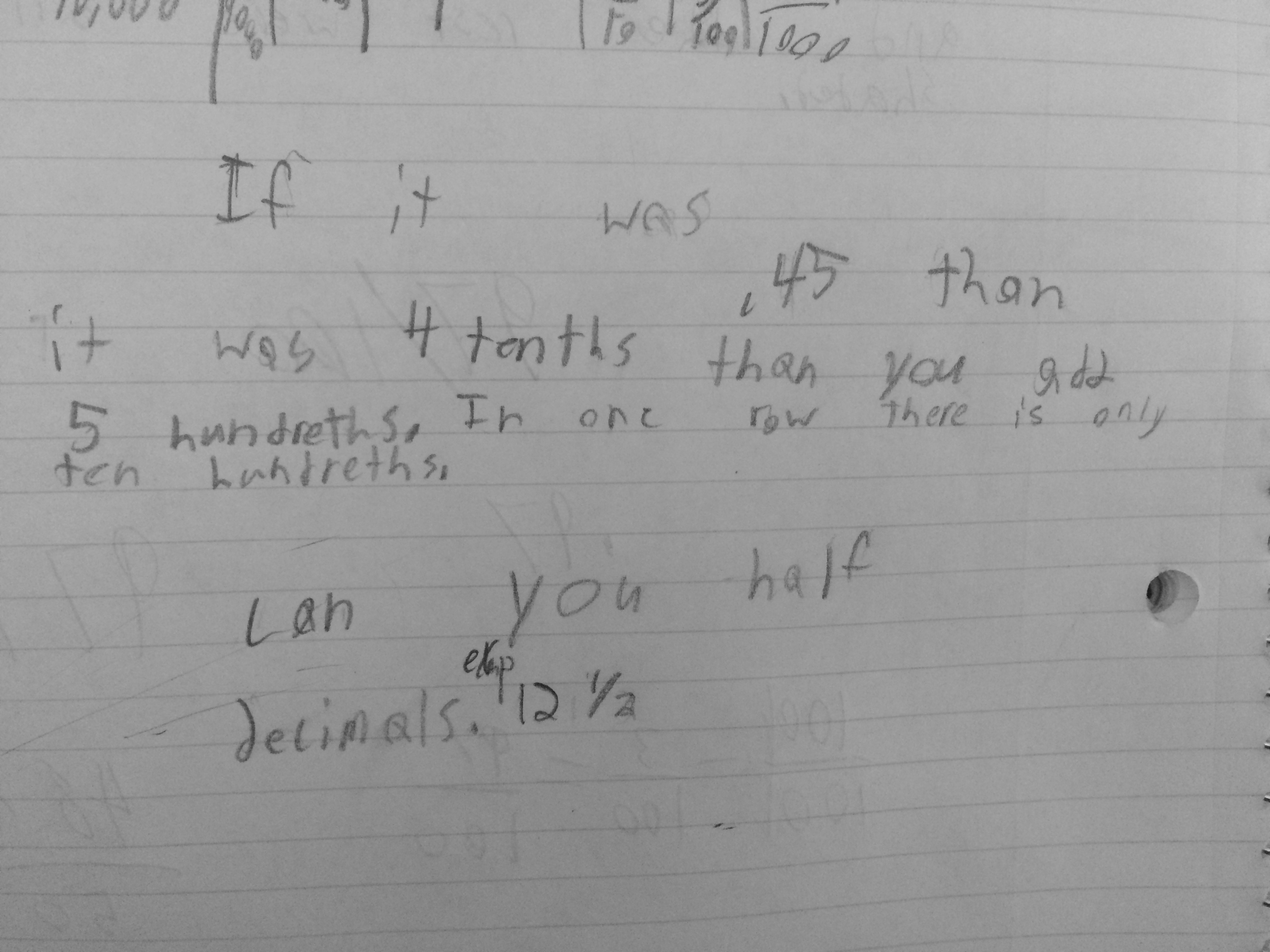
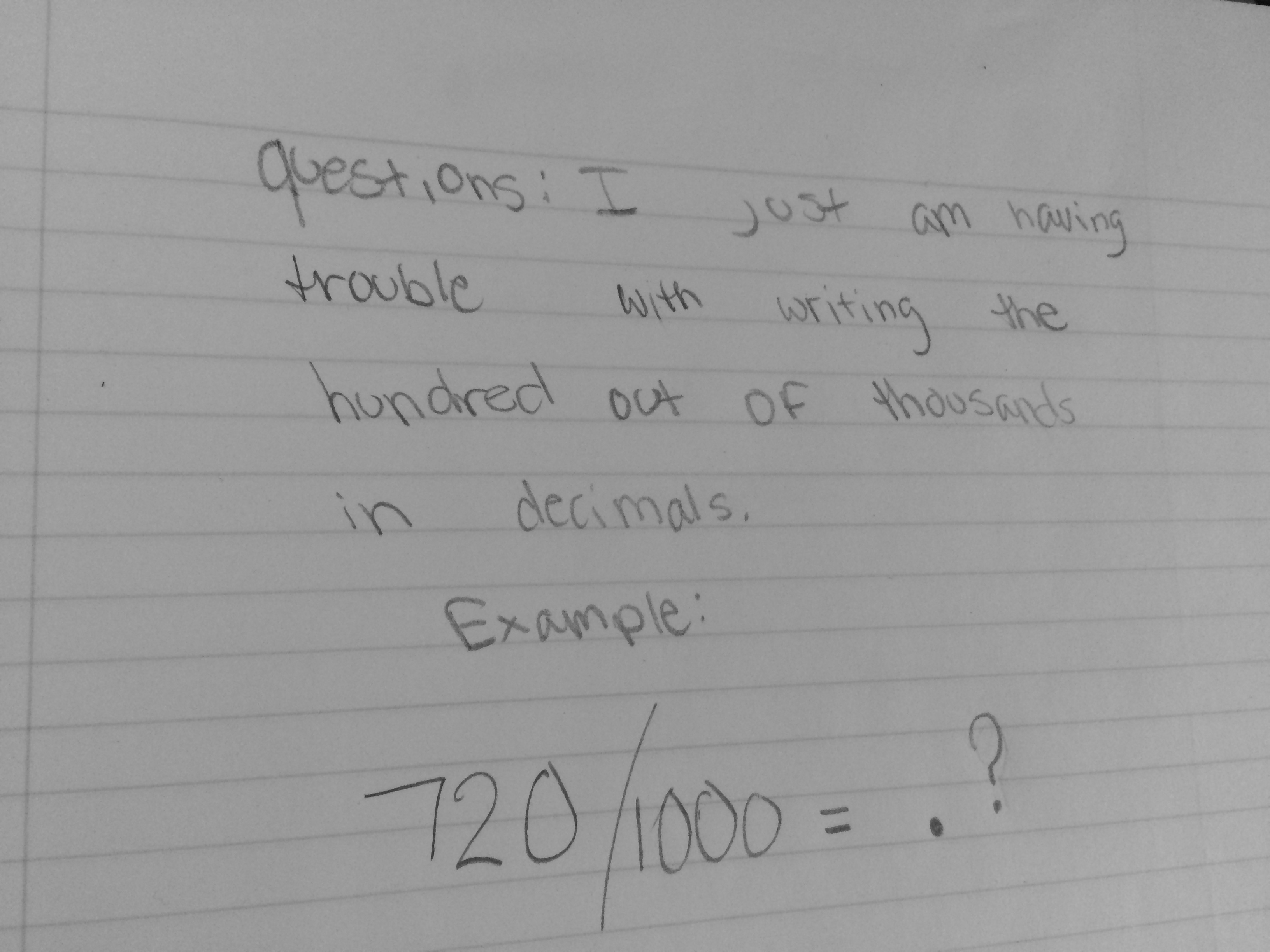
We started our conversation with this today and broke up the grids to prove that 5/100 is equivalent to 1/20 and equal to 1/2 / 10. Students were comfortable with the half of a tenth represented in the hundredths, however they made it perfectly clear that they much preferred the hundredths grid because it was much easier to read:) So, of course, then I pushed them into the thousandths grid. We started with 1/4 shaded on a hundredths grid and 1/4 on a thousandths grid. They comfortably wrote 25/100=250/1000=25%-.25=.250. Then we went to a hundredths and thousandths grids with 1/8 shaded. Great convo that we will have to build on tomorrow, but as always, I need more math time!! I had them leave on a reflection prompt about what noticings they had during our work today. For the students who could easily see these equivalencies, I told them to write me some wonderings they may have. I got quite a range of great things. The predominant question was about the fraction/decimal in a decimal. I struggle with how to address this because it visually is not as appealing to me as the fraction/decimal within a fraction. I am comfortable writing 1 1/2 /4 = 3/8 but to write the fraction in the decimal does not work. I never really thought about it much before, but how funny that we can write a fraction of a fractional piece and it is readable, but to try with decimals, not so much. The only way I see to address this is to do many more grid shadings to get comfortable with these equivalencies, but I do so appreciate their curiosity about it!

IMG_9018 IMG_9013 IMG_9014 IMG_9015 IMG_9020 IMG_9022 IMG_9023 IMG_9026 To use the word differentiation here is an understatement. The range of thoughts in my classroom (and many many others) amaze me on a daily basis, in the most wonderful way!

And I especially love these last two because it gives me the feeling that I have created a safe place for my students to put confusion out there. I LOVE LOVE LOVE this ❤

IMG_9019 IMG_9024

~Kristin

Decimal Quick Images

In Investigations we do Quick Images of dots, 2D and 3D figures. I thought we could incorporate this same routine into our decimal unit to talk about fraction/decimal/percent equivalents. I told the students that each grid equaled 1 and that it was broken into 10 or 100 pieces (just to save time of them counting to verify it). I flashed the grid image on the screen for 3-5 seconds and had students give me a thumbs up when they know how much of the grid was shaded. I asked them to signal with their fingers if they had more than one way to name the amount or an equation of how they saw it.

These were the first images that I did (one at a time) and after each we discussed what they saw. After they said their answer, I was sure to ask “How would you write that?” to be sure if they were seeing it as a fraction or decimal.  It was interesting, but not surprising, that every student gave a fraction.

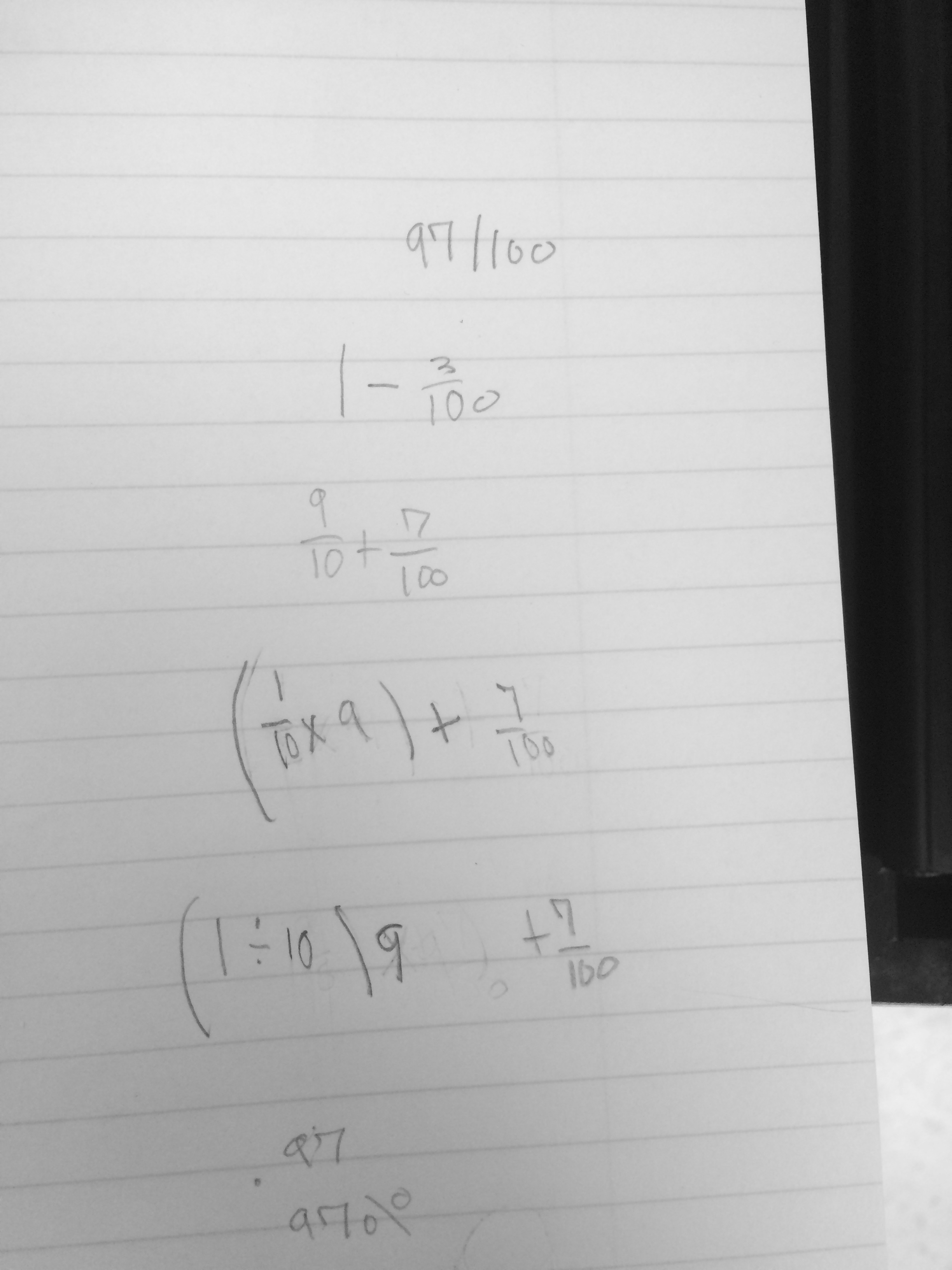
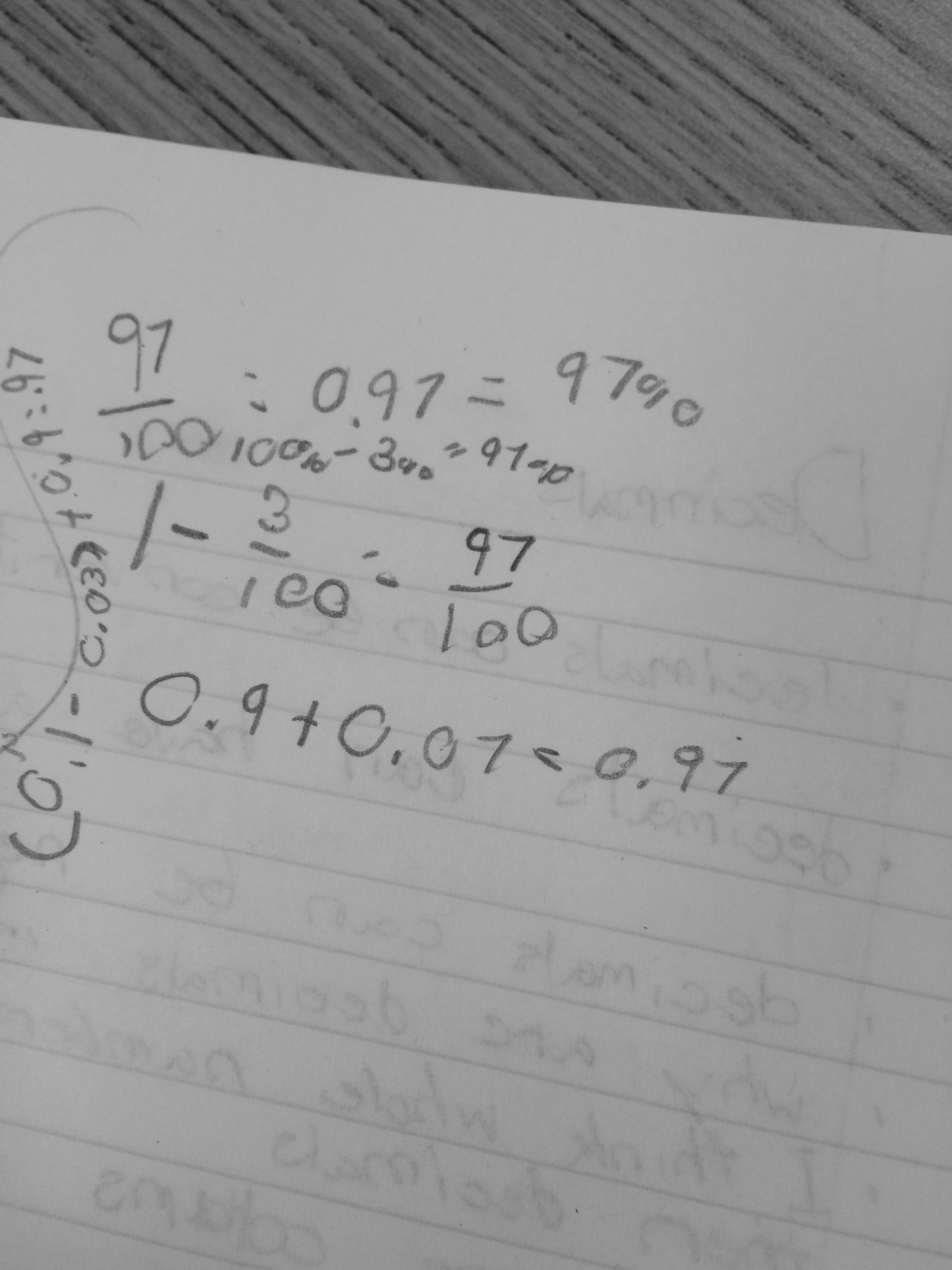
g1The first one elicited the 2/10, 20%, every equivalent fraction of 2/10, and eventually 0.2. I asked about the zero in front of the decimal to be sure everyone knew that meant there was not a whole filled. The second elicited much of the same, but also came with 10/10 – 3/10 = 7/10 as the way they remembered how much was there. “It was easier to count the white part.”

The next two went into hundredths and followed the same routine.

g2We did the first aloud in a Number Talk type setting and then I sent the students back to their seats to write what they could for the fourth image. Here is what they came up with…

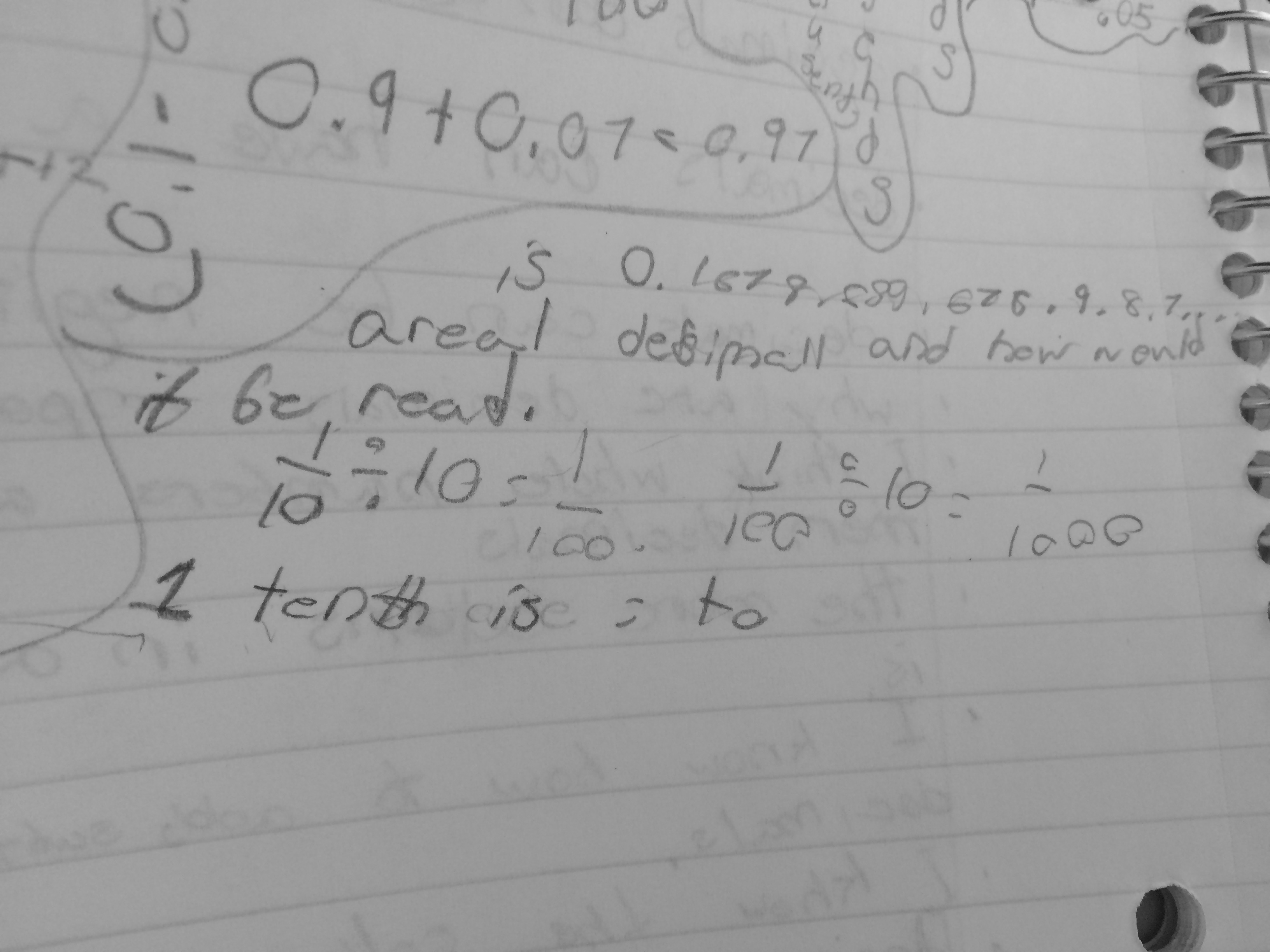
IMG_8995_2 IMG_9001_2 IMG_9004_2 IMG_9008_2 IMG_9011_2This is a wonderful jumping point for starting Fill Two game tomorrow! I plan on bringing up some of the examples with .9 + 07 to start our classwork!

-Kristin

Decimals – The Very Beginning…

Last week, I asked the students to tell me everything they know, like, don’t like, confused about, wonder, feel…etc, about decimals. I used these responses in developing the decimal unit as far as where I should start and what types of things I was sure to address during the course of the unit. The responses were really interesting and reinforced a lot the common misunderstandings/ misconceptions I think students have around decimals. I am surprised to hear that the majority of students like fractions much better than decimals!

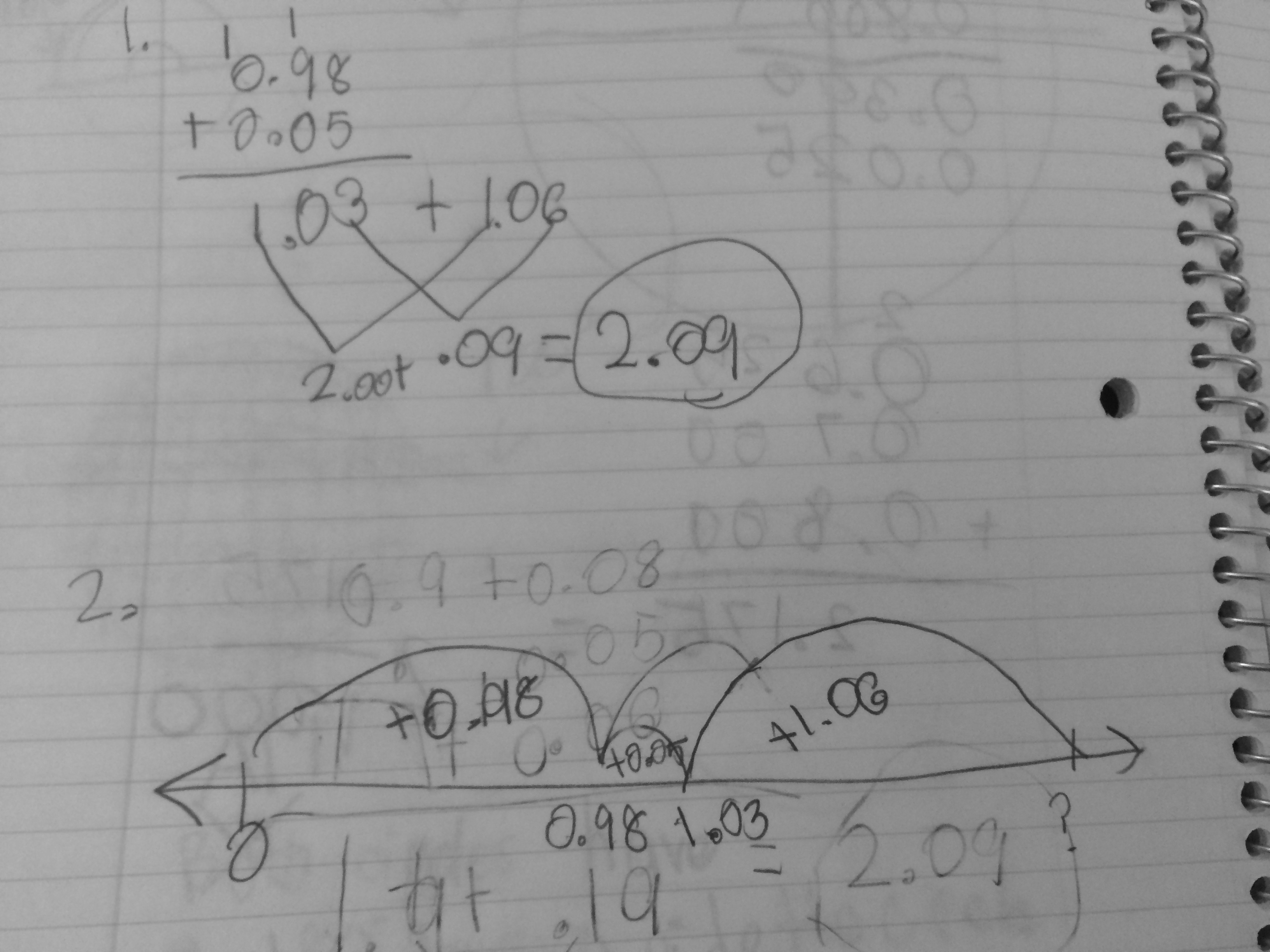
IMG_9010_2Love that this student knows that decimals fall between whole numbers and I am assuming the “10” number talk is about the place values. Also interesting that the student says the five isn’t 5, it is 50. Is this because they are taught to put them into hundredths to compare easily???

IMG_9012_2This one reminds me of the 1st one, however this student only sees decimals as less than 1 but greater than zero. This is a common misconception students have about decimals.

IMG_9003_2Love SO much about this one! All of the beginning is lovely but especially love the “farther to the right, the smaller the decimal.” This statement is what I put in my decimal talking points (https://mathmindsblog.wordpress.com/2015/01/27/talking-points-decimals/) that I want to keep revisiting. I am assuming this student meant the value of the digit, but instead said decimal, which sounds like the number itself, which is not correct. Love the wonderings at the bottom as well! Pie:)

IMG_9002_2This seems to be the general feeling of decimals…it is about places and they make them cringe:( We will change that this year!

IMG_8996_2

I love the wonder here about the zeros continuing after the decimal point, do we have to acknowledge them or not.

IMG_8992_2

Love that they are “almost like a puzzle.”IMG_8993_2

I think the honesty in this one is beautiful. So much confusion that I cannot wait to work through!IMG_8994_2Wow, really doesn’t like them at all! It looks like the zeros after the decimal point is a confusion point for this student because they are comfortable with the fact that a number before the decimal means more than one whole.

-Kristin