Category Archives: Decimals

What DO they know?

I love reading and giving feedback on my students’ journals,  I make time for it every day. But the mere thought of grading papers (feedback or not) makes me world’s biggest procrastinator. Unfortunately, my reality is that I need grades for progress reports and report cards, so I make the best of it. I try to make the assignments valuable for both the students and myself in their learning, however  I always wonder why I don’t approach the papers the same, they are both student work right?

I had a realization yesterday while I was grading, as to why I make time to read their journals vs the aversion I have to grading papers. While I was grading, my mind was focused on what the students DON’T know, what they aren’t getting, aggravation at the careless mistakes, aggravation that I didn’t “reach” that child and why they don’t all have 100%. As I graded, I was busy making notes in my own journal of the students who were missing certain items so I could make my plan for next week to help them better understand the material. And while I know this is invaluable in planning to better teach my students, I realized I was completely glancing over what they DO know. I was checking off the problems they were getting correct and focusing solely on the wrong. Don’t be mistaken, I LOVE mistakes in math, I love analyzing what students could have been thinking, misconceptions and/or misunderstandings, but when grading, the feeling is still not the same.

This focus on “wrong” wasn’t the only thing that bothered me though. I also wasn’t “feeling” my students’ voices in the assignments, like I do their journals. Maybe it is because I love hearing them talk about math so much, their journals are the next best thing when they have left class for the day.  Maybe it is the freedom for them to take more chances in their journals or simply say, “I don’t understand it from this point on..” that makes them so much more enjoyable. Or maybe it is the mere fact I don’t have to put a grade to their thinking. As I read their journals, I am looking at everything they DO know and how that led them to where they are instead of the other way around.

Their journals feel more like the way we learn then grades do. We try, we make mistakes, people help us along the way with advice, we try again, we test things out, we look back at what we did to build on it….no number is attached to that, so why grades? I would like to think I try my best to not have grades be a focus in my classroom and instead be a snapshot of where students are right now in their learning, but those assignments still do not hold the same value that their journals do for me.

Maybe someday standards based grading will make its way into our district but until then I will continue to read their journals for things just like this…

IMG_8986_2– Kristin

My Student’s Curriculum…

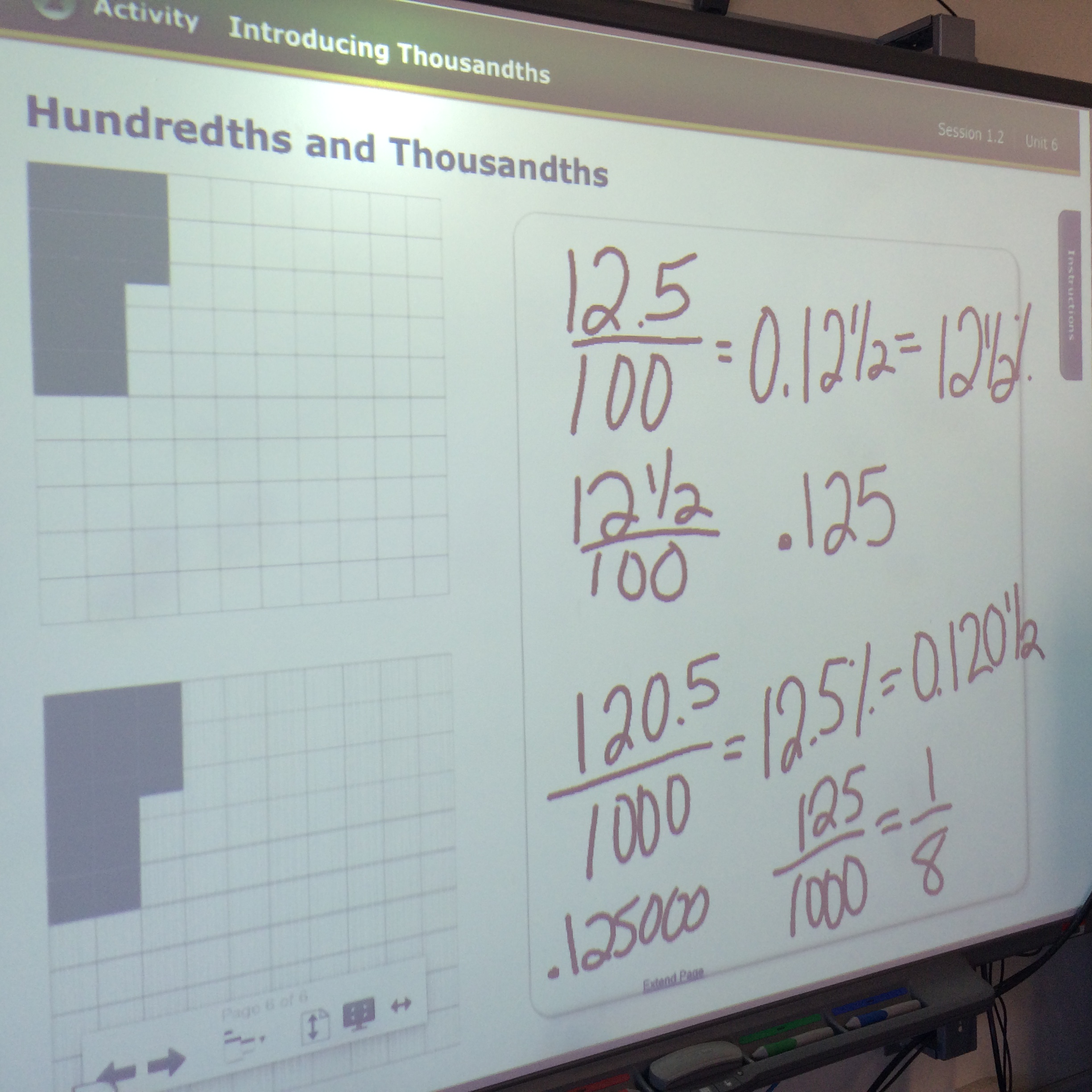
I am convinced that my students have another idea of what they want the 5th grade curriculum to be:) No matter how much I plan, they will always send me in a different direction, which I love. It started yesterday with these two grids and responses…

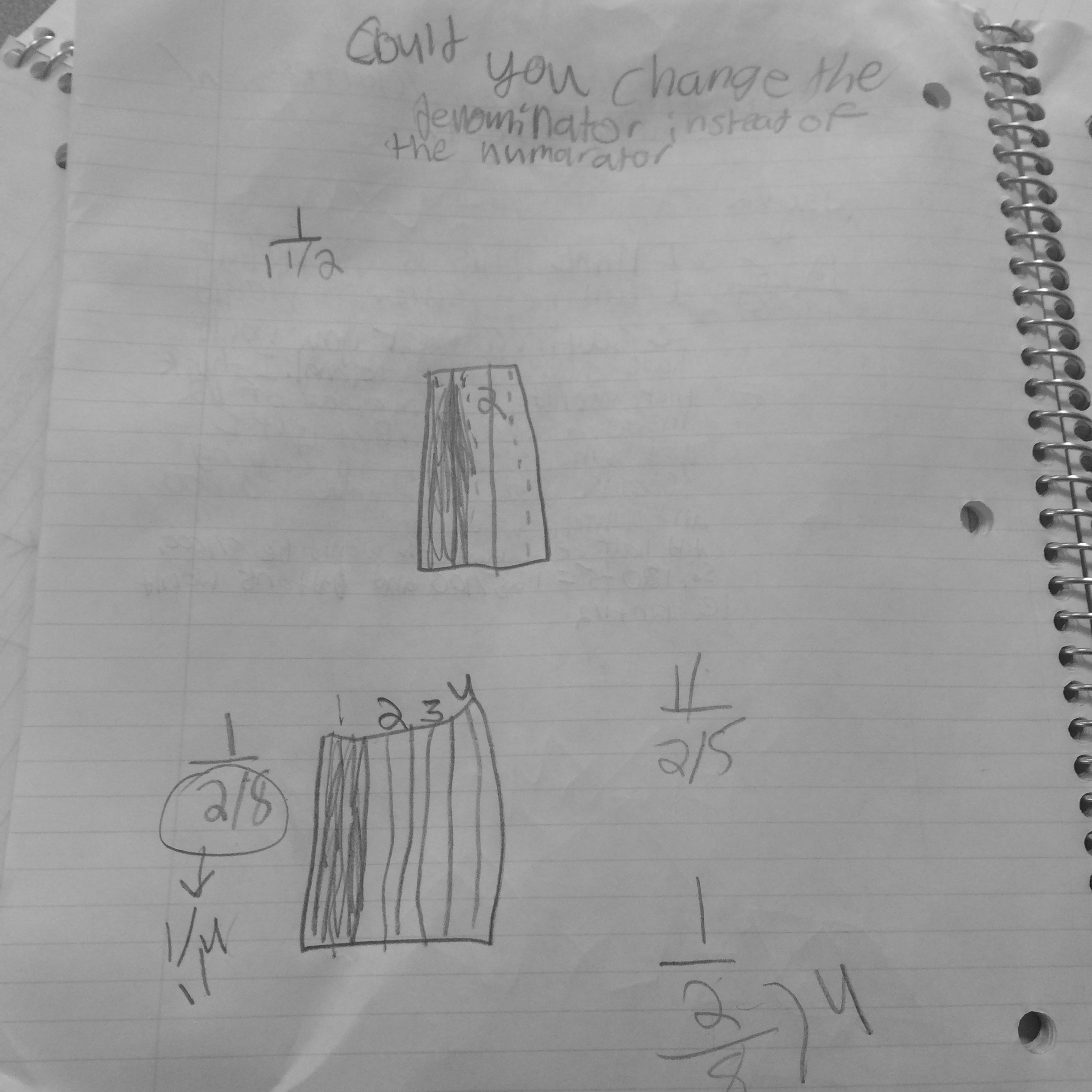
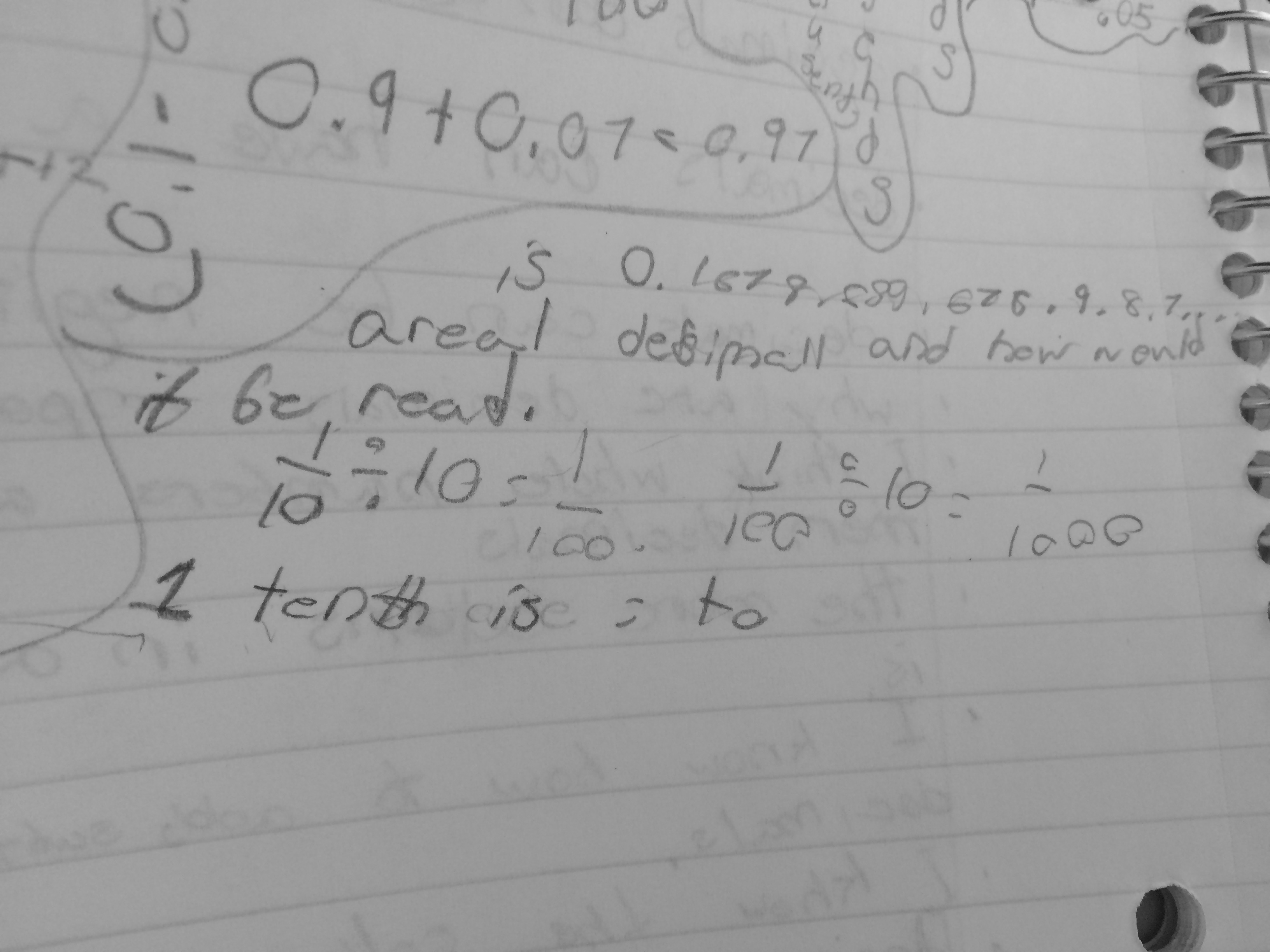
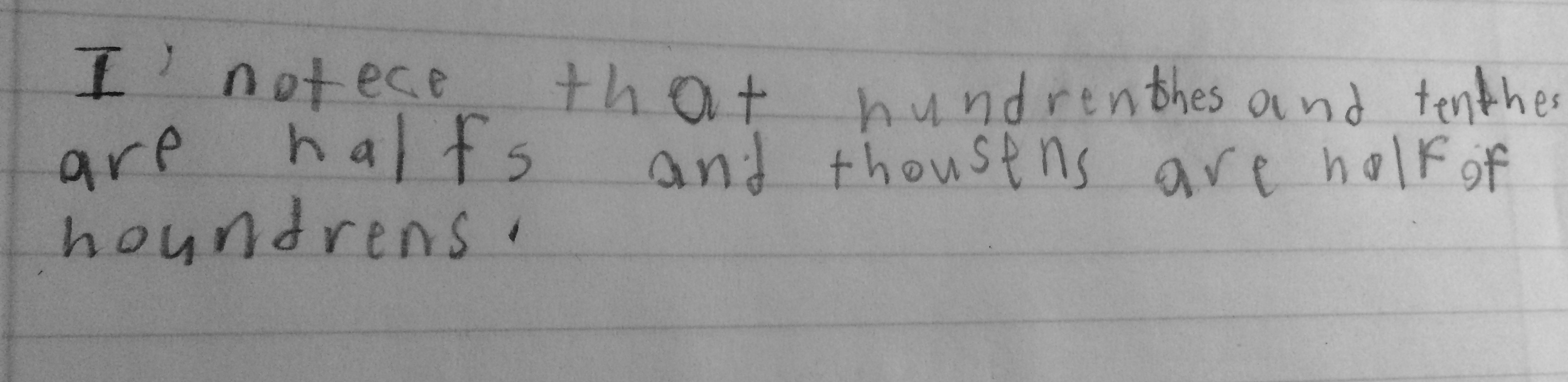
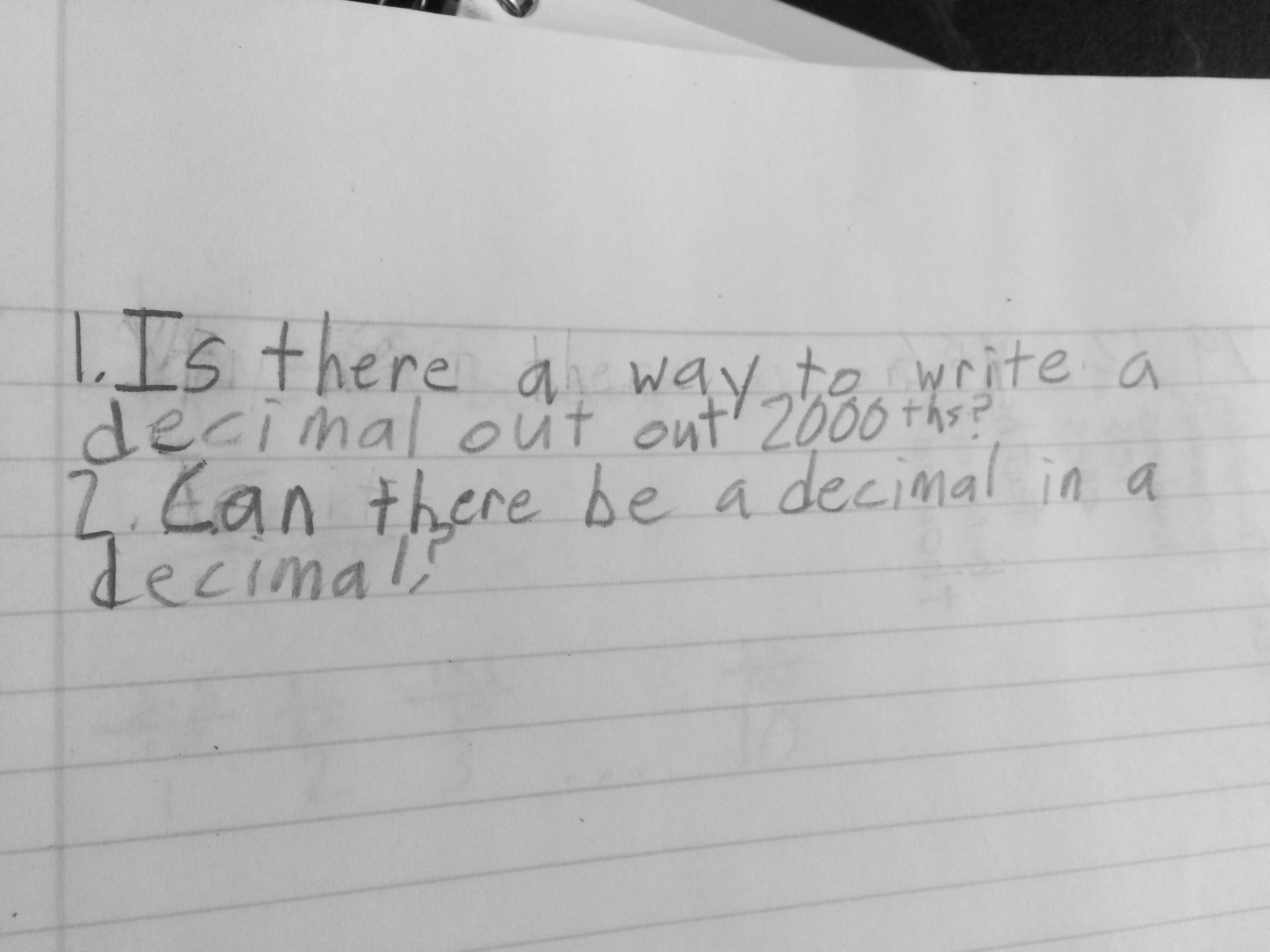
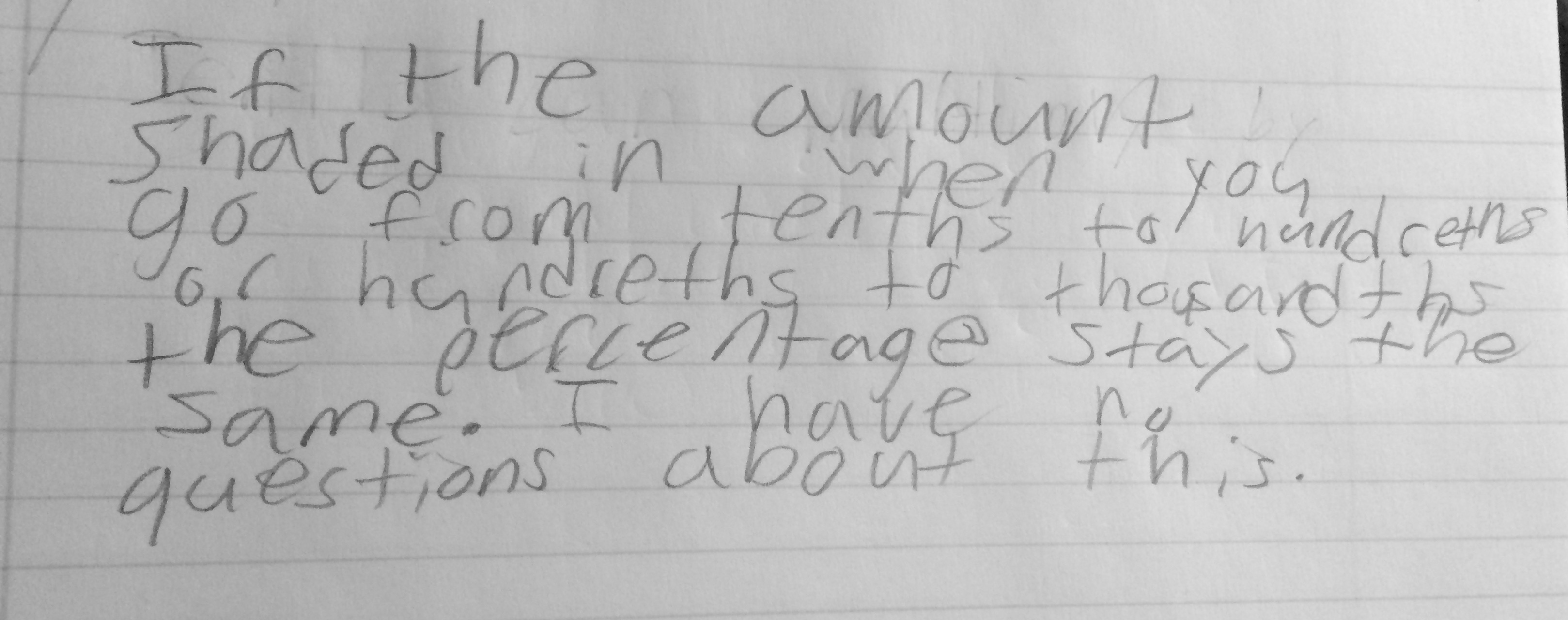
IMG_9034_2That led to these journal entries and our conversation today….

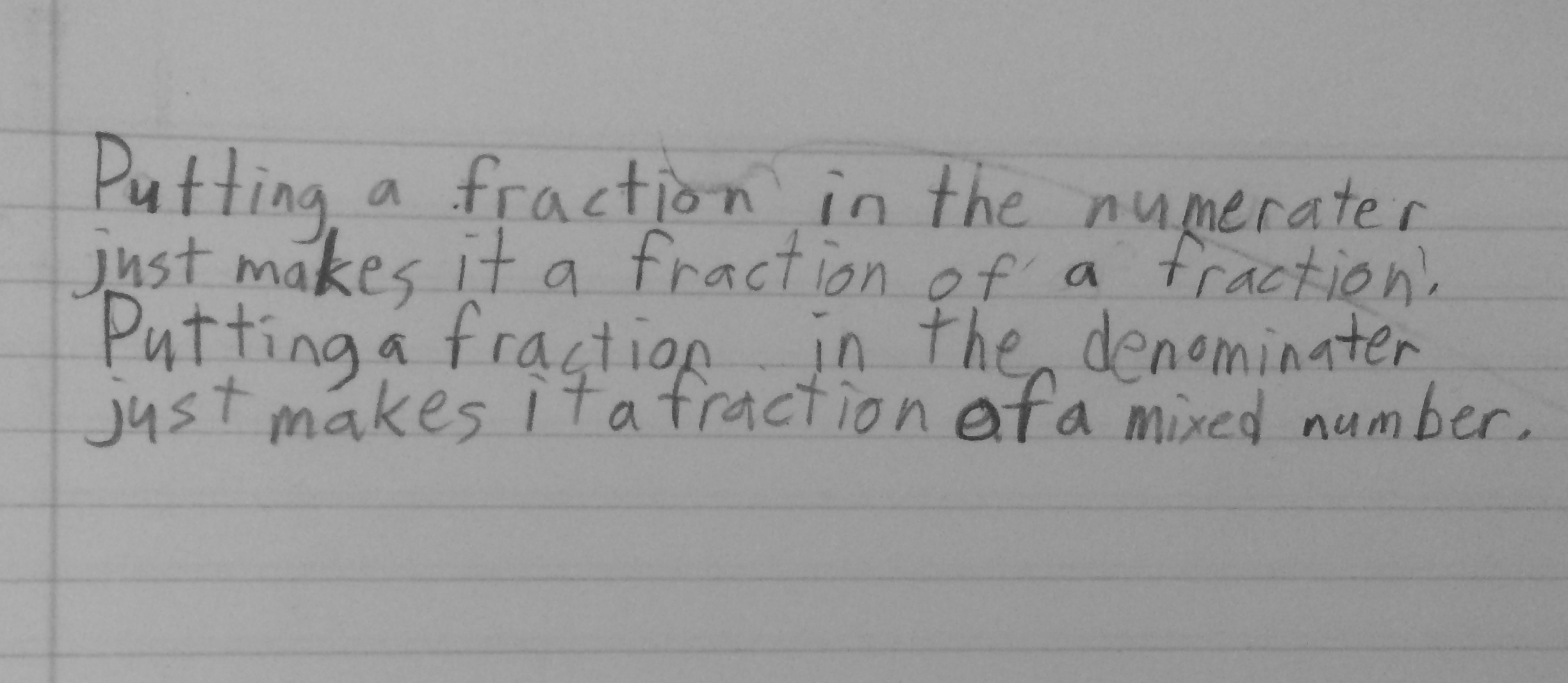
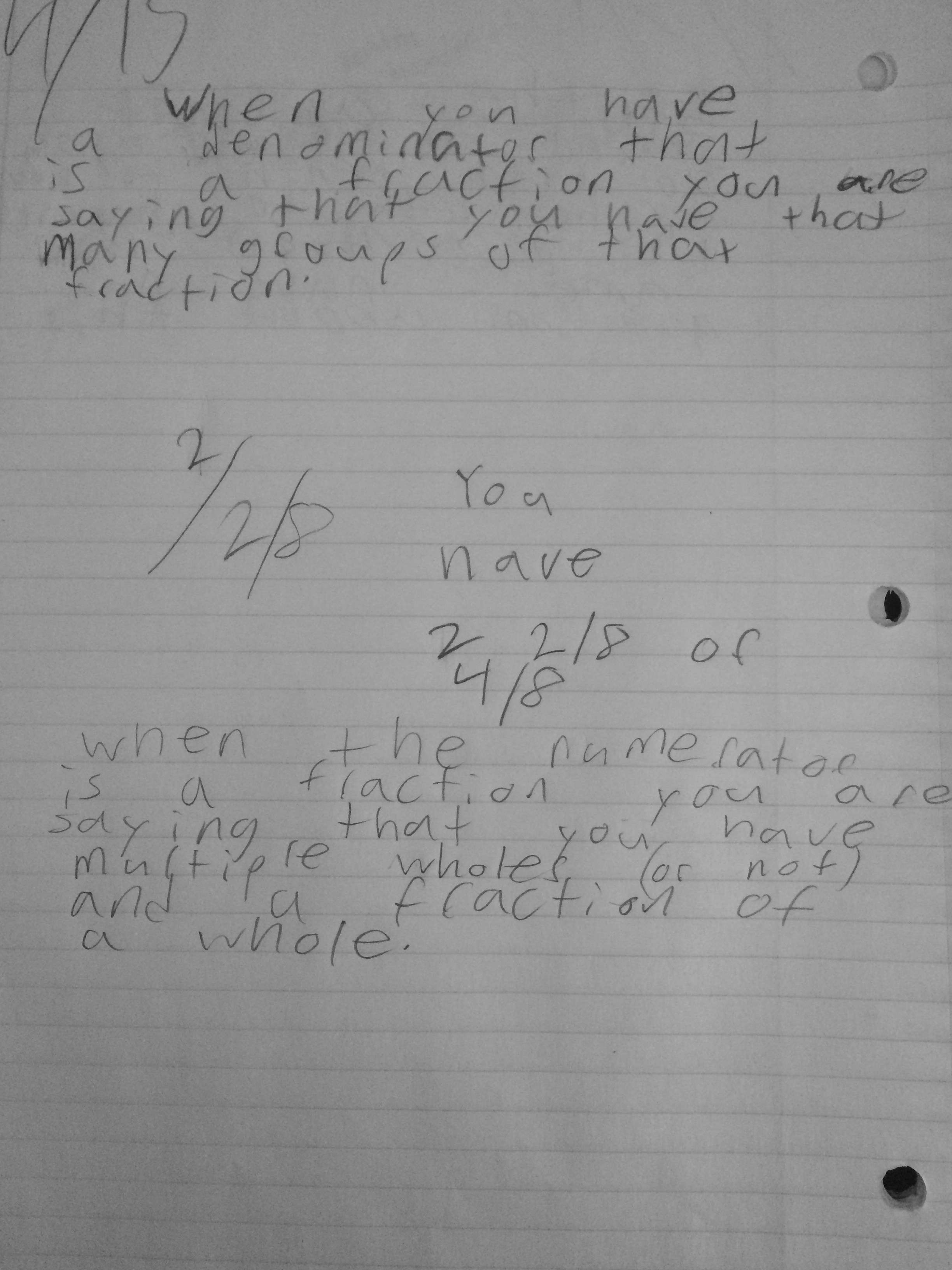
I led with thinking about the fraction (or decimal) in a decimal. We did some more grids and the students were seeing the thousandths like taking a fraction and breaking it into smaller pieces to still have equivalents, like 1.5/4 = 3/8. Then a group of students who were done with the grid work, asked me if there can be a fraction or decimal in a denominator…..here we go…

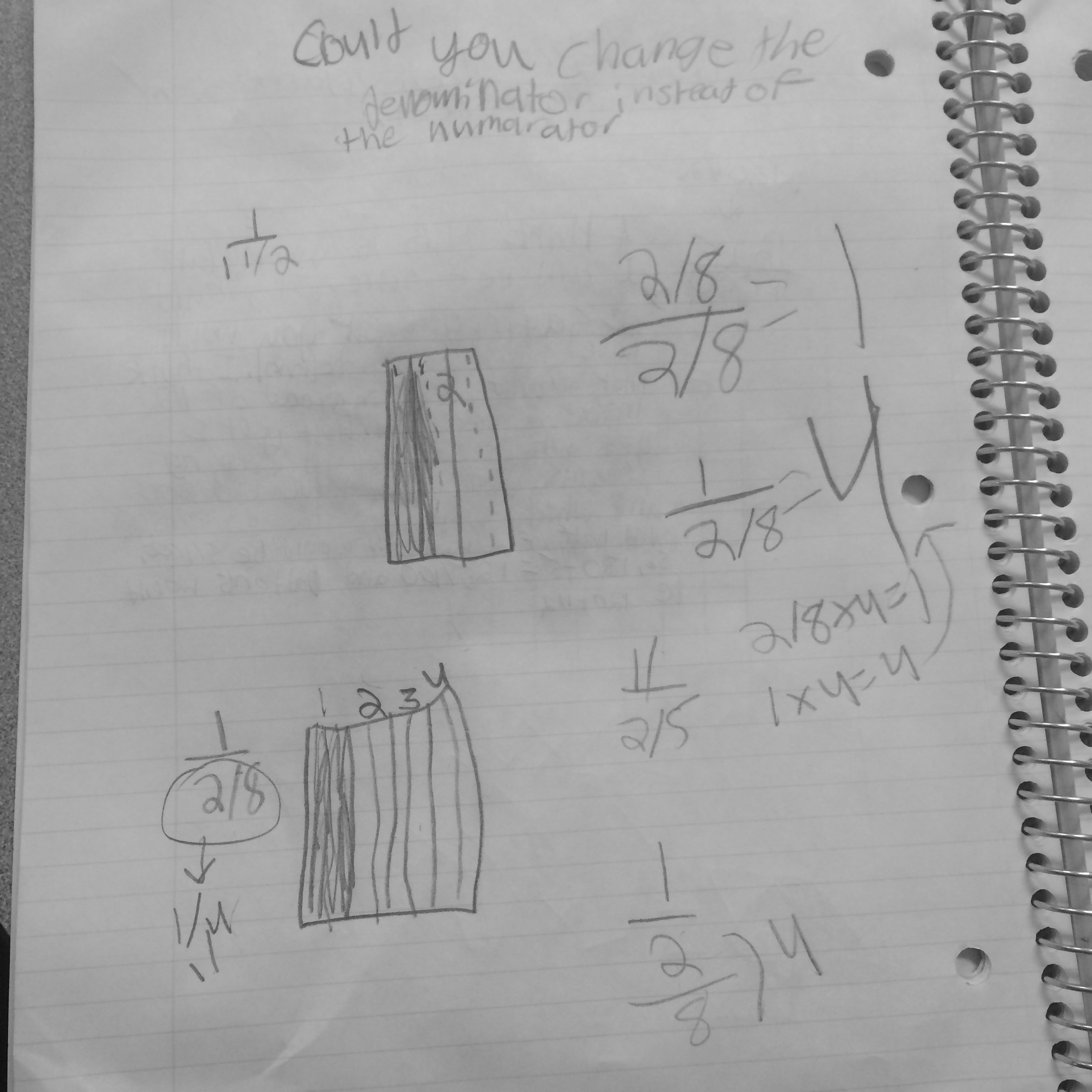
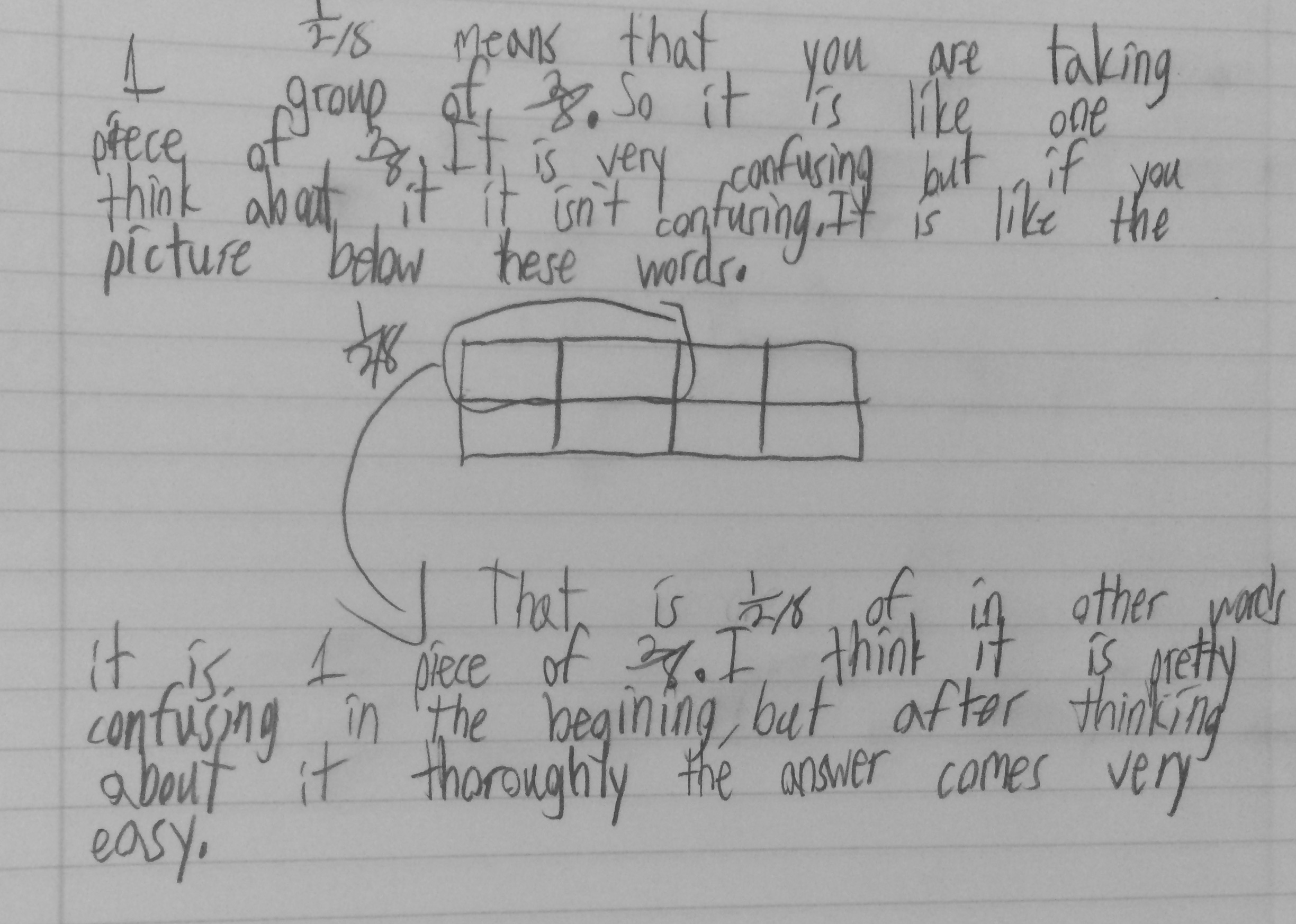
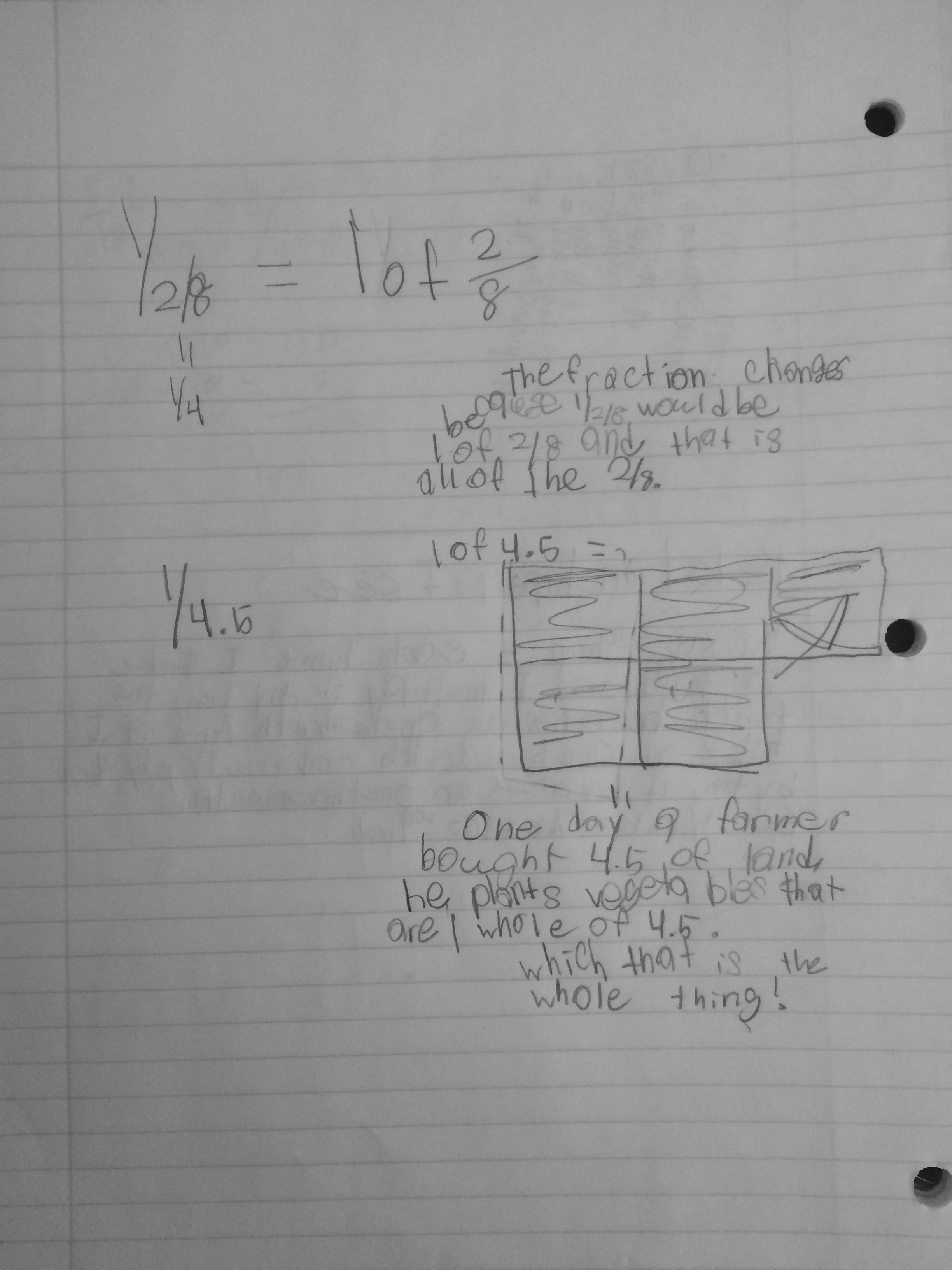
I asked them what they thought it meant and this is their starting point. They jotted some examples and started playing around with 1 / 2/8. He drew it with 2/8 size pieces, came out with 4 but said that looks the same as 1/4.

IMG_9035_2I asked him if it could be, and his intuition was saying no, but he couldn’t figure out why. I asked him what happens when a denominator number gets smaller, he says piece gets bigger. So he started with 1/4, 1/3, 1/2, 1/1, said 2/8 / 2/8 = 1. From there he realized that 1/ 2/8 was improper. Here is where he ended because class ended.

IMG_9037_2I had another working with 100 grids trying to figure percentage-wise is 1/4.5 fell between 1/4 and 1/5 and here are a few others…

IMG_9038_2 IMG_9039_2 IMG_9040_2 IMG_9042_2So much to chat about, but after a long day, my brain needs a break:)

I just love how a thousandths grid lesson can lead to this, I want my students to publish a “Kids Curriculum” as a supplement to mine, because they obviously have so many amazing curiosities! (Or maybe, Christopher, we can name it Kids Kurriculum)

-Kristin

Tenths to Thousandths Decimal Journey…

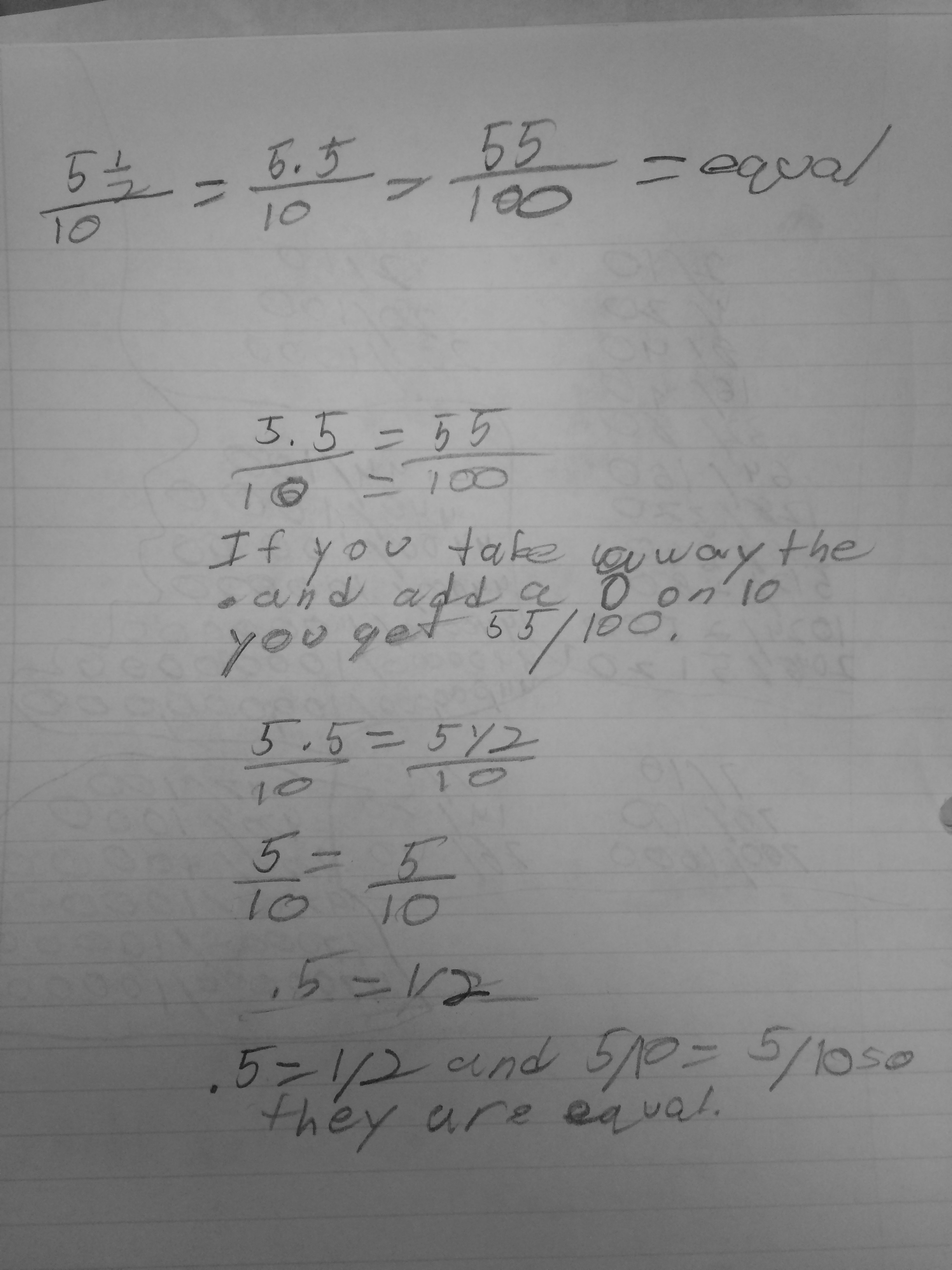
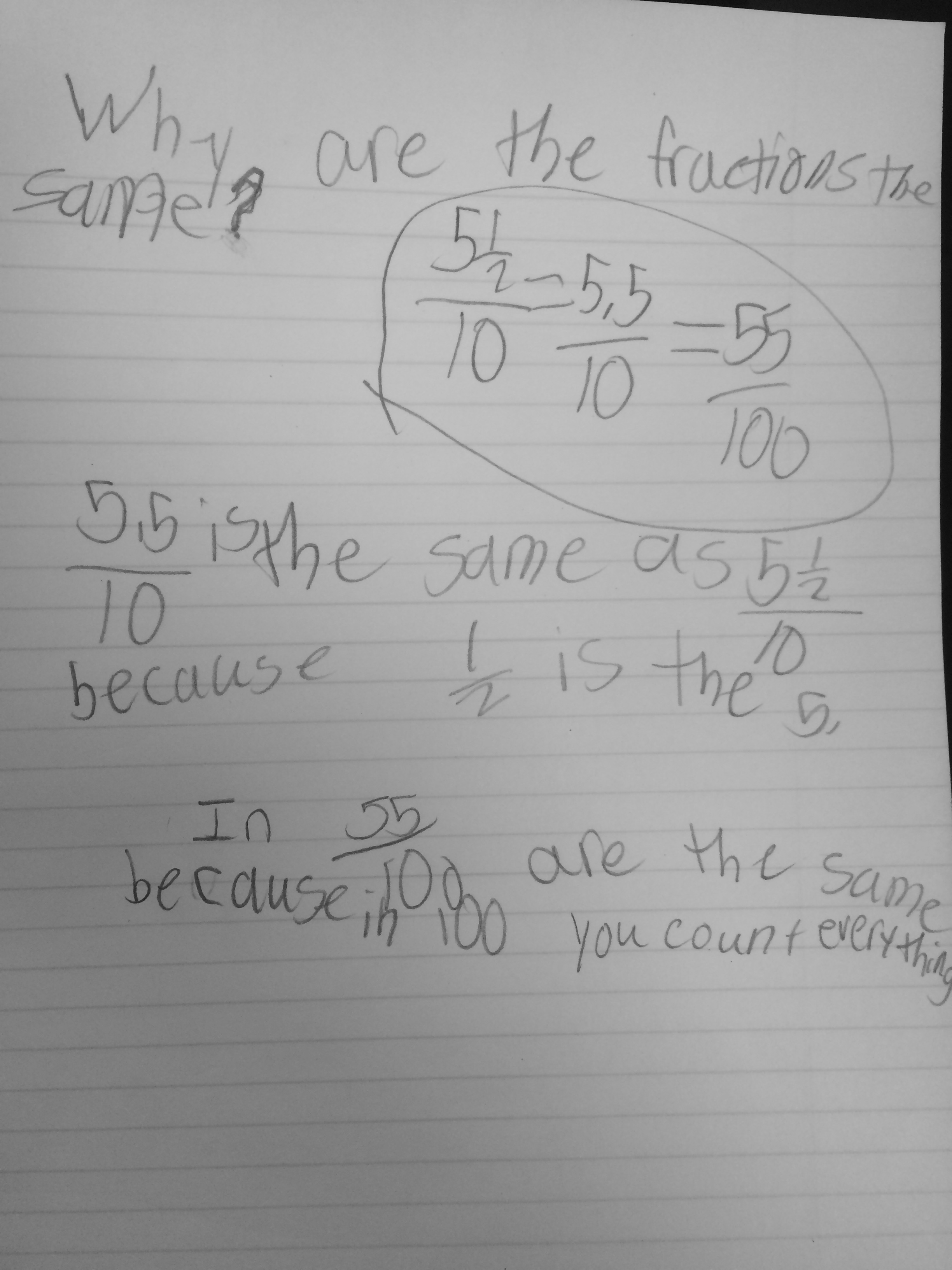
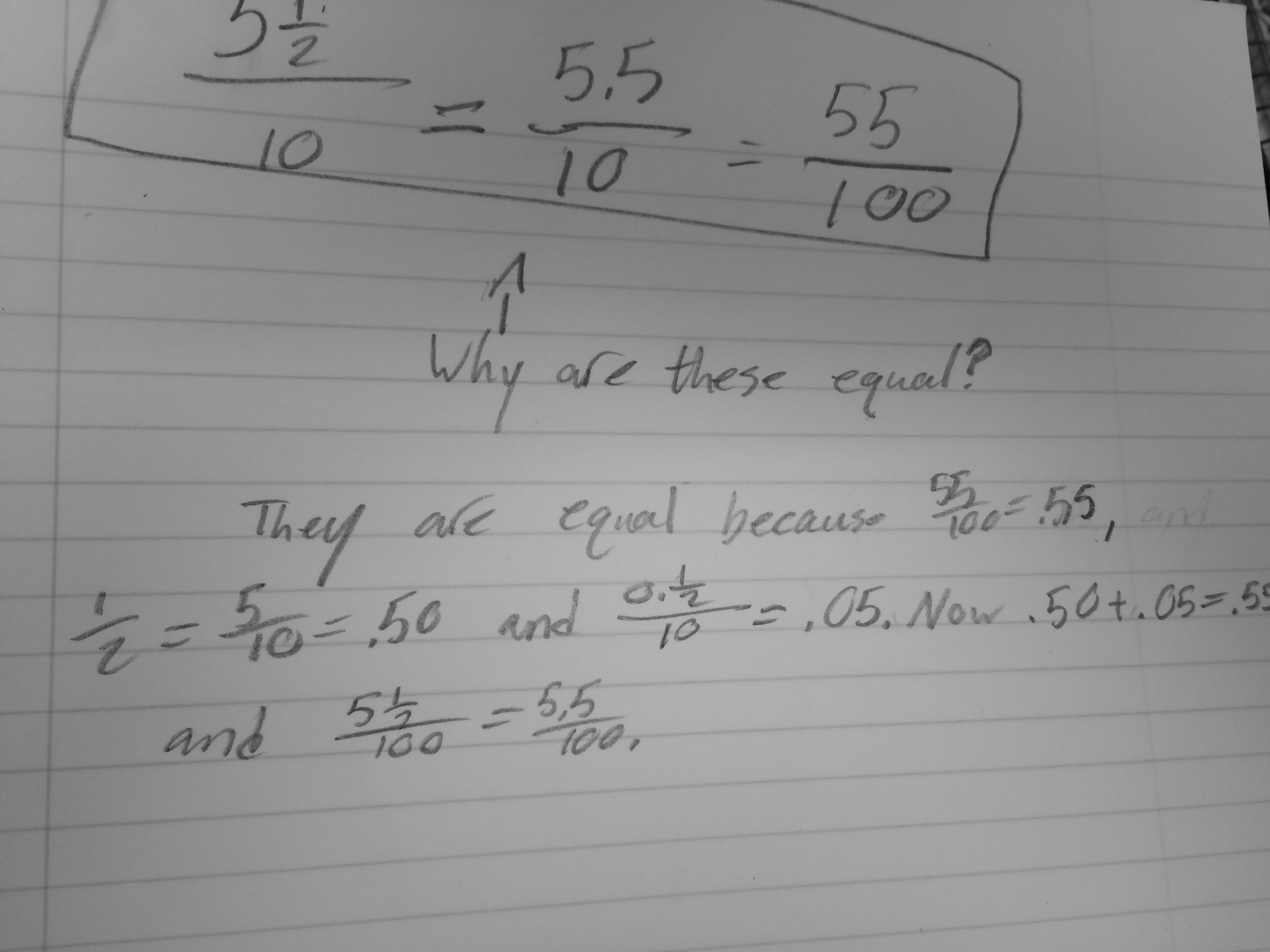
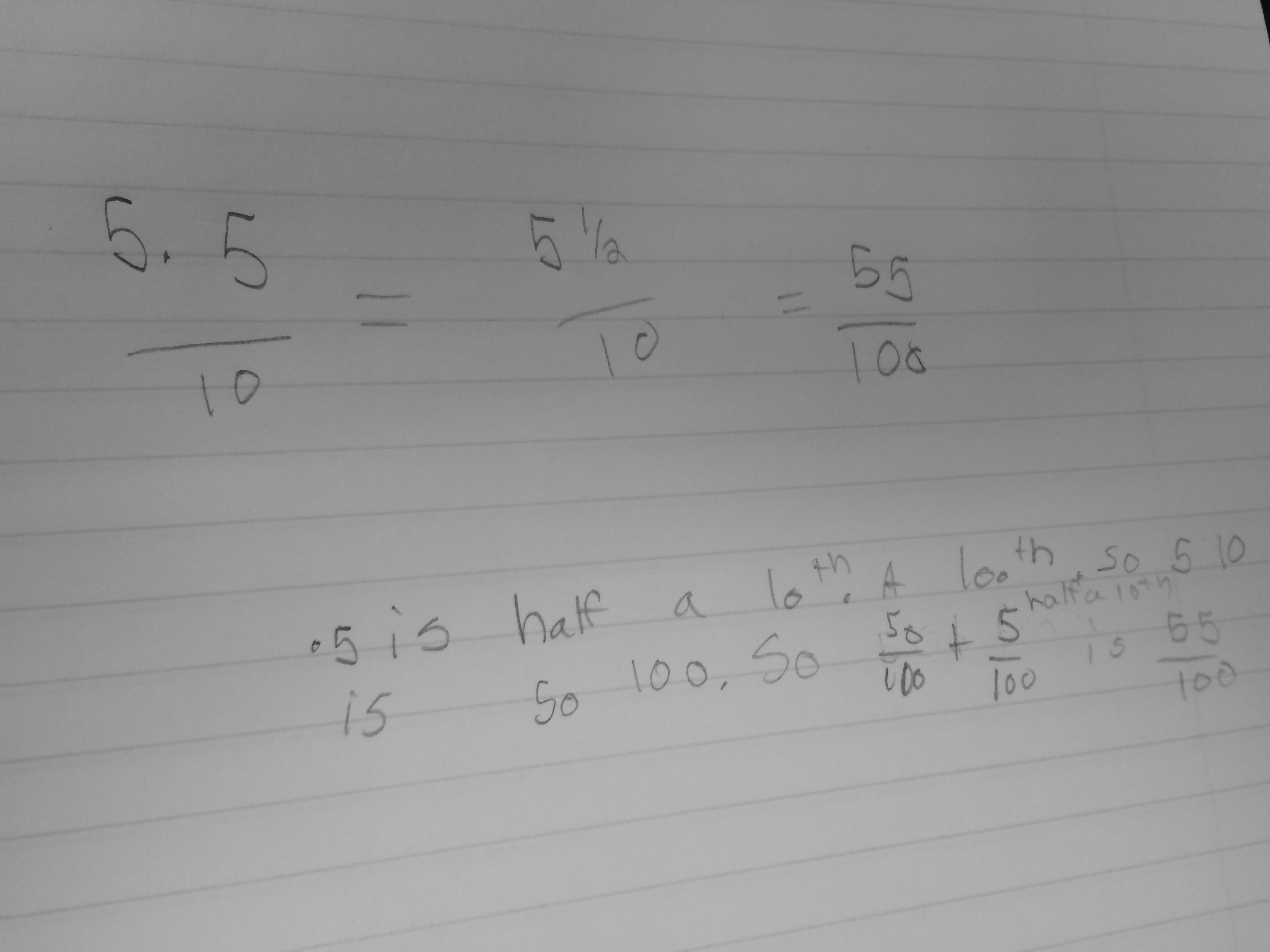
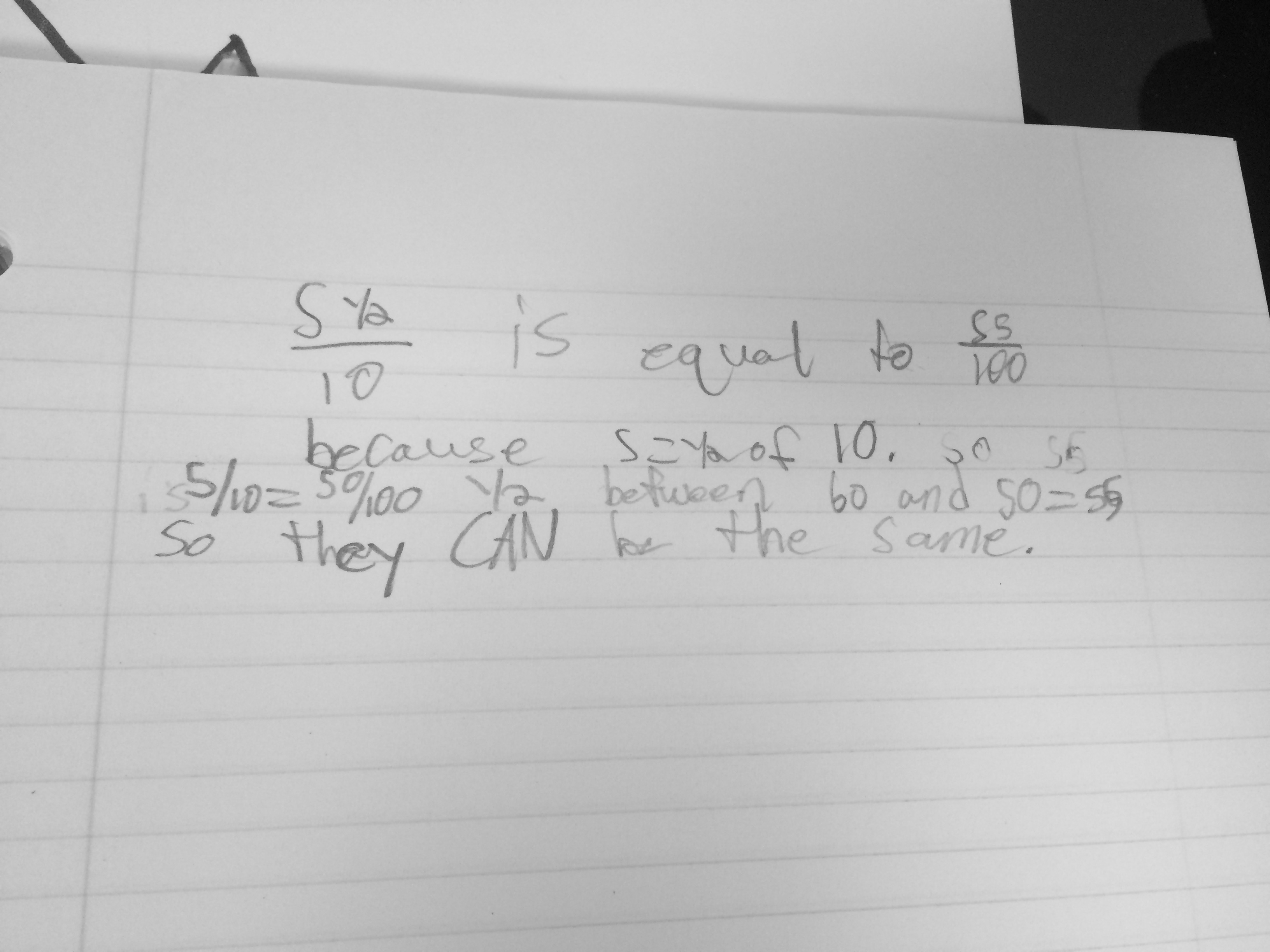
After our quick images, we moved into pre-shaded grids for students to look at equivalencies of decimals shaded on tenths and hundredths grids. We flew through until we hit the tenths grid with 5 1/2 tenths shaded and hundredths grid with 55 hundredths shaded. The students could see they were equivalent by the pictures, but many had a tough time explaining why. When someone did say “A half of a tenth is 5/100” another student said, “But I thought a half of a tenth was 1/20?” What a cool conversation! They left class yesterday with this question still lingering so I had them just jot what their group had talked about in relation to these pictures…

IMG_8997_2 IMG_8998_2 IMG_8999_2 IMG_9005_2 IMG_9007_2At this point students were starting to have trouble thinking about writing a decimal that was a half of the place value to the right, so they stayed in fractions where they comfortably can represent half a fractional piece.

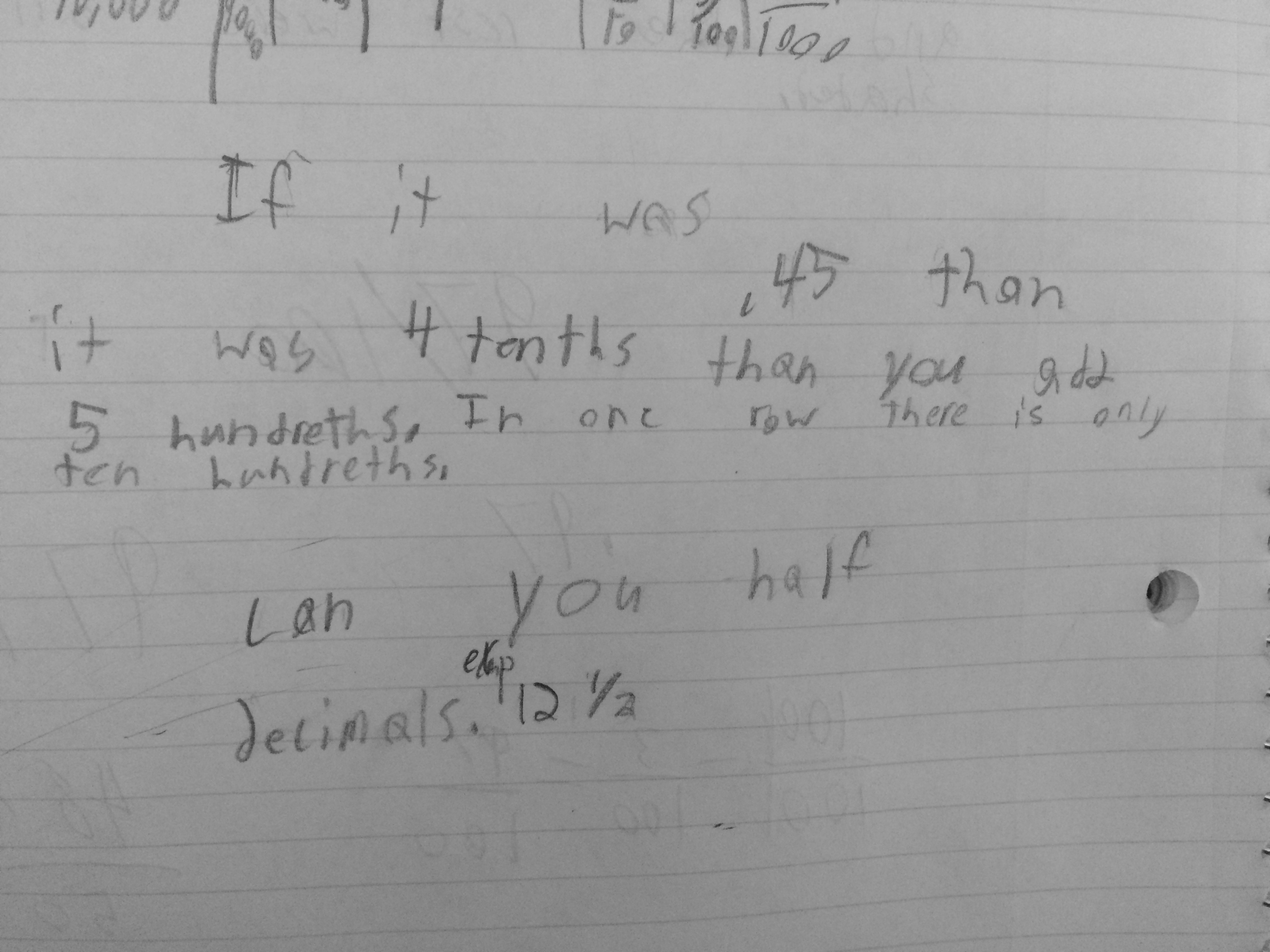
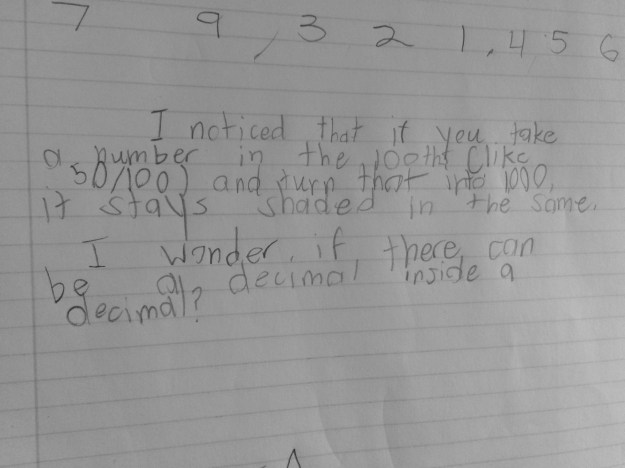
We started our conversation with this today and broke up the grids to prove that 5/100 is equivalent to 1/20 and equal to 1/2 / 10. Students were comfortable with the half of a tenth represented in the hundredths, however they made it perfectly clear that they much preferred the hundredths grid because it was much easier to read:) So, of course, then I pushed them into the thousandths grid. We started with 1/4 shaded on a hundredths grid and 1/4 on a thousandths grid. They comfortably wrote 25/100=250/1000=25%-.25=.250. Then we went to a hundredths and thousandths grids with 1/8 shaded. Great convo that we will have to build on tomorrow, but as always, I need more math time!! I had them leave on a reflection prompt about what noticings they had during our work today. For the students who could easily see these equivalencies, I told them to write me some wonderings they may have. I got quite a range of great things. The predominant question was about the fraction/decimal in a decimal. I struggle with how to address this because it visually is not as appealing to me as the fraction/decimal within a fraction. I am comfortable writing 1 1/2 /4 = 3/8 but to write the fraction in the decimal does not work. I never really thought about it much before, but how funny that we can write a fraction of a fractional piece and it is readable, but to try with decimals, not so much. The only way I see to address this is to do many more grid shadings to get comfortable with these equivalencies, but I do so appreciate their curiosity about it!

IMG_9018 IMG_9013 IMG_9014 IMG_9015 IMG_9020 IMG_9022 IMG_9023 IMG_9026 To use the word differentiation here is an understatement. The range of thoughts in my classroom (and many many others) amaze me on a daily basis, in the most wonderful way!
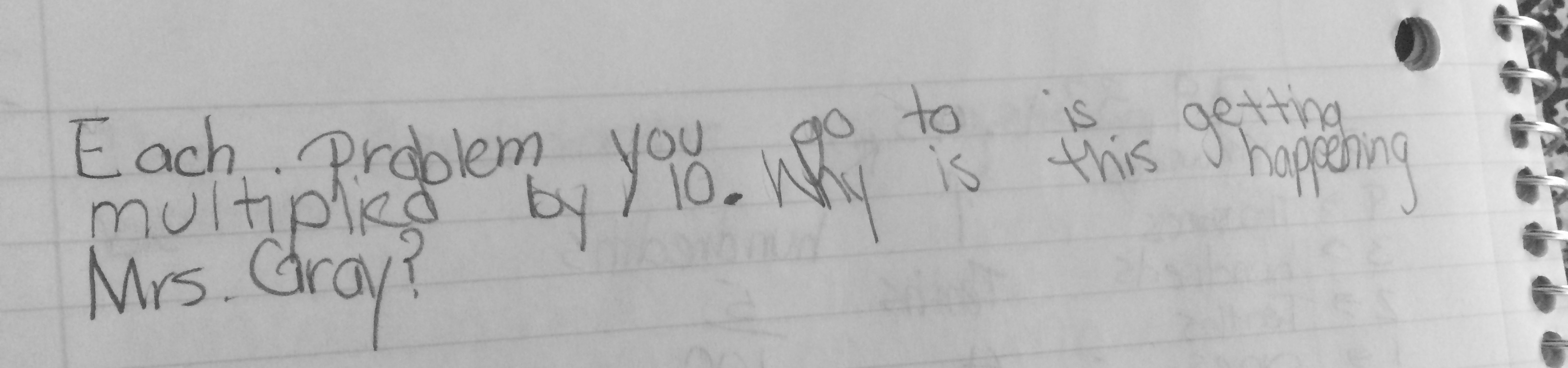
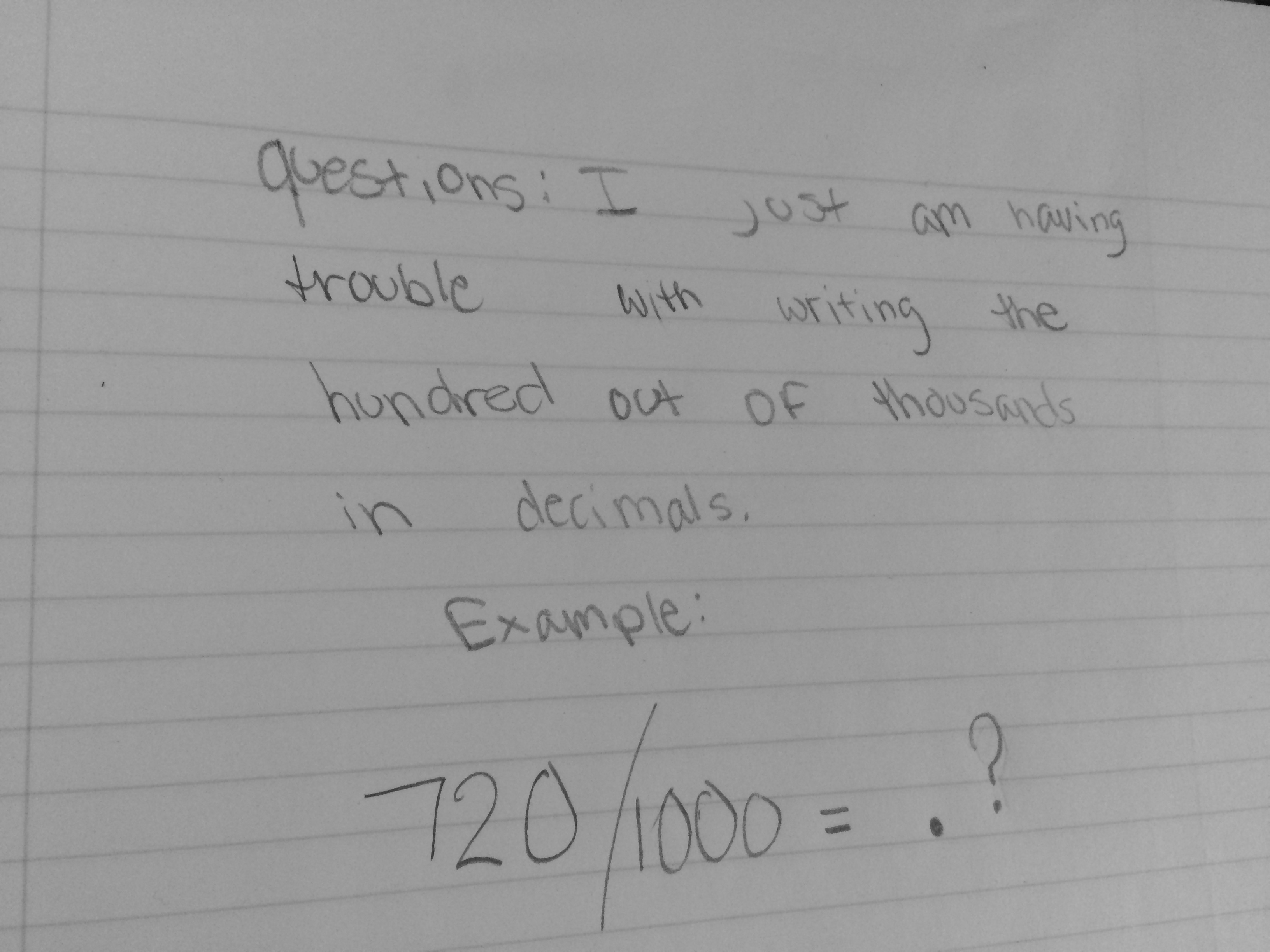
And I especially love these last two because it gives me the feeling that I have created a safe place for my students to put confusion out there. I LOVE LOVE LOVE this ❤

IMG_9019 IMG_9024

~Kristin

Decimal Quick Images

In Investigations we do Quick Images of dots, 2D and 3D figures. I thought we could incorporate this same routine into our decimal unit to talk about fraction/decimal/percent equivalents. I told the students that each grid equaled 1 and that it was broken into 10 or 100 pieces (just to save time of them counting to verify it). I flashed the grid image on the screen for 3-5 seconds and had students give me a thumbs up when they know how much of the grid was shaded. I asked them to signal with their fingers if they had more than one way to name the amount or an equation of how they saw it.

These were the first images that I did (one at a time) and after each we discussed what they saw. After they said their answer, I was sure to ask “How would you write that?” to be sure if they were seeing it as a fraction or decimal.  It was interesting, but not surprising, that every student gave a fraction.

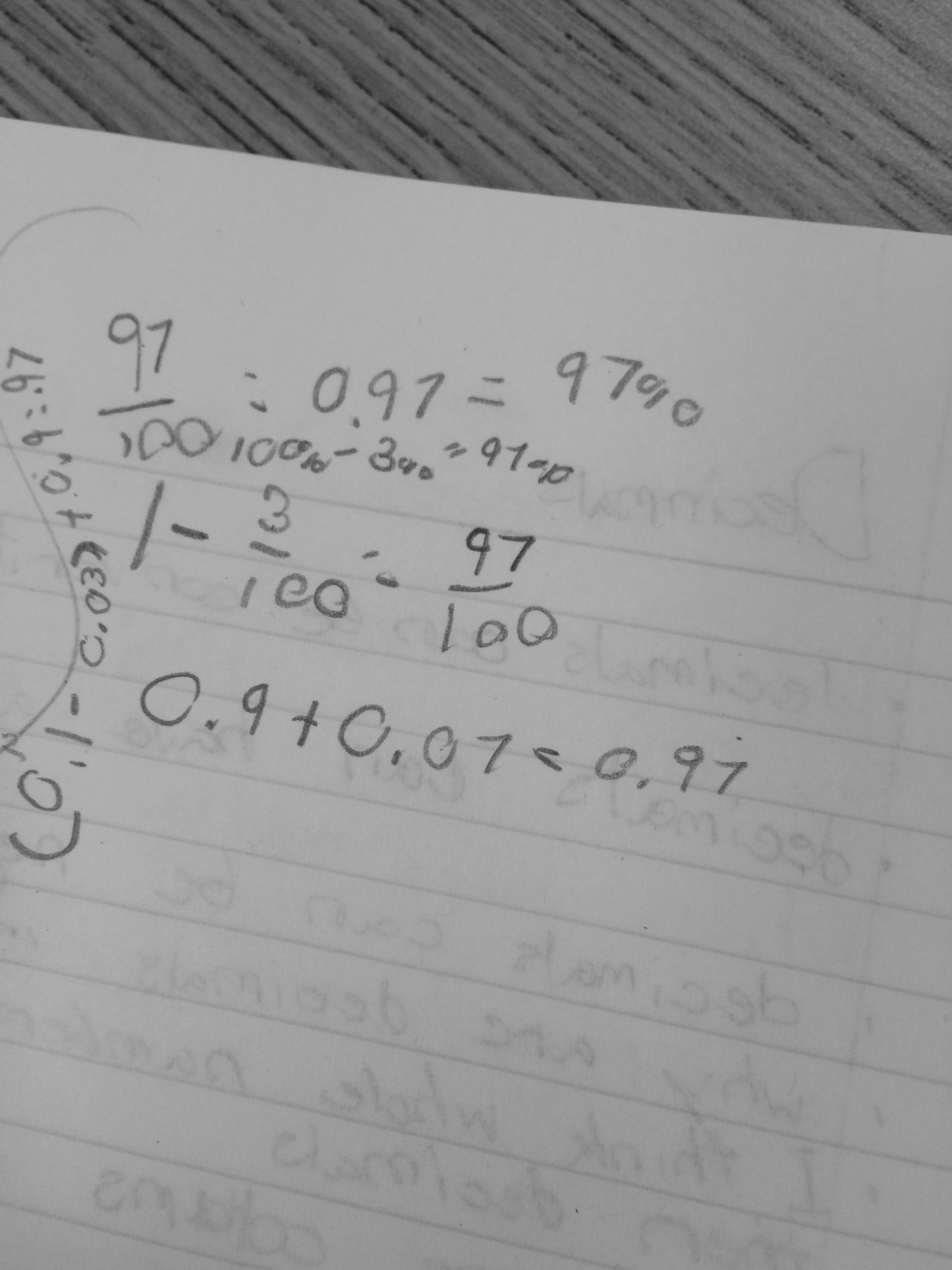
g1The first one elicited the 2/10, 20%, every equivalent fraction of 2/10, and eventually 0.2. I asked about the zero in front of the decimal to be sure everyone knew that meant there was not a whole filled. The second elicited much of the same, but also came with 10/10 – 3/10 = 7/10 as the way they remembered how much was there. “It was easier to count the white part.”

The next two went into hundredths and followed the same routine.

g2We did the first aloud in a Number Talk type setting and then I sent the students back to their seats to write what they could for the fourth image. Here is what they came up with…

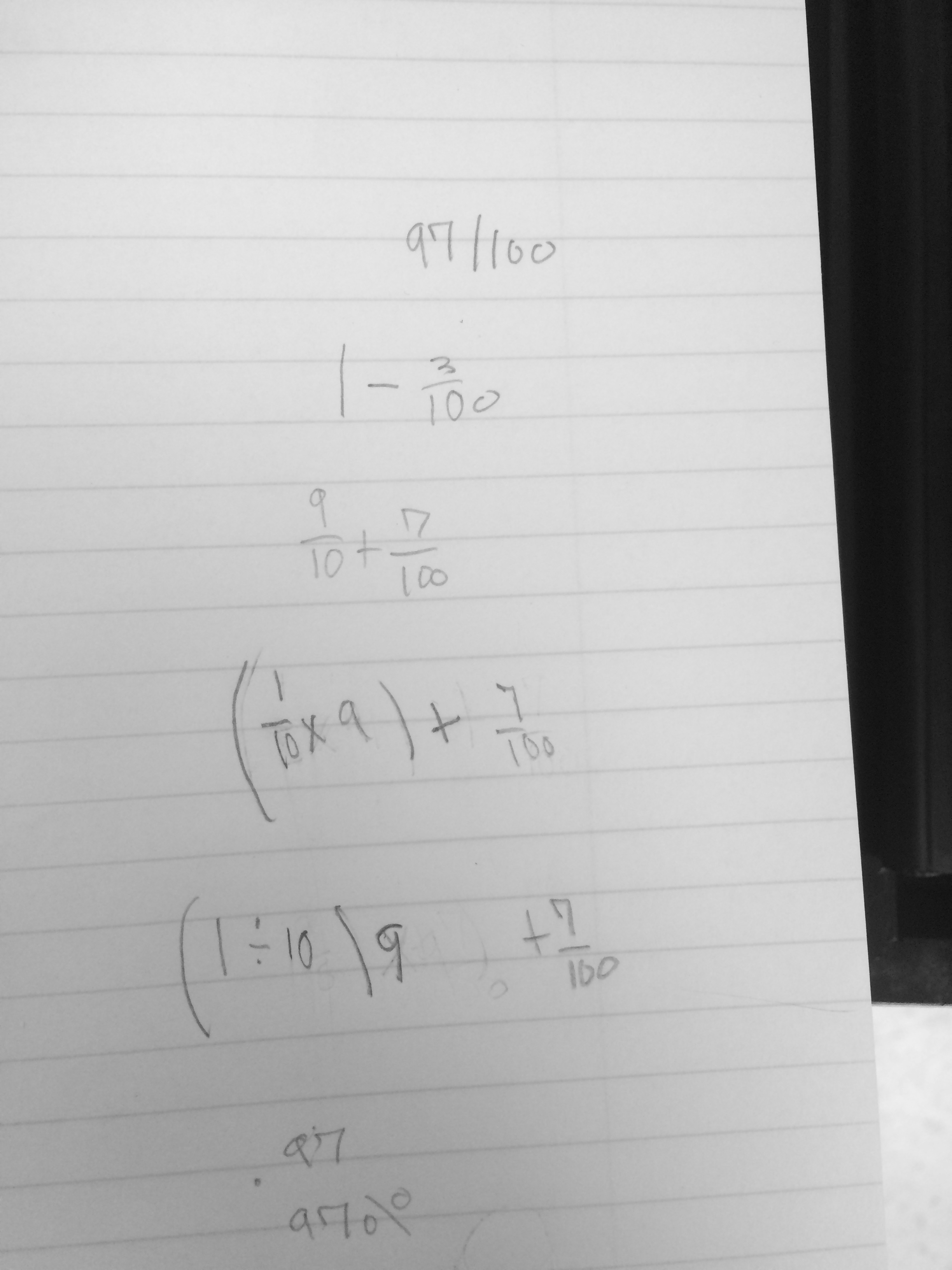
IMG_8995_2 IMG_9001_2 IMG_9004_2 IMG_9008_2 IMG_9011_2This is a wonderful jumping point for starting Fill Two game tomorrow! I plan on bringing up some of the examples with .9 + 07 to start our classwork!

-Kristin

Decimals – The Very Beginning…

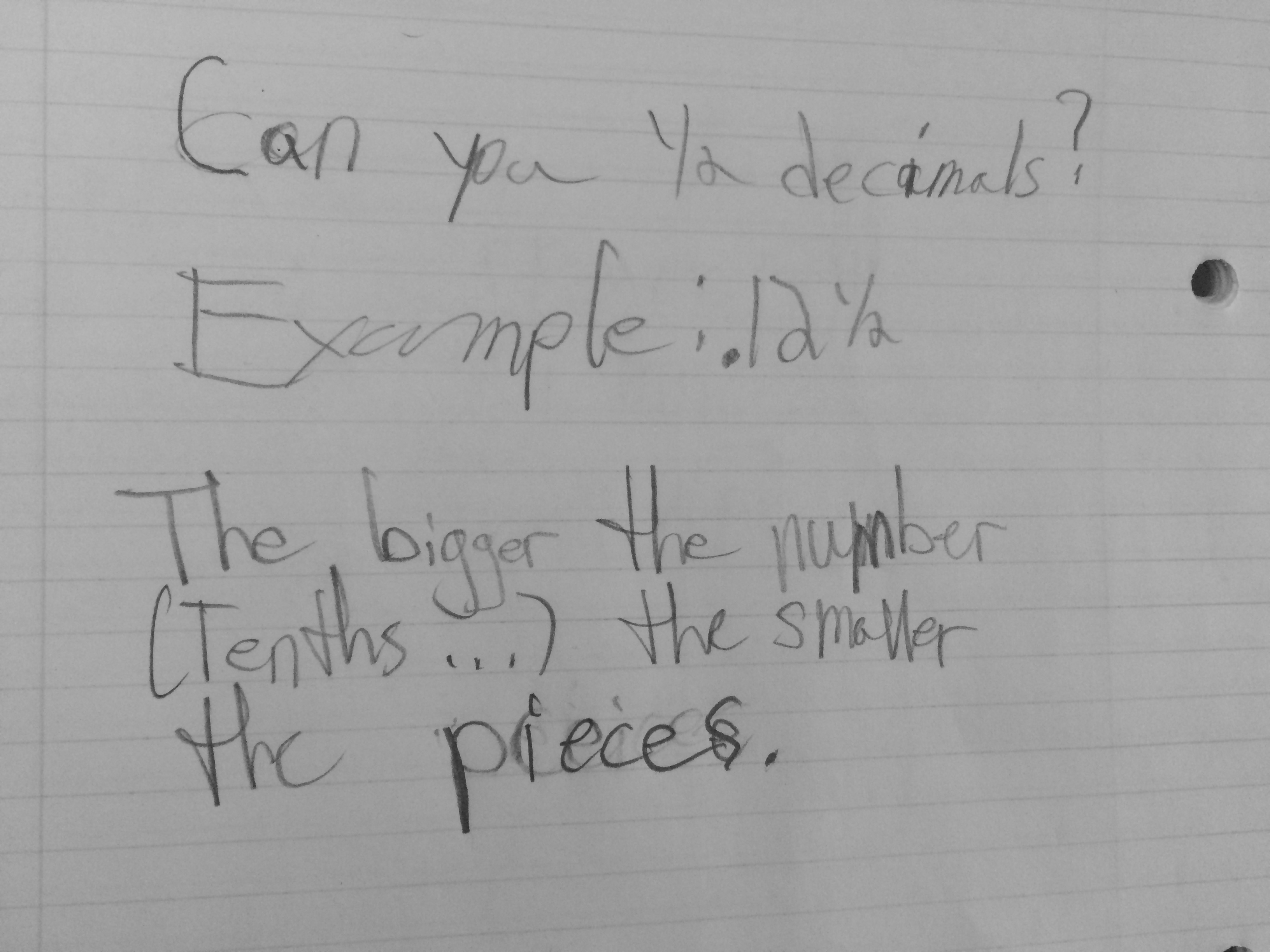
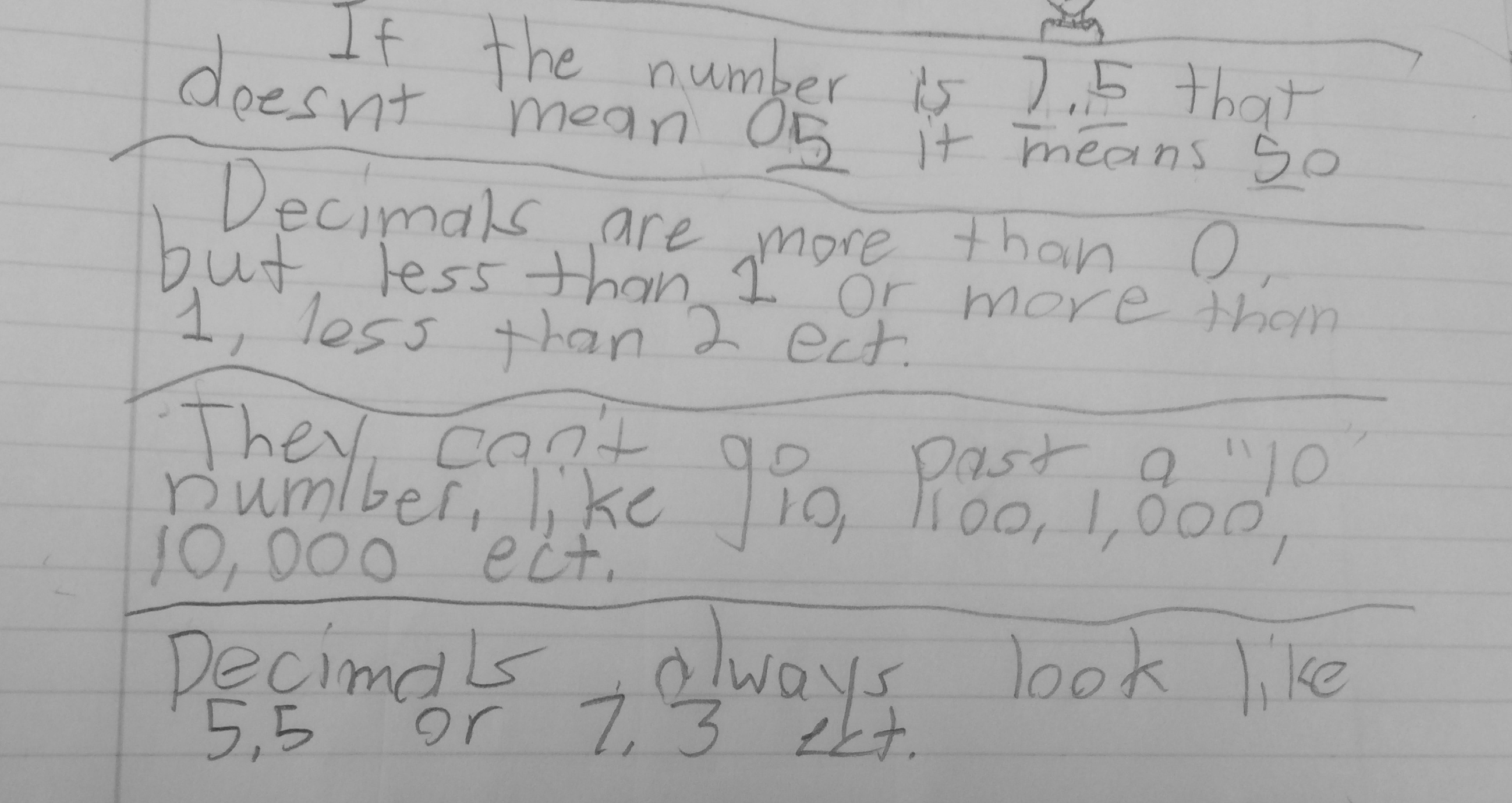
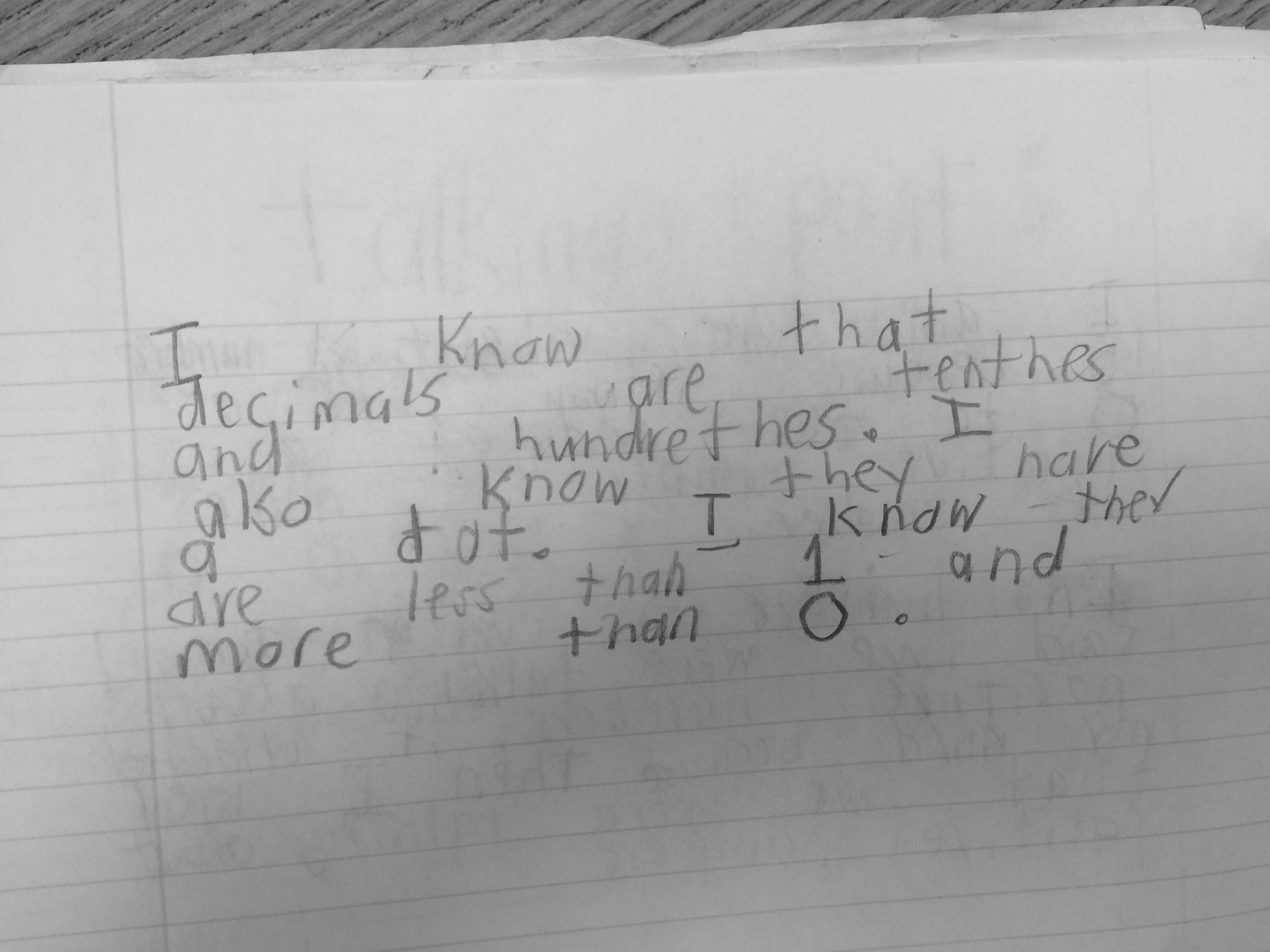
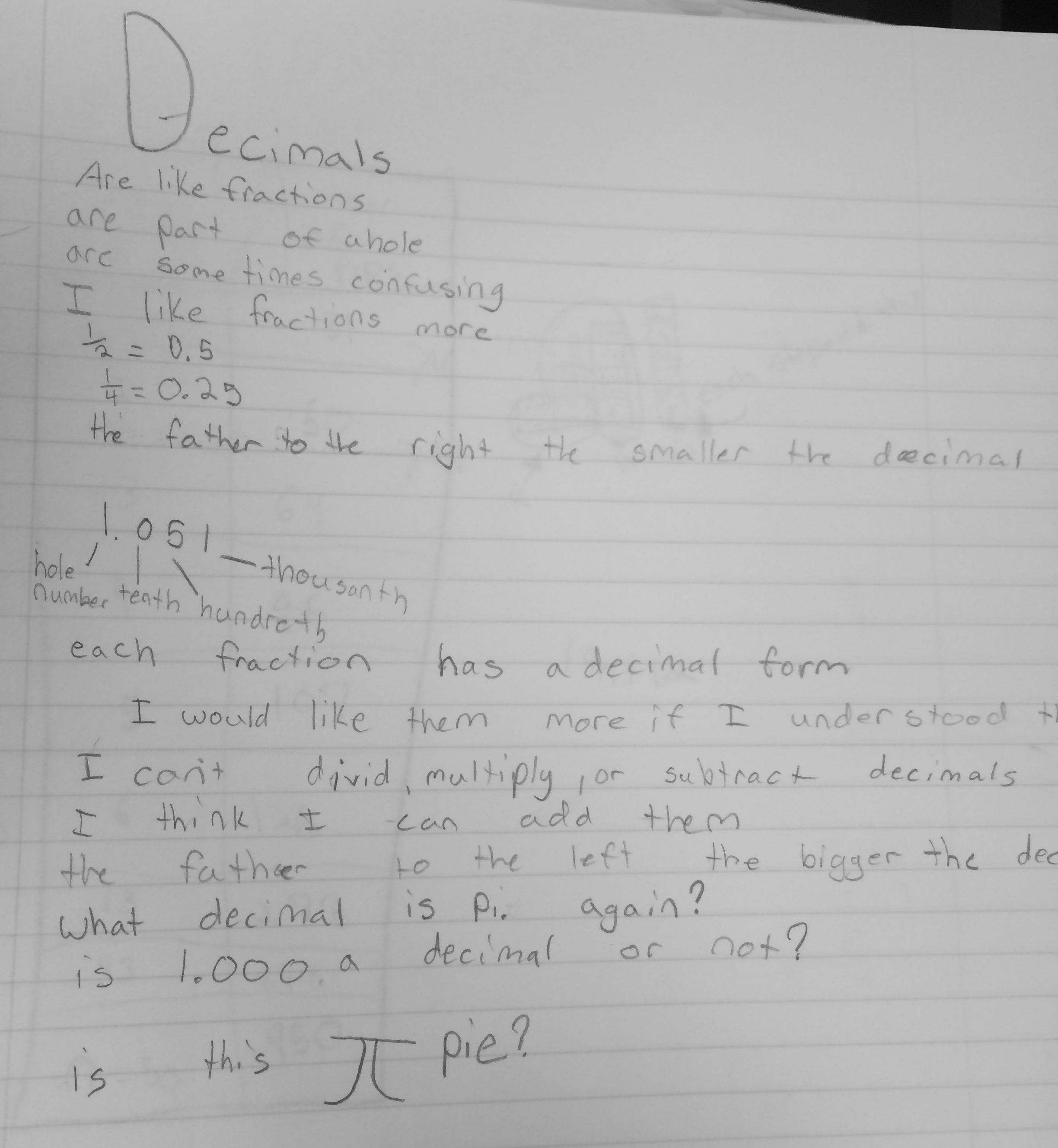
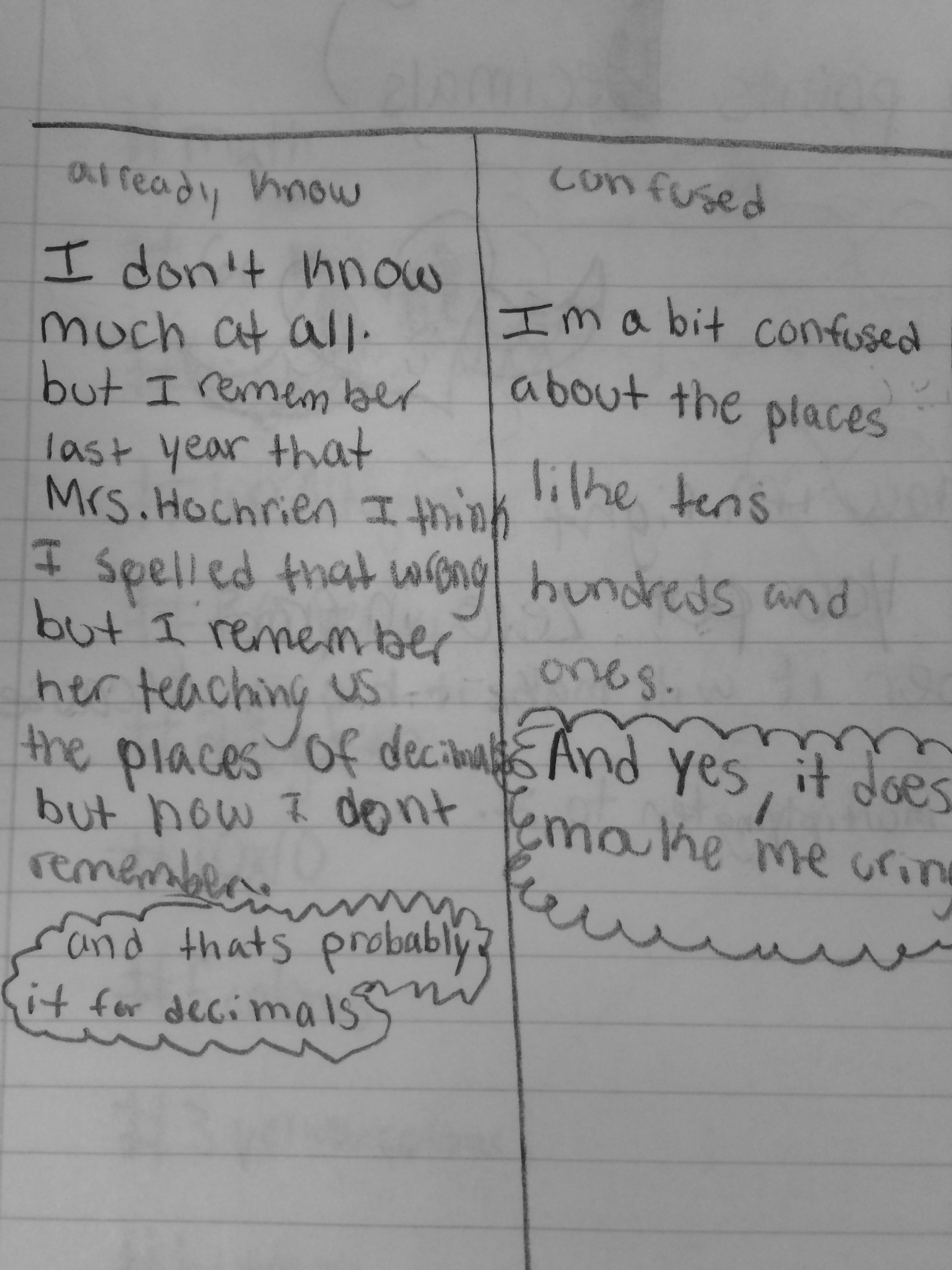
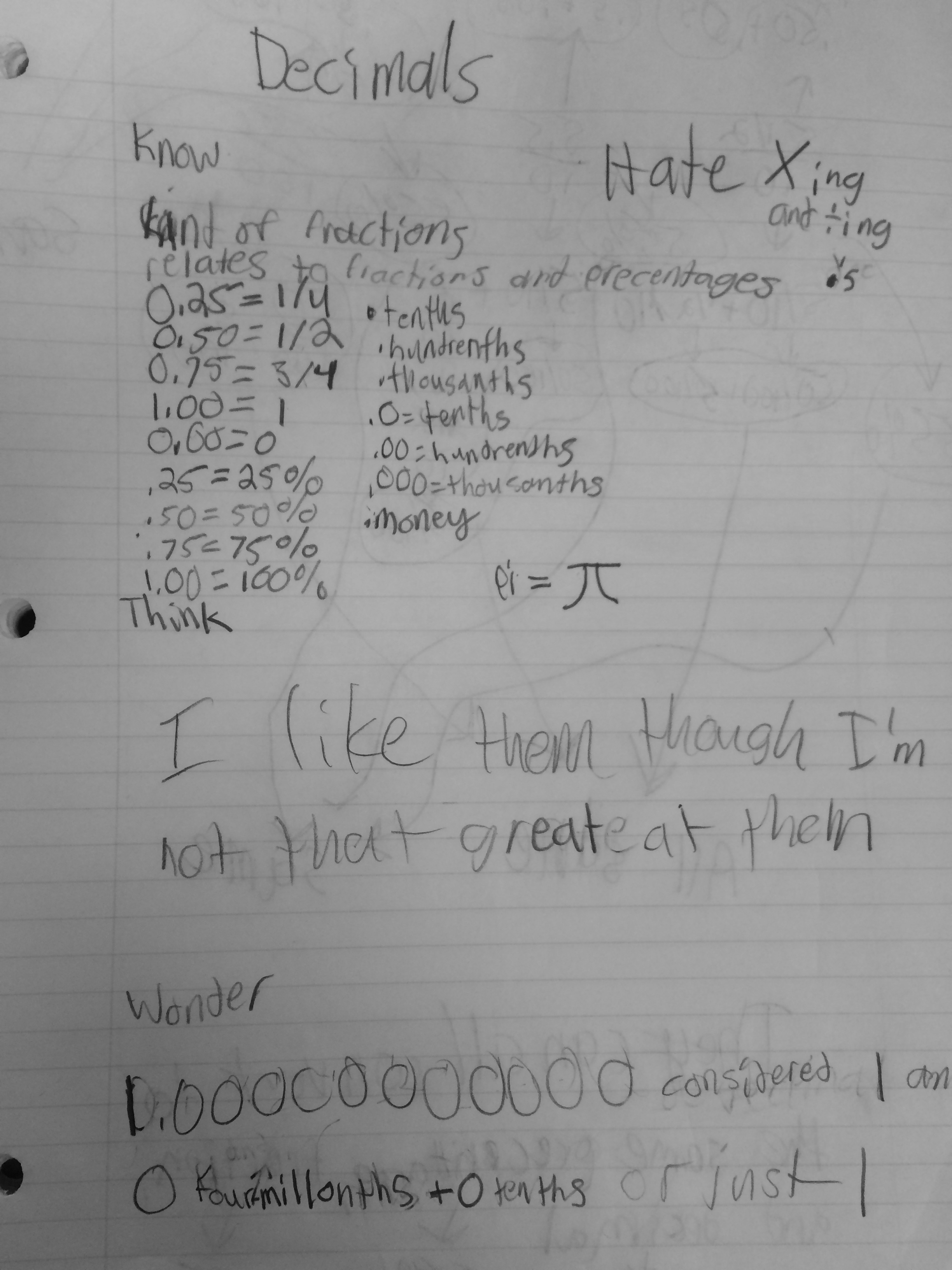
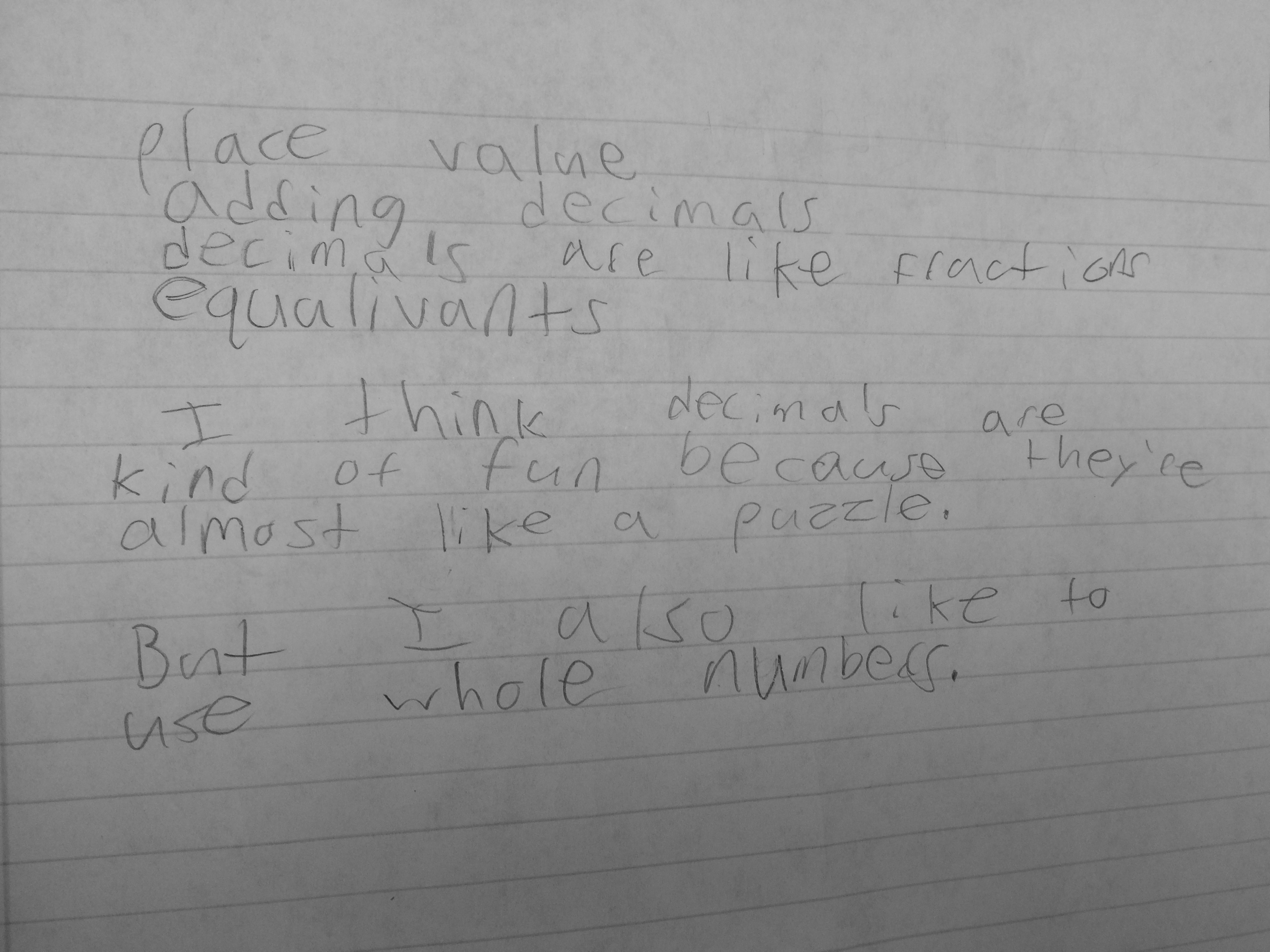
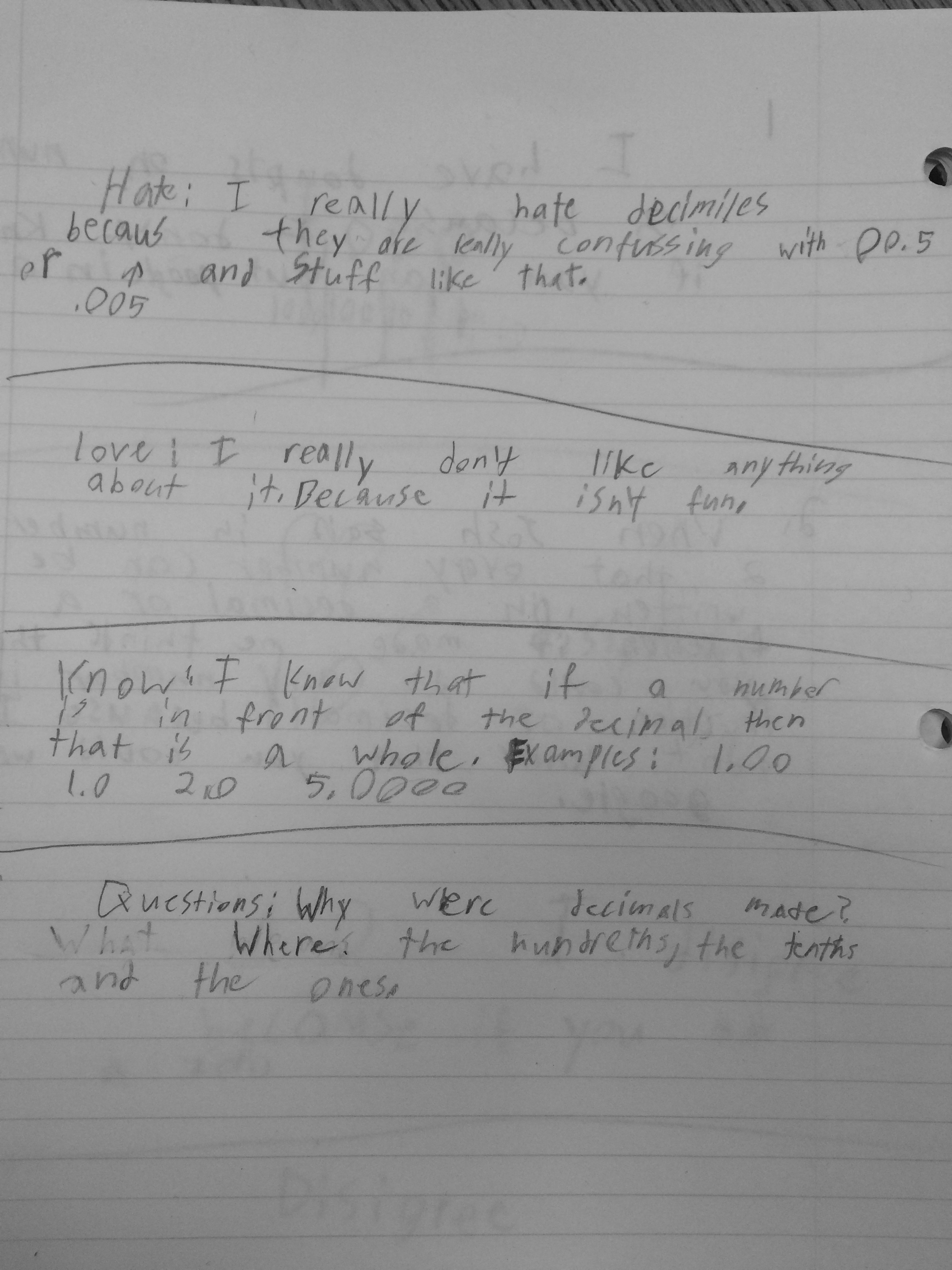
Last week, I asked the students to tell me everything they know, like, don’t like, confused about, wonder, feel…etc, about decimals. I used these responses in developing the decimal unit as far as where I should start and what types of things I was sure to address during the course of the unit. The responses were really interesting and reinforced a lot the common misunderstandings/ misconceptions I think students have around decimals. I am surprised to hear that the majority of students like fractions much better than decimals!

IMG_9010_2Love that this student knows that decimals fall between whole numbers and I am assuming the “10” number talk is about the place values. Also interesting that the student says the five isn’t 5, it is 50. Is this because they are taught to put them into hundredths to compare easily???

IMG_9012_2This one reminds me of the 1st one, however this student only sees decimals as less than 1 but greater than zero. This is a common misconception students have about decimals.

IMG_9003_2Love SO much about this one! All of the beginning is lovely but especially love the “farther to the right, the smaller the decimal.” This statement is what I put in my decimal talking points (https://mathmindsblog.wordpress.com/2015/01/27/talking-points-decimals/) that I want to keep revisiting. I am assuming this student meant the value of the digit, but instead said decimal, which sounds like the number itself, which is not correct. Love the wonderings at the bottom as well! Pie:)

IMG_9002_2This seems to be the general feeling of decimals…it is about places and they make them cringe:( We will change that this year!

IMG_8996_2

I love the wonder here about the zeros continuing after the decimal point, do we have to acknowledge them or not.

IMG_8992_2

Love that they are “almost like a puzzle.”IMG_8993_2

I think the honesty in this one is beautiful. So much confusion that I cannot wait to work through!IMG_8994_2Wow, really doesn’t like them at all! It looks like the zeros after the decimal point is a confusion point for this student because they are comfortable with the fact that a number before the decimal means more than one whole.

-Kristin

Talking Points – Decimals

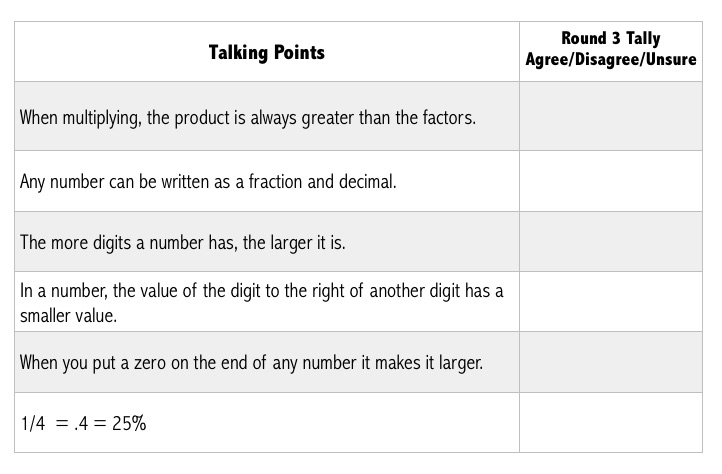
This week, we are beginning our decimal unit. I decided to start with Talking Points today to hear how the students are thinking about decimals before we dig in. In developing the Talking Points, I asked the #mtbos for some ideas on decimal misconceptions/misunderstandings they see students have each year. Thanks to @MikeFlynn55, @AM_MathCoach, and @MsJWiright2 for  your thoughts! Of course as the students were talking today, I wanted to tweak my wording of the statements!  Here are the points I used, my intended purpose of the statement, what I noticed and possible rewording for future use…

tp1TP1 – My goal in this statement was to hear if students were thinking about multiplying by a number (fraction or decimal) less than one. The first thing I realized is that I have a class obsessed with negative numbers! Then the next thing that other groups talked about a lot was multiplying by zero or 1. I did have some students think about fractions, like in the example below. In future wording, I would probably adjust it to, ” When multiplying by a number other than 0 or 1, the product is greater than the factors.”

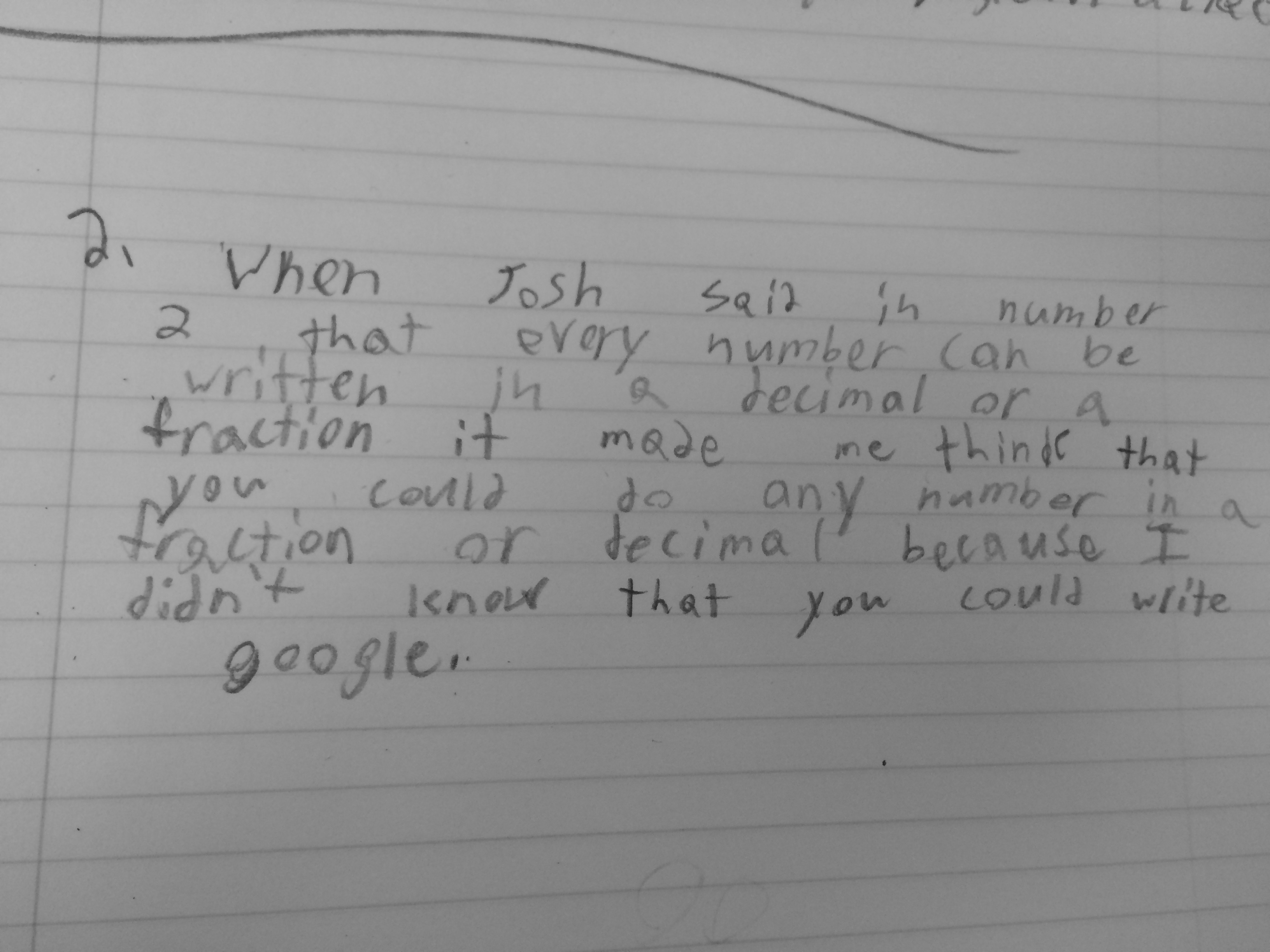
IMG_8968_2TP2: My goal with this statement was to hear if students thought about taking any number and make equivalents. My initial thought was just fraction/decimal equivalents like .3 = 3/10, but I did run into some great conversations about 3=6/2=3.0. The problem was that some were agreeing because they were just taking any number and writing it a fraction, not equivalent, just plopping it into a random fraction, like 7 can be 1/7 can be .7 can by 7/8, as long as there was a 7!  Possible rewording would be “All numbers can be written as equivalent fraction and decimals.”

IMG_8976_2TP3: This one was to elicit conversation about a comparison problem in which I see students often having a misconception. In comparing, students will think that 0.35 is less than 0.1245 because it has more digits. This one blew up in my face, of course:) The negative numbers arose again, which was interesting however, the some very clever students wrote 00000001 and said it is smaller than 12, but it has more digits. They were right, my statement was bad. Possible rewording, “The more digits a number has after the decimal point, the larger the number is.”

TP4: This one was really to plant a seed for the unit. I wanted students thinking about the place of the digit and its relationship to the digits surrounding it. So often when we decompose numbers, we deal with place values independently but I want to really focus on how the value changes as we move within the number. This one elicited great points made by the students and I plan on revisiting this one often throughout the course of our work together. This is one student’s reflection afterwards about this point:

IMG_8973_2TP5: My goal was to see if students thought about equivalency between decimals such as .3 and .30. The talk at each table was interesting and it was definitely one that was a split decision at many tables. I would leave this prompt the same based on the student responses, it was a nice mix and the mention of decimals came out vaguely. Student reflection on how another student changed his thinking:

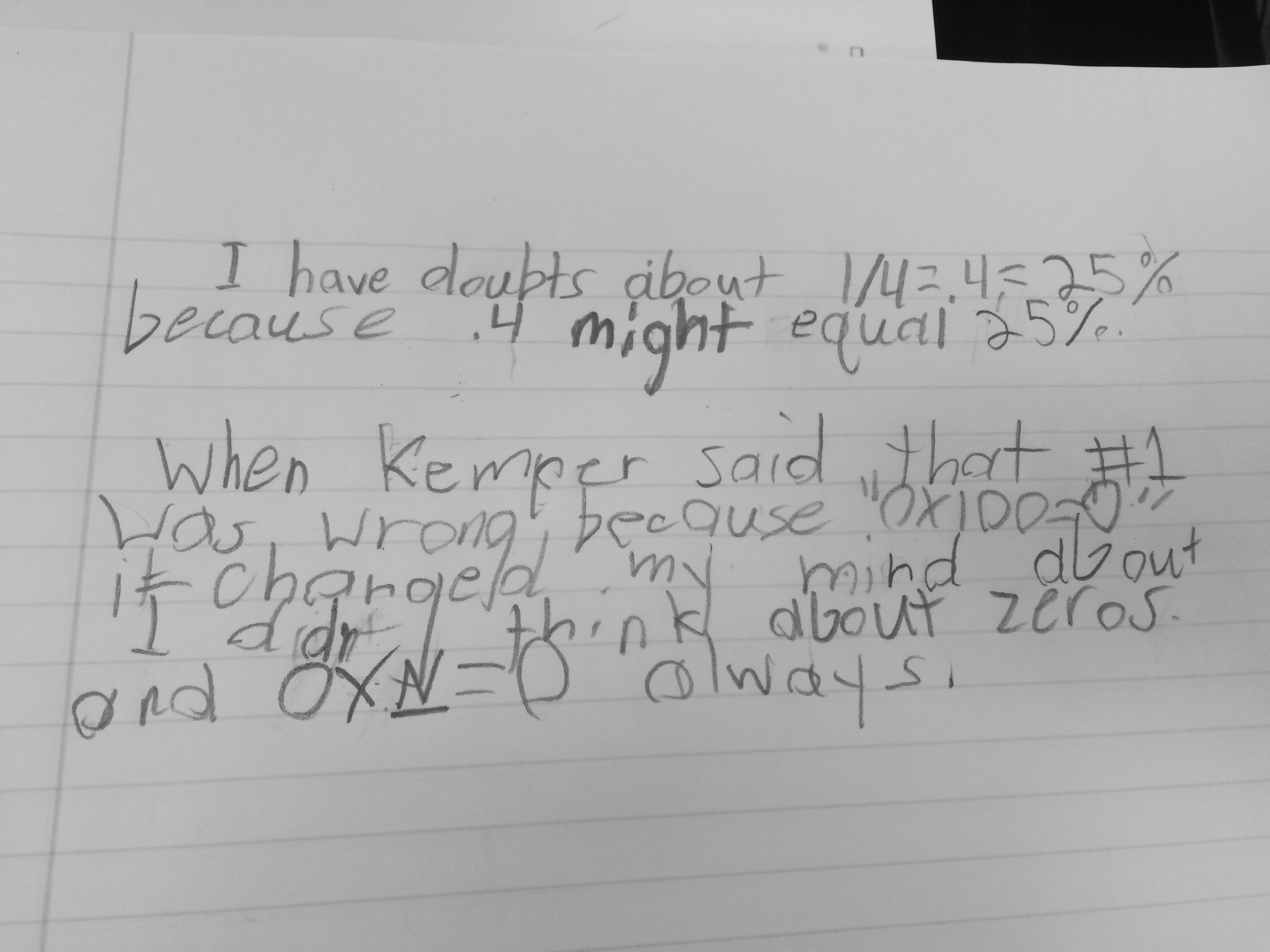
IMG_8977_2TP6: I used this point to check for equivalency understanding of fractions and percents (because we have worked with them) and then to see any connections to decimals. A lot times, student will take the fraction denominator and put that right behind the decimal point to make equivalents. This one was eh. I like that students knew 1/4 = 25% so the conversation focused on the meaning of the decimal in relation to the other two. I may reword this to, “.4 = 4%” and leave it at that.

After the points, I had the students reflect on two prompts…

“I am still having doubts about Talking Point __- because….” and “When (insert person’s name) said ___________ it changed my mind about Talking Point ___ because…” Some samples of these are above and here are a few more….

IMG_8969_2IMG_8970_2IMG_8971_2IMG_8975_2

Volume with Fractional Dimensions

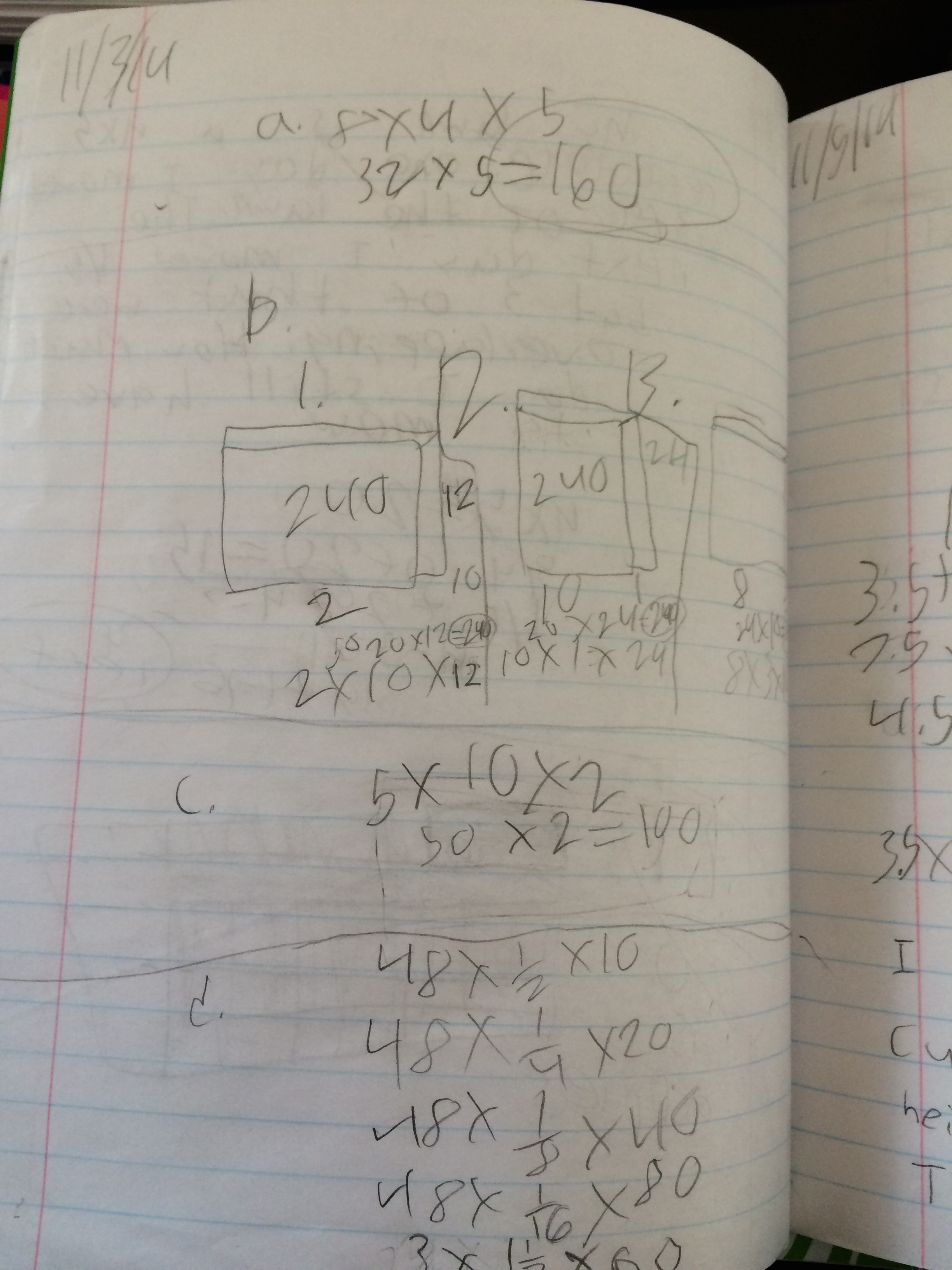
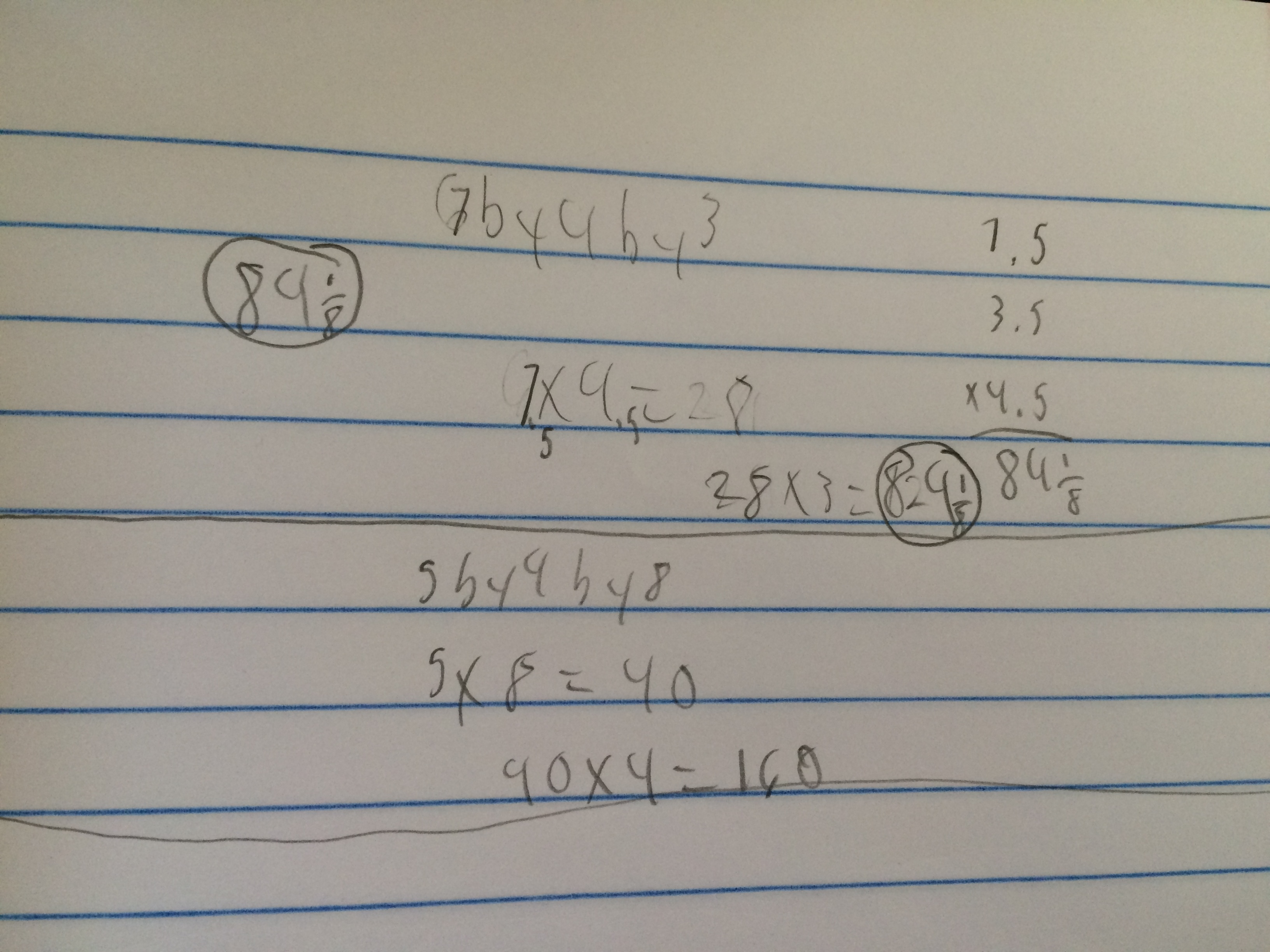
Before I began our volume work this year, I blogged about my planning process here: https://mathmindsblog.wordpress.com/2014/10/20/unit-planning/. As anticipated, I had many students who quickly developed (or already had) strategies for finding volume and could articulate a conceptual understanding of what was happening in the prism. In my previous post, I was throwing around the idea of giving those students dimensions with fractional length sides, so the other day I thought I would try it out. I did this Illustrative Task as a formative assessment of student understanding. Many students were done in a couple of minutes, with responses for part b that looked like this:

IMG_7972As I walked around the room and saw they were finished quickly, I asked them to revisit part b and think about a tank with fractional dimensions. Because of the great work they had done here I thought they would have some interesting thoughts. These are a few of the responses I got:

IMG_7976IMG_7977IMG_7973IMG_7981

So, what did I learn from this work?  I saw they had some great understandings about taking a fraction of one factor to make a number that they knew they needed to multiply by a third whole number factor to get 240.  In the first two pictures, there is a great pattern happening that I want to explore further with the whole class. I also loved seeing that a student took the question “fractional length sides” to include decimals in his work. In my question, however, I had wanted them to consider more than one side in fractional lengths, however not being more explicit, they took it and ran with one side being fractional.  In the next lesson, I thought I would push them a bit with this.

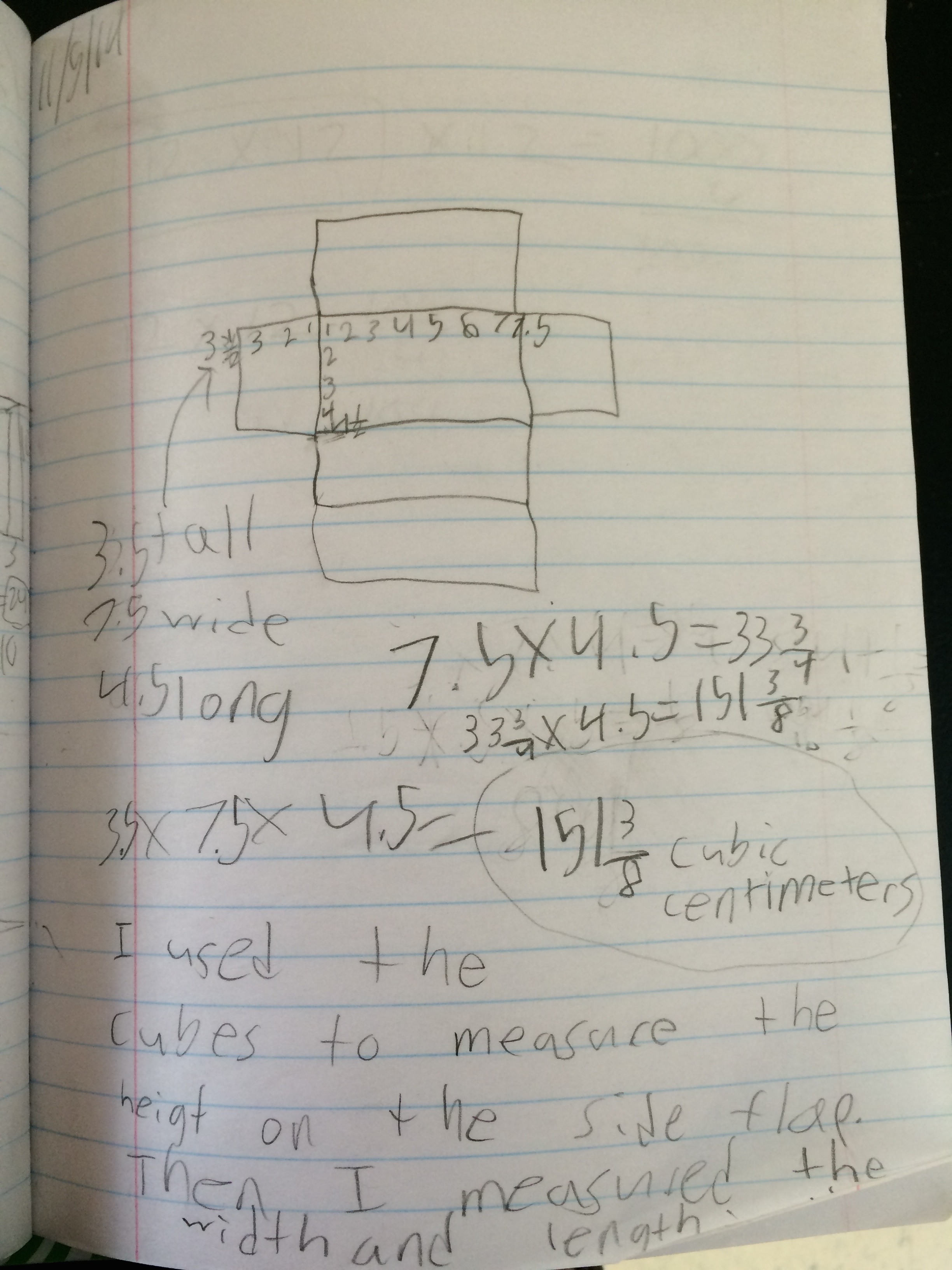
In the following lesson, students were finding the volume of an unmarked prism in cubic centimeters. They had rulers, cm cubes, and cm grid paper available to them, and went to work. Every year this happens, the Investigations grid paper works with the box to be whole number dimensions, however the cm are a bit “off” when using a ruler or cm cubes. I knew this, however, I do love the discussions that evolve from students who used different tools. I also thought this is the perfect opportunity for my students who were beginning to think about fractional sides. What transpired in the whole class lesson is a blog post in and of itself, however this is what came about from the fractional sides work…

IMG_7975IMG_7980

IMG_7979

Sooo much great stuff here! I had a group who was using the cubes, coming out with halves, but not wanting to round because it was “right in the middle” of the cube. I let them go and came back to see they were multiplying whole numbers, multiplying the fractions, and then adding them together to get their product. I asked them to think about another multiplication strategy to see if they got the same product, then came the array. Another student in the same group solved mentally to get the products. Unfortunately, the class had to leave me to go to their next class, also leaving me with so many things to think about. From here, I want to be sure students start to think about reasonableness of their solutions, compare their fraction multiplication strategy to whole number multiplication strategies, and think about how we multiply three numbers (Associative property). So much to do, I need full day math classes!

-Kristin

Why My Tweeps Deserve a Hug…

By nature, I am not big “hugger” when I first meet someone. Which is why I am always so shocked that every time I meet one of my Tweeps in person, I feel the overwhelming need to give them a hug. I always wonder why that happens….I mean, I have just had online conversations with these people, right? Wrong.

Over the past month it has become crystal clear why my tweeps will always get a hug….

1 – They care about my learning. They challenge my thinking, give me wonderful new ideas, and continually make me feel like I have a team of teachers working with me to improve my practice. For example, just the other day, I threw out this tweet:

1

and what I got in return was this amazing conversation: https://storify.com/TracyZager/multiplying-fractions AND then two fantastic follow up blog posts: http://tjzager.wordpress.com/2014/09/06/elementary-teachers-as-math-learners/ and http://bstockus.wordpress.com/2014/09/07/of/ Talk about professional development at its finest! I LOVED it and left with so many ideas to think about!

2 – They care about my students as much as I do. Recently, our district is working through opening Twitter on our network. Wanting to be as informed and prepared as possible to defend the use of Twitter in schools, I reached out on Twitter with this post:

2

I tweeted it, went to bed, and woke up to over 40 notifications in response. I had teachers sharing how they use it as PD and in the classroom, as well as superintendents and principals (Thank you @gcouros and @joesanfelippo) offering to chat with my superintendent to offer their experiences. These tweeps are from all over the world, they don’t need to care if the students in my class get Twitter, but they do. They took the time. It is so touching to know that the heart of education is alive and well on Twitter with the students in the forefront.

3- They get as excited and passionate about math work as I do! You can read these fun, nerdy conversations all over my Twitter feed, passionate people talking about what we love, math. After trying Talking Points that I have blogged about recently, I could not wait to tweet @cheesemonkeysf because I was so excited about the conversations in my classroom:

4

My tweeps have become so much more than online conversations, they are my colleagues, mentors, and coaches. They are open and honest and allow me to feel safe being open and honest.

It is personal. It has changed my practice. It is hug-worthy.

I could really keep going on and on about how much I adore my tweeps, but being a school night, it is time for one more Big Bang rerun and bed!

Happy Almost Friday,

Kristin

Aurasma Math Work with Decimals

Last year, I started playing around with the Augmented Reality app, Aurasma, in math class. For this particular activity, students worked in pairs to create a video of their explanation and trigger image in which to overlay their response. They swapped their creation with other groups, compared solution strategies, and discussed similarities/differences.

If you have the app Aurasma, simply follow our class channel, “Grays Class,” and scan the trigger images below to hear their explanations.

aur

If you do not have the app, download it here: Aurasma and follow the directions above.

Here are some trigger images to scan and hear solutions:

p2 p3 p4 p5 I definitely look forward to doing more of this work with my students this year and possibly embedding this into a newsletter for parents!

-Kristin

Unanticipated Student Work…Always a Fun Reflection!

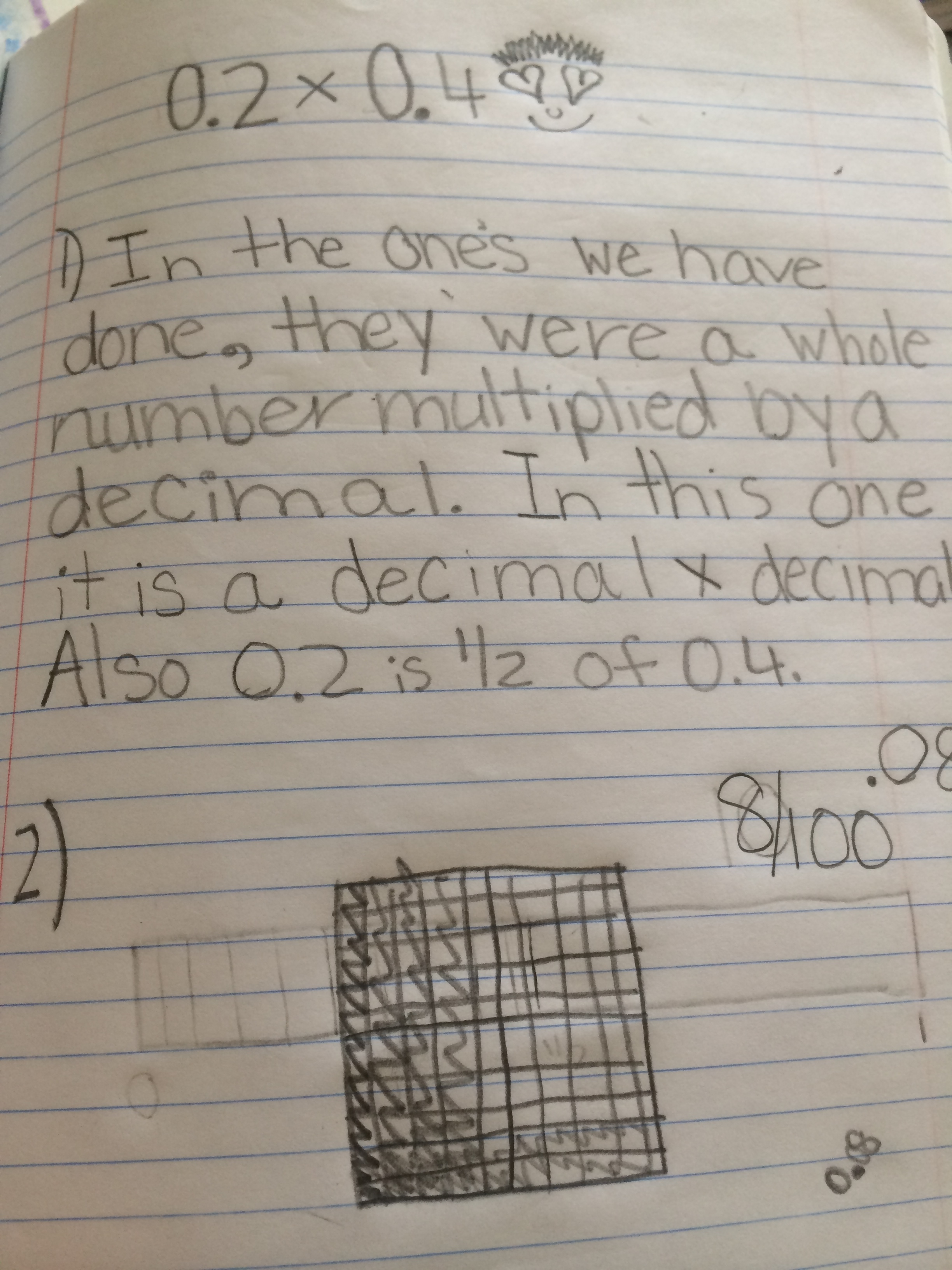
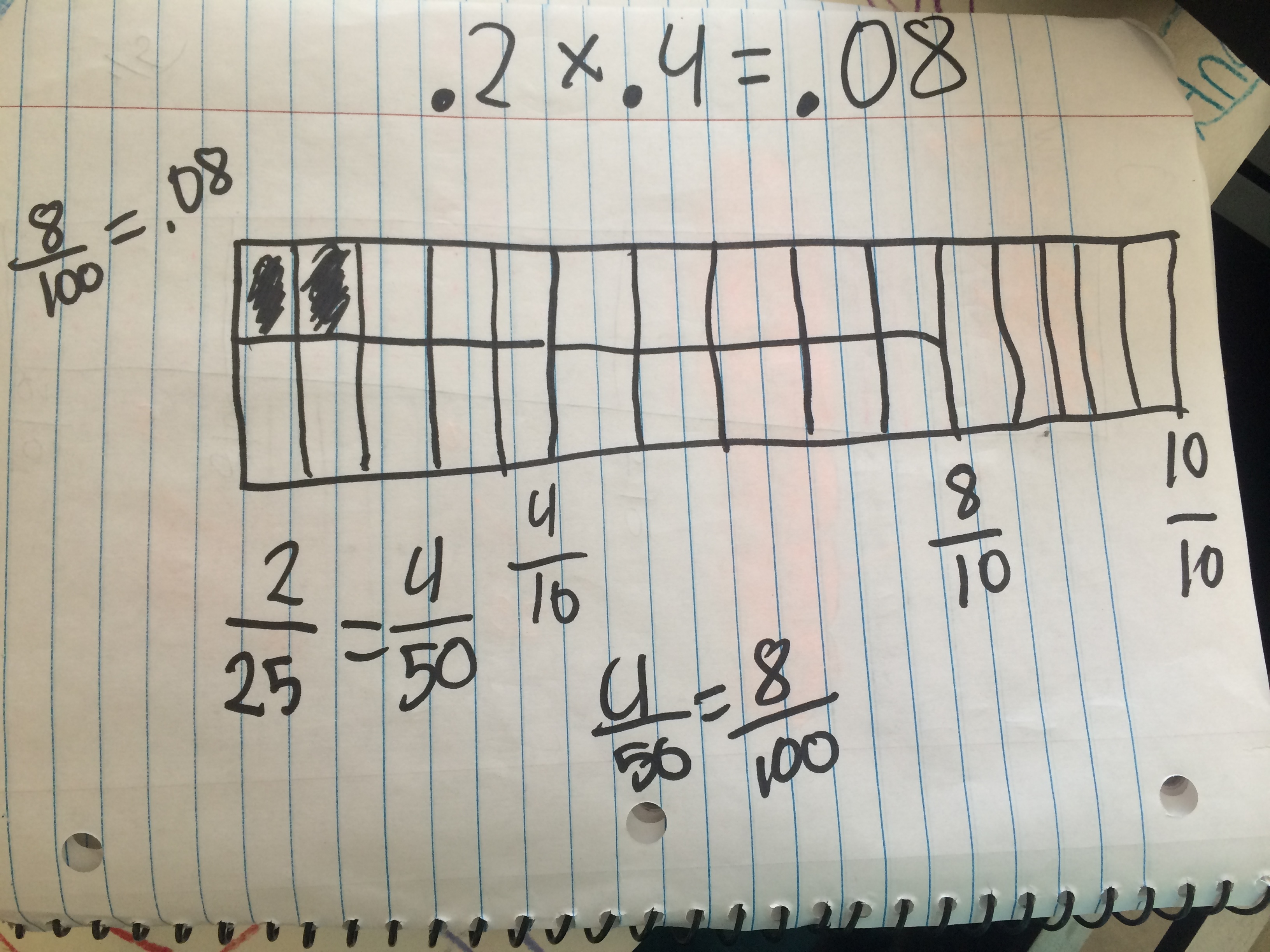
As I was planning for a summer PD, “Decimal Fluency Built on Conceptual Understanding”, I was going through pictures of my students’ work. I focused on the very first multiplication problem I had presented to them in which both numbers were less than a whole. I presented them with 0.2 x 0.4 and asked them to do a “Notice/Wonder” and think about the product. I had anticipated some may reason using fraction equivalents, some may know that .4 is close to half and take half of .2, and some may try fraction bars or arrays to solve. Here are samples of their initial work….

IMG_4323 IMG_4326 IMG_4334 IMG_4338 IMG_4341As I circulated the room, the two products that showed up were 0.8 and 0.08, as I anticipated. I put them on the board and had the students work through it as a group and try to prove the product they thought was correct and disprove the one they thought was incorrect (I did not tell them at this point, that was their job!:)

During the share out, this is the one response I did not anticipate at all and now, going back, I wish I had spent more time with…grrr….darn hindsight!

IMG_4335


For all of the nerdy math peeps, like me, who like to “figure things out” I am going to leave out her explanation here! I will gladly recap it for anyone who would like to hear it in the comments or via twitter!

Needless to say it left many students a little baffled, and we did revisit it the next day for her to re-explain her reasoning. I just wish I had extended this by asking students if this model would work for any two decimals less than one whole? Why does it work with .2 of .4?

I highly recommend snapping pictures of your students’ work all year long because reflecting back on this work over the summer has taught me a lot about anticipating student responses and how to handle those responses you just don’t expect! It also just makes me smile at the way my students reasoned about the math we were doing!

-Kristin

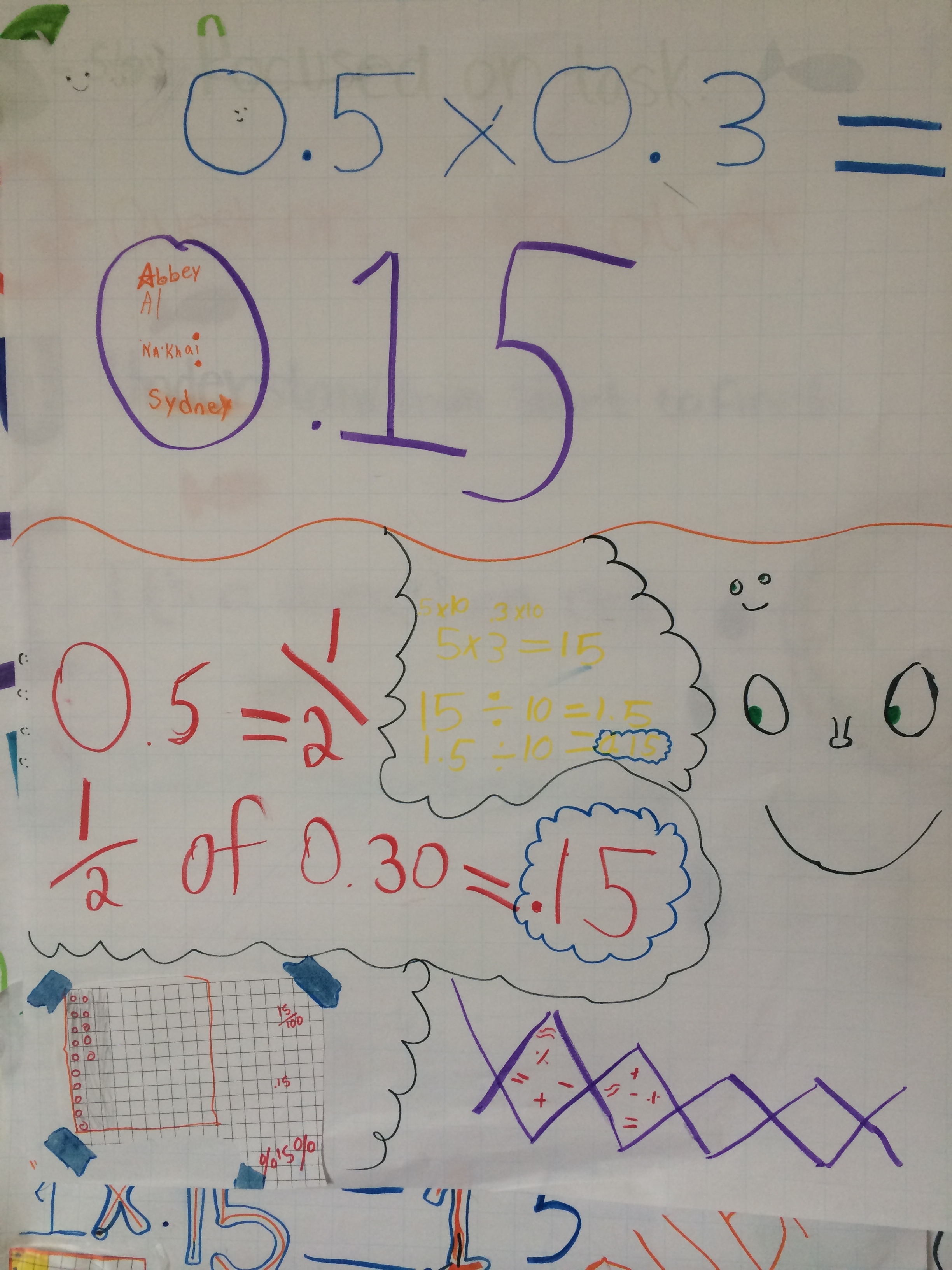
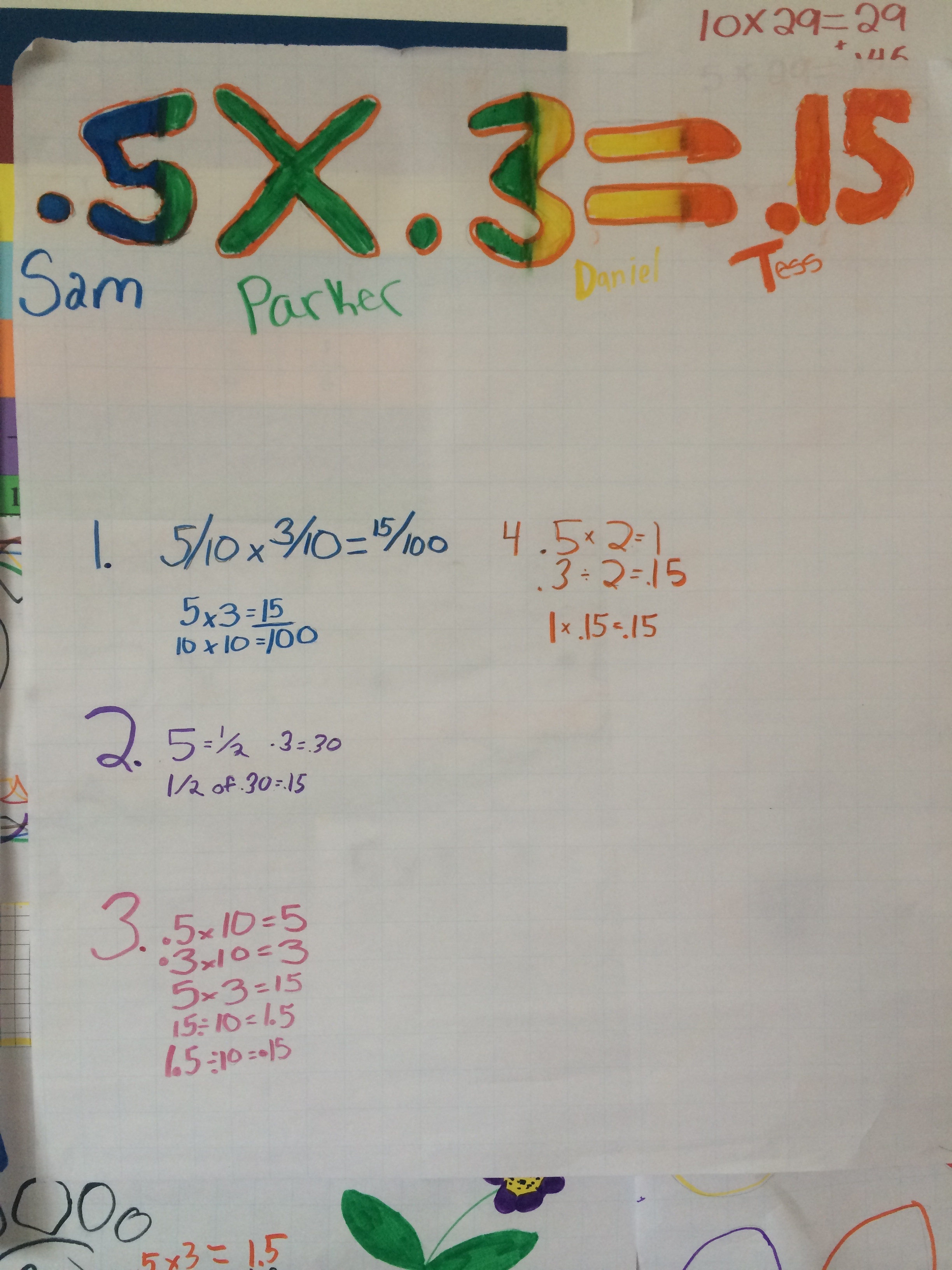
Here are a few pictures of the follow up group work and Gallery Walk they did with 0.5 x 0.3….

IMG_4228 IMG_4229 IMG_4232 IMG_4233