Remainders: Division & The School Year

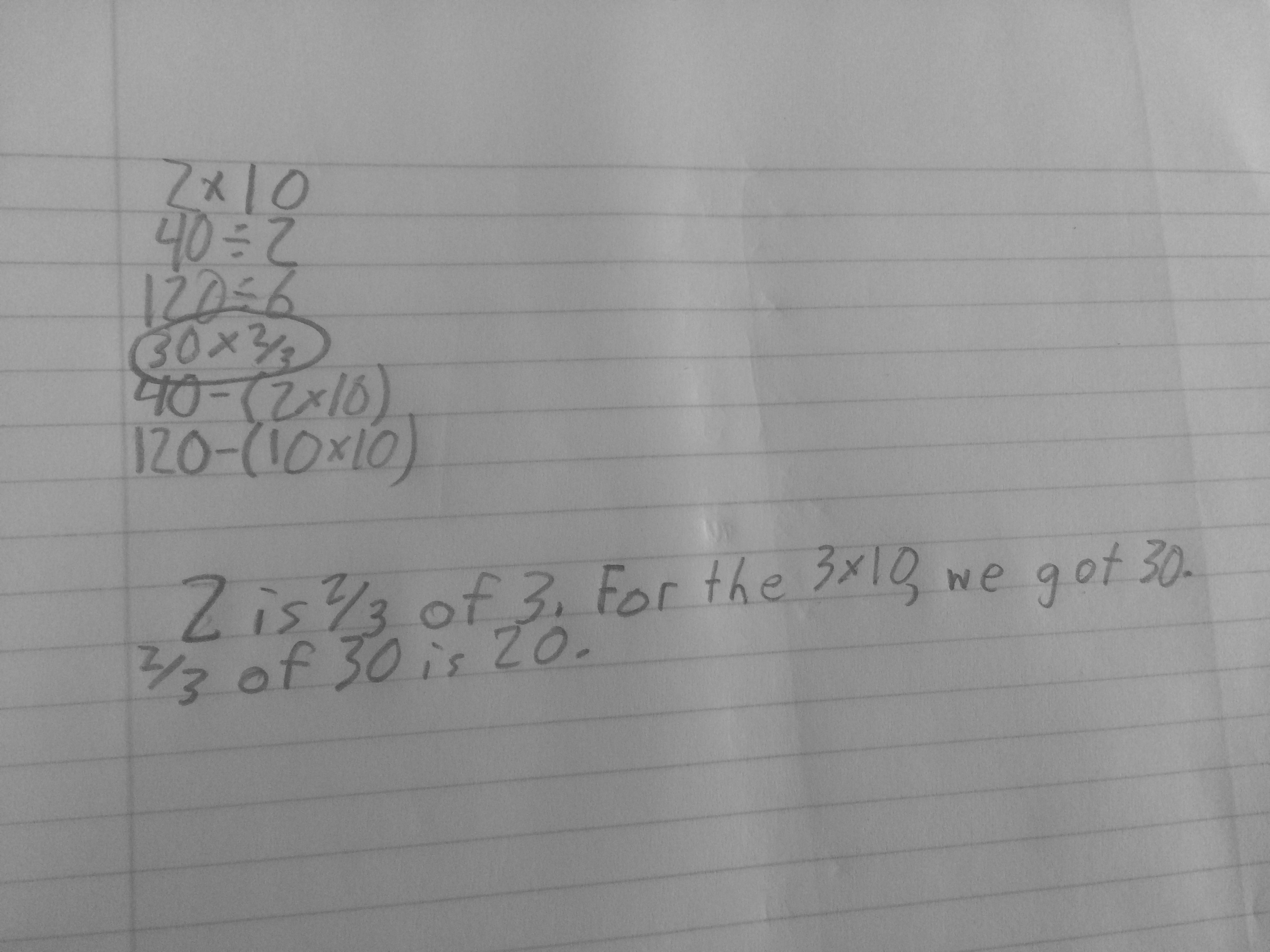
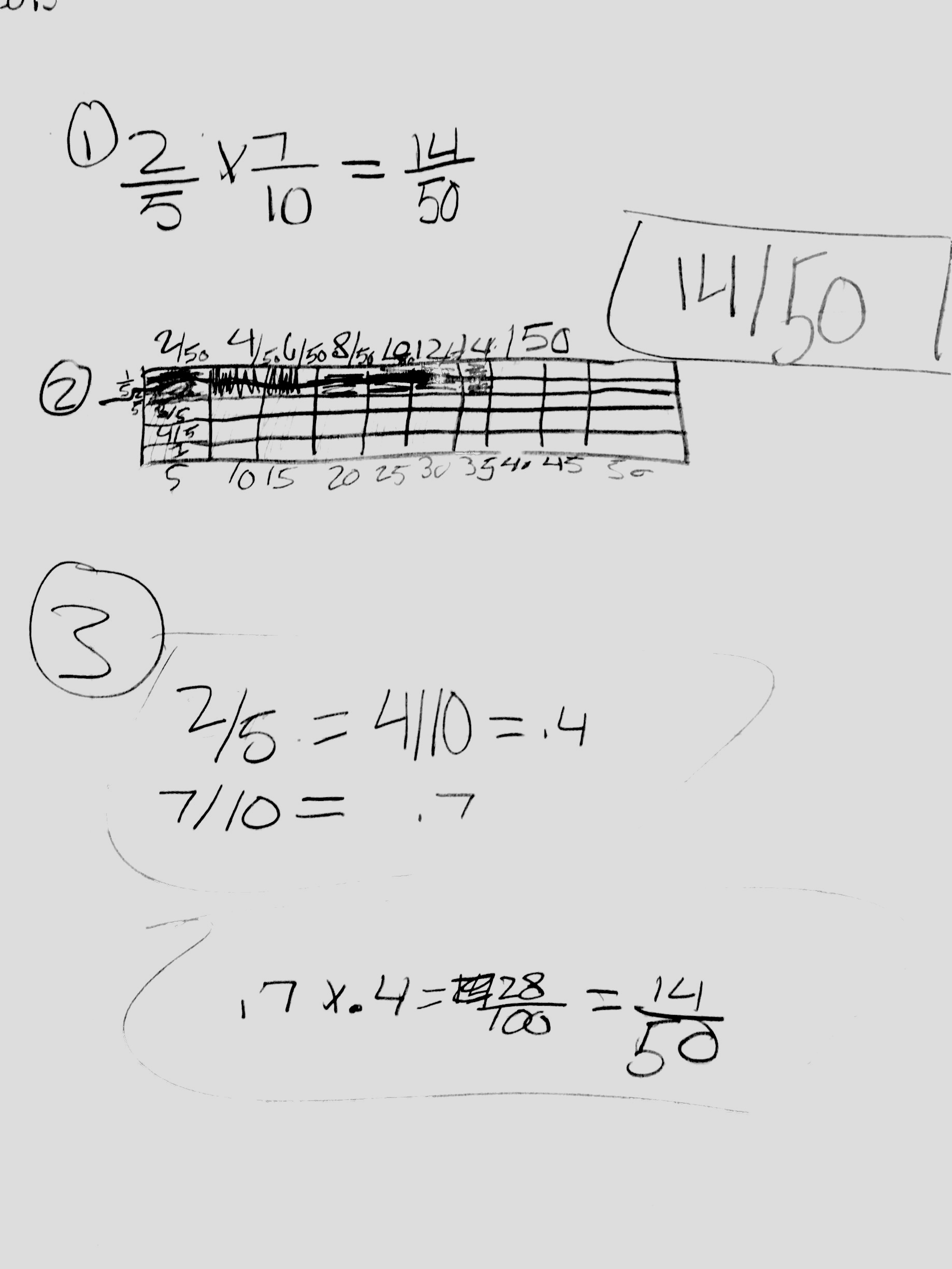
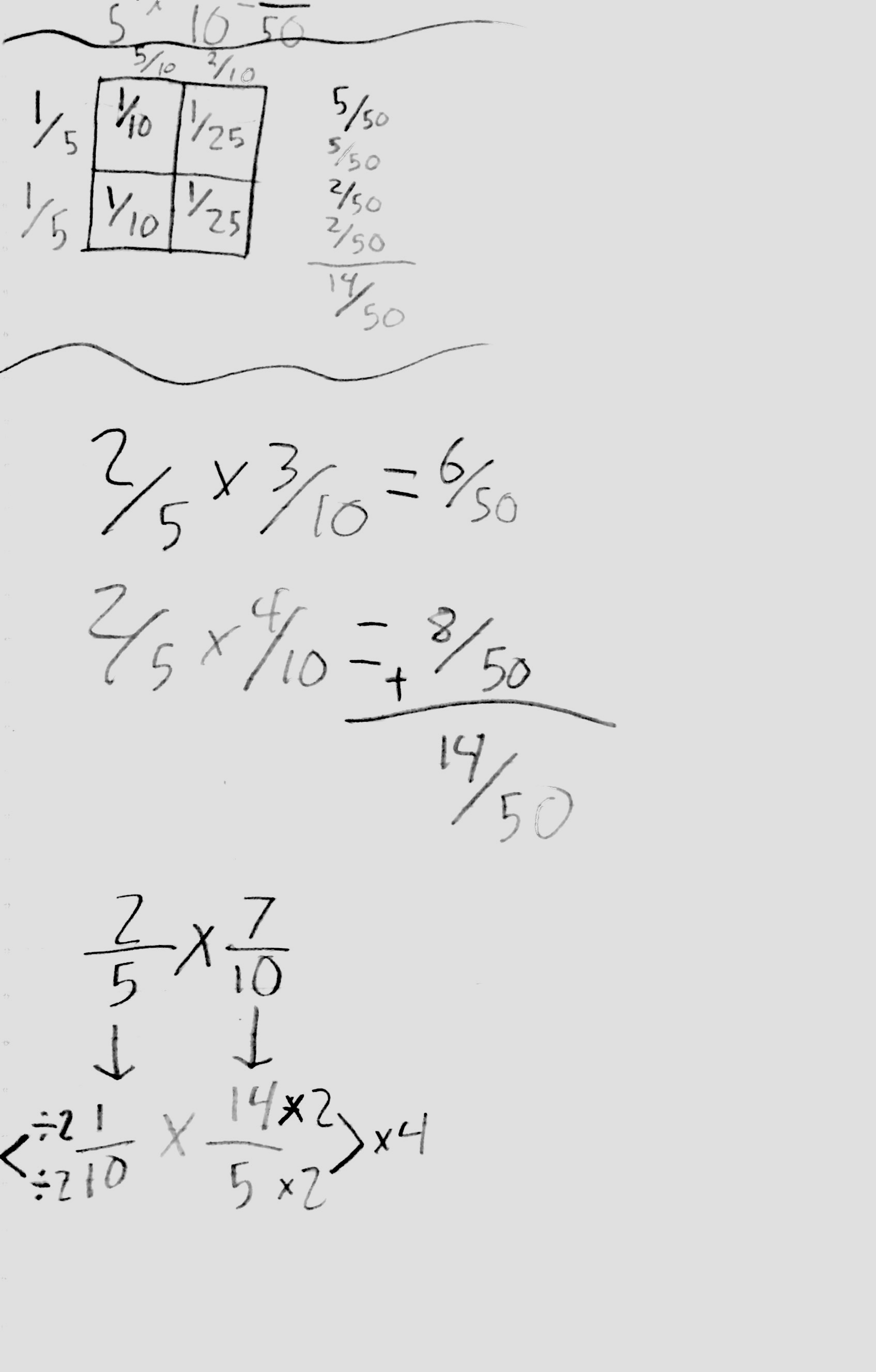
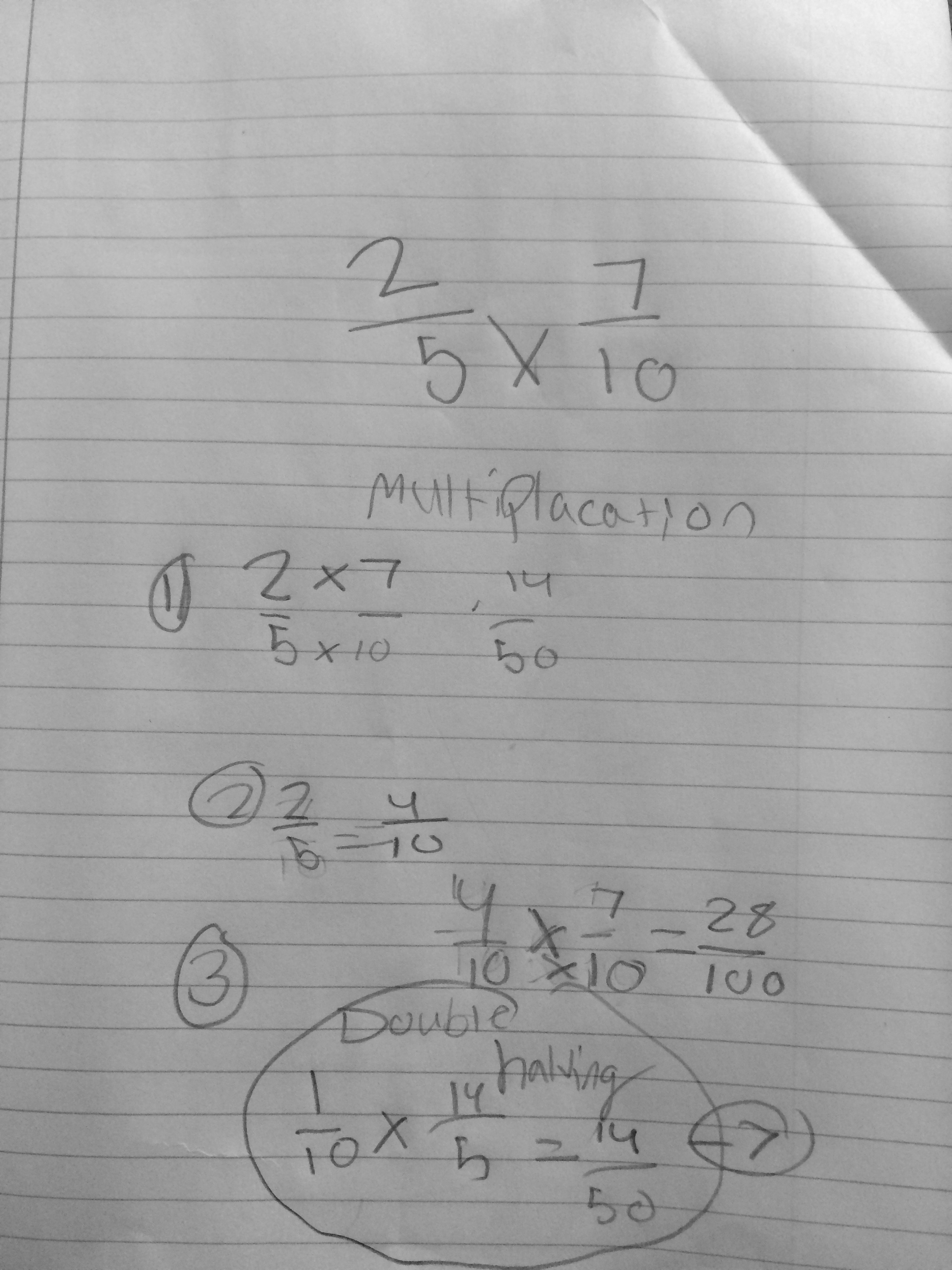
Looking ahead in planning for the remainder of the school year, I am currently finishing up my decimal unit and excited to end the year with Growth Patterns. I was planning on finishing decimals this week, however, I have one more thing that I feel is missing from the unit that I am curious to see how students are thinking around it. In the unit, within decimal division, the students are very comfortable estimating quotients and thinking about a variety of strategies in finding how many of the divisor are in the dividend. However, one thing that is not addressed is remainders, and how we notate them. I had not really thought much about it because in the context of the problems we were doing, the remainder made sense. However, during a division number talk, not within a context, the “r” was still there. It bothered me a bit. When I asked how they could write the quotient as a number, I got blank stares. I know fourth grade really spends a lot of time on interpreting remainders, but do we spend equal time on various notations of the quotient?

I have decided to extend my decimal unit just a bit longer because I feel this is something my students can definitely reason about and I am curious the connections they can make between whole numbers, fractions, and decimals. I decided to start with whole number divisors and dividends and move to decimals from there. Today, I gave them the problem 256 ÷ 20. They estimated somewhere just over ten and then I asked them to solve it. If they finished early, I asked them to write a context to match the problem.

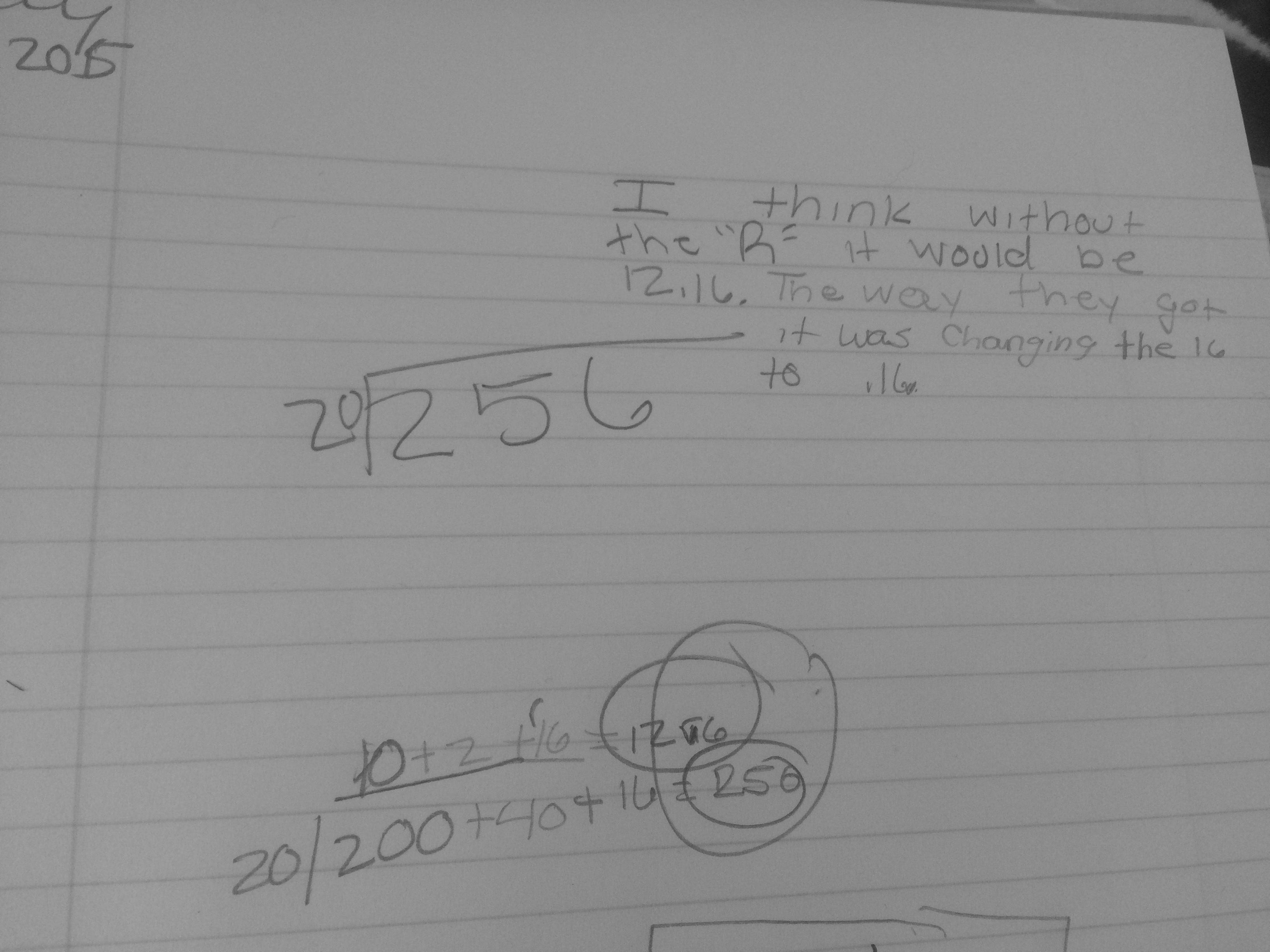
The majority of the class’ work looked like these and contexts involved a sharing situation…

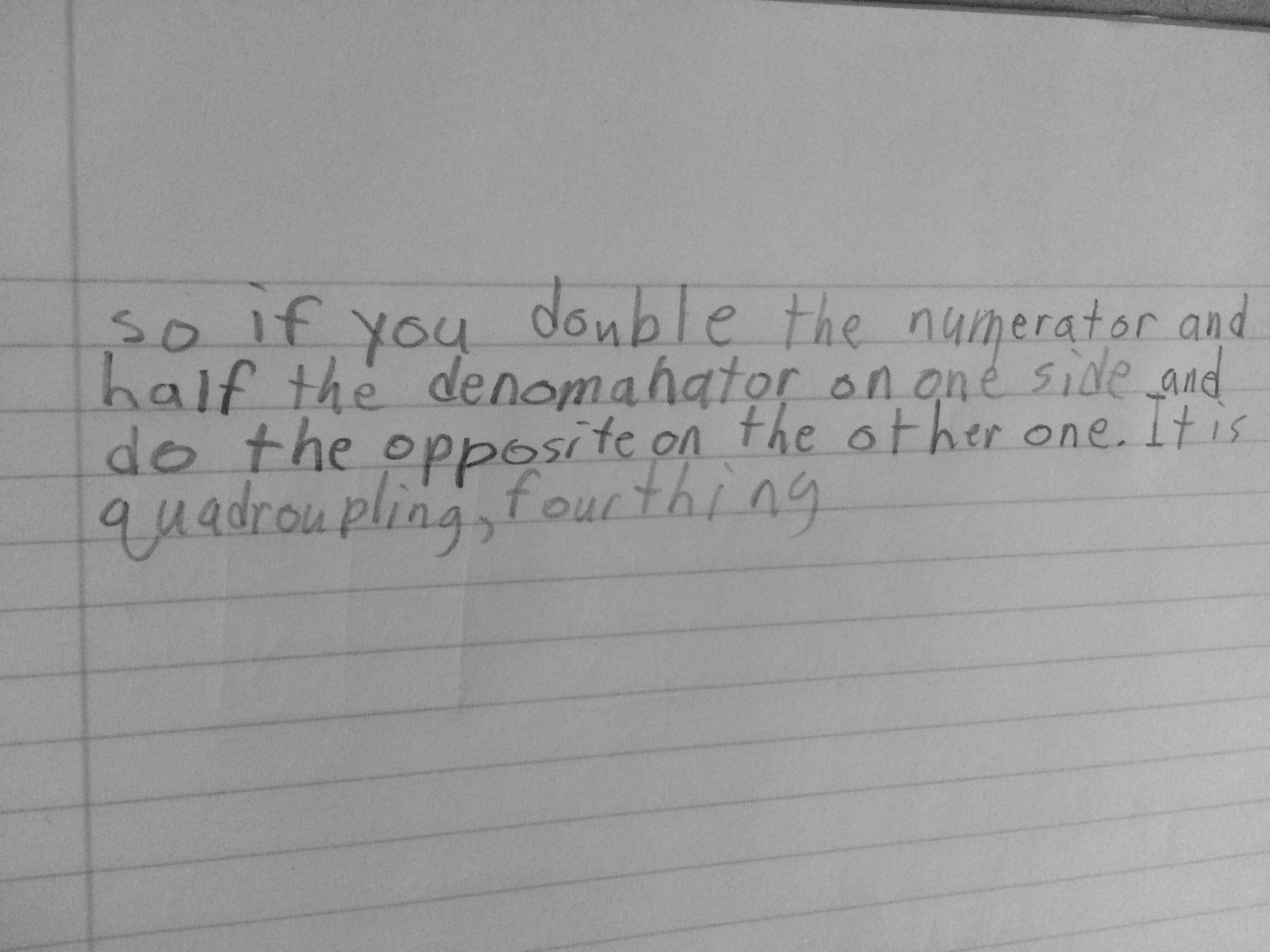
IMG_0590_2IMG_0594_2When pushed to write their quotient as a number without the “r,” most said this…(I do love the way this student divided:)

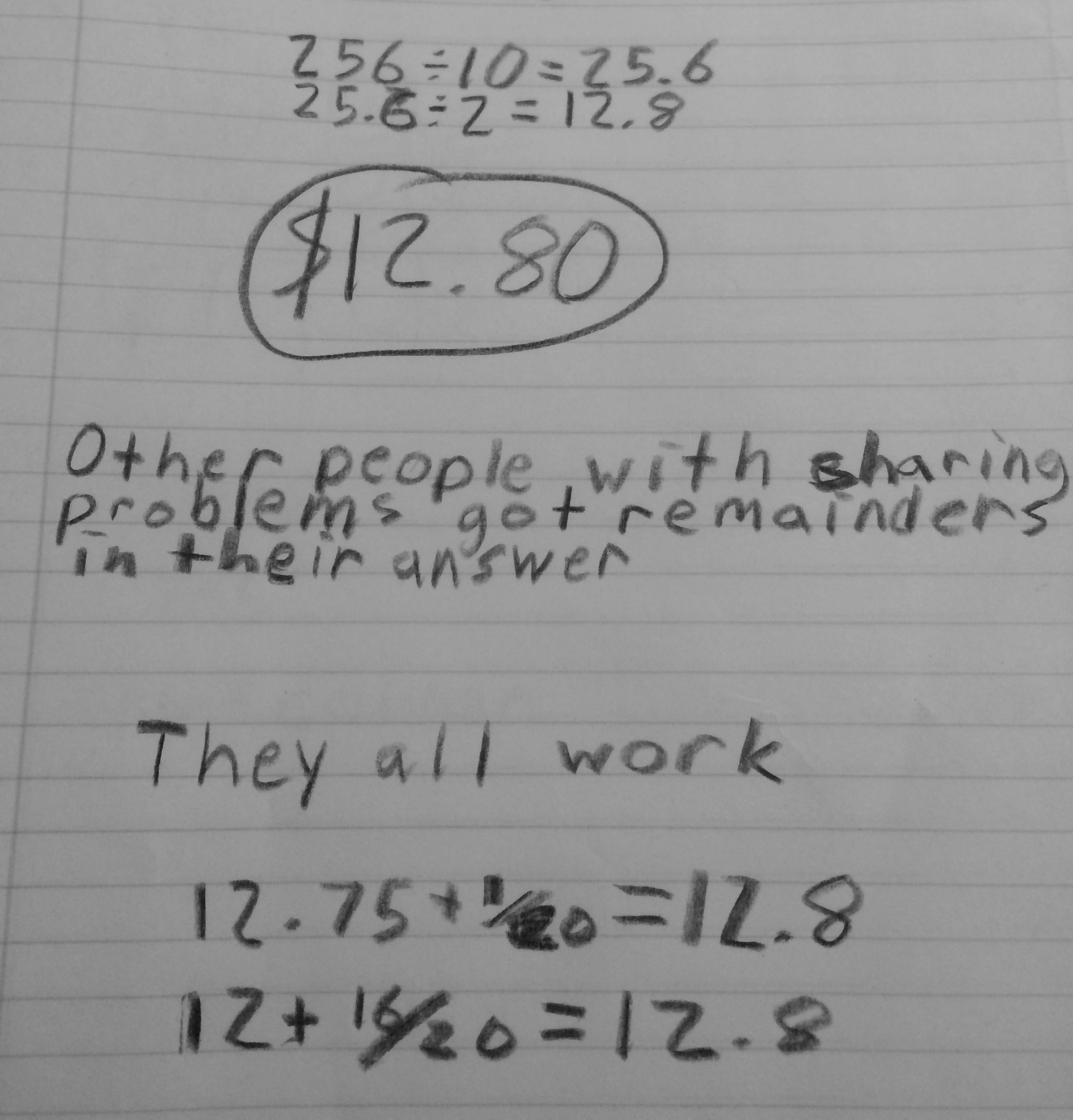
IMG_0585I did get a few 12.8 and 12 16/20, which interestingly fell more in money contexts…

IMG_0583_2IMG_0586_2IMG_0592_2All of these, I had anticipated, but then I got some really great unexpected answers that allowed students to think about the connections between notations…

12.5 r 6         12 16/256         12.75 r 1

I wrote these responses on the board and asked the students to see if any of the answers meant the same as 12.8 or 12 16/20 or 12 r 16, that we had established were the same. They did also mention, which I loved, that certain situations my use different notations.

I had some amazing proofs that we are kicking off the day with tomorrow before moving into decimal divisors. While I was hoping for students to look for equivalencies in the quotients themselves, most groups went back to trying out division in a different way to prove the answers. This group went back and solved the problem using the same method every time, just changing the breakdown of the quotient.

IMG_0591_2This group used multiplying up to see that 12.5 r 6 worked as a correct answer. IMG_0588_2

After asking them if they saw any relationship between the quotients, I got this…(much more what I was hoping to see in their reasoning)

IMG_0593_2This group had a nice, simple explanation at the bottom of this page…

IMG_0584This student is still sticking with 12 16/256 and quite honestly I don’t know how to approach this one. It is a different way of writing the remainder and I cannot decide if there is a time when this would be an appropriate notation?

IMG_0587_2The most perplexing quotient for most of the students was the 12.75 r 1 so I asked the student to write out his thought process because he was having trouble explaining it.

IMG_0581_2Now, while the entire class period seemed to focus on the remainder in a division problem, this explanation represents the remainder of the school year! I asked the above student to go in the hallway and record his thinking through the problem because he had such a beautiful way of starting to explain how he decided how much to add based on the distance from the dividend…but then I got this 🙂 https://www.educreations.com/lesson/view/kewl-aid/31841872/

And here’s to the remainder of the school year….

-Kristin

Collaboration As Key Work

Earlier this school year, I was involved in an amazing collaborative project with Illustrative Mathematics, The Teaching Channel and Smarter Balanced. Following that experience, I have continued to collaborate with the same wonderful people involved in the project, as well as the incredible educators in the #mtbos! So, when The Teaching Channel asked if I would blog about my collaborative experience, of course I could not resist!

The Teaching Channel Blog Post

The videos of the experience also went live today on The Teaching Channel! I had blogged about this experience twice in the fall and it is so nice to now be able to put collaborative voices to the written work. The collaboration that happens in the video is truly centered on student work, conversations, and reasonings around fractions. I have paired my previous blog post to the accompanying video so you can have a feel for the entire experience!

Background of the Project:

Collaborating Coast to Coast Blog  with this Teaching Channel Blog w/Video Links

The Project Work:

Lesson Study “Take 2” Blog with this Teaching Channel Video

I feel so fortunate to have the opportunity to grow and learn with so many amazing educators! I cannot say thank you to all of you enough!

-Kristin

The Meaning of Subtraction

After a Number Talk a couple of days ago, I blogged about my students’ thoughts around a subtraction problem. Instead of being a talk about subtraction strategies, as I anticipated, it ended up more of a talk about the meanings of subtraction.

After class, I was curious where these meanings of subtraction arise in our curriculum and found this in the 3rd grade Investigations’ Teacher Notes:

gr3Now being in 5th grade, I began asking myself a bunch of questions…If these subtraction meanings arise in 3rd grade, do we ever have students explicitly investigate them? Once they have an efficient strategy to subtract, do we just move on? Do we think that the meanings of subtraction really do not matter if they can read a context and solve for the solution?

After reflecting on my own practice, I honestly think it is a combination of all of these things. I am completely guilty of being satisfied if students are able to understand how to solve a problem, with or without a context, and explain their reasoning. I actually feel quite great about student understandings in that moment, however, I have really seen the importance of having students make deeper connections, create conjectures and justify claims/generalizations. It truly pushes them to think about a deeper meaning of operations and demonstrates the depth of their understanding in developing proof of their thinking.

The day after the Number Talk, I had the class split into two groups and each focused on writing a context that would lend itself to being solved using one of the two strategies for 400-274.

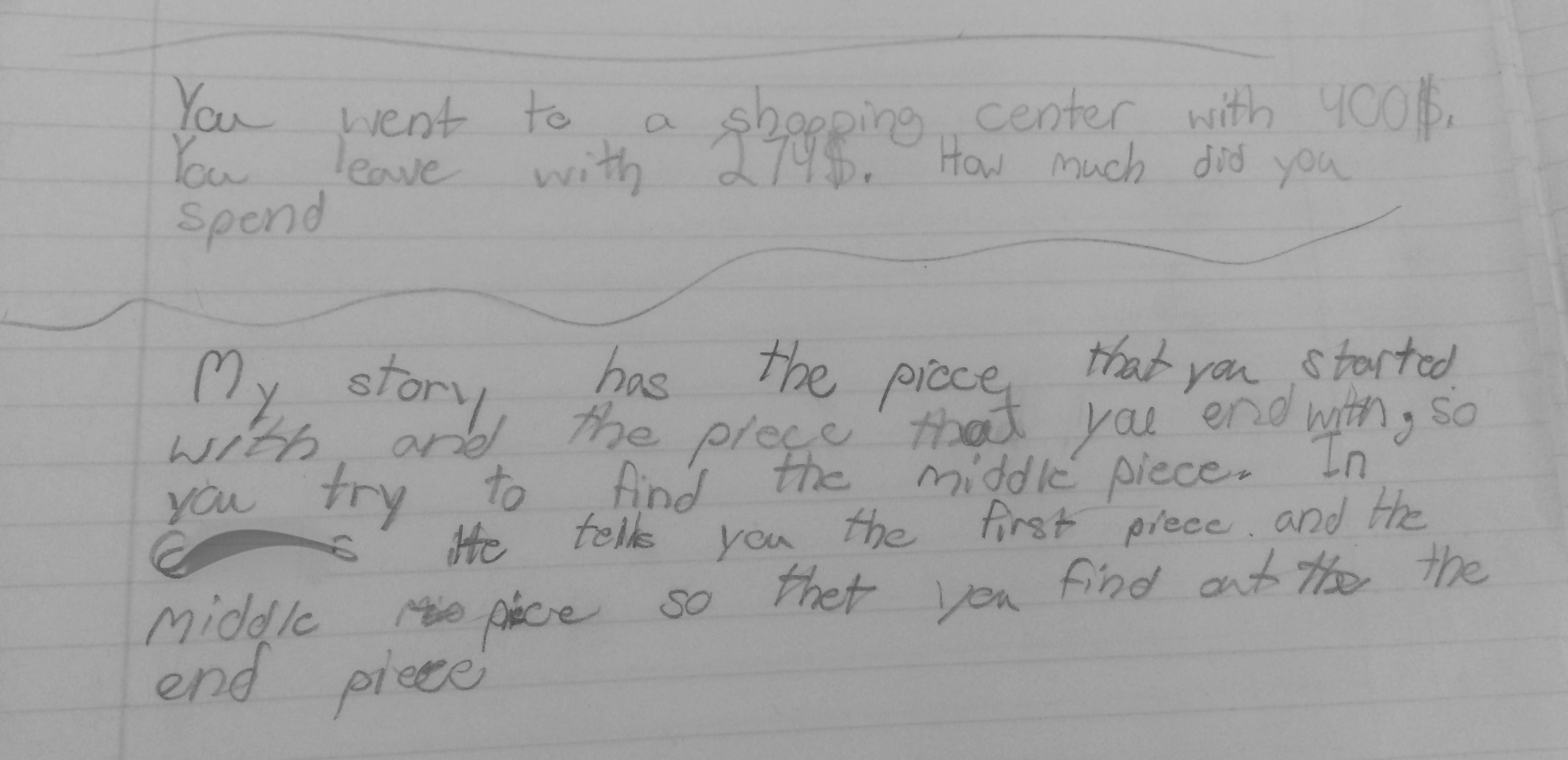
IMG_0508_2After about 5 minutes, I had each group share their context and they did just what I was hoping. The group with the top strategy had a few contexts that all involved having something and then giving something away or losing something. The bottom strategy had a context involving having $400 and leaving the store with $126 and asked to find how much they spent. The second was much more difficult because they kept arguing (in a great way) that it was an adding up problem, not subtraction.

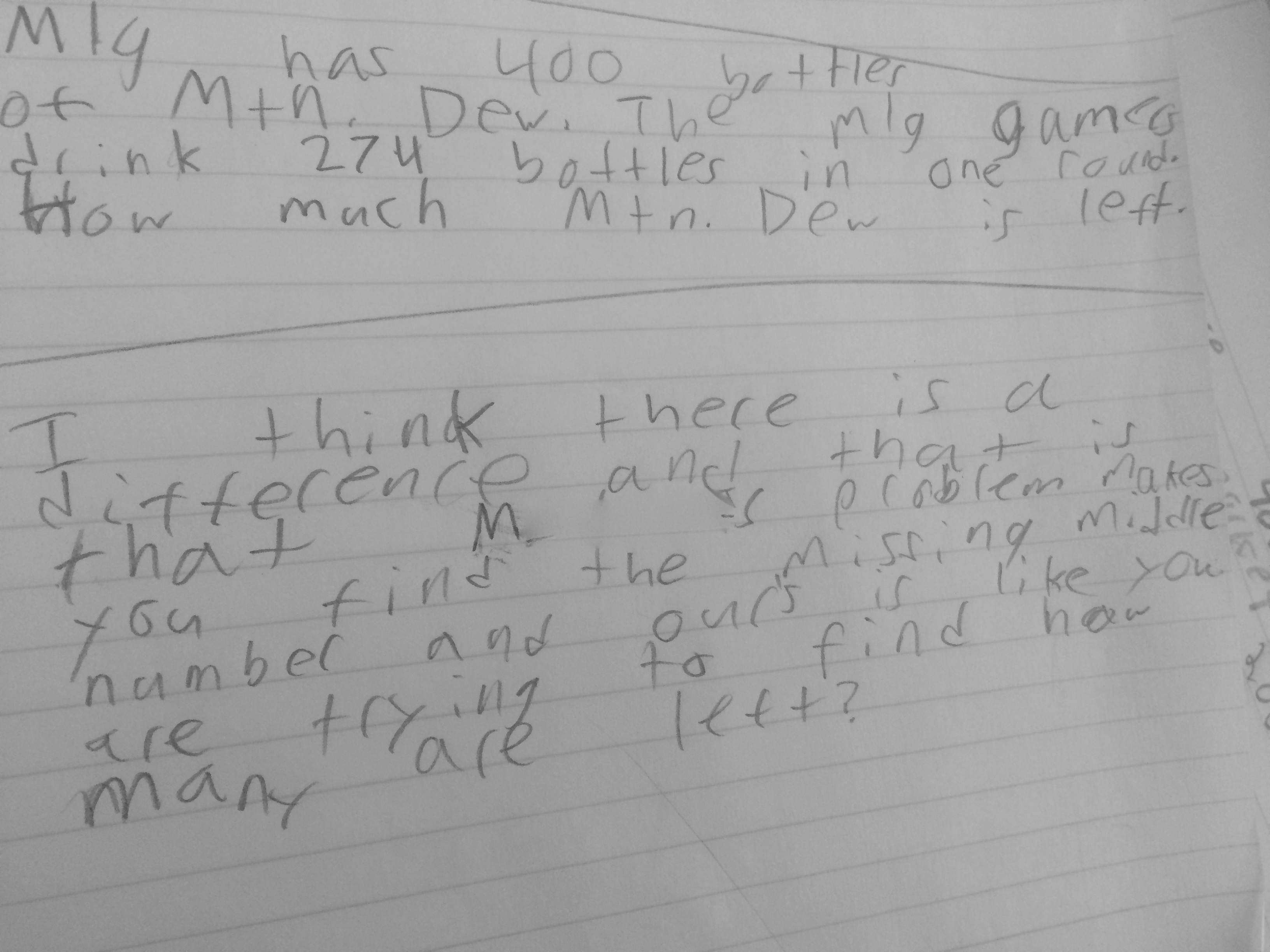
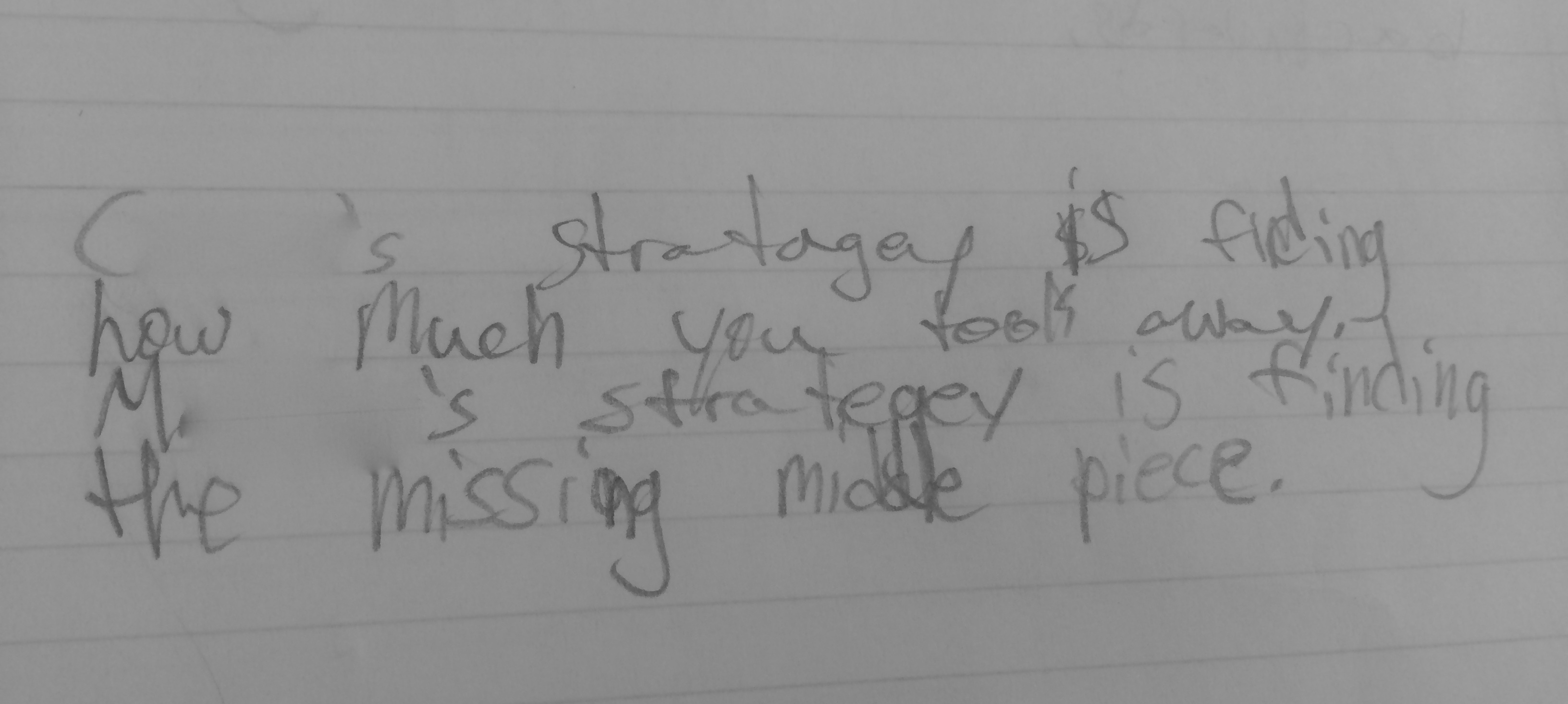
I had each group read their context aloud twice. The first time I could tell everyone was listening to see if it could be solved using subtraction so for the second time, I gave them a listening focus. I asked them to listen for how the two contexts were different, was something different happening in each? After reading them aloud once more, I had them journal what they thought, were they the same type of subtraction problem or different? (They referred to the problems by the student’s name whose strategy it matched).

I loved this student’s wording of the difference as “things happen”

IMG_0529_2

IMG_0524_2IMG_0528_2

IMG_0530_2There was an overwhelming “what is left” and “what the middle piece is” theme among all of the responses as the main difference between the two contexts. Knowing that removal is their primary way in which to think about subtraction, we chatted more about this missing piece and they agreed that they think about that context more as adding up, which makes complete sense to me. It was so nice to hear them talking about the way a context can influence how you use subtraction or addition and how it really was doing the same thing.

A lone student also brought out the constant difference meaning of subtraction during the Number Talk, however he was losing the class in his explanation that day. I didn’t want to lose this idea, so while the others worked on the contexts, I asked him if he minded elaborating more on his idea and creating a visual proof for the class to better explain his reasoning. I got this…

IMG_0521_2He did such a great job of showing two different representations, but I was secretly hoping for a number line with a “shift” in the numbers to really show constant difference. He instead showed removal with same difference. I adore the top piece and just as I was thinking of how we could make that more visual for the class today, Simon (of course) responded with a brilliant visual…

At the beginning of class today, I asked the student who wrote the response above, what he thought about this visual and he said, “Well, that is just like what I was saying.” I asked him if he could work on a claim for the way he is thinking about subtraction while I asked the rest of the class to see if they could think of a claim that this representation would support. This was such an interesting reversal of the usual process I use with student claims, but I was excited to try it out!

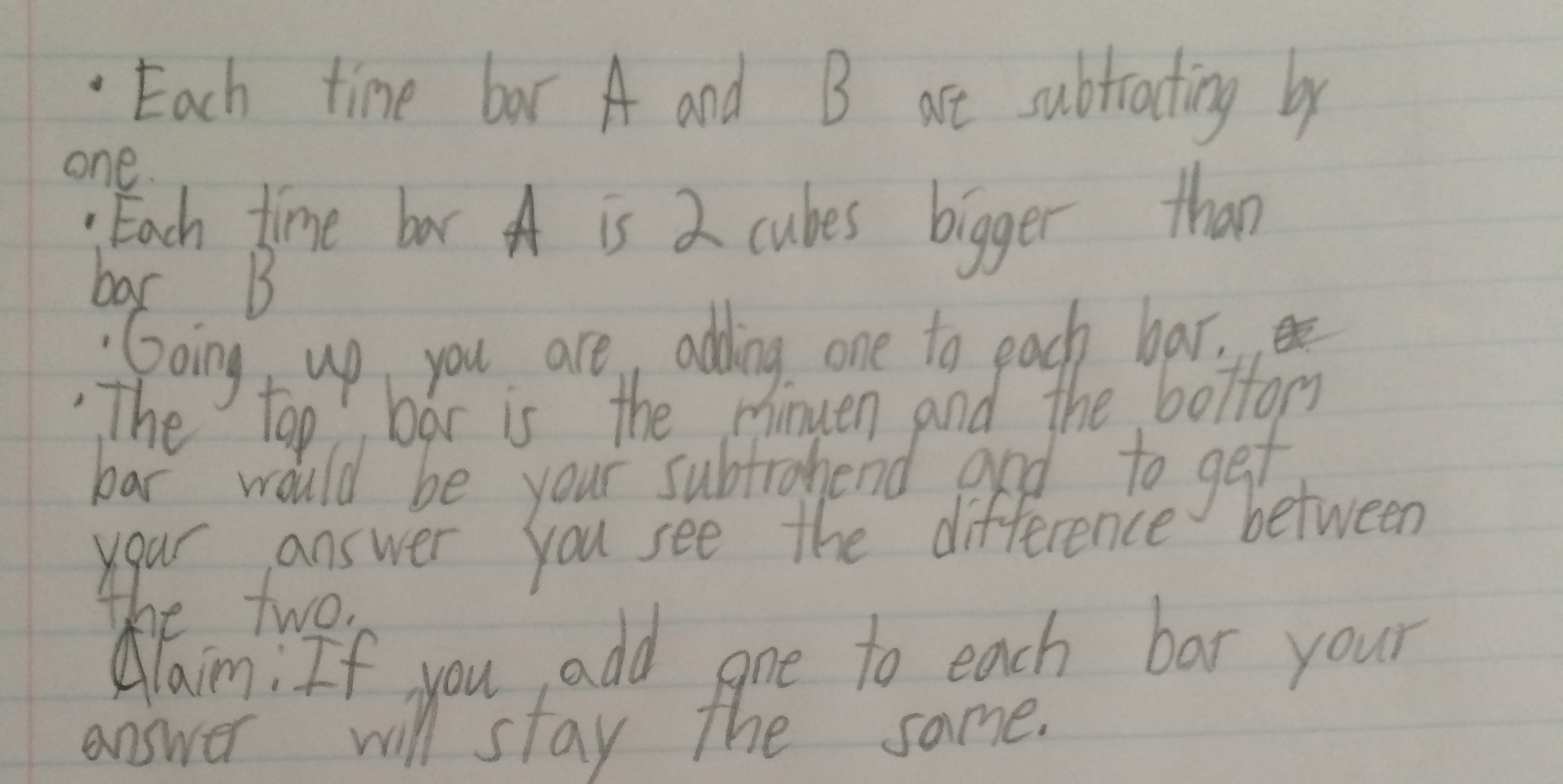
I got many ideas in terms of the bars such as these…

IMG_0550IMG_0552I then showed them Simon’s second idea…

…and asked them to think of these more as subtraction problems and see what they could come up with in terms of noticings and/or generalizations. I got some awesome responses! IMG_0550 - Version 2

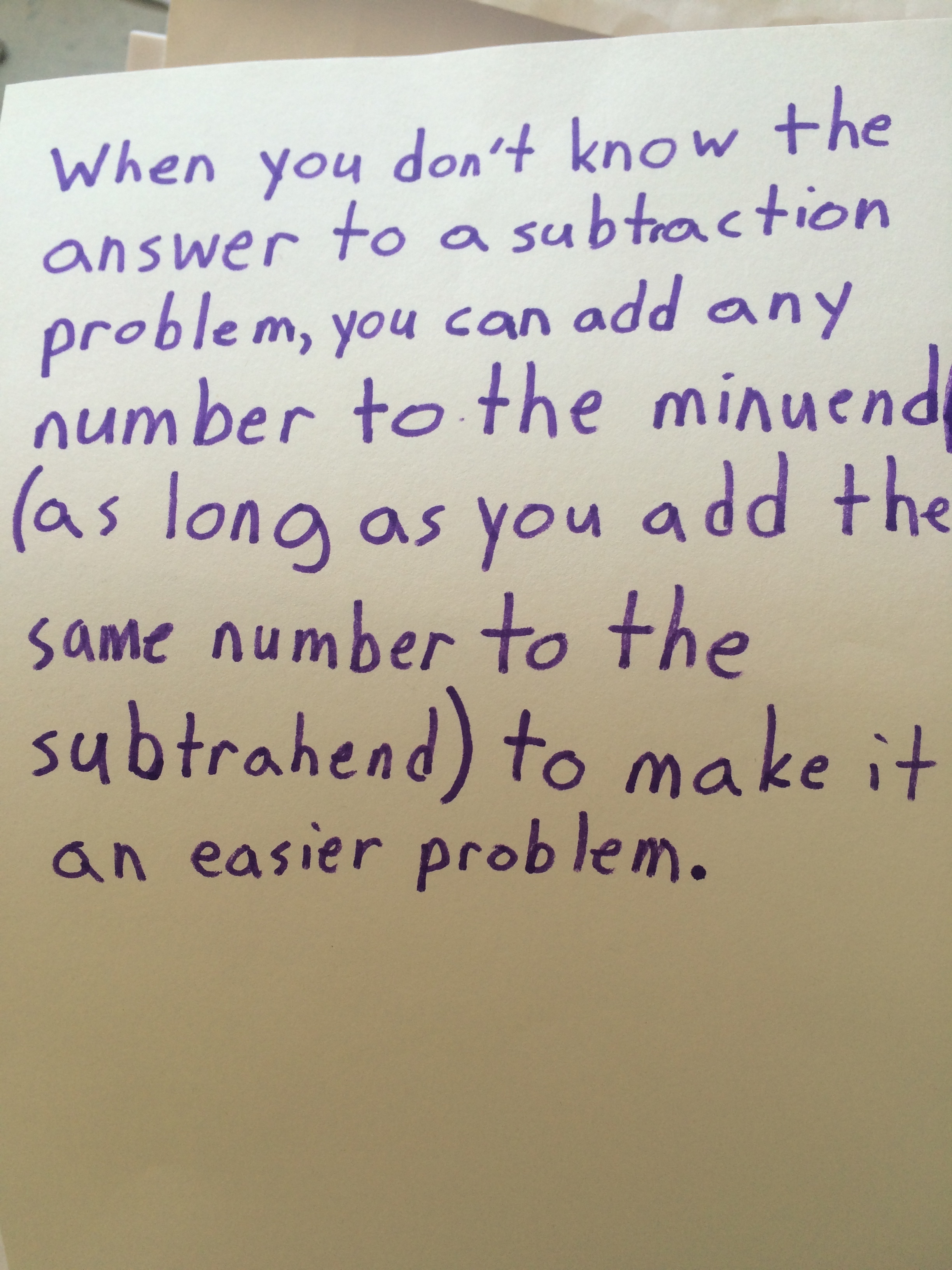
IMG_0548Then we shared the original student’s claim he worked on to see if it matched their thinking…

IMG_0553I love that he was not only thinking about what was happening in the problem, but also why he would want to use this in order to make a problem easier to solve.

These lessons were a beautiful way to work forward and backward in making claims. Thank you Simon for being so amazing, as always, it was not only great learning, but great fun!

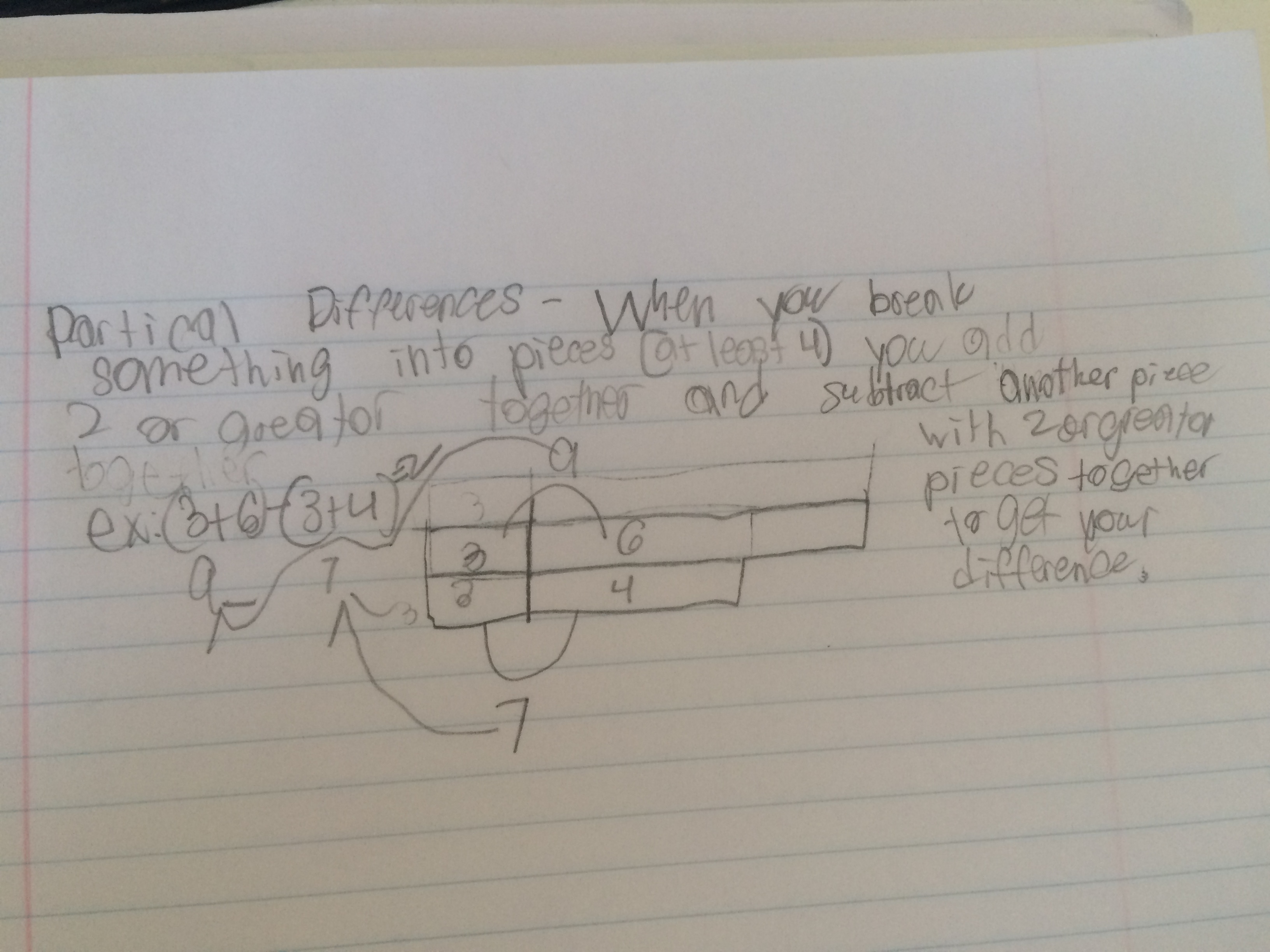
My students never fail to leave me with something to think about. One student said he thought of “partial differences” and here is how he explained it (definitely not what I thought when he said the term)

IMG_0547My next task is thinking of questions to ask him about this….

-Kristin

Subtraction Number Talk: My Curiosity Today…

Subtraction is the one operation that every time it arises in class, throws one more thing for me to think about into the mix. I have two recent posts around decimal subtraction, here and here, and I continue to work with whole number subtraction through number talks.

Today, I only had time for two problems in the Number Talk due to testing 😦 The first problem was 400 – 349. I was most anticipating students would subtract 50 and add one back or add up from the 349 to the 400 (1+50) to arrive at the answer of 51.  I was surprised when a student said he “subtracted 100 – 49 to get 51 and knew that would be the same answer because if you added 300 to both numbers it would give you the same problem, so the same answer.” This made me think of a distance model on a number line, but I completely missed that opportunity and moved into the next problem. Seeing what happened next, it may have either made one strategy more clear or completely caused us to miss out on the conversation that followed.

Problem #2: 400 – 274

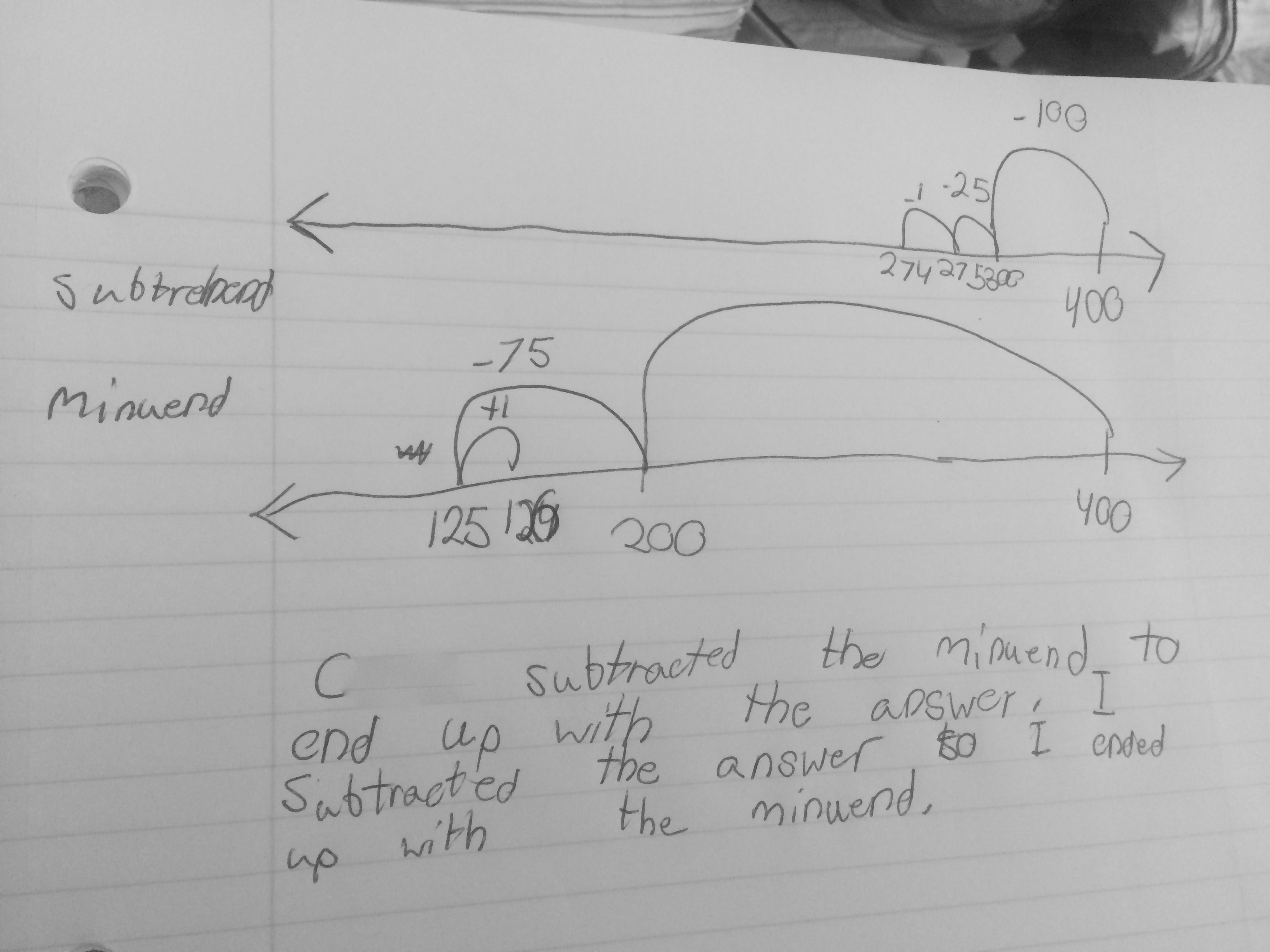
IMG_0502_2The student, “M”, on the right subtracted to find the distance between 400 and 274, however did not explain it that way so it left many students wondering how she knew what to subtract. I had a student ask her if that was her second strategy because she seems to have subtracted the answer from the 400.

The student, “C”, on the left solved it the way the majority of the class did, removal in part with some compensation at the end. Before he started explaining, he prefaced with, “I did it pretty much like M.” When he finished, he realized it was not the same and was confused as to where “M” came out with the same answer. He even exclaimed that, ‘I think she got the answer by mistake.”

“M” knew exactly what she did, however, I didn’t let her explain yet because I wanted the rest of the class to think about it a bit more. I told her she would be able to explain it tomorrow after we chat a bit more with it. I had them all end the class with a journal entry (surprising, right?:) I asked them what they understood, saw happening in each, or were not too sure about. It is just the most beautiful thing to read the honesty and reflection in their writings.

Some students could see what was happening…(even though it seems some tables have the vocabulary a little mixed up:)

IMG_0509_2IMG_0506_3Some left confused…

IMG_0504_3IMG_0508_2

Some had a really interesting way of thinking about it…

IMG_0505_3And then there was “M” who cannot wait to share tomorrow…

IMG_0503_2

Now, the question is, how to approach this tomorrow? I am thinking I would love three groups, one who subtracted in parts, one who found the distance by subtracting back to the minuend, and one group who adjusted the subtrahend and minuend to find the distance between. Have them create a context and representation that shows what they did (still working within the same problem they all have the same answer for) and do a share. I would like the share to go in the exact order of the groups I just listed above. Crossing my fingers I have time to talk some more math with them tomorrow, a silent classroom is probably more torture for me than them 🙂

-Kristin

Encouraging Students To Make Deeper Mathematical Connections.

Because of all of the math talk my students do in class every day, they are very comfortable (and flexible) in sharing multiple strategies and solution paths. They can explain others’ strategies in their own words and agree and disagree with one another beautifully, however when asked to make connections between two representations (numerical or visual), I feel like I get very “surface” connections. I will read things in their journals like “They are the same because they have the same numbers” or “They are different because we double and halved the other numbers instead” or “We both used an area model” Something like this…

IMG_0391_2 IMG_0393_2

After going through their journals the other day with Faith, we were thinking and questioning one another about how we, as teachers, can have students dig deeper into the connections. We obviously would like to them to notice them but if not put in a position to make connections, will they on their own? Is there a way to frame a task or question that would push them to think a little deeper about how and why the two representations are alike/different yet still arrive at the same answer? How do we encourage students to make deeper, more meaningful connections when we know they can, but just may not be sure of how to get there?

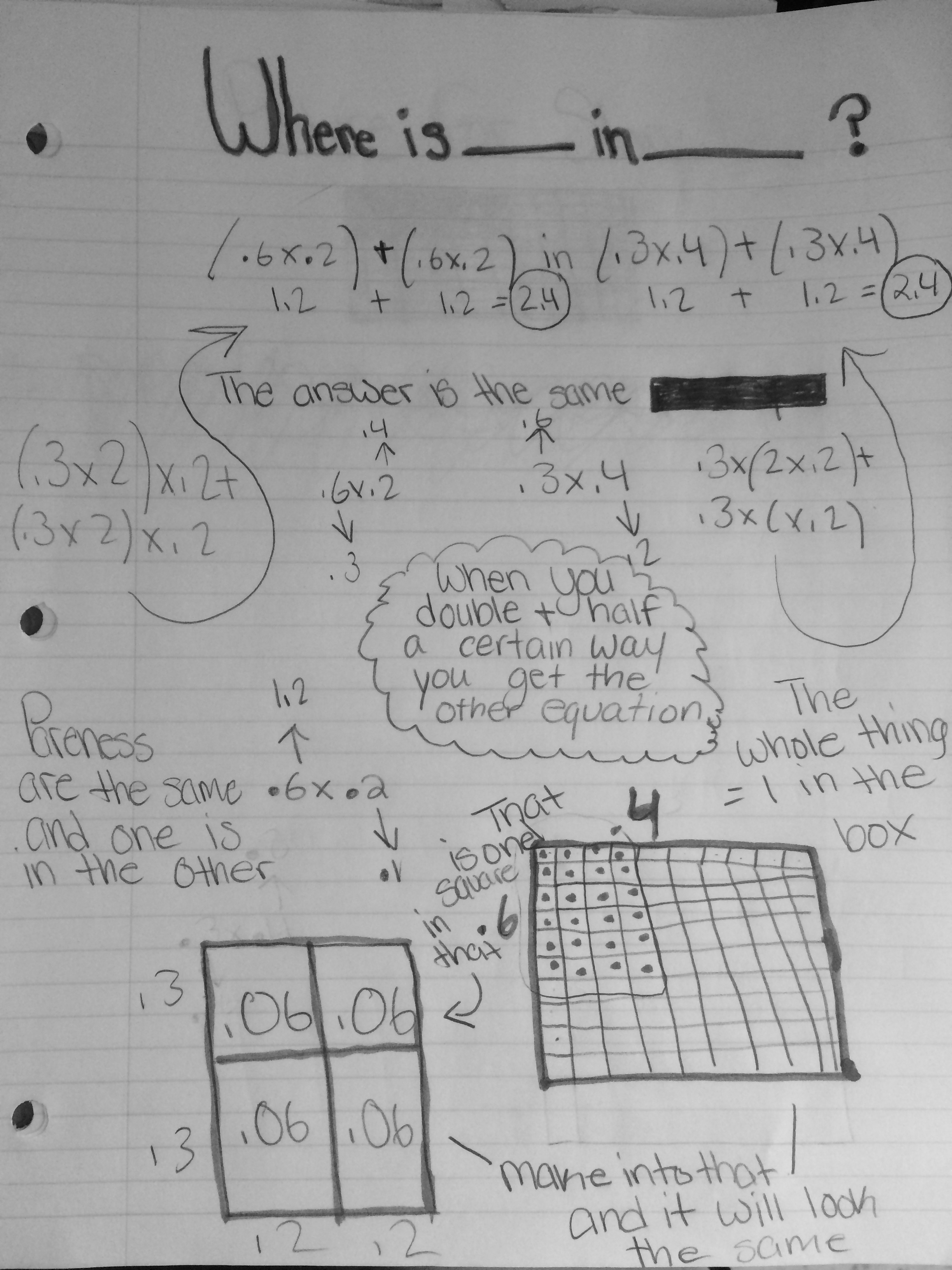
Instead of a number talk they other day, I did a math routine I named “Where is _____ in _____?” I was hoping the prompt would have them go beyond just looking “at” the representations and look “into” the meaning of each representation. On the board, I posted some examples of their representations from the day before in which they had done a surface job of connecting. I had them work independently for a few minutes and then talk as a table before the group share. I was much happier with the conversation and felt like asking them to look “into” the problems really got them thinking about what the representation was showing.

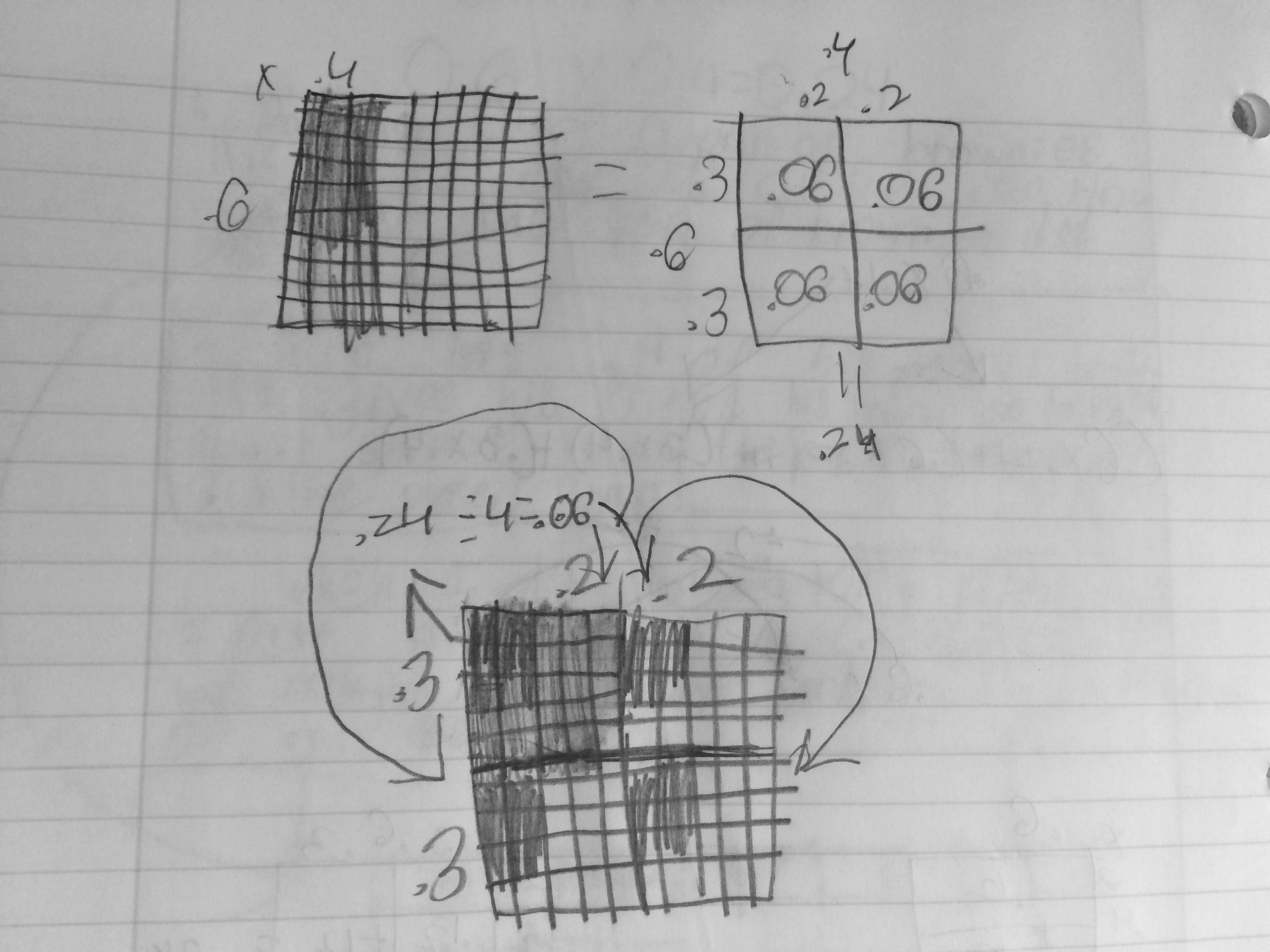
This an example of two area models in which students the day before had simply said, “We both used the area model” without thinking about how they were related. I love the (.3 x .2) in each of the quadrants of the first grid.

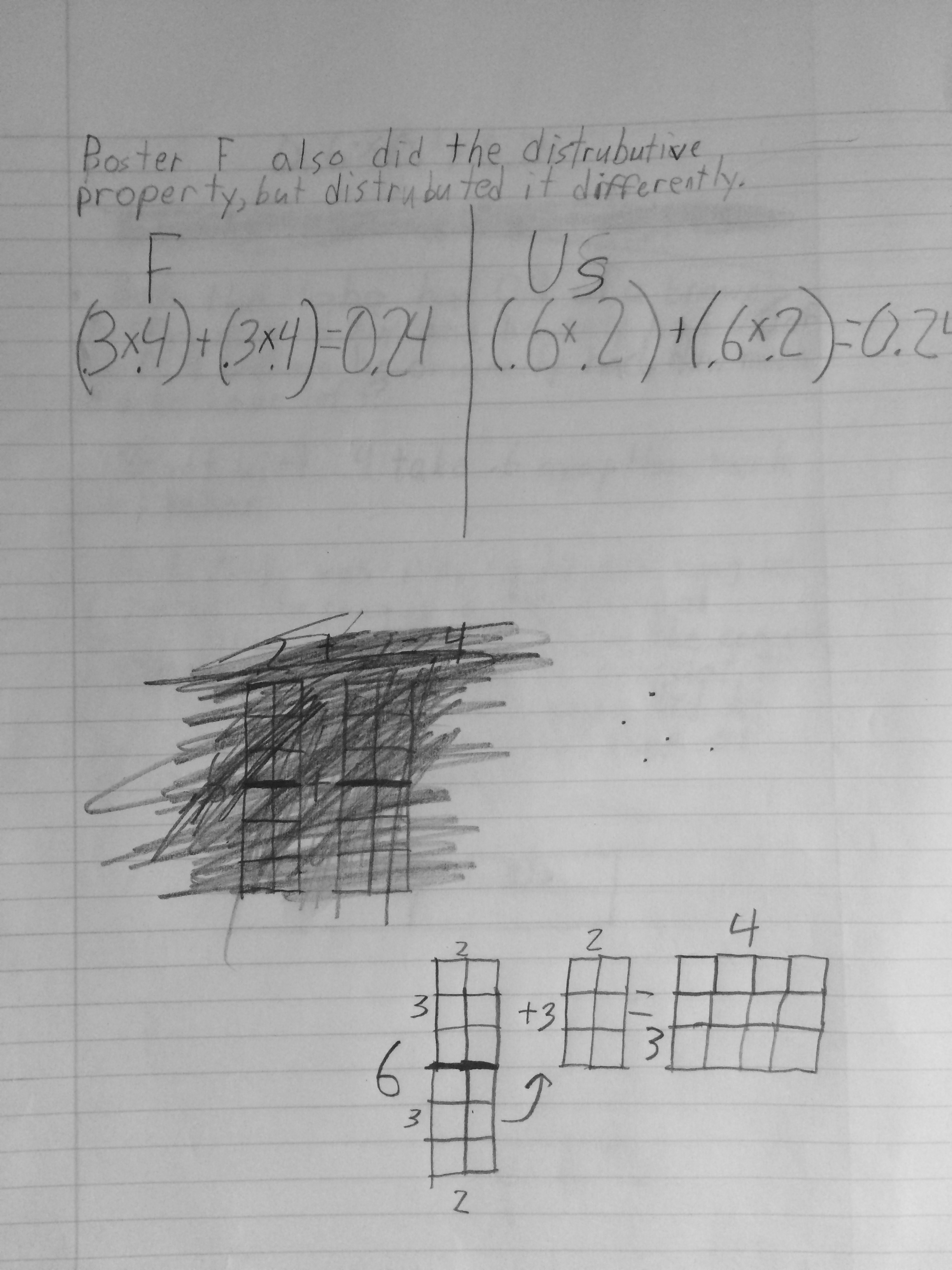
IMG_0388_2This student had a different take on how the two area models were alike, which led to such an interesting discussion! She also did some lovely work with showing how the two distributive properties were within one another through factoring.

IMG_0389_2

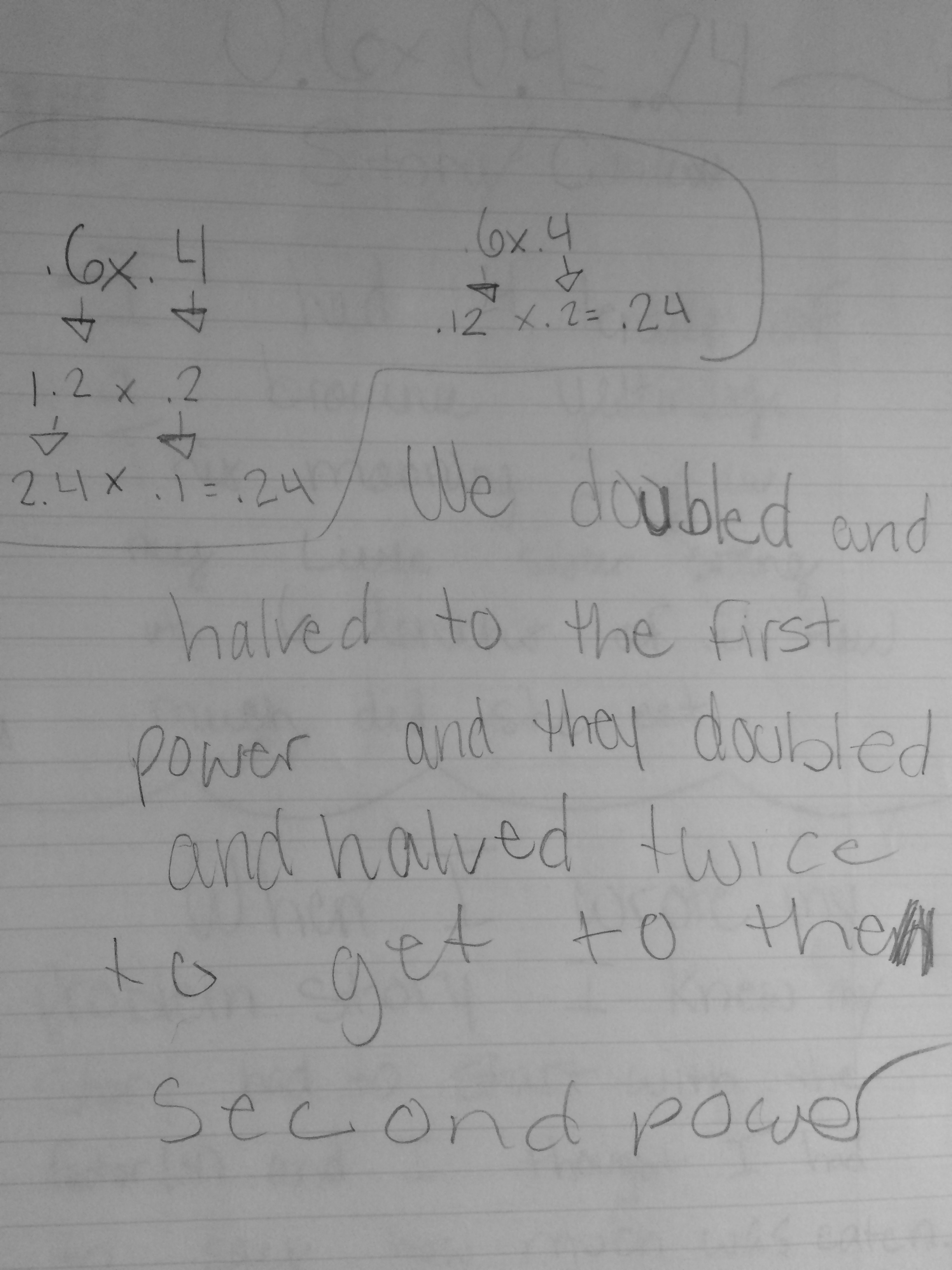
This student showed the distributive property and double/halving in a wonderful way…

IMG_0396_2This one was the only student who connected the area model of .6 x .4 to the strategy of .6 x .5 – .06. He showed where the .6 x .5 would be in the model and then scratched out where the extra .06 were coming off to arrive at the answer.

IMG_0397_2

Having students make connections in math is so incredibly important and so difficult to do, especially with so many variations in strategies and representations. I would love to hear other ways to encourage these connections!

-Kristin

Decimal Division, Running & Why I Love My Tweeps

Yesterday, I posed a decimal division problem to get my students thinking about what division means to them and how that applies to decimals: https://mathmindsblog.wordpress.com/2015/05/05/a-great-day-of-decimal-division/ (It was a really great day)

I was thinking of moving into a context today to see how they would represent the problem and the approach they would take after yesterday’s discussion. So, of course I threw it out on Twitter…

All evening I was thinking about a context and this one Elham suggested worked great for me! I was still thinking about how to word it to be something that the students may be connected to, then Joe’s tweet came this morning after my run…

Duh, my runs! Thank goodness Joe was up early too!  My students know I run every morning and cannot fathom that anyone actually wakes at 4:30 in the morning, so I knew they would love this.

To start the class, I posed..

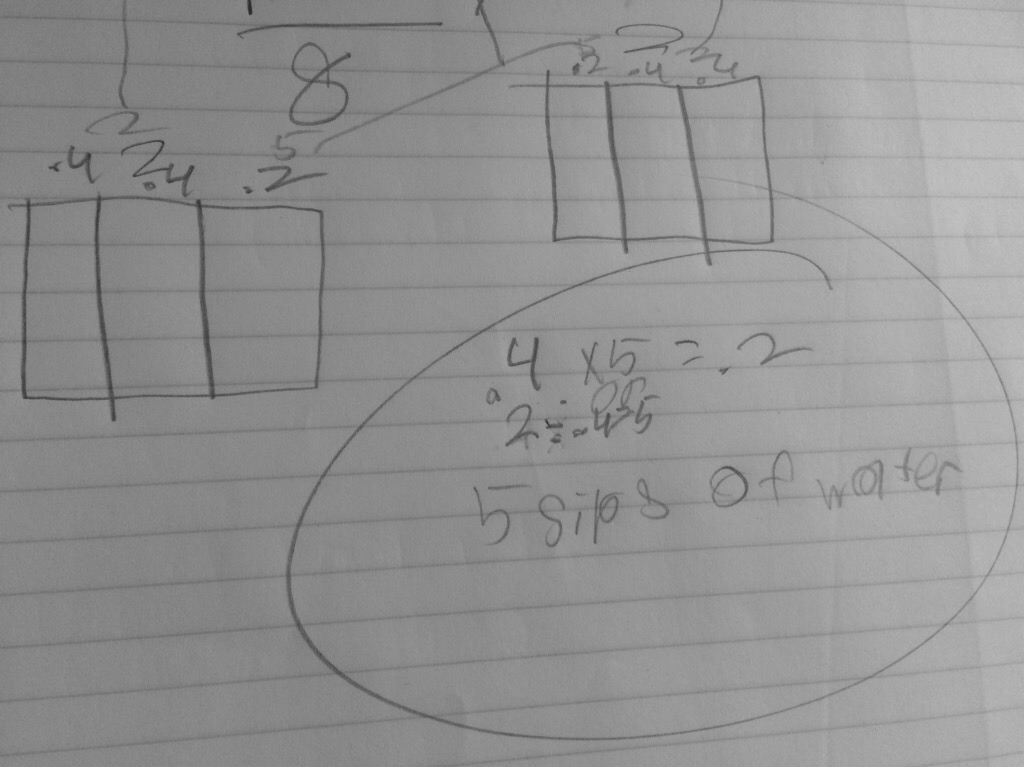
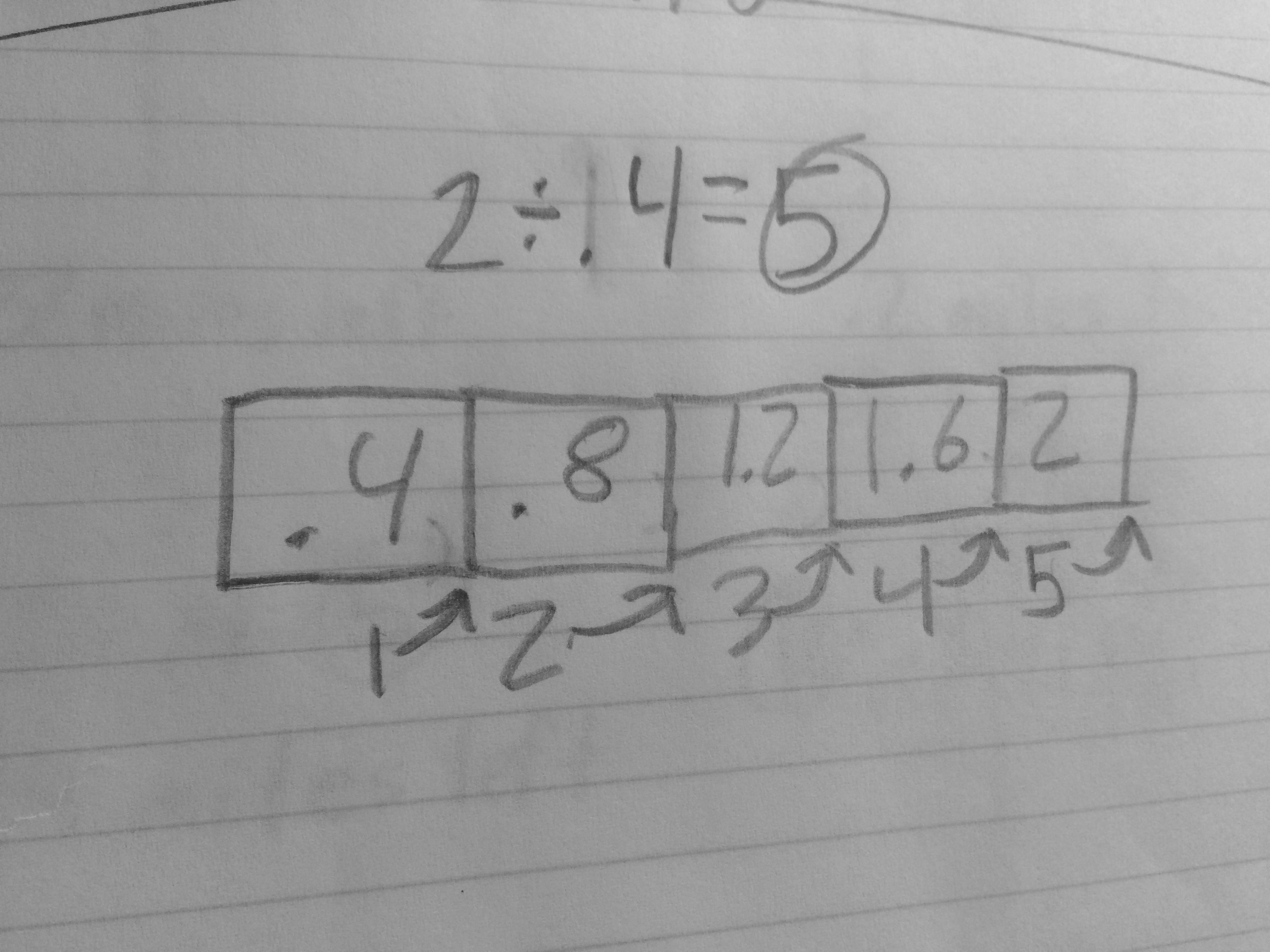
“I ran 2 miles on Monday afternoon. Every .4 mile I took a sip from my water bottle.How many sips of water did I take during my run?”

As with most times, I gave them some individual time before consulting with their table mates. It was awesome to see so many of the connections to yesterday’s work and also new representations that did not show up yesterday.

This one was so interesting how he broke up the mile to .4 +.4 +.2 and then combined the .2’s to make 5 four tenths.

IMG_0471_2This number line was so nice and then I loved how he got to the end and then counted the jumps going back down to zero. Also, at the top he had multiplied up to the 2 miles, nice way to show two ways of thinking about the problem.

IMG_0462_2There was a lot of skip counting by .4, but this model was especially wonderful. It is an area model combined with a number line. He counted up by .4 in squares that attached until he reached 2. I would expect students to count the number of .4 sections to find the answer, however this one labeled the 1, 2, 3, 4, and 5 at the end of each section.

IMG_0459_2

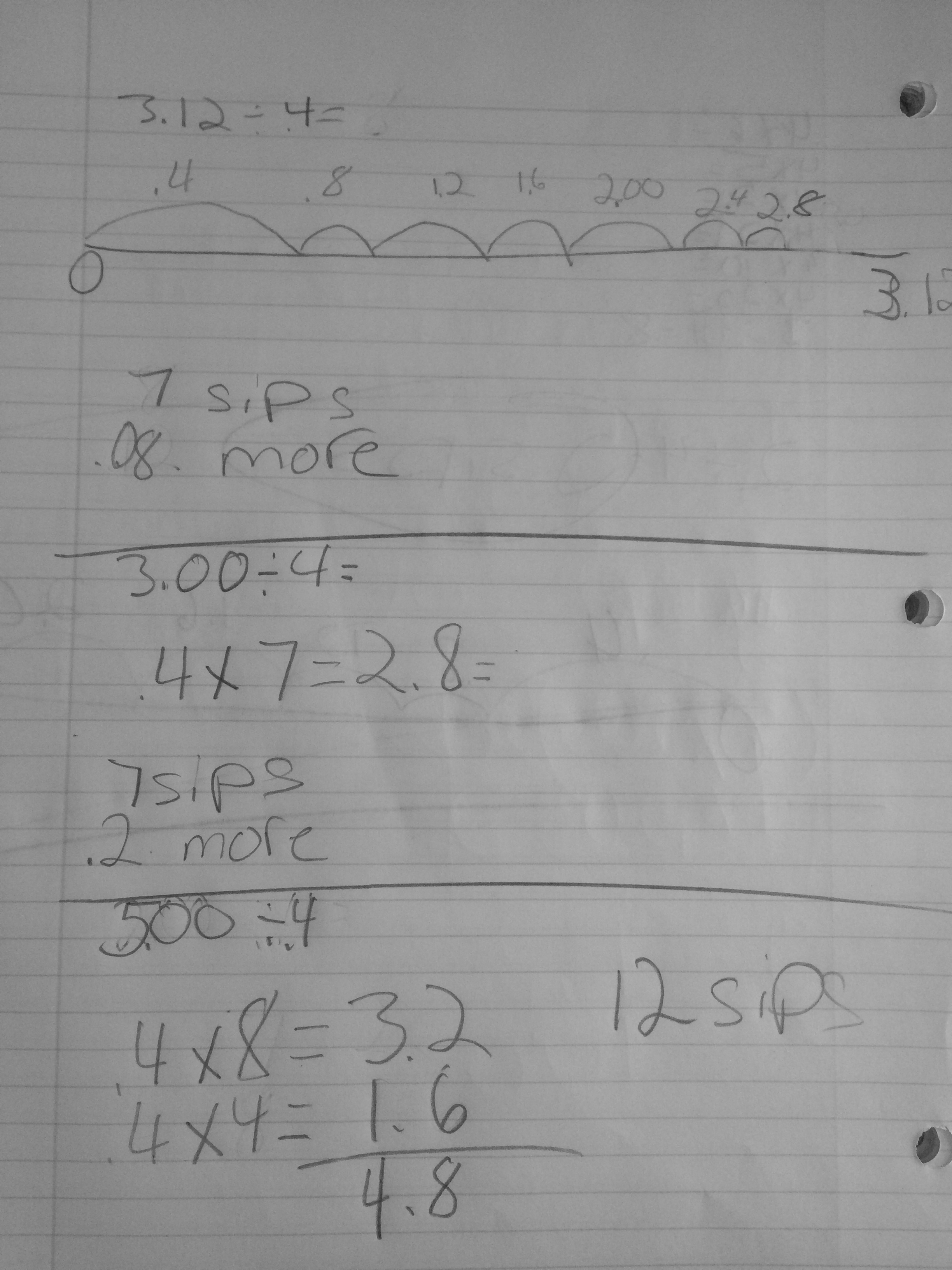
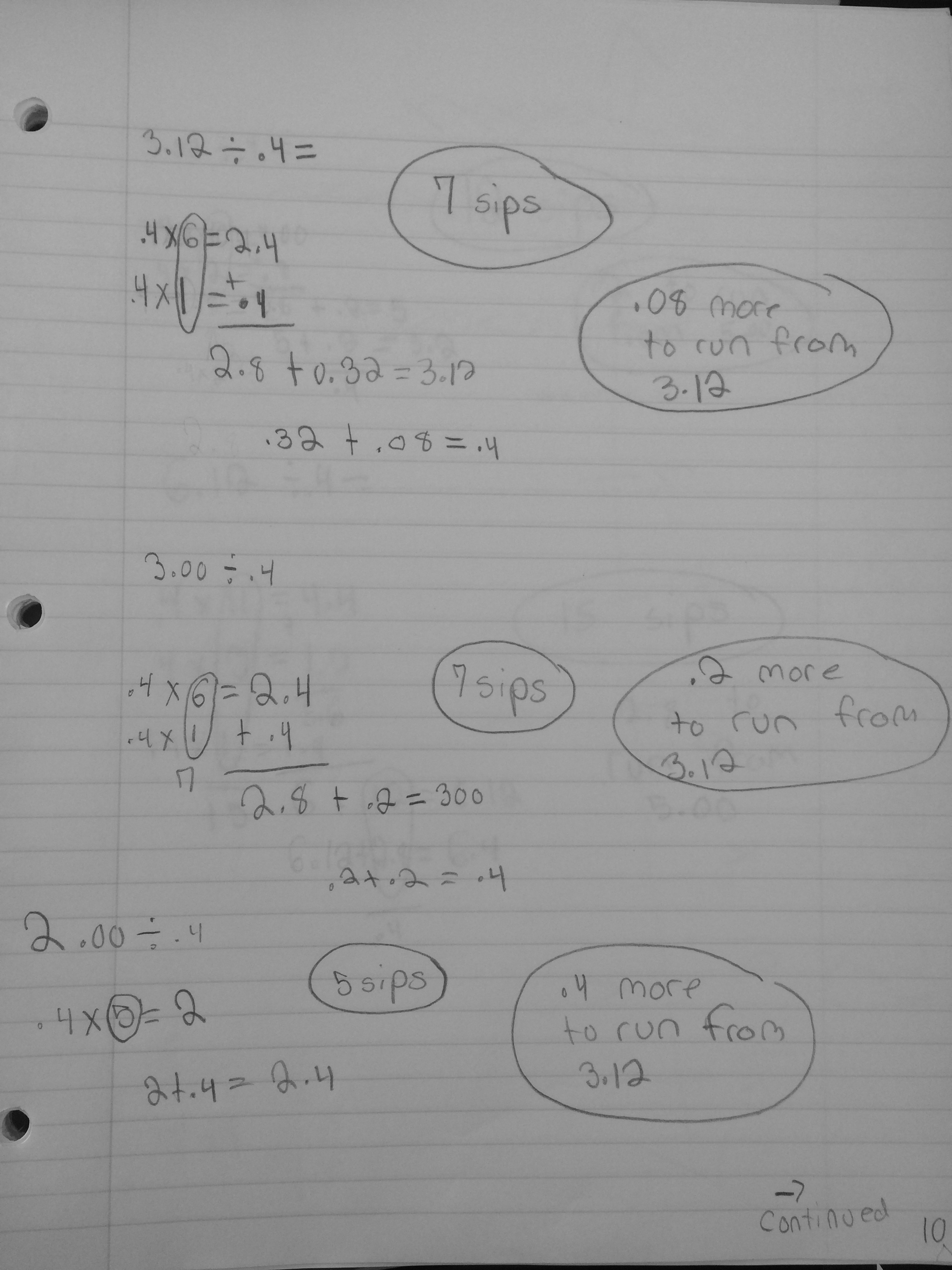
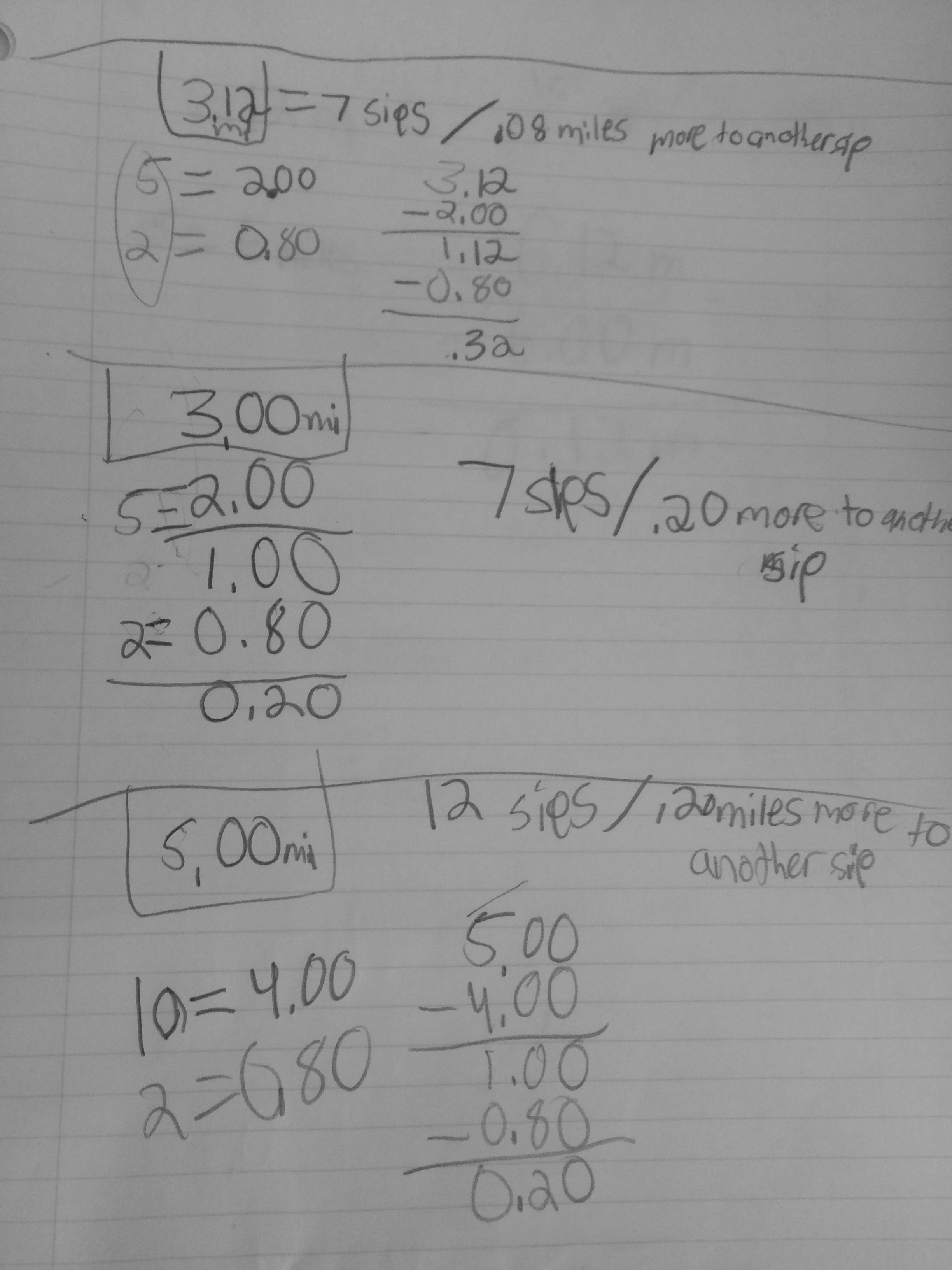
I then gave them a log of my past five runs. I told them to assume that I still take a sip of water every .4 mile. I wanted to know how many sips I took and then how much further I had to go until my next sip.

IMG_0465_2

I got some awesome partial quotients, number lines and multiplying up.

IMG_0458_2 IMG_0461_2 IMG_0469_2 IMG_0467_2

Now, the conversation of remainders came up. They want to know how to write the answer without the “r.” They wanted to know if they could write that as part of the number that was the answer. For example, could they write “7 sips r .2 as 7 1/2?” Saving that for tomorrow.

And THIS is why I love the #mtbos….my lessons take wonderful twists that make the learning experiences in my classroom so much better for my students! No teacher can do this job alone!

-Kristin

A Great Day of Decimal Division

Today, I really saw such a beautiful picture of the culture of learning in my class and marveled in the way in which my students had arguments in the best possible sense of the word. They were excited about the math, working so hard on proving their answer, and in the end ok with being wrong because they “saw where they messed up.”

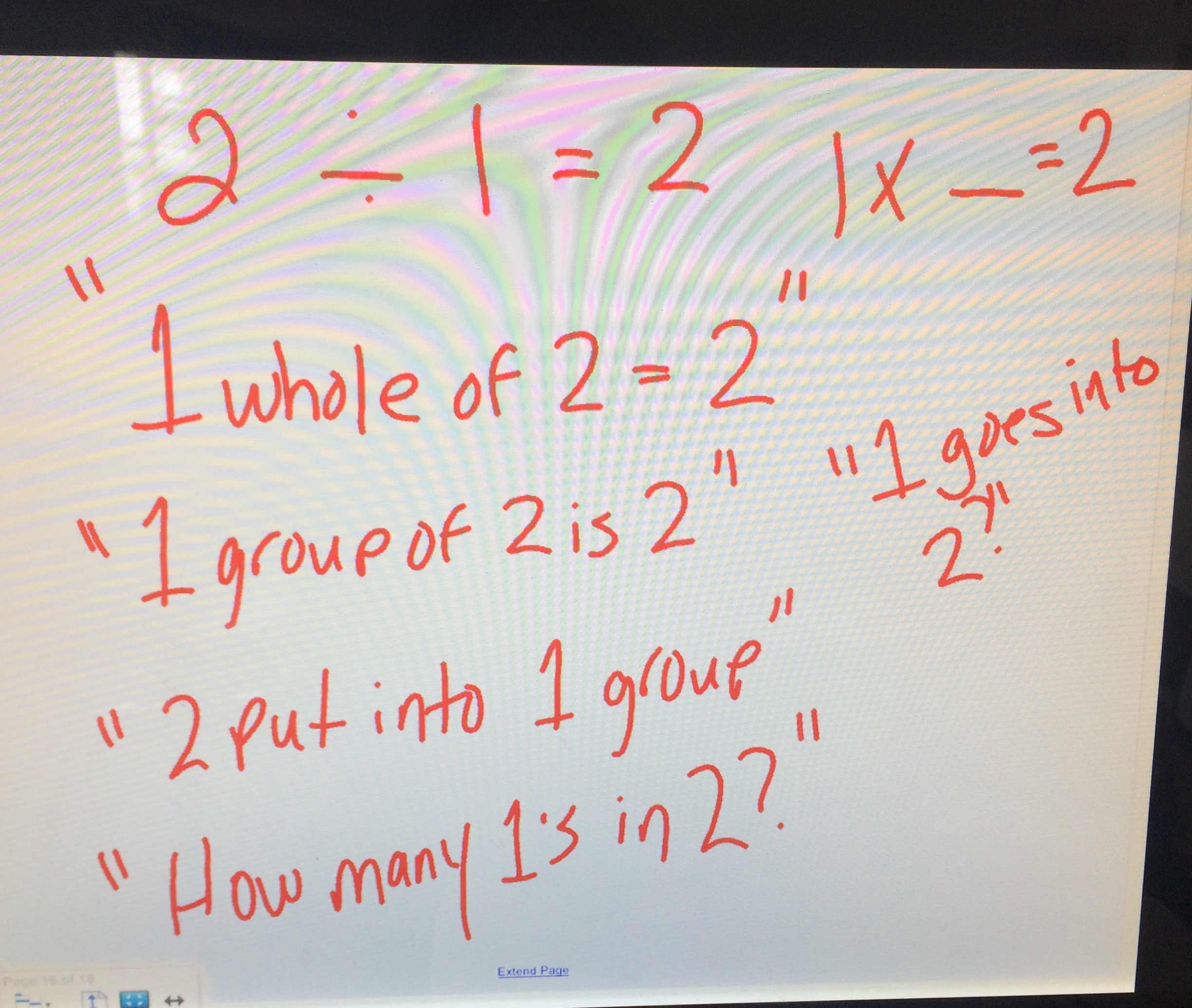
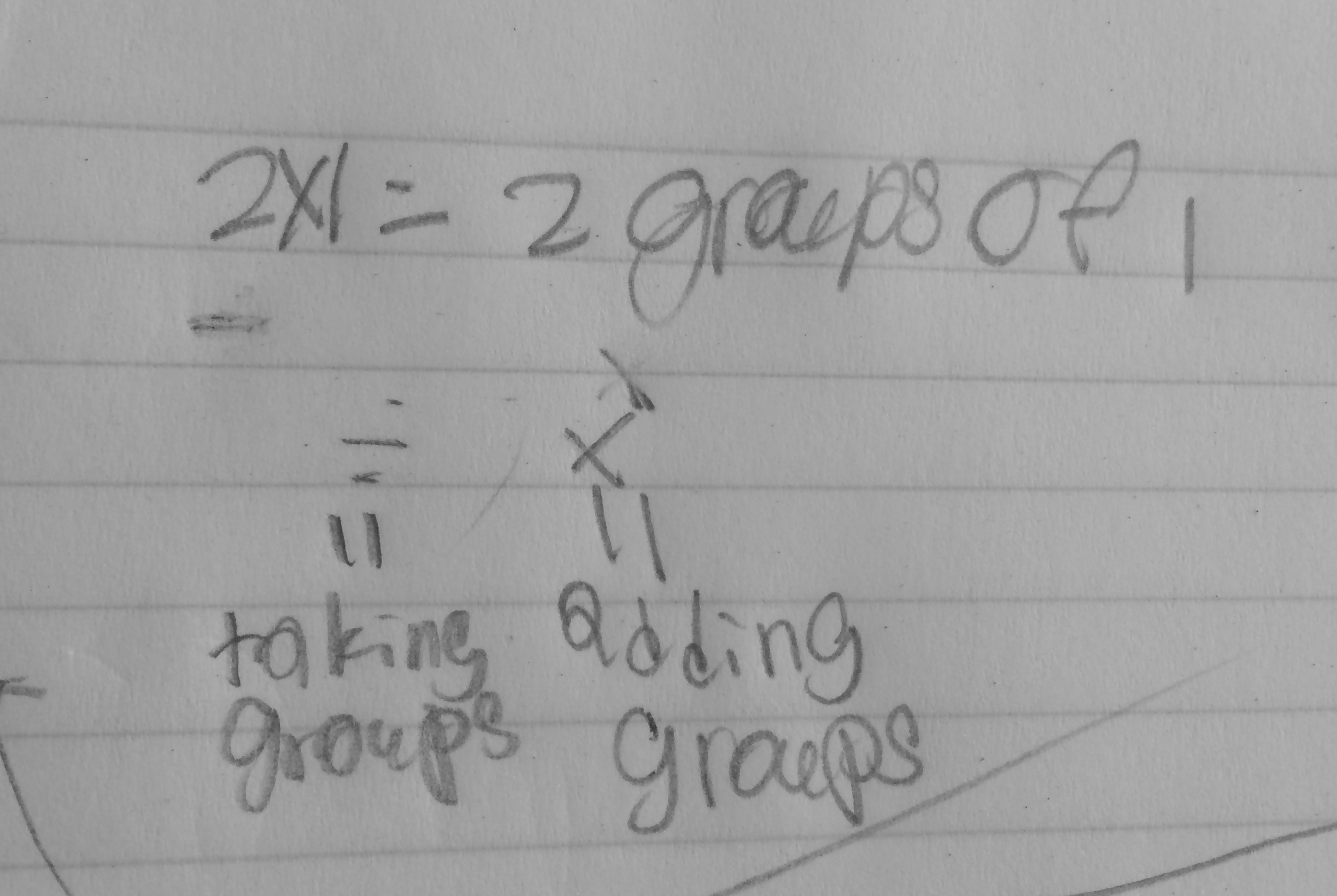
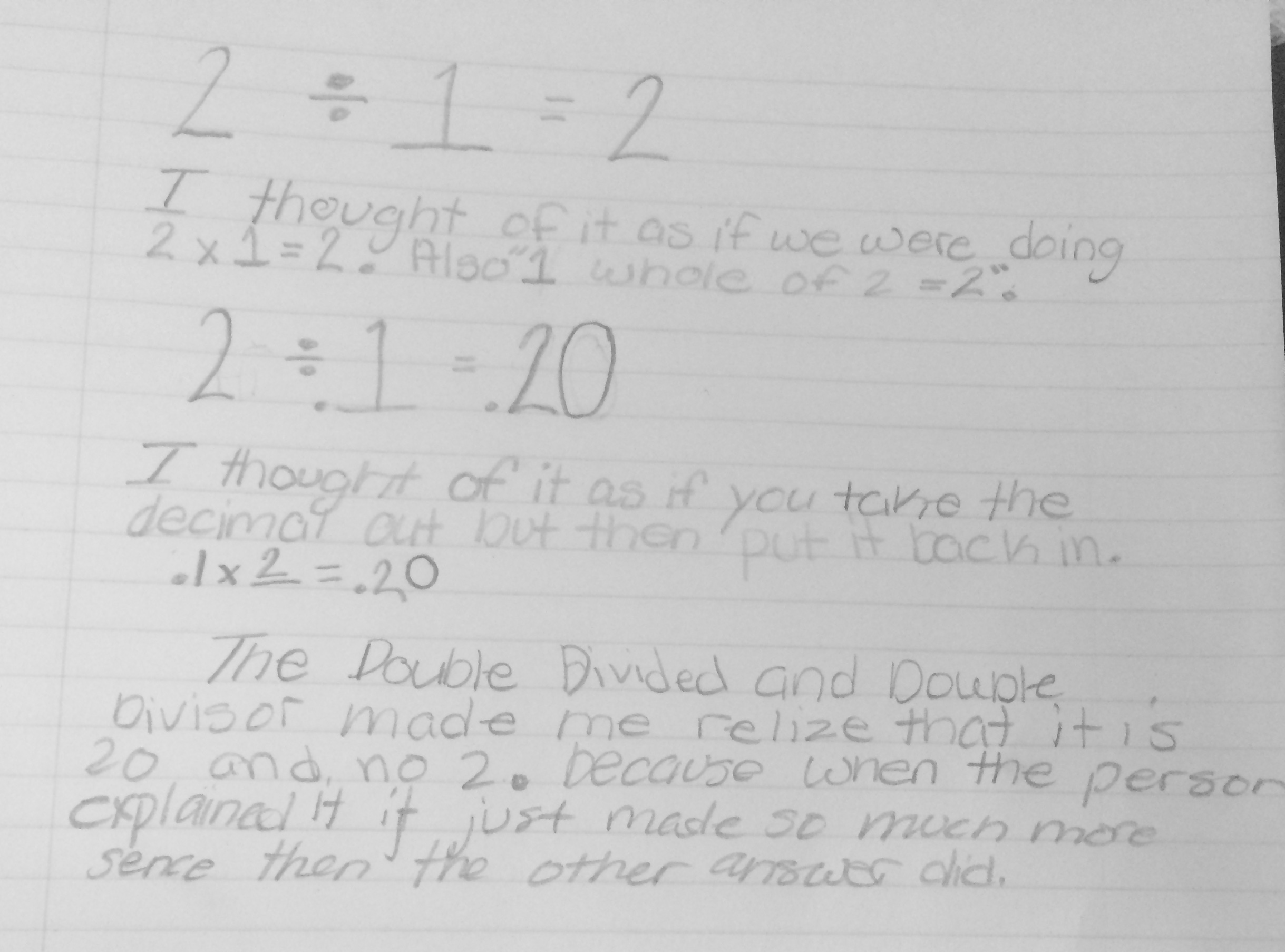
I posed the the question 2 ÷ 1 on the board and asked the students to write what they thought about when solving that question, or any division equation similar to that. We shared and collected our responses…

IMG_0444_2

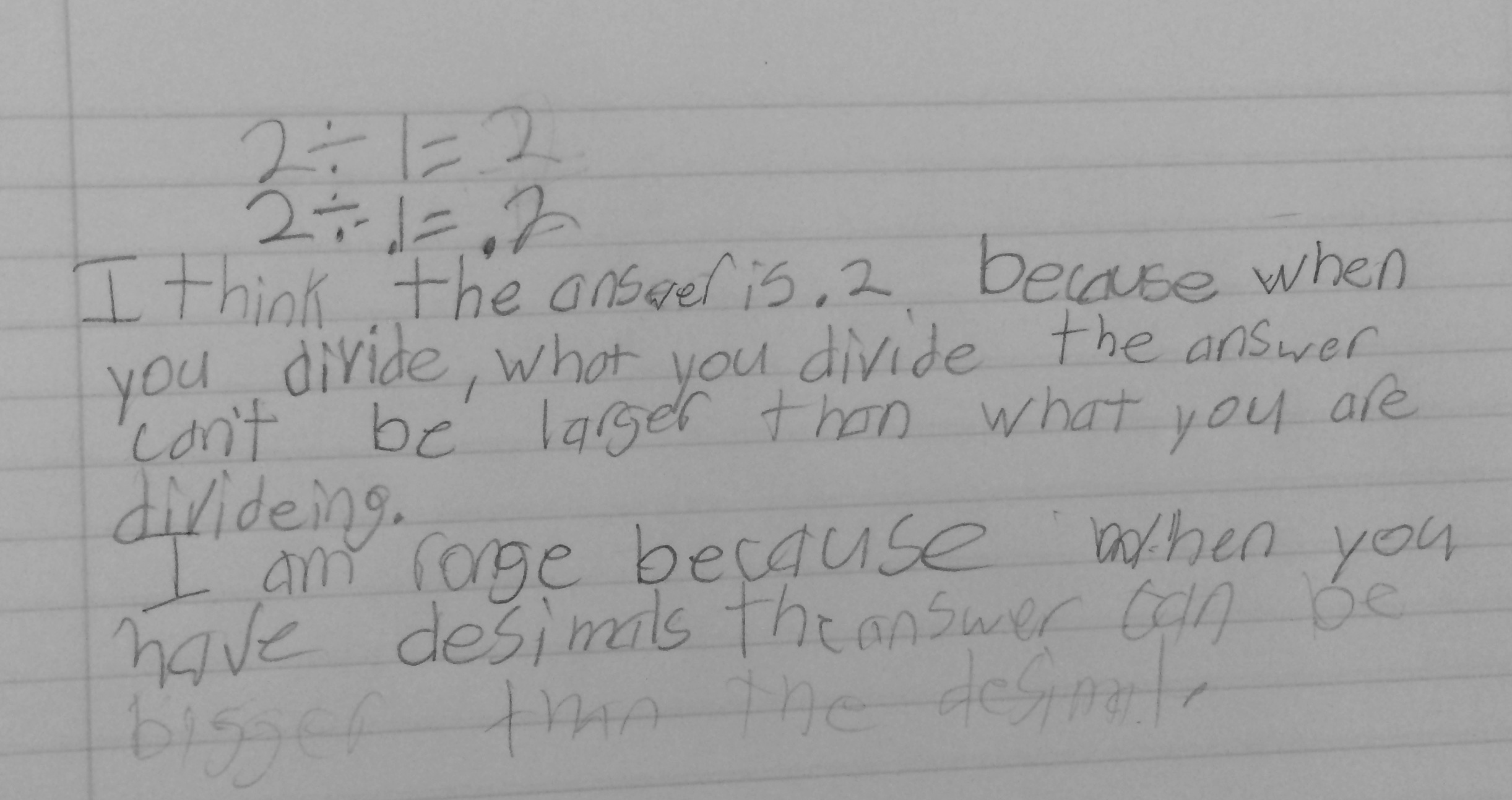
Going back to their journals, there were some other interesting ones such as contexts and what the symbols meant…

IMG_0432_2 IMG_0429_2

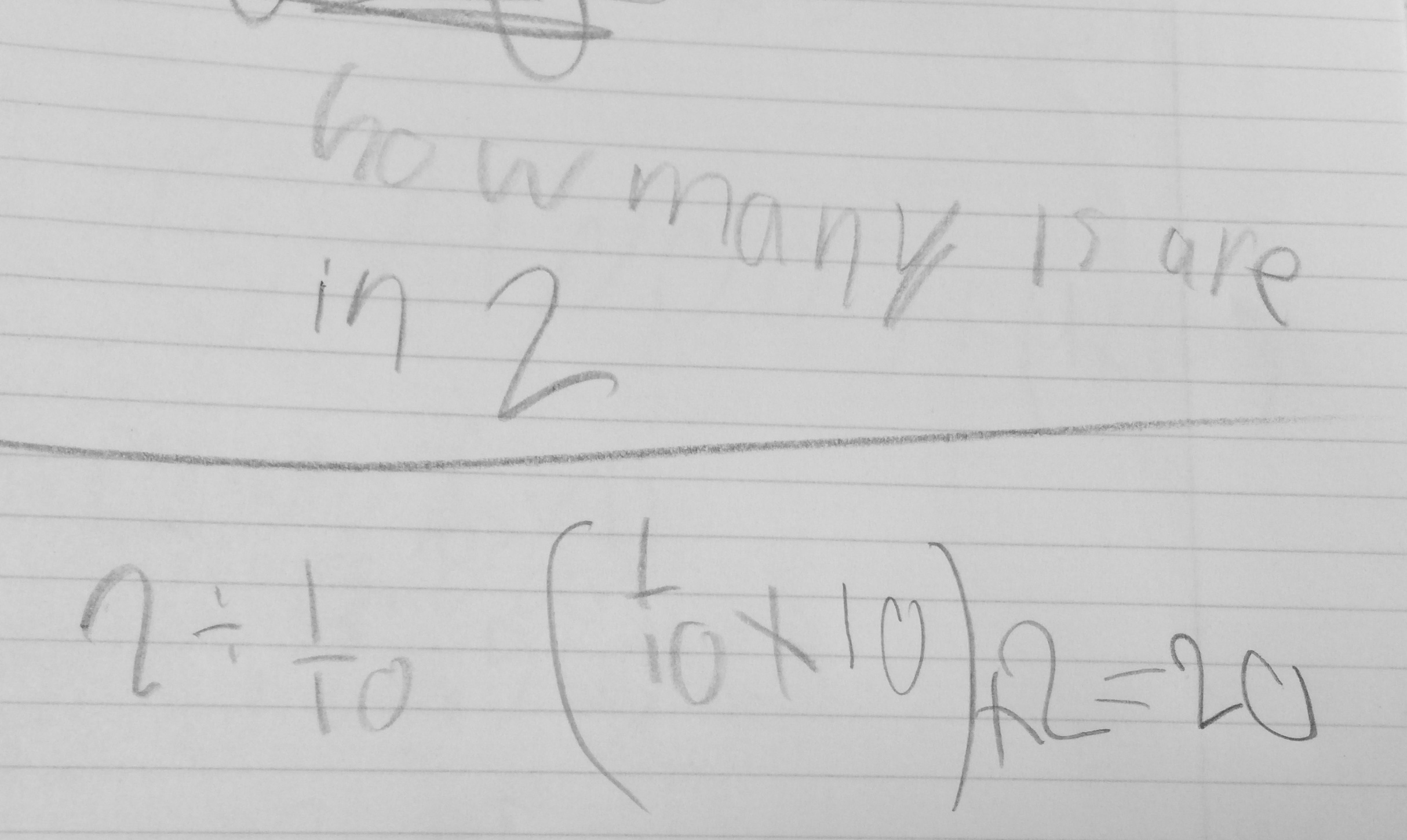
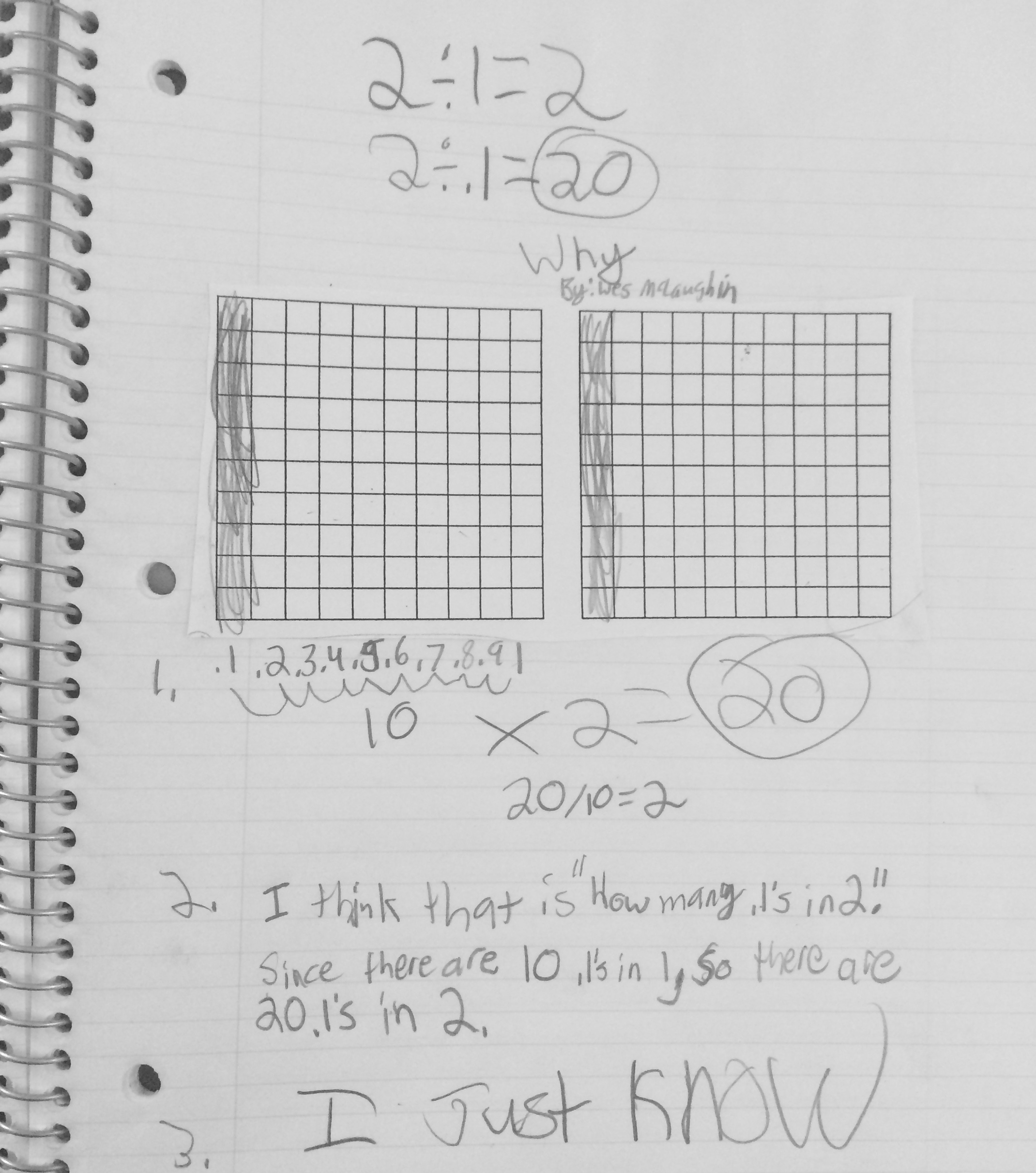
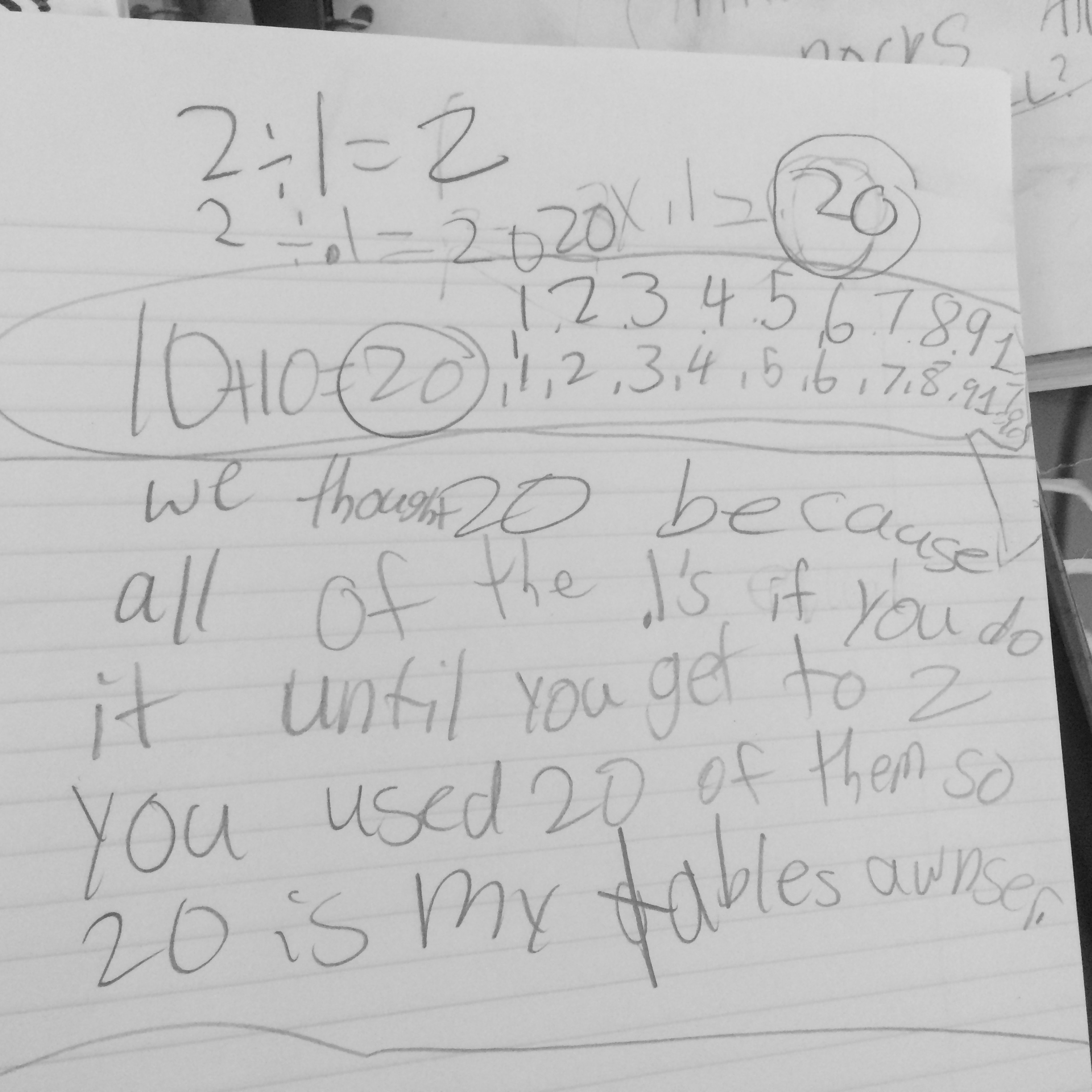
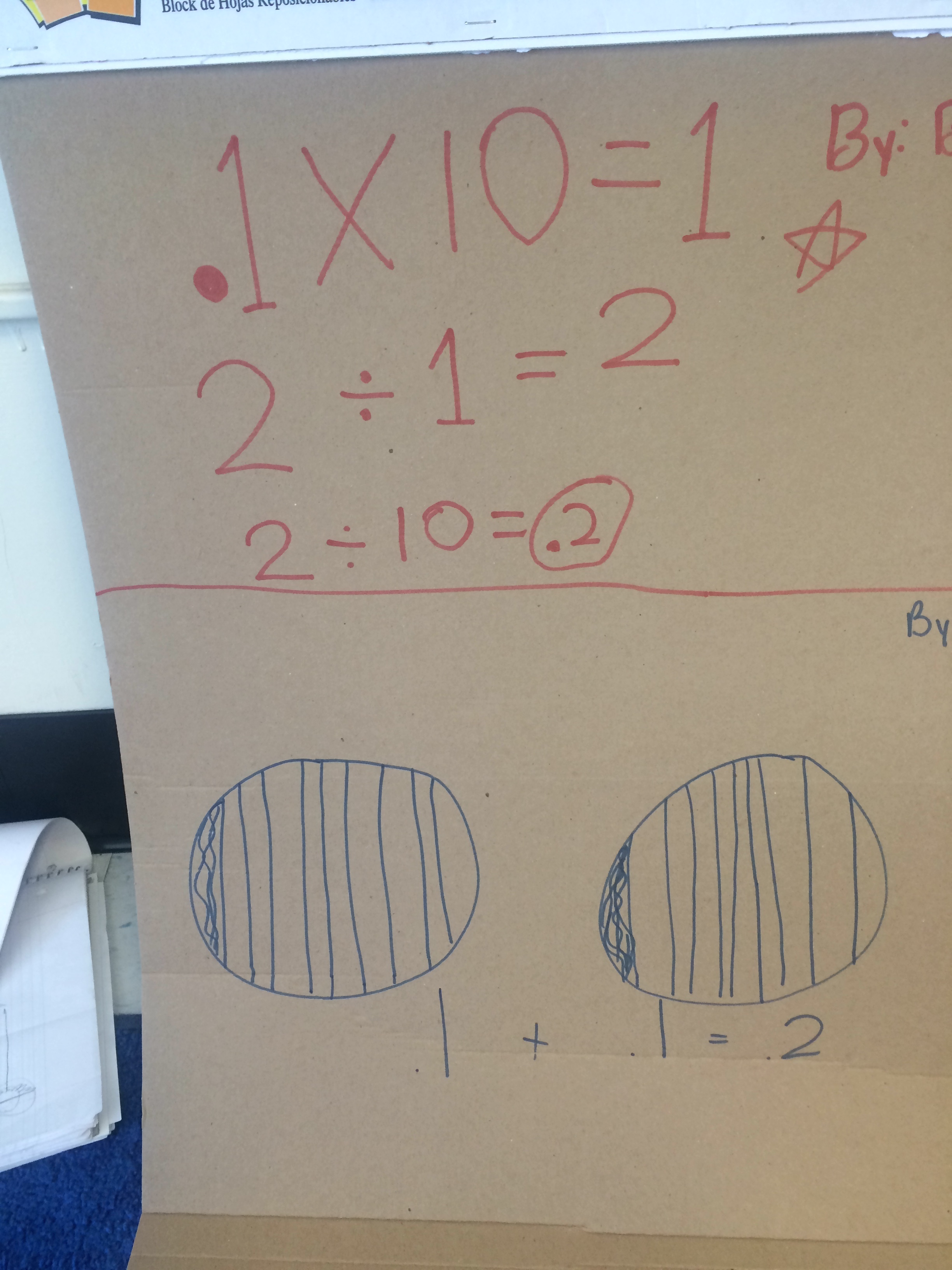
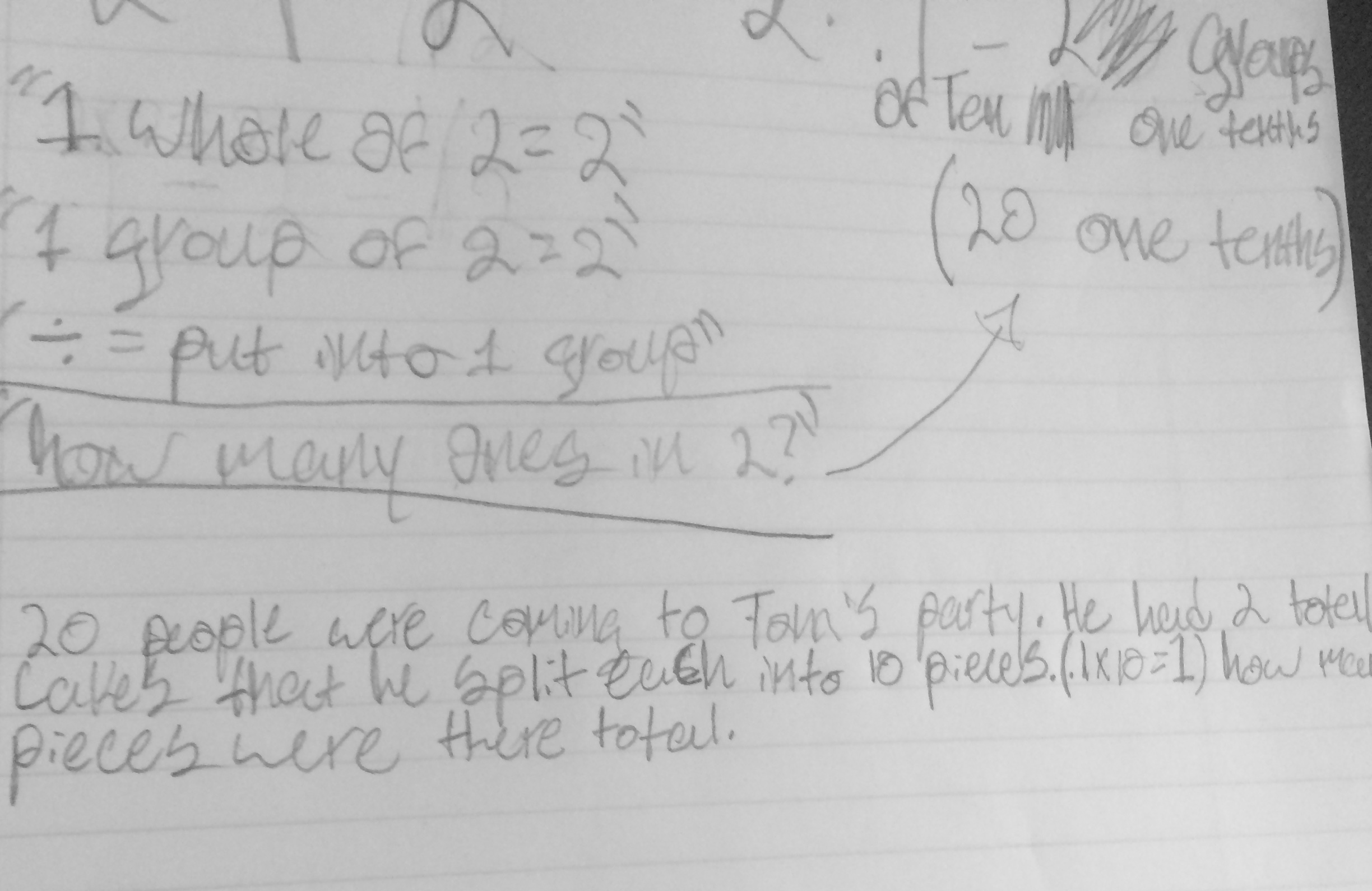
I then asked them to write this equation and answer they thought for 2 ÷ 0.1. I was so excited to have a split class of the answers 20 and 0.2. They worked on proofs with their tables and I got some great thoughts around what the think about division as well as references to visuals they think about in their solution.

IMG_0443_2  IMG_0426_2IMG_0438_2 IMG_0441_2

I particularly like this answer because of the way it was written…

IMG_0423_2

At this point they begged for chart paper to create a poster to “show the other group why they are right.”

IMG_0427_2 IMG_0428_2

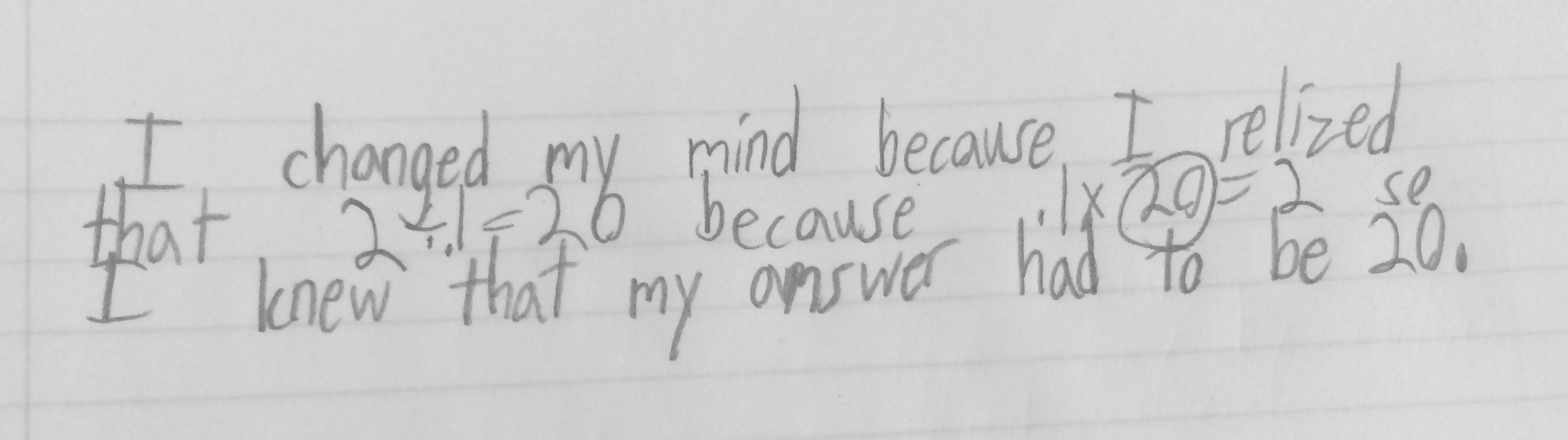
Each group shared their thoughts and there were a lot of “Oh”‘s and “I have a question for…”‘s going around the carpet area. At that moment, they were completely owning the class. They politely waited to ask their questions, politely disagreed with one another, and openly admitted when they “changed their mind.” I loved this moment so much, I just listened.

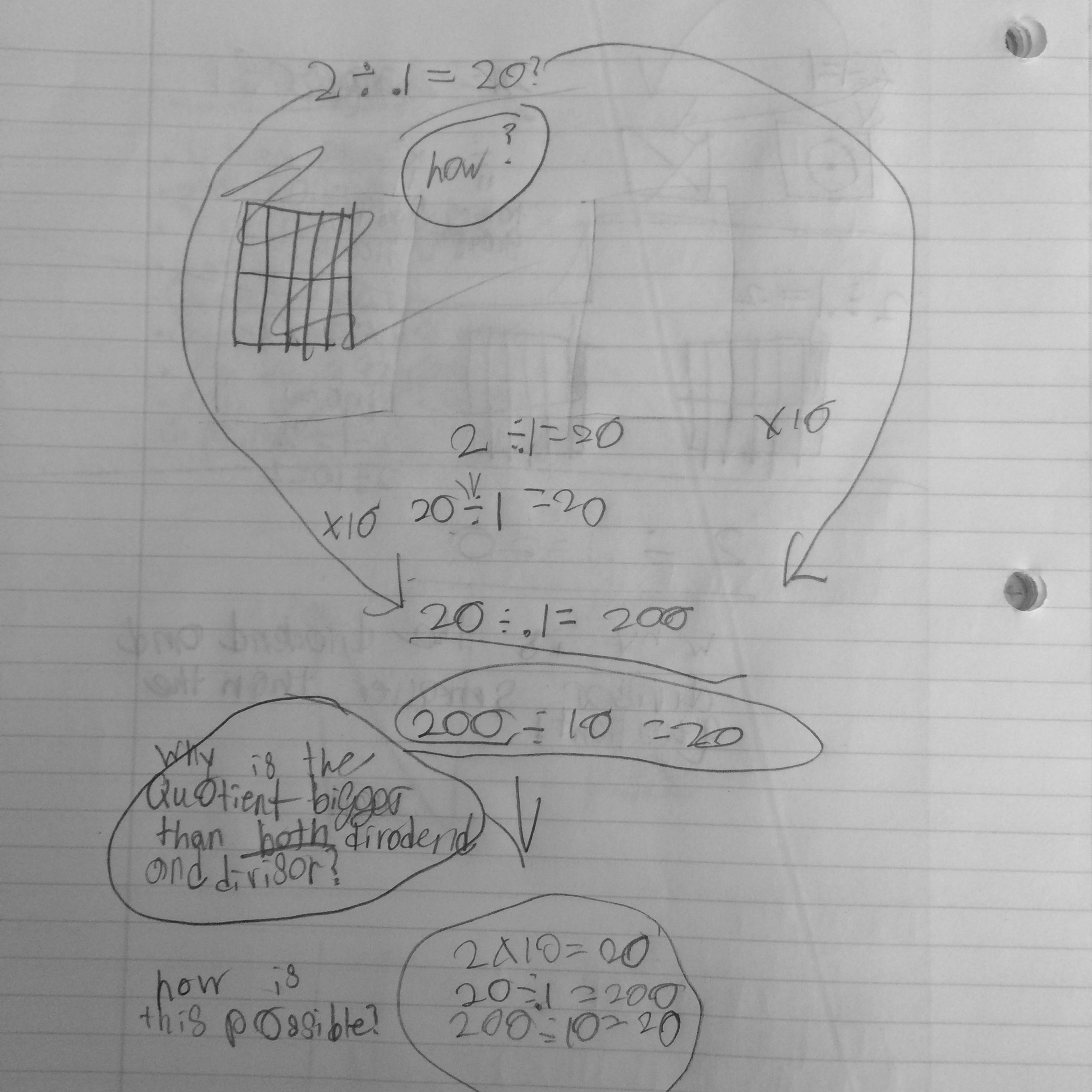
I had all but one student who still did not agree yet with the 20 so I had him write down why so I can think about how to structure tomorrow to meet his concerns. He is focused on adjusting either the dividend and/or divisor and then adjusting the quotient. I love all of the “how”‘s.

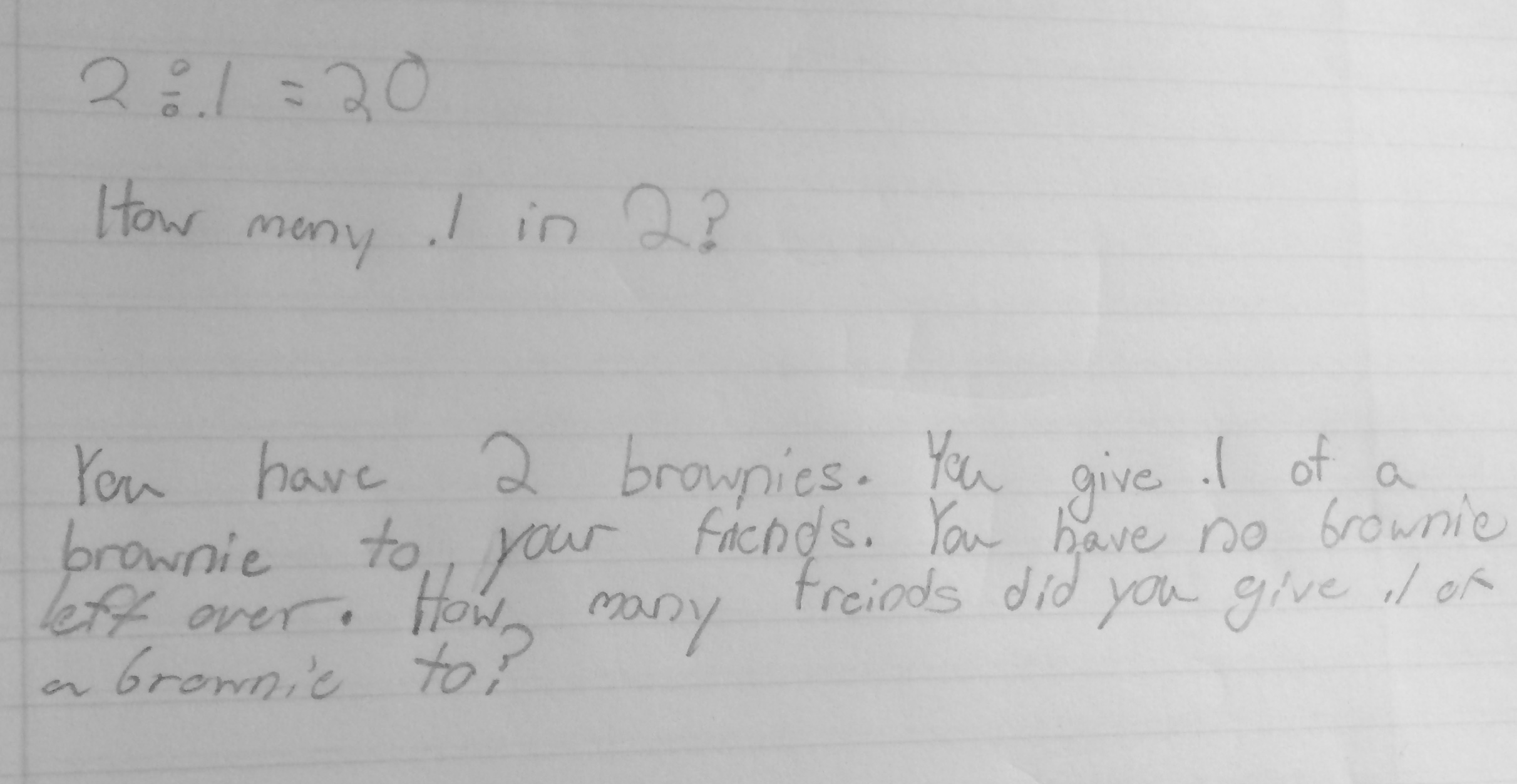
IMG_0445_2I asked the ones why had 20 to take a stab at a context for the problem and others who changed their mind to tell me what part was the final aha for them.

IMG_0446  IMG_0448 IMG_0450IMG_0447Today was the day I wanted to have other people in there watching to be as excited as I was. I told the kiddos how proud I was of them and off to lunch they went! I then had to bottle up my excitement until I could get this all out. It was just a really great day to watch my class work, and learn, together.

-Kristin

Conjecture or Claim?

I have been having wonderful conversations on Twitter recently with Kassia (@kassiaowedekind), Simon (Simon_Gregg), Mike (@MikeFlynn55), Elham (@ekazemi) around the topic of students making claims, more specifically differentiating between claims and conjectures. I have to admit, I have really just formed my own idea of how I differentiate between the two, so it was nice to hear others’ perspectives around this. I consider a conjecture a noticing they think to be true, more on a case by case basis. A claim, to me, becomes more generalized and then followed with a proof. (I have also had great convo with Malke (@mathinyourfeet) around these proofs w/geometry).

The conversation last night started with Kassia…(Look Kassia, I finally learned to embed tweets:)

  Mike gave us a nice perspective of claims based on his work with Virginia Bastable….

My students have now started to say, “I have a claim to make” when they notice something happening over and over again. In those moments, I don’t really think about “what” they are calling it because I am just so excited to hear them talking about the patterns and regularities they are seeing. But is what they are saying a conjecture or claim? Does it make it to the claim wall to be revisited and proven? This year being my first work in really having students think about making “claims” beyond just noticings, I have made a “Claim Wall.” Students see things happening in certain cases and I ask them if they can write a statement for “any time we…” to see if they can make it more general. I like Simon’s idea to expand on my wall…

We all agreed that the proof piece is the difficult piece of going from being a conjecture or unproven claim to a substantiated, generalized claim. I find my students prove over and over again that it “works here and here and here…” but have trouble with the why. It is hard to do, even as adults putting it into words is difficult.

What I love most about these conversations is the fact that the next day it continues, but this time with the kids. Simon tweets this morning about a claim that two of his students made while folding paper…

Which coincidentally would help my students tremendously to think about when proving their claim from Friday’s number talk…

The coolest part about this claim was that it stemmed from a multiplication of fraction number talk, yet they proof show division. I loved that. Also loved the explanation that accompanied their statement. I did ask them if this was true for taking half of any fraction because they seemed to be just dealing in unit fractions at this point. So is this a conjecture or a claim? I am not sure. How generalized would make it a claim? Could it be “When taking any unit fraction of another fraction…”

Would love any thoughts, conjectures or claims on this…:)

To be continued…

-Kristin


Creating Contexts for Decimal Operations

Sometimes I have students engaging in math within a context, however at other times, we just explore some beautiful patterns we see as we play around with numbers. I see a value and need for students to experience both. This week was one of those “number weeks” and it was so much fun!

Over the past few weeks, we have been working on decimal multiplication. If you want to see the student experiences prior to this lesson, they are all over my recent blog posts….it is has been decimal overload lately:) After sharing strategies and connecting representations in this lesson, I was curious how students thought about this problem in a context because up to this point, I had not given them one for thinking about a decimal less than one times a decimal less than one.After they wrote their problem, I asked them to tell me what they were thinking about as they were deciding on the context.

I anticipated that many would refer back to what they know about taking a fraction less than 1 of a fraction less than 1, like in this example…

IMG_0343

I love how this one said she knew she “had to start with .4” That shows the order of the numbers in the problem create a context for her. It mattered to her, taking .6 of the .4.

IMG_0340

This student went with two different contexts and again saying that he started with the .4. This must be something we have chatted about quite a bit about because it showed up multiple times. I loved how this student said he thought about an area model in creation of his problems.

IMG_0342

This student was great in listing all of things he was thinking about as he thought about a context..

IMG_0344

I had students who attempted to create a “groups of” context. I don’t know if I ever realized how difficult this and how much I, as an adult, need to be able to create a visual in my mind of what is happening in a problem to make sense of it. Here is one example (not the sweetest context but she thought the Mary HAD a little lamb was clever…) She worked a bit yesterday to show what the representation would be, but kept running into problems with cutting into “.6 pieces.”

IMG_0360

And then I have these two that had my brain reeling for a bit, for many reasons. First, does the context work with this problem? Secondly, I knew it sounded like it should work, but when I tried to make sense of it, I couldn’t create a visual. Also, as I read them, I thought I knew where it was going and the question I would pose, but it wasn’t the way they saw it ending. I asked them to create an Educreations about their problem so I could check out their thinking around the context.

Yes, Rick Astly. But the question at the end, compared to the total time Never Gonna Give You Up, threw me a bit, not where I was going with it….

IMG_0346

His Explanation: https://www.educreations.com/lesson/embed/31398809/?ref=embed

The second one tried it out, and wasn’t so sure of his question after messing with it. The wording “.6 as small” was making me think. I was trying to make sense of that wording, do we ever say six tenths times as small? Then does his question referring back to the .4 make sense?

IMG_0345His Explanation:https://www.educreations.com/lesson/embed/31402039/?ref=embed

Definitely a lot for me to think about this week too! I have some amazing work with them connecting representations to write up later…they are just such great thinkers!

-Kristin

Multiplying Decimals Less Than 1 Whole

Apologize, not much time to write, but today was so cool I had to share!  I am in the midst of using this work to better plan for tomorrow.

Short version: After our predictions yesterday, I posed 0.4 x 0.2 (I changed the problem to 0.6 x 0.4 for my second class) and asked the students to individually jot down what they thought the answer is. I was looking to see how they intuitively thought about the problem.  As expected, I saw 0.8 and 0.08 (2.4 and .24) as I walked around. I wrote both answers on the board, asked them to write their reasoning in their journals and then we shared as a class. No telling which was right or wrong, just sharing and listening.

IMG_0284 IMG_0283

Some great thinking and critiquing of each others’ reasoning ensued and then I sent them off to come to a consensus as a table and create a poster of how they thought about it!

IMG_0292  IMG_0290IMG_0286IMG_0288IMG_0289IMG_0291   IMG_0281 IMG_0280

Now, where to go with this work? They could just look at strategies, but I want them to think deeper about the meaning of the problem.  After chatting with my colleague Faith tonight, who is coming to observe tomorrow, we are going to have the students walk around to the other group posters and talk about what they saw on the other posters that changed the way they thought about the problem.

From there, I really wanted them to think about a context for this problem and Faith suggested also thinking about what happens are you begin to adjust the numbers and why….really thinking about the reasonableness of answers. What happens when one factor increases? What happens when one factor goes over a whole? What happens if the factors go into the hundredths? Does the product increase or decrease? Why?

So many fun convos to be had tomorrow!

-Kristin