Category Archives: Uncategorized

The “One Frame”

I love this introduction of decimal addition so much from last year, that I had to relive it again: https://mathmindsblog.wordpress.com/2014/02/19/decimals-in-a-one-frame/  It was just as amazing this time!

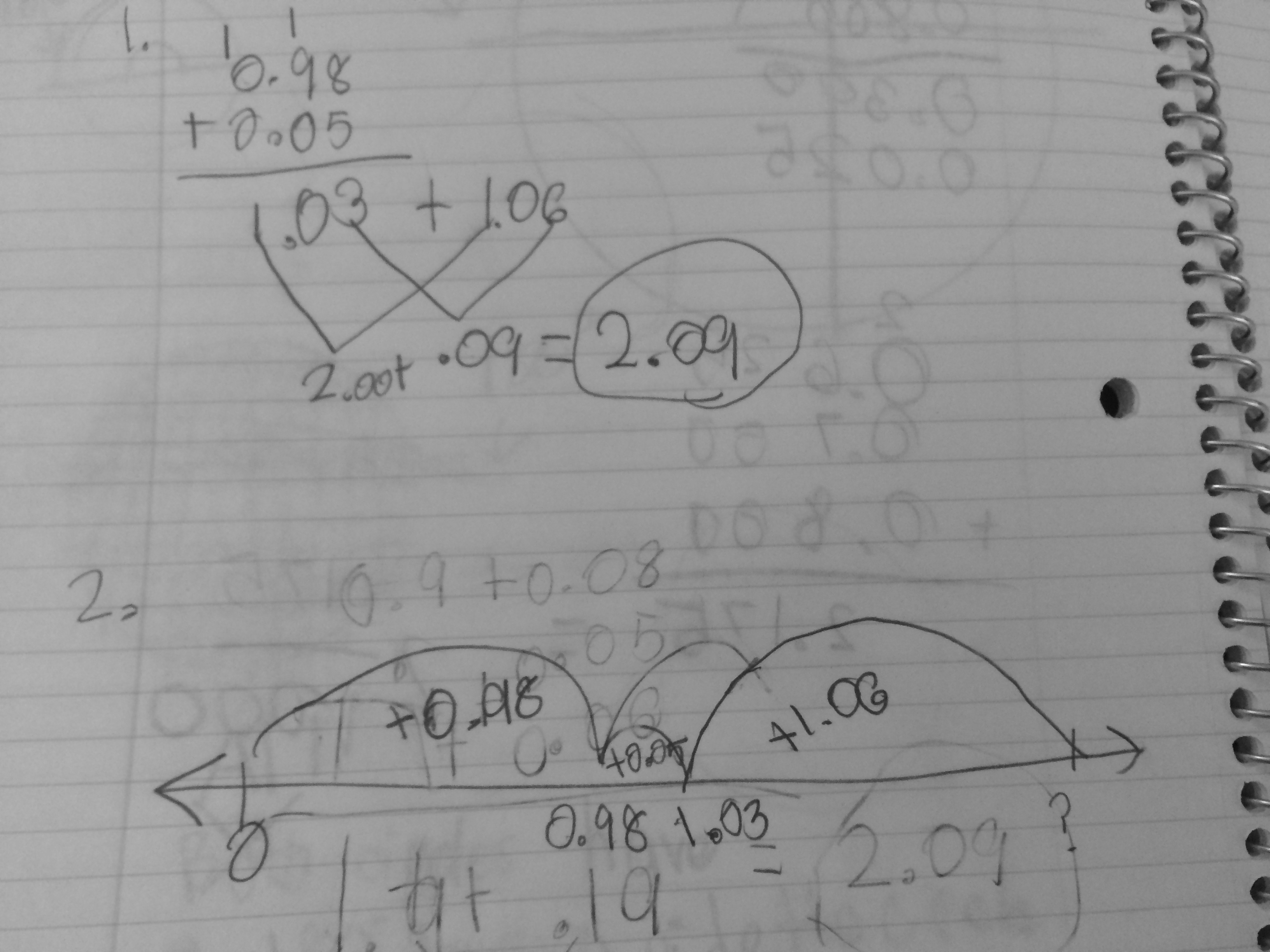
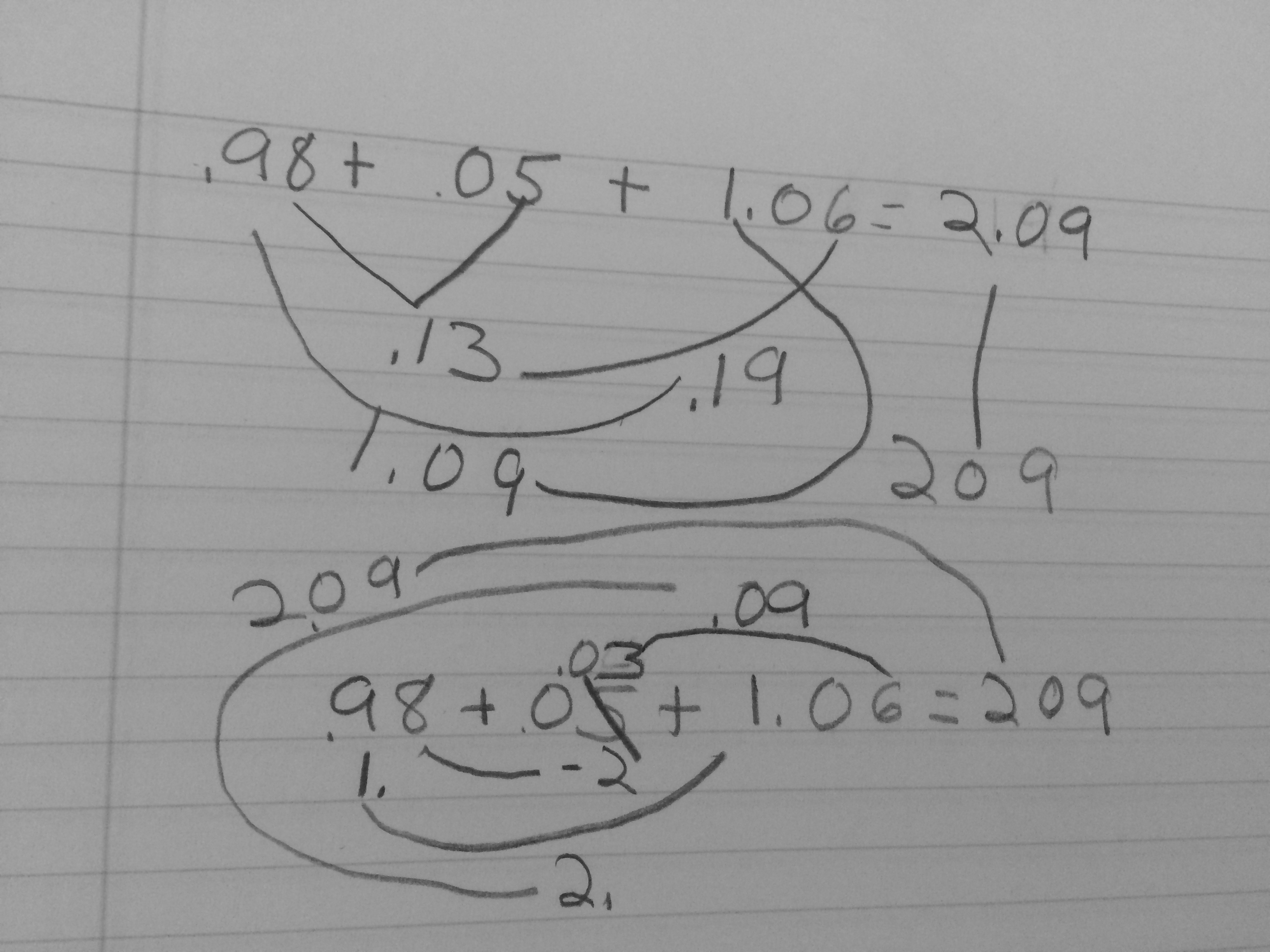
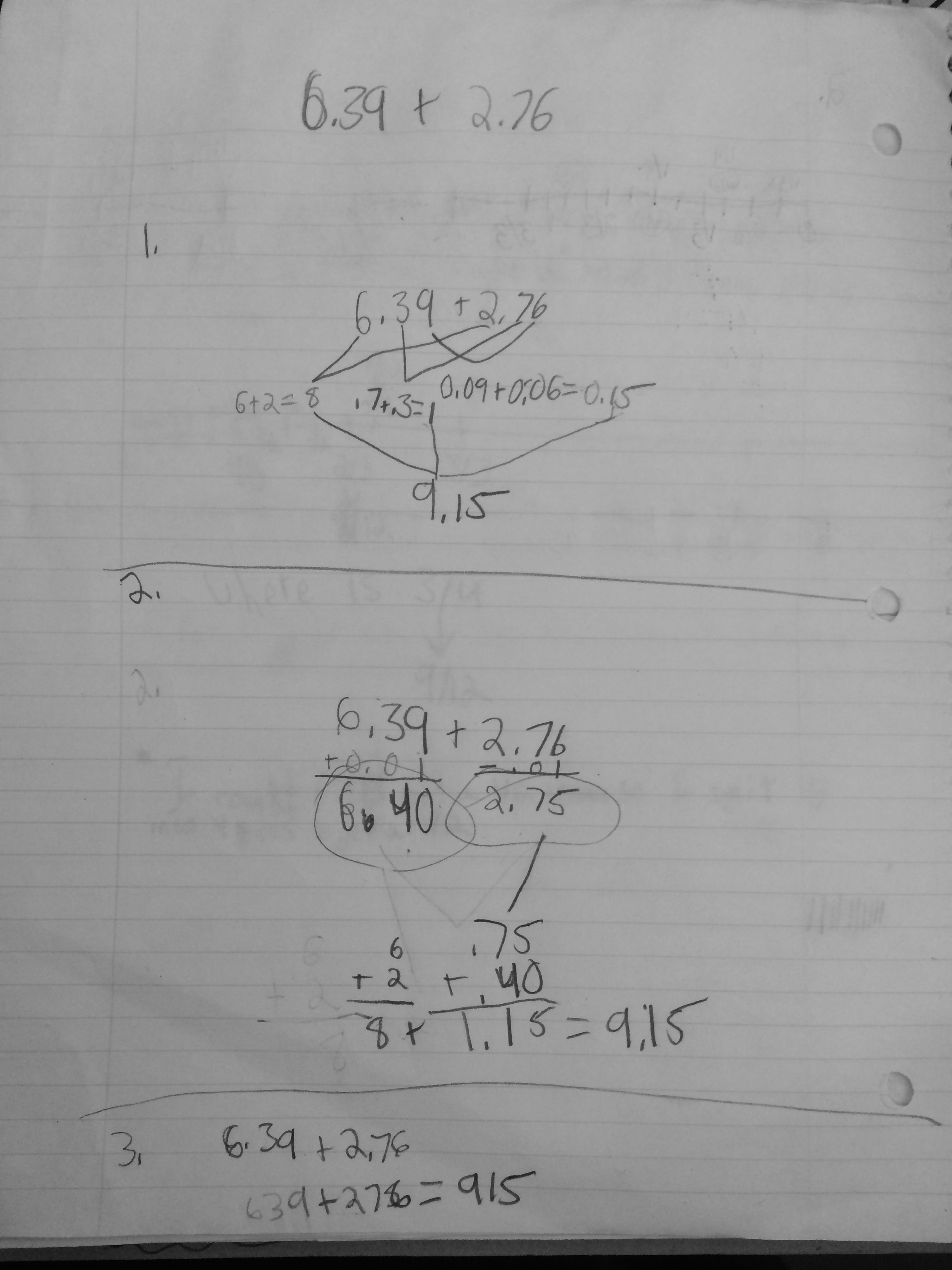
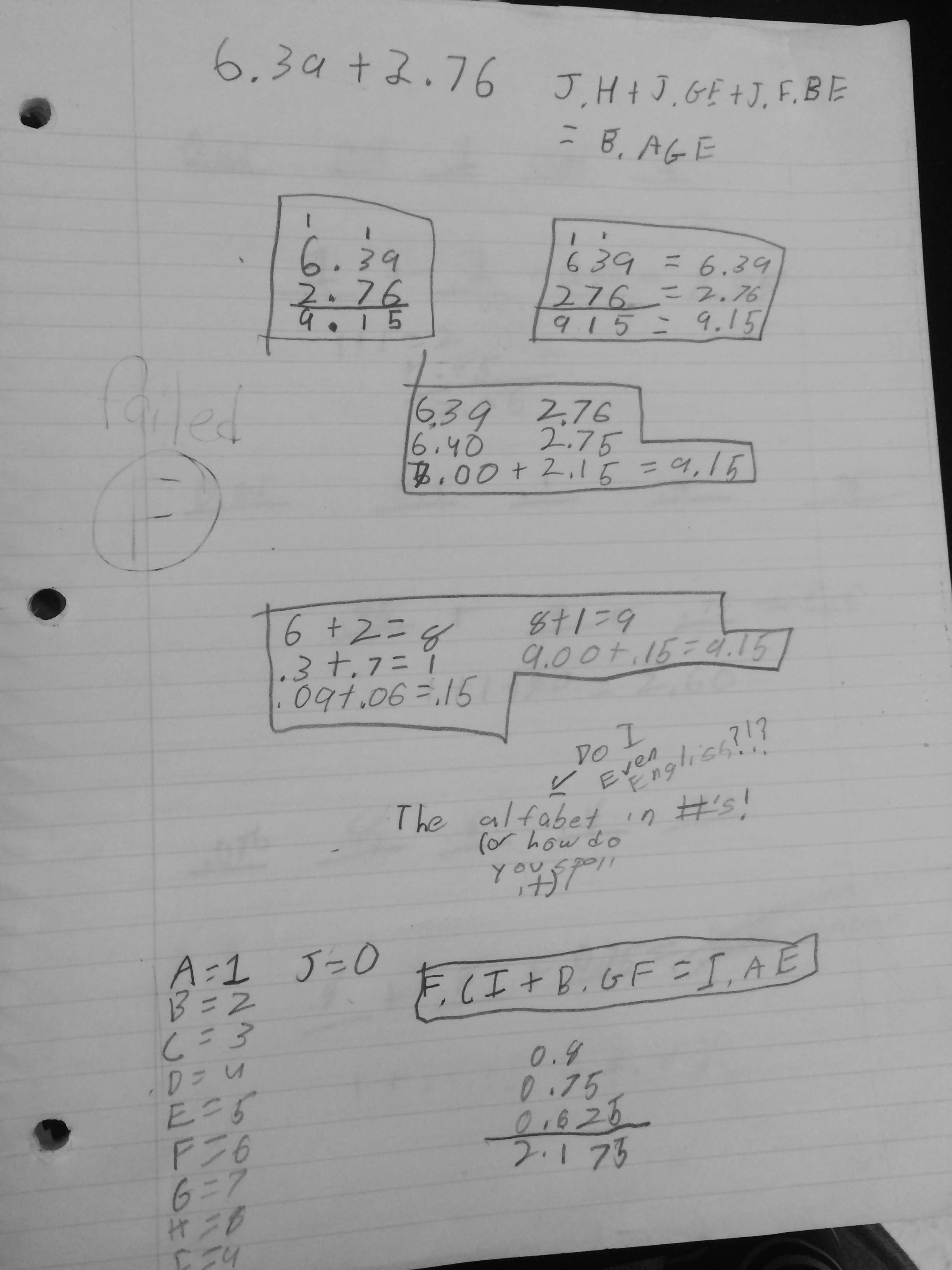
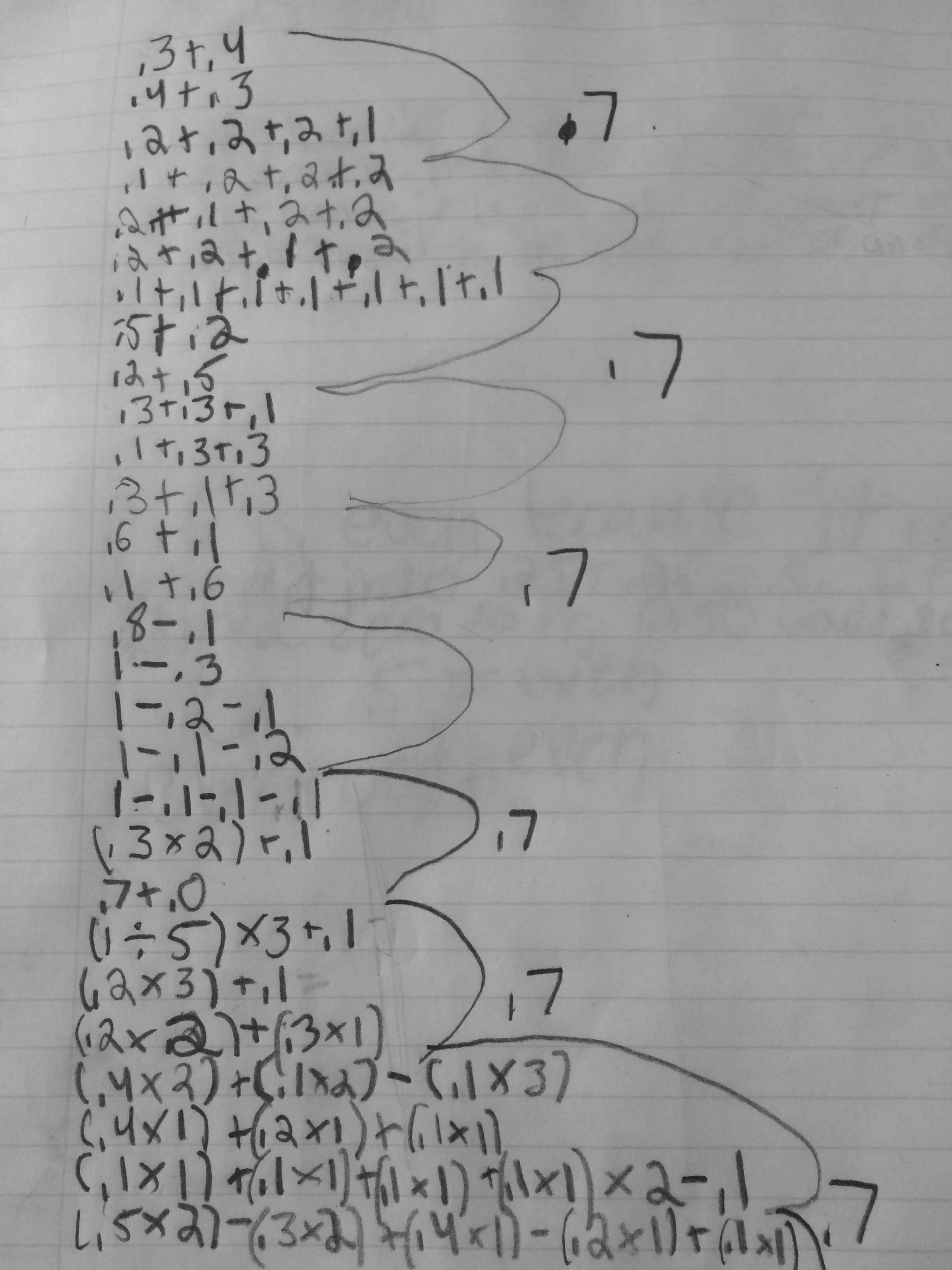
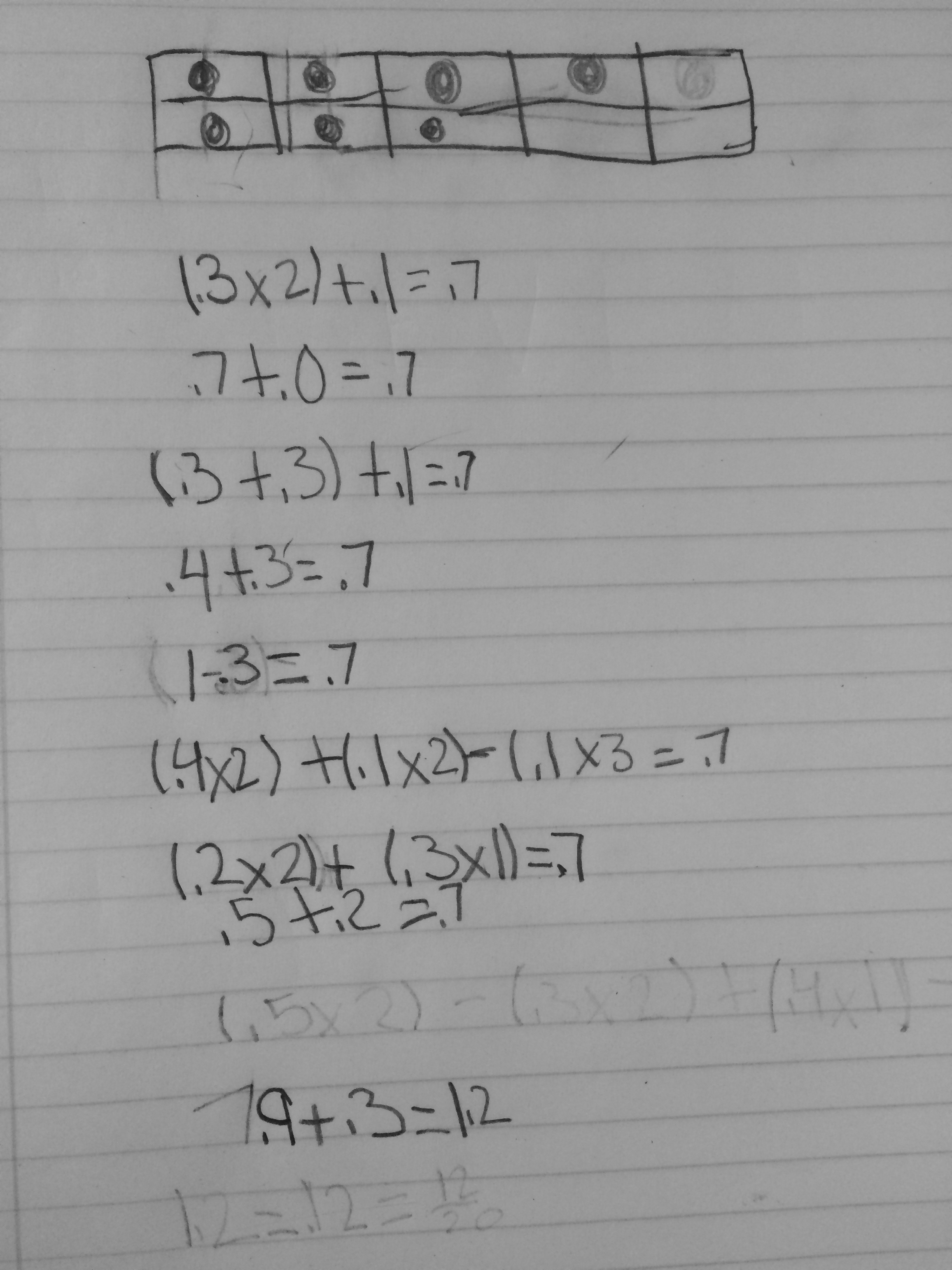
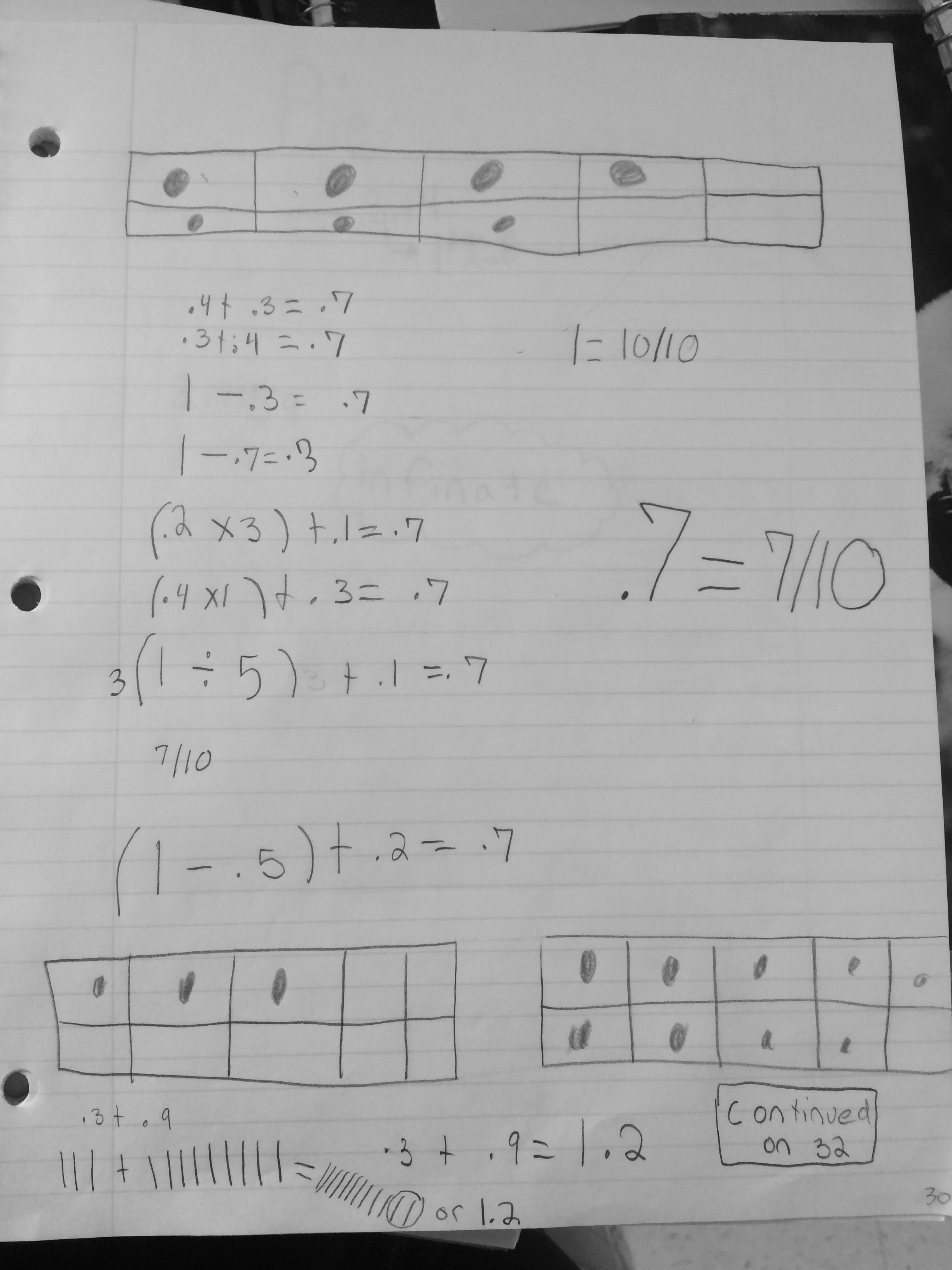
I opened with the same discussion about the ten frame, why we call it a ten frame, and then changed it to a one frame. We discussed the value of each box and were on our way. This year, I really pushed the students more into the equations that matched the frame on the board. We did .9 as a group in a number talk setting with a lot of revoicing and restating to be sure the students could explain how their equations matched the one frame image. I then put up a frame showing 0.7 ( four tenths on the top row and 3 tenths on the bottom row) and sent them to their journals to write some equations by themselves before sharing out. Here are some examples… (Some went crazy:) I think it is so interesting that without any formal work with decimal multiplication, students intuitively can see that any number of groups of some tenths can be written as multiplication.

IMG_9263_2 IMG_9265_2 IMG_9268_2 IMG_9270_2

The one below was so interesting when he said, “.35 x 2” I asked him how that matched the picture and he said, “..since I like symmetry, I took the fourth dot on the top row, split it in half, and put the other half on the bottom row.” I asked the class how that gave him .35 and another student explained that because half of a tenth was 5 hundredth, it became .35 on each row. YES!

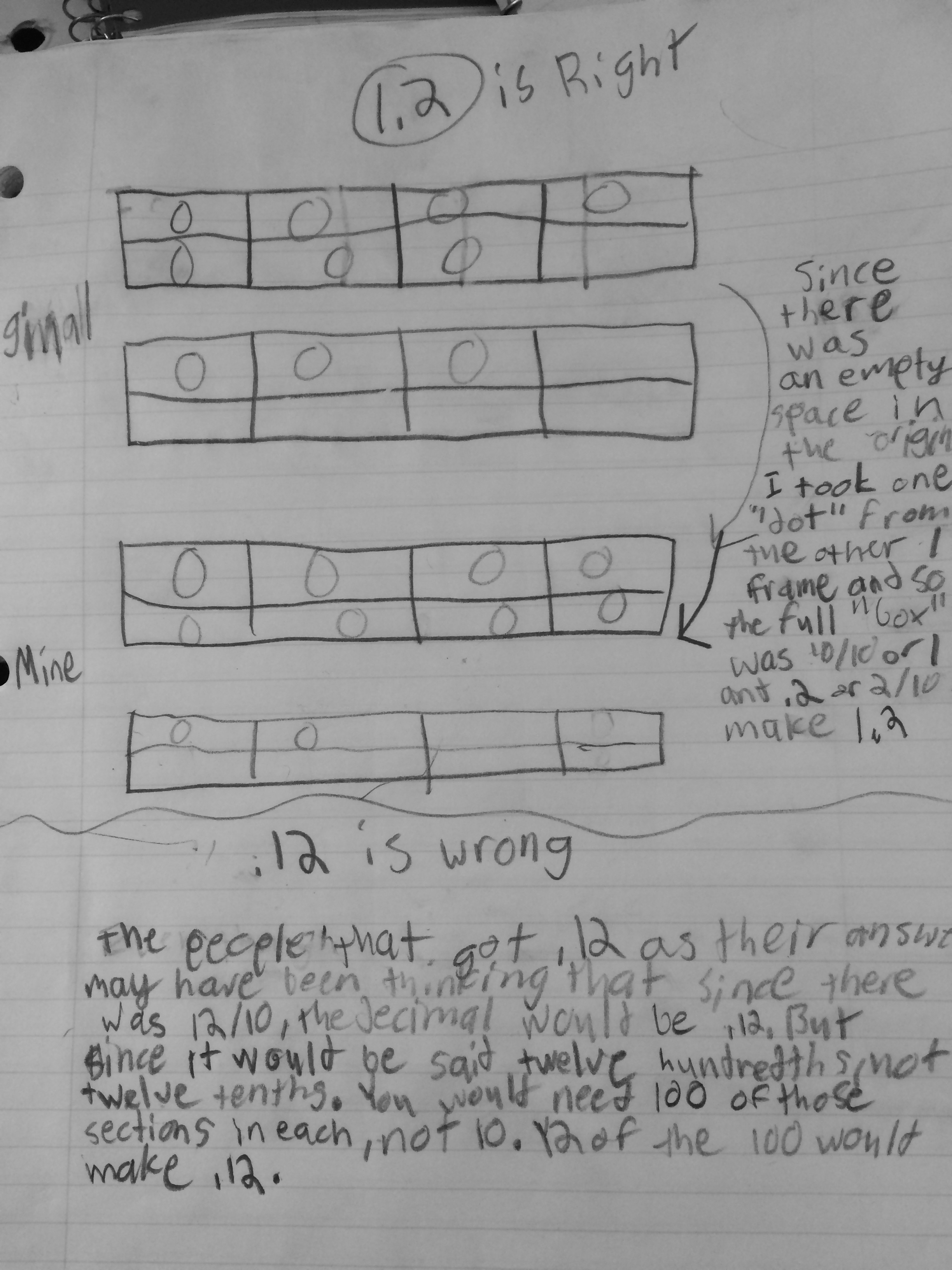
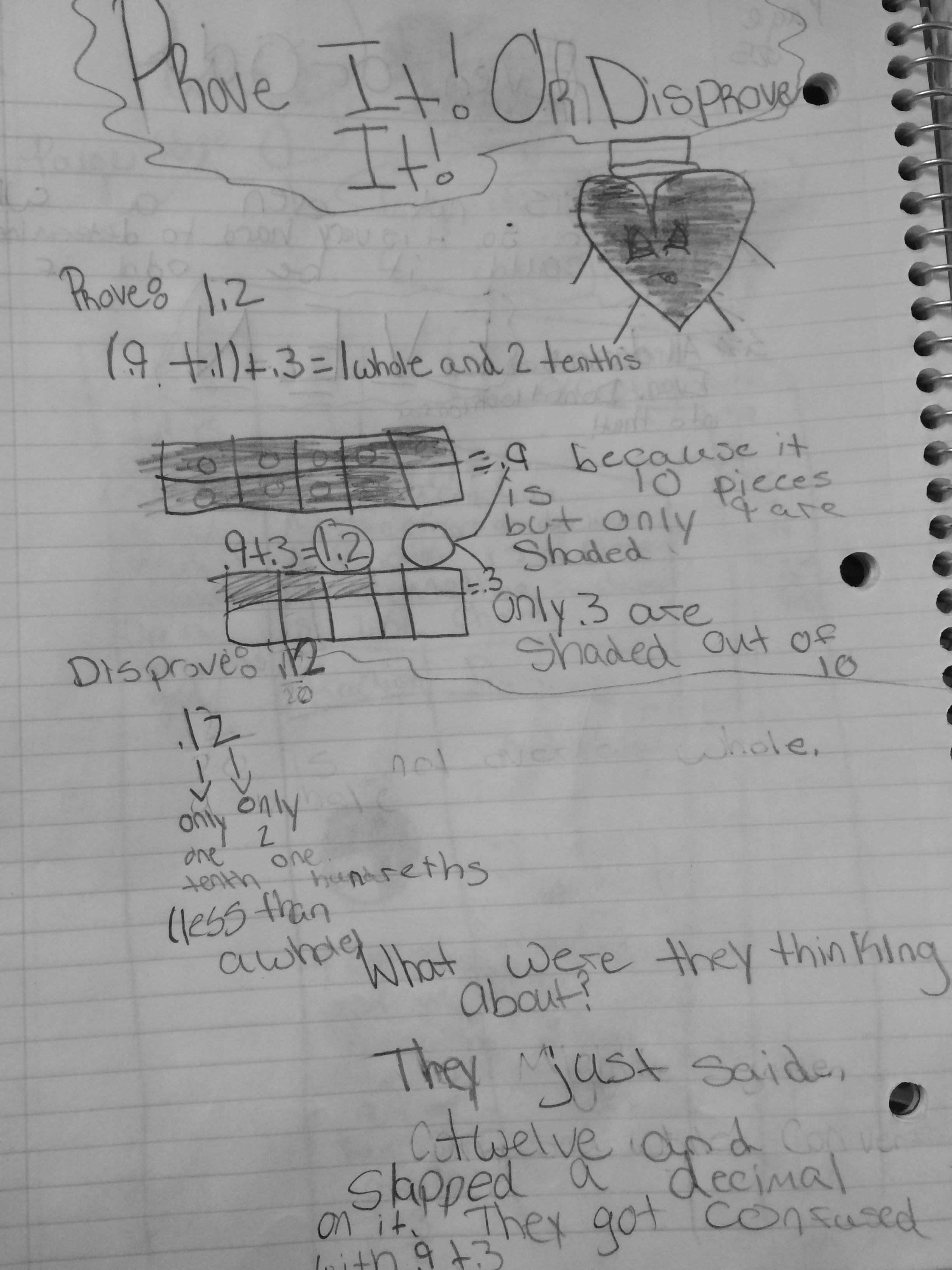
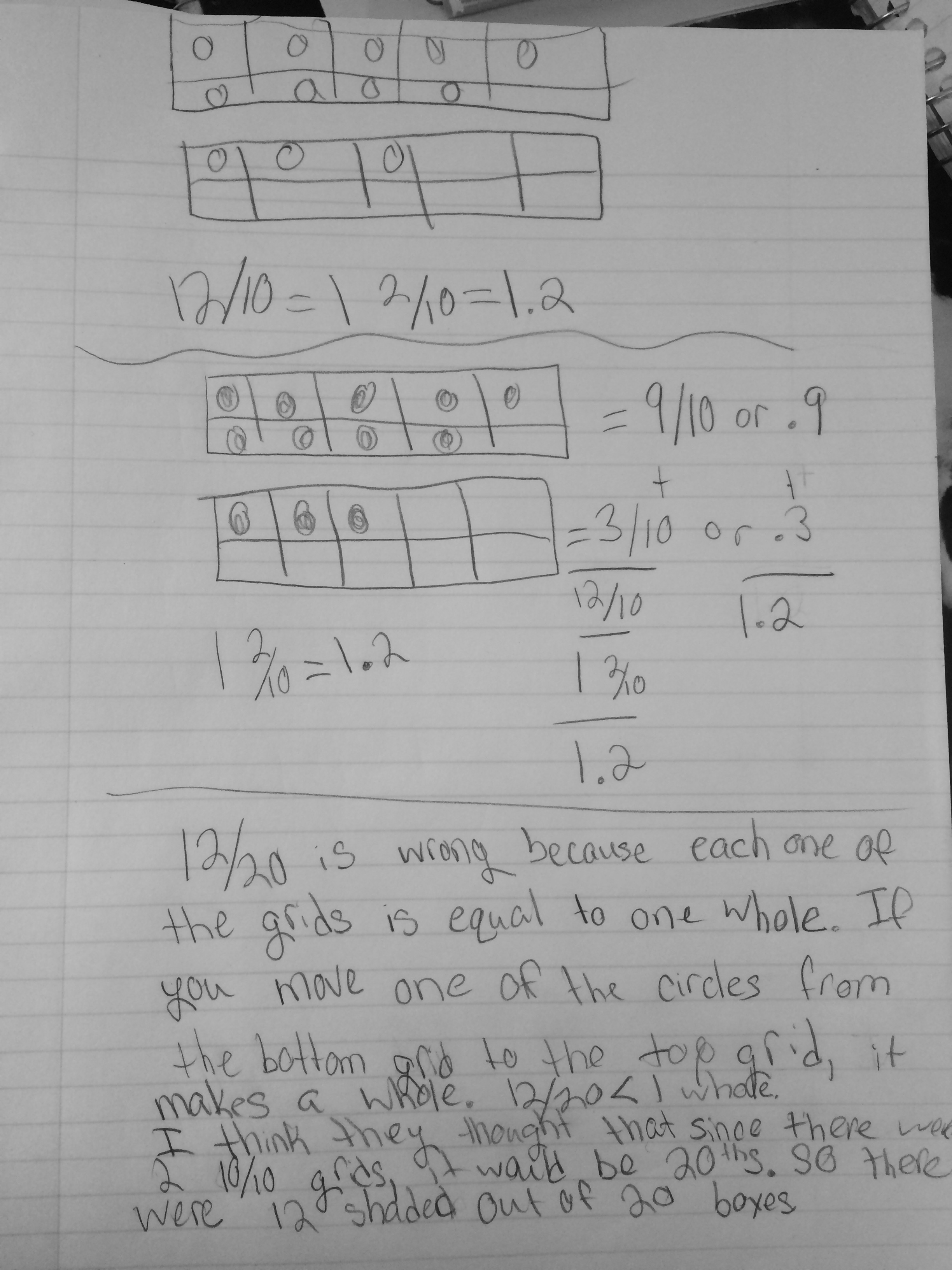
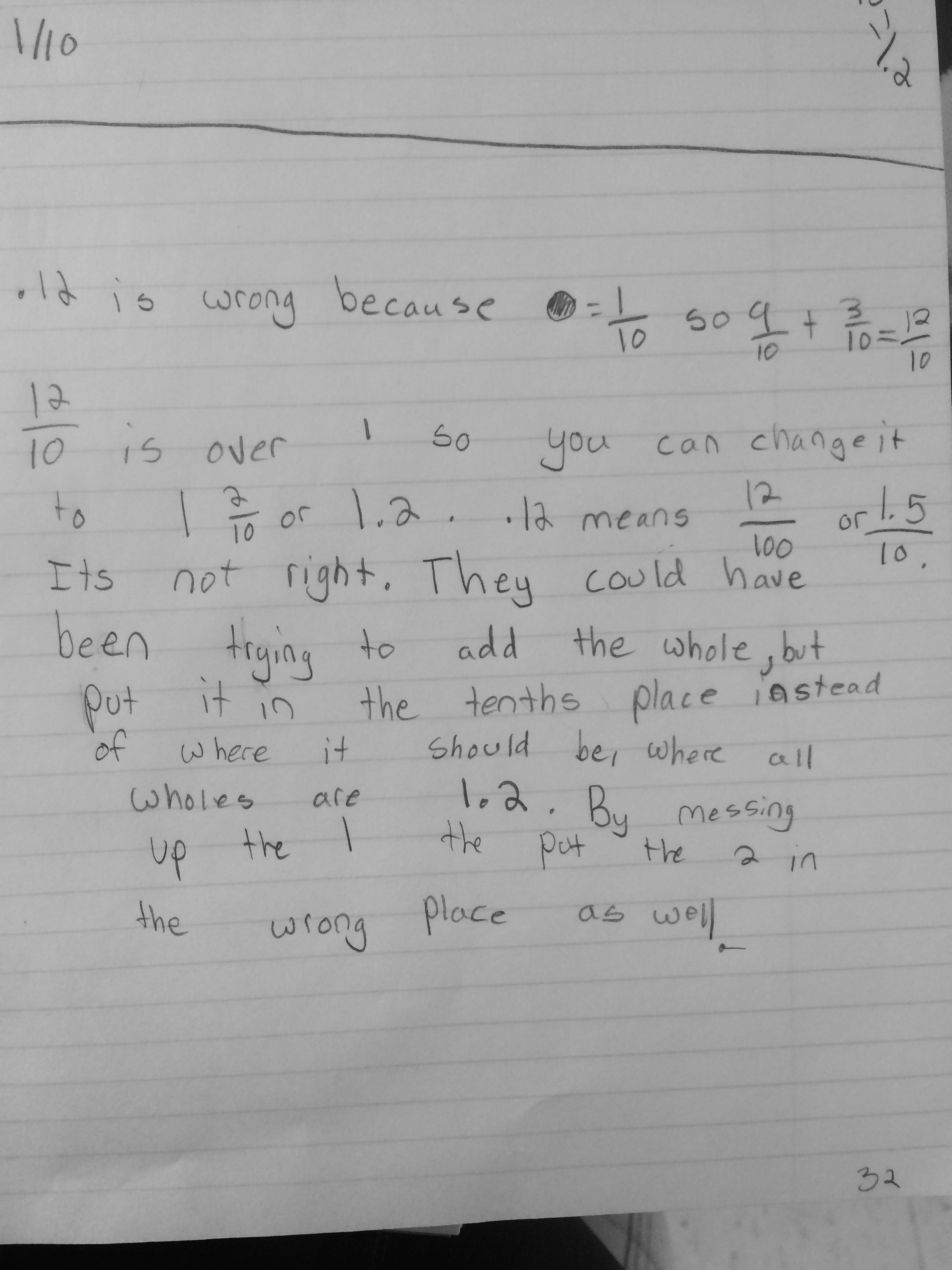
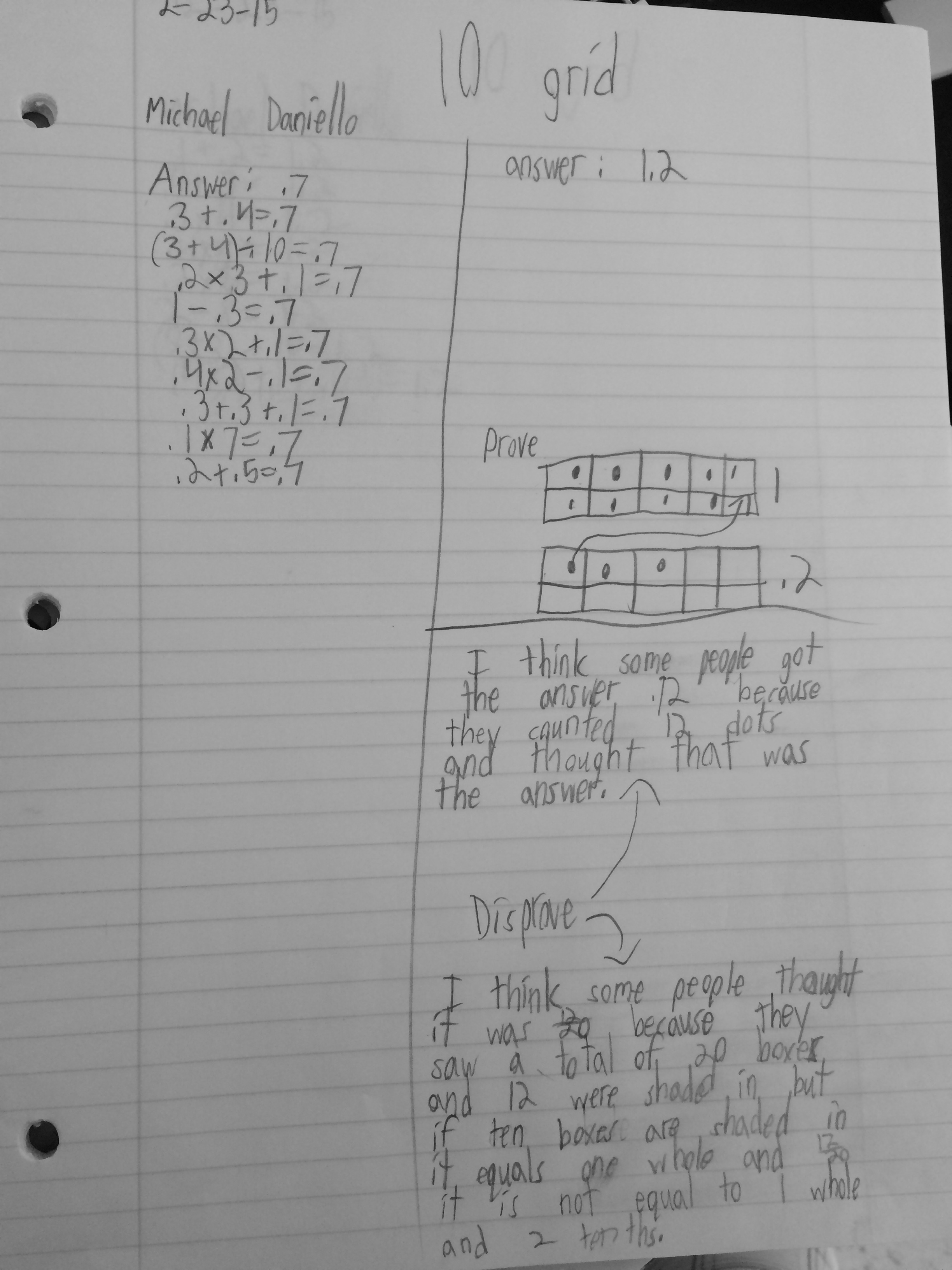
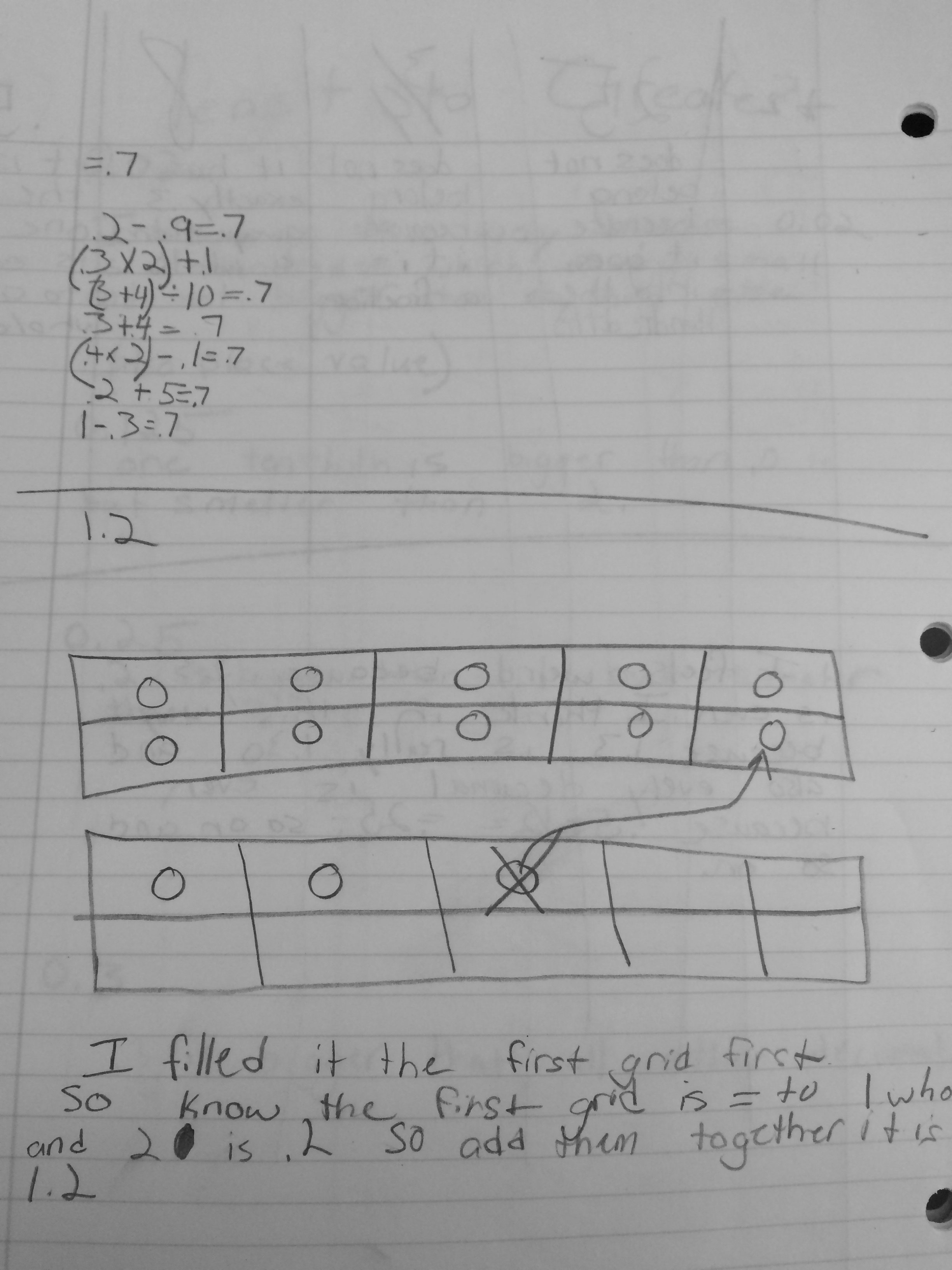
IMG_9275 - Version 2I think put up two frames, one with .9 and the second with .3 and asked students to write down how much was represented in the picture. Like last year, it was a mix of 1.2, 12/20 and .12. I asked students to prove the one they got as their answer and then explain where they think someone got confused with one of the answers they do not agree with. They did a beautiful job with this.

IMG_9264_2 IMG_9266_2 IMG_9269_2 IMG_9271_2 IMG_9276 IMG_9277

It was so nice to kick off our adding decimals with students identifying what the whole it, looking at decomposing numbers, being aware of place value and reasoning about what makes sense. I am SO looking forward to the rest of this work!

-Kristin

Properties of Numbers

Earlier this year, I had a student bring up a great conversation about odd and even numbers: https://mathmindsblog.wordpress.com/2014/11/01/things-i-have-noticed-and-wondered/

After this idea about even/odd rational numbers surfaced, I started having realizations about ideas that we, as teachers, do not ever revisit over the course of a student’s learning journey. Ideas that we could be more exact in, refine, apply constraints, or just simply play around with the idea of developing working definitions for ourselves. Properties of numbers seems to be one of those ideas for me lately.

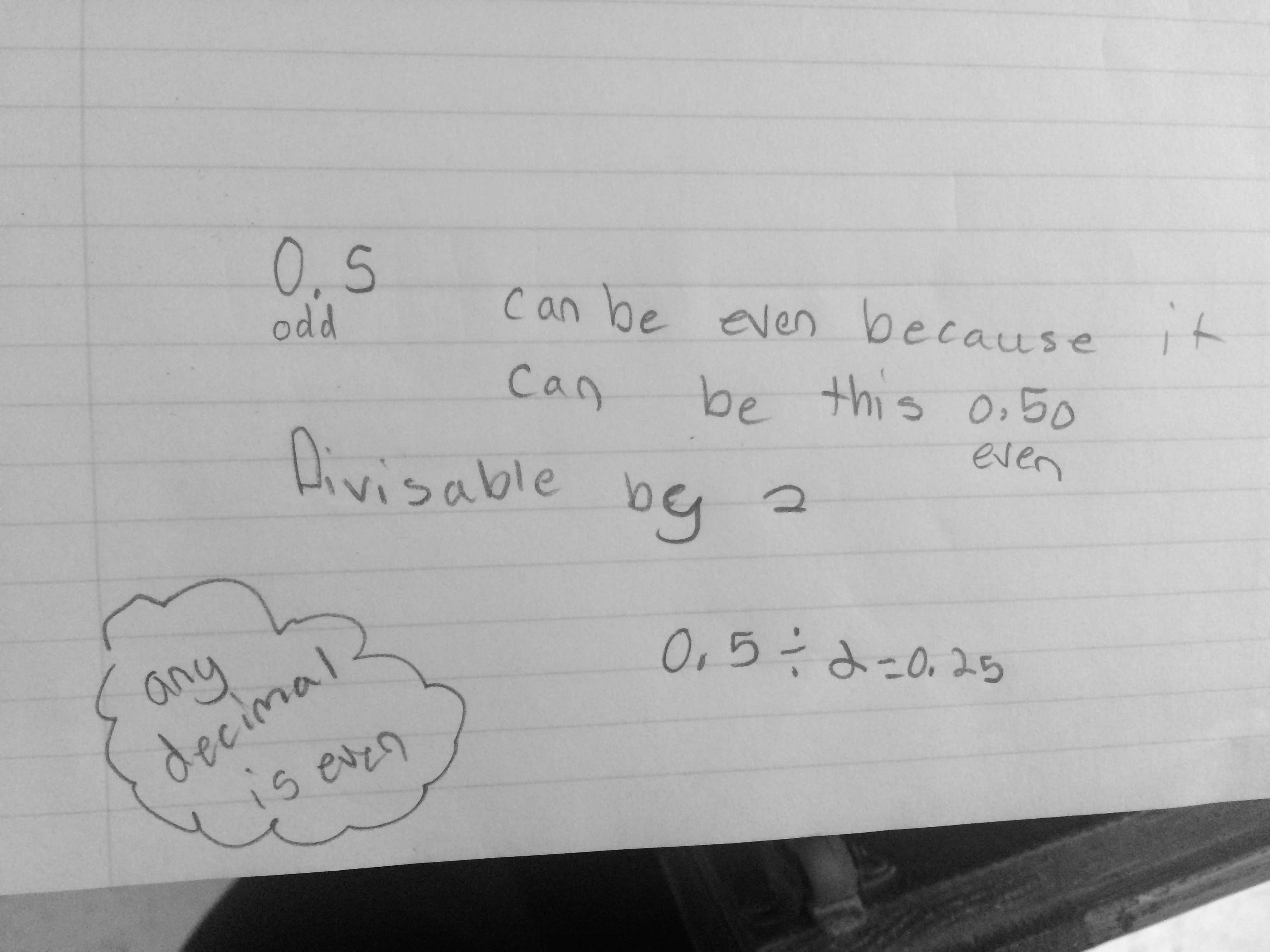
Today I did an opening activity called, Which Doesn’t Belong   and Billy’s idea resurfaced. I put the following numbers on the board and asked students which one they thought didn’t belong and why: 0.25, 3/4, 0.8. 0.5 A lot of great properties of numbers such as square, factor, multiple, even/odd, and equivalencies arose. I recorded all of their answers here, but I dug a little deeper into even/odd numbers. A student said that 0.5 doesn’t belong because it was the only one that was an odd decimal in the tenths place.

I pointed to each number one at a time, and asked for a raise of hands if they thought it was even or odd. When I pointed to 0.25 and 0.5, the overwhelming majority said odd, 3/4 they said it is neither because it is a fraction, and 0.8 was overwhelmingly even. I asked them to tell me how they determine if a number is even? I got the answers I expected, equal groups with no leftovers and looking at the last digit of a number.

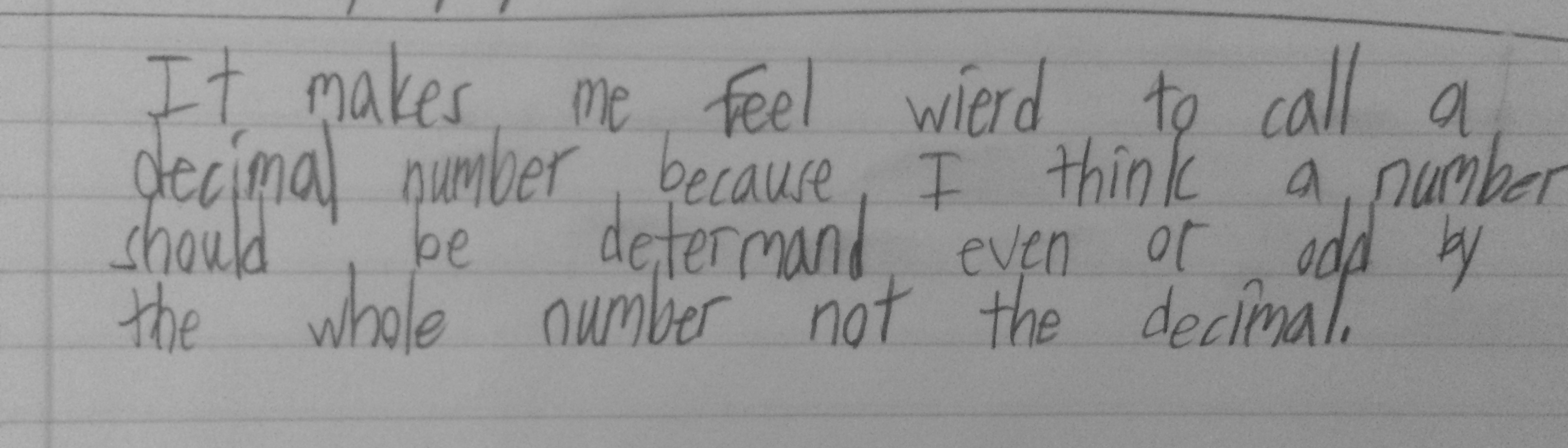
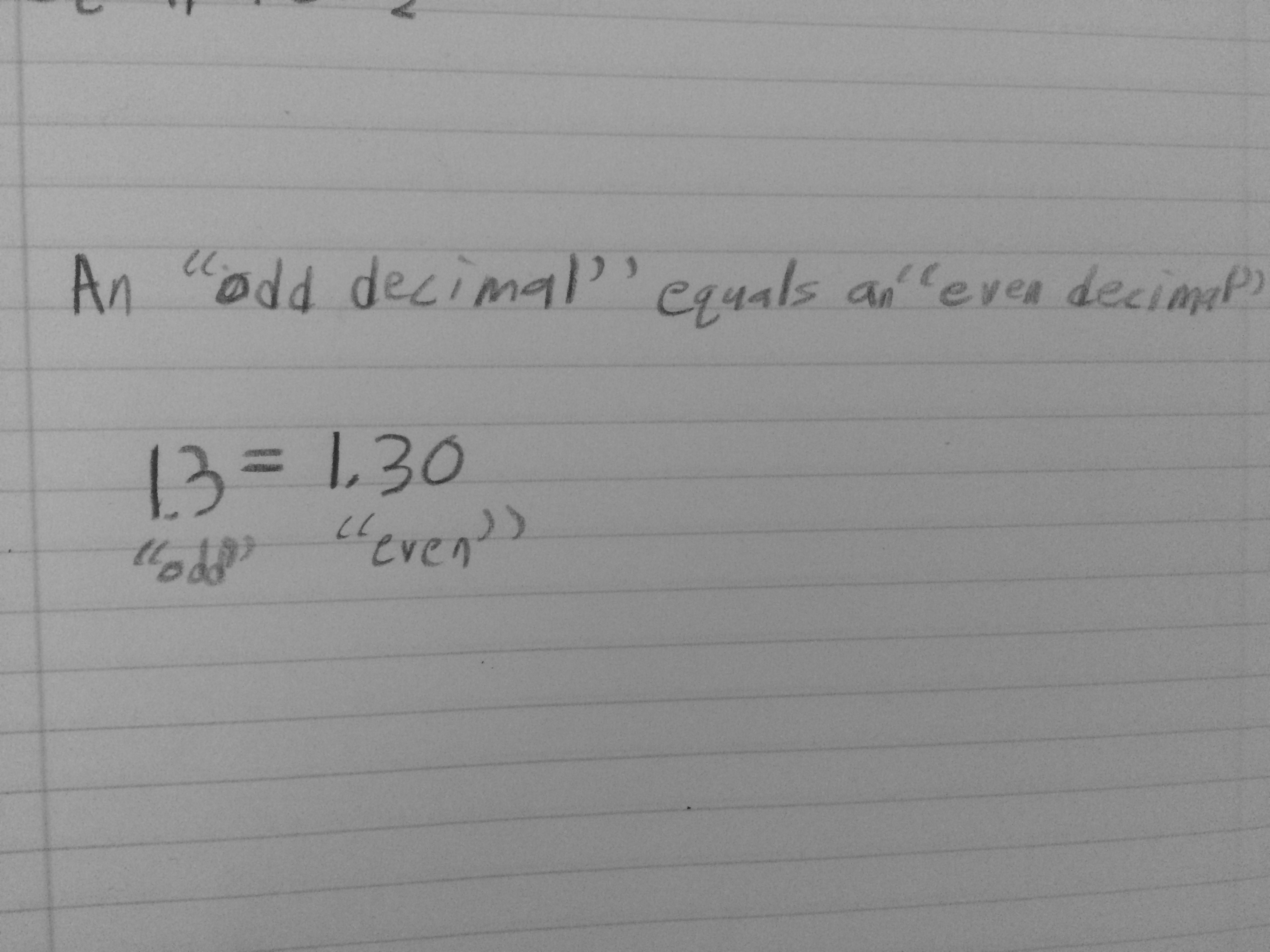
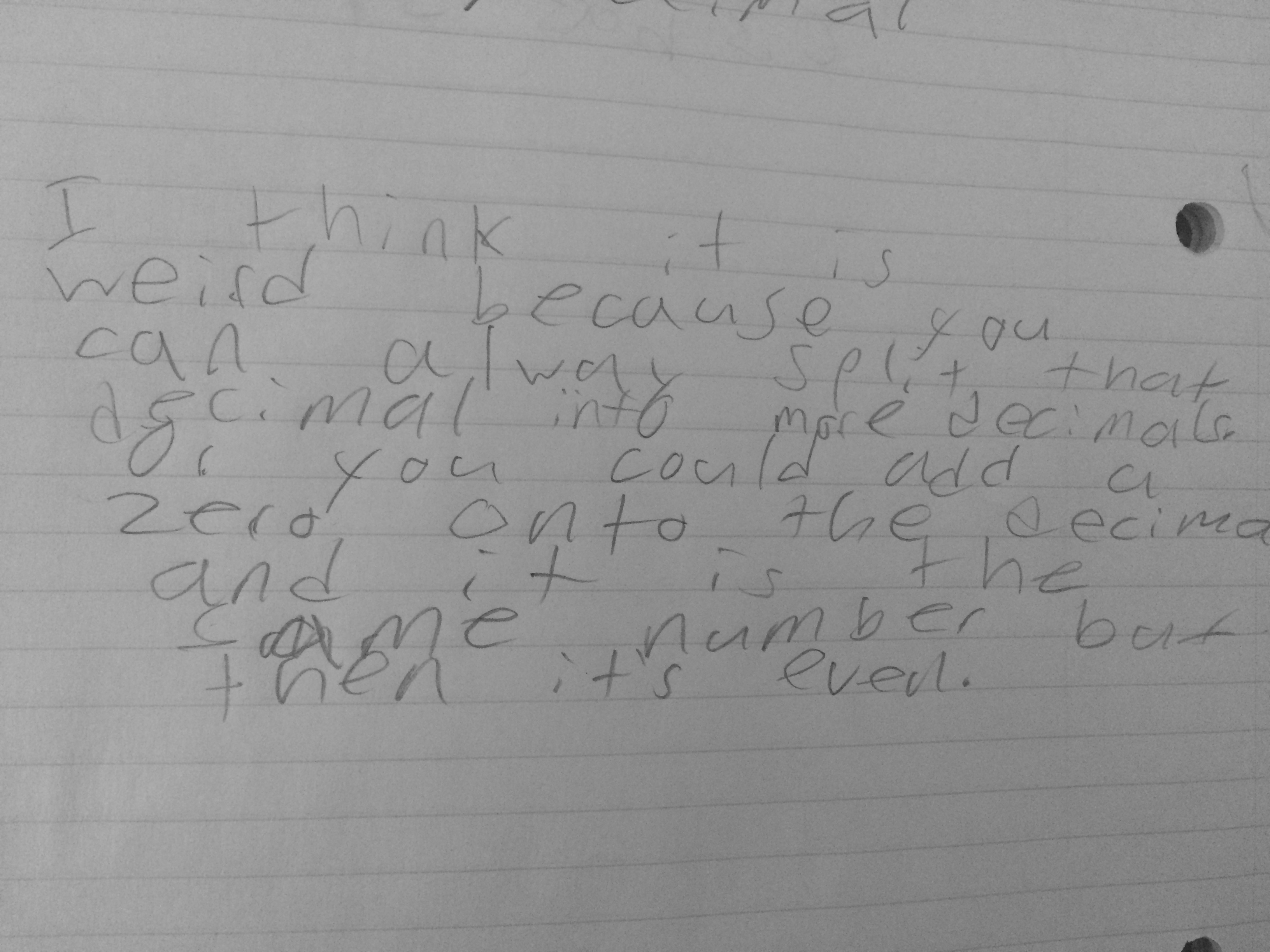
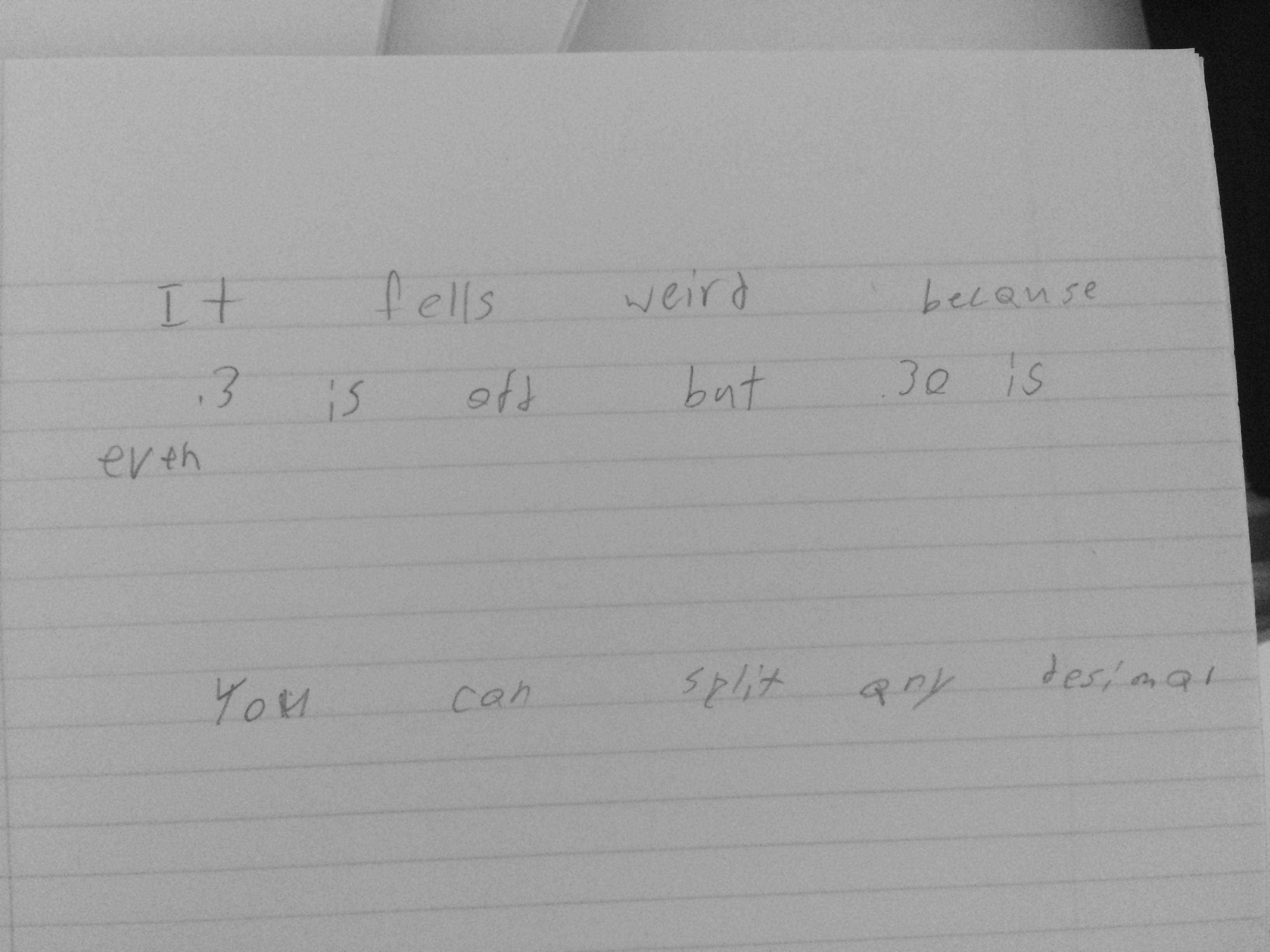
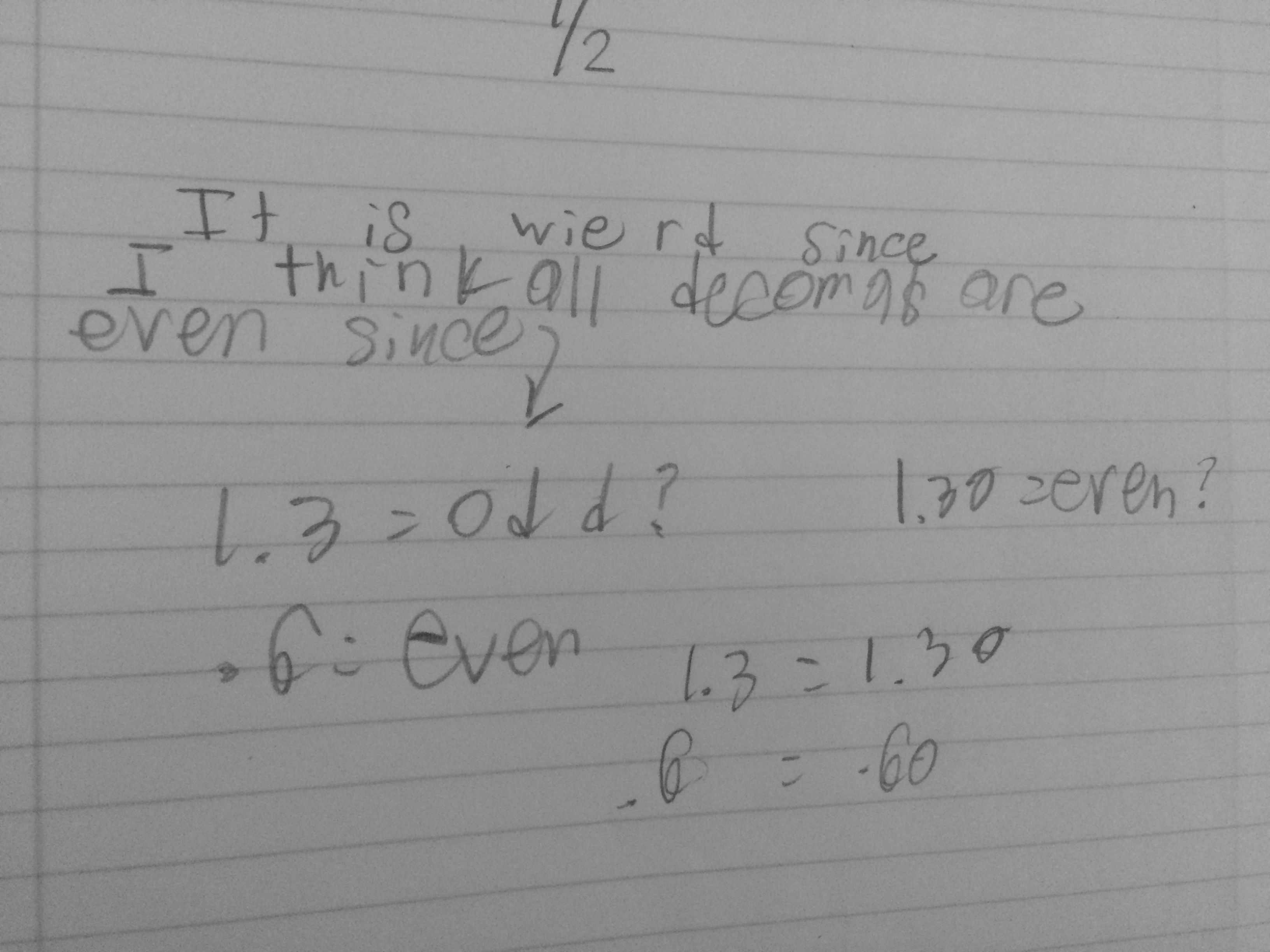
I said, “So thinking about that, let’s look back at the numbers we were just discussing. Talk to your table about your thoughts now.” There were a lot of ooohs and hmmmms, and one student finally said, “Five tenths is just weird.” That statement got a lot of nods and uh huhs, but before we shared out, I wanted to get everyone’s quick initial thought on why it felt weird to call five tenths odd now since it was overwhelmingly odd at the beginning. Here are their thoughts…

IMG_9143_2IMG_9147IMG_9146IMG_9145IMG_9144IMG_9148We shared out and one student said he is going to “make a claim that all decimal numbers are even.” I loved that moment a lot! These are the working definitions that I feel are fun for students to explore. In the end, they wanted some closure and I felt they had done their due diligence, so we looked up the definition of an odd number. We talked about what an integer is and everyone felt a nice resolve to the “weirdness.”

This is something I am really interested in right now and wondering what other properties of numbers we talk about in the younger grades that don’t often explicitly resurface. Properties that apply to integers but not to rationals or even change a bit when dealing with rationals. I feel we always build on concepts as the students go through school, but do we look closely at the definitions we use and assume students don’t have more curiosities about them?

Of course I couldn’t let them leave without something to think about, so I asked them to tell me what they knew about square numbers and we listed a bunch on the board. I then put a decimal in front of each one and asked if we still called them square numbers? A few started throwing out their thoughts, but it was time to go, so more to come on that later…To Be Continued.

-Kristin

Visual Patterns Fun!

Each day, I start class with a math routine. Whether it is a Number Talk string, If I Know Then I Know, Closest Estimate or Quick Image, those first 10-15 minutes are always my favorite math conversations of the day! Today I added Fawn’s (@fawnnguyen) Visual Patterns into the mix.  I spend a lot of class time having students look for patterns and regularity in their math work, but this visual brought a wonderfully different “feel” to their work. As Fawn had previously blogged, the Visual Patterns have an entry level for everyone and every student in my classroom engaged immediately with the images.

I chose this one to kick off our work today:

vp1 I asked the students to work as a group to find the number of unit for Steps 1 – 6, 13, 43, and then n. Being their first time, we had to deal with what the “n” meant and after the initial “Is this algebra?” followed by numerous stories of siblings who are doing this math with letters, they were on their way. It was interesting to see some students go straight to drawing each image, others started looking for what was changing as the steps progressed, and then there were the students who love going straight for an expression for finding 13 and 43. After they all had the table completed, we came together to fill it in. I was so impressed with their work and their ability to find the expression for the nth shape, however the BEST part of the conversation was taking that expression and connecting it back to the images. Why was n doubling? Why is that 1 being subtracted?

I love how this student used a specific example to connect his expression (or almost an expression, we’ll get there:)

Photo Jan 26, 9 29 51 AM

This student found the equation and decided to use “a” to stand for “answer.” I loved how she then tested it with other numbers. Photo Jan 26, 9 31 39 AM


These two students then put a different spin our our work. Every group in the room came to the expression n x 2 -1, and as one student was explaining how the 1 needed to be subtracted because it was being double counted, another student exclaimed that his group figured out that if you just split that block in half and made each said a mixed number you just had to multiply that by 2. For example on step 4, if you made each side 3 1/2 x 2, you would arrive at the same answer. How awesome!

Photo Jan 26, 9 31 49 AMPhoto Jan 26, 9 31 23 AMI am excited to make this a part of my daily math routines, thanks Fawn for sharing, awesome stuff! I had students asking for another one before they left class that day, they loved it!

-Kristin

Geometry Is Worth The Extra Time…

As I am sure many teachers can attest, there is a constant struggle each year between covering content and the precious amount of time we have to engage the students in learning. Prior to the past two years in the classroom, this guilt always seemed to creep up most during our geometry units. I used to feel that once the students could find area, perimeter, and volume, we would move back into our fraction and decimal work because that always took SO much time to develop a deep, foundational understanding. While geometric representations such as an area model support the fraction and decimal work, it is still not the 2D or 3D unit work.  Right or wrong, I felt I had to prioritize to make use of the little time I had for the best of my students. Over the past two years, however, my geometry units have been taking longer and longer because I have started to see things evolve in my geometry units that has me  wanting to kick myself and go back in time to give my past students a different learning experience. From the connections to number and operations to the development of proofs and generalizations have been eye-opening.

As all of these math connections were going through my head, I see this tweet from Malke (@mathinyourfeet)…

mrahhh, it felt like validation in some weird way.

After this Twitter conversation, I started to dig back into my students work to find examples that makes these connections visible.

After doing a dot image as our Number Talk one day, I asked students to see if they saw any connections between the image and our volume work that day. This work shows how students see the commutative property in both, multiplication as groups (like layers in volume) and most importantly puts a visual to how multiplication and its properties “look” in both 2D and 3D.

IMG_7754IMG_7755IMG_7763IMG_7765IMG_7764Then volume led into some great generalizations about how multiplication “works” through looking at patterns, which is extremely important in mathematics in and of itself.  In keeping constant volume (product), students realized they could double one dimension (factor) and half the other. In doubling the volume (product), the students realized they double one dimension (factor) and leave the others the same. T

IMG_7795_2IMG_7797This volume discoveries later let to this claim on our claim wall:

IMG_8148The students extended this area and volume work to fractions/decimals that showed that fractions/decimals act as numbers in operations as well, supporting the structure of our number system.

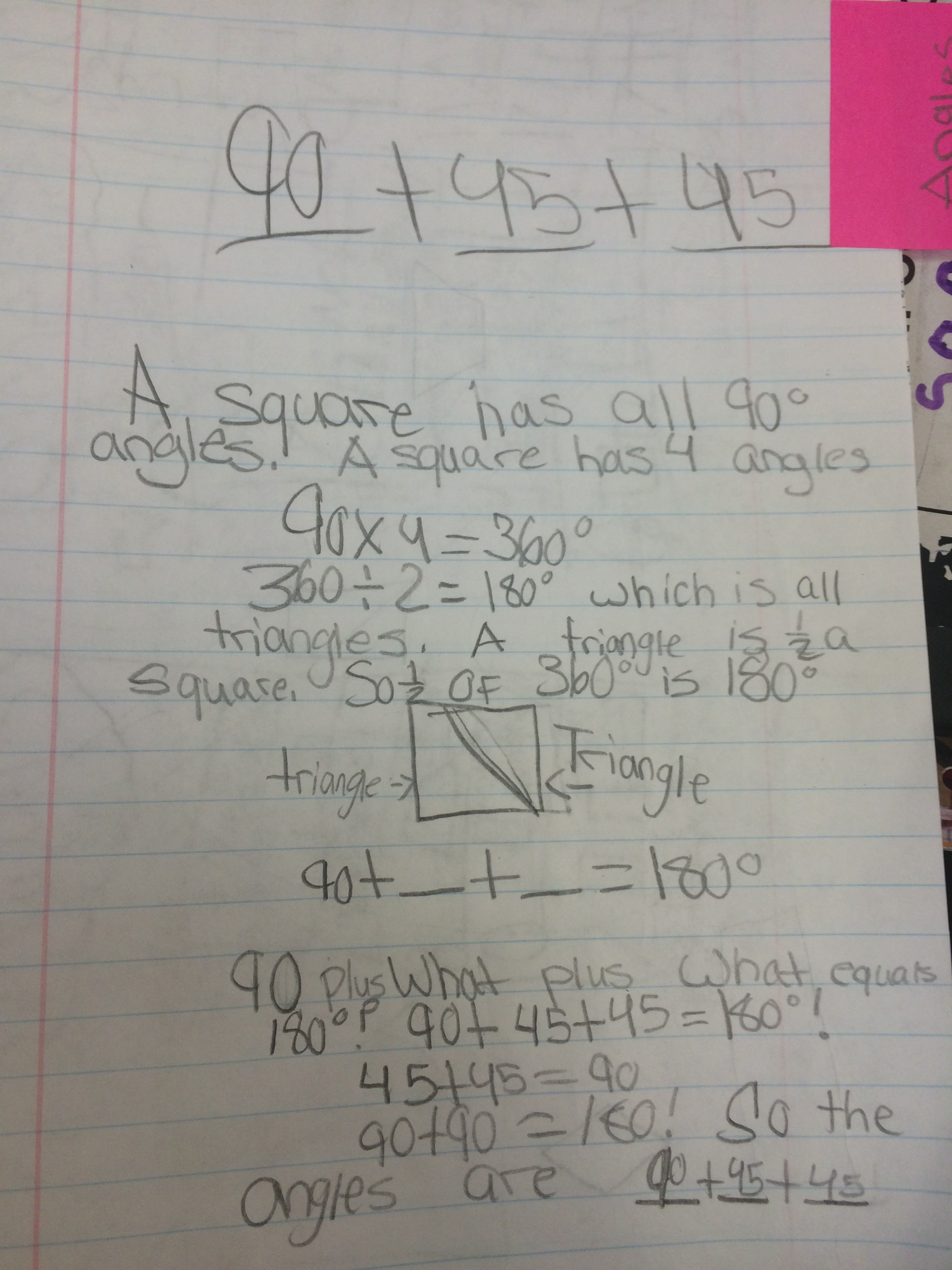
IMG_7632IMG_7980While we classified polygons, I saw my students develop proofs for angle measures and our always, sometimes, never experience was invaluable. This work in connecting reasonings through visuals of the polygons explicitly supports the Mathematical Practices of using models, perseverance, and repeated reasoning.

IMG_8280_2IMG_8283_2IMG_8423Then our work with perimeter and area solidified the importance of students creating a visual in building number is so important. In a problem with equal perimeter and different area (moving into greatest area), students created a beautiful visual for the commutative property as well as supported students in seeing the closer two numbers (with the same sum), the greater the product.

IMG_8854IMG_8866IMG_8867-Kristin


Kindergarten Dot Image Number Talk

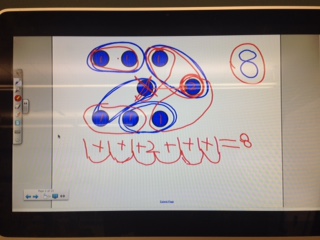
IMG_3455My friend Jenn (@jennleachteach), a Kindergarten teacher in my building, sent me this picture from her number talk yesterday with her students. I could see how the students counted by ones and some by twos by her circling, but I was confused by “x” through the middle dot so I asked her to explain it to me today and I had to share…

The blue circles are by the student who counted them all by 2s, which is clear, however the red circles and numbers are by another student who blew our minds a bit….. The student came to the board, circled the top two left dots, the third top and middle right dot, re-circled the middle right dot with the bottom right, and then the two bottom left dots. If that was hard to follow, the odd part was he didn’t use the middle dot and said that he just “moved it over” in his head.  When asked to explain further, he labeled the dots by number and wrote the equation. He put a one in each to show that it made two in each circle and the put a “2” in the right dot because he had moved the middle dot on top of it and double counted it as two.

I love when she shares her Kindergarten class number talks with me, so MUCH FUN!

-Kristin

Developing Claims – Rectangles With Equal Perimeters

Yesterday’s math lesson launched based on this student activity book page in Investigations…

IMG_8861

Students read the introduction and I first asked them, “If we were to build these in Minecraft, was feet an appropriate unit of measure?”  Some thought that feet seemed too small for a garden and instead wanted to use yards, that was, until one student schooled us all on Minecraft. Come to find out, Minecraft uses the metric system with each block representing one cubic meter. We then changed the unit to meters and were on our way.

I gave them 10 minutes, either with a partner or individually, to build as many different rectangular garden designs as they could with 30 meters of fencing. As I walked around, it was interesting to see how students were designing their gardens. Some started building random dimensions and adding/subtracting fence links to eventually hit 30 while others had thought of one rectangle to start and adjusted from there by subtracting/adding from sides. It was fun to see the ones that discovered a pattern in their building and sped through the rest of the rectangles. Some beautiful patterns emerged….

IMG_8854Photo Jan 14, 1 23 24 PM

Photo Jan 14, 1 22 35 PMAfter 10 minutes, I asked them fill in the table on their activity page and chat with their table to see if anyone had any dimensions they didn’t have. As a table, they came up with some noticings based on their table, Minecraft builds, and process of building.

IMG_8862 IMG_8863 IMG_8865 IMG_8866 IMG_8867 IMG_8868 IMG_8869 IMG_8870 IMG_8871 IMG_8872 IMG_8873The class ended after this group work. Talking with another colleague about the lesson at the end of the day, we chatted about what claims could come out of this lesson. It was so interesting to me to think about not only the geometric claims, in terms of rectangles and dimensions, but also the numeric claims that can evolve from these conversations as well. And to think that these number claims are grounded in a visual connection is pretty awesome to me!

I was so I started today by pairing up every two tables to share with one another. One table read their noticings while the job of the other table was to ask clarifying questions. That gave me time to circulate, listen, and choose the claims for our class share out. After the table shares, we reconvened as a whole class and chatted about a few of the claims as a group.

IMG_8853I asked them to think about similarities and if we could combine some of them to form one claim based on our work.

Class ended with a journal entry in which they worked independently to begin to form a claim or the beginnings of one. Here is where I will start tomorrow…

IMG_8855 IMG_8856 IMG_8857 IMG_8858 IMG_8859 How fun!

As a follow up on this post, this is the assessment on their work with perimeter and area. During the class period, only one student started working on finding the square that would give them the largest area with a perimeter of 30. After this idea came out in our class discussion, using fractional dimensions was something that others were thinking about during the assessment.  Here is a student’s (different than the initial student) work that I thought was pretty fantastic:

Photo Jan 16, 11 51 34 AM

-Kristin


Math Class Through My Students’ Eyes…

Each January, I like to ask the students to do a reflection on the first half of the year…things they liked, didn’t like, things they still want to learn, questions they have, etc…

Some students gave me a list of things they have learned by topic, others suggested that their seat be moved because they think they would work much better with their best friends, while some offered the suggestion of doing a “math project” that they work on over the course of a month or two (like their science fair project). I do like this last idea and looking into some type of ideas for this:)

I could really post all of them, because I just think my students are the coolest, most honest people I know, but for the sake of time, I chose two to reflect on tonight because I think it says a lot about what I hope students leave my class thinking about each year….

IMG_8800_2 This is exactly why I started the Class Claim wall! I SO love that this student enjoys proving why things work, and even better that she started the sentence with the word “Actually,” like it was not expected! I also think it is so awesome that she said multiplied fractions before she even realized she was multiplying fractions! It makes me feel so good about all of the planning and work for the cornbread task which launched this unit.

IMG_8804_2 - Version 2This one just made me chuckle at the subtrahend and minuend talk. That came out of a number talk one day when they were calling them the “one you’re taking away from” and the “one you are taking away” and wanted an easier, less wordy way to say it (don’t know if those words are, but stuck for this student). It did make me reflect on my work with Virginia Bastable this summer when she said (I am putting quotation marks, but this is not verbatim),  “Vocabulary should be a gift for the students in their explanations, developed out of need.”

The second part was just too funny and completely what I do to these poor kiddos all of the time! He has learned that when he has a finding or “idea,” I don’t just give him an answer, but instead send him back to think about it and see if they can figure out why that is happening. Then with another idea, the same process ensues…but at least, “it is not as hard as it seems.”

This is exactly what I want, curious students who work to explore their ideas and strategies and learn the processes of “doing math” without knowing there are procedures in place to do exactly what they are doing. I want them to see the “hard” math work they do as fun and an invaluable part of their learning.

They would probably be very surprised to find out that they make me do all of these same things before, during and after each lesson….

-Kristin
 

Number Routine PD: What Do I Know About…

My colleague Nancy and I facilitated a K-2 afternoon professional development session yesterday afternoon. The 2.5 hour session was with a wonderful group of teachers from across our state who we are fortunate to work with several times over the course of the school year. Our major focus over the course of this school year centers around connecting arithmetic to algebra based on a book by Virginia Bastable, et al, that I blogged about here: https://mathmindsblog.wordpress.com/2014/11/20/articulating-claims-in-math/ I thought blogging about this experience would be helpful for any of our teachers who could not attend and for any others who facilitate PD.

I find planning for professional development is much like planning for the classroom. Many of the same questions arise:

What content will be engaging and relevant? (especially being an afternoon session when everyone is winding down on a Friday)

What is the trajectory of the content?

Where are they? Where are they heading?

What questions or prompts will encourage conversation?

When are points for table conversation? Whole Group conversation?

How will be know where they are in terms of the content when they leave us?

How will we follow up?

After much planning, videoing, and organizing this was the flow of the afternoon:

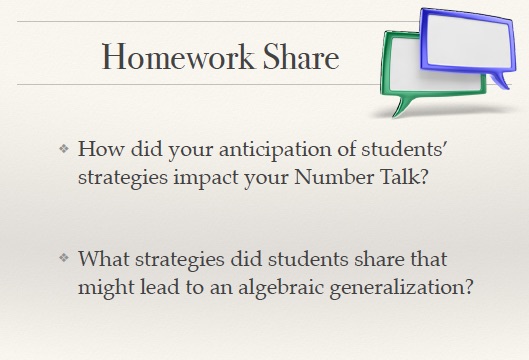
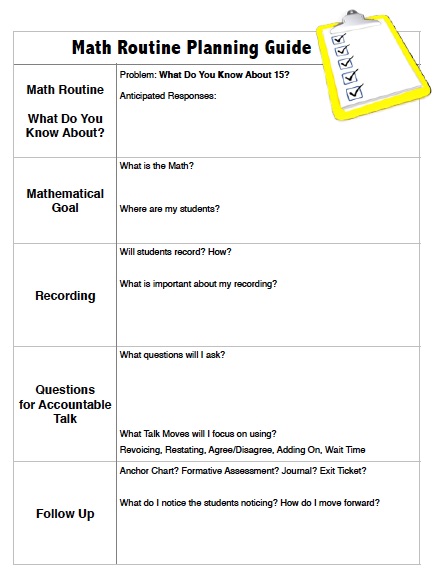
We opened by getting into grade level groups to discuss the homework from last month, doing a group planned Number Talk with their students. They used this form to plan together and brought back recording sheets of their work to discuss these two questions:

ntp nt1With the number talk being planned by the group, I felt a sense of ownership over the results in the classroom and, really, who doesn’t like talking about all of the wonderful things our students say during a number talk?

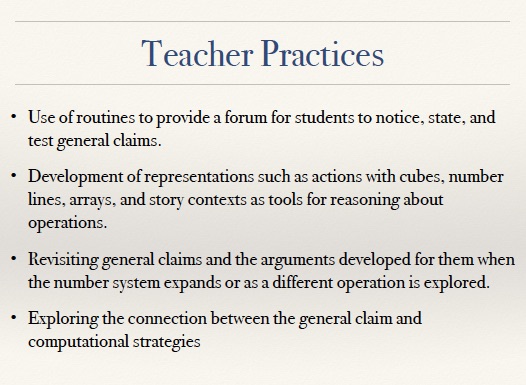
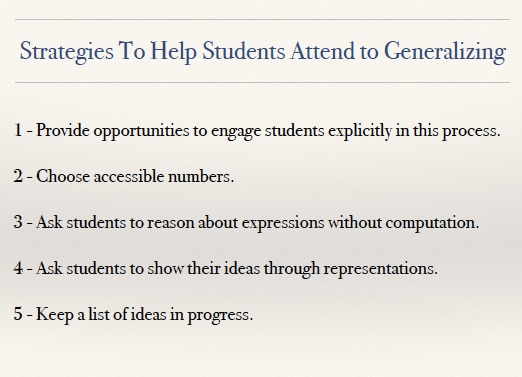
We continued with a quick recap of last month’s session on the book, “Connecting Arithmetic to Algebra” to plant the seed for our routine of focus that day, What Do You Know About….?

 21 3Now into the really fun stuff! Working with a Kindergarten teacher in my school (@jennleachteach) who is also a part elementary pd group, we planned and videoed a math routine called “What Do You Know About 15?” in Jenn’s class.

We mixed the grade level PD groups up at this point so there was a range of K-2 teachers (and a few math coaches) in each group.  They got a blank planning sheet to brainstorm what they think the planning would look like for this routine in a Kindergarten classroom in January. It was great conversation, with the Kindergarten teachers being the experts at each table. I thought this was such an interesting dynamic since we often tend to pose a mathematical idea and ask what previous understandings K-2 need to build to get there, however, with this opportunity, it was starting in the opposite direction and really focusing on what Kindergartners know at this point of the school year.

4After they predicted what our planning sheet would look like, Nancy brought 6 teachers up to act as students in a fishbowl enactment of the Number Routine. The other teachers in the room were observers focusing on two particular aspects of the talk, what you notice about the teacher recording and what you notice the “students” noticing. Importance of recording was a previous topic in an earlier pd, so we wanted to be sure that resurfaced. Nancy did the routine with the teachers and  we came back as a group to discuss the observations of our focus questions. Our discussion also touched on the use of the talk moves she used to clarify and illustrate student thinking.

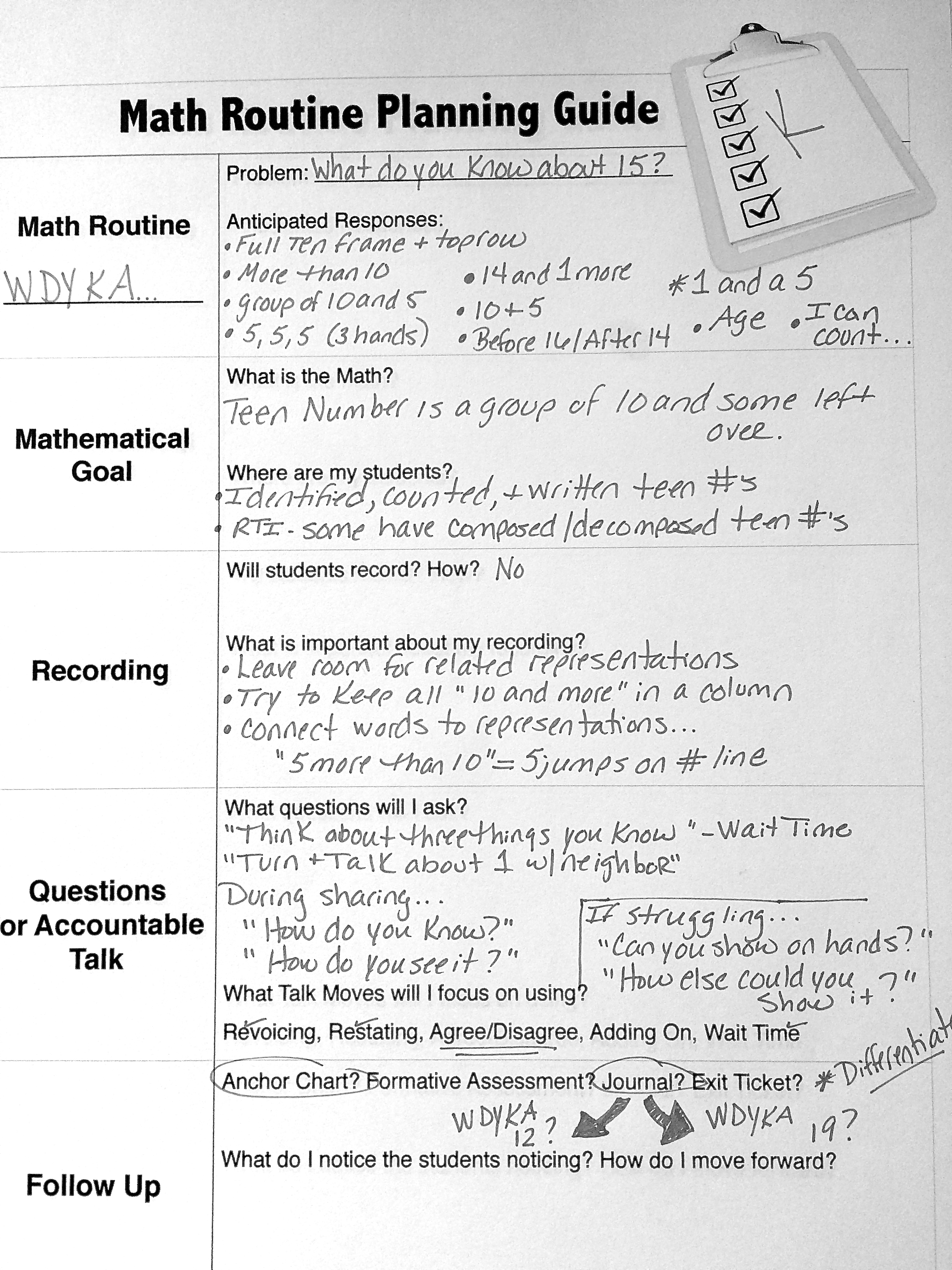
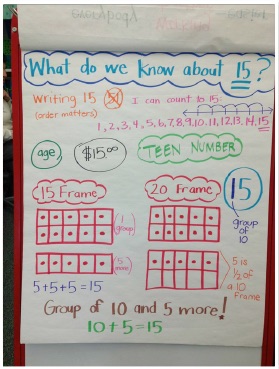
We then watched Jenn’s Kindergarten class do the same exact Number Routine, focusing now on the follow up piece of the planning sheet. What did they notice the students noticing? I wish I had permissions from everyone because Jen did a beautiful job in facilitating the talk and her students said some amazing things. We also took a look at the planning sheet that Jenn, Nancy and I had done for this routine. Here is the planning sheet and anchor chart that arose from the talk:

IMG_8758

5

As a group we discussed what they noticed the students noticing that could lead to future “claims” in their classroom. Teachers noticed such things as, “We can count by fives to get to 15” “It is three fives” (of course I am thinking about groups of and multiplication right there!) “A teen number is a group of ten and some more” “Looking at equality with related equations” and “The 1 means one ten”

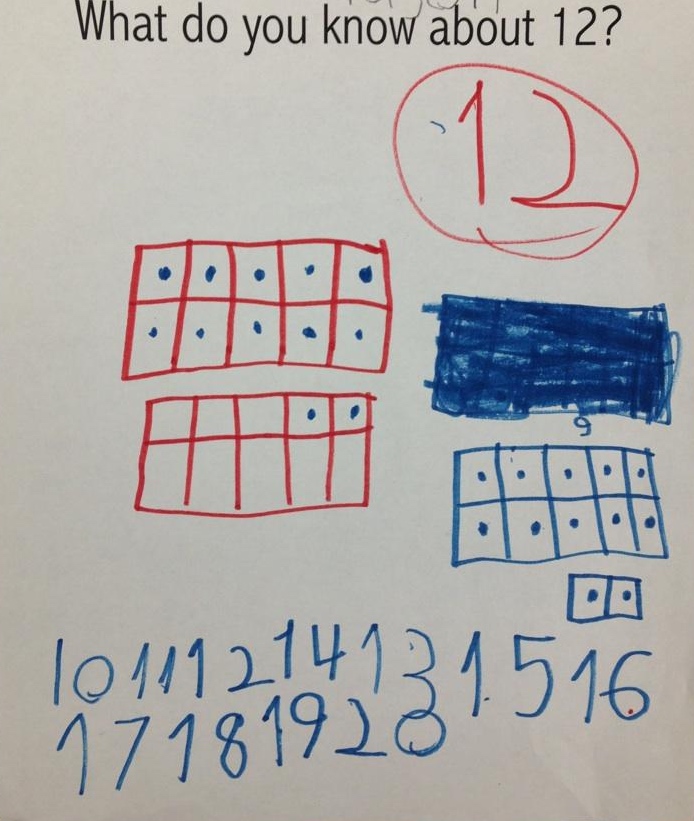
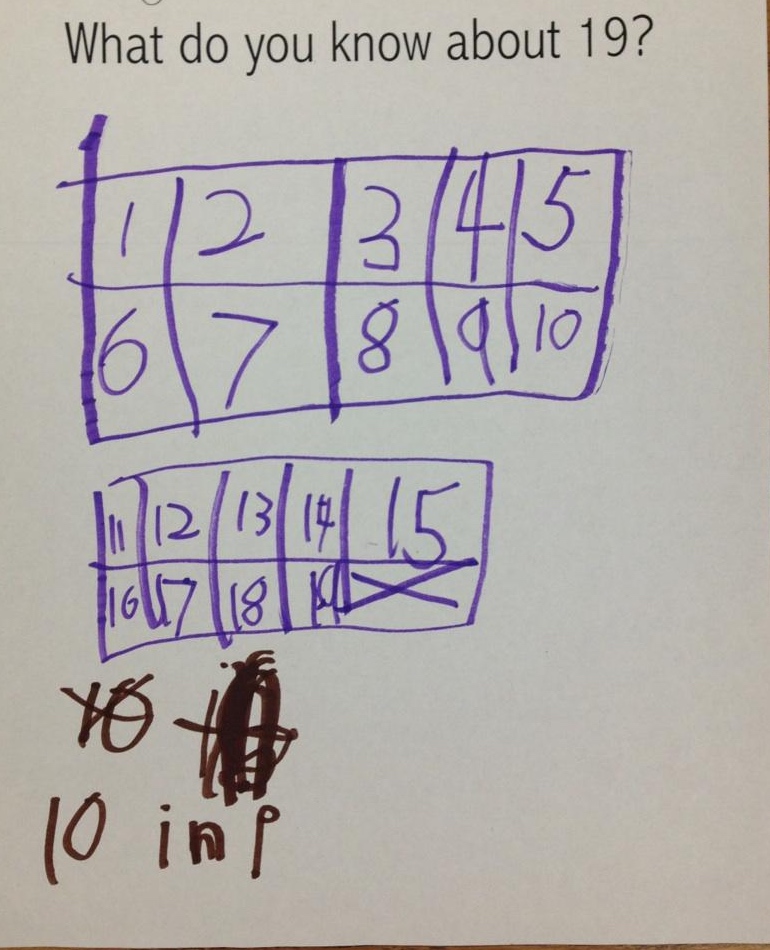
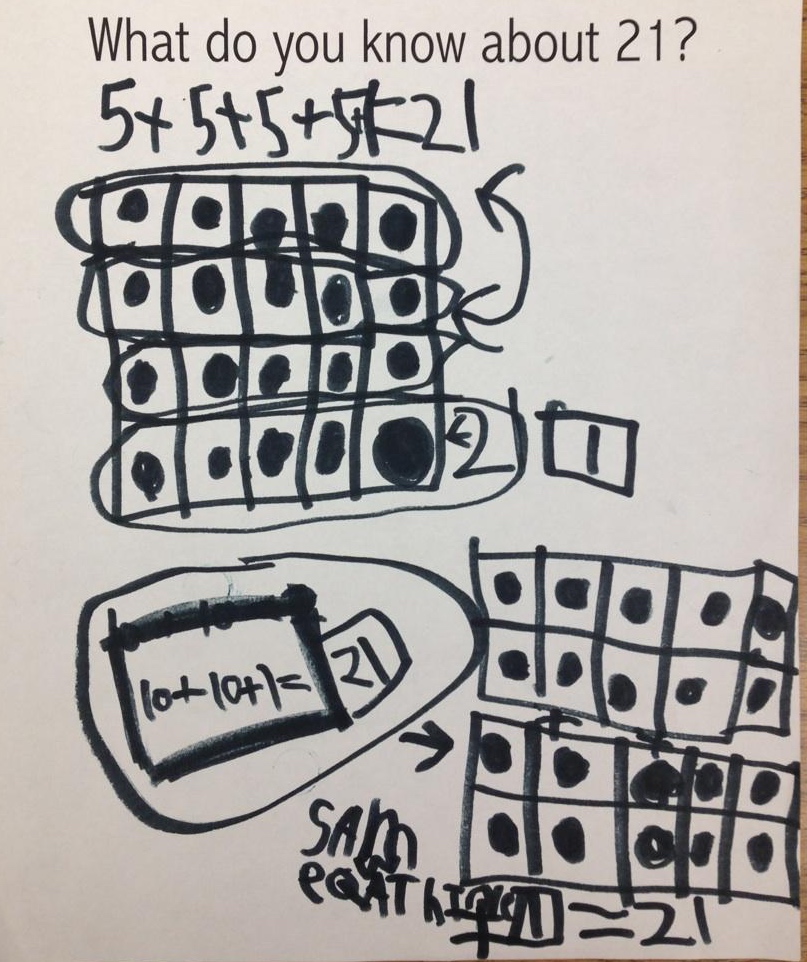
Jenn then gave students “random” journal entries to see how students were thinking about the numbers after the talk. To differentiate, we decided to give students 12, 19, or 21 depending on where we thought their entry level was into this thinking. After students completed the journals they chatted with someone who had a different number, to talk about their ideas.” Here are the student samples our PD group looked at and discussed:

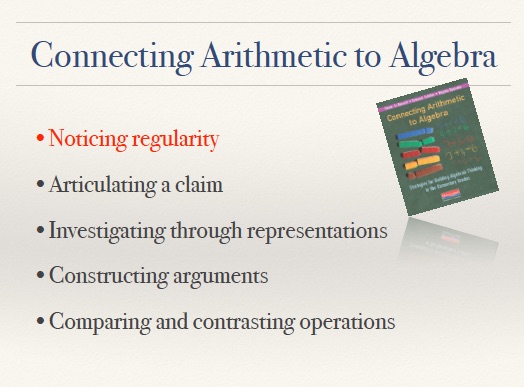
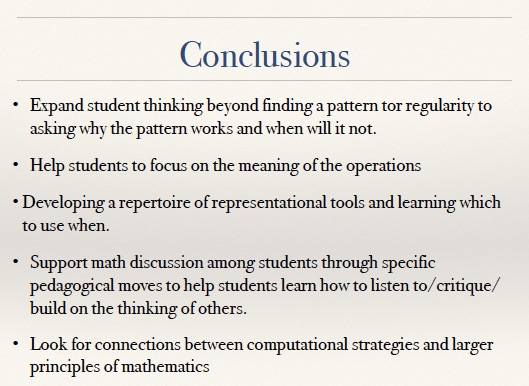
Photo Jan 08, 5 35 21 PM Photo Jan 08, 5 35 18 PM Photo Jan 08, 5 35 15 PM Photo Jan 08, 5 35 12 PM Photo Jan 08, 5 35 08 PM Photo Jan 08, 5 35 05 PM Photo Jan 08, 5 35 03 PMWe ended with Virginia’s conclusion slide about Connecting Arithmetic to Algebra and our homework for the group:

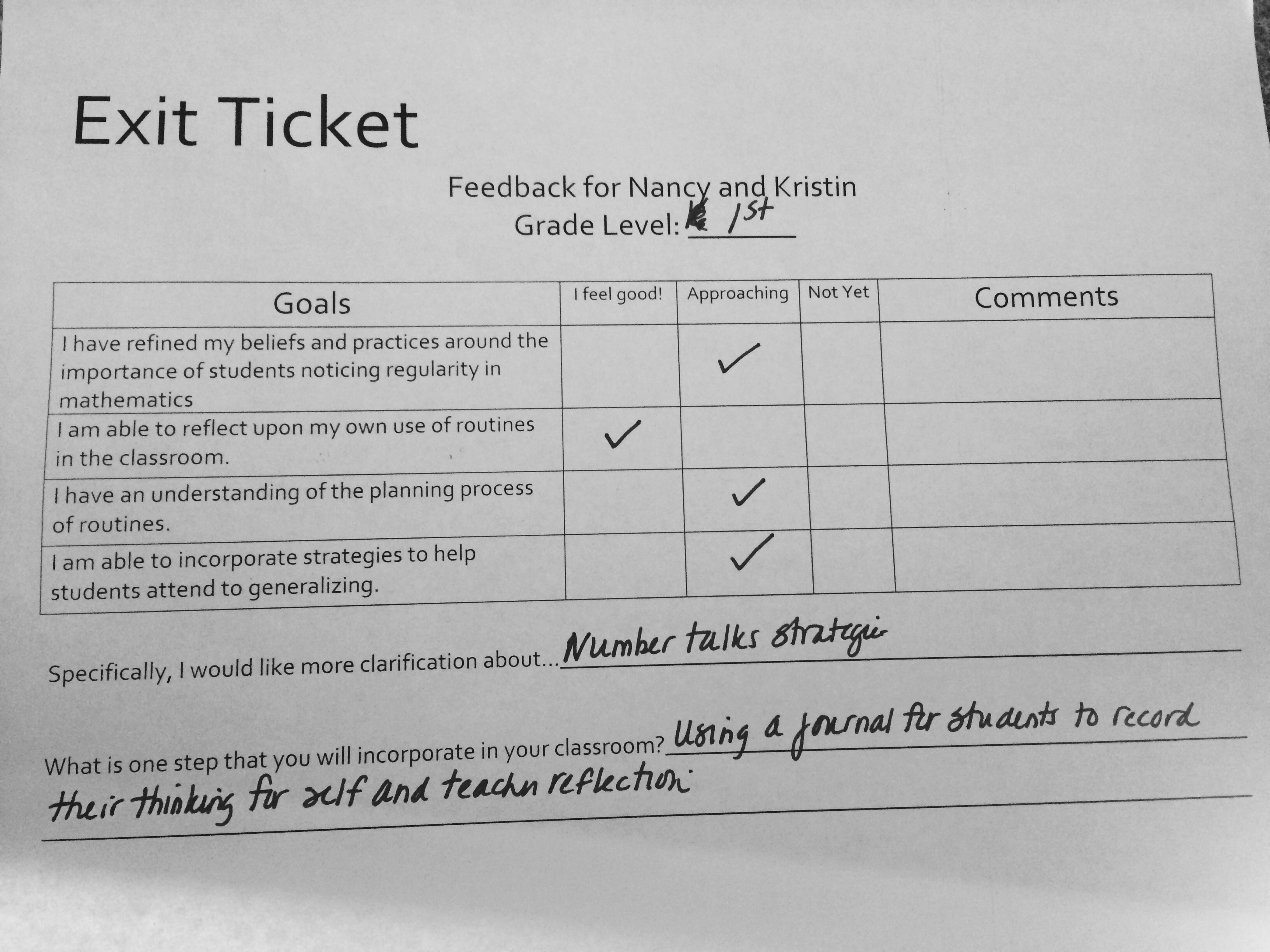
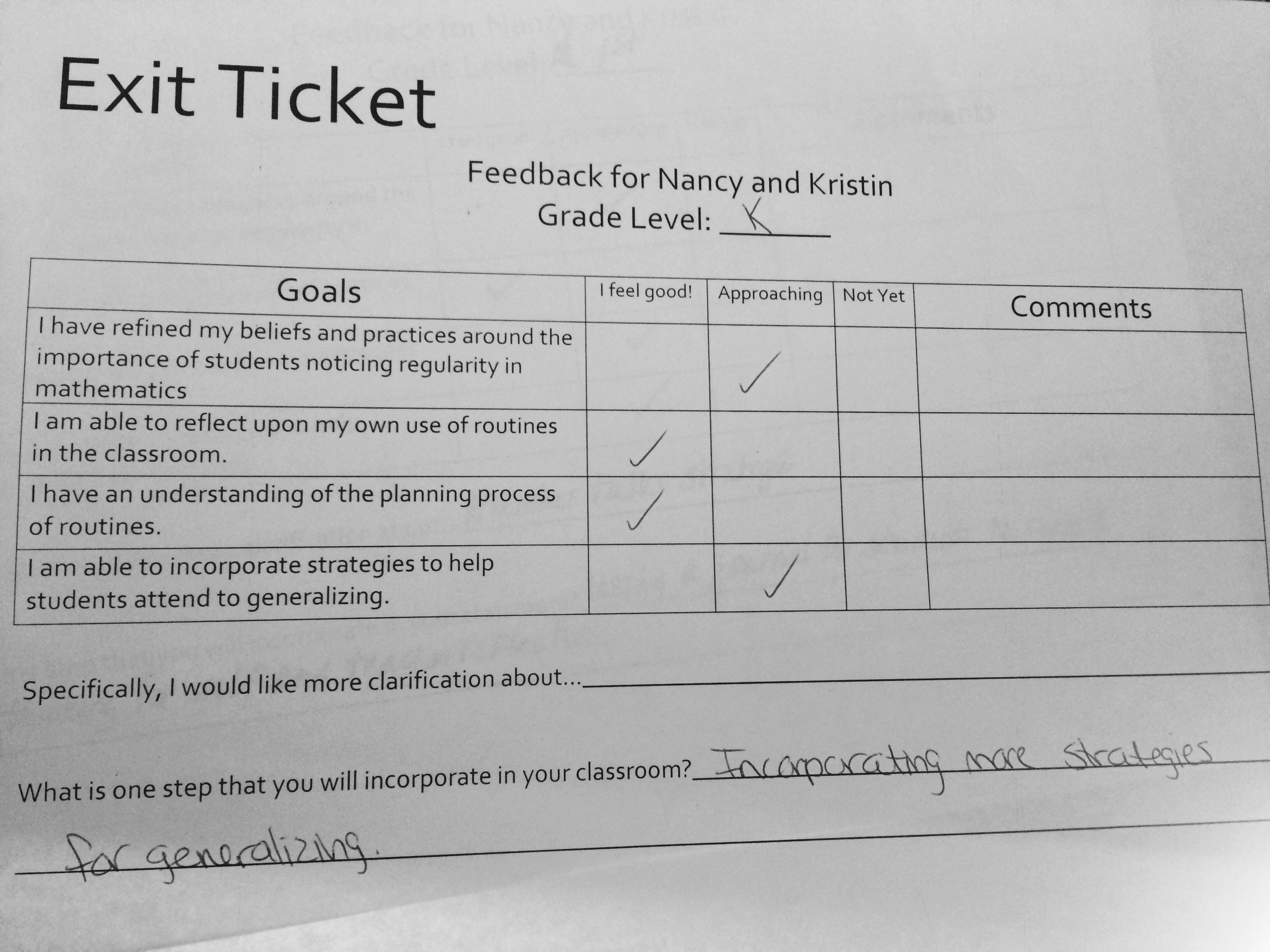
6 7We also gave an Exit sheet to help us in future planning. We got some very useful information as to where the teachers feel they are. I am very excited to hear about everyone’s journey back in their classrooms next month!

Photo Jan 10, 8 53 02 AM Photo Jan 10, 8 52 41 AM Photo Jan 10, 8 52 29 AM-Kristin

My #oneword

Since I am having my students choose one word that will be their inspiration this year, I have been thinking a lot about which word I will choose. In the chaos of everyday school life, my initial thought was the word “No” simply to remind myself to say no to more things to de-crazy my life.  If you are anything like me, which most teachers who I find on Twitter and blogging are, you are juggling a million things at once. Ideas sound so exciting to me, that I jump on board and say yes without really thinking about how much work it will be and what other projects will sacrifice time because of the new project.

Today, I thought more about it and the word “No’ seemed a bit too negative and I wouldn’t really want that to be my motto for the year, however I have come up with a more powerful word to help guide my actions this year….Less.

Less initiatives that I have to be the driving force behind, less projects that I am not passionate about that will take time away from things in which I am, less things that go around in circles and never make much progress, less, less, less…..

-Kristin

Area/Perimeter of Squares…Help.

Through my work each year with area and perimeter, I learn more and more about how I learned (was taught) math. I can work out a “proof” algebraically, however I struggle in connecting it conceptually to the problem. When this happens, I am so hesitant to reach out bc, truthfully, it is a bit embarrassing. I mean, I teach this stuff, right? But I finally hit a point, after I started blogging, when I learned that I will never learn more if I am not open to where I am. Since I encourage my students to write honestly about their understandings, I thought it only fair to throw my thoughts out there into the wonderful #mtbos. So here it is…

Here was last year’s example that I worked my way through: https://mathmindsblog.wordpress.com/2014/01/27/area-and-perimeter-of-squares-student-noticings/

And now here is this year’s: https://mathmindsblog.wordpress.com/2014/12/20/areaperimeter-my-homework-over-vacation/

I am finding the same thing is happening again…algebraically I have it, but struggling with the conceptual connection. I have a bunch of theories scattered on my papers this morning, but nothing that is satisfying me mathematically and would appreciate any thoughts….

IMG_8763_2 IMG_8764_2So when thinking about area related to perimeter in squares, I know that n^2 x 4/n = 4n, but I am stuck at that 4/n. I marked off what I thought 4/n looked like in my squares, I messes around with ratios, found some patterns, but still not seeing (or putting together) what I want. … so I went to this drawing bc the side was increasing by 2 every time…. IMG8765Then I went to this…

IMG8766 And while I would love to play with this for a bit longer, I have so many other things to do to get ready for school tomorrow! I feel like I have it somewhere here, I just cannot make a connection that works for me. Would love any pieces to the puzzle put together for me:)

Thanks!!

-Kristin