Category Archives: Math

3rd Grade Dot Image

The third grade team is planning for a dot image number talk that focuses on this standard:

“Apply properties of operations as strategies to multiply and divide.2Examples: If 6 × 4 = 24 is known, then 4 × 6 = 24 is also known. (Commutative property of multiplication.) 3 × 5 × 2 can be found by 3 × 5 = 15, then 15 × 2 = 30, or by 5 × 2 = 10, then 3 × 10 = 30. (Associative property of multiplication.) Knowing that 8 × 5 = 40 and 8 × 2 = 16, one can find 8 × 7 as 8 × (5 + 2) = (8 × 5) + (8 × 2) = 40 + 16 = 56. (Distributive property.)”

Before this talk the students have been doing work with equal groups and are moving into array work with the arranging chairs activity in Investigations. They have also been doing dot images with smaller groups and have noticed the commutative property as arranging the same dots into different-sized groups.

These are the three images we are playing around with and anticipating which would would draw out the most interesting strategies based on the properties. We are thinking of having a journal entry afterwards to see if students make any connections between the strategies.

So if you feel like playing around with some dot images and doing some math, I would love anyone’s thoughts on which image you would choose and why!

Screen Shot 2015-11-04 at 6.23.29 PM

Screen Shot 2015-11-04 at 6.26.17 PM

Screen Shot 2015-11-04 at 6.27.29 PM

The start of my planning….

IMG_0970 IMG_0971

My new thoughts on these images and responses…

IMG_0978

After chatting with a few friends yesterday and thinking about which image would elicit the most expressions that could allow students to see some connections between the properties of operations, I am thinking about some changes to the images (in orange).

In image 1, I am wondering if we should split each group of 8 into fours but leave a bigger space between the top four groups and bottom four groups. It may allow students to better see the 4’s and then group them as 8’s and at the same time thinking about “doubling” the top group to get the total because of symmetry. They could then explore ideas like (4 x 4) + (4 x 4) = 4 x 4 x 2  or (4 x 2) x 4 = (4 x 4) x 2 [associative property] or 8 x 4 = (4×4) + (4 x 4) [distributive property] or any fun mix of them. If we leave it as it is, I think it may be hard to move them past 4 x 8, skip counting by 8’s or using 2’s.

In the second image, I love the structure of it but am wondering how students could use that 4 in the middle aside from just adding it on each time? Will we just end up with a lot of expressions with “+4” at the end? I am wondering what would happen if we adding an extra group of four next to it? Would students see the structure of a 5 and double it in some way? (5×4)x2 = 10 x 4 or 5x(2×4)=(5×4)x2 [associative] or 5 x 8 = 10 x 4 [doubling/halving] or 2×4 + 2×4 + 2×4 + 2×4 + 2×4 = 10 x 4

Then what question to pose at the end? Do we ask them to freely choose two expressions and explain how they are equal? or Do we choose the two we want them to compare? Do we have the dot image printed at the top of the page for them to use in their entry?

So much to think about..

~Kristin

3rd Grade Dot Image Number Talk

Since the 3rd graders are entering their multiplication unit, I find it the perfect time for some dot images!! I used the image below as a quick image in which I ask them to think about how many dots they saw and how they saw them. Quick images are so great for pushing students to visualize the dots and move beyond counting by ones and twos. I flashed the image for about 3 seconds, gave students time to think, and then gave them one more quick look at the image to check and/or revise their thinking.

Screen Shot 2015-10-21 at 7.06.28 PM

They all saw 20, however the way they the 20 varied a lot and the conversation was amazing from there! Here is how our board ended up…

IMG_0857

Recording is something that I am always working on, making truly representative of the students’ thinking. The first thinking was adding groups of four to get 16 and then the additional middle 4 to arrive at 20. The second was skip counting, so I asked the student to do that for me and how they knew to stop at 20. He said he knew it was 5 groups of 4 so he needed to stop after 5 fours. Then I wrote under that “5 groups of 4.” From there a student jumped on that and said that was the same as 5 x 4, because they were talking about that the day before in class.

Then, the thing I was hoping happened, happened. A student said she did 4 x 5 because that was easier. I wrote it down and, of course, ask if that is the same thing? We began on open discussion and they agreed it was the same answer but the picture is not the same. I asked how it changes and a student told me to move a dot to the middle of each of the outside fours to make fives. I drew the arrow and then one student said that is like division, 4 ÷ 4 because you are splitting that 4 between the 4 groups. I let that sit for those not ready for that yet.

The last strategy was counting by twos so I had him skip count for me and recorded that. I asked if we had an equation to match that thinking and got 10 x 2. At that point, I was ready for them to do some algebraic reasoning.

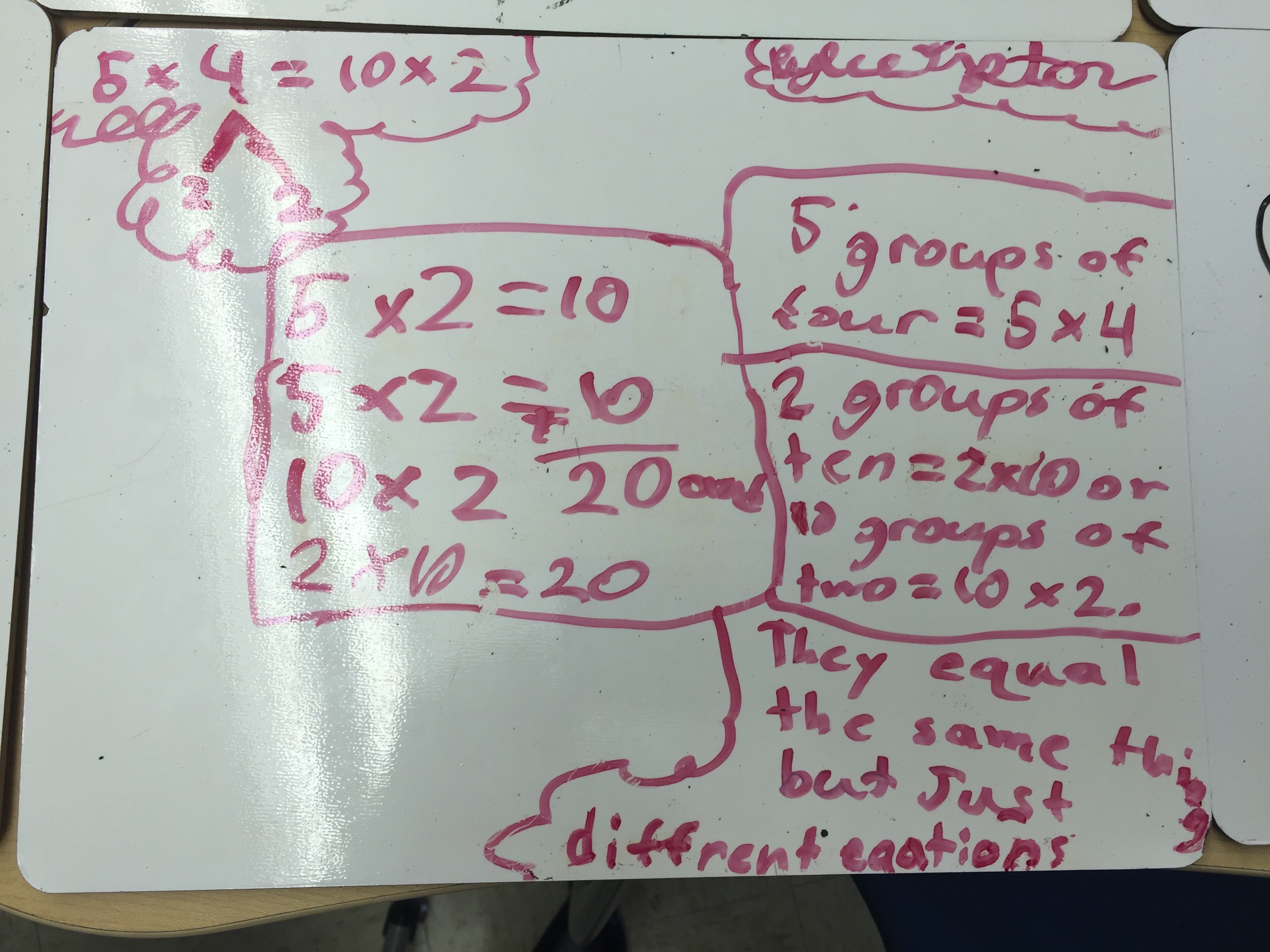
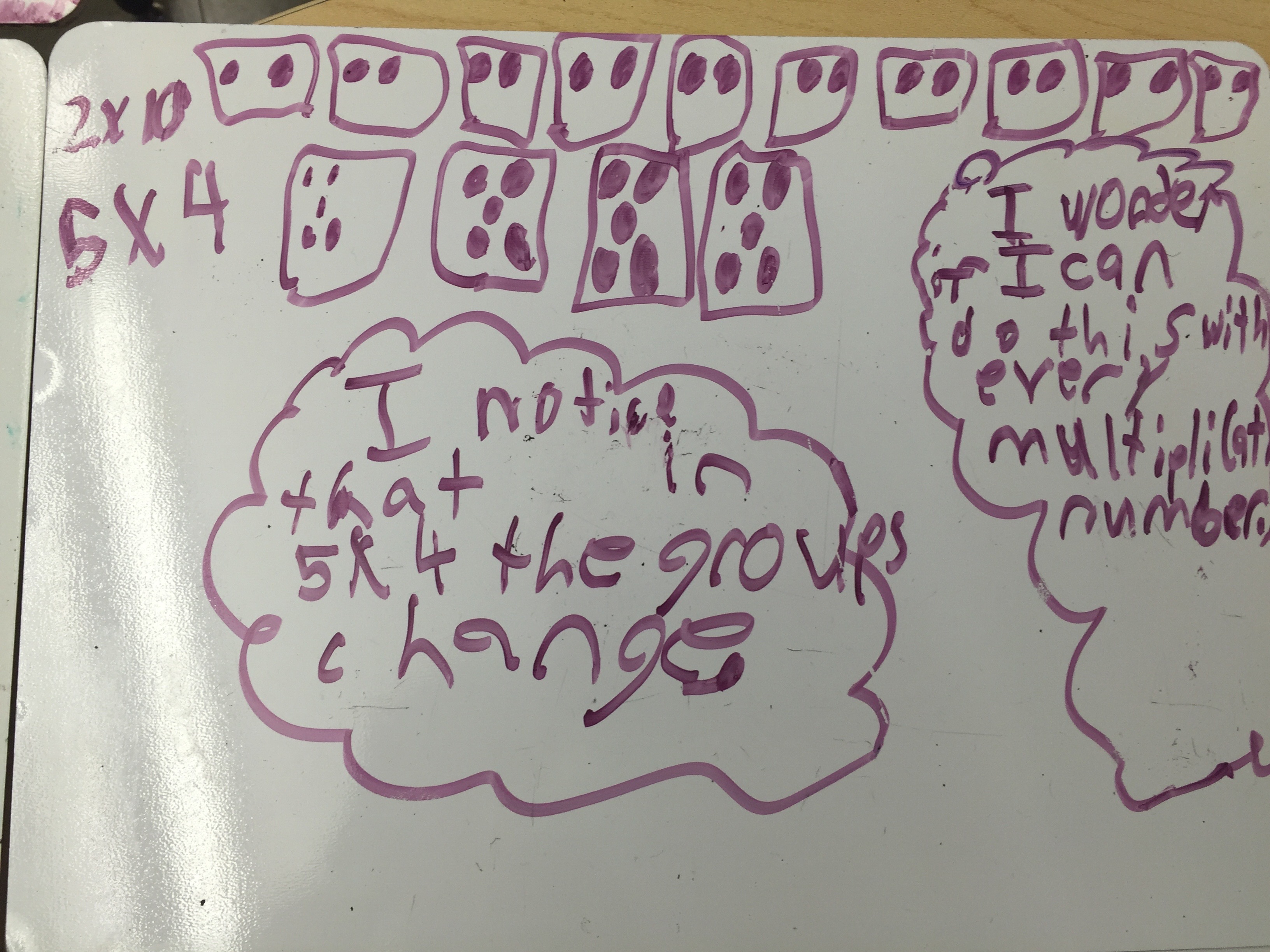
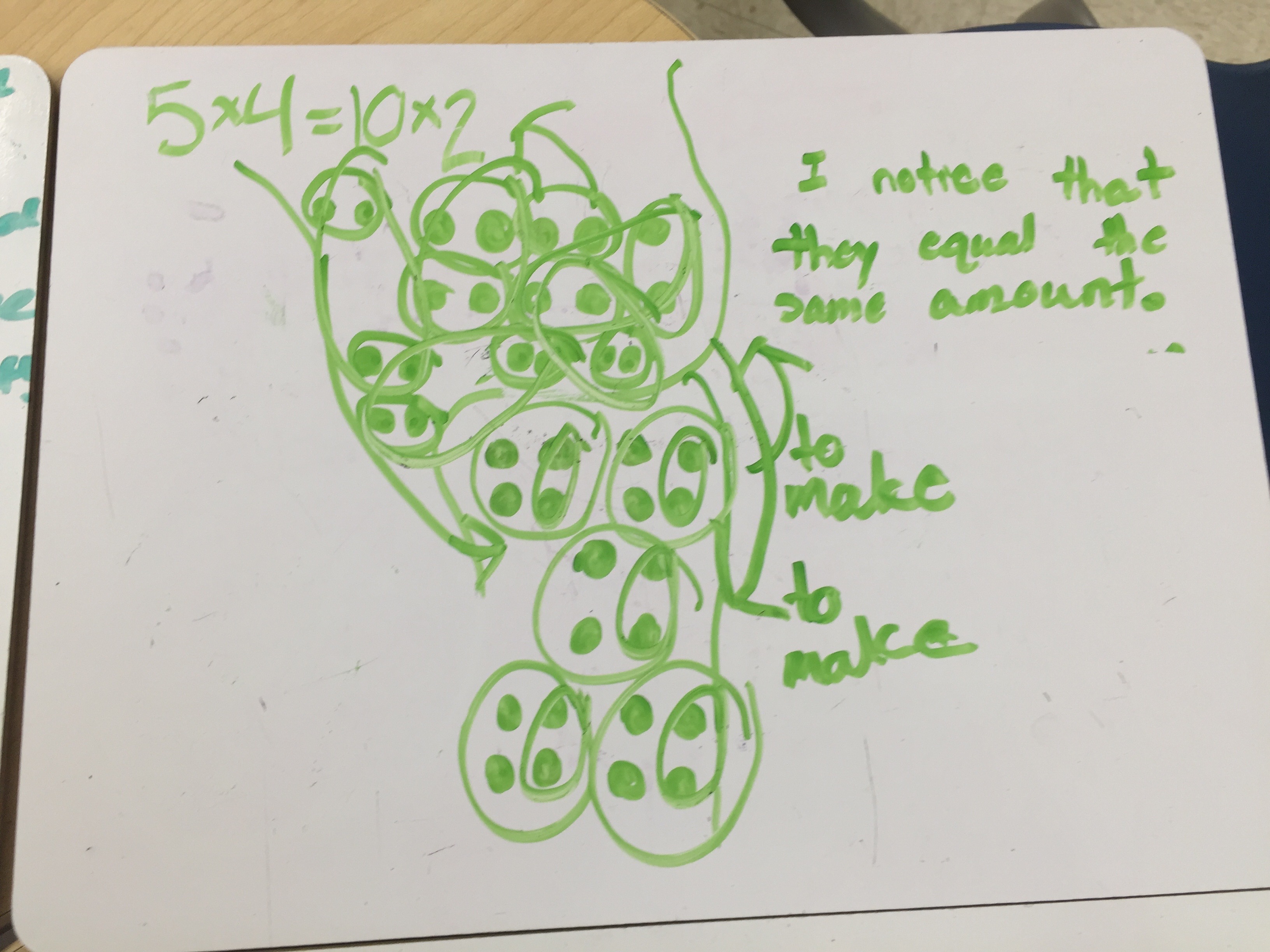
So I wrote 5 x 4 = 10 x 2 and asked them if that was true or false. They unanimously agreed yes so I asked them how they could prove that and to write what they noticed and/or wondered about it. Here are their whiteboard work:

This one showed the 5×4=4×5 to me but I loved the notice so much:

IMG_0851

This one was an interesting decomposition of the 4 to show where the two tens are coming from in 2 x 10:

IMG_0852

This was a beautiful notice and wonder on the groups changing and wondering if this is with every multiplication problem….how AWESOME?!:

IMG_0853

This one required a conversation because I couldn’t really understand it. The movement of dots made two groups of five to make the ten they said, but it was more their noticing/wondering that I want to explore more with them: 

IMG_0855

Oh my goodness, how much do I love this mention of al(l)gebra in here and then the notice about the half of 10 is 5 and 2 is half of 4…this could have some potential conjecture-making in future talks:

IMG_0850

This one is incredibly hard to understand and I am not even sure I completely do, but I love how she used one image to “make” the other: 

IMG_0847

This student started with decomposing the four (I know we need to think about that equal sign later) but then moved to talking about ten frames. He said if I put two ten frames on top of one another (one attached under the other) I can see five fours (vertically). Then he said he drew them side by side and he saw 2 tens. HOLY COW! 

IMG_0844

What an amazing conversation with this group! Today I posed them with a few of these noticings and wonderings and asked them to pick one and see if it always worked and why. I didn’t have time to snap pics of their journals but all I can say is 3.5 x 10 came up…so I will have to blog that this weekend!

All of this K-5 work is so exciting and it is so amazing to hear and see all of the great teaching and learning going on around the building!

-Kristin

5th Grade Fraction Clothesline

Today, I had the chance to plan and teach with a 5th grade teacher and it was awesome! Last week, this class had just finished a bunch of 100s grid shading in thinking about fraction/percent equivalencies, so we picked up planning the lesson in Investigations with the fraction/percent equivalent strips. Instead of the 10-minute math activity, we thought it would be really interesting to do the clothesline number line to kick off the class period.

We chose fractions (and one percent I will talk about later) based on the fractions the students had been working with on the grids. We chose fractions based on different comparison strategies that could arise such as:

  • Partitioning sections of the line
  • Distance to benchmarks
  • Equivalent Fractions
  • Common Denominator
  • Greater than, Less than or equal to a whole or 1/2

We settled upon the following cards:

1/4, 3/4, 4/4, 1/3, 4/3, 5/10, 2/5, 100%, 3/8, 1 5/8, 1 7/8, 4/5, 11/6, 1 6/10, 1/10, 9/8, 12/8, 2

To start, I put the 0 toward the left of the line (when you are looking at it) and we practiced with a few whole numbers. One student volunteered to be first and I handed her a card with the number 7. As she walked up, looked around, walked up and down the line, looked at me like I was playing some type of trick on her, we immediately had the conversation about how knowing the highest numbered card would be super helpful. She settled on putting it toward the far right side and had a seat. I gave another student the 10 card. He put that at the far right and adjusted the 7 to be “about 2 cards away” from the 10, leaving a really long distance from 0-7 for them to think about. We had some students disagree so we talked about distance and adjusted the cards to be more reflective of distance. Since the conversation of half of the distance to 10 came up, I handed another student the 5 card and he placed it right in the middle. The discussion went back to the 7 and they decided that since 7.5 would be halfway between 5 and 10 that 7 had to be a little bit less than the halfway of 5 and 10.

Then, we moved into the fraction cards. We gave each pair of student two cards. In hindsight, for times sake, I would probably only do one card per pair. I gave them one minute to talk about everything they knew about the fractions they had and then we started. I asked for volunteers who thought their card would help us get started and called on a boy with the 1 7/8 card. He went up and stood all of the way to the right and said he couldn’t put his on. I asked why and he said that since the cards were all fractions the line could only go to 1 so his is more than one and can’t go on here. I asked if anyone in the class had a card that may help us out and a student with the 2 card raised her hand. She placed her card all of the way to the right, said “maybe it goes to two” and the other student placed it just to the left of it because, “it is only 1/8 from 2.” Awesome!

We went along with the rest of the cards and so many amazing conversations, agreements and disagreements happened along the way. There are a few things that stand out in my mind as some great reflections on the activity:

  1. A student had placed 5/10 halfway between 0 and 1. The next student placed 2/5 just to the left of the 5/10 because, “I know 2 and a half fifths is a half so that means that 2/5 has to be less than 5/10. It is a half of a fifth away.” The NEXT student volunteered and placed 3/8 overlapping just the edge of the 2/5 card on the left. I was expecting percentages to come out, since that was their most recent work with those fractions, however the student said they knew 3/8 was an 1/8 from a half and 2/5 was a 1/10 from a half and an 1/8 and 1/10 are close but an 1/8 is just a little bit further away. Awesome and definitely not what I expected!
  2. I wish I had not put the zero so far to the left. Looking back I am wondering if that instills misunderstandings when they begin their work with negative numbers on a number line similar to the original misconception that launched the activity with the 1 7/8.
  3. Oh, the 100% card….complete mistake on my part, although it may have been a great mistake to have! In the first class, the student with the 100% card came up and said, “I have 100% and that is 100/100 which is 1” and put it in the appropriate place on the line. Just as she did that, I started thinking how I never really thought about the distinct difference between percent in relation to area (like the grids they had been shading) and 100% when dealing with distance on a number line. No one seemed to notice and since I didn’t know exactly what to ask at that point because I was processing my own thoughts, I waited until another student placed 4/4 on top of it and erased it from my immediate view!
    • I stayed for the next class and this time I was prepared for that card and now really looking around to see what students’ reactions were when it was placed. As soon as the student placed it at the 1 location, I heard some side whispers at the tables. I paused and asked what the problem was and they said, “100% is the whole thing.” The next student who volunteered had the 2 card, picked up the 100% card on the way to the right side and put the 2 down and the 100% on top. Lovely and just what I was thinking.

I have never had students reflect on the difference of talking about percentages with distance versus area because I had never thought about it! It definitely feels like an interesting convo to have and a great mistake that I am glad I made!!

IMG_0840

I will be back in another 5th grade class tomorrow and will see what happens…it could make for a great journal writing!

-Kristin

3rd Grade Multiplication Talking Points

This week I had the chance to work with a third grade teacher, Andrea! Her class is just about to begin their unit on multiplication and division so she wanted to do Talking Points to see what they knew, and were thinking about, in relation to these operations. During our planning we discussed the ways in which this Investigations unit engages students in these ideas, misconceptions students typically have, bounced around ideas, and played with the wording of the points. Being my first talking points activity with third graders, I was so excited to see how students engaged in the activity. I have found that even during Number Talks, the younger students are very eager to share their own ideas, but listening to others is difficult.

In looking for how students “saw” multiplication and thought about operation relationships, we designed these Talking Points..

Screen Shot 2015-10-17 at 7.12.13 AM

Andrea introduced the activity and we did the first talking point as a practice round in which we stopped the groups after each of the rounds to point out the important aspects. We pointed out things like,”I liked how Bobby was unsure and explained why,” and “I liked how everyone was listening to Becky when she was talking,” and “I thought it was great proof when Lily drew something really quick to support her thoughts.” Then we let them go and walked around to listen as well!

During the Talking Point round, some things we found really interesting were:

  • How difficult is for them to sit and listen to others without commenting. Not like it is not hard for use as adults though, right? 😉
  • How much students struggled to say why they were unsure. Sometimes it was not knowing what the word division meant, yet they struggled to articulate what it was within that talking point that was confusing them. What a great thing for them to be able to think about!?
  • How they related the dot images they had been doing in class to multiplication and division.
  • How they thought about inverse operations. They said things like, “I don’t know what division is but if I can use subtraction with addition, I probably can use division with multiplication.

We had pulled two of the points that we wanted to discuss, whole group, afterwards, “I can show multiplication as a picture.” and “We can use multiplication problems to solve division problems.” We put them up and just asked them what their table had talking about. The conversation was amazing. Hearing how they thought about multiplication as groups of but 50 x 2 means “fifty two times” while 2 x 50 means “2 fifty times.” We also heard how someone at their table had changed the way they thought about something. And the division conversation was so great and for the students who were unsure because they did not know what division meant, it felt really organic to come out that way… from them, not us.

Of course, we followed with a journal write:) We gave them three choices to write about…

Screen Shot 2015-10-17 at 8.31.07 AM

I was so impressed by the way they wrote about their thinking, by 5th grade, they will be amazing!!

IMG_0811

IMG_0812

The student above, during the Talking Points, said that he could show multiplication as a picture because “an equation IS a picture.” It was lovely to see him make the connection to a visual for an equation in his journal.

IMG_0813

I wish the quality of this picture was so much better but her pencil was so light it was hard to see! She does a beautiful writing about how exactly someone at her table changed her mind with such an articulate way of talking about multiplication and division!

IMG_0815

IMG_0817IMG_0818

This student above explains perfectly why teaching is so difficult…”…sometimes we have facts about math, we all have a different schema. We were taught differently than other kids.” I am curious to hear more about her feeling about the end piece, “some kids know more then other kids.” Is that ok with her and she understands we all will get there just at different times?

IMG_0820

IMG_0821

These last two were two different ways in which students reflected on the dot images they have been doing in relation to multiplication!

What a great class period! I cannot wait to be back in this class to see how students are working with and talking about multiplication and division!

~Kristin

Fraction/Percent Equivalents

It goes without saying that I miss talking 5th grade math with my students each day. But I am so lucky this year to have a new, wonderful teacher in 5th grade who lets me plan and teach some lessons with her! This lesson was one of her first lessons of Unit 4, Name That Portion.

Since in 4th grade the students do a lot of work with comparing fractions, we designed a Number Talk string in which students were comparing two fractions. We wanted to hear how they talked about the fractions. In the string we used a set with common denominators, common numerators, and one unit from a whole. On each problem we were excited to hear talking about the “size of the piece” being the unit and the numerator telling us how many of those pieces we have. Our 4th grade teachers really do a beautiful job with this work. They also used equivalents to have common denominators to compare and a few used percents, since they had done a some grid work with that they day before.

We started the lesson by asking them how they could shade 1/4 on a 10×10 grid. The majority of the students split the grid in half vertically and then again horizontally and shaded one quadrant. We heard a lot of the “1/4 is half of a half.” As I was walking around, I heard a pair talking about shading a 5×5 in that grid. I saw this as a beautiful connection to the volume unit they just completed in which they were adjusting dimensions and seeing the effect on the volume. I had her explain her strategy and wrote 5 x 5 under the 10 x 10 that was up on the board already and asked how that could get us 1/4 of the whole thing? One student said it looks like it should be half of it because 5 is half of 10, but then one student said since we were taking 1/2 of both it would be a fourth….this is where I hope Leigh (the 5th grade teacher) and I remember to use this when they hit multiplication of fractions!

They then worked in pairs to shade 1/8 and 3/8 and we came back to discuss. We noticed as we walked around that the shading was wonderful on their papers, but when asked to write the fraction and percent, most were blank. I remember this lesson from last year during decimals where the same thing happened. So, we asked them what they thought the fraction was as we got these three answers…

12 r4/100

12 1/2/100

12.5/100

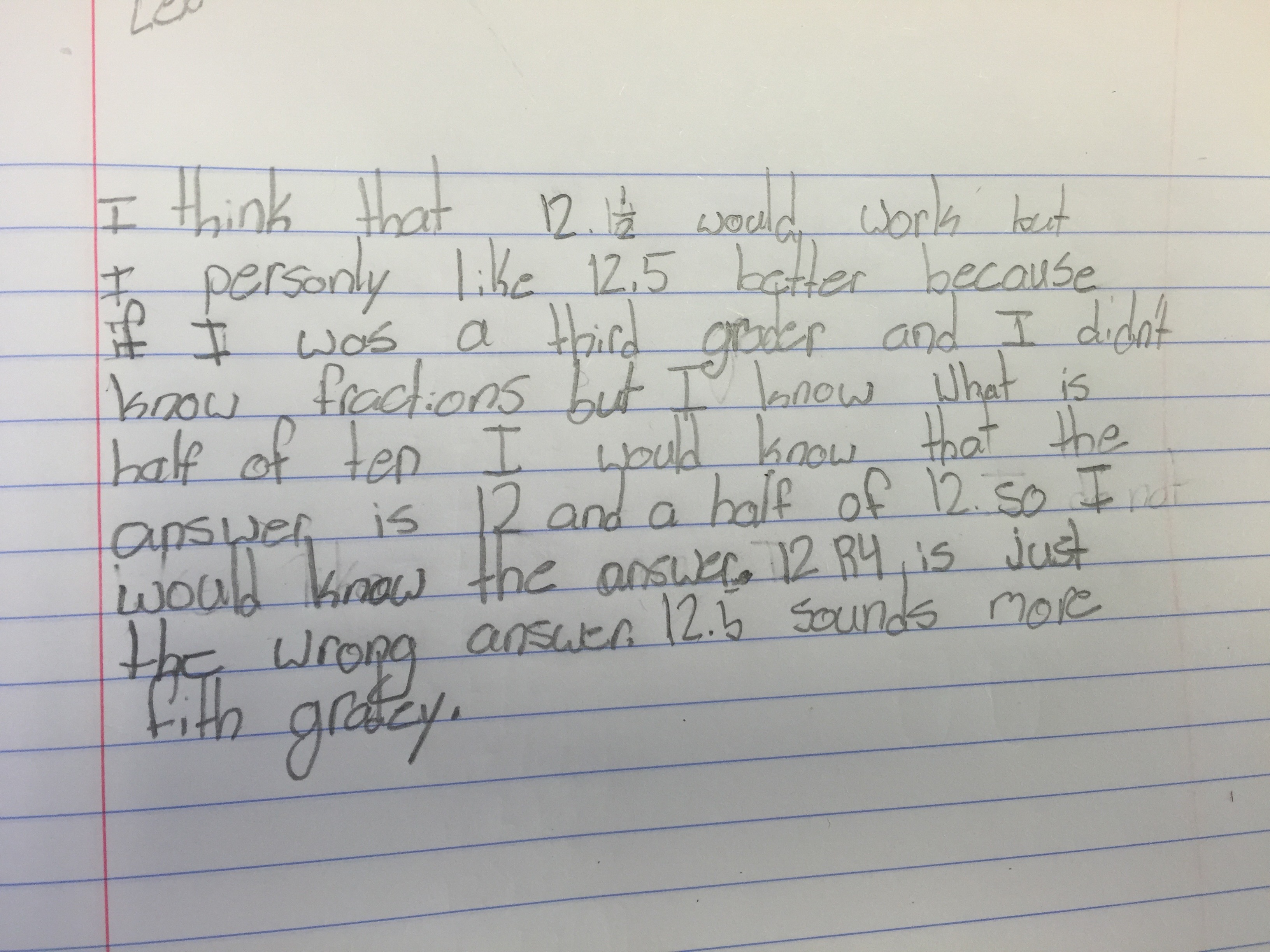
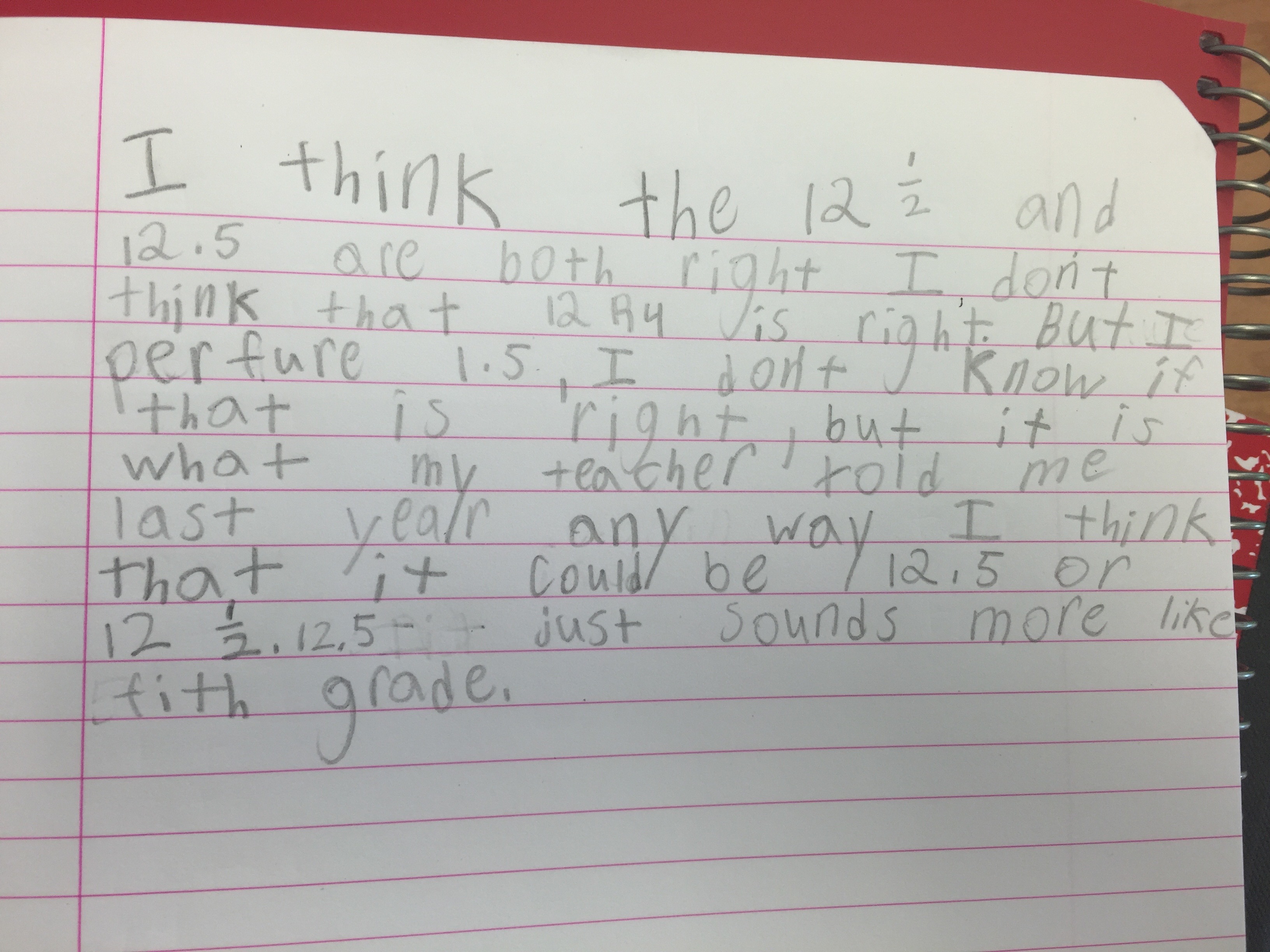
They were not overly comfortable with any of them so we asked them to journal which one “felt right” to them and why…

IMG_0789 IMG_0781 IMG_0786 IMG_0780 IMG_0779 IMG_0784 IMG_0790 IMG_0787

We loved to see what they knew about decimal fraction relations, but we especially liked the “it sounds more fifth grady to use 12.5.”

-Kristin

My Week In The 2nd & 3rd Grade Math Classroom

While I am loving my new role as the school math specialist, I am definitely finding that my blogging has taken a bit of a slide. I have come to realize that my main inspirations for blogging is having a class every day in which I am thinking things through with and the student work that is the result. Working in various classrooms around the building does not offer that consistent look at student work, but I am SO excited to see so many teachers in my building using student math journals! I think they are finally starting to get used to me snapping pics of all of that great student work at the end of class!

This week, I had the chance to plan and teach with second and fifth grade teachers and do number talks in 3rd, 4th and 5th grade classrooms! Ahhhh…finally student talk and work that gets me excited to learn and inspires me to blog!:)

Second Grade:

Our second grade begins the year with Unit 3 of Investigations which centers around addition, subtraction and the number system. What the teachers and I realized, during the lesson we planned, was that, while the students did an amazing job adding and were finished fairly quickly, they all used primarily one strategy and if they did use a second one, they did see it as different.

The majority of the students decomposed both numbers and combined the tens and ones like the top two strategies of this student:

IMG_0743When asked to show another way, he quickly did the third strategy. Walking around the room, the teacher and I saw many others thinking in the same way as the third strategy but intricately different.

IMG_0745 (1)IMG_0744

IMG_0746Thinking in terms of the 5 Practices, we monitored and selected a progression of papers to elicit connections between strategies, however what we found is that as students shared, the others were saying, “I did it the same way, I just broke it apart.” They didn’t see a difference in breaking both numbers or breaking one number or then how they thought about the decomposition and combining of the partial sums. We left class with that spinning in our heads….”It is wonderful they can use a strategy to add, but how do we get them to see the differences in each and think about when one may be more efficient than another?” and for me, being new to second grade math, “How important is it that they do? and Why?” The following class period, which I could not be there due to a meeting, the teacher began creating an anchor chart of strategies as students discussed them and pushed them to see the similarities and differences of each. I am still thinking through the importance of these connections and realizing I have so much to learn!!

3rd Grade

In third grade this week, I was asked by a teacher if to come and do an addition number talk with her class. That took no thought, of course I jumped at the chance to chat math with them! I realized both before and after how much easier it was for me to plan for my 5th graders because I knew them and, due to experience, could anticipate fairly well what they would do with problems. I chose a string of addition problems that, while open to any strategies, encouraged the use of friendly numbers. I forget the exact string now, but something like 39 + 43 and 53 + 38. After being in second grade a few days before, it was interesting to see the same decomposition of both numbers to tens and ones and recombining of them. I am beginning to think that is the easiest, most instinctual way for them to do problems because they CAN do it other ways, they just jump right to that first! We did three problems together, and while the use of friendly numbers did emerge, it was definitely not the instinctual choice of the class. I left them with one problem to do “as many ways as they could in their journal (WOOHOO, they have math journals). I went back later to have them explain some of their strategies and take a look at their work.

I was excited to see that while many started with tens/ones, they had a wide variety of thinking around the problem:

IMG_0761IMG_0770IMG_0776

Of course there are always a couple that leave you thinking….

In his verbal explanation, this one said he, “Multiplied 35 times 2 because he knew that 30 and 30 made 60 and the two 5’s made 10 so that was 70. Then he added the 14 to get 84.” When he first started talking, I had no idea where he was going and was honestly prepared to hear an incorrect answer at the end. I asked him to write out his thinking and he gave me this great response:

IMG_0760

I know we need to be aware of his use the equal sign and make that a point in future number talks, but that thinking is soo interesting. He saw he had two 35’s, one of which within the 49 and then 14 leftover once he used it in his multiplication. Great stuff!

This one I need to hear more about from the student. He said he subtracted from 100 on a number line to end at 84. I asked him why he subtracted and he said he knew he needed to get from 100 to 84. I was confused but in the midst of the class, I didn’t think it was the time to go deeper with this one. I can’t tell if it is connections to things they are working on in class with 100 or something else?IMG_0762

I still have to blog about the 4th and 5th grade fun, but this is getting long already! I will save that for tomorrow!

~Kristin

3rd Grade Subtraction Number Talk

So, this year is tough….getting to know students and content across all grade levels is so exciting but always leaves me with so many questions! As much as I use the CCSS as a guide, I go in to every class wondering what students at this grade know, wondering how they talk about it, and wondering how to structure activities to encourage connections. These are all things I took for granted as a 5th grade teacher.

Today I went in and did a subtraction number talk with a 3rd grade teacher. I did a string starting with the problem: 23 – 19 and all of the other problems were subtracting a number with a 9 in the ones place. I thought I could possibly get adding up, removal and/or compensation strategies. For this problem and the following two, I got at least 3 or 4 different answers and a lot of strategies, some correct others not. The most common was subtracting tens (20-10 = 10) and then incorrectly subtracting ones (9-3=6) and arriving at 16 as their answer. Correct or not, I absolutely loved their openness to sharing and looking for errors in their thinking, it was fantastic! Their thinking was definitely not anything I could even begin to really string together because they were really all over the place so all I can focus on now is where to go from here?

The only common thread I saw was the majority of the students were “number pulling and operating” without seeming to think about the numbers first, what was happening or reasonableness. So, my question now is, Is there a type of number talk that would take the focus off of the numbers for a bit and allow students to think about what relationship the pictures have? I don’t know if this makes much sense but I am playing around with these images, but struggling with the wording…

IMG_0657 IMG_0658

If I flashed the first one, How many did you see? How did you see them?

Flash the second one, What changed? What is the difference? <—–(I like this one suggested by the awesome 3rd grade teacher) Can you write an equation to represent the change?

I am thinking we could get 20 – 5 = 15 or 15 + 5 = 20.

Next this..same questions.

IMG_0659 IMG_0660

Now on this one, 30 – 11 = 19, I think I may bring up the strategy they used today, 30 – 10 = 20 and 1-0 = 1, leaving us with the answer of 21 and see what they think? I can’t tell if that would be helpful or not?? Would love thoughts.

Also, I cannot decide whether to end with a number expression and ask them what the first image looked like and what is different in the second and what the equation would be? Still thinking on this one too.

Trying it out tomorrow and will keep you posted, however I couldn’t sign off without one piece of student work that I loved. I left them today with 36 – 19 in two ways if they could. This student originally got 23 (by the means I described above) but then did the number line and arrived at 17. He went back to the first and realized that 20 and -3 gave him 17, not 23. IMG_0661

When I asked him how he knew it was 17, he said it was like having something 20 feet above the ground and it goes down 3 feet. It has 17 above ground still. I asked him to try and capture that and this is the beautiful piece of work I got…

IMG_0662

Looking forward to seeing this bunch tomorrow!

-Kristin

Second Grade Number Talk

This was the first week of school and the very first number talk these students had done this year! From the excitement in the room and this poster on the wall, however, you can tell they have done them before…

IMG_0583

This string was to see some of the strategies they had used before and how they were thinking about organization, decomposition and notation. I included my reasoning for choosing each one under the image.

Image 1:

image1

I was curious to hear so many things in this first one. I wanted to see if the students saw the numbers in particular ways such as: 4 on top and 3 on bottom, subitize the die 4 to the left then the 3, or 6 and 1 more. After they saw them, how do they combine? Do they “just know” 4+3 or 6 +1, do they count up, do they count all? I was also curious to hear if any students reorganized the dots to fill the five on the top row to create 5 +2. And then do they combine them 5,6,7 or do they know 5 and 2 more is 7 right away?  I was so impressed to hear the students do all of the things I anticipated very quickly and were very comfortable with writing equations, explaining the thinking, expressing where they made a mistake and talking to one another. Yeah K and 1 for building that community, it showed! 

Image 2:

image2

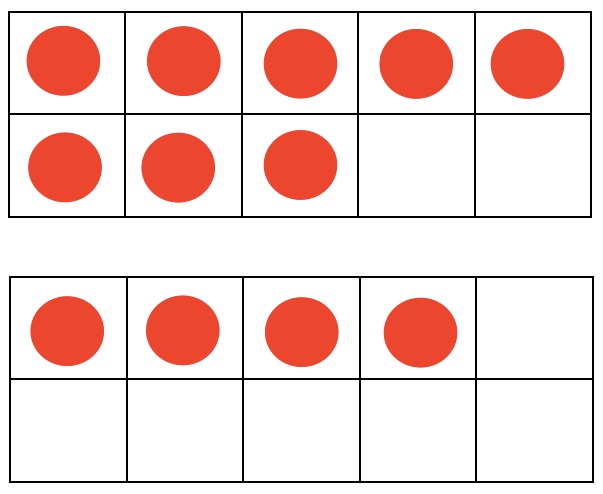
On this one I was curious to hear all of the same things from the first one, but to also hear how they see/think about teen numbers. Do they move the dots to make the 10 and why do they do that? Do they know 8+4 and don’t think about moving the dots? How do they know it is 8 and 4…is it because of 5 and some more or because of the missing boxes to make the 10 or the 5?

Again, all of the things I anticipated came out, however one little girl started explaining how she started by counting the empty boxes so I completely thought it was going to be 20 – 8 =12, however it did not go there.  She did get to 8 empty boxes but then said, “so then I moved two up to make 10…” Ha, not where I saw that going!

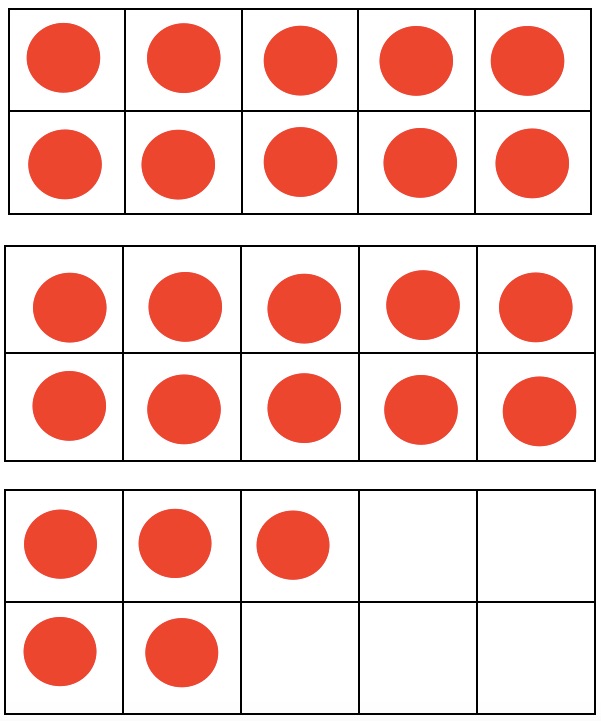
Image 3:

image3

Building on what I learned from the first two, I wanted to see if and how they combined 10’s and then added on the extra dots. I didn’t make the 5 a neat row on the bottom because I wanted to see how they organized them. I was excited to see that as soon as I flashed the image the first time, all of their eyes went right to the bottom ten frame. That let me know that once they saw a full ten, they could just keep going and it would be easy to add that on at the end. The students shared their thinking and then I wanted to focus on the 20 + 5 = 25 and 10 + 10 + 5 = 25. Having recently read/reread Connecting Arithmetic to Algebra and Thinking Mathematically, I am really interested in how students in the younger grades build this foundation for algebra. So I told them i was going to write an equation and I wanted them to tell me whether it was true or false and give me a thumbs up or thumbs down on it. I wrote 20 + 5 = 10 + 10 + 5. I was completely anticipating the majority to say false because they are used to seeing one number after the equal sign, so I was SO excited to see more than 75% of the class with their thumbs up. I asked them share why and many students said because the 10 and 10 are the same as the 20 on the other side and the five stayed the same on both sides. Others said because it is 25 on both sides so that is the same. This was such an interesting thing to think about for me…some student look for balance (equal on both sides) while others look to make them look the same on both sides (the 20 is the 10 + 10), a little bit different in my mind. 

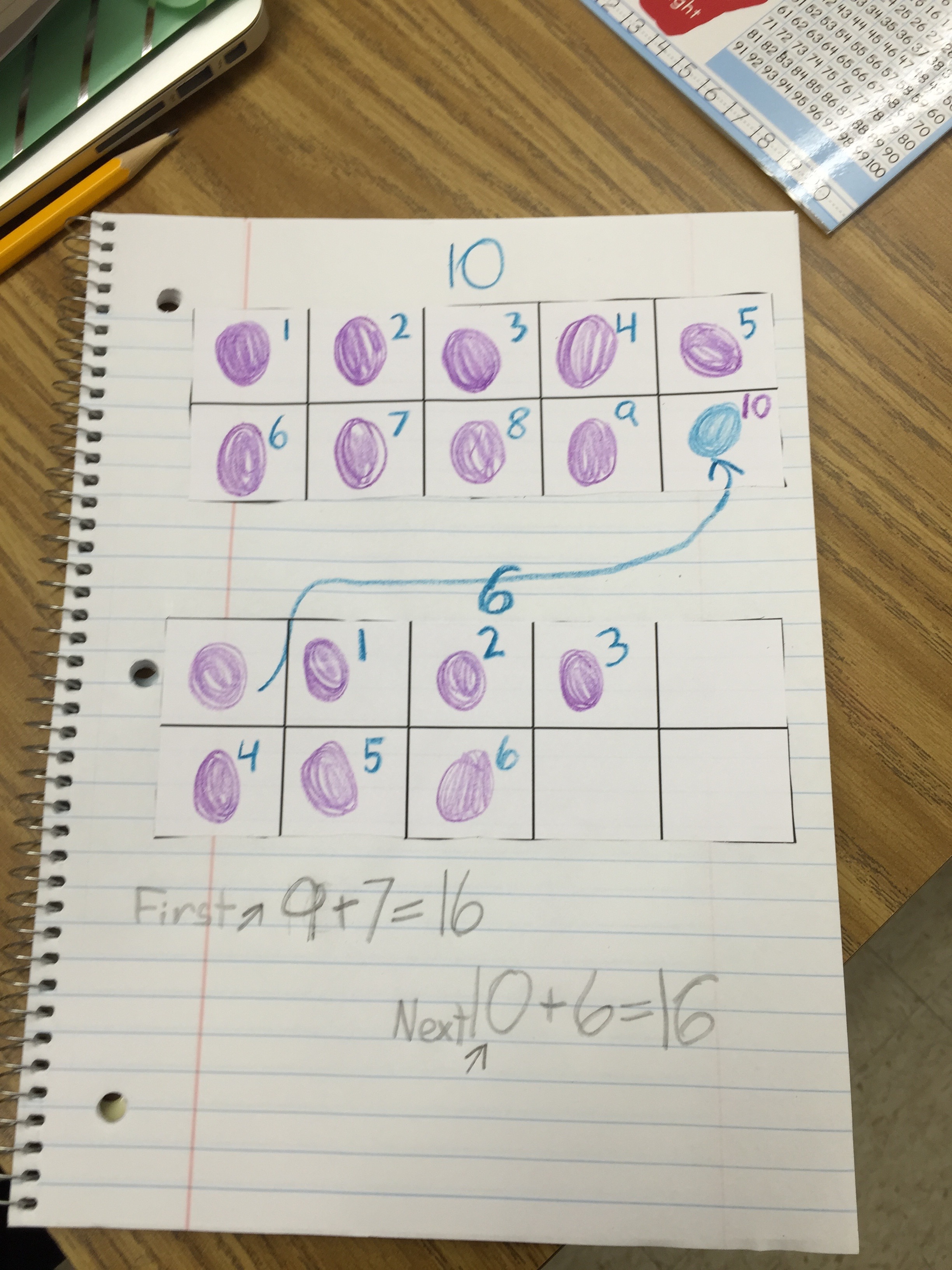
After the talk, I was SOOOO excited to see that Miss Robertson was starting math journals this year so we came up with a double ten frame (the first one with 9 dots and the second with 7 dots) for the students to explain how they think about the dots? What things to they look for or do to find the number?

Here were some of their responses that I thought we so interesting and leaves me wanting to chat with them about their work!!

IMG_0590

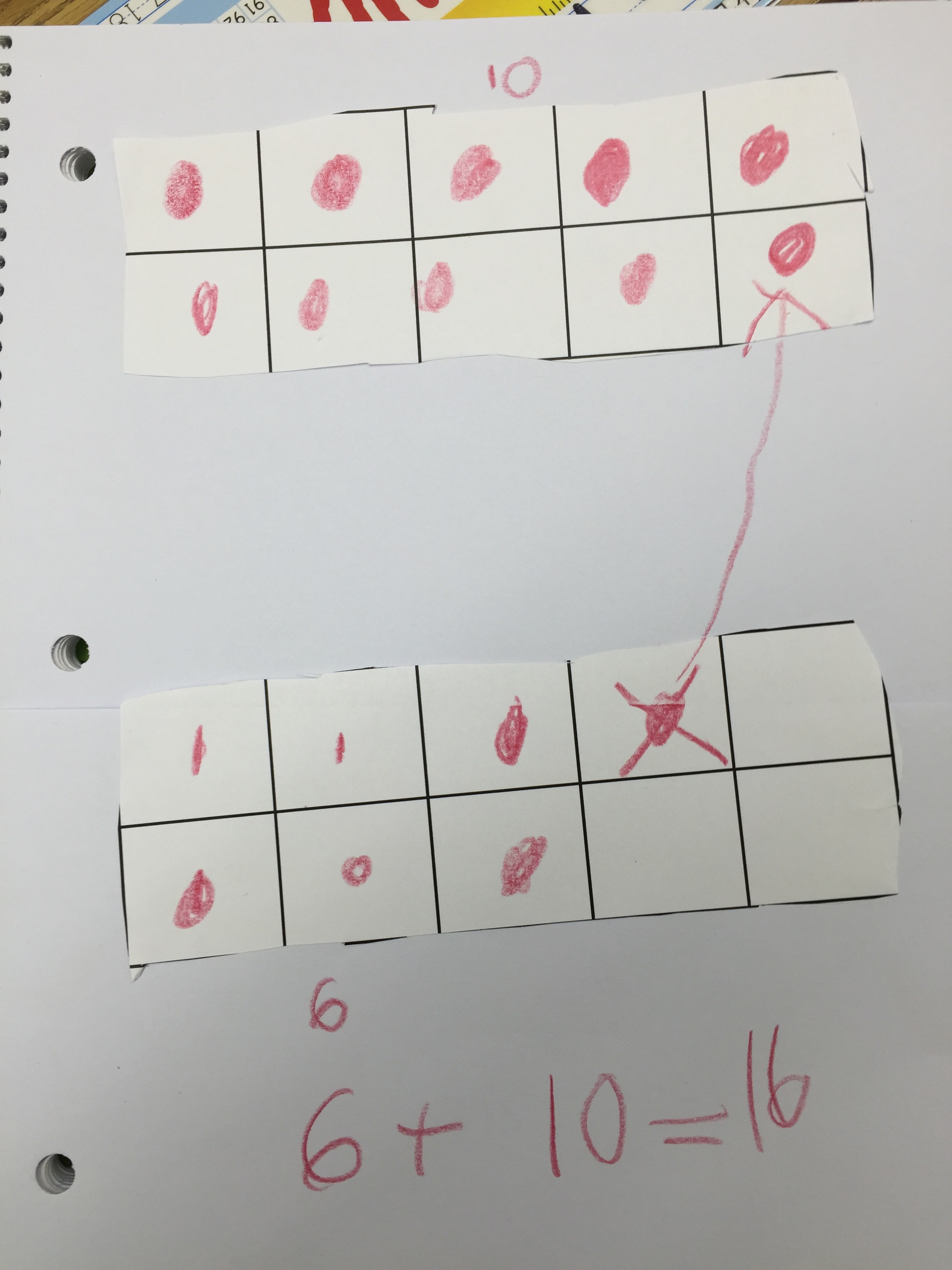
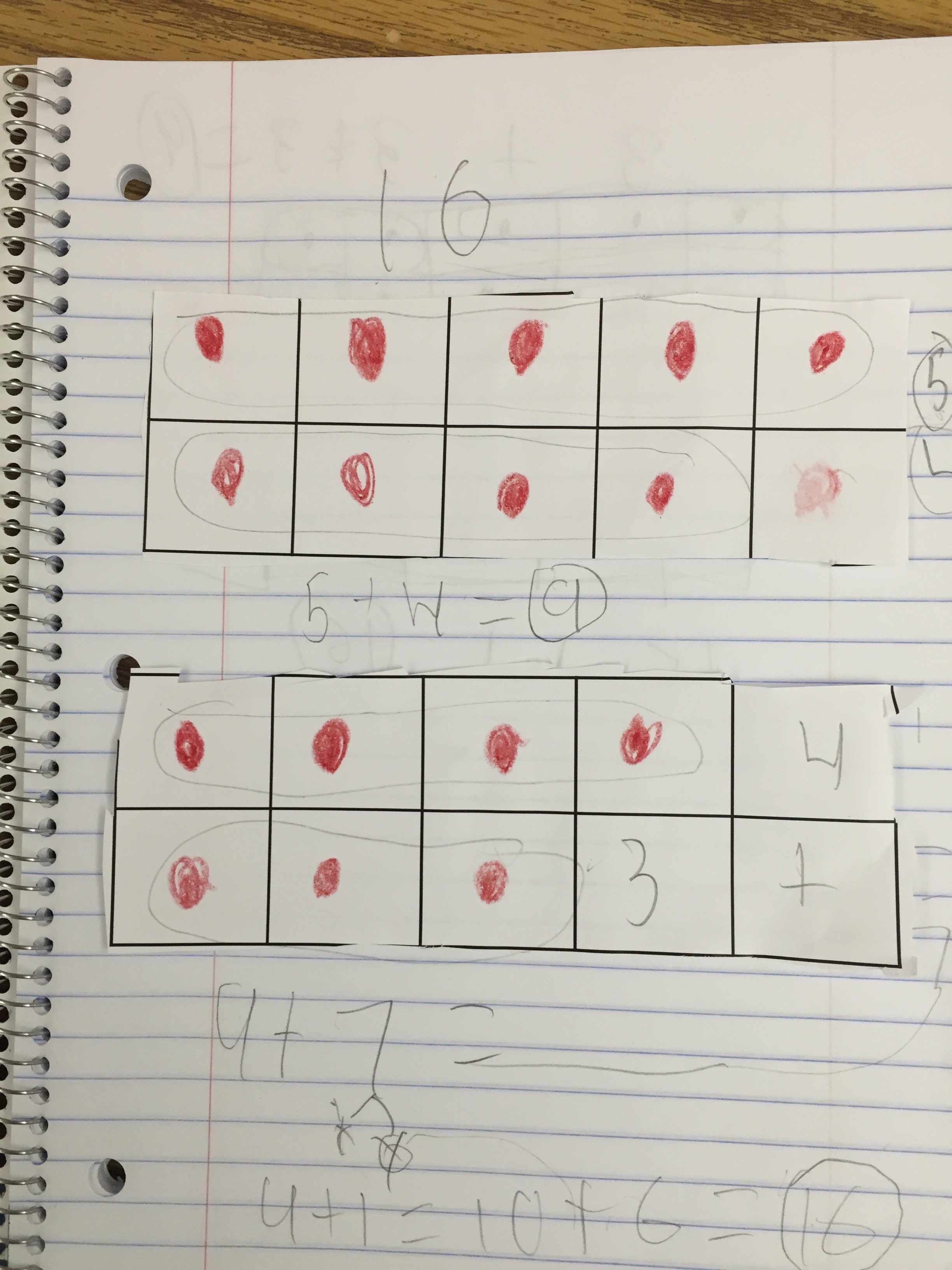
I loved so many things about this one. The “10” in a different color makes me feel like that student thinks there is something really special about that 10. Although she numbered them by ones, I don’t think that is how she found the 16, but I would like to chat with her more. I wonder if she wrote 9+7 but then filled in the answer after she moved and solved the 10+6=16? 

IMG_0585 (1)

This was so exciting because it was one of Miss Robertson’s ELL students and look at all of that writing!! While there is no answer, there is the expression, 5+4+4+3 at the top which shows me how he is seeing the dots. He went on explain about a 10, but I did not capture the back of the paper…grrrr… stupid me. I will have to go back to this one! 

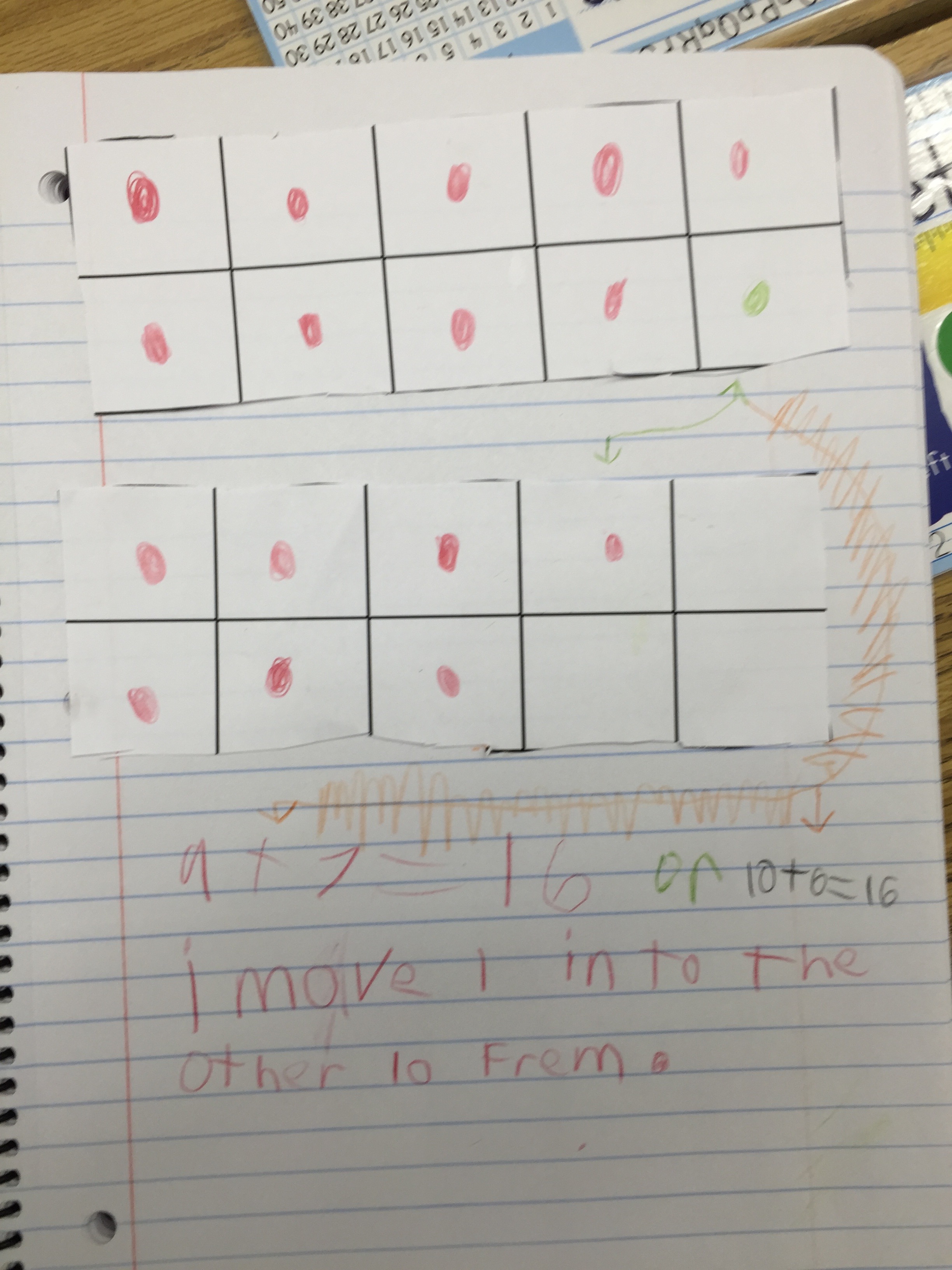
IMG_0588

I was amazed to see so many students write both equations and with such an articulate explanation of the process. I expected, if a student moved a dot, to just see 10+6=16 written. Like this:

IMG_0589

But it was interesting the student in the first one wrote both! I am so excited for Miss Robertson to try a number string with them without the ten frames to see what they do with that! 

IMG_0587

This student showed how they thought about the dots in each ten frame and then at the bottom shows beautifully how he combined 9+7. Under the 7 you can see the decomposition to 6 and 1, how lovely. The bottom thought string needs to be something to think about moving forward as teachers. Making explicit the meaning of the equal sign. 

IMG_0586

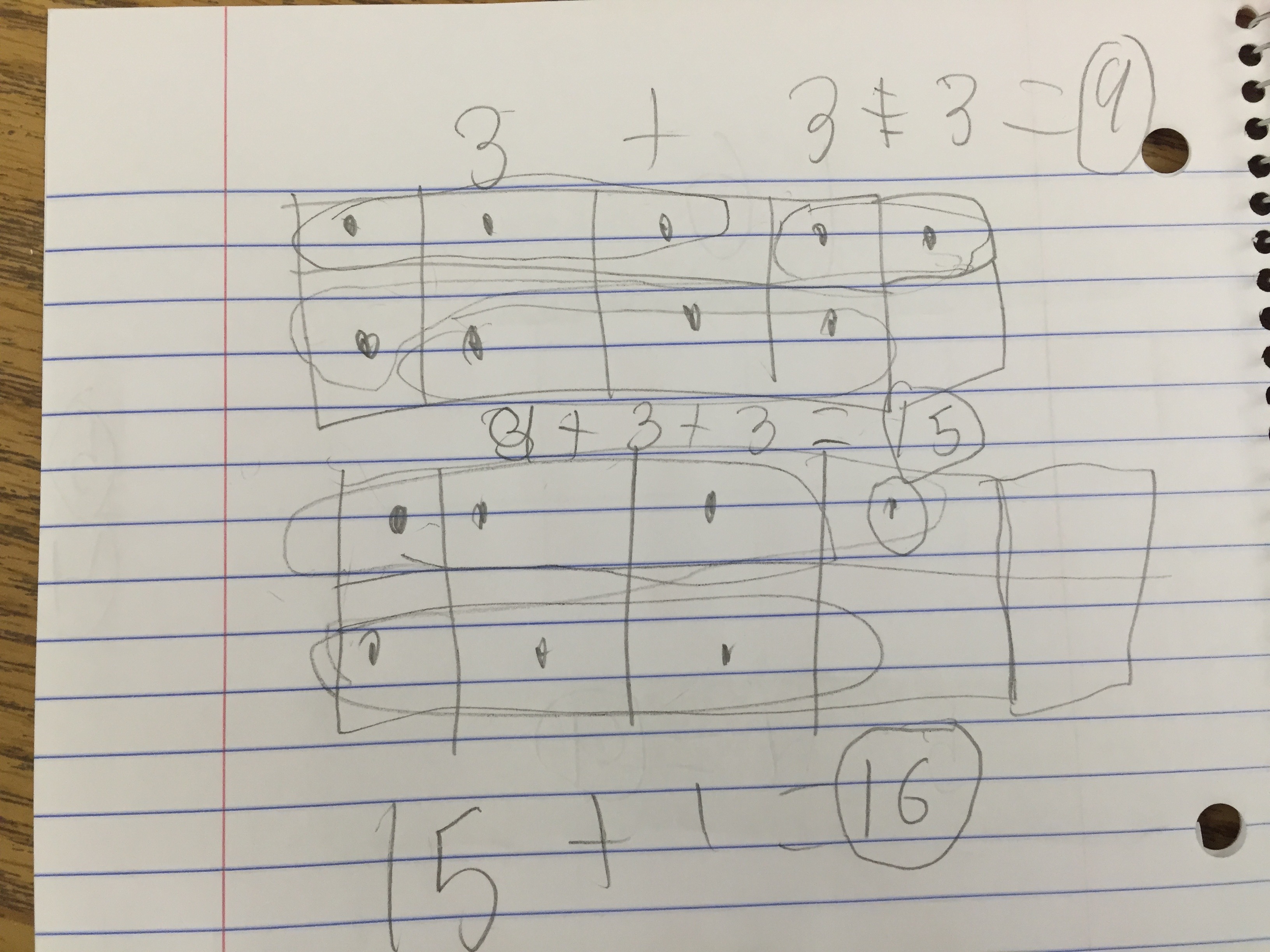
Ok, I am obsessed with this one and I need to talk to this student one more time! I am so curious why this student chose 3’s. Did he see 3’s to start or did he know something about 9 being able to be broken into 3’s? I  could completely see that if the top ten frame looked like 3’s or they were circled like the bottom one and the 3’s to the right were grouped together, however they are circled like he was counting off by 3’s by going down to the next row. Would he have done the same thing if the top ten frame was 8? In my head I am feeling like the student knew that 9 could be three 3’s, thirds, by the way it is circled. I don’t know if that is something students think about at all, so I am so curious. Or do students “see” threes but then circle them in a different way then they saw them?

Now, onto my 1st and 5th grade experiences yesterday….I am not going to be able to keep up with these K-5 blogging ideas this year…so much great stuff!

-Kristin

Making Number Talks Matter – Book Study!

I honestly cannot talk about the teaching and learning in my classroom, or across our school, without highlighting Number Talks. I cannot recall the very first time I started Number Talks, but now I cannot imagine my math class without them. My Number Talk journey began with Sherry Parrish’s book and had continued to grow through reading Cathy Humphreys’ and Ruth Parker’s most recent book, Making Number Talks Matter. I implement Number Talks on a regular basis, reflect through writing blog post after blog post and have presented at both NCSM and NCTM around Number Talks. I simply cannot say enough wonderful things about them!

For this reason, it was not surprising when I had the opportunity to meet my fellow Teaching Channel Laureates this summer, that Crystal (@themathdancer) and I struck up an immediate conversation about Number Talks when we began chatting instruction. As an elementary school teacher, I often have middle and high school teachers ask what Number Talks could look like in the secondary classrooms. Would the setting be the same? What would example problems or strings look like? How does the content focus change? How do we get students at that age to engage in these mathematical conversations?…etc. So many questions that I still am trying to wrap my head around.

Fortunately for me, Crystal is a middle school teacher using Number Talks, so our conversations gave me great insight as to how they look and feel in the middle school. We talked extensively about the Number Talk course she had taken with Ruth Parker and shared students’ conversations during Number Talks in our classrooms. It was so exciting to see the connections between our students’ experiences and the path Number Talks can take after my students leave me and enter the middle school.  While I would love the opportunity to plan and observe Crystal’s classroom, and her to visit mine, she lives in Washington state while am on the east coast in Delaware, so our opportunity to collaborate face to face is not a reality.

Enter the wonderful world of technology, amazing resources available through The Teaching Channel, incredible teachers around the world wanting to learn and grow every day, and Ruth and Cathy’s new book Making Number Talks Matter!  Now, Crystal and I do not have to be on this amazing journey alone, but instead we have the opportunity to create an experience in which other educators everywhere can join us!

Together, we have planned and structured a book study unlike any other! Flexible to fit your needs, full of valuable resources, and completely FREE!

Beginning October 5th, each week will be dedicated to one chapter of the book. Conversations will happen on Twitter and Facebook, videos will be posted in our Teaching Channel Teams group, and we will even have a guest appearance by Ruth Parker herself! It is guaranteed to be an amazing learning experience that can only get better with your participation!  

For more information and to register for the book study, follow the links below:

We look forward to learning with you and Getting Better Together!

Check out Crystal’s Number Talks journey here!

-Kristin

Establishing a Culture of Learning …The First Hour

Every year, we as teachers work so hard to establish a safe, open place for our students to learn. My goal in moving out of the classroom year and into a math specialist role is to also establish this same culture among our staff. A culture where teachers talk about instruction, math problems, and student ideas, feel ownership in their lessons and the lessons of others, and can comfortably visit one another’s classrooms. It becomes a norm. It is not easy and definitely cannot be done alone. I am SO incredibly fortunate to have a wonderful principal, Jenny (@PrincipalNauman) and district supervisor (@EducatorKola) who support the vision and are always open to new ideas, a great ELA counterpart Erin (@EGannon5) who helps me focus and thinks about the important details I miss in my excitement about things, incredibly caring, motivated colleagues who always want to grow and learn, and all of the amazing educators in my face-to-face and online (#MTBoS) networks who I mention throughout this post.

Yesterday was Erin and my first opportunity to talk with teachers. We only had one hour to work with the full staff, so we had to truly prioritize and make the most of every minute! We decided it was most important to set the tone for the year and our work together with the teachers. We wanted to begin establishing a culture of learning. The best part was, we were not starting from scratch! Our staff is so wonderfully open to new ideas and really took Number Talks and ran with them over the past few years, however there is always room to grow and improve upon what we were already doing. PLCs are part of that room to grow. While they participated and did everything asked of them, teachers were not feeling that time was based on their individual needs as much as it should be. Being one of those teachers last year, I put myself in that group.

Establishing a Culture of Learning

Establishing a Culture of Learning (2)

Instead of telling them what a learning culture could/should look and feel like, we wanted them to experience and reflect on it. What better way to do that than Talking Points? (shout out to Elizabeth @cheesemonkeysf) We designed the Talking Points to give teachers a range of ideas of how they could be used, whether around content specific statement or ones around mindset.

Establishing a Culture of Learning (3)

I have never been in a PD where Talking Points are not a hit during the activity itself, but the reflection afterward is twice as valuable! We asked them how this activity would promote a culture of learning in a classroom. We tried to quickly list ideas as they responded so the list doesn’t truly capture the appreciation teachers had for students talking and listening to one another!

IMG_0551

When talking to my colleague Faith (@Foizym) about our plan for the hour, I really stressed how I wanted to make my work with teachers valuable this year. I wanted them to want to talk math with me and want me in the classroom and not see me in any type of evaluative role, I wanted our work together to be about their needs in order to best meet the needs of their students. She suggested having them write goals for themselves and their students. So, we asked them to complete these questions to know what each of their goals were…

Establishing a Culture of Learning (5)

We got amazing answers that really spoke to the thoughtfulness of our staff. I would love to post a few but I have to ask for some permissions first:)

Now we moved into how we were visualizing this culture permeating through our work together. Knowing we were introducing Learning Labs and Teacher Time Outs to them soon, we wanted to have them brainstorm words they associated with the word “Lab” and “Time Out” to set the stage. These slides did not have the words/ideas around it when they saw it, we put those up after they brainstormed.

Establishing a Culture of Learning (6)IMG_0549

Establishing a Culture of Learning (7)IMG_0550

Now we described our shift from PLCs to “Learning Labs” and the use of Teacher Time Outs. If you have not heard of Math Lab or Teacher Time Outs, I will point you to Elham Kazemi (@ekazemi) and her University of Washington peeps who are doing AMAZING work with this. Here is her ShadowCon speech that gives a wonderful description. Elham has been so generous in thinking this through with me and has given me wonderful advice, much of which I will continue to need I am sure!

Establishing a Culture of Learning (8)

Establishing a Culture of Learning (10)

Establishing a Culture of Learning (9)

I hope we captured it as she intended, but sadly at this point we were running out of time. There were many questions about the timely structure (that we honestly are still trying to hammer out) but overall everyone was really excited about this work! We received so many positive comments and offers to be the first to try out whatever we wanted to do!

I left completely excited about this work…even more excited than I was to start, if that is even possible! Once Erin and I work through the time constraints and the crazy schedules we know everyone keeps as teachers, I cannot wait to see the work that awaits all of us!

-Kristin