Category Archives: Number Talks

Fraction Flexibility in Number Talks

In my RTI (Response to Intervention) class, I use Marilyn Burns’ Do The Math program, which is wonderful for building conceptual understanding of fractions through the use of fraction strips. Students use the fraction strips to build equivalencies, make comparisons and add/subtract fractions. It does not take long for students to be able to “see” the equivalencies without having the strips in front of them and develop fluency and flexibility with fractions. In addition to this module, I do Number Talks with the group. I do a combination of whole number operation talks and fraction number talks.

This Thursday, I did a Fraction Number Talk in which I wanted students to think about the fractions and make friendly combinations when adding. I never like to pose a problem with one solution path, so each can be solved using another strategy, however my goal was making friendly combinations. Next to each problem I put my thought in brackets so you have an idea of what i was thinking:) This is the string I planned:

2/4 + 2/3 + 6/12      [(2/4 + 6/12) + 2/3]

2/3 + 1/4 + 1/4 + 2/6  [(2/3 + 2/6) + 1/4 +1/4]

1 3/8 + 5/10 + 3/4  [(5/10 + 1/2)+1 3/8 + 1/4]

They did so wonderful with these and some began whining that these were too easy and to give them something really hard. So I gave them my final problem:

2/3 + 1/2 + 3 + 1/4

There were a few groans and “this isn’t hard“s because they went to 12ths and had the answer quickly. I told them if they had the answer, to try to use the strategy they had used in the previous problems to see if they got the same answer. I was thinking they would use a piece of the 3 to make the 1/2 and 1/4 a whole, but of course there is always one who surprises me! He had a beautiful explanation so I asked him to write it down for me so I could remember. He got a little mixed up in his wording, so I will do a translation after you check out his reasoning.
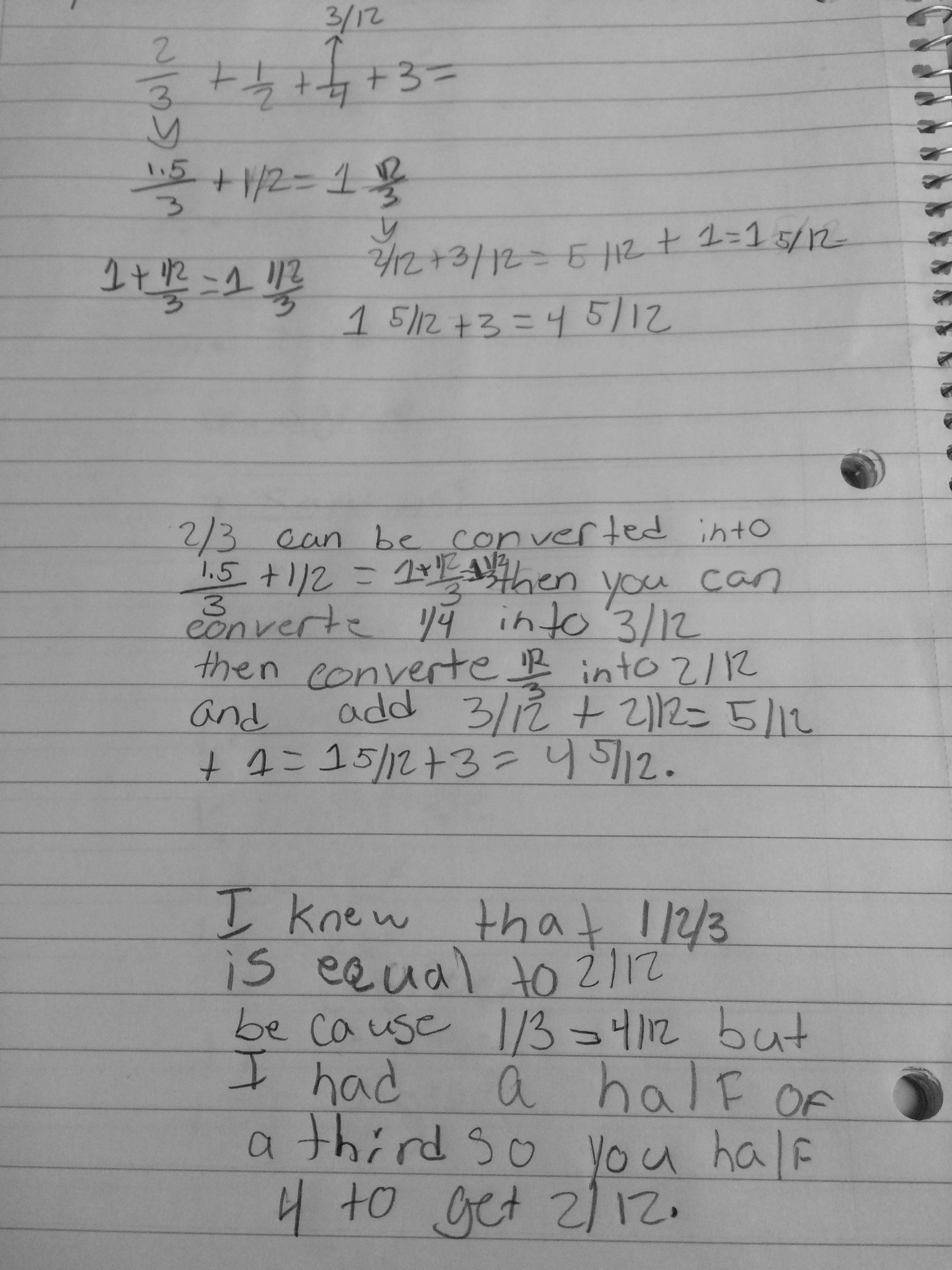
IMG_8300

He took 1.5/3 from the 2/3 to add to the 1/2 and make a whole. He then added the 1/2/3 to the 1/4. I, of course, asked him how he added that and his response was so beautiful as he explained it to me. I mean how amazing is it that he knew 1/2/3 is equivalent to 2/12…and this was all mentally!

Let me assure you that this student CAN add these fractions in a much more efficient way, and this was him challenging himself to play around with the fractions. THIS is what I would consider flexibility in operations and also where I want students to see math as fun…playing around with numbers!

– Kristin

Student-Led Number Talk

As I read Max Ray’s (@maxmathforum) book, “Powerful Problem Solving,” I can’t help but reflect on my own classroom experiences.

In the chapter about Communication and Community, Max writes,

“Modeling good listening skills and acting like a dinner party host (bringing together interesting people with good ideas, asking questions or providing activities to help them start talking, and then backing out of the way and encouraging them to talk to one another) go a long way in helping students pick up on the idea that their peers have useful things to say.”

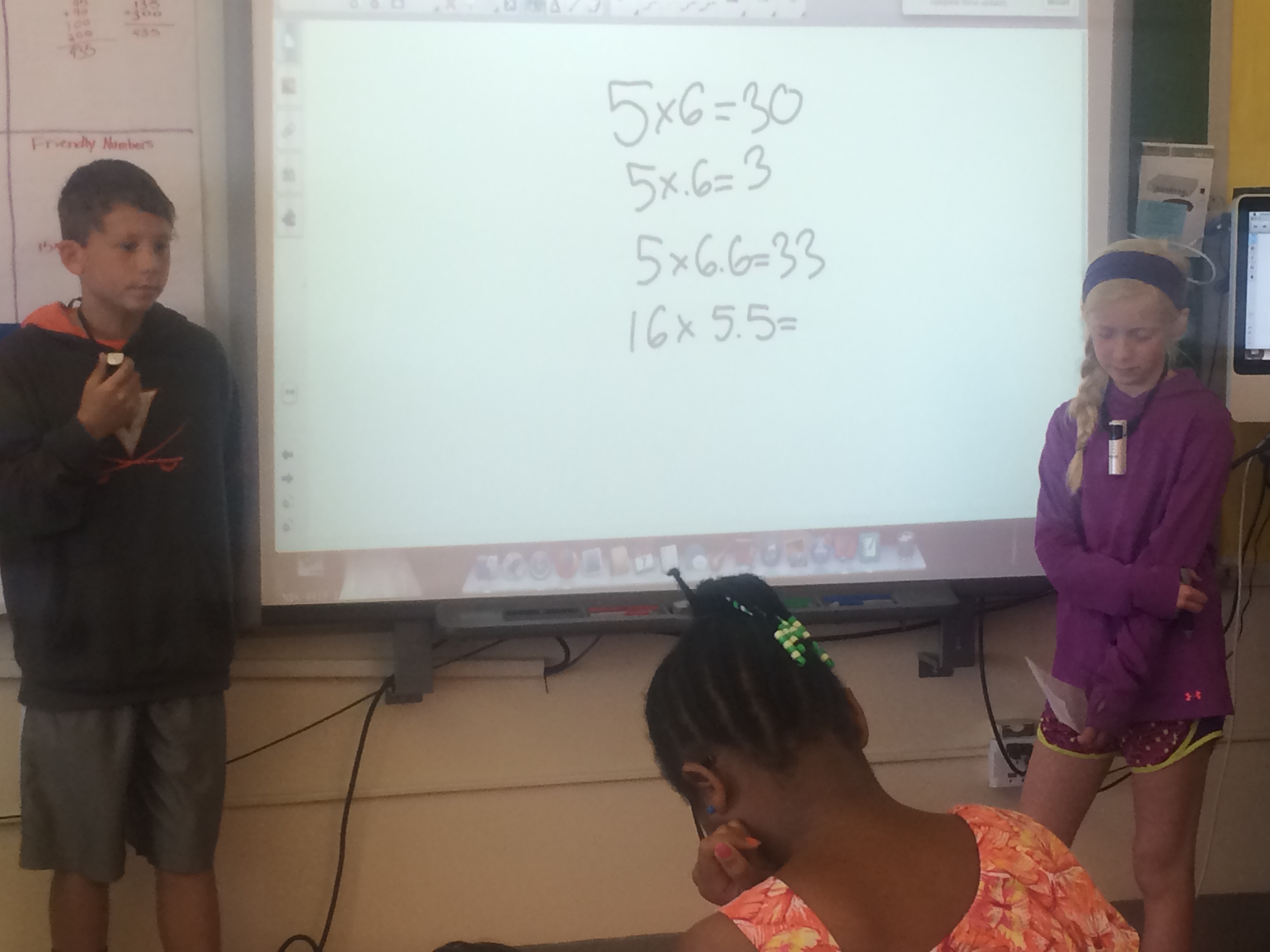
At the end of the year my students began asking if they could “do a Number Talk” with the class and record it with their ipad to watch later. I hadn’t thought of this, but thought it would be interesting to see how it went so, “Sure!”  Before presenting, they had to show me the string of problems designed with a purpose and the questions they would ask the class as the number talk progressed. Wow, do you learn a lot about yourself and their role as active listeners when they start planning!

This was their string and questions….

IMG_4220When I looked at this, I was so surprised to see they DO really listen to the questions I ask during class. Don’t get me wrong, they always are such great communicators/listeners during class, but I never knew how much they internalized the questions themselves. It is my hope they keep these questions in the back of their mind as they continue future math work, both in groups and individually. How cool to think that as a student is working on any math problem, they are continually thinking things like, “What strategies could I use?” or “Does this always work?” Metacognition at its finest!

They designed a string in which they said partial products (distributive property) was the goal. It obviously was, however the decimal point movement when multiplying by 10 also arose since we had done previous work with multiplying by powers of 10. They did a beautiful job and the rest of the students were such amazing participants.

Another student had filmed the talk for them on their ipad and it was so interesting to watch them later go back, watch it, and talk about what they should have said or how funny something they said sounded. It was such a great experience for all of us and definitely something I will build more regularly into my class next year!

– Kristin

This was their revised/follow-up one since the x10 didn’t really capture their intent…they wanted to try another!

IMG_4221


Inspired Thoughts on Number Talks

During the majority of the professional development planning I have been doing this summer, I feel like one of the common threads is Number Talks. After each conversation, more and more questions start spinning in my head….questions about how often to implement, questions about teacher recording, and most importantly, questions about their purpose.

I wasn’t inspired to write them all down until I read @gfletchy’s post: http://gfletchy.com/2014/07/22/on-you-marks-get-set-number-talks/.  BTW *If you do not follow his blog, you most definitely should, great stuff*

Questions/Thoughts about Number Talks:

1 – Through the math conversations, it fosters a safe, collaborative culture in my classroom.

2- Their conversations embody the Mathematical Practices in my eyes. Their use of structure of the number system, creating viable arguments, critiquing the reasoning of others and repeated reasoning is always music to my ears.

3 – I struggle with purpose…is the purpose a particular strategy? That is how Parrish’s book frames it. There is a string, centered around a certain strategy. Not that other strategies do not emerge, but the numbers are such that they lend themselves to a particular path. So, my conclusion is this – When doing a number talk string, I  am not pushing a certain strategy, but instead, encouraging the students to truly think about the numbers before simply “computing.” I do want students to think that if they are multiplying 39 x 45, to think about 40 and taking a group away rather than breaking both numbers to get 4 partial products. In thinking about the numbers more deeply, they call on their conceptual understandings to develop fluency.

4 – Is the purpose to generate connections between strategies? I do think there is a benefit to putting up one problem and recording all of the strategies to make connections between them. I use that as a formative assessment as to what my students know and also to identify misunderstandings/misconceptions that emerge.

5 – Fawn’s blog has sparked an interest to branch into more visual patterns to switch it up a bit. What that would look like in my 5th grade class, is something I need to work through but I think the algebraic reasoning behind them would be intriguing.

6 – I Completely agree with Graham, they must be a daily routine, they build computational fluency (based in conceptual understanding) and must not just happen on Fridays! Also, it is important for students to use their Number Talk reasonings in other math work.

7 – Teacher recording is something I am still trying to improve upon daily. Recording their thinking is harder than one would think! Also, I find WHAT I write can change the direction of the talk itself.

I am a huge proponent of Number Talks and would love to see our elementary work with them to start to move into the middle/high school classrooms!

-Kristin


Decimal Multiplication: Whole # x Decimal

Through numerous Decimal Number Talks, Investigations on tenths, hundredths, and thousandths grids, and many findings about decimal operations, we are approaching our last couple lessons in our decimal unit. Not that the work with decimals ever ends, but our unit ends with decimal times decimal and the generalization of a “rule” for multiplying decimals. I have many thoughts about the new Investigations unit on multiplication of decimals but I am very excited about the connections my students have made between whole number and decimal operations. I do attribute a lot of their flexibility to our Number Talks though:)

I wanted to assess where they were before we moved into a decimal times decimal work because I think there is a lot of reasoning to do there before we come to a generalization!  I was really excited to see the use of multiple strategies!

First, I had students who were still treating the decimal operations like whole number operations and reasoning about where the decimal point “makes sense.” I do love this because it is heavy in estimation and sense making about what is reasonable. It is obviously not the most efficient strategy, but I what I truly learned from this, is that I need to do more whole number multiplication work with this student to build efficiency…

Image

I have students that love partial products….(and I cannot get some students to stop saying the “box method”….:)

Image

I loved this area model because of the size of the .4 side. She was very particular about that!

Image

Some friendly number work…I especially loved her estimation first….yeah!

Image

I had some who multiplied the decimal by 10 and then divided their product by 10…

Image

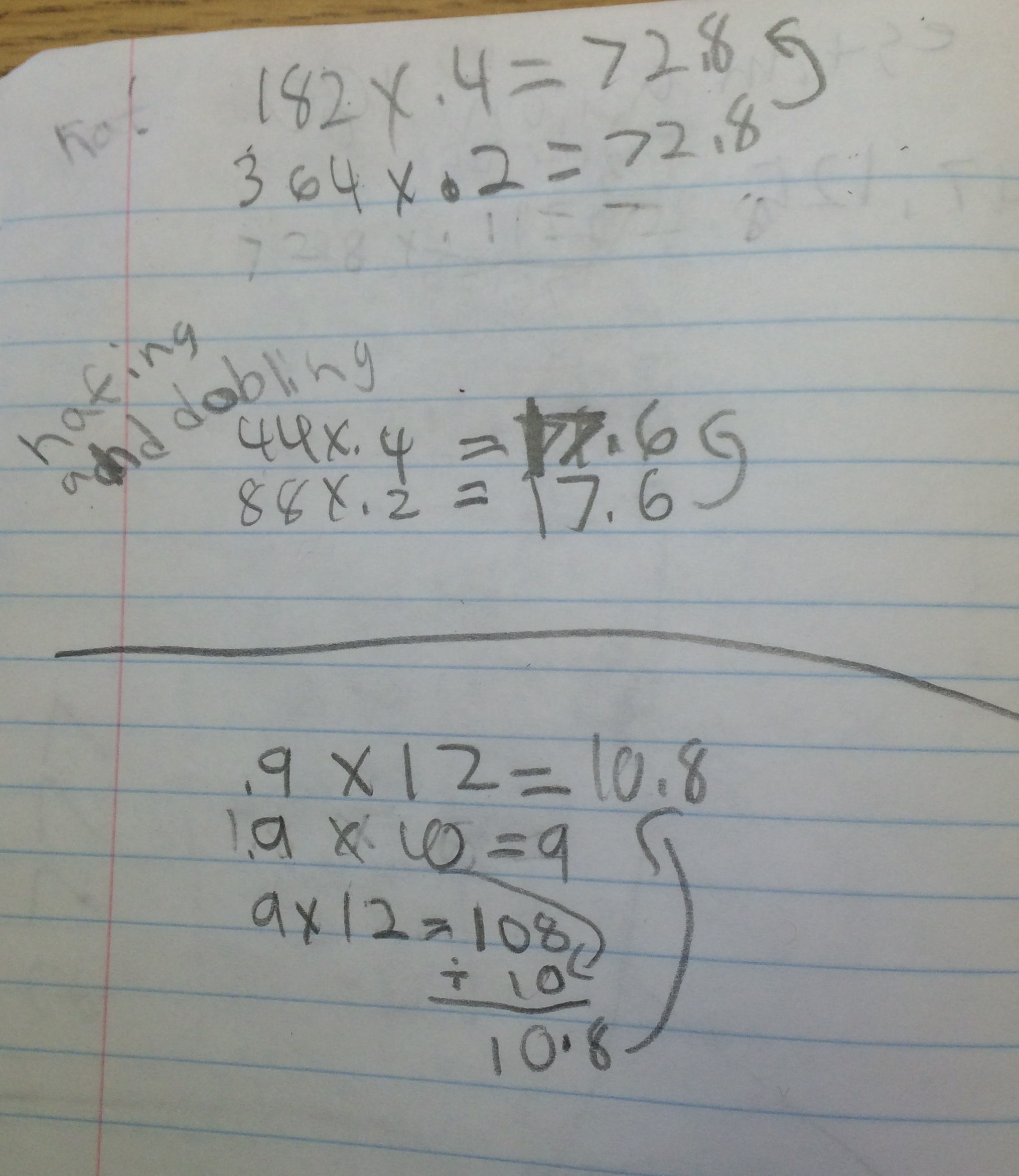
Saw some halving and doubling…

Image

I had a student think about the decimal as a fraction. It starts at the top and then he jumps to the bottom of the page.He said he multiplied 9 x 12 to find out how many “rows” he would have, 108. Then he divided it by ten because there were 10 rows in each grid.  It was interesting!

Image

So tomorrow we start decimal by decimal multiplication…I feel great about our start and I look forward to having them reason about decimals less than a whole times less than a whole.

-Kristin


Number Talks – Fractions

Through doing Number Talks with students K-5, I started to realize that one thing I look for students to use in our whole number computation discussions is using known or derived facts to come to a solution. I feel like the problems I have been using are crafted to use the answers from previous problems to reason about the ending problem.

In the younger grades, I would like to see students using the double known fact of 7+7=14 to know 7+8=15. I want them using 23 + 20=43 to get 23 +19 = 42. I don’t want them treating every problem as if they have to “start from scratch” adding all or adding on.

An example in the upper elementary:

18 x 2

18 x 20

18 x 19

This progression leads them to use a known or derived fact (18 x 20) in order to solve 18 x 19. To build efficiency, I don’t want them to the treat the final problem in the progression as a “brand new” problem in order to reason about an answer.

Along these lines of thinking, as I observed students working the other day, I realized that students weren’t using this same use of known/derived facts when working with fractions. For example, a student was adding  3/4 +  7/8. He used 6/8 as an equivalent of 3/4, added that to 7/8 and ended with an answer of 13/8. Don’t get me wrong, I loves his use of equivalency and I am a fan of improper fractions, however I started wondering to myself if it would have been more efficient (or show that he actually thought about the fractions themselves) if he used a fact he may have known such as 3/4 + 3/4=1 1/2 to then add an 1/8 on to get 1 5/8? Or used 3/4 + 1 = 1  3/4 and then took away an 1/8? Is that the flexibility I want them using with fractions like I do with whole numbers?

I thought I would try a Number Talk the following day to see….

1/2 + 1/2

Thumbs went up and they laughed with a lot of “this is too easy”s going around.

1/2 + 1/4

Majority reasoned that 1/2 was the same as 2/4 and added that to 1/4 to get 3/4. Some said they “just knew it because they could picture it in their head” I asked if anyone used what they knew about the first problem to help them with the second problem? Hands went right up and I got an answer that I wish I was recording. It was to the effect of,”I know a 1/4 is half of 1/2 so the answer would be a 1/4 less than 1.”

1/2 + 3/4

Thumbs went up and I got a variety here. Some used 2/4 + 3/4 to get 5/4 while others decomposed the 3/4 to 1/2 + 1/4, added 1/2 + 1/2=1 and added the 1/4 to get 1  1/4.

3/4 + 3/4

Got some grumbles on this one, because it was “too easy” – 6/4…Duh! The class shook their hands in agreement and they were ready to move on to something harder.  I noticed that when the denominators are same, they don’t really “think” about the fractions too much. I waited….finally a student said, “It is just a 1/4 more than the previous problem so it is 1  1/2″ and another said each 3/4 is 1/4 more than a 1/2 so if you know 1/2 + 1/2 = 1 then you add 1/2 because 1/4 + 1/4 = 1/2.” I had to record that reasoning for the class bc it was hard for many to visualize.

3/4 + 5/8

Huge variety on this one and I thoroughly enjoyed it! From 6/8 + 5/8 = 11/8 to decomposing to combine 3/4 and 2/8 to get the whole and then 3 more 1/8s = 1 3/8.  There were many more students who used problems we had previously done.

What I learned (and questions I still have) from this little experiment:

– Students LOVE having the same denominator when combining fractions.

– Do they really “think” about the fractions when the denominators are the same? Can they reason if that answer makes sense if they are just finding equivalents and adding.

– Students can be flexible with fractions if you push them to be.

– Subtraction will be an interesting one to try out next.

– I would much prefer if I remembered to use the word “sum” instead of “answer”…. I tell myself all of the time, but in the moment I always forget.

– Using known or derived fact and compensation are invaluable for students when working with both whole numbers,  fractions and decimals.

– Are there mathematical concepts that present themselves later in Middle School or High School in which known and derived facts would be useful?

Happy Thanksgiving,

Kristin

Reversing the Number Talk

I am a huge fan of number talks and use Sherry Parrish’s book at least two to three times a week to conduct a number talk with my students.  Sometimes I pose just one problem for students to solve mentally and discuss strategies while making connections between them or I do a string of problems targeting a specific strategy.  Recently, I have been focusing on partial products and using friendly numbers as strategies to multiply. I noticed that as the string went along, they wanted to try and predict what the final problem (or “the hard problem” as my students would say) in the string would be. I started taking a few predictions each time and the conversation was really intriguing to me.

For example, the other day, the string was:

5 x 10

5 x 50

10 x 50

15 x 50

15 x 49

As they predicted the final problem, they actually made a more difficult prediction than the ending problem, 15 x 49. They predicted problems such as 15 x 47, 30 x 51 and 15 x 52.  Their reasonings were targeting the strategy of using friendly numbers without me having to outwardly say it.

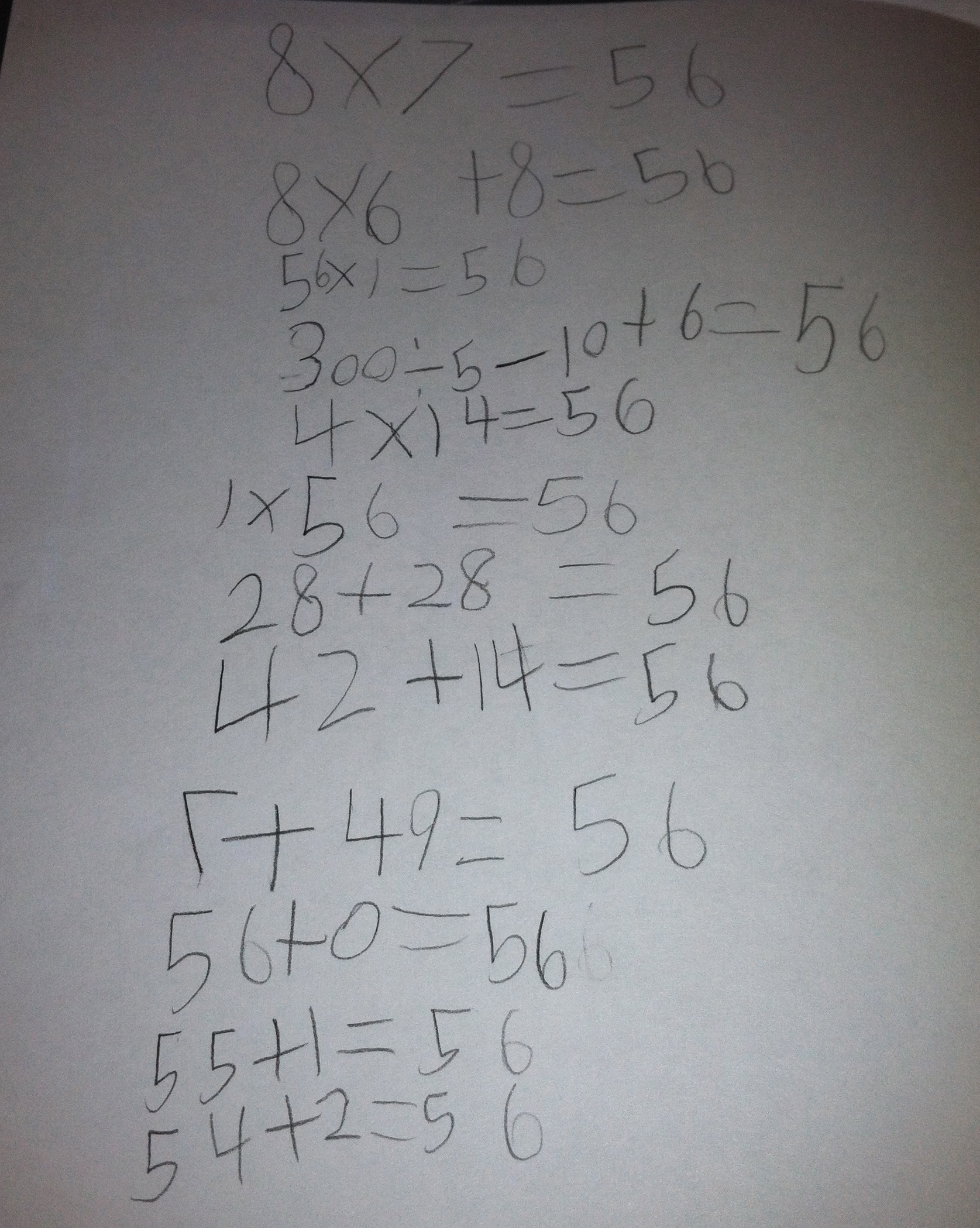
So I thought it would be interesting (and fun) to go in the opposite direction and give them the last problem of a string  to see if they could develop the string of three problems that would come before it.  I gave them “36 x 19” and they ran with it.  Here are some ideas i captured from the journals:

Photo Oct 09, 12 50 16 PM Photo Oct 09, 12 51 15 PM Photo Oct 09, 12 52 40 PM

This is a great formative assessment for me to see their thought process through our multiplication problems. Definitely adding it to my list of favorite activities!

~Kristin

Number Talks by Sherry Parrish: http://store.mathsolutions.com/product-info.php?Number-Talks-pid270.html

Connecting the Dots in 1st Grade Math Centers

As many elementary teachers know all too well, effective Math Centers take A LOT of planning and preparation. Are all of the activity manipulatives available to students? Are the directions clear for students? Are the game boards laminated? Are the ipods/ipads charged? and on and on and on….

Last week, I realized that sometimes simpler is better. A handful of my 1st graders, who have a very strong place value sense and can mentally add and subtract 2-digit numbers, have been asking (hounding) me to teach them multiplication. I struggled with this for a few days because I didn’t want to just tell them that multiplication was “groups of” or take out the tiles for array building quite yet. It wanted it to develop from something more natural, something they were used to seeing but just in a different light.

This group of students is familiar with dot images since we do number talks with them often, focusing on addition equations and properties of operations. I put the following dot image on the board:

ImageThumbs went up (our signal for having an answer) and they all agreed on the answer of 36. Then I asked them write down all of the equations they could for finding the answers. Not the main point of this post, however when a student says I knew that if it was four 10s, it would be 40 so I took away one from each group to get 36, I can’t help but get goose bumps:)

I recorded their answers on the board and then chose to focus on 9 + 9 + 9 + 9 = 36. I asked them to explain that equation to me. One student said there was 9 in each bunch (close enough to “group” so i jumped on it). I explained that this is an example of when we can write this same problem as multiplication. “This is four groups of nine, so we can write that as 4 x 9.” Their reaction “That’s it? That’s Easy” Priceless. We did a few more together before the class ended.

The next time we met, I wanted to give them a chance to do some work in partners so I could walk around and listen to each of the conversations. I tried to plan an activity that would allow me to see their thoughts on multiplication and if any of it really “stuck” with them. I racked my brain, and the internet, for something that would be engaging and fun for them, until I just decided to give them a dot image and see what happened!

Here are some of the results:
Dot Image:

Image

Student Work:

ImageDot Image: ImageStudent Work: (I was bummed, his second equation is wrong bc he forgot the middle two 6’s, but the rest is amazing!)Image

Least prep ever for a math center with the most amazing results! Demonstrates the relationship between addition and multiplication and has the properties of operations all over it! I am almost convinced you could teach K-1 math class with dot images, ten frames and number lines!

Mathematically Yours,

Kristin

Isn’t Math Really Just How You Look At It?

Over the past year and a half, I have attended numerous CCSS trainings, read the standards and examined the CCSS learning trajectories. It is evident there is an emphasis placed on understanding of the properties of operations in the elementary grades. I don’t know about anyone else, but I remember it being taught to me as a lesson: Commutative Property is a+b=b+a… and such. No meaning behind it, simply some symbols, that if you could memorize and recite each, you were considered successful (as far as grades were concerned) in math class.

Fast forward to my second year as a K-5 math specialist. Having taught nothing below 5th grade in my previous 15 years in education, I am slowly wrapping my head around the depth of conceptual knowledge in grades K-1.  I always knew K-1 was very “hands-on” but I have to admit, I really did not understand the complexity and beauty in the way kindergarteners “see” math until this year.

The other day I did a number talk with a class of kindergarten students. I displayed various dot images with anywhere from  5-10 dots arranged in different patterns. My goal was to have students subitizing the dot patterns and writing addition equations to match the groupings.

I flashed the first dot image on the smartboard for @ 2 seconds and the students wrote the number of dots they saw on their dry erase board. Students shared their answer with a partner and showed me their boards. I put the image back up and asked how they saw (visualized) the dots.  We talked about different groupings, circled the dots for each, and practiced writing a couple equations together.

Feeling confident about the goals i had set for the number talk, i began to rethink them a bit after the following image:

Image

Students quickly shared the answer of seven and then I asked, “How did you see the dots?”

The first student said,”I saw 2, 1 ,1,1, 2.” I had him circle the dots the way he saw them on the SMARTBoard and asked the students to write an equation for that grouping. Many successfully wrote a version (with some backwards 2s) of 2 + 1 +1+ 2+1=7. As I was looking around, I noticed one little girl had written all of the possible ways to arrange the 2s and 1s in the equation on her dry erase board. I realized at that moment, THIS is the commutative property in action! We shared all of the equations and I wrote them on the Smartboard.  I posed the wondering to the class: How can these equations look different but still have the same answer? They talked to their neighbor and the common response was because no dots left the picture…not exactly what I was looking for, but good answer.  I thought maybe it was too many numbers in the equation to see the commutative property or i just asked the question wrong, so i continued.

I asked for another way they saw it. Tons of thumbs went up (this is our sign for having a strategy) and the next student came to the board and circled 5 and 2. She knew it was a five, she explained because of a dice and she just knew two (there was the subitizing i wanted, but at this point we were going deeper). I asked students to write an equation for that grouping. They shared with their partner and we recorded 2+5=7 and 5+2=7. I was excited because two students had already written both equations on their boards before the share out. Now I posed the same type of question, worded differently, “What do you notice about the two equations we just wrote?”

I got responses like:
“The have the same numbers”
“Seven is at the end”
“Seven is the answer”
“He took my eraser” (all a part of the kindergarten learning curve)
“5,2,7 are there, mixed up”
Image
I went with that  comment and pressed further… “So how can the 5 and 2 be mixed up and still have the same answer?”

After a  minute or two, one little girl said, “It’s just how you look at it. From that way (she pointed left) it is 2 then 5. If you look that way (she pointed right) it is 5 then 2.”

So there you have it teachers…the commutative property is “just the way you look at it.” Simple and beautiful.