Rhombus vs Diamond

Every year in 5th grade, when we begin classifying quadrilaterals, students will continually call a rhombus a diamond. It never fails. While doing a Which One Doesn’t Belong in 3rd grade yesterday, the same thing happened, so Christopher’s tweet came at the most perfect time! (On Desmos here: https://t.co/rZQhu2SGnR)

Of course I had to pop into the same classroom today and try it out! The lower right was so obviously a diamond to me that I was curious to see if students saw the same thing and if it changed their reasoning about the rhombus as a diamond.

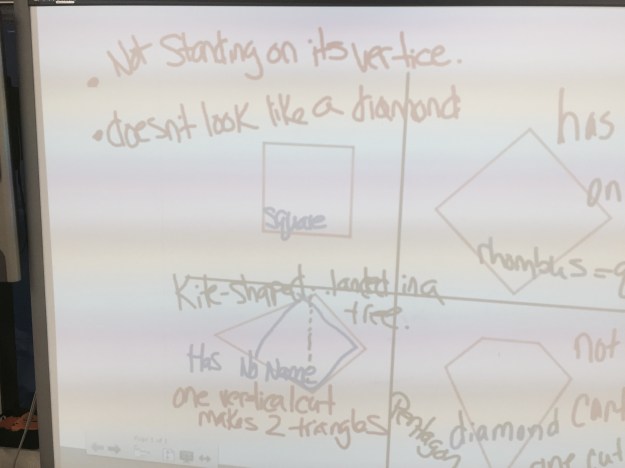
Here are pictures of the SMARTboard after our talk:

IMG_1784IMG_1783

After great discussions around number of sides, rotations, decomposition and orientation, they finally got to the naming piece. Honestly, I was surprised names didn’t come up as one of the first things. It started with a student saying the square didn’t belong because it is the only one that doesn’t look like a diamond. The next student said the lower left was the only one “that didn’t have a name.” When I asked him to explain further, he named the square, rhombus, and diamond. Because I knew at the end of our talk I wanted to ask about the diamond vs rhombus, I wrote the names on the shapes. Another classmate added on and said the lower left “may not have a name but it is kite-shaped and looks like it got stuck in a tree sideways.” I asked the class what they thought about the names we had on the board and it was a unanimous agreement on all of them. Funny how quickly they abandoned their idea from yesterday, so I reminded them….they were not getting off the hook that easy;)

“Yesterday you were calling this rhombus a diamond, what changed your mind?”

Students explained that the lower right actually looks like a real diamond and the rhombus doesn’t now that they see them together.

“Can we call both of them a diamond?” I asked. I saw a few thinking that may be a great idea. I had them turn and talk to a neighbor while I listened to them.

We came back and they seemed to agree we couldn’t call them both a diamond because of the number of sides. They were really confident in making the rule that the quadrilateral one had to be a rhombus and the pentagon was the diamond. I pointed to the kite and asked about that one, since it has four sides. “Could we call this a rhombus?” They said no because the sides weren’t equal, so not a rhombus. And because it didn’t have five sides, not a diamond either.

Thank you Christopher! All of these years of trying to settle that rhombus vs diamond debate settled right here with great conversation all around!

Next up, this one from Christopher…


Counting Collections Extension

Today in 1st grade, we did a counting collections activity. One thing I am thinking about as I see this activity happening in K-2 classrooms, is the extension. While choosing questions for students who are struggling is difficult, choosing questions for those who are finished quickly, and correctly, I find just as difficult. What questions can we ask those students who organize, count and can explain their count perfectly?

I have been toying around with this idea for a bit. I have thought about asking them to combine collections, ask how many more they would need to get to another number or mentally adding tens and hundreds to their count.

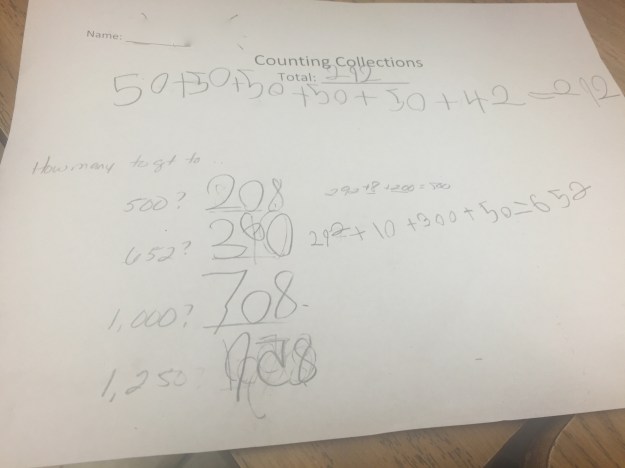
Today, I tried asking a student how many more to get to another number. It was pretty cool and led to some more ideas. He and his partner ended with 292. I asked how many more to get to 300? 8. 350? 58. He could explain using the 8 to get to 300 and how to move forward from there. Because of other groups I wanted to chat with, I left him with 500, 652, 1,000, and 1,250. He came back with the answers, but no explanation and said, “I don’t feel like writing all of that out.” I asked him to explain how he got to 500 and I would record the equation for it. He said he added 8 to get to 300 and then 200 more to get to 500, so 208. He was shocked to see it as an equation because he thought I meant to explain it all out in words. I asked him to try the next one and he started with adding 10. He said he wanted to keep the 2 ones to make it easier, awesome. When he said that, I had another idea to have students think about what place values are changing as they add to a certain number. I want to ask him why he ended with 8 ones on three of them but zero ones in another?

IMG_1767 (1).jpg

I know I have seen tons of people on Twitter using counting collections and would love to hear of other ways we could extend this activity in the comments!

Obsessed With Counting Collections

If you have seen my recent Twitter feed and blog posts, you can probably tell I am currently obsessed with Counting Collections! Because of this obsession, during our recent K-2 Learning Lab I made it the focus of our conversation. This was our first chance to talk across grade levels during a Lab and to hear the variation in ways we could incorporate counting in each was so interesting! Based on this lab, yesterday, I had the chance to participate in both a 2nd grade and Kindergarten counting collection activity and while there were so many similarities, I left each thinking about two very different ideas!

2nd Grade: Naming A Leftover

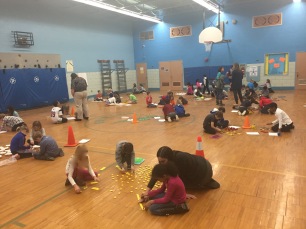
Based on our Learning Lab discussions three 2nd grade teachers had the amazing idea to combine their classes for a counting activity. While it was a great way to give students the opportunity to work with students from other classrooms, it also offered the teachers a chance to observe and talk to one another about what they were seeing while the activity was in progress. I was so excited when they sent me their idea and invitation to join in on the fun! I have never seen so much math in an elementary gymnasium before!
IMG_1713.jpg

There was a lot of the anticipated counting by 2’s, 5’s, 10’s and a bit of sorting:

And while this is so interesting to see students begin to combine their groups to make it easier to count in the end, there were three groups counting base 10 rods that particularly caught my attention:

1st Group (who I missed taking a picture of): Counted each rod as 1 and put them in groups of 10.

2nd Group: Counted each rod as 10 because of the 10 cube markings, making the small cube equal to 1. They had a nice mix of 20’s in their containers!

IMG_1711.jpg

3rd Group: Counted each rod as 10 but had a mix of rods, small cubes and some larger blocks. It was so neat to see them adjust the way they counted based on size…the rod=10, small cube=1 and the large block=5 (because they said it looked like it would be half a rod if they broke it up). After this beginning picture, they arranged the 10 rods to make groups of 100.
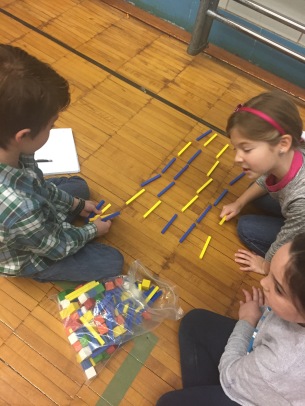
IMG_1707.jpg

The second and third group ended up with a final count and recorded their thinking, however group 1 could not wrap it up so neatly. When they finished counting they had 141 rods but one small cube left over. Since they were counting each rod as 1, instead of 10, they were left trying to figure out how to name that leftover part. When I asked the group what they were thinking, one boy said, “It is kind of like half but smaller.” I asked him how many he would need for half of the rod and he examined the rod and said 5. I have to admit, I wasn’t sure where to go with this knowing their exposure to fractions is limited to half and fourths at this point. So, I asked him, “How much we do have of one rod” and he said 1.  I followed with, “Of how many?” and he answered, “Ten. So we have 141 and 1 out of 10?” Thankfully it was approaching time to clean up so I could think more about this one. I feel like I left that idea hanging out there and would love to bring it back to the whole class to think about, but I am still wondering, what question would have been good there? How would you structure this share out so this idea of how we name 1 is important and impacts our count? How do we name this leftover piece and why didn’t a group counting the same thing not have that problem? Also, I think it will important for these students to think about the question they could ask that their count would answer…For example, how many objects do you have – would that be accurate for the group who counted each rod as 10?

Kindergarten: Why Ten Frames?

Every time I am in Kindergarten I leave with so many things to think about! In this case I left the activity thinking about Ten Frames. I am a huge fan of ten frames, so this is not about do we use them or do we not, but more about….Why do we use them? How do we use them? What is their purpose? What understandings come from their use? What misunderstandings or misconceptions can be derived from their use? and Where do these misunderstanding rear their ugly head later?

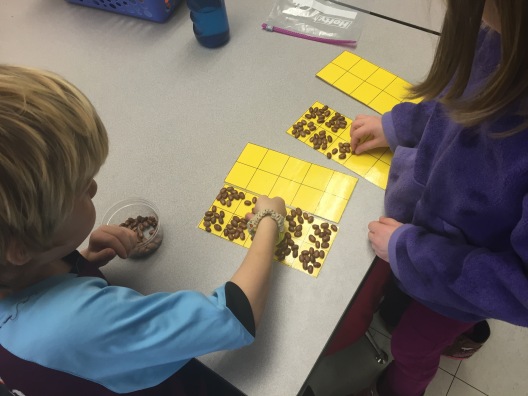
To start the lesson, groups of students were given a set to count. With a table of tools available to help them organize their count, ten frames were by far the most popular choice. However, not having enough (purposefully) for everyone’s set pushed them to think of other means… which ended up looking like they were on a ten frame as well!

As the teachers and I went around and chatted with groups, we heard and saw students successfully counting by 10’s (on the frames or look-alike frames) and then ones. This is what we hope happens as students work with the ten frames, right? They see that group of 10 made up of 10 ones and then can unitize that to 1 group. It reminds me of Cathy Fosnot’s comment via Marilyn Burns on Joe’s post, which I had huge reflection on after this lesson too!

I was feeling great about the use of ten frames until a first grade teacher and I were listening to one group count their set. I wish I snagged a pic, but I was so stuck trying to figure out what to ask the girls, that I didn’t even think about it. They had arranged 4o counters on 4 ten frames and had one left over, sitting on the table, no ten frame. We asked how she counted and she said, 10, 20, 30, 40, 50…the 1 leftover was counted as a 10. I immediately thought of Joe’s post. Not knowing exactly what to do next, I tried out some things…

  • I picked up the one and asked her how many this was, “One” and then pointed and asked how much was on the ten frame, “Ten.” Ok, so can you count for me one more time? Same response.
  • I filled an extra ten frame pushed it next to her 4 other full ones and asked her to count: 10, 20, 30, 40, 50. I removed 9, saying “I am going to take some off now,” leaving the one on the ten frame and asked her to count again. Same response.
  • I asked her to count by 1’s and she arrived at 41. So I asked if it could be 41 and 50 at the same time. She was thinking about it for a minute but stuck with “that is what I got when I counted.”
  • Then I became curious if she had a reason for using the ten frame, I asked. She said it was to put her things on so I began wondering about the usefulness of the 10 frames for her. Was is something, as an object, that represents 10 to her but not able to think about the 10 things that make it up?

I left that class thinking about how complex unitizing is. We hope students are able to count 10 things, know those 10 things are still there even when we start calling a unit, 1 ten, and then combine those units but still know there are 10 in each one of them. WOW, that is a lot! However, they can easily appear successful in counting by 10’s, which is one of the many reasons Counting Collections are so powerful. They bring to light the misunderstandings or missing pieces in students’ thinking.

I then start to think of recent conversations I have had with 4th grade teachers about students who are struggling with multiplying a number by multiples of ten and wonder if this is where we can “catch” those misunderstandings and confusions before they compound?

What to do next with this class? Erin, the teacher, and I quickly discussed this as she was busy transitioning between classes. We were thinking about displaying an amount, lets say 23, with two full ten frames with 3 extra. Say to the class, “Here are two sets, do they look the same? How can  you tell? Two groups counted this amount two different ways.  One group counted it 10, 20, 21, 22, 23 and the other group counted it 10, 20, 30, 40, 50. Can it be both? If so, how? If not, which one is it?”

Would love any other thoughts. I am heading back to re-read all of the comments on Joe’s post to gain more insight, but I would love your thoughts too!
 

Fraction & Decimal Number Lines

Recently, our 3rd, 4th, and 5th grade teachers had the opportunity to chat math for 2 hours during a Learning Lab held on a professional development day. It was the first time we had done a vertical lab and it felt like perfect timing as 3rd and 4th grade would soon be starting their fraction unit and 5th would be entering their decimal unit. Prior to the meeting, we read the NCTM article, “Identify Fractions and Decimals on a Number Line” by Meghan Shaughnessy, so we started the meeting discussing ideas in the article. We then jumped into playing around with clothesline number lines and double number lines, discussing what they could look like at each grade level based on where students are in the fractional thinking.

I have co-taught number line lessons in both 5th grade and Kindergarten this year, but both were a bit different in not only number, but organization. In 5th grade we used one clothesline with the whole class, while in Kindergarten we used tape on the floor and students worked in small groups. Leigh, 5th grade teacher, was interested in trying the small group number lines on the floor. As we planned the lesson, the one thing we thought would be difficult about having small groups is getting around to each group to hear their conversations, especially when we were planning cards purposefully to address misconceptions and misunderstandings. However, knowing we would have the two of us circulating, as well as two 3rd grade teachers who wanted to see the lesson (yeah!), we knew we had plenty of eyes and ears around the room to hear the math conversations.

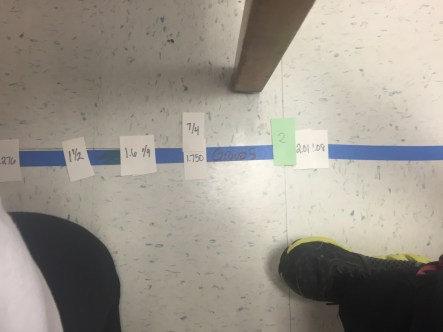
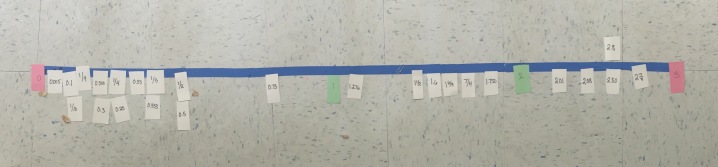
During the lesson, in groups of three, students placed 24 cards on their number line. There were two sets of cards, so after placing all of their cards, each group visited a number line with a different set of cards to discuss. Instead of boring you with all of the number choices we made, here are a few of the choices in cards and the reason(s) we chose them:

1/3 and .3: Students often think these two are equivalent so before the decimal unit we were curious to see how they were thinking around that idea and how they used what they knew about fractions or percents to reason about it.

0.3, 0.33, 0.333, 1/3: The 1/3 and .333 were there to think about equivalency, while the others were there to think about what is the same in each and how much more each decimal has to make it larger. Which you can see caused some confusion here:

IMG_1729.jpg

2.01 and 2.08: We were curious about the distance they put between these two cards.

1 6/9 and 1.6: We wanted to see how students compared fractions and decimals when they can’t easily convert 6/9 into a decimal. Then, if they began thinking 6/9 and 6/10, how would they decide on the larger fraction and then how much distance do they put between them?

The group below practically had them on top of one another:

IMG_1736.jpg

While this group had a bit of a space between them:

IMG_1726

2.8 and 2.80: Tenths and hundredths equivalency. They all seemed to handle this with ease.

.005 and 1/100: Curious to see the placement in relation to the other numbers. This 1/100 is close to 0 but I wonder about it in relation to the .2. Definitely a conversation worth having!

IMG_1730.jpg

2.8 and 2 7/8: To see how they compared the 7/8 to the 8/10.

After they visited other number lines, they had a chance to meet with that group and discuss card placements they agreed with and placements they did not. Groups then made adjustments accordingly…

IMG_1737.jpg

Here was a group’s completed number line and my first stab at panoramic on my phone!

IMG_1735.jpg

The journal entry we left them with was, “Which cards were the most difficult to place on the number line? Why?”  Many were just as we suspected.


The conversation as I walked back over to the other building with the 3rd grade teachers was, what does this look like in 3rd grade? Could we use array images to place on the line instead of the fractions? Could the pictures include over 1 whole? What whole numbers would we use? Do we play with equivalent pictures with different partitioning? Being mindful of the students’ second grade fraction exposure, below, we are planning on trying out something very soon! I am thinking the cards like these on Illustrative, with the pictures but no fraction names at this point.

CCSS.MATH.CONTENT.2.G.A.2
Partition a rectangle into rows and columns of same-size squares and count to find the total number of them.
CCSS.MATH.CONTENT.2.G.A.3
Partition circles and rectangles into two, three, or four equal shares, describe the shares using the words halves, thirds, half of, a third of, etc., and describe the whole as two halves, three thirds, four fourths. Recognize that equal shares of identical wholes need not have the same shape.
…and then could the journal could be, “Can you name any of the fractions on your number line? How do you know?”…or something like that!


Counting is Complex

There are so many interesting things to consider when counting, however having taught upper elementary and middle school, I have never taken the time to consider these complexities. After doing a Counting Collections activity in Kindergarten on Friday, I saw so many foundational ideas being constructed in simply counting a set of things. As I planned and implemented the activity with Kindergarten teachers Jenn and Michele, I felt a lot of the ideas in this post by Joe Schwartz, including the amazing counting conversations, surfacing.

The lesson plan seemed simple: Give the students a set of things to count. Walk around, watch, listen, and ask questions. From that simple plan, our planning conversation was filled with so many questions since this group of students had never done a counting collections activity. After watching this Teaching Channel video, we began asking ourselves: What is important about the set of things when students count? What tools do we make available? How do we keep them from grabbing every tool because they can? What questions do we ask? What numbers are appropriate for each student? How will they record their thinking? What is the end idea we want students to leave thinking about? This post would be so long if I included our decisions on all of this, but I am happy to answer any questions in the comments if you are curious. Not that they were the right or wrong answers, but our decisions.

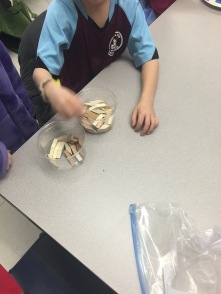
We decided to keep the sets the same object, same color to avoid students sorting by color. I think it will be an interesting conversation in the future about what matters when we are counting, but for the first time, we wanted to really see what they did with counting without distractions and how they recorded their count. We made available big cups, small cups, ten frames and plates.

These are some of the interesting things we observed students considering when counting and explaining their count…

Choice of Tool(s)

Students had to consider the size of the object and size of the set to decide on the tool they felt would best organize their set. We saw groups switch because their object did not fit in or on what they originally chose. Some groups liked the plates to stack and organize their count because the ten frames took up too much space on the table. I wish I got a picture of one group who used the yellow and blue ten frames in the picture below…they put their full tens on the blue and their ones on the yellow and were able to articulate that statement as their counting strategy.

Counted vs Not Counted

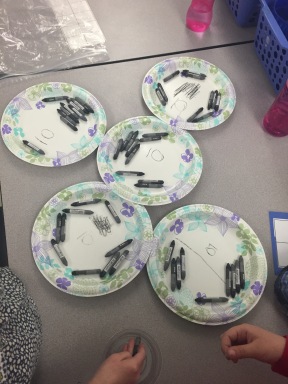
This is where the tool they chose came into play again. Some groups chose to put the uncounted objects in one cup and count by 1’s into another cup. For these groups we saw a lot of losing track of count. We anticipated this in our planning and decided to ask them if there was another way they could count to help keep track of their numbers or if there was a way to organize their objects so we could see how they counted when we walked up.IMG_1622

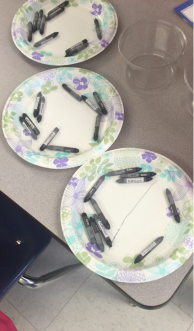
Another group drew a line on their first plate and said it was for ones they counted and ones they hadn’t, however as the crayons took up too much space, they moved to putting 10 on a plate.

Screen Shot 2016-01-23 at 4.57.35 PM

Do We Even Have to Count?

This group got away with not really doing any counting at all until they combined their end organization. They filled a ten frame and poured it into cups. It was interesting because in the first, smaller set they counted just before this larger one, they filled all 10 frames on their table (in the pic under Choice of Tool). As it took up too much space this time, they switched.

IMG_1650

How We Count vs How We Record The Number Of Objects We Count

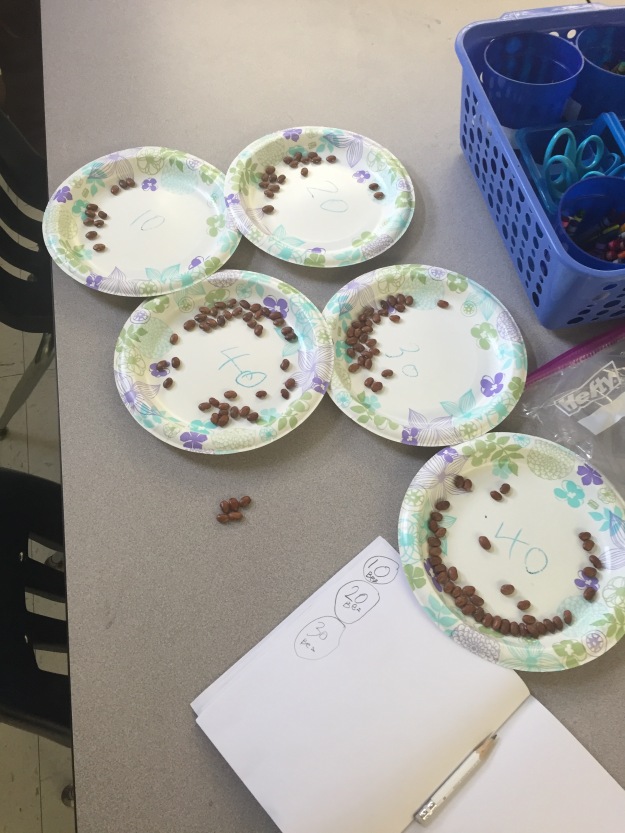
This group put 10 on each plate and started to label each plate by 10s, however on the second plate one partner wrote “20” because she was counting, 10, 20, 30..etc. Her partner corrected her and said there were not 20 on the plate. You can see the scratched out mark on the plate and hear it here.

IMG_1630.jpg

Adjusting for Larger Sets

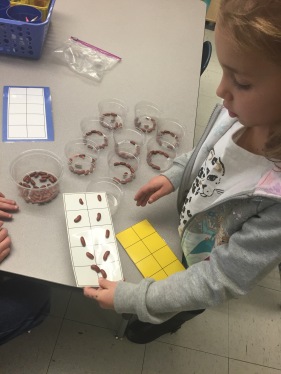
This group kind of blew my mind. Their second set was 225, so they decided to put ten beans in every box of the ten frame. They were then even able to articulate the fact they knew 10 groups of 10 is 100. You can listen to them here. This is my first try with YouTube, so if this doesn’t play, please let me know in the comments;)

IMG_1647

Recording Our Counting

This was one of the areas where we were so curious to see what happened! Jenn and Michele do a ton of Number Talks and journal writing, however during the Number Talks, the teachers does the recording. We didn’t know if they would draw everything they counted or be able to record it more abstractly with equations or would they do both? We did see a mix of all of this!

When Counting and Number of Things Counted Gets Jumbled…What To Do?

We had the groups share their first set (which were all in the 50s) and one group picked up on a counting strategy and way to organize that got a bit jumbled in the end.  This group put 10 on the first plate, 20 on the second, 30 on the next, etc. It was like counting by 10s but now there were not 10 on each plate. When I asked how many were on each plate, they were able to tell me that the number they recorded way was the number of beans on each plate and when I asked how many were there altogether, they said they didn’t know. This is where they ended:

IMG_1663

So, where would you go from here with this group? Our feeling is to pull out the ten frames and put the beans from each plate on them because the students are really great at seeing and counting by 10s in this way. Would this be an interesting thing for the whole class to explore?

So many things to think about when counting! I love to think about how these ideas of counting and combining groups keep showing up in the work I am doing in all of the other grade levels! If we could really do this more and give students space to make sense of groups and how and why they work, wouldn’t it make so much of their future math work so much more accessible? If students really understood these foundational ideas, would we need to spend the time (and money) on intervention programs in later grades that are addressing these very same things?

Counting is Complex but we can structure ways to allow students to be successful in thinking about all of these ideas!

3rd Grade Perimeter Part II

Last week, I posted about a 3rd grade lesson I planned and taught with Hope and Lori. We did not get to everything we planned so I love that they filled me in on what happened the next day when they continued the work! And when the continuation involves looking at student work, I love it even more! That said, this will be a bit of a student work-heavy post with things I noticed and wondered in steps moving forward from here with the students…

After measuring a piece of paper in the previous lesson, we wanted to ask students how they would find the distance around any-sized piece of paper. In giving them the journal writing, we wanted to have them reflect on the measuring and calculating they did in a more general sense and see how they put the process into words. Most student papers resembled the explanation in piece of work below:

IMG_1586

It was really interesting to find most students drew a picture to illustrate their explanation even when not asked to do so. To me, this is a nice mix of show your thinking and show your work. In reading this example below, this student is thinking a lot about conversions and I think, moving forward, the class needs to have a discussion about combining different measurement units.


The mix of units shows up again below. I can see they probably chose centimeters because they didn’t have a smaller unit than the inch and didn’t know how to name the measurement in inches. I love the “not really the size” but I wonder about the border look of the perimeter. Is this student seeing the 6 inches and 3 cm ending where the line is and counting boxes instead of the distance around?


This one is an amazing look at how the formula we all know, and probably had to memorize, arises in third grade. The calculation on the back was equally as nice. This is an example of something during a class share that I would show last in a progression to compare with the previous strategies as it does a nice job of showing the process of finding perimeter in two ways.


This one was so interesting because it involved a square and a circle. The measurements on the back were most intriguing and I have so many questions for this student. Like, how do you know that is a square? (because the sides are not the same length) Where is the 1/2 coming from in your answer? (because I cannot tell where he is stopping and starting his measuring) and Why did you want to cut a circle and a square?


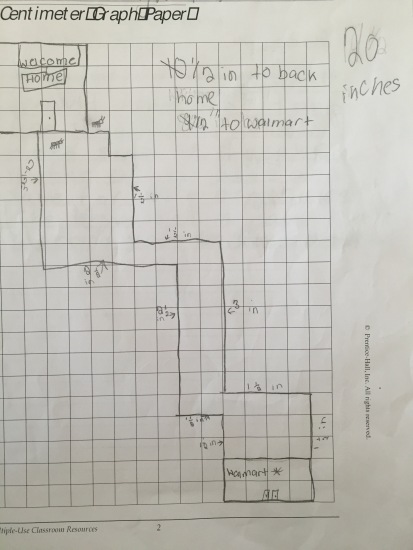
Then, Hope asked them to draw their own ant path and some really interesting things came out that will have to be a blog post in and of itself! There are things we didn’t think about in our question and some things we really need to think about moving forward. Like…

Could this student start thinking about area? Why did the choose to draw a non-rectangular path?

IMG_1568

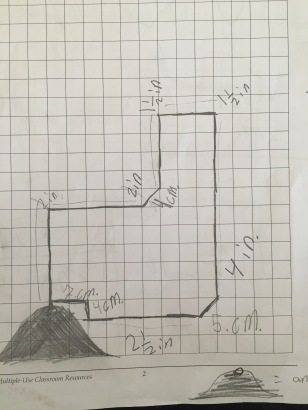
Where are the measurements for each side? Why did you label them where you did? Why did you choose to use inches and centimeters?

IMG_1575

When did you choose to use inches and when did you choose centimeters? Could you have measured it all in inches? all in centimeters?

IMG_1571

First, the fact the student sent the ant to Walmart is too funny:) I would love to ask this student how he or she added all of those side lengths? and Why was it longer to get home from Walmart than it was to get there? Could the ant have walked the same distance there and back? How?

IMG_1573

On this one, we did not anticipate students’ ants taking the same path back that he did out. So this is important to think about distance and versus distance around something.

IMG_1570

Oh, an isosceles right triangle, how fun! I would love to ask this student about this perimeter in centimeters because of the diagonal cuts in the boxes. A lot of students counted the diagonals as 1 unit like they did for the sides of the boxes, so would that work out if you measured it with a ruler in centimeters? Why?

IMG_1574

My question is where to go with a student who is here? All teachers face this, right? There are some students who conceptually and computationally have a grasp on an idea. This student can obviously find perimeter and is very comfortable with the computation piece of it, so what do you ask him from here? Do you give him things to measure that closer to  a quarter and see how he works with the fractions? Do you ask him if his strategy will work for every shape? (I lean toward this one) Do you ask him about non-rectangular polygon areas? Do you do anything with area at this point? So much to think about!

IMG_1569

~Kristin

Two Things I Am Wondering…

It is an interesting perspective moving out of the classroom into a coaching position. I have had more face-to-face teacher math conversations this year than ever in my career and it is wonderful. This position also lets me take a step back from the daily lesson planning and think about things I see across all of the grade levels. Most times, my thoughts are about the trajectory of mathematical ideas, however over the past couple of weeks I find myself thinking about two things I saw as norms when I taught, but now wonder more about…

1 – Is there a such thing as an addition, subtraction, multiplication or division problem?

I am sure we all can relate to the stories of students struggling with story problems. We see them be successful with Notice/Wonders and 3-Act Math tasks, however when given a story problem some “number grab” and compute without thinking about reasonableness. Why? While I think there are many factors at play here, I have another theory that has led me to question problem types. I could be completely off, but as I look through the curriculum and think about the progression in which I taught in 5th grade, I wonder if there is something to teaching “types of problems” within a unit. For example, in Unit 1, Investigation 1 could be my multiplication lessons while Investigation 2 could be my division lessons. While we don’t explicitly say, “this is how you solve a multiplication problem” and we explore various strategies to make connections between the operations, the header of the activity book pages say things such as, “Division Stories” or “Multiplication Stories.” Also, the majority of the work that week is the specific operation and applications.

From there I began to wonder, is there really a such thing as a specific operation problem? I would think that any division story could also be thought of as a multiplication problem. Do we lead students to think there are certain types of problems even if we make clear all of the strategies to find solutions? I love how CGI talks about problem types and wondering why more curriculum are not set up that way instead of keying students into operation-specific problems?

I asked some 4th graders about this exact idea. I gave them some multiplicative compare problems and asked them if they thought about each as multiplication, division or both. Then we talked about why.

2 – What makes students attach meaning to a vocabulary word? Do they need to?

Every year in 5th grade, I was confident that all of my students could find area and perimeter of rectangles. However, I was also confident that there would also be a handful of students who could find area and perimeter but didn’t know which was which. After much work with area and perimeter, they would have it by the end of the unit, but did they remember when they got to 6th grade? I am not sure.

Now, seeing all of the work they are doing with this beginning in 3rd grade, and talking to 3rd and 4th grade teachers who are seeing the same thing, I am left wondering why this is? What makes students attach meaning to vocabulary? This question is then followed by the my very next question…when do they have to?

I wonder if students should ever be given a problem where the context would not allow the students to figure out which one, area or perimeter, the problem was asking. For example, if Farmer Brown is buying fencing he would need the perimeter where if he was buying something to cover a piece of ground, it would be area. Should we ever give them just naked perimeter or area problems with no context where knowing the meaning of the word impacted their ability to solve it?

And then, after they do all of this work with both measurements, why do they forget which word is which year after year? I know the teachers do investigations with the work and use the vocabulary daily during the unit, as I did, but students still don’t hold on to it. What makes it become part of their vocabulary? Is it just too long between when they use it? Is it

These are just two things I am wondering about….


Perimeter in 3rd Grade

I am in the unique position over the next few weeks to see perimeter and area work in 3rd, 4th and 5th grade. It is so incredible to see the overlap across all three grade levels and, being a 5th grade teacher for so long, it is great for me to see where this work begins.

After planning with Hope and her student teacher, Lori, last week, we taught the lesson introducing perimeter today. On Friday, the students measured things around the room in different units of measure, having discussions about most appropriate units. For example, when measuring the length of the room would we use the same unit as we would for the width of our pencil eraser? Why?

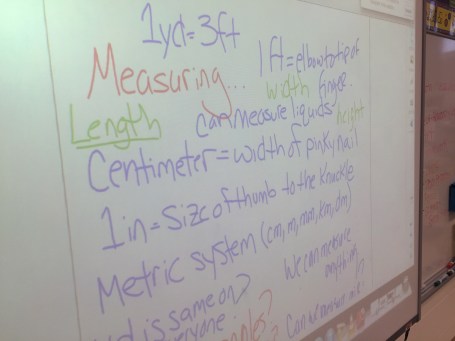
Since I was not there for the lesson on Friday, I was super curious to just hear what students thought about when they heard the word “measuring.” I wrote the word on the board and away we went. They were very quick with benchmarks, equivalents and different dimensions we can measure. I did a terrible job with my picture, but I got a couple really interesting questions like, “Can we measure anything? Air?” and “Can we measure the corner angles of things like the carpet?” Also, after a student had shared that one yard is the same as your hip to your ankle, students questioned if that was true because of the different heights of people. All of these things are great for students to explore at later times!

IMG_1518

Hope introduced the Investigations problem of an ant traveling around the edge of a piece of paper. To be honest, we were not thrilled with the context, but at the time we could not come up with anything snappy or original, so we went with it. We thought it was nice because, in inches, we could see if students measured to the half inch and also how they worked with the half inch when combining to find the perimeter. In hindsight, I am thinking a city map might have worked, however then the scale comes into play, so maybe not?? We let them choose the unit they thought would be appropriate, put them with a partner and they went off to work together. We were surprised to see most students using inches and when asked, thought that it would be “too many centimeters.” They seemed to chose units based on the biggest unit that still fits the object, but not thinking about precision and getting the smallest unit for that.

This is where I am continually amazed by what students know and intuitively do with mathematics.


It was interesting to see some pairs not know how to deal with the half,”not quite 9,” but know they only had to measure one side and then put “11” on the opposite side.

IMG_1520

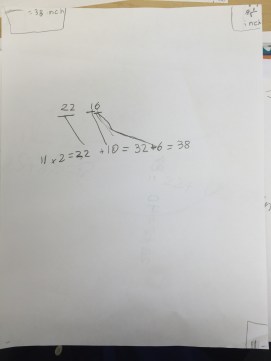
While another group had the 8 and one half written exactly like they said it “8 and 1 (one).5(half) inches.” Although written incorrectly, they dealt with it beautifully in their computation. However, I would want to bring up the equal sign in future share outs so they 8×2=16+1=17 would be written correctly. Does anyone use arrows in the elementary grades for this? 8×2–>16+1–>17? Or is it more appropriate for separate lines at this age?

IMG_1525

When I walked up to this group I asked where the ant was walking because of their lines through the middle of the paper. They said around the outside but it is the same no matter where you draw the line. I asked them to show me the 8 inches and I left them to talk about the 1/2 inch.

FullSizeRender 42

Some students did not deal with the 1/2 inch but seeing the ways they found the perimeter and wrote their equations, I was able to see the formula for perimeter coming to life.

IMG_1527 FullSizeRender 44

As students got finished with their first unit choice, we had them find the perimeter in another unit. It was nice to see the multiplication from their previous unit showing up a lot. IMG_1526

When I saw this one, I didn’t really know what to do with it. What do you with a 3rd grader using .5 as half? I asked them what .5 meant and they quickly said one half. They said one can be broken into .5 and .5 just like it can be broken into 1/2 and 1/2. That is so interesting to me and I would have loved to explore that conversation more, but with a whole class that is not ready to go there, I wrote it on the board and moved on.

FullSizeRender 43

As always, there is not enough time in a class period for me to talk about math with the kiddos. Tomorrow morning, students will journal about their strategy to find the distance the ant traveled. Since the majority of the class only measured two sides, we want to make explicit, through student sharing, why they didn’t have to measure all four sides in this case.

They next part of the lesson, which Hope and Lori will continue tomorrow, includes the students creating their own ant path on grid paper and finding the perimeter of that path. We are not going to dictate that the path must be a rectangle, but the ant must stay on the grid lines. We are hoping that this generates the conversation of when we can double the two sides and add them and when we can’t, assuming students draw irregular shape paths.

Sorting Data in 2nd Grade

Today, I met the Yekttis.

While our intention today was to plan for the lesson after these crazy, fabled, Investigations characters, this activity quickly became the center of our conversation. It seemed the more we talked, the more tangled we got in our own thinking around the math itself, in addition to how to pose the activity to students and what questions to ask as they sorted. It felt like wording was a big deal here. How were we using the words: attribute, category, rule? Were they interchangeable? Would they make a difference in the way student thought about it? Do they make a difference in how we think about it? What is this mathematically and where is it going? While I was planning with three other teachers, only one of the teachers had taught this lesson before and she expressed how difficult it was for students once they were asked to sort based on two rules. We were ready to rethink the whole thing and kept asking ourselves if it was worth what the students would get out of it. But, because of all the questions and confusion in our own thinking, we were really intrigued to see how students would think about it.

Feeling a little like I jumped into the middle of a series of lessons, the teachers were great about filling me in on the students’ work prior to this activity. They had played a game called “Guess My Rule” which I was knew from 5th grade. In this activity, the teacher secretly chooses a rule, points out a few students who fit the rule, others who do not, and students try to guess the rule used to sort. They were really successful with this and enjoyed it.

Now, enter the Yekttis. They are a bunch of cards like the ones above. They have different shaped faces, eyes, and antennae. We decided to give them some time to play with the Yektti cards today and ask them how we could sort the Yekttis. I am hoping Tara, Lauren, and Kristin comment on here so they can go into depth about what the students did because I had to be 5th grade while they taught this lesson. When I caught up with Lauren toward the end of the day to recap, she noticed that the students, at first, looked at sorting as organizing the Yekttis in patterns rather than by attributes. They finally got to what attributes they could use, but when asked if they could sort based on a second rule, they were stumped. They could say “has this, but not this” type of sorts, but were seeing that as two rules because they were creating two groups…the haves and the have nots. As her and I talked, we realized how difficult it was to ask students to sort by two rules vs only one.

Since I left school, I have been thinking about this and have reread the lesson (I will post that at the bottom, after my questions). To me, it feels really difficult for students to sort by two rules and create a Venn diagram based on that sort. Choosing the categories is the stickies part because up until this point, they have experience only choosing categories that are mutually exclusive.

I find the really cool part of this whole thing is students realizing what categories will have an overlap versus those that will not. For this reason, I don’t want to walk students through this, but I feel there are some questions to ask in the process that could be pretty important. This is where I am struggling. What do I ask that does not put the answer right in from of them or become just another process of representing data. My thought for tomorrow is to play Guess My Rule with the Yektiis. Put a few Yektti cards inside and outside of the circle and ask students what the rule could be.  Once they guess the rule, I will label the circle and place the rest of the cards accordingly. Next, and this is the question I don’t know is the right one, I will ask “Is there another rule we can use to sort the Yekttis in our circle?” For example, I could choose “Has a Square Face” as my rule, we sort by placing all of the square faces in the circle and the others out. Now, let’s say the students say our second rule could be, “Has two antennae.” How do we proceed from here? Do I draw in the second circle that overlaps? Do I ask if the circles will overlap? Why does it then feel weird to then pull cards that were once outside of the circle back into the new circle?

After coming up this idea, I looked at the book to realize they handle it quite differently:

Screen Shot 2016-01-05 at 6.20.31 PM

I don’t know how I feel about this and need to re-read it in the morning when I am not also thinking about a 3rd and 5th grade lesson for tomorrow! I feel it takes a bit of the “sorting power” out of the students hands? I would love any thoughts on this!


Decomposition of Number in Kindergarten

This post has been sitting in my drafts just waiting to be written for weeks now, thank goodness for a vacation to get all caught up!

This lesson came about during the same Kindergarten planning session as the Both Addends Unknown (BAU) lesson. As the team and I talked about the dot images they had recently been using during number talks and the decomposition of number standard, we were curious how students would do with a context in which a number is broken down into more than two addends. We knew it wasn’t exactly matching the standard, however we were interested in seeing how the ideas that emerged were similar or different from the BAU problem.

The first piece of our planning was developing a context so the students would have a visual of something moving from one place to another as the addends changed. For no better reason than the fact that Jodi, the classroom teacher, had counting bears, we decided upon polar bears as our context. We launched the problem with an image of 6 polar bears swimming at a zoo, all in the same pool. We asked the students what would happen if the zoo had six different pools for the bears to choose from? Could they all be in the same pool? Could they each be in a different pool? How many different ways could these 6 bears be arranged in the pools? The students did some talking about how they could swim together or by themselves.

I then showed them the muffin tin below and asked if this could be the pools for us to work with today since we didn’t have the actual bears or zoo with us. They counted and agreed it could be the pools since there were 6 spaces, but we had to also agree that it was “not big enough for the real bears.”

chicago-metallic-44305-6-cup-glazed-oversized-mini-cake-muffin-pan-11-1-8-x-15-3-4.jpg

Jodi and I knew recording freely in a journal would have been a bit tricky without something to match the tin, so I printed the image below and we put a stack of them on each table for students to use. We did have a conversation on the carpet about recording, because our goal was for students to have multiple ways to decompose the group of 6 and we didn’t want time wasted drawing bears. I asked them how we could show the bears if we didn’t draw each one and dots and circles were the most agreed upon way.

Screen Shot 2015-12-29 at 3.37.20 PM.png

I felt like this whole introduction took way too long. I don’t know how to make it quicker, but I would have loved to have had more time at the end of the lesson connecting the representations than in the launch. Perhaps just giving them 6 bears and asking how they could be in the tin, recording it on the board, asking them to change it, recording those, and then comparing? 

From there, we set them off with a partner, 6 bears and a muffin tin. I was so impressed by the way they worked together. In so many groups, one student moved the bears in the tin while the other recorded and then they switched. As they got the hang of moving the bears around, a lot of them began to look like they were on a race, cranking out a ton of different recordings. We did not have to give them more than 10-15 minutes before they had at least six or more ways. We stopped them from working, asked them to put their papers out on the table in front of them, and talk to their partner about ones that seemed the same and ones that seemed different.

As they spread them out on their tables and chatted, I saw and heard SO much possibility but not enough time. So many patterns, so many interesting ways of composing and decomposing groups, and so much commutativity.  However, they were leaving for recess soon and we wanted to wrap it up with a whole class notice/wonder before they left.

IMG_1440IMG_1443IMG_1441IMG_1442

I strategically chose sets like the ones in the pictures above and asked students what they noticed/wondered. This is the point where you could see a bit of the hour-long math class fatigue setting in. A lot of noticing of 6 total bears and patterns such as 2,1,2,1 and 2,2,1,1, however we did not hear any talk of how the bears regrouped. For example in the 1,1,1,1,1,1 and the 2,2,2, I was wondering if students may say the two ones each made a two or any type of movement like that. I wonder if I asked how they were the same or different if I would have gotten a different response? Not sure.

Jodi and I chatted after the class and agreed we wanted to revisit this lesson. We wanted to revisit because we did not get to writing equations for each picture, as we had planned. We were curious to see what they would do with that and if any other similarities and/or differences would arise. We also thought this could be a great activity for a math center, but we are just not sure what angle to take with it yet. Could it be about arranging them three ways and then comparing? Could it be practice at writing equations for their model? Could it be eventually knowing the combinations without manipulating the bears? Could it possibly be a mix of all of this? I am not sure…I am learning everyday in Kindergarten!