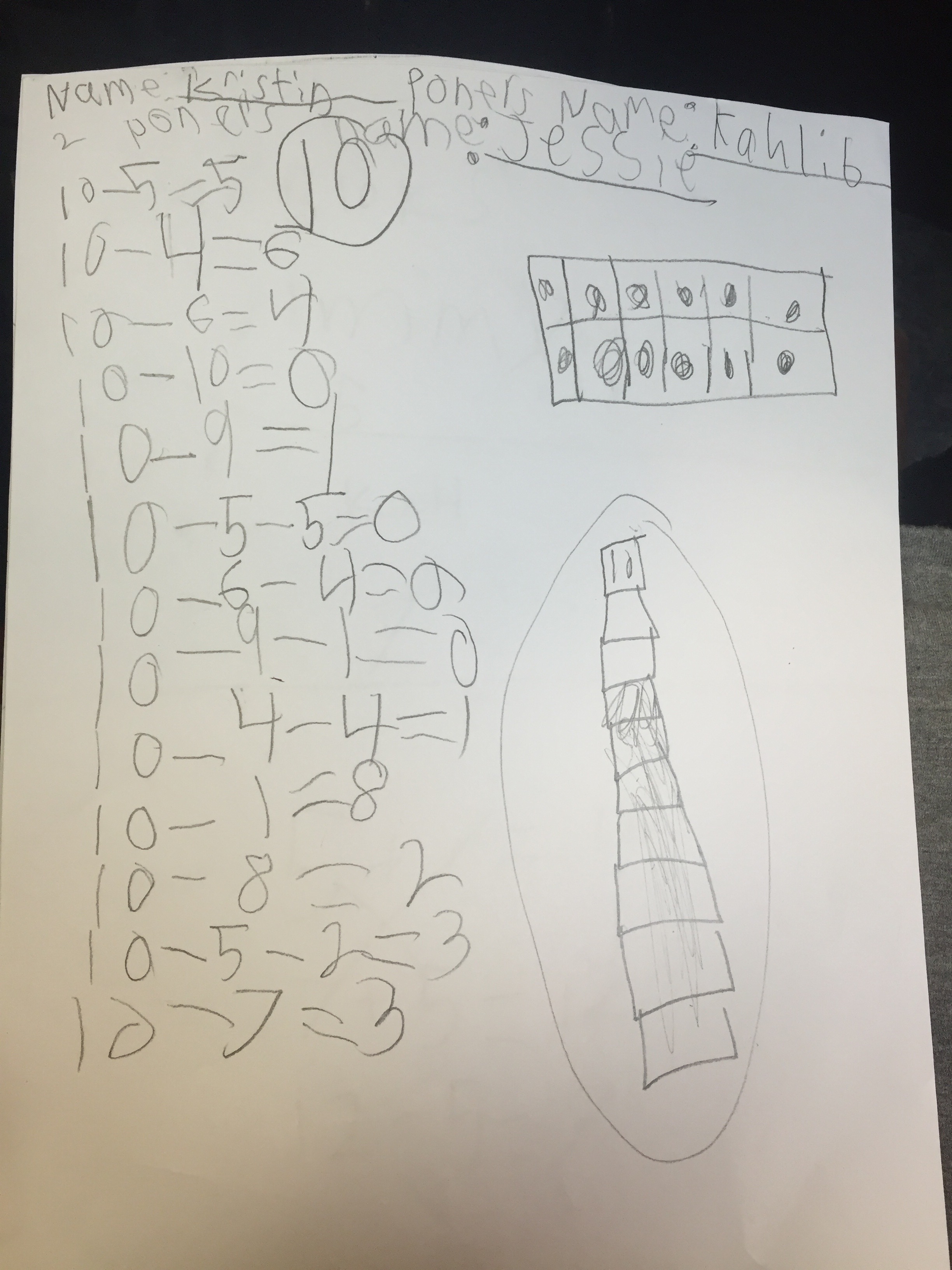
100 Hungry Ants: Math and Literature

This week the Kindergarten and 1st grade teachers planned with Erin, the reading specialist, and I for an activity around a children’s book. This planning was a continuation of our previous meeting about mathematizing. We jumped right into our planning by sharing books everyone brought, discussing the mathematical and language arts ideas that could arise in each. I made a list of the books the teachers shared here.

We chose  the book One Hundred Hungry Ants and planned the activity for a Kindergarten class. We decided the teacher would read the story and do a notice/wonder the day before the activity. We thought doing two consecutive readings may cause some students to lose focus and we would lose their attention. Based on Allison Hintz’s advice, we wanted the students to listen and enjoy the story for the first read-through. Here is an example from one classroom:

Screen Shot 2016-05-05 at 9.28.27 PM.png

So many great problem and solutions, cause and effects, illustration and mathematical ideas were noticed by the students.

The following day, the teacher revisited the things students noticed and focused the students’ attention on all of the noticings about the ants. She told the students she was going to read the story one more time but this time she wanted them to focus on what was happening with the ants throughout the story. We had decided to give each student a clipboard and blank sheet of paper to record their thoughts.

We noticed a few great things during this time..

  • Some students like to write a lot!
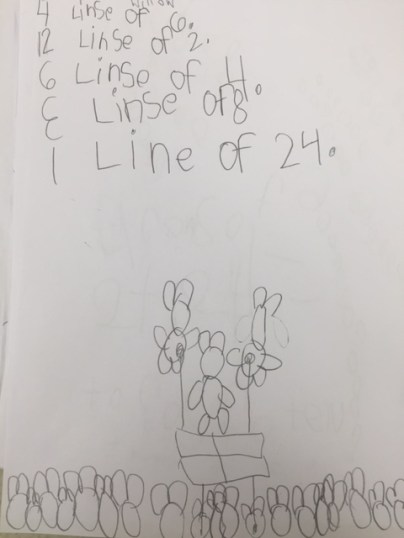
  • After trying to draw the first 100 ants, students came up with other clear ways to show their thinking. I love the relative size of each of the lines in these!
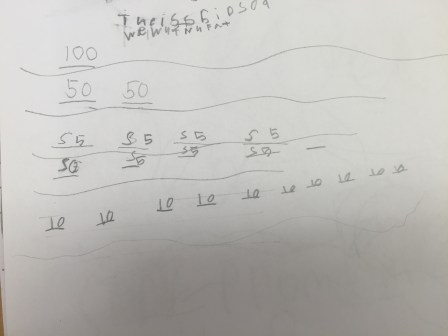
  • A lot of students had unique ways of recording with numbers. Here is one that especially jumped out at me because of the blanks:

IMG_2336 (1).jpg

Students shared their recordings at the end of the reading and it was great to hear so many students say they started the story by trying to draw all of the ants, but changed to something faster because 10o was a lot!

After sharing, we asked students, “What could have happened if they had 12 or 24 ants?” We put out manipulatives and let them go! So much great stuff!

IMG_2321.jpg IMG_2323.jpg

IMG_2296 (1).jpg–> IMG_2398.JPG

IMG_2396.JPG

IMG_2397.jpg

Next time I do this activity, I would like to see them choose their own number of ants.

Just as I was telling Erin that I could see this book being used in upper elementary grades when looking at generalizations about multiplication, I found some great posts by Marilyn Burns on this book for upper elementary and middle school:

Excited to do this in a 1st grade classroom today!

Measuring Tools in 2nd Grade

Last week, the 2nd grade team and I planned for a measurement lesson. Their measurement unit falls at the end of the year, so this was actually the first lesson of their unit.

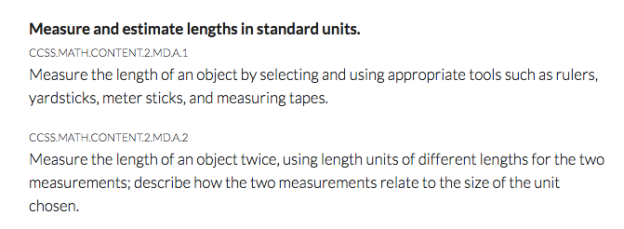
We focused on work on the first of these two standards, anticipating the other would be a natural part of the work as well:

Screen Shot 2016-05-03 at 10.37.50 AM.png

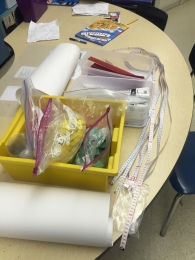
We put out the following measuring tools: square tiles, inch bricks (unlabeled ruler from Investigations), a ruler with inches and cm, and a tape measure in cm.

IMG_2305

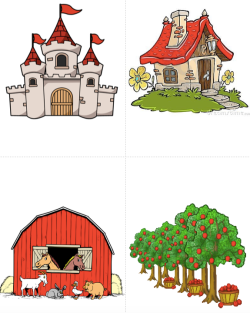
The teacher launched the lesson by introducing the “Land of Inch,” a context that Investigations uses in the measurement unit. The introduction involved showing a picture of the 4 places in the Land of Inch: the castle, a cottage, apple orchard, and stable. The students discussed why they thought each one was in the Land of Inch.

Screen Shot 2016-05-03 at 11.22.16 AM.png

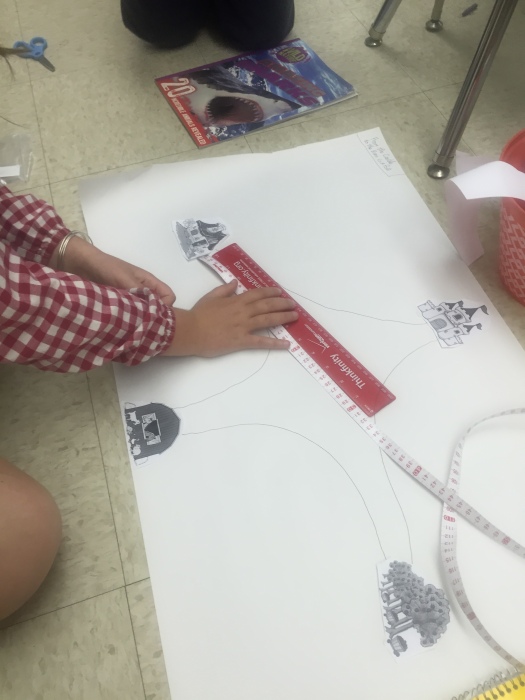
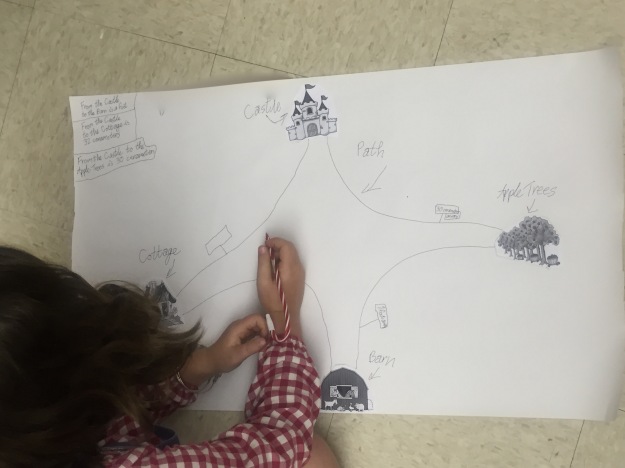
On a piece of paper, partners were asked to put the places of the Land where they thought they belonged and measure the distance from the castle to each, choosing whichever tool they thought was appropriate. The only stipulations were that there must be a path from the castle to each and each must be a different distance from the castle.

There were some really cool things that came up as we watched them working:

  • Every group took only the straightedge ruler and tape measure.
  • All of the straight lines were measured with the straightedge.
  • They all noticed the unit difference. We did not state what the unit of each tool was beforehand to see if they noticed.
  • They labeled 12 inches as 1 foot.
  • Students measured the curved paths using both the straightedge and tape measure.
  • Some students wanted to change centimeters to inches because it was the Land of Inch so they lined up the tape measure with the straightedge.

IMG_2307

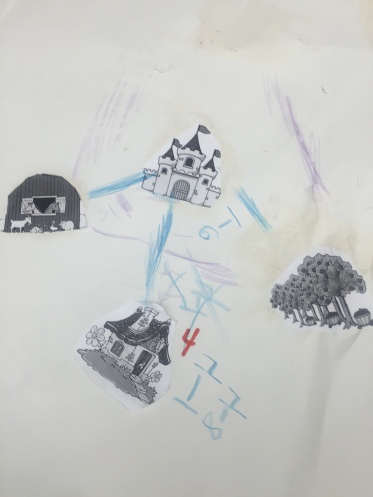
  • One group recorded their measurements in ranges. They had no interest in starting at the end of the ruler. They just put the ruler down and wrote the two measurements it fell between.

IMG_2314

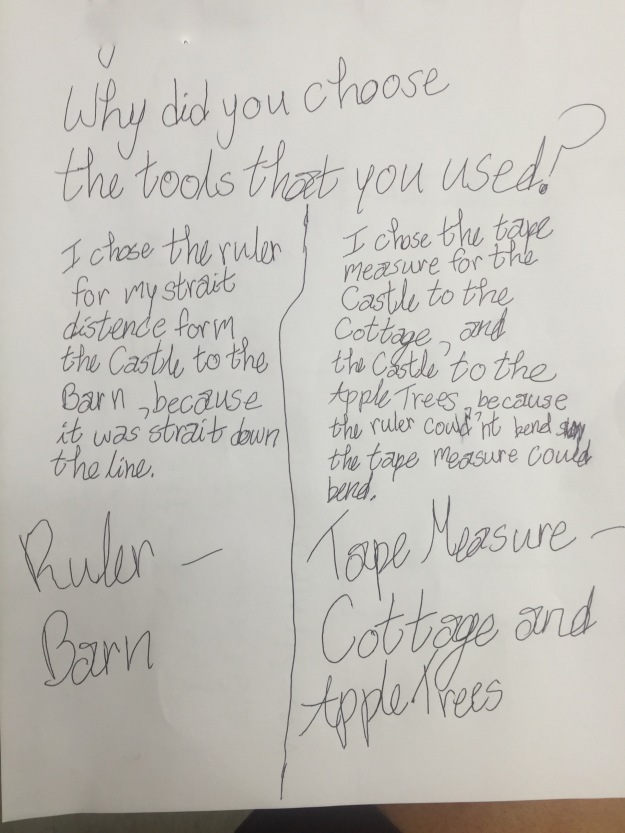
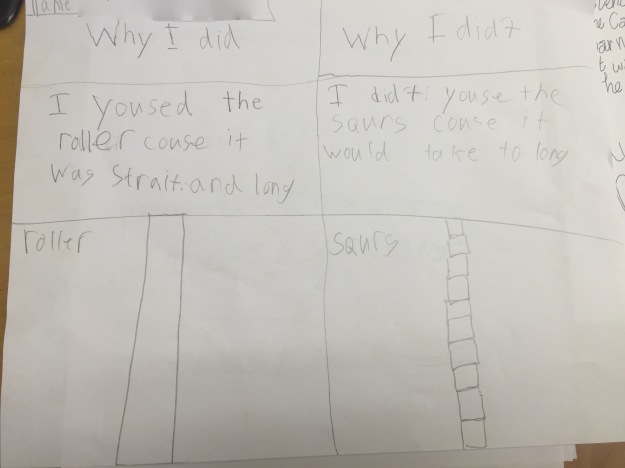
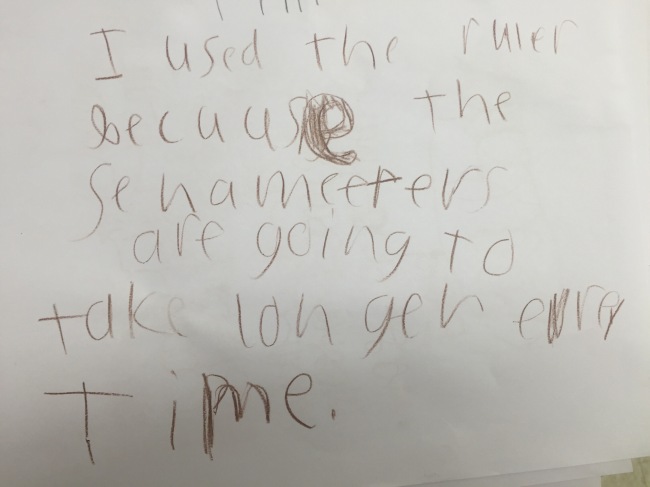
We wrapped up the lesson asking students to talk about why they chose their measuring tools. We had planned for them to share these ideas before they did a different journal prompt we designed last week. However, as they were sharing, there were one or two students doing a lot of talking (great stuff, but a lot) so we decided to have them reflect on their own before having this conversation.

IMG_2312.jpg


This student did a great job of explaining when they used one tool over another:

FullSizeRender 48

This student discussed why they chose to use the ruler but not the square inch tiles at all because it would take too long. So while both tools were the same unit, one tool has connected units versus individual units that need to be put together.

FullSizeRender 47

This group noticed that the centimeters (on the tape measure) would take them longer than the straightedge because there were more centimeters than there would be inches.

FullSizeRender 49

There were a couple instructional prompts we are revising for the next time this lesson gets taught by one of the other 2nd grade teachers that were there:

  • We didn’t let them know the paths didn’t have to be straight until after we saw them get started that way. Need to launch with that.
  • We didn’t have out meter or yard sticks, oops, need those next time. Talked about it during our planning, but we completely forgot.
  • We didn’t do a poster share which I think we want to incorporate next time because they all wanted to share. So maybe just two groups explaining their choices.
  • Wondering about the writing connection as they all had interesting reasoning behind where their places were located. Could they write a description about the placement and reasoning for their poster and then have other partners try to match them up?

Next up, reading Inch by Inch and the lesson inspired by the TCM article Inch by Inch in the most recent publication.


RTI for Adults

I want to preface this post with a few things I believe to be true about RTI (Response to Intervention):

  • Some students need small group instructional time for intervention.
  • Some students enjoy their RTI classes because they like their RTI teacher and feel successful on the work they do during that time.
  • The RTI structure was originally designed for Kindergarten and 1st Grade students.

Understanding these things, sadly this is what I also believe to be true about RTI:

  • Pulling students out of class for Tier 2 and 3 instruction negatively impacts how they view themselves as learners.
  • The current system negatively impacts the way we talk about students, pushing educators to refer to students as a number.
  • After 2nd grade, the majority of students become “stuck” in a tier forever.

Questions I continuously ask myself about RTI are:

  • Why RTI?
  • If we focused our attention on differentiation during core instruction (Tier 1) would this be as necessary?
  • Does the current RTI structure lay blame on the student’s ability to learn as if their learning was not impacted by prior learning experiences?
  • Can we pretend that students aren’t impacted by pulling them out of their regular classroom for intervention classes?
  • How does a student who is labeled as “working on grade level” and not being pulled for “enrichment”during RTI time feel? Do they feel as if they aren’t capable of that work? How does that impact their future educational decisions?
  • How do we fix this?

And the questions that intrigue me most right now:

What if we treated teachers like we treat students?  

Would thinking in those terms give us a clearer lens in which to look at RTI?

I love that our school is currently looking at ways in which to improve this structure. I truly believe that every single teacher has the best interest of students at heart when designing this intervention structure however, I don’t know if we consider all of its implications in terms of a student’s confidence and perception of themselves as learners. I think we all want them to be successful but at what expense?

My colleague, Brandi, and I had a long conversation around all of these questions and ultimately ended thinking about the question, “What would happen if we treated adults in this way? Should we expect children’s view of themselves as learners differ from a teacher’s view of themselves at teachers?”

Our conversation inspired her to write a mock lesson plan for how a principal could run a faculty meeting that would offer teachers insight as to what being pulled for RTI would feel like. I loved it so much, I had to ask her to share. While this is a lesson plan for teachers, I believe all people involved in education policy and decision-making such as principals, district office personnel, board members, state and national legislators would benefit from this activity.

Lesson Plan for the Principal: Treating Teachers as Students

Start the staff meeting announcing that he or she has decided to make the meetings more productive by splitting the staff into three groups.

  • Exemplary teachers: the teachers who are at the top of their game and need to be challenged
  • Average teachers: the teachers who are doing a good job but who still have room for improvement
  • Teachers in need of extra support: the teachers who need more support than others.

It is important to remember to be positive when telling the extra support teachers which group they are in, because if this is done positively and said nicely, they will understand that there are always people who do well and always people who struggle and the strugglers should be willing to accept help.

Announce who falls in each group in front of the entire staff. The extra support teachers (~15%) report to the principal’s office for intensive instructional strategies for behavior management and/or content professional development to improve their classroom instruction. The average teachers (~75) will remain in the cafeteria with either the reading or math specialist for an extension of the work they are currently doing in class, nothing too exciting, but is on their current working level of teaching. The exemplary teachers report to the assistant principal’s office for new, exciting technology initiatives or content extensions that are above and beyond what they are currently doing in class. 

Wait. (Prediction: people should be murmuring and making little grimacing faces).

Ask if anyone has any thoughts on this process. Hopefully everyone will have figured out by now this isn’t really happening — BUT that it is exactly what we do to kids each day.

That KNOT in your stomach as you worried you would be pulled into the “needs help” room – the fear that your name would be called and you would have to get up and leave.

The ANXIETY over which of the three groups you fell into. The greater ANXIETY over knowing where everyone else fell.

The ANGER over the potential to be Average when you had a really great lesson last week and nobody saw it!

The ANNOYANCE that someone has judged you and you don’t know what they based their information on.

Discussion. Before even knowing which group they had been placed in, I imagine most teachers would have gone through this range of emotions. Most teachers would prefer not to have anyone know if they were being placed in the extra support group, just as they would not want anyone to know if they were on an Improvement Plan or Expectations. But are we taking equal care of 6,7, 8, 9 and 10 year olds feelings the same way?

Ask anyone if they would feel PROUD to be pulled into the extra support room – whether they can admit to needing it or not. Ask them how frustrating it would be to work hard and collaborate in that room, put together an exemplary lesson, and then pull it off in class only to be pulled back into the principal’s office at the next staff meeting with nobody having seen it or realizing you had improved.

End lesson plan.

I wonder if people would take a different stance on RTI (or tracking in general) after engaging in this activity? Like I stated previously, I know some students need extra support, but I just wonder if we can find a way for that support to happen in the classroom with the student?

Could working with teachers on ways to support students who may struggle while at the same time challenging those who are finished quickly be more effective and less damaging to students?

Could this work with teachers lessen the number of students who need extra support year after year and truly help us identify those with learning disabilities so we can appropriately address those needs?

I never like complaining about a problem if I haven’t thought about a solution and although I do not have a complete answer here, I do believe we can do better. I believe we can take responsibility as teachers to try and best meet all students where they are, as impossible as that may seem. Through collaborative content professional development and managing small group work in the classroom we can improve the current structure.

I know we are all trying to do our best by the students, but I think we can take better care of our students’ views of themselves as learners and would love to hear ways in which others are doing just this.


Mathematizing Learning Lab

Each month, teachers choose their Learning Lab content focus for our work together. Most months, 1/2 of the grade level teachers choose to have a Math Learning Lab while the other 1/2 work with Erin, the reading specialist in an ELA Learning Lab. This month, however, we decided to mesh our ELA and Math Labs to do some mathematizing around children’s literature in Kindergarten and 1st grade! This idea was inspired by a session at NCTM last year, led by Allison Hintz, that left me thinking more about how we use read-alouds in our classrooms and the lenses by which students listen as we read.

In The Reading Teacher, Hintz and Smith describe mathematizing as, “…a process of inquiring about, organizing, and constructing meaning with a mathematical lens (Fosnot & Dolk, 2001). By mathematizing books commonly available in classroom collections and reading them aloud, teachers provide students with opportunities to explore ideas, discuss mathematical concepts, and make connections to their own lives.” Hintz, A. & Smith, T. (2013). Mathematizing Read Alouds in Three Easy Steps. The Reading Teacher, 67(2), 103-108.

Erin and I have literally been talking about this idea all year long based on Allison’s work. We discussed the ways we typically see read-alouds used, such as having a focus on a particular text structure or as a counting book in math.

As Erin was reading Kylene Beers & Robert Probst’s book, Reading Nonfiction she pointed me to a piece of the book on disciplinary literacy which automatically had me thinking about mathematizing.

Beers refers to McConachie’s book Content Matters (2010), in which she defines disciplinary literacy as, “the use of reading, reasoning, investigating, speaking, and writing required to learn and form complex content knowledge appropriate to a particular discipline.” (p.15) She continues to say, “…disciplinary literacy “emphasizes the unique tools that experts in a discipline use to engage in that discipline” (Shanahan and Shanahan 2012, p.8).

As I read this section of the book, my question became this…(almost rhetorical for me at this point)

Does a student’s lens by which they listen and/or read differ based on the content area class they are sitting in? 

For example, when reading or listening to a story in Language Arts class, do students hear or look for the mathematical ideas that may emerge based on the storyline of the book or illustrations on the page? or Do students think about a storyline of a problem in math class or are they simply reading through the lens of “how am I solving this?” because they are sitting in math class?

Mathematizing gets at just this. To think about this more together, Erin and I decided to jump right into the children’s book  The Doorbell Rang by Pat Hutchins. Erin talked about the ideas she had for using this in an ELA class, I talking through the mathematical ideas that could emerge in math class, and then we began planning for our K/1 Learning Lab where we wanted teachers to think more about this idea with us! We were so fortunate to have the opportunity to chat through some of our thoughts and questions with Allison the day before we were meeting with the teachers. (She is just so wonderful;)

The first part of our Learning Lab rolled out like this…

We opened with this talking point on the board:

“When you change the way you look at things, the things you look at change.” 

Everyone had a couple of minutes to think about whether they agreed, disagreed, or were unsure about the statement. As with all Talking Points activities, each teacher shared as the rest of us simply listened without commenting. The range of thoughts on this was so interesting. Some teachers based it on a particular content focus, some on personal connections, while I thought there is a slight difference between the words “look” and “see.”

After the Talking Point, Erin read The Doorbell Rang to the teachers and we asked them to discuss what the story was about with a partner. This was something Allison brought up that Erin and I had not thought about in our planning. I don’t remember her exact wording here, but the loose translation was, “Read for enjoyment. We want students to read for the simple joy of reading.” While Erin and I were so focused on the activity of exploring the text through a Math or ELA lens, we realized that the teachers first just needed to enjoy the story without a purpose.

For the second reading of the book, we gave each partner a specific lens. This time, one person was listening with an ELA lens while, the other, a Math lens. We asked them to jot down notes about what ideas could emerge through these lenses with their classes. You may want to go back and watch the video again to try this out for yourself before reading ahead!

Here are some of their responses:

Together we shared these ideas and discussed how the ELA and Math lenses impacted one another. A question we asked, inspired by Allison, was “Could a student attend to the math ideas without having a deep understanding of the story?”

Many questions came up:

  • Could we focus on text structures and the math in the same lesson?
  • Could we start with an activity before reading the book, like a probable passage?
  • Would an open notice/wonder after the first reading allow the lens to emerge from the students? Do they then choose their own focus or do we focus on one?
  • How could focusing on the problem and solution get at both the ELA and Math in the book?
  • How could we use the pictures to think about other problems that arise in the book?
  • How do we work the materials part of it? Do manipulatives and white boards work for K/1 while a story is being read or is it too much distraction?
  • What follow-up activities, maybe writing, could we think about after the book is read?

Unfortunately, our time together ended there. On Tuesday, we meet again and the teachers are going to bring some new books for us to plan a lesson around! So excited!

Making Sense of Problems: Part 2

This post is an extension of a previous post. For the background story to this post, it will be helpful to read THIS POST first.

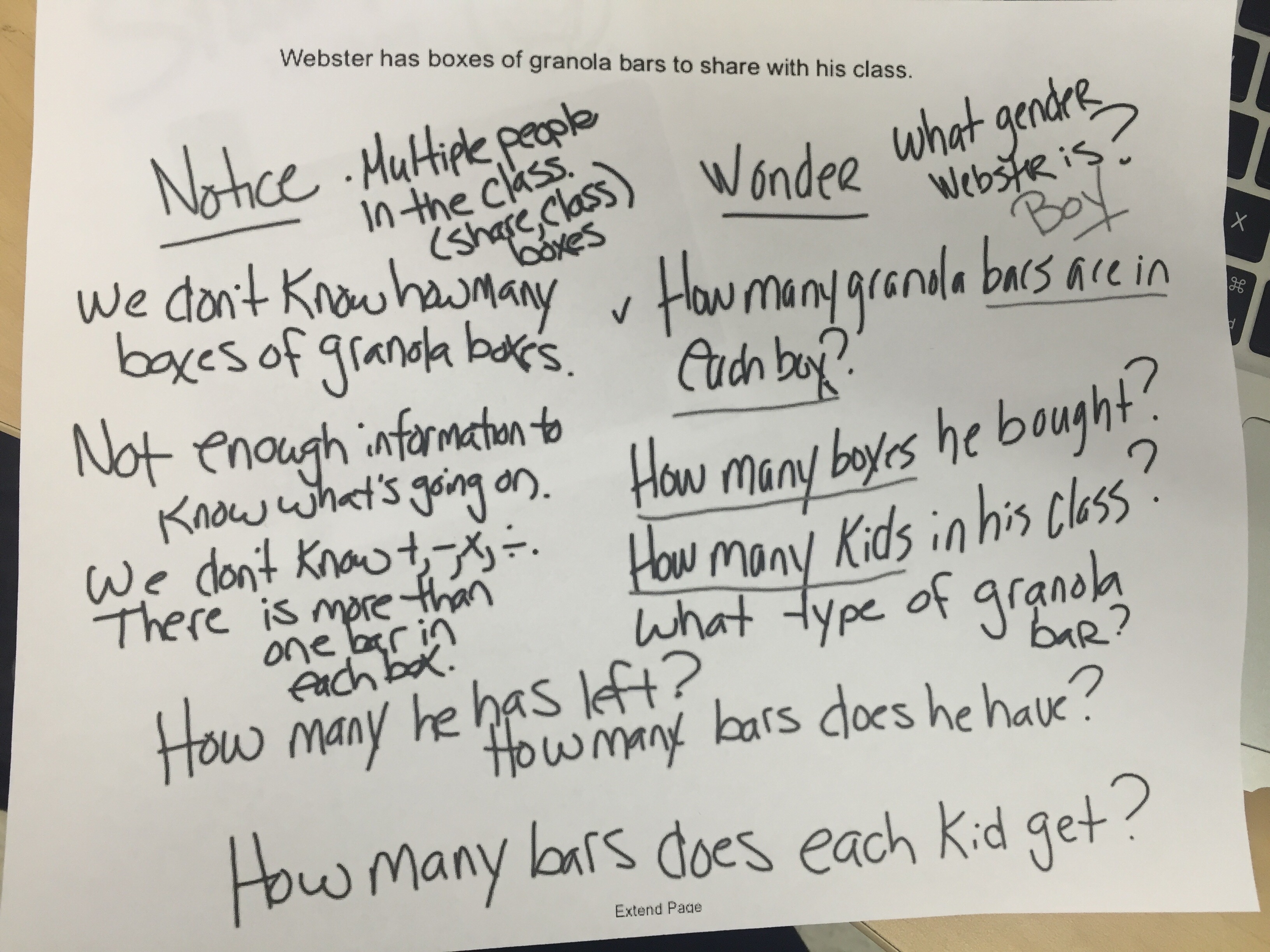
The original Noticing and Wondering from the launch of the lesson:

FullSizeRender 44

Here are some expanded descriptions of the student work:

Chose numbers strategically to make it easier for themselves:

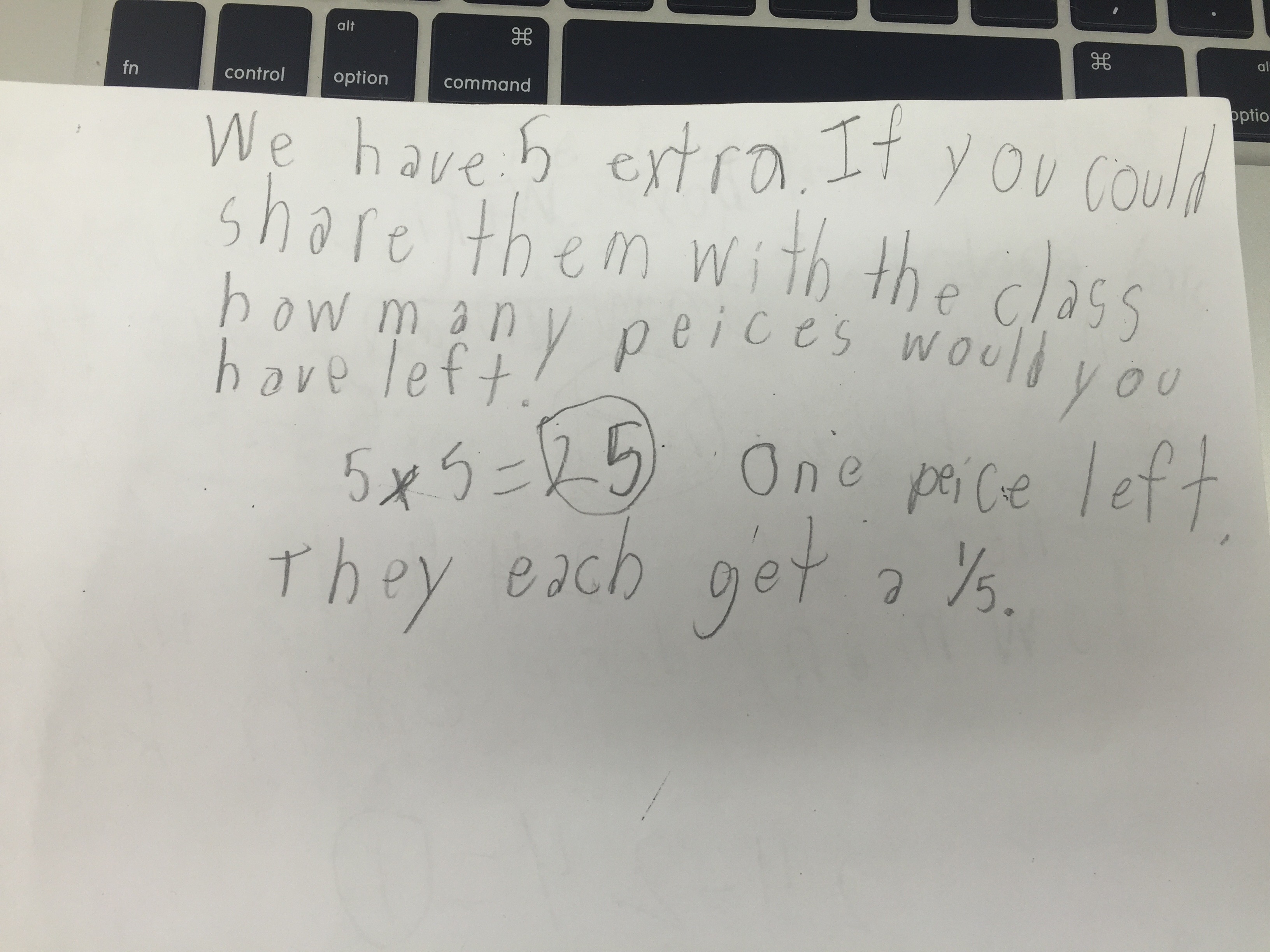
These two girls were great because they wrote out the paragraph first with the blanks left to fill in after they made a decision on their numbers. You can see the erased 5 in the second blank. When I asked them about it, they said 25 in a class seemed like too many but they couldn’t make the class too small to each get more than 1 bar.

IMG_1792

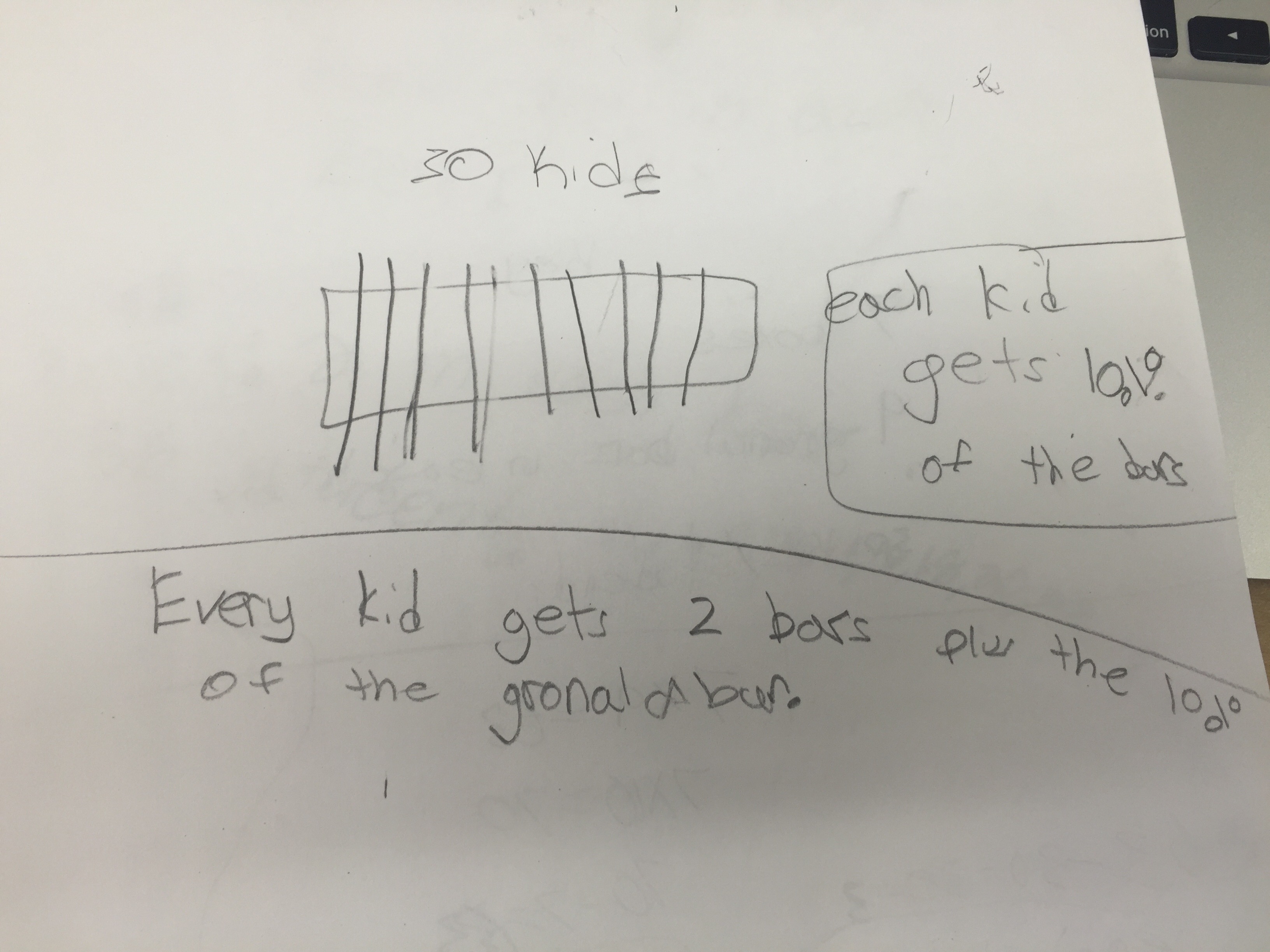
These two were concerned with the number in each box. They said they knew 6 usually came in a box so they just did 4 boxes and then wrote the students in last to make it easy division.

IMG_1787

These two were done SUPER fast so I gave them 5 more bars to try and decide what they wanted to do with them. They didn’t do any written work, but asked me how they divide something up into 5 pieces because then each student could get a piece. “We know halves and fourths, but that is not 5 pieces.” After playing around with “fiveths” I gave them the word fifths and they wrote down 1/5.

IMG_1797IMG_1790

These two partners were so interesting because when I walked by the first time they had chosen their numbers together, but when I went back the second time, their computation was completely different. I absolutely loved that and asked them to explain their strategy to one another and asked how they were the same and how they were different. The difference was more about the look  of their work, but they agreed they were the same because it was still how many 30s were in 63.

Chose numbers randomly:

IMG_1798IMG_1793

…and then they worked together on breaking the extra 3 into 10 pieces. Because they didn’t know how to name tenths, they went to something they obviously knew something about…percents! We ran out of time to ask how they knew that was 10%, but I have to make a point to go back and ask!

IMG_1794

Dealt with the leftovers using fractions:

This one took a while for me to figure out. These two girls finished rather quickly, so I asked them if they could share the leftovers equally among the kids in the class. It looks like they multiplied the 22 by 2 to get how many pieces they would have if they split them in halves. They each person got an extra 1/2 and they were left with 18 halves. They multiplied by 2 to make them wholes again and ended with 9 bars left over. The sense-making in this one was so incredible to me.

IMG_1796

Chose numbers strategically to make it harder for themselves: 

When I asked these two girls why they chose the numbers they did and they said they wanted to make it hard! There are so many things I think continued to be fabulous after their initial number choice. The partial products for multiplication and then the repeated subtraction were amazing. I asked them why they were subtracting 26 every time. They said each time they subtracted 26, each student got 1, hence the growing list of 1,2,3,4,5… Absolutely awesome and something I would have never seen if I had given the original problem and the sense-making of what is happening whey you repeated subtract to divide just blows my  mind.

IMG_1786

To me, every one of these examples, along with all of the papers in the class that day, demonstrated to me how we need to look critically at our math textbooks, think deeply about what we learn about students as they do that work, and adapt materials to allow students to make sense of problems and allow us to learn more about their understandings.

Formative Assessment

Assessment always seems to be such a broad, hot topic  There are rubrics to help create assessments, rubrics for reviewing assessments, and tons of reading about the benefit of assessments. While I agree assessment is an important topic of conversation and all of these things can be helpful, I just lose a bit of interest when it becomes so cumbersome. I feel the longer the rubric and steps to create an assessment, the more detached the assessment becomes from student thinking.  This could be completely be my short attention span speaking, however the way assessment is discussed feels either like data (a grade or number-type of data) or a huge process with tons of text in rubrics that I really, quite honestly, don’t feel like reading. Not to mention, I just love looking at student writing and listening to student thinking when planning my immediate next steps (formative) or checking in to see what students have learned over a longer period (summative). This is why I find the work we are doing each month in our Learning Labs such a wonderful way to think about formative assessment in an actual classroom context, in real time.

This passage from NCTM’s Principles to Action really captures how I feel about the work we are doing in our Learning Labs:

Screen Shot 2016-04-06 at 2.43.31 PM.png

In this most recent Learning Lab in 3rd grade, we planned the activity together using the 5 Practices model and reflected after the lesson. Since this blog is always my thoughts about student work, I thought it would be great to hear what the teachers took away from the activities we are doing in terms of the students’ understandings and impact on their future planning, formative assessment.  

The teacher mentioned in the blog said, I was surprised by how quick many of the students defended their responses that 1/2 will always be greater than 1/3, and then proving this response using visual representation of the same whole ( which is an idea that we have made explicit). I was impressed with “skeptics” in the crowd that were looking to deepen their understanding around the concept by asking those “What if” questions.  Going forward, I want to create opportunities that push and challenge my student’s thinking. I want them to continue to question and explore math – especially when it uses the word “always.”

Another teacher who taught the same activity after watching it in action in another classroom said, “I learned that almost half of my students assumed they were comparing the same size wholes.  They agreed with the statement, and each student gave at least two different ways to prove their thinking (area and number line model were most common).  The students that disagreed almost all provided their own context to the problem, such as an example with small vs large pizzas, or a 2 different-length races being run.  I found it so interesting that almost all students confidently chose one side or the other, and were able to defend their thinking with examples (and more than one-yeah!)  I was excited to see that they could be so flexible in their arguments as to why they felt as they did.  Three students responded that they were unsure, and gave reasons to support both sides of the argument. This impacted my instruction by giving me such valuable formative assessment information with a simple, non-threatening prompt.  It took about 5 minutes, and gave me tons of information.  It was accessible and appropriate for all.  Students were comfortable agreeing or disagreeing, and in some cases, saying “unsure-and here is why.”  I was most excited about that!”

She also said, From this activity, I learned that I really needed to revisit the third grade standard to see what is actually expected.  It says they should recognize that comparisons are valid only when the two fractions refer to the same whole.  My statement didn’t have a context, so how cool that some were at least questioning this!   This impacted my planning and instruction by reminding me how thinking/wondering about adding a context to the statement would influence their responses.  I am also reminded that I need to stress that students must consider the whole in order to make comparisons accurately.”

Earlier in their fraction unit, the third grade teachers used the talking point below to hear how her students were talking about fractions. (This work is actually from another teacher’s class, but you get the idea;)

A teacher who did this activity reflected, “From this activity, I learned my students had only ever been exposed to a fraction as a part of a whole (and wanted to strictly refer to fractions in terms of pizza). This impacted my instruction by being sure to have the discussion that fractions can represent parts of a whole, but we can also represent whole numbers with fractions.”

To me, these reflections are what assessment should be….the teachers learn about student thinking, the students think about their own thinking, and what we learn helps us plan future lessons with our students’ understandings in mind!

More examples from different grade levels where the teachers and I learned so much about student thinking that impacted future instruction:

Kindergarten: Adding

Kindergarten: Counting

1st Grade: Fractions and Adding

2nd Grade: Counting and Leftovers

4th Grade: Division

5th Grade: Fraction Number Line

3rd Grade: Comparing Fractions

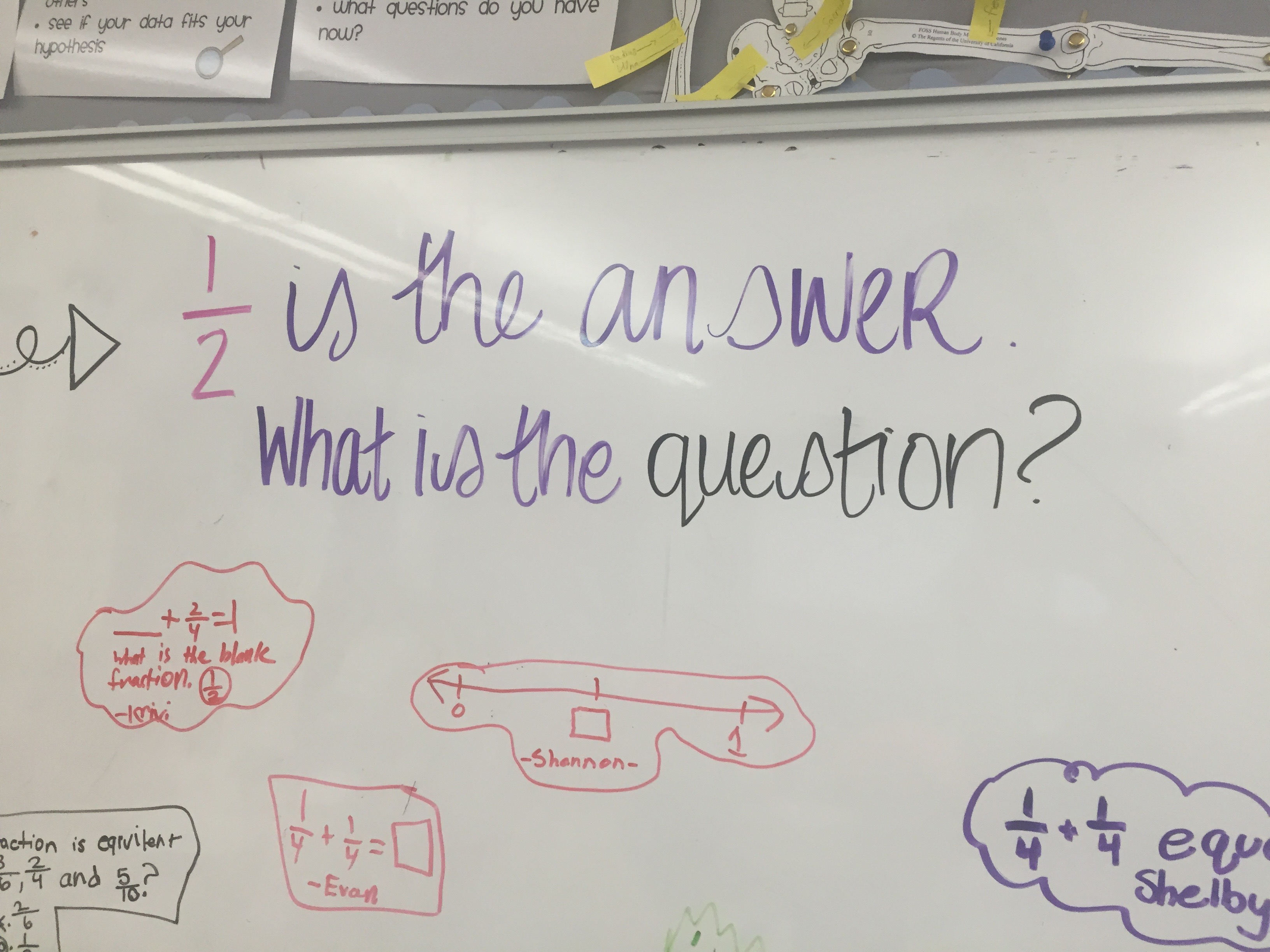
I was so excited just walking into Jenn Guido’s room today and seeing this awesomeness on the board from the day before:

IMG_2052.jpg

We chatted with the class a bit about their responses on the board before jumping into our Number Talk. One thing Jenn and I both noticed during this chat was the use of the word “double” when talking about equivalents such as 2/4 and 4/8. We had the chance to ask them what exactly was doubling and kept that in the back of our mind as something to keep revisiting. Even in 5th grade, I would hear the same thing being said each year. I would always have to ask, “What is doubling?” “What is 1/2 doubled?” “What exactly is doubling in the fraction?” “What happens when we double the numerator? denominator?”

After this chat, it was time to move into our planned activity. The class has been doing a lot of work with partitioning (and they used that word:) circles, rectangles and number lines so we planned a Number Talk consisting of a string of fractions for the students to compare. We were curious to hear how they talked about the fractions themselves and how they used benchmarks and equivalents. The string we developed was this:

1/6 or  1/8 – Unit Fractions

5/8 or 3/8 – Same Denominator (same-sized pieces in student terms)

3/8 or 3/4 – Common Numerator, Benchmark to 1/2, or Equivalents

3/3 or 4/3 – Benchmark to 1

The students shared their responses and did an amazing job of explaining their reasoning very clearly. In all of these problems and actually in all of their work thus far, they have always assumed the fractions referred to the same whole. We decided to change that up on them a bit and see what they would do with the statement, “1/2 is always greater than 1/3.” We thought the word “always” would make them second guess the statement, but we could not have been more wrong…they all agreed. A few students shared their responses, and it was great to see such a variety of representations.

This student was interesting because he used 12ths, and although he could not articulate why, it was labeled correctly. I am assuming it was because 1/2 and 1/3 could be placed on 12hs, but I am not sure because his reasoning sounds like he is comparing the 1/2 and 1/3 as pieces not in 12ths.

IMG_2071

Jenn, Meghan (another 3rd grade teacher with us in the room) and I chatted while they were working about how to get them to reason about different-sized wholes. A picture would have been a dead giveaway so I just went up and circled the word always and asked, “Does this word bother anyone?” and one lone student said it made him feel like there was a twist. I love those skeptics. I asked them to talk as a table about what the twist could be in this statement, and then we had some great stuff! They talked as tables, and while only two of the tables talked about different wholes (in terms of number lines which was not what I expected either), there was so many great conversations trying to “break the statement.”

This is an example of the number line argument:

IMG_2067

This group kept saying it would be a different answer if they were talking about “1/2 of” or “1/3 of”…then said, “Like 1/3 of 1/2” and THEN KNEW IT WAS 1/6 when I asked what that would be! They said 1/2 is 3/6 so 1/3 of that is 1/6. Wow. Then, of course I could not resist asking what 1/2 of 1/3 would be and they kept saying one half thirds, but could figure out how to write it and then questioned if that could even be right.

IMG_2073

After having the tables share with the whole group, they all agreed the statement should be sometimes instead of always. Jenn asked them to complete two statements…

“1/2 is greater than 1/3 when….”

“1/2 is not greater than 1/3 when…”

IMG_2070

IMG_2076

A great day! We are doing the same thing in Meghan’s classroom tomorrow and are changing the first problem in the string to 1/2 and 1/3 so we can revisit that at the end. Can’t wait!

1st Graders Talking and Using Half

Yesterday, I had the chance to teach a 1st grade math class. The teacher told me they are about to start their fraction lessons so I thought it would be fun to do a quick check in on what they currently think about half and then do a numberless story problem to see if they incorporated anything about half in that work.

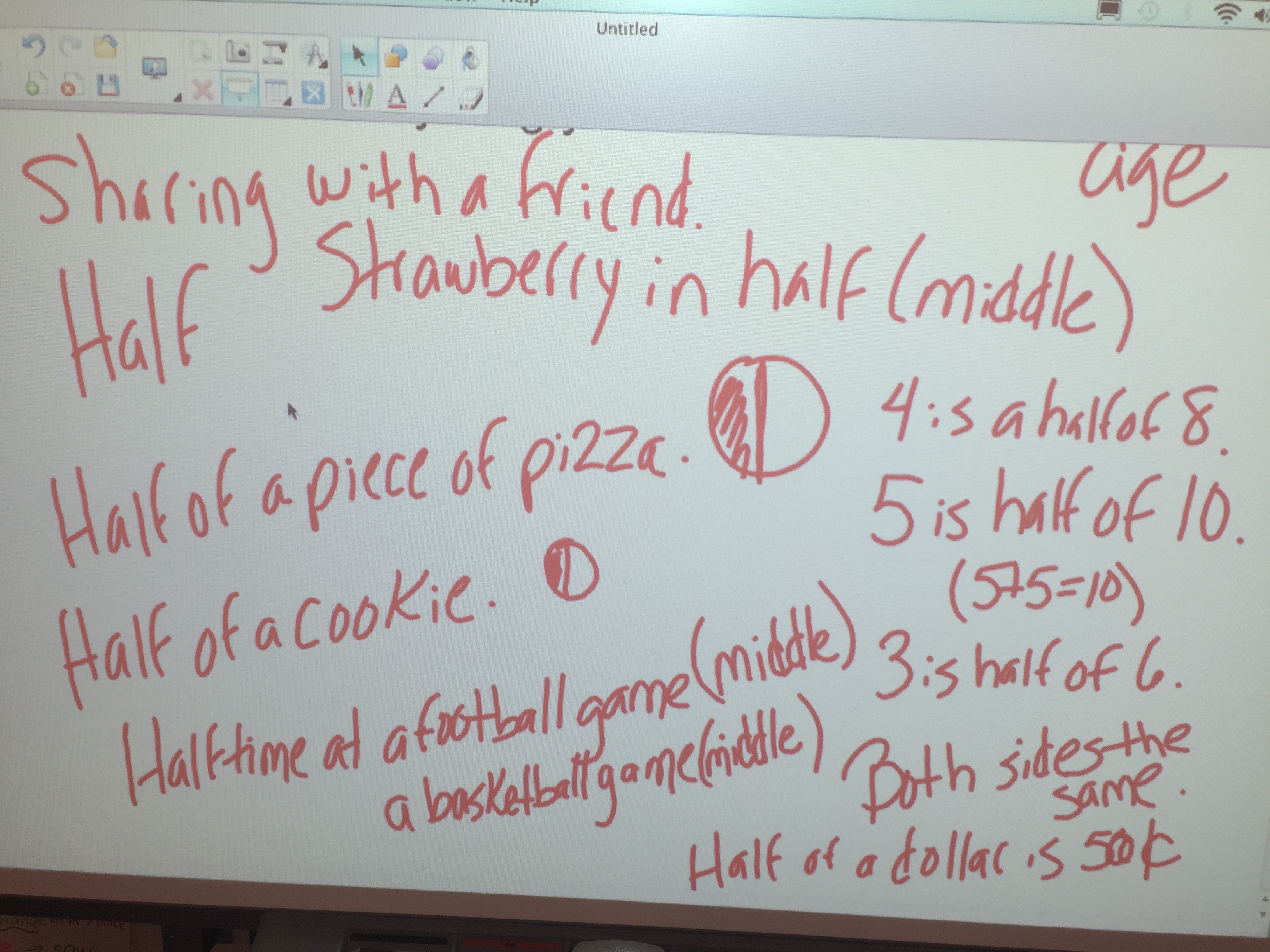
I launched with “Tell me everything you know about half.”

One student started by telling me it is like half a piece of pizza, so I asked what that looked like to her and she said it was the whole thing (big circle with hand) and then cut in half (hand straight down vertically). That springboarded into half of lots of things, cookies, strawberries…and many other things. Each time I asked if each half was the same in the different things and they said no, they were different sizes. So, I asked what was the same and someone said they were all cut in the middle. I got some cool sports references, I asked when halftime happened and they said in the middle of the game. Then one girl said “5 is half of 10.” Awesome. I asked how she knew that and she said, “because 5+5=10.” Hands shot up everywhere after that with other numbers and their halves.

IMG_1973

Then I posed the following story on the board and read it to the class:

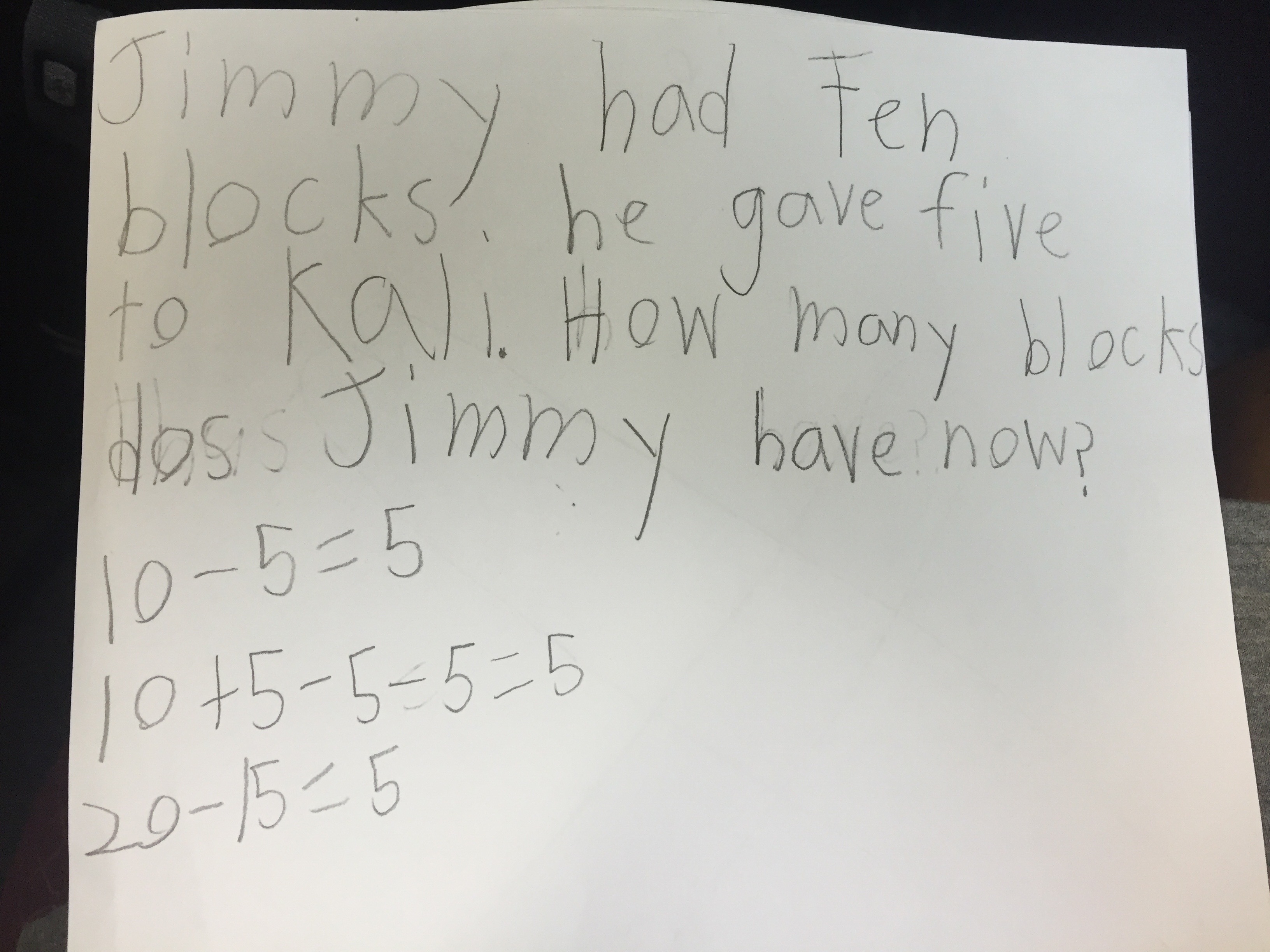
There was a pile of blocks on the table. Jimmy came into the room and took some of the blocks. He gave the rest of the blocks to his friend Kali. 

We did a notice/wonder and they wondered the things I had hoped: How many blocks were there? How many did Jimmy take? How many did Kali get? It was really cool that one student noticed there were none left on the table because Kali got “the rest.” I didn’t expect that one!

I let the partners choose their own numbers and as they got their answers, I asked if they could write an equation for their work. My plan for the group share was to have groups share, some who split the blocks in half, others who did not. My backup plan, because I never know what could happen, was to compare addition and subtraction equations for the same story to see if they noticed a relationship. I ended up with enough half/not-half that I went with that!

Here were some of the groups who split the blocks in half. The number choices were really interesting. I would love to put all of them up there for the class to talk about…why did they choose numbers that end in zero? What do we know about those numbers?

Some did not choose a number they could easily split in half. The group on the right noticed the commutative property right away and drew lines to show the same numbers in their equations.

Some really wanted to write as many equations as they could that didn’t necessarily match what was happening in the story but was great mathematical reasoning in their work!

IMG_1982IMG_1975


I cannot wait to see what this group does in their fraction unit, so many great thoughts and work about half!

Decimal Addition Card Sort

When solving problems in Number Talks, the strategies, en route to the solution, are the focus of the discussion. However, not all problems posed during a Number Talk are created equal or solved the same way every time by every student. While I know the majority of students use a particular strategy for one reason or another, whether it be because of the numbers involved or maybe it is the only strategy they are comfortable using, I like to take time and make these choices explicit. I want the students to think about the numbers before just computing and become more metacognitive about their actions.

Last week, the 5th grade teachers and I planned for a card sort to get at just this. The students have been adding decimals and using some great strategies, but we really wanted to hear about the choices they were making. With the help of the Making Number Talks Matter book, we chose problem types for students to think relationally between whole number and decimal operations. While there are no right or wrong answers, these are the problems we chose with strategies we thought went along with each. The expectation was not to have the students solving it the way we had listed, but to hear, and have other students hear the choices being made.

Screen Shot 2016-03-07 at 3.05.28 PM.png

We gave partners the cards, they sorted, and named the categories whatever they wanted:

IMG_1966IMG_1965IMG_1967IMG_1964

While the card sort conversations were really interesting, the class discussion afterwards was amazing! There were so much questioning of one another about how one strategy is any different than another. For example, some groups used rounding for a problem that another group used compensation and another grouped called it using friendly numbers…so groups had the same problem in three differently-named categories. Again, the category was not important, but more the fact they were actually thinking about the numbers they were given.

The other 5th grade teacher and I are planning to do the same activity with multiplication when they get there! Excited!

Kindergarten: Numberless Problems

Last week, the kindergarten students solved a problem about Jack and his building blocks. It went something like this:

Jack was building with blocks. He used 4 blocks to build a wall and 2 blocks to build a bridge. How many blocks did Jack use altogether?  

The teachers posed the problem without the question, did a notice/wonder, and then gave the students time to answer how many blocks altogether. We looked at this student work in our planning for their upcoming lesson.

We were curious to see what the students would do without the numbers in the problem, so we planned for a numberless story problem during last week’s Learning Lab. Three kindergarten teachers and I had a chance to be in the same room to see it in action today.

Nicole, the teacher, posed the following story to her students:

Susie is building with blocks. She used some blocks to build a wall. She used some blocks to build a bridge. 

She asked the students what they noticed/wondered and the very first notice was there were no numbers to tell us how many blocks, awesome. They did some wondering about how many blocks she used and compared this story to Jack’s building from last week.

We planned to have the students choose the number of blocks they wanted Susie to use in her building and then find how many she used altogether. Their number choices were so interesting and left me wondering when students begin to explain the usefulness of 10? I know some of them know 10 is a great number to add after the activity today, but I am wondering the questions to ask to make it clear to them because they just “know it.”

Here were some examples of their work…so much cooler than 4+2 in Jack’s problem!