#WhatCouldGoWrong

On Tuesday, I received a book entitled “Accelerating Learning for All Students” in which all of the teachers in the district will receive professional development in the upcoming week. I cannot speak to the ELA piece of the material, however the math examples made me cringe. I quickly got out my post-its and started reading…pink for positives, yellows for yuck.
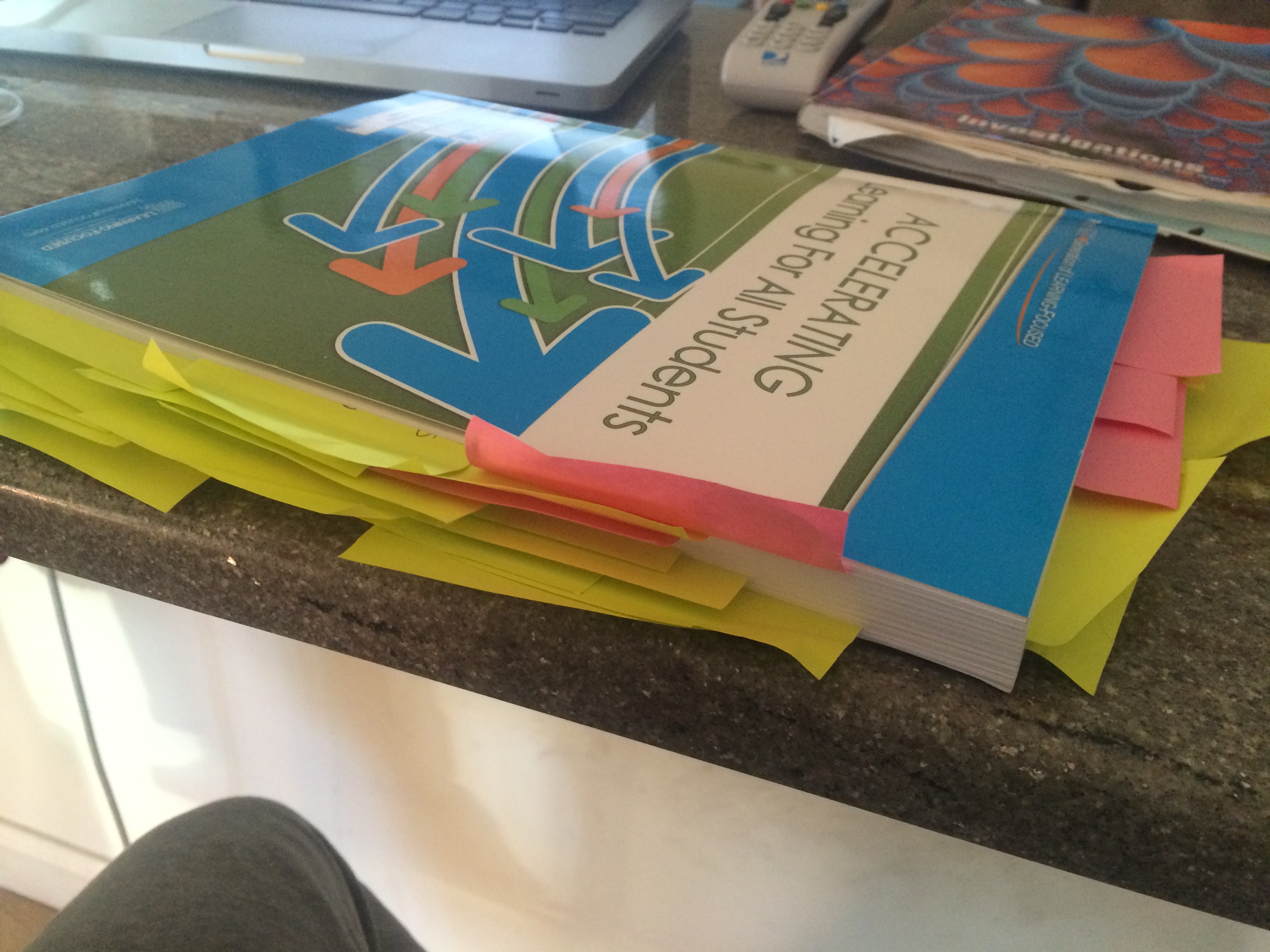
IMG_3608I think various points of the book were positive as far as the focus on teacher planning and opening up tasks to be accessible to all learners, they even have Carol Dweck’s Mindset mentioned, however the pathways they explain to achieve this accessibility completely frustrated me. To me, it feels completely at odds with all of the great math work we have been doing in our district/state. I am sure so many of you can relate to the type of aggravation that builds from being so passionate about learning. This week, I have been very aggravated.

Thank goodness for Twitter.

From this point on, I cannot take credit for this blog post…I had some incredible help…

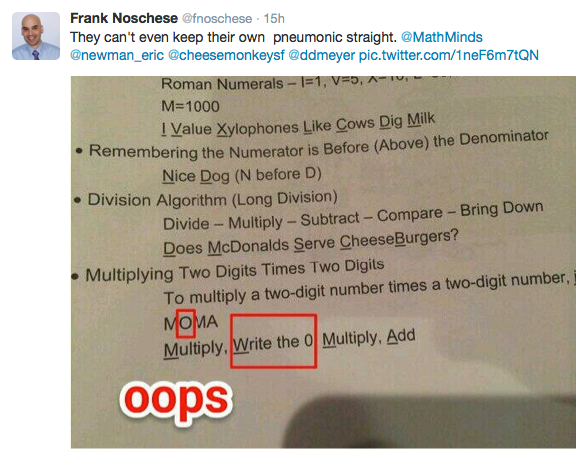
It all started when Frank threw out this tweet yesterday afternoon:f1Wow, was he reading the same book I was, with mnemonics and other “tricks” to help students “learn” multiplication? I responded with a pic from my book, along the same lines:
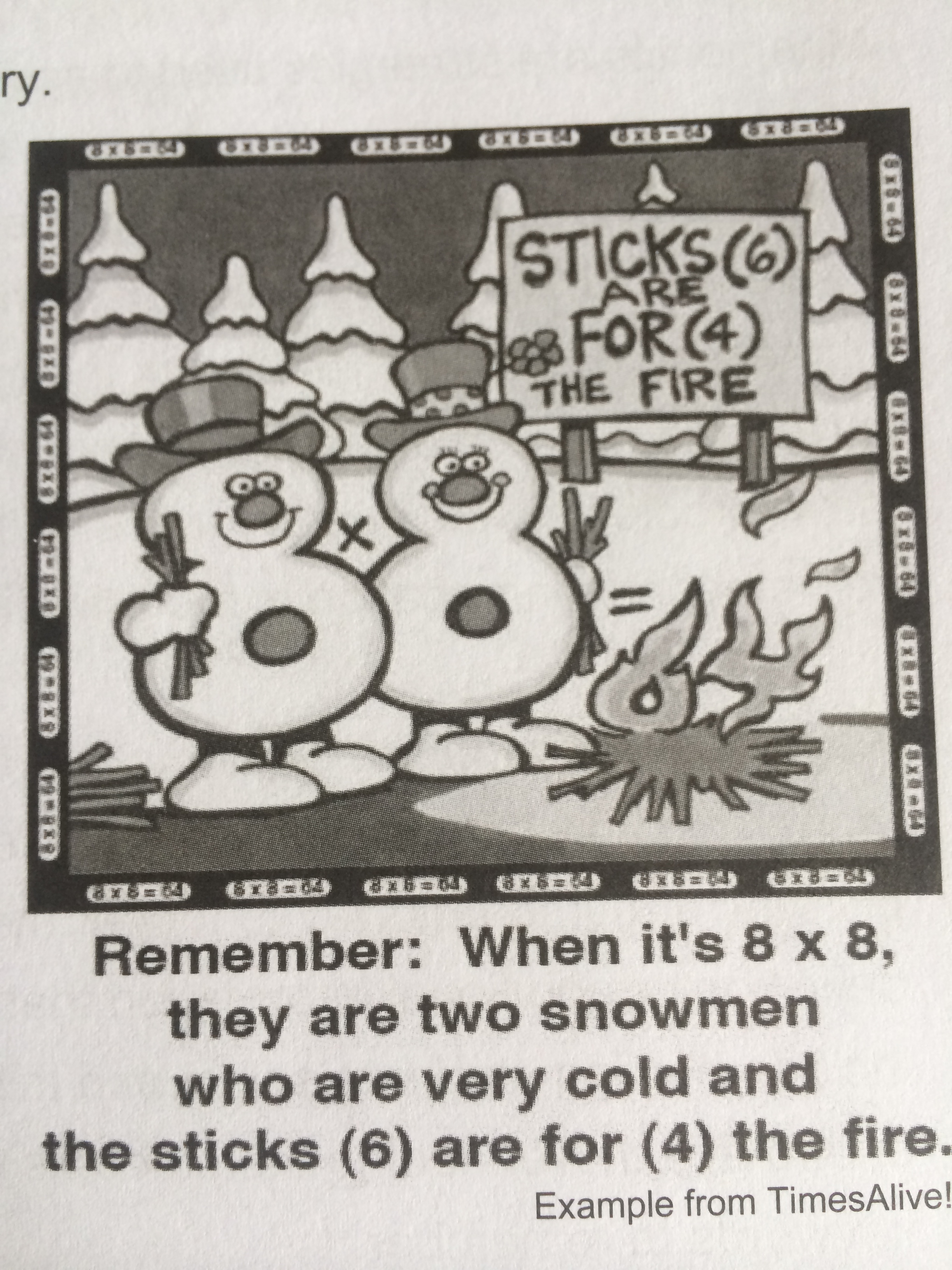
IMG_3587Of course the ever obvious question…

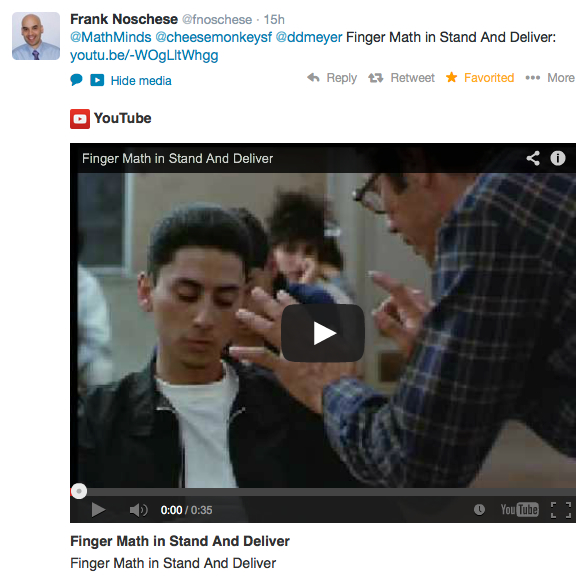
f6Which was quickly followed by…

f7and…

f20Then Dan offers this suggestion….

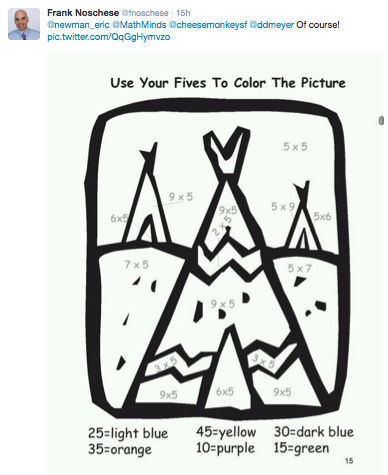
f5And now, for your entertainment, a few of the worst mnemonics and memorization tactics for multiplication (feel free to add any others in the comments:)…

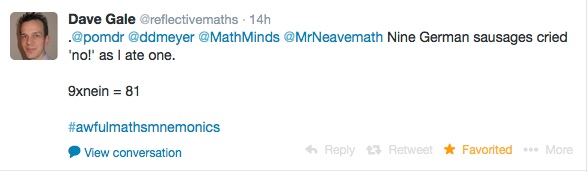
f8

f14f10 (Thanks David for the hashtag inspiration)

f3f9f15f16f17f21

f13f11

What could make this even better….

f2So as not to disappoint….

f12But the good news is kiddos…..

f4And mirroring my own thoughts after reading all of these…

f22f23

f25I would love to sincerely thank everyone who contributed to this conversation, I needed the laugh. Because, while we all know how absurd this is in the math classroom, it sadly leaks its way in with district/state initiatives. Those leaks are most frustrating for me when they are avoidable. I am SO fortunate to be surrounded by such passionate and knowledgeable math educators I can run to for support, opinions, advice, research, and, in this case, a much needed laugh!

Thank you!

Kristin

Decimals in a “One Frame”

After reading @ChrisHunter36’s post: http://reflectionsinthewhy.wordpress.com/2013/06/09/more-decimals-and-ten-frames/ I could not believe I had never thought to use 10 frames when working with decimals.

Today we began our unit on decimals and I decided to use the 10 frame (now called a “one frame” in my room) as a quick image to get a feel for how my reason about decimals as a part of a whole and the types of equations they could write to represent the way they viewed the frame.

I started with this frame:

1frameI had to explain how we used this as a visual in K-2 to build combinations of ten and later use more than one frame for students to think about addition and subtraction strategies. One student then asked, “Um, how are we going to use them in 5th grade?” Perfect intro. We came to the conclusion that in the younger grades each box is equal to one making  the whole frame equal to ten, hence the name.

Me, “Well, what if the whole frame was 1? What would each box be?

Student, “1 tenth.”

Me, “Great and how can we write that?”

Student, “1 over 10 or point 1.”

Me, “So what decimal does the frame on the board represent?”

Student, “Five tenths.” Everyone gave a quick shake of their hand in agreement. (The signal in our number talks)

Now that we had the basic understanding, I did a quick image flash of this frame:

1frame1I got thumbs up right away, agreed there were 9 tenths in the frame, and then students shared equations for how they viewed the frame. The said…

1 – 0.1 = 0.9

0.5 + 0.4 = 0.9

9 x 0.1 = 0.9

Then of course the comedian that just loves to make me write more than necessary… 0.1 + 0.1 + 0.1 + 0.1 + 0.1 + 0.1 + 0.1 + 0.1 + 0.1 = 0.9 He would laugh to think he now got me to type that out as well 🙂

We were moving fast through this so I thought I would throw out two frames to see how they reasoned about going over the whole. I know from past experience that some students will line .9 + .3 up vertically and add straight down to get an answer of .12, it is the most common mistake that I think using the one frames will be helpful in minimizing  by providing students the concrete visual of a whole.

I flashed this quick image next and asked students to write what number is represented by the two frames and equations that represent how they “saw the dots.”

7Here are some responses (right and wrong):

Loved how they visualized the dot moving to make the whole.

Loved how they visualized the dot moving to make the whole.

IMG_3342

This equation was great!

This equation was great!

The mistake I was expecting.

The mistake I was expecting.

I saw 1.2 and 0.12 in journals as I walked around, but then a student shared out that he thought it was 12/20. I LOVE when a student does this…makes it so much more interesting. I wrote all three answers on the board. I asked them who believes their answer is correct, they all raised their hands (confident bunch), so I told them to choose one of the the other two answers and explain what the misunderstanding is that led to that answer. I got some great work that we shared out and agreed finally on 1.2.

Here is what they said…

IMG_3341

This one is great because she realized she made a mistake as she was trying to disprove another answer. Then the reason that 9+3 is more than 10 so .9 +.3 has to be more than one. Interesting to revisit later.

This one is great because she realized she made a mistake as she was trying to disprove another answer. Then the reason that 9+3 is more than 10 so .9 +.3 has to be more than one. Interesting to revisit later.

Understand the thinking, just need to be sure to focus on the whole being broken into 20ths vs 10ths, not 20 and 10.

Understand the thinking, just need to be sure to focus on the whole being broken into 20ths vs 10ths, not 20 and 10.


She had to get her Fun Dip finger in the pic:)

She had to get her Fun Dip finger in the pic:)

IMG_3367

So, thanks so much to Chris. I can see many One Frames in my future number talks!

-Kristin


Why the Word “Smart” Makes My Stomach Turn…

I  used to love the word “smart.” To me, it had such positive connotations…Who doesn’t want to be thought of as smart? Who doesn’t want to think of their children as “smart”? Who doesn’t want their students leaving their classroom “smart”? Right? It is heard repeatedly in reference to students in parent conferences, PLC meetings and such. It felt like such a typical word, until now.

Over the past years, it is becoming one of my least favorite words. It literally starts to make my stomach turn. Since reading Jo Boaler and Carol Dweck’s works (http://joboaler.com/ and http://mindsetonline.com/abouttheauthor/index.html) and hearing Jo speak on numerous occasions, I have such a new perspective on the impact of the work “smart.”

I work very hard in my classroom to believe in the power of yet. There are no longer students who know something vs those who do not. It is now students who have learned something and those who have just not learned it…yet. (Great read on that:  http://www.mathsolutions.com/nl44/feature-article.html I am also trying very hard to take that perspective with teachers as well. I now am much more thoughtful in my conversations with not only my students but with colleagues/parents/administration and the impact of the words I use. I focus my words on the work, not the person. In my class, we are not “smart or not-smart”, we are all learners.

This belief that I have made part of my being as an educator was truly put to the test the other day. My students were presented with information on a program meant to help students with organization and study skills be more successful. Ok, not really what I believe makes students more successful, but they had to go, so I sat with them and listened. I could possibly write a dissertation on everything that was wrong with the presentation from my perspective, however the heart of the problem was the mindset of the person presenting.  If I had to hear the word “Smart” one more time in that 20 minutes, I was going to explode. And every time the word was used, it was in connection to grades and state test scores. As my stomach turned and knotted, I wanted to yank my entire class out of the room. I saw all of my work in trying to move every student from fixed to growth mindset slowly circling the drain.

It finally brought tears to my eyes (melodramatic, I know) when one little girl raised her hand and asked, “So do we have to have straight A’s to do this?” and the presenter responded with something to the effect of “the students in the program now are smart and have mostly straight A’s, but she understands if a “C happens sometimes.” So, this little girl who would have truly benefited from just some extra attention at school, but does not have straight A’s (whatever that really means) was deflated. What message was just sent by those words? Now does she think she is not “smart”? Now does she think she is not “smart enough” to get in? At that point I could not contain myself, I raised my hand and addressed the group, and the presenters.

I would love to quote my exact words, but I was so frustrated by that point, I do not even know the exact words that came out of my mouth. I truly was focusing on trying not to say anything rude to the presenters while making a point to the students. I can tell you it was something like this…I had to tell the group that their grades/test scores do not define them. That everyone in the room can learn, grow and improve in anything they persevere through. That I see them working hard, working together and learning every day and those things will be invaluable as they go through life. Smart is not something you are, so please do not leave here thinking it is.

After addressing the students, I left to address the adults in charge of this program. Hopefully, this will change from here…I guess if they are “Smart”, it will 🙂

A sincere thank you to the people in my PLN who have a growth mindset. I continue to learn from you every day and my students are so much better for it!

-Kristin


iPad Garden Problem

The Garden Project:

Over the past couple of weeks, my 3rd graders have been working with our new set of iPads on a Garden Project. Since our school has put in learning gardens this year, I thought it would be an applicable project for them.

The premise of the problem: The school wanted to build a garden with the most space to plant our vegetables. Each group was given 18 feet of fencing (18 toothpicks) to use as their perimeter. They were to design each garden, record the dimensions, and take a picture to save in their photos. After they designed all possible rectangular gardens, they had to create a presentation in Numbers to show me which garden they wanted to build.

The instruction page looked like this (Since this was our first project, I put the app pic next to each direction to help them along the way):

2

I am always amazed how fast the students can pick up the technology and run with it! They were collaborating and discussing perimeter and area like pros! We are sharing presentations tomorrow and then we will be extending our thinking by looking at the relationship between area and perimeter!

Hard at work:

IMG_0019IMG_0004

I will post their presentations when I get them uploaded tomorrow! Here is the GardenProject pdf if you want to try it out!

Mathematically Yours,

Kristin

Area and Perimeter of Squares – Student Noticings

This will be a quick post because I have a student-posed math problem that I need some time to reason through!

Today, students found the area and perimeter of squares that increase in side length by one each time. Students used a variety of models when building their squares from Minecraft carpets, to Geoboards to graph paper. Here is the completed activity sheet from their work: IMG_3140I then gave them a few minutes to talk to their tablemates about things they notice in their work. Here are the answers they shared as a class and I recorded on the board:

“An even dimension by even dimension = an even area”

“An odd dimension by odd dimension = an odd area”

“The perimeter goes up by 4 every time the square gets bigger”

“The areas are square numbers.”

“The areas go up by odd skip counting: +3, +5, +7…”
I was pretty excited because they really pulled out some great noticings and my next step was for them to choose one and find out why that was happening.

AND THEN THIS HAPPENED…

WOW, what a noticing!

Each pair of students chose one noticing from the board and worked on figuring out why that was happening. I had groups share the even dimensions = even area and perimeter going up by four. The tables that chose area going up by “odd skip counting” and the last one, left with no answer but excited to keep trying to “figure it out.”

Now, if you know why this last one works, please let me know that you know, but keep it a secret from me for right now! I want to sit and work through this one but I also need to know who to run to if I don’t get it!

I have found that you have to add the odd dimension area to the even dimension perimeter and if you do it the other way, it does not work. Why in the world does this work every time?

Had to share because it was such great conversation and I left having the hunger to sit and work thru the math….better yet, the students did too.

Enjoy and please let me know if you know why that is working because I may be reaching out!!

-Kristin

**Follow up comment: Thanks to my Twitter buddies, I worked my way to the visual of this problem. It was much easier to make sense of this algebraically, but the “why” took a lot of square drawings and scribbles! It was hard to make the connection between perimeter being the distance around to it being one side or a square tile. Here is part of my working on my Geoboard app…
IMG_0282
So the area of a 1×1 + the perimeter of a 2×2 = the area of a 3×3.

Always, Sometimes, Never – Quadrilaterals

One of my “go to” questions for students when they are working through math in my classroom is, “Will that always be true?” I find it pushes the thinking to another level where students are looking for examples and/or non-examples.

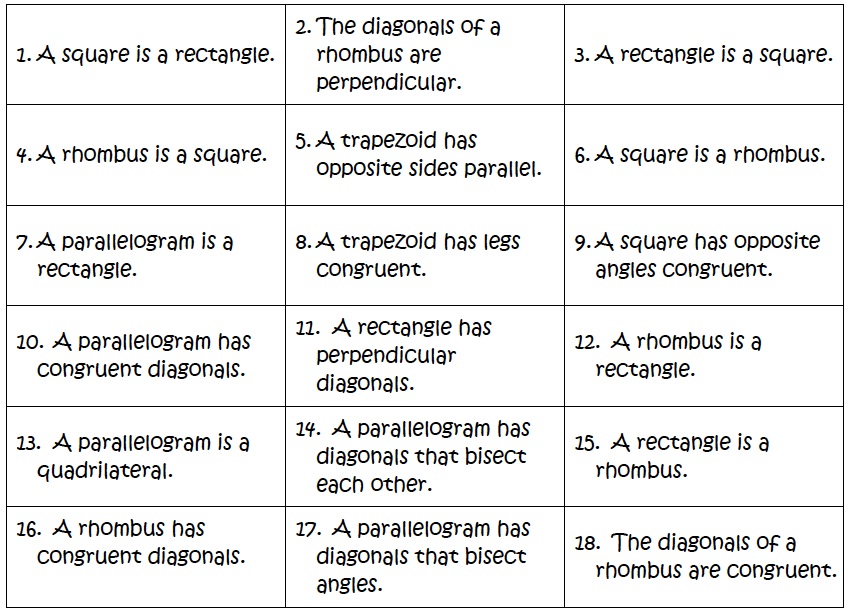
On Twitter one evening I found a blog post by @lisabej_manitou that was the embodiment of my go-to question: http://crazymathteacherlady.wordpress.com/2013/11/20/always-sometimes-never/ . Can you say perfect timing, as my class is in the midst of quadrilateral properties/classifications?

I gave each group of students Lisa’s sheet, clarified any key vocabulary questions and the conversations started rolling!

asn

We have been doing a lot of work with classifications and discussing all of the classifications polygons can have, but this activity took that to a great new level.  The “Sometimes” column has to be my favorite because it requires to think of both cases, true and not true.

One group had a very “heated” debate on the “Square is a Rectangle” card, which if you asked me ahead of time, would not have been the one I expected to hear such debate (at least in the respect that it was). I know that often students come into this unit having formed or memorized some form of the statement that “Squares are rectangles, but rectangles aren’t squares.” Whether it is taught or formed on their own, it is put to test when faced with the always, sometimes, never. Those are the words that are key in the misconceptions built around that statement. That was the conversation I expected to hear when I walked over to the group and looked at the card in question…however it was actually quite different reasoning!

One member of the group was literally “Starting to sweat” (her words) from this conversation. She was trying to explain to her group why a square is SOMETIMES a rectangle. Her reasoning was this: (I had to have her write it down so I could use it later in class and she needed a breathing moment away from her group)

IMG_3129She made an interesting point for students to reason about. If a rhombus can be a square, and rhombuses (or is it rhombi?) are not rectangles, squares can’t always be rectangles.

I pulled the class together to discuss this point because there were others agreeing with her reasoning. They SO wanted me to tell them who was right and who was wrong….um no way! I asked them what would prove or disprove this argument to them. One group said they would need her to show them an example of when a square was not a rectangle because if it is sometimes, it has to be a case of when it is and isn’t.

And, class dismissed. They left wanting to continue: creating arguments, critiquing the reasoning of other, making mathematical models, looking for patterns in their reasoning….I would say it was a great day in math!

I am SO glad they didn’t finish yet bc I am planning on recording some conversations on Monday to post.

Thanks Lisa for the great lesson!

-Kristin

Math Workshop

In my last post: https://mathmindsblog.wordpress.com/2014/01/16/rethinking-homework-pt-2/, I had a couple of tweets inquiring about how I organize my math workshops.

I am fortunate in the fact that our district uses the Investigations math program that embeds math workshops into the units. Over the years, I have learned to take what they have in the book and tweak it to meet the needs of my students. I appreciate the structure, games and activities, but I found that it could also afford me the time to work individually or with small groups of students who need the extra time. That extra time could be for an intervention or extension.

When I first started trying to use math workshops, i quickly realized that the management piece was by far the most important piece I needed to work on before we ever tried this again. It was L.O.U.D. I am all for noise that is productive, but it was definitely not that!

First step, figure out how to balance the noise so I can actually hear the students I am working with in a small group. So that everyone was not talking at the same time, I decided to make one center an individual center, one w/a partner, and one as a group. I created a template in SMART Notebook so the students knew their rotation and they wouldn’t have to ask me what they were doing next: https://www.dropbox.com/s/m3m37zelvgy70i1/MathWorkshop.notebook

Next step, I had to decide on the activities that would make the most of the time they were in each rotation. The partner activity was easy because I really like the games in Investigations.  I have just added a couple guiding questions for students to think about while they are working. The group activity, I decided to make more of a task-based problem that would require the students to work through the math. Most recently, students were trying to find unknown angle measures of polygons using angles that they knew.  The Individual activity varies, but each time I use it as a formative assessment of the work we have been doing in class. Recently, students solved two problems and did journal reflections explaining their work.

The hardest part is organizing the groups and deciding what I will be working on in the Teacher Rotation. I don’t want students to feel that when they come to my table they are “stupid” or embarrassed  because they may need extra help, so I keep the groups as heterogeneous as possible. I have learned that I need to be very thoughtful (and crafty) about the work they do when with me by embedding the concepts students have misconceptions about into work that others in the group, who do not, can still learn something from it.  It is tough and definitely the most time consuming piece of organizing Math Workshops.  Sometimes I make my table the table in which students are extending their thinking on a recent concept while other times it is meeting students where they are to try to work on misconceptions.  I have used my recent math homework as a way to choose the problems we work on at the “Teacher Center.” Looking at the homework has also made it easier for me to put the students in Workshop Groups so I have a range of strategies in the group in which to make connections.  * I don’t always have a group. Sometimes I walk around and facilitate discussions while the students work in the three centers. *

After all of that work, I set the timer on my phone for 20 minutes & run three centers for a total of an hour of Math Workshop. The students really enjoy it and have learned to work very well together.  I typically like to run the Workshop at least once every couple of weeks.

-Kristin


Rethinking Homework Pt 2

For those interested in the follow-up on my homework change after reading my first post: https://mathmindsblog.wordpress.com/2013/12/28/rethinking-homework/ , this is my reflection on the the process…

1 – Choosing the problems – I felt a bit overwhelmed with choosing the problems to put on the homework page. Who would have thought? It is just two problems, right? Unlike the “typical” homework that goes along with what we did in class that particular day, I wanted to use it more to see if students truly learned the concepts we worked with over the course of the first half of the year. With that, I chose to use a volume problem from Illustrative Math: http://www.illustrativemathematics.org/illustrations/1308  , which was our first unit of the year, on one side and on the opposite side I put the addition problem: 3  3/4 + 5  1/8, and asked students to show two different ways to solve the problem. I thought one problem in context along with one problem without context was a nice mix.

2 – Students showed great responsibility – I purposely gave the paper to the students on Thursday and assigned it to be due the following Monday so students had two nights to actually get the paper home (sometimes that is the hardest part:) and then two more nights to find an adult. I was very excited to get 98% of the papers back from the students and they seemed really excited to tell me about what their parents had said about their work. I heard everything from “They said they wouldn’t solve it that way” to “They were so proud of my vocabulary.” Loved it!

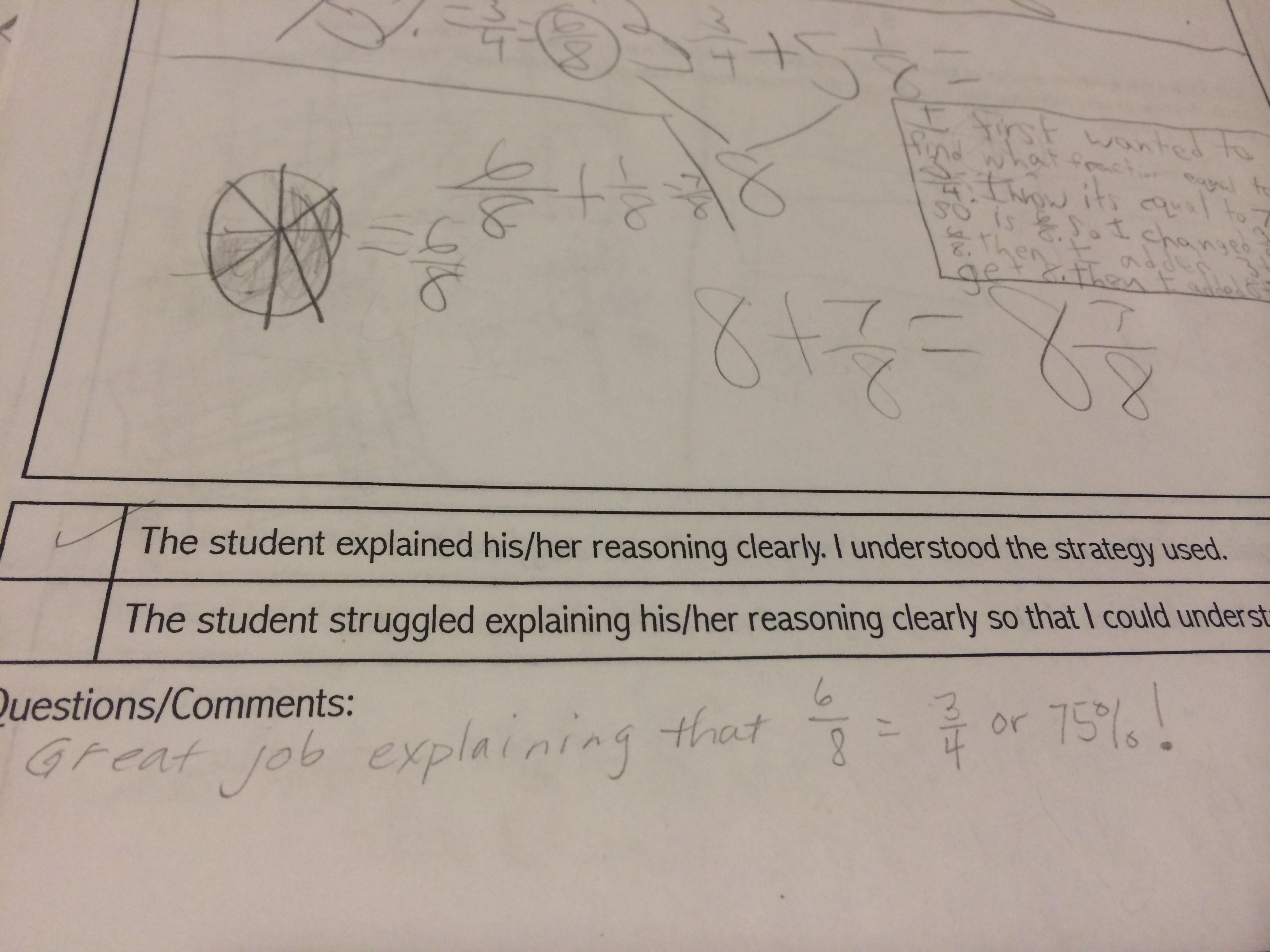
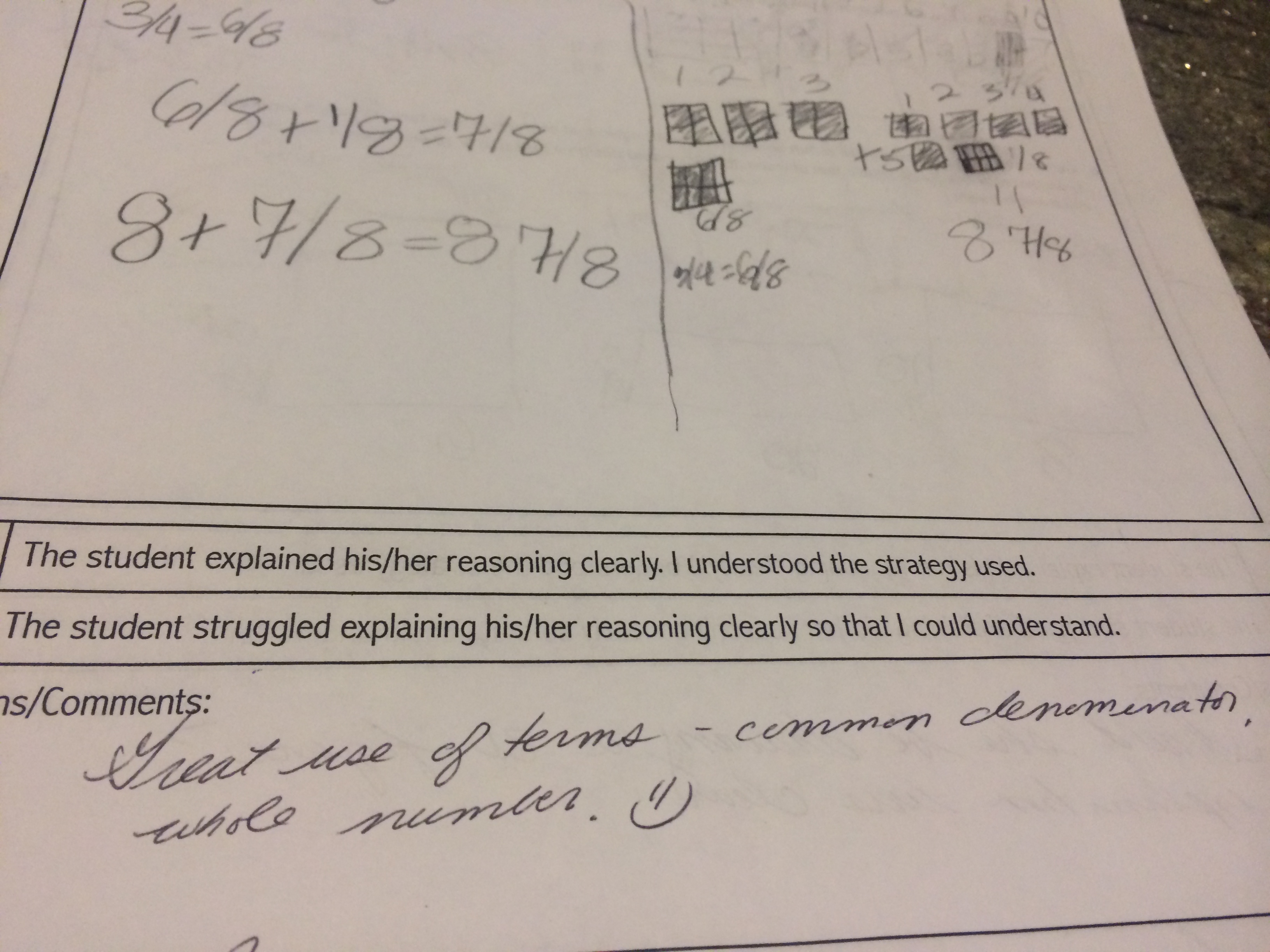
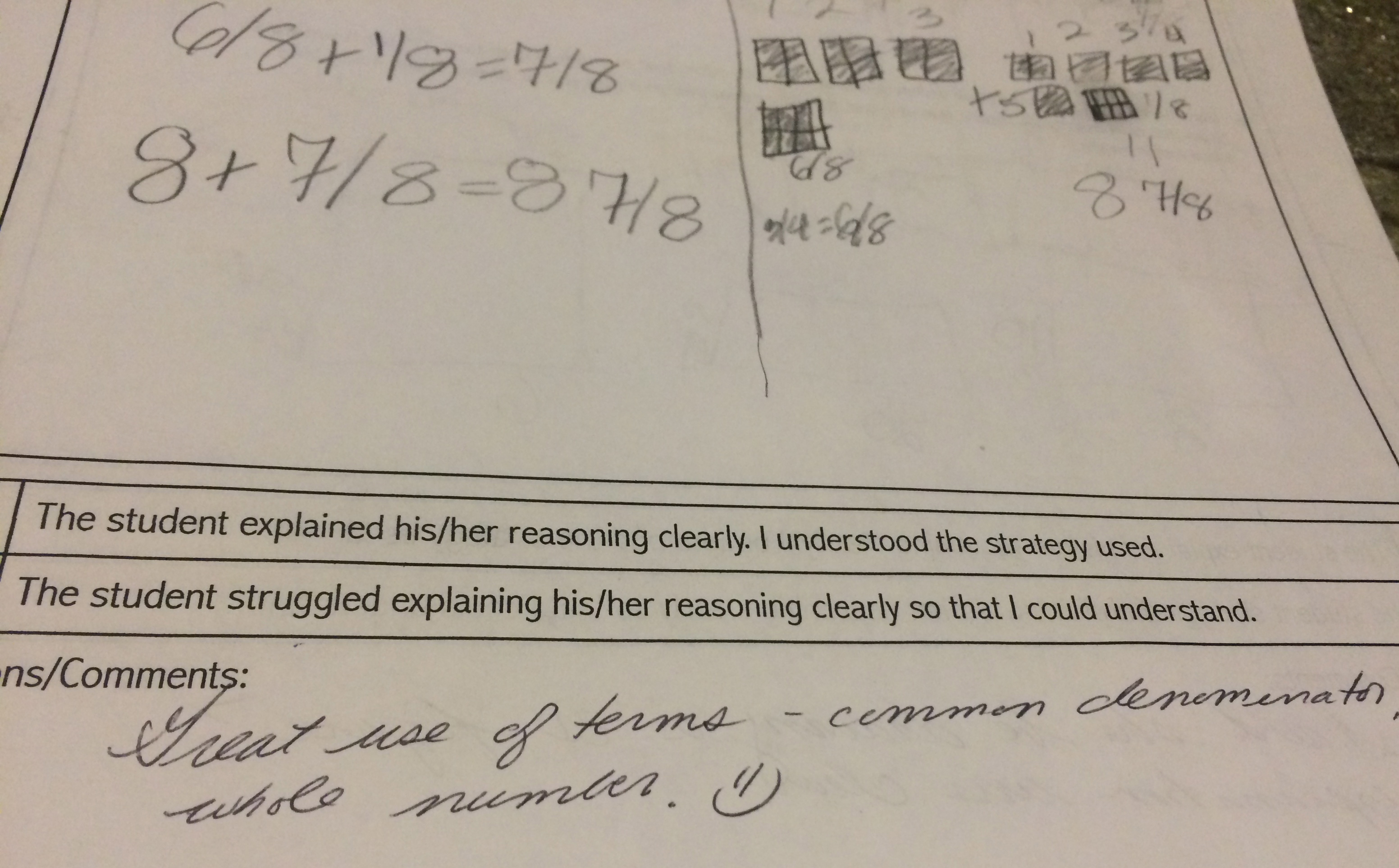
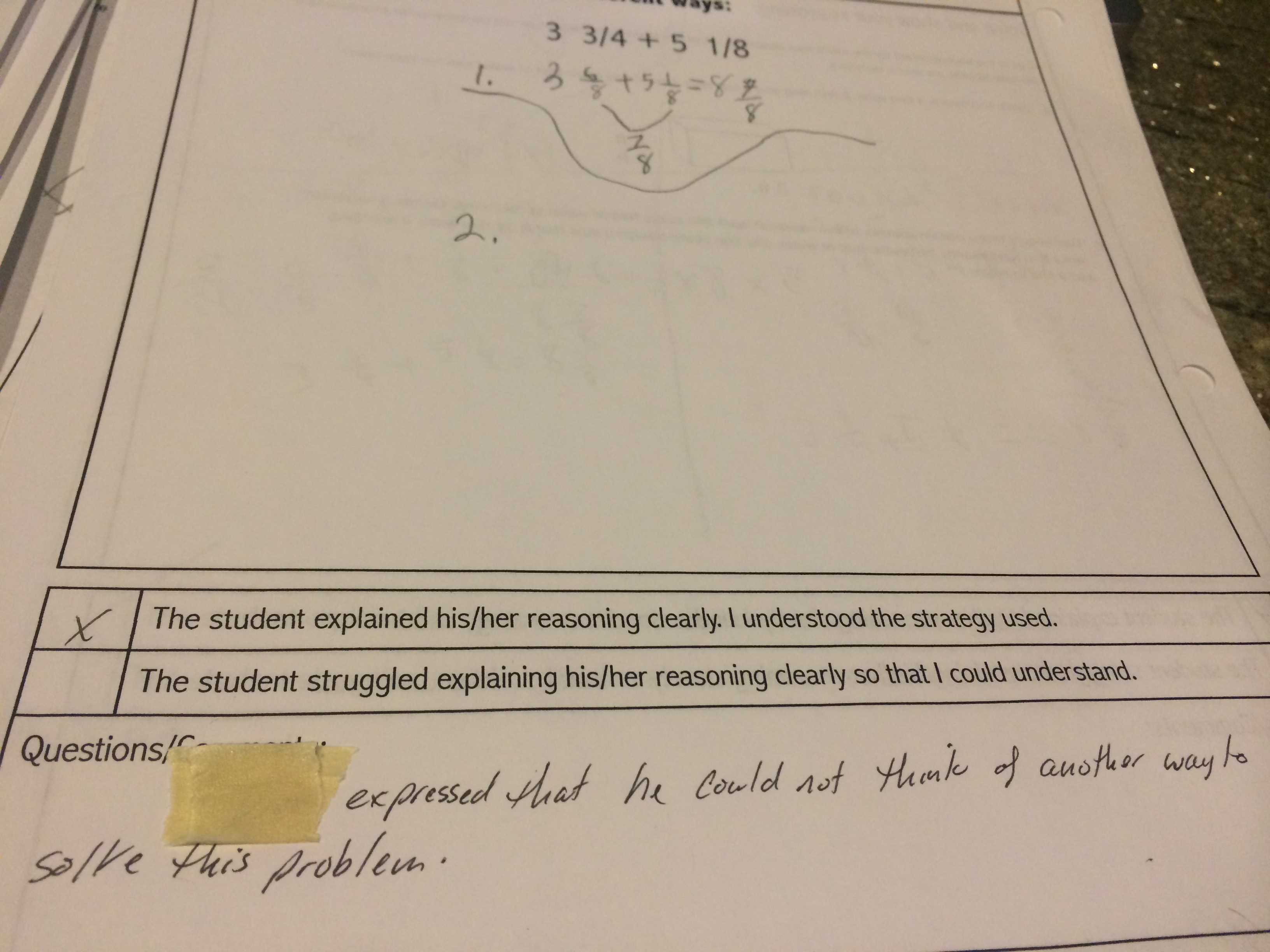
3 –Parent response – I had great parent response both on the sheet and in conversations after the fact. Here are just a few examples of comments made….

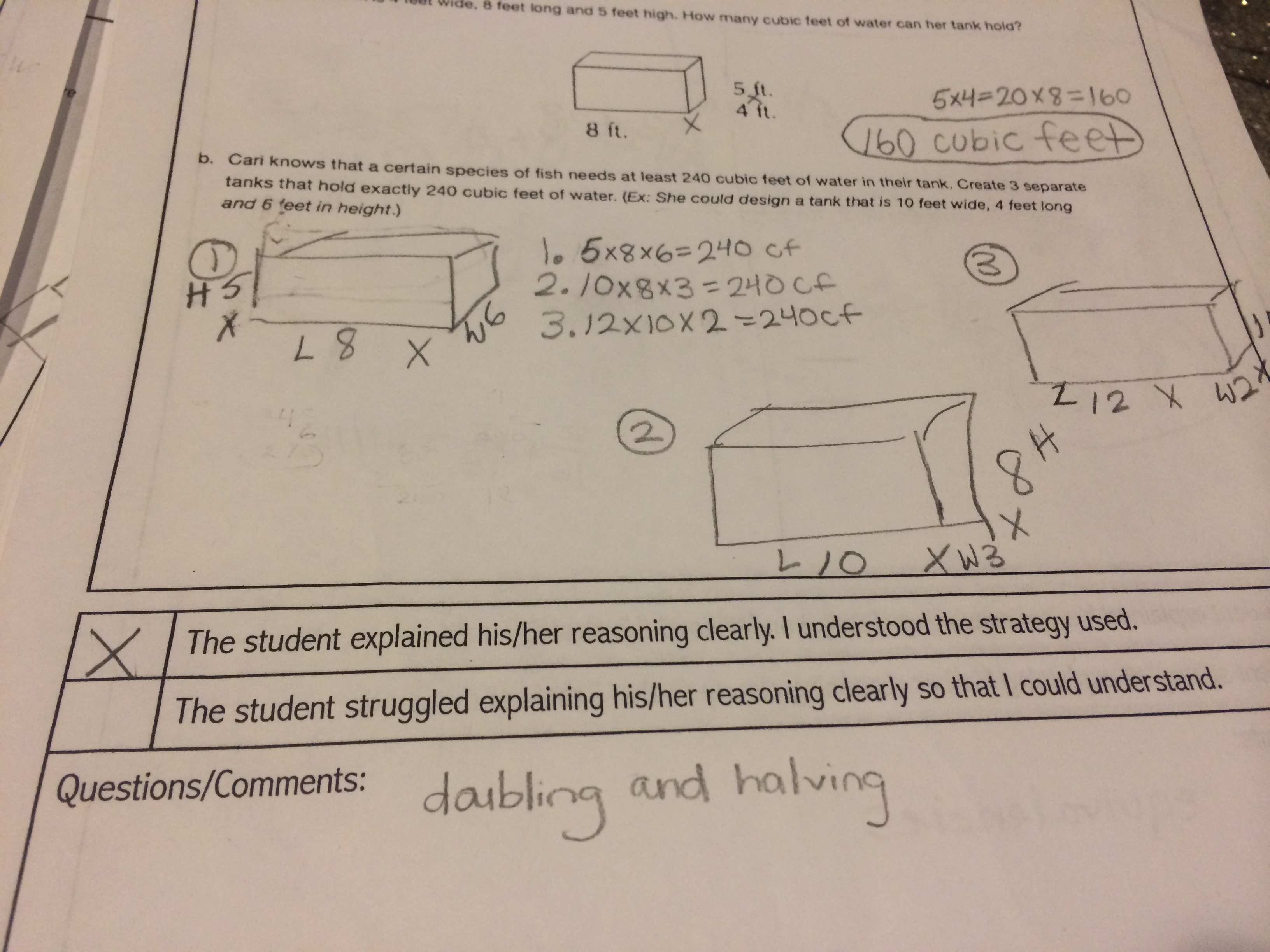
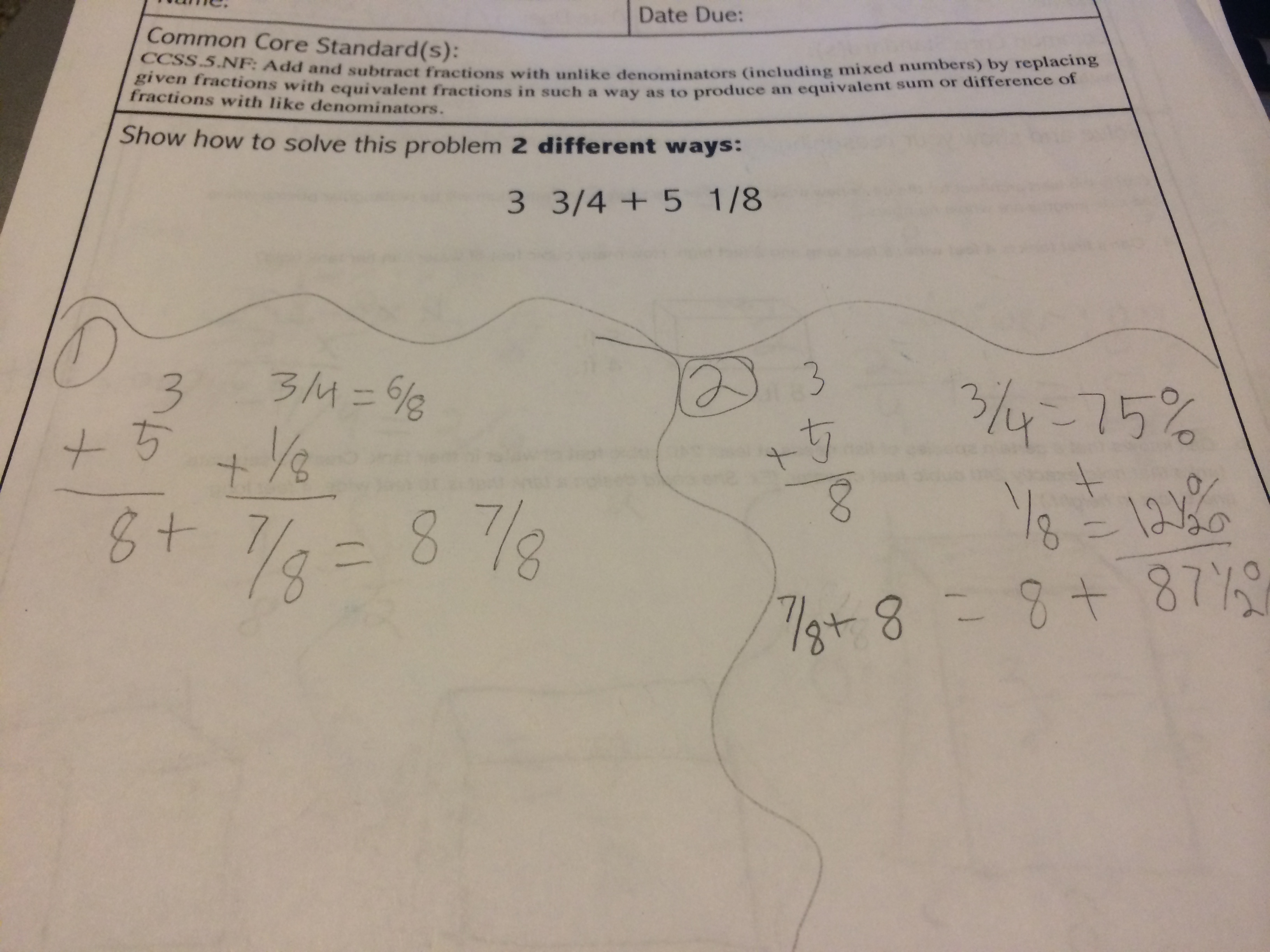
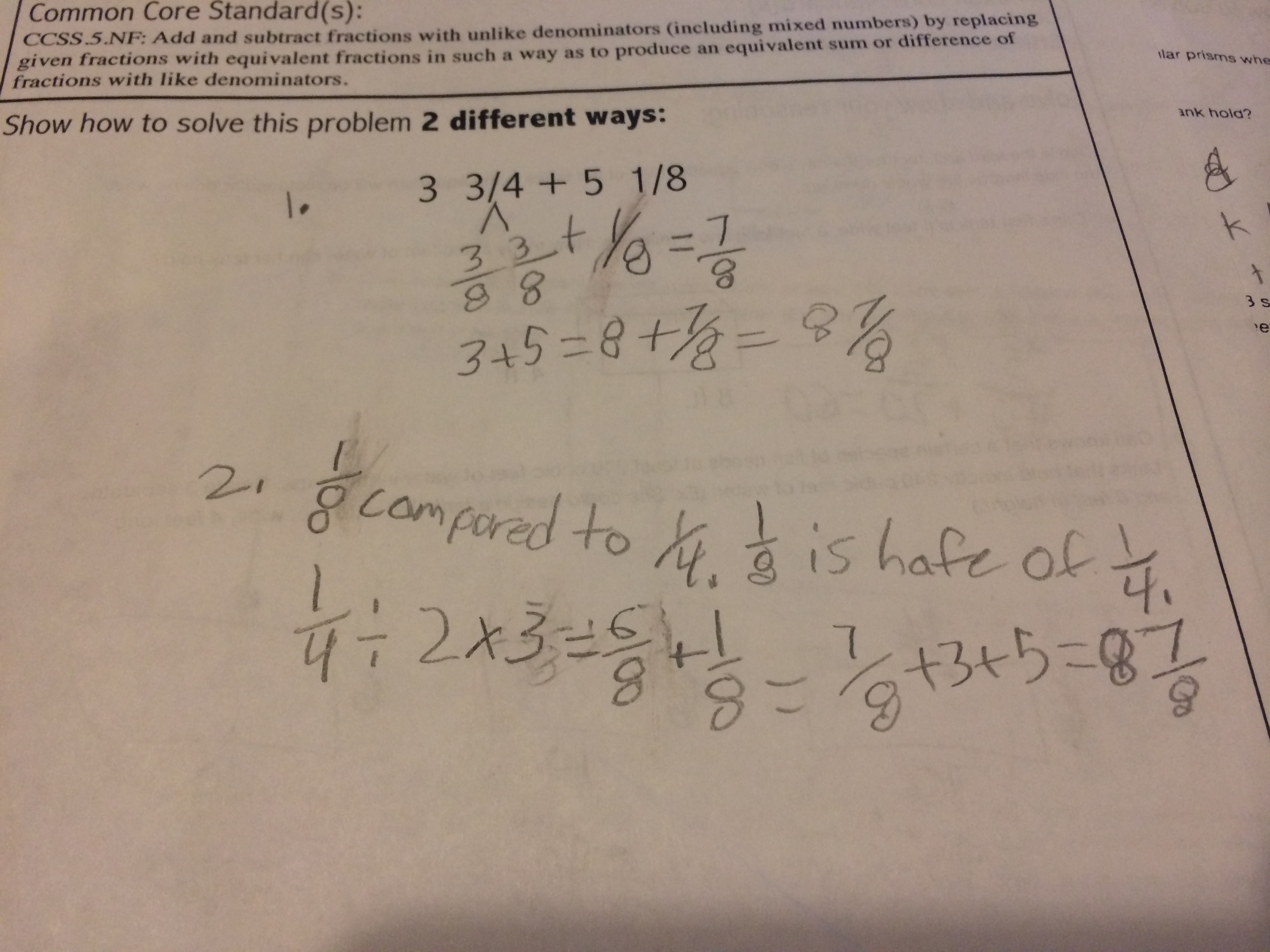
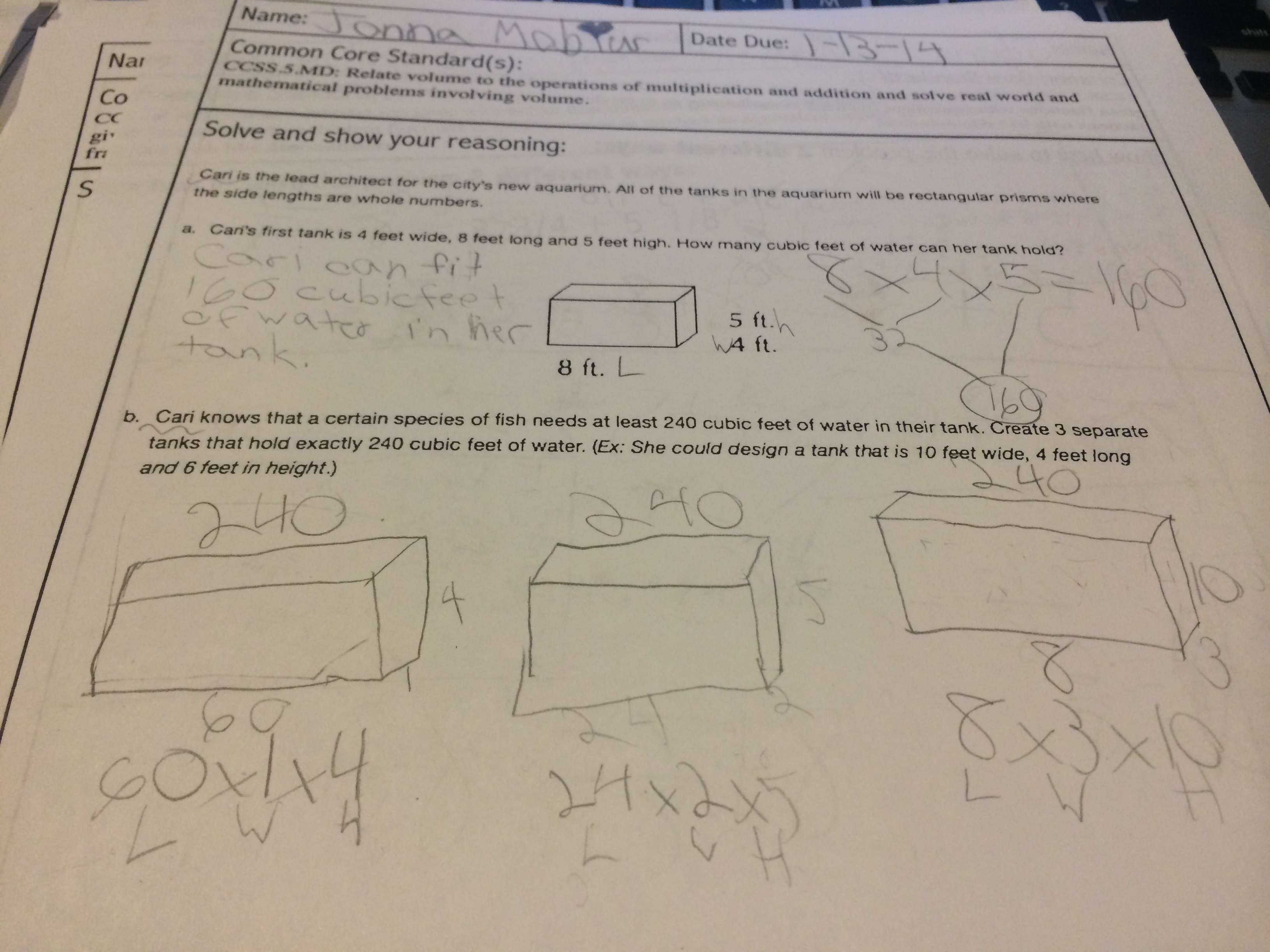
IMG_3076 IMG_3075 IMG_3074 IMG_3073 IMG_3072 IMG_3071I loved that I got praise, concerns as well as strategies! It was pretty awesome and hopefully led to some great conversations at home!

4 – My response – I wanted to take time to look through the work and plan my next steps but I also wanted to acknowledge the parents comments and/or concerns right away. That day, I sent a quick email to the parents to first thank them for taking the time to work with their child on math and to also let them know that I saw their questions/concerns and that although they may not get a direct response from me on each individual comment, I will be working with their child based on their work.

5 – My plan from here – I have math workshop planned for tomorrow in order to give me time to work with the students who may have misconceptions or maybe just not using an efficient strategy in their work with volume and/or fractions. I found the fraction work pretty amazing and, I cannot lie, it really made me feel great about the work we had just done in our fraction unit. They really used some creative thinking in looking for a second strategy!

Overall, I completely loved the homework and the result! I am in the process of creating my next one to give the students tomorrow. I don’t think I will make any changes at this point in the layout of the sheet at this point. I do think that when I give a problem with no context next time, I will ask the students to write a story to go along with it.  I did find that more struggled with the volume question, possibly because of the context, so I really want to work on the students moving in and out of context in mathematics.

– Kristin

Student samples in case you are interested:

IMG_3077 IMG_3078 IMG_3079 IMG_3080

Rethinking Homework…

One of the things on my vacation “To-Do” list is to rethink the way I do homework in my classroom. The concept of homework is something I constantly go back and forth with in my head, trying to find the perfect balance of meaningfulness for my students.

Some things I have learned, loathed, and/or questioned about homework…

  • More problems does not equate to more meaningful. If a student can do 2 problems correctly, chances are they can do 20. Conversely, if they can’t do 2, 20 will be extremely painful.
  • Some parents will want more homework, some will want less. This is not necessarily based on any particular demographic, it is varying. I find this more stems from parents reflecting on their own school experience and homework load. What they believe makes students “better math students.”
  • Some students will have help (resources) at home and others will not. Then I end up grading/giving feedback on parent’s work or work that has been corrected by the parents vs the students that did it completely alone. Not equitable in my eyes.
  • Some will never remember to bring their homework home and if they do, will lose it on the way back to school. So, then I feel like I am grading a student on responsibility and not their math understanding.
  • Homework should be meaningful, however what is meaningful varies from student to student. How can I make it meaningful for the 45 individuals in my math classes?
  • Homework can be beneficial to involve parents in what is being learned in class. I do newsletters and parent math nights, but really homework seems more accessible. I want students talking math their parents and questions that may arise from parents. Homework can open those doors, but I don’t want it opened in a negative “my child couldn’t do this and I had to show them how I solve it” kind of way.
  • Am I doing the students a disservice if they hit 6th grade and beyond and the homework load increases dramatically on them? Am I responsible for “preparing” them for what will happen in future grades? (whether it be best practice or not).
  • I feel there is benefits to students being held accountable for completing assignments outside of school. From time management to the organization and responsibility of completing a task are life skills that I feel are extremely important. But, how do grade/give feedback to those skills? If it doesn’t somehow “count,” some students will not really have the motivation to do it.
  • I feel like the time spent grading/giving feedback on homework could be better utilized in planning upcoming lessons.

This list could go on and on, but for the sake of time and actually being able to check something (actually two things bc blogging was also on there) off my to-do list, here is what I have come up with thus far…

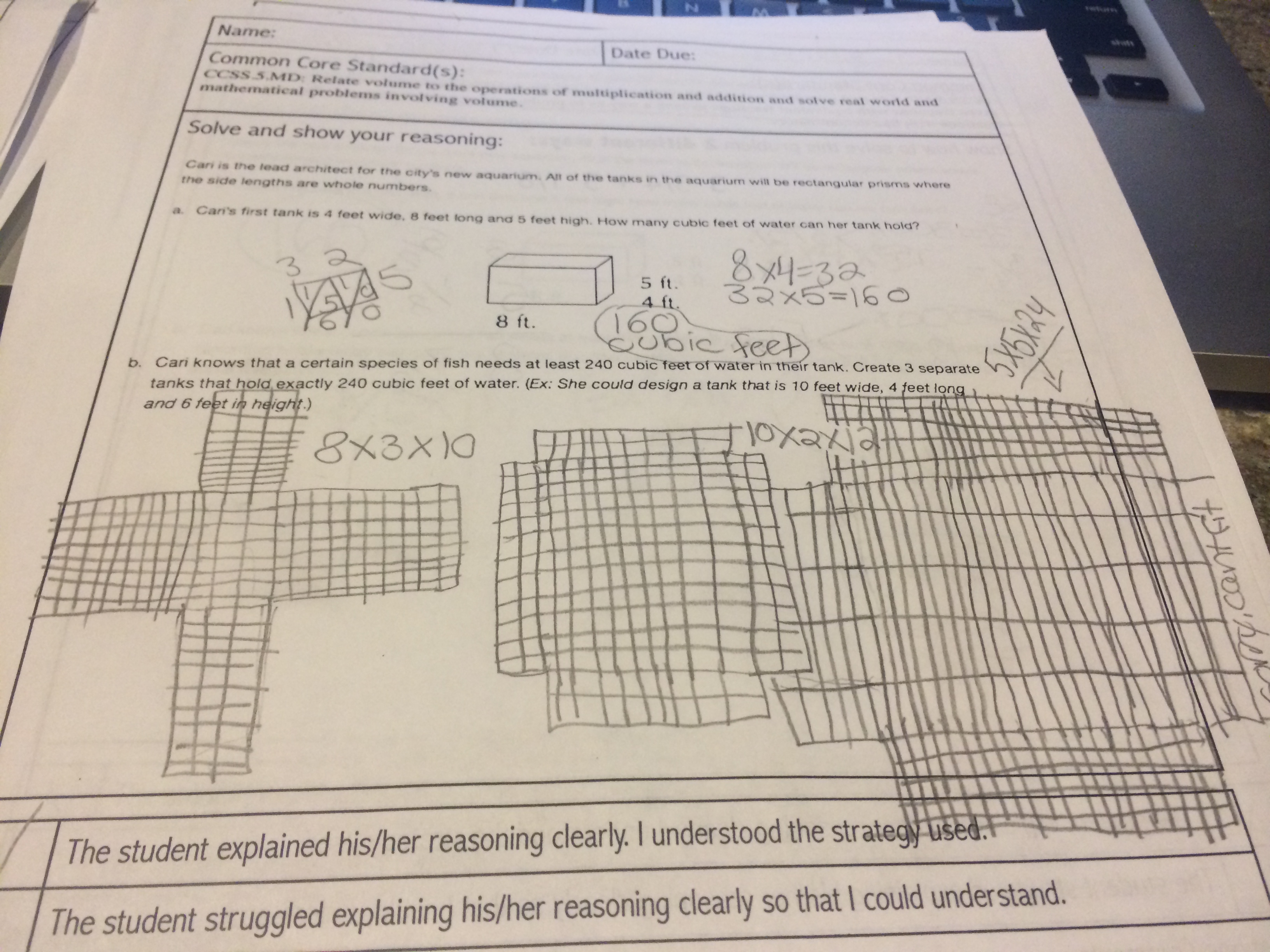
I will assign one or two problems for students to solve and explain their reasoning. I will attach those problems to applicable standard(s) (including the Math Practices) so parents who would like, can see why certain things are being done in class. I will have it due over a few day period so students can manage their time and organization. Hence leading to the first part of the page:

hw1

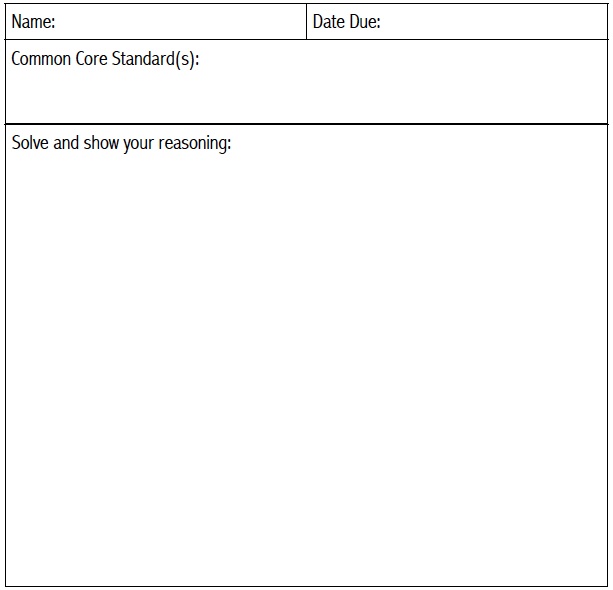
Now the second part is hard because I am trying to break a mindset. I want the students to explain their reasoning to the problem and parents (or any adult) to check off whether the student could explain it clearly or not. NOT FIX IT! Then I left a box for any questions or concerns for me… second part:

hw2

I am hoping this offers as more of a formative assessment for me that connects parents to the learning in our classroom. For the students who do not always have parents available, any adult will do…this way the students could use one of their other teachers in school that they see each day.

I am also hoping that by having students explain their reasoning to someone other than me (because most times I “get where they are coming from mathematically”) it will force them to be accurate and clear in their explanations, putting a big emphasis on the Math Practices.

I am hoping this opens more communication between the parents who I may not have reached the first half of the year.

I am hoping this gives me more time to focus on planning and instruction time than grading or  going over homework assignments.

As always, a work in progress. Any thoughts are appreciated!

Now, time to check two things off my list…for now..

-Kristin

Brainstorming with Minecraft…

Like many teachers right now, I am starting my Winter Break “To Do List.” One of the things at the top of my list is planning for our upcoming math unit.  Since we have recently received our iPads, I am constantly trying to find a way to use them as a learning tool in my classroom. I don’t want them to just be a “paper replacement” but instead a part of the learning process.  Our upcoming unit is Measuring Polygons which includes work with area and perimeter and as I read Fawn’s AMAZING Hotel Snap task the other day, I got inspired!

In case you haven’t seen it: http://fawnnguyen.com/2013/12/10/20131027.aspx

I love SO many things about this task: the collaboration, the challenge, the math, the Math Practice reflection, all materials to go along with it, accessibility for all students…and I could go on and on….it is awesome!

For my 5th graders, I am going to try to recreate this task using Minecraft, since the app is on their ipads and they are just dying to use it in class. I think it has such potential for some seriously amazing math and creations…not to mention the engagement factors of a competition and Minecraft…they will be in math heaven!

I am in the beginning planning stages, but to keep my thoughts organized (and get some feedback), I figured I would just start typing my initial thoughts and/or questions I am having…

1 – To start, our next Social Studies unit of study is Economics so I had the students price out the materials in Minecraft today.  It was great conversation of durability and availability. If a material was difficult to “find” or “craft” in the game, the higher the prices. Here is an example of a piece of the students’ work:

Image

I plan on creating a spreadsheet in Numbers for them to keep track of their block usage during construction.


2 – I am thinking they will build a resort instead of a hotel because of the options to put in sidewalks, pools, petting zoos and such to increase revenue and include volume into the equation. Question: How do I factor in profit of having extra amenities? Does a bigger pool bring in more money? How in the world do I price a petting zoo (because they so want to put animals in there)?

3 – The rooms of the resort will still follow the window guidelines in Fawn’s original task, but the rooms will be 3-D so I am going to allow them to put beds in each room. That would change the pricing of the rooms not only by window, but by accommodations (single vs double vs king).  Question: Will the bed and window pricing be overwhelming and time consuming and take away from the challenge of finding most profit? Should I make it one or the other?

4 – Love the scoring, keeping that exactly the same.

5 – Question: Do I give them a block limit or spending budget? Is there an advantage of seeing who can make the most money with the same number of cubes vs who can make the most money with the same budget?

6 – I would like to incorporate area and perimeter relationships here so I am thinking it has to be a “gated” resort. Possibly: What would happen to you cost of gating if you doubled the area of your resort? or How could you arrange the resort to keep the area you would like but keep your gating cost the lowest?

I would first like to thank Fawn for the inspiration and amazing resources! I would love any and all thoughts additions/deletions on the task. I always have my cubes bagged and ready for use if this is a bust!

Thanks!

Kristin

Image