Unanticipated Student Work…Always a Fun Reflection!

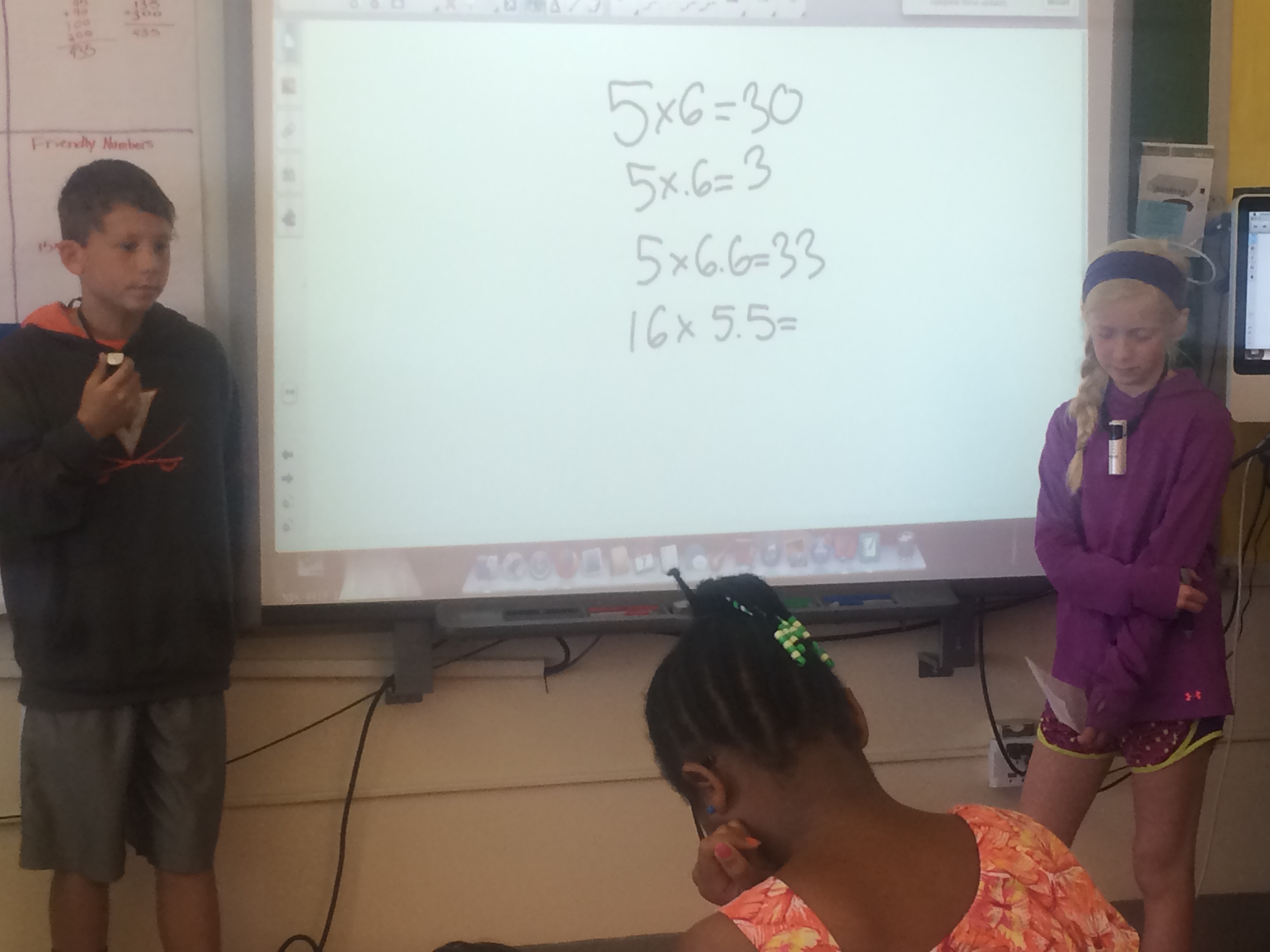
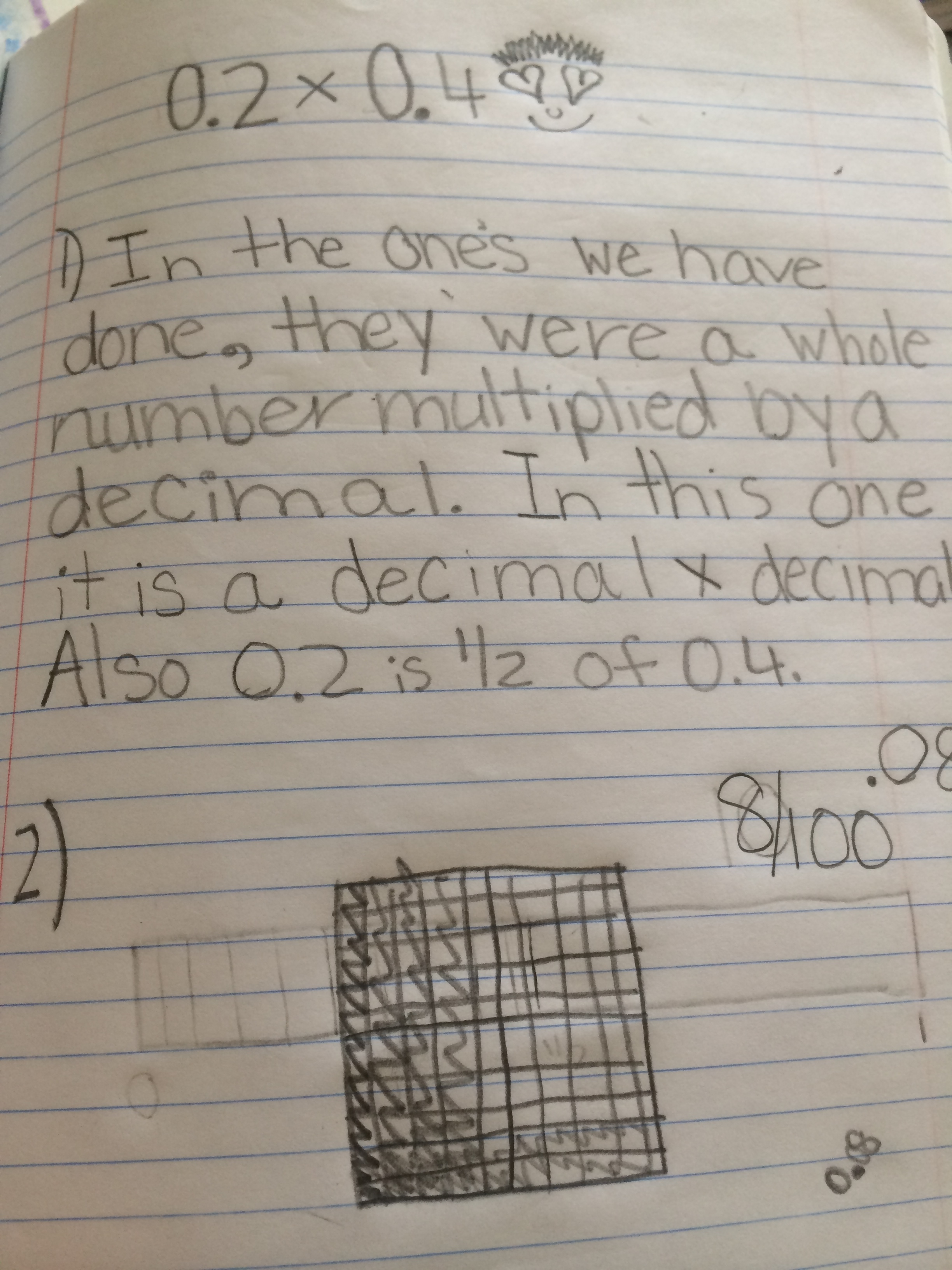
As I was planning for a summer PD, “Decimal Fluency Built on Conceptual Understanding”, I was going through pictures of my students’ work. I focused on the very first multiplication problem I had presented to them in which both numbers were less than a whole. I presented them with 0.2 x 0.4 and asked them to do a “Notice/Wonder” and think about the product. I had anticipated some may reason using fraction equivalents, some may know that .4 is close to half and take half of .2, and some may try fraction bars or arrays to solve. Here are samples of their initial work….

IMG_4323 IMG_4326 IMG_4334 IMG_4338 IMG_4341As I circulated the room, the two products that showed up were 0.8 and 0.08, as I anticipated. I put them on the board and had the students work through it as a group and try to prove the product they thought was correct and disprove the one they thought was incorrect (I did not tell them at this point, that was their job!:)

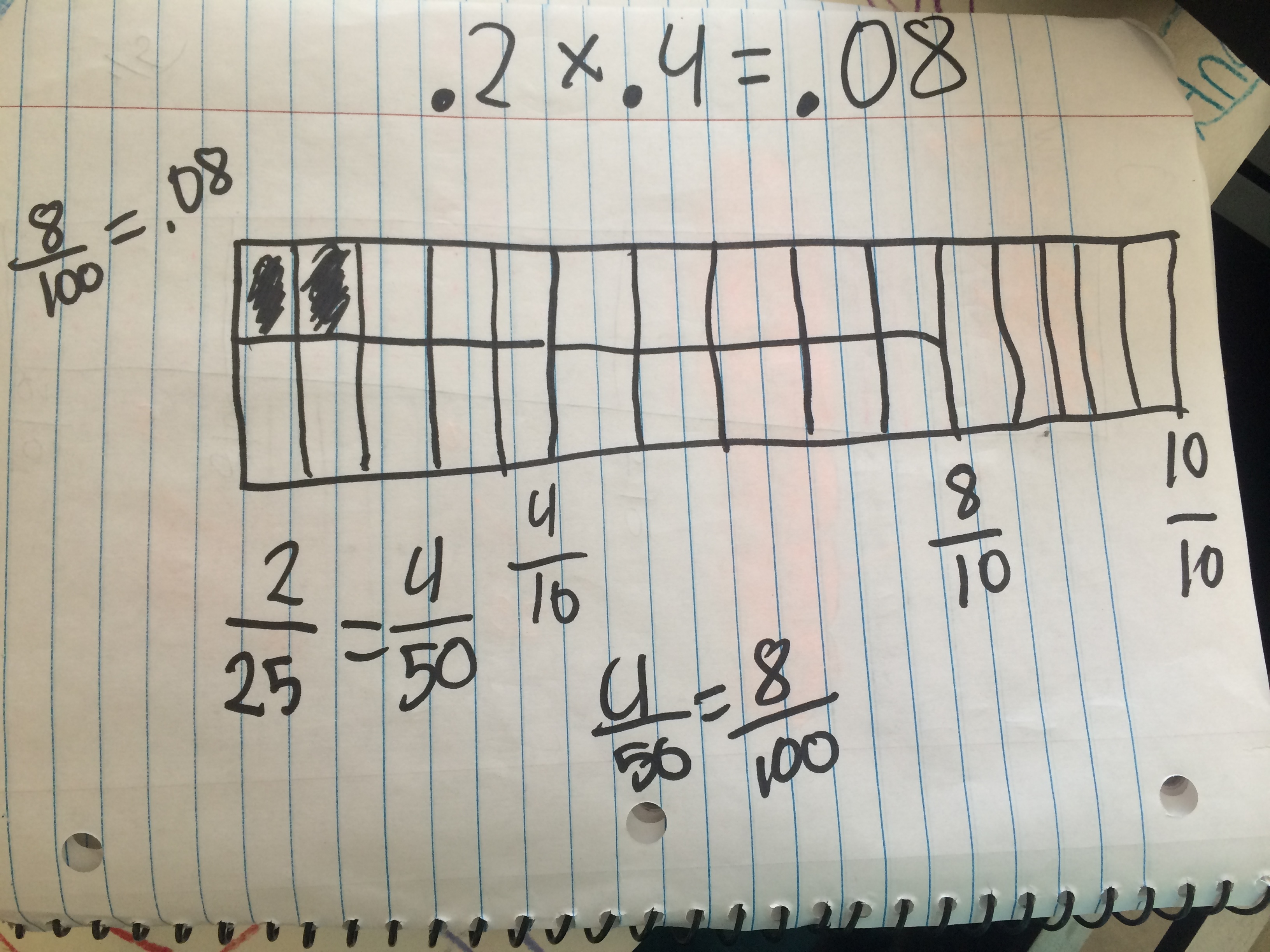
During the share out, this is the one response I did not anticipate at all and now, going back, I wish I had spent more time with…grrr….darn hindsight!

IMG_4335


For all of the nerdy math peeps, like me, who like to “figure things out” I am going to leave out her explanation here! I will gladly recap it for anyone who would like to hear it in the comments or via twitter!

Needless to say it left many students a little baffled, and we did revisit it the next day for her to re-explain her reasoning. I just wish I had extended this by asking students if this model would work for any two decimals less than one whole? Why does it work with .2 of .4?

I highly recommend snapping pictures of your students’ work all year long because reflecting back on this work over the summer has taught me a lot about anticipating student responses and how to handle those responses you just don’t expect! It also just makes me smile at the way my students reasoned about the math we were doing!

-Kristin

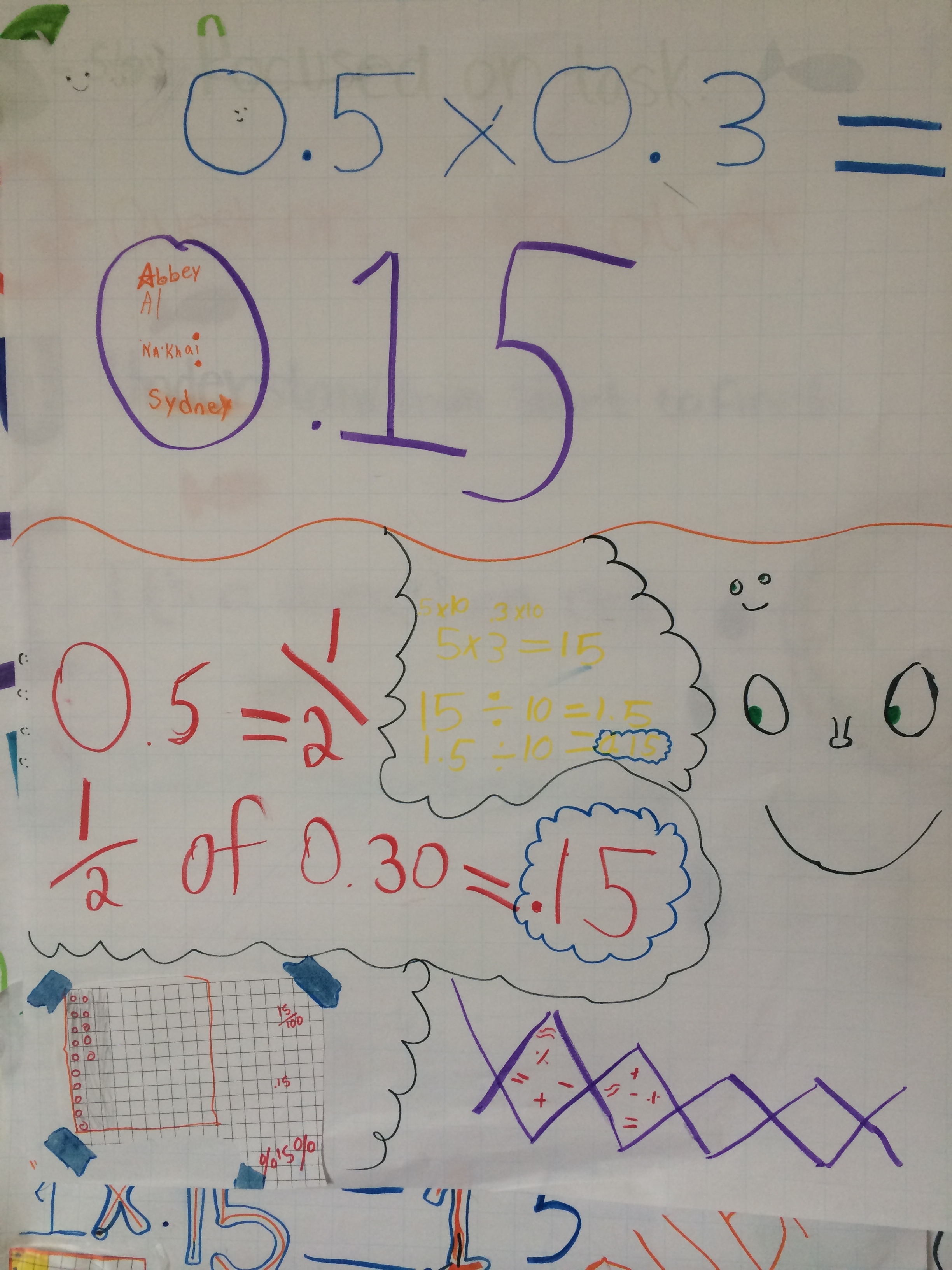
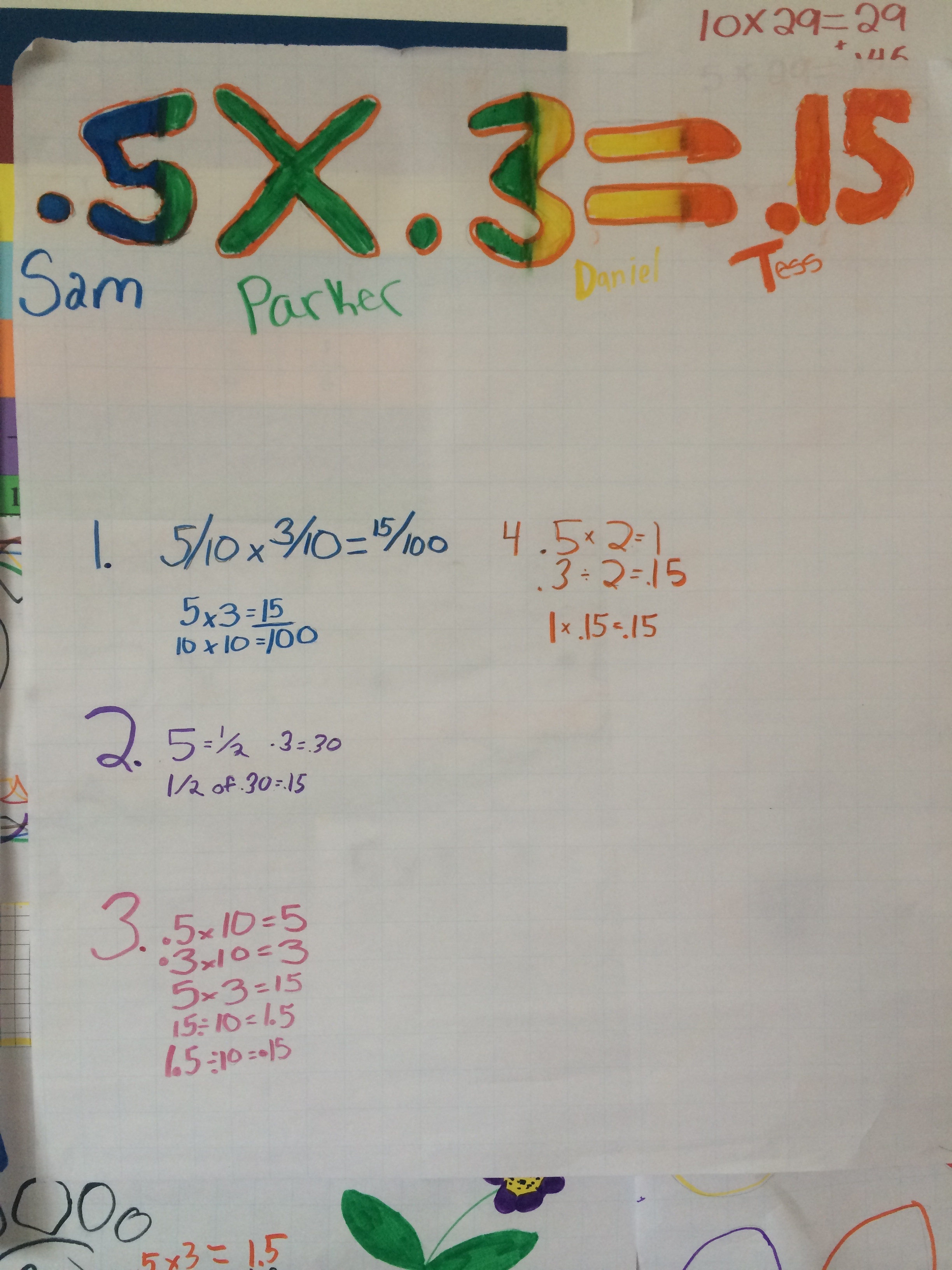
Here are a few pictures of the follow up group work and Gallery Walk they did with 0.5 x 0.3….

IMG_4228 IMG_4229 IMG_4232 IMG_4233

Inspired Thoughts on Number Talks

During the majority of the professional development planning I have been doing this summer, I feel like one of the common threads is Number Talks. After each conversation, more and more questions start spinning in my head….questions about how often to implement, questions about teacher recording, and most importantly, questions about their purpose.

I wasn’t inspired to write them all down until I read @gfletchy’s post: http://gfletchy.com/2014/07/22/on-you-marks-get-set-number-talks/.  BTW *If you do not follow his blog, you most definitely should, great stuff*

Questions/Thoughts about Number Talks:

1 – Through the math conversations, it fosters a safe, collaborative culture in my classroom.

2- Their conversations embody the Mathematical Practices in my eyes. Their use of structure of the number system, creating viable arguments, critiquing the reasoning of others and repeated reasoning is always music to my ears.

3 – I struggle with purpose…is the purpose a particular strategy? That is how Parrish’s book frames it. There is a string, centered around a certain strategy. Not that other strategies do not emerge, but the numbers are such that they lend themselves to a particular path. So, my conclusion is this – When doing a number talk string, I  am not pushing a certain strategy, but instead, encouraging the students to truly think about the numbers before simply “computing.” I do want students to think that if they are multiplying 39 x 45, to think about 40 and taking a group away rather than breaking both numbers to get 4 partial products. In thinking about the numbers more deeply, they call on their conceptual understandings to develop fluency.

4 – Is the purpose to generate connections between strategies? I do think there is a benefit to putting up one problem and recording all of the strategies to make connections between them. I use that as a formative assessment as to what my students know and also to identify misunderstandings/misconceptions that emerge.

5 – Fawn’s blog has sparked an interest to branch into more visual patterns to switch it up a bit. What that would look like in my 5th grade class, is something I need to work through but I think the algebraic reasoning behind them would be intriguing.

6 – I Completely agree with Graham, they must be a daily routine, they build computational fluency (based in conceptual understanding) and must not just happen on Fridays! Also, it is important for students to use their Number Talk reasonings in other math work.

7 – Teacher recording is something I am still trying to improve upon daily. Recording their thinking is harder than one would think! Also, I find WHAT I write can change the direction of the talk itself.

I am a huge proponent of Number Talks and would love to see our elementary work with them to start to move into the middle/high school classrooms!

-Kristin
 

Passionate Teachers Learn Year-Round

This past week, I had the amazing opportunity to work with an exciting group of elementary teacher leaders (lead learners if you will) from across our state. Over the course of the four days, we engaged in mathematics, discussed classroom pedagogy, and reflected on our practice while centering around the big idea of Developing Procedural Fluency through Conceptual Understanding. While I am still trying to digest all of the conversations, I thought it may be helpful to start with this initial list of thoughts and then expand on each at later times (immediate deep reflection is just not my forte;).

My thoughts…

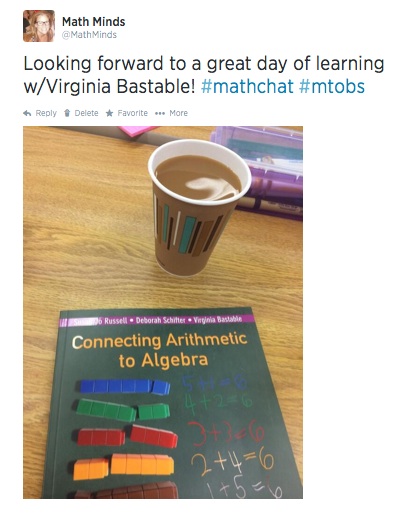
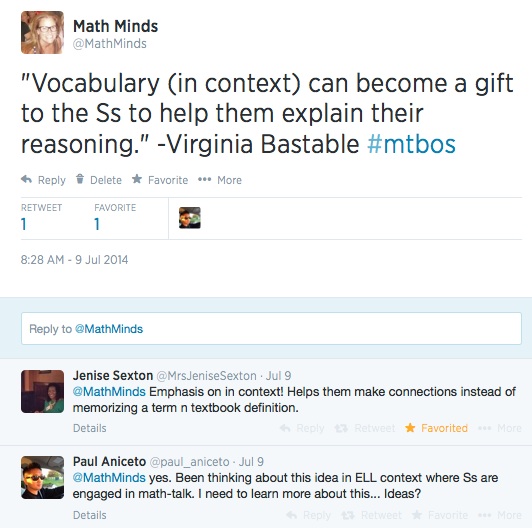
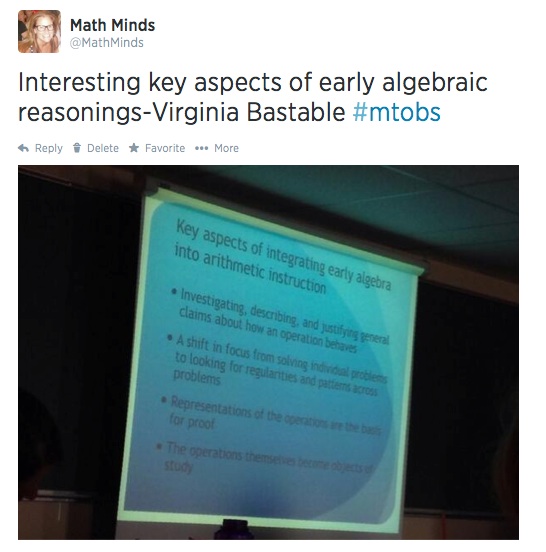
  • Virginia Bastable spoke around the topic of “Supporting Mathematical Reasoning Across Grade Levels: Helping Students Make Connections Between Arithmetic and Algebra.” She spoke, showed video and guided us through student learning in relation to developing algebraic reasoning in the classroom. She was amazing and left me with some things to really think about in terms of my teaching.  I, of course, tweeted some things that really struck a chord during her talk..1 2345I particularly love the slide above due to the wording. The thought of regularity in their reasoning, not simply saying “patterns.” With regularity, comes irregularity in which I find intrigues students (and most adults) to dive deeper into the relationships of the mathematics. I love the feel of that so much better than “why doesn’t the pattern work?”…don’t get me wrong I love that question, but “irregularity” hits me a bit differently. I am sure I will be coming back to that as I use that with my students this year!
  • Virginia reinforced my belief that teachers should have explicit goals for each lesson, but that students should not have a specific question/objective that influences their thinking about the work before they engage in the math, ahem…Lesson Essential Question. Goodbye. Thank you.
  • The thought of vocabulary as a gift to explain reasoning is huge. In ELA, teachers are told not to front load vocabulary before reading a passage/story, students should learn it in context. So, why do so teachers not think the same thing applies in mathematics? Virginia was dead on…in context, give the students the math words to use to make their reasoning easier to explain.
  • Outside of Virgina’s talk, we did so much math around conceptual building of procedures that I cannot even list it all, however I did have some things come to mind regarding the math in every part of every day….the importance of equivalencies in ALL number work, how critical decomposition of number is in all facets of number work, how our work with Number Talks is invaluable in students explaining their reasoning and creating arguments, and how much geometry and measurement is embedded in our number work. All of these could really be (and hopefully WILL be) their own separate blog post!
  • When talking  to the teachers, I noticed how much they appreciate learning  the trajectory of the math and the seeing connections from what they do immediately in their classroom to where their students “start” or “end up” with the conceptual building. I think sometimes teachers do not see how critical it is for students to be flexible in making tens in Kindergarten because in the future those same students will rely on that understanding with decimals, fractions, equations and so on…..If a student understands why  3 + 7 = 10, they can reason that  .3 + .7 = 1, 3 pieces the size of 1/8 (3/8) + 7 pieces the size of 1/8 (7/8) = 1,  3x + 7x = 10x (no matter what the x)….could go on and on….and this could all start with a 10 frame. Amazing.
  • Personally, as one of the presenters, I realized how much I LOVE hearing my students talk about math. I used some of their work samples & video in the presentation.  I truly forget how awesome they are. We all get caught up in the school year craziness and forget to really listen, so it was nice to reflect back on that over the summer. They were comfortable making mistakes, talking to one another, and really worked hard on understanding the math. Made me proud to say I taught them. I encourage everyone to do it.
  • Also in the presenter role, I realized the connections between planning for adults in comparison to planning for my students. There must be an entry point for everyone, there must be an explicit goals, present ideas,not topics, working cooperatively in groups is so important, personal reflection is necessary, active engagement is necessary…..sooo many….
  • Lastly (for now), I am so excited to be working with such a dedicated and passionate group of educators who care as deeply as I do about impacting math instruction across our state. They remind me each day that every teacher is at a particular point in their journey, that continuous learning is so important, that my passion for what I do is exciting (because I do get a bit high strung sometimes …heehee), that change takes time (again, very hard for me to grasp:), and that we are a team. I love it.

So, whoever said teachers have the summers off is CRAZY! There is so much planning and learning happening in education over the summer, it is mind-blowing! Need proof, check out Twitter….#mtbos, #5hchat, #satchat

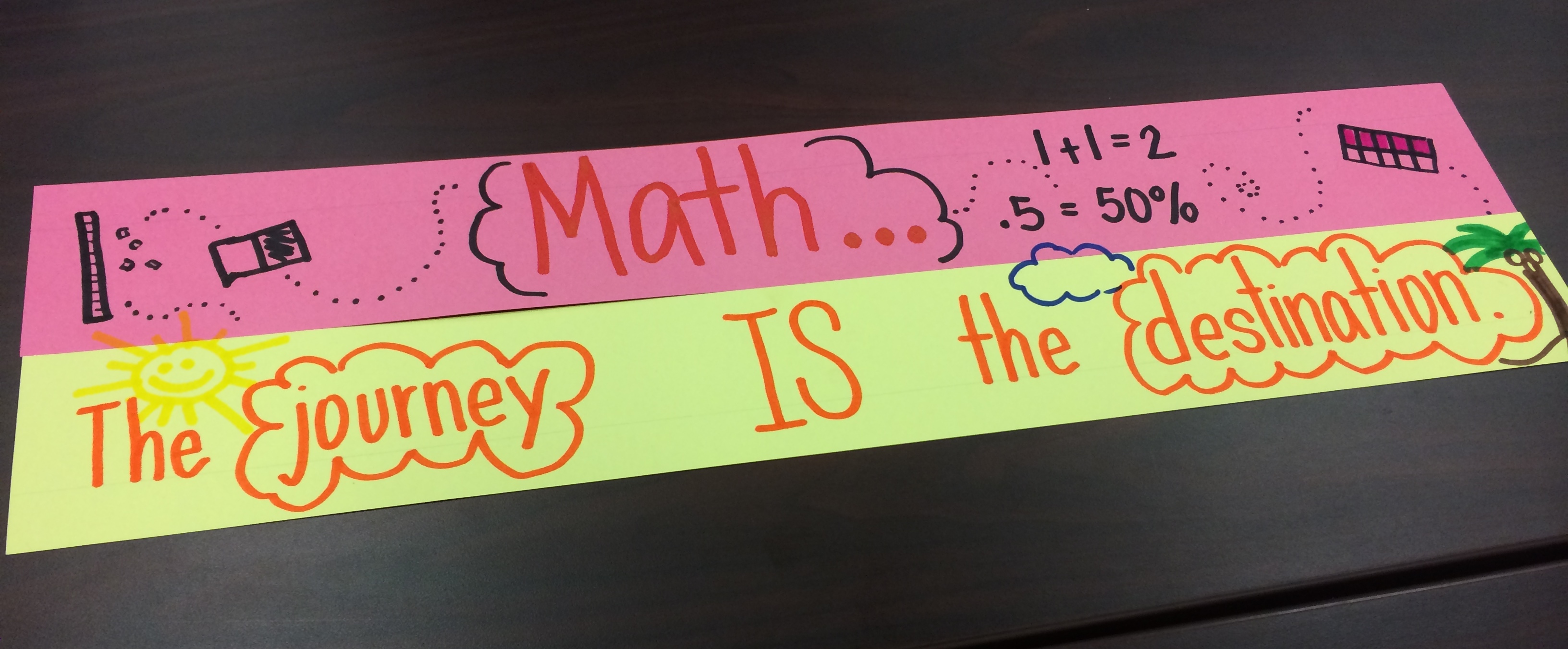
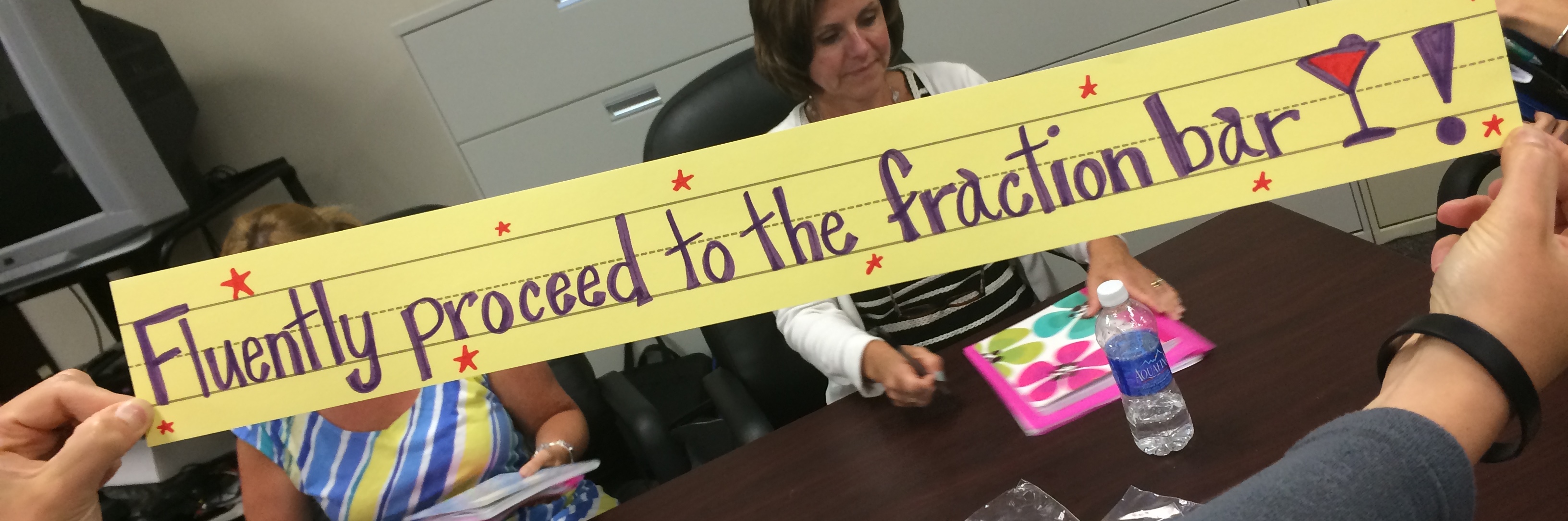
I have so many more things to reflect upon, but in the hopes of getting something else productive done today, I must stop here. I will leave you with some bumper stickers created by the participants at the end of the final day encapsulating their experiences over the course of the week….

IMG_6112 IMG_6113 IMG_6114 IMG_6116 IMG_6117 IMG_6118 Happy Saturday,

Kristin

#ISTE2014 Reflection

This was my first ISTE conference so I was first completely impressed with the sheer number of attendees and organization of such a massive conference. Throw in the number of passionate educators present and it makes for an unbelievable and somewhat overwhelming experience. I wanted to jot down some of my overall impressions, takeaways, and random thoughts before summer work kicks in and I forget everything by the time school starts! I looked at the conference from two perspectives, first as a classroom teacher and then as a person responsible for the math professional development in our district.

As a teacher…

1 – I loved, loved, loved the number of educators on Twitter. The #ISTE2014 hashtag was blowing my phone up every minute of every day during the conference.  The amount of multitasking going on everywhere was amazing! I have never seen so many people engaging in technology, learning, spreading the word to others, and walking at the same time 🙂 I felt connected to the many sessions I could not attend or that closed before it even started due to capacity (that was a bit frustrating at times). It truly demonstrated the need to be a connected educator and the value of networking with colleagues around the world.

2 – I was excited to see the focus of my sessions more about the student learning than the technology in and of itself. The tweets reflected the same emotion and I loved that!

3 – I got SOO many exciting ideas to use for Open House, management, and  parent communication (http://www.kleinspiration.com/2013/05/using-augmented-reality-via-aurasma-in.html Thanks to Erin Klein:)  however I do find I struggled just a bit to relate some of my tech learnings into my math classroom. I am not one to use technology for the sake of using it and my classroom thrives on student discourse. I LOVE to hear the students talking about the math with each other and I am not a “flipping” fan. Don’t get me wrong I love to use Educreations, Minecraft, Aurasma,  Nearpod, and Padlet on the ipads, but even then, I need to improve upon using them to make the math more authentic for the students. The presenters at ISTE definitely provided the inspiration and wealth of tools I can look into when doing my planning. Teachers are doing AMAZING work out there and it was so inspiring to see that during the Sessions.

4 – As a presenter as well, I loved all of the support in the room! From sound to video, to ISTE representatives, to Apple Distinguished Educators, there were tons of people on hand to make sure it was perfect! Well Done!

5 – The Expo was packed with exhibitors. I was excited to chat with @Schoology as a new LMS for my classroom and for my K-2 teachers, I found a great new product from a company called Osmo (https://www.facebook.com/PlayOsmo?ref=br_tf). Check them out! There were many more interesting ones I chatted with,  however after being in heels all day, my feet could not make the trek around to everyone 🙂 One thing I find intriguing at every conference I attend, is I always have to ask myself, do the vendors here convey the mission/vision of the conference organization itself. For example, at NCTM, I find vendors selling programs/products that, in my humble opinion, do not support the Mathematical Practices and vision of what best practice is in the classroom. In the case of ISTE, I saw a vendor with bubble sheet reading software that worked with any document camera (and of course his example was a math sheet…ugh) . Don’t get me wrong, it was amazing how fast it could read the bubbles and plop a grade into their accompanying grading system, but is that truly what we see as a vendor who should be at an educational conference? Just like at NCTM, do we want a timed test program to be supported by an organization who’s vision is to “…ensure equitable mathematics learning of the highest quality for all students…” I always just find that interesting.

6 – I had the opportunity to participate in a live #satchat. It was such an amazing opportunity to meet face to face with all of the avatars I chat with on many Saturday mornings! Definitely a highlight!!

From a professional development standpoint….

I was absolutely blown away by the organization and setup of ISTE. There was something for everyone and more! There were workshops, IGNITE sessions, lecture sessions (with some recorded so attendees could watch from the tv in the hallway in case of overflow), Playgrounds where teachers were encouraged to play with the technology and experience what it was like to be a student, and Poster Sessions which I can best describe as an overwhelmingly exciting “science fair” with tables set up and manned by teachers and students describing the exciting work being done in classrooms around the world!

The format of each element was genius and definitely something I want to bring back and use in my school/district. I think starting our opening district meeting with and IGNITE session showcasing district happenings would be an amazing, invigorating way to launch the school year. I also love the feel of a Playground in which teachers just play with the math and can choose the topic that best fits their needs. A district/school hashtag where we can easily share resources and ask questions would be amazing…now to just get everyone on Twitter:).

Overall it was a great experience and I still continue to learn on the #ISTE2014 hashtag! It is full of passionate educators focusing on learning, not simply the technology. Thank you all for a wonderful conference! Looking forward to Philly 2015!

Decimal Multiplication: Whole # x Decimal

Through numerous Decimal Number Talks, Investigations on tenths, hundredths, and thousandths grids, and many findings about decimal operations, we are approaching our last couple lessons in our decimal unit. Not that the work with decimals ever ends, but our unit ends with decimal times decimal and the generalization of a “rule” for multiplying decimals. I have many thoughts about the new Investigations unit on multiplication of decimals but I am very excited about the connections my students have made between whole number and decimal operations. I do attribute a lot of their flexibility to our Number Talks though:)

I wanted to assess where they were before we moved into a decimal times decimal work because I think there is a lot of reasoning to do there before we come to a generalization!  I was really excited to see the use of multiple strategies!

First, I had students who were still treating the decimal operations like whole number operations and reasoning about where the decimal point “makes sense.” I do love this because it is heavy in estimation and sense making about what is reasonable. It is obviously not the most efficient strategy, but I what I truly learned from this, is that I need to do more whole number multiplication work with this student to build efficiency…

Image

I have students that love partial products….(and I cannot get some students to stop saying the “box method”….:)

Image

I loved this area model because of the size of the .4 side. She was very particular about that!

Image

Some friendly number work…I especially loved her estimation first….yeah!

Image

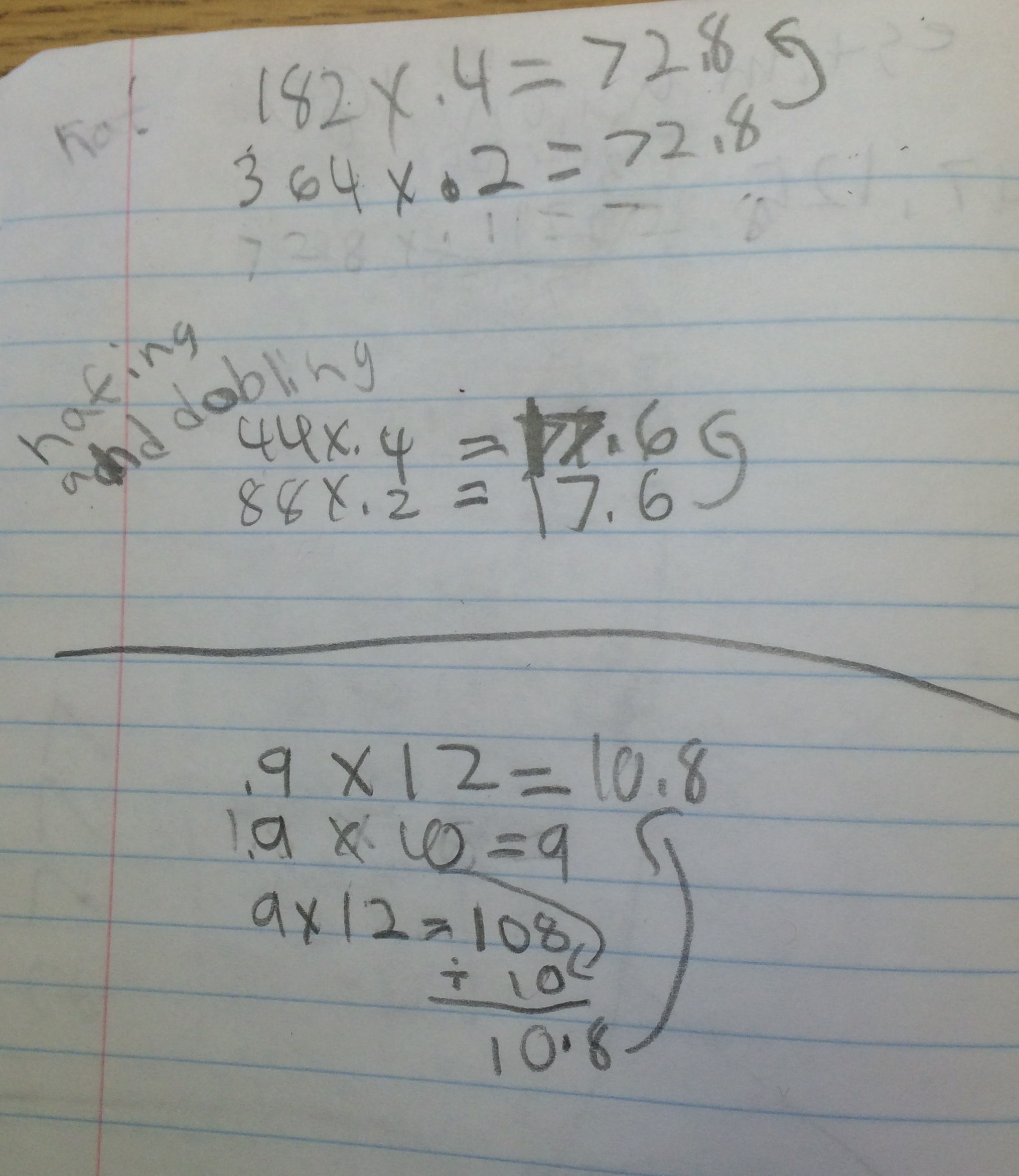
I had some who multiplied the decimal by 10 and then divided their product by 10…

Image

Saw some halving and doubling…

Image

I had a student think about the decimal as a fraction. It starts at the top and then he jumps to the bottom of the page.He said he multiplied 9 x 12 to find out how many “rows” he would have, 108. Then he divided it by ten because there were 10 rows in each grid.  It was interesting!

Image

So tomorrow we start decimal by decimal multiplication…I feel great about our start and I look forward to having them reason about decimals less than a whole times less than a whole.

-Kristin
 

Decimal Multiplication

This is a quick lunchtime post, so not much time to reflect or analyze, but wanted to throw it out there..

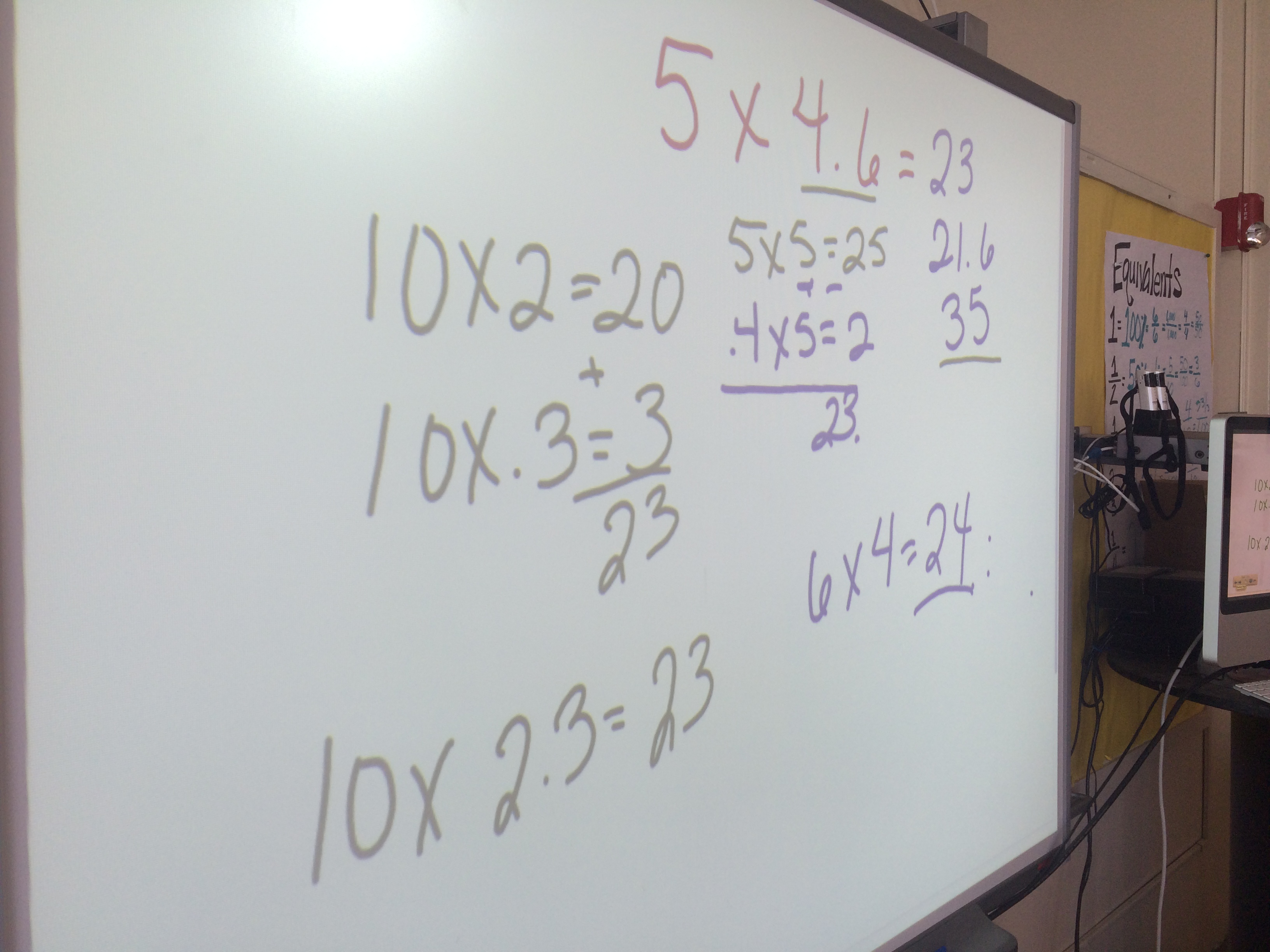
We did a Decimal number talk today and ended with the problem 5 x 4.6

I had students double half, use partial products, and use friendly numbers. (Incorrect answers were also written in case you are wondering about the 21.6 and 35…we looked for errors also)

Image

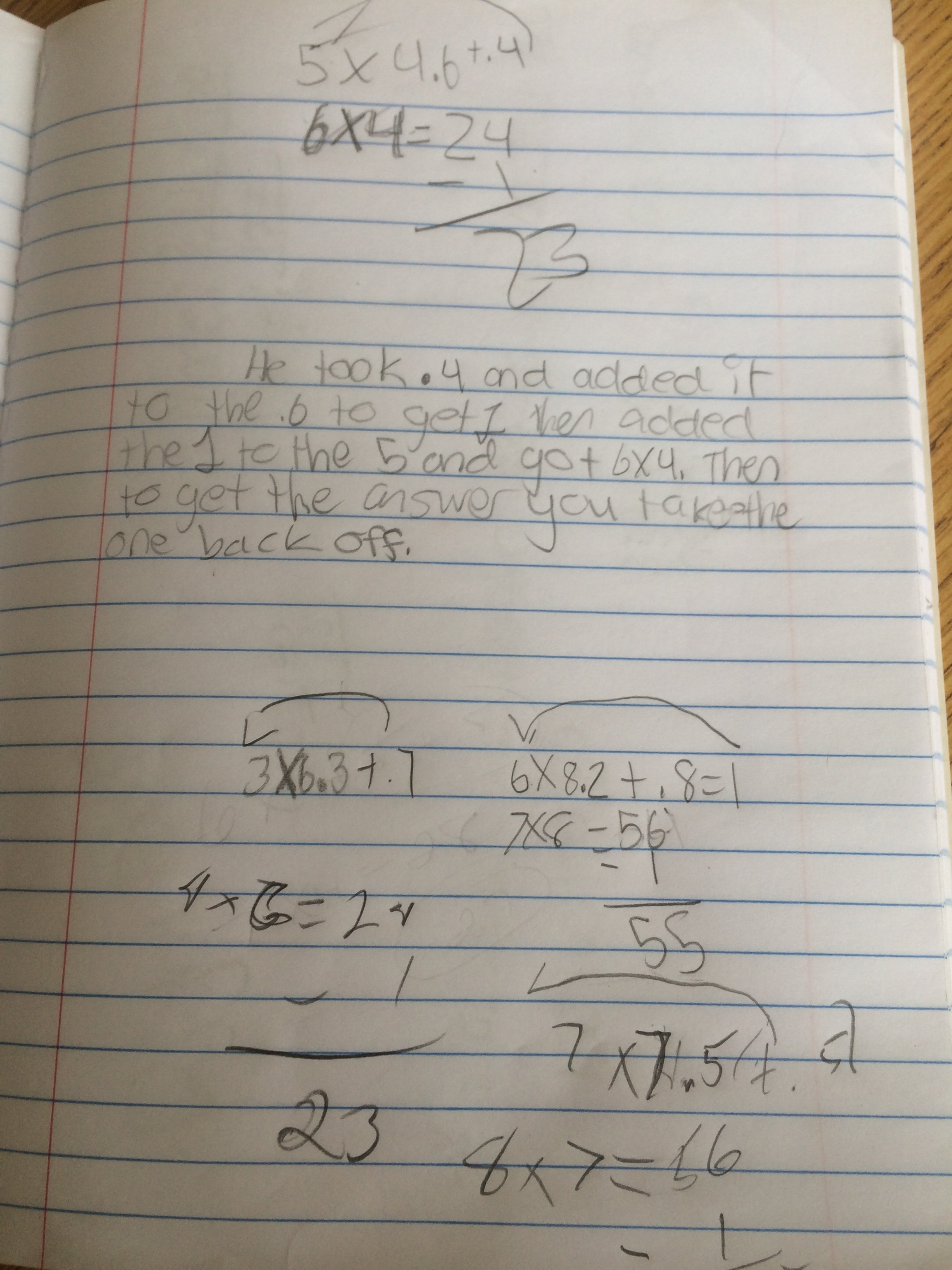
Then one student said that she bumped the 5 up to 6 and did 6 x 4 because she knew that faster, however she couldn’t figure out how to adjust her answer based on what she did. We had already had someone explain how they adjusted from 5 x 5, but this was not the same. She knew that she needed to subtract 1 (because we had already established 23 was correct) but where was that 1 coming from?

I sent them back to their groups to talk about it.

One group had this idea…

Image

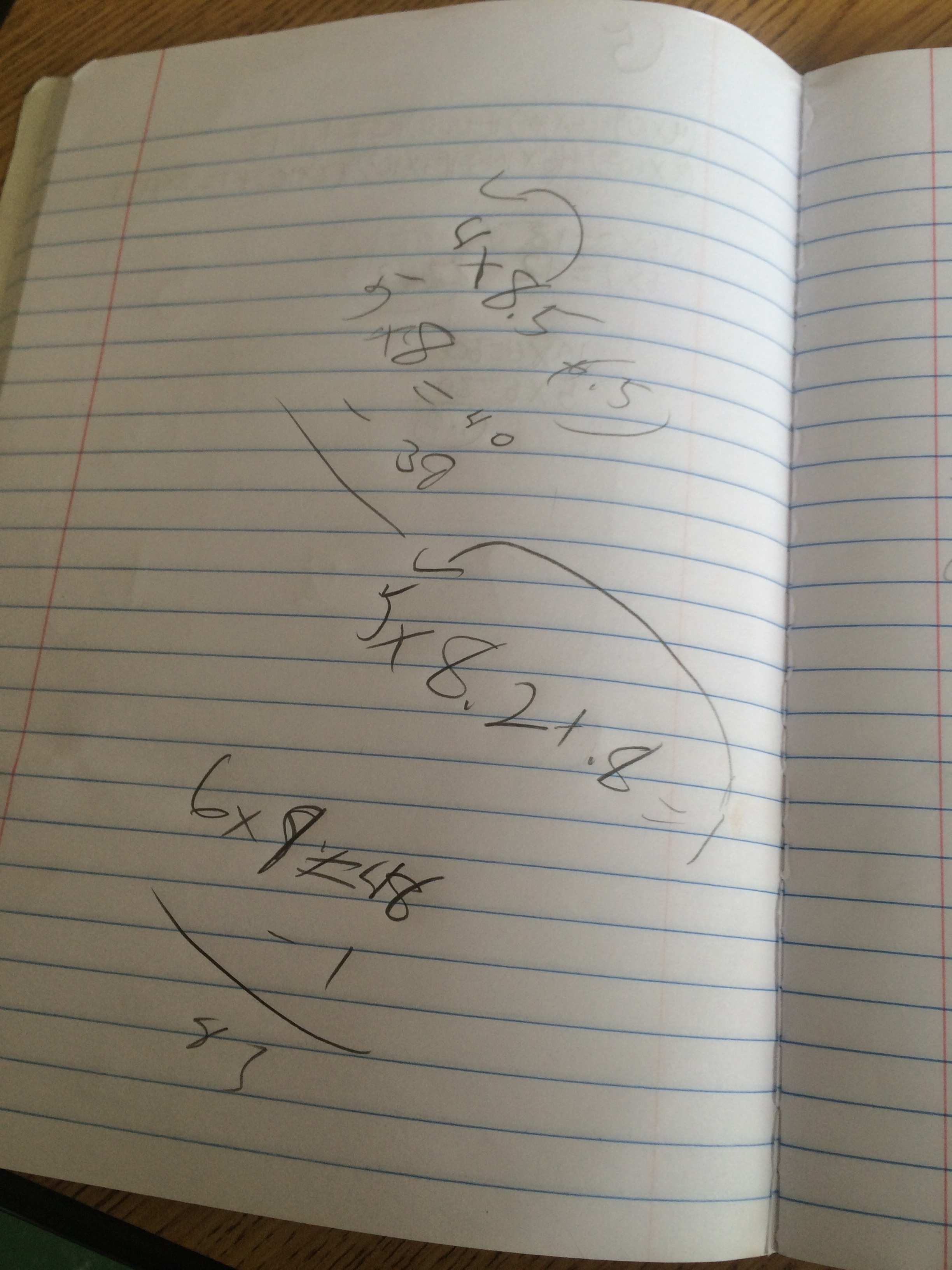
I asked them if it always worked so they tried some more problems at the bottom that did not. They tried some more….

Image

They found one that worked….hehe..

Image

The class had to leave for lunch, but I will keep you posted what they come up with…

-Kristin
Why I can’t just “Close My Door and Teach”

After a conversation with an amazing colleague this morning, I have postponed my state testing blog post (which was getting difficult to write without snark anyway) and replaced it with a question that continuously nags at me….

Why can’t I just close my door, teach and be okay with it?

It would be so freeing to just let go of my frustrations with the structure of our school system, people’s uninformed views on math education and/or Common Core State Standards, national/state/local education initiatives that feel like “one more thing” instead of what is best for students, standardized testing….etc…however, I find that is close to impossible for me as of lately.

Admittedly, I am a very strong-willed and possibly overly passionate person, which makes me a little more reactive to the above situations than most. I am slowly learning to take things in, be a better listener, and look for solutions over simply living the problem. But as hard as I try, I still find myself aggravated with things that are just “not right” in my head/heart/gut with our current system.  Every time I hit this frustration level, I always think to myself, “Why can’t I just be okay with closing my door and doing what is best for the group of students I have right now? Why do I let all of these other “things” bother me so much? Why can’t I just “LET IT GO”?

I thought it was just me, until this morning, when my colleague stated the identical thought. I left our conversation wondering what makes us different than those who can just live in the present, focus on doing best by their current students and tuck away their educational frustrations? Is it just our personalities or something more?

Don’t get me wrong, every day I do my best by the learners in my room, but that is just not seeming like enough anymore.  I find myself questioning how much longer I can do this because it seems like such a gargantuan problem with our system OR I am constantly feeling very anxious about being labeled as a “troublemaker” because I voice my opinions to those who may not want to hear them.

So, why can’t I just close my door and teach….

#1 – My students have to leave my room at the end of the year and if I am not comfortable with the math classrooms they may be entering, I feel it is my responsibility to try and work on this.

#2 – I can’t stop, because if I do, who will push for an improvement in our current school structure? If all of the passionate educators “give up” how will change ever happen?

#3 – Twitter has empowered me. I have developed a PLN of so many amazing, brilliant and open educators who leave me feeling that I am not alone in these issues/struggles. I am pushed forward daily by reading all of the great things that are happening in math education across the world. I am bombarded (in the best sense of the word) with research and action research on the very things in which I consistently struggle.

#4 – Teaching math is my passion, not just my job. I am not okay with working so hard to build perseverance and great mathematical curiosity in my students to have it followed by rote algorithmic memorization. I can’t ignore that.

#5 – I love these kids. Every year, I love a new group of them and I feel that they are worth all of my frustrations and struggles. They deserve the best education and until I feel that is consistent across our district/state, I am not okay with it.

#6 – I want people to be held accountable. If you are going to speak to the public concerning our education system, do your research. If you are going to be a part of a structure that isn’t working, work to fix it. Just be passionate. Period.

Ahh…this post feels like therapy for me 🙂 Now time to get off of the psychiatrist’s couch and start my planning for the week….have some great decimal work ahead!

-Kristin
Fraction-to-Decimal Division Table Noticings

Last week, I did an investigation on identifying fraction/decimal equivalents and interpreting fractions as division.  In previous years, I have to admit, I never fully appreciated this lesson. I could never get a grasp on how to not lose all of the great understandings students have about fractions and make it about division with the calculator. However after last week’s work, I have a new appreciation for the conversations it brought out in the classroom.

Throughout the year, we have worked with decimals, fractions and percents, so I feel my students are very comfortable moving between the three notations. They see the relationships between the decimal and percents for the /2s , /3s , /4s, /5s,  /6s , /8s, and /10s and know the percents for many (if not all) of those fractions because of our work on the 10×10 grid.

I opened this lesson with a fraction I was sure they knew the decimal for, 1/2. I asked them how they think we could use a calculator to find the decimal if we did not know it. They played around for a while and as I walked around many students could tell me they divided the numerator by the denominator. I asked if that same method worked for 1/4? As a class, they agreed it worked every time, so I asked why they thought that was so. Why are we getting a decimal? Many said with 1/2 we had “one whole divided into 2 pieces, so each piece has to be .5 so they both add to 1 whole.”  Another said we only get a whole number when “it is more on top then the bottom.”  I felt comfortable after a lot of talking from the class that they were seeing the fraction bar as division. So, we moved along to the division table. I had a student explain how a multiplication table works and then explained the numerator and denominator row and column in this decimal table. We looked at 1/2 and filled in the 0.5. I asked where else that decimal would show up in the table and they filled in the equivalents of 2/4, 4/8…etc. From there they worked with their partner to complete the table.

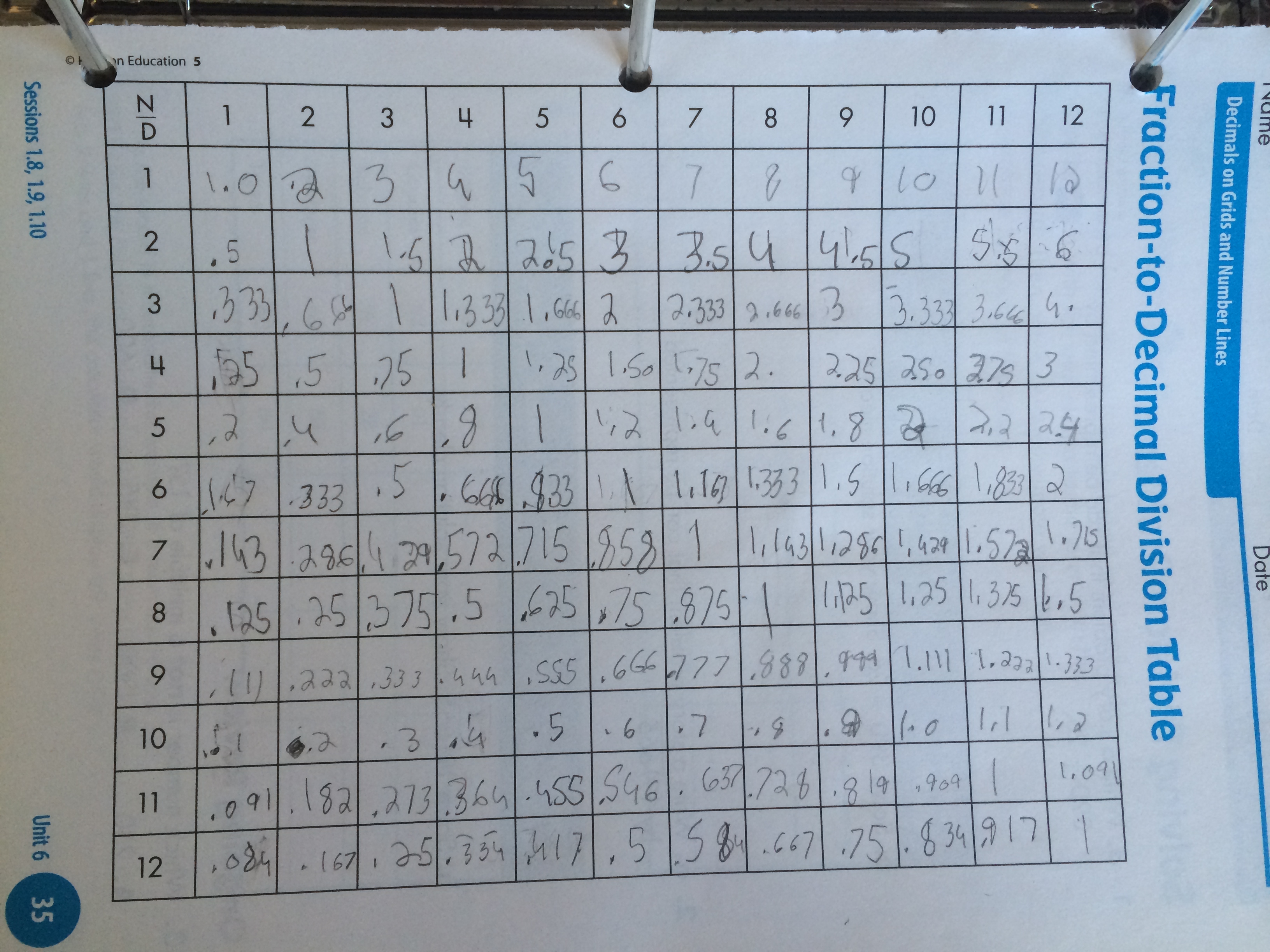
I teach two classes of math (thank goodness) so I can change up things that didn’t work as expected the first time. In the first class, I let them use their calculator from the start of the table. I realized as I walked around that students were completely losing their sense of fractions and it became a calculator exercise…exactly what I was afraid was going to happen. I saw students filling in by column and using the calculator in the tenths row! Big Fail on my part. I stopped all calculators, told them they had 5 minutes to work without the calculator to complete all of the decimals they could. The conversation took a dramatic turn for the better! They started to see that working in rows helped them see patterns and used their knowledge of equivalents to complete other cells and honestly moved along much faster! Needless to say, I started the next class without the calculator and the students liked the challenge of trying to reason about the empty cells without the calculator. Here is a sample of one of my student’s completed table:

IMG_3604

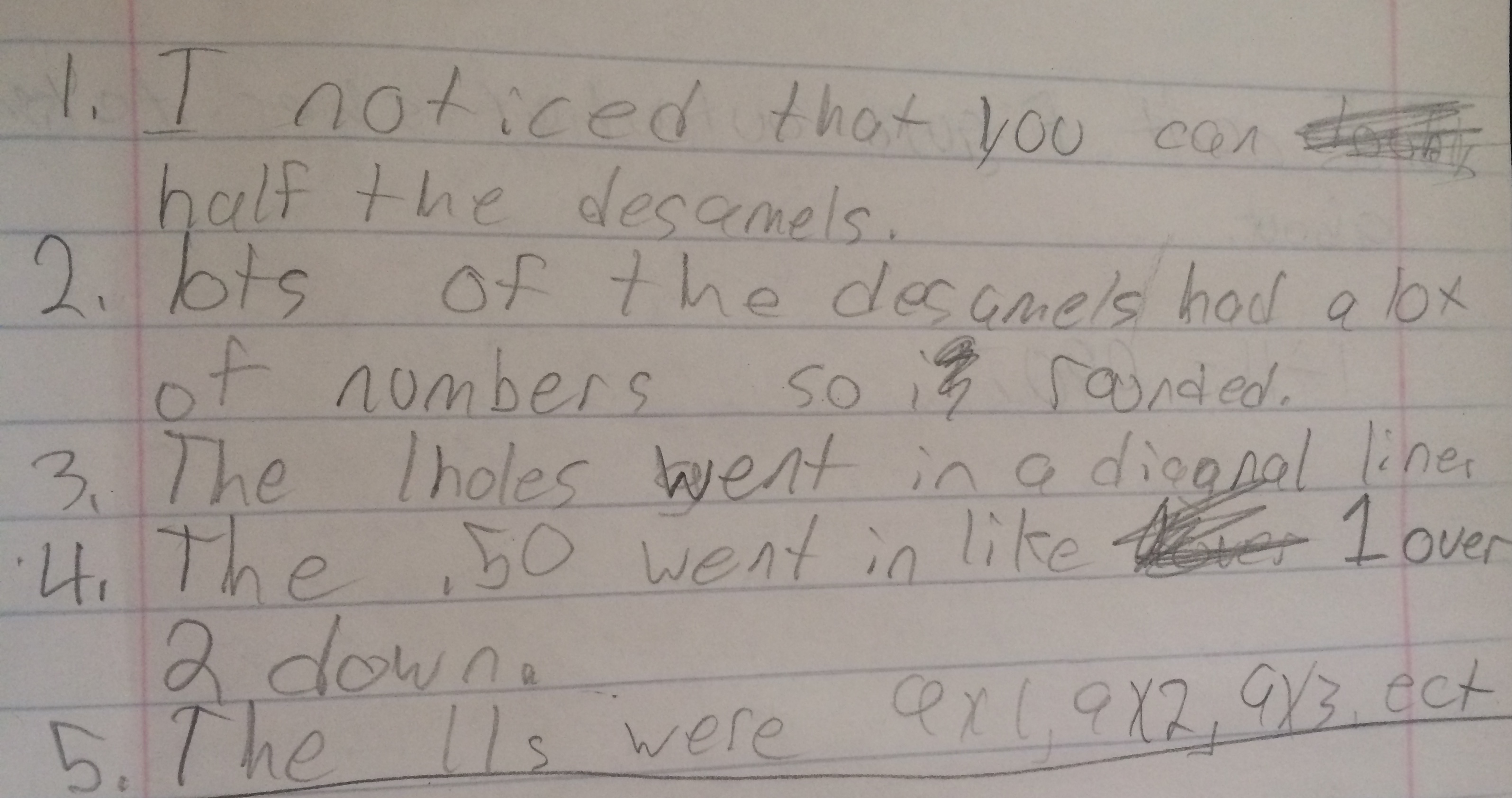
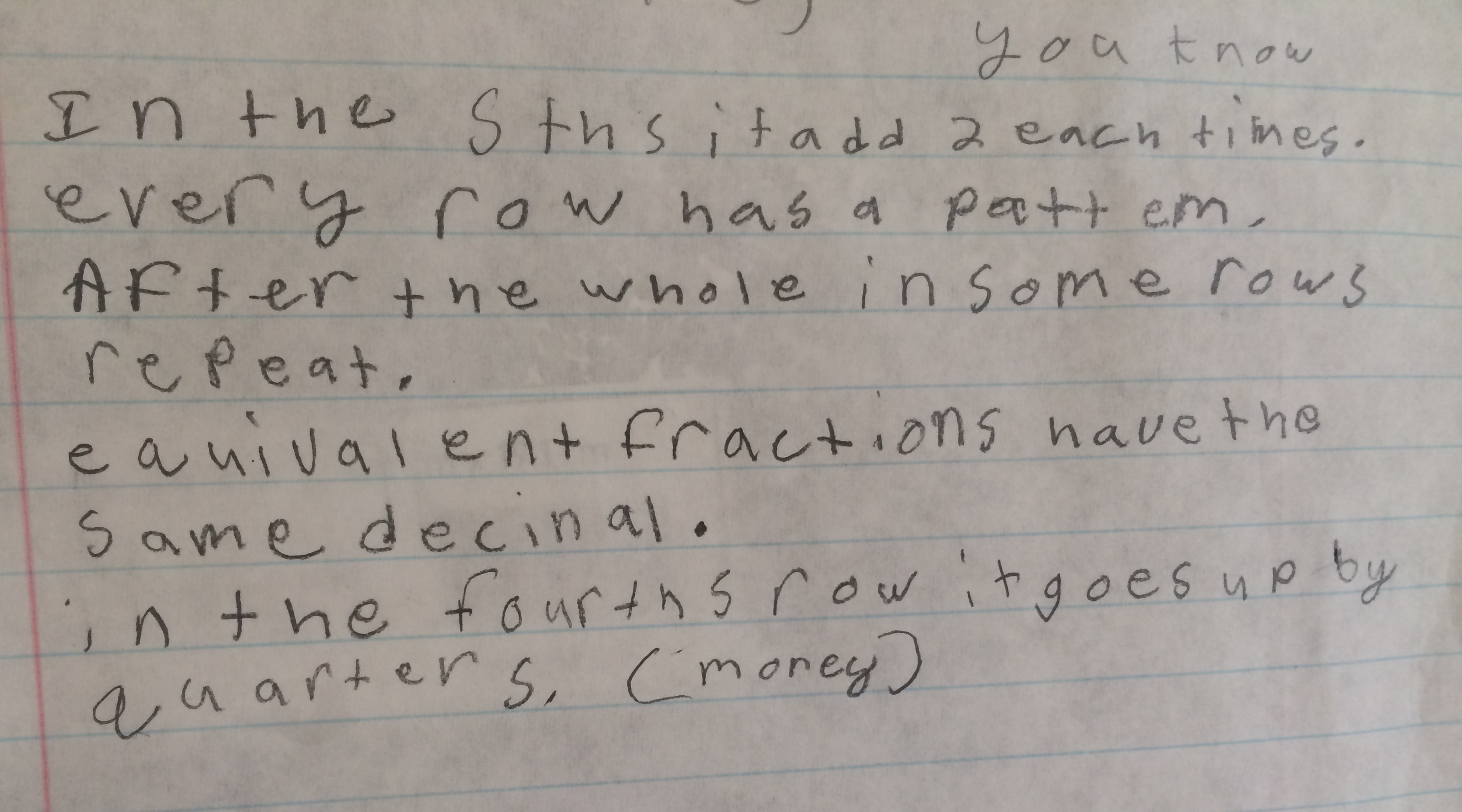
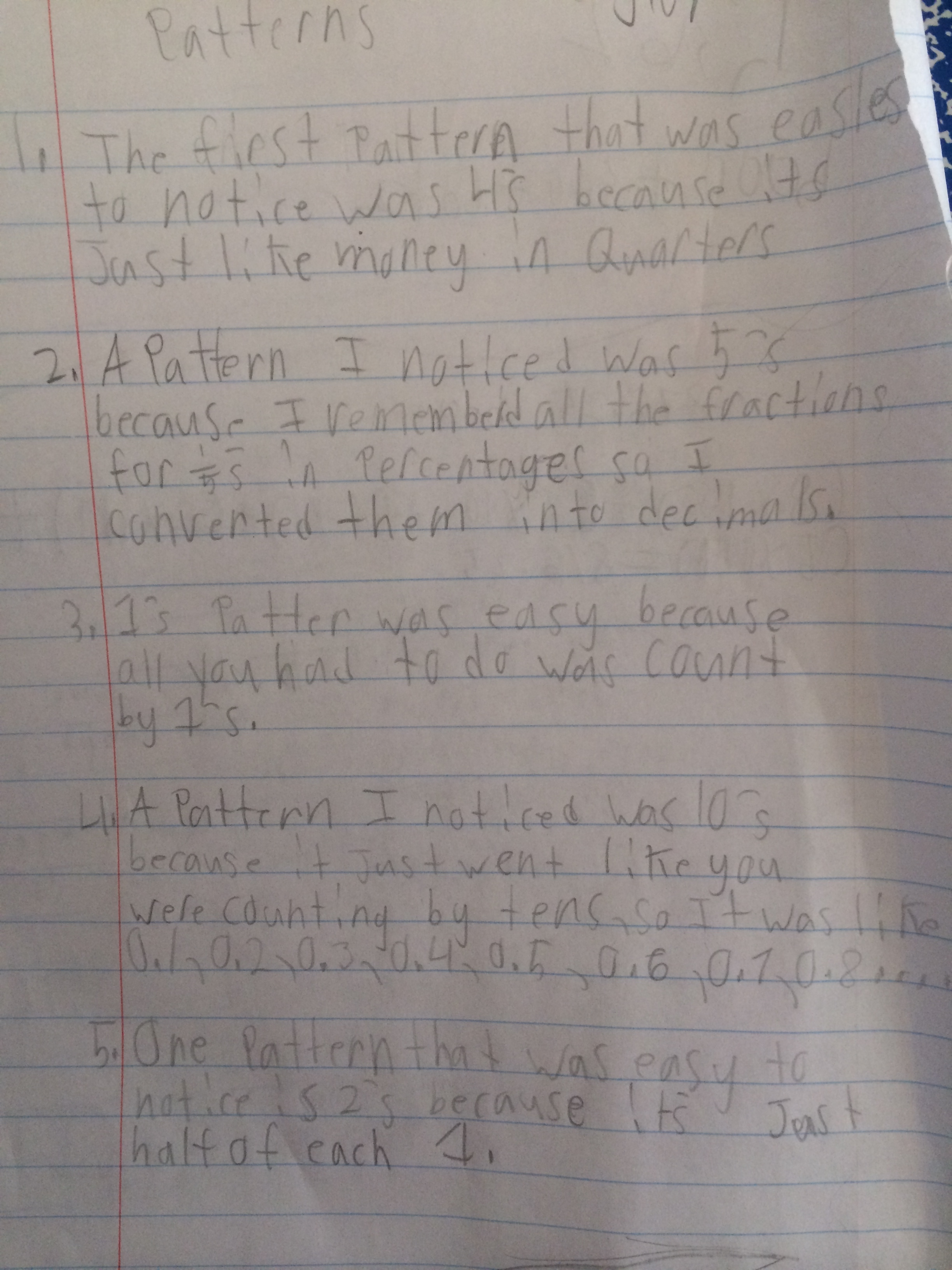
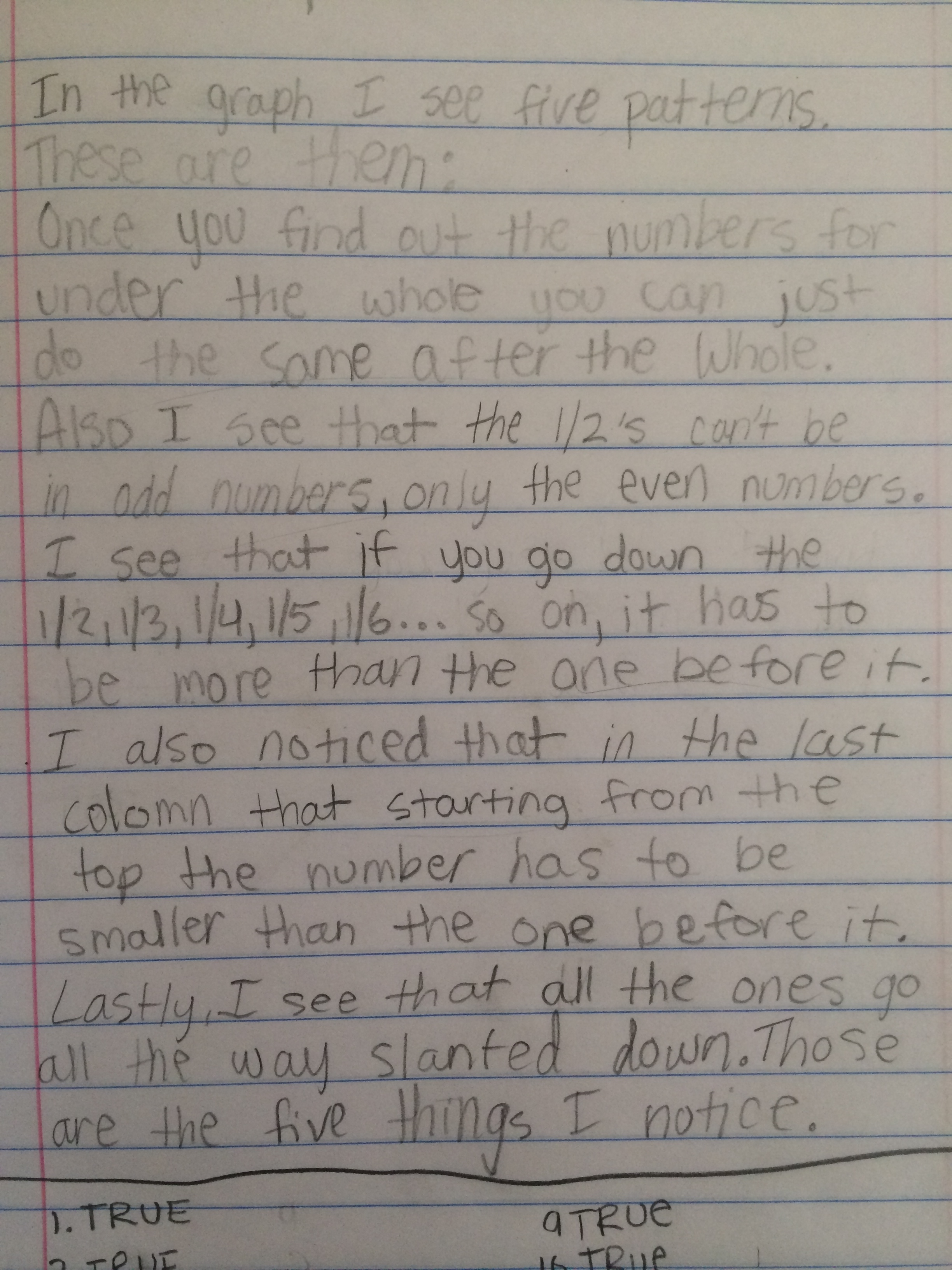
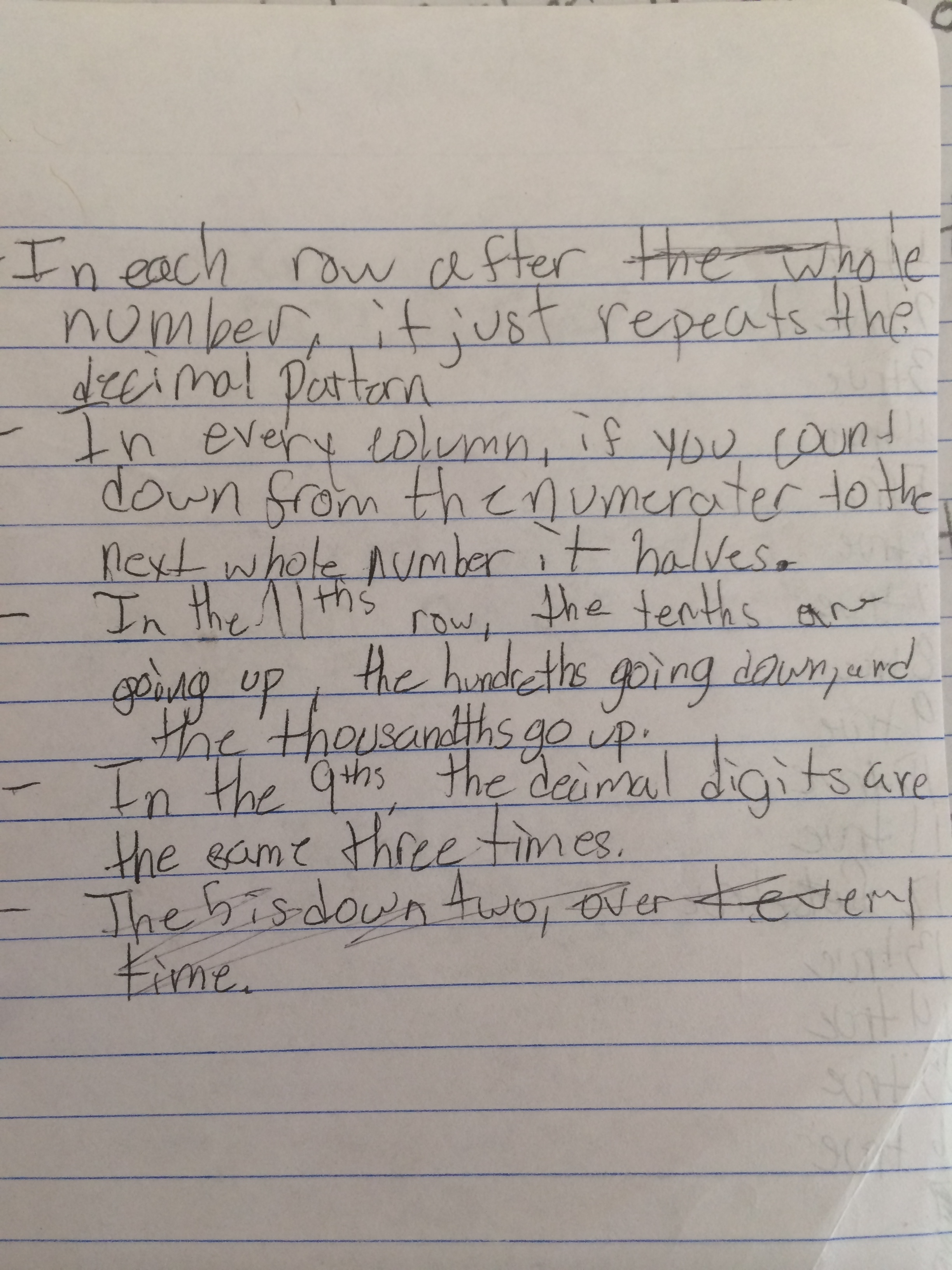
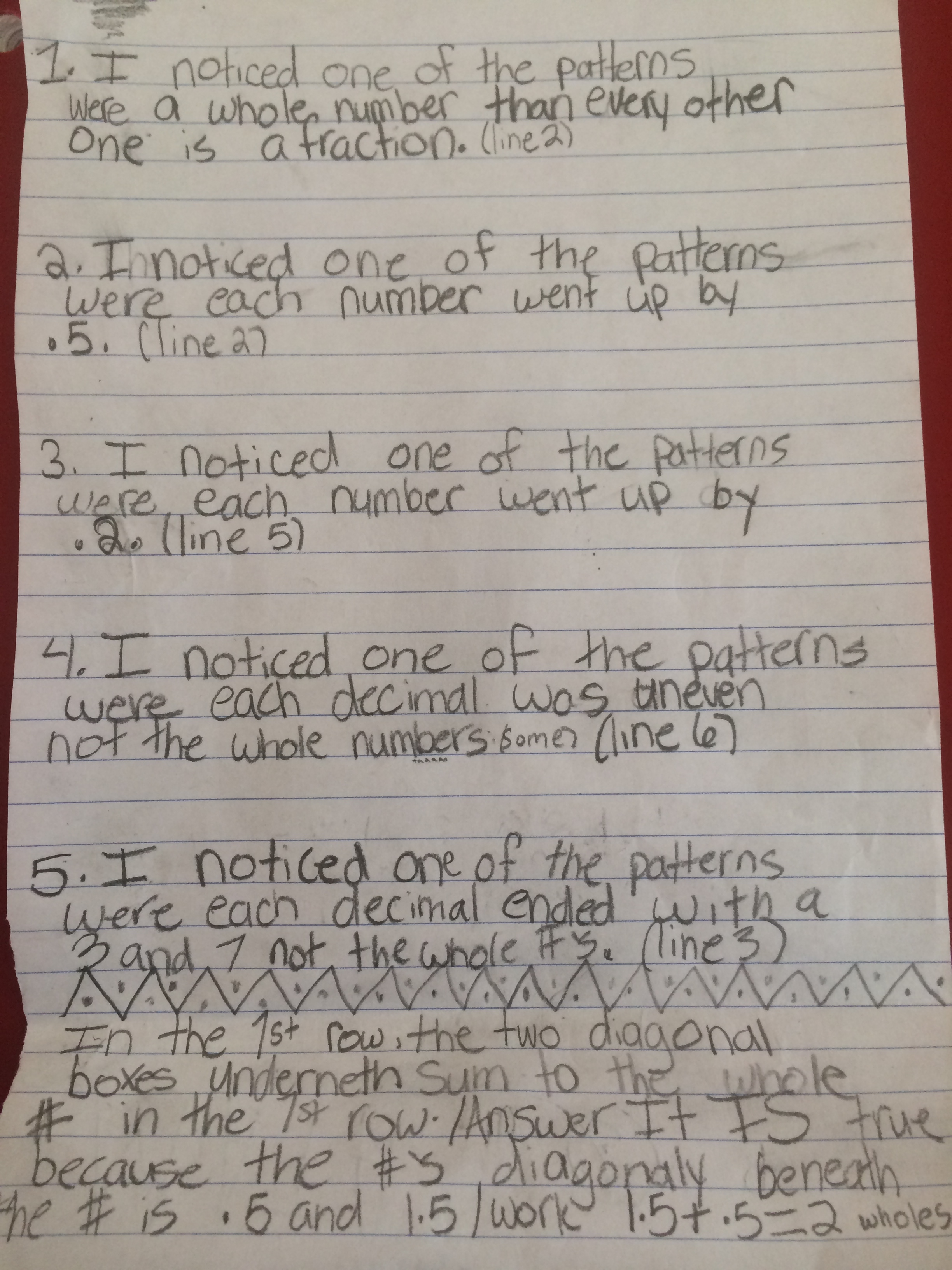
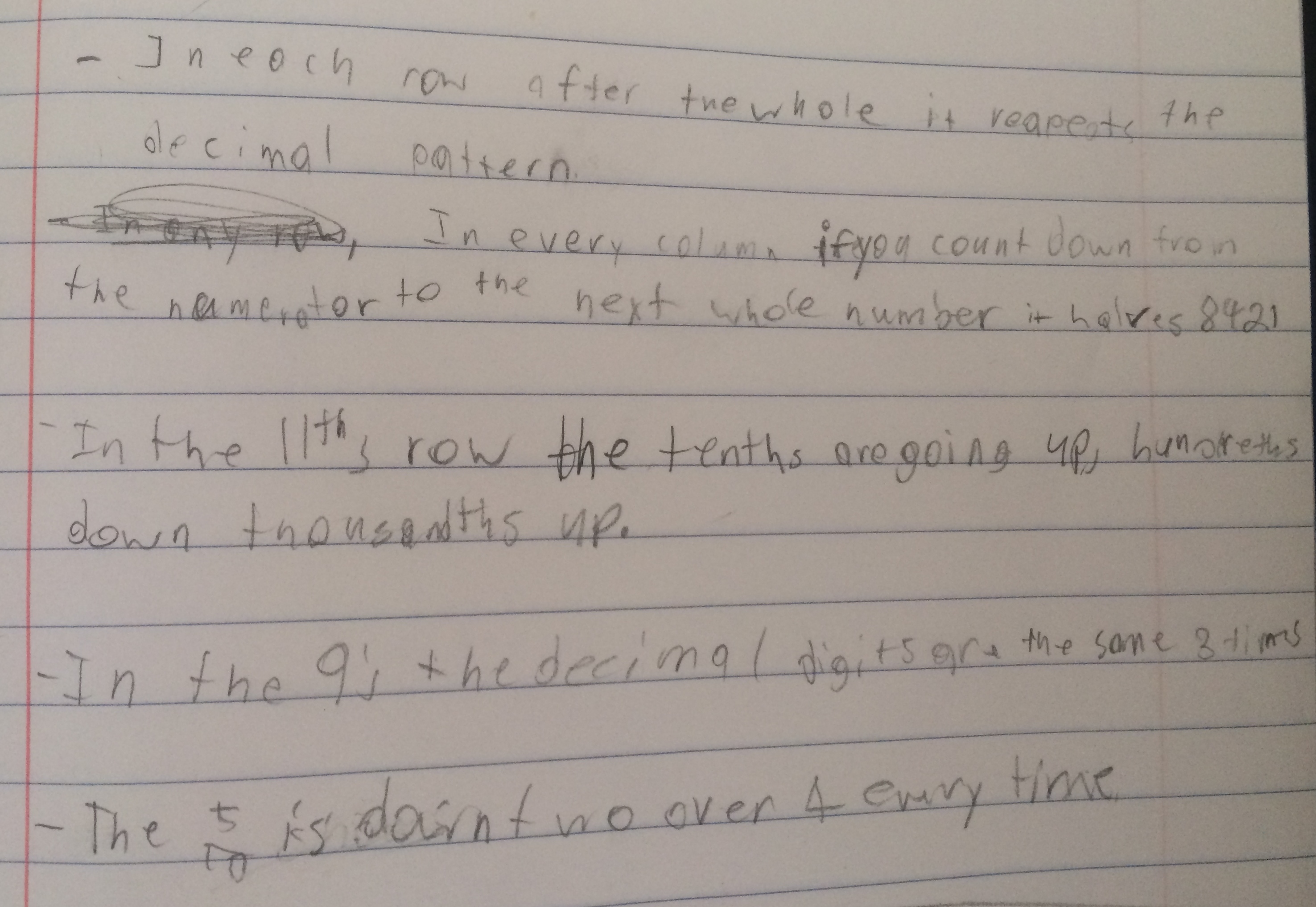
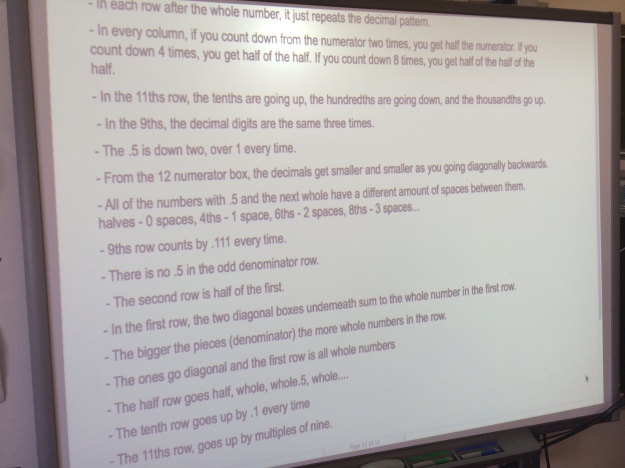
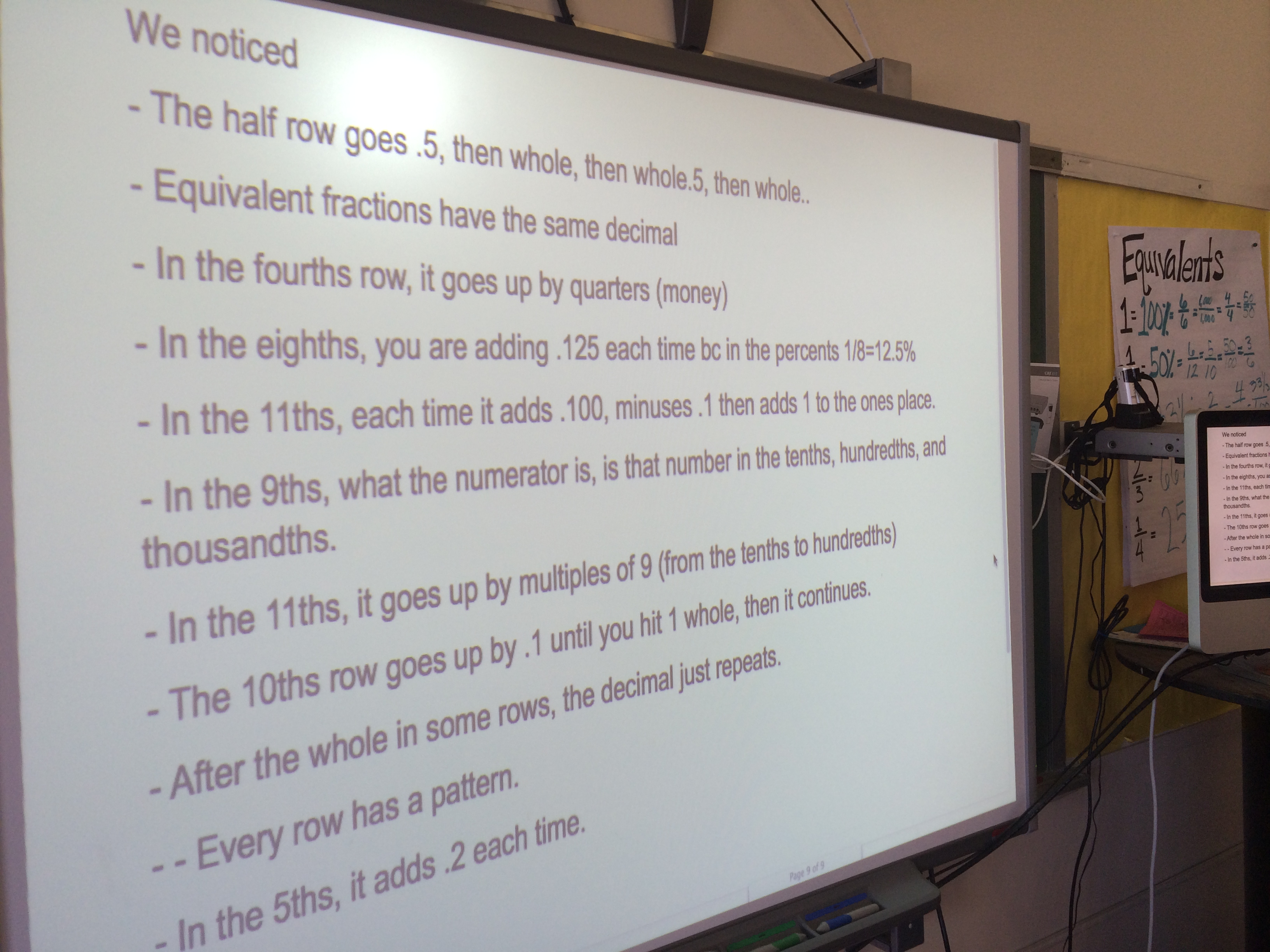
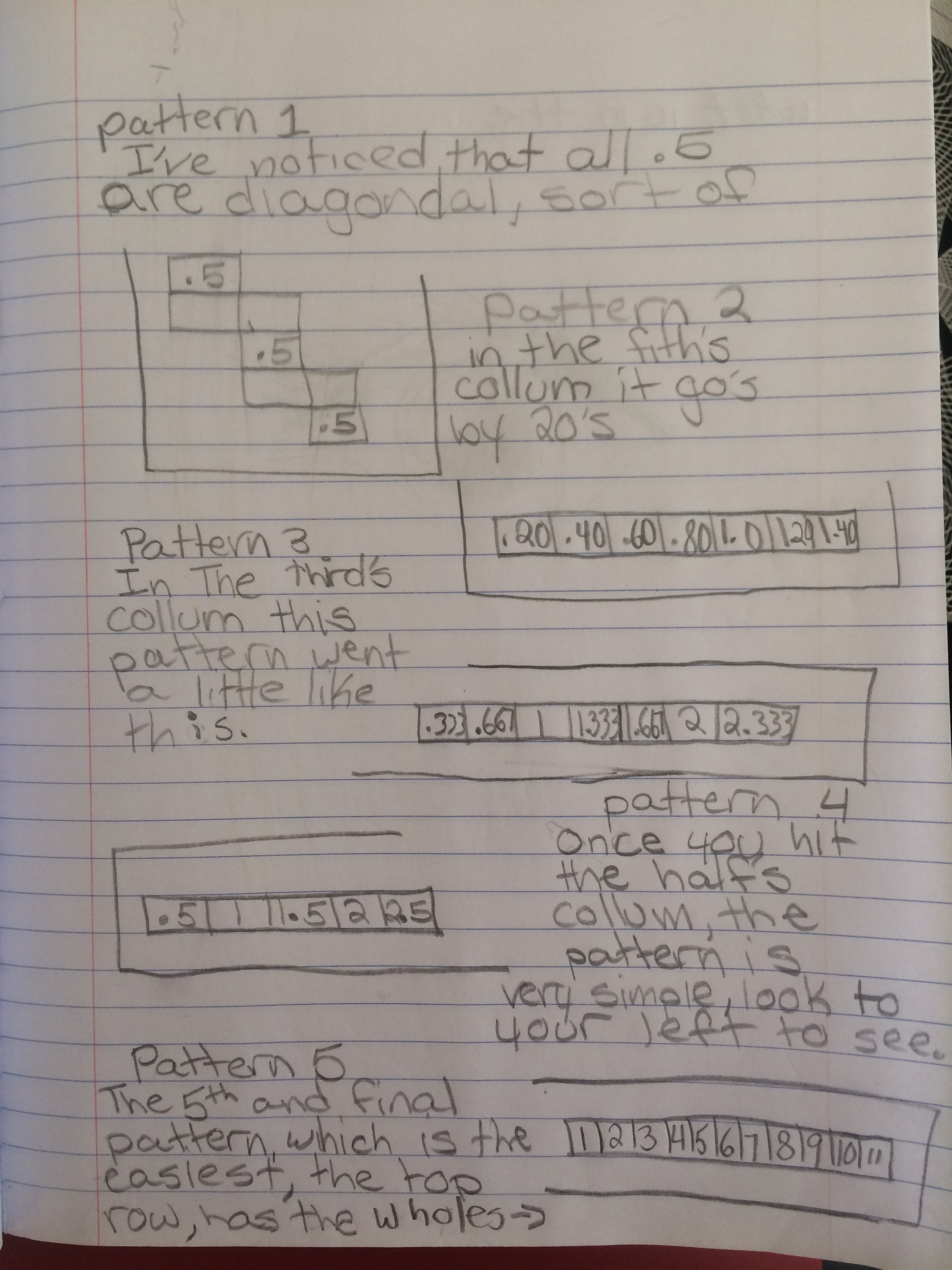
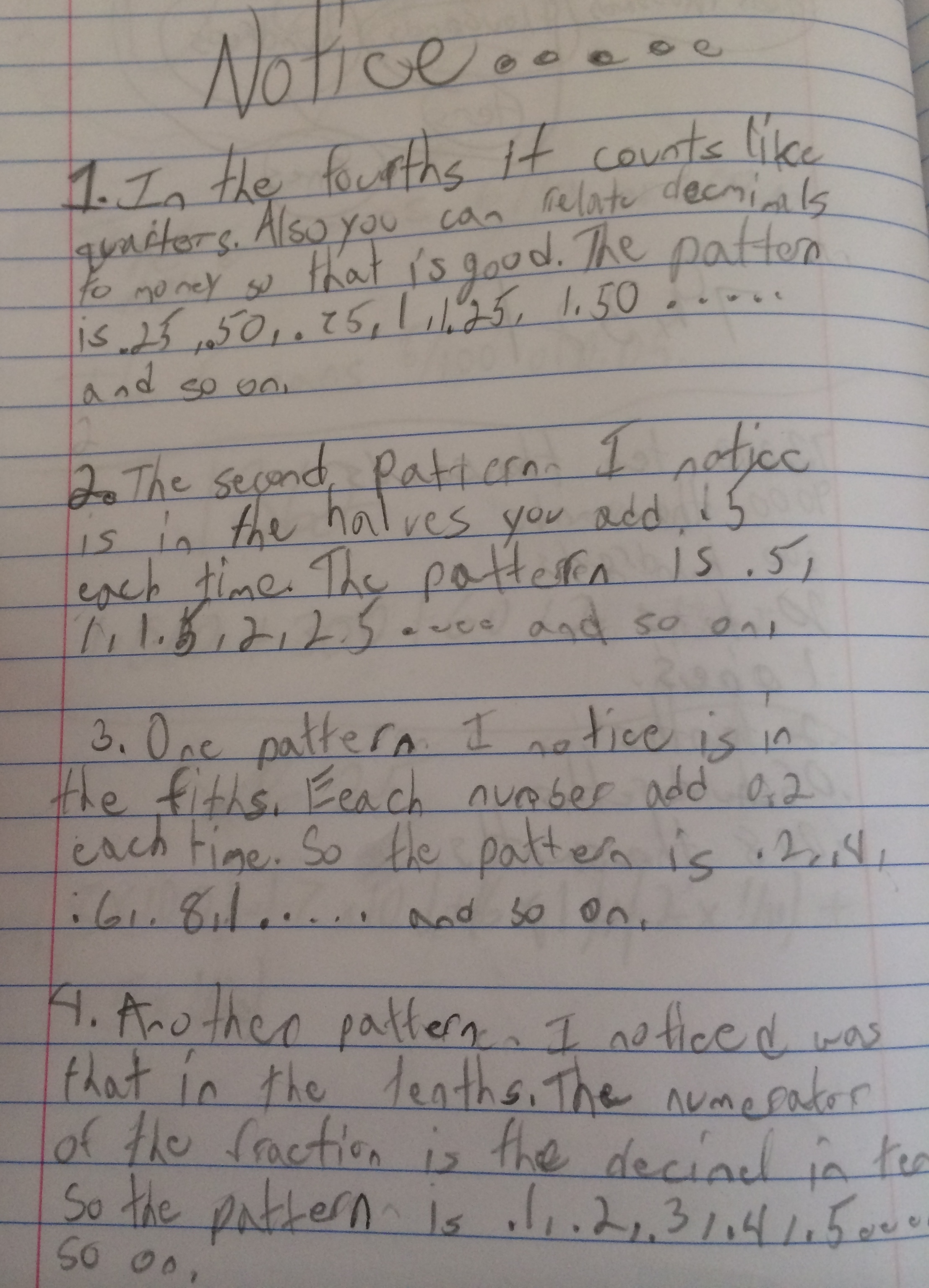
For homework, I asked the students to write at least five patterns they saw in the table, either as they were completing it or after reflecting back on it. Here are some journal entries:IMG_3662 IMG_3661  IMG_3659IMG_3660 IMG_3658 IMG_3657 IMG_3656 IMG_3655 IMG_3654 IMG_3653As a class, we came back together the next day and collected our noticings on the board:

Period 1:IMG_3605

Period 2:

IMG_3603

We had some that we agreed on, some we disagreed with and others we had to reword to make it agreeable for everyone. I found in that class period the meaning of this lesson for me…it wasn’t so much about completing the table by using division, which was my previous aversion to this lesson, but instead about finding patterns and digging into why those patterns were happening.

I would love to go through each one and tell you about our discussions, however to be honest, I have so many other things I have to get done before class tomorrow! I hope to follow up with a future post on our decimal discussions.

However I do have one thought/question I am still grappling with that I would love some thoughts on..

One student noticed that the elevenths “goes up by multiples of 9 in the tenths and hundredths.” They clarified by writing the decimals (rounded to the thousandths) on the board for us: 0.091, 0.182, 0.273, 0.364, 0.455…etc. The class could see where the multiples of 9 were showing up. Then one student noticed that the tenths was going up by one, the hundredths was going down by one, and the thousandths up by one.

At that moment, this sounded like the multiples of 9, the ones place decreasing by one and the tens place increasing by one. Now with the whole numbers you are adding a ten and taking one away to add the 9, so I see that…and for the elevenths, you are getting one more piece then tenths, so are you adding a tenth and then taking a hundredth away? Is that for the same type of reasoning? Then the thousandths? I will be busy procrastinating other work to play around with this tonight 🙂 Any thoughts welcome!

-Kristin
#WhatCouldGoWrong

On Tuesday, I received a book entitled “Accelerating Learning for All Students” in which all of the teachers in the district will receive professional development in the upcoming week. I cannot speak to the ELA piece of the material, however the math examples made me cringe. I quickly got out my post-its and started reading…pink for positives, yellows for yuck.

IMG_3608I think various points of the book were positive as far as the focus on teacher planning and opening up tasks to be accessible to all learners, they even have Carol Dweck’s Mindset mentioned, however the pathways they explain to achieve this accessibility completely frustrated me. To me, it feels completely at odds with all of the great math work we have been doing in our district/state. I am sure so many of you can relate to the type of aggravation that builds from being so passionate about learning. This week, I have been very aggravated.

Thank goodness for Twitter.

From this point on, I cannot take credit for this blog post…I had some incredible help…

It all started when Frank threw out this tweet yesterday afternoon:f1Wow, was he reading the same book I was, with mnemonics and other “tricks” to help students “learn” multiplication? I responded with a pic from my book, along the same lines:

IMG_3587Of course the ever obvious question…

f6Which was quickly followed by…

f7and…

f20Then Dan offers this suggestion….

f5And now, for your entertainment, a few of the worst mnemonics and memorization tactics for multiplication (feel free to add any others in the comments:)…

f8

f14f10 (Thanks David for the hashtag inspiration)

f3f9f15f16f17f21

f13f11

What could make this even better….

f2So as not to disappoint….

f12But the good news is kiddos…..

f4And mirroring my own thoughts after reading all of these…

f22f23

f25I would love to sincerely thank everyone who contributed to this conversation, I needed the laugh. Because, while we all know how absurd this is in the math classroom, it sadly leaks its way in with district/state initiatives. Those leaks are most frustrating for me when they are avoidable. I am SO fortunate to be surrounded by such passionate and knowledgeable math educators I can run to for support, opinions, advice, research, and, in this case, a much needed laugh!

Thank you!

Kristin
Decimals in a “One Frame”
After reading @ChrisHunter36’s post: http://reflectionsinthewhy.wordpress.com/2013/06/09/more-decimals-and-ten-frames/ I could not believe I had never thought to use 10 frames when working with decimals.
Today we began our unit on decimals and I decided to use the 10 frame (now called a “one frame” in my room) as a quick image to get a feel for how my reason about decimals as a part of a whole and the types of equations they could write to represent the way they viewed the frame.

I started with this frame:

1frameI had to explain how we used this as a visual in K-2 to build combinations of ten and later use more than one frame for students to think about addition and subtraction strategies. One student then asked, “Um, how are we going to use them in 5th grade?” Perfect intro. We came to the conclusion that in the younger grades each box is equal to one making  the whole frame equal to ten, hence the name.

Me, “Well, what if the whole frame was 1? What would each box be?

Student, “1 tenth.”

Me, “Great and how can we write that?”

Student, “1 over 10 or point 1.”

Me, “So what decimal does the frame on the board represent?”

Student, “Five tenths.” Everyone gave a quick shake of their hand in agreement. (The signal in our number talks)

Now that we had the basic understanding, I did a quick image flash of this frame:

1frame1I got thumbs up right away, agreed there were 9 tenths in the frame, and then students shared equations for how they viewed the frame. The said…

1 – 0.1 = 0.9

0.5 + 0.4 = 0.9

9 x 0.1 = 0.9

Then of course the comedian that just loves to make me write more than necessary… 0.1 + 0.1 + 0.1 + 0.1 + 0.1 + 0.1 + 0.1 + 0.1 + 0.1 = 0.9 He would laugh to think he now got me to type that out as well 🙂

We were moving fast through this so I thought I would throw out two frames to see how they reasoned about going over the whole. I know from past experience that some students will line .9 + .3 up vertically and add straight down to get an answer of .12, it is the most common mistake that I think using the one frames will be helpful in minimizing  by providing students the concrete visual of a whole.

I flashed this quick image next and asked students to write what number is represented by the two frames and equations that represent how they “saw the dots.”

7Here are some responses (right and wrong):

Loved how they visualized the dot moving to make the whole.

Loved how they visualized the dot moving to make the whole.

IMG_3342

This equation was great!

This equation was great!

The mistake I was expecting.

The mistake I was expecting.

I saw 1.2 and 0.12 in journals as I walked around, but then a student shared out that he thought it was 12/20. I LOVE when a student does this…makes it so much more interesting. I wrote all three answers on the board. I asked them who believes their answer is correct, they all raised their hands (confident bunch), so I told them to choose one of the the other two answers and explain what the misunderstanding is that led to that answer. I got some great work that we shared out and agreed finally on 1.2.

Here is what they said…

IMG_3341

This one is great because she realized she made a mistake as she was trying to disprove another answer. Then the reason that 9+3 is more than 10 so .9 +.3 has to be more than one. Interesting to revisit later.

This one is great because she realized she made a mistake as she was trying to disprove another answer. Then the reason that 9+3 is more than 10 so .9 +.3 has to be more than one. Interesting to revisit later.

Understand the thinking, just need to be sure to focus on the whole being broken into 20ths vs 10ths, not 20 and 10.

Understand the thinking, just need to be sure to focus on the whole being broken into 20ths vs 10ths, not 20 and 10.


She had to get her Fun Dip finger in the pic:)

She had to get her Fun Dip finger in the pic:)

IMG_3367

So, thanks so much to Chris. I can see many One Frames in my future number talks!

-Kristin