1st Gr Number String: Missing Number

Yesterday, I wrote a quick post as I was trying to decide which of two number talks I should do with a 1st grade class. I got some great feedback and went with the first one in the post! It was amazing and completely evident that the teacher, Ms. Williams, does a great job asking students to share their thinking regularly. The students were so clear in explaining their reasoning and asking questions of one another.

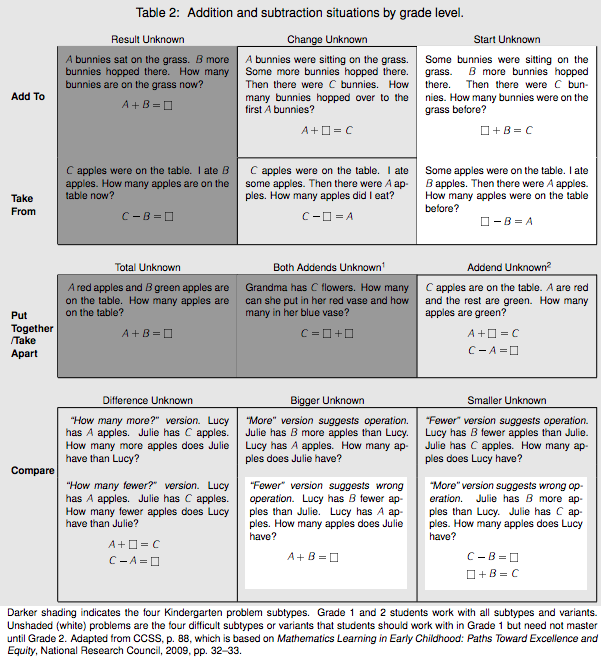
The first problem drew out exactly what I was hoping and more. One student shared counting on and a few students shared how they decomposed the 4 and added 2 and then 2 more. I was not expecting the use of a double, but two students used 8+8 in their reasoning. The use of their “double fact” reminded me of the solving equations conversations I have with Michael Pershan but in a much more sense-making way than I personally think about it. The students said they “knew 4 and 4 made 8 so they took 4 away and that changed the answer.” I tried to get out of them that they subtracted the 4 from the 16 as well, but it just made sense to them the 16 changed to 12 because he subtracted 4 from the 8. I am so glad I videoed this talk because I want to talk more about it after I re-watch it!

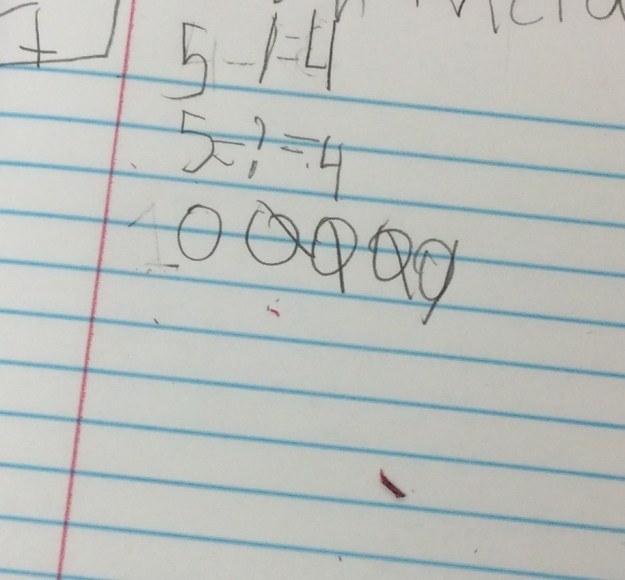
The second problem was as tricky, as I anticipated, and split the class between the answers 1 and 9. The students seemed very used to having the difference on the lefthand side of the equal sign which is great, but some still wanted to add 1 to the 4 instead of subtract the 4 from the missing number. I moved on to the final question because we were at a bit of a standstill at this point. Hindsight, I wish I did that problem last, but I had them journal about it after the talk.

IMG_4191

The final problem, which I wish was my first problem – what was I thinking in this order? – was great! They decomposed the 5, made 10 and talked their way through the two incorrect responses.

IMG_4192

I asked them to journal about the second problem when we finished. The prompt was to explain which answer, 9 or 1, they thought it was and why. Here are few examples:

IMG_0133.jpgIMG_0121.jpgIMG_0122IMG_0128IMG_0120IMG_0123.jpg

I think I would love to post the following string (all at once) on the board to start tomorrow’s lesson:

? – 4 = 5

5 = ? – 4

? + 4 = 5

5 = ? + 4

Ask what the question mark is in each one and which equations seem most similar.

Such a great day in 1st grade!


1st Grade Number Talk

I am planning for a number talk tomorrow with a 1st grade class. I have been playing around with two different problem strings that I would love feedback on, because I can’t make a decision!

I would particularly like feedback on:

  • What could we learn about student thinking?
  • What would you be curious to find our about their thinking at the end?
  • Do you think one would be better before the other or doesn’t it matter?

Here are the two I am playing around with (sorry, I had them written on Post-its):

FullSizeRender.jpg

My thoughts:

  • 1st problem – Do they add to 10 and then add on? For example, 8+2=10 and since 12 is 2 more the answer is 4 or do they subtract 8 from 12?
  • 2nd problem – How do they do with the missing number on the right side of the equation? Do they visualize a 10 frame, taking 4 off of the bottom row to leave 5? Do they add 5 and 4?
  • 3rd problem – Do they decompose the 5 into 4+1 to use the 1 with the 9? Do they count on from 9?

Prompt at the end – How are these problems different? Which was your favorite to do? Why?

Second option:

FullSizeRender.jpg

My thoughts:

  • 1st problem: Set the stage for expressions on both sides of equal sign. Notice you can’t add more to the same number and stay equal. Did we need to solve both sides to know that?
  • 2nd problem: Both equal 10 but did we need to solve both sides to know it is equal? Take one from one addend and add it to the other and still remain equal.
  • 3rd problem: Commutative property.
  • 4th problem: Now that I just wrote the commutative for problem 3, I want to switch the 8+5 on this one to 5+8 so that they might also think about taking 2 from one addend and adding it to the other.

Prompt at the end: Write two of your own equations that would fit something you noticed in our problems today. (wording is rough on that one).

Chances are I will have the opportunity to do both of them and I think they both hit on different, interesting things. I would love feedback on both and know if you think one is better before the other or if it doesn’t matter?


3rd Grade Place Value: Part 2

Last week, I wrote a bit about place value after doing a Which One Doesn’t Belong activity with a 3rd grade class. Since then, I have been thinking A LOT about how complicated place value really is. I think you can get a feel for the various ways we handle place value with students in this Twitter thread.

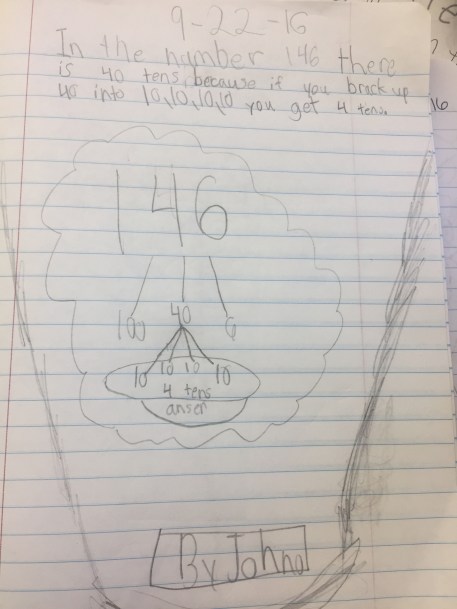
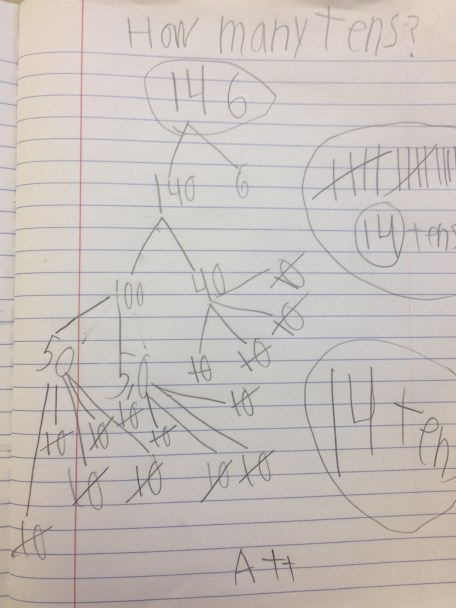
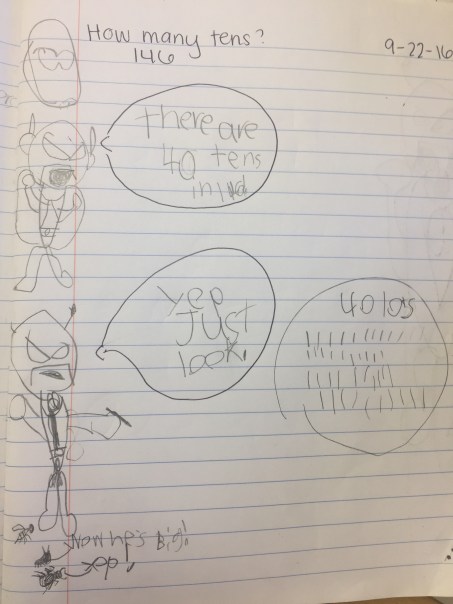
I have been talking about this with my 3rd grade colleagues at school, so one of them did the same WODB activity and ended with the same discussion around the number 146. She asked how many tens were in that number and got a lot of 4’s and 14’s, but this time she also got 40, which I did not hear in the other class. She asked the students to defend their thinking in their journals.

The journal below is the one I anticipate the most, separating the places and naming the number of tens in the tens place. (Although, I am unsure what is going on with the 74, possibly was going to give another example and ran out of time?)

img_3026

This journal shows a slightly different reasoning because now instead of saying there is 1 hundred, 4 tens, and 6 ones, the student is using the value (or quantity, again not sure what to call this here, its complicated) of the 4 in the tens place as 40 broken into the four 10’s so you can see them.

img_3027

I want to pair the student above with the student below and have them chat. This student had the same train of thought in the beginning but broke the 100 into ten 10’s to arrive at 14 altogether.

img_3025

The last one, that surprised us, was the 40 tens. He actually showed 40 ones that make up the 4 tens with his dash marks in the last speech bubble. I may want to pair this student with the second example in this post to have them chat about that 4 tens vs 40 tens.

img_3028

All of this still leaves me wondering a lot. I know there are times it is helpful to think about the tens only in the tens place while there are times we want to be thinking about how many tens are in the whole number, but….

  • When are those times?
  • How do we best structure activities to explore these ideas with students?
  • What assumptions do we make about student understanding of place value as we teach comparison and computation strategies?


One Hundred Hungry Ants – 4th Grade

Next year, we are restructuring our RTI block to be a time when students are working in small groups in their classrooms. This is a really exciting change from our previous model in which students were pulled from their classroom for intervention. This change will shift our Learning Lab focus to planning small group activities, however the first, REALLY important, piece we need to focus on is how small groups work in the classroom. I think the K-1 teachers have a much better sense of how centers work within the classroom, although we still want to move from the current centers to more strategically planned small groups. So, with only a week and a half left of school, Erin and I are playing around with some ideas in the classrooms as a part of our planning! Fun!

Erin and I planned for a 4th grade class today where we were going to test out a small group scenario. We started in a way I imagine everyone could kick off the year next year, involving students in the process. We asked them what they needed in order to learn in small groups. Below are all of their great responses, most of which were accompanied by an example of something they had experienced during small group work.

IMG_2494 (2).jpg

I launched the small group task by reading One Hundred Hungry Ants aloud, pausing occasionally to ask for predictions. After the reading, I didn’t preview the task, but instead sent them off to work in their small groups. This was for two reasons: to see if the wording of the task was clear enough for students to follow independently and to see how they worked as a small group. We choose to give everyone the same task today to see how it went but we are trying different small group tasks tomorrow.

Each group had a journal, storyboard, and this task card:

Screen Shot 2016-06-06 at 7.57.14 PM.png

They worked for about half an hour and had some great conversations. I especially liked the conversation sparked by the third question because number choice is something I find so interesting. They also had to do some serious negotiating to decide which number they would do as a group since everyone had different reasons. In one group a student wanted to pick 2 because they would “get there faster,” another wanted 75 because “it could make a lot of combinations, but be less than 100 so they could still make it in time.” In another group, a student was saying he didn’t want any prime numbers because you could only do two lines with them.

This one was great because they changed the storyline from finding a picnic to getting to Dairy Queen, but when they get there they had forgotten their money so they still got no food. Different story, same ending.

This one was so interesting because, unlike the book, they used the commutative property, seeing the arrangements as different situations, which the book did not do:

This group saw a lot of doubling going on in their arrangements when they chose 50 instead of the 100 in the book:

We came back together and talked about the patterns they saw.

IMG_2495.jpg

While the math conversation was interesting and I can definitely see some great generalizations stemming from this work, tonight I am thinking more about the questions I am left with about small group work…

  • Could a teacher work with primarily with one group, realistically, without continuously checking in on the others?
  • How can we structure the work so everyone in the group is working on the recording at the same time and can see what is being written? We saw a lot of the journal or storyboard sitting in front of one student. Not that the others weren’t contributing, but they all couldn’t see what was being written. I think dry erase boards can work well here.
  • What type of formative checkin can we do with each group that doesn’t add to an already growing pile of papers to be graded or give feedback?
  • How do we control the noise? The students were not being purposely disruptive or off-task, they were just loud and began talking louder to hear one another.
  • What does this look like at other grade levels?
  • How can we keep this interesting for students to do every day while not making it a planning nightmare?
  • How can we embed more student choice in the task?

More to come tomorrow when we tackle these tasks:

Screen Shot 2016-06-06 at 8.22.29 PMScreen Shot 2016-06-06 at 8.22.41 PM

2nd Grade Collaborative Planning Using the 5 Practices

This Tuesday, I am teaching a 2nd grade lesson for a teacher who will be out that day. I offered to this for all of the teachers if my schedule permitted. I thought it was a great way for me to learn more about each grade level, possibly plan and teach it with other grade level teachers for that lesson, and it saves having to use a “sub plan” lesson which we all know either leaves us with more papers to grade or even worse, having to redo when we return. After doing this same type of thing for a 3rd grade classroom last week, and getting great suggestions in the comments after the lesson, I thought this time I would try throwing it out there before I taught it. I would love to see how this lesson could take shape with the input ahead of time!

Lately, I have seen a lot of tweets regarding using the 5 Practices when planning. Now, while I don’t use them to the extent the book lays out for every lesson (because, you know, time), I do always have them playing in the back of my mind when I plan. So, I am going to plan here, one piece at a time, using the 5 Practices. I will pose my questions where I have stopped and look forward to feedback in the comments!

Here is a little background information…

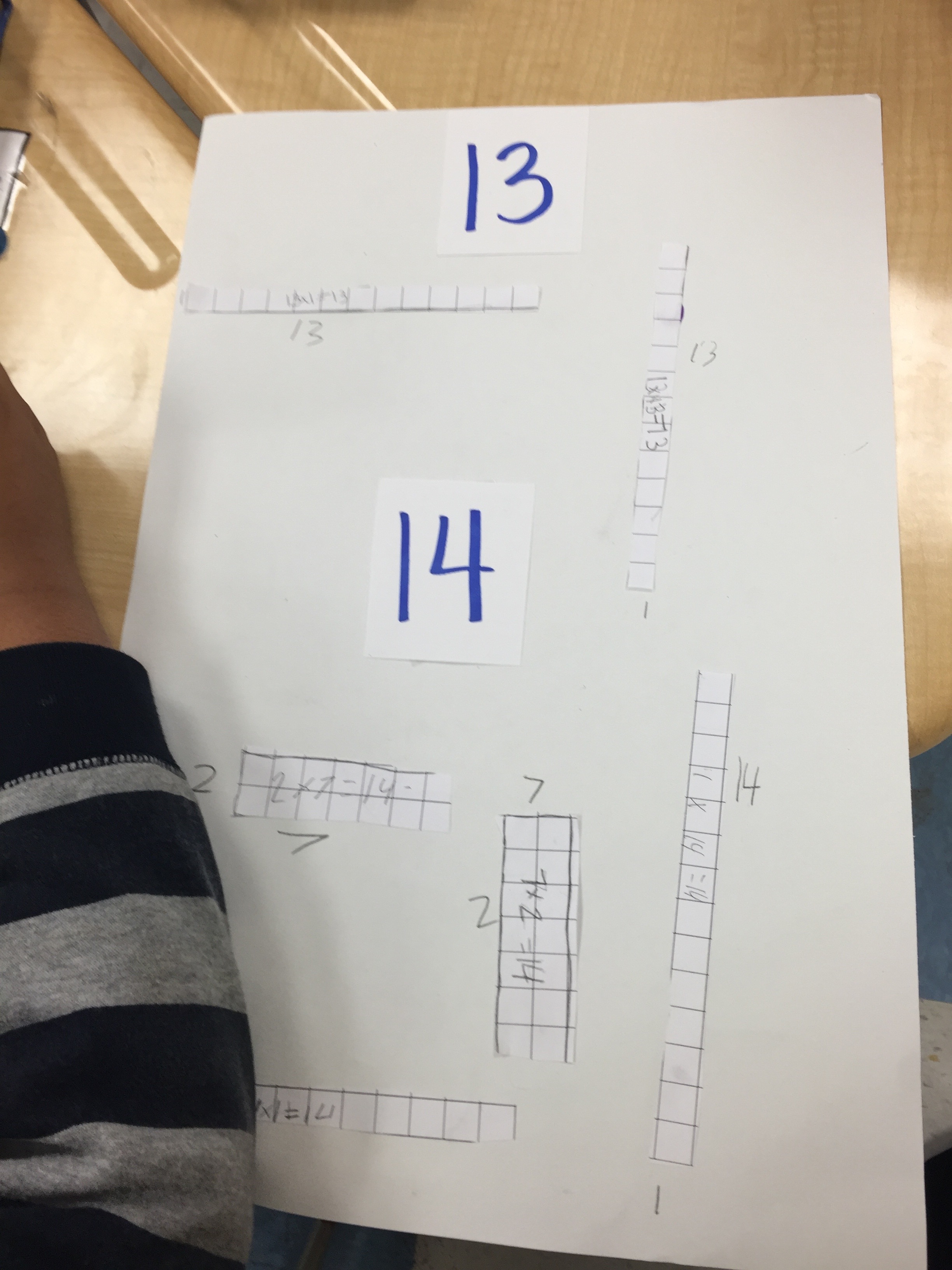
The Investigations Unit Summary:
Screen Shot 2015-11-15 at 1.45.19 PM

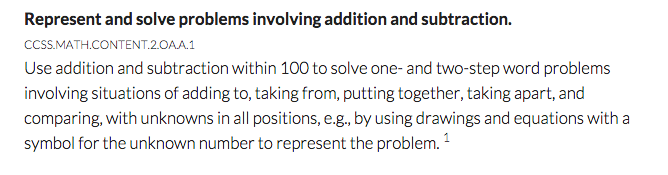
I see the CCSS highlighted most in this lesson:

Screen Shot 2015-11-15 at 1.58.21 PMScreen Shot 2015-11-15 at 1.58.32 PM

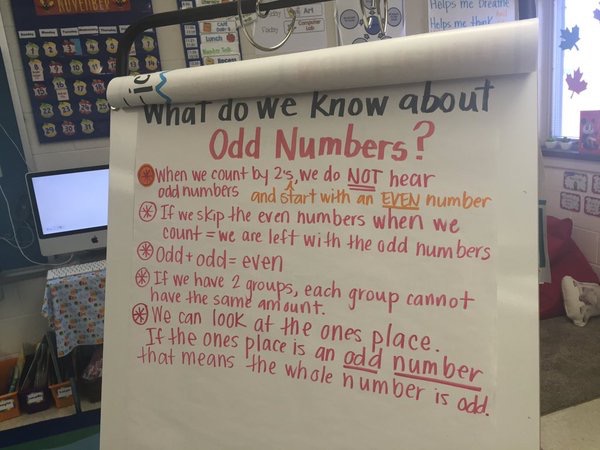
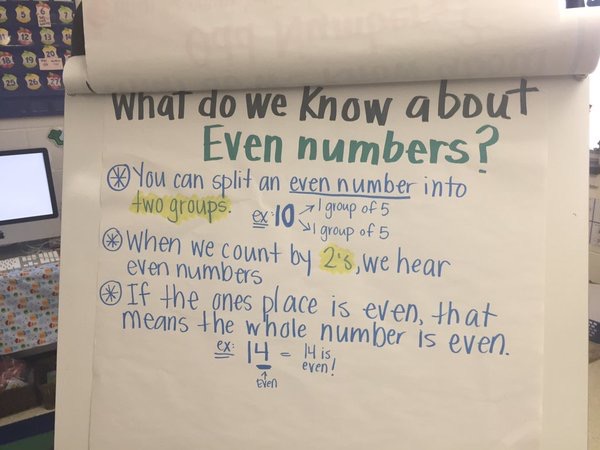
Up to this point the students have been doing a lot of addition/subtraction story problems and sharing of strategies, counting by equal groups, and working with evens/odds. In their work with evens/odds they have been deciding if numbers can form two equal teams or if they allow each person to have a partner. As of a week ago, this was the class noticings around even/odd:

CS6C0fkW4AAqjTR CS6C0ckWsAA2Flz

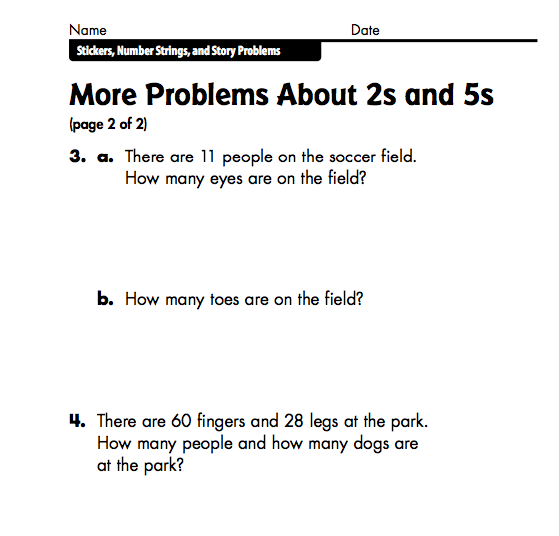
The lesson I am planning is structured as a workshop in which one piece calls for the students to individually solve the following pages, however I am thinking I want to turn these two pages into the lesson because I think they could lead to some amazing thinking!

Screen Shot 2015-11-15 at 12.09.34 PM

Screen Shot 2015-11-15 at 12.09.25 PM

Practice 0: Mathematical Goal

[Planning 1]Students use equal groups when thinking about a context. I am not sure if this is too broad, but there is so much here. What I would really love to see is students moving beyond drawing each one out and counting by 1’s but I am also so interested to see how multiplication and division show their beginnings here! 

[Final Plan] After a conversation with a colleague, my goal for the lesson is for students to begin unitizing the equal groups when combining the groups. I also have this subgoal of proportional reasoning when thinking about people/eyes or dogs/legs.

Practice 1: Anticipating 

IMG_1091IMG_1092

[1st Planning Thought] Before moving on here, I need to decide whether to focus on both pages or just focus my planning on one or two problems. Although they all involve equal groups, I am wondering if focusing on a particular one brings out more conversations and connections between the ways in which we can count? I am leaning to #4, but I it would be helpful for me to also see how they think about 1-3 before thinking about the share of #4. OR, do I leave 4 for the next day after gathering info and sharing strategies together for 1-3?

[2nd/Final Planning] I am thinking now that I am going to launch with a simple sentence of “There are 12 people” and ask student what problems we could solve based on that sentence. Talk about ears, eyes, fingers, legs…etc and then how we could represent our work. I am thinking to not actually DO the math but write the ways as a reference back at their seats. For example, “Draw pictures, Use numbers, Use cubes, Write equations, Use words, Use tables…etc” In planning with another 2nd grade teacher today, we saw that “show your work” at the top pushed some students back to pictures when they were not necessary.

After this, I am going to have 1/2 of the class working (in groups) on problem 1 and the other half on 2. Before they jump right into group work, however, I will ask them to take individual think time to get into the problem. After the groups have arrived at an answer, I will  have a couple students swap seats and explain to the new table how they arrived at their answer. They will then discuss what was the same and different about their problems and ways they solved their problems. After they share among tables, I will bring them to the carpet for a group discussion about these similarities and differences. 

Practice 2: Monitoring

During the work at their seats, I will be walking around, and asking questions when necessary to generate conversation (I don’t know this class as well as I would my own so I do not know what to expect as far as conversation) and looking at strategies.  Questions: How did you arrive at your answer? Does everyone at the table agree ? Where do you see [the ears, people, eyes, fingers] in your work? Is there an equation to match your work? 

Again, after discussing this with a colleague, I will not only be monitoring student understandings but also monitoring for which students to switch and share. I would not want students with the same strategies to switch and not have anything to build upon so this is a great opportunity to structure a better situation for conversation.

Practice 3: Selecting

I will choose papers based on a variety of strategies that build along a trajectory. I would like to see students who drew out the problem by 1’s, 2’s, 4, 5’s or 10’s, then others who used one group to represent the 2’s,4’s, 5’s, or 10’s (unitizing), then students who used equations or number operations w/o the pictures. 

Practice 4: Sequencing

In the share, after each group has presented to the other groups, we will come to the carpet for a share. The sharing will be sequenced in the way I discussed in the Selecting part, asking students during each student work sample how it is similar and different than the ones we previously shared.

Practice 5: Connecting 

The connecting I see happening through my questioning as we share strategies. I am still working on writing this part out and looking for the connections that can be made, aside from the picture to number representation connections.

The connections I would love to see students making throughout the work and sharing, is how we can combine equal groups. For example I would like the student who is drawing ones and counting them all to move to seeing those ones grouped as a 2 or a 5 depending on the context. I would love the student who is seeing the five 1’s as one group of 5 to now see that if they have 2 of them it will make a 10 and if we have 4 of them we would have 20 and really start looking at different ways to combine those groups. 

For the journal, I will give them the scenario that there are people and dogs in the park and 28 legs, how many of each could there be? This will offer multiple solutions (Thanks Simon) and allow for them to see some great patterns the following day!

I will let you know how it goes!

Follow up Post #1

Follow up Post #2


~Kristin


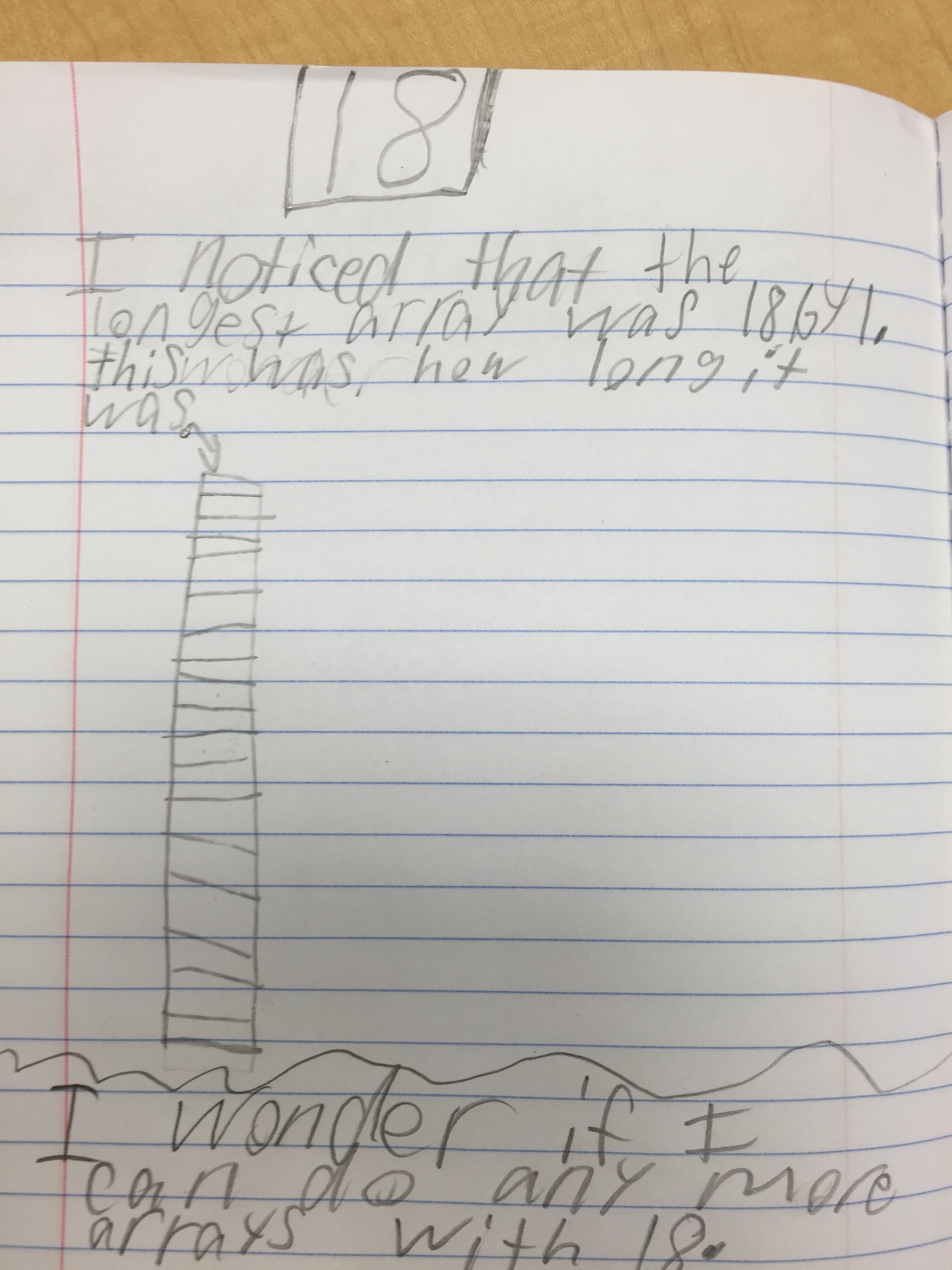
The Beginning of Arrays in 3rd Grade

Today, I was lucky enough to be asked to teach a third grade math class because the teacher was going to be out. Since I have never taught the Arranging Chairs activity in third grade, I was excited when two of the other third grade teachers, Jen and Devon, wanted to plan with me yesterday. Before meeting I read up in Children’s Mathematics: CGICarpenter, Fennema, Franke, Levi, Empson to think more about this idea of equal groups, meets arrays, meets area model builds. Here is one piece I found that connects them in a very nice way.

FullSizeRender 7FullSizeRender 6

We decided to change the Ten-Minute activity from a time activity to a dot image number talk. We thought since the students have been doing so many dot images involving equal groups, that it would be interesting to see how they thought about one image with a missing piece. We were curious if students would use any structure of an array to think about how many dots were in the picture. The board ended like this…

IMG_1074

For the most part, students either added rows (so they were seeing the array structure) or looked at the symmetry of the picture. They had so many more strategies they wanted to share, but for times sake, I did a quick turn and talk so they could share their ideas with someone before they left the carpet. Because I heard a student talk about filling in the middle, I asked him to describe to the group what he and his partner talked about. He said, “You could fill in the missing dots and then do 4,8,12,16 minus 2.” I heard the word array thrown around so I asked them to tell what they knew about arrays. A few students built upon one another’s definition ending with something with rows and columns.

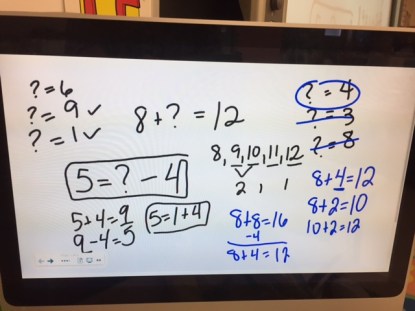
Next, we introduced the activity on the carpet right after the Number Talk. You have 12 chairs to arrange in straight rows for an audience to watch a class play. You want to arrange the chairs so that there will be the same number in every row with no chairs left over. How many arrangements can you make? They talked to a neighbor and I took one example, a 6×2, and constructed it on the board. We talked about what that would look like on the grid paper. The grid here felt like a very natural way to move students between arrays as equal groups to rectangular arrays. They went back to their table, with cubes, and worked on making as many arrangements as they could. We shared them as a group.

IMG_1075

They talked about the commutativity in the rotation of the arrays. We discussed the fact that since we were talking about seating arrangements in this activity, we would consider them two different ways to arrange the seats. This is where I saw the arrays as such a beautiful way of visualizing commutativity in a much different way than they previously had discussed in rearranging number or groups and group sizes.

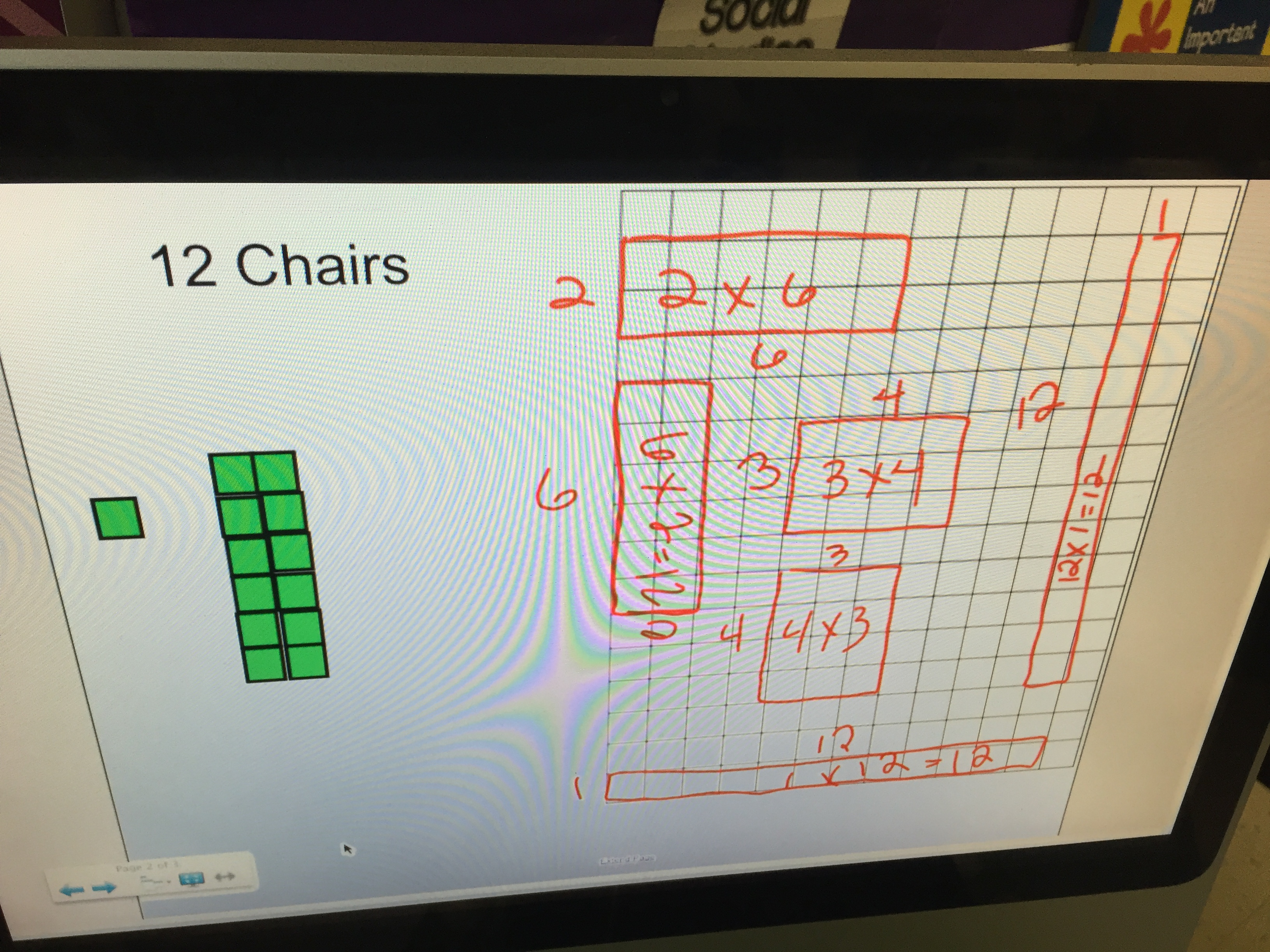
Next, each group was given a number to create as many arrays as they could, cut and paste them on a piece of construction paper. Choosing the numbers for each group was something we spent a lot of time in during our planning. We wanted to be sure that noticings around sets of numbers such as primes, composites, evens, odds, and squares would surface, as well as relationships between different sets of numbers, we tried to be really thoughtful around this. We came up with a first set of numbers and then decided on a second number to give that same group if they finished early. So, this list is first number/second number (although we knew not all would get to the second one).

11 / 27 – Prime number and then an odd that wasn’t prime

25 / 5 – Odd square number and then relationship to a multiple they did of that number.

16 / 8 – Even square number and then halving on dimension

9 / 18 – Odd composite and square and then double a dimension

24 / 12 – Even number and then half a dimension (we didn’t think they would get to this one because 24 has quite a few to cut out:)

18 / 36 – Even number to compare with another group and then double a factor (36 could also relate to other groups numbers in various ways)

15 / 30 – Odd composite and then double a factor. We didn’t think they would finish 30.

13 / 14 – Prime number and then how adding one more chair changes what you can make.

Extras for groups done both: 64, 72, 128. (No one got there)

Thanks to a lovely fire drill in the middle of class, some groups did not get to a second number or if they did, did not get to finish. This is the point where you realize how amazing it is to have more than 1 teachers in the room! Everyone could walk around and listen to their conversations while they worked. We heard everything from frustration/wonderings about prime numbers because they thought there had to be more than one (and the rotation) to excitement when they finally got a second number with more. Here a few of the (close to) final products:

IMG_1057 IMG_1054 IMG_1055

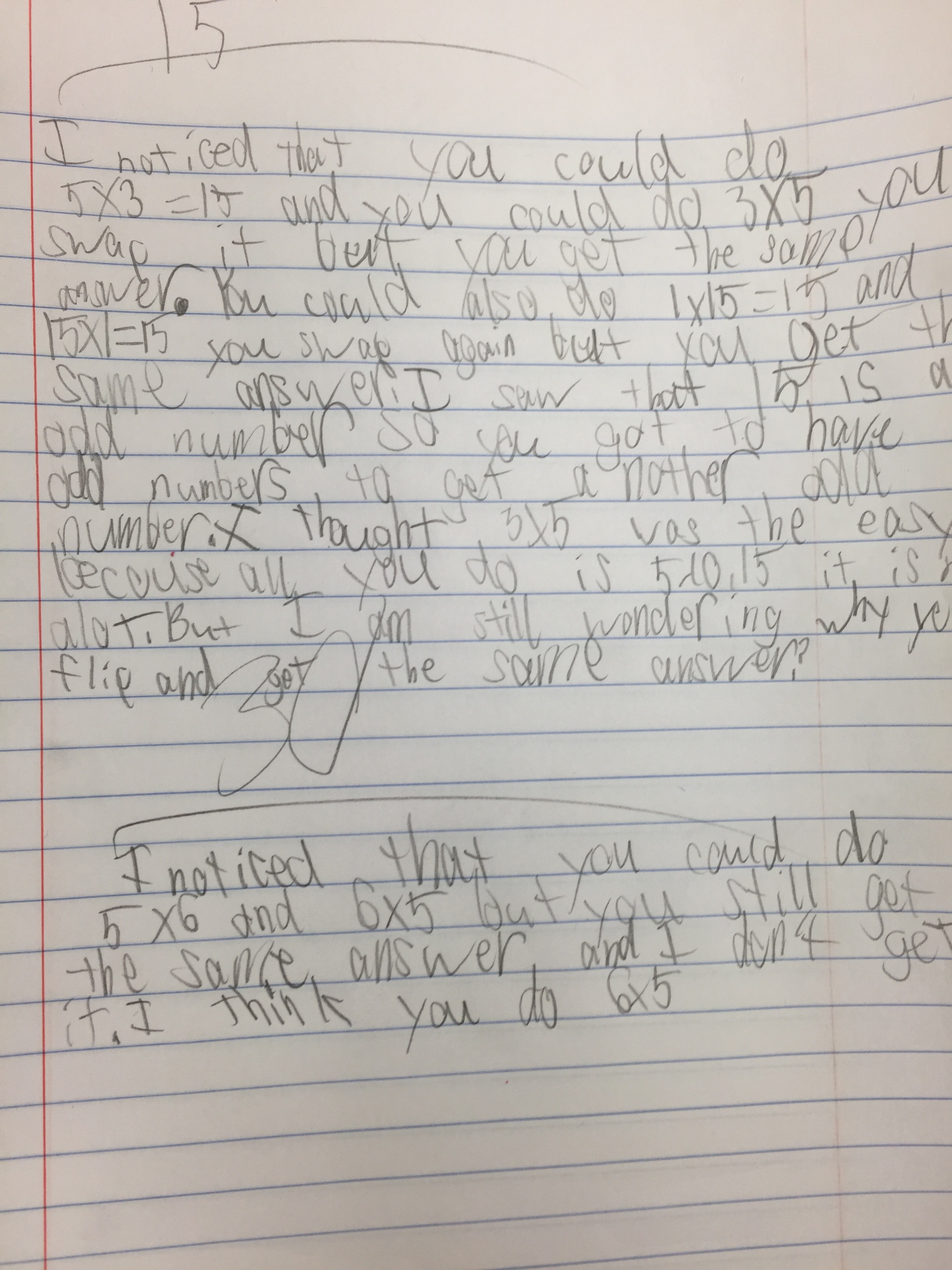
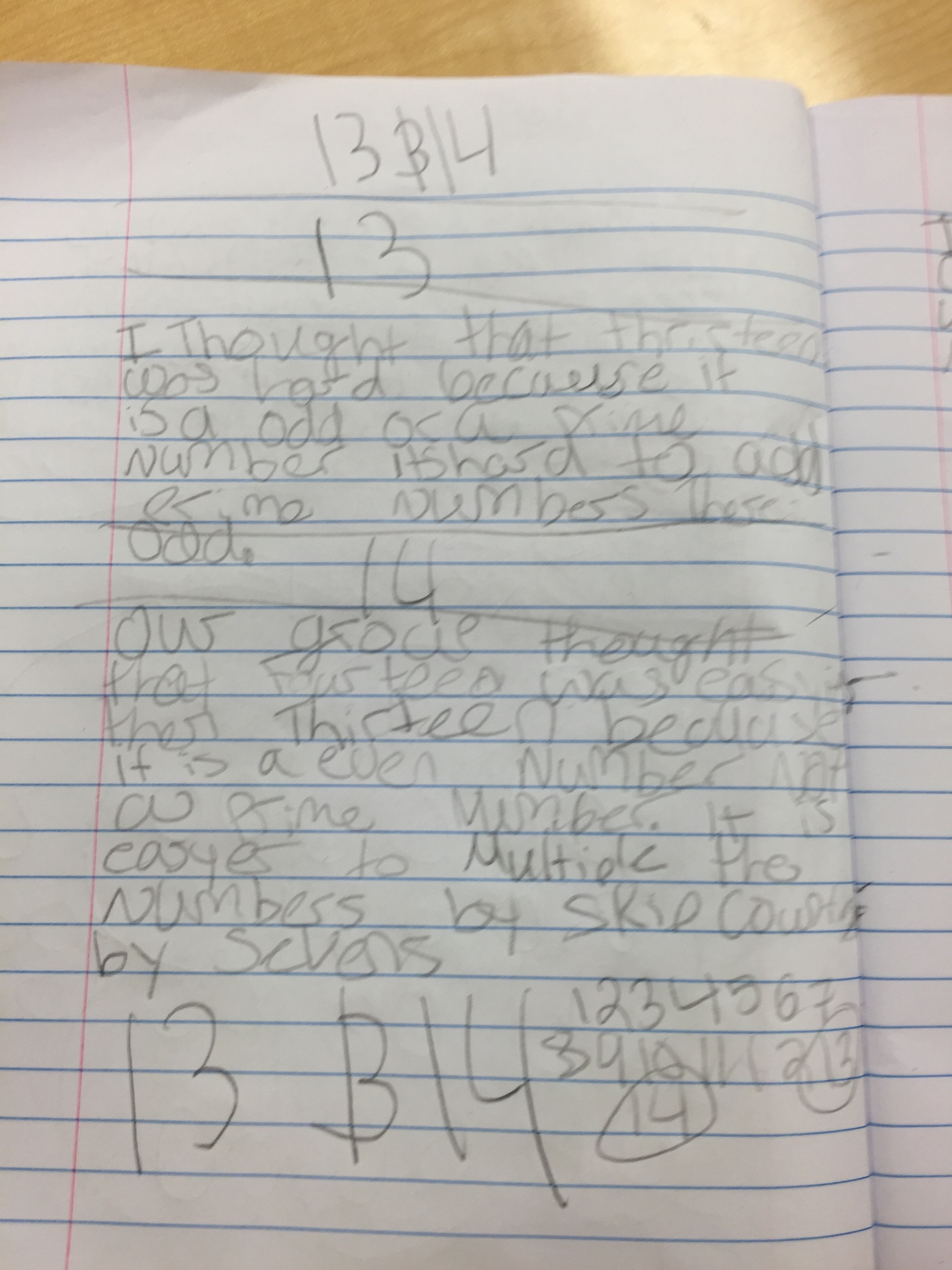
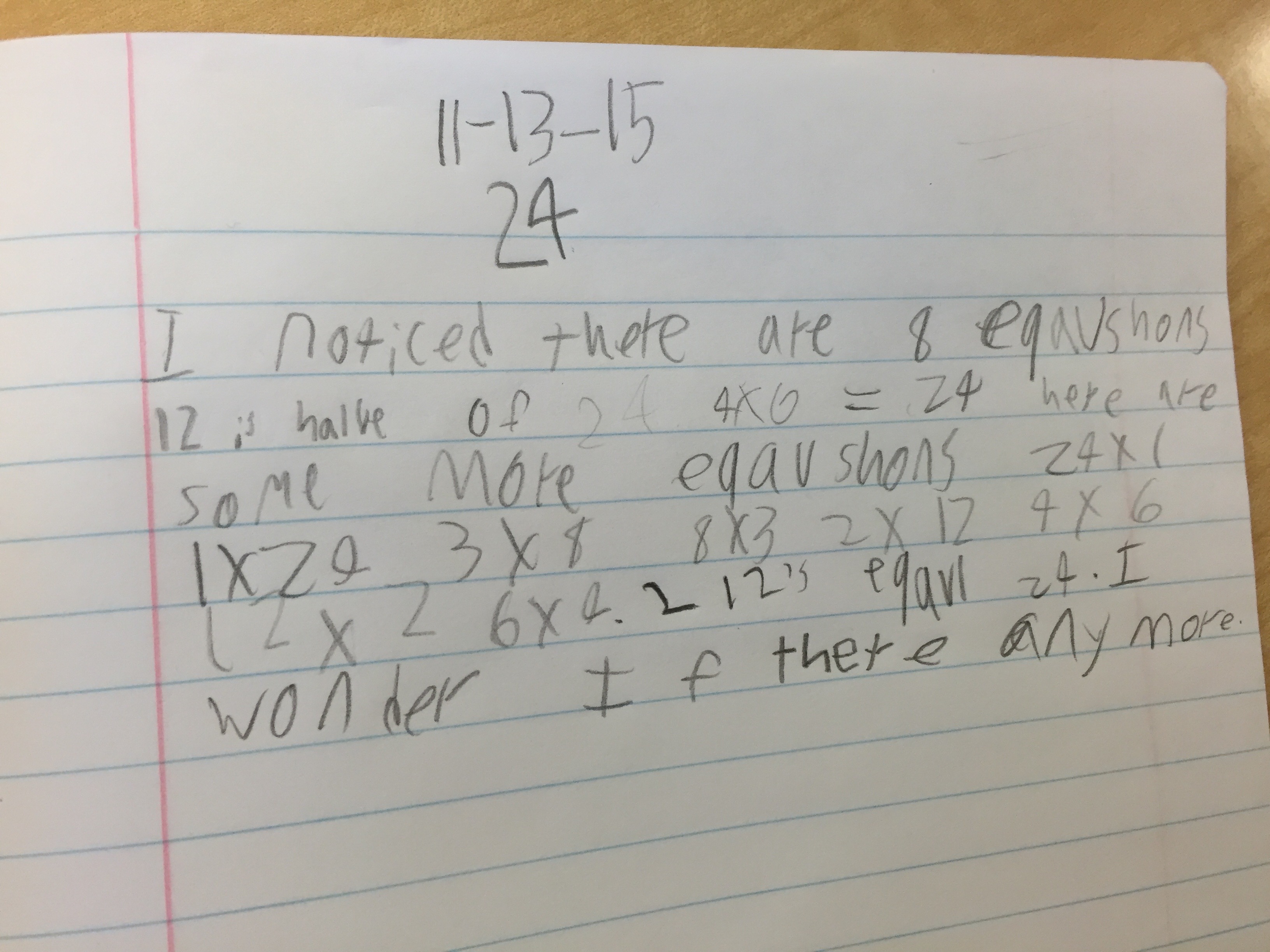
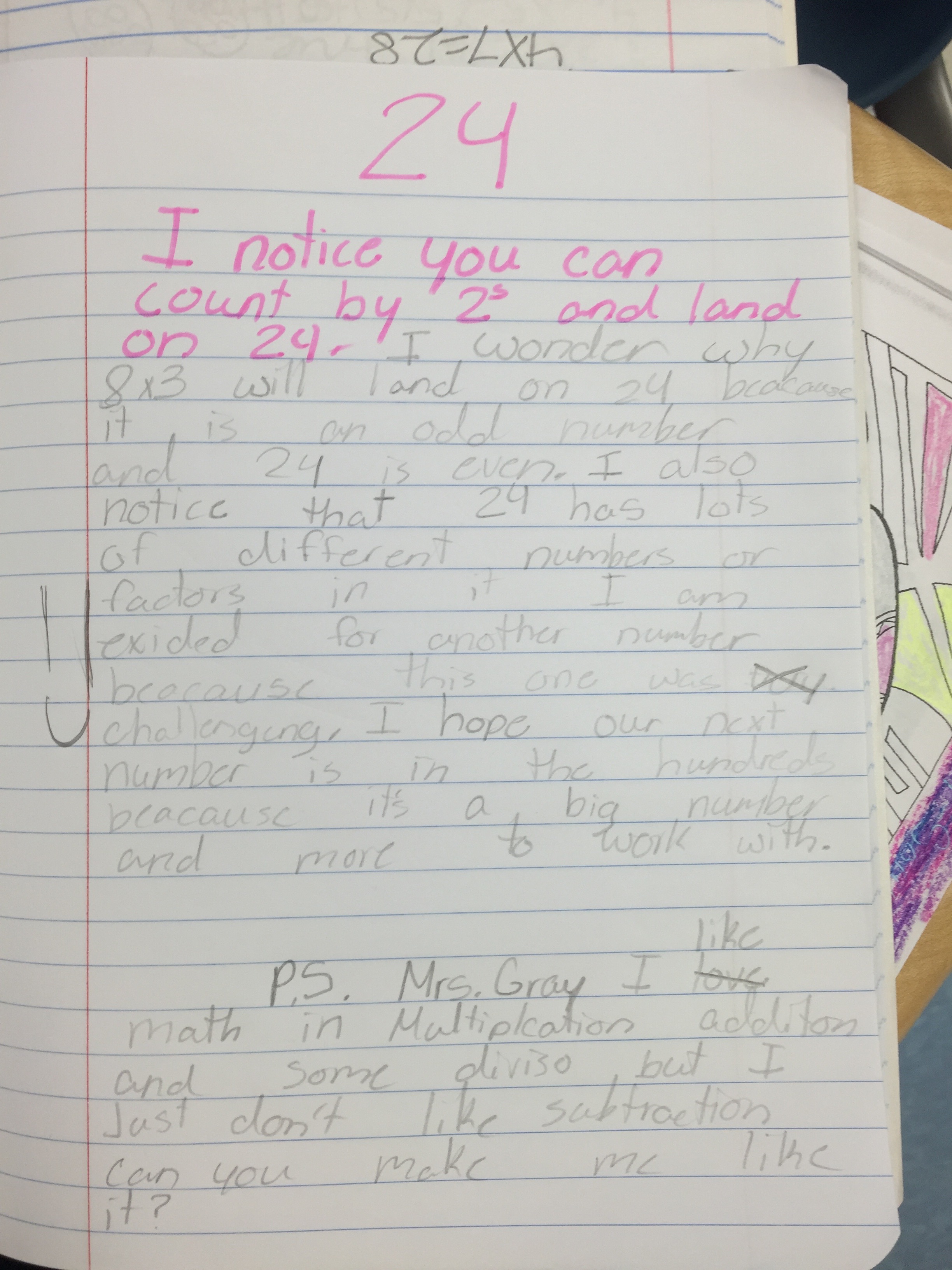
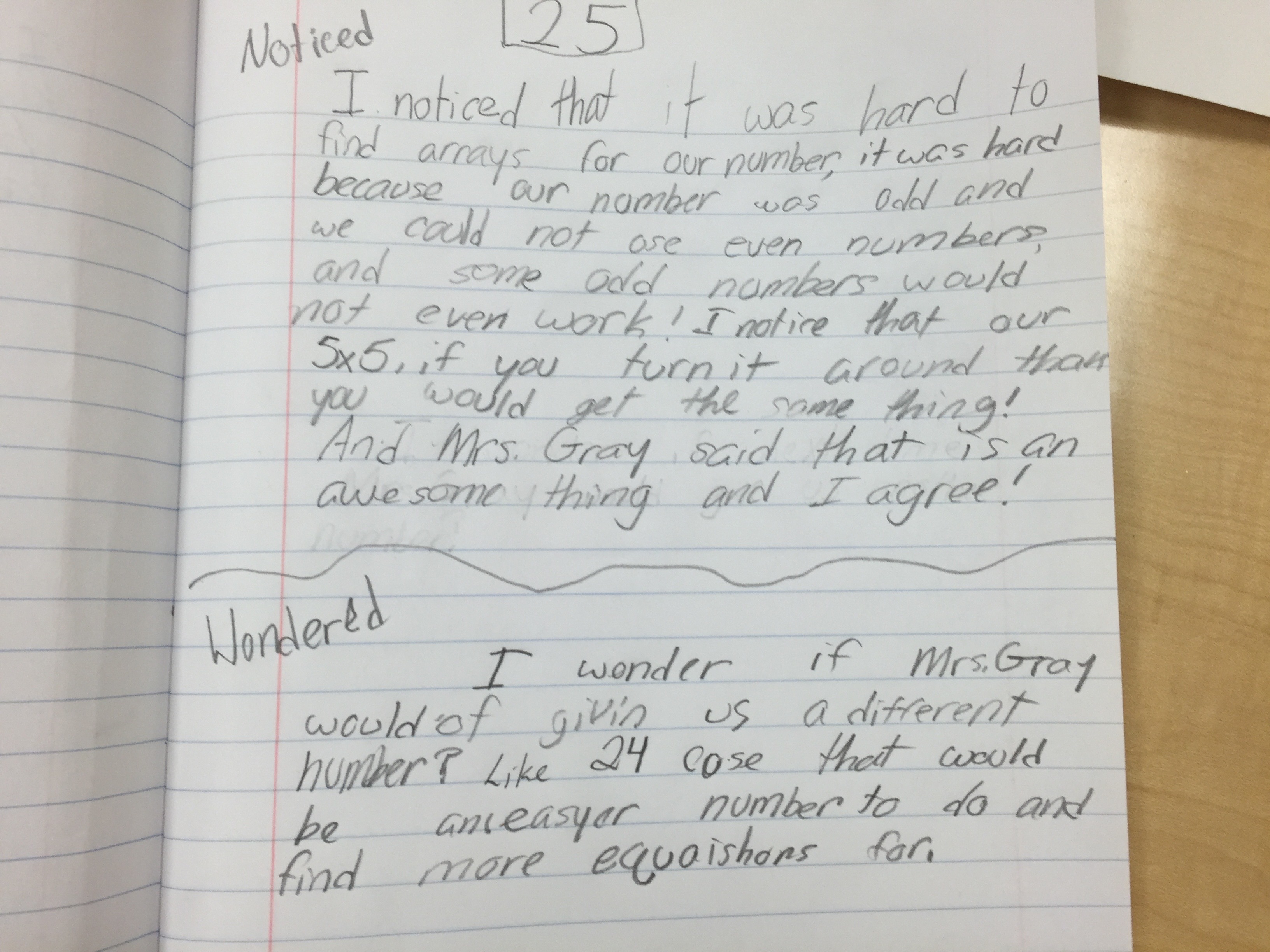
On Monday they will hang them up and walk around to do a notice/wonder about all of the different numbers around the room, but we really wanted them to think about their work today before jumping into comparing others. I also really wanted to capture what they were frustrated by, liked about their number, were thinking about in the moment and were left wondering. So, I asked them to write about what they noticed and wondered about their work today. I expanded on the prompt a bit to avoid, “I notice I could make 4 arrays,” and I said, “You could tell me why you liked your number or didn’t, what you think made your number easy or hard, or what you realized as you were making them.”

There were some beautiful responses that I cannot wait for Andrea (their teacher) to hear on Monday because they were so excited to share!

A nice noticing that could lead to largest perimeter with the same area:

IMG_1072

An informative noticing and wonder about commutativity to keep in mind when planning…

IMG_1069

Wonderful comparison of why they feel evens are easier than odds, but also great wonderings about “Is that really all you can do?” with prime numbers and why?

IMG_1067 IMG_1056

I talked to this student and he was using the 12’s for 24 but had trouble articulating it in his journal.

IMG_1064

Loved this one wanting a number in the hundreds because it would be more challenging and don’t miss the bottom piece about subtraction!

IMG_1061 (1)

She was not as much of a fan of the square as I was when I walked up, she said it is, “just the same when we turn it” and I said, “That is an awesome thing!” (I meant her noticing, but I think she thought it was about the square:)

IMG_1065 (1)

I will leave you with this one that struck me as “We always have more to learn.” I cannot wait to see her working with fractional dimensions in 5th grade!

IMG_1071 (1)

I cannot wait for the gallery walk and noticings and wonderings from the entire group of numbers. I am also really excited to see this work move into rectangular arrays and seeing students’ strategies around multiplication evolve and how they take this work and form relationships between multiplication and division.

Great day in 3rd grade and I have to say, I think Jen, Devon and I planned really well for this one!

-Kristin
1st Grade Dot Addition and Math Journals

A couple of weeks ago, I blogged about my planning with a first grade teacher here.  After teaching the lesson, the students did an amazing job with the dot images we chose to use. Some students moved the dots to make the dice look the same on both sides of the equal sign while others solved both sides. On the last image they easily decomposed the 4 into the two 2’s to prove both sides were equal so that was something we were hoping to see transfer into the dot image activity.

We walked around, recorded the expressions we saw students writing, and asked students questions about their strategies for choosing cards. As I do with many lessons, in thinking about their strategies beforehand, I referred to the Learning Progressions to see how students progress through algebraic reasoning.  If they didn’t know the the addition expression from memory, like 3+3 or 5+5, this clip from the progressions best describes how I was seeing students arrive at the first expression written for each given sum. Because the commutative property was the way most students found the second expression for each sum the day before, this particular day we told the students they had to use different cards than their partner in thinking about writing their expression.

Screen Shot 2015-11-11 at 8.49.25 AM

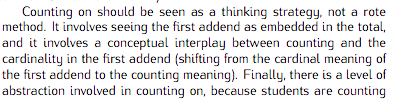
I especially loved this passage in the Progressions about counting on…I had never thought of counting on as seeing the first addend embedded in the total, although it makes complete sense now! I wonder how understanding that could impact the way in which I question students about their thinking when adding?

Screen Shot 2015-11-11 at 9.02.15 AM Screen Shot 2015-11-11 at 9.02.33 AMWhat we were looking for as we walked around in particular was how students were using either this Level 2 method above or, what the progressions would call it, Level 3:

Screen Shot 2015-11-11 at 9.07.59 AM

It is hard to convey all of the conversations we heard, however here are some of the game boards I captured after the finished playing the game. (Some boards were 6,9,10,15 and others were 8,9,12,16)

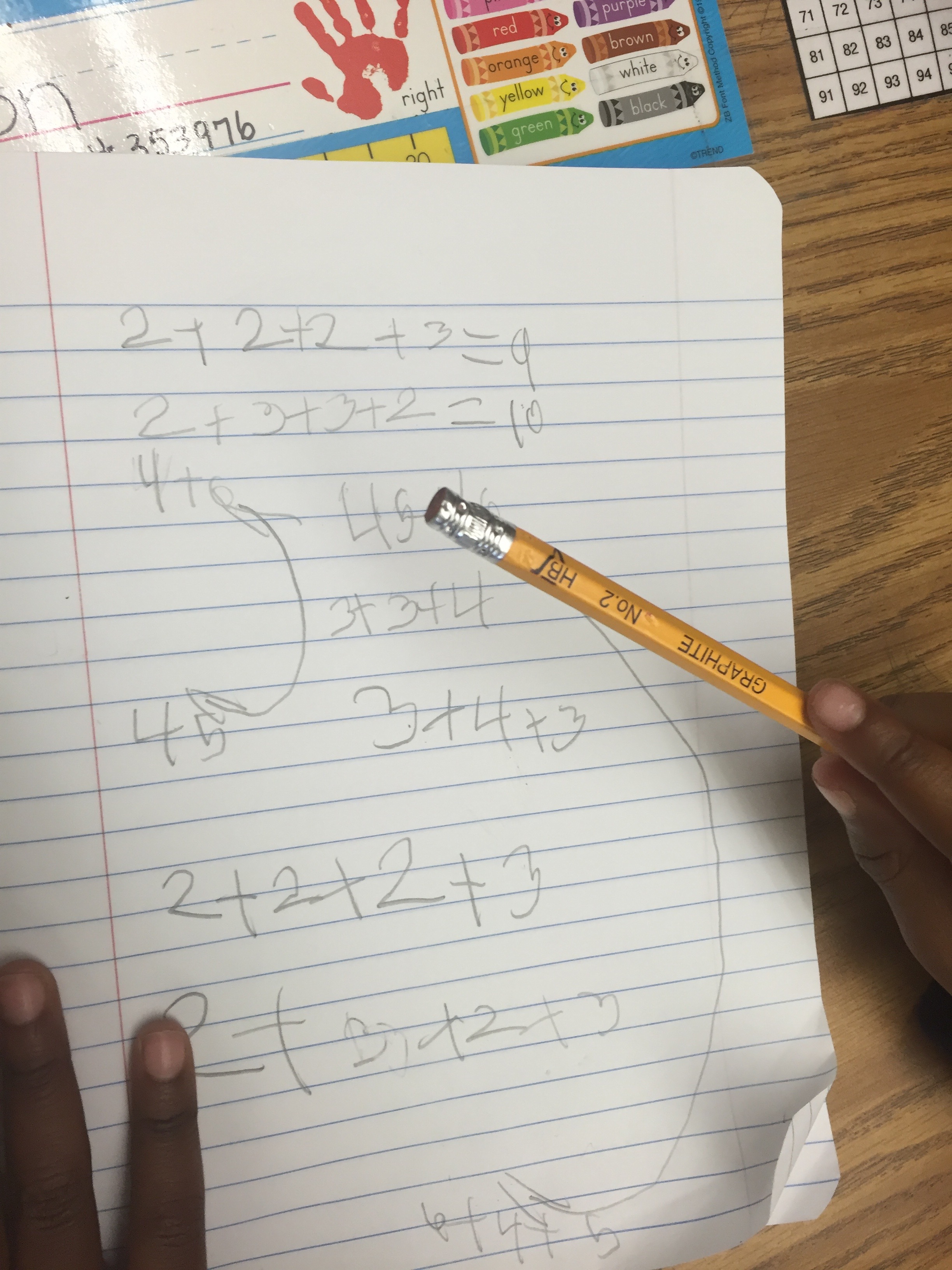
These partners seemed to think individually about their expressions on the left and right sides of the board. The student on the left appears to use facts they know such as 7+3 to arrive at 4+3+3 (since there were no 7 cards). I love the use of the equal sign between the two columns!

IMG_0919

The other two pairs appears to have done the same thing…

IMG_0917IMG_0913

The two groups below, I remember talking to because I was so interested in how closely their sides were related. After the student on the left had written their expression, the student on the right either combined or decomposed numbers to write an equivalent expression. I would love to talk to both groups about the sum for 12 because I am curious if they are decomposing and making a “new” number based on what they are “taking from” another number. 
IMG_0918

IMG_0916

After playing the game, we put the equations we saw for each of the sums on the board and asked students what they noticed. Some noticed relationships between the expressions for a given sum while others looked at expressions for various sums. For example, when looking at the expressions for 10 and 15, they noticed that each expression added 5. Then we discussed whether that 5 was always a 5 and students were really comfortable saying that it could be a 2 and 3 or a 4 and 1. They could have shared their noticings for quite a while so we asked them to go back to their journals and describe something they were noticings among any of the equations.

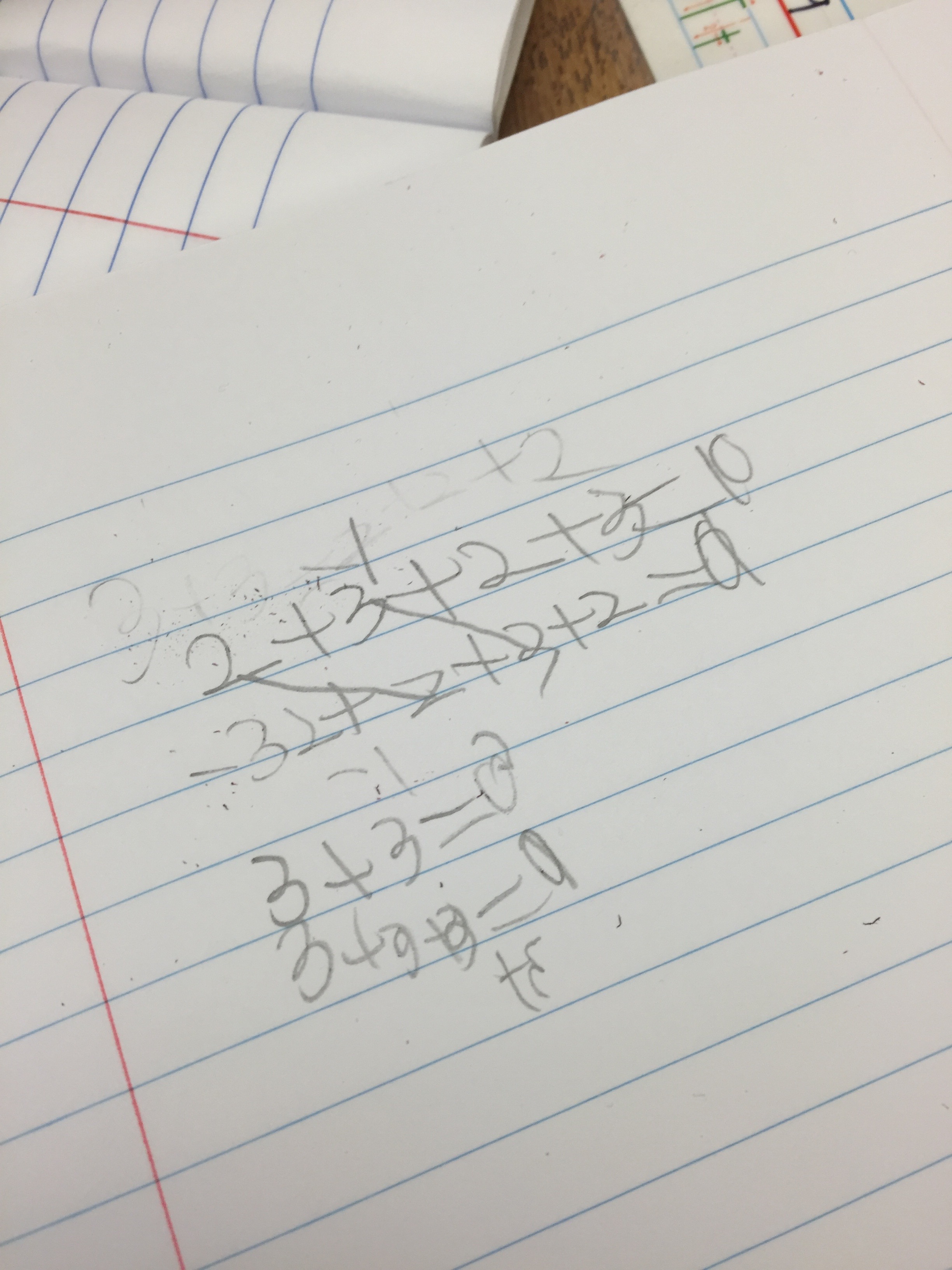
It was at this moment when I started to detach myself from the math for a quick second and began seeing how journaling really begins. I found I take it for granted that when I say write in your journal about something, that they understand how we explain our mathematical thinking. I know that writing at various grade levels differs based on so many things such as vocabulary, writing experience, and just how they write words in general. However, one thing I did not think so much about is how students view writing in math. I did not realize until I saw this student showing all of his compensation in numbers by connecting the numbers that were staying the same with lines and showing the number that was “one less” by writing -1 when going from an expression that totals 10 to a sum of 9. He explained it so beautifully but was having trouble communicating that on paper. When he finished talking a girl next to him, asked me, “Can we use words too?” <—- that is when I had an aha! Do students think about writing in math as only communicating numerically? Do we ever explicitly tell them it is ok to write about math in numbers, words, or we can use both numbers and words? I think I have always assumed they knew.

IMG_0926

Then I came back later and the very same girl had written all of this wonderful thinking…

IMG_0930

This student showed a wonderful connection to what was happening when he went from 6 to 9 and then from 10 to 15:

IMG_0929

After they had finished journaling, the students moved to recess, however this student sat for another 20 minutes explaining to me all of the wonderful thoughts he had in his journal. The arrows were movement of numbers that were changing however being able to clearly communicate that in his writing was not something he was able to capture clearly. THIS is the power of writing in math I think…learning to take all of the amazing thoughts and communicate it clearly because the more he talked it out to me, the more arrows he drew, the more he elaborated on his thoughts.

IMG_0922

IMG_0931

Moving forward from here there is so much to think about for me….in addition to moving students thinking about addition and relating that to subtraction, how do I begin to think more about journaling in math, how does it really start?

For Dot Addition game I am wondering if we could allow some students the option to use subtraction? Make the range of card choices larger to allow for students to play around with that relationship. It is something that I thought about as I looked at the table in the Learning Progressions..

Screen Shot 2015-11-11 at 9.52.37 AM

So much to think about each time I leave a classroom!

~Kristin

3rd Grade Dot Image

The third grade team is planning for a dot image number talk that focuses on this standard:

“Apply properties of operations as strategies to multiply and divide.2Examples: If 6 × 4 = 24 is known, then 4 × 6 = 24 is also known. (Commutative property of multiplication.) 3 × 5 × 2 can be found by 3 × 5 = 15, then 15 × 2 = 30, or by 5 × 2 = 10, then 3 × 10 = 30. (Associative property of multiplication.) Knowing that 8 × 5 = 40 and 8 × 2 = 16, one can find 8 × 7 as 8 × (5 + 2) = (8 × 5) + (8 × 2) = 40 + 16 = 56. (Distributive property.)”

Before this talk the students have been doing work with equal groups and are moving into array work with the arranging chairs activity in Investigations. They have also been doing dot images with smaller groups and have noticed the commutative property as arranging the same dots into different-sized groups.

These are the three images we are playing around with and anticipating which would would draw out the most interesting strategies based on the properties. We are thinking of having a journal entry afterwards to see if students make any connections between the strategies.

So if you feel like playing around with some dot images and doing some math, I would love anyone’s thoughts on which image you would choose and why!

Screen Shot 2015-11-04 at 6.23.29 PM

Screen Shot 2015-11-04 at 6.26.17 PM

Screen Shot 2015-11-04 at 6.27.29 PM

The start of my planning….

IMG_0970 IMG_0971

My new thoughts on these images and responses…

IMG_0978

After chatting with a few friends yesterday and thinking about which image would elicit the most expressions that could allow students to see some connections between the properties of operations, I am thinking about some changes to the images (in orange).

In image 1, I am wondering if we should split each group of 8 into fours but leave a bigger space between the top four groups and bottom four groups. It may allow students to better see the 4’s and then group them as 8’s and at the same time thinking about “doubling” the top group to get the total because of symmetry. They could then explore ideas like (4 x 4) + (4 x 4) = 4 x 4 x 2  or (4 x 2) x 4 = (4 x 4) x 2 [associative property] or 8 x 4 = (4×4) + (4 x 4) [distributive property] or any fun mix of them. If we leave it as it is, I think it may be hard to move them past 4 x 8, skip counting by 8’s or using 2’s.

In the second image, I love the structure of it but am wondering how students could use that 4 in the middle aside from just adding it on each time? Will we just end up with a lot of expressions with “+4” at the end? I am wondering what would happen if we adding an extra group of four next to it? Would students see the structure of a 5 and double it in some way? (5×4)x2 = 10 x 4 or 5x(2×4)=(5×4)x2 [associative] or 5 x 8 = 10 x 4 [doubling/halving] or 2×4 + 2×4 + 2×4 + 2×4 + 2×4 = 10 x 4

Then what question to pose at the end? Do we ask them to freely choose two expressions and explain how they are equal? or Do we choose the two we want them to compare? Do we have the dot image printed at the top of the page for them to use in their entry?

So much to think about..

~Kristin

Kindergarten Number Lines…The Lesson

Two days ago, I planned this kindergarten lesson with Nicole and we taught it today! It was so much fun and I just have to say, I have such an admiration for Kindergarten teachers..that hour was tiring!

The Number Talk was a sequence of two dot images, both showing 7. It always amazes me to see the students counting, explaining their counting and writing equations so beautifully this early. In both images we heard counting by ones, counting by “2’s and 1 more,” and saw students count by ones and twos in different orders, solidifying the concept that the order in which we count does not change the total dots in the image. There was such a wonderful culture in place where students were open to agree, disagree, share answers (right or wrong) and all of this was shown to be valued by Nicole.

Next, came our number line adventure. Nicole had strips of painters tape around the room and sent each group of 4 to their assigned tape. As Nicole handed every group the first card, we (Jenn Leach, another Kindergarten teacher, Nicole, and I) walked around to ask students why they placed the card where they did. In keeping with the plan, the number order and observations were like this:

  • 1 – Every group except one placed it on the far left. It was interesting to me that each group put the card under the blue tape, not on it.
  • 10 – This was a great one to watch. One group put it at the very end of the tape, others “counted out” from 1 to ten to approximate where it would go, and some just put it in the middle without much of an evident strategy. When we asked the groups that placed it in the middle, they said they needed to leave room for other numbers. I asked what numbers would go over there and they said, “big ones, like 100.”
  • 0 – They all shifted the 1 card to the right and replaced it with the 0. I saw one group have a group member place it at to the very left of the blue tape, just before the blue tape actually started and a group member said, “That would be a number if you put it there, but zero is a number” as he moved it under the very beginning of the tape. So cool.
  • 3 – This is where some serious shifting happened. I didn’t get to see all groups do their moving, but as I walked around, I did see the 3 very close to the 1 and all of the tens that were at the end of the line, moved down. It seems their spacing strategy had taken over.
  • 9 – All of them attached it to the left side of 10.

Before we gave them 5, where we really wanted to see how they dealt with the half, Jen, Nicole and I convened quickly to figure out how we were going to see that. We thought the ten at the end would be much easier to see their thinking about 1/2 so we decided to tell the students that 10 was going to be their biggest number to see if that changed their line. We got a couple, “Ohs” and slides of the 10 and 9 to the very right end.

  • 5 – Most went back to counting spots but I did catch a couple groups looking at spacing. One group was using the 1 card to decide on the spot for a 5 while another group said they knew 5 and 5 was ten but was having a hard time using that to place the card.

Because we were running long on this part, we gave them the rest of the cards to place, finalize and tape down. This is what a few of them looked like (the others were all like the third pic):

IMG_0572

The above group worked from the right.

IMG_0569

Loved the extra space before the 0 here!

IMG_0567

This was by far the most popular line!

Then we had students walk around to other lines and talk about similarities and differences to their line. It was great to see the group who started on the right notice that the other groups started on, “that end” while the spacing was a huge topic of conversation. One little girl, whose group had placed all of the cards touching, said she knew why they spaced them out….”They took a breath. Like one, take a breath, two, take a breath, three, take a breath…” I had never thought about how the visual could impact the way we think about timing in our counting! The closer they are the quicker we count, the more spread out, the slower we count. Loved it!

We regrouped on the carpet and talked briefly about what they noticed….

  • All of the groups went started at 0 and went to 10.
  • They all went in order, “Not, one and then four and then three and then two…”
  • Some were spread out far.
  • Some had the cards squished together.

All really important ideas! Next we went to our big clothesline to play around. Nicole placed the zero all the way to the left and I placed the ten all of the way to the right and said, for this part, we are going to say the zero and ten cannot move. Each pair of students (each from a different original group) got a card to talk about for a minute and then we called them up in the same order as the individual activity to place the cards. It started off all shoved to the left until one little girl went to place her number and started spacing them all out so it “looked better in her brain.” We asked the others what they thought about that. Some said, “it looks right” (says a lot about how equal intervals are visually appealing and seem instinctual for some) while others said they need to all be “at that end” (attached to the zero). We never reinforced one was better than the others but more that there are many ways we could think about this. I have video, but here is a pic of a piece of the final line…

Screen Shot 2015-10-29 at 7.55.32 PM

Then, because we are just so curious to hear about connections they make, Nicole asked if they saw anything the same about the ten frames they have been using in class and the number line. A few students said both had ten and one little girl said it was like 5 and 5. Then, it was pretty awesome…she went up to show it was 5 and 5 and started counting at the zero card, so zero was 1, the one card was 2 and so on so needless to say when she ended her second 5 she was at 9. She said, huh? Loved it! Another student raised her hand and said it was because she counted too many, she started at zero and there is no zero on a ten frame.

it was SOOO much fun and I feel so lucky to get to see and hear all of this amazing math conversations across these K-5 classrooms.

The harder part, or at least what I am grappling with right now, is where to go from here. When it is a lesson within Investigations, I find it quite easy to pick up and move on but since this one is something we did outside of the curriculum, it requires a different plan. I am not quite sure where to go with this, but I have a couple thoughts (and would love others)…

  • I wonder if students could think about when the number line would make sense to have all of the cards closer together. Like if a lesson was adding to 20 and 20 was on the end now, what would happen?
  • Could we think about measuring things that are really short versus things that are really long? That feels like choosing the appropriate unit of measure to me.
  • Could we just leave it up and see if students reference it? and maybe refine the distance between each number?
  • Could we find some children’s lit that are around measurement and reference the line?
  • Could we put some painters tape in the hallway and see how they interact with it? Could they think about walking every tile line versus the feel of two tiles each time?
  • Could they model addition on there? Like in connection to maybe their dot image number talks?

So much to think about and I don’t know if any of these ideas are right or wrong or even age appropriate, but I am loving learning this stuff!! I am just so thankful to have such unbelievable colleagues who love to play around with these ideas with me!

~Kristin
1st Grade Dot Addition

Tomorrow I get to teach with a 1st grade teacher, Lisa! I am super excited! To give a bit of background, the students up to this point have done a lot of dot image number talks. These talks have been a mix of just dots with no particular order and others with subitizable dots. The main focus has been becoming aware of how students are organizing and/or combining the dots. Are they counting all? Counting on? Using known facts? Or using any combination of the three strategies? In their Investigations work, they have been building on these talks using the 100’s chart and number lines to represent the addition and subtraction contexts.
Today in class the students will be learning how to play Dot Addition, so we will be building on that work tomorrow when I join them.

Screen Shot 2015-10-28 at 5.25.23 PM

We decided to build on this work and launch the lesson with a string of three dice images. Just to make it a bit interesting, we set the dice equal to each other and ask them how we could prove if it was true or false.

Image 1 – Hear if students recognize that order of the dice doesn’t matter in finding the sum

Screen Shot 2015-10-28 at 5.28.51 PM

Image 2 – See if students decompose to form equivalent expressions

Screen Shot 2015-10-28 at 5.28.58 PM

Image 3 – See how they talk about decomposition with three addends versus two. Can they be equal with more on one side?

Screen Shot 2015-10-28 at 5.29.09 PM

Next we will review the game and show the change in game boards. Instead of finding sums of 6, 8, 10, 12 to 6, 9, 10, 15. Now, here is where I am wondering about what the changes are in student thinking? There is SO much in here! Is it about combining strategies? Is it recording? Is it how they decompose? Is it compensation? Is it the relationships between the addends and sums that students need to start to look at? Holy cow, we had all of these conversations in our planning and we are still not sure we have it right, but here is our plan from here:

  • Observe them play on the new game board and take note of how students are find the sums.
  • Pull out strategic expressions that we want to highlight in the group share.
  • Ask students what they would do if they didn’t have a card they needed. For example, what would happen if there was no 5 and you needed it? What could you do? or Could you have made that expression with more than two cards? How do you know?

After they play, we have two options. If there are a variety of expressions, we will bring them to the carpet to look at a completed game board from my game with Ms. Williams that contains the expressions they have arrived at also. If there is not a variety, we will complete a blank sheet together, gathering all of the expressions they did have and then ask them to turn and talk to see if they could come up with different ways to write these equations with the cards.

If we use our completed sheet, it will look like this:

Screen Shot 2015-10-28 at 5.41.56 PM

We were going to ask them to take a few minutes to look at the expressions within each sum and then talk about what they notice. For example, within 6 do they notice that you can either “move a dot” or decompose and the sum stays the same?

If that goes smoothly and we make it this far without running out of time, we will ask them to do the same noticing between different sums. Do they notice that you add three to every expression in 6 to get to 9? Do they notice that somewhere in the 10 expressions there is an extra 1 from the expressions in 9? Do they notice the 5 when moving from a sum of 10 to a sum of 15?

So much to see! I cannot wait! Would love any thoughts and I will be posting the follow up soon!!

-Kristin