Category Archives: Uncategorized

Adding & Subtracting: Tools and Representations

There is always a lot of talk about students using an algorithm, process or set of rules, for addition and subtraction. Whether talking about “any algorithm” or “the algorithm,” I am certain, in most cases, people are talking about a process that is absent of tools such as a 100 charts, number lines or base ten blocks. But, what happens when we see the tool becoming an algorithm in and of itself? Can moving left or right on a number line, making jumps of 10s and 1s, writing problems vertically, or jumping rows and columns become an algorithm where students lose sight of the numbers themselves because the process is one more thing to learn?

This was the exact conversation I had yesterday with two 3rd grade teachers as I was leaving school. The students had been playing a game called Capture 5 and struggled making various jumps on the 100 chart. The teacher, understandably, was concerned students were confused about adding and subtracting tens and ones. After more conversation, we began to wonder if the students saw the 100 chart as a set of rules to follow in order to add and subtract instead of a place to look for patterns and structure as we add and subtract. Were they getting caught up in the left, right, up, down movement and losing sight of what was actually happening to the number?

As I thought more about it last night, I wondered about other tools and representations  students learn that could easily turn themselves into an unhelpful set of procedures. I also wondered how often we make connections between these tools and representations explicit. Like, when is one helpful over another? How are they the same? How are they different?

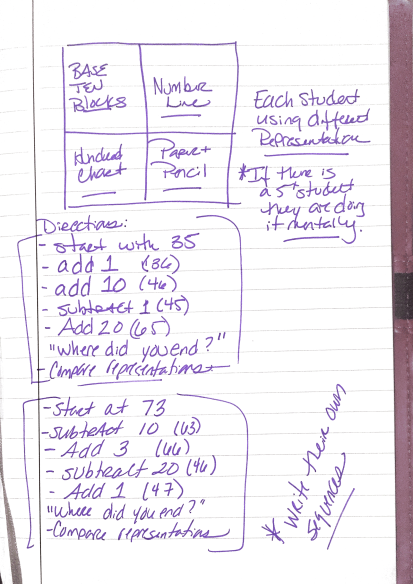
I emailed the teacher my notes (below) and we decided we would try this out this morning.

Scannable Document on Sep 27, 2016, 7_06_18 PM.png

If you can’t interpret from my notes, the plan was to have each student in a group using a different tool or representation as I called out a series of operations to carry out. After the series of addition and subtraction, they compared their answers and discussed any differences. They rotated seats after each series so they had a chance to try out each of the roles.

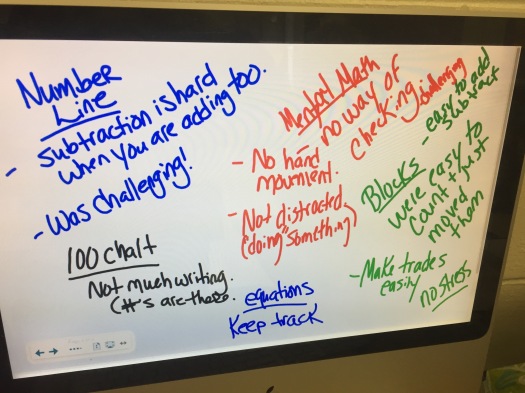
We came back together to discuss their favorite one. The recording is below…what do I have against writing horizontally, really?? I found this entire conversation SO incredibly interesting!

  • They found the base ten blocks to be “low stress” because they were easy to count, move and trade, but did agree that bigger numbers would be really hard with them because there would be too many.
  • They really did not like adding and subtracting on the number line with multiple jumps. It got messy.
  • They liked mental math because there was nothing (tool) to distract them and they could focus but they didn’t like that you couldn’t check your answer.
  • The 100 chart’s only perk was they didn’t have to write the numbers in, they were already there for them.
  • I really loved that they mentioned the equations were they only way they could track their work. So if someone in their group messed up, the equation person was the only one that could help them retrace their steps easily.
    img_3048


I am not sure what I learned today, I am still thinking a lot about this. I know that I loved having them compare the tools and representations and that the teacher felt much better about their ability to add 10s and 1s. I feel like there are so many other cools things to do here, but my brain is fried today so that will have to wait!:)


3rd Grade Dot Image

Since the 3rd grade classes are about to begin their multiplication unit, the teachers and I wanted to hear how they talk about equal groups to get a sense of where they are in their thinking. What better way to do that than a dot image? I chose the first image because of the 3’s and “look” of 5’s and the second image because of the 2’s,3’s, and 6’s, all of which students can count by easily.

Image 1 went relatively the same in both classrooms and much like I anticipated. There were two things that stood out to me as a bit different between the class responses:

  • There were more incorrect answers shared in the 1st class than the 2nd class.
  • In the second class, multiplication came out during the discussion. The “4 groups of 7 and 4 x7 = 28” in the 1st class came out after both images were finished and one student said she knew some multiplication already. She asked to go back to the first image and gave me that.
img_2983

1st Class

img_3005

2nd Class

After the first image, I anticipated Image 2 would go much the same, however it was quite different.

img_2984

1st Class

img_3004

2nd Class

After the 1st image, I was really surprised at the difference in responses and I have to say it even felt really different. My assumption at this point is that in the 2nd Class one of the early responses was multiplication.

I am left wondering:

  • Does that early multiplication response shut down other students who don’t know anything about multiplication yet? While I asked her to explain what she meant when she said 4 x 12, I wonder if that intimidated others?
  • How could I have handled that response differently so others felt OK using skip counting or addition to count the dots?
  • Can we anticipate that type of reaction from other students when someone starts the discussion with something that may be beyond where the majority of the class is in their thinking?
  • Was this even the issue at all? Did the 2nd class just see so many more dots and wanted to avoid adding and skip counting?

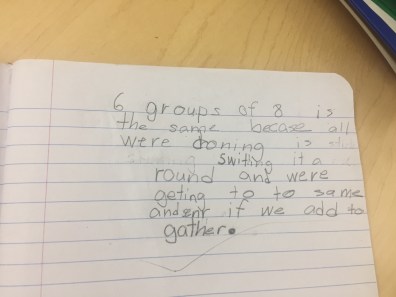
The 2nd Class ended with a journal entry after a student remarked, “If we know it is 8 groups of 6, then it is also 6 groups of 8.”

I asked if 8 groups of 6 is the same as 6 groups of 8 and the class was split on their response, so they set off to their journals.

The yes’s went with multiplication expressions representing the same product and commutative property:

img_3006img_3007

I loved this no because the picture changes:

img_3009

I am not sure about this argument but I would love to talk to the student a bit more about the bottom part!

img_3008

After that talk, I am excited to see what these guys do when they actually start their multiplication unit!

Which One Doesn’t Belong? Place Value

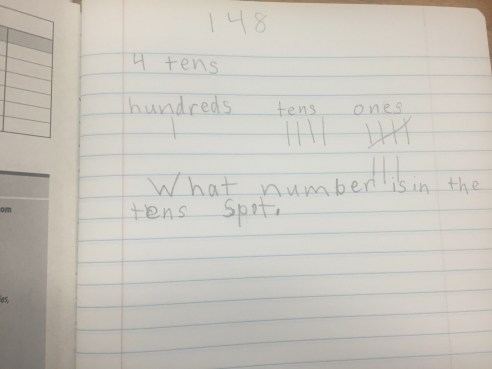
Since the 3rd grade team begins the year with an addition and subtraction unit in Investigations the teachers and I were having a conversation about how students understand place value. While I don’t see teachers using the HTO (hundreds/tens/ones) chart in their classrooms, students still seem to talk about numbers in that sense. For example, when given a 3-digit number such as 148, students are quick to say the number has 4 tens instead of thinking about the tens that are in the 100. I think a lot of this is because of how we as teachers say these things in our classrooms. I know I am guilty of quickly saying something like, “Oh, you looked at the 4 tens and subtracted…” when doing computation number talks, which could lead students to solely see the value of a number by what digit is sitting in a particular place.

We thought it would be interesting to get a vibe of how this new group of 2nd graders talked about numbers since their first unit deals with place in terms of stickers.  A sheet of stickers is 100, a strip of stickers is 10 and then there are the single stickers equal to 1.

I designed a Which One Doesn’t Belong? activity  with four numbers:  45, 148, 76, 40

I posted the numbers, asked students to share which number they thought didn’t belong, and asked them to work in groups to come up with a reason that each could not belong. Below is the final recording of their ideas:

img_2969

I loved the random equation for 148 that emerged and the unsureness of what numbers they would hit if they counted by 3’s or 4’s. One student was sure she would say 45 when she counted by 3’s and was sure she would not say 76 or 40, but unsure about the 148. I wrote those at the bottom for them to check out later.

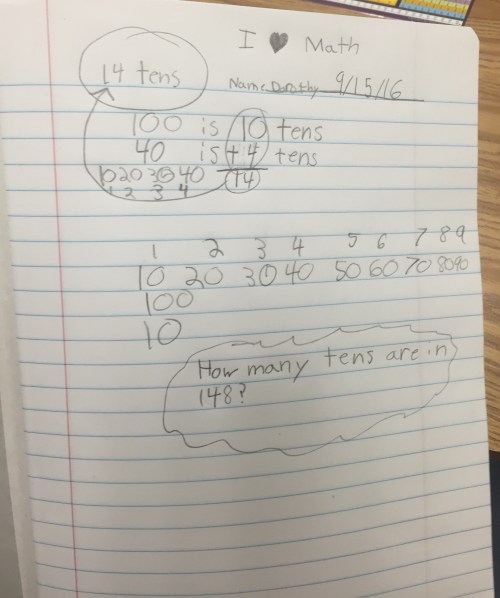
Since the teacher said she was good on time, I kept going. I pulled the 148 and asked how many tens were in that number. I was not surprised to see the majority say 4, but I did have 3 or 4 students say 14. As you can see below a student did mention the HTO chart, with tallies, interesting.

img_2970

As students shared, I thought about something Marilyn Burns tweeted a week or so ago…

Screen Shot 2016-09-16 at 10.37.25 AM.png

So, I asked the students to do their first math journal of the school year (YEAH!):

“For the students who answered 14, what question did you answer?

“For the students who answered 4, what question did you answer?

After the students shared, I revisited the Hundreds, Tens, Ones chart. I put a 14 in the tens column, 8 in the ones column, and asked if that was right. The light bulbs and confusion was great! It was as if I had broken all rules of the HTO chart! Then I put a 1 in the hundreds, 3 in the tens, and they worked out the 18. I look forward to seeing them play around with this some more and wonder if when they go to subtract something 148-92, they can think 14 tens -9 tens is 5 tens.

I had to run out because I was running out of time, but snagged three open journals as I left! (I especially love the “I Heart Math” on the second one!
FullSizeRender 52.jpg

fullsizerender-52

fullsizerender-53

Kicking off the 2016/2017 School Year!

Ah, I am so excited to dust off the blog and get started with the new school year! There are so many exciting changes in our structures for RTI that I just cannot wait to get going! After some really honest conversations at the end of last year on how we were grouping and pulling students for interventions with minimal to no impact, we decided to completely change the way we do RTI, starting with the name. From this point on, we call it WIN, What I Need, time…because, you know, we needed another acronym!;) However, changing the name means nothing without blowing up the structure itself and that is exactly what Erin, the reading specialist, and I intend to do. We spent A LOT of time this summer brainstorming what the new WIN time could look like and imagining how we can use our time with teachers during Learning Labs to support this work. There are so many details and logistics that would make this post way too long, so let’s just start with the first month.

Typically, during the first month, students would be given content screeners used to group them into tiers. These screeners set a terrible tone for how students view the learning they will be doing during the school year (as Tracy blogged about here). The content on the screeners was across so many areas and there were no conversations about the math that, instructionally you got little to no information about what the students actually knew. Not to mention, for the students who had previously been in a tier, they knew this screener would put them right back where they were last year. So, this year, we are starting with getting to know our students in a way that can truly guide our planning and instruction and set a tone of how learning will happen this year!

Since our new WIN time will involve a lot of small group work, Erin and I designed a “First Month of School Plan” for everyone to help guide our future planning conversations. This plan could definitely be adapted by the teachers, but we wanted to give examples, or plan for those that wanted it, of ways to get to know your students and provide opportunities to develop a community of learners.

Without all of the details, it basically looks like this:

Week of September 6th: Talking Points.

Week of September 12th: Ask students what they need as learners. Do Norm-setting.

Week of September 19th: Read Last Stop on Market Street and do activities.

Week of September 26th: Read What Do You Do With A Problem? and do activities.

(If you want more info, the break down of all of this is in our first Learning Letter of the school year.)

For our very first Learning Lab this year, we have asked teachers to come with a formative assessment of what students know about their upcoming content work in October. Using this information we are going to work together to dig into the content and design small groups to help support students where they are. This design could be an extension of the content or address misunderstandings, all with a focus on what the students KNOW, not solely what they don’t.

I am sure it will be a bumpy ride for teachers, Erin and I, but when something needs to change, a bumpy ride is better than the same old crappy way of doing things. I will keep you posted and look forward to sharing our work!

My One Hundred Hungry Ants Obsession

Lately, I have been obsessed with children’s literature across K-5. My most recent obsession is the book One Hundred Hungry Ants. I did this in Kindergarten and this in 4th grade and today I invaded a 3rd grade classroom with it!

I followed the same pattern I usually do, I read the story aloud and did a notice/wonder. These are all of the things they noticed:

IMG_2510 (1).jpg

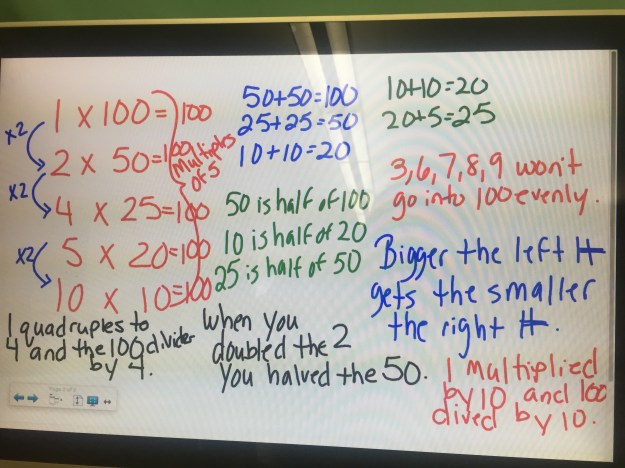
The last one led perfectly into asking about the ways the ants rearranged themselves. I wrote the combinations they recalled from the book and asked them to chat with a neighbor about patterns they see.

IMG_2509 (1).jpg

The discussion started with the 50+50=100, 25+25=25 and 10+10=20. Another student said they had the same things but it sounded different because she saw 50 was half of 100. They moved away from that and went to divisibility by the numbers that did not show up like 3,6,7,8, and 9 and pointed out that all of the second factors were multiples of 5. At this point they were focusing primarily on the second factor until someone pointed out the increasing and decreasing pattern happening. Then we got into the doubling and halving, quadrupling and dividing by 4 and multiplying and dividing by 10 of the factors.

I asked them if that would work with any number I gave them. They were quiet so I threw a number out there for them to think about, 24. They had to move into another activity so I left them with that thought. Before I left, however, one student said yes for 24 because 2×12, 4×6,8×3. Another student said it could be sixteen 1 1/2s and then thirty-two 3/4s! Wow!

Tomorrow they are going to investigate this further to see if they can come up with a conjecture about this work! So excited!

Literature & Algebraic Reasoning

I read the book One is a Snail, Ten is a Crab to two Kindergarten classes this week. If you have not read the book, Marilyn Burns does a great post about it here. After reading aloud, making predictions and doing a notice/wonder, I placed 10 tiles in the middle of our circle in an arrangement like this:

Screen Shot 2016-06-07 at 6.45.10 PM.png

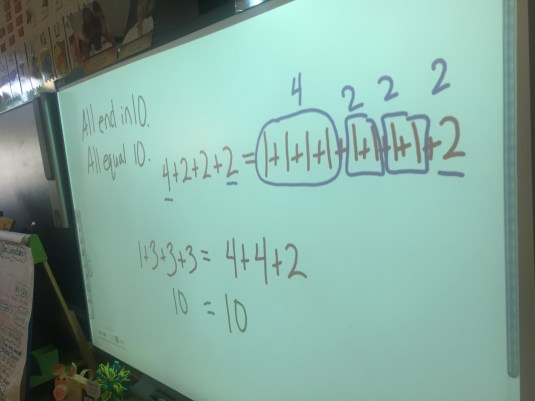
I asked the students who could be standing on the beach and they quickly guessed a dog, two people and two snails. I asked if they could give me an equation for the feet they see and they said 4 + 2 + 2 + 1 + 1 = 10. I asked if anyone had a different equation and they switched the order of the numbers, but agreed there was still 10. I did a few more arrangements before sending them back to their groups to investigate with the tiles. The directions were for one student to put out the arrangement, the groupmates guess who was standing on the beach, and write an equation for what they see. Their equations were all so different but the ways they were composing and decomposing the tiles to make new arrangements was really interesting!

We brought them back to the carpet and asked what they noticed about all of their equations. They said they all ended in 10 and equaled 10, so I asked if that meant we could write the equations so they were equal to each other? I asked two groups to share one of their equations and I put them equal to one another on the board. I asked if that was true? How could be we prove it? Their first answer was like, duh, they both equaled 10 so yes. I asked if they could combine or break apart any of the numbers like they did with their tiles to prove it. One student talked about combing the 1’s circled in the picture below.

IMG_2493.jpg

They had to leave for lunch so I left them with an equation to talk about when they got back!

This lesson was such an amazing way of allowing students the space to think about equality and the meaning of the equal sign. It took one student talking about the ways he combined the numbers to open up the conversation and possibilities for future equations. I would love to see what the students could do if I wrote one equation on the board and asked students to write all of the different ways they could fill in the other side of the equal sign.

Being THAT Teacher

Before reading on, please know the point of my post is not testing but instead the poor administrative decisions being made in its administration. In our school and district, testing is fairly uneventful. Since Smarter Balanced, our Department of Education has done a good job lessening assessment requirements across the state and I feel the environment around testing has gotten relatively better. We now have only one testing period, instead of three, during which students spend approximately a week (of just mornings) taking the tests, with their teacher, in their homeroom.

Unfortunately, a school in another district was given the autonomy to treat testing much differently.

Current Situation

This school year, one elementary school spent 1-2 weeks of precious instructional time to give every 8, 9, and 10 year old in the school a standardized interim assessment midyear. This assessment was not mandated by state. It was completely optional, however the administration at that school was given the autonomy to make the students take it. It was the only school in that district to give this assessment.

Based on that assessment each 8, 9 and 10 year old in that school was given a score of 1, 2, 3 or 4. Little did the students know, that score defined how they were grouped from that point forward. The scores were used to group or re-group students for building mandated test preparation for one to two months before they took the spring test. As if each student associating their academic ability with a number was not bad enough, when spring testing began, every other student in the class knew that score as well because they were pulled to test by that score.

This is where the standardized test becomes quite un-standard.

Students in that school were tested in groups based on those interim scores First the 4’s, then the 3’s, then the 2’s, and I am assuming the 1’s were left for last to allow for more test prep time.

Even more interesting is how the proctors rotated mid-test. Let’s say it was the 5th  grade “3’s” turn to test. Those students left their homeroom to go test with one of the other 5th grade teachers. The rest of the students in the proctoring teacher’s homeroom, who did not get a 3, were shuffled out into the other 5th grade teachers’ classrooms. Not to worry, that teacher doesn’t have to do that everyday because another teacher from the 5th grade administered the second or third part of the test to the 3’s, and also with the 4’s, 2’s and 1’s. So, technically speaking, a teacher could administer the test three times before they administered it to the 1’s? Interesting. [This changed immediately after I brought it to the district office’s attention. Funny the grouping couldn’t change immediately, but this could.]

As with any great testing situation, it also came with the go-get’m pep talks from the administration. Sending the over-achieving 4’s into panic attacks and the test-prepping 2’s seeing their work as drills before the “big game.”

I can only assume the administration believes there is no harm being done to children administering a test in this manner or why else would they do it, right? There is no way they can think this is bad for students’ mindset and image of themselves as learners or they wouldn’t keep doing it, right? And, worse, what if the superintendent found out, investigated, and did not see enough wrong with the situation to bother changing it immediately?

The most heartbreaking piece was hearing what students were saying and doing….

I am going with the other dumb kids that got a 2 to do test prep.

I am not a 3, so I am not testing today.

“I don’t need to have any more novels to read because we are test prepping in reading.”

“I didn’t test with my friend ___ because she is a 3 and I am 4.” 

“I got called in from recess after 5 minutes because I had to finish my test.” 

“Don’t opt me out because then I am bored.  At least the test is on the computer.

An 8 yr old gets sent to the nurse with what seems to be a panic attack after being given the 4’s pep talk before taking the test. Not to mention, she has a pre-existing heart condition after having heart surgery at 2 weeks old.  Upon picking her up from the nurse’s office, the parent was told by the nurse to take the child immediately to her pediatrician because she was stark white with an incredibly high heart rate. 

And these are only from three students, can you imagine if you collected them all?

After hearing this, I was thinking to myself, there is no way the superintendent would ignore my concerns of such blatant disregard for students’ well-being and emotional safety in a school when brought it to his attention.

Evidently, he can ignore these concerns, for weeks. After three weeks, he responded with a message that basically said, “We have looked into your concerns and your opinion has been considered. I will not meet with you because you do not have children in the school.”

Wait…I cannot be an advocate for children if they are not mine? Isn’t that all part of being an educator? Standing up for what is best for them? Any and All of them?  Maybe that is the problem here. They are not the administrations’ children, so why care what is happening to them? I have been teaching for 20 years, not one student has been my child, but I cared about them as if they were.

After three weeks of ignoring my requests, a family member who has children in that district requested a meeting for us. She had previously met with the building administration about this same testing situation so she was invested in this situation. Upon her request, we finally got a meeting date with the superintendent.

Before the meeting, I was still hopeful for change. That was, until we arrived for our scheduled meeting and was told by the curriculum director that the superintendent was meeting with someone else at the moment but we could go “get him if we have any questions.” Really? We waited 3-4 weeks for a meeting and he isn’t there when we explicitly requested he be there? We said we would wait and after the 10-15 minute power trip wait, he finally showed.

The parent started with the firsthand student accounts described above, accompanied by quotes from her children in regards to the teacher testing “pep talks.” It was gut-wrenching as she held back the tears that come when talking about your children. It was so disheartening and equally as infuriating to see the smirk and hear the chuckle that came from the superintendent as if to convey the “Oh, the silly things kids say” message as the parent spoke. I felt me heart actually beating out of my chest at that moment.

How could he not be infuriated by this happening in one of the elementary schools in his district? How did he not feel responsible? How could he give autonomy to a building principal who is so obviously not doing what is best for students?

After establishing the principal had not communicated any of these testing procedures to parents and told blatant untruths about other related items, the meeting continued to be about all of the great things the principal says he is doing to ensure the students do their best on the test, you know, for the student’s sake. Are we really trying to convince ourselves that the test score is not more about the school looking good than the child’s testing pride?

Then the blame game began. I was also told that the teachers in that school requested to give the interim assessment so the principal agreed. So, what, not his fault? Am I to believe he accommodates all of his teachers’ requests as willingly?

After hearing that the building administration “didn’t mean to make the students feel bad,” I couldn’t listen to one more thing. There is too much information out there to use that excuse…you didn’t mean to? Are you kidding me?

It unfortunately ended with the superintendent not being about to assure us this would not happen again next year. He said “we could expect change” but could give no specifics. That is not good enough for me since also finding out that this same issue was brought to his attention last year with no changes.

Fortunately, there are so many wonderfully caring people surrounding this principal and superintendent that I have talked to, that I DO believe these testing/grouping situations will not happen again next year.

The saddest part for me was the dismissive, “my school/district, my way” nature of this principal and superintendent. I am embarrassed for them as educators in this situation. 

As teachers, we want to empower our students. We want them to have a voice, share their thoughts and opinions, feel as if they can take control of their given circumstances and make change. However, as adults the harsh reality of what is really like to make change in education leaves us, at times, feeling powerless, like our hands are tied. Oftentimes it is because we don’t want to be THAT parent or THAT teacher, afraid of the repercussions for our children or ourselves in the workplace.

Sadly, I find myself in that place. Knowing this is wrong for students, wanting to make a change, fighting to do so, yet feeling like I am the one in the wrong because I am calling out bad practice.

This entire situation reminds me of a quote from a post by this author to school superintendents about data walls in schools, “This madness in our education has to stop. All of you run schools or districts and you have the power to put an end to this absolute insanity happening in our schools.”

It truly is insanity and this superintendent had the opportunity to make it right and he didn’t. Sad.

I truly always believed if people in education could not answer, “Why are we doing this?” with “Because its what is best for children.” then it would indicate a needed change.

100 Hungry Ants: Math and Literature

This week the Kindergarten and 1st grade teachers planned with Erin, the reading specialist, and I for an activity around a children’s book. This planning was a continuation of our previous meeting about mathematizing. We jumped right into our planning by sharing books everyone brought, discussing the mathematical and language arts ideas that could arise in each. I made a list of the books the teachers shared here.

We chose  the book One Hundred Hungry Ants and planned the activity for a Kindergarten class. We decided the teacher would read the story and do a notice/wonder the day before the activity. We thought doing two consecutive readings may cause some students to lose focus and we would lose their attention. Based on Allison Hintz’s advice, we wanted the students to listen and enjoy the story for the first read-through. Here is an example from one classroom:

Screen Shot 2016-05-05 at 9.28.27 PM.png

So many great problem and solutions, cause and effects, illustration and mathematical ideas were noticed by the students.

The following day, the teacher revisited the things students noticed and focused the students’ attention on all of the noticings about the ants. She told the students she was going to read the story one more time but this time she wanted them to focus on what was happening with the ants throughout the story. We had decided to give each student a clipboard and blank sheet of paper to record their thoughts.

We noticed a few great things during this time..

  • Some students like to write a lot!
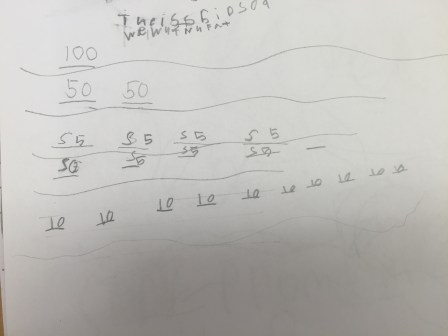
  • After trying to draw the first 100 ants, students came up with other clear ways to show their thinking. I love the relative size of each of the lines in these!
  • A lot of students had unique ways of recording with numbers. Here is one that especially jumped out at me because of the blanks:

IMG_2336 (1).jpg

Students shared their recordings at the end of the reading and it was great to hear so many students say they started the story by trying to draw all of the ants, but changed to something faster because 10o was a lot!

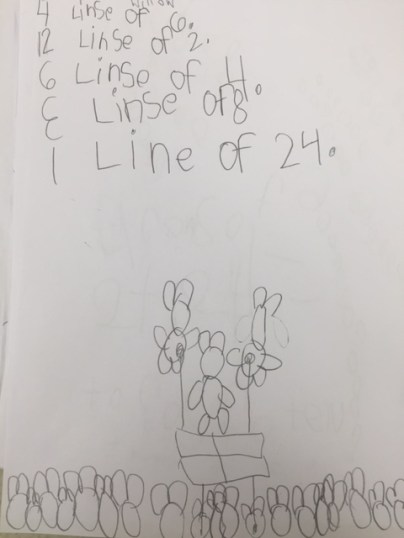
After sharing, we asked students, “What could have happened if they had 12 or 24 ants?” We put out manipulatives and let them go! So much great stuff!

IMG_2321.jpg IMG_2323.jpg

IMG_2296 (1).jpg–> IMG_2398.JPG

IMG_2396.JPG

IMG_2397.jpg

Next time I do this activity, I would like to see them choose their own number of ants.

Just as I was telling Erin that I could see this book being used in upper elementary grades when looking at generalizations about multiplication, I found some great posts by Marilyn Burns on this book for upper elementary and middle school:

Excited to do this in a 1st grade classroom today!

Measuring Tools in 2nd Grade

Last week, the 2nd grade team and I planned for a measurement lesson. Their measurement unit falls at the end of the year, so this was actually the first lesson of their unit.

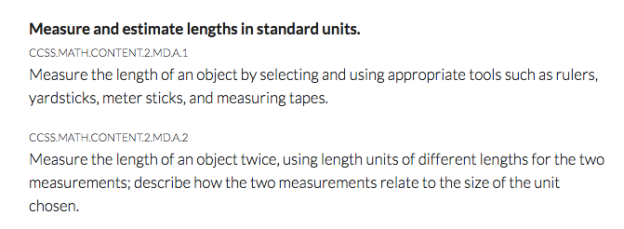
We focused on work on the first of these two standards, anticipating the other would be a natural part of the work as well:

Screen Shot 2016-05-03 at 10.37.50 AM.png

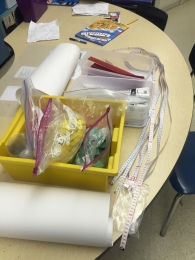
We put out the following measuring tools: square tiles, inch bricks (unlabeled ruler from Investigations), a ruler with inches and cm, and a tape measure in cm.

IMG_2305

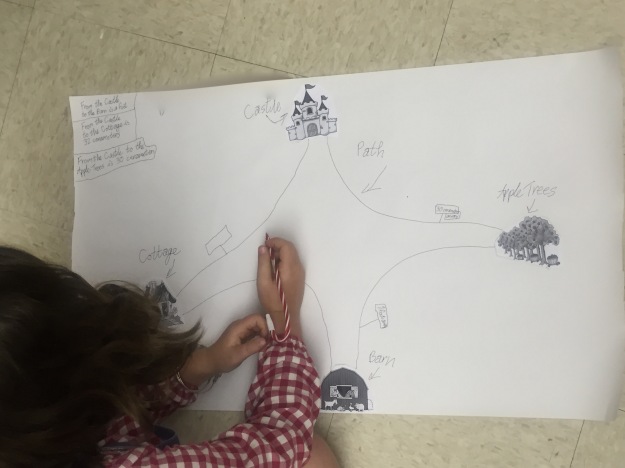
The teacher launched the lesson by introducing the “Land of Inch,” a context that Investigations uses in the measurement unit. The introduction involved showing a picture of the 4 places in the Land of Inch: the castle, a cottage, apple orchard, and stable. The students discussed why they thought each one was in the Land of Inch.

Screen Shot 2016-05-03 at 11.22.16 AM.png

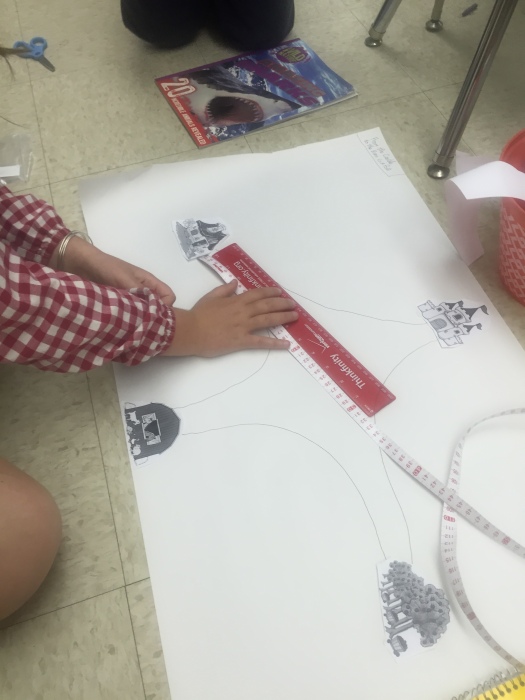
On a piece of paper, partners were asked to put the places of the Land where they thought they belonged and measure the distance from the castle to each, choosing whichever tool they thought was appropriate. The only stipulations were that there must be a path from the castle to each and each must be a different distance from the castle.

There were some really cool things that came up as we watched them working:

  • Every group took only the straightedge ruler and tape measure.
  • All of the straight lines were measured with the straightedge.
  • They all noticed the unit difference. We did not state what the unit of each tool was beforehand to see if they noticed.
  • They labeled 12 inches as 1 foot.
  • Students measured the curved paths using both the straightedge and tape measure.
  • Some students wanted to change centimeters to inches because it was the Land of Inch so they lined up the tape measure with the straightedge.

IMG_2307

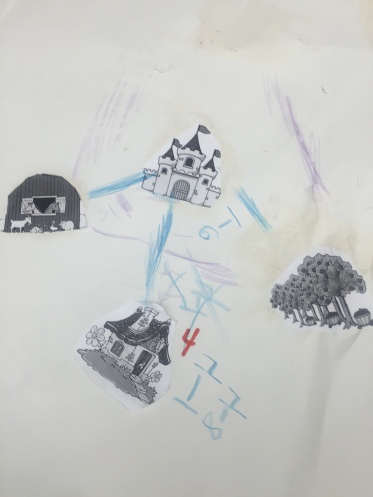
  • One group recorded their measurements in ranges. They had no interest in starting at the end of the ruler. They just put the ruler down and wrote the two measurements it fell between.

IMG_2314

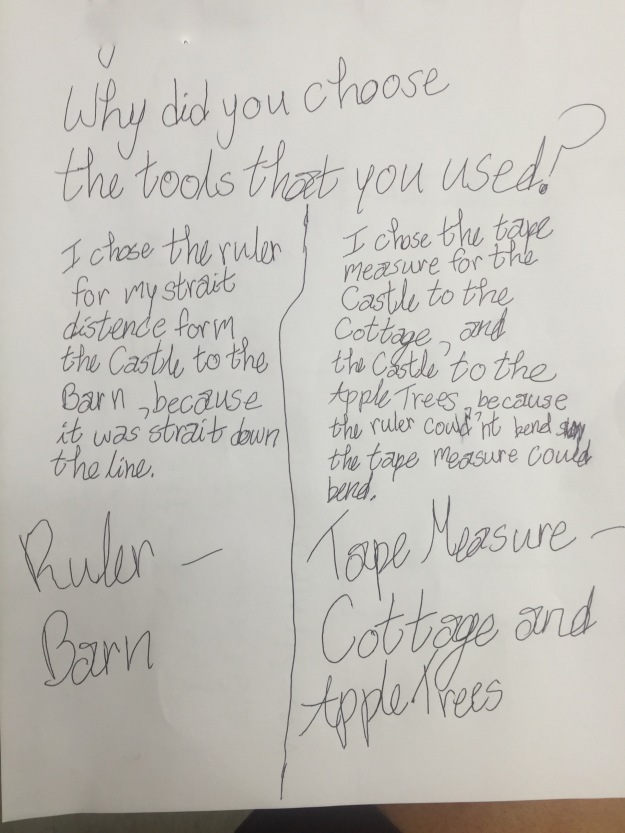
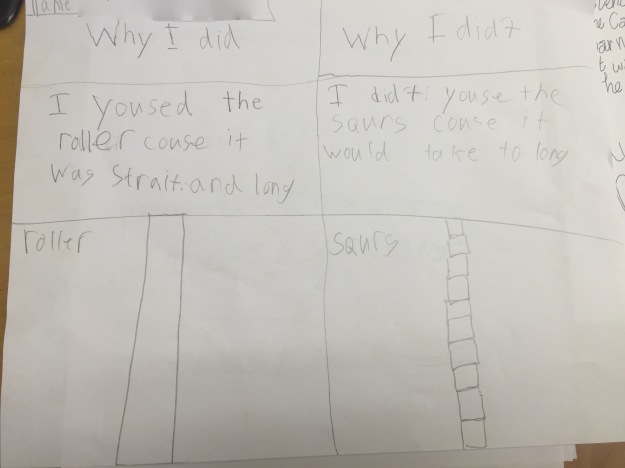
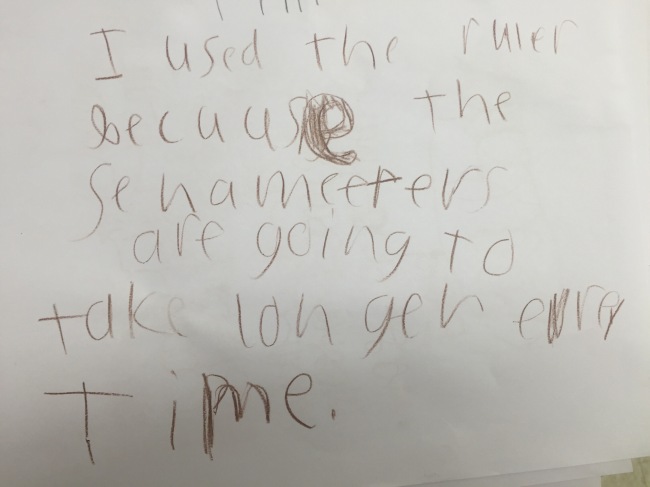
We wrapped up the lesson asking students to talk about why they chose their measuring tools. We had planned for them to share these ideas before they did a different journal prompt we designed last week. However, as they were sharing, there were one or two students doing a lot of talking (great stuff, but a lot) so we decided to have them reflect on their own before having this conversation.

IMG_2312.jpg


This student did a great job of explaining when they used one tool over another:

FullSizeRender 48

This student discussed why they chose to use the ruler but not the square inch tiles at all because it would take too long. So while both tools were the same unit, one tool has connected units versus individual units that need to be put together.

FullSizeRender 47

This group noticed that the centimeters (on the tape measure) would take them longer than the straightedge because there were more centimeters than there would be inches.

FullSizeRender 49

There were a couple instructional prompts we are revising for the next time this lesson gets taught by one of the other 2nd grade teachers that were there:

  • We didn’t let them know the paths didn’t have to be straight until after we saw them get started that way. Need to launch with that.
  • We didn’t have out meter or yard sticks, oops, need those next time. Talked about it during our planning, but we completely forgot.
  • We didn’t do a poster share which I think we want to incorporate next time because they all wanted to share. So maybe just two groups explaining their choices.
  • Wondering about the writing connection as they all had interesting reasoning behind where their places were located. Could they write a description about the placement and reasoning for their poster and then have other partners try to match them up?

Next up, reading Inch by Inch and the lesson inspired by the TCM article Inch by Inch in the most recent publication.


RTI for Adults

I want to preface this post with a few things I believe to be true about RTI (Response to Intervention):

  • Some students need small group instructional time for intervention.
  • Some students enjoy their RTI classes because they like their RTI teacher and feel successful on the work they do during that time.
  • The RTI structure was originally designed for Kindergarten and 1st Grade students.

Understanding these things, sadly this is what I also believe to be true about RTI:

  • Pulling students out of class for Tier 2 and 3 instruction negatively impacts how they view themselves as learners.
  • The current system negatively impacts the way we talk about students, pushing educators to refer to students as a number.
  • After 2nd grade, the majority of students become “stuck” in a tier forever.

Questions I continuously ask myself about RTI are:

  • Why RTI?
  • If we focused our attention on differentiation during core instruction (Tier 1) would this be as necessary?
  • Does the current RTI structure lay blame on the student’s ability to learn as if their learning was not impacted by prior learning experiences?
  • Can we pretend that students aren’t impacted by pulling them out of their regular classroom for intervention classes?
  • How does a student who is labeled as “working on grade level” and not being pulled for “enrichment”during RTI time feel? Do they feel as if they aren’t capable of that work? How does that impact their future educational decisions?
  • How do we fix this?

And the questions that intrigue me most right now:

What if we treated teachers like we treat students?  

Would thinking in those terms give us a clearer lens in which to look at RTI?

I love that our school is currently looking at ways in which to improve this structure. I truly believe that every single teacher has the best interest of students at heart when designing this intervention structure however, I don’t know if we consider all of its implications in terms of a student’s confidence and perception of themselves as learners. I think we all want them to be successful but at what expense?

My colleague, Brandi, and I had a long conversation around all of these questions and ultimately ended thinking about the question, “What would happen if we treated adults in this way? Should we expect children’s view of themselves as learners differ from a teacher’s view of themselves at teachers?”

Our conversation inspired her to write a mock lesson plan for how a principal could run a faculty meeting that would offer teachers insight as to what being pulled for RTI would feel like. I loved it so much, I had to ask her to share. While this is a lesson plan for teachers, I believe all people involved in education policy and decision-making such as principals, district office personnel, board members, state and national legislators would benefit from this activity.

Lesson Plan for the Principal: Treating Teachers as Students

Start the staff meeting announcing that he or she has decided to make the meetings more productive by splitting the staff into three groups.

  • Exemplary teachers: the teachers who are at the top of their game and need to be challenged
  • Average teachers: the teachers who are doing a good job but who still have room for improvement
  • Teachers in need of extra support: the teachers who need more support than others.

It is important to remember to be positive when telling the extra support teachers which group they are in, because if this is done positively and said nicely, they will understand that there are always people who do well and always people who struggle and the strugglers should be willing to accept help.

Announce who falls in each group in front of the entire staff. The extra support teachers (~15%) report to the principal’s office for intensive instructional strategies for behavior management and/or content professional development to improve their classroom instruction. The average teachers (~75) will remain in the cafeteria with either the reading or math specialist for an extension of the work they are currently doing in class, nothing too exciting, but is on their current working level of teaching. The exemplary teachers report to the assistant principal’s office for new, exciting technology initiatives or content extensions that are above and beyond what they are currently doing in class. 

Wait. (Prediction: people should be murmuring and making little grimacing faces).

Ask if anyone has any thoughts on this process. Hopefully everyone will have figured out by now this isn’t really happening — BUT that it is exactly what we do to kids each day.

That KNOT in your stomach as you worried you would be pulled into the “needs help” room – the fear that your name would be called and you would have to get up and leave.

The ANXIETY over which of the three groups you fell into. The greater ANXIETY over knowing where everyone else fell.

The ANGER over the potential to be Average when you had a really great lesson last week and nobody saw it!

The ANNOYANCE that someone has judged you and you don’t know what they based their information on.

Discussion. Before even knowing which group they had been placed in, I imagine most teachers would have gone through this range of emotions. Most teachers would prefer not to have anyone know if they were being placed in the extra support group, just as they would not want anyone to know if they were on an Improvement Plan or Expectations. But are we taking equal care of 6,7, 8, 9 and 10 year olds feelings the same way?

Ask anyone if they would feel PROUD to be pulled into the extra support room – whether they can admit to needing it or not. Ask them how frustrating it would be to work hard and collaborate in that room, put together an exemplary lesson, and then pull it off in class only to be pulled back into the principal’s office at the next staff meeting with nobody having seen it or realizing you had improved.

End lesson plan.

I wonder if people would take a different stance on RTI (or tracking in general) after engaging in this activity? Like I stated previously, I know some students need extra support, but I just wonder if we can find a way for that support to happen in the classroom with the student?

Could working with teachers on ways to support students who may struggle while at the same time challenging those who are finished quickly be more effective and less damaging to students?

Could this work with teachers lessen the number of students who need extra support year after year and truly help us identify those with learning disabilities so we can appropriately address those needs?

I never like complaining about a problem if I haven’t thought about a solution and although I do not have a complete answer here, I do believe we can do better. I believe we can take responsibility as teachers to try and best meet all students where they are, as impossible as that may seem. Through collaborative content professional development and managing small group work in the classroom we can improve the current structure.

I know we are all trying to do our best by the students, but I think we can take better care of our students’ views of themselves as learners and would love to hear ways in which others are doing just this.