Category Archives: Math

Talking Points – Decimals

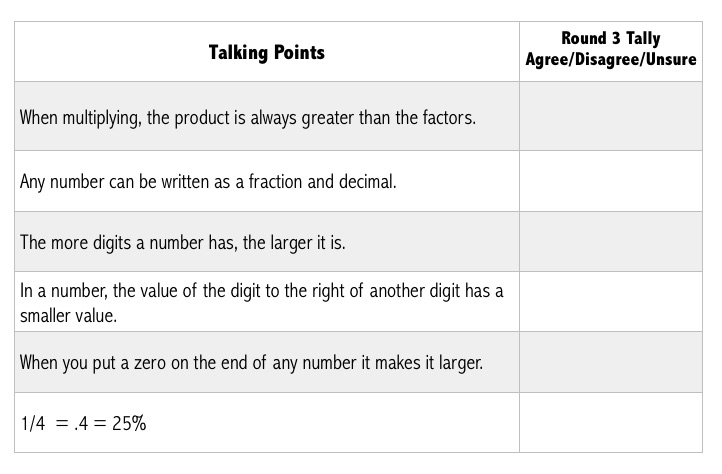
This week, we are beginning our decimal unit. I decided to start with Talking Points today to hear how the students are thinking about decimals before we dig in. In developing the Talking Points, I asked the #mtbos for some ideas on decimal misconceptions/misunderstandings they see students have each year. Thanks to @MikeFlynn55, @AM_MathCoach, and @MsJWiright2 for  your thoughts! Of course as the students were talking today, I wanted to tweak my wording of the statements!  Here are the points I used, my intended purpose of the statement, what I noticed and possible rewording for future use…

tp1TP1 – My goal in this statement was to hear if students were thinking about multiplying by a number (fraction or decimal) less than one. The first thing I realized is that I have a class obsessed with negative numbers! Then the next thing that other groups talked about a lot was multiplying by zero or 1. I did have some students think about fractions, like in the example below. In future wording, I would probably adjust it to, ” When multiplying by a number other than 0 or 1, the product is greater than the factors.”

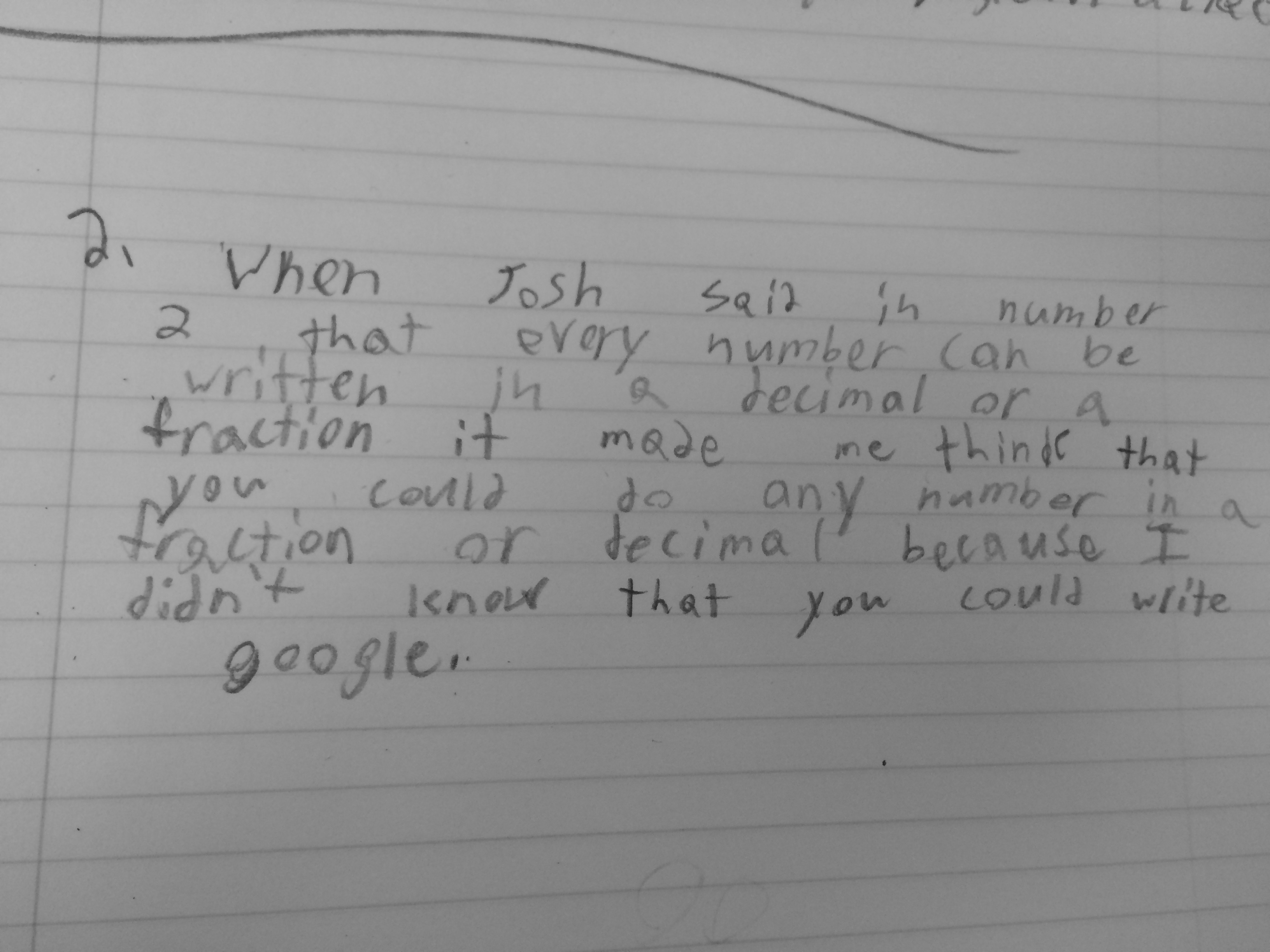
IMG_8968_2TP2: My goal with this statement was to hear if students thought about taking any number and make equivalents. My initial thought was just fraction/decimal equivalents like .3 = 3/10, but I did run into some great conversations about 3=6/2=3.0. The problem was that some were agreeing because they were just taking any number and writing it a fraction, not equivalent, just plopping it into a random fraction, like 7 can be 1/7 can be .7 can by 7/8, as long as there was a 7!  Possible rewording would be “All numbers can be written as equivalent fraction and decimals.”

IMG_8976_2TP3: This one was to elicit conversation about a comparison problem in which I see students often having a misconception. In comparing, students will think that 0.35 is less than 0.1245 because it has more digits. This one blew up in my face, of course:) The negative numbers arose again, which was interesting however, the some very clever students wrote 00000001 and said it is smaller than 12, but it has more digits. They were right, my statement was bad. Possible rewording, “The more digits a number has after the decimal point, the larger the number is.”

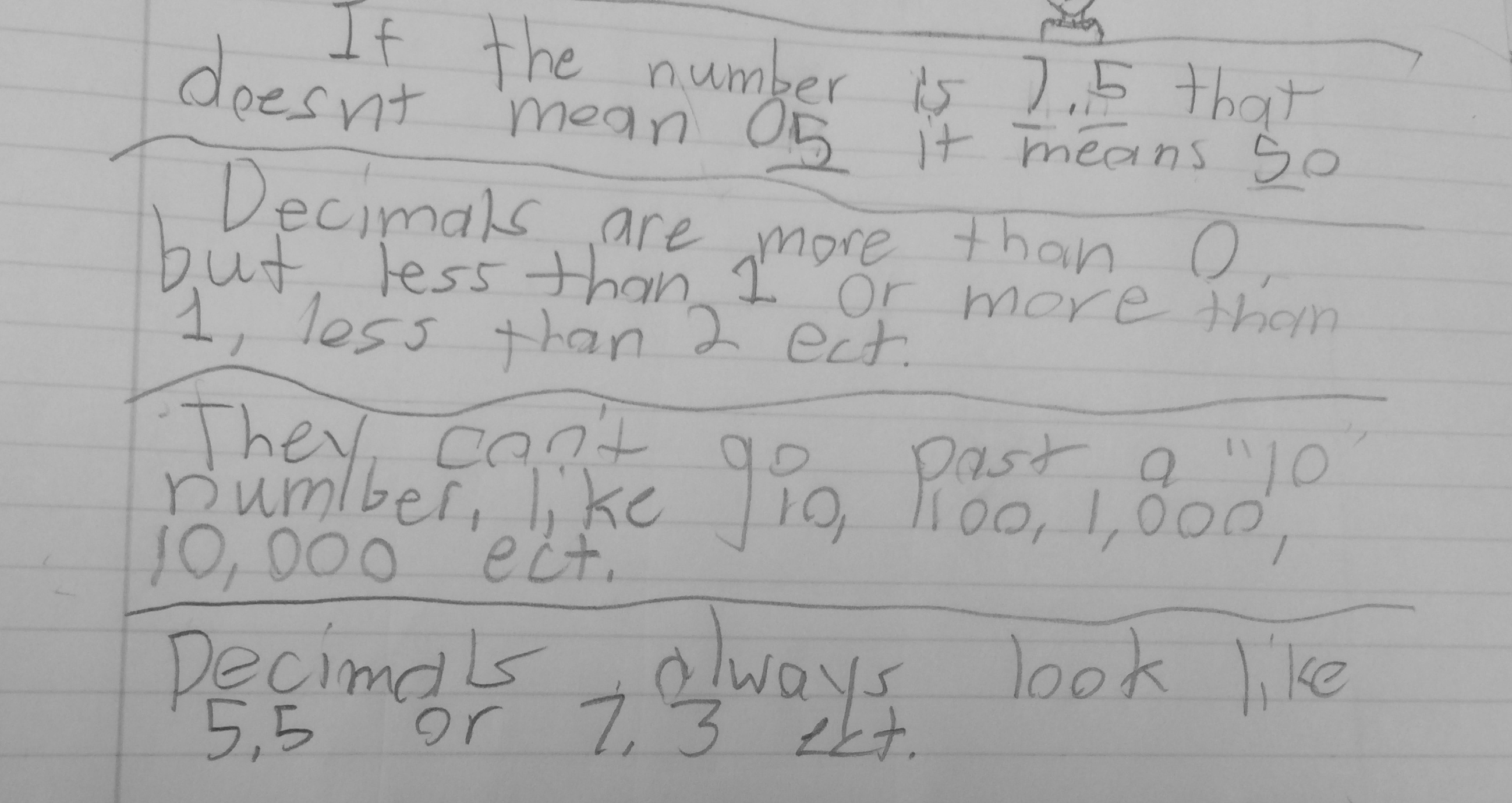
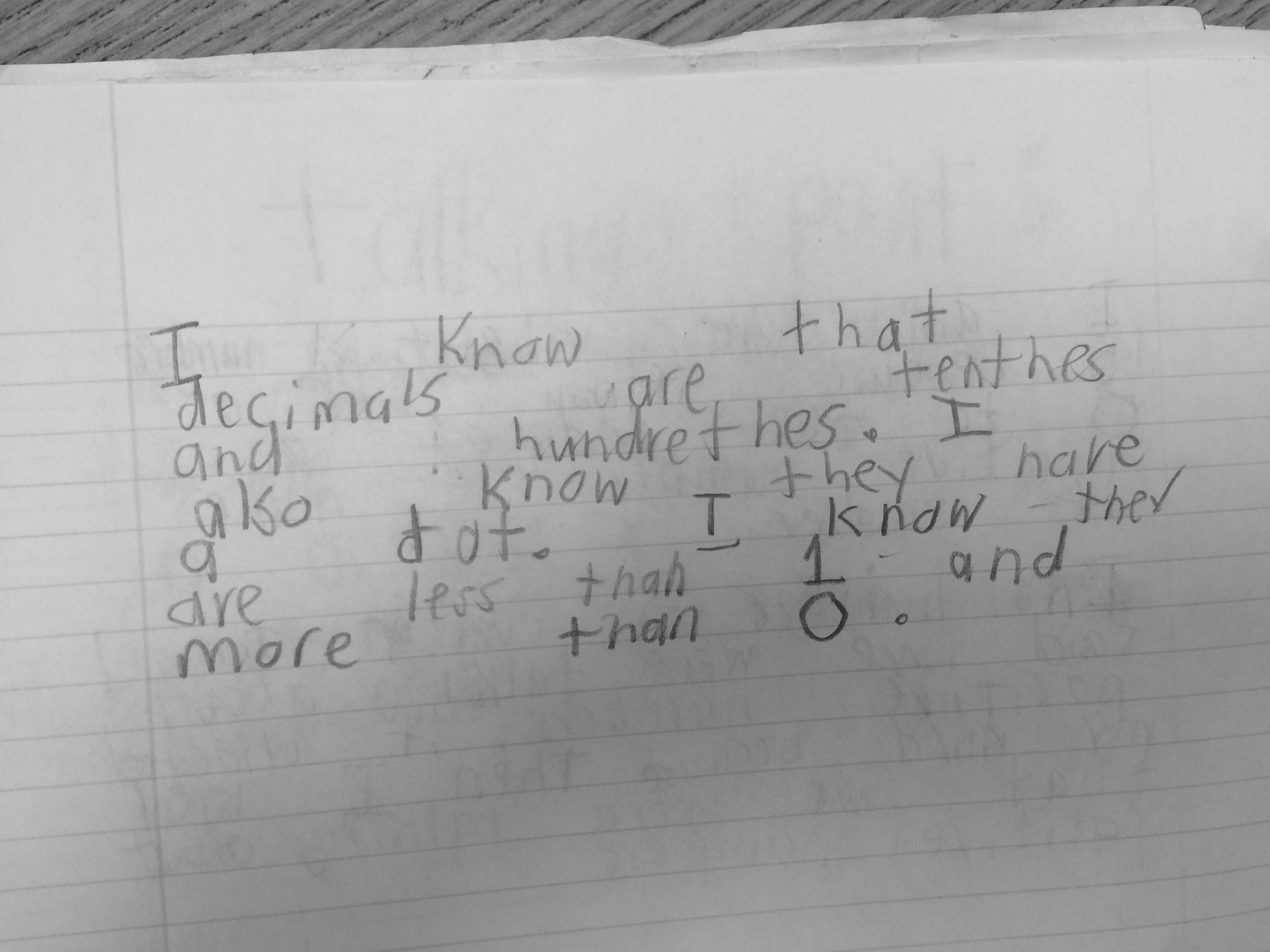
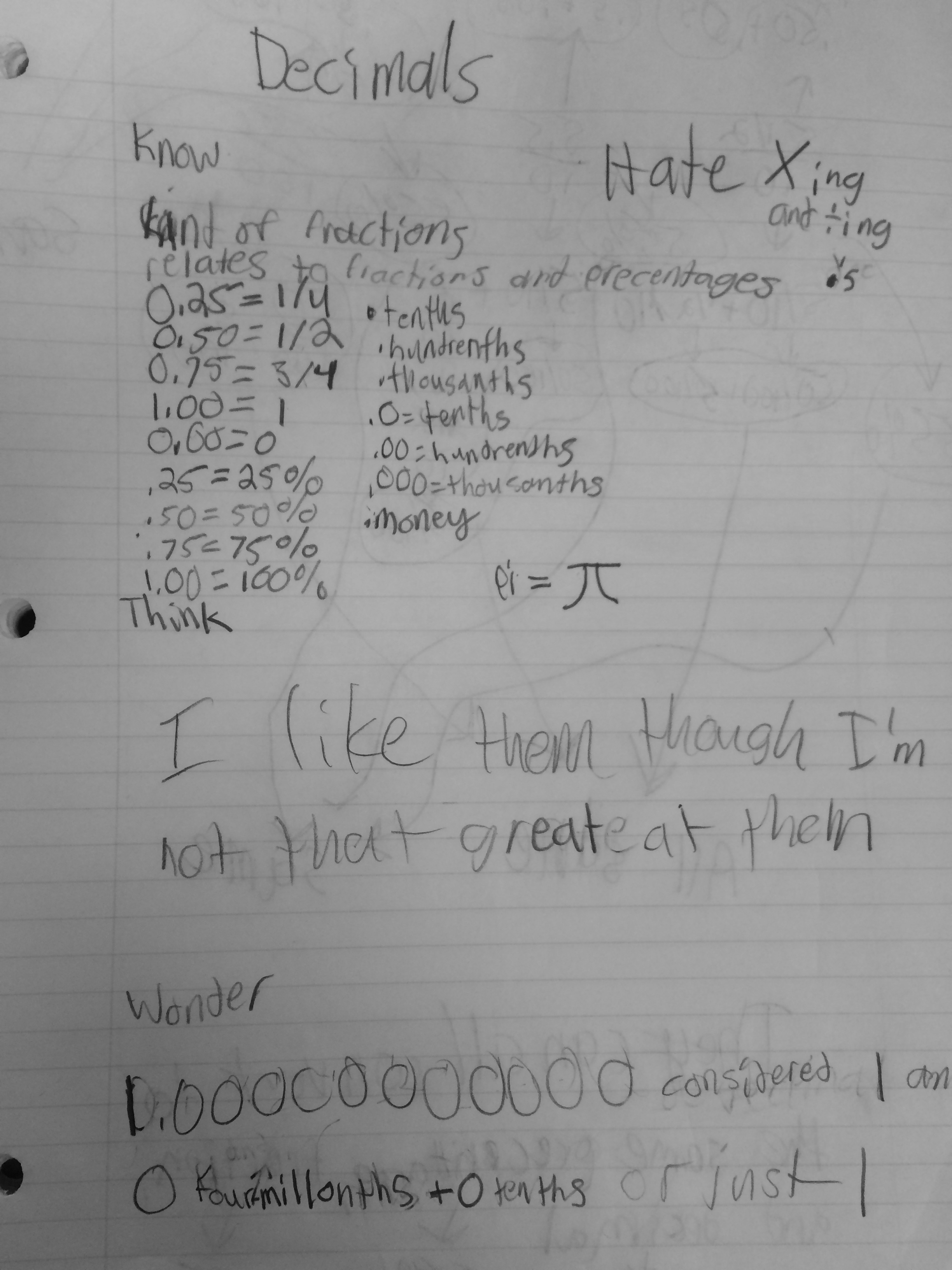
TP4: This one was really to plant a seed for the unit. I wanted students thinking about the place of the digit and its relationship to the digits surrounding it. So often when we decompose numbers, we deal with place values independently but I want to really focus on how the value changes as we move within the number. This one elicited great points made by the students and I plan on revisiting this one often throughout the course of our work together. This is one student’s reflection afterwards about this point:

IMG_8973_2TP5: My goal was to see if students thought about equivalency between decimals such as .3 and .30. The talk at each table was interesting and it was definitely one that was a split decision at many tables. I would leave this prompt the same based on the student responses, it was a nice mix and the mention of decimals came out vaguely. Student reflection on how another student changed his thinking:

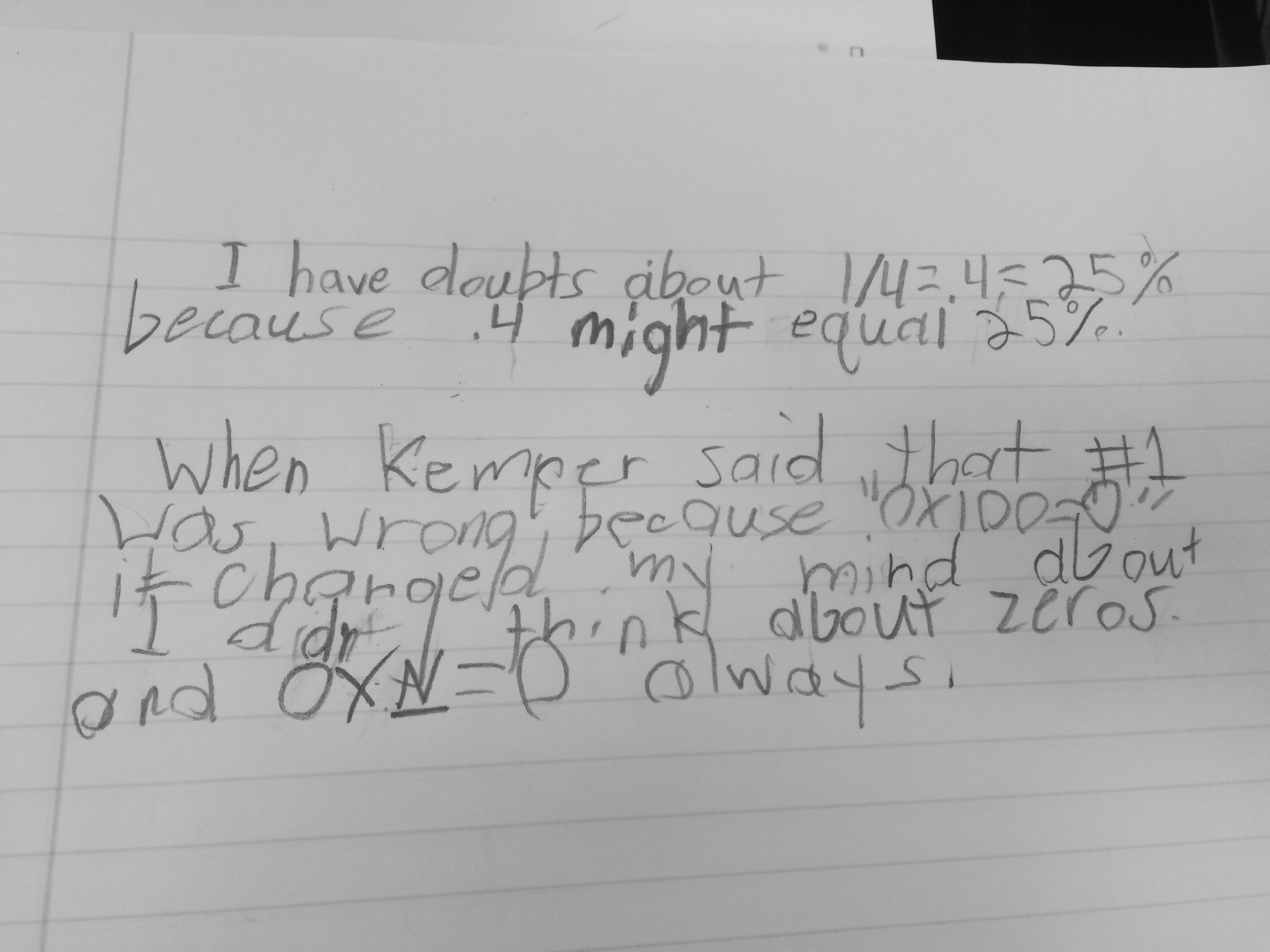
IMG_8977_2TP6: I used this point to check for equivalency understanding of fractions and percents (because we have worked with them) and then to see any connections to decimals. A lot times, student will take the fraction denominator and put that right behind the decimal point to make equivalents. This one was eh. I like that students knew 1/4 = 25% so the conversation focused on the meaning of the decimal in relation to the other two. I may reword this to, “.4 = 4%” and leave it at that.

After the points, I had the students reflect on two prompts…

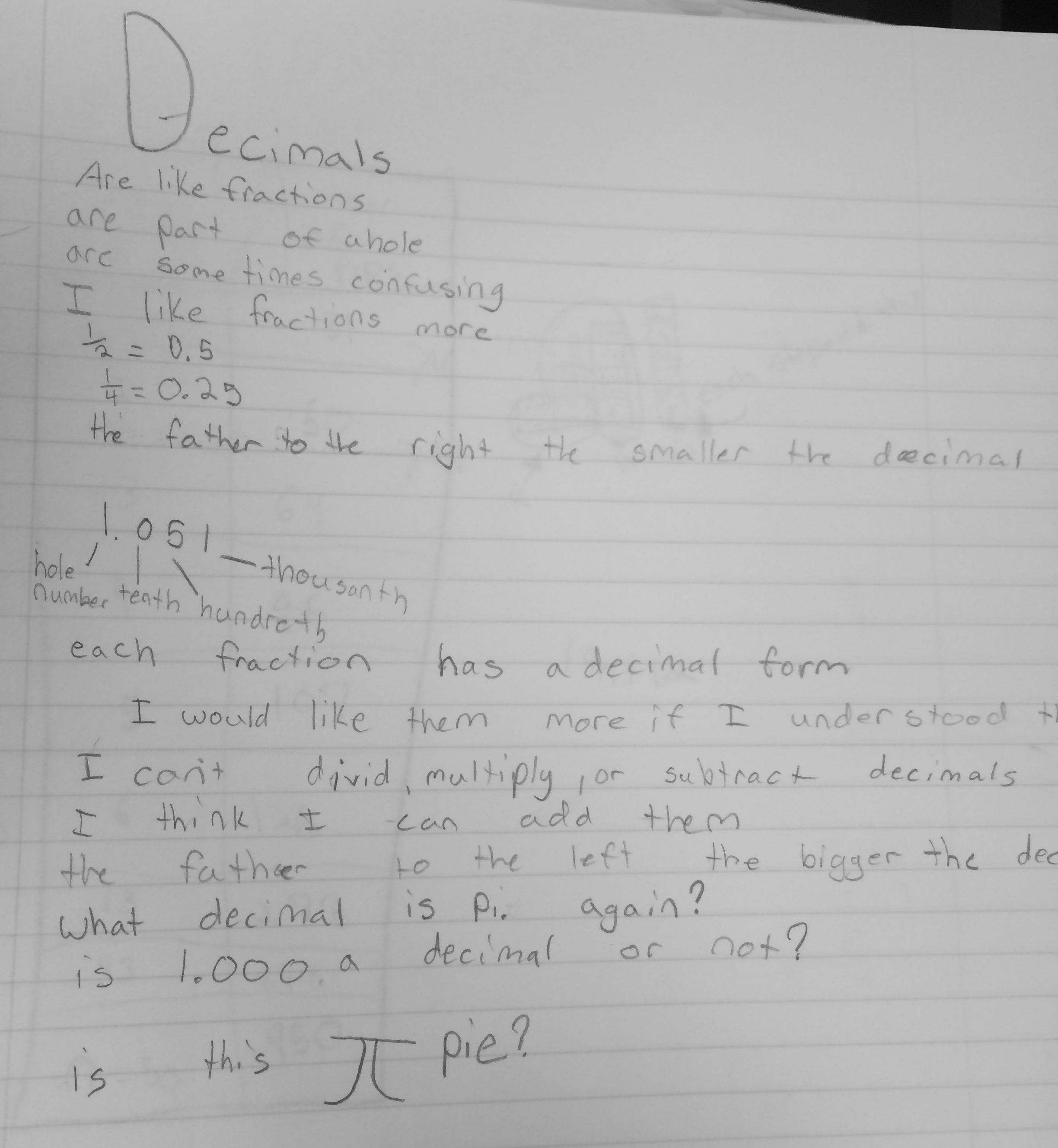
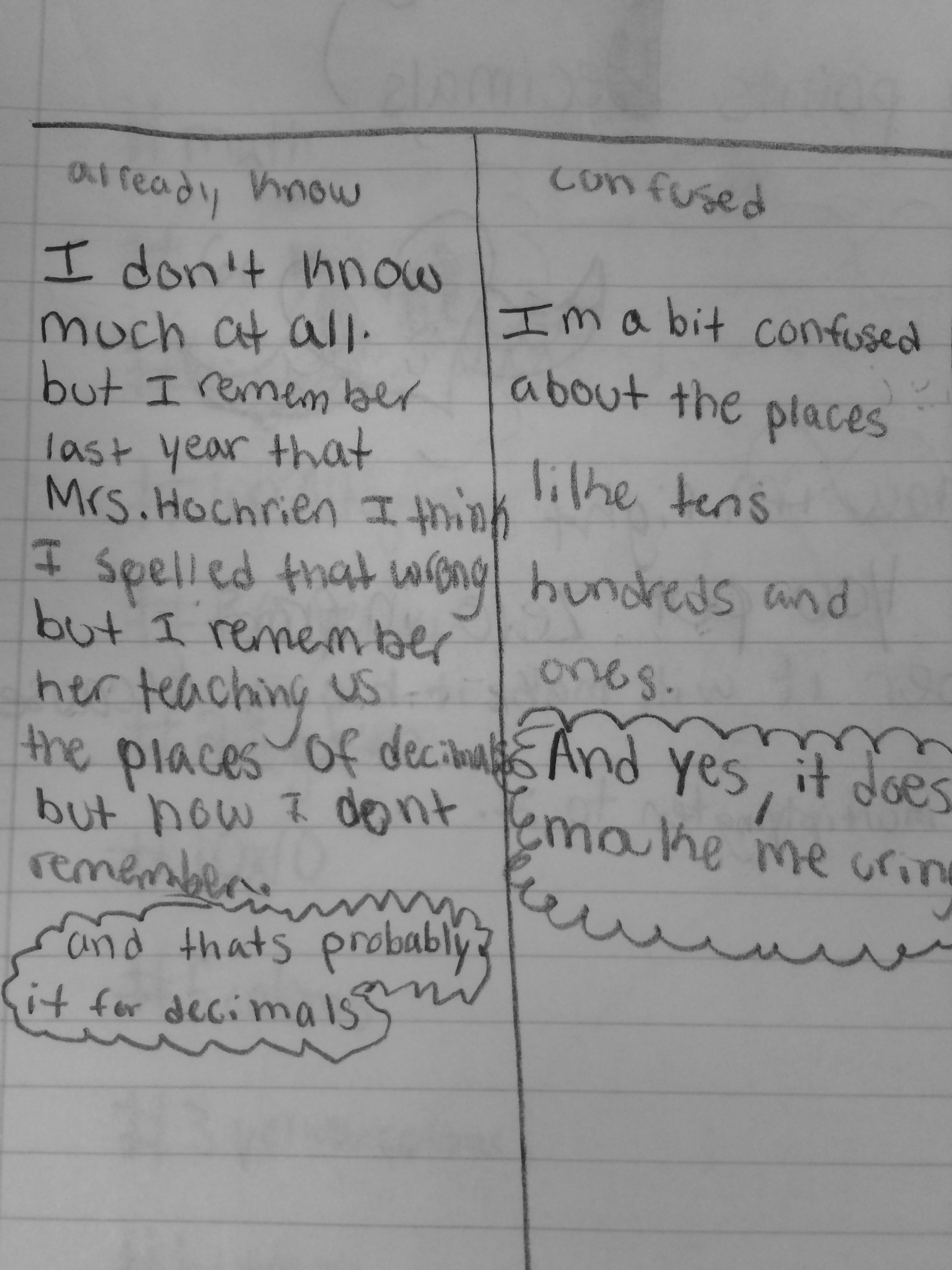
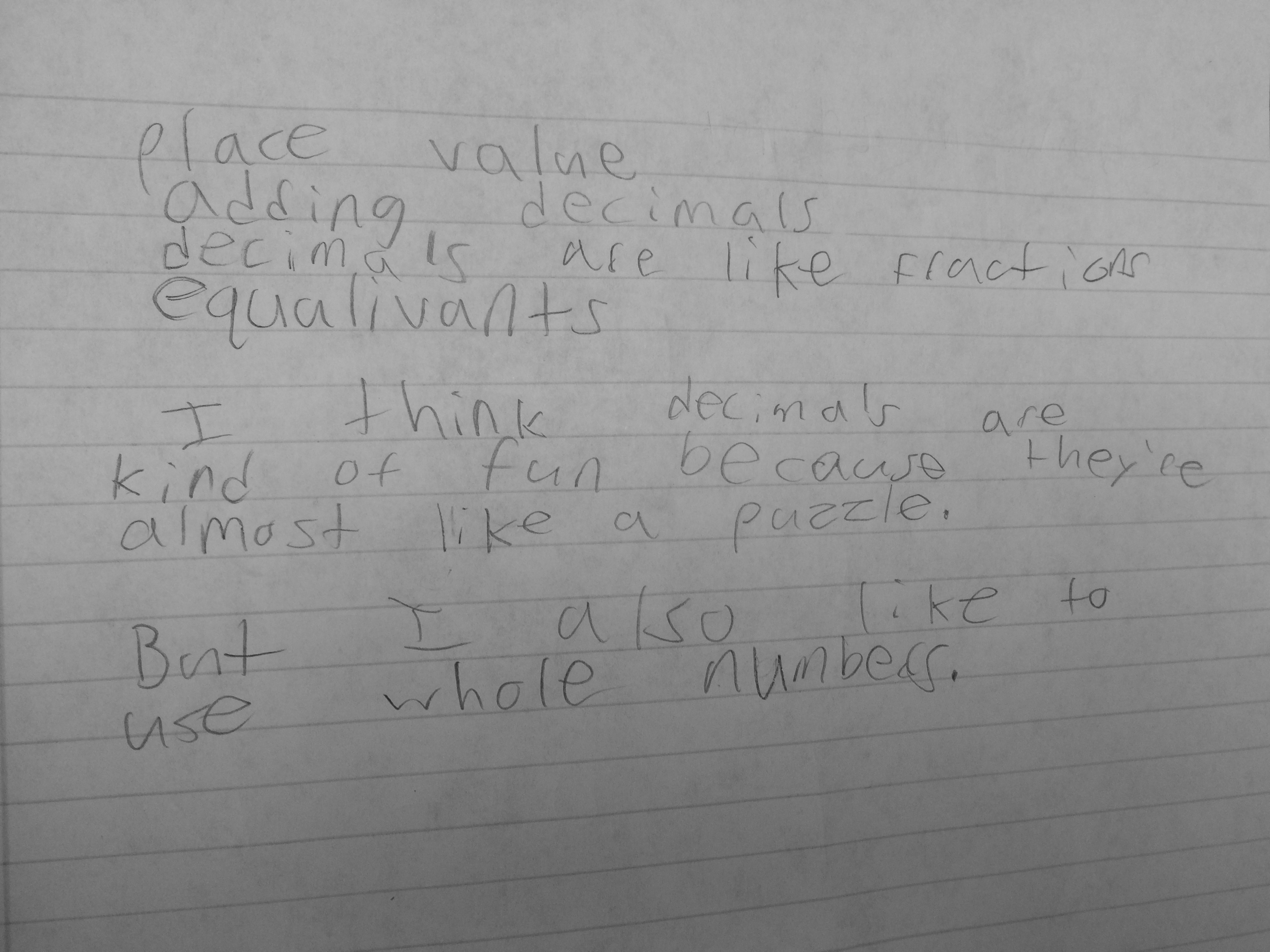
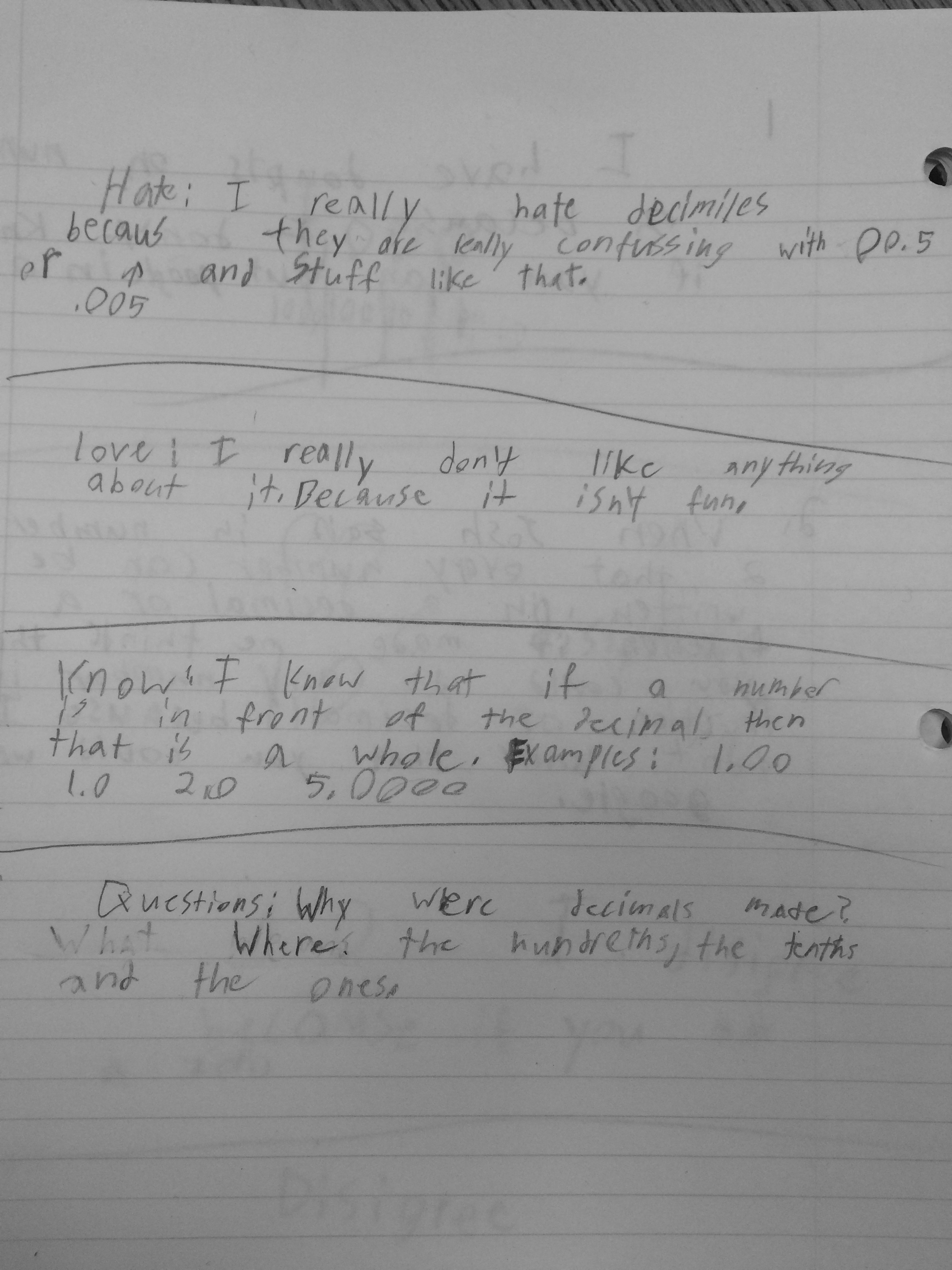
“I am still having doubts about Talking Point __- because….” and “When (insert person’s name) said ___________ it changed my mind about Talking Point ___ because…” Some samples of these are above and here are a few more….

IMG_8969_2IMG_8970_2IMG_8971_2IMG_8975_2

Visual Patterns Fun!

Each day, I start class with a math routine. Whether it is a Number Talk string, If I Know Then I Know, Closest Estimate or Quick Image, those first 10-15 minutes are always my favorite math conversations of the day! Today I added Fawn’s (@fawnnguyen) Visual Patterns into the mix.  I spend a lot of class time having students look for patterns and regularity in their math work, but this visual brought a wonderfully different “feel” to their work. As Fawn had previously blogged, the Visual Patterns have an entry level for everyone and every student in my classroom engaged immediately with the images.

I chose this one to kick off our work today:

vp1 I asked the students to work as a group to find the number of unit for Steps 1 – 6, 13, 43, and then n. Being their first time, we had to deal with what the “n” meant and after the initial “Is this algebra?” followed by numerous stories of siblings who are doing this math with letters, they were on their way. It was interesting to see some students go straight to drawing each image, others started looking for what was changing as the steps progressed, and then there were the students who love going straight for an expression for finding 13 and 43. After they all had the table completed, we came together to fill it in. I was so impressed with their work and their ability to find the expression for the nth shape, however the BEST part of the conversation was taking that expression and connecting it back to the images. Why was n doubling? Why is that 1 being subtracted?

I love how this student used a specific example to connect his expression (or almost an expression, we’ll get there:)

Photo Jan 26, 9 29 51 AM

This student found the equation and decided to use “a” to stand for “answer.” I loved how she then tested it with other numbers. Photo Jan 26, 9 31 39 AM


These two students then put a different spin our our work. Every group in the room came to the expression n x 2 -1, and as one student was explaining how the 1 needed to be subtracted because it was being double counted, another student exclaimed that his group figured out that if you just split that block in half and made each said a mixed number you just had to multiply that by 2. For example on step 4, if you made each side 3 1/2 x 2, you would arrive at the same answer. How awesome!

Photo Jan 26, 9 31 49 AMPhoto Jan 26, 9 31 23 AMI am excited to make this a part of my daily math routines, thanks Fawn for sharing, awesome stuff! I had students asking for another one before they left class that day, they loved it!

-Kristin

Geometry Is Worth The Extra Time…

As I am sure many teachers can attest, there is a constant struggle each year between covering content and the precious amount of time we have to engage the students in learning. Prior to the past two years in the classroom, this guilt always seemed to creep up most during our geometry units. I used to feel that once the students could find area, perimeter, and volume, we would move back into our fraction and decimal work because that always took SO much time to develop a deep, foundational understanding. While geometric representations such as an area model support the fraction and decimal work, it is still not the 2D or 3D unit work.  Right or wrong, I felt I had to prioritize to make use of the little time I had for the best of my students. Over the past two years, however, my geometry units have been taking longer and longer because I have started to see things evolve in my geometry units that has me  wanting to kick myself and go back in time to give my past students a different learning experience. From the connections to number and operations to the development of proofs and generalizations have been eye-opening.

As all of these math connections were going through my head, I see this tweet from Malke (@mathinyourfeet)…

mrahhh, it felt like validation in some weird way.

After this Twitter conversation, I started to dig back into my students work to find examples that makes these connections visible.

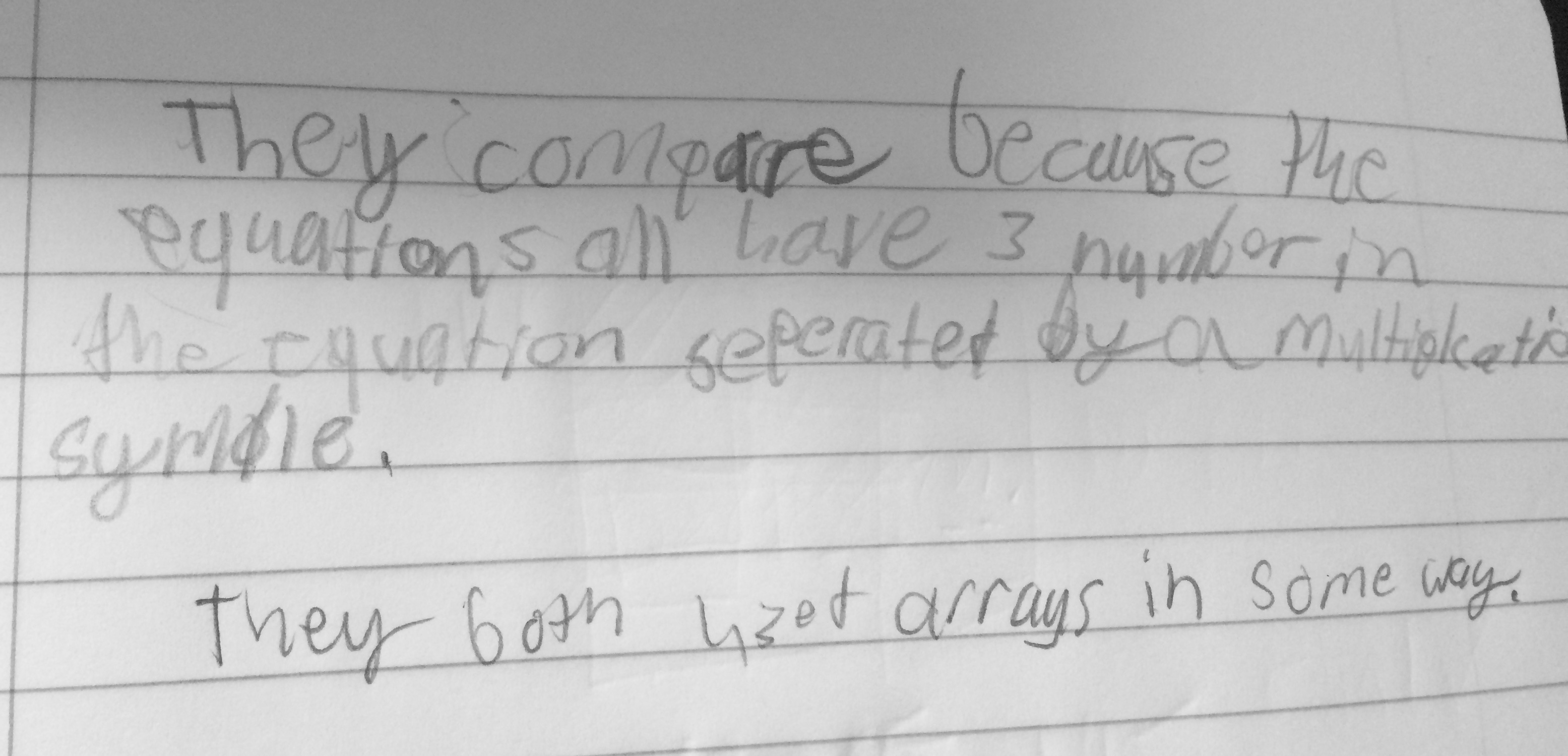
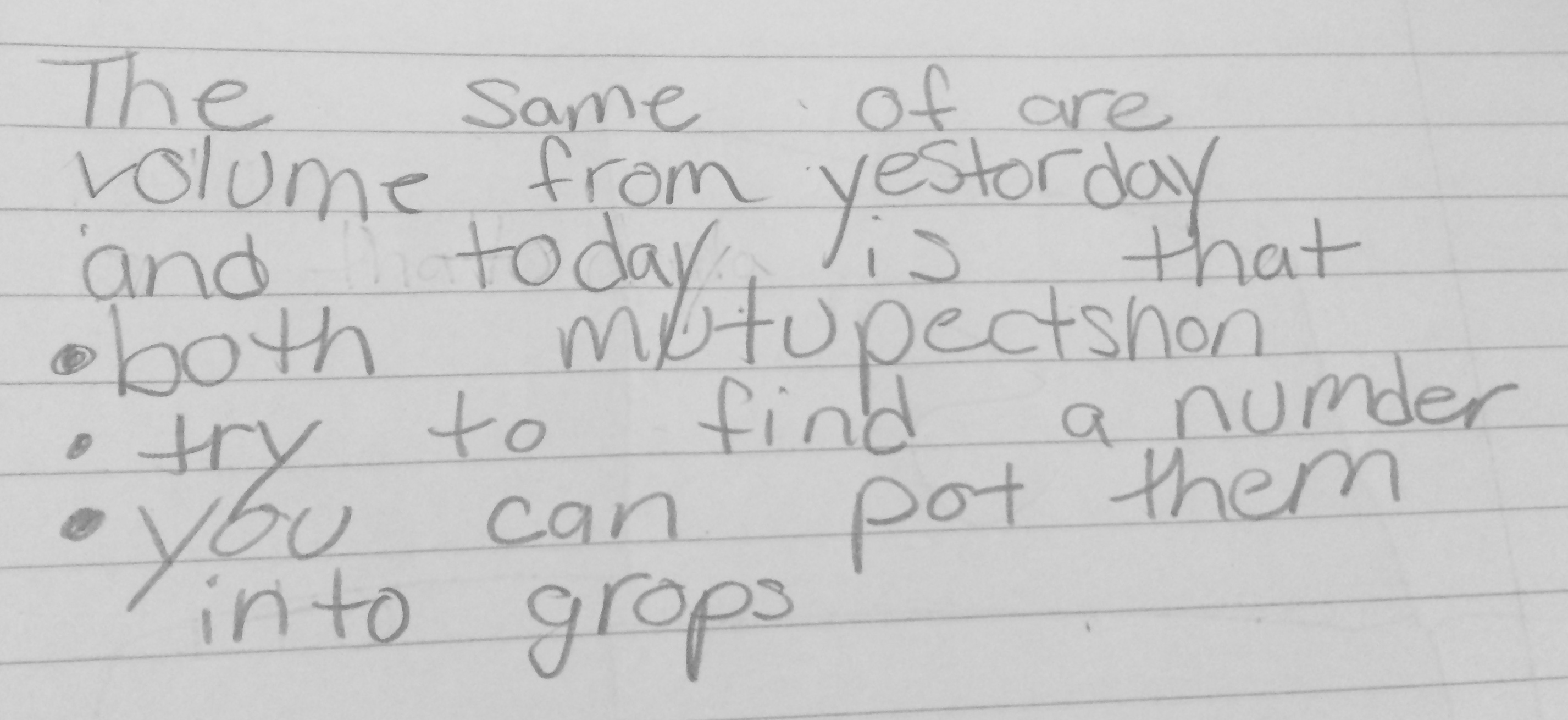
After doing a dot image as our Number Talk one day, I asked students to see if they saw any connections between the image and our volume work that day. This work shows how students see the commutative property in both, multiplication as groups (like layers in volume) and most importantly puts a visual to how multiplication and its properties “look” in both 2D and 3D.

IMG_7754IMG_7755IMG_7763IMG_7765IMG_7764Then volume led into some great generalizations about how multiplication “works” through looking at patterns, which is extremely important in mathematics in and of itself.  In keeping constant volume (product), students realized they could double one dimension (factor) and half the other. In doubling the volume (product), the students realized they double one dimension (factor) and leave the others the same. T

IMG_7795_2IMG_7797This volume discoveries later let to this claim on our claim wall:

IMG_8148The students extended this area and volume work to fractions/decimals that showed that fractions/decimals act as numbers in operations as well, supporting the structure of our number system.

IMG_7632IMG_7980While we classified polygons, I saw my students develop proofs for angle measures and our always, sometimes, never experience was invaluable. This work in connecting reasonings through visuals of the polygons explicitly supports the Mathematical Practices of using models, perseverance, and repeated reasoning.

IMG_8280_2IMG_8283_2IMG_8423Then our work with perimeter and area solidified the importance of students creating a visual in building number is so important. In a problem with equal perimeter and different area (moving into greatest area), students created a beautiful visual for the commutative property as well as supported students in seeing the closer two numbers (with the same sum), the greater the product.

IMG_8854IMG_8866IMG_8867-Kristin


Kindergarten Dot Image Number Talk

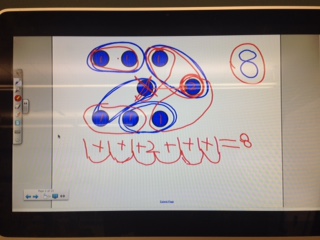
IMG_3455My friend Jenn (@jennleachteach), a Kindergarten teacher in my building, sent me this picture from her number talk yesterday with her students. I could see how the students counted by ones and some by twos by her circling, but I was confused by “x” through the middle dot so I asked her to explain it to me today and I had to share…

The blue circles are by the student who counted them all by 2s, which is clear, however the red circles and numbers are by another student who blew our minds a bit….. The student came to the board, circled the top two left dots, the third top and middle right dot, re-circled the middle right dot with the bottom right, and then the two bottom left dots. If that was hard to follow, the odd part was he didn’t use the middle dot and said that he just “moved it over” in his head.  When asked to explain further, he labeled the dots by number and wrote the equation. He put a one in each to show that it made two in each circle and the put a “2” in the right dot because he had moved the middle dot on top of it and double counted it as two.

I love when she shares her Kindergarten class number talks with me, so MUCH FUN!

-Kristin

Pre/Post Assessment Reflection

We started our 2D Geometry unit with Talking Points: https://mathmindsblog.wordpress.com/2014/11/13/talking-points-2d-geometry/.  This was the ultimate pre-assessment in which I could hear what the students were thinking around mathematical concepts while at the same time, they had a chance to also hear the thinking of their peers. After the talking points activity, I had the students reflect on a point they were still unsure in their thinking.

We are now wrapping up our Polygon unit, and I thought it would be interesting for them to reflect back on what they were unsure about in the beginning, and get their thoughts now. I have a class full of amazing writings, but here are just two of the great reflections (the top notebook in each picture is the pre-unit and the bottom is post-unit)….

Photo Jan 15, 11 42 12 AM Photo Jan 15, 11 55 54 AM

Looking at the class as a whole, it was so interesting to see their math language develop and see them laughing at things they had written before. I loved that the student above wrote, “I am smarter!!!” How amazing they can see their own learning!  During their reflection time, it was so fun to also hear students exclaiming, “See, I KNEW I was right!”

This is the first pre/post assessment I have ever done where I think the students enjoyed it as much as I did! They were as proud of themselves as I was of them!

-Kristin

Developing Claims – Rectangles With Equal Perimeters

Yesterday’s math lesson launched based on this student activity book page in Investigations…

IMG_8861

Students read the introduction and I first asked them, “If we were to build these in Minecraft, was feet an appropriate unit of measure?”  Some thought that feet seemed too small for a garden and instead wanted to use yards, that was, until one student schooled us all on Minecraft. Come to find out, Minecraft uses the metric system with each block representing one cubic meter. We then changed the unit to meters and were on our way.

I gave them 10 minutes, either with a partner or individually, to build as many different rectangular garden designs as they could with 30 meters of fencing. As I walked around, it was interesting to see how students were designing their gardens. Some started building random dimensions and adding/subtracting fence links to eventually hit 30 while others had thought of one rectangle to start and adjusted from there by subtracting/adding from sides. It was fun to see the ones that discovered a pattern in their building and sped through the rest of the rectangles. Some beautiful patterns emerged….

IMG_8854Photo Jan 14, 1 23 24 PM

Photo Jan 14, 1 22 35 PMAfter 10 minutes, I asked them fill in the table on their activity page and chat with their table to see if anyone had any dimensions they didn’t have. As a table, they came up with some noticings based on their table, Minecraft builds, and process of building.

IMG_8862 IMG_8863 IMG_8865 IMG_8866 IMG_8867 IMG_8868 IMG_8869 IMG_8870 IMG_8871 IMG_8872 IMG_8873The class ended after this group work. Talking with another colleague about the lesson at the end of the day, we chatted about what claims could come out of this lesson. It was so interesting to me to think about not only the geometric claims, in terms of rectangles and dimensions, but also the numeric claims that can evolve from these conversations as well. And to think that these number claims are grounded in a visual connection is pretty awesome to me!

I was so I started today by pairing up every two tables to share with one another. One table read their noticings while the job of the other table was to ask clarifying questions. That gave me time to circulate, listen, and choose the claims for our class share out. After the table shares, we reconvened as a whole class and chatted about a few of the claims as a group.

IMG_8853I asked them to think about similarities and if we could combine some of them to form one claim based on our work.

Class ended with a journal entry in which they worked independently to begin to form a claim or the beginnings of one. Here is where I will start tomorrow…

IMG_8855 IMG_8856 IMG_8857 IMG_8858 IMG_8859 How fun!

As a follow up on this post, this is the assessment on their work with perimeter and area. During the class period, only one student started working on finding the square that would give them the largest area with a perimeter of 30. After this idea came out in our class discussion, using fractional dimensions was something that others were thinking about during the assessment.  Here is a student’s (different than the initial student) work that I thought was pretty fantastic:

Photo Jan 16, 11 51 34 AM

-Kristin


Number Routine PD: What Do I Know About…

My colleague Nancy and I facilitated a K-2 afternoon professional development session yesterday afternoon. The 2.5 hour session was with a wonderful group of teachers from across our state who we are fortunate to work with several times over the course of the school year. Our major focus over the course of this school year centers around connecting arithmetic to algebra based on a book by Virginia Bastable, et al, that I blogged about here: https://mathmindsblog.wordpress.com/2014/11/20/articulating-claims-in-math/ I thought blogging about this experience would be helpful for any of our teachers who could not attend and for any others who facilitate PD.

I find planning for professional development is much like planning for the classroom. Many of the same questions arise:

What content will be engaging and relevant? (especially being an afternoon session when everyone is winding down on a Friday)

What is the trajectory of the content?

Where are they? Where are they heading?

What questions or prompts will encourage conversation?

When are points for table conversation? Whole Group conversation?

How will be know where they are in terms of the content when they leave us?

How will we follow up?

After much planning, videoing, and organizing this was the flow of the afternoon:

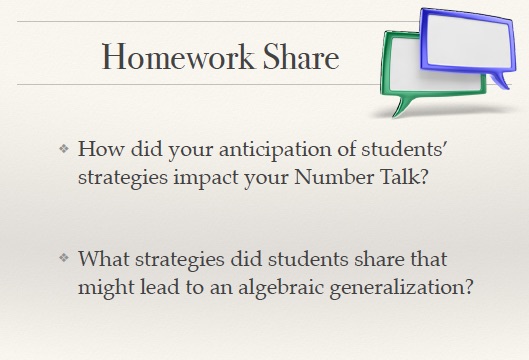
We opened by getting into grade level groups to discuss the homework from last month, doing a group planned Number Talk with their students. They used this form to plan together and brought back recording sheets of their work to discuss these two questions:
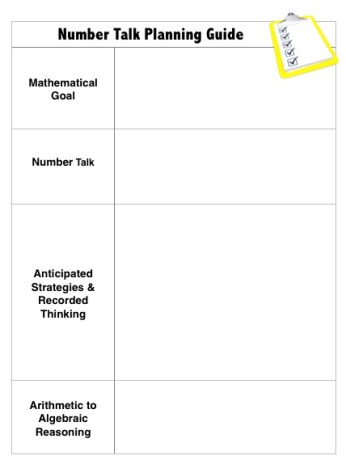
ntp nt1With the number talk being planned by the group, I felt a sense of ownership over the results in the classroom and, really, who doesn’t like talking about all of the wonderful things our students say during a number talk?

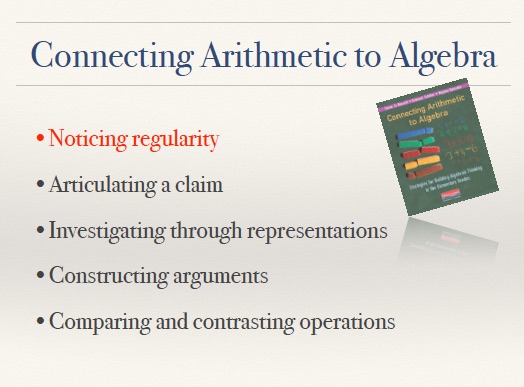
We continued with a quick recap of last month’s session on the book, “Connecting Arithmetic to Algebra” to plant the seed for our routine of focus that day, What Do You Know About….?
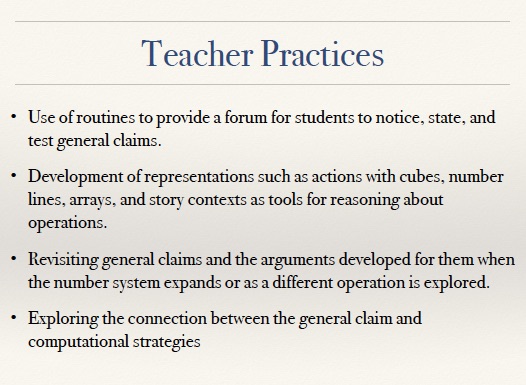
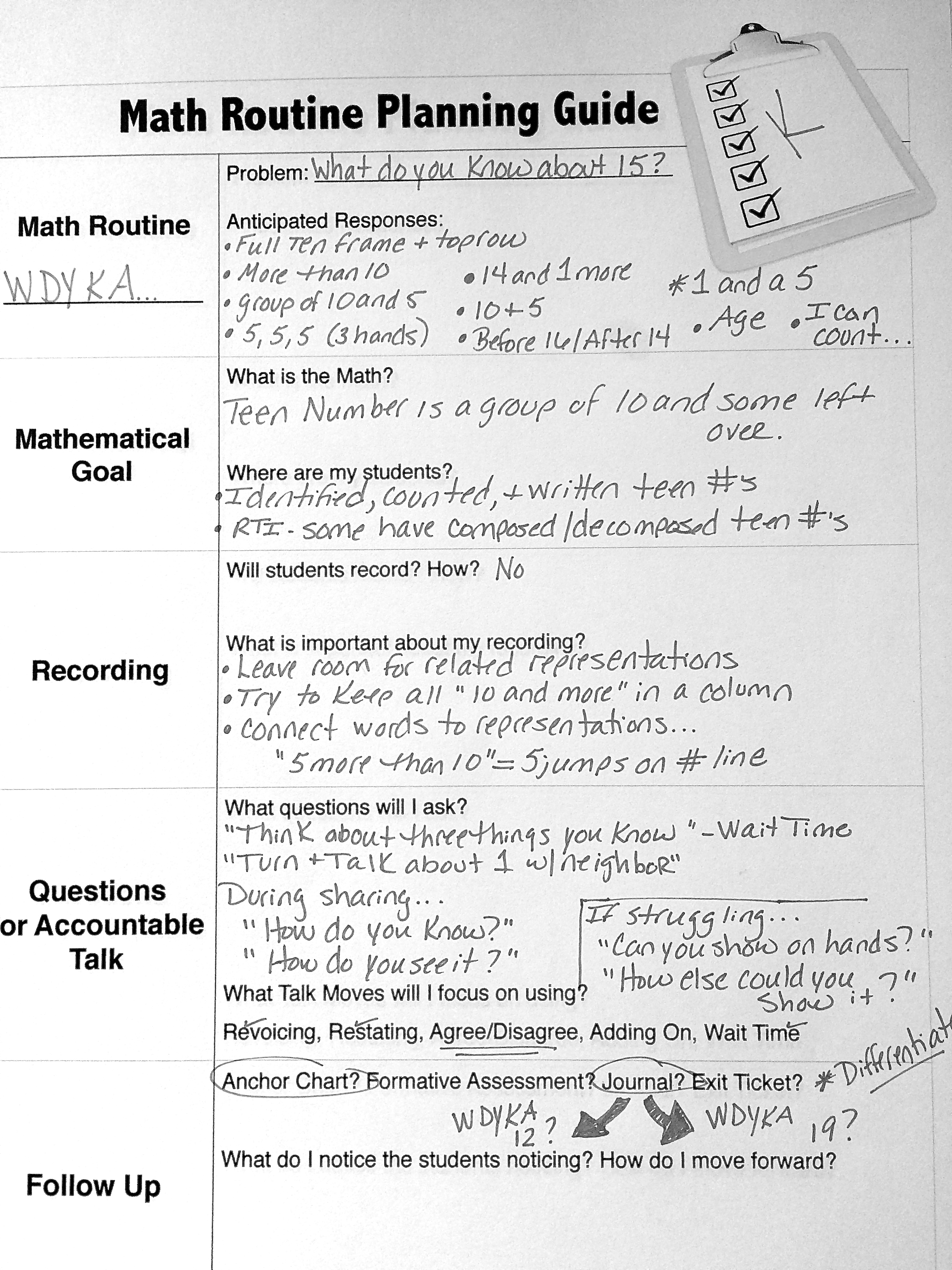
 21 3Now into the really fun stuff! Working with a Kindergarten teacher in my school (@jennleachteach) who is also a part elementary pd group, we planned and videoed a math routine called “What Do You Know About 15?” in Jenn’s class.

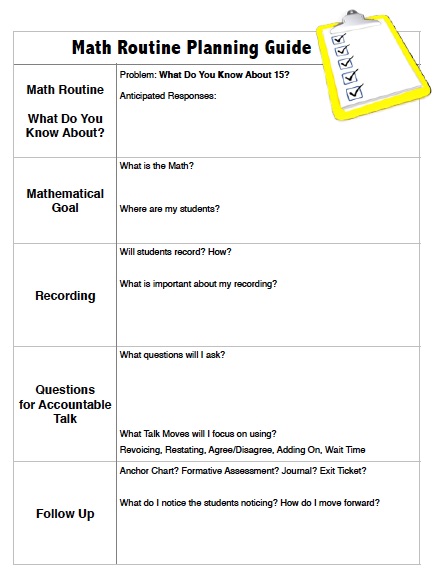
We mixed the grade level PD groups up at this point so there was a range of K-2 teachers (and a few math coaches) in each group.  They got a blank planning sheet to brainstorm what they think the planning would look like for this routine in a Kindergarten classroom in January. It was great conversation, with the Kindergarten teachers being the experts at each table. I thought this was such an interesting dynamic since we often tend to pose a mathematical idea and ask what previous understandings K-2 need to build to get there, however, with this opportunity, it was starting in the opposite direction and really focusing on what Kindergartners know at this point of the school year.

4After they predicted what our planning sheet would look like, Nancy brought 6 teachers up to act as students in a fishbowl enactment of the Number Routine. The other teachers in the room were observers focusing on two particular aspects of the talk, what you notice about the teacher recording and what you notice the “students” noticing. Importance of recording was a previous topic in an earlier pd, so we wanted to be sure that resurfaced. Nancy did the routine with the teachers and  we came back as a group to discuss the observations of our focus questions. Our discussion also touched on the use of the talk moves she used to clarify and illustrate student thinking.

We then watched Jenn’s Kindergarten class do the same exact Number Routine, focusing now on the follow up piece of the planning sheet. What did they notice the students noticing? I wish I had permissions from everyone because Jen did a beautiful job in facilitating the talk and her students said some amazing things. We also took a look at the planning sheet that Jenn, Nancy and I had done for this routine. Here is the planning sheet and anchor chart that arose from the talk:
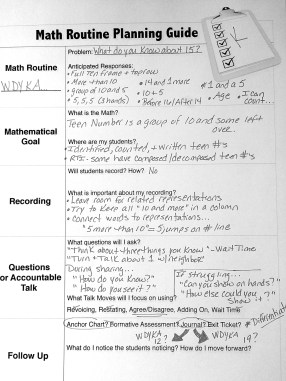
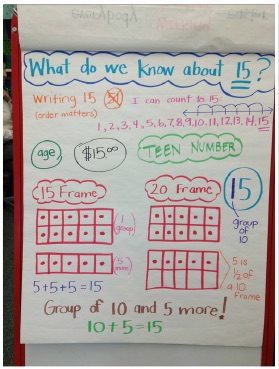
IMG_8758

5

As a group we discussed what they noticed the students noticing that could lead to future “claims” in their classroom. Teachers noticed such things as, “We can count by fives to get to 15” “It is three fives” (of course I am thinking about groups of and multiplication right there!) “A teen number is a group of ten and some more” “Looking at equality with related equations” and “The 1 means one ten”

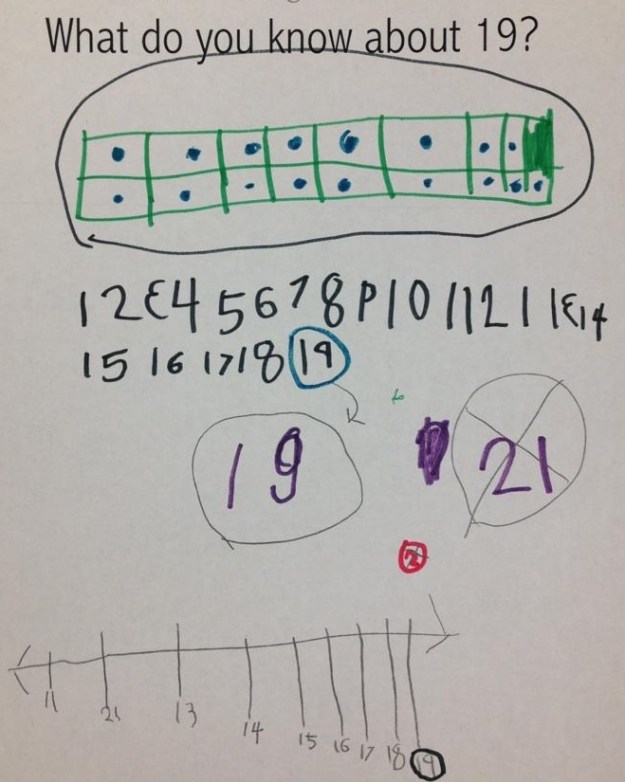
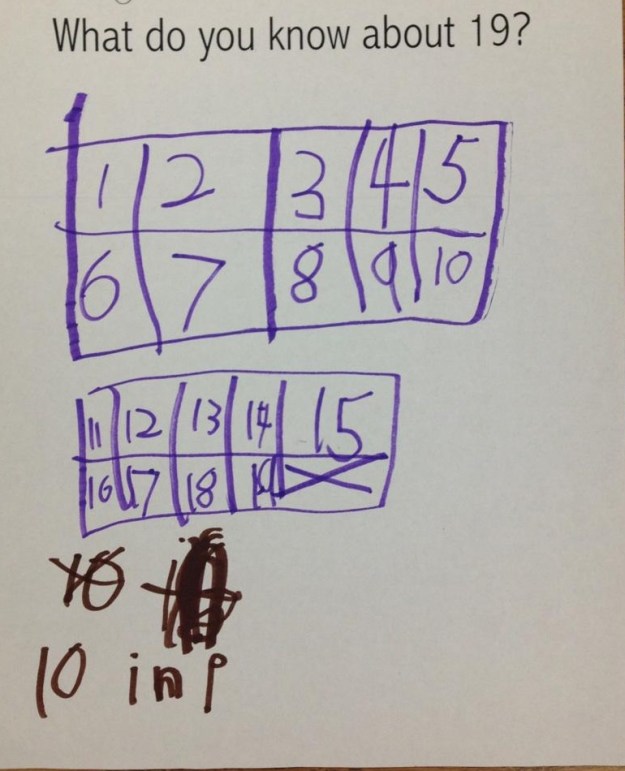
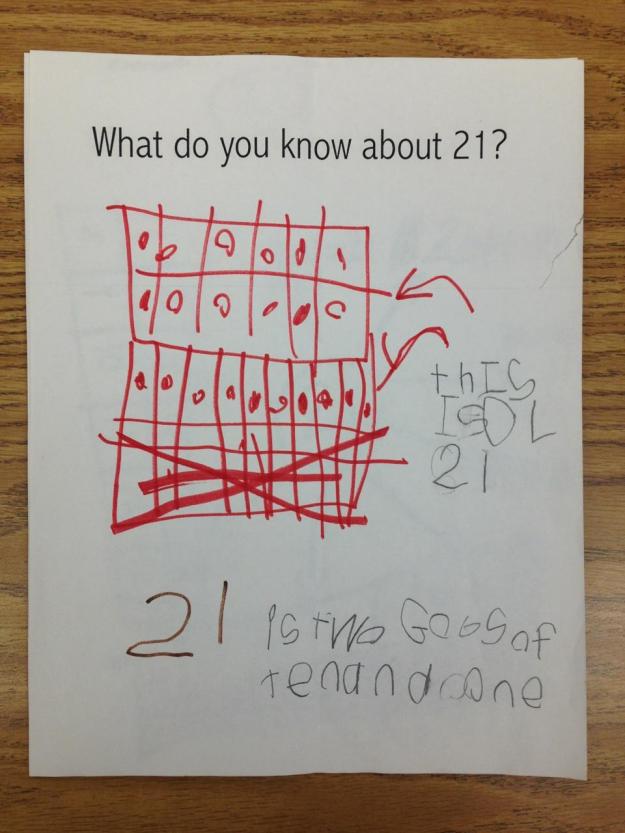
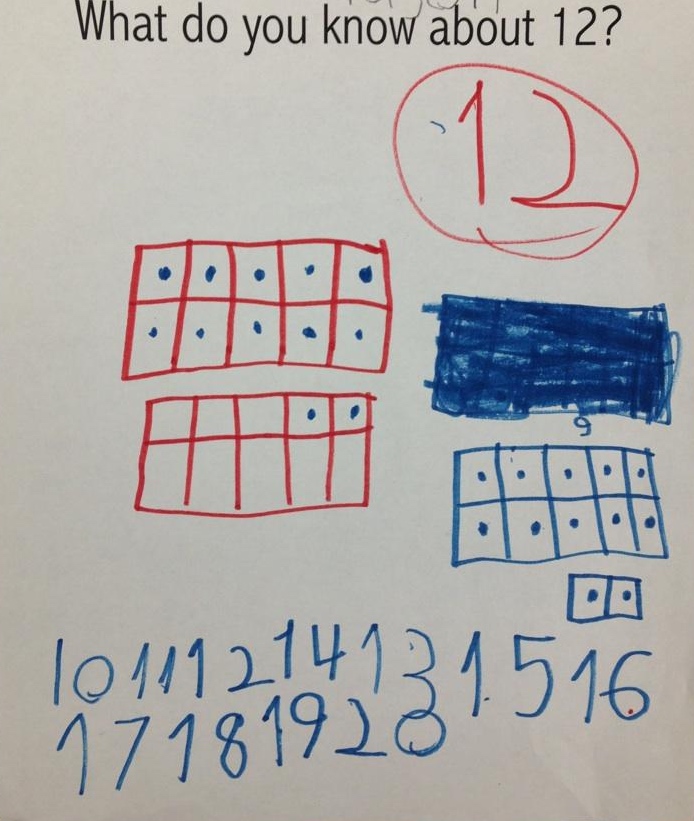
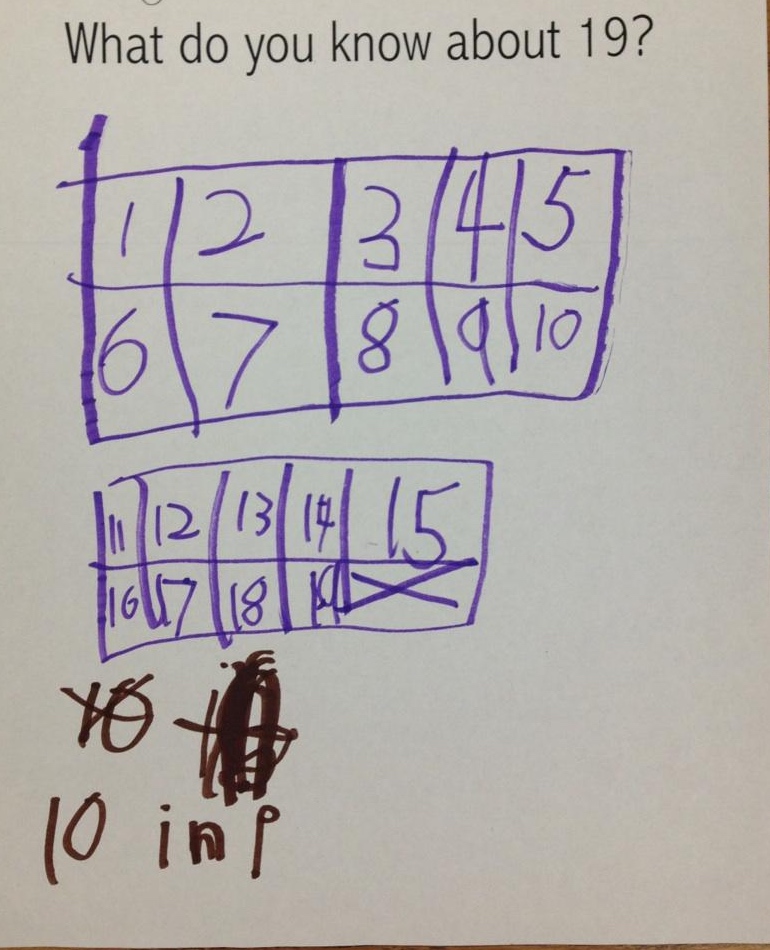
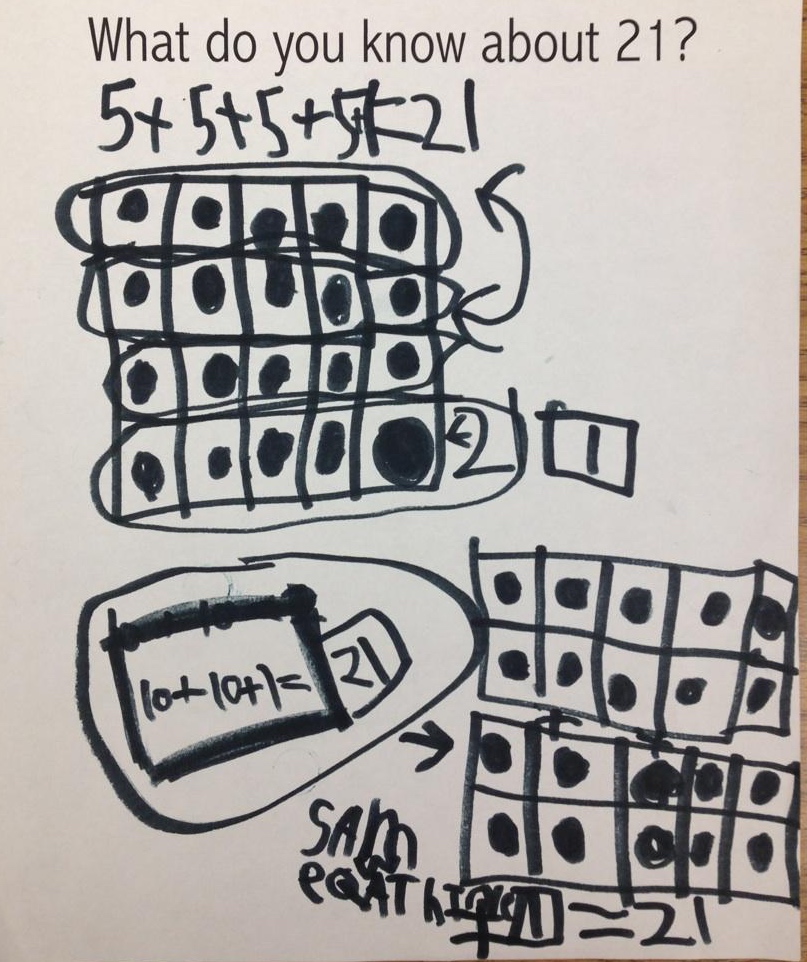
Jenn then gave students “random” journal entries to see how students were thinking about the numbers after the talk. To differentiate, we decided to give students 12, 19, or 21 depending on where we thought their entry level was into this thinking. After students completed the journals they chatted with someone who had a different number, to talk about their ideas.” Here are the student samples our PD group looked at and discussed:
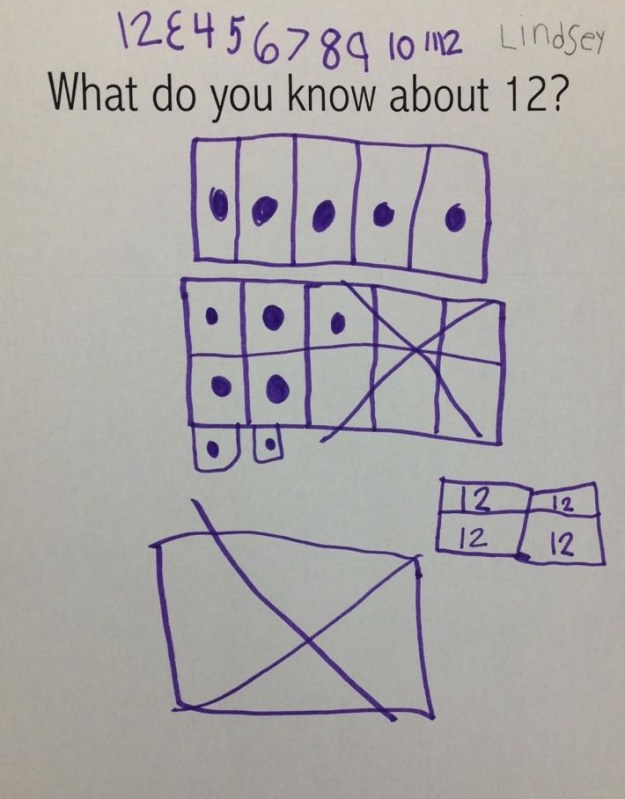
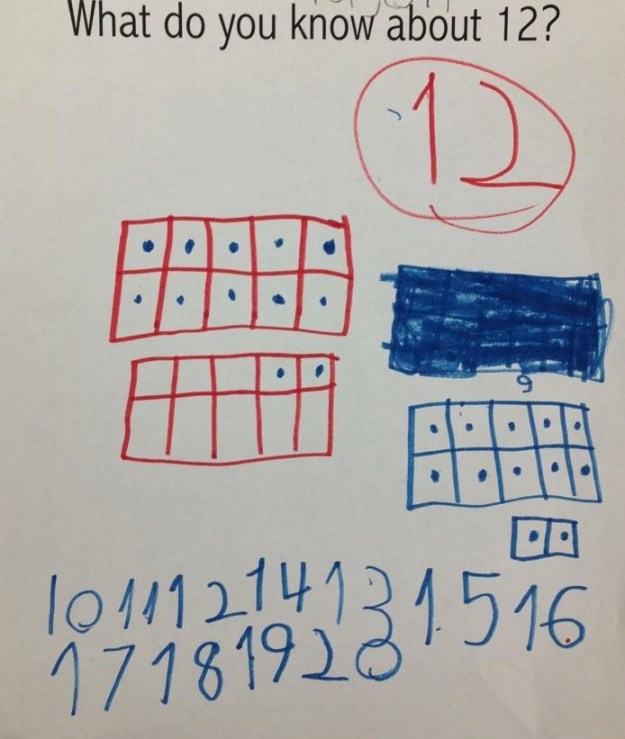
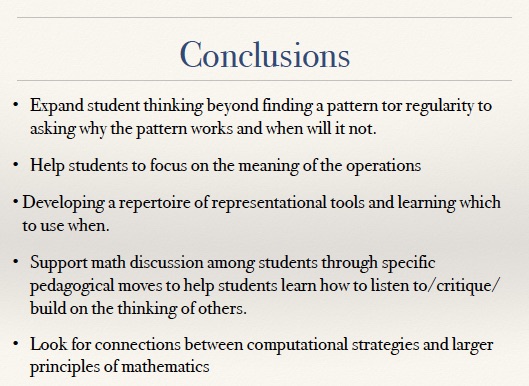
Photo Jan 08, 5 35 21 PM Photo Jan 08, 5 35 18 PM Photo Jan 08, 5 35 15 PM Photo Jan 08, 5 35 12 PM Photo Jan 08, 5 35 08 PM Photo Jan 08, 5 35 05 PM Photo Jan 08, 5 35 03 PMWe ended with Virginia’s conclusion slide about Connecting Arithmetic to Algebra and our homework for the group:
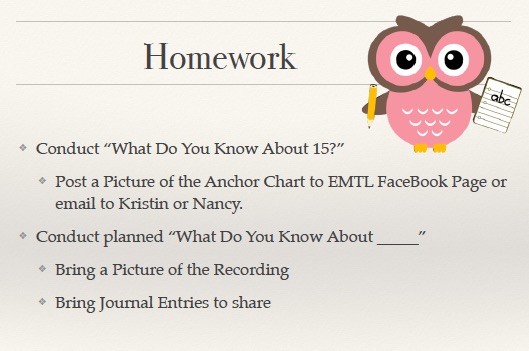
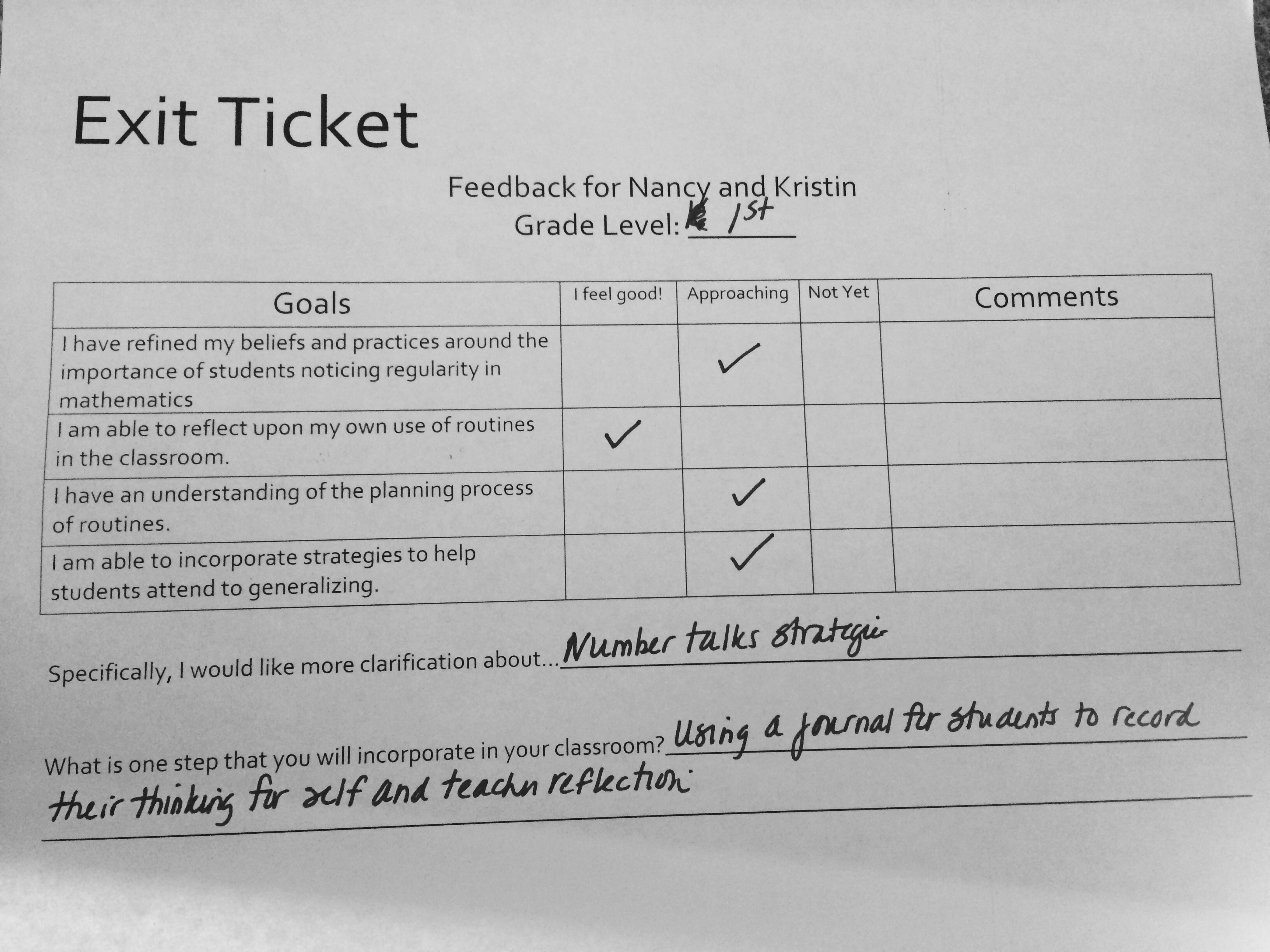
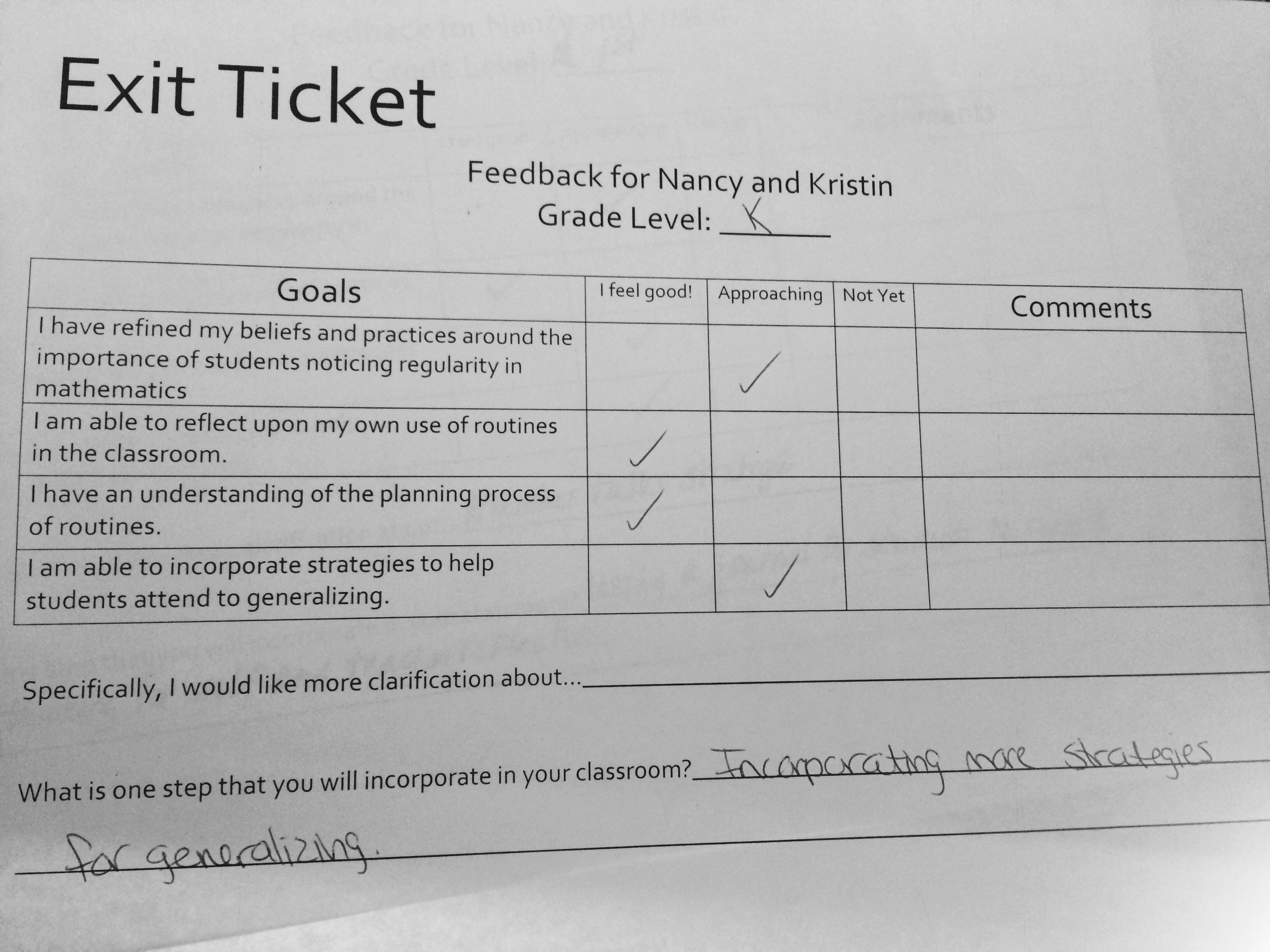
6 7We also gave an Exit sheet to help us in future planning. We got some very useful information as to where the teachers feel they are. I am very excited to hear about everyone’s journey back in their classrooms next month!

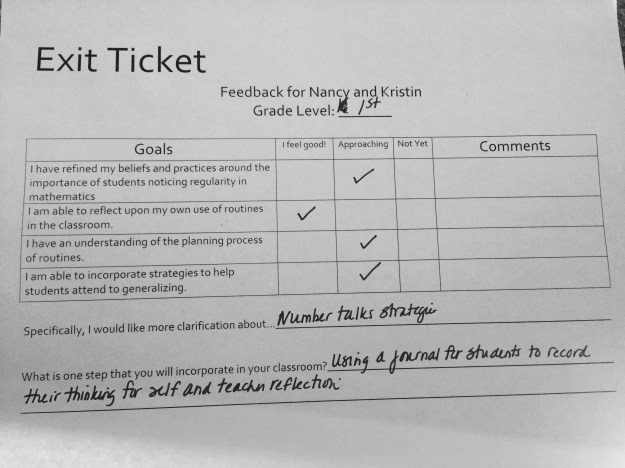
Photo Jan 10, 8 53 02 AM Photo Jan 10, 8 52 41 AM Photo Jan 10, 8 52 29 AM-Kristin

Area/Perimeter – My homework over vacation

It is always fun when I can look back at my past blog posts, see what I learned from a lesson, and reflect on student reasonings before I teach that same lesson again. This past week we were working on this lesson from last year: https://mathmindsblog.wordpress.com/2014/01/27/area-and-perimeter-of-squares-student-noticings/.

The lesson unfolded in much the same way, with the class patterns looking like this:

IMG_8589_2

I anticipated all of them, however, like last year, there always has to be one that throws me a curve ball and leaves me math homework over Christmas vacation:)

The 5th statement looked like this in his math journal:

IMG_8587_2

With these other noticings below it…

IMG_8588_2

His explanation focused on the pattern of the fraction the perimeter is of the area. The numerator stayed a two and the denominator went up by one on every even dimension. I honestly didn’t know what to ask him because the question “Why is that happening?” seemed way to broad. He played around with building the squares and was not getting anywhere. I am thinking, after chatting with Christopher (@trianglemancsd) on Twitter, that focusing on the meaning of the fraction first may be the way to go??

Basically, I first have to sit down and reason about his on my own…gotta love math homework on vacation!

Finding Angle Measures

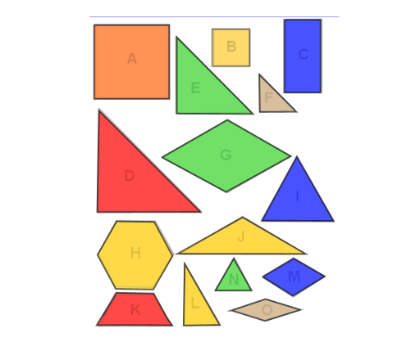
In our 2-D geometry unit, we have been classifying polygons based on attributes of sides and angles.  This week, the students were using what they know about angle measures and polygons to find the measures of other angles.  These are the polygons students were working with:

0001

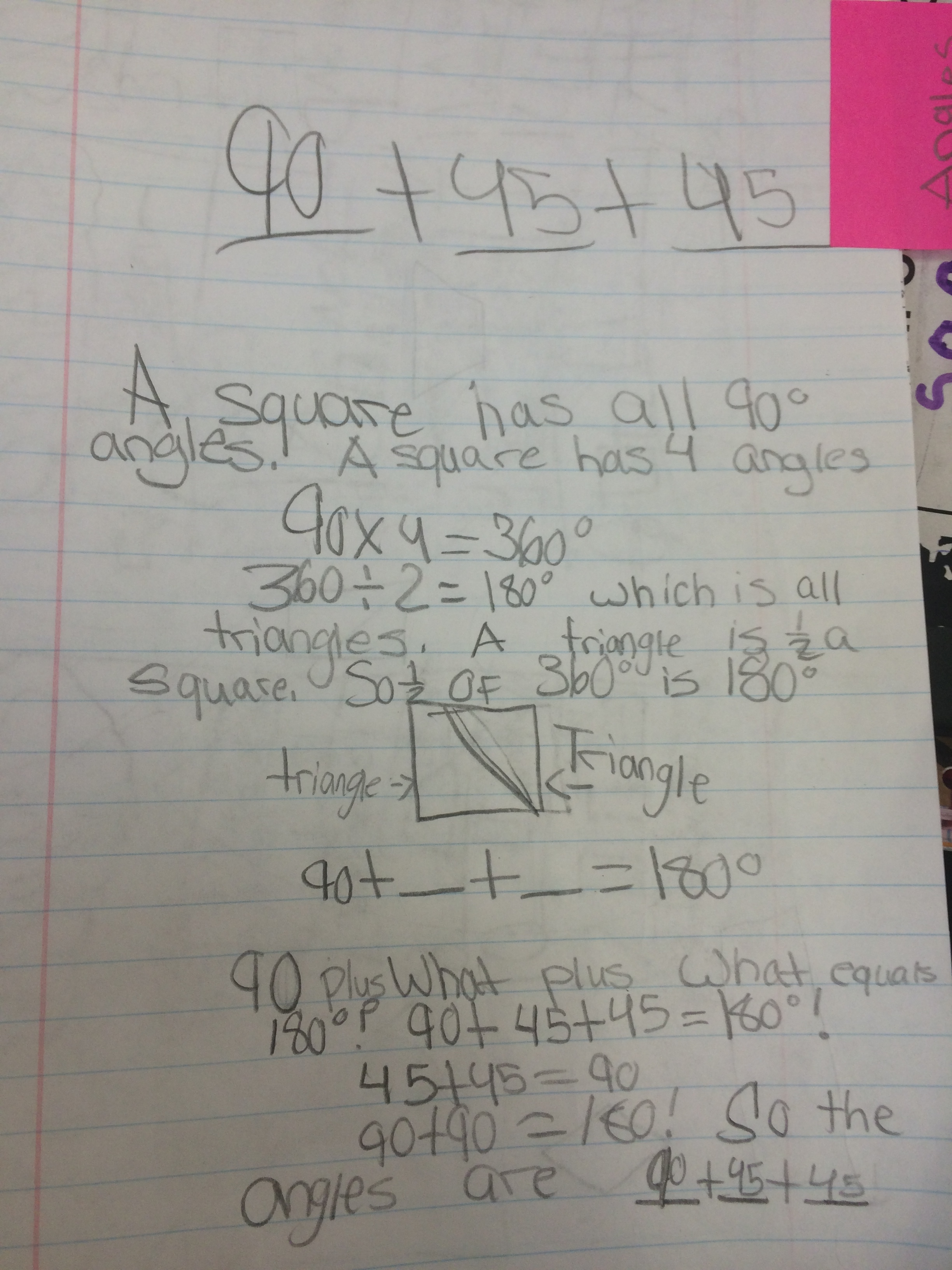
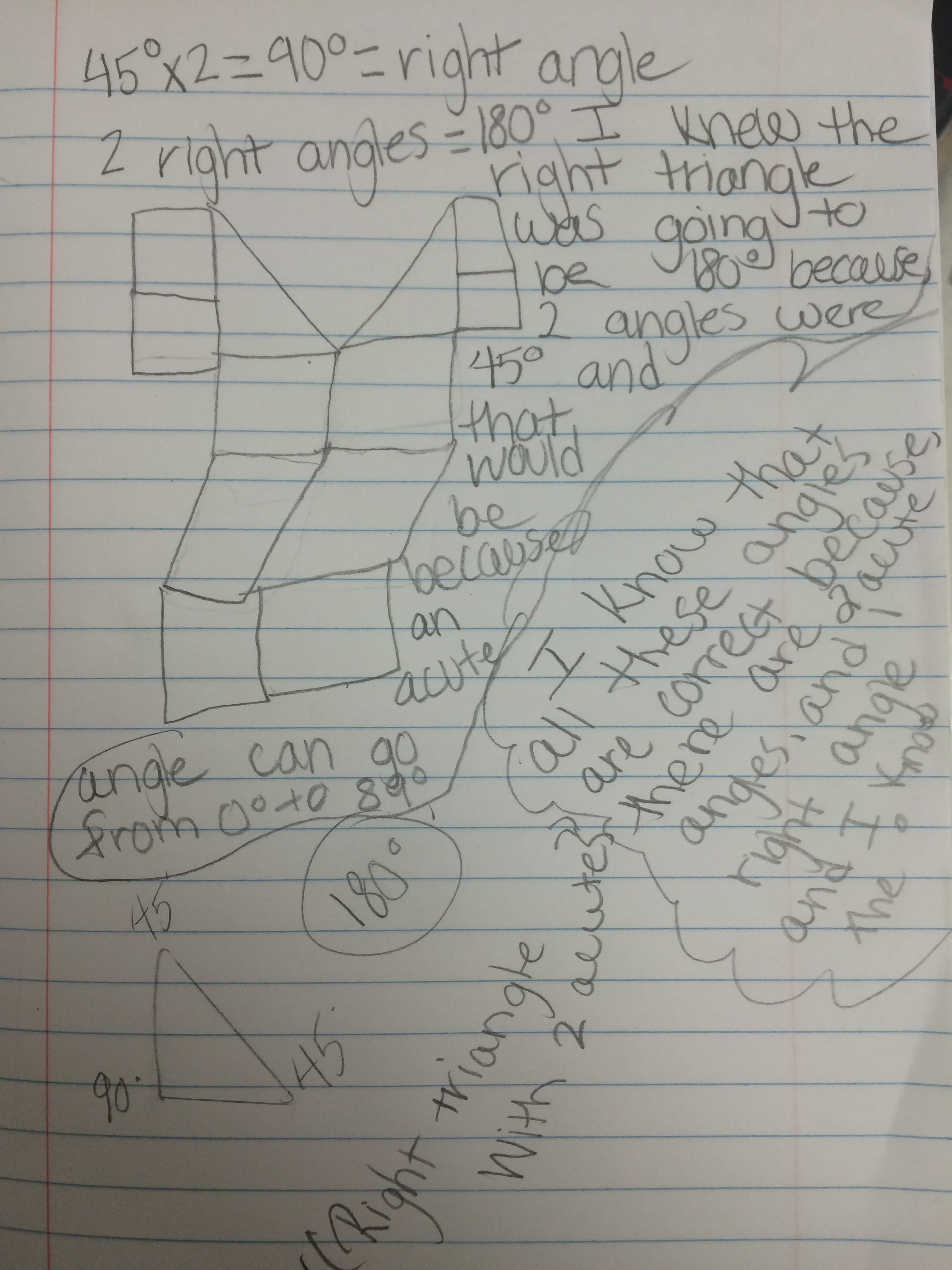
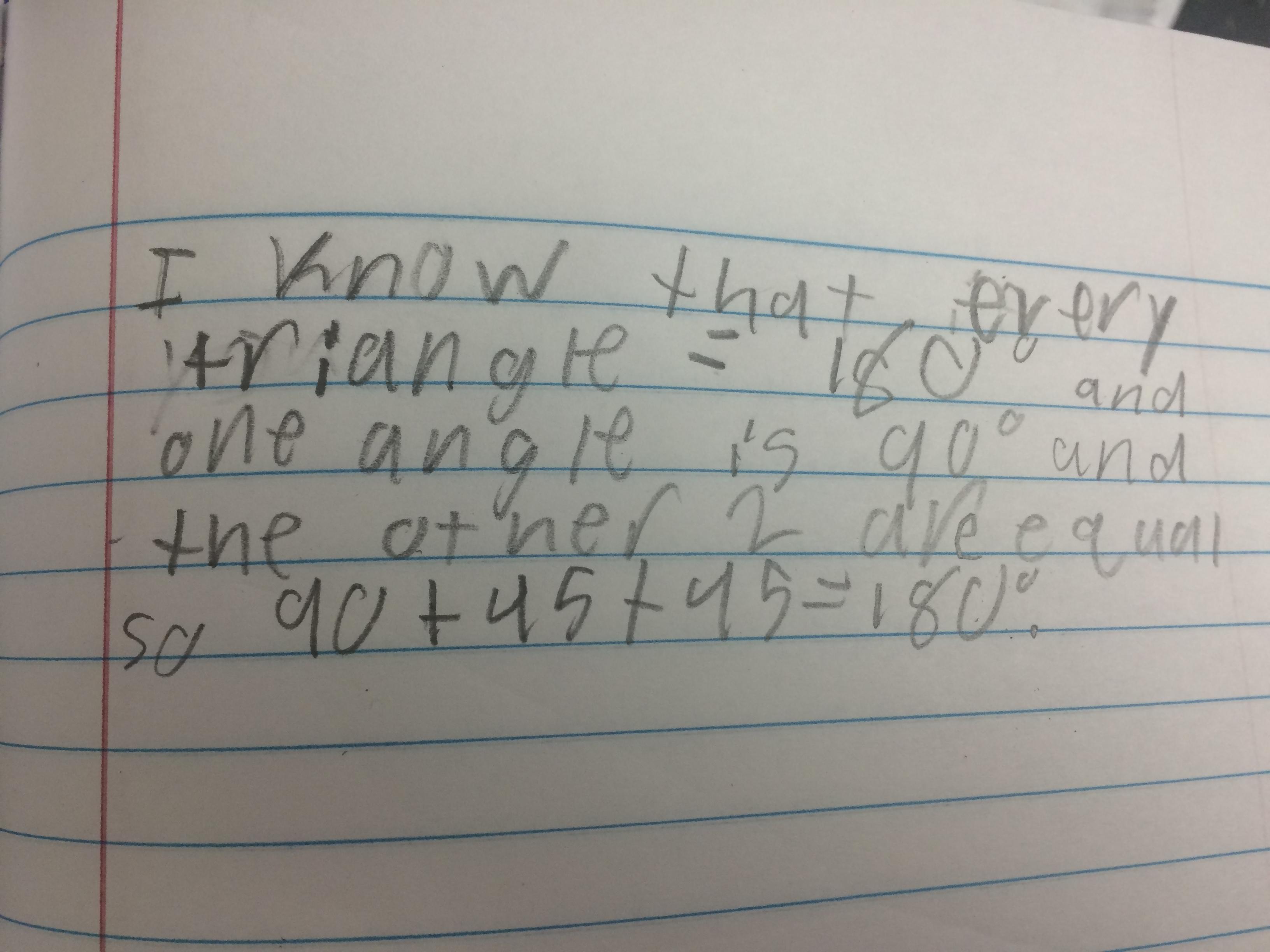
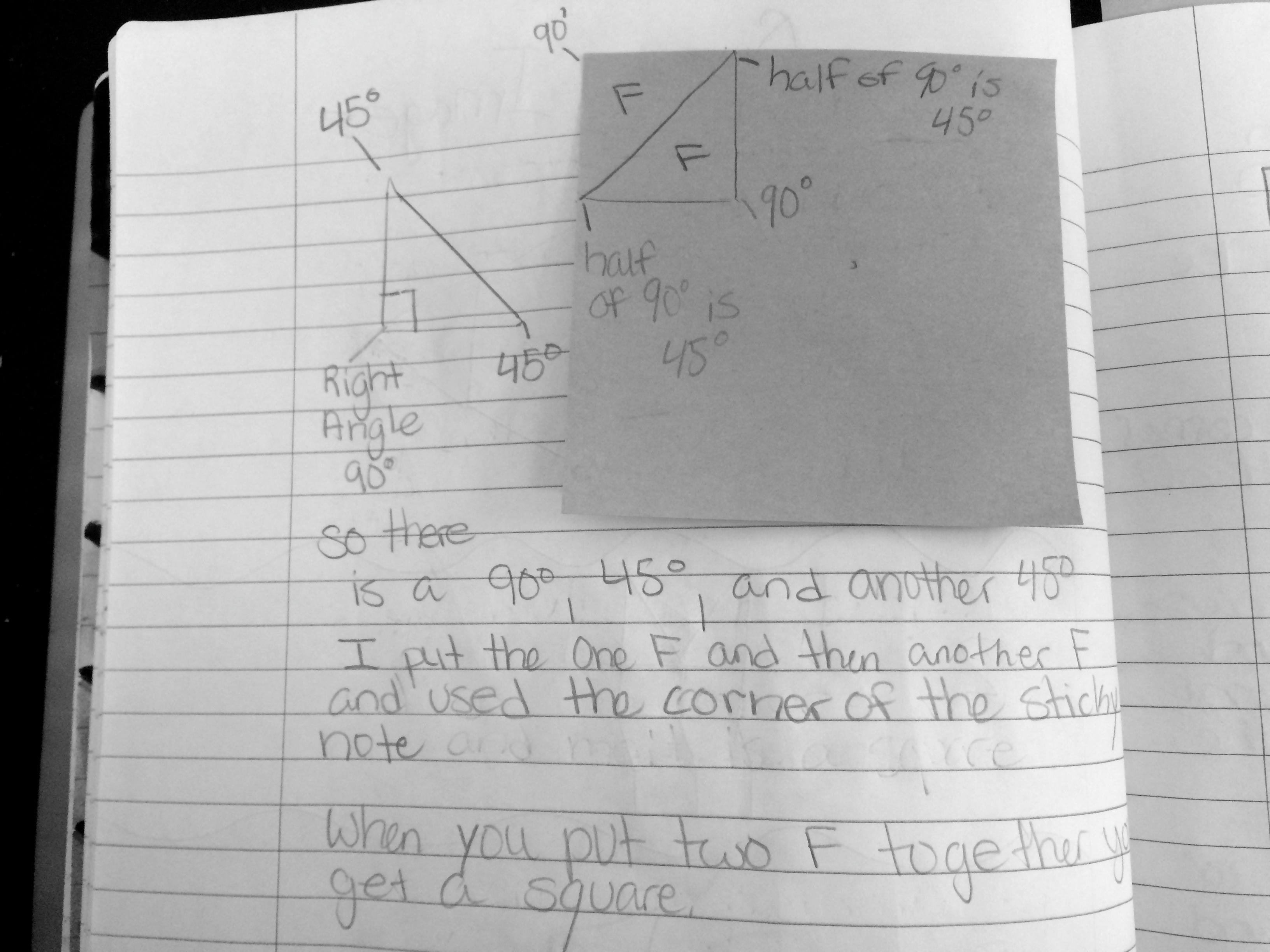
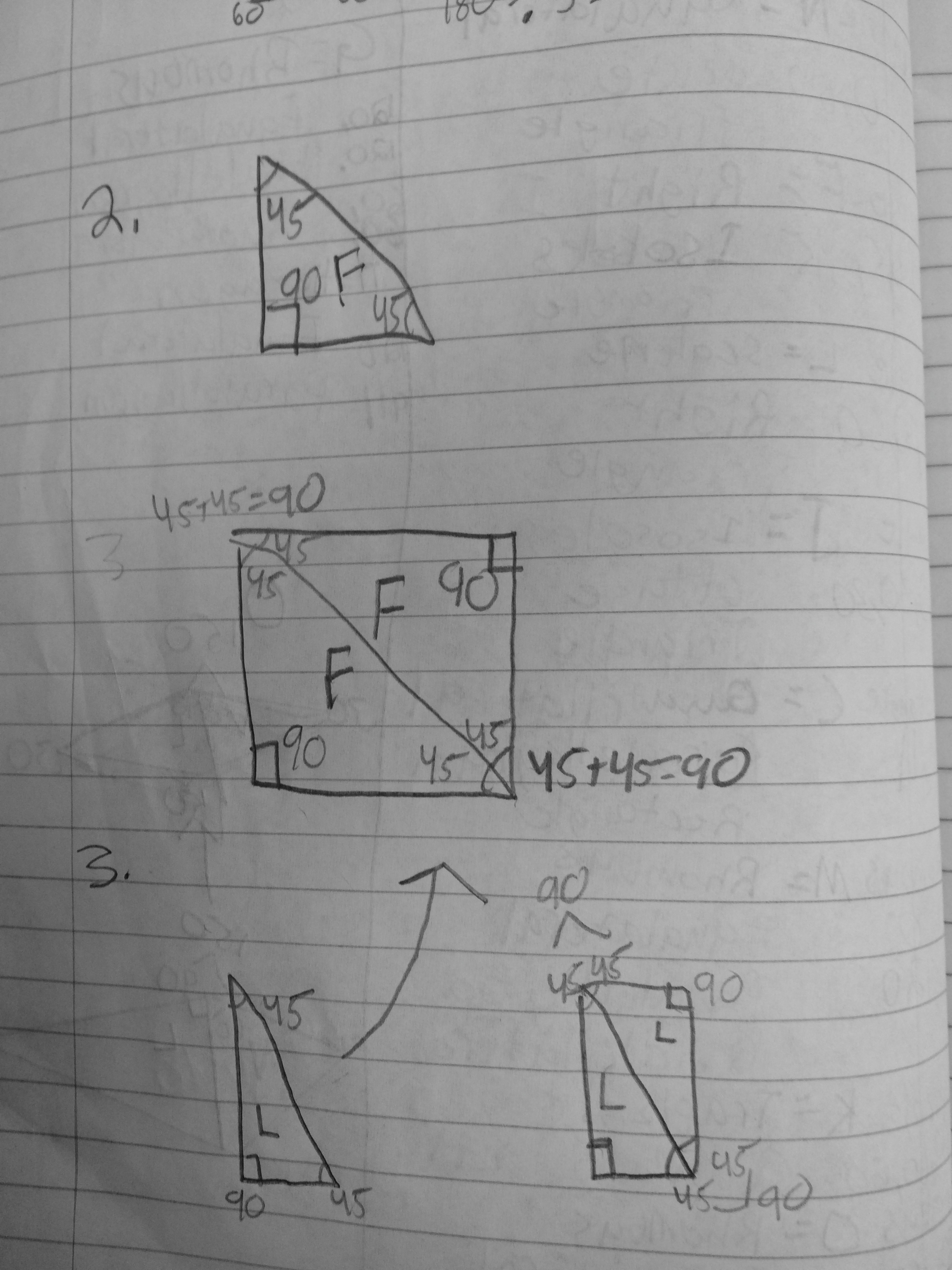
The first day, I put polygon F on the whiteboard and asked tables to develop a proof for the angles in F. I was excited to see they had worked with this in 4th grade and were comfortable in being able to prove it was 90, 45, 45. Here are a couple of the proofs from that day’s work…

IMG_8423 IMG_8422IMG_8417IMG_8457

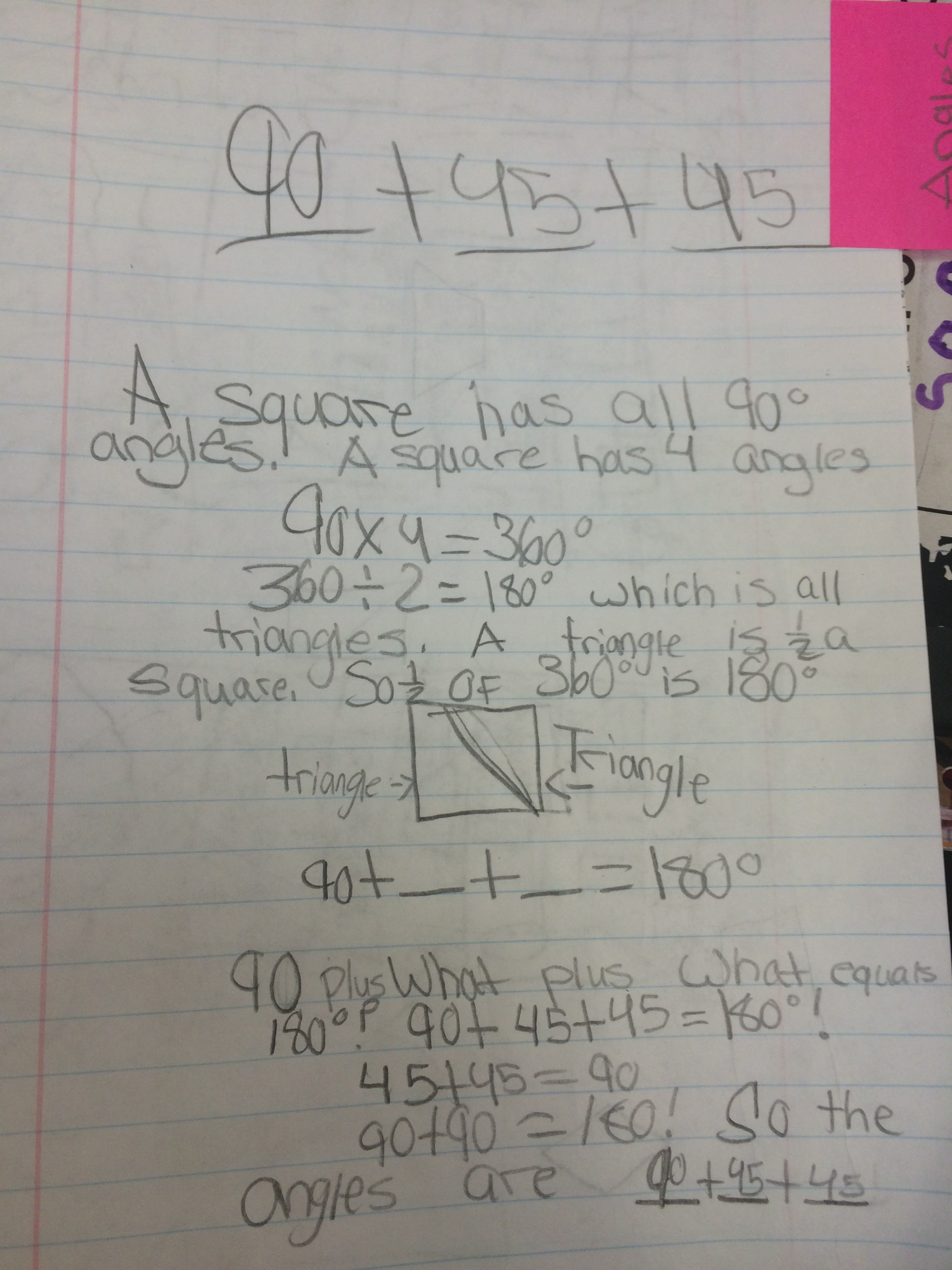
It was interesting to my colleague and I to really think deeply about what the students were saying in their explanation. We had to ask ourselves if they were really thinking about the angle itself when they were saying “A triangle is 180º because it is half of a square which is 360º.” Their proof with the polygons looked like an area model, so were they thinking about the angles or thinking that the area of the triangle is 180?

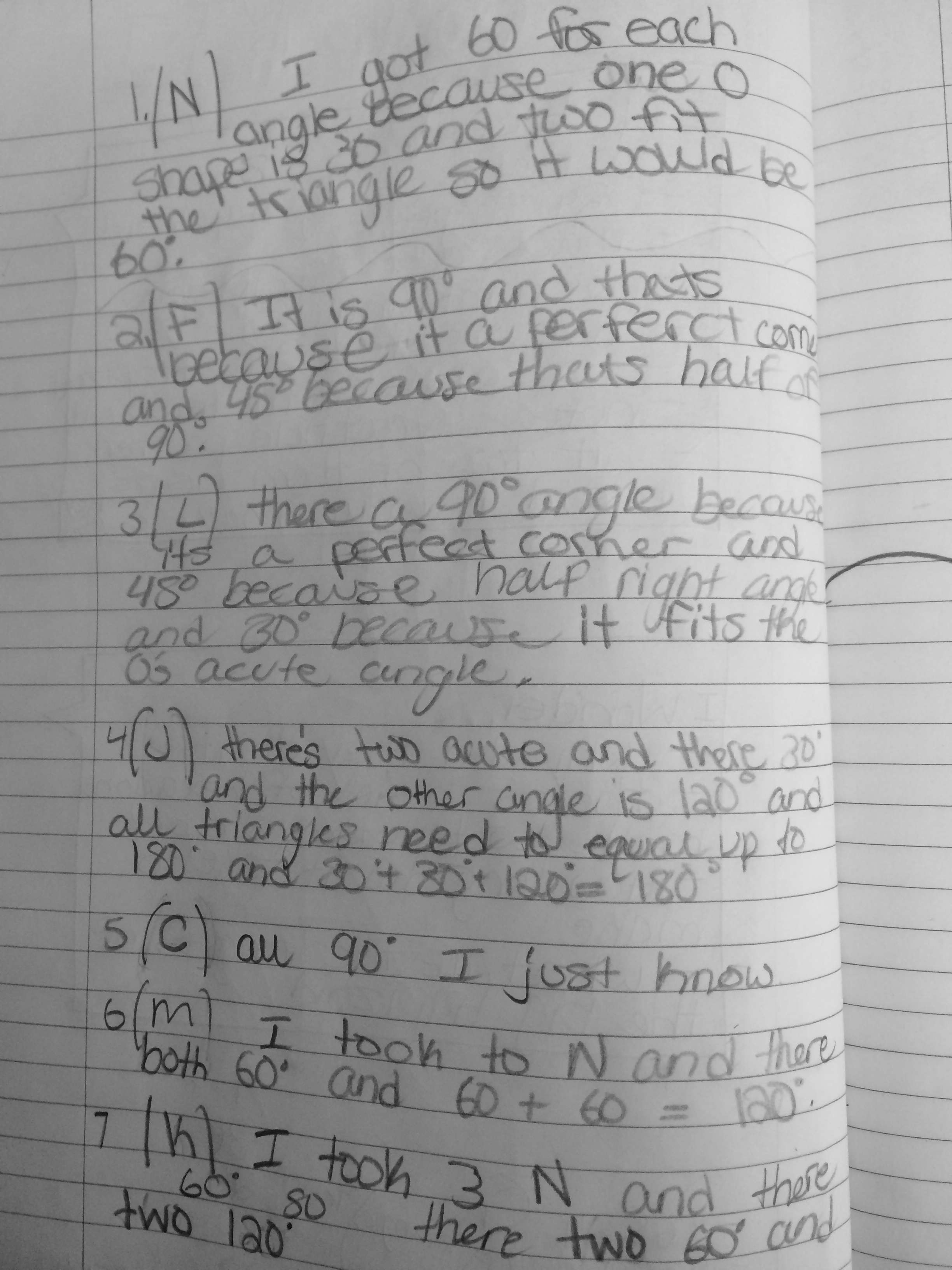
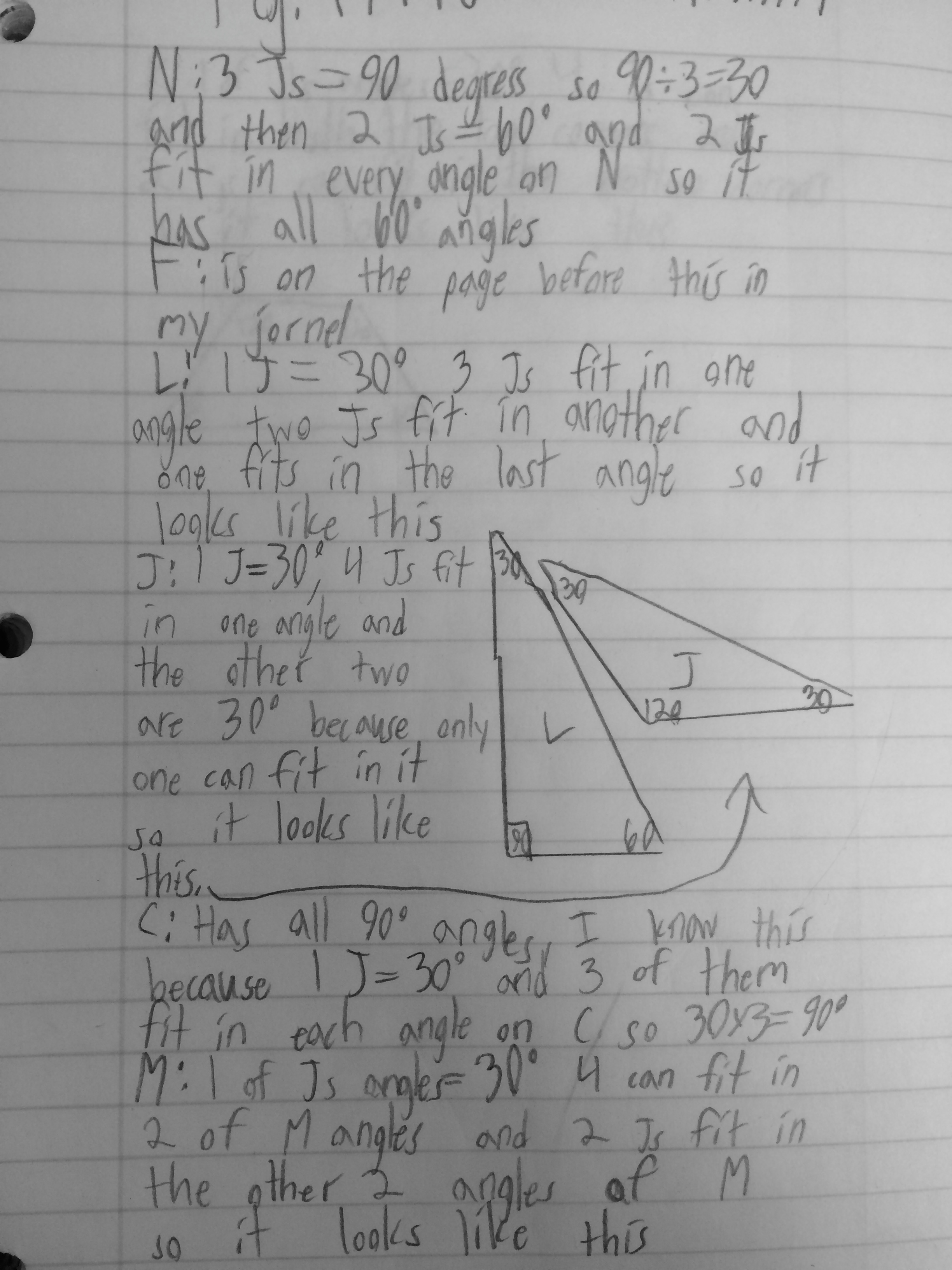
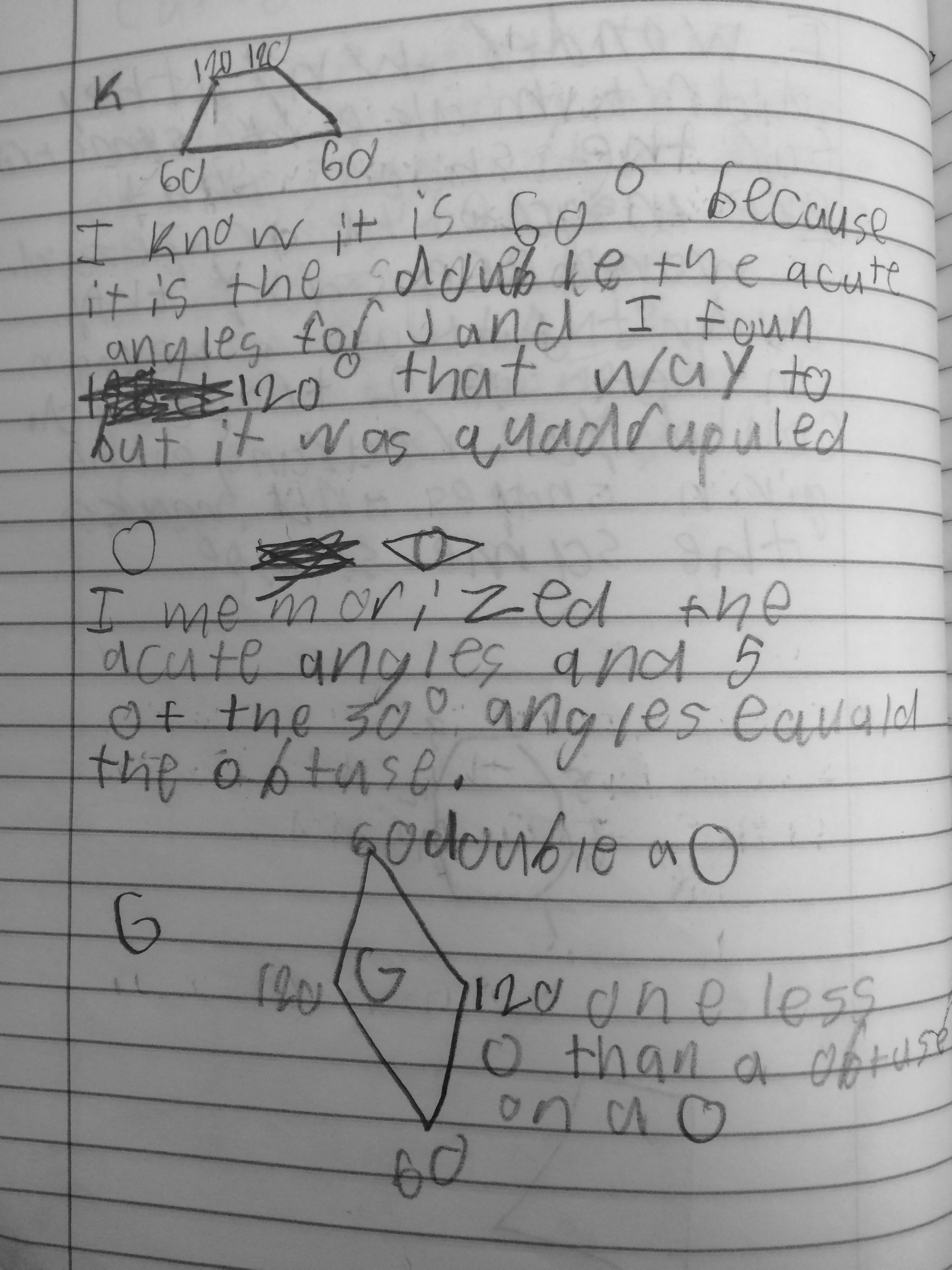
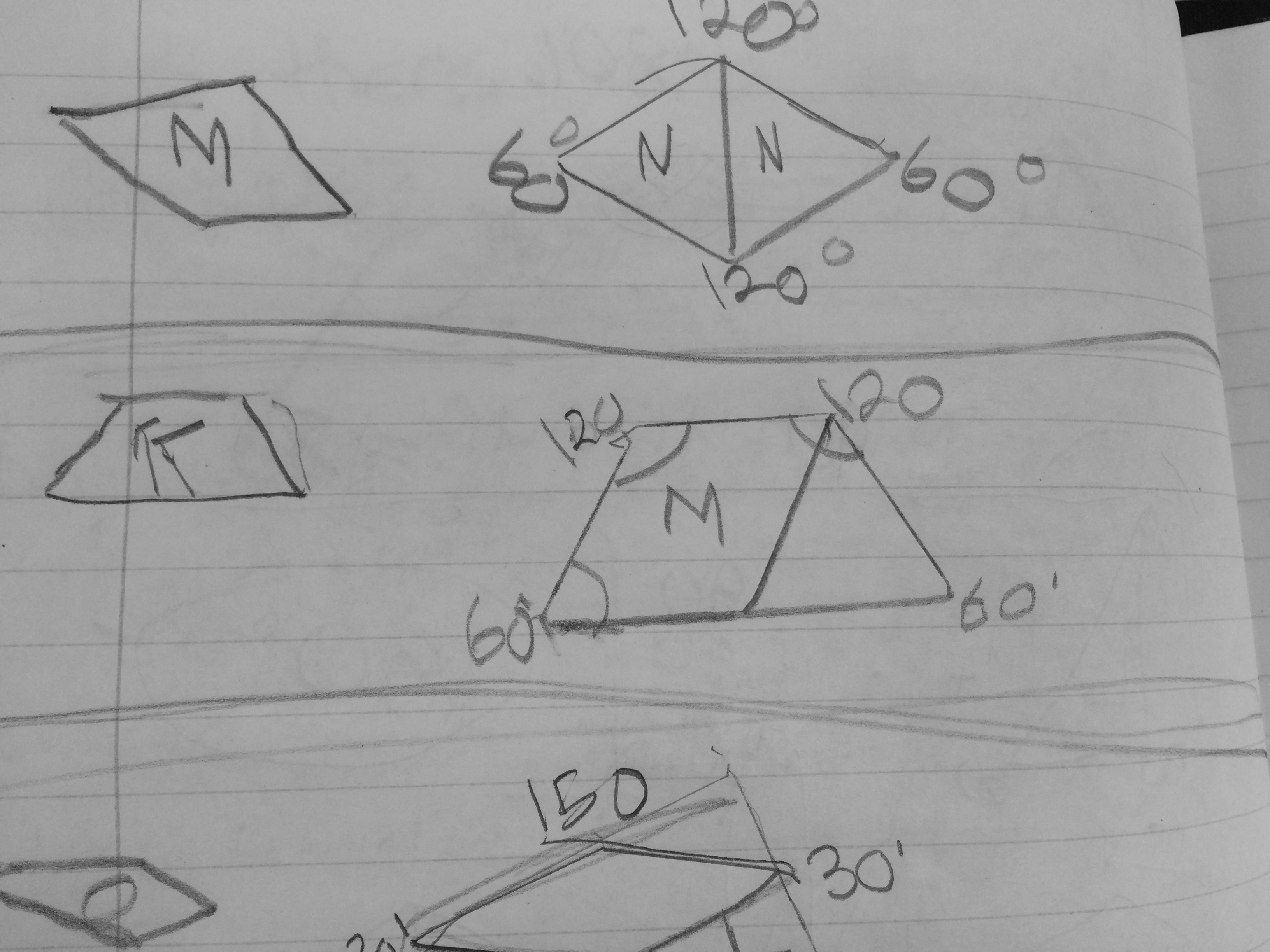
In the next activity, I really wanted to focus on students composing and decomposing the angles themselves. They worked in groups to find the angle measures of the remaining polygons on the above sheet. Here are a few of their proofs that we shared as a class.

IMG_8458 IMG_8459 IMG_8460  IMG_8462IMG_8461

After sharing our proofs today, I felt very comfortable with student understanding of finding missing angles and thought it would be interesting to move into construction of these shapes in Hopscotch (a coding app). This is one of those things that is not explicitly in the curriculum, but something I just think is so great for students to explore. It is wonderful for students to see angles as turns and explore supplementary, interior and exterior angles.

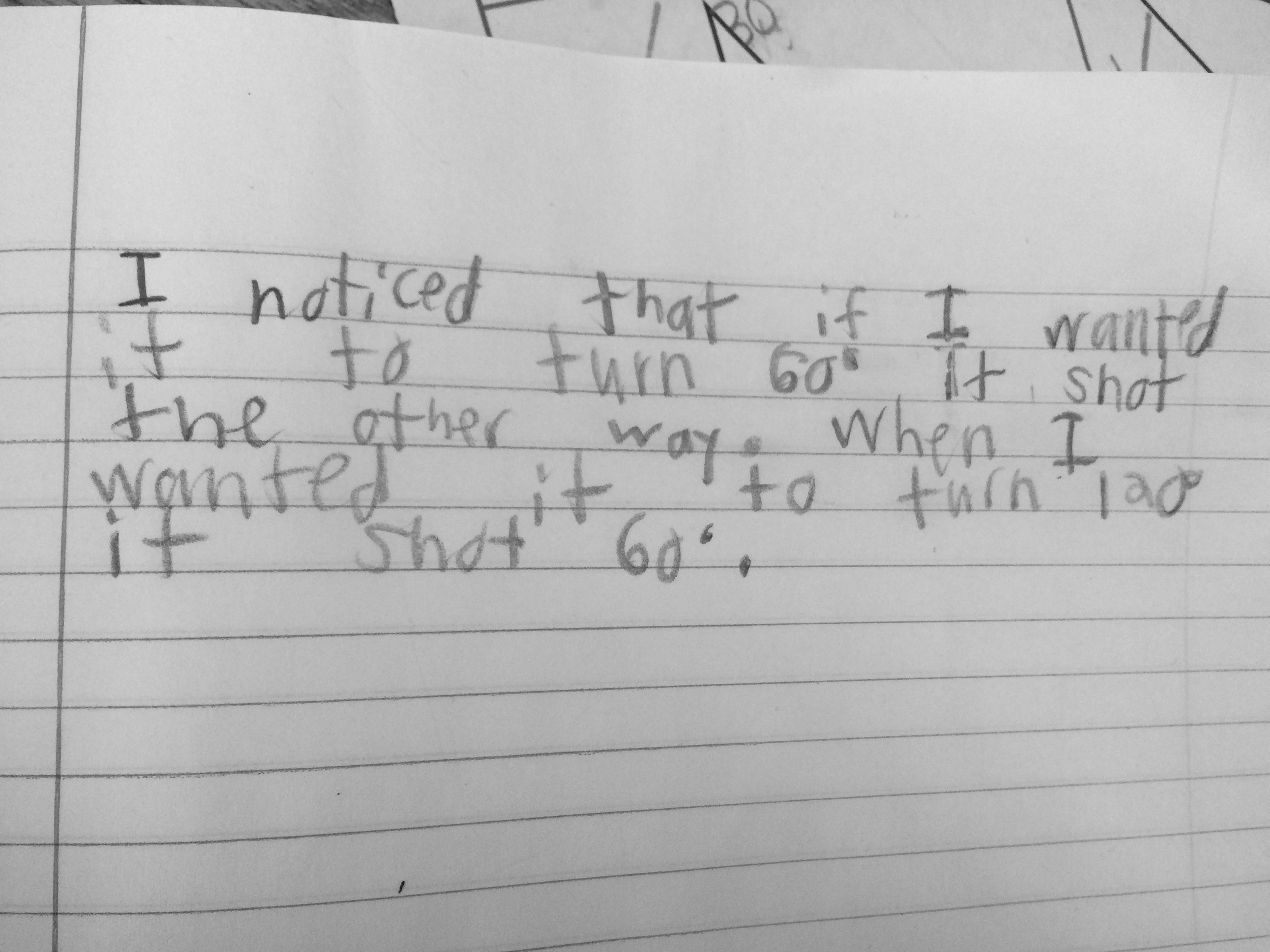
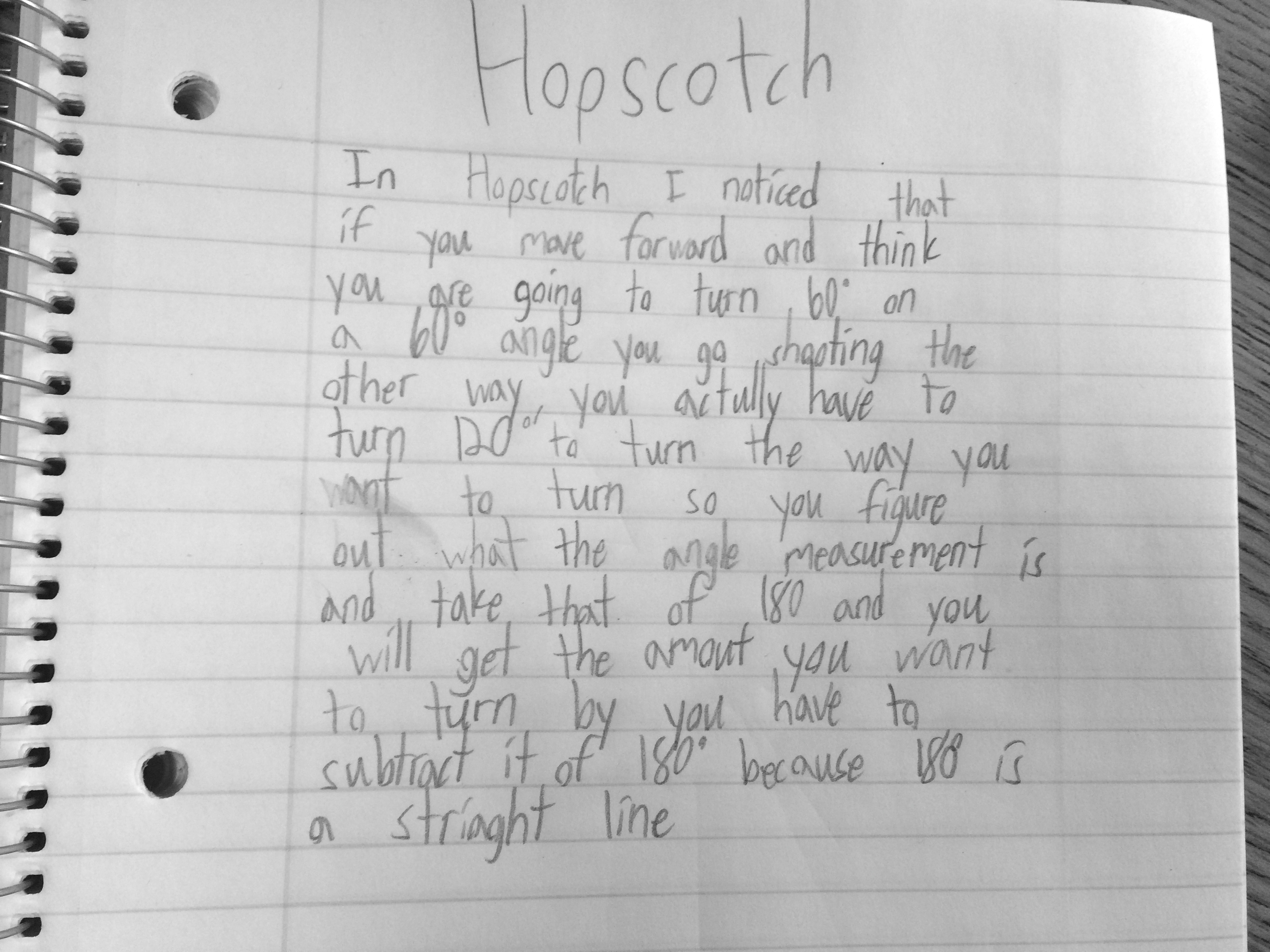
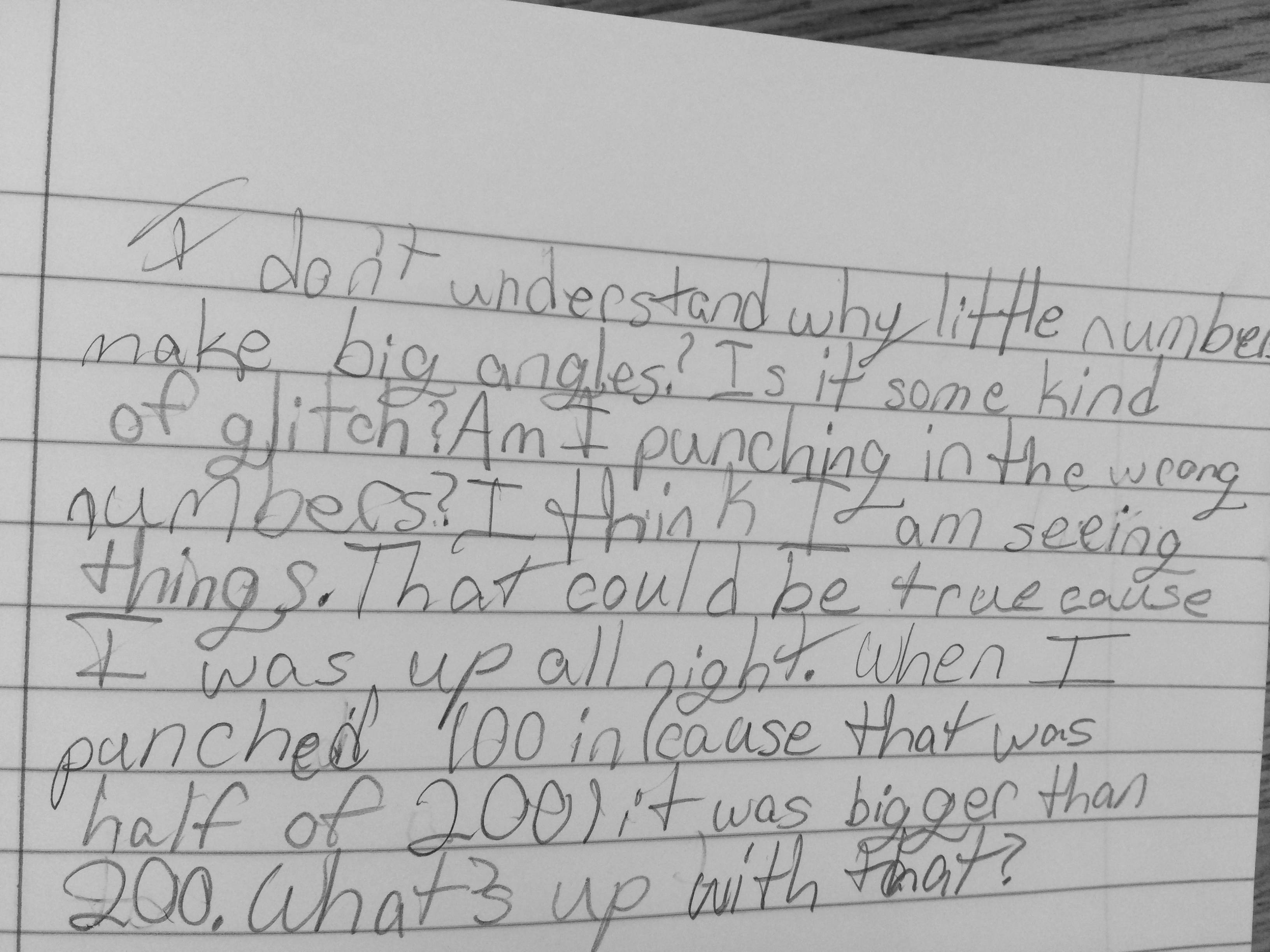
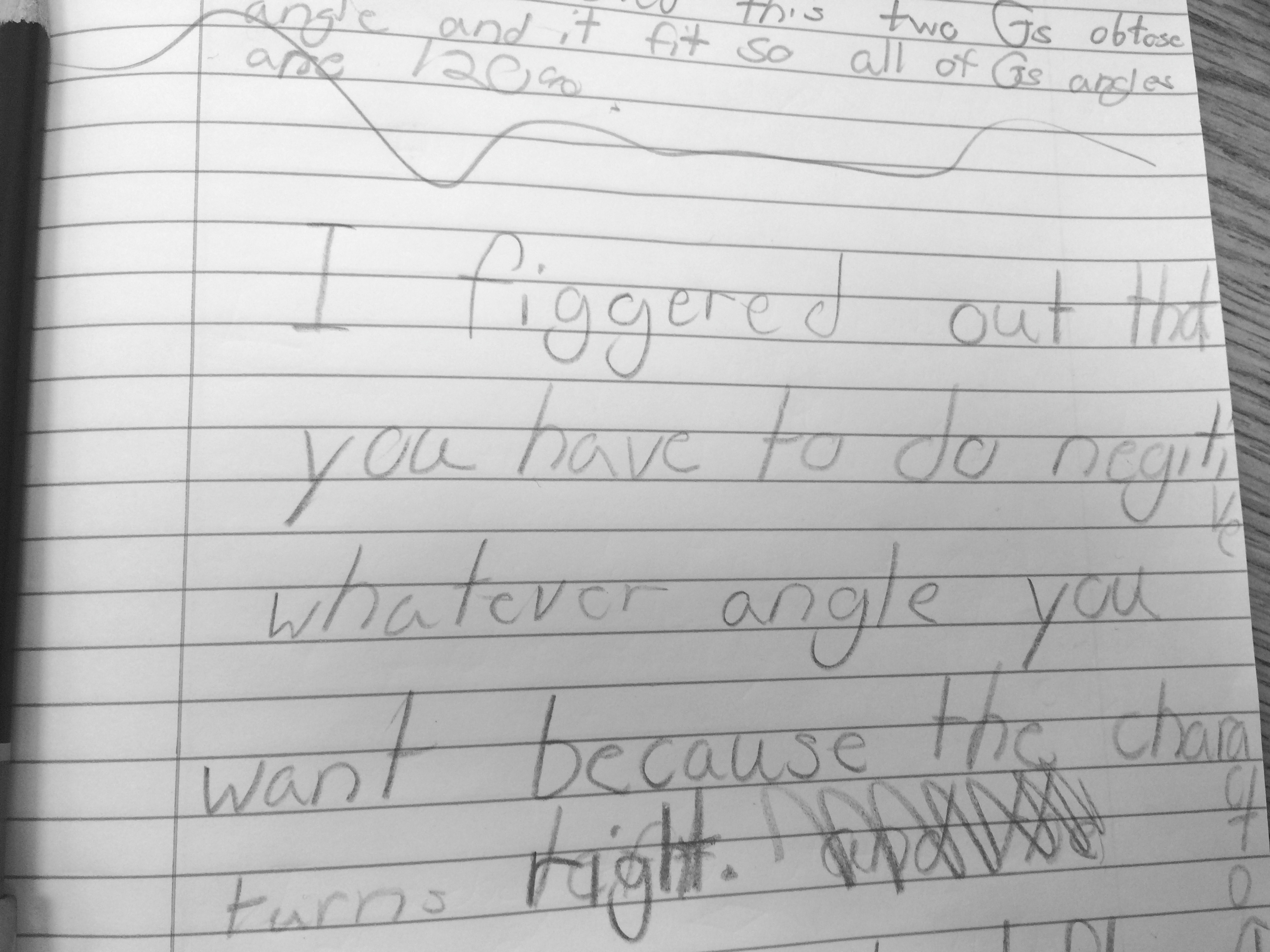
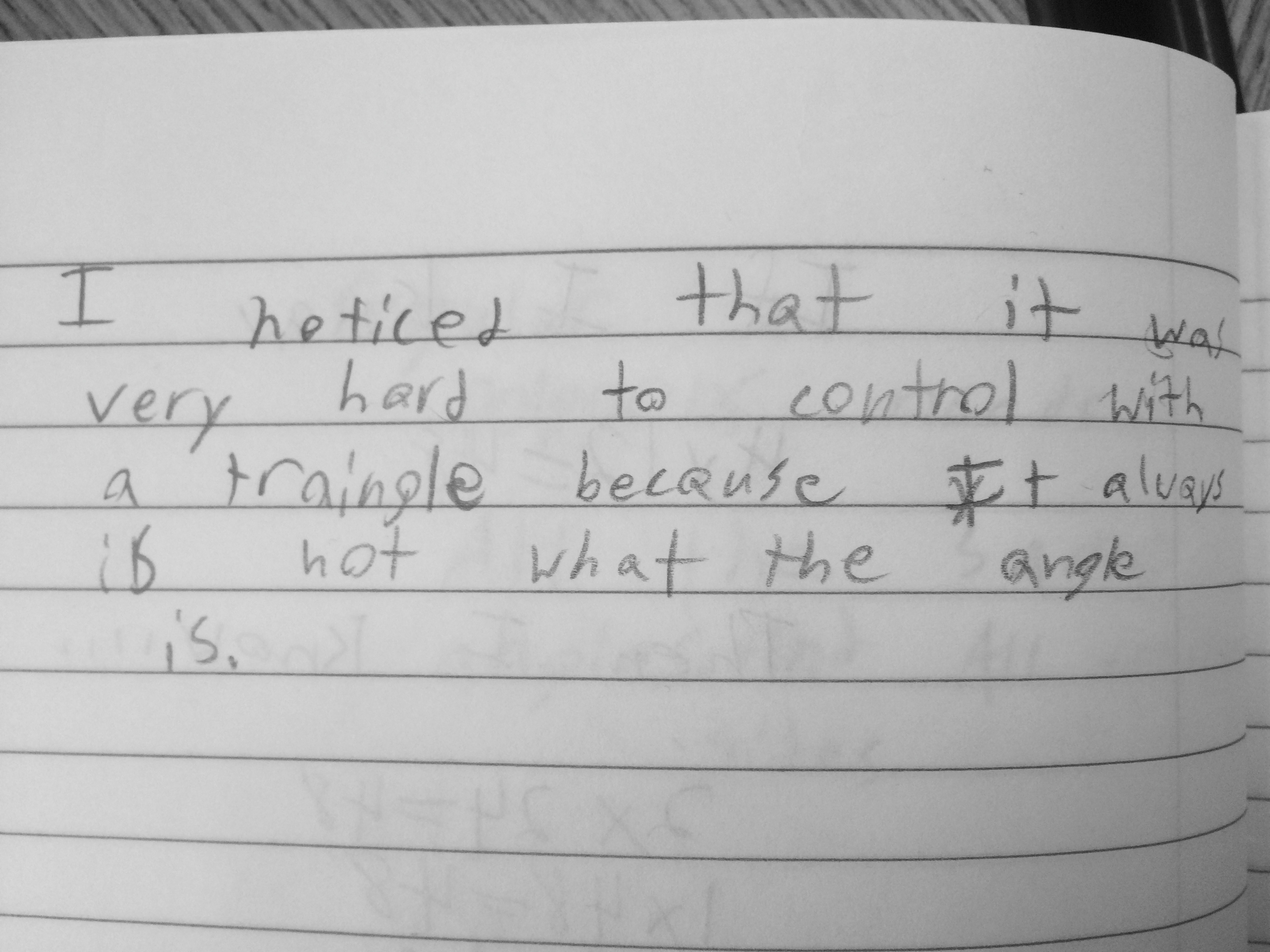
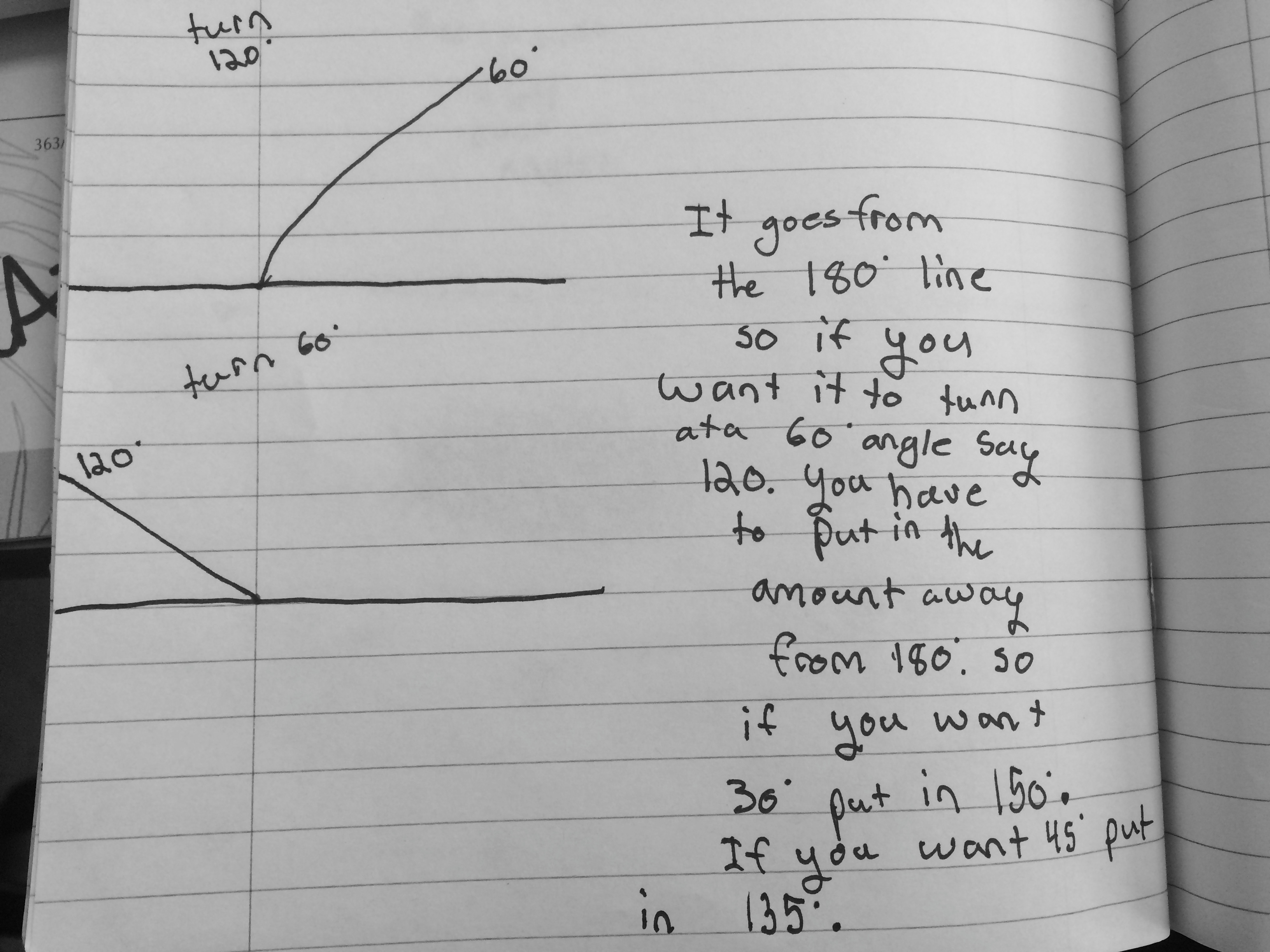
We practiced making a square together to be sure everyone had an understanding of how the codes worked and then I sent them off to build the triangles. You can imagine the surprise as they punched in 60º for the turn to make an equilateral triangle and the character shot off in the wrong direction. I let them work their way through it and then reflect in their journals after. Here are some of their thoughts…

IMG_8451 IMG_8452 IMG_8453 IMG_8454 IMG_8455 IMG_8456

They left me with so much to think about for Monday’s lesson. I love the idea of a negative number makes them turn the other direction, the relationships to 180º, and the two angles adding up to 180º. Interesting stuff!

-Kristin

Fraction Flexibility in Number Talks

In my RTI (Response to Intervention) class, I use Marilyn Burns’ Do The Math program, which is wonderful for building conceptual understanding of fractions through the use of fraction strips. Students use the fraction strips to build equivalencies, make comparisons and add/subtract fractions. It does not take long for students to be able to “see” the equivalencies without having the strips in front of them and develop fluency and flexibility with fractions. In addition to this module, I do Number Talks with the group. I do a combination of whole number operation talks and fraction number talks.

This Thursday, I did a Fraction Number Talk in which I wanted students to think about the fractions and make friendly combinations when adding. I never like to pose a problem with one solution path, so each can be solved using another strategy, however my goal was making friendly combinations. Next to each problem I put my thought in brackets so you have an idea of what i was thinking:) This is the string I planned:

2/4 + 2/3 + 6/12      [(2/4 + 6/12) + 2/3]

2/3 + 1/4 + 1/4 + 2/6  [(2/3 + 2/6) + 1/4 +1/4]

1 3/8 + 5/10 + 3/4  [(5/10 + 1/2)+1 3/8 + 1/4]

They did so wonderful with these and some began whining that these were too easy and to give them something really hard. So I gave them my final problem:

2/3 + 1/2 + 3 + 1/4

There were a few groans and “this isn’t hard“s because they went to 12ths and had the answer quickly. I told them if they had the answer, to try to use the strategy they had used in the previous problems to see if they got the same answer. I was thinking they would use a piece of the 3 to make the 1/2 and 1/4 a whole, but of course there is always one who surprises me! He had a beautiful explanation so I asked him to write it down for me so I could remember. He got a little mixed up in his wording, so I will do a translation after you check out his reasoning.

IMG_8300

He took 1.5/3 from the 2/3 to add to the 1/2 and make a whole. He then added the 1/2/3 to the 1/4. I, of course, asked him how he added that and his response was so beautiful as he explained it to me. I mean how amazing is it that he knew 1/2/3 is equivalent to 2/12…and this was all mentally!

Let me assure you that this student CAN add these fractions in a much more efficient way, and this was him challenging himself to play around with the fractions. THIS is what I would consider flexibility in operations and also where I want students to see math as fun…playing around with numbers!

– Kristin