Category Archives: Math

My Questions Around Professional Development w/Video

When I read this blog post by Grace, and the comments that followed, I noticed some things…

1 -The wonderfully open, honest way in which Grace put herself out there and responded to each of the comments.

2 – The amount of incredibly thoughtful and thought-provoking comments.

3 – The community desire to have more of these videos for us to have discussions around.

4 – I reflect and learn so much through these interactions.

*At this point of reading, If you do not already follow Grace’s blog, you must do that ASAP*

My noticings led me to these questions around the types of video we, as a math community, would like to have available for either individual or group professional learning experience:

1 – What time range do you prefer when watching an classroom video clip? Is it different in a professional developmet setting vs at home?

2 – Do you like an open Notice/Wonder format when watching/discussing a video or prefer having a “focus question” when watching/discussing?

3 – What focus questions would be most helpful for you to either think about or discuss after watching a video?

4 – What makes you want to comment on a video or blog after watching/reading?

5 – What makes you NOT comment on a video or blog after watching/reading?

If you have any thoughts, answers, or suggestions to any of these questions, I would love your thoughts here: Google Form

Thanks so much!

Kristin

Number Talks vs Number Strings

CHvklLzUEAA3JsZ

When I first saw this image, I have to admit, it didn’t match what I had been calling a Number Talk in my classroom. Having started my journey with Number Talks with Parrish’s book, I saw it as a string of problems with a specific strategy as the focus of the string that got progressively more difficult (which sounds more like a string in reading this slide). As I started creating my own and making variations to them over the past couple of years, I have simply started calling them Math Routines….it was just easier than trying to make things fit into a certain framework in my brain. After going back and forth about terminology, I started looking at these structures more in the sense of purpose than the name and I am finding it very interesting. Please keep in mind as you read, this is completely from my experience with Math Routines in the classroom and I find all of these talks so incredibly valuable!

First comparison: Single problem vs string of problems. In my experience, I think these two designs have a substantial difference in purpose. When I give one problem, I am going for one of two things: a variety of strategies to see where students are in their thinking OR connections/comparisons of multiple strategies. Personally, I like the variety of strategies before and after we have investigated different ideas that could impact their thinking. For both the students and myself, it shows growth and I can use what I find to help me in planning future routines. Connecting and comparing takes a bit longer and, for me, I don’t get as many strategies out because we focus on connecting and comparing only a few for time’s sake.

Second comparison: Difference in having a representation and context. I don’t give a representation or context unless a student brings one up in a explanation. If it comes from them, I go with it, if it doesn’t, I don’t write it up there. If there is a specific representation I am hoping comes up because we have been doing work with it during our math class, but doesn’t, I do have them do a quick journal response. I will ask them something such as, “How was our number talk similar to or different from our work in math class this week?” Then I can read their journals and have some students share the next day about the representation connection they made. I also have had students create contexts after we finish a number talk with a prompt such as, “Write a context that you think fits one of the problems in the string. How does the context change for another problem in the string?” For example if the string has “16 x 4” followed by “16 x 8” I am hoping to see connections between the two problems in the context.

Nothing to compare in the final piece, multiple strategies discussed in both!

In the end, students are talking math with a mathematical purpose so they are win/wins in my book, but I am curious to hear what others think around the purposes of different formats of these routines! Would love to hear other ideas so comment away!

-Kristin

Growth Patter Number Talk….3rd Times a Charm

Over the past couple of days, with my homeroom, I have tried a few strings of numbers to bring out the different ideas that are important when thinking about growth patterns and finding any term in a sequence, Here and here. Both days brought out many great ideas, conversations, and disagreements, however I couldn’t help but feeling the ideas we talked about in two days, could have been achieved in one and felt a little more connected. I knew it was completely the way I posed the problems, so when my second class came in yesterday, after missing a couple days of math due to testing, I was excited to try and adjust my previous work.

Apologize for the messy board, but I still cannot seem to get a handle on that recording thing…

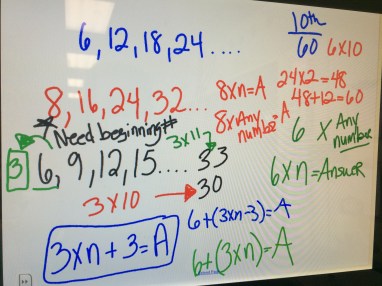
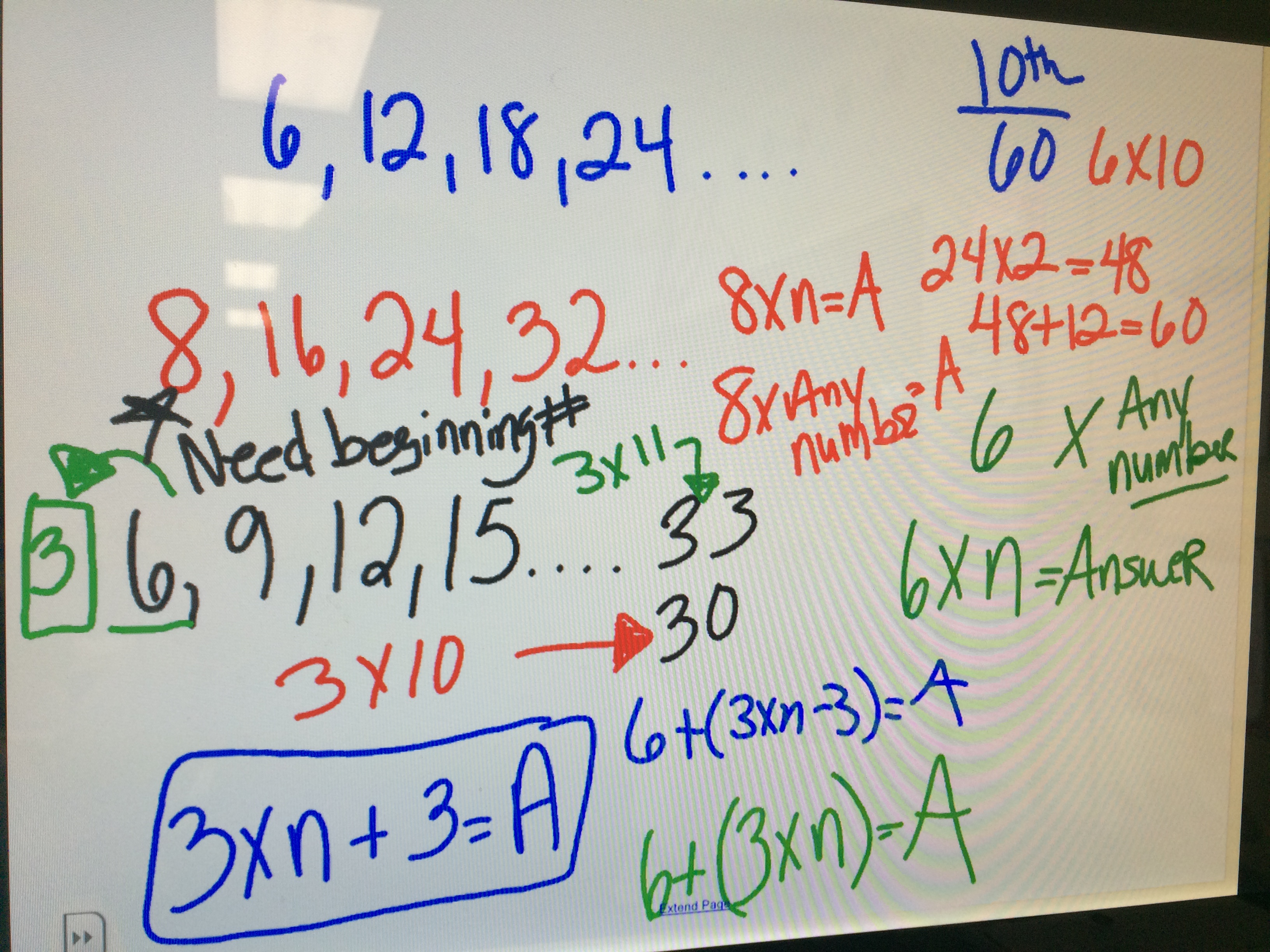
I started with having a student count by 6’s and wrote that in blue. I stopped them at 4 because I was asking about the 10th term and wanted to see if some would figure our 5th and double. I think that is an interesting thing to think about when the start is different so I wanted it up there. I asked 10th term? 60. Ways to get there? 6 x 10 and, unlike my prediction of doubling 30, one student said 24 x 2 because two group of 4 of them is 8 and then two more 6’s (12) is added to that to make 60. I asked 100th term? 600. 2,000th term? 12,000. I asked them how they were getting those without counting and I got “I did 6 times 100” “I did 6 x 2000” and then one student said you could do any number by multiplying it by 6. I asked how he wanted to write that and I wrote that in green. Another student, who has done Visual Patterns with me in our RTI group, said, “We can also write that as 6 times n = Answer.” I asked them to turn and talk to a neighbor if they thought that meant the same thing. We had all yeses and I had some student prove it. I did the same thing with 8’s and wrote that in orange. They started using “A” for “Answer.”

IMG_0774_2

After that, I asked them to to count by 3’s starting with 6 and stopped them at 15… Asked for the 10th term and got, as expected, 30 and 33. Then the conversation took off with proofs and some really important ideas that was hoping would emerge. I love it when the class is practically divided in half on an answer, we had the 30’s and the 33’s. I asked a 30 to explain how he got the answer and he quickly said 3 x 10=30. I saw a lot of agreement, so I asked for a 33 to share their reasoning. A student said that we “need the beginning number, three, to find out where the tenth one is. 3 x 10 is 30 but then you started three ahead of that so you add 3 to 30.” I wrote that down on the board.

A student then said something that made me have a realization, “It shouldn’t change because you are still doing 10 jumps of 3, so it HAS to be 30. 33 is 3 x 11.” In my last class I had a student who kept insisting that the 10th term remain the same no matter where we started and I could not figure out what they were trying to articulate. NOW, I understand. 30 will always be the distance between wherever we start in the sequence and the 10th term, but not the tenth from the true beginning. AH HA!

IMG_0774_2So, the beginning number was suddenly becoming very important and articulating “10th term from where” was having students agreeing that the 10th term starting from the 6 was going to be 33 but when thinking about a rule for the pattern we needed the true beginning. We were just about to head back to our desks to continue our work when a student (different than the one who had originally said it) said that we could write this one “3 x n + 3 = A” because you have to “add the three you are missing from the beginning to get the answer.” I had them turn, talk and try a few terms out and see what they thought. It was all wrapping up nicely (I was excited about it) when another student said, “You could also write 6 + (3 x n) since you are starting at 6” ….oh goodness, they just don’t ever let it end and I love it:) A disagreement arose that it would have to be “6 + (3 x n -3) because of that extra jump of 3 to start at 6.”

I always hate to say that time got the best of me, but I had missed this group for 2 days of math and I saw this conversation going lonnnnng so I had them write those ideas down in their journal to kick off our class on Monday!

I love when I have the chance to refine ideas that don’t go exactly as I had hoped they would, especially when I know it was completely how I posed the problem or asked the question. After a couple days of talks not connecting as I hoped they would, third time was a charm!

-Kristin

Listening Carefully to Student Thinking

Recently, I have been reviewing a new “CCSS-Aligned” middle school curriculum and find myself completely frustrated with the overabundance of scaffolding and lack of student thinking required on every assignment. Not having the days/weeks it would take for teachers to engage in the mathematics as both learners and teachers, I needed a short, powerful way to show that this is not how students should experience/learn mathematics.

As I looked at the fraction page like this, my thought was “Why just two ways?” quickly followed by “Why those two ways?” quickly followed by “My students are doing this now, flexibly.”

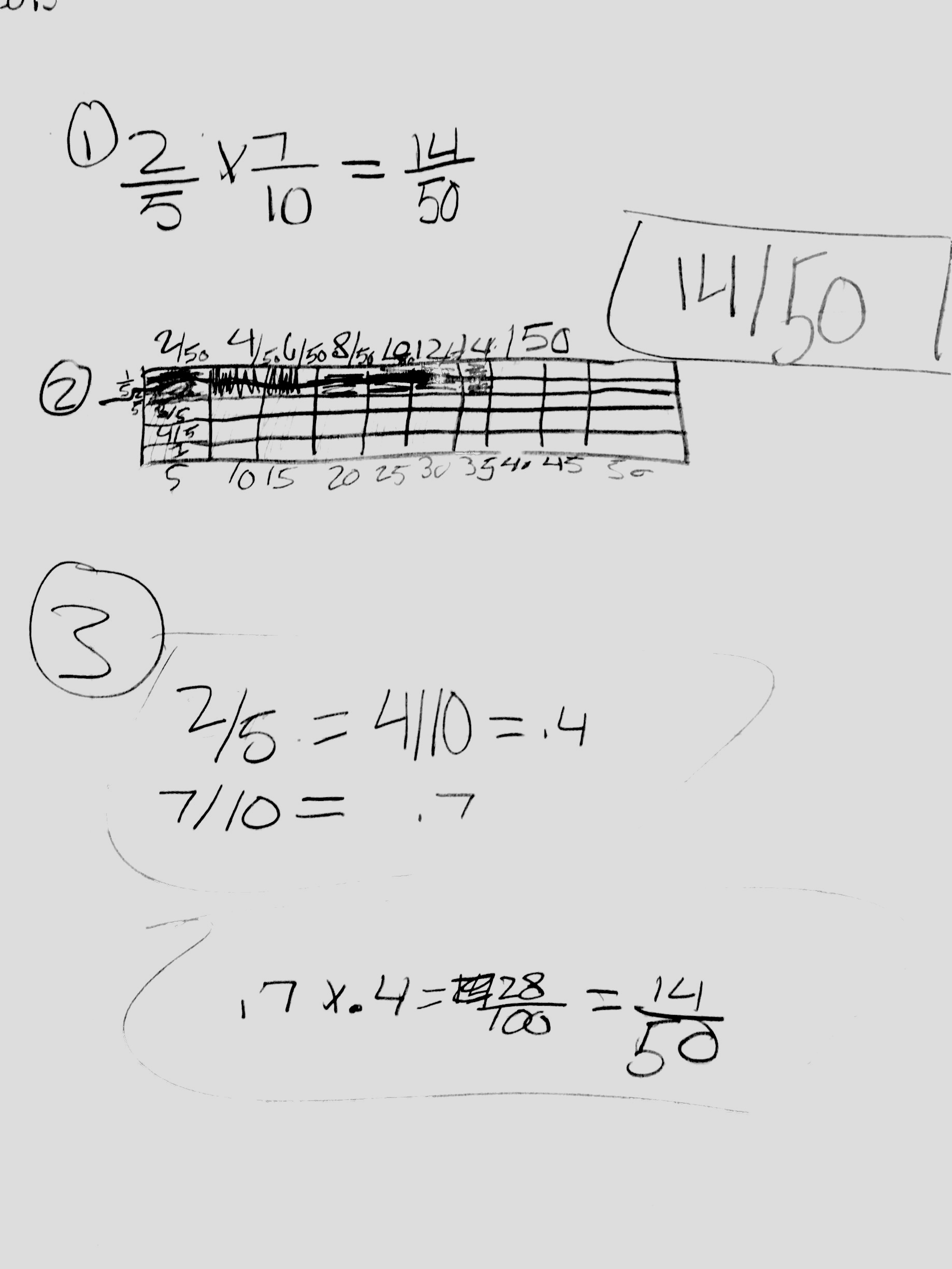
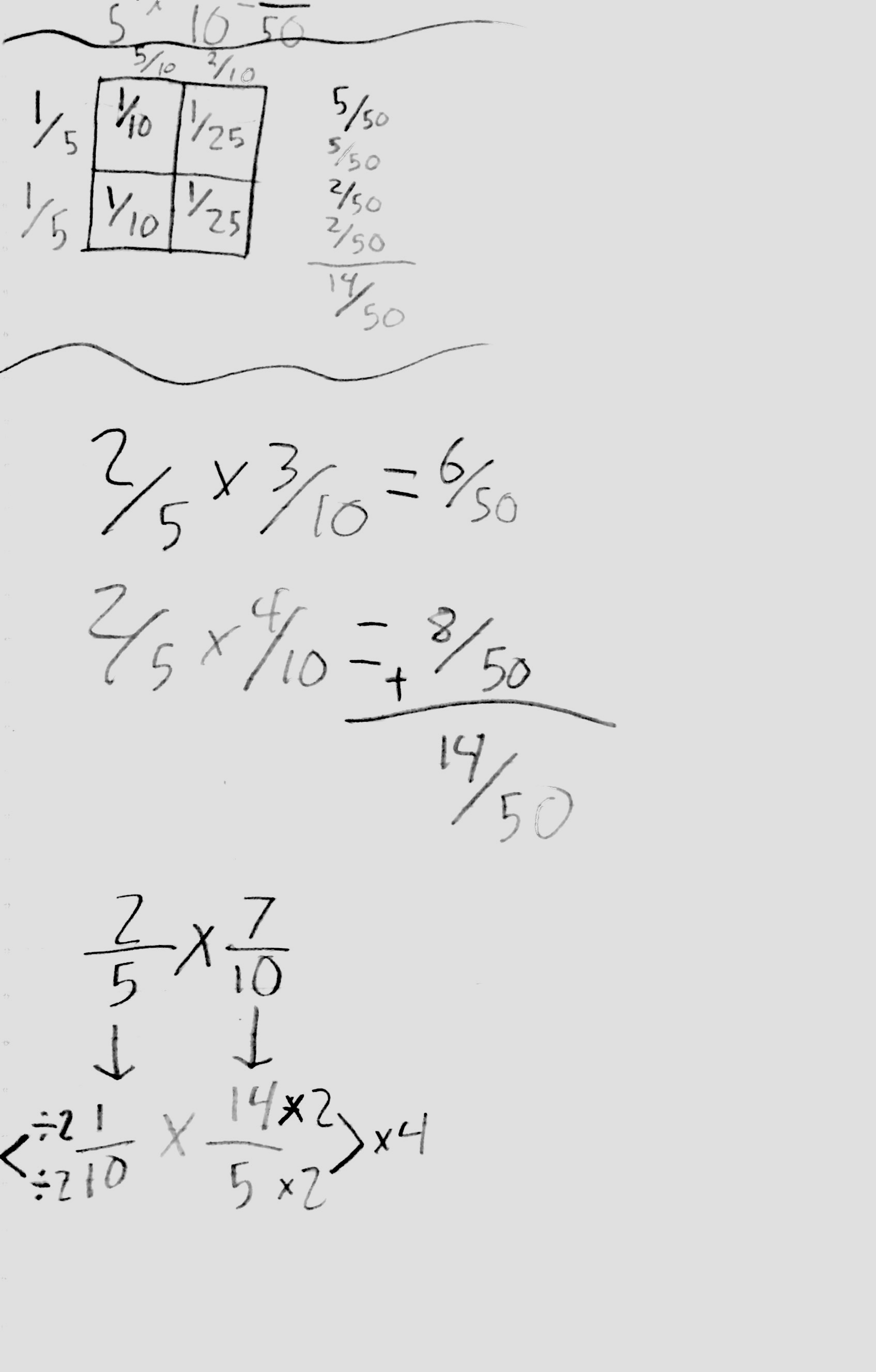
IMG_0598Right then, I realized the perfect proof of why NOT to do this, was the work my students already do when given the freedom to reason about a problem and do more than just procedurally compute an answer. So, I put the proof in their hands.  I simply asked them to solve 2/5 x 7/10 as many ways as they could. Some got creative after a couple of ways, and by no means am I saying some of these are “efficient,” but they show so much flexibility.

new doc 9_4 new doc 9_5 new doc 10_4new doc 10_1

This felt perfect. Why would we want to miss out on all of the great conversations that can happen around this work by making them answer in just 2 ways, and more specifically, those 2 ways they show you how to do…step-by-step?

and THEN this happened which validated my thoughts even further and instantly made me reflect on my friend Christopher’s talk at ShadowCon (video coming soon) around listening carefully to student thinking…

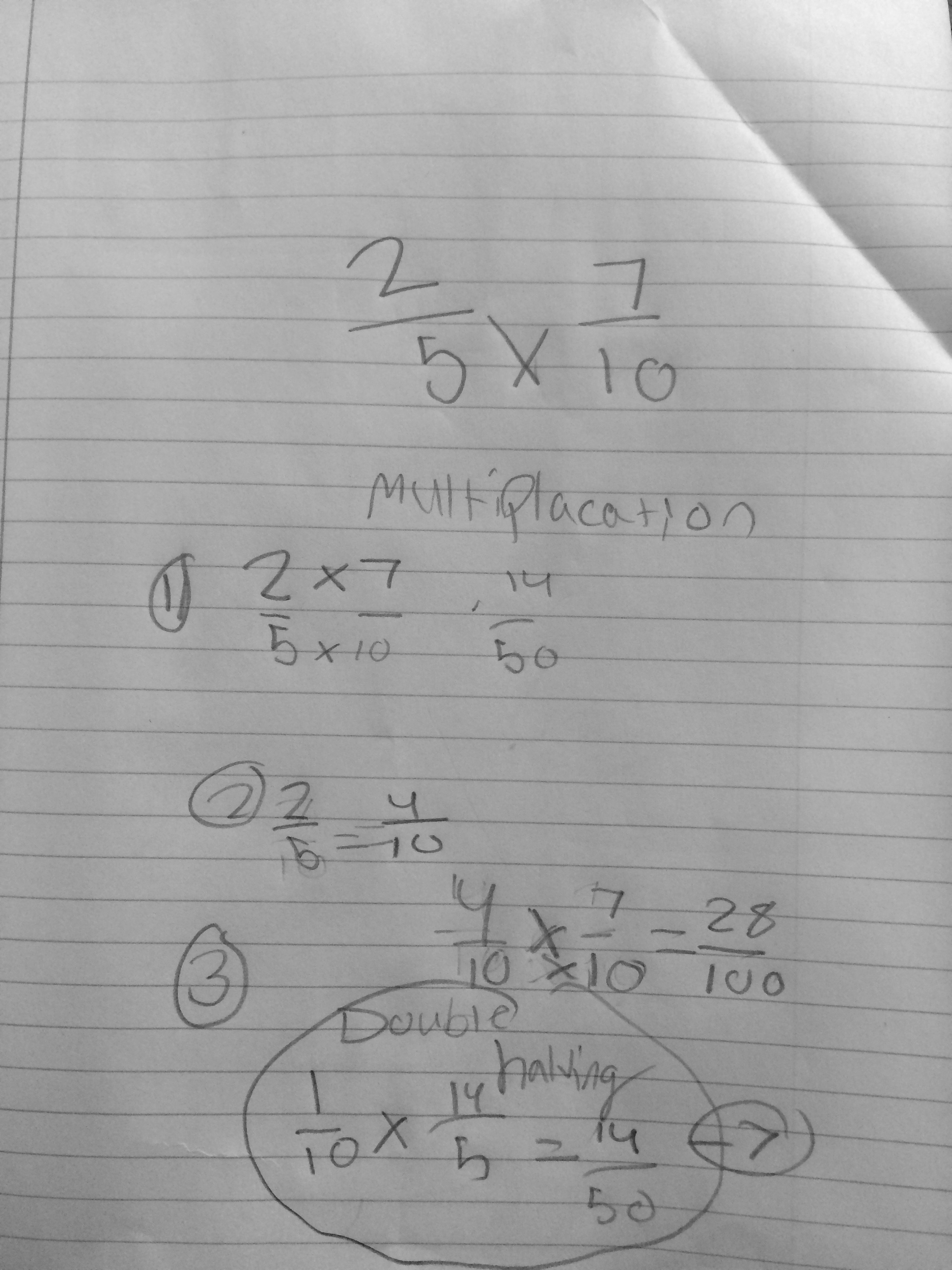
The students were working on 2/5 x 7/10 as I was walking around the room observing their work. I glanced over a student’s shoulder and saw “Doubling and Halving” written on her paper with the correct answer. Assuming it was doubling/halving in the sense of doubling one factor and halving another factor, I was excited to see the use of the strategy.

IMG_0643

I asked her how she did it, she said, “I double/halved” and I was about to move on to get ready for our sharing. When I glanced down, however, it was not at all like I had imagined. I asked her to explain further…“I halved this numerator and doubled this denominator [points to 2/5] then I doubled this numerator and halved this denominator [points to 7/10].”. Ok, now THIS is much different than I thought!!

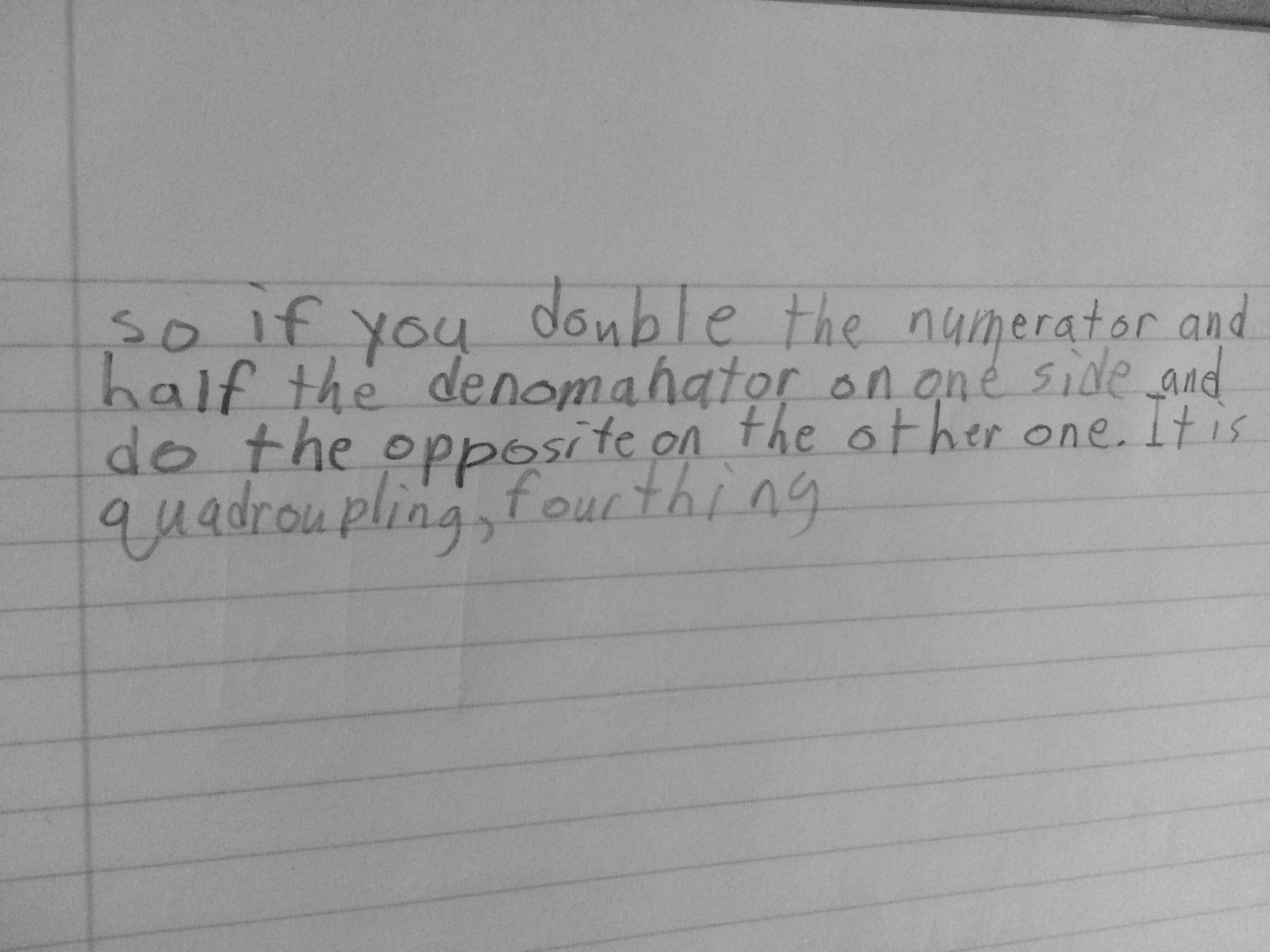
I had her share, and others immediately said they had double/halved also but did not get those fractions to multiply and wondered if that worked every time (I love that they ask that now:). I let them play around with it for a bit but since we had some division work to do I told them to keep thinking about that and we will revisit it tomorrow. By the end of the next class period, I had a student come up and say, “She didn’t double/half really, she quadrupled/fourthed.” I asked him to write down his explanation for me because it was lovely.

IMG_0647IMG_0648So glad I listened carefully and didn’t makes assumptions on her understandings because how amazing is this work? I am also so glad that I can appreciate a curriculum that allows for these reasonings and conversations to happen.

-Kristin

Subtraction Number Talk: My Curiosity Today…

Subtraction is the one operation that every time it arises in class, throws one more thing for me to think about into the mix. I have two recent posts around decimal subtraction, here and here, and I continue to work with whole number subtraction through number talks.

Today, I only had time for two problems in the Number Talk due to testing 😦 The first problem was 400 – 349. I was most anticipating students would subtract 50 and add one back or add up from the 349 to the 400 (1+50) to arrive at the answer of 51.  I was surprised when a student said he “subtracted 100 – 49 to get 51 and knew that would be the same answer because if you added 300 to both numbers it would give you the same problem, so the same answer.” This made me think of a distance model on a number line, but I completely missed that opportunity and moved into the next problem. Seeing what happened next, it may have either made one strategy more clear or completely caused us to miss out on the conversation that followed.

Problem #2: 400 – 274

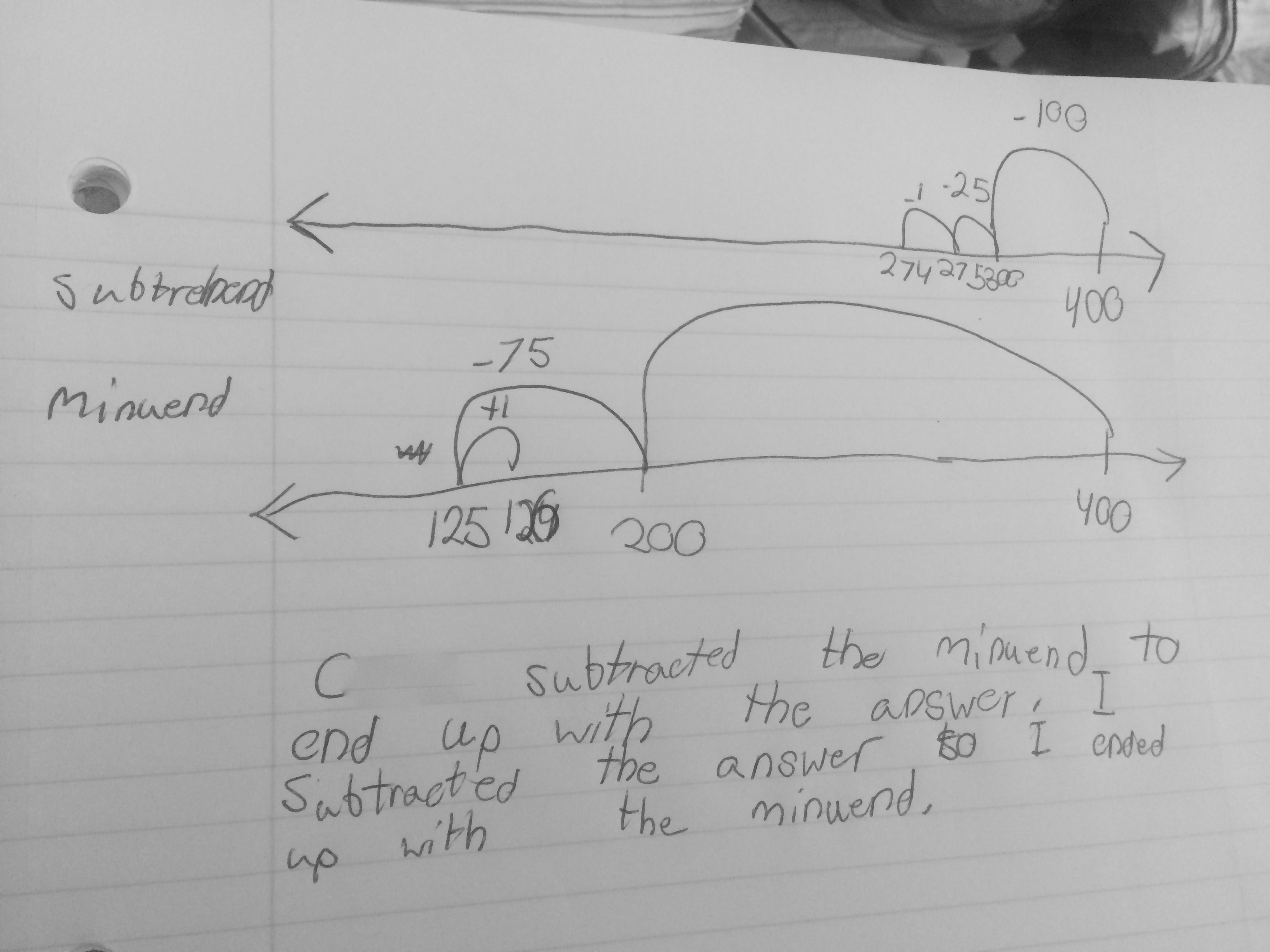
IMG_0502_2The student, “M”, on the right subtracted to find the distance between 400 and 274, however did not explain it that way so it left many students wondering how she knew what to subtract. I had a student ask her if that was her second strategy because she seems to have subtracted the answer from the 400.

The student, “C”, on the left solved it the way the majority of the class did, removal in part with some compensation at the end. Before he started explaining, he prefaced with, “I did it pretty much like M.” When he finished, he realized it was not the same and was confused as to where “M” came out with the same answer. He even exclaimed that, ‘I think she got the answer by mistake.”

“M” knew exactly what she did, however, I didn’t let her explain yet because I wanted the rest of the class to think about it a bit more. I told her she would be able to explain it tomorrow after we chat a bit more with it. I had them all end the class with a journal entry (surprising, right?:) I asked them what they understood, saw happening in each, or were not too sure about. It is just the most beautiful thing to read the honesty and reflection in their writings.

Some students could see what was happening…(even though it seems some tables have the vocabulary a little mixed up:)

IMG_0509_2IMG_0506_3Some left confused…

IMG_0504_3IMG_0508_2

Some had a really interesting way of thinking about it…

IMG_0505_3And then there was “M” who cannot wait to share tomorrow…

IMG_0503_2

Now, the question is, how to approach this tomorrow? I am thinking I would love three groups, one who subtracted in parts, one who found the distance by subtracting back to the minuend, and one group who adjusted the subtrahend and minuend to find the distance between. Have them create a context and representation that shows what they did (still working within the same problem they all have the same answer for) and do a share. I would like the share to go in the exact order of the groups I just listed above. Crossing my fingers I have time to talk some more math with them tomorrow, a silent classroom is probably more torture for me than them 🙂

-Kristin

Creating Contexts for Decimal Operations

Sometimes I have students engaging in math within a context, however at other times, we just explore some beautiful patterns we see as we play around with numbers. I see a value and need for students to experience both. This week was one of those “number weeks” and it was so much fun!

Over the past few weeks, we have been working on decimal multiplication. If you want to see the student experiences prior to this lesson, they are all over my recent blog posts….it is has been decimal overload lately:) After sharing strategies and connecting representations in this lesson, I was curious how students thought about this problem in a context because up to this point, I had not given them one for thinking about a decimal less than one times a decimal less than one.After they wrote their problem, I asked them to tell me what they were thinking about as they were deciding on the context.

I anticipated that many would refer back to what they know about taking a fraction less than 1 of a fraction less than 1, like in this example…

IMG_0343

I love how this one said she knew she “had to start with .4” That shows the order of the numbers in the problem create a context for her. It mattered to her, taking .6 of the .4.

IMG_0340

This student went with two different contexts and again saying that he started with the .4. This must be something we have chatted about quite a bit about because it showed up multiple times. I loved how this student said he thought about an area model in creation of his problems.

IMG_0342

This student was great in listing all of things he was thinking about as he thought about a context..

IMG_0344

I had students who attempted to create a “groups of” context. I don’t know if I ever realized how difficult this and how much I, as an adult, need to be able to create a visual in my mind of what is happening in a problem to make sense of it. Here is one example (not the sweetest context but she thought the Mary HAD a little lamb was clever…) She worked a bit yesterday to show what the representation would be, but kept running into problems with cutting into “.6 pieces.”

IMG_0360

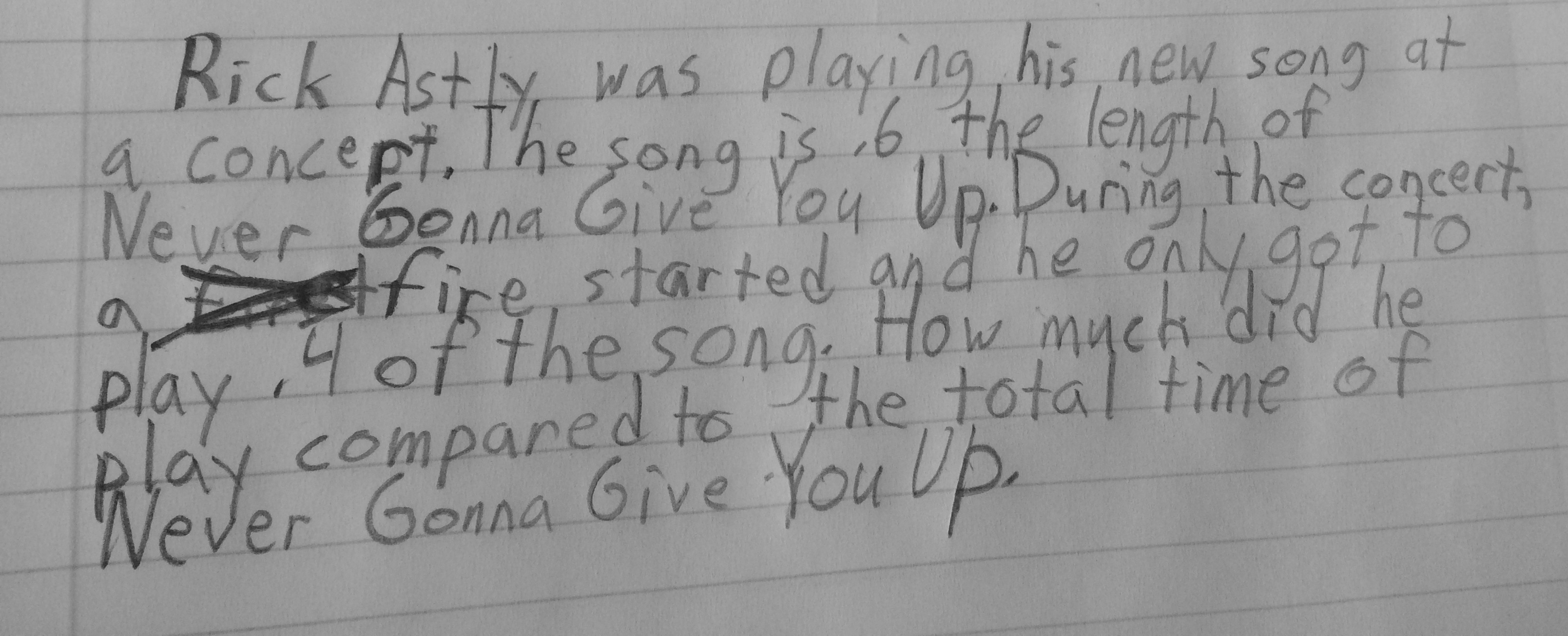
And then I have these two that had my brain reeling for a bit, for many reasons. First, does the context work with this problem? Secondly, I knew it sounded like it should work, but when I tried to make sense of it, I couldn’t create a visual. Also, as I read them, I thought I knew where it was going and the question I would pose, but it wasn’t the way they saw it ending. I asked them to create an Educreations about their problem so I could check out their thinking around the context.

Yes, Rick Astly. But the question at the end, compared to the total time Never Gonna Give You Up, threw me a bit, not where I was going with it….

IMG_0346

His Explanation: https://www.educreations.com/lesson/embed/31398809/?ref=embed

The second one tried it out, and wasn’t so sure of his question after messing with it. The wording “.6 as small” was making me think. I was trying to make sense of that wording, do we ever say six tenths times as small? Then does his question referring back to the .4 make sense?

IMG_0345His Explanation:https://www.educreations.com/lesson/embed/31402039/?ref=embed

Definitely a lot for me to think about this week too! I have some amazing work with them connecting representations to write up later…they are just such great thinkers!

-Kristin
Commutativity in Fraction Multiplication

Think about these two expressions…

2/3 x 6              6 x 2/3

Do you think differently about each?

Does your solution approach change?

I had not really given this much thought because we do both in 5th grade, multiply a fraction by a whole number and whole number by a fraction. However, recently, when working with a group of 4th grade teachers and looking more closely at the standards and my curriculum, I am beginning to see a distinct difference. I now look at each expression from a different perspective. Not that both ideas do not arise at multiple grade levels in some form or another, but it is so interesting to me as to which thinking would come before the other.

Let’s first look at the standards…

4th Grade:

cc25th Grade:

cc1

Interesting. For me, taking a fraction of a group feels more “natural” and intuitive than multiplying a whole number by a fraction, however in the learning trajectory of multiplication and building of unit fractions composing a whole, the multiplication of a whole by a fraction feels like the natural next step.

For our upcoming Illustrative Mathematics professional development, I was collecting work samples for the following problem (thanks Jody:)

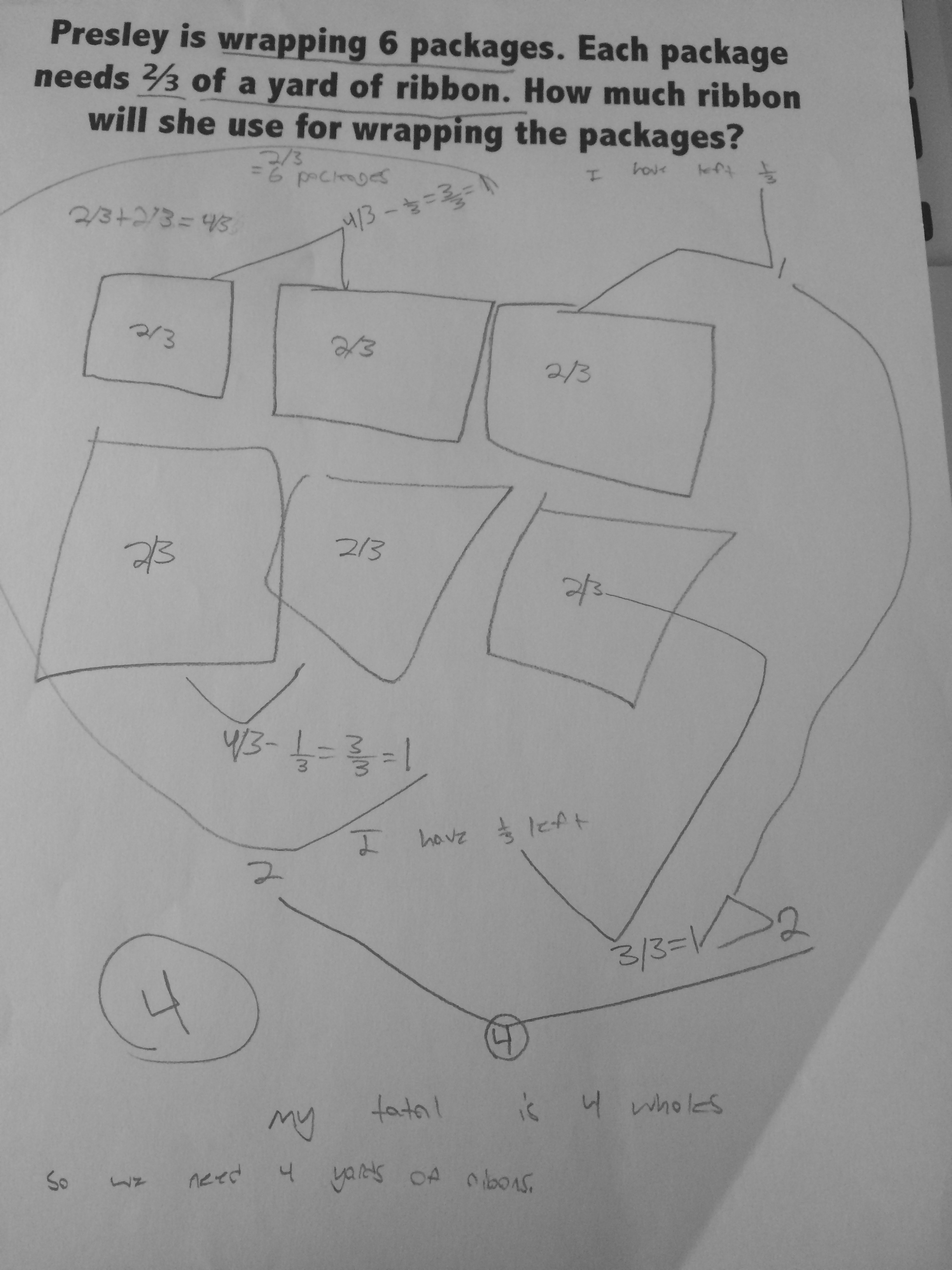
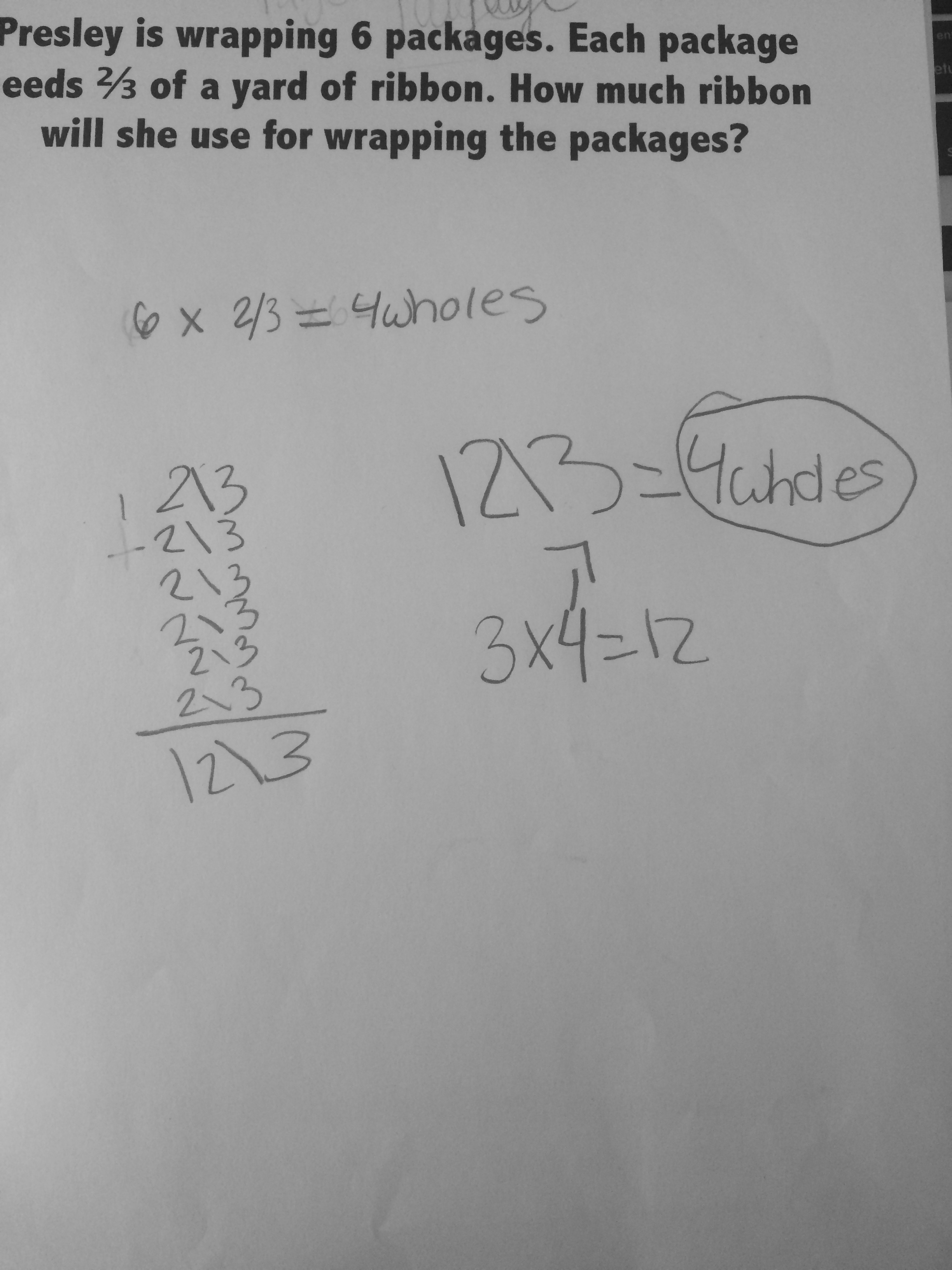
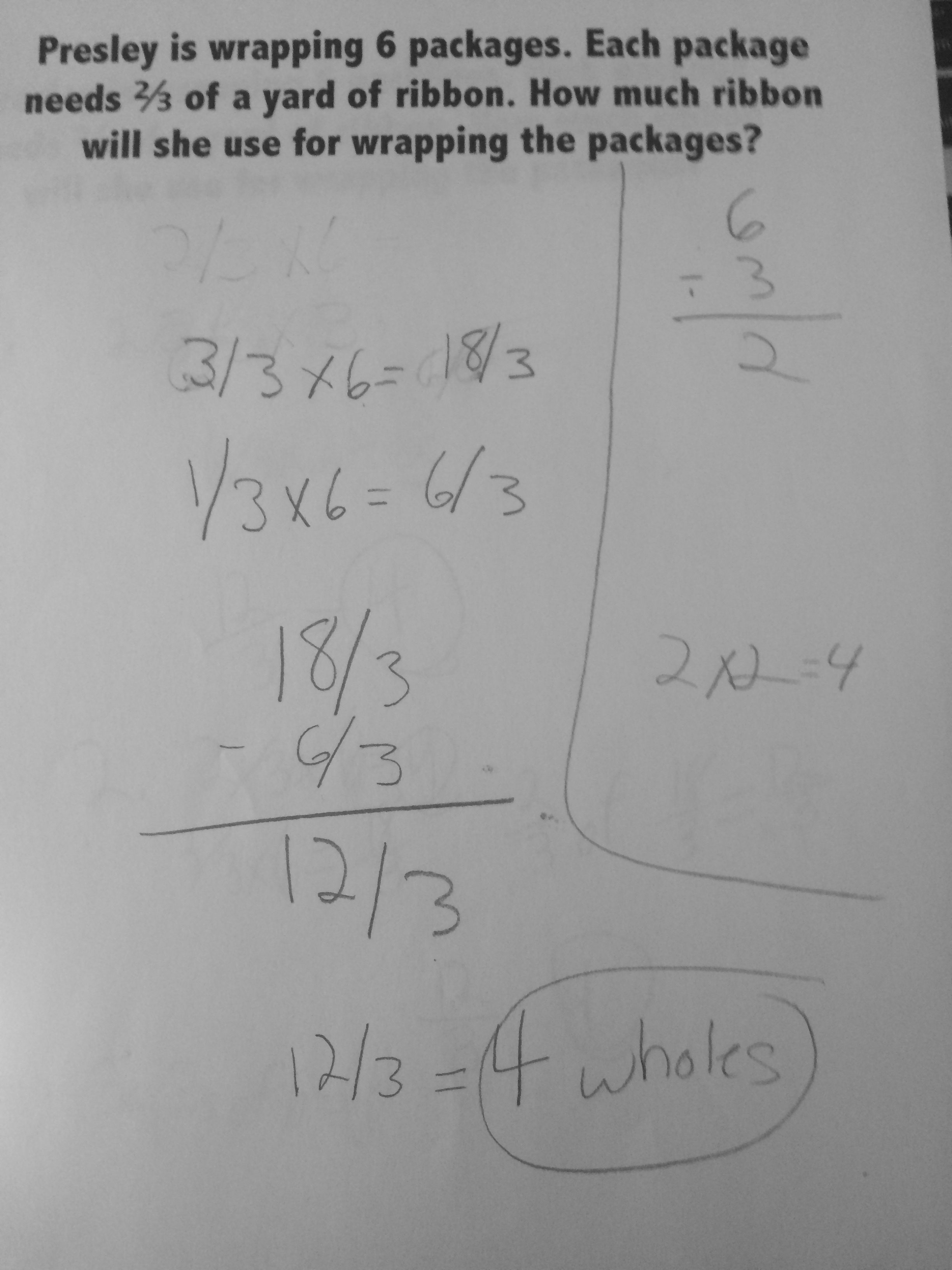
“Presley is wrapping 6 packages. Each package needs 2/3 of a yard of ribbon. How much ribbon will she use for wrapping the 6 packages?”

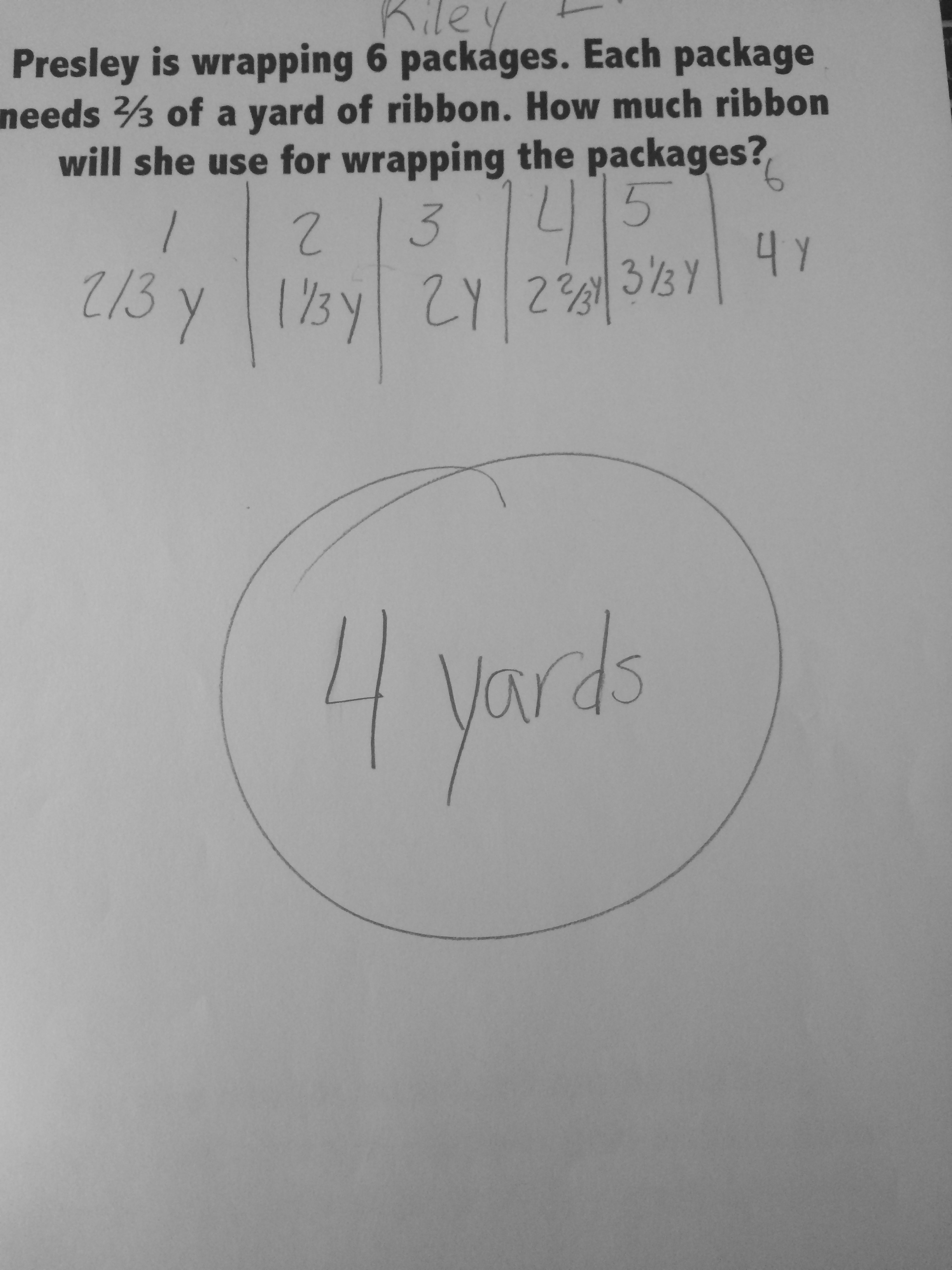
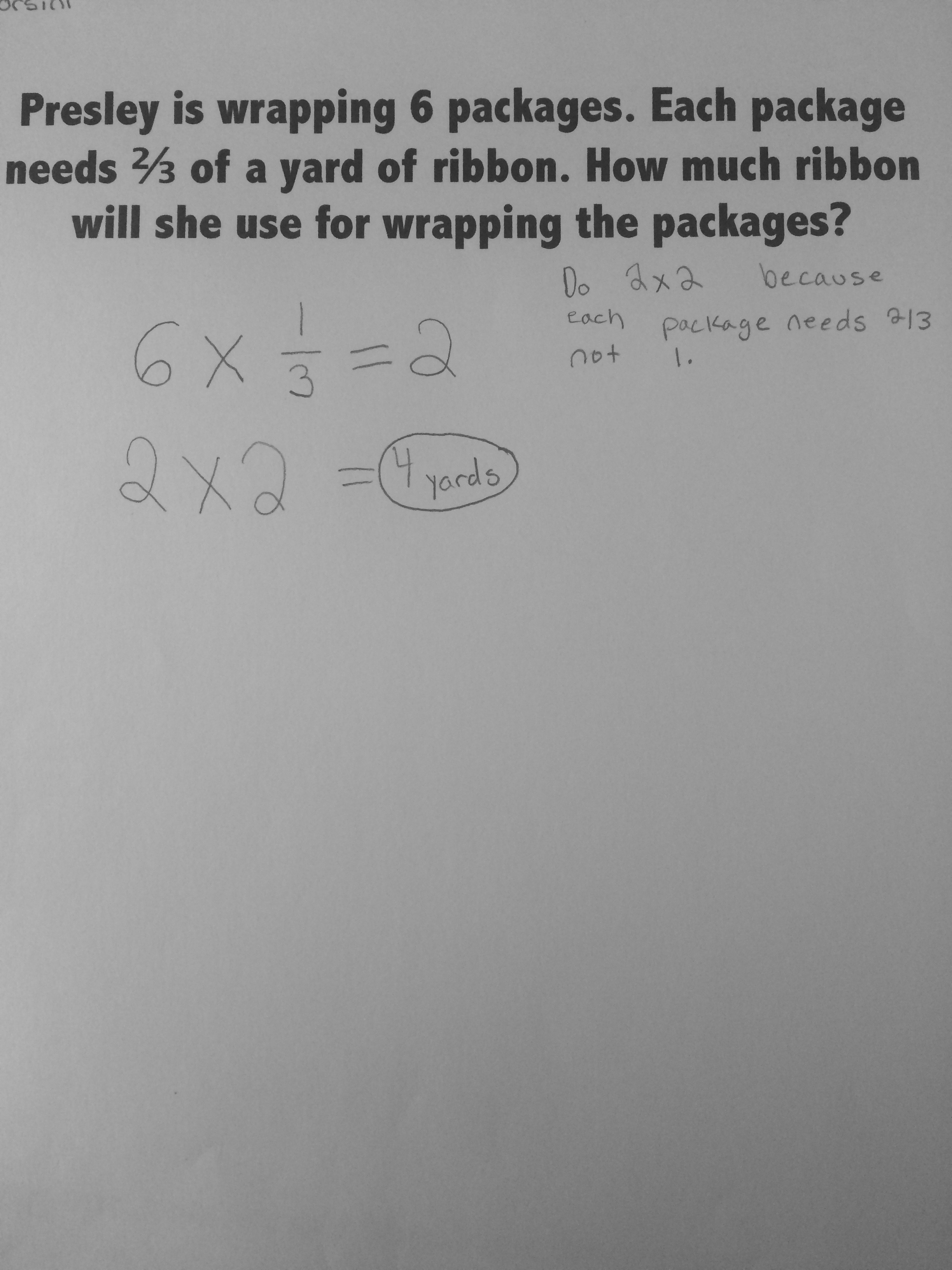
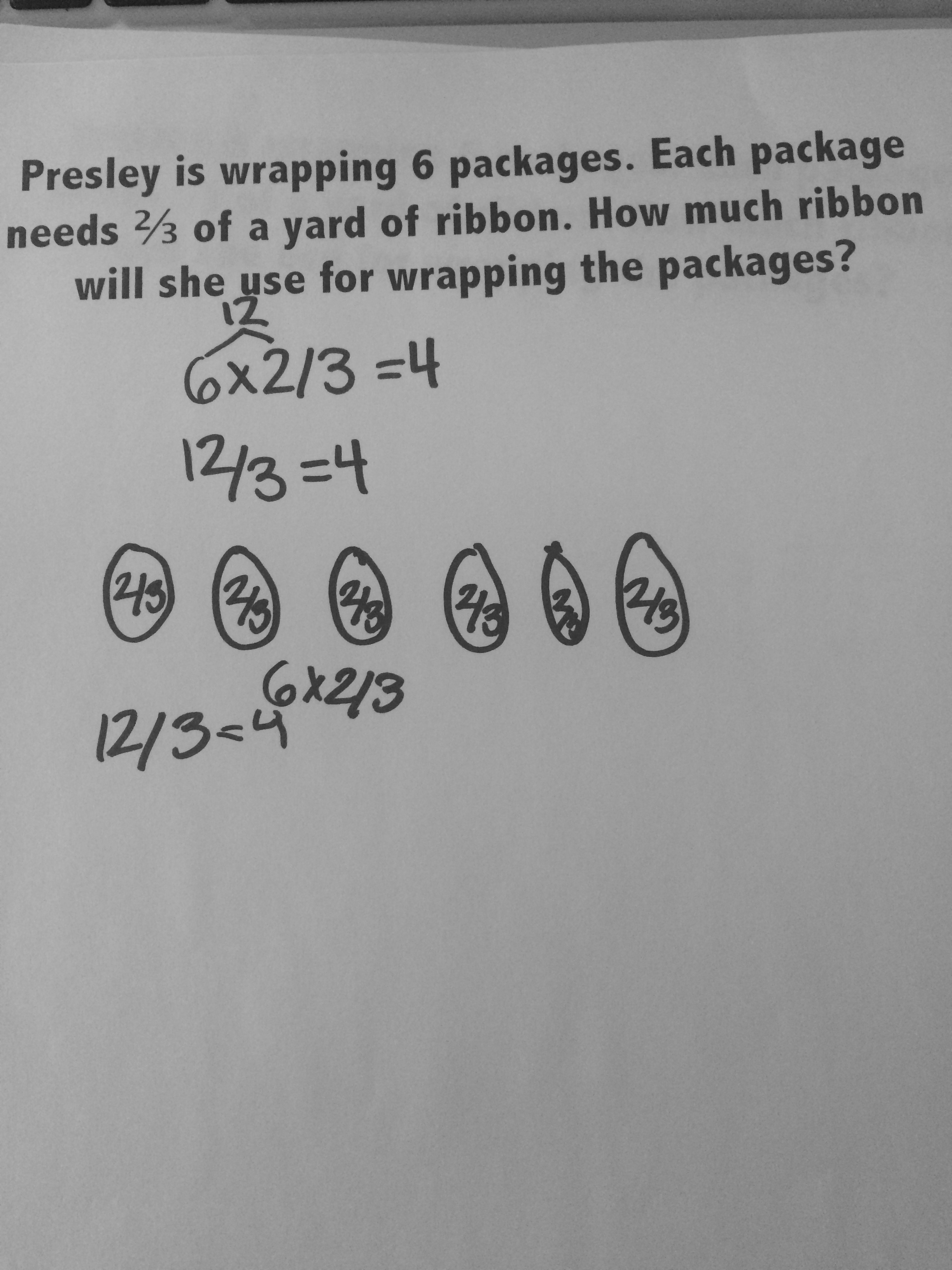
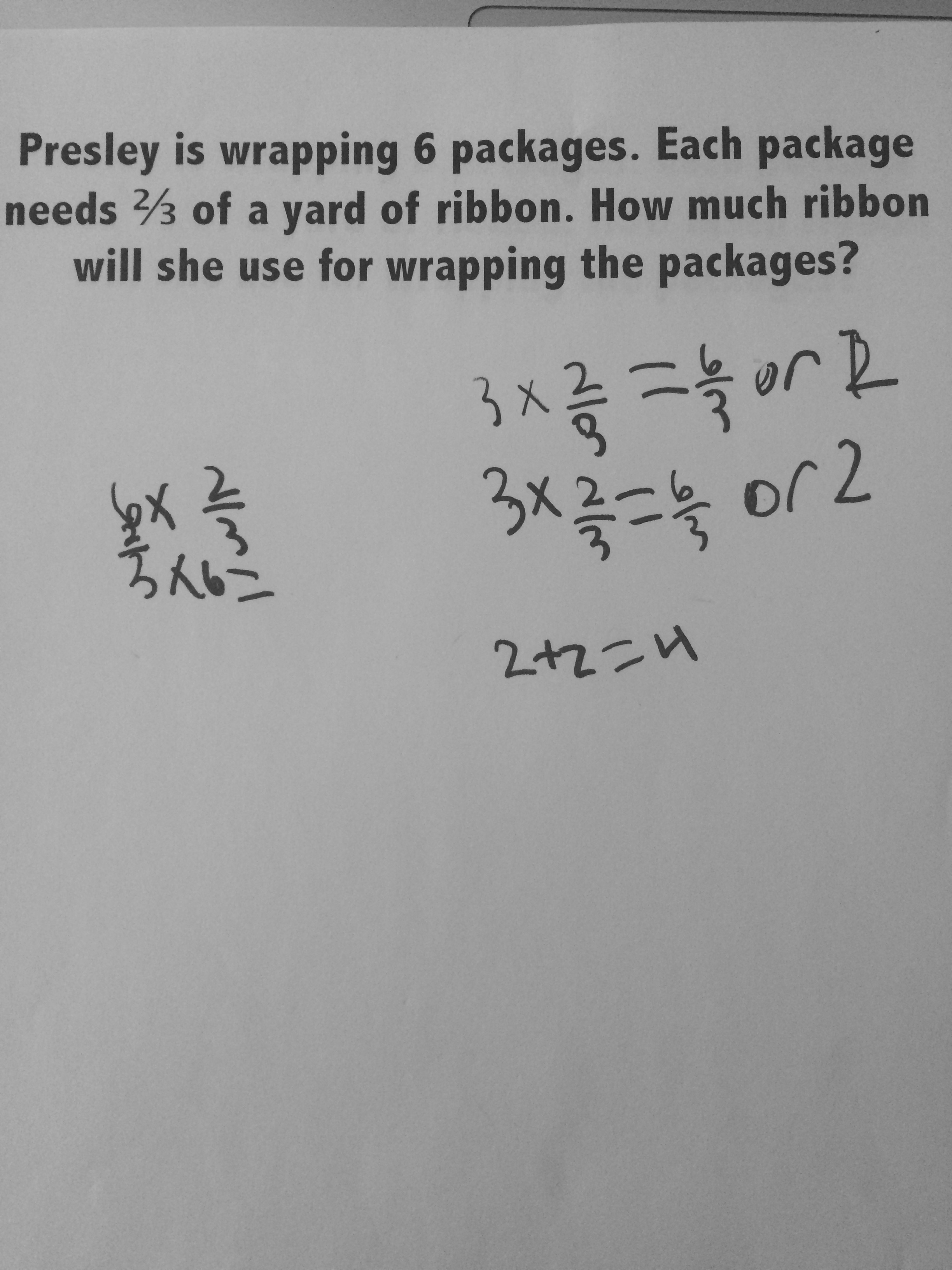
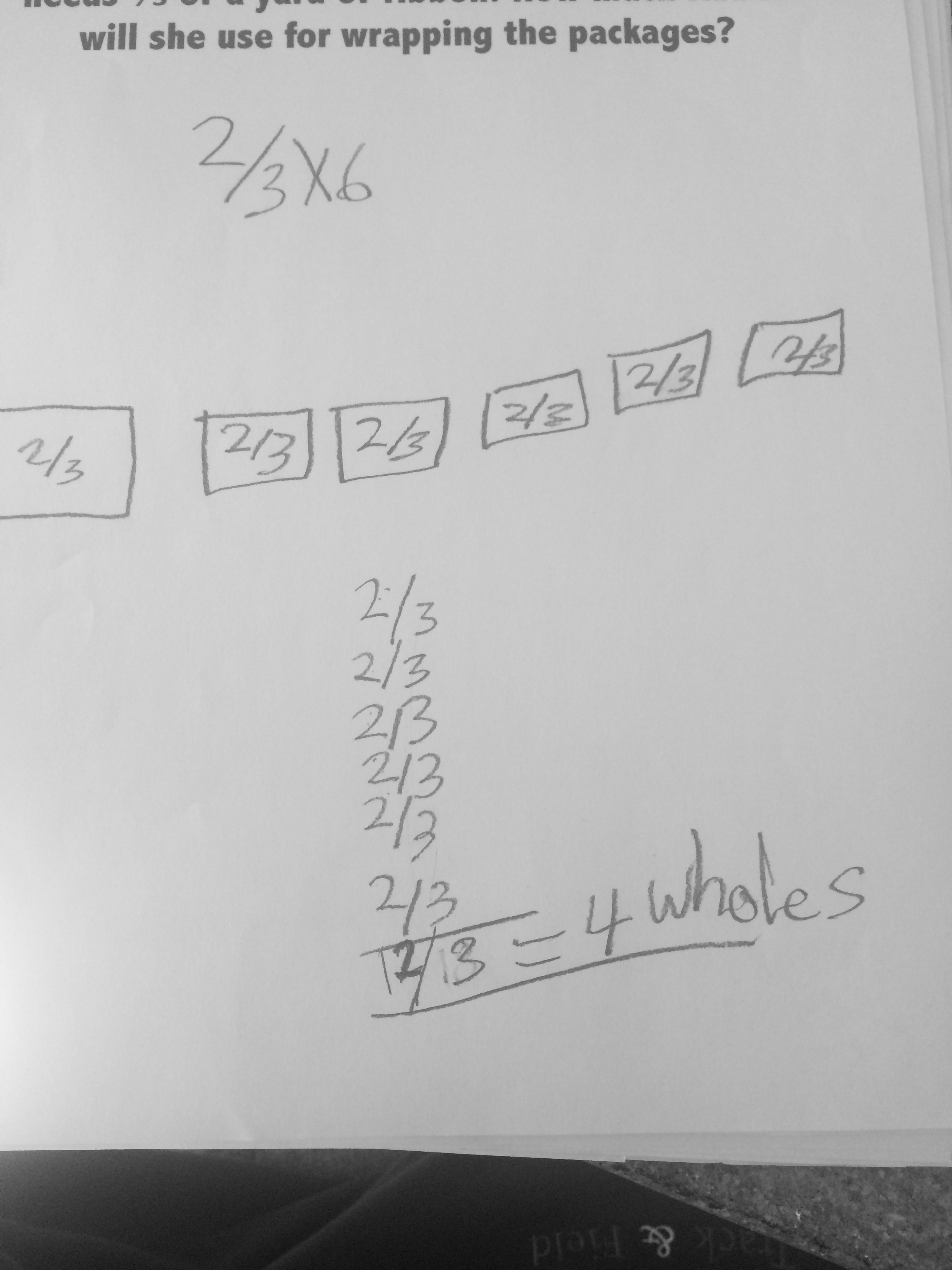
As anticipated, I received a wide variety of solutions to arrive at 4 yards of ribbon. Here are just a few examples in what I think is the progression I expect (some of them got finished  quickly and opted to show a few ways to solve).

IMG_9719_2 IMG_9720_2 IMG_9721_2 IMG_9723_2IMG_9722_2 IMG_9724_2  IMG_9725_2 IMG_9726_2 IMG_9727_2 IMG_9728_2 IMG_9729_2 IMG_9731_2IMG_9730_2

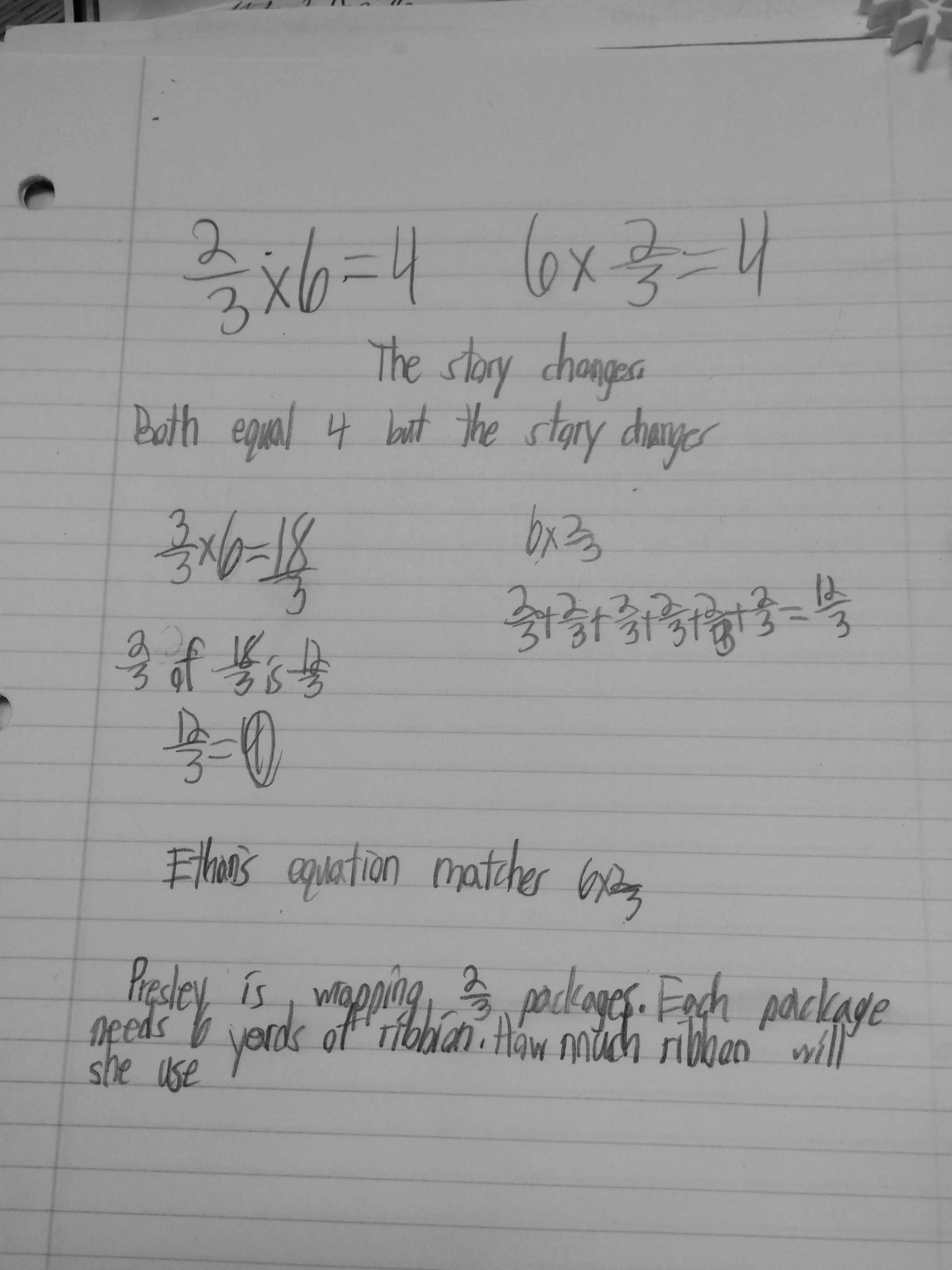
They all finished fairly quickly and as I was walking around I thought it was really interesting to see such a variety in the equations they used to represent the problem. We came together as a whole group and I asked them for the equations they thought best represented the problem. The most common answers were: 2/3 x 6 = 4, 6 x 2/3= 4 and 2/3 + 2/3 + 2/3 + 2/3 + 2/3 + 2/3= 12/3 = 4.

I asked them if there was a difference between the equations and there was a unanimous “No” because they mean the same thing. “They all get 4.” In my head I was very excited that commutativity was something they see when finding a solution, but I was also curious if it worked the same in the opposite direction. I asked if we could narrow it down to two equations and they all agreed that the repeated addition was the same as 6 x 2/3 because it was “six groups of 2/3.” Interesting, so they see that in the numeric representation but not contextually?

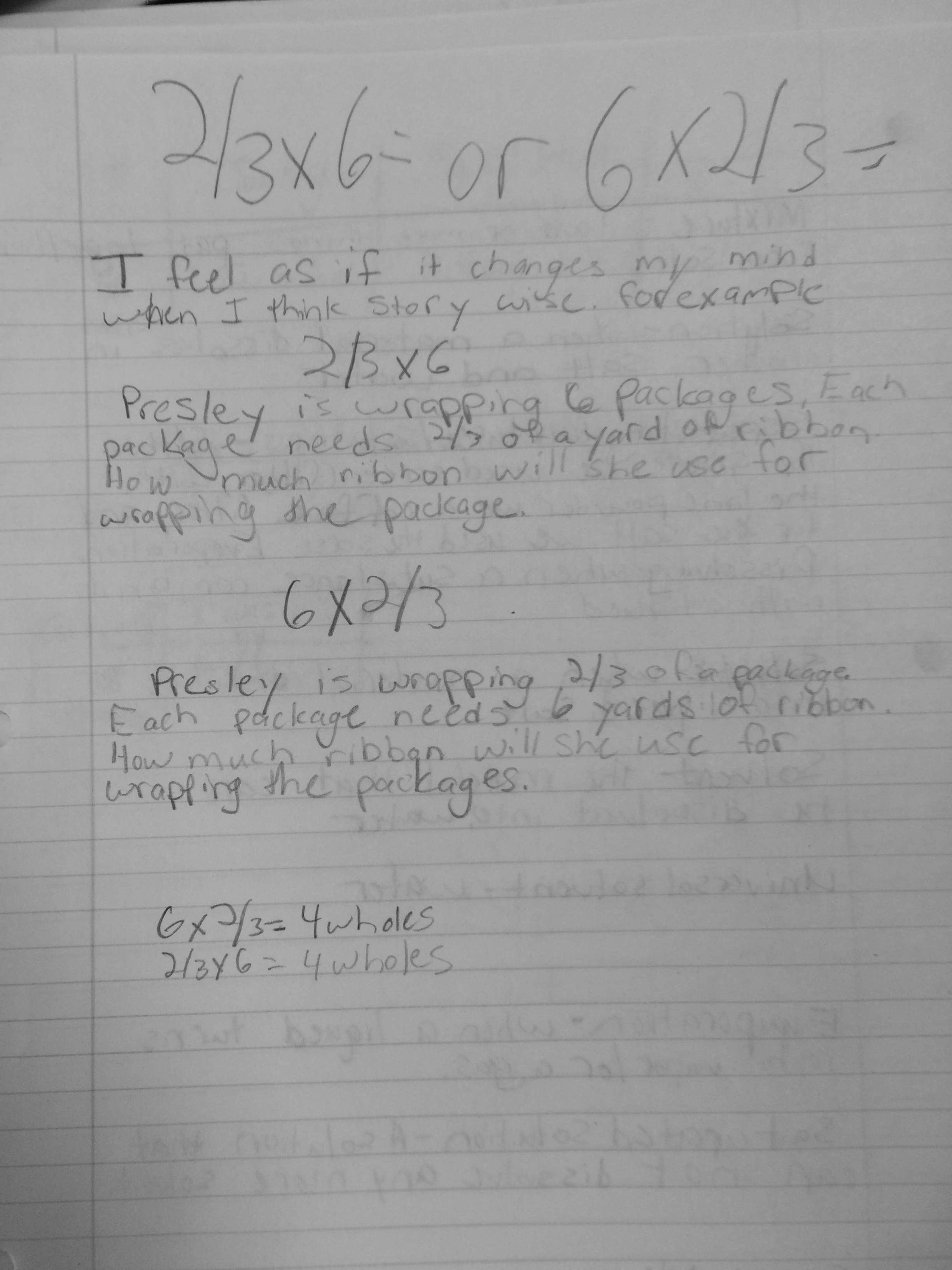
I then asked them to write 6 x 2/3 and 2/3 x 6 on the top of their journal page and think about them without the previous context.  I posed, “If I gave you these two problems to solve, would you think about them the same way? Do you think about them differently?” I was curious to hear their thoughts on the commutativity.

IMG_9692 IMG_9694 IMG_9695 IMG_9696

The conversation after was so great and interesting! There is a difference when going from number to context, however when put in context, I think students use whatever strategy is easiest for them to arrive at the answer. Is this what is truly meant by contextualizing and decontexualizing in the SMPs?

To further intrigue me, I went and pulled a few fourth graders to interview during my planning period. It was so interesting that they saw this as a whole number times a fraction because it was “six 2/3’s.” Their connection to multiplication and “groups of” was evident. I did love how they did 3 of the 2/3s first to get 2 and then doubled that to get 4.

IMG_9733 IMG_9734 IMG_9735

This 4th grader was the most interesting..

IMG_9736She solved it as 2/3 of 6 and arrived at 4. I asked her if she could write an equation for the problem she solved and she wrote 2/3 of 6 = 4. Completely because I am so nosy, I asked her to write 6 x 2/3 under that. I asked how she thought about that problem? Would she solve it the same? She said, “No, that is 6 of the 2/3’s so I have to multiply the 2 and 3 by 6.” She proceeded and ended with 12/18. She saw the numerator and denominator as numbers in and of themselves and used the distributive property to arrive at her answer instead of thinking about the 2/3 as a number. This was something I had never thought of before! I wish I had more time with her because I SO wanted to ask if that makes sense, but since my planning runs into dismissal, she had to get back to class! Argh!

This progression (to me) now seems to be more about building on student’s understanding of multiplication then about what is more intuitive for students to do. That is such a revelation to me. In second and third grade students do so much in “sharing” situations, that I had assumed it was en route to this skill of taking a fraction of a number when in fact it is more about the operations. It builds multiplication and division. Those operations then progress from operations with whole numbers to operations with fractions and from there students start to build deeper understandings of the properties of operations.

This is of course, all my interpretation based on my experiences and perspective of the student work, but how awesome! I cannot wait to share this with the 4th grade teachers along with the video of the kids chatting with me about this, awesome stuff!!

-Kristin

Fraction Number Talks

Two days a week we have a Math RTI period built into our school schedule. It is 50 minutes in which students receive additional math support through Marilyn Burns’ Do The Math Program, as well as the use of Number Talks. The groups are smaller than the regular core classes, allowing for more individual time with each student. In 5th grade, we focus heavily on the fraction module and building reasoning within the structure of our number system. When we implemented this structure about four years ago, the majority of the students in the more intensive groups had an extreme aversion to fractions and really just a lack of confidence in their ability to do math. They were just looking for a “way to solve” the problem to get it over with, rather than reasoning and working through a problem.

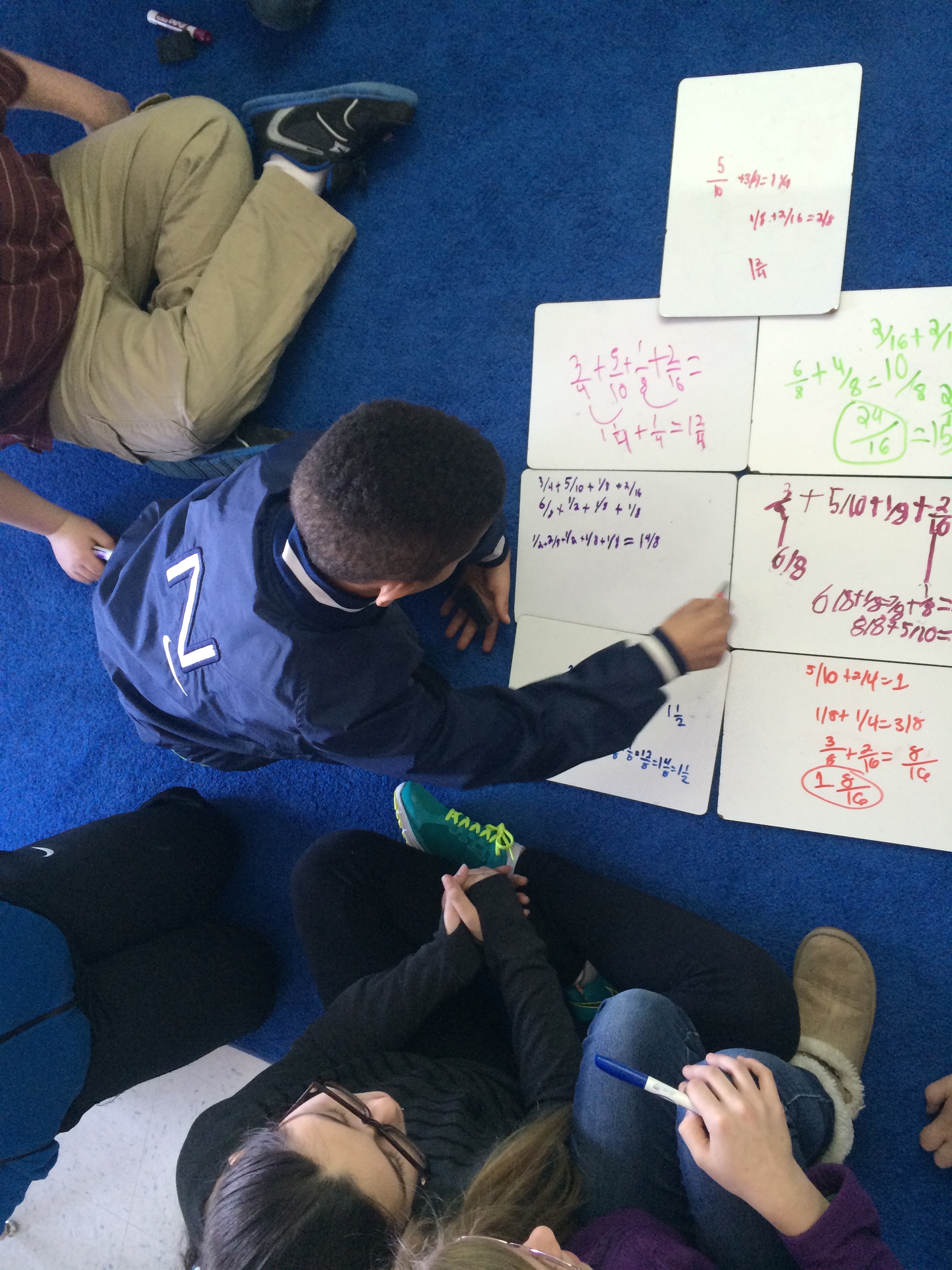
The fraction module, through the use of fraction strips, encourages the students to think about the size of fractional pieces, creates a visual for fraction equivalence and looks at the relationships between fractions. Students use these understandings to compare, add and subtract fractions and most importantly build their confidence in their ability to do math. The Number Talks I do with fractions really focus on getting the students to THINK about the fractions before just operating left to right and looking for a common denominator each time. This week I was doing a number talk on adding fractions with my group and put up this problem: 3/4 + 5/10 + 1/8 + 2/16. My thought in choosing the problem was there was some great decomposition and equivalence that could happen.

We usually do these problems mentally, so I don’t typically give them white boards but since I really wanted to see their thinking, I did this time (and I am so glad). Seven students came up with six different answers. It was awesome. I had them lay their boards down and look at them all before they started to explain their strategy. It was all of the great decomposition, equivalence, and addition I was hoping it would be. I especially love 3/4 + 5/10 = 1 1/4 and the bottom left where the student rewrote 5/10 as 4/8 + 1/8 to add to the 6/8.

IMG_9675_2I started to hear a lot of “Oh”‘s and “They are the same”‘s but the student who got 24/16 thought she was wrong because hers “looked different.”  They all agreed the others were equivalent but I asked them to explain to their strategy and discuss the 24/16.

IMG_9676_2It was such a great discussion and as I was listening to them, I wondered how in the world any teacher could ever want to teach a group of students how to solve problems in only one way when there is such rich conversation in their individual thinking. They loved matching their answer to the others and proving how it was the same. Not to mention the confidence, independence and reassurance in their own math ability when they arrived at the correct answer.

-Kristin
Flexibility, Efficiency or Starting From Scratch?

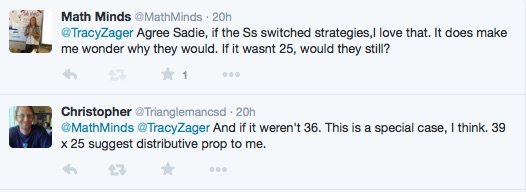
I ask myself this question numerous times during the course of school week. During number talks and in class conversations, the students show such amazing thinking and strategies in solving various computation problems. But, just when I think they are constantly thinking about the numbers, their values and sense-making, they seem to start a new problem from scratch without connecting to any of their prior reasonings. Is it flexibility in their thinking, efficiency or seeing each problem as a new one? I was SO glad to see I am not alone when I read Tracy’s tweets yesterday….

tweett3

The conversation was an interesting one that then seemed to moved into number choice and thinking about what the students were thinking and what we do as teachers from here. We all definitely had a lot more questions than answers, which is always fun to explore!

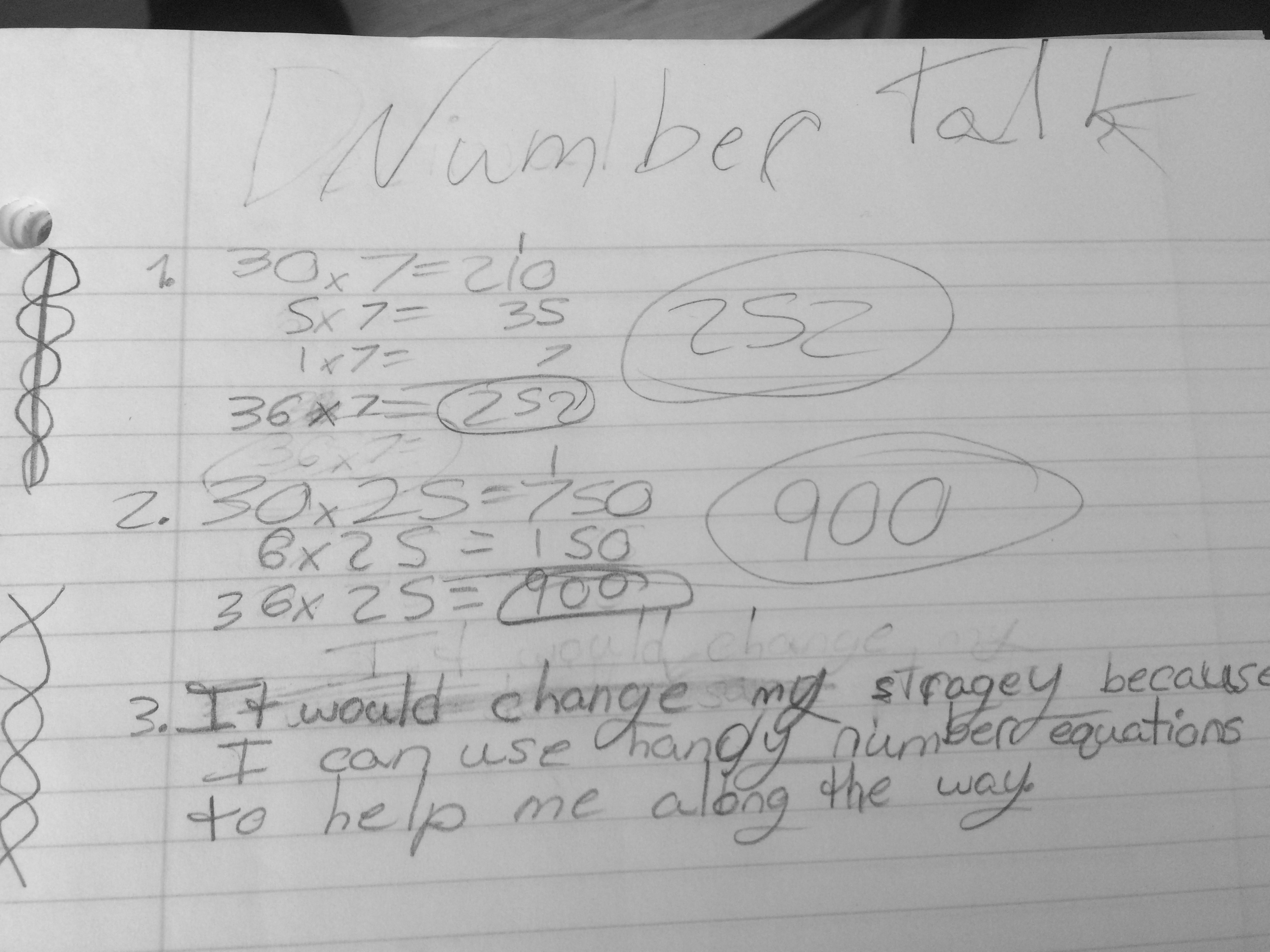
t4t5So, of course I had to test out some of our questions into my number talk today. I had the students do the number talk from their seats so they had their journals readily available. I gave them 36 x 7, asked them to solve mentally and really think about the strategy they were using. I took answers, they all got 252, and I asked them to jot down how they solved it. We shared out and the majority had solved it just as Tracy had mentioned in her tweet, (30×7) + (6 x 7). Then I gave them 36 x 25 to see if, when given a 2-digt x 2-digit, they changed their thinking. I was also interested in the influence of the number choice of 25.

I don’t think it was the two-digit  times 2-digit number that changed their approaches, but more so the influence of the 25.  A lot went to double/halving because they could get to 50 and 100 and others used the 100 made of four 25s. One student multiplied 40x 25 and subtracted 100 while a few others used the associative property that Tracy had mentioned (4×25) x 9.

The final problem was 39 x 25. Unlike a typical number talk in which I push students to connect to previous responses in route to an answer, I instead asked them to not solve it, but just think about how they would solve the problem. After they had their thumbs up with a strategy, I asked them to complete one of the following prompts: “I used the same strategy I had used before because….” or “I used a different strategy in this problem because…” Here are some of their responses…

IMG_9614_2IMG_9615_2IMG_9616_2IMG_9617_2IMG_9619_2IMG_9620_2

IMG_9622_2IMG_9623_2

IMG_9624_2IMG_9618_2

IMG_9626_2IMG_9625_2

IMG_9627_2

My conclusion is: the more students talk about their strategies, reasonings, and choices, the more they think about the numbers and what “makes sense” in the solution pathway. I think some students definitely get into a comfort zone with a strategy that works for them, and that is ok with me, but I definitely want to expose them to other ideas and things to think about. I loved that 25 and 39 influenced their thinking about the way to approach the problems.

I am not sure this answers any questions in our Twitter conversations, but I am always SO incredibly curious to see what the students actually do after anticipating their thoughts. The even better part is, they love sharing what they were thinking without the worry of being wrong. I even had one student who said she changed her strategy for the last problem because she got the one before it wrong after solving it twice. In her words, “It definitely was not working.” 🙂

Hope this gives you something to think about Tracy, Christopher, Sadie, Simon and Kassia!

-Kristin
What Are They Really Thinking About Decimals?

Understanding student thinking is so hard. I make assumptions. I read into things. I SO want to believe there is understanding behind everything they write on their papers. However, it is so much more difficult than that and my most recent difficulty is addition of decimals.

We have talked about decimals in one frames, shaded grids, and I am confident that every student can compare decimals with understanding of place value and magnitude. They understand decimals independently. Then, enter decimal addition. What is it about computation that sends students right back to not thinking about the numbers themselves and straight back to “lining them up” and adding? I know it is not that they CAN’T think about the numbers, so then my wheels start turning…. is it just ease of use? Great. But is it ease of use with understanding? Or is it ease of use without understanding but just gets them the right answer? This is where teaching is so hard!
We do number talks at least 2-3 times per week and given a problem such as 38 + 47, the majority of the students would say 40 + 45 = 85 using a compensation strategy. Today, given 6.8 + 4.7, I got “I lined them up and added 8 and 7 and got 15, carried the one…” You can hear the rest. Wait, what? Where are the tenths? Where is the place value? Why didn’t I ask them to give me an estimate first (ugh, hindsight)? I ask for any other strategies, nothing emerges. I am left to wonder what they truly understand about addition of decimals. Is it the decimal place value that takes away from thinking about the numbers or is it simply that they see how the decimals operate like whole numbers in a base ten sense. After doing a contextual task the day before, with pencil and paper, I was excited by the outcome, there were numerous strategies. However, if pushed to solve mentally, the students reverted back to an algorithmic feel. I am not saying that it means the students do not understand the place values they are adding, but trying to bring to light how hard it is to interpret their understanding on my part.

I then gave them a problem involving three decimals and asked them to solve it two ways. I was trying to get a better feel of their understanding. The two ways would push those “liner-uppers” to work with the decimals in a different way and also allow me the time to walk around and question students about their work.  I was not shocked to see that the majority went to lining them up as their first strategy, however I was very excited by their second strategy that showed more understanding of place value.

Here are some examples of the students solving 0.98 + 0.05 + 1.06

IMG_9611_2IMG_9609_2

I loved the number line in the first example and the breaking apart of the 0.05 in the second example. I was starting to see the flexibility and thinking that I want to see in my students.

I gave my second class a different problem involving two decimals, both in the hundredths that were not as “friendly” as the decimals in the previous example. I was happy to see the variety of strategies, including my student who starts assigning letters for each digit. He said he is ready to start doing some algebra 🙂  I love it!

IMG_9607_2IMG_9605I had a few who finished fairly quickly, so I gave them the problem 0.8 + 0.75 + 0.625, and then they started getting creative! This is one answer that was so interesting and will be the way I kick off my class tomorrow. His reference to columns and boxes are the hundredths grids we used for the Fill Two game.

IMG_9606Today was a day that really showed me how hard it is to understand student thinking and how important it is to push students to explain their understanding in more than one way. I could have very easily assumed that every student could add decimals by place value because they lined them up and added to get a correct answer.  However, if not given the opportunity to show another way to think about the problem, how would I truly know? I still have a few students who are getting the correct answer but are not able to articulate their process, so I am going to do a lot more estimating to get them thinking about the numbers before the operation. Going to be a fun day in math tomorrow!

-Kristin