Category Archives: Math

Number Talks Inspire Wonder

Often when I do a Number Talk, I have a journal prompt in mind that I may want the students to write about after the talk. I use these prompts more when I am doing a Number String around a specific idea or strategy, however today I had a different purpose in mind.

Today I was in a 4th grade class in which I was just posing one problem as a formative assessment to see the strategies students were most comfortable or confident using.

The problem was 14 x 25.

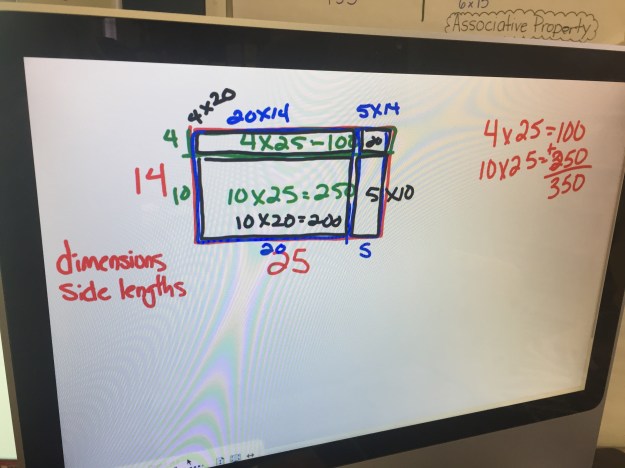
I purposefully chose 25 because I thought it was friendly number for them to do partial products as well as play around with some doubling and halving, if it arose. When collecting answers, I was excited to get a variety: 370,220, 350 and 300. The first student that shared did, what I would consider, the typical mistake when students first begin multiplying 2-digit by 2-digit. She multiplied 10 x 20 and 4 x 5 and added them together to get 220. Half of the class agreed with her, half did not. Next was a partial products in which the student asked me to write the 14 on top of the 25 so I anticipated the standard algorithm but he continued to say 4 x 25=100 and 10×25=250 and added them to get 350.

One student did double the 25 to 50 and halved the 14 to 7 and then skip counted by 50’s to arrive at 350, instead of the 300 she got the first time. I asked them what they thought that looked like in context and talked about baskets of apples. I would say some were getting it, others still confused, but that is ok for now. We moved on..

Here was the rest of the conversation:

IMG_3307.JPGIMG_3308.JPG

I felt there were a lot more wonderings out there than there was a need for them to write to a specific prompt, so I asked them to journal about things they were wondering about or wanted to try out some more.

I popped in and grabbed a few journals before the end of the day. Most were not finished their thoughts, but they have more time set aside on Wednesday to revisit them since they had to move into other things once I left.

What interesting beginnings to some conjecturing!

Number Talk Karaoke

It is always so fun when I have the chance to hang out with my #MTBoS friends in person! This summer Max Ray was in town and of course, during lunch, we chatted a lot about the math work we are doing with teachers and some of the routines we are finding really valuable in their classrooms. From these two topics of conversation, Number Talk Karaoke emerged.

We both agreed that while Number Talks are invaluable in a classroom, it can be challenging to teach teachers how to use them in the classrooms. As much as we could model Number Talks during PD and show videos of them in action, it is still not the same as a teacher experiencing it for themselves in their classroom with their students. There is so much to be said for practicing all of the components that are so important during the facilitation with your own students.

That conversation then turned into two questions:  What are these important components? and How do we support teachers in these areas?  We discussed the fact that there are many books on mathematical talk in the classroom to support the work of Number Talk implementation, however the recording of student explanations during a Number Talk is often left to chance. What an important thing to leave to chance when students often write mathematics based on what they see modeled. We brainstormed ways teachers could practice this recording piece together, in a professional development setting, where students were not available.

Enter Number Talk Karaoke.

During Number Talk Karaoke, the facilitator:

  • Plays an audio recording of students during a Number Talk.
  • Asks teachers to record students’ reasoning based solely on what they hear students saying.
  • Pair up teachers to compare their recordings.
  • Ask teacher to discuss important choices they made in their recording during the Number Talk.

Max and I decided to get a recording and try it out for ourselves. So, the next week, I found two of the 3rd grade teachers in my building who were willing to give it a go!

They wanted to try out the recording piece themselves, so they asked me to facilitate the Number Talk. They sat in the back of the room, with their backs to the students and SMARTBoard so they could not see what was happening. All they had in front of them was a paper with the string of problems on it.

Before seeing our recording sheets below, try it out for yourself. In this audio clip of the Number Talk, you will hear two students explain how they solved the first problem, 35+35. The first student explains how he got 70 and the second student explains how he got 80.

Think about:

  • What do you think was really important in your recording?
  • What choices did you have to make?
  • What question(s) would you ask the second student based on what you heard?

The talk went on with three more problems that led to many more recording decisions than the ones made in just those two students, but I imagine you get the point. I have to say, when I was facilitating, I tried to be really clear in my questioning knowing that two others were trying to capture what was being said. That makes me wonder how this activity could be branched out into questioning as well!

Here was my recording on the SMARTBoard with the students:

Screen Shot 2016-11-13 at 9.12.41 AM.png

Here are the recordings from the two teachers in the back of the room:

screen-shot-2016-11-13-at-9-13-22-am

screen-shot-2016-11-13-at-9-12-58-am

We sat and chatted about the choices we made, what to record and how to record certain things. We also began to wonder how much our school/district-based Number Talk PD impacted the way we record in similar ways.

Doesn’t this seem like a lot of fun?!? It can be done in person like mine was, or take the audio and try it with a room of teachers, like Max did! <– I am waiting on his blog for this:) Keep us posted, we would love to hear what people do with this!

Which One Doesn’t Belong? Place Value

Since the 3rd grade team begins the year with an addition and subtraction unit in Investigations the teachers and I were having a conversation about how students understand place value. While I don’t see teachers using the HTO (hundreds/tens/ones) chart in their classrooms, students still seem to talk about numbers in that sense. For example, when given a 3-digit number such as 148, students are quick to say the number has 4 tens instead of thinking about the tens that are in the 100. I think a lot of this is because of how we as teachers say these things in our classrooms. I know I am guilty of quickly saying something like, “Oh, you looked at the 4 tens and subtracted…” when doing computation number talks, which could lead students to solely see the value of a number by what digit is sitting in a particular place.

We thought it would be interesting to get a vibe of how this new group of 2nd graders talked about numbers since their first unit deals with place in terms of stickers.  A sheet of stickers is 100, a strip of stickers is 10 and then there are the single stickers equal to 1.

I designed a Which One Doesn’t Belong? activity  with four numbers:  45, 148, 76, 40

I posted the numbers, asked students to share which number they thought didn’t belong, and asked them to work in groups to come up with a reason that each could not belong. Below is the final recording of their ideas:

img_2969

I loved the random equation for 148 that emerged and the unsureness of what numbers they would hit if they counted by 3’s or 4’s. One student was sure she would say 45 when she counted by 3’s and was sure she would not say 76 or 40, but unsure about the 148. I wrote those at the bottom for them to check out later.

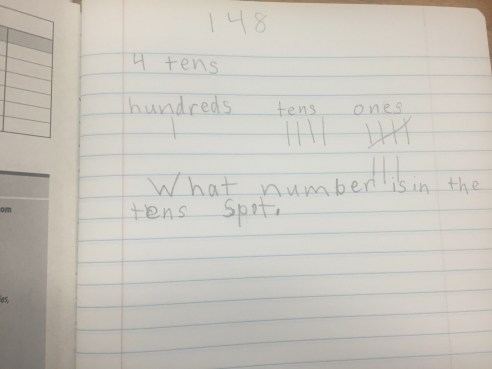
Since the teacher said she was good on time, I kept going. I pulled the 148 and asked how many tens were in that number. I was not surprised to see the majority say 4, but I did have 3 or 4 students say 14. As you can see below a student did mention the HTO chart, with tallies, interesting.

img_2970

As students shared, I thought about something Marilyn Burns tweeted a week or so ago…

Screen Shot 2016-09-16 at 10.37.25 AM.png

So, I asked the students to do their first math journal of the school year (YEAH!):

“For the students who answered 14, what question did you answer?

“For the students who answered 4, what question did you answer?

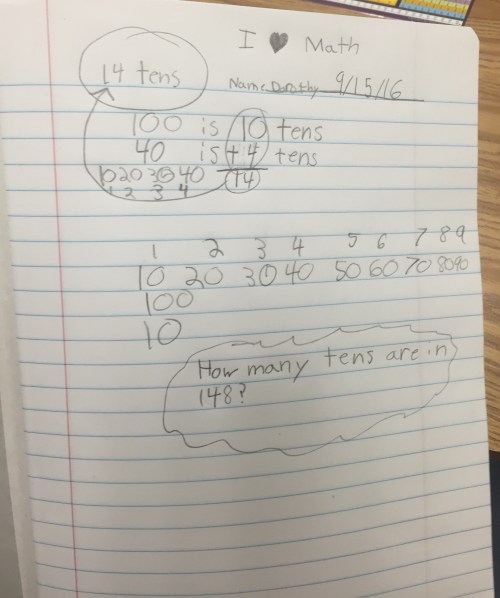
After the students shared, I revisited the Hundreds, Tens, Ones chart. I put a 14 in the tens column, 8 in the ones column, and asked if that was right. The light bulbs and confusion was great! It was as if I had broken all rules of the HTO chart! Then I put a 1 in the hundreds, 3 in the tens, and they worked out the 18. I look forward to seeing them play around with this some more and wonder if when they go to subtract something 148-92, they can think 14 tens -9 tens is 5 tens.

I had to run out because I was running out of time, but snagged three open journals as I left! (I especially love the “I Heart Math” on the second one!
FullSizeRender 52.jpg

fullsizerender-52

fullsizerender-53

Mathematizing Learning Lab

Each month, teachers choose their Learning Lab content focus for our work together. Most months, 1/2 of the grade level teachers choose to have a Math Learning Lab while the other 1/2 work with Erin, the reading specialist in an ELA Learning Lab. This month, however, we decided to mesh our ELA and Math Labs to do some mathematizing around children’s literature in Kindergarten and 1st grade! This idea was inspired by a session at NCTM last year, led by Allison Hintz, that left me thinking more about how we use read-alouds in our classrooms and the lenses by which students listen as we read.

In The Reading Teacher, Hintz and Smith describe mathematizing as, “…a process of inquiring about, organizing, and constructing meaning with a mathematical lens (Fosnot & Dolk, 2001). By mathematizing books commonly available in classroom collections and reading them aloud, teachers provide students with opportunities to explore ideas, discuss mathematical concepts, and make connections to their own lives.” Hintz, A. & Smith, T. (2013). Mathematizing Read Alouds in Three Easy Steps. The Reading Teacher, 67(2), 103-108.

Erin and I have literally been talking about this idea all year long based on Allison’s work. We discussed the ways we typically see read-alouds used, such as having a focus on a particular text structure or as a counting book in math.

As Erin was reading Kylene Beers & Robert Probst’s book, Reading Nonfiction she pointed me to a piece of the book on disciplinary literacy which automatically had me thinking about mathematizing.

Beers refers to McConachie’s book Content Matters (2010), in which she defines disciplinary literacy as, “the use of reading, reasoning, investigating, speaking, and writing required to learn and form complex content knowledge appropriate to a particular discipline.” (p.15) She continues to say, “…disciplinary literacy “emphasizes the unique tools that experts in a discipline use to engage in that discipline” (Shanahan and Shanahan 2012, p.8).

As I read this section of the book, my question became this…(almost rhetorical for me at this point)

Does a student’s lens by which they listen and/or read differ based on the content area class they are sitting in? 

For example, when reading or listening to a story in Language Arts class, do students hear or look for the mathematical ideas that may emerge based on the storyline of the book or illustrations on the page? or Do students think about a storyline of a problem in math class or are they simply reading through the lens of “how am I solving this?” because they are sitting in math class?

Mathematizing gets at just this. To think about this more together, Erin and I decided to jump right into the children’s book  The Doorbell Rang by Pat Hutchins. Erin talked about the ideas she had for using this in an ELA class, I talking through the mathematical ideas that could emerge in math class, and then we began planning for our K/1 Learning Lab where we wanted teachers to think more about this idea with us! We were so fortunate to have the opportunity to chat through some of our thoughts and questions with Allison the day before we were meeting with the teachers. (She is just so wonderful;)

The first part of our Learning Lab rolled out like this…

We opened with this talking point on the board:

“When you change the way you look at things, the things you look at change.” 

Everyone had a couple of minutes to think about whether they agreed, disagreed, or were unsure about the statement. As with all Talking Points activities, each teacher shared as the rest of us simply listened without commenting. The range of thoughts on this was so interesting. Some teachers based it on a particular content focus, some on personal connections, while I thought there is a slight difference between the words “look” and “see.”

After the Talking Point, Erin read The Doorbell Rang to the teachers and we asked them to discuss what the story was about with a partner. This was something Allison brought up that Erin and I had not thought about in our planning. I don’t remember her exact wording here, but the loose translation was, “Read for enjoyment. We want students to read for the simple joy of reading.” While Erin and I were so focused on the activity of exploring the text through a Math or ELA lens, we realized that the teachers first just needed to enjoy the story without a purpose.

For the second reading of the book, we gave each partner a specific lens. This time, one person was listening with an ELA lens while, the other, a Math lens. We asked them to jot down notes about what ideas could emerge through these lenses with their classes. You may want to go back and watch the video again to try this out for yourself before reading ahead!

Here are some of their responses:

Together we shared these ideas and discussed how the ELA and Math lenses impacted one another. A question we asked, inspired by Allison, was “Could a student attend to the math ideas without having a deep understanding of the story?”

Many questions came up:

  • Could we focus on text structures and the math in the same lesson?
  • Could we start with an activity before reading the book, like a probable passage?
  • Would an open notice/wonder after the first reading allow the lens to emerge from the students? Do they then choose their own focus or do we focus on one?
  • How could focusing on the problem and solution get at both the ELA and Math in the book?
  • How could we use the pictures to think about other problems that arise in the book?
  • How do we work the materials part of it? Do manipulatives and white boards work for K/1 while a story is being read or is it too much distraction?
  • What follow-up activities, maybe writing, could we think about after the book is read?

Unfortunately, our time together ended there. On Tuesday, we meet again and the teachers are going to bring some new books for us to plan a lesson around! So excited!

Formative Assessment

Assessment always seems to be such a broad, hot topic  There are rubrics to help create assessments, rubrics for reviewing assessments, and tons of reading about the benefit of assessments. While I agree assessment is an important topic of conversation and all of these things can be helpful, I just lose a bit of interest when it becomes so cumbersome. I feel the longer the rubric and steps to create an assessment, the more detached the assessment becomes from student thinking.  This could be completely be my short attention span speaking, however the way assessment is discussed feels either like data (a grade or number-type of data) or a huge process with tons of text in rubrics that I really, quite honestly, don’t feel like reading. Not to mention, I just love looking at student writing and listening to student thinking when planning my immediate next steps (formative) or checking in to see what students have learned over a longer period (summative). This is why I find the work we are doing each month in our Learning Labs such a wonderful way to think about formative assessment in an actual classroom context, in real time.

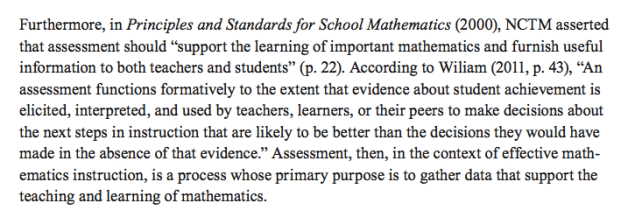
This passage from NCTM’s Principles to Action really captures how I feel about the work we are doing in our Learning Labs:

Screen Shot 2016-04-06 at 2.43.31 PM.png

In this most recent Learning Lab in 3rd grade, we planned the activity together using the 5 Practices model and reflected after the lesson. Since this blog is always my thoughts about student work, I thought it would be great to hear what the teachers took away from the activities we are doing in terms of the students’ understandings and impact on their future planning, formative assessment.  

The teacher mentioned in the blog said, I was surprised by how quick many of the students defended their responses that 1/2 will always be greater than 1/3, and then proving this response using visual representation of the same whole ( which is an idea that we have made explicit). I was impressed with “skeptics” in the crowd that were looking to deepen their understanding around the concept by asking those “What if” questions.  Going forward, I want to create opportunities that push and challenge my student’s thinking. I want them to continue to question and explore math – especially when it uses the word “always.”

Another teacher who taught the same activity after watching it in action in another classroom said, “I learned that almost half of my students assumed they were comparing the same size wholes.  They agreed with the statement, and each student gave at least two different ways to prove their thinking (area and number line model were most common).  The students that disagreed almost all provided their own context to the problem, such as an example with small vs large pizzas, or a 2 different-length races being run.  I found it so interesting that almost all students confidently chose one side or the other, and were able to defend their thinking with examples (and more than one-yeah!)  I was excited to see that they could be so flexible in their arguments as to why they felt as they did.  Three students responded that they were unsure, and gave reasons to support both sides of the argument. This impacted my instruction by giving me such valuable formative assessment information with a simple, non-threatening prompt.  It took about 5 minutes, and gave me tons of information.  It was accessible and appropriate for all.  Students were comfortable agreeing or disagreeing, and in some cases, saying “unsure-and here is why.”  I was most excited about that!”

She also said, From this activity, I learned that I really needed to revisit the third grade standard to see what is actually expected.  It says they should recognize that comparisons are valid only when the two fractions refer to the same whole.  My statement didn’t have a context, so how cool that some were at least questioning this!   This impacted my planning and instruction by reminding me how thinking/wondering about adding a context to the statement would influence their responses.  I am also reminded that I need to stress that students must consider the whole in order to make comparisons accurately.”

Earlier in their fraction unit, the third grade teachers used the talking point below to hear how her students were talking about fractions. (This work is actually from another teacher’s class, but you get the idea;)

A teacher who did this activity reflected, “From this activity, I learned my students had only ever been exposed to a fraction as a part of a whole (and wanted to strictly refer to fractions in terms of pizza). This impacted my instruction by being sure to have the discussion that fractions can represent parts of a whole, but we can also represent whole numbers with fractions.”

To me, these reflections are what assessment should be….the teachers learn about student thinking, the students think about their own thinking, and what we learn helps us plan future lessons with our students’ understandings in mind!

More examples from different grade levels where the teachers and I learned so much about student thinking that impacted future instruction:

Kindergarten: Adding

Kindergarten: Counting

1st Grade: Fractions and Adding

2nd Grade: Counting and Leftovers

4th Grade: Division

5th Grade: Fraction Number Line

3rd Grade: Comparing Fractions

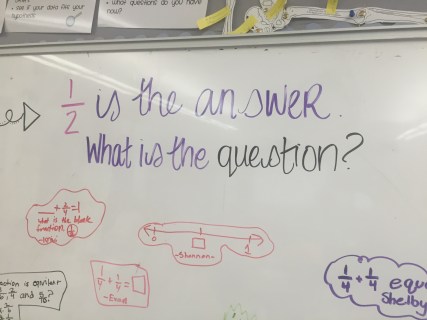
I was so excited just walking into Jenn Guido’s room today and seeing this awesomeness on the board from the day before:

IMG_2052.jpg

We chatted with the class a bit about their responses on the board before jumping into our Number Talk. One thing Jenn and I both noticed during this chat was the use of the word “double” when talking about equivalents such as 2/4 and 4/8. We had the chance to ask them what exactly was doubling and kept that in the back of our mind as something to keep revisiting. Even in 5th grade, I would hear the same thing being said each year. I would always have to ask, “What is doubling?” “What is 1/2 doubled?” “What exactly is doubling in the fraction?” “What happens when we double the numerator? denominator?”

After this chat, it was time to move into our planned activity. The class has been doing a lot of work with partitioning (and they used that word:) circles, rectangles and number lines so we planned a Number Talk consisting of a string of fractions for the students to compare. We were curious to hear how they talked about the fractions themselves and how they used benchmarks and equivalents. The string we developed was this:

1/6 or  1/8 – Unit Fractions

5/8 or 3/8 – Same Denominator (same-sized pieces in student terms)

3/8 or 3/4 – Common Numerator, Benchmark to 1/2, or Equivalents

3/3 or 4/3 – Benchmark to 1

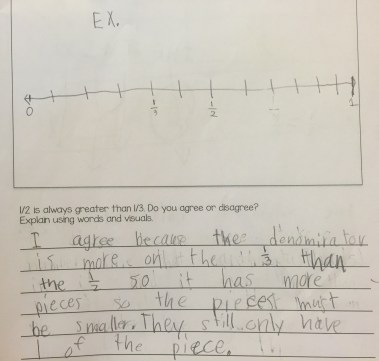
The students shared their responses and did an amazing job of explaining their reasoning very clearly. In all of these problems and actually in all of their work thus far, they have always assumed the fractions referred to the same whole. We decided to change that up on them a bit and see what they would do with the statement, “1/2 is always greater than 1/3.” We thought the word “always” would make them second guess the statement, but we could not have been more wrong…they all agreed. A few students shared their responses, and it was great to see such a variety of representations.

This student was interesting because he used 12ths, and although he could not articulate why, it was labeled correctly. I am assuming it was because 1/2 and 1/3 could be placed on 12hs, but I am not sure because his reasoning sounds like he is comparing the 1/2 and 1/3 as pieces not in 12ths.

IMG_2071

Jenn, Meghan (another 3rd grade teacher with us in the room) and I chatted while they were working about how to get them to reason about different-sized wholes. A picture would have been a dead giveaway so I just went up and circled the word always and asked, “Does this word bother anyone?” and one lone student said it made him feel like there was a twist. I love those skeptics. I asked them to talk as a table about what the twist could be in this statement, and then we had some great stuff! They talked as tables, and while only two of the tables talked about different wholes (in terms of number lines which was not what I expected either), there was so many great conversations trying to “break the statement.”

This is an example of the number line argument:

IMG_2067

This group kept saying it would be a different answer if they were talking about “1/2 of” or “1/3 of”…then said, “Like 1/3 of 1/2” and THEN KNEW IT WAS 1/6 when I asked what that would be! They said 1/2 is 3/6 so 1/3 of that is 1/6. Wow. Then, of course I could not resist asking what 1/2 of 1/3 would be and they kept saying one half thirds, but could figure out how to write it and then questioned if that could even be right.

IMG_2073

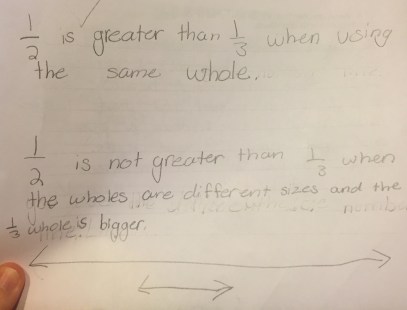
After having the tables share with the whole group, they all agreed the statement should be sometimes instead of always. Jenn asked them to complete two statements…

“1/2 is greater than 1/3 when….”

“1/2 is not greater than 1/3 when…”

IMG_2070

IMG_2076

A great day! We are doing the same thing in Meghan’s classroom tomorrow and are changing the first problem in the string to 1/2 and 1/3 so we can revisit that at the end. Can’t wait!

Rhombus vs Diamond

Every year in 5th grade, when we begin classifying quadrilaterals, students will continually call a rhombus a diamond. It never fails. While doing a Which One Doesn’t Belong in 3rd grade yesterday, the same thing happened, so Christopher’s tweet came at the most perfect time! (On Desmos here: https://t.co/rZQhu2SGnR)

Of course I had to pop into the same classroom today and try it out! The lower right was so obviously a diamond to me that I was curious to see if students saw the same thing and if it changed their reasoning about the rhombus as a diamond.

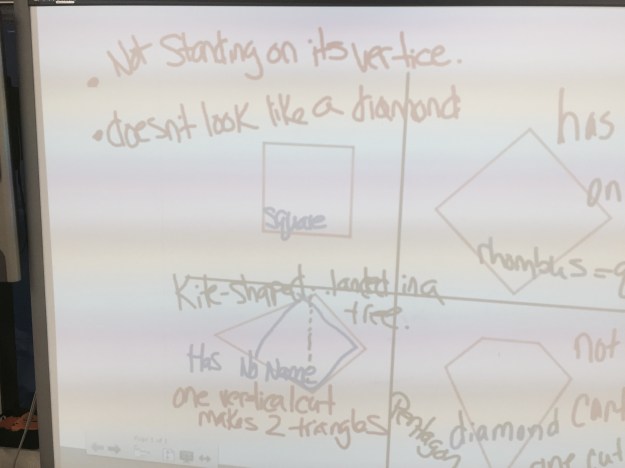
Here are pictures of the SMARTboard after our talk:

IMG_1784IMG_1783

After great discussions around number of sides, rotations, decomposition and orientation, they finally got to the naming piece. Honestly, I was surprised names didn’t come up as one of the first things. It started with a student saying the square didn’t belong because it is the only one that doesn’t look like a diamond. The next student said the lower left was the only one “that didn’t have a name.” When I asked him to explain further, he named the square, rhombus, and diamond. Because I knew at the end of our talk I wanted to ask about the diamond vs rhombus, I wrote the names on the shapes. Another classmate added on and said the lower left “may not have a name but it is kite-shaped and looks like it got stuck in a tree sideways.” I asked the class what they thought about the names we had on the board and it was a unanimous agreement on all of them. Funny how quickly they abandoned their idea from yesterday, so I reminded them….they were not getting off the hook that easy;)

“Yesterday you were calling this rhombus a diamond, what changed your mind?”

Students explained that the lower right actually looks like a real diamond and the rhombus doesn’t now that they see them together.

“Can we call both of them a diamond?” I asked. I saw a few thinking that may be a great idea. I had them turn and talk to a neighbor while I listened to them.

We came back and they seemed to agree we couldn’t call them both a diamond because of the number of sides. They were really confident in making the rule that the quadrilateral one had to be a rhombus and the pentagon was the diamond. I pointed to the kite and asked about that one, since it has four sides. “Could we call this a rhombus?” They said no because the sides weren’t equal, so not a rhombus. And because it didn’t have five sides, not a diamond either.

Thank you Christopher! All of these years of trying to settle that rhombus vs diamond debate settled right here with great conversation all around!

Next up, this one from Christopher…


Two Things I Am Wondering…

It is an interesting perspective moving out of the classroom into a coaching position. I have had more face-to-face teacher math conversations this year than ever in my career and it is wonderful. This position also lets me take a step back from the daily lesson planning and think about things I see across all of the grade levels. Most times, my thoughts are about the trajectory of mathematical ideas, however over the past couple of weeks I find myself thinking about two things I saw as norms when I taught, but now wonder more about…

1 – Is there a such thing as an addition, subtraction, multiplication or division problem?

I am sure we all can relate to the stories of students struggling with story problems. We see them be successful with Notice/Wonders and 3-Act Math tasks, however when given a story problem some “number grab” and compute without thinking about reasonableness. Why? While I think there are many factors at play here, I have another theory that has led me to question problem types. I could be completely off, but as I look through the curriculum and think about the progression in which I taught in 5th grade, I wonder if there is something to teaching “types of problems” within a unit. For example, in Unit 1, Investigation 1 could be my multiplication lessons while Investigation 2 could be my division lessons. While we don’t explicitly say, “this is how you solve a multiplication problem” and we explore various strategies to make connections between the operations, the header of the activity book pages say things such as, “Division Stories” or “Multiplication Stories.” Also, the majority of the work that week is the specific operation and applications.

From there I began to wonder, is there really a such thing as a specific operation problem? I would think that any division story could also be thought of as a multiplication problem. Do we lead students to think there are certain types of problems even if we make clear all of the strategies to find solutions? I love how CGI talks about problem types and wondering why more curriculum are not set up that way instead of keying students into operation-specific problems?

I asked some 4th graders about this exact idea. I gave them some multiplicative compare problems and asked them if they thought about each as multiplication, division or both. Then we talked about why.

2 – What makes students attach meaning to a vocabulary word? Do they need to?

Every year in 5th grade, I was confident that all of my students could find area and perimeter of rectangles. However, I was also confident that there would also be a handful of students who could find area and perimeter but didn’t know which was which. After much work with area and perimeter, they would have it by the end of the unit, but did they remember when they got to 6th grade? I am not sure.

Now, seeing all of the work they are doing with this beginning in 3rd grade, and talking to 3rd and 4th grade teachers who are seeing the same thing, I am left wondering why this is? What makes students attach meaning to vocabulary? This question is then followed by the my very next question…when do they have to?

I wonder if students should ever be given a problem where the context would not allow the students to figure out which one, area or perimeter, the problem was asking. For example, if Farmer Brown is buying fencing he would need the perimeter where if he was buying something to cover a piece of ground, it would be area. Should we ever give them just naked perimeter or area problems with no context where knowing the meaning of the word impacted their ability to solve it?

And then, after they do all of this work with both measurements, why do they forget which word is which year after year? I know the teachers do investigations with the work and use the vocabulary daily during the unit, as I did, but students still don’t hold on to it. What makes it become part of their vocabulary? Is it just too long between when they use it? Is it

These are just two things I am wondering about….


Perimeter in 3rd Grade

I am in the unique position over the next few weeks to see perimeter and area work in 3rd, 4th and 5th grade. It is so incredible to see the overlap across all three grade levels and, being a 5th grade teacher for so long, it is great for me to see where this work begins.

After planning with Hope and her student teacher, Lori, last week, we taught the lesson introducing perimeter today. On Friday, the students measured things around the room in different units of measure, having discussions about most appropriate units. For example, when measuring the length of the room would we use the same unit as we would for the width of our pencil eraser? Why?

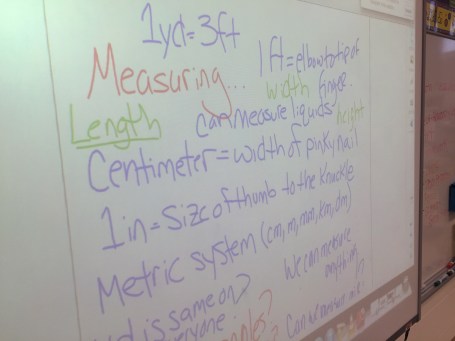
Since I was not there for the lesson on Friday, I was super curious to just hear what students thought about when they heard the word “measuring.” I wrote the word on the board and away we went. They were very quick with benchmarks, equivalents and different dimensions we can measure. I did a terrible job with my picture, but I got a couple really interesting questions like, “Can we measure anything? Air?” and “Can we measure the corner angles of things like the carpet?” Also, after a student had shared that one yard is the same as your hip to your ankle, students questioned if that was true because of the different heights of people. All of these things are great for students to explore at later times!

IMG_1518

Hope introduced the Investigations problem of an ant traveling around the edge of a piece of paper. To be honest, we were not thrilled with the context, but at the time we could not come up with anything snappy or original, so we went with it. We thought it was nice because, in inches, we could see if students measured to the half inch and also how they worked with the half inch when combining to find the perimeter. In hindsight, I am thinking a city map might have worked, however then the scale comes into play, so maybe not?? We let them choose the unit they thought would be appropriate, put them with a partner and they went off to work together. We were surprised to see most students using inches and when asked, thought that it would be “too many centimeters.” They seemed to chose units based on the biggest unit that still fits the object, but not thinking about precision and getting the smallest unit for that.

This is where I am continually amazed by what students know and intuitively do with mathematics.


It was interesting to see some pairs not know how to deal with the half,”not quite 9,” but know they only had to measure one side and then put “11” on the opposite side.

IMG_1520

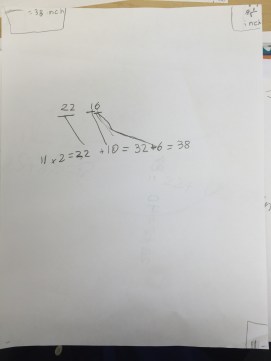
While another group had the 8 and one half written exactly like they said it “8 and 1 (one).5(half) inches.” Although written incorrectly, they dealt with it beautifully in their computation. However, I would want to bring up the equal sign in future share outs so they 8×2=16+1=17 would be written correctly. Does anyone use arrows in the elementary grades for this? 8×2–>16+1–>17? Or is it more appropriate for separate lines at this age?

IMG_1525

When I walked up to this group I asked where the ant was walking because of their lines through the middle of the paper. They said around the outside but it is the same no matter where you draw the line. I asked them to show me the 8 inches and I left them to talk about the 1/2 inch.

FullSizeRender 42

Some students did not deal with the 1/2 inch but seeing the ways they found the perimeter and wrote their equations, I was able to see the formula for perimeter coming to life.

IMG_1527 FullSizeRender 44

As students got finished with their first unit choice, we had them find the perimeter in another unit. It was nice to see the multiplication from their previous unit showing up a lot. IMG_1526

When I saw this one, I didn’t really know what to do with it. What do you with a 3rd grader using .5 as half? I asked them what .5 meant and they quickly said one half. They said one can be broken into .5 and .5 just like it can be broken into 1/2 and 1/2. That is so interesting to me and I would have loved to explore that conversation more, but with a whole class that is not ready to go there, I wrote it on the board and moved on.

FullSizeRender 43

As always, there is not enough time in a class period for me to talk about math with the kiddos. Tomorrow morning, students will journal about their strategy to find the distance the ant traveled. Since the majority of the class only measured two sides, we want to make explicit, through student sharing, why they didn’t have to measure all four sides in this case.

They next part of the lesson, which Hope and Lori will continue tomorrow, includes the students creating their own ant path on grid paper and finding the perimeter of that path. We are not going to dictate that the path must be a rectangle, but the ant must stay on the grid lines. We are hoping that this generates the conversation of when we can double the two sides and add them and when we can’t, assuming students draw irregular shape paths.

2nd Grade Counting,Unitizing, & Combining

The other day, I began writing up my lesson plan for a second grade class I was teaching today. I drafted the lesson, got feedback, revised and ended with this plan, around the 5 Practices, going into the classroom today.

I started the lesson, as I planned, with the students on the carpet like they typically are for a Number Talk. I wrote the sentence “There are 12 people in the park.” on the board and asked them to give me a thumbs up if they could give me a math question I could ask and solve from that statement. A couple students shared after a bit of wait time and I was getting a lot of even/odd talk or questions that involved adding more information to my original sentence. I asked them to turn and talk and one little girl next to me said they could find the number of legs. When I called the group back together I asked her to share her conversation with her partner and after that, hands shot up like crazy. It ended with a board that looked like this…

IMG_1101.JPG

I asked them if we could think about any of these in the same way? I tried to underline the “same thoughts” in the same color, but they started making connections that is got a bit mixed. A lot of there conversation turned to numbers and so I started a new slide and asked what numbers they thought of when they read those problems and why. I recorded what they were thinking…

IMG_1100.JPG

I really liked this opening talk (15ish minutes) and really didn’t want to let them go when it was time for their recess break in the middle of math class. So, they lined up and left for 30 minutes.

When they got back, we recapped the numbers and then I gave two groups question #1 and the other two groups question #2. They had individual time to get started and then they worked as a group to share their thinking. Knowing that I was going to be trading seats at groups for them to share their problem with another table, I was walking around looking for varying strategies so I didn’t trade seats and have a whole table who solved it all the same way.

They did a beautiful job working in their original group. I saw students who had different answers for the same problem talking out their strategies and arriving at a common answer. I saw students practicing how they were going to explain it to the new table they visited. I saw students who were stuck working through the problem with their tablemates. I can tell there is such a safe culture established by Lauren, the homeroom teacher. They trade seats, shared their problem and then I had to readjust my plans.

At this point, I wanted the tables talking about what was the same and/or different about the two problems but I was running out of time. In order to pick up with that conversation tomorrow, I decided to have them come to the carpet and I chose two papers (of the same problem) that had the same answer but different strategies. I asked the students privately if they would want to share and they were both excited so I put them both under the document camera and had them explain their work. I thought they was similar enough for students to easily see they both drew the figures out but as I walked around I heard the 1st student counting each one by ones and the 2nd student counting by twos after he wrote the equation. I had them explain their work and asked the class to think about what was the same and what was different and we discussed it. Here are the two I chose:

FullSizeRender 10.jpgFullSizeRender 12.jpg

They pointed out all of the similar things such as feet, people, two’s (but were counted differently), and the same answer. The difference was the equation which was an important thing to come up. I saw quite a few students with the correct answer but incorrect equation. A lot arrived at 22 by counting by wrote 7+2 as their equation so that was an important thing that a student pointed out.

I only had 5 minutes left, so I decided to collect their papers and pick up with the sequencing and connections tomorrow. Which I kind of love because it gives me time to be more thoughtful about how they should share them and also time to talk to their teacher about what I saw today.

So, from my previous plan, I am picking up here:

Practice 4: Sequencing

In the share, after each group has presented to the other groups, we will come to the carpet for a share. The sharing will be sequenced in the way I discussed in the Selecting part, asking students during each student work sample how it is similar and different than the ones we previously shared.

Practice 5: Connecting 

The connecting I see happening through my questioning as we share strategies. I am still working on writing this part out and looking for the connections that can be made, aside from the picture to number representation connections.

The connections I would love to see students making throughout the work and sharing, is how we can combine equal groups. For example I would like the student who is drawing ones and counting them all to move to seeing those ones grouped as a 2 or a 5 depending on the context. I would love the student who is seeing the five 1’s as one group of 5 to now see that if they have 2 of them it will make a 10 and if we have 4 of them we would have 20 and really start looking at different ways to combine those groups. 

The problem I am seeing in this plan is the differences in the two problems. As I sit here with the papers all over the table, I am struggling to make a sequence involving both problems. So, do I sequence a set for each problem and give each 1/2 of the class time to talk about the similarities and differences? or just choose one problem and go with that?

For problem 1, I like this sequence in moving from counting by 1’s to grouping them and then to the finding half of 34.

FullSizeRender 16FullSizeRender 15FullSizeRender 14FullSizeRender 13

For question 2, I see this sequence from pictures to grouping them by people and dogs, the third shows the 8 composed but broken apart on the number line and the paper before it, and the last one starting at 14.

FullSizeRender 17FullSizeRender 18FullSizeRender 19FullSizeRender 20

I collected their papers and asked them, in their journals, think about how many people and dogs there could be in the park if I just told them there were 28 legs. I thought that after their share tomorrow of this problem it would lead them into a nice problem from which some great patterns could arise. Here were a few I grabbed before I left:

FullSizeRender 9.jpg

IMG_1103.JPG

and this last one was getting at some really great stuff as she got stuck at 9 people and couldn’t figure out the number of dogs. I asked her to write what she was telling me!

FullSizeRender 8.jpg

Looking back, I would have probably chosen just one problem to work with to make it more manageable in sequencing and making connections during the share. Having two problems was nice as far as having them explain it to others, so I like that, but I am wondering if we did #1 through this process and then split for questions for #2 and #3.

I look forward to hearing how it goes tomorrow!

~kristin