Category Archives: Math

Math in a Movie Trailer

Last Wednesday at a PLC meeting, our district instructional technology specialist did a presentation on Blended Learning.  She did a beautiful job of demonstrating apps and web-based activities at various entry levels, so each teacher could participate. One of the fourth grade teachers expressed an interest, and a bit of fear, in trying to use ipads as part of her classroom routines. Since I had been in her room doing some math coaching the previous week, I offered to help her design an activity and give her a hand in the classroom with the ipad piece if she was not comfortable.

We met the next day to start our planning! She was just ending her 3D math unit in which students had been identifying 3D shapes by their silhouettes and attributes and finding volume of a rectangular prism. As a culminating activity, we decided to have the students create a movie trailer in iMovie that “told a story” about the unit. I sent the teacher home with one of the ipads to “play around” with iMovie, since she was not very familiar (or comfortable) with it.  I was so excited to come in the next day to see a trailer she had created at home that night! I LOVE when people jump right in!

This is how our lesson played out over the next two days…

– We created a room in “Todays Meet” on their ipads and had students go in and do a test post.

– We posted the question, “What is the purpose of a movie trailer?” in the TM room and let them type as we showed two movie trailers (Percy Jackson 2 and Despicable Me) on the SMARTBoard. When the trailers were over, we switched back to TodaysMeet on the SMARTBoard to go through their comments and have them expand on them. Here is a clip of the conversation:

TodaysMeet– Next we asked them to continue chatting about things they learned during this math unit. We noticed they were just writing one or two word things so we asked them to expand a bit and use more of their 140 characters. Sample clip:

TodaysMeet2– As a class we scrolled back through and had them stop and ask questions of each other if they didn’t understand what someone had posted. They were so engaged and they all kept asking if they could do this at home?!? YES! Next time I will leave the room open for a longer time frame so students can post as they think of things at home! What a great way to open class the following day!

– We took them through a brief “tour” of iMovie and let them move to a place in the room to look through the themes and storyboards and start brainstorming ideas for their trailer.

– To help them organize their thoughts, I had put a template of the storyboards: http://tinyurl.com/c3g5r2e in the Dropbox that was on each ipad. The students exported the PDF to UPad Lite: Upad

and let them play around with how to write on the document with pen width and different colors.

– The following day, students got in their groups (of 2-3 students) to plan out their storyboard and decide on pictures they need for their trailer.

When we meet on Monday, we are taking them around the school and outside to take pictures they need for their trailer. They are working this week finishing up the project, so this story will have  To Be Continued…

Mathematically Yours,

Kristin

Who is Coaching Who Here?

I am so fortunate to be involved in a wonderful state-wide cohort, MiST (Math Instructional Specialist Team), organized by MSERC and made up of specialists from the University of Delaware, the Delaware Department of Education and districts across the state. This year, one of our foci has been content coaching, looking deeply into the structures that need to be in place and how it can be used to develop lead teachers in our schools. Our latest “homework” for the group was to try content (math) coaching with a teacher in our building.

At my school, we do not have a coaching model in place as of this current school year. However, with our implementation of the CCSS, we are writing a district plan that involves structuring a content coaching model into each of our elementary schools. We are fortunate to have both a math and reading specialist in each elementary school, so we are starting with a foundational structure in place.  I thought it would be great to “try out” a coaching situation with one of the teachers in my building to bring back to MiST and get a feel for how it would work.

I have a wonderfully open 4th grade teacher in my building who is always excited to learn and willing to have me in her classroom and go through this process.  I find one of the more difficult things of coaching is finding that teacher who is open to having someone else in their classroom and sees the value in the learning experience.  I really lucked out with her! We met a week prior to the the day I would be in her classroom to choose the lesson and chat about which area(s) she would like to focus. The lesson we chose was on linear equations and in our pre-conference she wanted to focus on the timing of her launch and how to meet the needs of her “done early” and struggling students during the lesson.  We  planned a day to meet within the next few days to discuss the details of the lesson more thoroughly.

Having never taught this particular lesson before, I read and re-read the lesson, taking notes on the math involved, the launch of the lesson, how to extend and intervene for the students. I really was feeling the pressure to know EVERYTHING about the lesson and be overly prepared for any questions asked of me.  I think I was more nervous about this meeting than she was.

The day we were meeting about the lesson (pre-conference), I got to her room only to find out the plan had completely changed. She had just found out that in another RTI group (where @ 6-8 of her students go) they had already done our planned lesson. Oh No! We had to refocus quickly (45 minutes of planning isn’t much time), so we looked ahead to where she would be in her core math class and chose another lesson.

This was probably the BEST thing that could have happened to me, although at that moment, I found myself starting to get nervous.  I am a planner. I feel as the “math specialist,” I need to have all of the answers to any questions the teacher may ask. Which is so ironic bc with students, I am completely OK with saying “I don’t know that answer, let’s check it out” but with adults, I put pressure on myself.  With this unpredicted switch in lessons, I instantly went from coach to co-learner and it was awesome.  We read through the new lesson, asking questions as we went, learning from each other. I was offering ideas, she was offering ideas and we collaboratively “lived” the lesson for her 45 minutes of planning time. We talked through questions (inspired by Lucy West) such as: What is the math in the lesson? What previous experience have the students had? Who will struggle? Who will be done early and what will they do? What will the share out look like? Would you like me to chime in during the lesson?

She taught the lesson the following day, I filmed it, and it went beautifully! (I will be blogging more about the actual lesson soon).  Her classroom culture and routines were evident from the way the students respectfully disagreed with one another and moved around the room. I was so impressed with her! I cannot even express to everyone the excitement I felt when I left the room. I felt the success of the lesson as if I had taught it myself. Things we had talked about in the pre-conference came out from the students during the class. Things we had not thought about came out from the students. I feel like we had a mutual investment in the lesson, both feeling equal responsibility.  Our post conference is set up for next week, so I will blog about both of our reflections on the lesson and the process….so stay tuned!

It led me to ask myself, what does this coaching structure really look like? Who really coaches who? I would argue that this is really a multidimensional coaching model. I offered insight into “the math” of the lesson, the classroom teacher offered questions and insight into her students’ minds, the students offered comments for us to think about in upcoming lessons. When our district revisits our CCSS implementation plan and structure for coaching, this type of experience is critical in setting up those structures.

So thank you to my MiST peeps for the knowledge, motivation and safe environment to learn and share experiences. Thank you to my amazing 4th grade teacher for being so open to having me in the classroom and willing to learn through this with me. Thank you to the students who teach me something new every day I walk in the building.

Mathematically Yours,

Kristin

Negative Talk Is Not Always a Bad Thing.

My job as K-5 Math Specialist has many facets (too many sometimes) but luckily, a few times a month, I have the opportunity to teach an incredible group of 4th grade enrichment students.

Last month we were playing a fraction game called “Pot of Gold” in which students were adding and subtracting fractions using pattern blocks based on the fraction they rolled on a die.  The game typically ends when a student has lost all of their “gold” (pattern blocks) and the person with the most wins. In one group a student had a trapezoid left in hie pile (1/2 of the hexagon whole) and he rolled ” – 6/8.” He should have been out of the game because he didn’t have 6/8 to subtract from his pile, instead he asked me if he could just have negative 2/8 and try to “earn it back.” I asked the group what they thought and they were all on board so the game continued with the students going back and forth from positive to negative fractions, earning and owing as they went.

That comment opened the conversation up to negative numbers and unfortunately we ran out of time that day (isn’t that always the case?). From that point on, every time I saw one of them in the hallway they kept asking (hounding) me to come back and do something with negative numbers. I love when students are begging to learn math, how awesome!  I scheduled my time with the teacher and then started to plan, it was much tougher than I thought!

The class is a mix of students ranging from those who had a handle on what a negative number is and others who did not. I was worried about some forming “rules” and others, who did not have a good sense of negatives, memorizing them without understanding. I was stressing because I am a bit type A with planning, but I decided to take the pressure off of myself and just let them own this conversation. I could not be more happy with my decision!

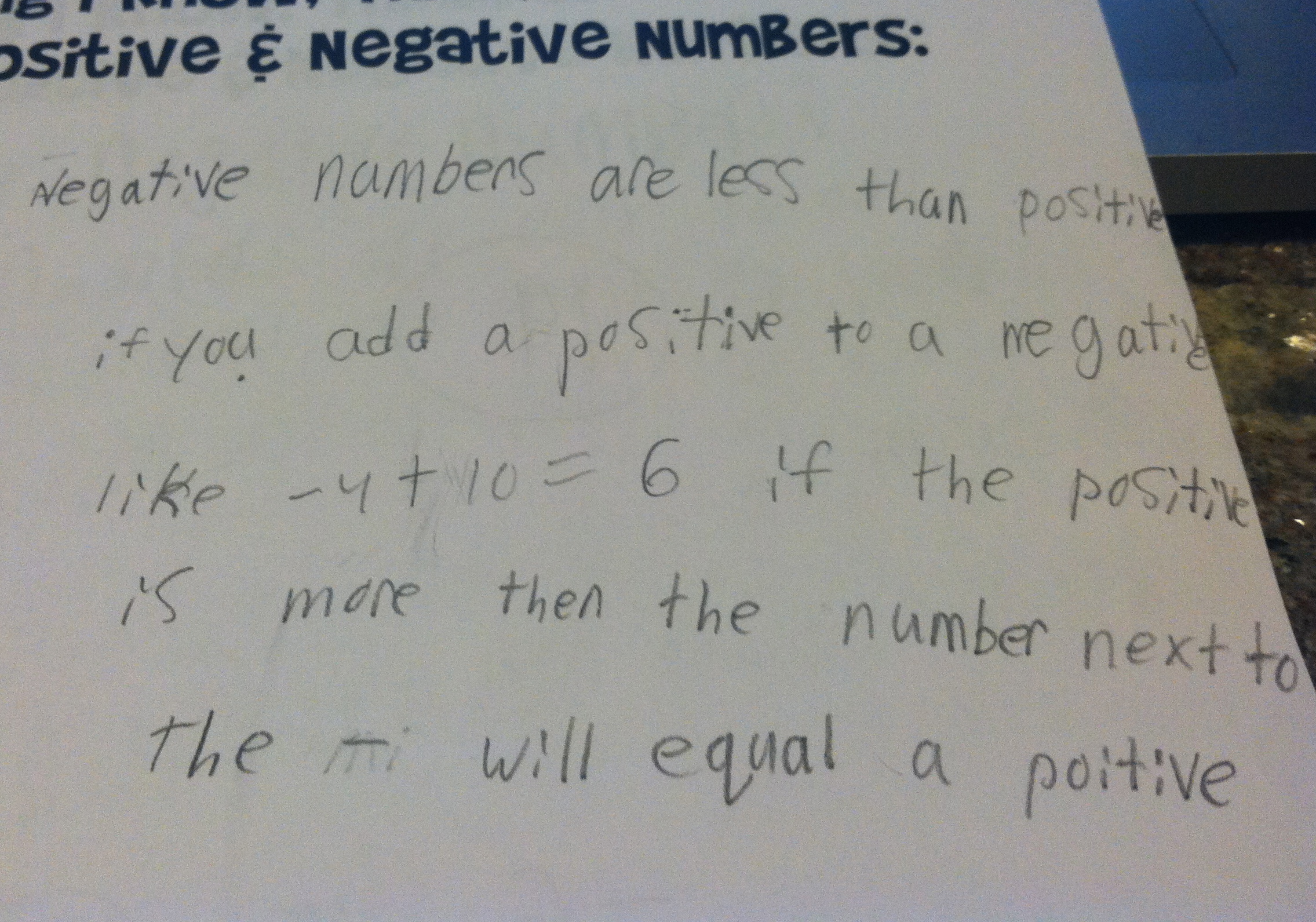
The class started and I gave them 5 minutes to write everything they know, don’t know, can draw, have questions about positive and negative numbers. I opened it up to questions first and let anyone in the class who had the answer, answer their peer’s question. I thought I would only hop if any untruths came about.  I could type all of their responses, but I think seeing their writing is so much cooler: Image

ImageImageImage

Image

ImageI cannot even describe how awesome this conversation was, students were asking and answering each other. I had my phone out, looking up answers to questions like, “When and why did negatives come about?” and “Are there negative Roman Numerals because IV for 4 seems like a negative?” We were ALL learning!

So where to go from here? I remembered a tweet from Andrew Stadel (@mr_stadel) about midpoints of numbers and I thought since the number line came up when talking about negatives, this could be an awesome problem to leave them with:

ImageI had another group to teach and had to leave, so we quickly talked about midpoint being the middle of two numbers (of course one student yells out “median”… I love this class) and I left them with this tweet.

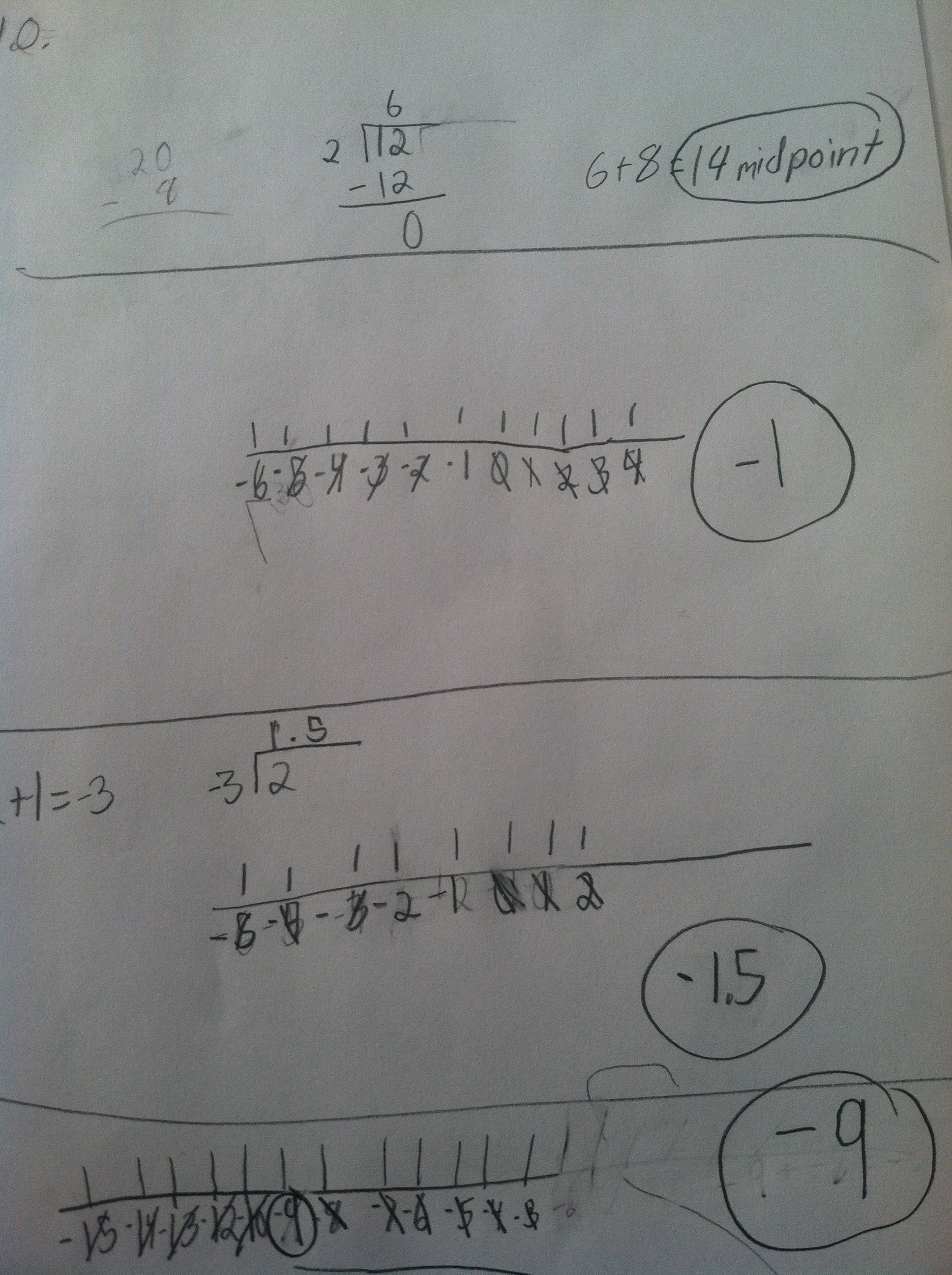
I came back to the class later to collect their work and it was just awesome. They gave me so many things to talk with them about next week, I can’t wait! Here are some sample works:

Photo May 10, 3 54 46 PM

Where would you go next with this group?? I loved the comment in the brainstorm that said, “Positive number – the higher the number, the higher the value. Negative number – the lower the number the higher the value” Hmmmm…do we get into absolute value?

I loved their strategies for midpoints…most used number lines, some found the distance between, divided in half and added to one of the numbers…do I keep going with this?

They also questioned a lot about addition and subtraction of positives and negatives…do I focus on this with the number line being the model?

So much information out there in one short lesson….but what I really learned from this lesson, was sometimes the best plan is to not really have a plan. Let them lead, let them talk, let them be in charge of their learning and they will open up more learning opportunities than you can imagine!

Mathematically Yours,

Kristin

Connecting the Dots in 1st Grade Math Centers

As many elementary teachers know all too well, effective Math Centers take A LOT of planning and preparation. Are all of the activity manipulatives available to students? Are the directions clear for students? Are the game boards laminated? Are the ipods/ipads charged? and on and on and on….

Last week, I realized that sometimes simpler is better. A handful of my 1st graders, who have a very strong place value sense and can mentally add and subtract 2-digit numbers, have been asking (hounding) me to teach them multiplication. I struggled with this for a few days because I didn’t want to just tell them that multiplication was “groups of” or take out the tiles for array building quite yet. It wanted it to develop from something more natural, something they were used to seeing but just in a different light.

This group of students is familiar with dot images since we do number talks with them often, focusing on addition equations and properties of operations. I put the following dot image on the board:

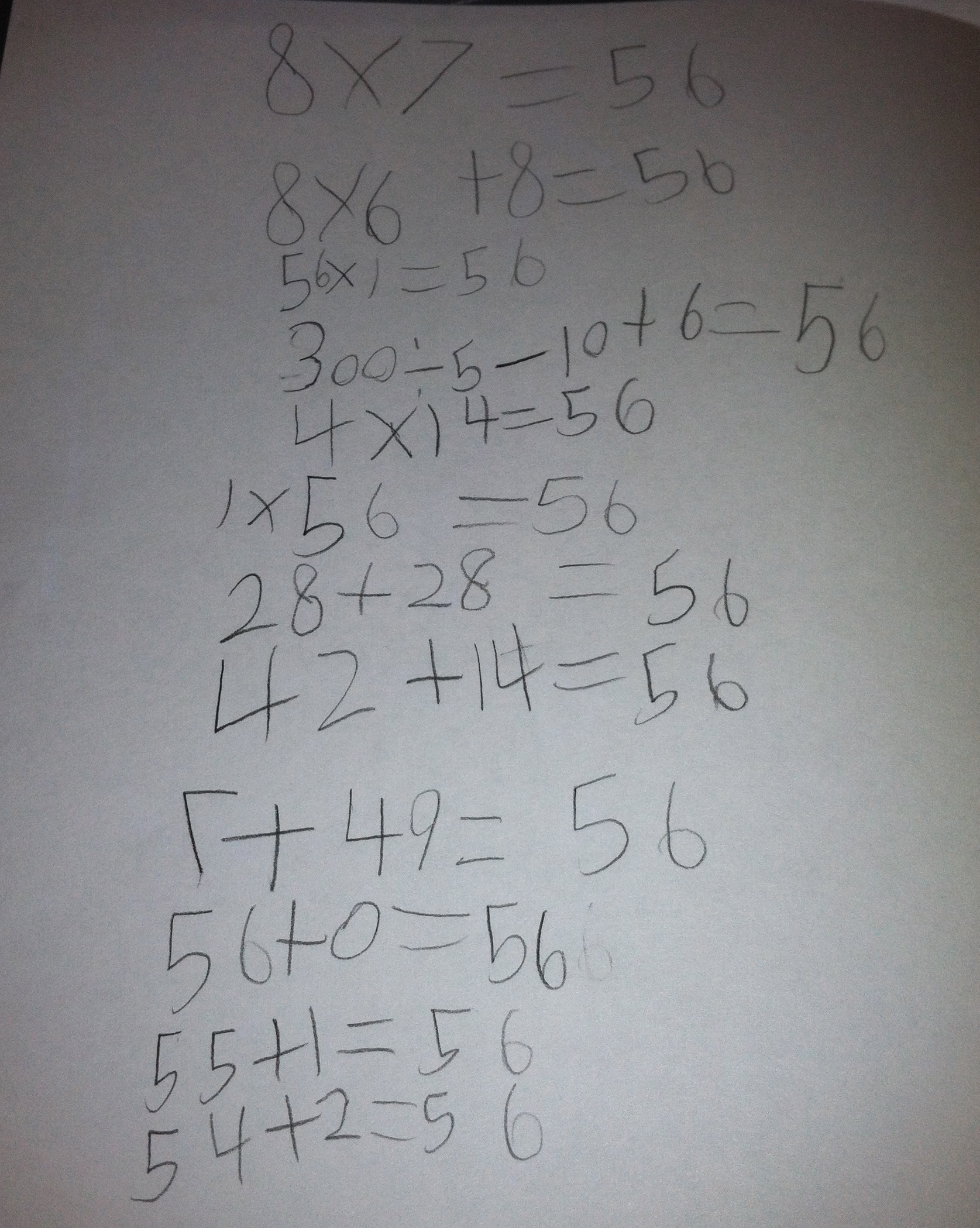
ImageThumbs went up (our signal for having an answer) and they all agreed on the answer of 36. Then I asked them write down all of the equations they could for finding the answers. Not the main point of this post, however when a student says I knew that if it was four 10s, it would be 40 so I took away one from each group to get 36, I can’t help but get goose bumps:)

I recorded their answers on the board and then chose to focus on 9 + 9 + 9 + 9 = 36. I asked them to explain that equation to me. One student said there was 9 in each bunch (close enough to “group” so i jumped on it). I explained that this is an example of when we can write this same problem as multiplication. “This is four groups of nine, so we can write that as 4 x 9.” Their reaction “That’s it? That’s Easy” Priceless. We did a few more together before the class ended.

The next time we met, I wanted to give them a chance to do some work in partners so I could walk around and listen to each of the conversations. I tried to plan an activity that would allow me to see their thoughts on multiplication and if any of it really “stuck” with them. I racked my brain, and the internet, for something that would be engaging and fun for them, until I just decided to give them a dot image and see what happened!

Here are some of the results:
Dot Image:

Image

Student Work:

ImageDot Image: ImageStudent Work: (I was bummed, his second equation is wrong bc he forgot the middle two 6’s, but the rest is amazing!)Image

Least prep ever for a math center with the most amazing results! Demonstrates the relationship between addition and multiplication and has the properties of operations all over it! I am almost convinced you could teach K-1 math class with dot images, ten frames and number lines!

Mathematically Yours,

Kristin

Isn’t Math Really Just How You Look At It?

Over the past year and a half, I have attended numerous CCSS trainings, read the standards and examined the CCSS learning trajectories. It is evident there is an emphasis placed on understanding of the properties of operations in the elementary grades. I don’t know about anyone else, but I remember it being taught to me as a lesson: Commutative Property is a+b=b+a… and such. No meaning behind it, simply some symbols, that if you could memorize and recite each, you were considered successful (as far as grades were concerned) in math class.

Fast forward to my second year as a K-5 math specialist. Having taught nothing below 5th grade in my previous 15 years in education, I am slowly wrapping my head around the depth of conceptual knowledge in grades K-1.  I always knew K-1 was very “hands-on” but I have to admit, I really did not understand the complexity and beauty in the way kindergarteners “see” math until this year.

The other day I did a number talk with a class of kindergarten students. I displayed various dot images with anywhere from  5-10 dots arranged in different patterns. My goal was to have students subitizing the dot patterns and writing addition equations to match the groupings.

I flashed the first dot image on the smartboard for @ 2 seconds and the students wrote the number of dots they saw on their dry erase board. Students shared their answer with a partner and showed me their boards. I put the image back up and asked how they saw (visualized) the dots.  We talked about different groupings, circled the dots for each, and practiced writing a couple equations together.

Feeling confident about the goals i had set for the number talk, i began to rethink them a bit after the following image:

Image

Students quickly shared the answer of seven and then I asked, “How did you see the dots?”

The first student said,”I saw 2, 1 ,1,1, 2.” I had him circle the dots the way he saw them on the SMARTBoard and asked the students to write an equation for that grouping. Many successfully wrote a version (with some backwards 2s) of 2 + 1 +1+ 2+1=7. As I was looking around, I noticed one little girl had written all of the possible ways to arrange the 2s and 1s in the equation on her dry erase board. I realized at that moment, THIS is the commutative property in action! We shared all of the equations and I wrote them on the Smartboard.  I posed the wondering to the class: How can these equations look different but still have the same answer? They talked to their neighbor and the common response was because no dots left the picture…not exactly what I was looking for, but good answer.  I thought maybe it was too many numbers in the equation to see the commutative property or i just asked the question wrong, so i continued.

I asked for another way they saw it. Tons of thumbs went up (this is our sign for having a strategy) and the next student came to the board and circled 5 and 2. She knew it was a five, she explained because of a dice and she just knew two (there was the subitizing i wanted, but at this point we were going deeper). I asked students to write an equation for that grouping. They shared with their partner and we recorded 2+5=7 and 5+2=7. I was excited because two students had already written both equations on their boards before the share out. Now I posed the same type of question, worded differently, “What do you notice about the two equations we just wrote?”

I got responses like:
“The have the same numbers”
“Seven is at the end”
“Seven is the answer”
“He took my eraser” (all a part of the kindergarten learning curve)
“5,2,7 are there, mixed up”
Image
I went with that  comment and pressed further… “So how can the 5 and 2 be mixed up and still have the same answer?”

After a  minute or two, one little girl said, “It’s just how you look at it. From that way (she pointed left) it is 2 then 5. If you look that way (she pointed right) it is 5 then 2.”

So there you have it teachers…the commutative property is “just the way you look at it.” Simple and beautiful.

NCSM-Jo Boaler-Promoting Equity Through Teaching For A Growth Mindset

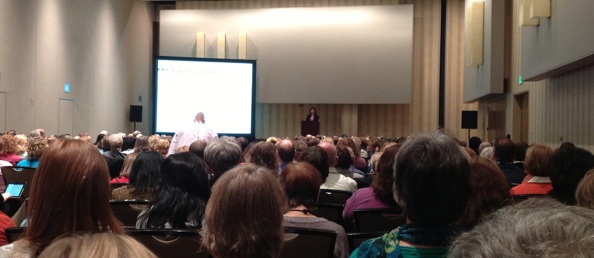
1As you can see from the picture, it was a packed house! After waiting in line for fifteen minutes, I was so lucky (and excited) to get a seat to hear Jo Boaler speak, even if my seat was in the next to last row.

Jo opened the presentation with Dweck’s research on mindsets. “In the fixed mindset, people believe that their talents and abilities are fixed traits. They have a certain amount and that’s that; nothing can be done to change it. In the growth mindset, people believe that their talents and abilities can be developed through passion, education, and persistence.”

Jo states that the fixed mindset contributes to one of the biggest myths in mathematics: being good at math is a gift. She referenced her book, The Elephant in the Classroom (added it to my reading list) and showed the audience various television/movie clips that continue to perpetuate this mathematical myth.

Jo then moved from Hollywood to the science behind the learning.  She briefly discussed brain plasticity,  the capacity of the brain to change and rewire itself over the course of one’s lifetime. When learning happens, synapses fire and create connections.  These synapses are like footprints in the sand, that if not used, wash away. To illustrate this plasticity, Jo showed the variation in two child brain scans, one child from a loving home and the other living in extreme neglect.  At this point, the neuroscience has me completely transfixed, so interesting.

2

Jo went on to discuss the London “Black Cab” Drivers. To become a Black Cab driver, one must pass a test called “The Knowledge” consisting of 25,000 streets and 20,000 landmarks. I had to Google it to find the image because I thought DC was bad…

3

Brain scans have shown that Black Cab drivers have a larger hippocampus after studying for and passing this test, demonstrating neuroplasticity, the brain changing/rewiring as new things are learned.

She shared a letter from a high school math department against using algebra II as a graduation requirement. The letter, in so many words, implied that certain students can’t learn, whether it be because they are minorities or due to lack of maturity, and would not be able to pass this requirement.  The reasoning in the letter goes against brain research that shows that every child can excel in math. I am so impressed with Jo’s use of research to dispute the comments we hear all too often, even at the elementary level.  Research shows that every learning experience changes one’s “ability,” yet we used fixed ability language often, “high kids and “low kids.”

Jo read a quote by Laurent Schwartz, “What is important is to deeply understand things and their relations to each other.  This is where intelligence lies.  The fact of being quick or slow isn’t really relevant.  Naturally, it’s helpful to be quick, like it is to have a good memory.  But it’s neither necessary nor sufficient for intellectual success.” I think that needs to be a poster every classroom wall!

So how does mindset impact how students view themselves? Jo shared 7th grade data in which students with a growth mindset outperformed fixed mindset students. Growth mindset students demonstrated more persistence in challenging situations and the gender gaps were eliminated in SAT levels.

Jo posed the question to the audience, “What do you think encourages a fixed mindset in a student?”  As we discussed our thoughts, I checked out Twitter only to find there were a few folks tweeting about this particular session, so we shared our ideas:

4
Jo suggested that student grouping, assessment & grading, and the math tasks we use in our classroom all contribute to creating a fixed mindset in a student. She presented this block pattern to the audience:

5

Typically, teachers would ask how many blocks will be in a certain figure number, leading to an input/output table response. Jo suggested asking students, “What you see happening?”” How do you see it growing?”
She showed video of a group of students working together for over an hour, sharing how each saw the pattern growing/changing.  They were engaged, following different pathways through the problem, creating arguments, and persevering. Ah, the Math Practices again…I do love seeing them in action! She suggests that when tasks are open and engaging, a growth mindset is developed.

I have to confess, I was reading some tweets about Jo’s session from other #NCSM13 participants at this point. I heard Jo mention Gauss and Cathy Humphries, so I jotted them down to check out later.

My attention was quickly drawn back in when Jo said, “Grades are not that important.” Thank you and thank you! She stated that diagnostic feedback of classroom observations leads to higher achievement in students. Then, the popular topic of timed tests arose.  According to neuroscience, math should never be associated with speed.  She shared numerous honest, yet sad, student reflections regarding timed tests. A 4th grader said he/she feels,”nervous because I am scared I will not finish or make a mistake.” A 2nd grader said he/she feels “that I am not good at math.”

Mistakes are good, mistakes grow synapses and yet students are pressured to NOT make them. Why? Jo stated that students have been brought up in a performance, not learning, culture. Jo ended with the message that teachers and students should be encouraged to have a growth mindset and how we teach will impact each student’s mindset. Awesome session!
Jo Boaler: http://www.joboaler.com

Marilyn Burns – NCSM presentation

When Dan Meyer tweeted for volunteers to recap sessions at NCTM, I thought it was such a great idea! What a wonderful opportunity for educators to learn from wherever they are!

When I sat down to write my first recap, it was harder than i thought. Taking my crazy notes and organizing them into a digestible format for readers was difficult, but here it is…

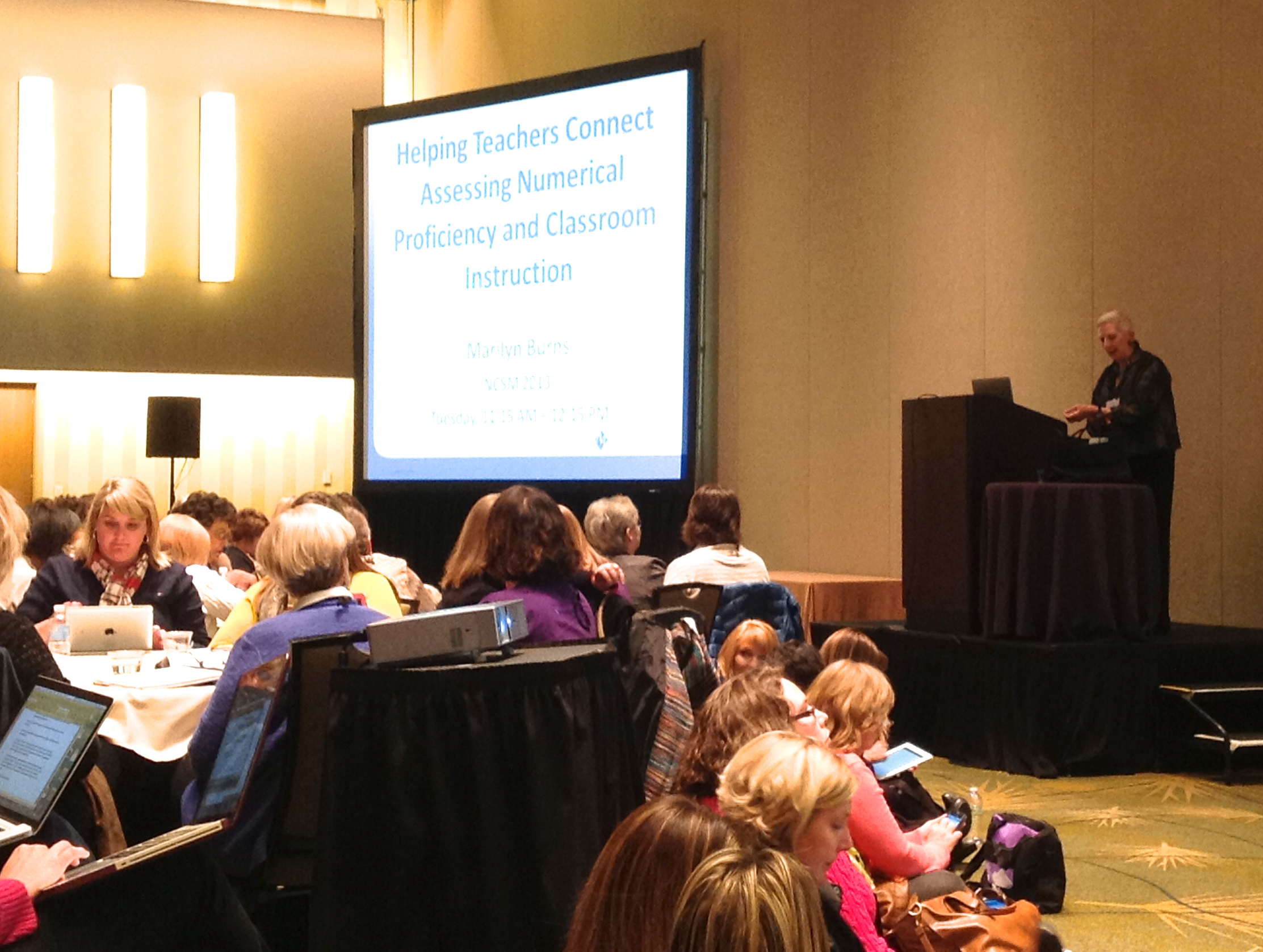
[Marilyn Burns] NCSM: Helping Teachers Connect Assessment of Numerical Proficiency and Classroom Instruction
Image

Marilyn opened the session with a brief description of her Math Reasoning Inventory (MRI), “MRI is an online formative assessment tool designed to make teachers’ classroom instruction more effective. The MRI questions focus on number and operations and are based on content from the Common Core State Standards for Mathematics prior to sixth grade. They are questions that we expect…and hope…all middle school students to answer successfully.”  From there, she outlined four uses of the MRI (or any MRI-type student interviews) to help teachers connect assessment to instruction: embed MRI clips into classroom instruction, use the interview questions to develop properties of operations, analyze student errors in reasoning and use interview answers to inform classroom instruction.

Marilyn described a number talk she had recently done with a group of 4th graders.  She posted 99 + 17 on the screen and asked audience members to share strategies with people seated around them.  After a few moments, the audience reconvened and Marilyn shared example reasonings from her 4th graders.
Some examples were:

She explained that during her number talk with the 4th grade students, she recorded the students’ reasonings on the board with their name beside it and offered other students the opportunity to agree, disagree, or share another way of solving the problem.  After the students had given all of their solutions, she showed them MRI video clips of 5th graders solving the same problem. After each clip, Marilyn had the 4th graders revisit their responses and relate the video solution to the recorded class solutions. I thought this was an amazing way for students to make connections between strategies, when not “worded” the same way.  For example if someone had added 100 + 20 and then taken away 4 to arrive at 116, it is a compensation strategy like example 1 above, however may look different numerically. This difference in appearance could lead to mathematically rich conversations in determining relationships of strategies among the students.

The next problem Marilyn posed to the audience was 15 x 12. She asked audience members to share strategies with the people seated around them.  After a few moments, the audience reconvened and Marilyn shared example reasonings of the problem on the board.
Some examples were:

We watched videos of students solving the problem and discussed the distributive property of multiplication over addition. Typically students decompose numbers by tens and ones, however when we do something like 12 x 12 to start, we are not using that same reasoning. Marilyn went on to discuss that we tend to look at the distributive property as multiplication over addition, however it could be multiplication over subtraction as well.  These discussions, when used in the classroom, help develop the students understandings of the property of operations and promote the standards of mathematical practice.  Marilyn showed video of a student solving 15 x 12 using the standard algorithm. I have to stop for just one second to say that I cringed a bit at the use of the term “standard algorithm.”  While I understand most teachers use it to identify “traditional” multiplication, I would argue that any algorithm could be standard if worked efficiently by a student. Ok, back to the presentation. The student arrived at the correct answer, however when explaining her process, it is clear she lacked numerical reasoning when computing mentally.  Marilyn further explains that the algorithm is not a concern on an individual problem, however IS a problem when it is the student’s only strategy.  She made a connection between properties of operations with whole numbers and decimals by posing the question, 1.5 x 20. We watched student videos and discussed the use of the distributive property in this problem vs the use of the associative property.

Marilyn revisited the problem 15 x 12, however this time asked the audience to guess the top two incorrect responses students gave for this question. The general consensus of the audience was 110 (10 x 10 + 5 x 2).  The second most common was 30, we were all a bit curious where that came from, including Marilyn.  My guess is the student set up the problem vertically, multiplied 5 x 2, carried the one and added 1 + 1 + 1 to get a 3 in the tens place.  Just a guess though. She went on to tell us that 24% of the 6th grade students got this problem incorrect. Scary.  The problem 12.6 x 10 was posed and we went through the same steps of guessing the two incorrect responses. 39% of the interviewed 6th graders answered this incorrectly and the two most frequent incorrect responses where 120.6 and 12.6.  We watched a couple videos of the students’ incorrect reasonings.  The most interesting clip for this problem was a student who answered the question as “120 and 30 fifths.”  The student had multiplied 12 x 10 to arrive at the 120, but then wrote 6/10 as 3/5 and multiplied by 10 to arrived at 30/5.  Marilyn pointed out that while not conventional, it is the distributive property and what an excellent opportunity it would be to ask students if that answer is correct. Knowing the student errors that occur on these problems can help guide your classroom instruction.  It was interesting to me that the majority of the teachers in the room could name the most frequent incorrect responses and yet these mistakes are still occurring.  If we know they happen, what are we doing to stop them from happening?

With a few technical difficulties in the beginning, we were running about 5 minutes behind schedule. That didn’t leave much time for fractions, however Marilyn briefly discussed comparing fractions such as 3/8 and 9/16.  She stressed the importance of having students explain the “because” part of the answer.  She said because of the easy equivalence of 16ths with 3/8 and 9/16, she suggested then asking 3/8 or 5/6 to elicit different solution pathways.

Marilyn’s discussion and examples of the Math Reasoning Inventory demonstrated the importance of teachers listening to students and using those conversations to improve the connection-making and relationship-building in classroom instruction.

If you are interested in more math recaps, visit Dan’s recap site! Awesome stuff!

-Kristin, Math Minds

Embracing Disequilibrium

There seemed to be two common threads among the majority of sessions at NCSM this week: CCSS and Standards for Mathematical Practice. It was close to impossible to find a session without those terms somewhere in the description. Whether you love them or challenge them, the CCSS offered a wonderful opportunity for rich mathematical discussions & examination into best practice.

It was Ruth Parker who closed her session by saying, “Looking ahead, we need to embrace disequilibrium, liberate students and teachers to step outside of their comfort zone.” This statement was NOT what you saw in every session description, however for us, truly captured the essence and heart of the conference.

Embrace Disequilibrium.

Not a phrase you often hear in education, right?

To help us along in our post-session discussion, we immediately pulled up our dictionary app: Disequilibrium (n) – loss or lack of balance attributable to a situation in which some forces outweigh one another. Synonyms: changeability, fluctuation, fluidity, unpredictability, variability…

As teachers, we like balance. We live on fixed schedules. We arrive at school at a specific time, each subject has an allotted time, lunch for 1/2 hour and so on. So for us, this thought of imbalance opened up a plethora of questions. What does that mean for math education going forward? Does it mean the same thing for everyone? Can you observe it in a classroom? How does it impact professional development for our teachers?

Disequilibrium in the way we plan our units of study: Plan for “the math” in a unit instead of planning how to teach students to solve the math at the end of unit assessment.

Disequilibrium in the way students problem solve: Don’t rush to rescue students from their confusion. Let them struggle. Allow them the satisfaction of learning something new and knowing they can do it.

Disequilibrium in the way we assess our students: Assessment opportunities arise often, take advantage of them at all times, do not just reserve assessment for “quiz/test day.” Make it formative and meaningful in guiding instruction.

Disequilibrium in the way students talk in the classroom: No more raising hands and sharing answers one at a time. Students create arguments, listen to one another, critique each other’s reasoning, and work collaboratively.

Disequilibrium in the way we pose problems to students: Engage them in meaningful math tasks. Pose investigations with student-driven inquiries and entry points for all learners. Make connections, discover relationships, and make a habit of asking, “Is it always true?” or “Does this always work?” to challenge the learners.

Disequilibrium in the way we organize our PD: No more one size fits all when we train our teachers. Design PD like you would want to see teachers teaching students. Be engaging, do math, involve administrators, use technology (shout out to Twitter here), coach teachers, create teacher leaders, model and reflect on best practice.

Marilyn Burns, Kathy Richardson, Jo Boaler, and many others by whom we were beyond impressed, all sent the powerful message that EVERY student can learn. We, as educators, must meet students where they are, embrace mistakes as a learning opportunities, engage students in challenging tasks with multiple pathways to a solution, and encourage mathematical discourse in the classroom. To do this, we must be fluid in our instruction and let student thinking create imbalance.

Embrace Disequilibrium.

Be okay with discomfort, be okay with imbalance, thoughtfully shake things up, be changeable, your students will thank you!

Mathematically Yours,
Kristin and Nancy, Math Minds

Is the generalization ever too much?

We love having students make generalizations in math class. Is this always true? Will it work for every number? If students can answer those questions, we feel we have created a successful learning experience for students, right?

Well, after attending a session today on supporting teacher learning in the CCSS, it led me to question if there is a time when the generalization hinders a learning experience? For example, we sat down to this problem: “Find all possible dimensions of a rectangle where the area equals the perimeter.” We worked through the problem individually and then together as a group. After coming up with 6×3 and 4×4 by guessing and checking, we started forming some ideas towards a generalization that would push students past guess and check. After some discussion, we concluded that the dimensions couldn’t be two odd numbers and there was a time when the area grew more rapidly than the perimeter so those larger dimensions would not work. After trying to set up an algebraic equation to formulate a generalization, we stopped to share as a group.

Long story short, we were told the generalization to find all possible dimensions with equal area and perimeter was that if a rectangle with sides a and b, a = 2b/(b-2). Now my question is this, does this generalization alienate a large group of students? I know as adults, we persevered and created viable arguments; however at a certain point we saw no entry point for many 6th grade students to answer this question. As adults, we were even at a loss after a certain point of working. Attentions started to stray and side conversations began. On the flip side, if i had left without the generalization, I would have left frustrated. But did that generalization help me make connections between length of sides and area and perimeter? I would argue not.

I feel that if we are going to have students make generalizations, there needs to be connections among entry points and when there is not a visible connection, I am at a loss.

Any general thoughts ;)?
– Kristin

NCTM 2013 – Choices, Choices, Choices…

We are finally en route to Denver! So far we are loving the free baggage (just made the 50 lb limit whew), drinks, and snacks on Southwest; however after leaving the runway & pulling out our NCSM packet of sessions, we are completely overwhelmed and exhausted!

Before choosing our sessions, we brainstormed a bit about what we wanted to get out of the conference as a whole, what were we definitely looking for, as well as what we were not. Nancy was looking for sessions that sounded thought-provoking, interactive and align philosophically with her beliefs on how students learn. I went more with weeding out what I was NOT looking for in a session. I did not want sessions based in “policy” or “newest trends” in education, testing, or tiers of RTI. I wanted sessions, like Nancy, centered around improving student learning and strategies to move more teachers in the direction of best math practice.

It was obviously easy to choose the big sessions led by presenters whom we have used their resources in our own practice, educators we look to for inspiration, and persons who have contributed to us becoming the math educators we are today. Jo Boaler, Marilyn Burns and Kathy Richardson were three easy session picks!

Now the tough part begins….

Monday options:

9:30-10:30
“Exploring teachers’ practices of responding to students’ ideas” – Amanda Milewski
“Constructing arguments in the elementary classroom: struggling and excelling students in the classroom community”-Susan Jo Russell
“Helping teachers implement research-based instructional practices”-Karin Lange
“Thinking beyond the content: using mathematics as a vehicle to teach reasoning”-Marilyn Trow (leaning toward this one)

10:45-11:45
“Linking problem solving and the standards for mathematical practice”-Robyn Silbey
“How to differentiate your mathematics instruction, K-5”-Jayne Bamford-Lynch (leaning toward this one-Nancy)
“Reaching all learners by differentiating instruction in grades 3-5”-Janet Caldwell
“What is fluency and why is it important”-Skip Fennell (leaning toward this one-Kristin)

12:15-1:15
“Interviewing students to learn about algebraic reasoning Grades 3-5”-Virginia Bastable
“Differentiated coaching: providing each teacher with the support to reach each student”-Jane Kise
“Defining effective learning experiences for educators in a CCSS classroom”-Marji Freeman

1:30-2:30
“Increasing teacher quality with differentiated PD”-Jennifer Taylor-Cox

2:45-3:45
“Enhancing mathematics education using the iPad”- Amanda Lambertus

4:00-5:00
“Noticing and wondering as a vehicle to understanding the problem”-Annie Fetter

As you can see we still have some narrowing down to do in our am sessions so any feedback is much appreciated! Do you know any of the presenters? Any topic jump out at you? Why?

Check back soon for our upcoming sessions and session recaps!!

Mathematically Yours,
Nancy & Kristin, Math Minds