Category Archives: 5th Grade

Comparing and Ordering Decimals

It is always so interesting to me what students take away in terms of strategies for doing various tasks in math class. In this particular case, ordering and comparing decimals. We all did the same shading activities, played the same comparing games, however the way this shading is applied to student thinking is so different among the students in the class.  In our assessment today I saw quite a variety in thinking that I just love.

These three are a sample of the most common strategy I saw in the work today. The students first thought about it in terms of how many tenths each decimal had. We talked about this a lot while shading in terms of full tenths, partial columns for hundredths and then parts of hundredths for thousandths so it makes sense that they would think about which decimal had the most tenths shaded first and move on from there.

IMG_9360_3 IMG_9363 IMG_9368

This student has a comfort in fractions and changed each to a fraction in the thousandths. It is interesting that certain students like to stay in fractions, where she could have just as easily made them decimals to the thousandths.

IMG_9362

This student explains using the hundredths grid in words. I love the use of the word blocks and 1/2 blocks. I just want to check back in on this one to see if there are connections to that 1/2 block representing 5 thousandths.

IMG_9364

“I thought about it like whole numbers.” This is something I would be extremely worried about if she had ordered them like: .6, 0.8, .55, .125, .875 because then the decimal would have been irrelevant in their reasoning in terms of “whole numbers”. She really multiplied each by 1000, which is something I would like to revisit tomorrow with her.

IMG_9366

I also had quite a few that compare using percents. This is a nice connection back to our fraction/percent work on the 100s grid earlier in the year.

IMG_9367

This was a nice way to ease back in after an extended weekend of snow and ice!

-Kristin

Fractions As the Denominator

As I was organizing my student work pictures this morning, I realized I had tweeted out this awesome work, but never blogged about it.

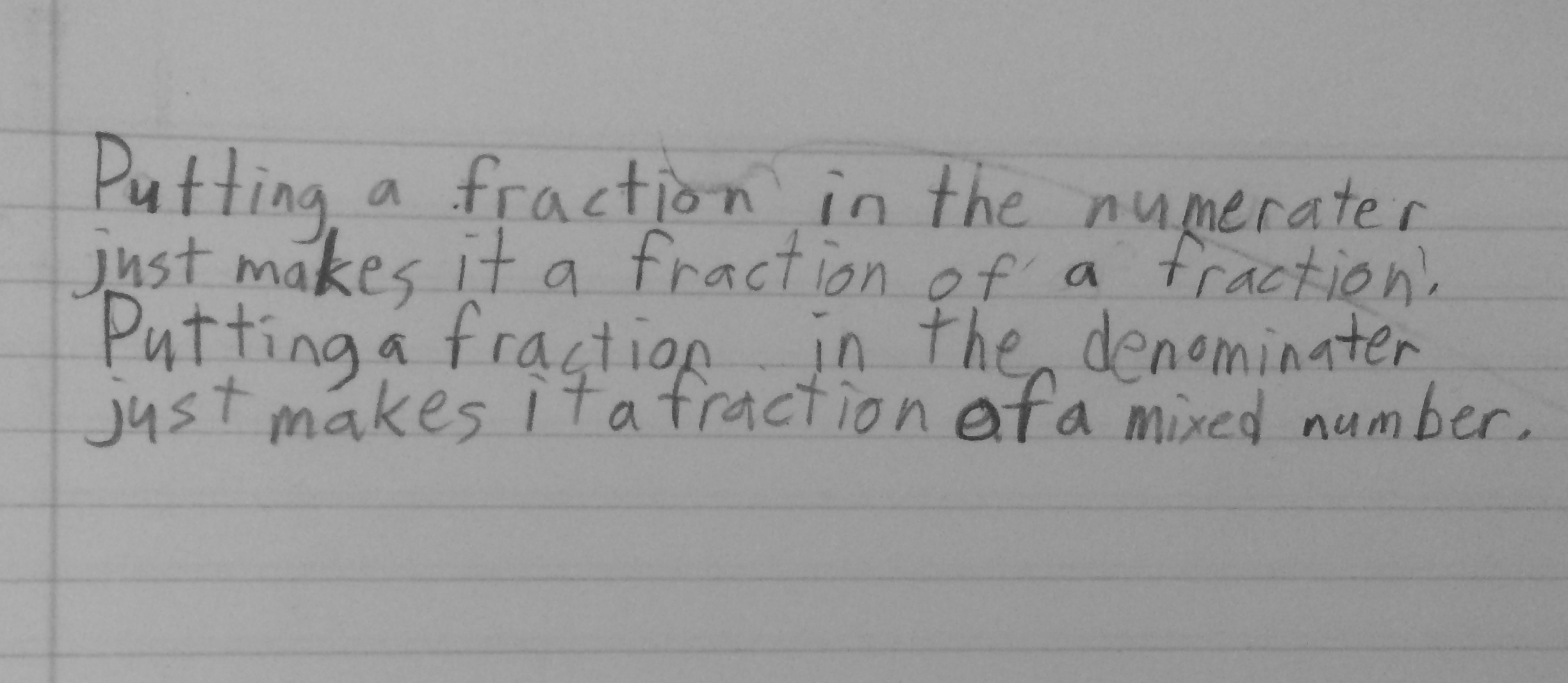
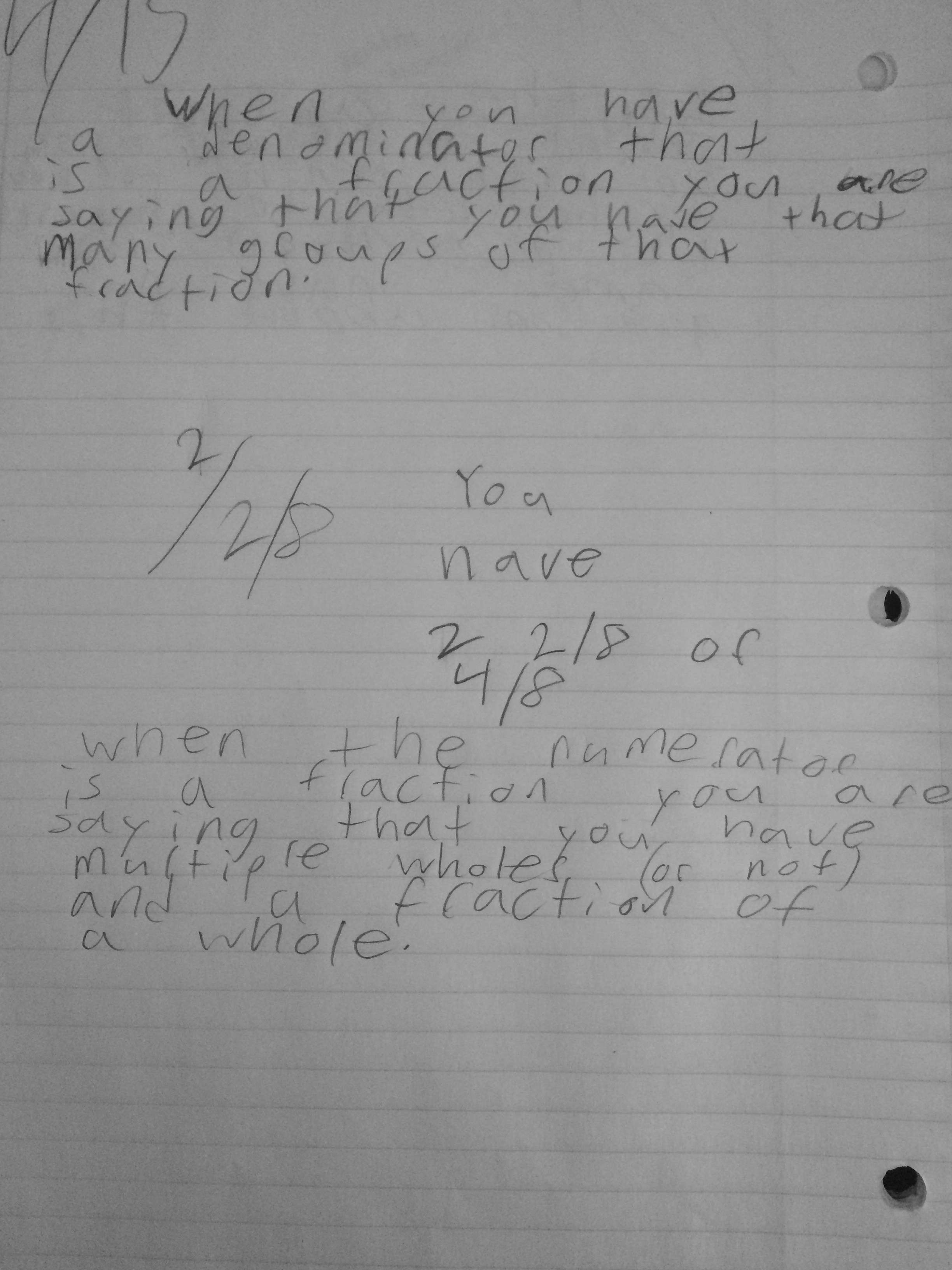
My students are very comfortable with putting fractions in the numerator. They use them all of time when decomposing, adding and comparing fractions like in these two examples…

IMG_8910_2 IMG_8300

The other day, two of my students finished early and as an aside asked me if there could be a fraction as the denominator. I asked them to try it out and see what they thought.

They wrote their question and then started playing around with some fractions in the denominator. At first they were writing a bunch of fractions with a fractions as the denominator in attempt to find one that jumped out and made sense to them. They tried drawing some pictures of them along the way to see if they could illustrate what it would look like.

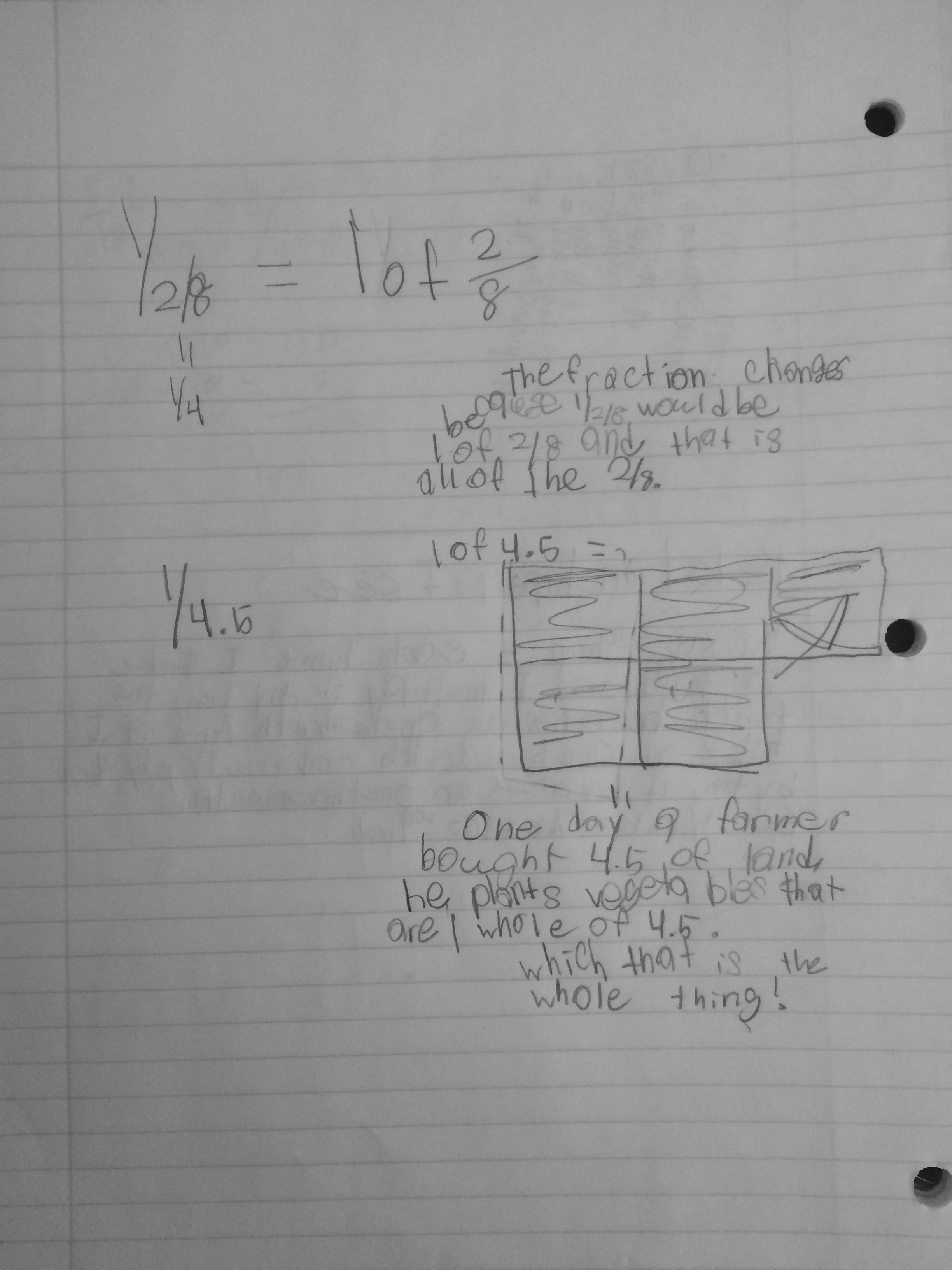
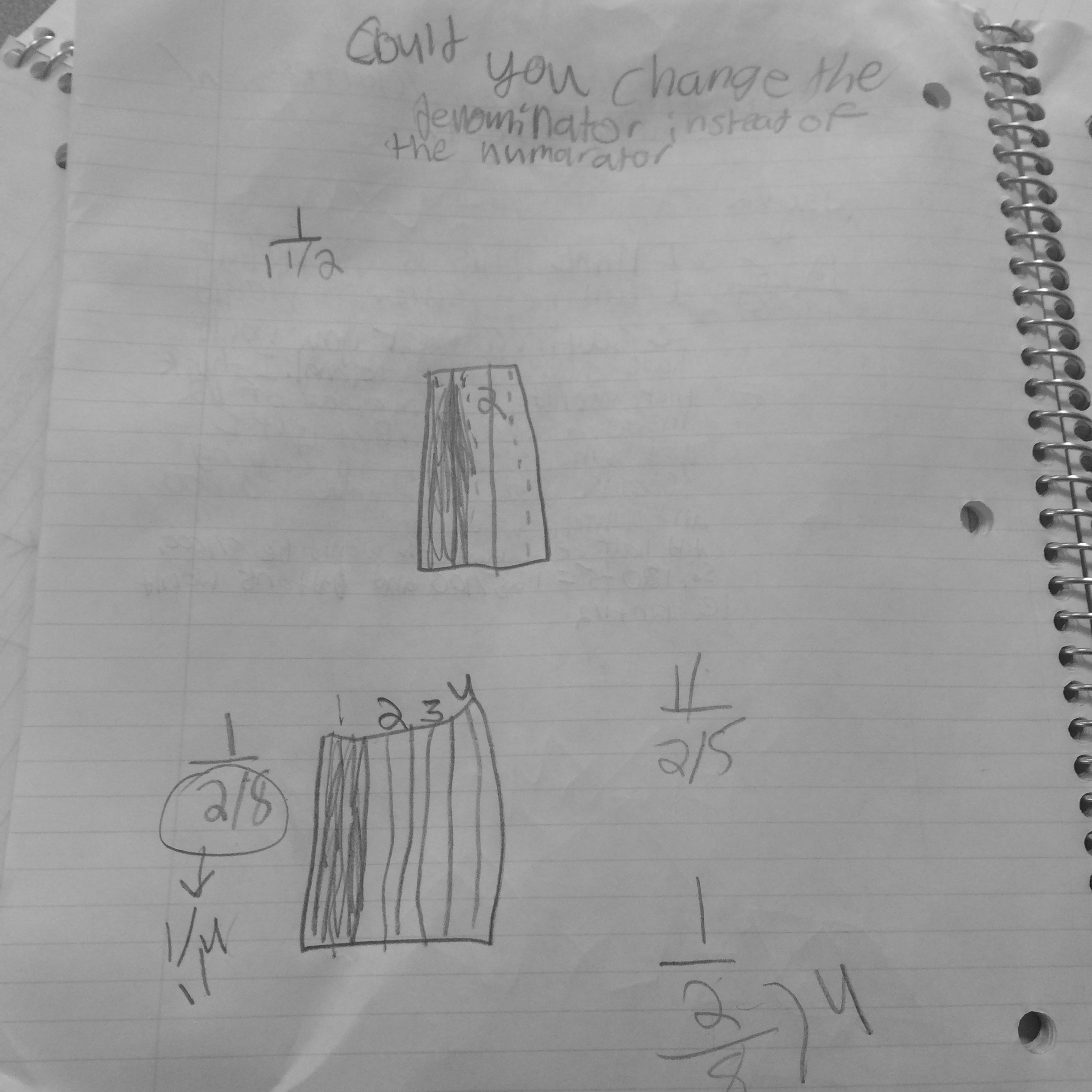
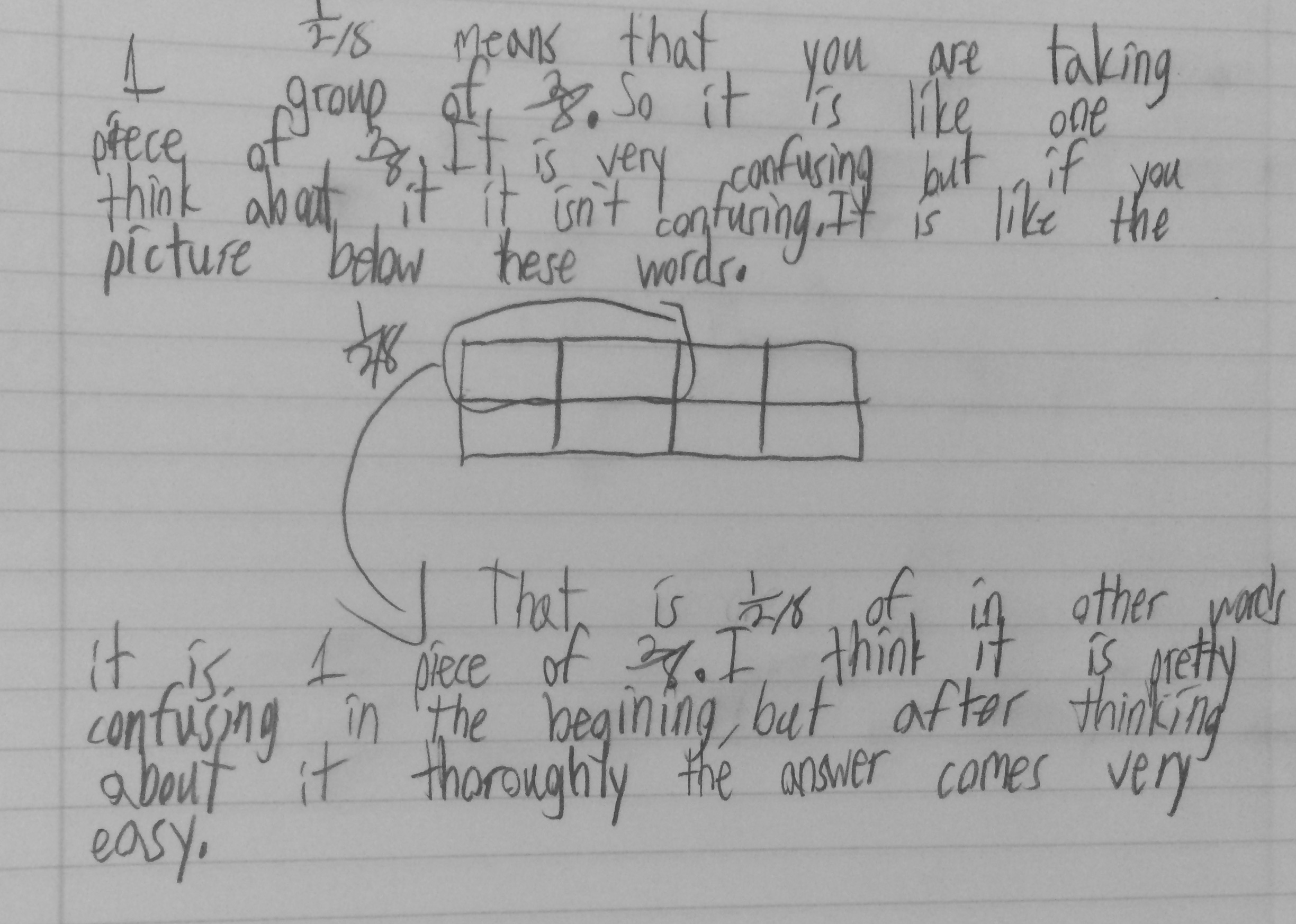
The first one they drew was 1/1.5 in which the rectangle was cut into thirds and had 1.5 shaded. When I asked what they would name what they just drew, they said 1.5/3. Hmmmm, back to the drawing board. They moved to 1 / 2/8, drew a rectangle cut into 8ths and shaded 2 of them. After shading, one student wrote 1, 2, 3, 4 over each 2/8 and said that there were four of the 2/8’s in his picture, so 1/ 2/8 must be 4. I asked what the whole was in the picture and left them to play around with that idea for a bit.

IMG_9035_2

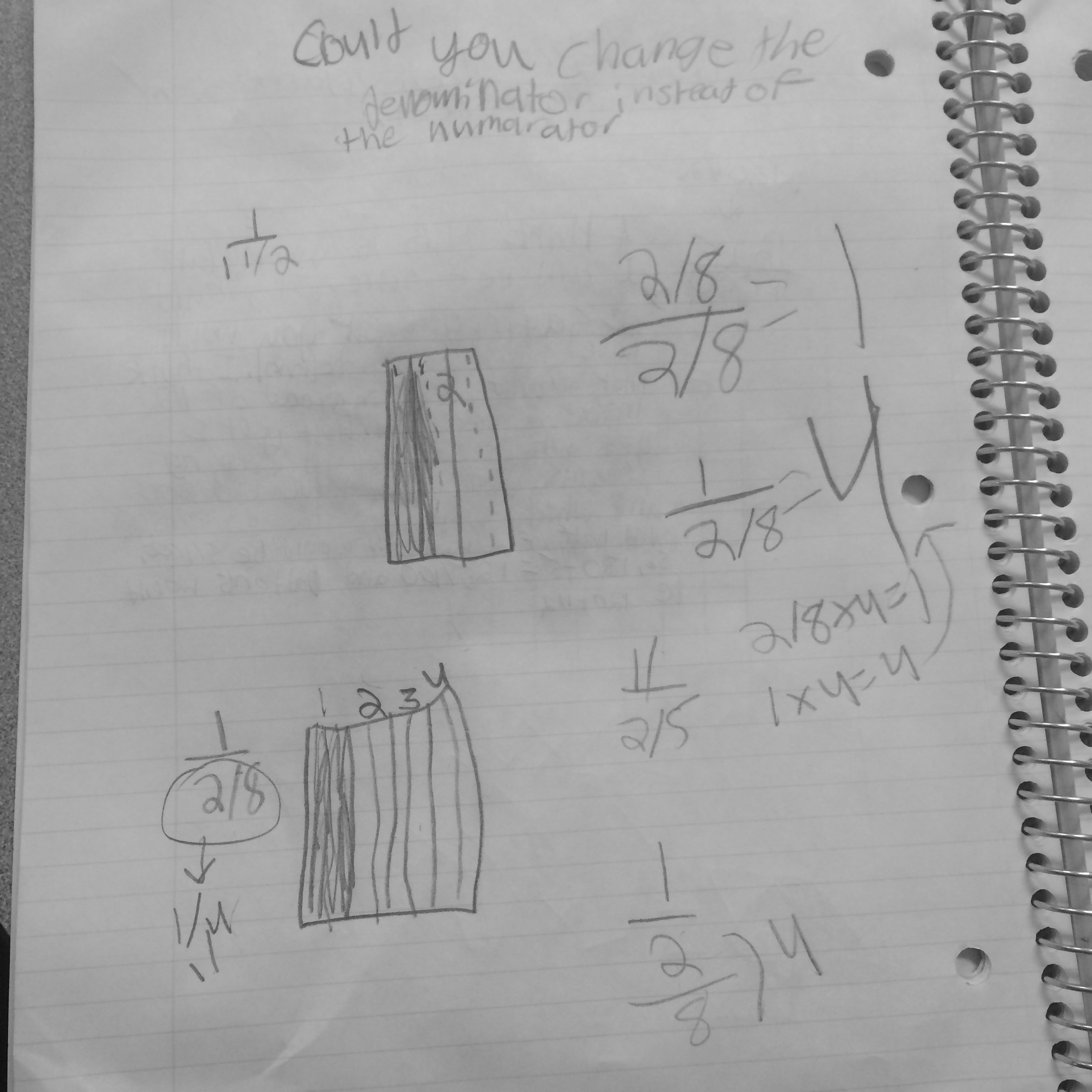
I came back to these additions to the work:

IMG_9037_2

When I came back they said they realized that 1/ 2/8 was really a fraction more than 1 since 2/8 / 2/8=1. When I asked them to show me where that thinking was in their representation, they said since 2/8 was really 1 in their picture, it took four of them to make four wholes. I especially liked how they multiplied the numerator and denominator by 4 (the reciprocal of the denominator) to get to 1 in the denominator. Interesting to think about the algorithm for dividing fractions at play here.

As others in the class finished their work, they started to mess around with this question, trying to make sense of it. This student attempted to put it into a context using the meaning of a fraction we use a lot, “a pieces the size of 1/b,” however with b as a fraction, it is not helpful here.

IMG_9040_2

One student wrote this as his thought about the fraction as the denominator.

IMG_9038_2

I am left thinking a lot about the progression in which students learn complex fractions.

The “One Frame”

I love this introduction of decimal addition so much from last year, that I had to relive it again: https://mathmindsblog.wordpress.com/2014/02/19/decimals-in-a-one-frame/  It was just as amazing this time!

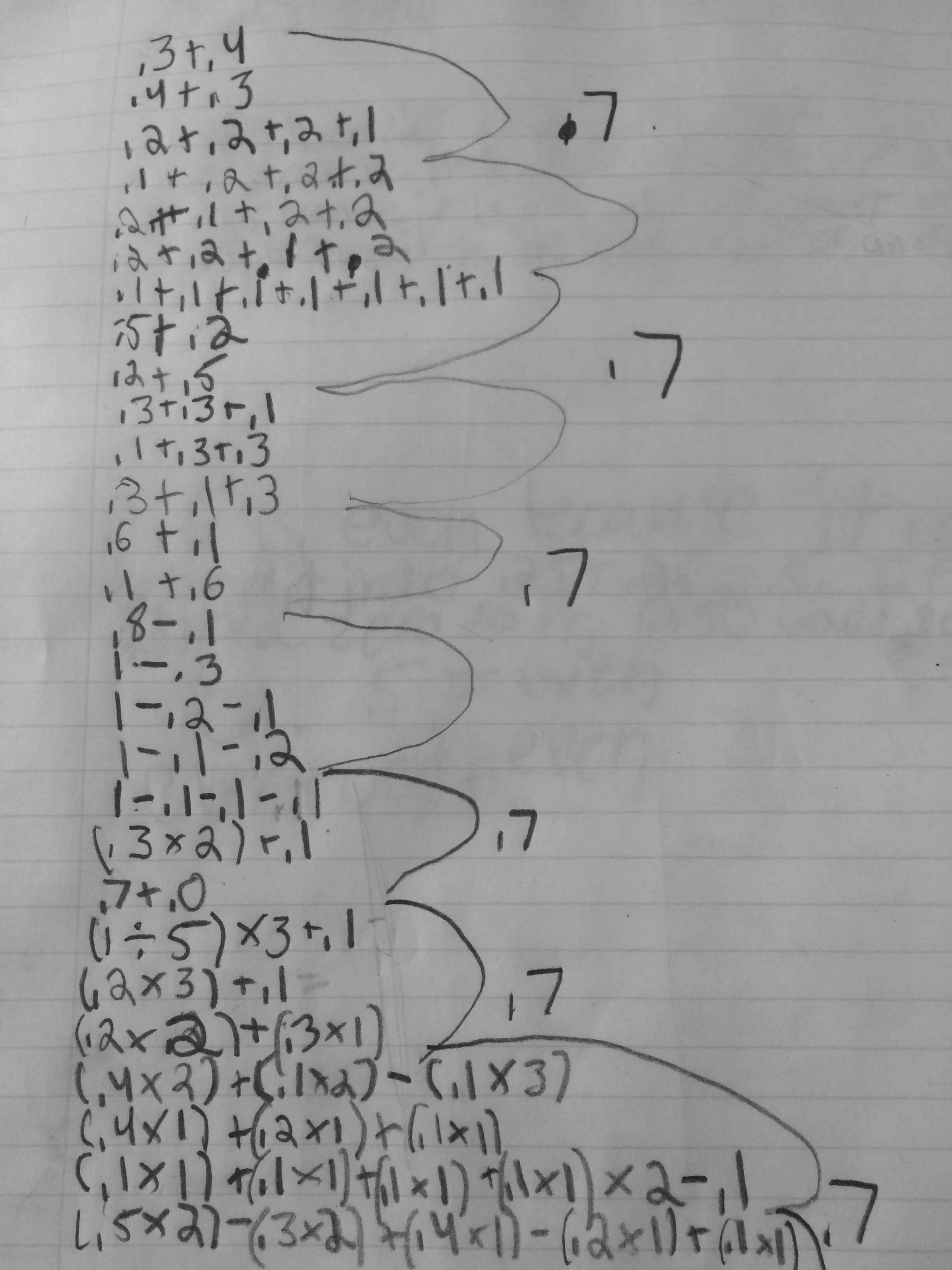
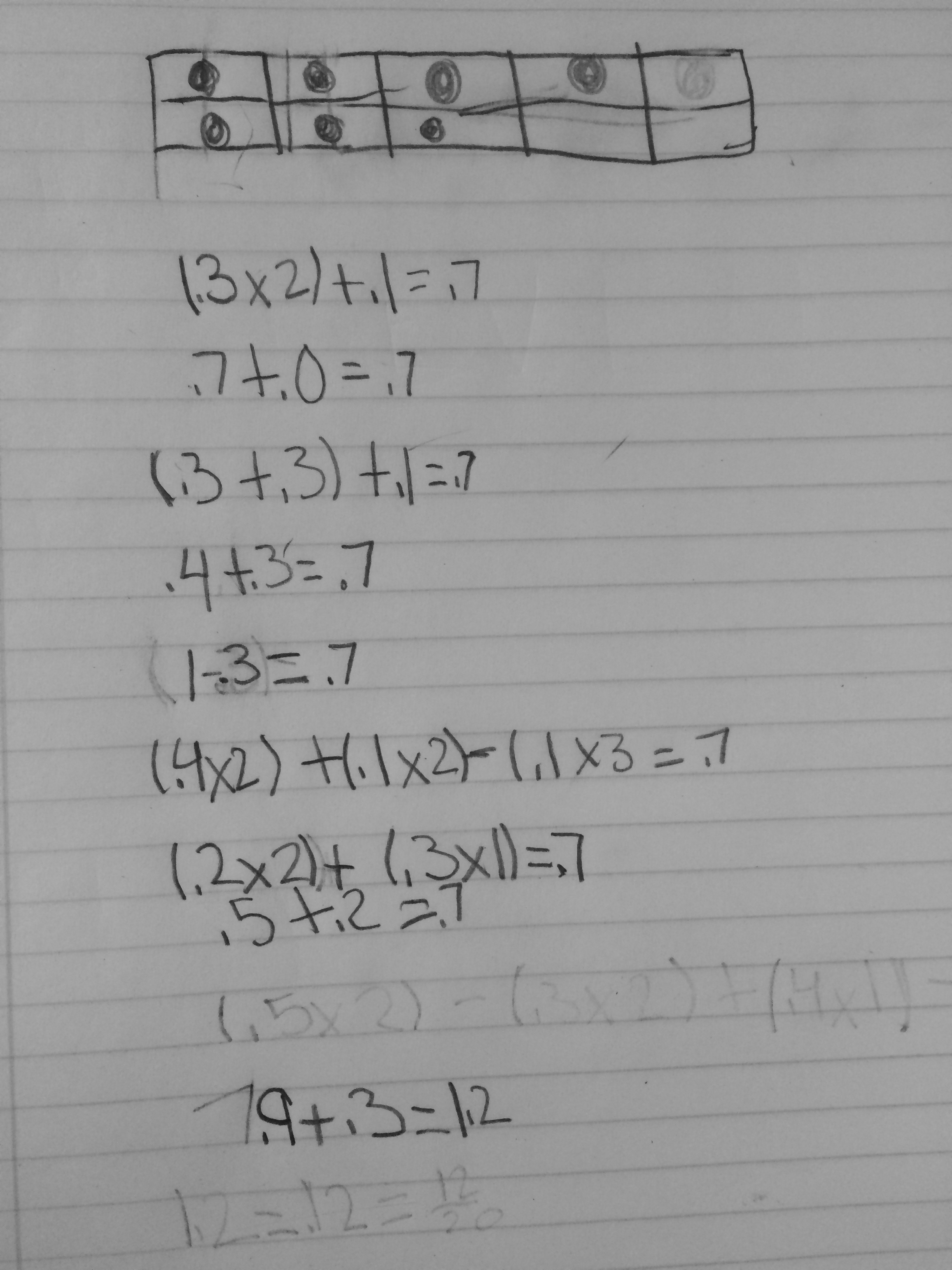
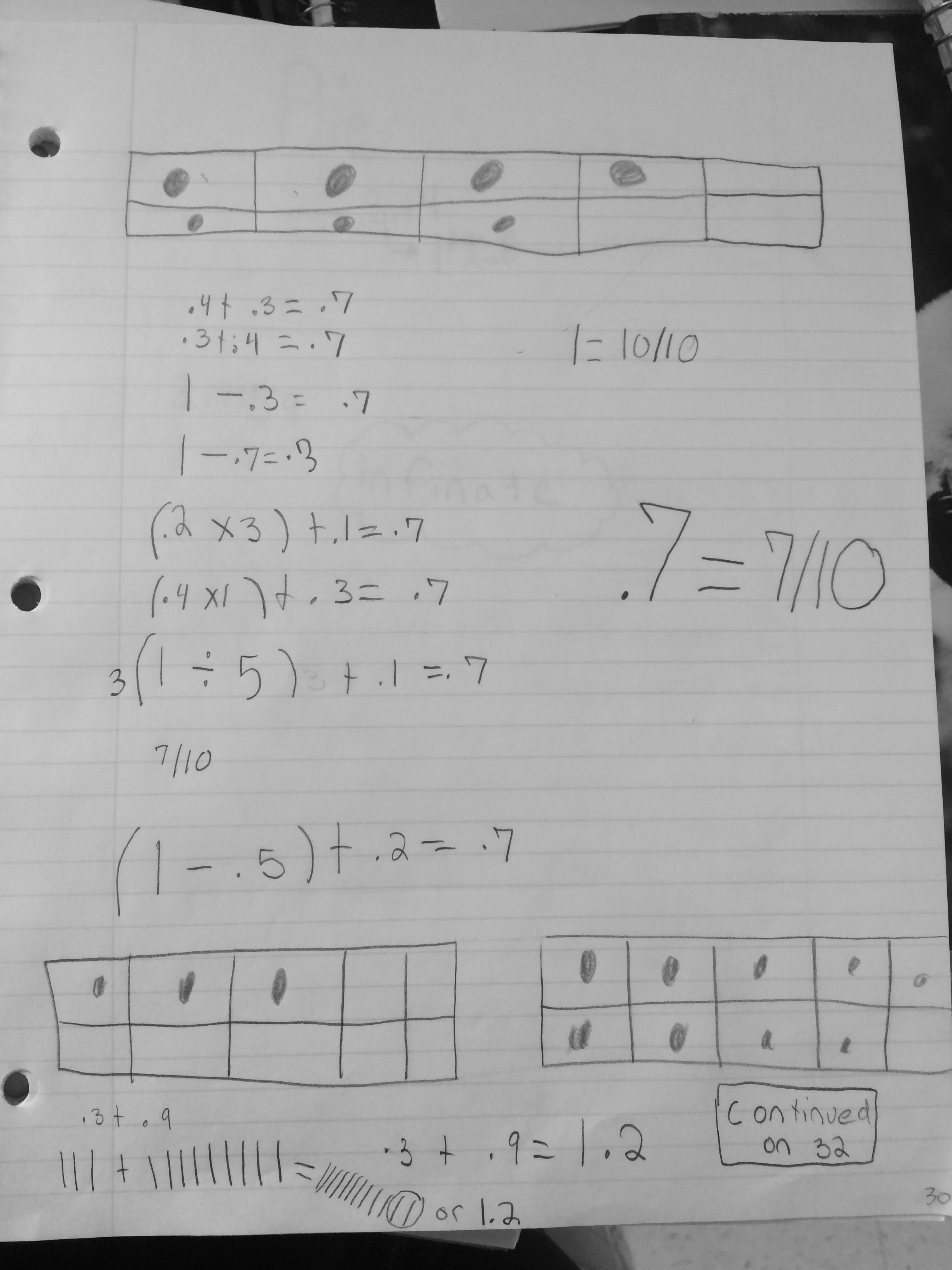
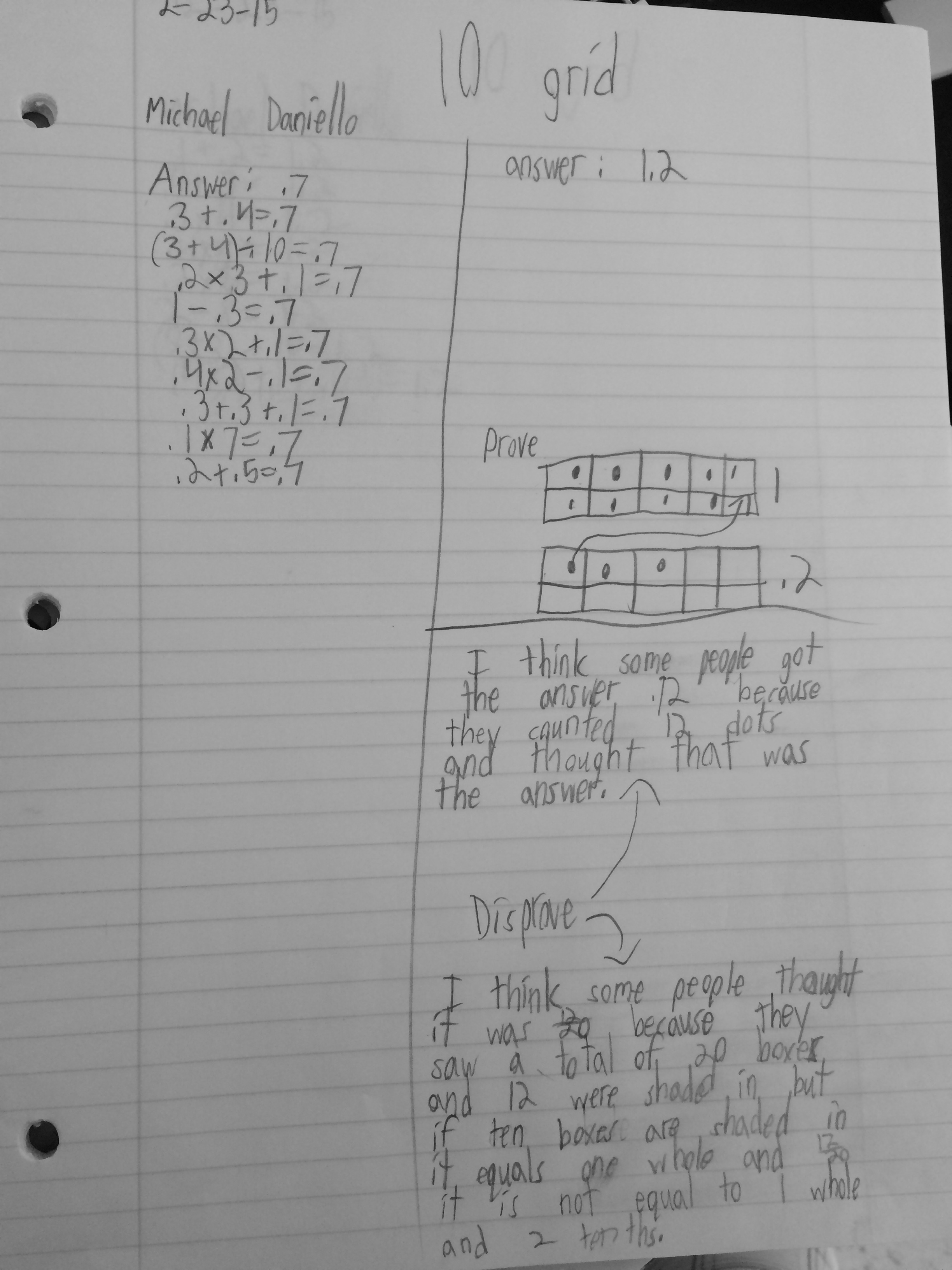
I opened with the same discussion about the ten frame, why we call it a ten frame, and then changed it to a one frame. We discussed the value of each box and were on our way. This year, I really pushed the students more into the equations that matched the frame on the board. We did .9 as a group in a number talk setting with a lot of revoicing and restating to be sure the students could explain how their equations matched the one frame image. I then put up a frame showing 0.7 ( four tenths on the top row and 3 tenths on the bottom row) and sent them to their journals to write some equations by themselves before sharing out. Here are some examples… (Some went crazy:) I think it is so interesting that without any formal work with decimal multiplication, students intuitively can see that any number of groups of some tenths can be written as multiplication.

IMG_9263_2 IMG_9265_2 IMG_9268_2 IMG_9270_2

The one below was so interesting when he said, “.35 x 2” I asked him how that matched the picture and he said, “..since I like symmetry, I took the fourth dot on the top row, split it in half, and put the other half on the bottom row.” I asked the class how that gave him .35 and another student explained that because half of a tenth was 5 hundredth, it became .35 on each row. YES!

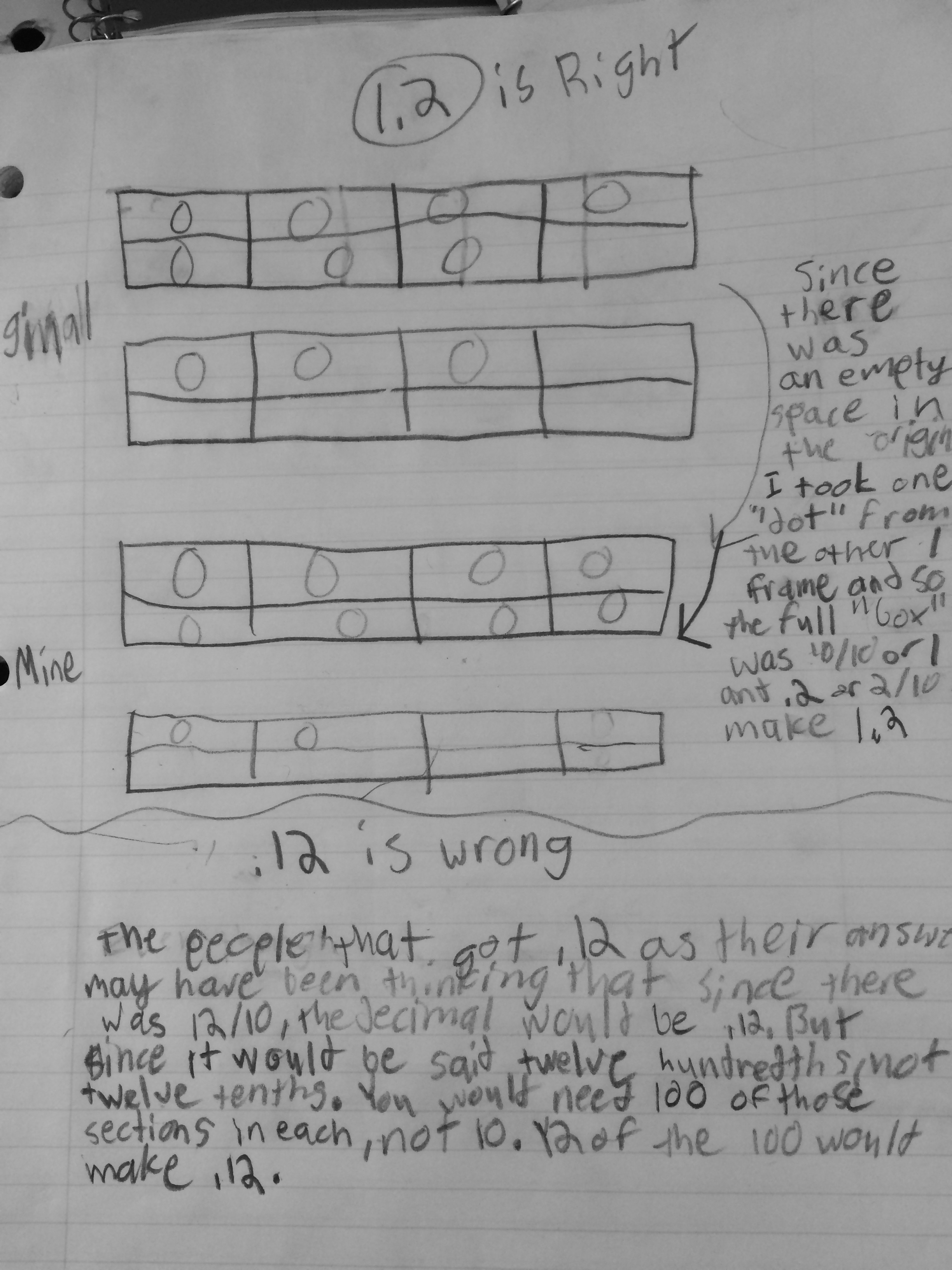
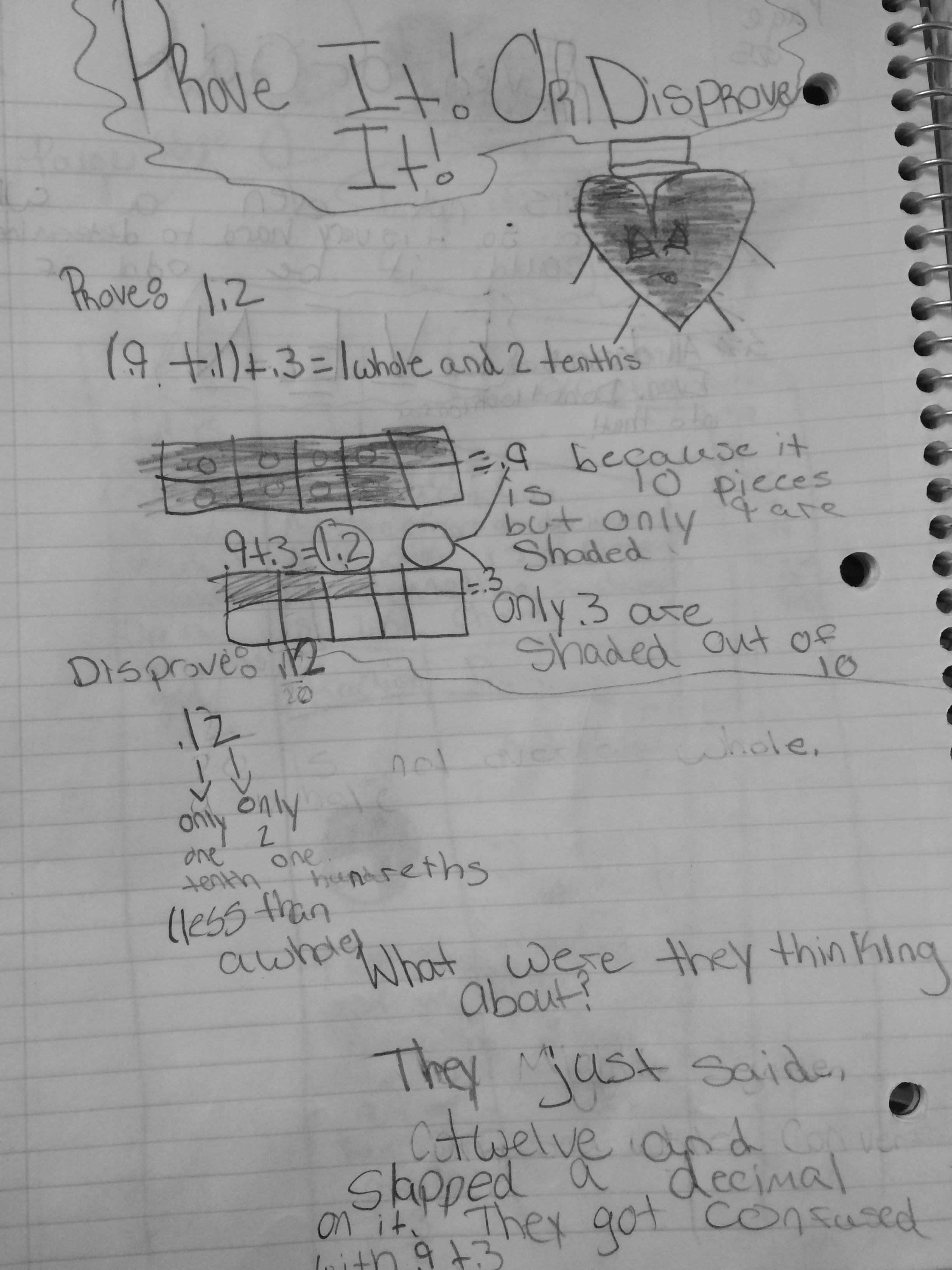
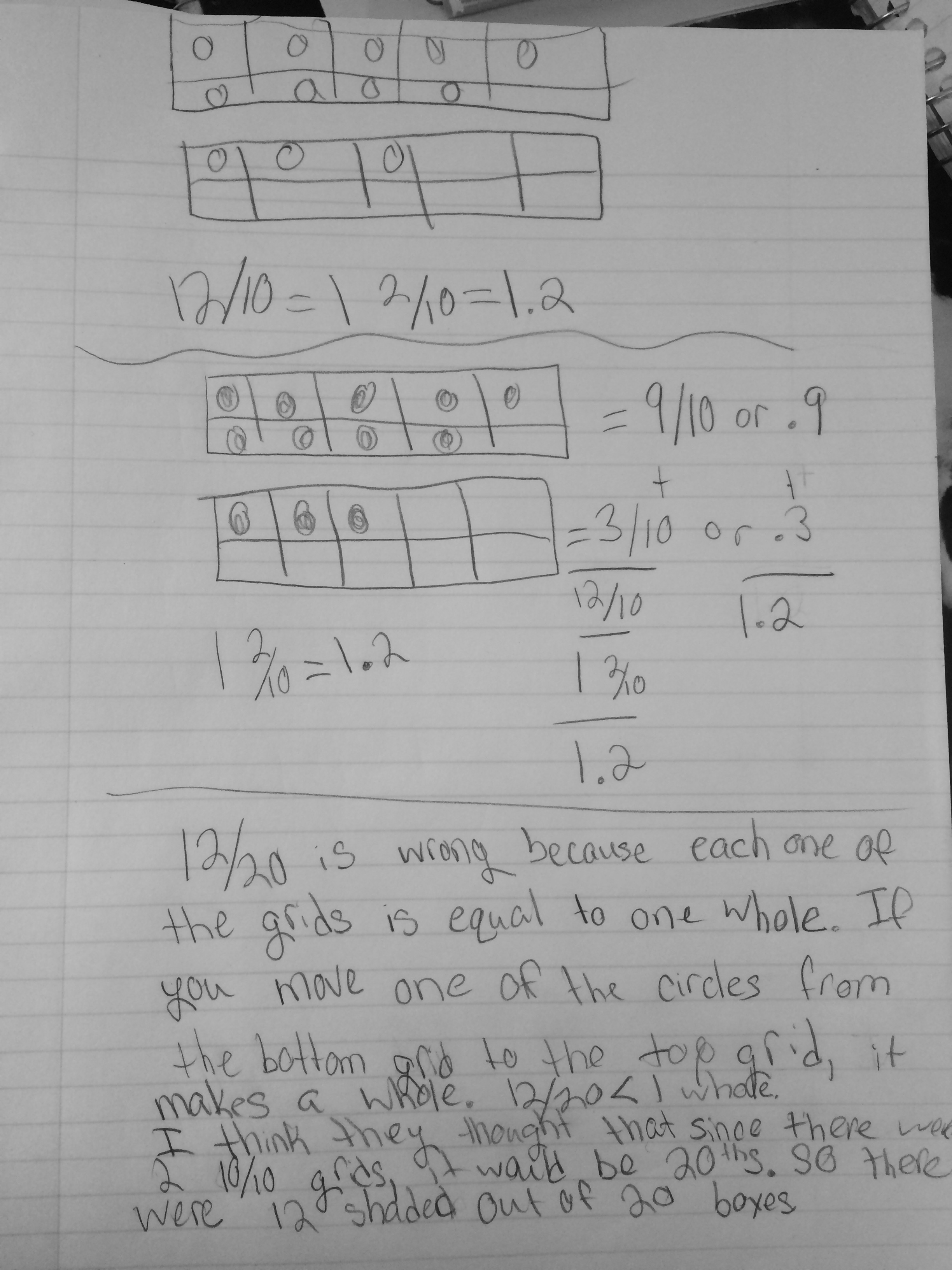
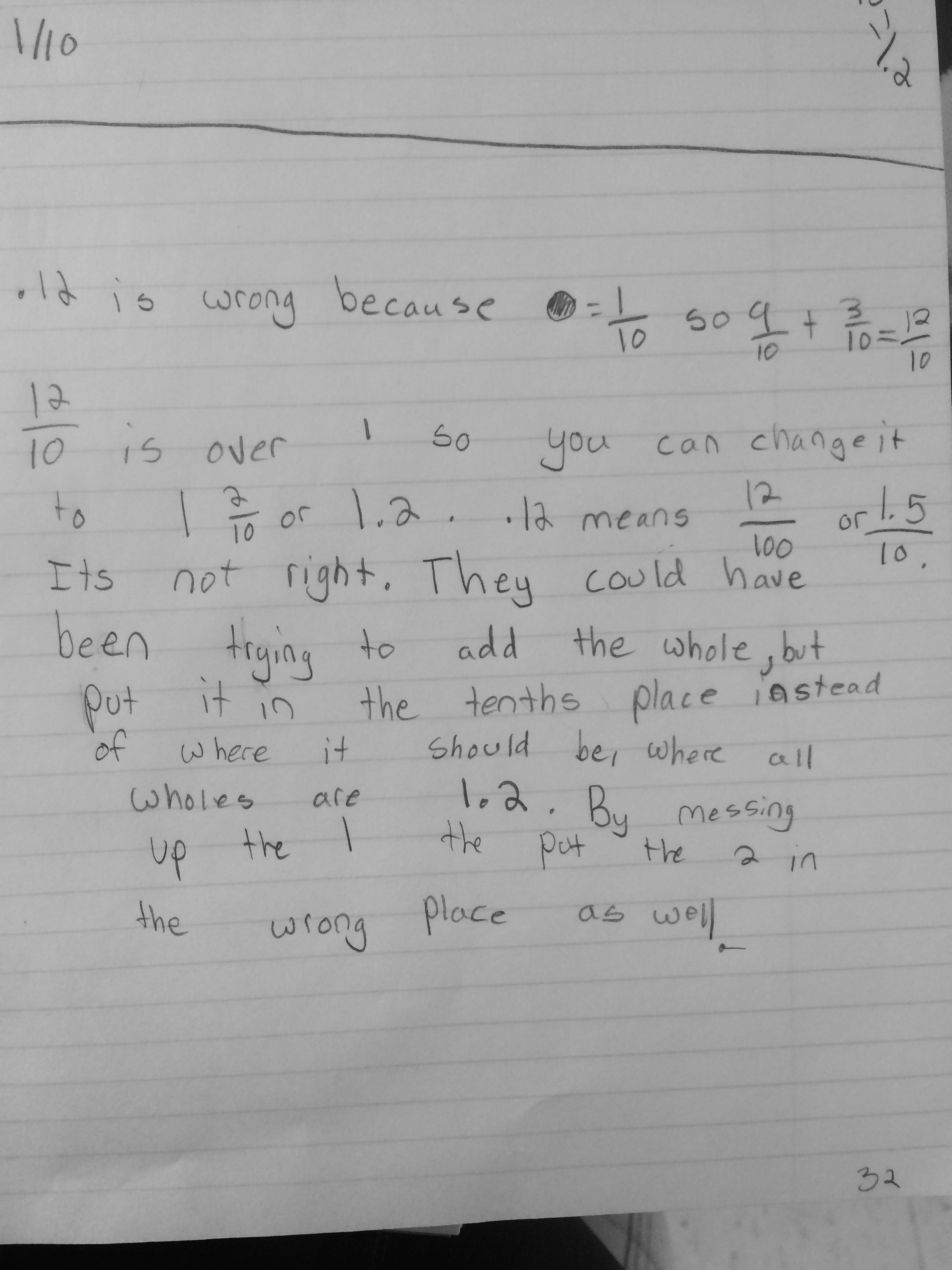
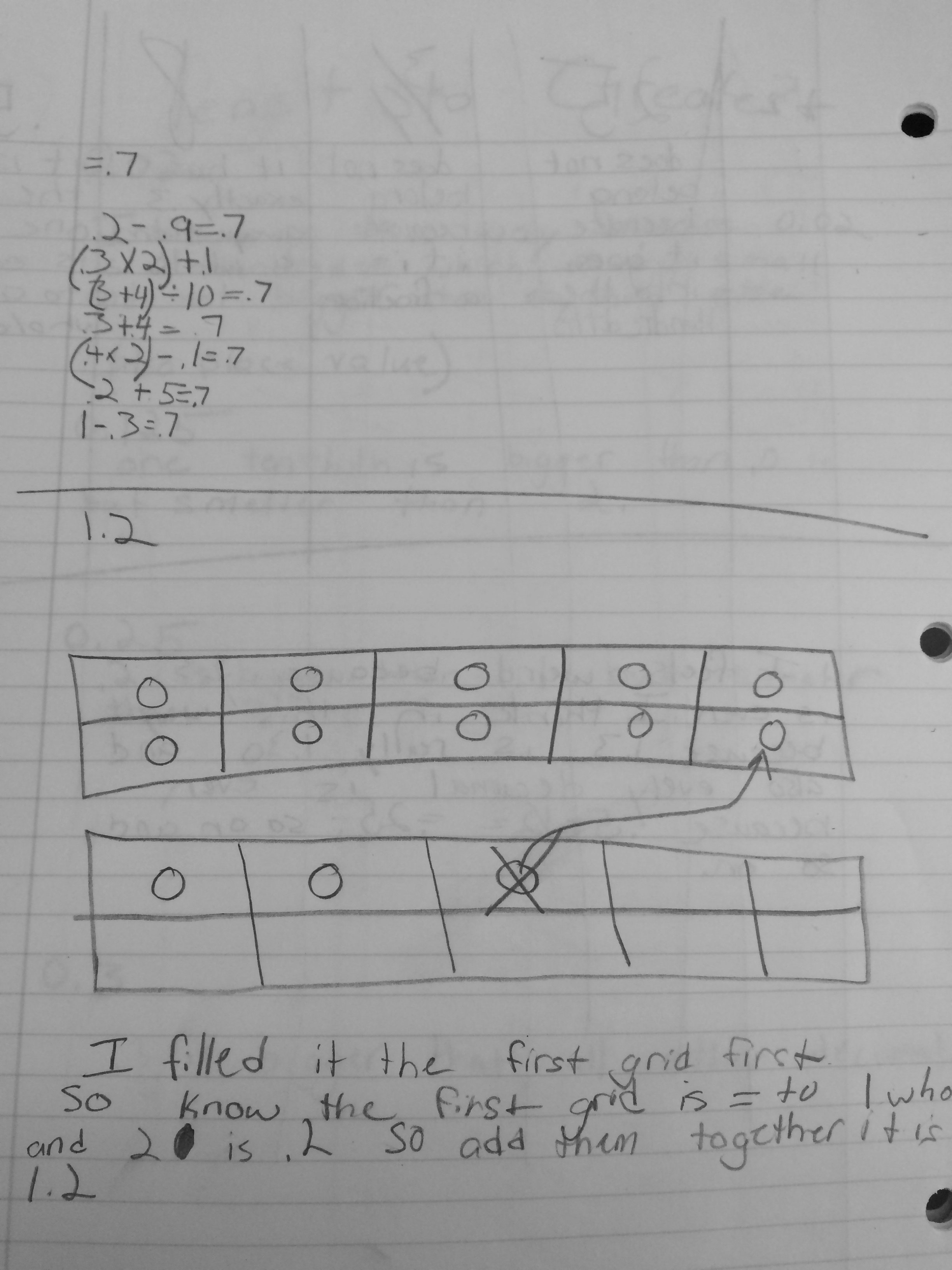
IMG_9275 - Version 2I think put up two frames, one with .9 and the second with .3 and asked students to write down how much was represented in the picture. Like last year, it was a mix of 1.2, 12/20 and .12. I asked students to prove the one they got as their answer and then explain where they think someone got confused with one of the answers they do not agree with. They did a beautiful job with this.

IMG_9264_2 IMG_9266_2 IMG_9269_2 IMG_9271_2 IMG_9276 IMG_9277

It was so nice to kick off our adding decimals with students identifying what the whole it, looking at decomposing numbers, being aware of place value and reasoning about what makes sense. I am SO looking forward to the rest of this work!

-Kristin

Properties of Numbers

Earlier this year, I had a student bring up a great conversation about odd and even numbers: https://mathmindsblog.wordpress.com/2014/11/01/things-i-have-noticed-and-wondered/

After this idea about even/odd rational numbers surfaced, I started having realizations about ideas that we, as teachers, do not ever revisit over the course of a student’s learning journey. Ideas that we could be more exact in, refine, apply constraints, or just simply play around with the idea of developing working definitions for ourselves. Properties of numbers seems to be one of those ideas for me lately.

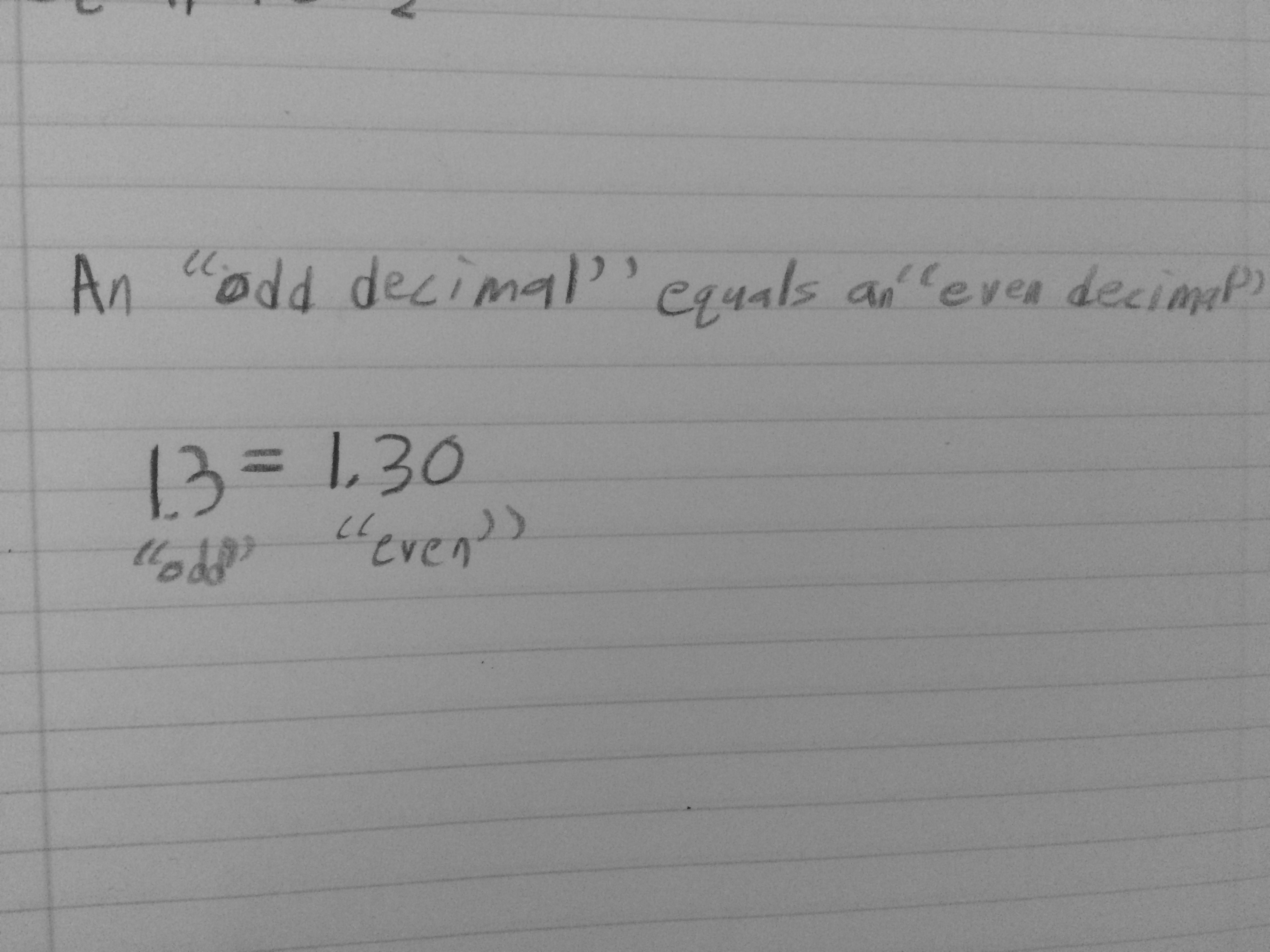
Today I did an opening activity called, Which Doesn’t Belong   and Billy’s idea resurfaced. I put the following numbers on the board and asked students which one they thought didn’t belong and why: 0.25, 3/4, 0.8. 0.5 A lot of great properties of numbers such as square, factor, multiple, even/odd, and equivalencies arose. I recorded all of their answers here, but I dug a little deeper into even/odd numbers. A student said that 0.5 doesn’t belong because it was the only one that was an odd decimal in the tenths place.

I pointed to each number one at a time, and asked for a raise of hands if they thought it was even or odd. When I pointed to 0.25 and 0.5, the overwhelming majority said odd, 3/4 they said it is neither because it is a fraction, and 0.8 was overwhelmingly even. I asked them to tell me how they determine if a number is even? I got the answers I expected, equal groups with no leftovers and looking at the last digit of a number.

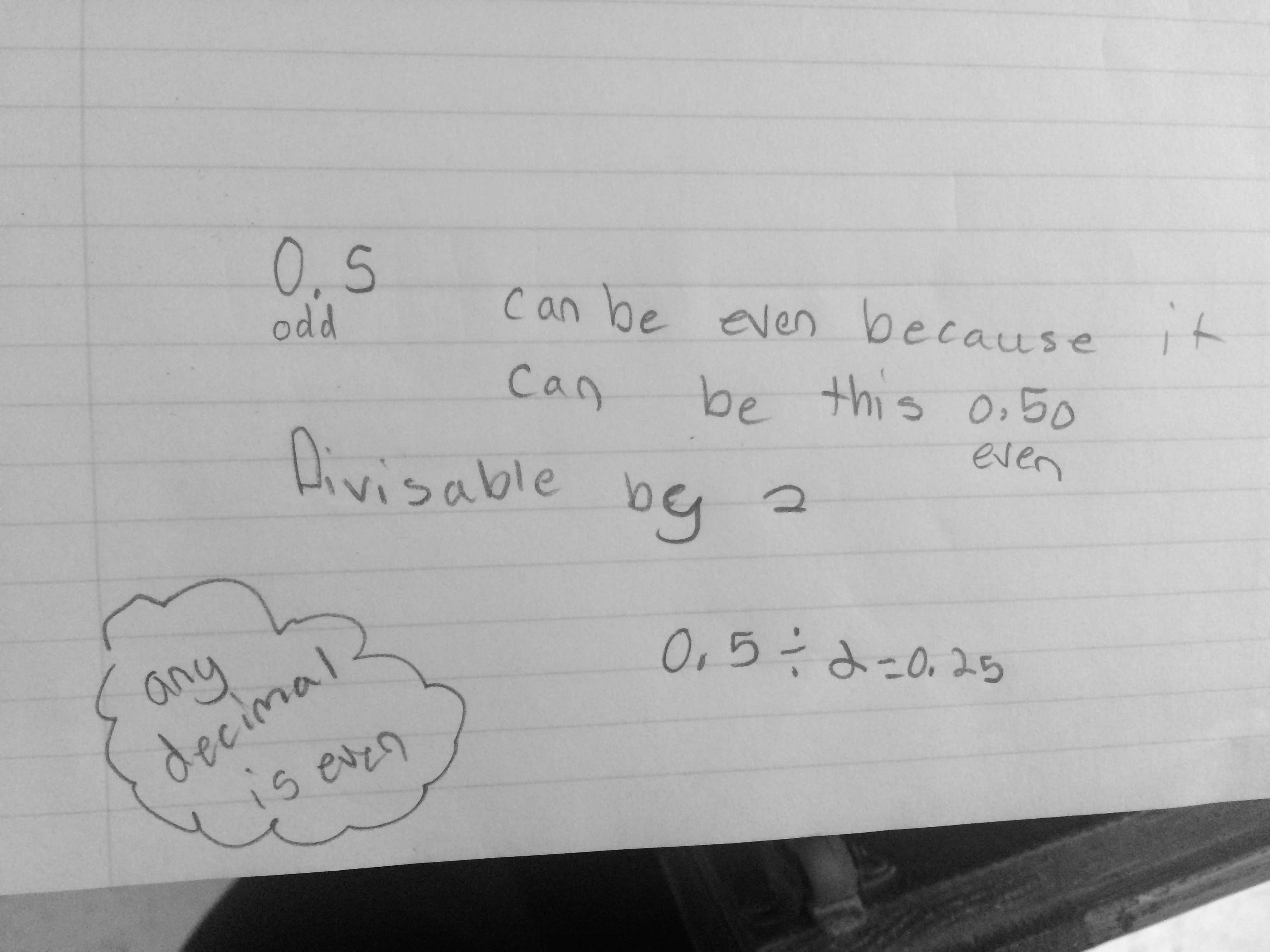
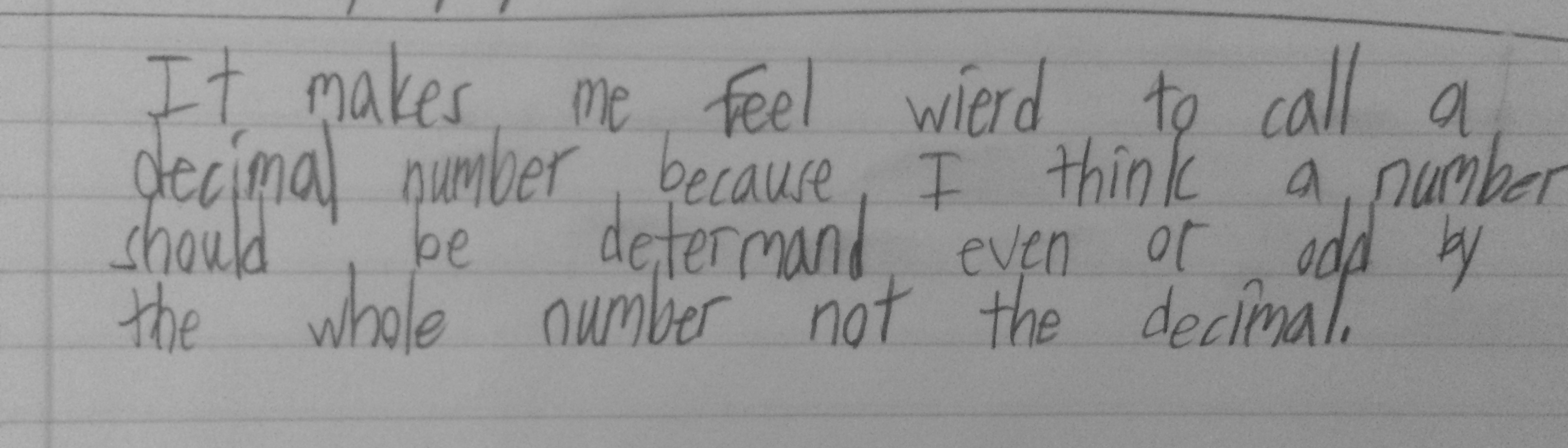
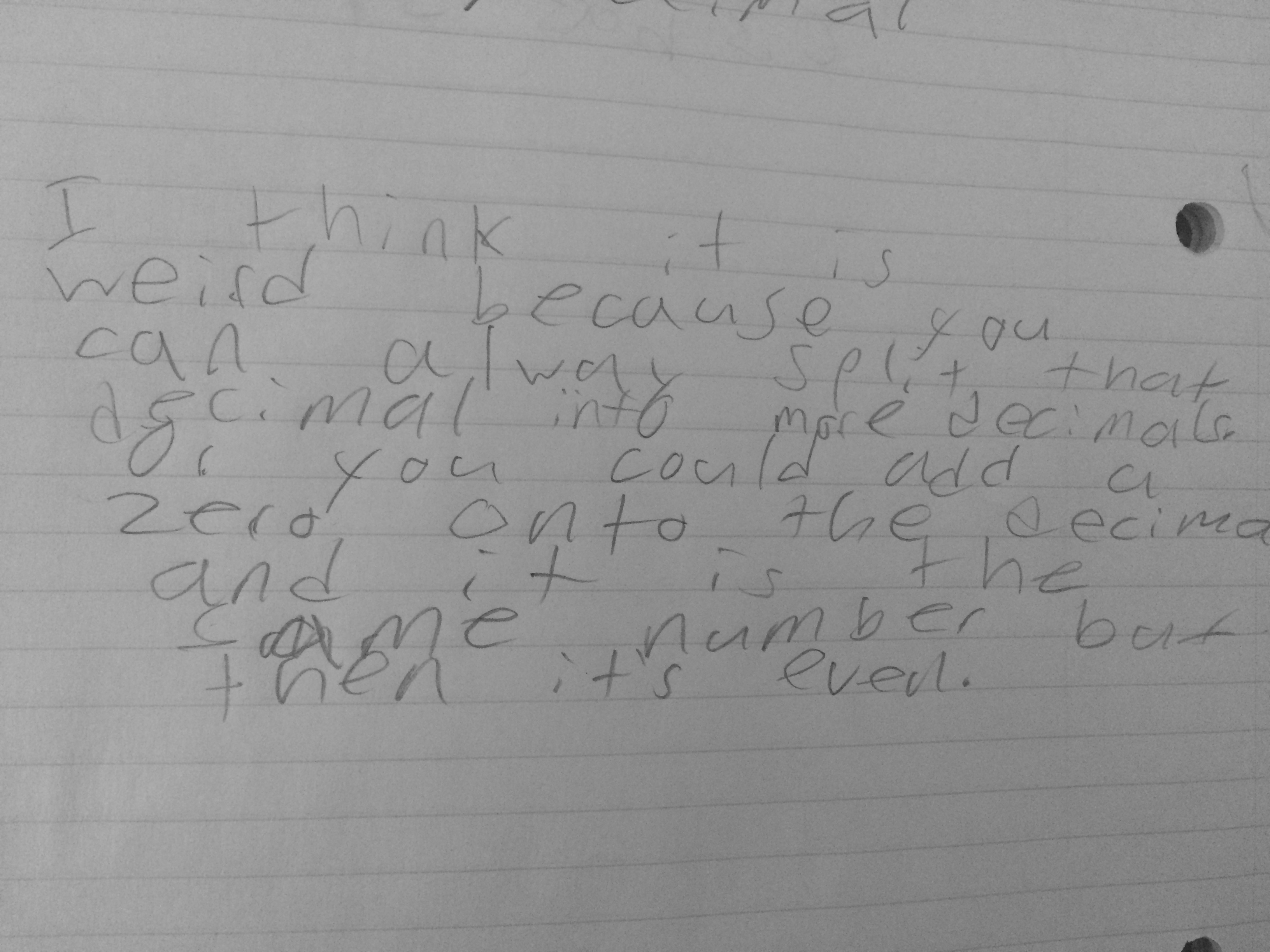
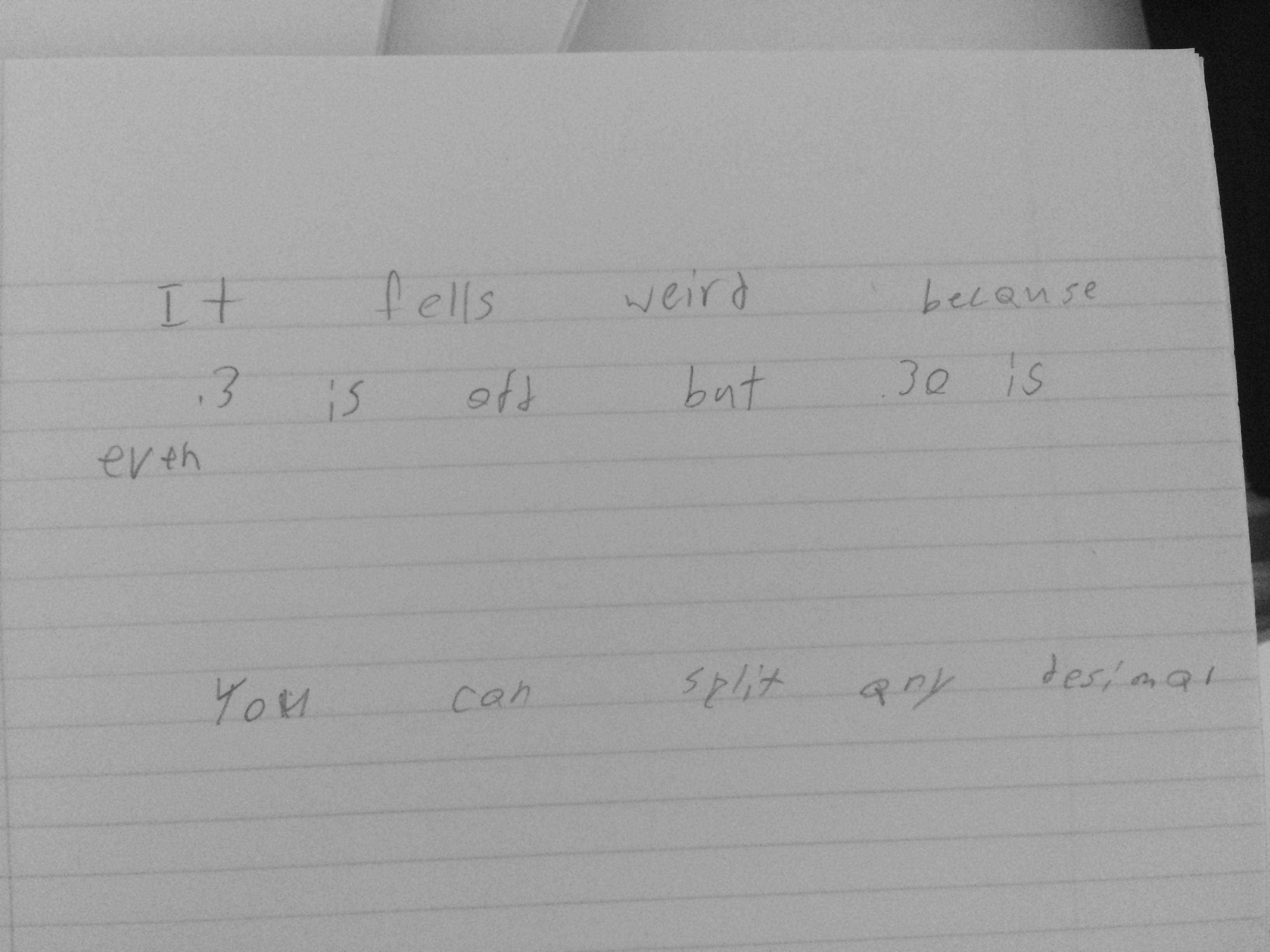
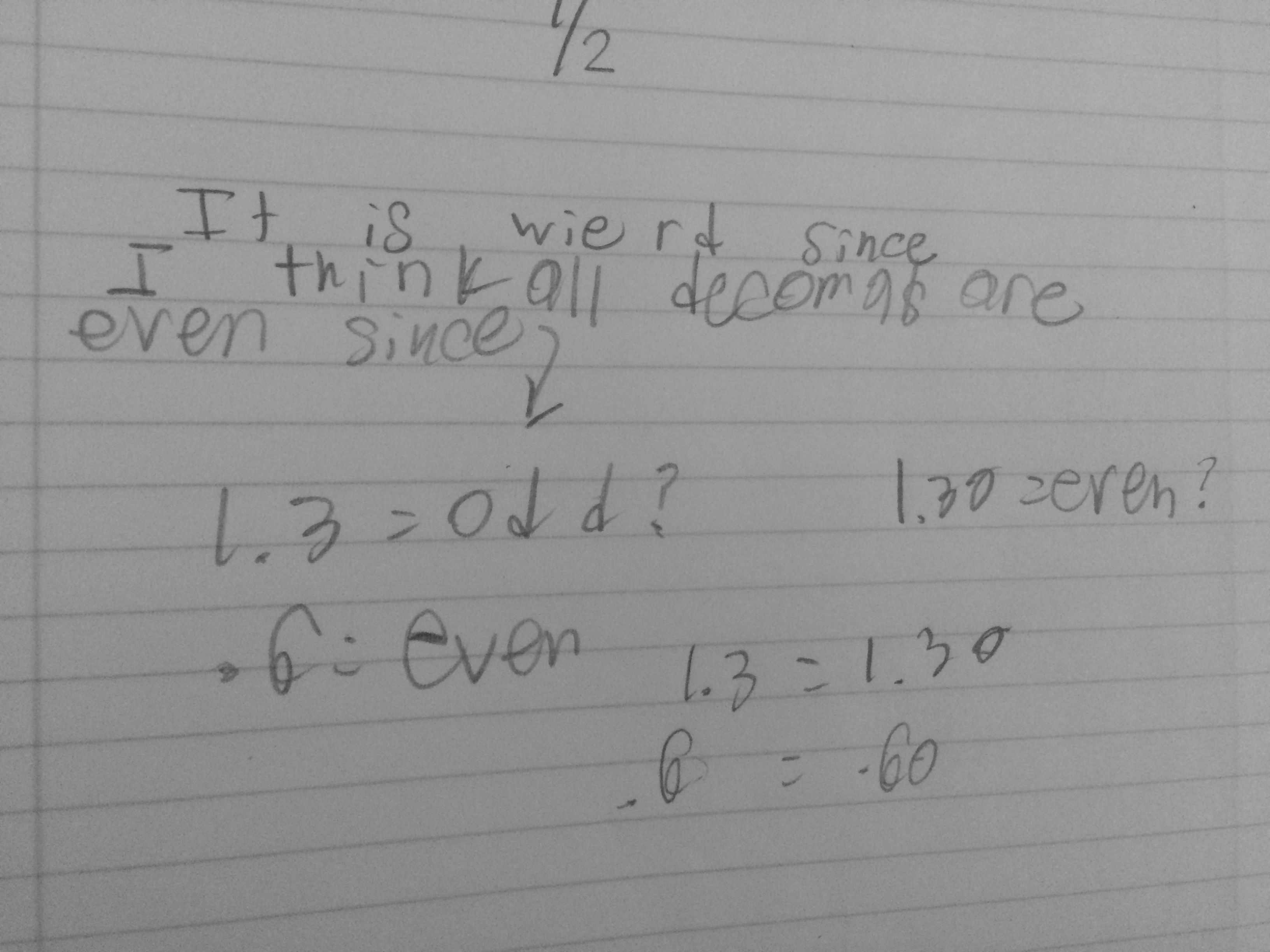
I said, “So thinking about that, let’s look back at the numbers we were just discussing. Talk to your table about your thoughts now.” There were a lot of ooohs and hmmmms, and one student finally said, “Five tenths is just weird.” That statement got a lot of nods and uh huhs, but before we shared out, I wanted to get everyone’s quick initial thought on why it felt weird to call five tenths odd now since it was overwhelmingly odd at the beginning. Here are their thoughts…

IMG_9143_2IMG_9147IMG_9146IMG_9145IMG_9144IMG_9148We shared out and one student said he is going to “make a claim that all decimal numbers are even.” I loved that moment a lot! These are the working definitions that I feel are fun for students to explore. In the end, they wanted some closure and I felt they had done their due diligence, so we looked up the definition of an odd number. We talked about what an integer is and everyone felt a nice resolve to the “weirdness.”

This is something I am really interested in right now and wondering what other properties of numbers we talk about in the younger grades that don’t often explicitly resurface. Properties that apply to integers but not to rationals or even change a bit when dealing with rationals. I feel we always build on concepts as the students go through school, but do we look closely at the definitions we use and assume students don’t have more curiosities about them?

Of course I couldn’t let them leave without something to think about, so I asked them to tell me what they knew about square numbers and we listed a bunch on the board. I then put a decimal in front of each one and asked if we still called them square numbers? A few started throwing out their thoughts, but it was time to go, so more to come on that later…To Be Continued.

-Kristin

Which One Doesn’t Belong?

After all of the interesting conversation around Christopher’s (@trianglemancsd) Shapes Book and a conversation with Faith (@Foizym), I thought it would be fun to take this thought about “Which One Doesn’t Belong” into my students’ decimal work. With these decimals, I wanted to draw out reasonings about closeness to benchmarks, equivalents, and properties of numbers in relation to decimals. It did all of that and more! I wrote the following four decimals on the board and had students talk about which one they thought didn’t belong:

woIn brainstorming these decimals beforehand, I knew that 0.49 would be the most obvious because it is the only one that went into the hundredths, so I go that out of the way as the sample response and asked them to see if they could find another reason for 0.49 or any of the other three decimals. They brought out some pretty great stuff and definitely gave me insight into how they think about multiplication of decimals! It was also so nice to hear, as I walked around during their talk, the freedom students felt expressing their ideas when they knew there was no right or wrong answer!

-Kristin
Consecutive Sums – 5th Grade

We did Fawn’s Visual Pattern #8 today! http://www.visualpatterns.org/

vp

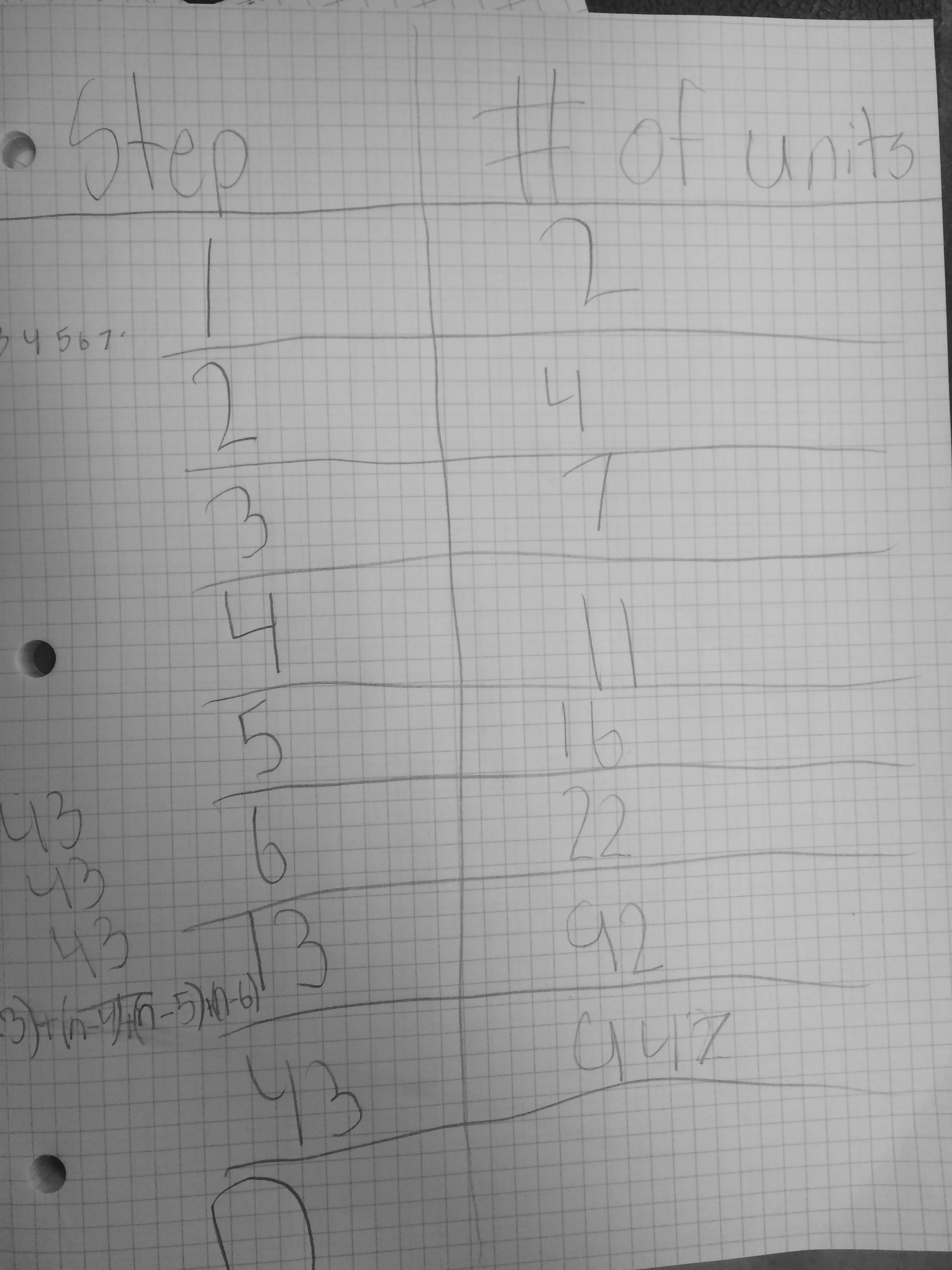
After completing steps 1-4 the class quickly saw that each time, the step added with the previous step’s unit count to get the new unit amount. From there, they struggled to get to the nth expression. They tried a bunch of different things, as you can see on this paper and saw various ways it was growing, but could not come to an agreement on this one!

IMG_9106On their calculator they could get the 43rd step, but if I asked about the 100th, they would just continue adding on the calculator. In their explanations, they kept saying that they would visually “set that one penguin on the bottom row aside and then it would be 3+2+1 or 4+3+2+1…etc” And then one student came up with this at the bottom of their paper..IMG_9107

This group also had some very nice work toward the nth expression…

IMG_9103IMG_9104IMG_9105They wanted me to tell them what it was, but of course I would not:) I will let them sit with that overnight and do a Notice/Wonder about consecutive numbers tomorrow to start our day together. I am thinking after some noticing, they will be able to apply it to this work!

-Kristin


What DO they know?

I love reading and giving feedback on my students’ journals,  I make time for it every day. But the mere thought of grading papers (feedback or not) makes me world’s biggest procrastinator. Unfortunately, my reality is that I need grades for progress reports and report cards, so I make the best of it. I try to make the assignments valuable for both the students and myself in their learning, however  I always wonder why I don’t approach the papers the same, they are both student work right?

I had a realization yesterday while I was grading, as to why I make time to read their journals vs the aversion I have to grading papers. While I was grading, my mind was focused on what the students DON’T know, what they aren’t getting, aggravation at the careless mistakes, aggravation that I didn’t “reach” that child and why they don’t all have 100%. As I graded, I was busy making notes in my own journal of the students who were missing certain items so I could make my plan for next week to help them better understand the material. And while I know this is invaluable in planning to better teach my students, I realized I was completely glancing over what they DO know. I was checking off the problems they were getting correct and focusing solely on the wrong. Don’t be mistaken, I LOVE mistakes in math, I love analyzing what students could have been thinking, misconceptions and/or misunderstandings, but when grading, the feeling is still not the same.

This focus on “wrong” wasn’t the only thing that bothered me though. I also wasn’t “feeling” my students’ voices in the assignments, like I do their journals. Maybe it is because I love hearing them talk about math so much, their journals are the next best thing when they have left class for the day.  Maybe it is the freedom for them to take more chances in their journals or simply say, “I don’t understand it from this point on..” that makes them so much more enjoyable. Or maybe it is the mere fact I don’t have to put a grade to their thinking. As I read their journals, I am looking at everything they DO know and how that led them to where they are instead of the other way around.

Their journals feel more like the way we learn then grades do. We try, we make mistakes, people help us along the way with advice, we try again, we test things out, we look back at what we did to build on it….no number is attached to that, so why grades? I would like to think I try my best to not have grades be a focus in my classroom and instead be a snapshot of where students are right now in their learning, but those assignments still do not hold the same value that their journals do for me.

Maybe someday standards based grading will make its way into our district but until then I will continue to read their journals for things just like this…

IMG_8986_2– Kristin
My Student’s Curriculum…

I am convinced that my students have another idea of what they want the 5th grade curriculum to be:) No matter how much I plan, they will always send me in a different direction, which I love. It started yesterday with these two grids and responses…

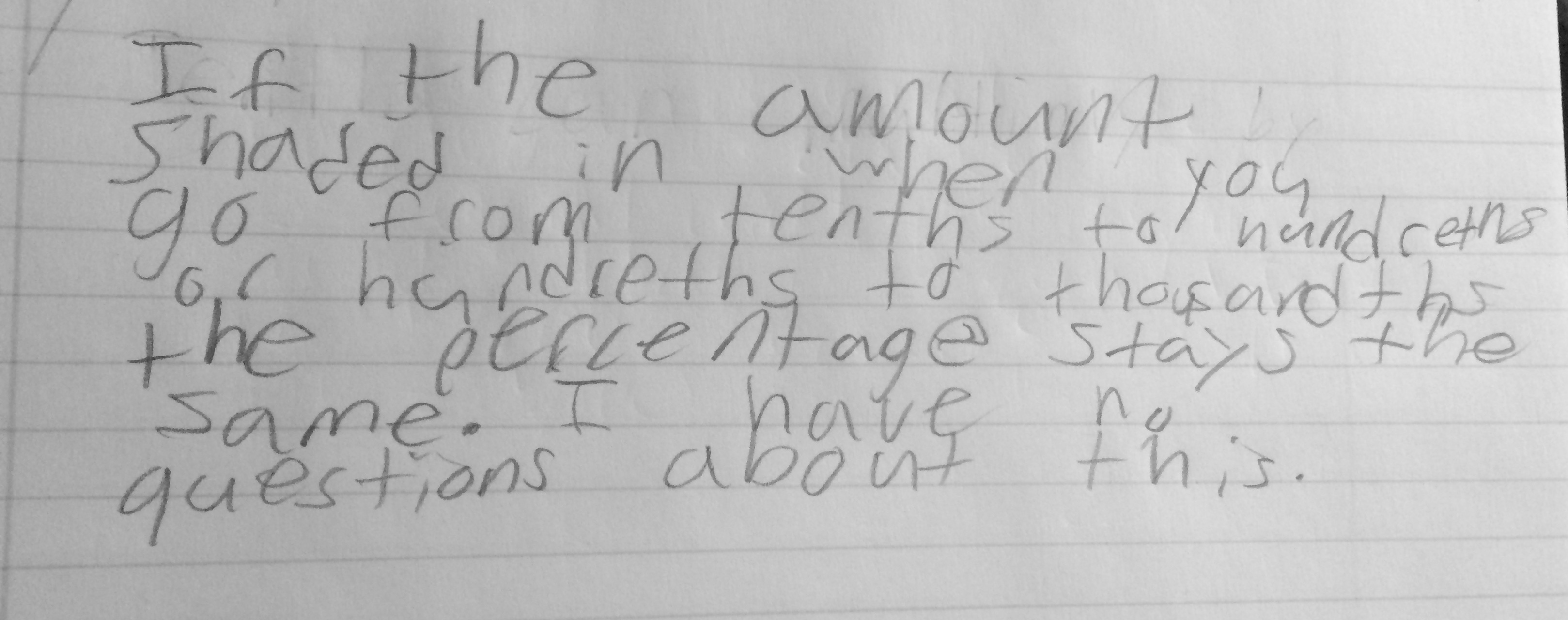
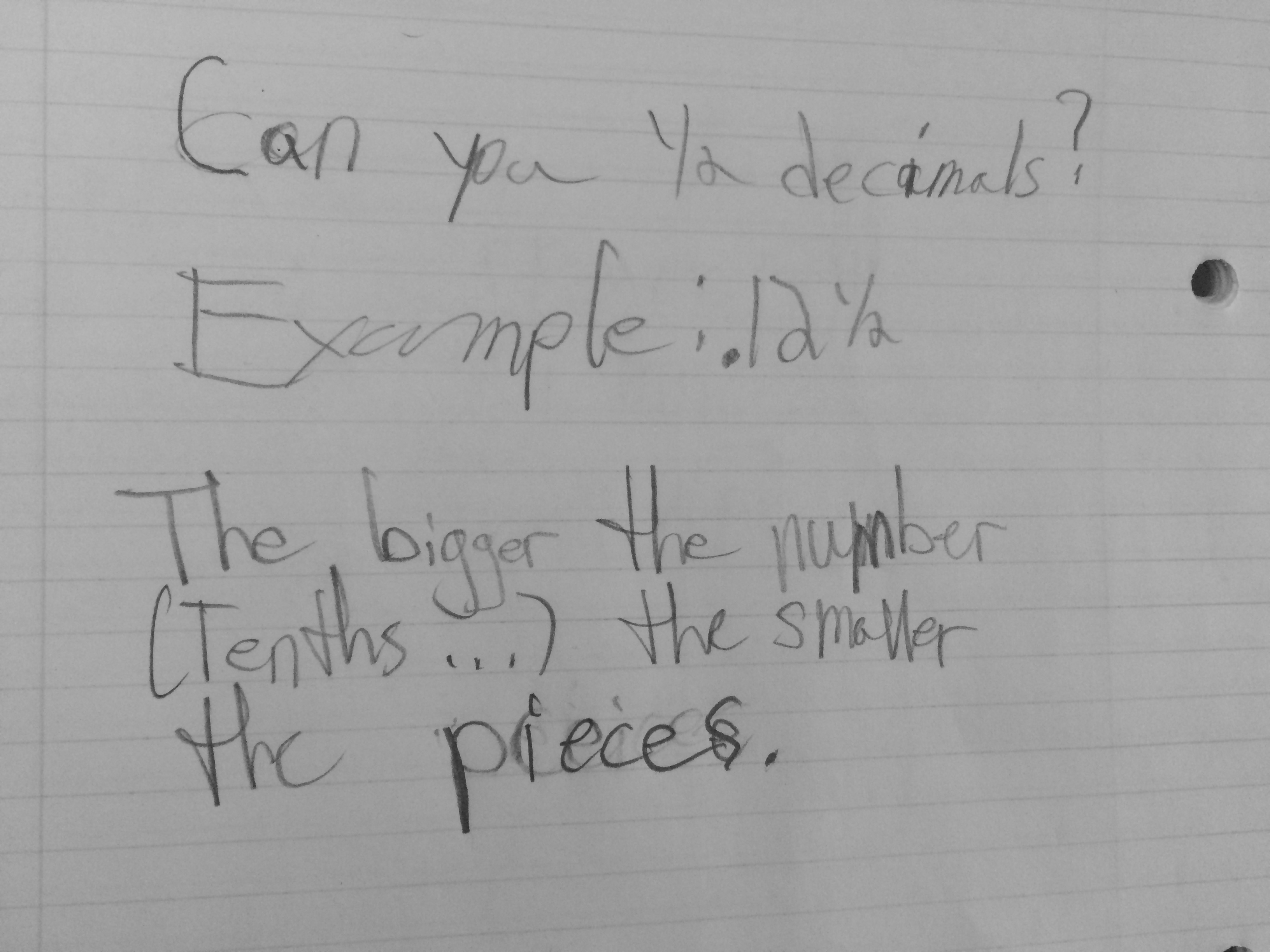
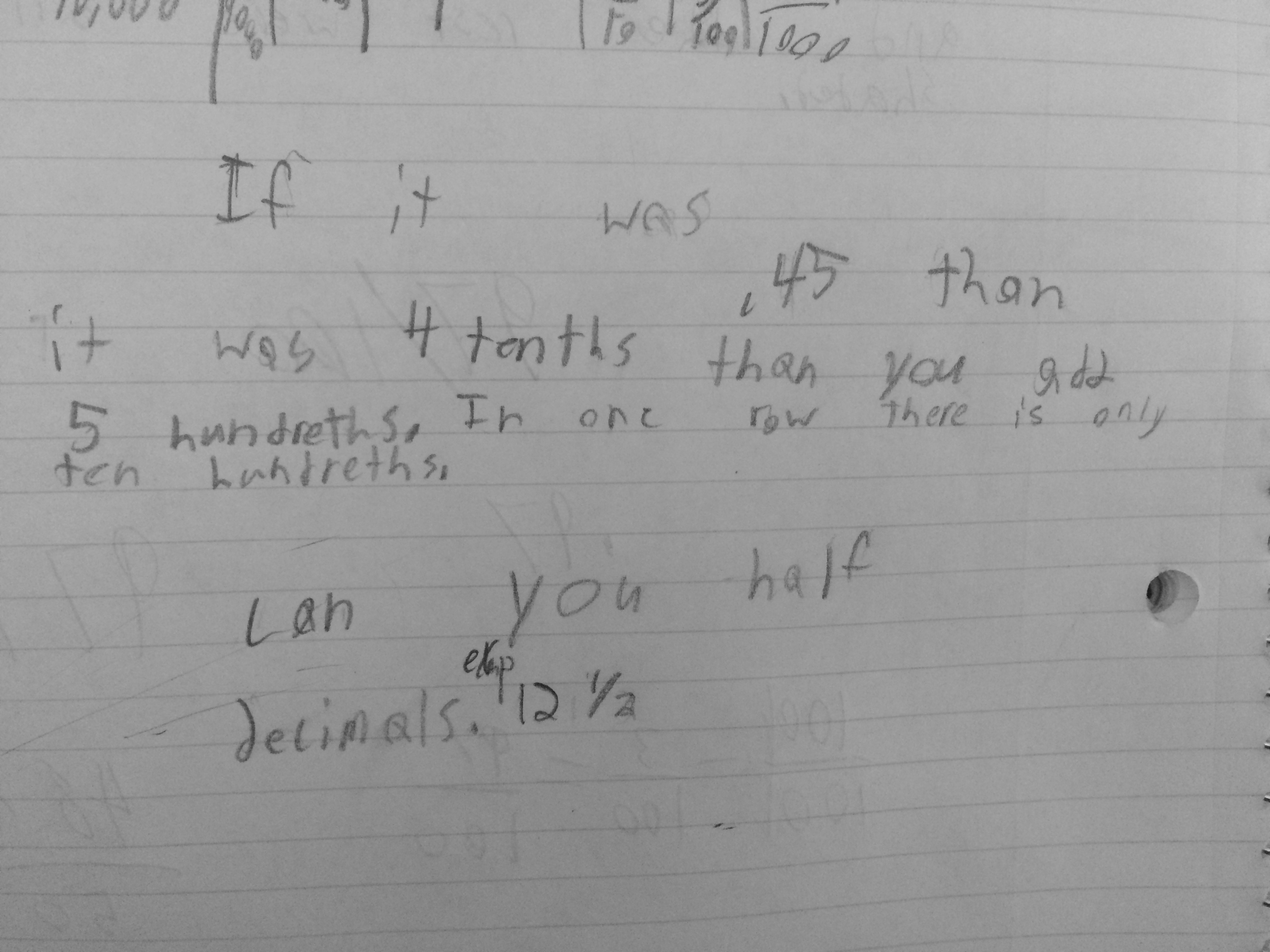
IMG_9034_2That led to these journal entries and our conversation today….

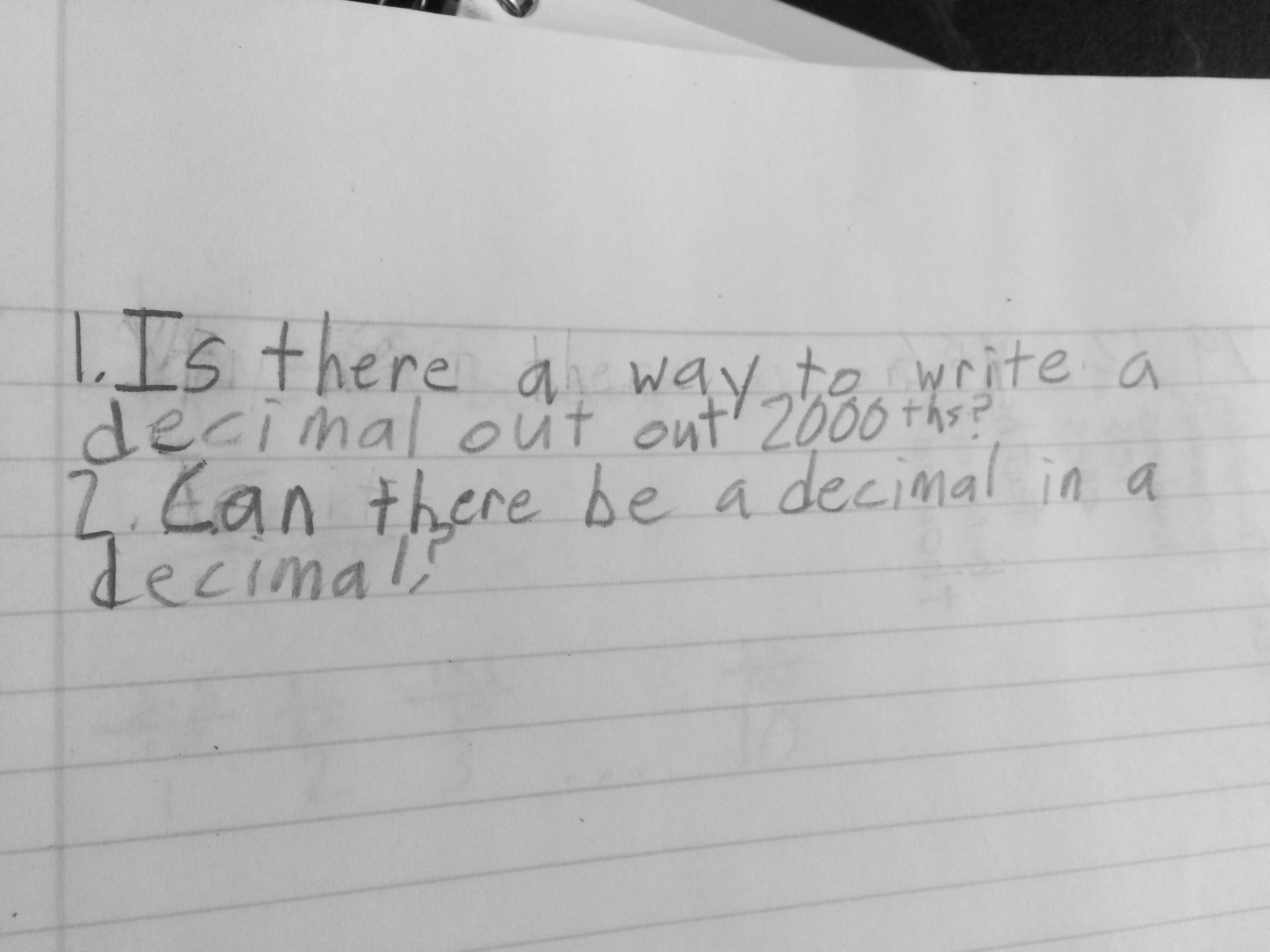
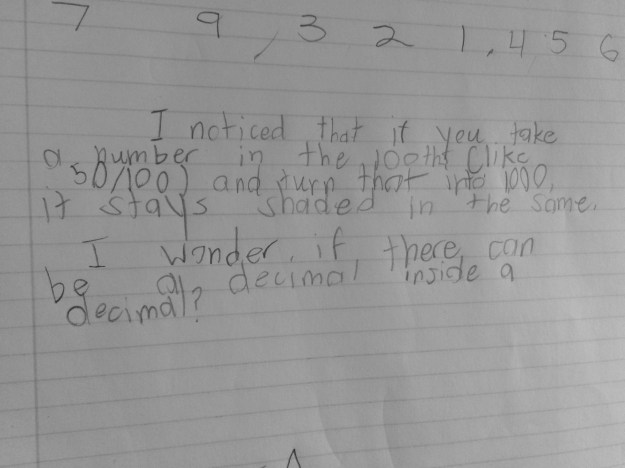
I led with thinking about the fraction (or decimal) in a decimal. We did some more grids and the students were seeing the thousandths like taking a fraction and breaking it into smaller pieces to still have equivalents, like 1.5/4 = 3/8. Then a group of students who were done with the grid work, asked me if there can be a fraction or decimal in a denominator…..here we go…

I asked them what they thought it meant and this is their starting point. They jotted some examples and started playing around with 1 / 2/8. He drew it with 2/8 size pieces, came out with 4 but said that looks the same as 1/4.

IMG_9035_2I asked him if it could be, and his intuition was saying no, but he couldn’t figure out why. I asked him what happens when a denominator number gets smaller, he says piece gets bigger. So he started with 1/4, 1/3, 1/2, 1/1, said 2/8 / 2/8 = 1. From there he realized that 1/ 2/8 was improper. Here is where he ended because class ended.

IMG_9037_2I had another working with 100 grids trying to figure percentage-wise is 1/4.5 fell between 1/4 and 1/5 and here are a few others…

IMG_9038_2 IMG_9039_2 IMG_9040_2 IMG_9042_2So much to chat about, but after a long day, my brain needs a break:)

I just love how a thousandths grid lesson can lead to this, I want my students to publish a “Kids Curriculum” as a supplement to mine, because they obviously have so many amazing curiosities! (Or maybe, Christopher, we can name it Kids Kurriculum)

-Kristin
Tenths to Thousandths Decimal Journey…

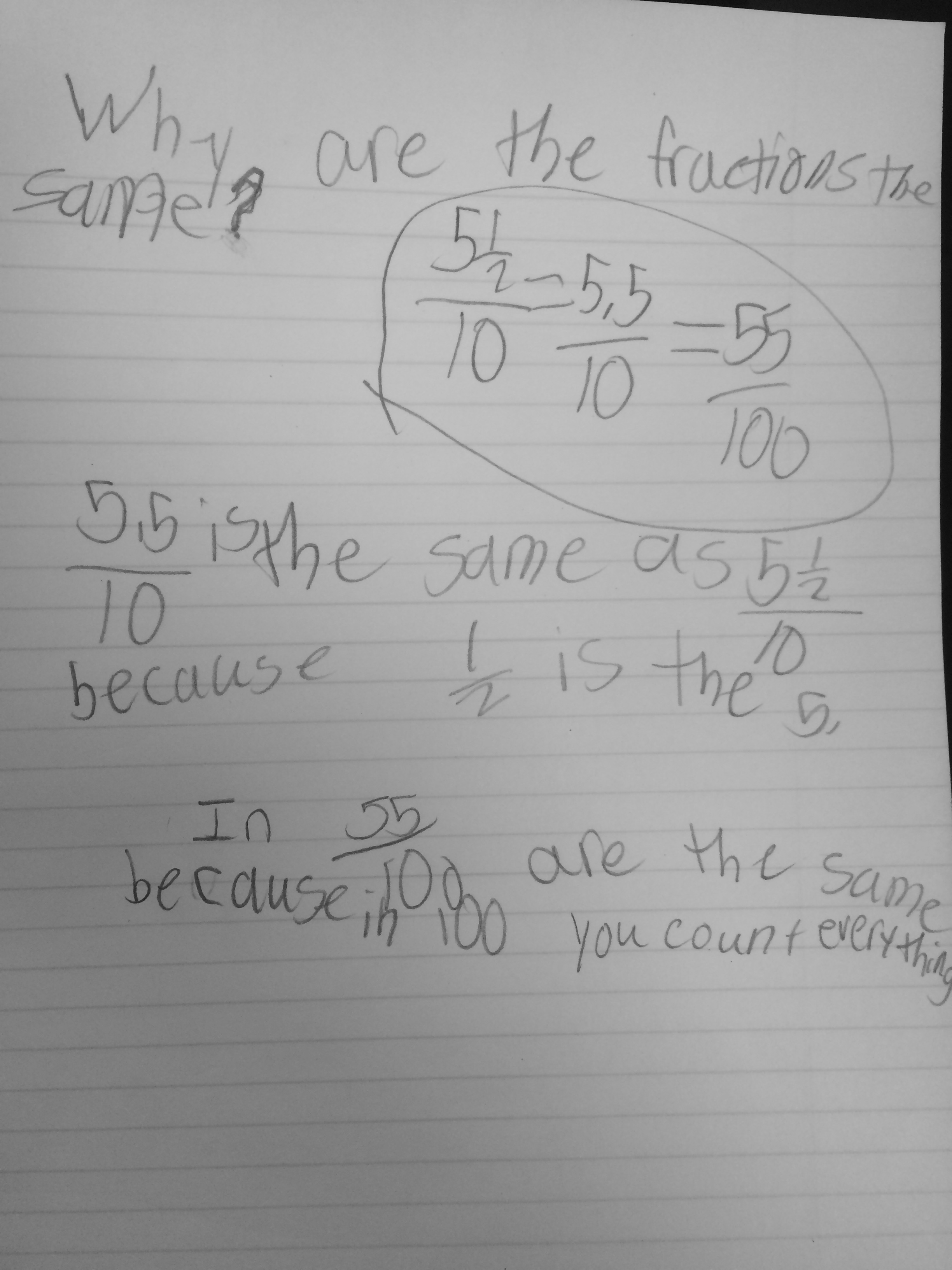
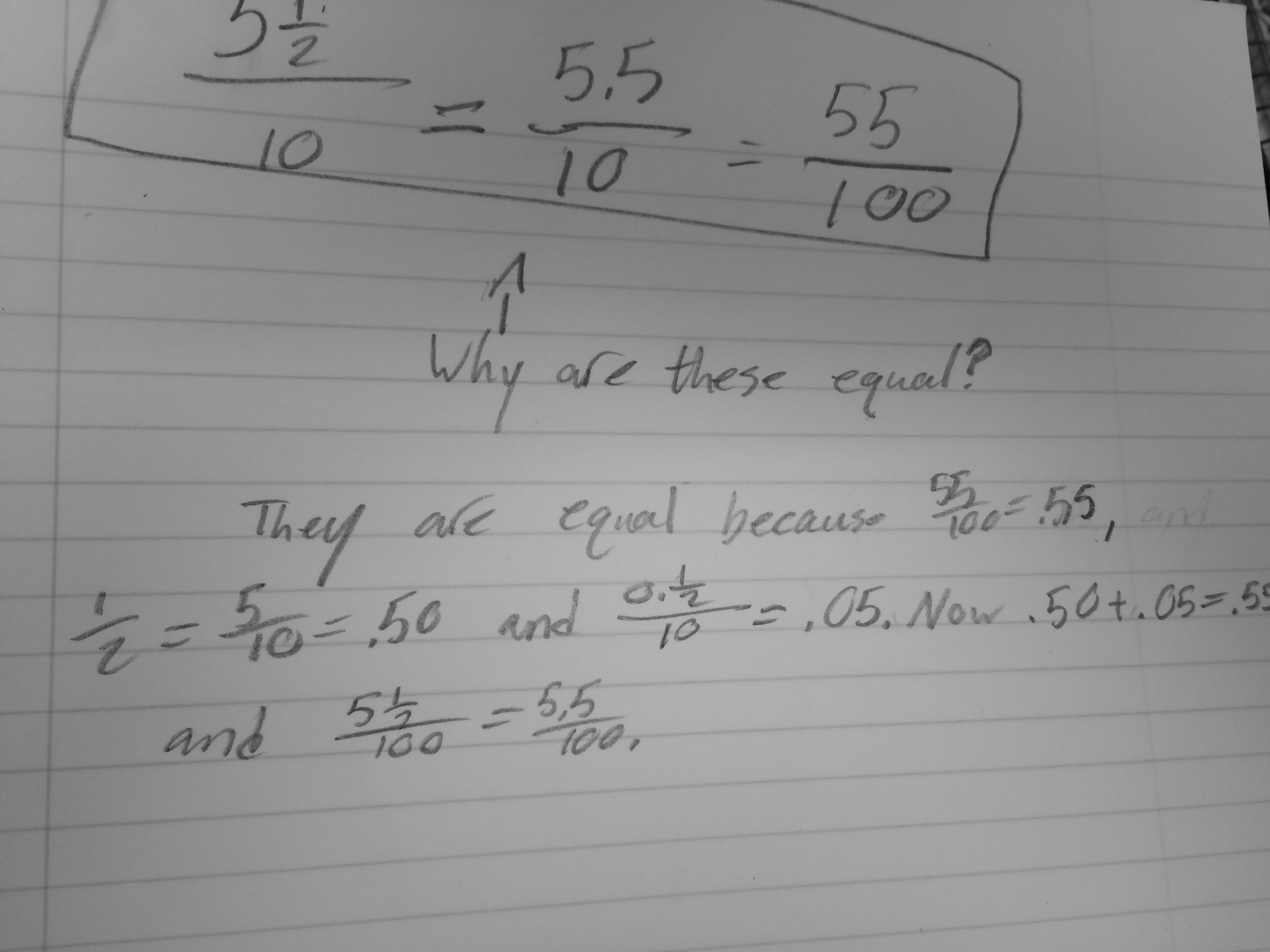
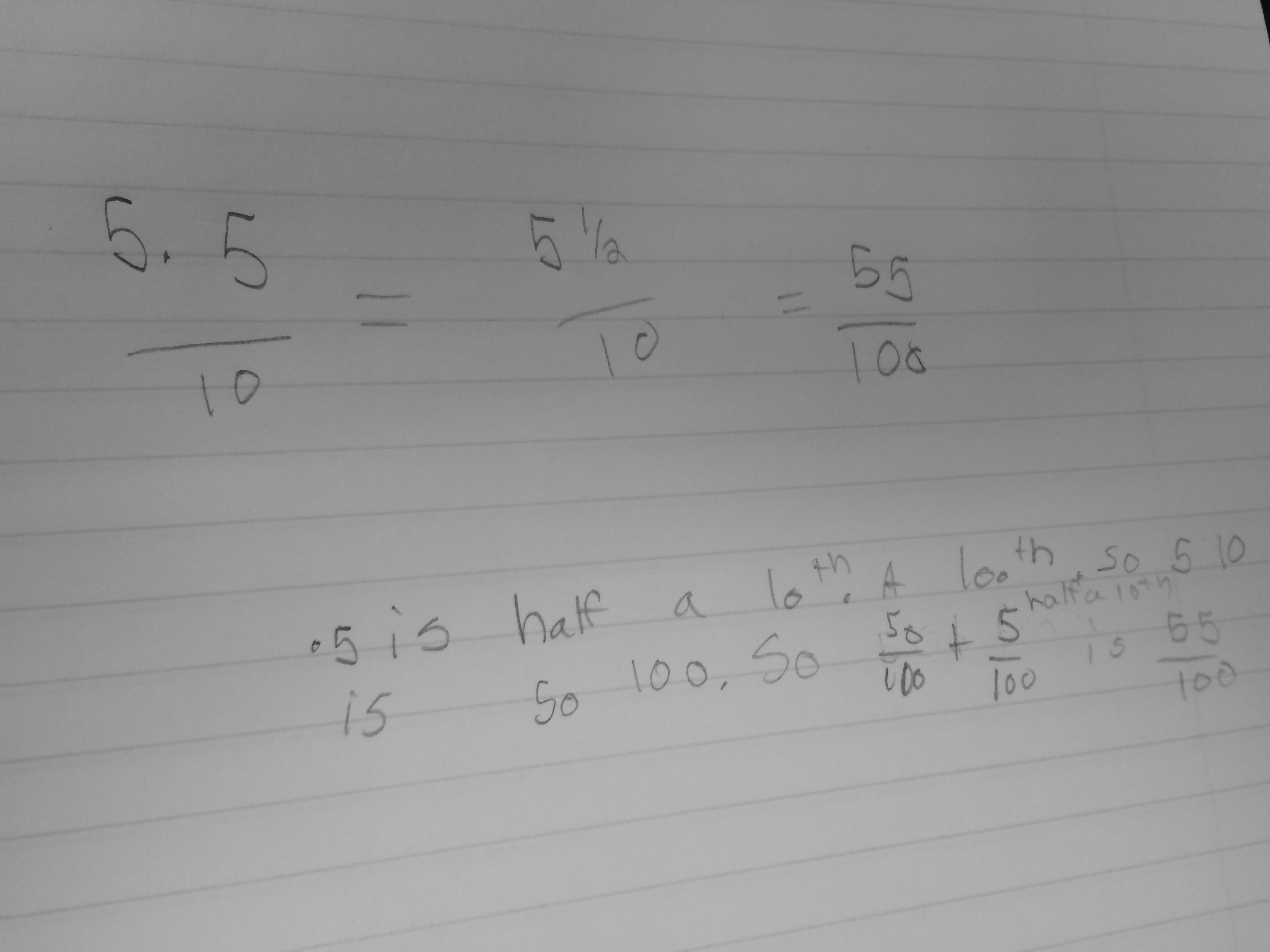
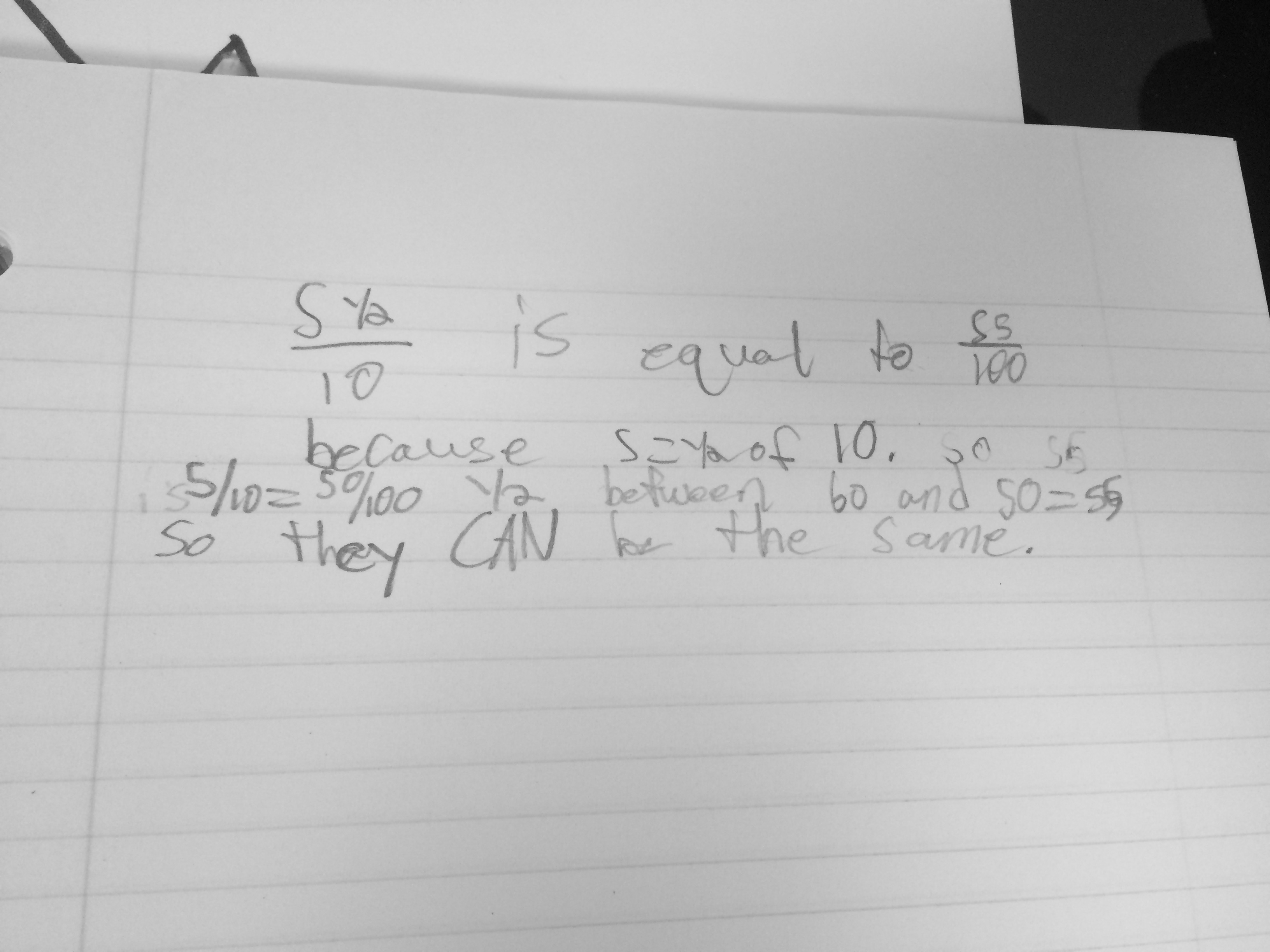
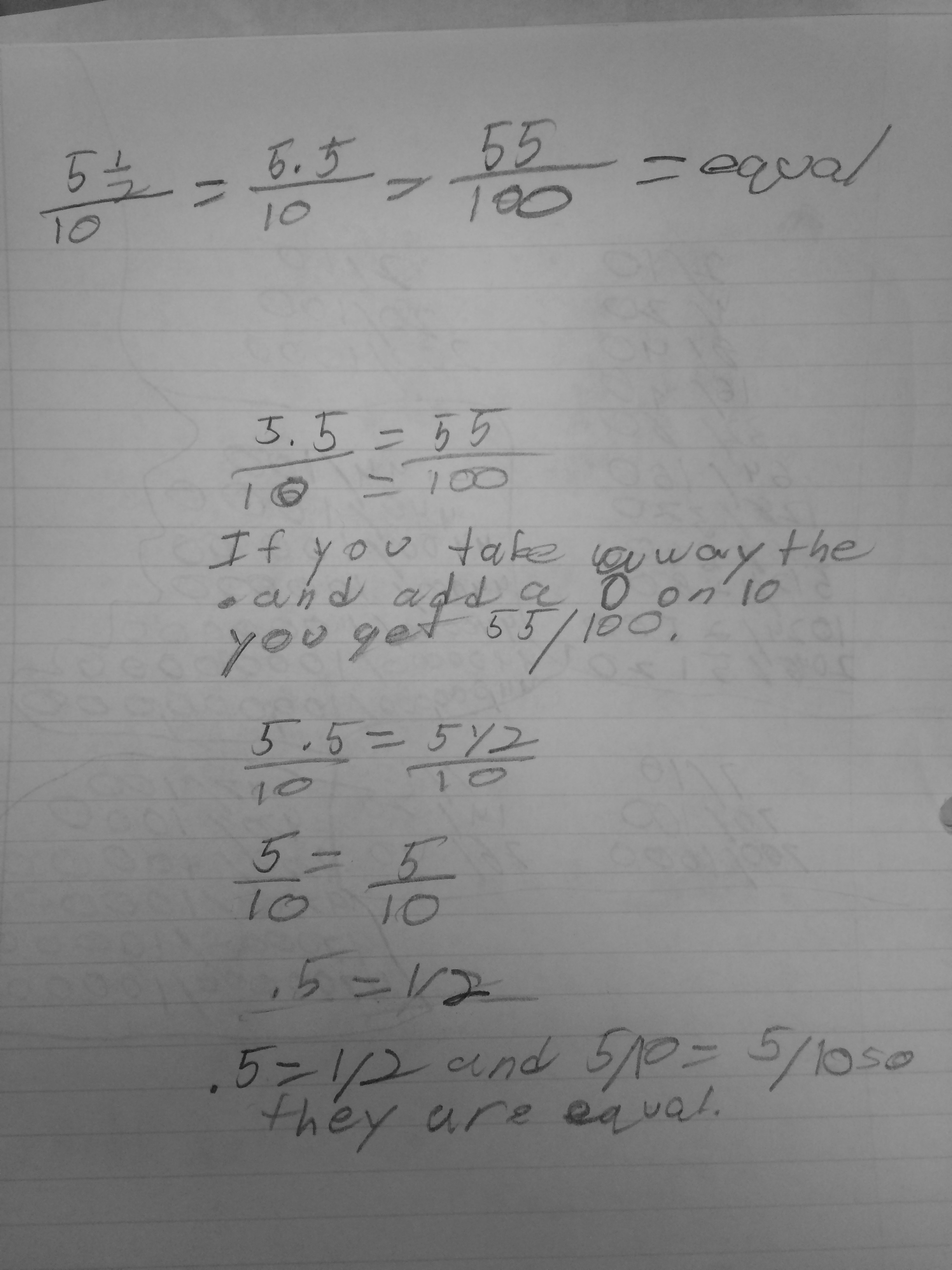
After our quick images, we moved into pre-shaded grids for students to look at equivalencies of decimals shaded on tenths and hundredths grids. We flew through until we hit the tenths grid with 5 1/2 tenths shaded and hundredths grid with 55 hundredths shaded. The students could see they were equivalent by the pictures, but many had a tough time explaining why. When someone did say “A half of a tenth is 5/100” another student said, “But I thought a half of a tenth was 1/20?” What a cool conversation! They left class yesterday with this question still lingering so I had them just jot what their group had talked about in relation to these pictures…

IMG_8997_2 IMG_8998_2 IMG_8999_2 IMG_9005_2 IMG_9007_2At this point students were starting to have trouble thinking about writing a decimal that was a half of the place value to the right, so they stayed in fractions where they comfortably can represent half a fractional piece.

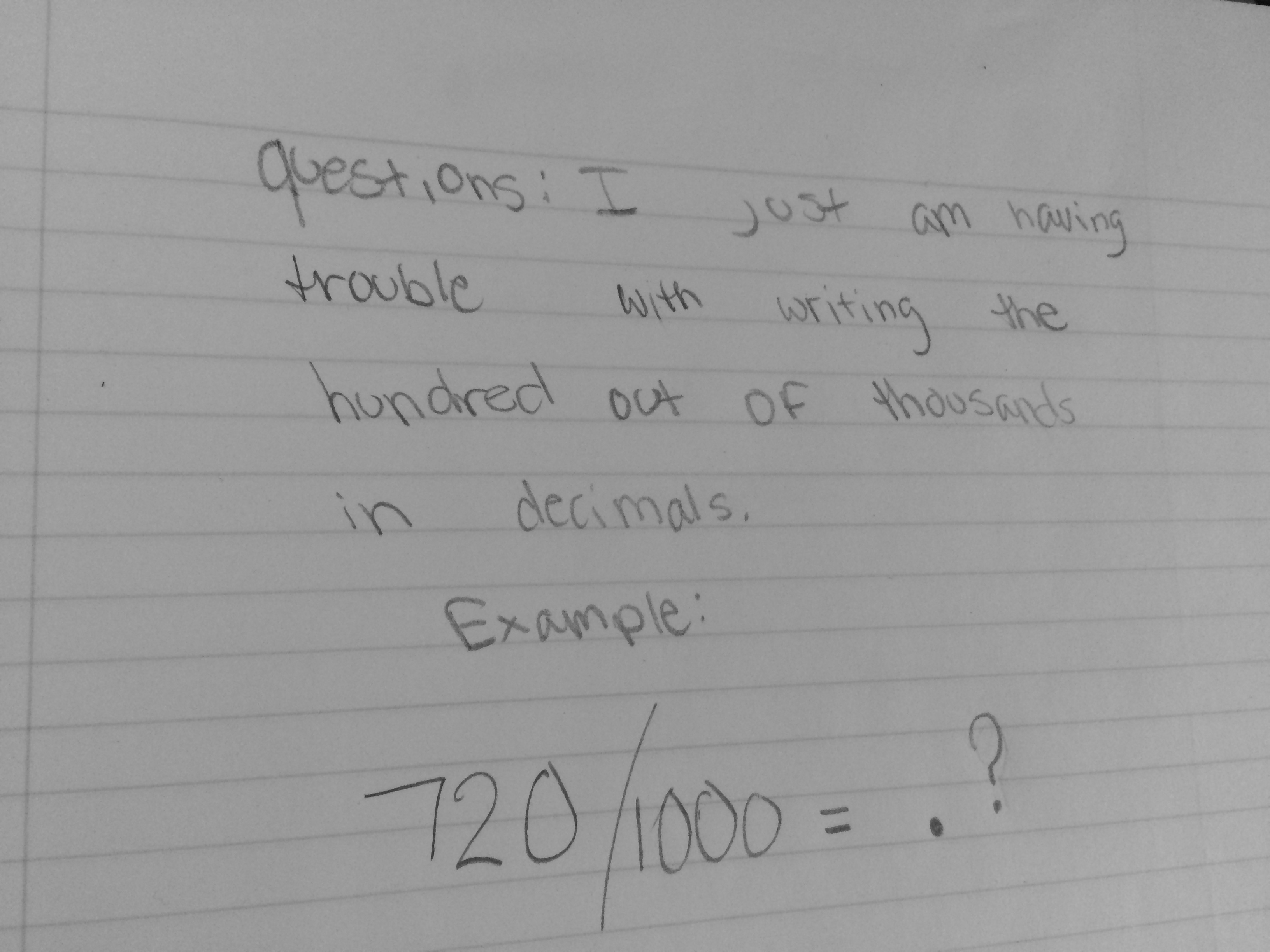
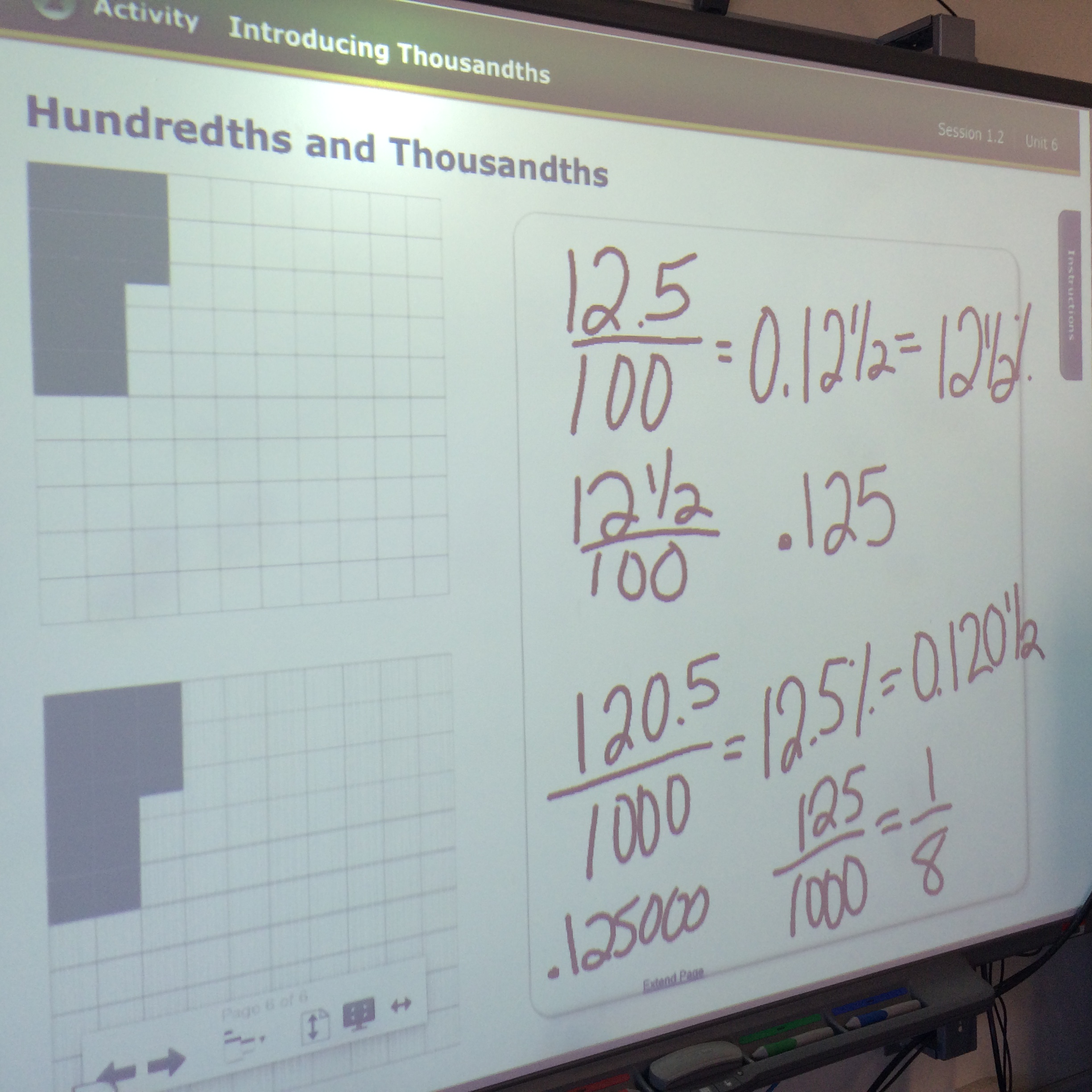
We started our conversation with this today and broke up the grids to prove that 5/100 is equivalent to 1/20 and equal to 1/2 / 10. Students were comfortable with the half of a tenth represented in the hundredths, however they made it perfectly clear that they much preferred the hundredths grid because it was much easier to read:) So, of course, then I pushed them into the thousandths grid. We started with 1/4 shaded on a hundredths grid and 1/4 on a thousandths grid. They comfortably wrote 25/100=250/1000=25%-.25=.250. Then we went to a hundredths and thousandths grids with 1/8 shaded. Great convo that we will have to build on tomorrow, but as always, I need more math time!! I had them leave on a reflection prompt about what noticings they had during our work today. For the students who could easily see these equivalencies, I told them to write me some wonderings they may have. I got quite a range of great things. The predominant question was about the fraction/decimal in a decimal. I struggle with how to address this because it visually is not as appealing to me as the fraction/decimal within a fraction. I am comfortable writing 1 1/2 /4 = 3/8 but to write the fraction in the decimal does not work. I never really thought about it much before, but how funny that we can write a fraction of a fractional piece and it is readable, but to try with decimals, not so much. The only way I see to address this is to do many more grid shadings to get comfortable with these equivalencies, but I do so appreciate their curiosity about it!

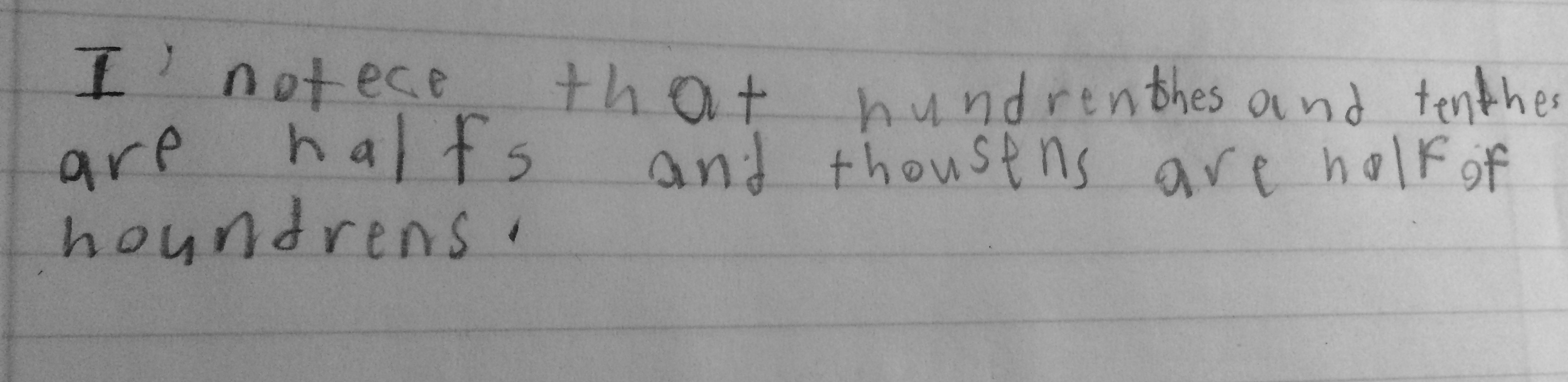
IMG_9018 IMG_9013 IMG_9014 IMG_9015 IMG_9020 IMG_9022 IMG_9023 IMG_9026 To use the word differentiation here is an understatement. The range of thoughts in my classroom (and many many others) amaze me on a daily basis, in the most wonderful way!

And I especially love these last two because it gives me the feeling that I have created a safe place for my students to put confusion out there. I LOVE LOVE LOVE this ❤

IMG_9019 IMG_9024

~Kristin
Decimal Quick Images

In Investigations we do Quick Images of dots, 2D and 3D figures. I thought we could incorporate this same routine into our decimal unit to talk about fraction/decimal/percent equivalents. I told the students that each grid equaled 1 and that it was broken into 10 or 100 pieces (just to save time of them counting to verify it). I flashed the grid image on the screen for 3-5 seconds and had students give me a thumbs up when they know how much of the grid was shaded. I asked them to signal with their fingers if they had more than one way to name the amount or an equation of how they saw it.

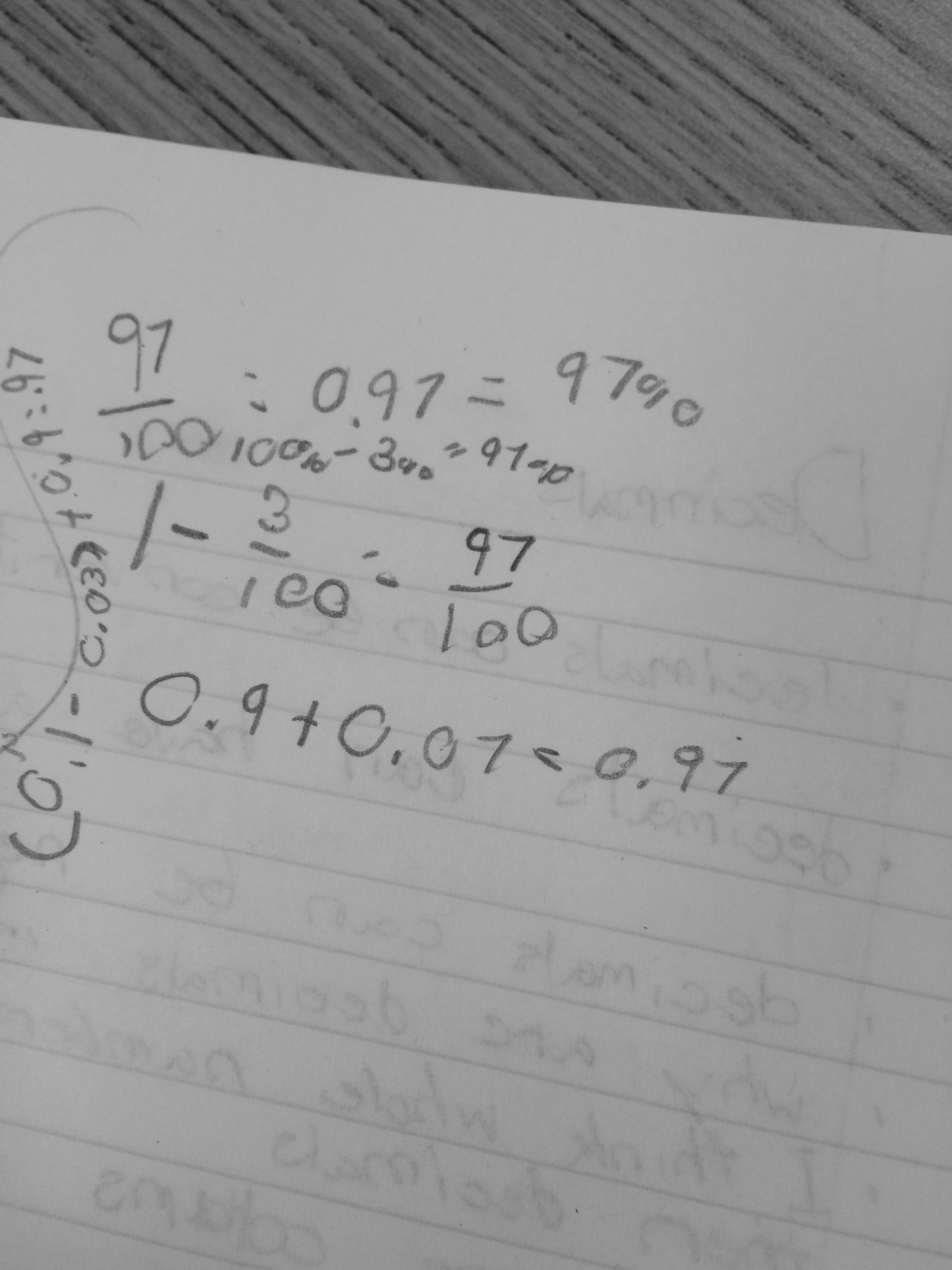
These were the first images that I did (one at a time) and after each we discussed what they saw. After they said their answer, I was sure to ask “How would you write that?” to be sure if they were seeing it as a fraction or decimal.  It was interesting, but not surprising, that every student gave a fraction.

g1The first one elicited the 2/10, 20%, every equivalent fraction of 2/10, and eventually 0.2. I asked about the zero in front of the decimal to be sure everyone knew that meant there was not a whole filled. The second elicited much of the same, but also came with 10/10 – 3/10 = 7/10 as the way they remembered how much was there. “It was easier to count the white part.”
The next two went into hundredths and followed the same routine.

g2We did the first aloud in a Number Talk type setting and then I sent the students back to their seats to write what they could for the fourth image. Here is what they came up with…
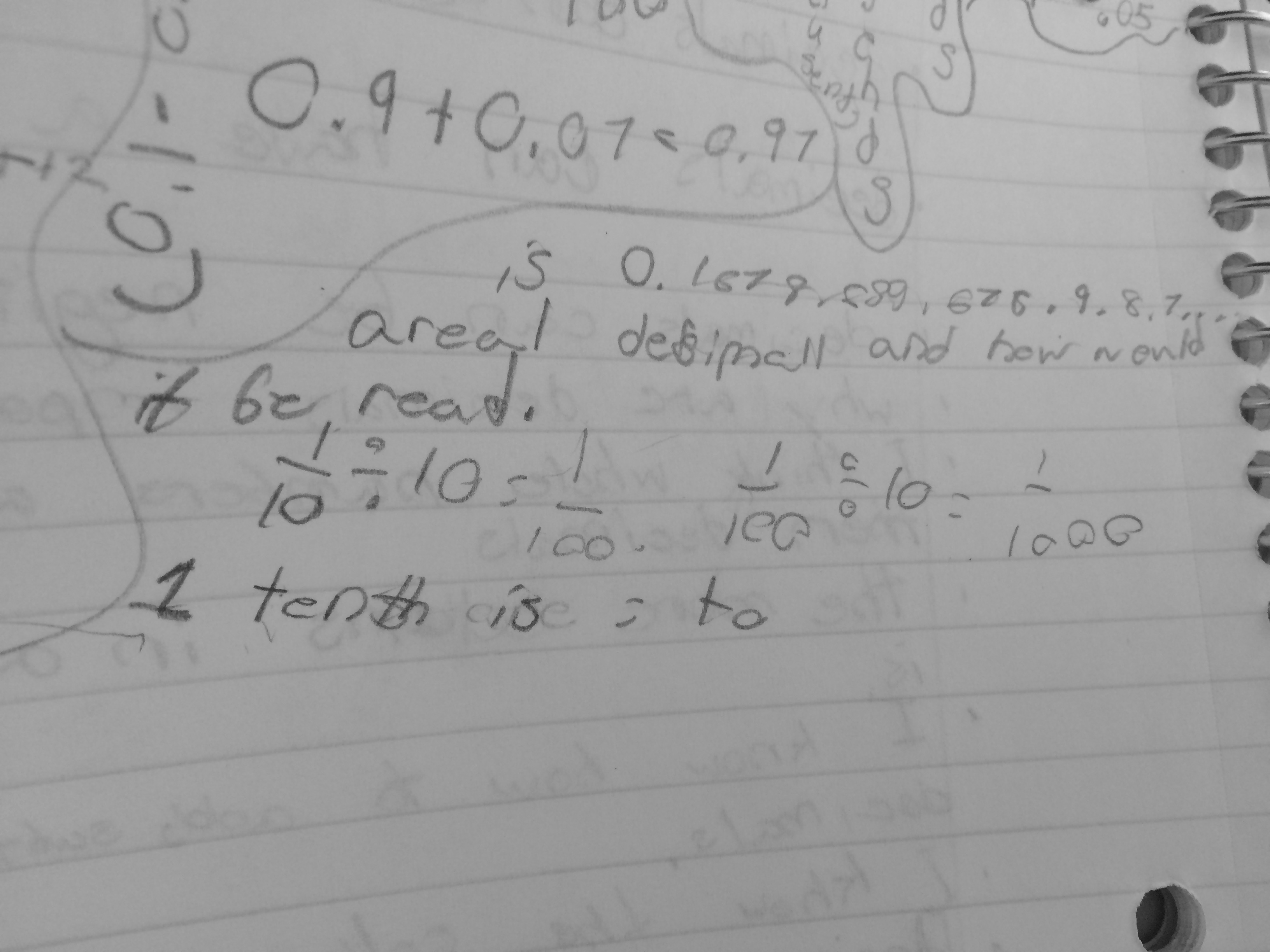
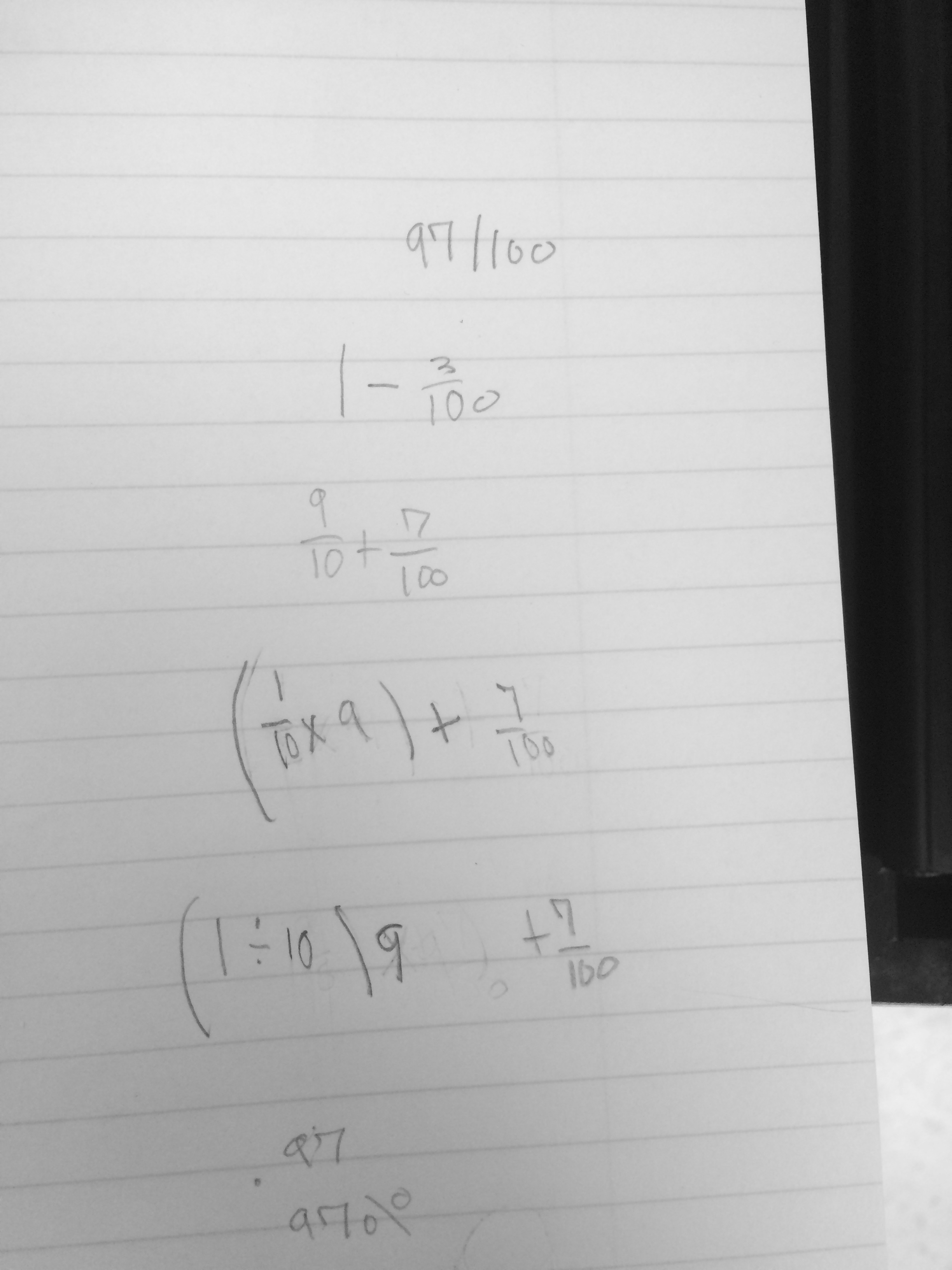
IMG_8995_2 IMG_9001_2 IMG_9004_2 IMG_9008_2 IMG_9011_2This is a wonderful jumping point for starting Fill Two game tomorrow! I plan on bringing up some of the examples with .9 + 07 to start our classwork!

-Kristin