Category Archives: 5th Grade

Patterns and Perseverance

Today in math was a test in perseverance. The students were working on the growth pattern of an animal called the Fastwalker. It was fairly easy for them to complete up to the 10th year, graph it and answer the questions regarding the line they graphed. The book did not require them to do any generalizing of a rule, however they had other plans! Here is a completed table of one of my students:

IMG_0823

We worked on this up until lunch, discussed the line and how it was different than the constant rate of change graphs we had seen earlier. They kept asking if there was a rule for this one, so I asked them to play around with it and see what they thought. One of the students noticed that if you added all of the terms before with the term number you were trying to find, it gave her the height, so she started adding to see if it worked for the 100th term (nothing like starting small:).

IMG_0826While she was working on adding, another student, who had done a consecutive sums task earlier in the year in RTI w/me, realized there was an easier way to add those numbers, and you can see on the top of the page where he started playing around with pairing up the numbers:

IMG_0823It was so interesting to see the groups working with them and asking questions as they tried different ideas. The two of them finally saw that pairing up the numbers was working and began to generalize based on what they had done with the numbers. It was awesome because they began generalizing based on an even or odd number term because of the pairings and needing to divide the term number by 2. At the bottom of the first paper earlier in this post, you can see she wrote an even and odd rule for the pattern, while this student realized that if should work with even and odd because the decimal didn’t make a difference.

IMG_0825

IMG_0828Shew…..they were sooo proud of themselves (and I was so proud of them) at the end of all of this hard work! The student who did the paper above said, “Wow, that one problem took us almost two hours!” And it was SO worth it to see the accomplishment on their faces. THIS is the reason we must make time for students to investigate their own mathematical curiosities and give them the time they need to persevere through these problems!

-Kristin

Growth Patterns In Both Math AND My Understandings!

The math ego in me wants to preface this post by saying, I understand how to find patterns, I understand how to graph lines, I understand slope and y-intercept and could graph any line based on that information….etc; however, more and more I find the need to truly reexamine the way in which I “understand” concepts in math. This unit is one of those times. Math ego aside, I have left class so confused over the past couple of days, calling my math phone-a-friends for tutoring!  I blogged about the beginning of the unit here and since then my head has been spinning.

We opened the unit reading growth stories of children that gave the child’s age at age 2 and how they grew. The students created data to match the story and graphed it on this graph (which at the time I didn’t think too much about the way the x and y-axis were set up)

IMG_0810_2We had great conversations about how they determined their data, the steepness of lines based on the change, and what steady growth looks like. So far I was completely in my comfort zone and felt prepared for what was coming….then I decided to try out some number talks with patterns and I still cannot decide if was a mistake or the best thing that could have happened in this unit!

To avoid recapping everything I have typed in my previous blogs, I am going to skip the actual number talks strings but instead focus on the things that have come up form the students that have pushed my understandings over the edge during them….

In a string of numbers with a constant change, students were getting amazing at finding the 10th term and then generalizing to find any term. At this point, all of the patterns had started with either the number we were counting by or a multiple of that number. When starting from a multiple of the number we were counting by, the students had great arguments and come to the conclusion that you didn’t need to add the number you started on, but instead the last multiple before the 1st term in the pattern. For example, counting by 9’s starting at 27, 36, 45, 54… the tenth term we would say is 9 x 10 + 18 while some students insisted it was 9 x 10 + 27 because that is where we started.  This part poses a problem later on….

After asking the students what was important when thinking about patterns, I was feeling great with responses like this (at the bottom of the page).

IMG_0792Then we jumped back into their student activity book into contexts of animal growing and finding the growth patterns of each. The first animal at birth is 1 cm and grows five centimeters each year. They filled out the table and found the pattern: 5n+1.

Anyone see the problem that is coming yet?

One student (who was adamant during the number talk earlier) starts questioning why we add the 1 on here but in the number talk we went back to find the last multiple and then added that on. If this one is true why didn’t we add the 27 in the earlier problem when counting by 9’s?  Just then I realized there is something else that is very important when looking for patterns that I completely missed, the term number. After class,  I started asking myself…why does that completely change how we solve for a term number and can you make any number a particular term? How does that effect the line and pattern?  Then when we graph it where do I start the x-axis? Like the graph earlier in this post, does the term 1 meet at the y-axis? These were the first of many of my questions.

Going into class today, I completely expected this idea to arise, and it did. We counted by 5’s starting at 2:

2, 7, 12, 17, 22…

I ask: Tenth term?

They respond: 47 and 52

They talk it out, count it out and come up with the two possible equations of 5×10⁻³ or 5×10+2. There are lots of  looks of confusion because they know when they count it ends at 47 but they remember the work in the book from yesterday. I have them go back to the growth pattern from yesterday. I sent them back to their table to talk about how it could be both and I was happy to see them start to think about the what we were naming the terms.IMG_0804_2We revisited the context in the book and I wrote that first growth pattern out on the board as 1, 6, 11, 16, 21… and asked what the 10th term is. In their table they had the 10th year as 51, so some were confused to see it pop us as 46 when they counted it out to double check….I loved this one….

IMG_0807_2But many were starting to see that the 10th year was really the 11th term because of the “0th term” as they called it. IMG_0814_2 IMG_0803_2So I seemed to have this concept under control….until we moved to graphing….I had them predict if they would be the same line or different lines? Majority went with the same line, one was just one jump ahead of the other. Even in graphing them, there was some confusion that I struggled to answer because of our work in the book earlier…does the origin have to be the 0 term on the y-axis or could they start with the 1st term on the y-axis? When we graphed the earlier graphing stories they started with year 2 on the y-axis, but there was growth before that, so why didn’t it start out on 2 on the x-axis. I completely could be missing something, but because it felt right in the moment I went with 0 at the origin. We graphed them and found them parallel, but I left the class uncomfortable with how the graphs were presented and how number patterns, like our number talk, transfer to graphs.

IMG_0806_2

They still had many questions (as did I) about how we number the terms. How could we decide if it is term 0 or term 1? We had a brief chat about how the context could dictate that. One group said they think it is like this….”If you walk into a casino with $1 and then every machine you go to, you hit for 5 dollars, then $1 would be the zero term because you had it when you got there.” They continued, “Then if you went it and won $1 on your first machine and then $5 every machine after that, $1 would be your 1st term.” We had to wrap it up for the day but I look forward to thinking about this a bit more with them.

I asked them to write what they thought was important now in looking at patterns after our work today..

IMG_0815_2 IMG_0805_2In conclusion, I have SO much to re-learn about thinking about patterns and graphing. I am still muddled in thinking around so many ideas that I am having trouble organizing them into a nice list at this point. This is somewhere the unit definitely does not go, but these students constantly push my thinking and I loving these final 8 days of it:(

On a side note, I had students do a quick fill in the blank from Justin’s Twitter post a month or so ago…Math is _______. I got some amazing ones, but this was one I snapped a pic of on my way out today because I loved it and it fit my mood….

IMG_0802_2  -Kristin

Growth Patter Number Talk….3rd Times a Charm

Over the past couple of days, with my homeroom, I have tried a few strings of numbers to bring out the different ideas that are important when thinking about growth patterns and finding any term in a sequence, Here and here. Both days brought out many great ideas, conversations, and disagreements, however I couldn’t help but feeling the ideas we talked about in two days, could have been achieved in one and felt a little more connected. I knew it was completely the way I posed the problems, so when my second class came in yesterday, after missing a couple days of math due to testing, I was excited to try and adjust my previous work.

Apologize for the messy board, but I still cannot seem to get a handle on that recording thing…

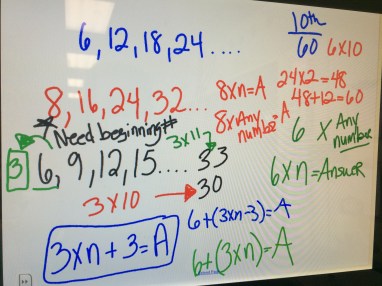
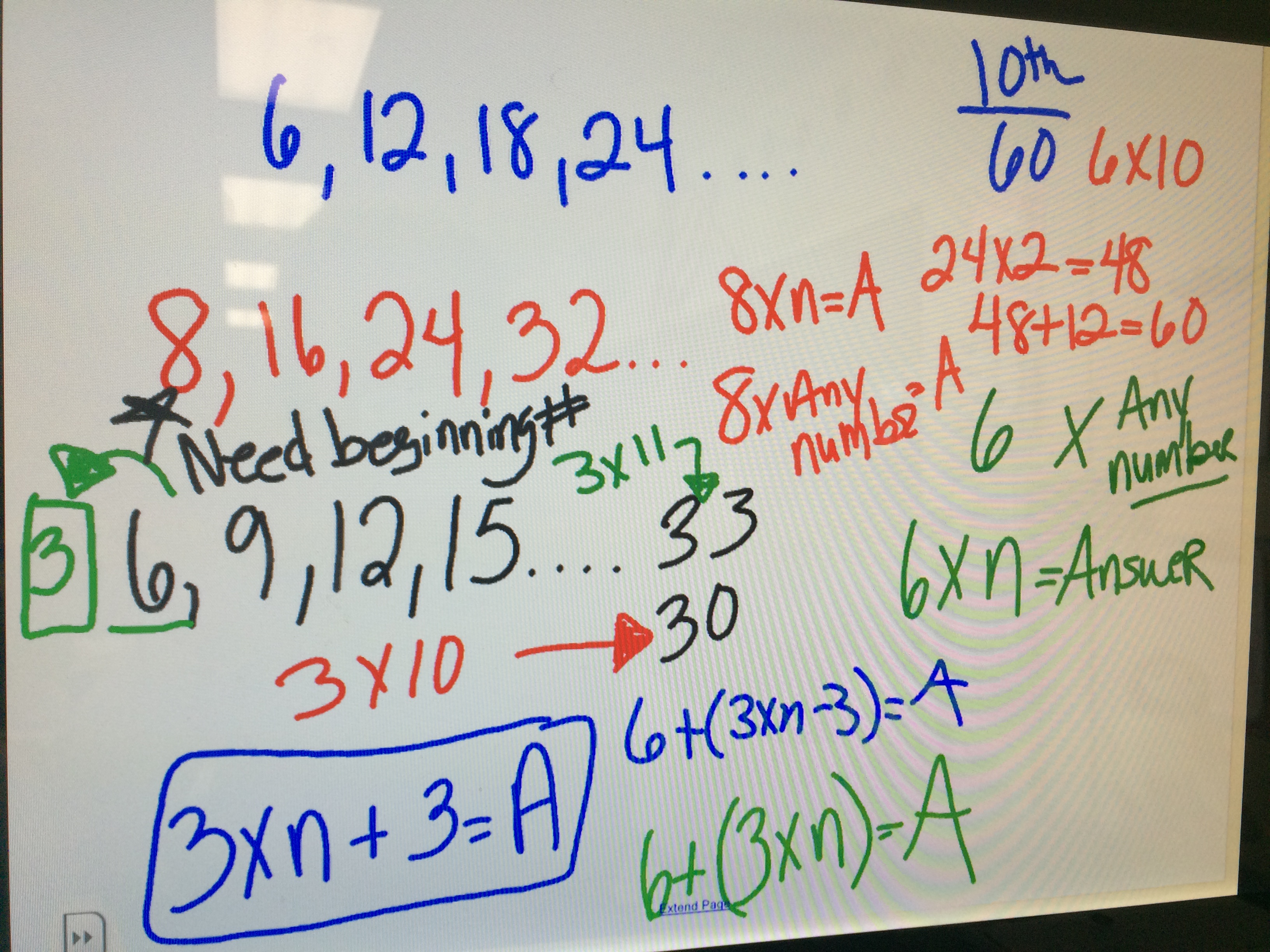
I started with having a student count by 6’s and wrote that in blue. I stopped them at 4 because I was asking about the 10th term and wanted to see if some would figure our 5th and double. I think that is an interesting thing to think about when the start is different so I wanted it up there. I asked 10th term? 60. Ways to get there? 6 x 10 and, unlike my prediction of doubling 30, one student said 24 x 2 because two group of 4 of them is 8 and then two more 6’s (12) is added to that to make 60. I asked 100th term? 600. 2,000th term? 12,000. I asked them how they were getting those without counting and I got “I did 6 times 100” “I did 6 x 2000” and then one student said you could do any number by multiplying it by 6. I asked how he wanted to write that and I wrote that in green. Another student, who has done Visual Patterns with me in our RTI group, said, “We can also write that as 6 times n = Answer.” I asked them to turn and talk to a neighbor if they thought that meant the same thing. We had all yeses and I had some student prove it. I did the same thing with 8’s and wrote that in orange. They started using “A” for “Answer.”

IMG_0774_2

After that, I asked them to to count by 3’s starting with 6 and stopped them at 15… Asked for the 10th term and got, as expected, 30 and 33. Then the conversation took off with proofs and some really important ideas that was hoping would emerge. I love it when the class is practically divided in half on an answer, we had the 30’s and the 33’s. I asked a 30 to explain how he got the answer and he quickly said 3 x 10=30. I saw a lot of agreement, so I asked for a 33 to share their reasoning. A student said that we “need the beginning number, three, to find out where the tenth one is. 3 x 10 is 30 but then you started three ahead of that so you add 3 to 30.” I wrote that down on the board.

A student then said something that made me have a realization, “It shouldn’t change because you are still doing 10 jumps of 3, so it HAS to be 30. 33 is 3 x 11.” In my last class I had a student who kept insisting that the 10th term remain the same no matter where we started and I could not figure out what they were trying to articulate. NOW, I understand. 30 will always be the distance between wherever we start in the sequence and the 10th term, but not the tenth from the true beginning. AH HA!

IMG_0774_2So, the beginning number was suddenly becoming very important and articulating “10th term from where” was having students agreeing that the 10th term starting from the 6 was going to be 33 but when thinking about a rule for the pattern we needed the true beginning. We were just about to head back to our desks to continue our work when a student (different than the one who had originally said it) said that we could write this one “3 x n + 3 = A” because you have to “add the three you are missing from the beginning to get the answer.” I had them turn, talk and try a few terms out and see what they thought. It was all wrapping up nicely (I was excited about it) when another student said, “You could also write 6 + (3 x n) since you are starting at 6” ….oh goodness, they just don’t ever let it end and I love it:) A disagreement arose that it would have to be “6 + (3 x n -3) because of that extra jump of 3 to start at 6.”

I always hate to say that time got the best of me, but I had missed this group for 2 days of math and I saw this conversation going lonnnnng so I had them write those ideas down in their journal to kick off our class on Monday!

I love when I have the chance to refine ideas that don’t go exactly as I had hoped they would, especially when I know it was completely how I posed the problem or asked the question. After a couple days of talks not connecting as I hoped they would, third time was a charm!

-Kristin

Growth Patterns – Number Talk Attempt…

After Tuesday’s talk, I wanted to continue having the students look for patterns within sets of numbers. They found it really easy to find any future term in our last talk because our starting term was the change value. For example, they knew the 10th term when counting by 3’s and starting at 3 was as easy as multiplying 3 x 10. I was curious how they would think about predicting future terms if the series did not start with the same number they were by which they were counting. I brainstormed a few possible strings students could begin to think about this and, if time went well, they could look for connections between:

IMG_0772I decided on the following three series:

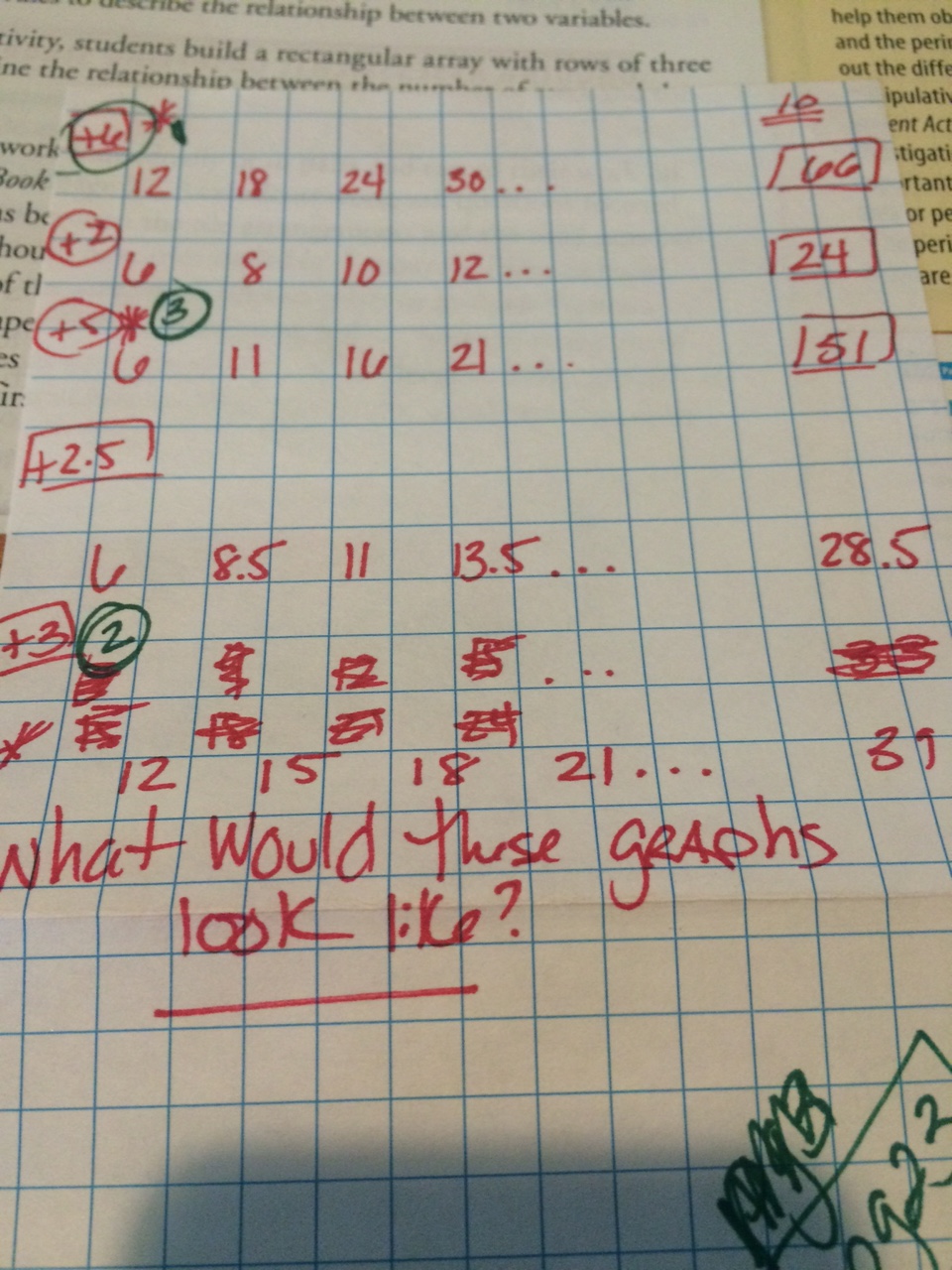
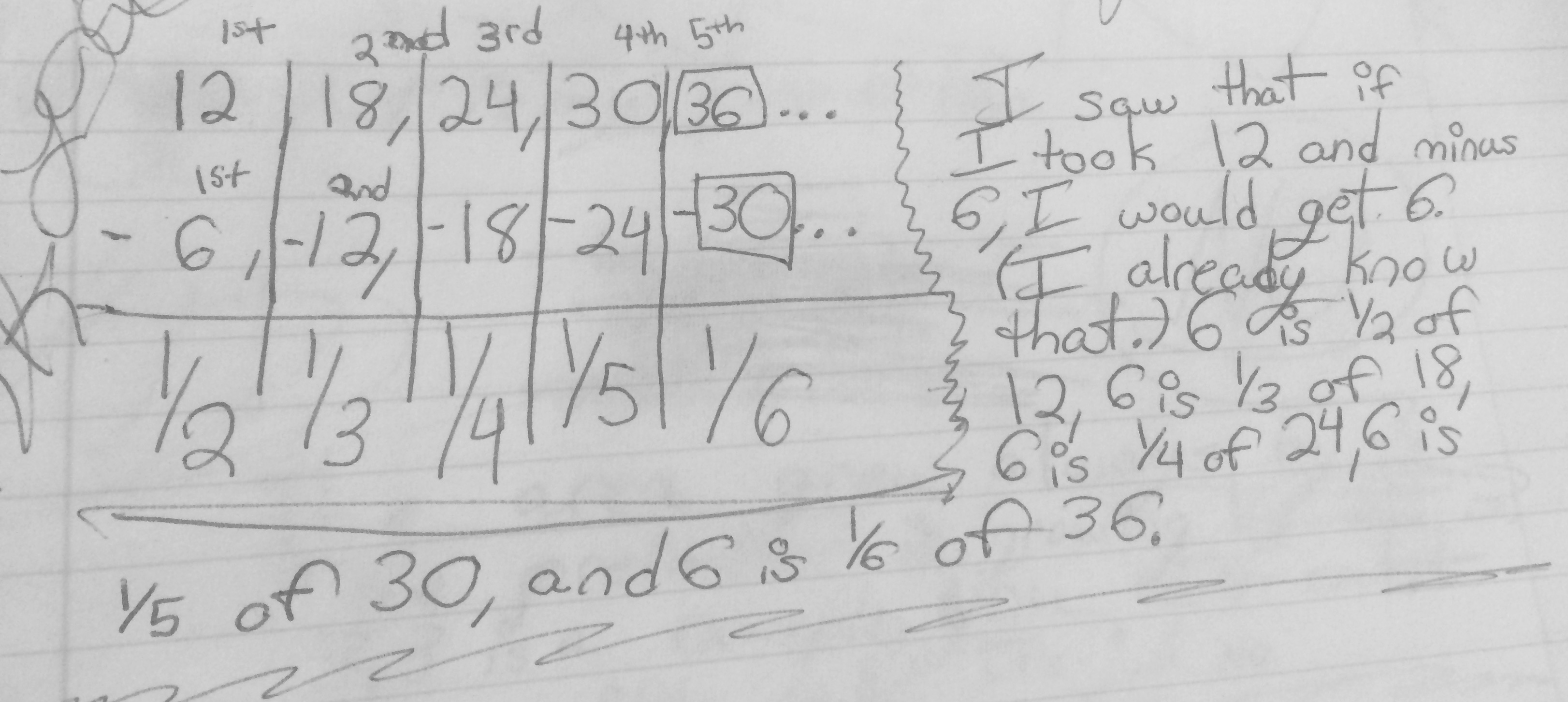
12, 18, 24, 30….

12, 15, 18, 21…

6, 11, 16, 21….

In each one I was going to have them figure the 10th term and discuss ways they were thinking about it. The idea that I wanted to emerge is the importance of accounting for the number at which they were starting and I also wanted to see how they made their predictions. I was going to end the talk by asking what the graphing story would look like if the first term was a starting height and it continued growing at this rate to connect back to our graphing stories from the previous day. As it sometimes happens, I did not make it as far as I had hoped because some amazing conversations were happening in the very first set of numbers.

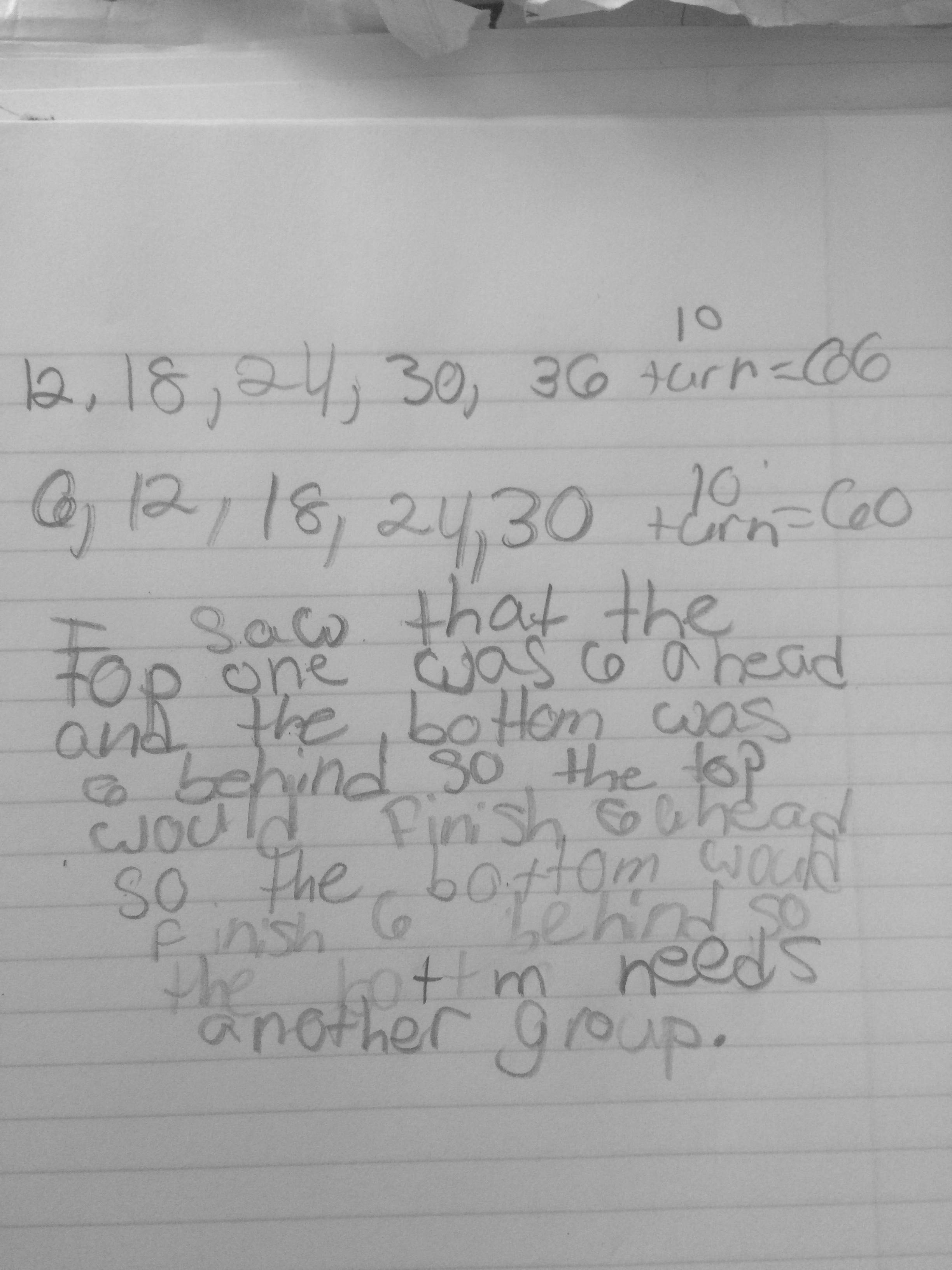
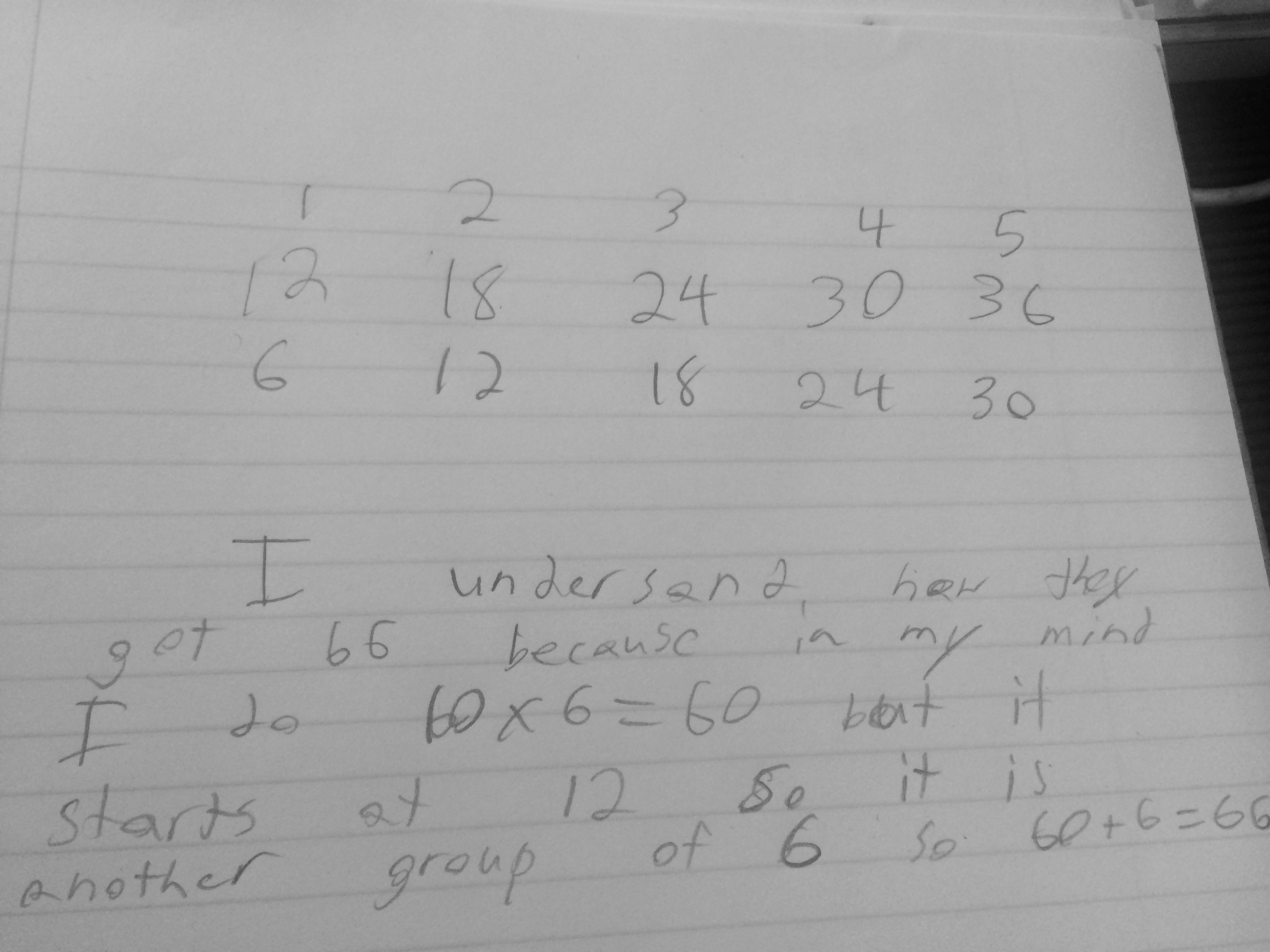
I had a student count by 6’s while I recorded, starting at 12 and stopped him after I wrote 30 on the board. I purposefully stopped there because I was curious to see if students would think about the next (5th term) and double to find the 10th as they did the day before. There was an overwhelming agreement for 72 for that exact reason, but since I got a few different answers for the 10th term, I wrote them all on the board and the proving, agreeing and disagreeing began. There was one, lone 66.

There were two proofs for 72:

– Found the 5th term as 36 and doubled it to get the tenth term.

– Did 6 x 10 to get tenth term but then added 12 because he started at 12. I was excited to see he was acknowledging where the series started and the idea of the start being important.

The lone 66, then did a simple continuous count to the 10th term proving that it would be 66. Heads tilted and eyes squinted. I realized at that moment how much I appreciated that the students looked for ways to think about the 10th term without having to count up to it, but also realized that we needed to do a little more work in thinking about what was happening in the sequence.

Since I knew I was not making it past this series of numbers, I decided to connect this set of numbers to a set in which the start was 6. I wrote them on top of each other:

12, 18, 24, 30……

6, 12, 18, 24…..

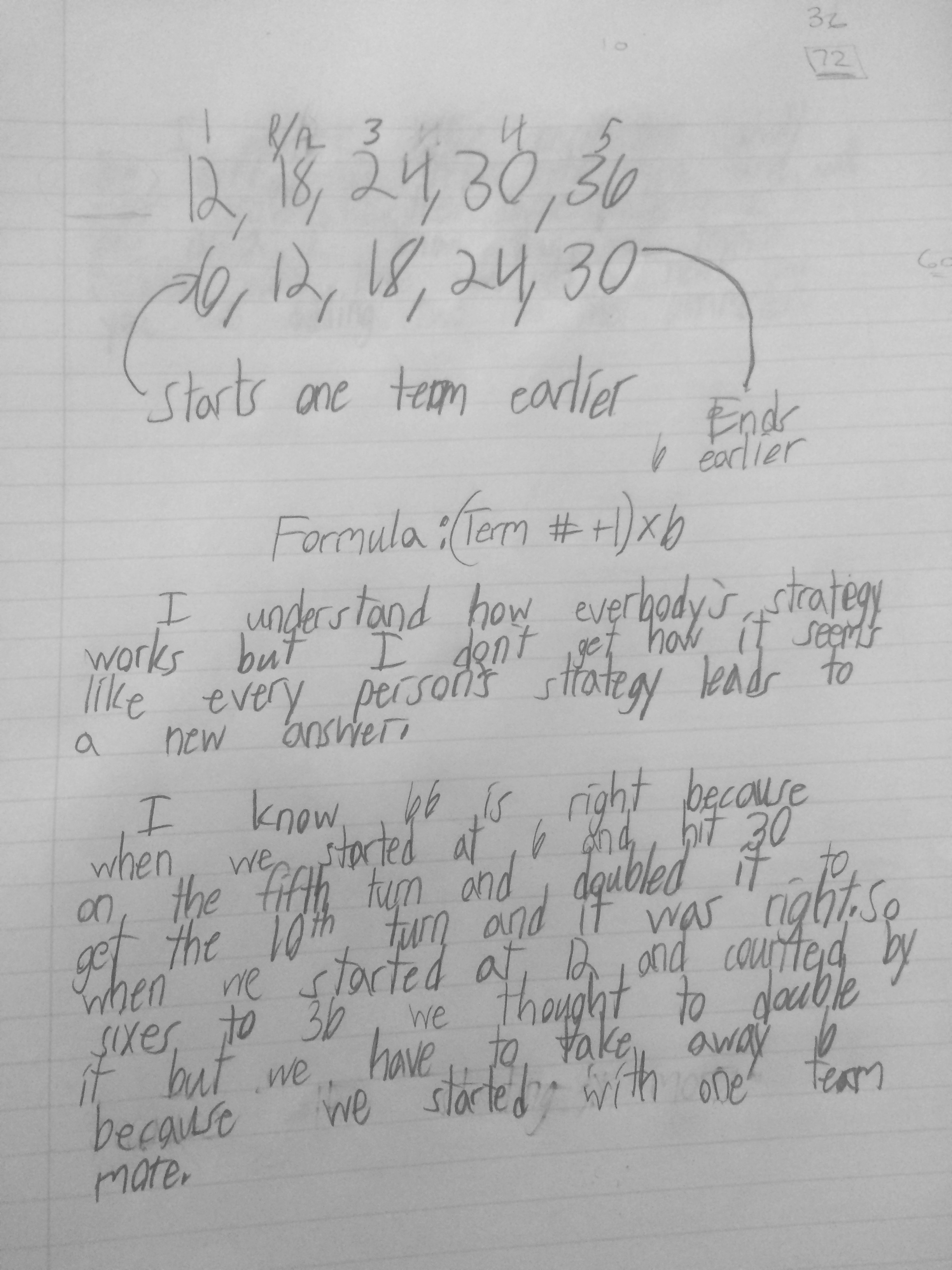
It then became clear to most that the first set’s 10th term had to be 6 ahead of the bottom one because of the start. The idea of term number and the increase from term to term started to emerge. One student said the bottom series “started one term earlier so it has to end 6 earlier than the top one.” Another student bounced off of that with “A term is 6, right?”

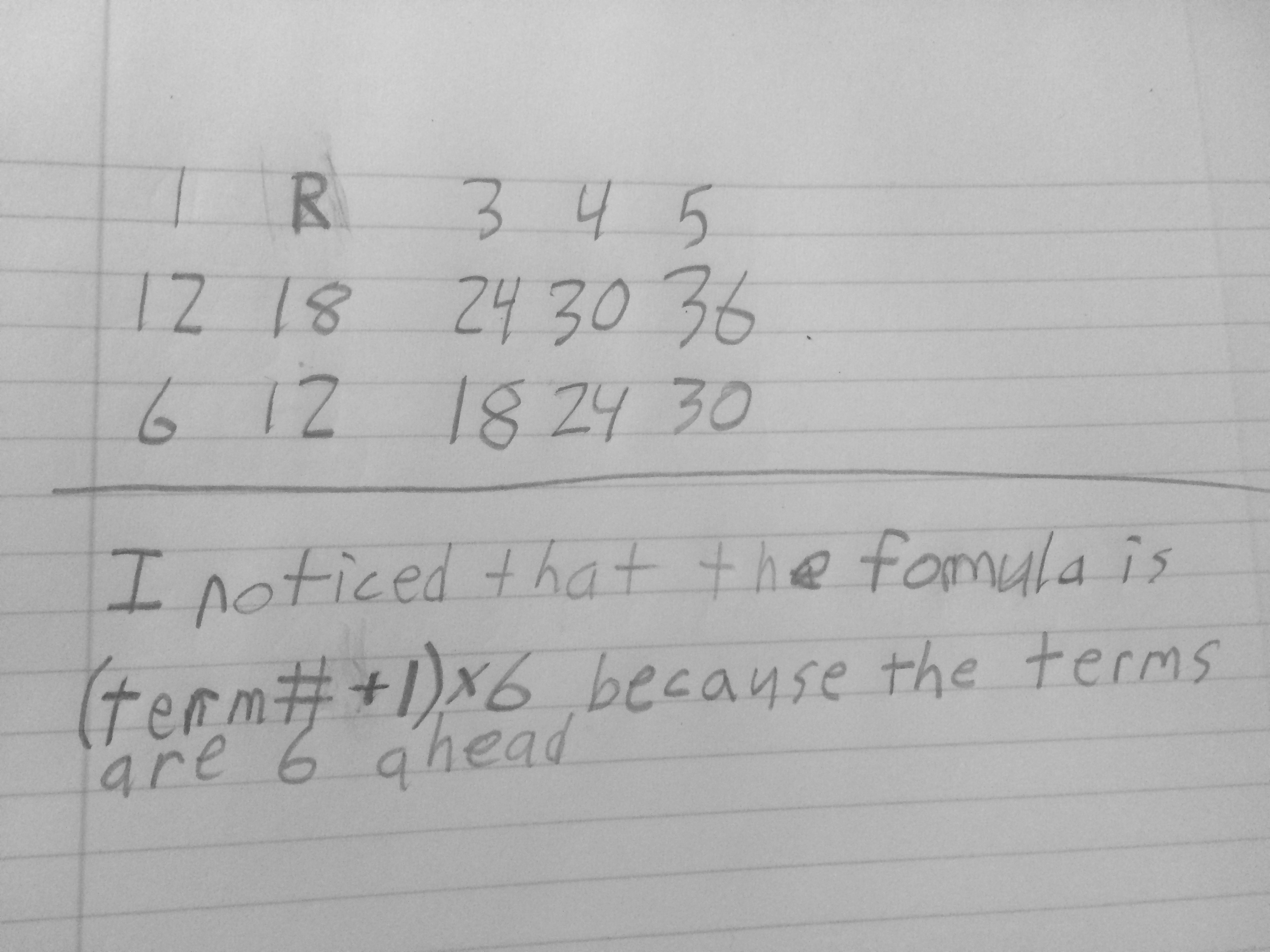
The debate continued and great ideas were coming out about what being the 1st term meant and then one student (the 66) said well it has to be right because (the term number +1) x 6 works for every one of them. That threw most kids for a loop and definitely not a place that I thought most of the class would be ready to engage in conversation around. I let a few students question what he meant, and I let him answer them. The biggest disconnect for students was how the term number factors into finding the number in future terms. To them the term number was just labeling and not really relevant in the values.

It was time to move into our lesson for the day and I was happy with the ideas that were emerging so I had them go back to their journals and do a quick 3 minute writing of either: what they noticed between the two, what someone else said that cleared up something for them, or something they were confused about still. It was interesting to see the word “group” popping up when that really didn’t come up in the talk…

IMG_0748_2

IMG_0758_2

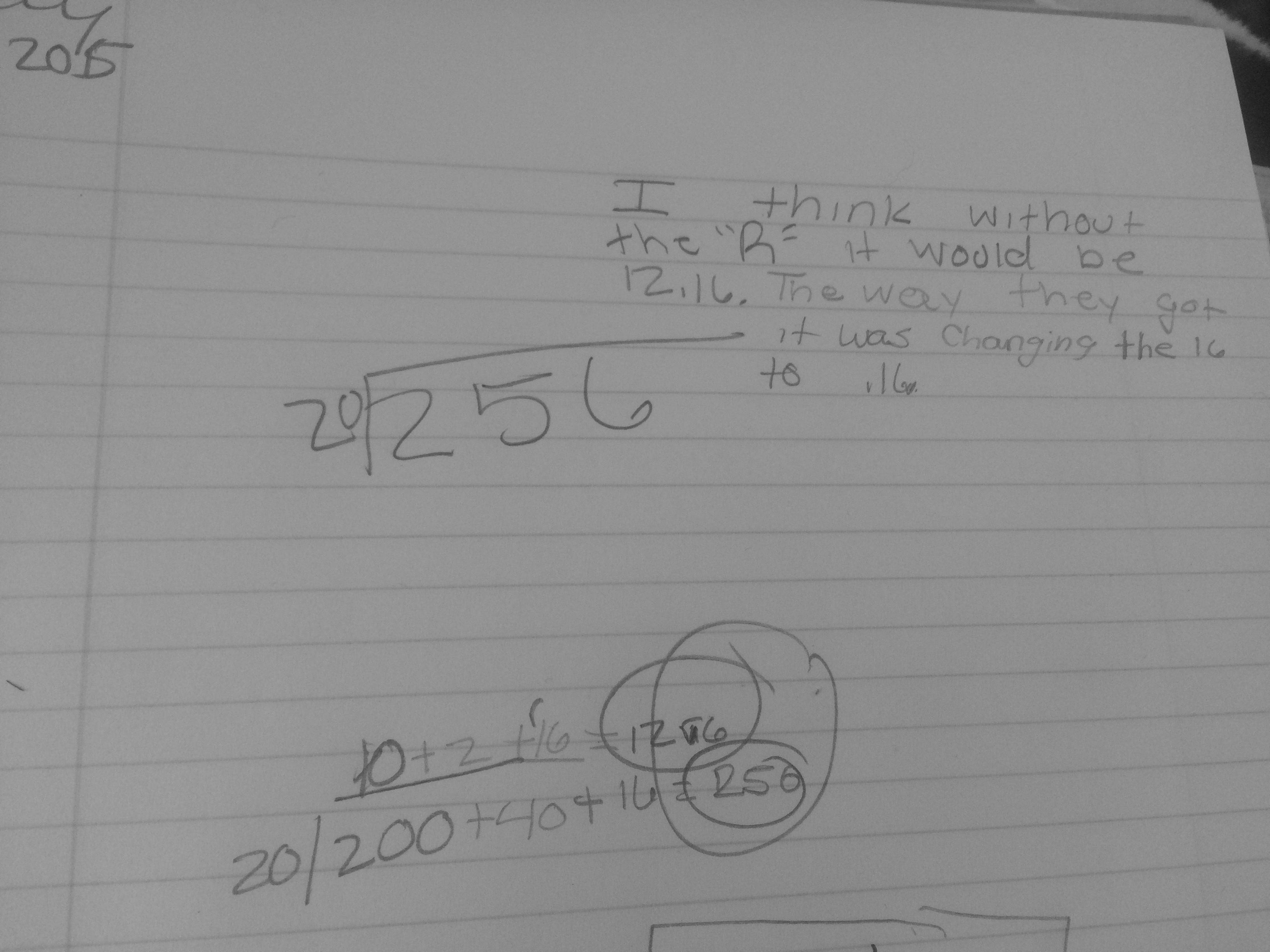
The “R” was my writing on the board….the SMARTBoard jumped and my 2 looked a bit like an R…they would not let it go of course:)

IMG_0752_2IMG_0754_2IMG_0755_2IMG_0759_2and of course there is always one that I want to find more about because it seems nothing like what the others thought about..

IMG_0763_2

After this talk, we went into some pattern building with rectangular arrays and finding the nth term. So much to write about that too, but will have to save that work for another night!

Tomorrow, I want to go back to second number talk set I had intended to do today and see how the conversation builds on our thoughts from today. Do they think about the starting number now? Do they talk about the numbers as “terms”? I think I will have them journal about what they find is most important when predicting what future terms would be in the series.

-Kristin

Growth Patterns…the Beginning

It is finally here, our last unit of the year and I have to say I am so excited to make it to Growth Patterns! Before we did some reorganization of units due to CCSS shifts, I could never get to this unit, however now having fewer units, I finally make it to the end!

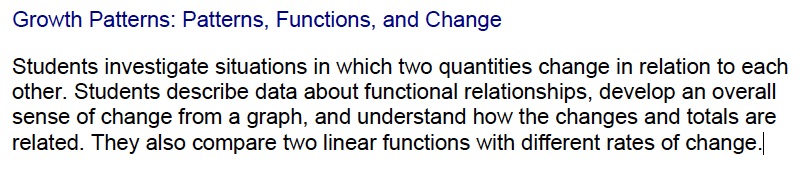
If you have never looked at this Investigations unit before, here is a brief description:

1This unit is really a beautiful culmination of all of the pattern noticings my student do all year long.

Being the end of the year, I know I am going to miss constantly having a class to try out my ideas on during the course of the summer, so I am making the most of the time I have left to test some different number routines.  After reading through this unit, two things jumped out at me that could potentially be incorporated into our number routine work before the lesson: predicting nth terms and relationships between two sets of numbers. So, I thought it may be interesting to do some counting and then think about relationships between our sets we make.

I first had a student count by 3’s four times: 3,6,9,12…. I asked the 10th term and everyone looked at me like I was crazy because this seemed too simple and said “30.” I asked how they knew and immediately thumbs went up and they all agreed that 3 x 10 = 30.I asked for another way you could get there? Next I got, “If you add one more 3 and get 15, you can just double it because it is doing the same thing all the way.” I wrote (12 + 3) x 2 = 30. Another student said, “You can double/half and do 5 x 6 = 30.” Me, “How does double/halving look here?” Silence for a minute, so I asked them to chat with a neighbor and then they came to thinking about jumps on a number line and explained that you were doing jumps twice as big so you need half as many.

Next I did the same process with 4’s: 4, 8, 12, 16 and I got much of the same as above. I asked if we could make any connections to the first set. I had an idea this one may be tough (but I had a plan for it in the next set), however I did have two students who noticed it was one more every time you counted by 4’s, so by the time you counted 10 times, you would have to add 10 to your total, 30+10=40.

The third problem, I wanted to give them the chance to make some connections to the 3 and 4 counts, so I did 12’s: 12, 24, 36, 48… Again, I got many of the above strategies, but then they made some connections to doing “3 times as many jumps of 4 in 12” and “4 times as many jumps of 3 in 12” and adjusting their 10th terms.

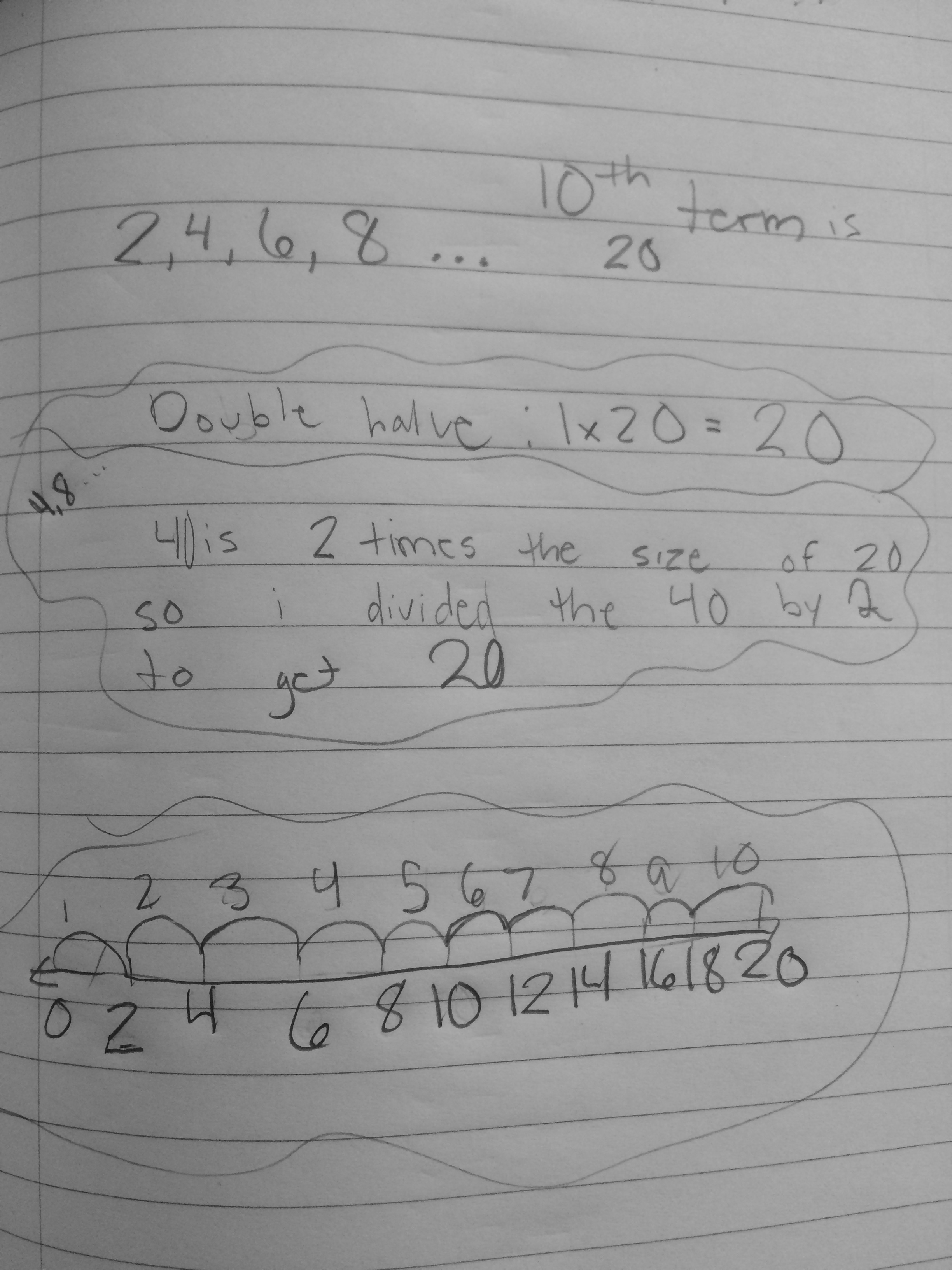
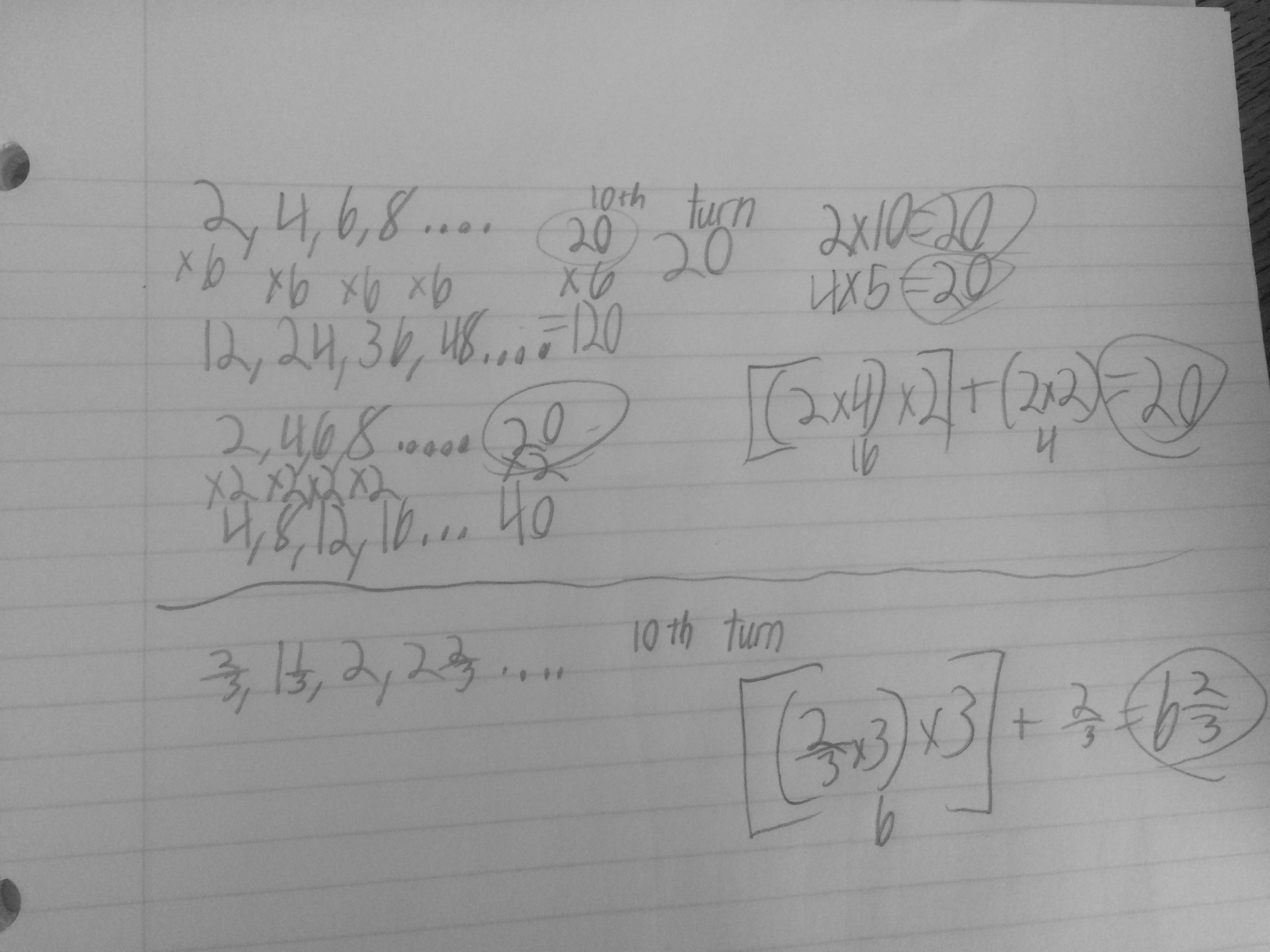
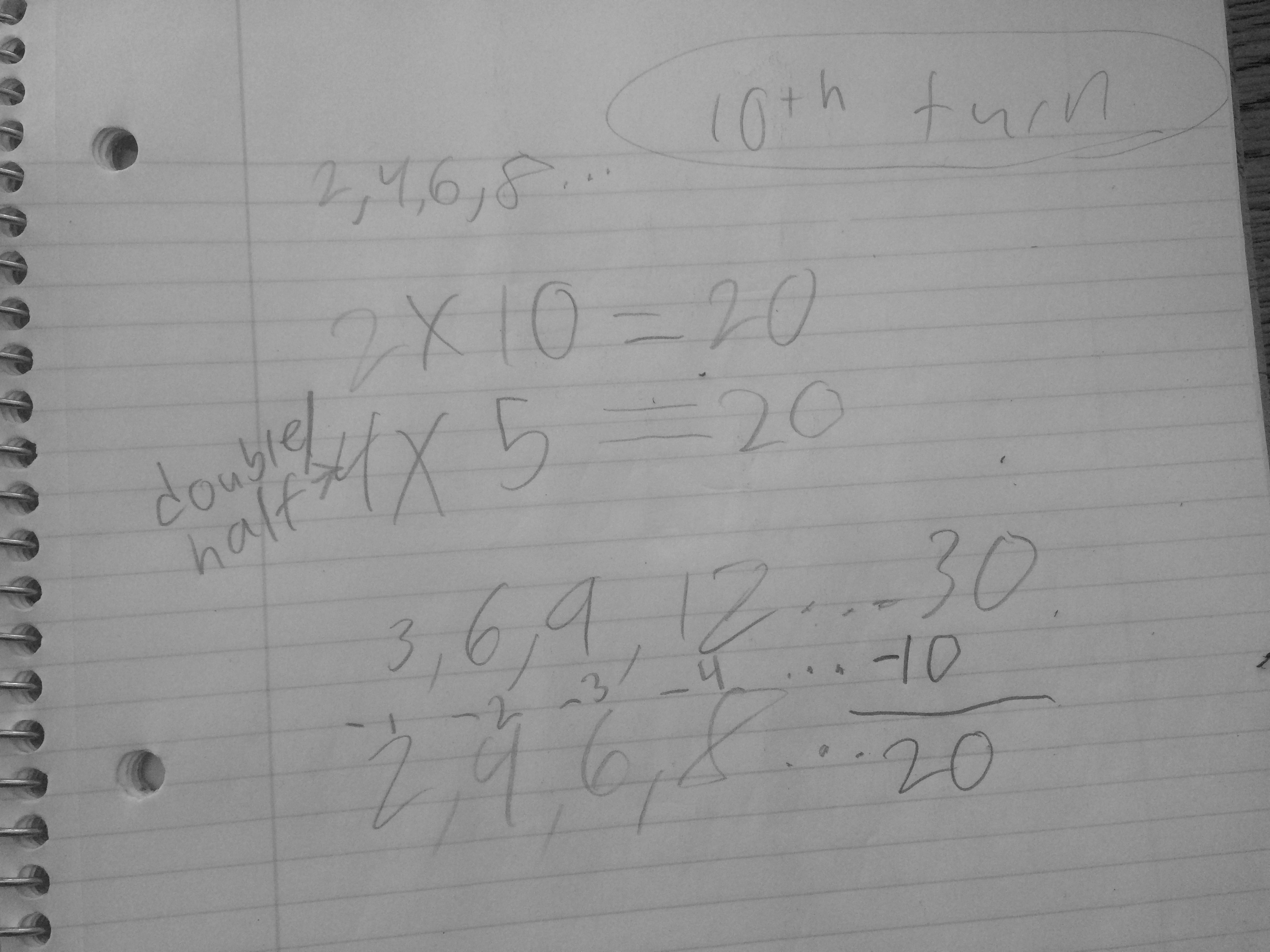
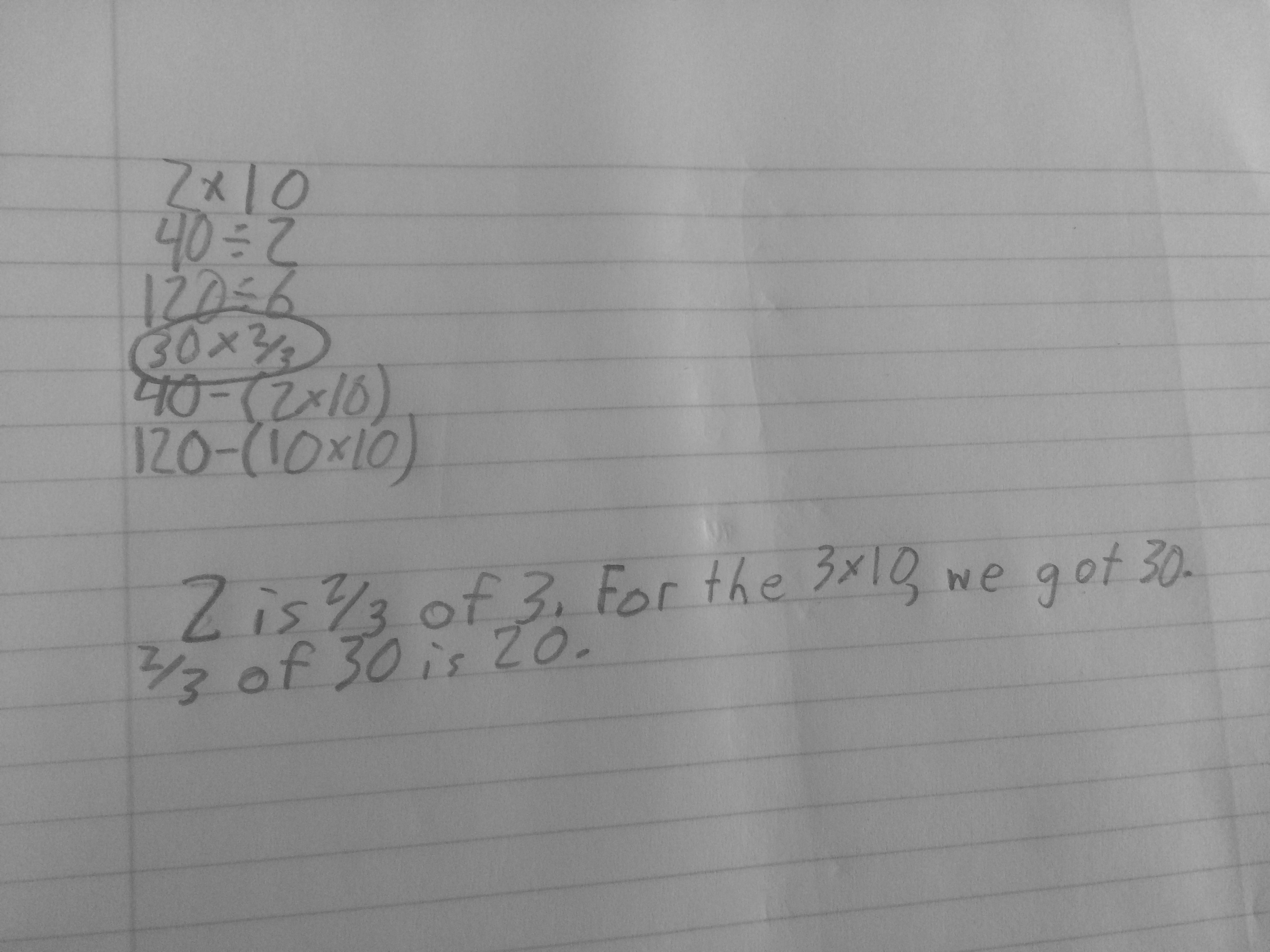
Because some students were really comfortable moving between the sets of numbers, others were still staying within one set of numbers in describing the 10th term, I gave them two sets to go back to their journal to reflect on: 2’s: 2, 4, 6, 8…. and 2/3’s:  2/3, 4/3, 6/3, 10/3….

I asked them to either talk about how they could arrive at the 10th term or make a connection to one of the previous sets of numbers…

IMG_0724IMG_0728IMG_0729IMG_0730

It was interesting to see their connections between the sets, but I think for next time I need to think more about either the predictions of future terms or comparing two sets, this was a bit too much at once. Next time I may have them look at sets with constant change but not starting at a multiple of that number….and then as I was typing that, I think it would be cool to come up with a set with a missing number at the end that could be varying numbers depending on how they see the pattern, then give a term after the missing number and narrow it down to which pattern it actually is….hmmmm…have to think more about this one…

-Kristin

Listening Carefully to Student Thinking

Recently, I have been reviewing a new “CCSS-Aligned” middle school curriculum and find myself completely frustrated with the overabundance of scaffolding and lack of student thinking required on every assignment. Not having the days/weeks it would take for teachers to engage in the mathematics as both learners and teachers, I needed a short, powerful way to show that this is not how students should experience/learn mathematics.

As I looked at the fraction page like this, my thought was “Why just two ways?” quickly followed by “Why those two ways?” quickly followed by “My students are doing this now, flexibly.”

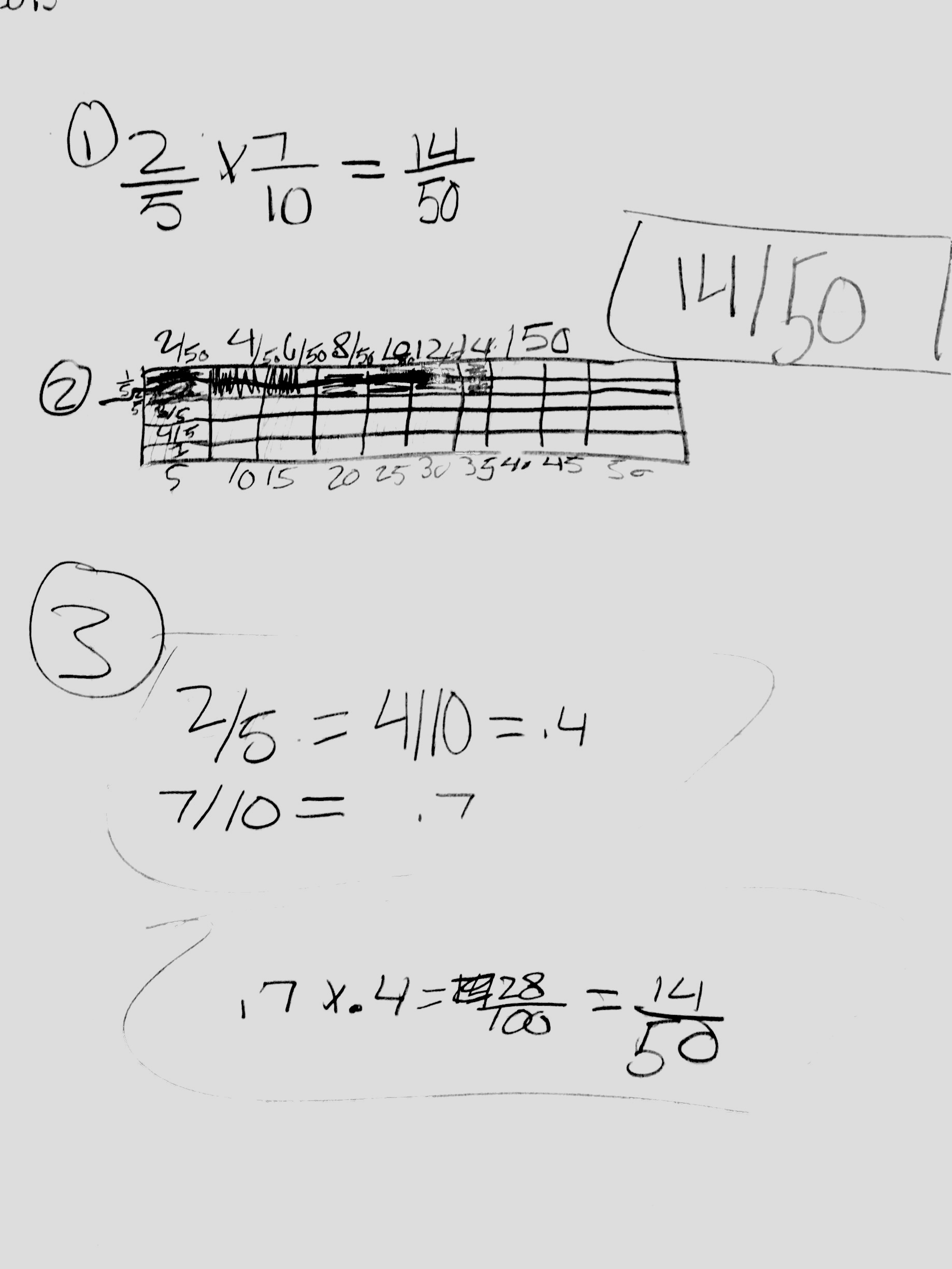
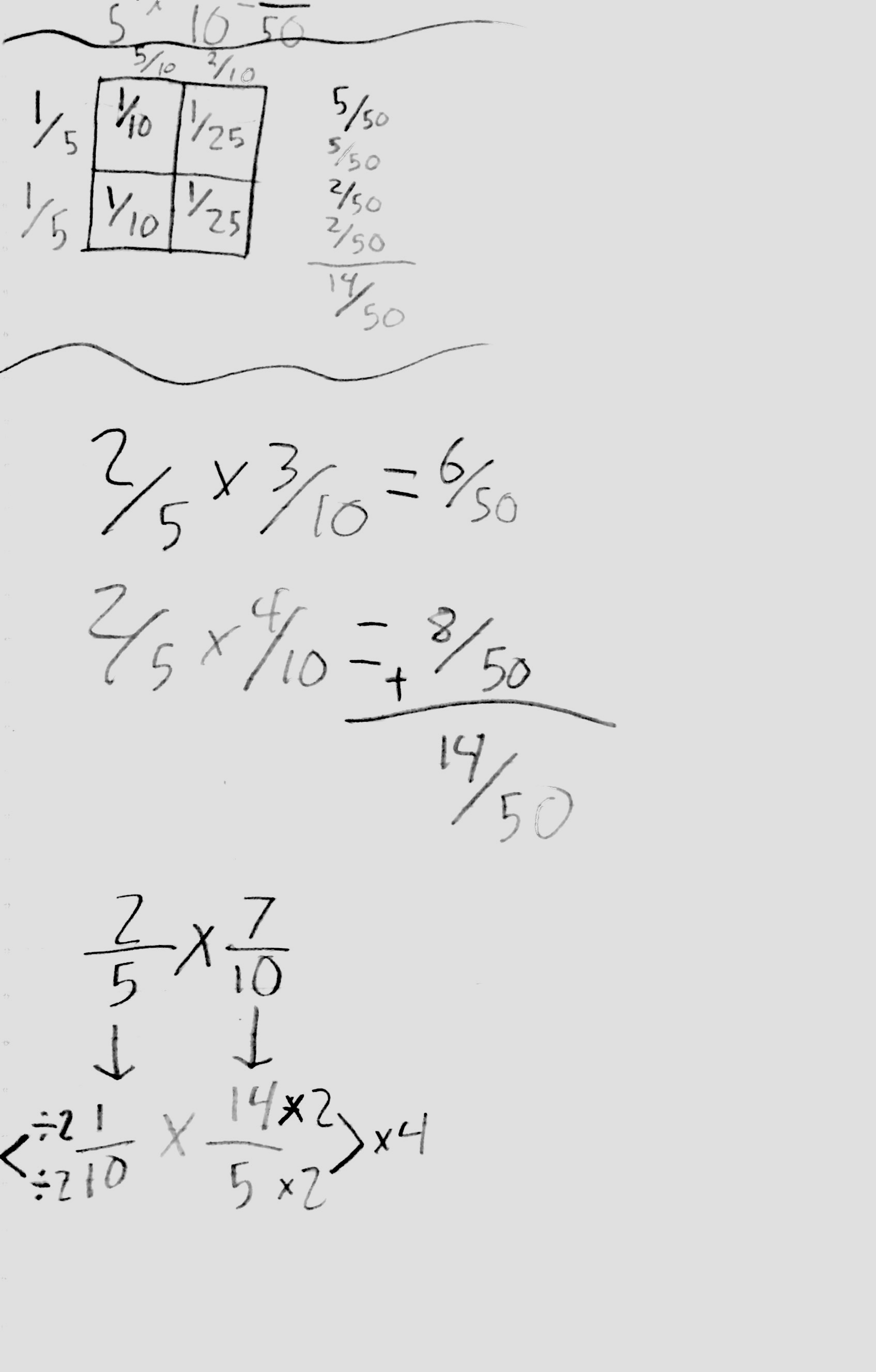
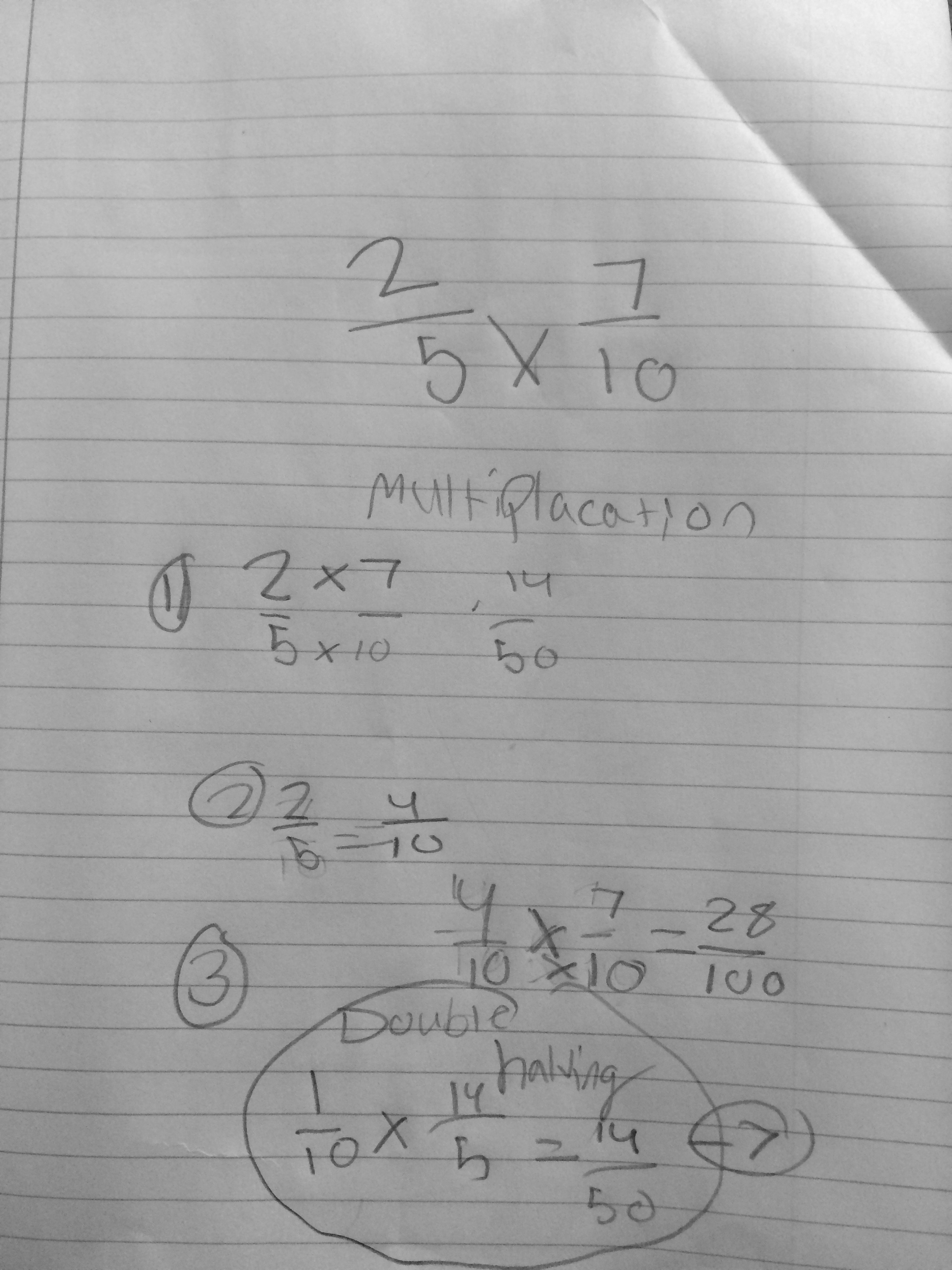
IMG_0598Right then, I realized the perfect proof of why NOT to do this, was the work my students already do when given the freedom to reason about a problem and do more than just procedurally compute an answer. So, I put the proof in their hands.  I simply asked them to solve 2/5 x 7/10 as many ways as they could. Some got creative after a couple of ways, and by no means am I saying some of these are “efficient,” but they show so much flexibility.

new doc 9_4 new doc 9_5 new doc 10_4new doc 10_1

This felt perfect. Why would we want to miss out on all of the great conversations that can happen around this work by making them answer in just 2 ways, and more specifically, those 2 ways they show you how to do…step-by-step?

and THEN this happened which validated my thoughts even further and instantly made me reflect on my friend Christopher’s talk at ShadowCon (video coming soon) around listening carefully to student thinking…

The students were working on 2/5 x 7/10 as I was walking around the room observing their work. I glanced over a student’s shoulder and saw “Doubling and Halving” written on her paper with the correct answer. Assuming it was doubling/halving in the sense of doubling one factor and halving another factor, I was excited to see the use of the strategy.

IMG_0643

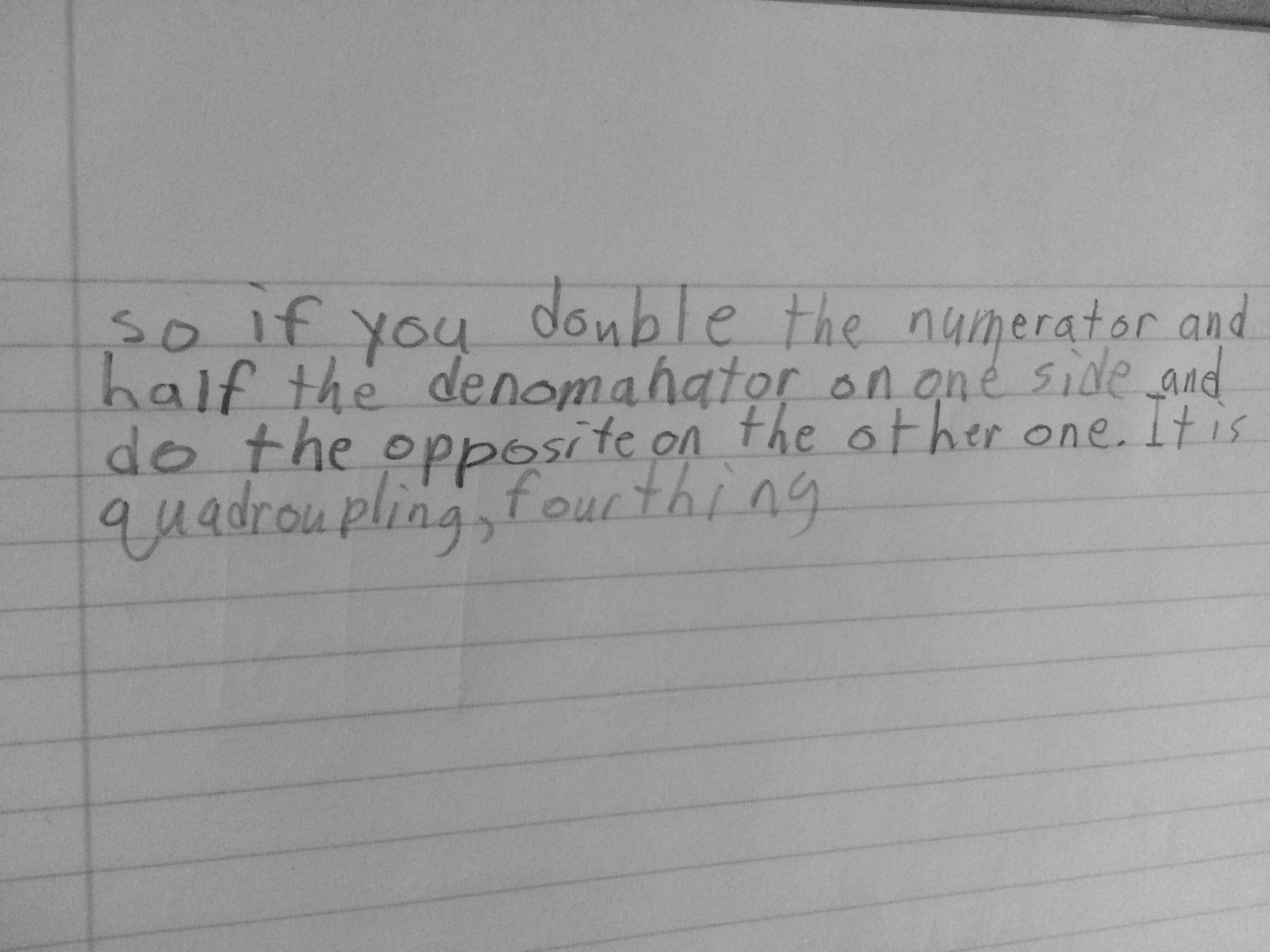
I asked her how she did it, she said, “I double/halved” and I was about to move on to get ready for our sharing. When I glanced down, however, it was not at all like I had imagined. I asked her to explain further…“I halved this numerator and doubled this denominator [points to 2/5] then I doubled this numerator and halved this denominator [points to 7/10].”. Ok, now THIS is much different than I thought!!

I had her share, and others immediately said they had double/halved also but did not get those fractions to multiply and wondered if that worked every time (I love that they ask that now:). I let them play around with it for a bit but since we had some division work to do I told them to keep thinking about that and we will revisit it tomorrow. By the end of the next class period, I had a student come up and say, “She didn’t double/half really, she quadrupled/fourthed.” I asked him to write down his explanation for me because it was lovely.

IMG_0647IMG_0648So glad I listened carefully and didn’t makes assumptions on her understandings because how amazing is this work? I am also so glad that I can appreciate a curriculum that allows for these reasonings and conversations to happen.

-Kristin

Remainders: Division & The School Year

Looking ahead in planning for the remainder of the school year, I am currently finishing up my decimal unit and excited to end the year with Growth Patterns. I was planning on finishing decimals this week, however, I have one more thing that I feel is missing from the unit that I am curious to see how students are thinking around it. In the unit, within decimal division, the students are very comfortable estimating quotients and thinking about a variety of strategies in finding how many of the divisor are in the dividend. However, one thing that is not addressed is remainders, and how we notate them. I had not really thought much about it because in the context of the problems we were doing, the remainder made sense. However, during a division number talk, not within a context, the “r” was still there. It bothered me a bit. When I asked how they could write the quotient as a number, I got blank stares. I know fourth grade really spends a lot of time on interpreting remainders, but do we spend equal time on various notations of the quotient?

I have decided to extend my decimal unit just a bit longer because I feel this is something my students can definitely reason about and I am curious the connections they can make between whole numbers, fractions, and decimals. I decided to start with whole number divisors and dividends and move to decimals from there. Today, I gave them the problem 256 ÷ 20. They estimated somewhere just over ten and then I asked them to solve it. If they finished early, I asked them to write a context to match the problem.

The majority of the class’ work looked like these and contexts involved a sharing situation…

IMG_0590_2IMG_0594_2When pushed to write their quotient as a number without the “r,” most said this…(I do love the way this student divided:)

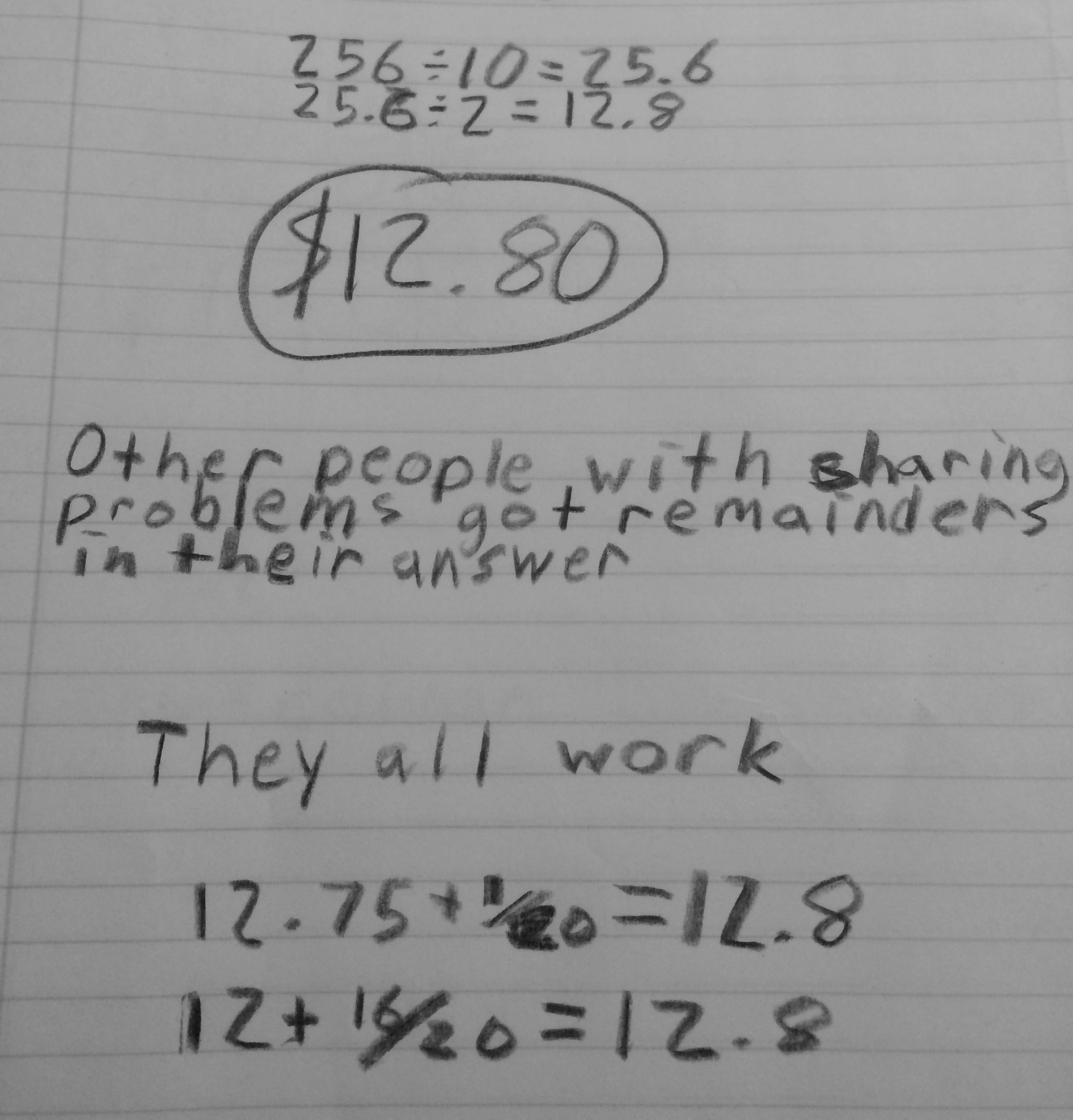
IMG_0585I did get a few 12.8 and 12 16/20, which interestingly fell more in money contexts…

IMG_0583_2IMG_0586_2IMG_0592_2All of these, I had anticipated, but then I got some really great unexpected answers that allowed students to think about the connections between notations…

12.5 r 6         12 16/256         12.75 r 1

I wrote these responses on the board and asked the students to see if any of the answers meant the same as 12.8 or 12 16/20 or 12 r 16, that we had established were the same. They did also mention, which I loved, that certain situations my use different notations.

I had some amazing proofs that we are kicking off the day with tomorrow before moving into decimal divisors. While I was hoping for students to look for equivalencies in the quotients themselves, most groups went back to trying out division in a different way to prove the answers. This group went back and solved the problem using the same method every time, just changing the breakdown of the quotient.

IMG_0591_2This group used multiplying up to see that 12.5 r 6 worked as a correct answer. IMG_0588_2

After asking them if they saw any relationship between the quotients, I got this…(much more what I was hoping to see in their reasoning)

IMG_0593_2This group had a nice, simple explanation at the bottom of this page…

IMG_0584This student is still sticking with 12 16/256 and quite honestly I don’t know how to approach this one. It is a different way of writing the remainder and I cannot decide if there is a time when this would be an appropriate notation?

IMG_0587_2The most perplexing quotient for most of the students was the 12.75 r 1 so I asked the student to write out his thought process because he was having trouble explaining it.

IMG_0581_2Now, while the entire class period seemed to focus on the remainder in a division problem, this explanation represents the remainder of the school year! I asked the above student to go in the hallway and record his thinking through the problem because he had such a beautiful way of starting to explain how he decided how much to add based on the distance from the dividend…but then I got this 🙂 https://www.educreations.com/lesson/view/kewl-aid/31841872/

And here’s to the remainder of the school year….

-Kristin

The Meaning of Subtraction

After a Number Talk a couple of days ago, I blogged about my students’ thoughts around a subtraction problem. Instead of being a talk about subtraction strategies, as I anticipated, it ended up more of a talk about the meanings of subtraction.

After class, I was curious where these meanings of subtraction arise in our curriculum and found this in the 3rd grade Investigations’ Teacher Notes:

gr3Now being in 5th grade, I began asking myself a bunch of questions…If these subtraction meanings arise in 3rd grade, do we ever have students explicitly investigate them? Once they have an efficient strategy to subtract, do we just move on? Do we think that the meanings of subtraction really do not matter if they can read a context and solve for the solution?

After reflecting on my own practice, I honestly think it is a combination of all of these things. I am completely guilty of being satisfied if students are able to understand how to solve a problem, with or without a context, and explain their reasoning. I actually feel quite great about student understandings in that moment, however, I have really seen the importance of having students make deeper connections, create conjectures and justify claims/generalizations. It truly pushes them to think about a deeper meaning of operations and demonstrates the depth of their understanding in developing proof of their thinking.

The day after the Number Talk, I had the class split into two groups and each focused on writing a context that would lend itself to being solved using one of the two strategies for 400-274.
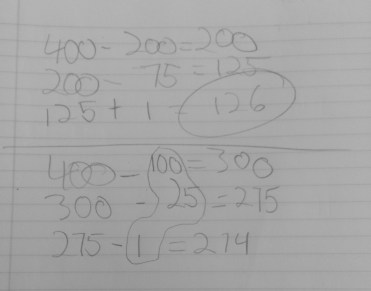
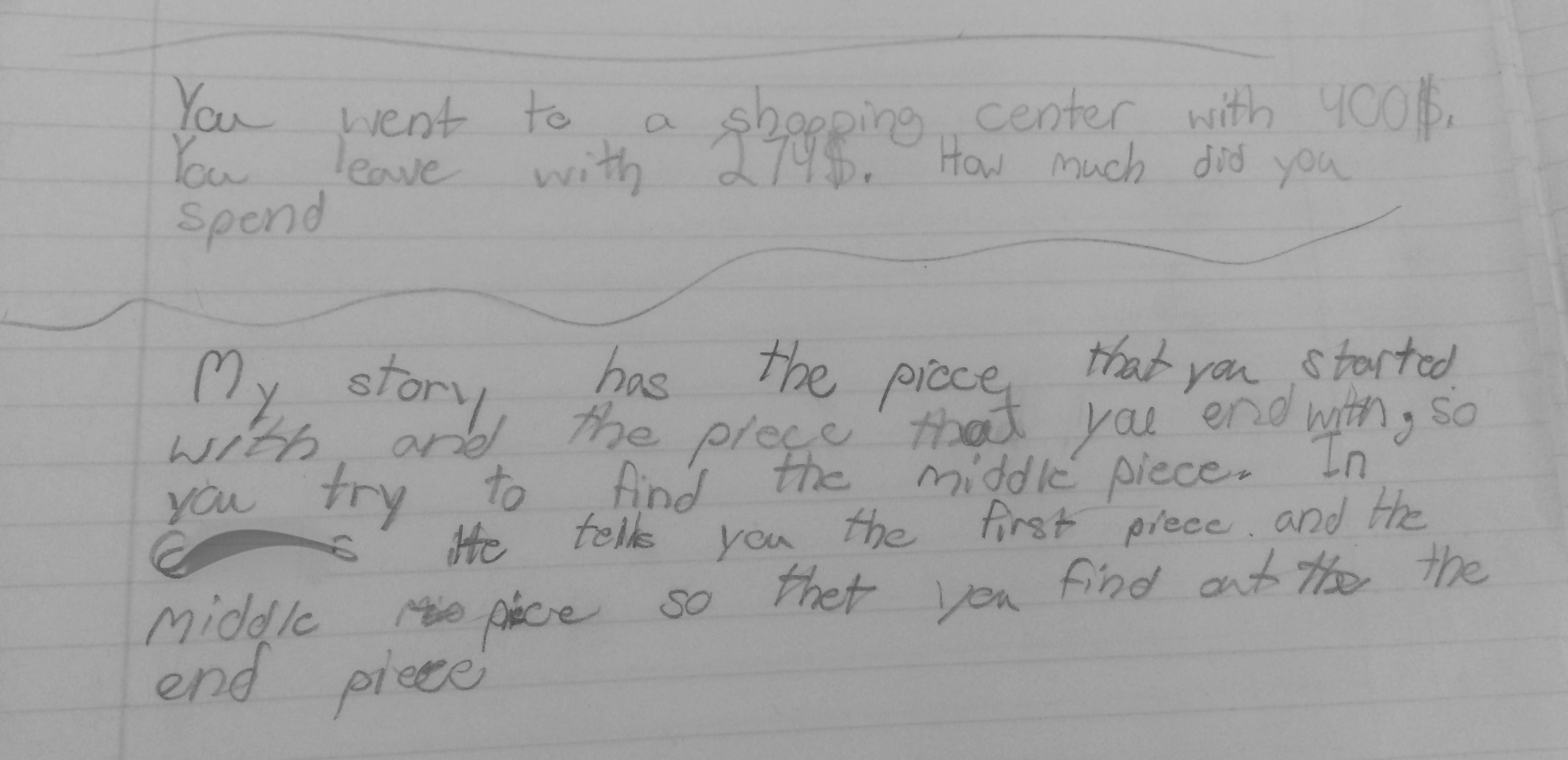
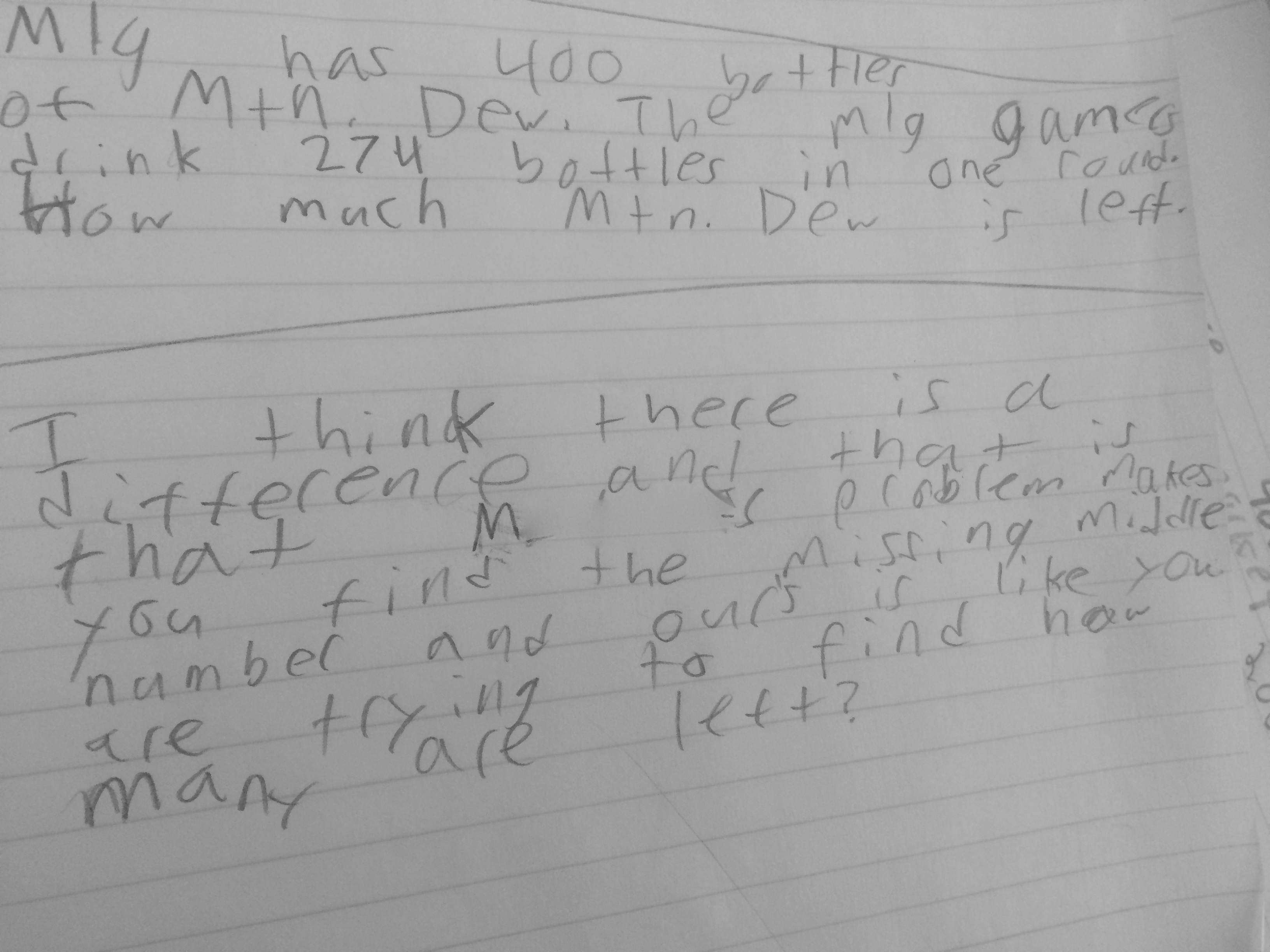
IMG_0508_2After about 5 minutes, I had each group share their context and they did just what I was hoping. The group with the top strategy had a few contexts that all involved having something and then giving something away or losing something. The bottom strategy had a context involving having $400 and leaving the store with $126 and asked to find how much they spent. The second was much more difficult because they kept arguing (in a great way) that it was an adding up problem, not subtraction.

I had each group read their context aloud twice. The first time I could tell everyone was listening to see if it could be solved using subtraction so for the second time, I gave them a listening focus. I asked them to listen for how the two contexts were different, was something different happening in each? After reading them aloud once more, I had them journal what they thought, were they the same type of subtraction problem or different? (They referred to the problems by the student’s name whose strategy it matched).

I loved this student’s wording of the difference as “things happen”

IMG_0529_2

IMG_0524_2IMG_0528_2

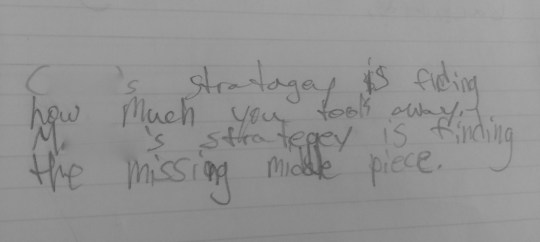
IMG_0530_2There was an overwhelming “what is left” and “what the middle piece is” theme among all of the responses as the main difference between the two contexts. Knowing that removal is their primary way in which to think about subtraction, we chatted more about this missing piece and they agreed that they think about that context more as adding up, which makes complete sense to me. It was so nice to hear them talking about the way a context can influence how you use subtraction or addition and how it really was doing the same thing.

A lone student also brought out the constant difference meaning of subtraction during the Number Talk, however he was losing the class in his explanation that day. I didn’t want to lose this idea, so while the others worked on the contexts, I asked him if he minded elaborating more on his idea and creating a visual proof for the class to better explain his reasoning. I got this…

IMG_0521_2He did such a great job of showing two different representations, but I was secretly hoping for a number line with a “shift” in the numbers to really show constant difference. He instead showed removal with same difference. I adore the top piece and just as I was thinking of how we could make that more visual for the class today, Simon (of course) responded with a brilliant visual…

At the beginning of class today, I asked the student who wrote the response above, what he thought about this visual and he said, “Well, that is just like what I was saying.” I asked him if he could work on a claim for the way he is thinking about subtraction while I asked the rest of the class to see if they could think of a claim that this representation would support. This was such an interesting reversal of the usual process I use with student claims, but I was excited to try it out!

I got many ideas in terms of the bars such as these…

IMG_0550IMG_0552I then showed them Simon’s second idea…

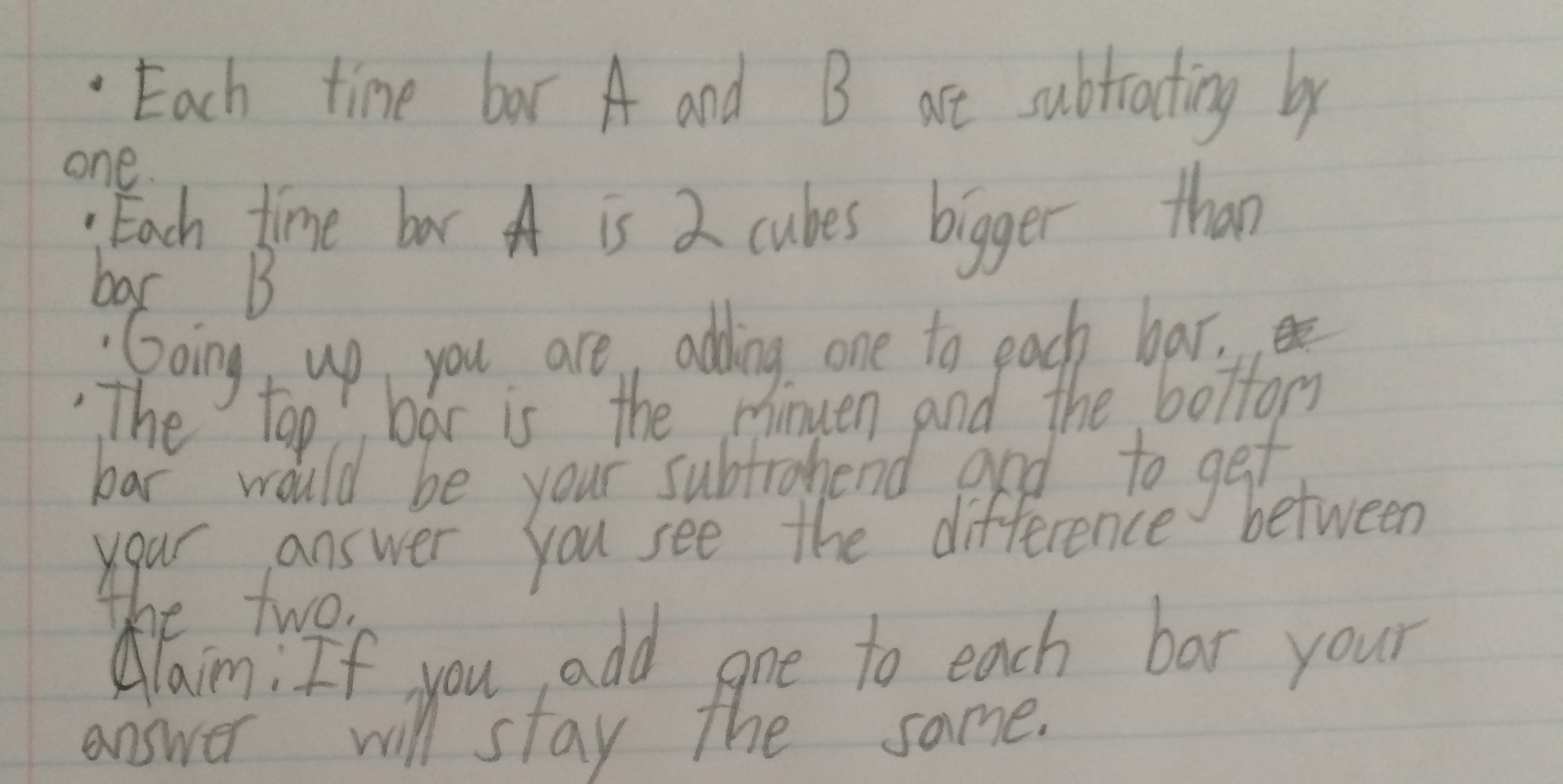
…and asked them to think of these more as subtraction problems and see what they could come up with in terms of noticings and/or generalizations. I got some awesome responses! IMG_0550 - Version 2

IMG_0548Then we shared the original student’s claim he worked on to see if it matched their thinking…

IMG_0553I love that he was not only thinking about what was happening in the problem, but also why he would want to use this in order to make a problem easier to solve.

These lessons were a beautiful way to work forward and backward in making claims. Thank you Simon for being so amazing, as always, it was not only great learning, but great fun!

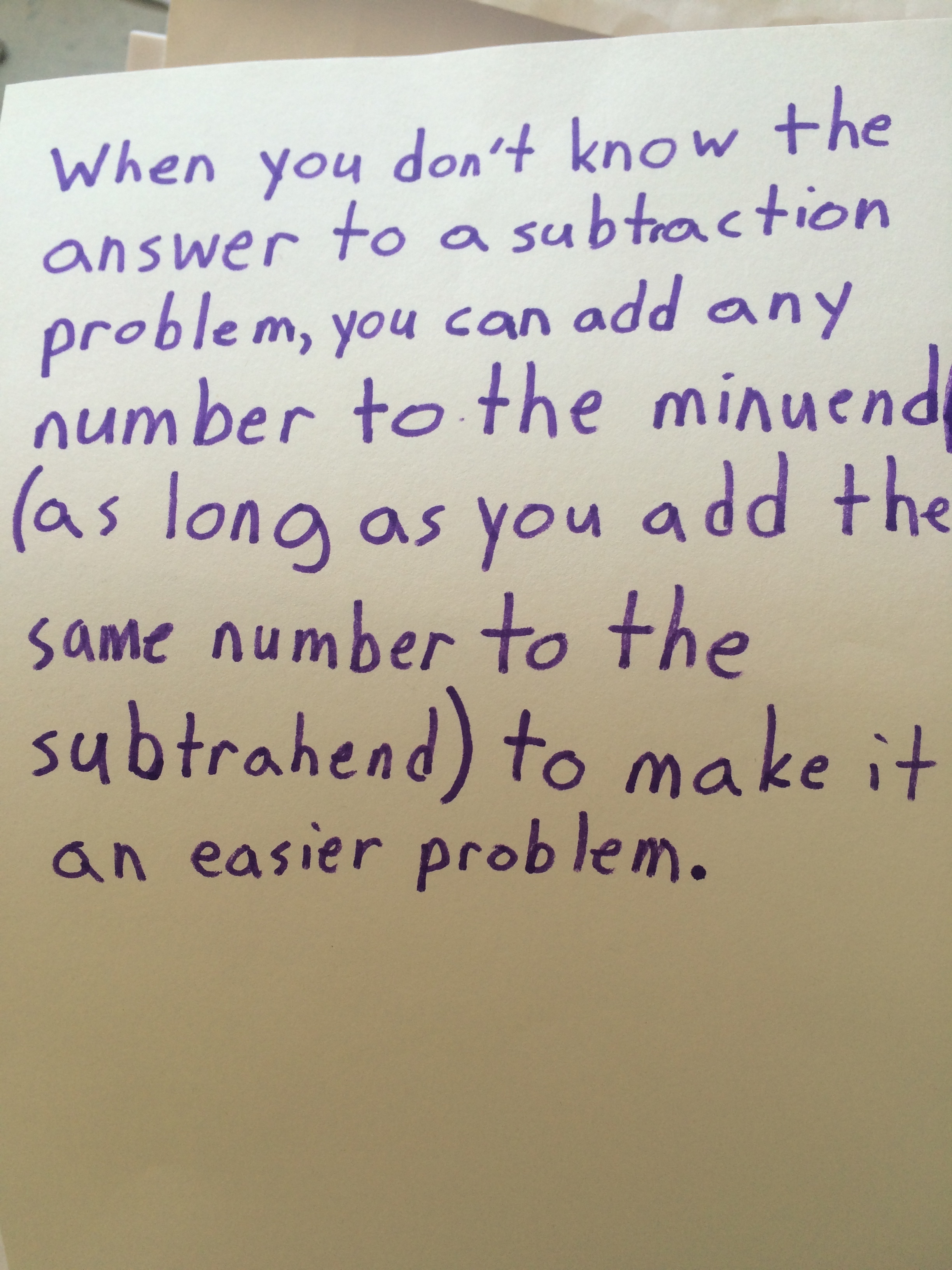
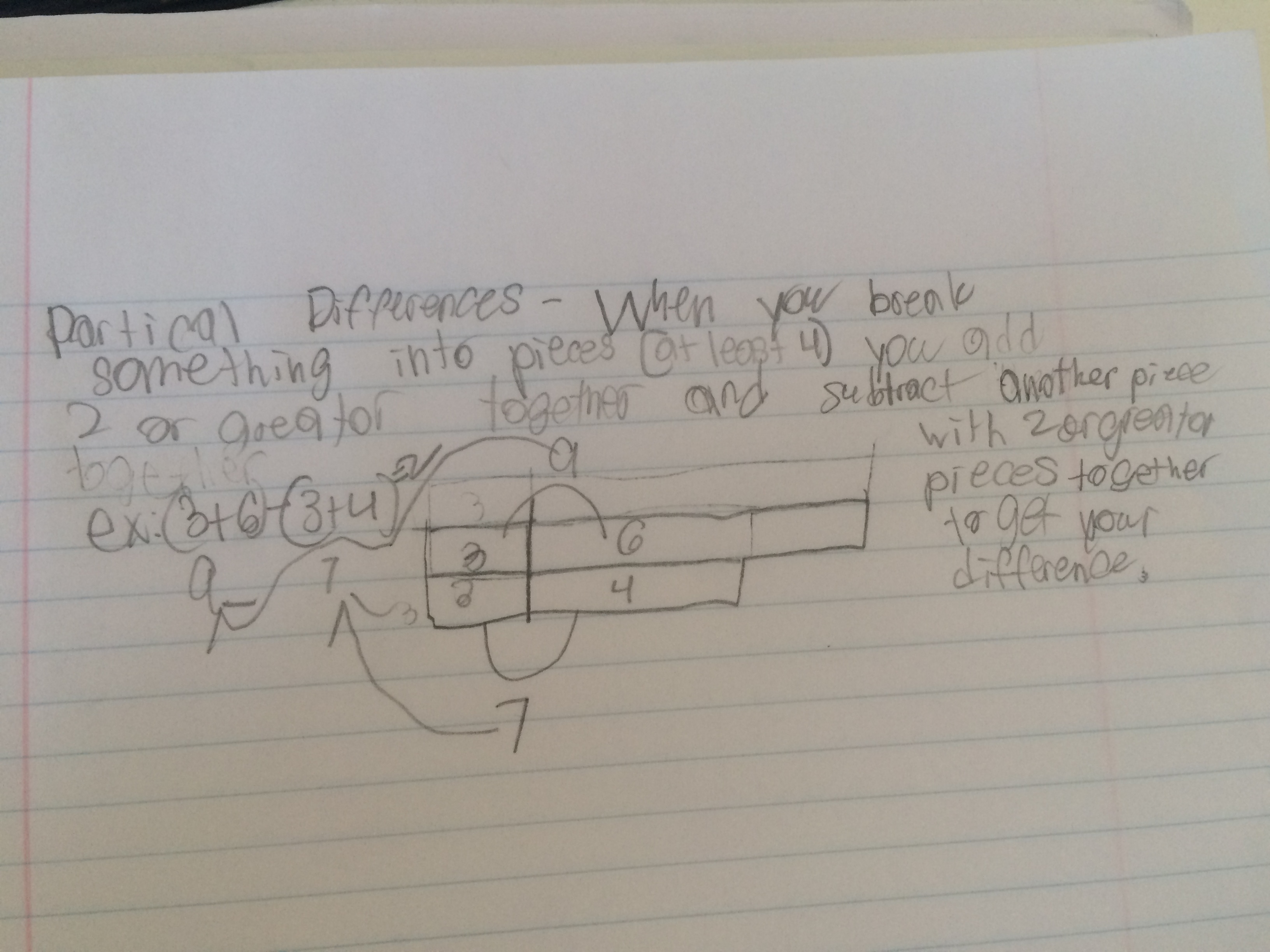
My students never fail to leave me with something to think about. One student said he thought of “partial differences” and here is how he explained it (definitely not what I thought when he said the term)

IMG_0547My next task is thinking of questions to ask him about this….

-Kristin

Subtraction Number Talk: My Curiosity Today…

Subtraction is the one operation that every time it arises in class, throws one more thing for me to think about into the mix. I have two recent posts around decimal subtraction, here and here, and I continue to work with whole number subtraction through number talks.

Today, I only had time for two problems in the Number Talk due to testing 😦 The first problem was 400 – 349. I was most anticipating students would subtract 50 and add one back or add up from the 349 to the 400 (1+50) to arrive at the answer of 51.  I was surprised when a student said he “subtracted 100 – 49 to get 51 and knew that would be the same answer because if you added 300 to both numbers it would give you the same problem, so the same answer.” This made me think of a distance model on a number line, but I completely missed that opportunity and moved into the next problem. Seeing what happened next, it may have either made one strategy more clear or completely caused us to miss out on the conversation that followed.

Problem #2: 400 – 274

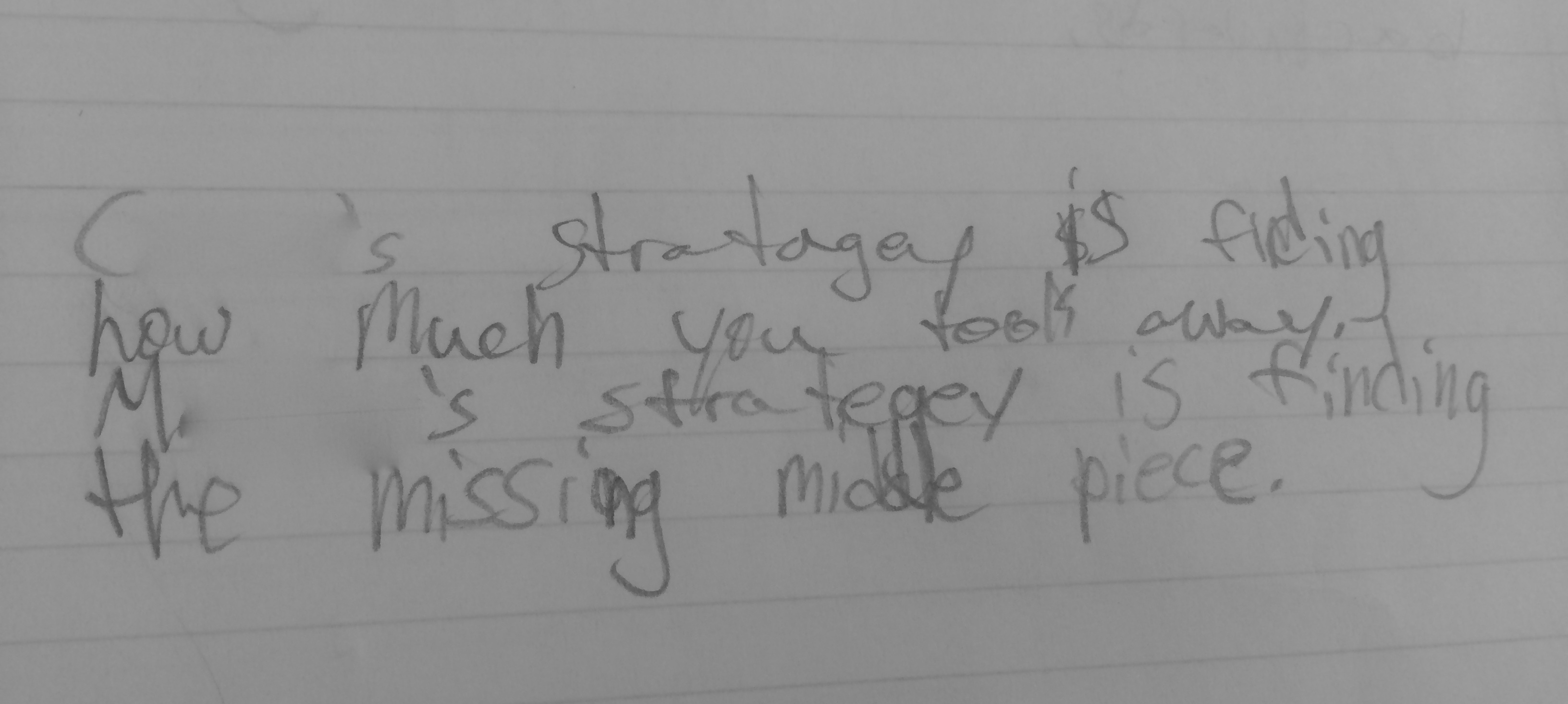
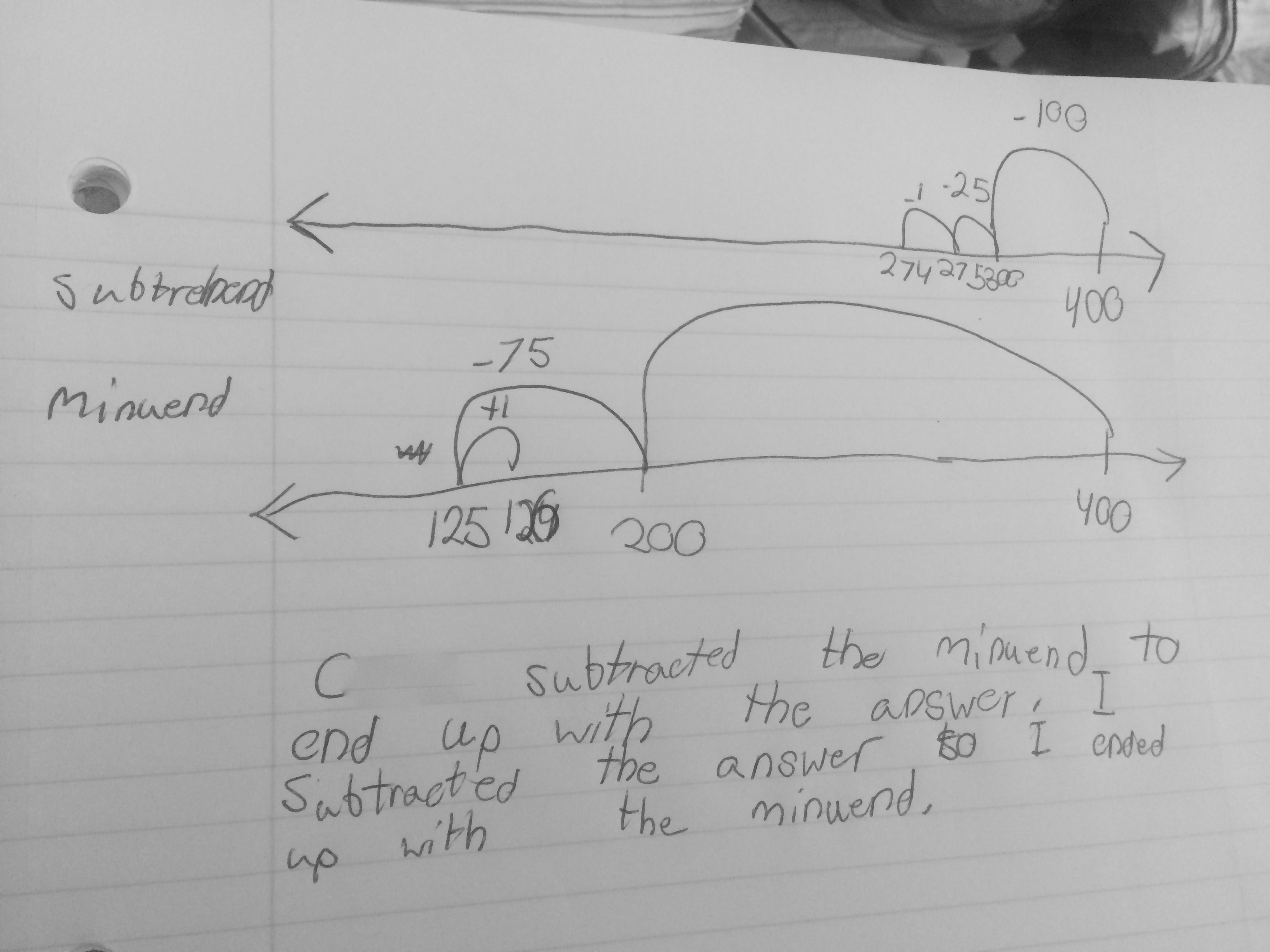
IMG_0502_2The student, “M”, on the right subtracted to find the distance between 400 and 274, however did not explain it that way so it left many students wondering how she knew what to subtract. I had a student ask her if that was her second strategy because she seems to have subtracted the answer from the 400.

The student, “C”, on the left solved it the way the majority of the class did, removal in part with some compensation at the end. Before he started explaining, he prefaced with, “I did it pretty much like M.” When he finished, he realized it was not the same and was confused as to where “M” came out with the same answer. He even exclaimed that, ‘I think she got the answer by mistake.”

“M” knew exactly what she did, however, I didn’t let her explain yet because I wanted the rest of the class to think about it a bit more. I told her she would be able to explain it tomorrow after we chat a bit more with it. I had them all end the class with a journal entry (surprising, right?:) I asked them what they understood, saw happening in each, or were not too sure about. It is just the most beautiful thing to read the honesty and reflection in their writings.

Some students could see what was happening…(even though it seems some tables have the vocabulary a little mixed up:)

IMG_0509_2IMG_0506_3Some left confused…

IMG_0504_3IMG_0508_2

Some had a really interesting way of thinking about it…

IMG_0505_3And then there was “M” who cannot wait to share tomorrow…

IMG_0503_2

Now, the question is, how to approach this tomorrow? I am thinking I would love three groups, one who subtracted in parts, one who found the distance by subtracting back to the minuend, and one group who adjusted the subtrahend and minuend to find the distance between. Have them create a context and representation that shows what they did (still working within the same problem they all have the same answer for) and do a share. I would like the share to go in the exact order of the groups I just listed above. Crossing my fingers I have time to talk some more math with them tomorrow, a silent classroom is probably more torture for me than them 🙂

-Kristin

Encouraging Students To Make Deeper Mathematical Connections.

Because of all of the math talk my students do in class every day, they are very comfortable (and flexible) in sharing multiple strategies and solution paths. They can explain others’ strategies in their own words and agree and disagree with one another beautifully, however when asked to make connections between two representations (numerical or visual), I feel like I get very “surface” connections. I will read things in their journals like “They are the same because they have the same numbers” or “They are different because we double and halved the other numbers instead” or “We both used an area model” Something like this…

IMG_0391_2 IMG_0393_2

After going through their journals the other day with Faith, we were thinking and questioning one another about how we, as teachers, can have students dig deeper into the connections. We obviously would like to them to notice them but if not put in a position to make connections, will they on their own? Is there a way to frame a task or question that would push them to think a little deeper about how and why the two representations are alike/different yet still arrive at the same answer? How do we encourage students to make deeper, more meaningful connections when we know they can, but just may not be sure of how to get there?

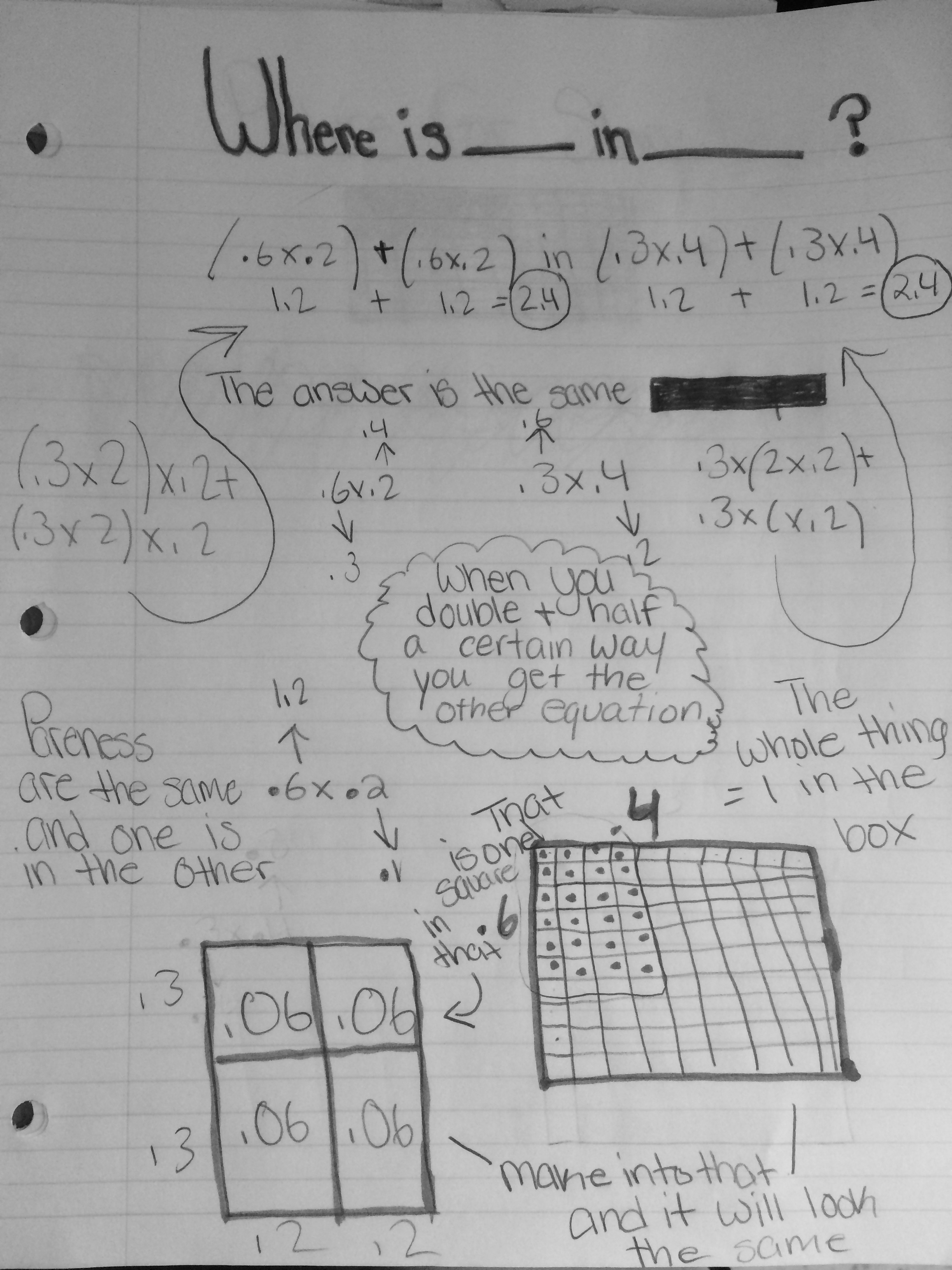
Instead of a number talk they other day, I did a math routine I named “Where is _____ in _____?” I was hoping the prompt would have them go beyond just looking “at” the representations and look “into” the meaning of each representation. On the board, I posted some examples of their representations from the day before in which they had done a surface job of connecting. I had them work independently for a few minutes and then talk as a table before the group share. I was much happier with the conversation and felt like asking them to look “into” the problems really got them thinking about what the representation was showing.

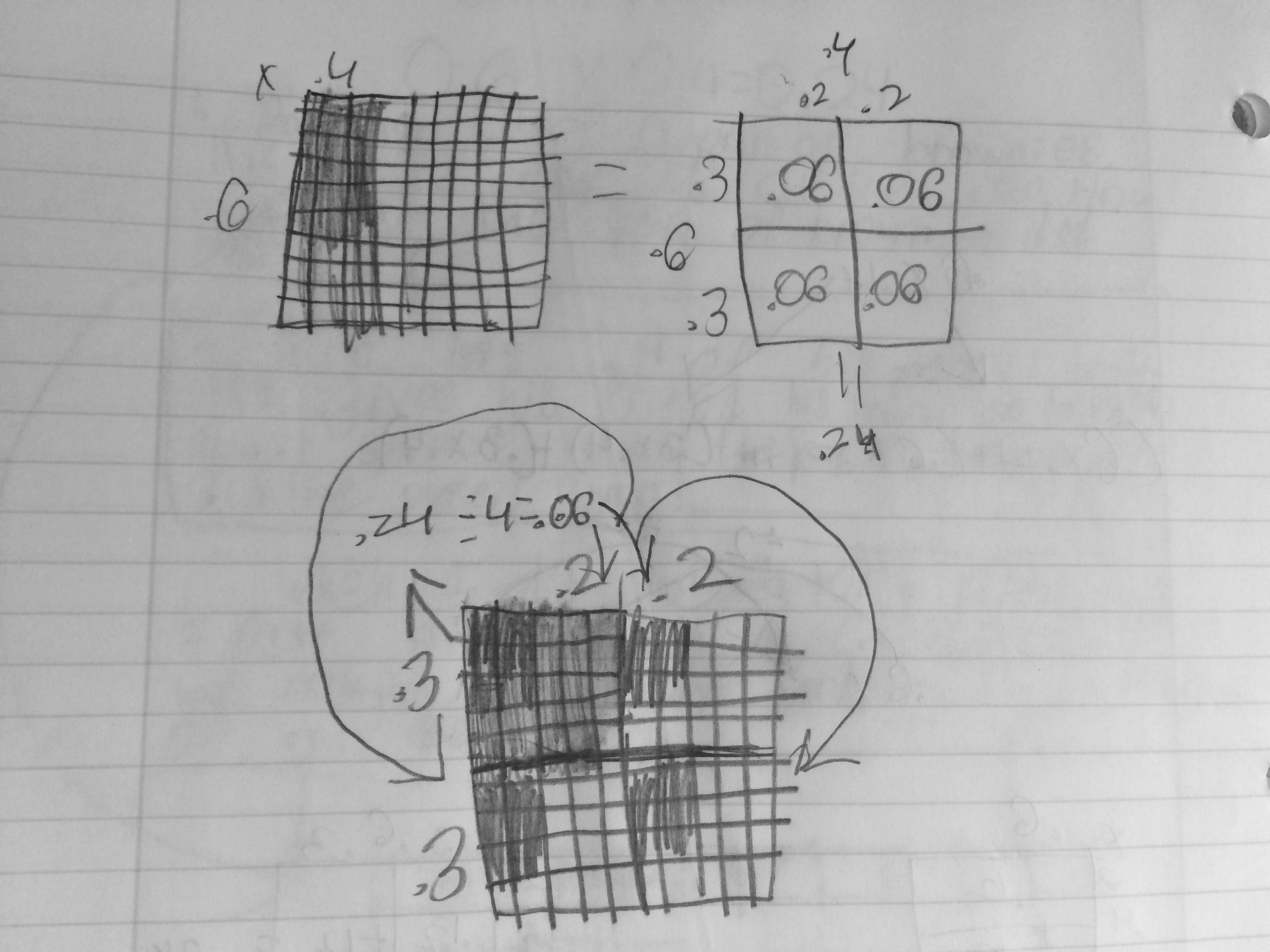
This an example of two area models in which students the day before had simply said, “We both used the area model” without thinking about how they were related. I love the (.3 x .2) in each of the quadrants of the first grid.

IMG_0388_2This student had a different take on how the two area models were alike, which led to such an interesting discussion! She also did some lovely work with showing how the two distributive properties were within one another through factoring.

IMG_0389_2

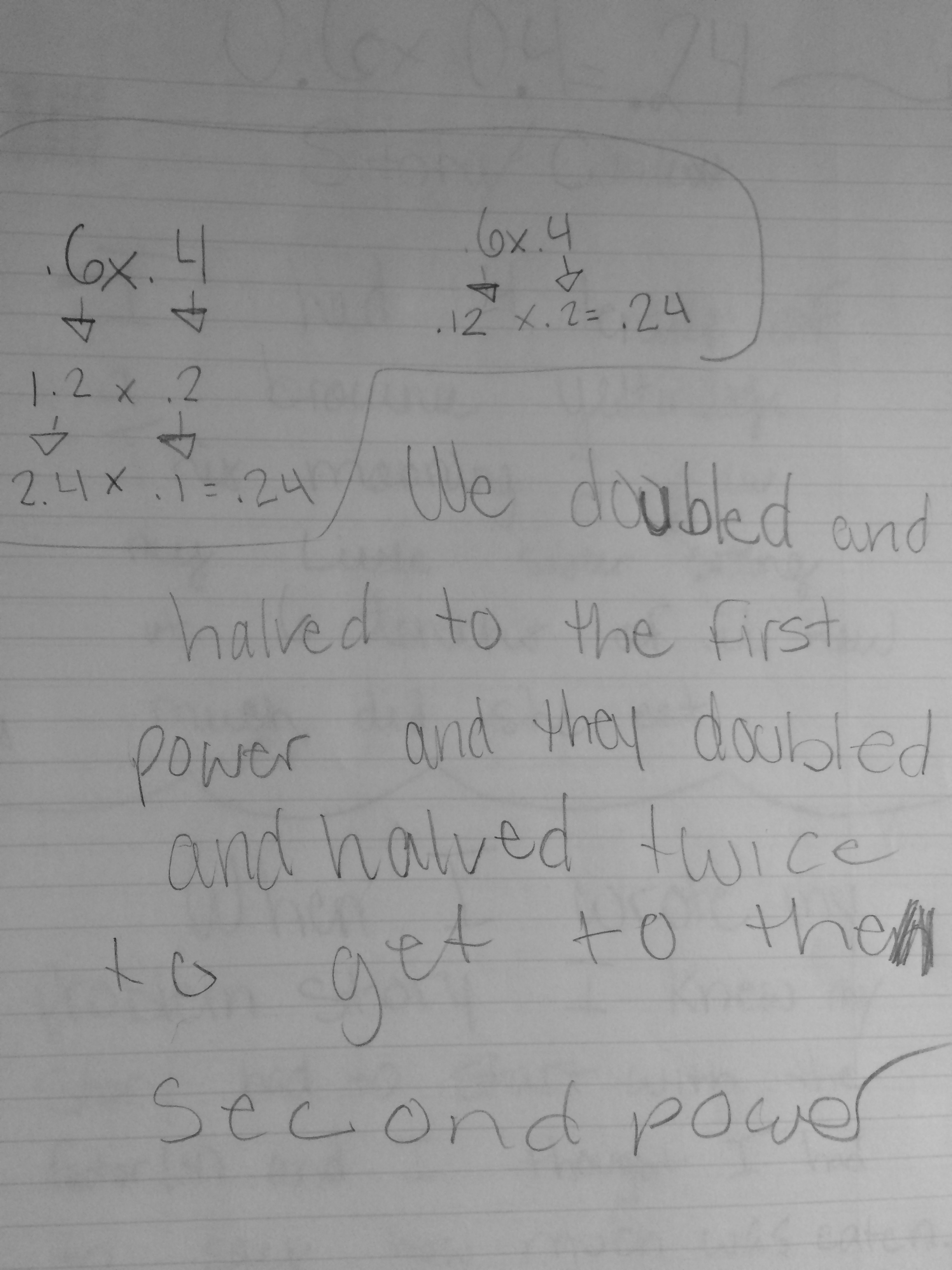
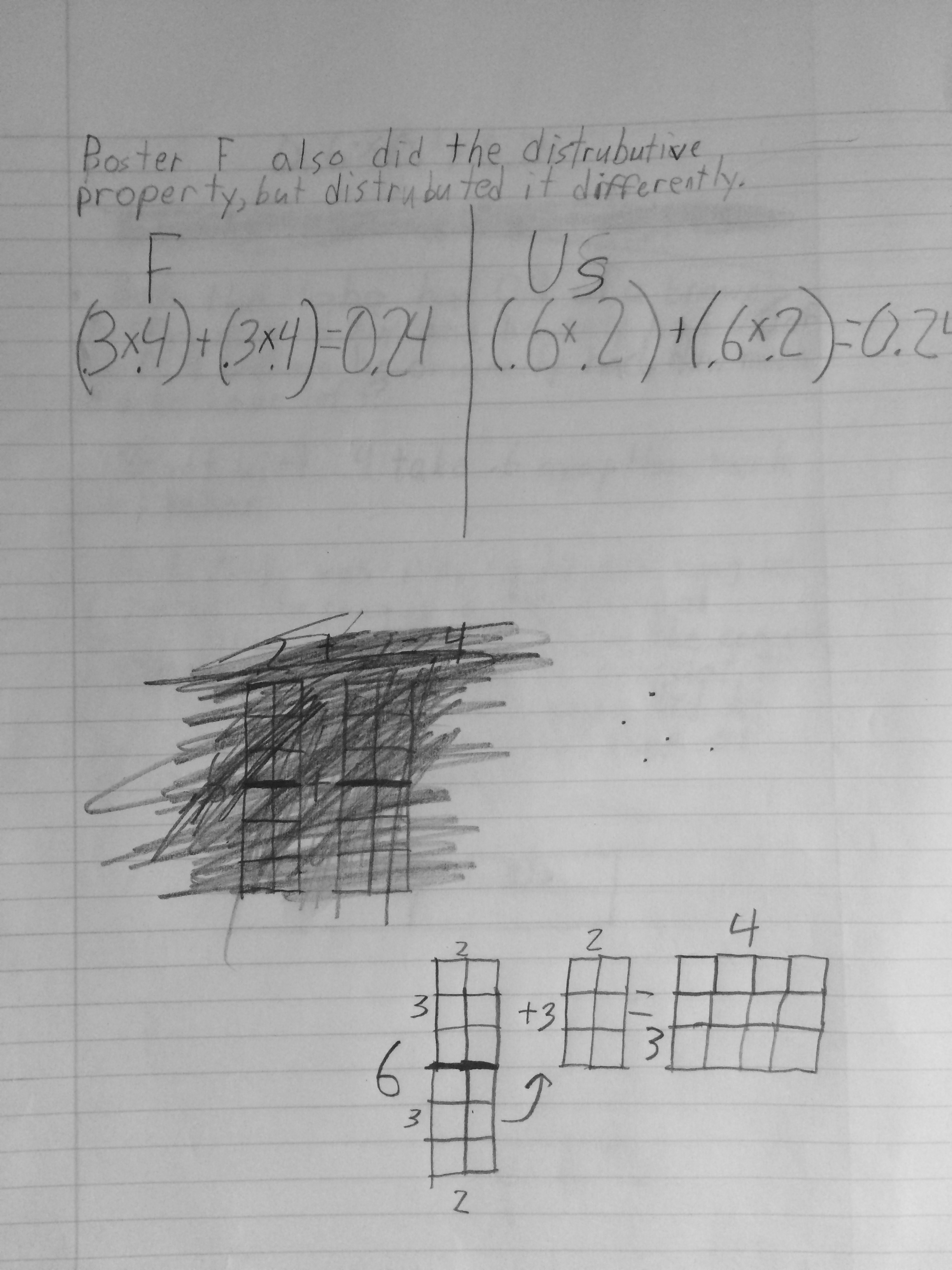
This student showed the distributive property and double/halving in a wonderful way…

IMG_0396_2This one was the only student who connected the area model of .6 x .4 to the strategy of .6 x .5 – .06. He showed where the .6 x .5 would be in the model and then scratched out where the extra .06 were coming off to arrive at the answer.

IMG_0397_2

Having students make connections in math is so incredibly important and so difficult to do, especially with so many variations in strategies and representations. I would love to hear other ways to encourage these connections!

-Kristin