Author Archives: mathmindsblog

Multiplication: Does Order Really Matter?

Some things I am wondering right now about 3rd grade multiplication…

  • When students notice 4 x 3 is the same product as 3 x 4 and say, “The order doesn’t matter,” how do you answer that question?
  • Is there a convention for writing 4 groups of 3 as 4 x 3?
  • Is there a time, like when moving into division or fraction multiplication and division when the order does matter in solving or in thinking about the context?

Answers I have right now for these questions….

  • Right now, since they are just learning multiplication, I ask them what they think and why.
  • I think there is a bit of a convention in my mind because the picture changes. Three baskets with 2 apples in each is different than 2 baskets with 3 apples in each. Also, when reading the CCSS it seems that way.
  • I am still thinking about division but it makes me think that this would be the difference between partitive and quotative division. I also think when students begin 4th fraction multiplication, they are relating it to what they know about whole number operations, so 4 x 1/2 is 4 groups of 1/2. This seems important.

The 3rd grade teachers and I have been having a lot of conversation about these ideas. The students have been doing a lot of dot images and some feel strongly that the two expressions mean the same thing because they can regroup the dots to match both expressions. Others think they are different because the picture changes. All of this seems great, but then students are taking this reasoning to story problems. For example, given a problem such as, There are 5 shelves with 6 pumpkins on each shelf. How many pumpkins are on the shelves? students will represent that as 5×6 or 6×5. Is that a problem for me, not really if they have a way to get the 30, but should it be? I am not sure.

I went into a 3rd grade classroom to try some stuff out. I told them I was going to tell them two stories and wanted them to draw a picture to represent the story (not an art class picture, a math picture) along with a multiplication equation that matched.

1st story: On a grocery store wall there are 5 shelves. There are 6 pumpkins on each shelf.

2nd story: On another wall there are 6 shelves with 5 pumpkins on each shelf.

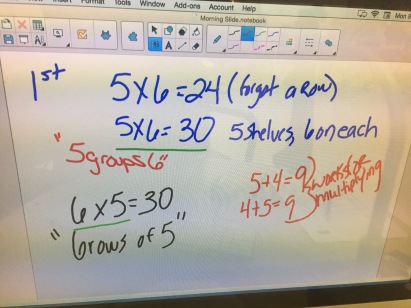
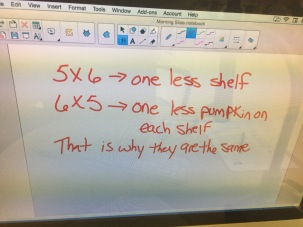
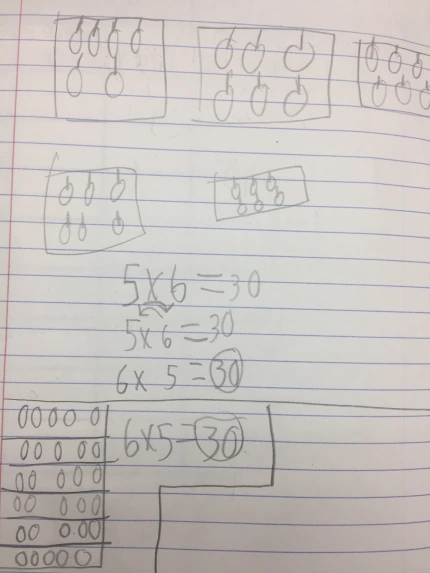
I asked them if the stories were the same and we, as I anticipated, got into the conversation about 5×6 vs 6×5 and what it meant in terms of the story. They talked about 5 groups of 6, related the switching of factors to addition and then some talked about 6 rows of 5.

IMG_3124 (1).jpg

From this work, many interesting things emerged…

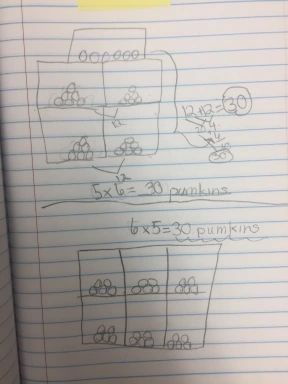
  • Some students had different answers for the two problems. They obviously did not see the two expressions as the same because they struggled with 5 groups of 6 as they tried to count by 6’s and forgot a row.
  • One student said they liked the second problem better because she could count by 5’s easier than by 6’s.

IMG_3135.jpg

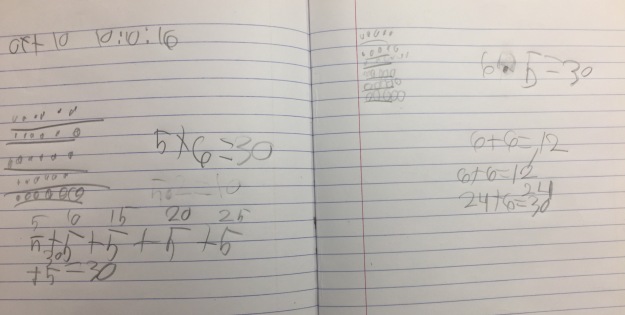
  • Students skip counted by 5’s but added 6’s when finding the 5 groups of 6. IMG_3127.jpg
  • One student noticed the difference between 5 and 6 and could relate that removing one shelf was just adding a pumpkin to each of the other rows.

IMG_3125.jpg

  • One student showed how he used what he knew about one to switch the factors to make it easier to solve. IMG_3150.jpg


But they keep asking Which one is right? and I tell them I don’t have an answer for them. I just keep asking them:

Is the answer the same?

Is the picture the same when you hear the story? 

After chatting with Michael Pershan yesterday, I am still in a weird place with my thinking on this and I think he and I are in semi-agreement on a few things (correct me if I am wrong Michael) …Yes, I think “groups of” is important to the context of a story. I want students to know they can find the answer to these types of problems by multiplying. I want students to be able to abstract the expression and change the order of the factors if they know it will make it easier to solve BUT what I cannot come to a clear decision on is…

If we should encourage (or want) students to represent a problem in a way that matches the context AND if the answer is yes, then is that way: a groups of b is a x b?

What Is It About These Questions?

Today, I gave the 4th graders four questions to get a glimpse into how they think about multiplication and division before starting their multiplication and division unit. Michael Pershan had given the array question to his 4th graders last week and shared the work with me. As we chatted about next steps with his students, I became curious if the students think about multiplication differently depending on the type or setup of the problem.

Here were the questions:

After sorting 35 student responses I found the following:

  • 17 students got the area question wrong but the two multiplication problems on the back correct. Not only correct, but with great strategies based on place value.
  • 8 students got all of the problems correct, however the area was found in many ways, some not so efficient with lots of addition.
  • 10 got more than two of them incorrect. Some were small calculation errors on the back.

So, what makes almost half of the students not get the area?

Here is the perfect example of what I saw on the majority of those 17 papers:

img_3066 img_3067

Then I did a Number String with them to hear how they shared their mental strategies. I wanted to get more insight into some of their thinking because a few students had used the algorithm on the back two problems.

They did great. They used the 10 and 20 to help them solve the problems and talked about adding and removing groups of one of the factors. I was surprised on the final problem of 7 x 18 that no one used the 7 x 20 but instead broke the 18 apart to find partial products.

IMG_3062.jpg

This makes me think there is something about that rectangle that makes them not use the 10s to help them decompose for partial products. I would love others thoughts and ideas!

————————————————————————–

After reading the comments about area and perimeter, I wanted to throw another typical example of what I saw to see what others think of this (when I asked her she could easily explain partial products on the second and third problem)


Adding & Subtracting: Tools and Representations

There is always a lot of talk about students using an algorithm, process or set of rules, for addition and subtraction. Whether talking about “any algorithm” or “the algorithm,” I am certain, in most cases, people are talking about a process that is absent of tools such as a 100 charts, number lines or base ten blocks. But, what happens when we see the tool becoming an algorithm in and of itself? Can moving left or right on a number line, making jumps of 10s and 1s, writing problems vertically, or jumping rows and columns become an algorithm where students lose sight of the numbers themselves because the process is one more thing to learn?

This was the exact conversation I had yesterday with two 3rd grade teachers as I was leaving school. The students had been playing a game called Capture 5 and struggled making various jumps on the 100 chart. The teacher, understandably, was concerned students were confused about adding and subtracting tens and ones. After more conversation, we began to wonder if the students saw the 100 chart as a set of rules to follow in order to add and subtract instead of a place to look for patterns and structure as we add and subtract. Were they getting caught up in the left, right, up, down movement and losing sight of what was actually happening to the number?

As I thought more about it last night, I wondered about other tools and representations  students learn that could easily turn themselves into an unhelpful set of procedures. I also wondered how often we make connections between these tools and representations explicit. Like, when is one helpful over another? How are they the same? How are they different?

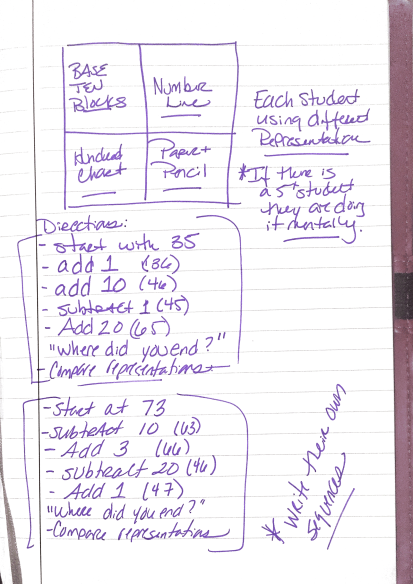
I emailed the teacher my notes (below) and we decided we would try this out this morning.

Scannable Document on Sep 27, 2016, 7_06_18 PM.png

If you can’t interpret from my notes, the plan was to have each student in a group using a different tool or representation as I called out a series of operations to carry out. After the series of addition and subtraction, they compared their answers and discussed any differences. They rotated seats after each series so they had a chance to try out each of the roles.

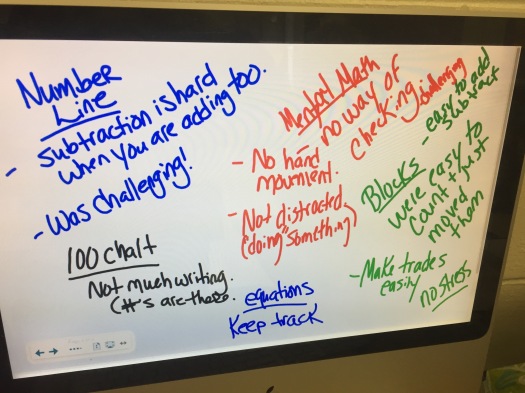
We came back together to discuss their favorite one. The recording is below…what do I have against writing horizontally, really?? I found this entire conversation SO incredibly interesting!

  • They found the base ten blocks to be “low stress” because they were easy to count, move and trade, but did agree that bigger numbers would be really hard with them because there would be too many.
  • They really did not like adding and subtracting on the number line with multiple jumps. It got messy.
  • They liked mental math because there was nothing (tool) to distract them and they could focus but they didn’t like that you couldn’t check your answer.
  • The 100 chart’s only perk was they didn’t have to write the numbers in, they were already there for them.
  • I really loved that they mentioned the equations were they only way they could track their work. So if someone in their group messed up, the equation person was the only one that could help them retrace their steps easily.
    img_3048


I am not sure what I learned today, I am still thinking a lot about this. I know that I loved having them compare the tools and representations and that the teacher felt much better about their ability to add 10s and 1s. I feel like there are so many other cools things to do here, but my brain is fried today so that will have to wait!:)


3rd Grade Place Value: Part 2

Last week, I wrote a bit about place value after doing a Which One Doesn’t Belong activity with a 3rd grade class. Since then, I have been thinking A LOT about how complicated place value really is. I think you can get a feel for the various ways we handle place value with students in this Twitter thread.

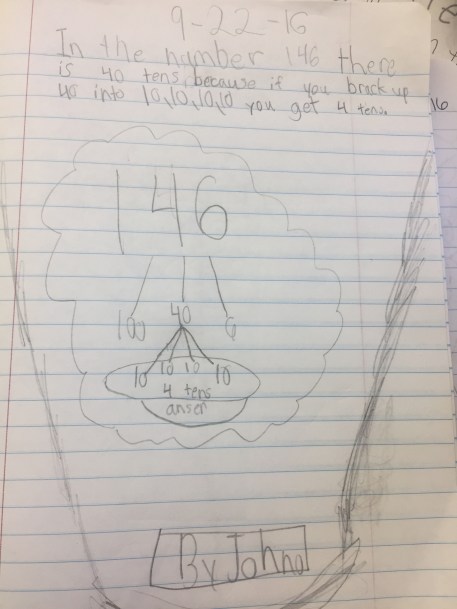
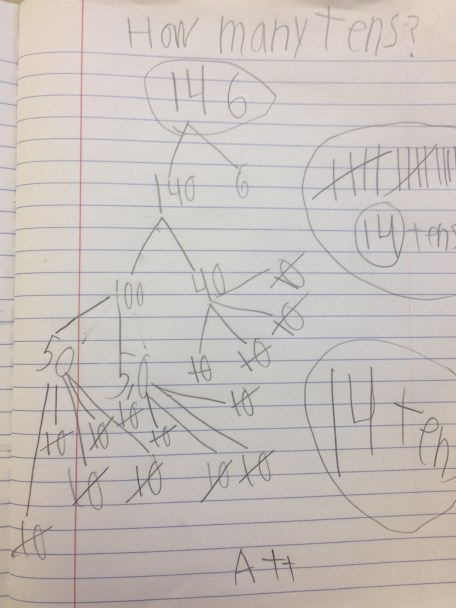
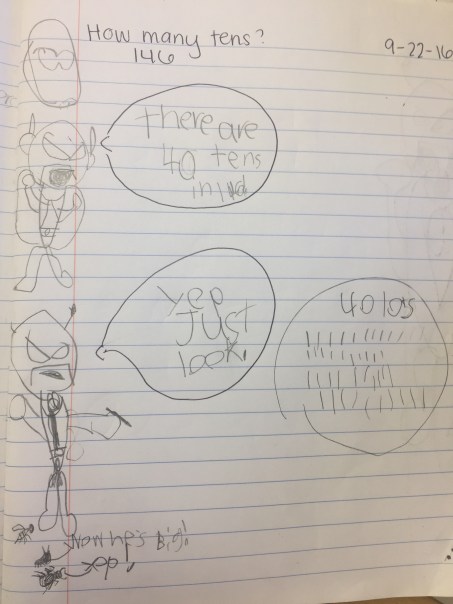
I have been talking about this with my 3rd grade colleagues at school, so one of them did the same WODB activity and ended with the same discussion around the number 146. She asked how many tens were in that number and got a lot of 4’s and 14’s, but this time she also got 40, which I did not hear in the other class. She asked the students to defend their thinking in their journals.

The journal below is the one I anticipate the most, separating the places and naming the number of tens in the tens place. (Although, I am unsure what is going on with the 74, possibly was going to give another example and ran out of time?)

img_3026

This journal shows a slightly different reasoning because now instead of saying there is 1 hundred, 4 tens, and 6 ones, the student is using the value (or quantity, again not sure what to call this here, its complicated) of the 4 in the tens place as 40 broken into the four 10’s so you can see them.

img_3027

I want to pair the student above with the student below and have them chat. This student had the same train of thought in the beginning but broke the 100 into ten 10’s to arrive at 14 altogether.

img_3025

The last one, that surprised us, was the 40 tens. He actually showed 40 ones that make up the 4 tens with his dash marks in the last speech bubble. I may want to pair this student with the second example in this post to have them chat about that 4 tens vs 40 tens.

img_3028

All of this still leaves me wondering a lot. I know there are times it is helpful to think about the tens only in the tens place while there are times we want to be thinking about how many tens are in the whole number, but….

  • When are those times?
  • How do we best structure activities to explore these ideas with students?
  • What assumptions do we make about student understanding of place value as we teach comparison and computation strategies?


3rd Grade Dot Image

Since the 3rd grade classes are about to begin their multiplication unit, the teachers and I wanted to hear how they talk about equal groups to get a sense of where they are in their thinking. What better way to do that than a dot image? I chose the first image because of the 3’s and “look” of 5’s and the second image because of the 2’s,3’s, and 6’s, all of which students can count by easily.

Image 1 went relatively the same in both classrooms and much like I anticipated. There were two things that stood out to me as a bit different between the class responses:

  • There were more incorrect answers shared in the 1st class than the 2nd class.
  • In the second class, multiplication came out during the discussion. The “4 groups of 7 and 4 x7 = 28” in the 1st class came out after both images were finished and one student said she knew some multiplication already. She asked to go back to the first image and gave me that.
img_2983

1st Class

img_3005

2nd Class

After the first image, I anticipated Image 2 would go much the same, however it was quite different.

img_2984

1st Class

img_3004

2nd Class

After the 1st image, I was really surprised at the difference in responses and I have to say it even felt really different. My assumption at this point is that in the 2nd Class one of the early responses was multiplication.

I am left wondering:

  • Does that early multiplication response shut down other students who don’t know anything about multiplication yet? While I asked her to explain what she meant when she said 4 x 12, I wonder if that intimidated others?
  • How could I have handled that response differently so others felt OK using skip counting or addition to count the dots?
  • Can we anticipate that type of reaction from other students when someone starts the discussion with something that may be beyond where the majority of the class is in their thinking?
  • Was this even the issue at all? Did the 2nd class just see so many more dots and wanted to avoid adding and skip counting?

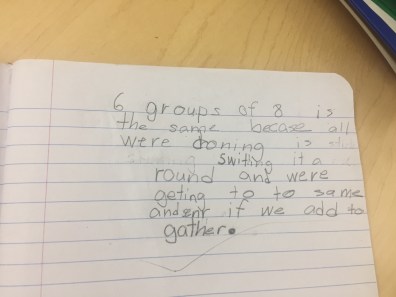
The 2nd Class ended with a journal entry after a student remarked, “If we know it is 8 groups of 6, then it is also 6 groups of 8.”

I asked if 8 groups of 6 is the same as 6 groups of 8 and the class was split on their response, so they set off to their journals.

The yes’s went with multiplication expressions representing the same product and commutative property:

img_3006img_3007

I loved this no because the picture changes:

img_3009

I am not sure about this argument but I would love to talk to the student a bit more about the bottom part!

img_3008

After that talk, I am excited to see what these guys do when they actually start their multiplication unit!

Which One Doesn’t Belong? Place Value

Since the 3rd grade team begins the year with an addition and subtraction unit in Investigations the teachers and I were having a conversation about how students understand place value. While I don’t see teachers using the HTO (hundreds/tens/ones) chart in their classrooms, students still seem to talk about numbers in that sense. For example, when given a 3-digit number such as 148, students are quick to say the number has 4 tens instead of thinking about the tens that are in the 100. I think a lot of this is because of how we as teachers say these things in our classrooms. I know I am guilty of quickly saying something like, “Oh, you looked at the 4 tens and subtracted…” when doing computation number talks, which could lead students to solely see the value of a number by what digit is sitting in a particular place.

We thought it would be interesting to get a vibe of how this new group of 2nd graders talked about numbers since their first unit deals with place in terms of stickers.  A sheet of stickers is 100, a strip of stickers is 10 and then there are the single stickers equal to 1.

I designed a Which One Doesn’t Belong? activity  with four numbers:  45, 148, 76, 40

I posted the numbers, asked students to share which number they thought didn’t belong, and asked them to work in groups to come up with a reason that each could not belong. Below is the final recording of their ideas:

img_2969

I loved the random equation for 148 that emerged and the unsureness of what numbers they would hit if they counted by 3’s or 4’s. One student was sure she would say 45 when she counted by 3’s and was sure she would not say 76 or 40, but unsure about the 148. I wrote those at the bottom for them to check out later.

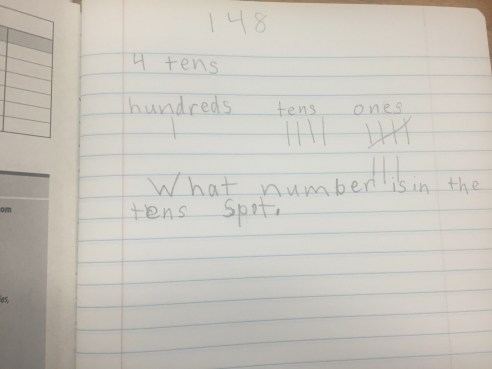
Since the teacher said she was good on time, I kept going. I pulled the 148 and asked how many tens were in that number. I was not surprised to see the majority say 4, but I did have 3 or 4 students say 14. As you can see below a student did mention the HTO chart, with tallies, interesting.

img_2970

As students shared, I thought about something Marilyn Burns tweeted a week or so ago…

Screen Shot 2016-09-16 at 10.37.25 AM.png

So, I asked the students to do their first math journal of the school year (YEAH!):

“For the students who answered 14, what question did you answer?

“For the students who answered 4, what question did you answer?

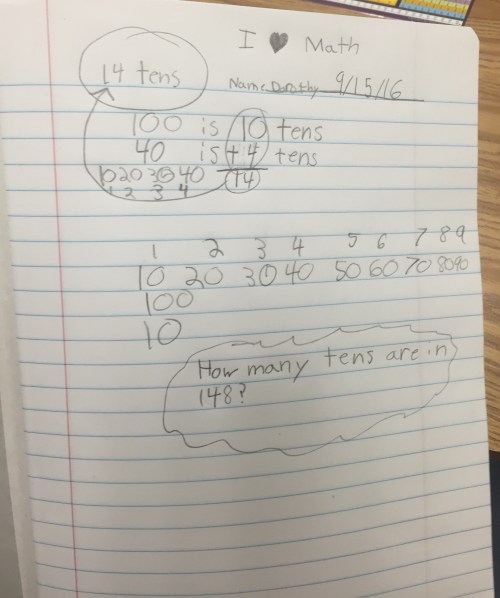
After the students shared, I revisited the Hundreds, Tens, Ones chart. I put a 14 in the tens column, 8 in the ones column, and asked if that was right. The light bulbs and confusion was great! It was as if I had broken all rules of the HTO chart! Then I put a 1 in the hundreds, 3 in the tens, and they worked out the 18. I look forward to seeing them play around with this some more and wonder if when they go to subtract something 148-92, they can think 14 tens -9 tens is 5 tens.

I had to run out because I was running out of time, but snagged three open journals as I left! (I especially love the “I Heart Math” on the second one!
FullSizeRender 52.jpg

fullsizerender-52

fullsizerender-53

Kicking off the 2016/2017 School Year!

Ah, I am so excited to dust off the blog and get started with the new school year! There are so many exciting changes in our structures for RTI that I just cannot wait to get going! After some really honest conversations at the end of last year on how we were grouping and pulling students for interventions with minimal to no impact, we decided to completely change the way we do RTI, starting with the name. From this point on, we call it WIN, What I Need, time…because, you know, we needed another acronym!;) However, changing the name means nothing without blowing up the structure itself and that is exactly what Erin, the reading specialist, and I intend to do. We spent A LOT of time this summer brainstorming what the new WIN time could look like and imagining how we can use our time with teachers during Learning Labs to support this work. There are so many details and logistics that would make this post way too long, so let’s just start with the first month.

Typically, during the first month, students would be given content screeners used to group them into tiers. These screeners set a terrible tone for how students view the learning they will be doing during the school year (as Tracy blogged about here). The content on the screeners was across so many areas and there were no conversations about the math that, instructionally you got little to no information about what the students actually knew. Not to mention, for the students who had previously been in a tier, they knew this screener would put them right back where they were last year. So, this year, we are starting with getting to know our students in a way that can truly guide our planning and instruction and set a tone of how learning will happen this year!

Since our new WIN time will involve a lot of small group work, Erin and I designed a “First Month of School Plan” for everyone to help guide our future planning conversations. This plan could definitely be adapted by the teachers, but we wanted to give examples, or plan for those that wanted it, of ways to get to know your students and provide opportunities to develop a community of learners.

Without all of the details, it basically looks like this:

Week of September 6th: Talking Points.

Week of September 12th: Ask students what they need as learners. Do Norm-setting.

Week of September 19th: Read Last Stop on Market Street and do activities.

Week of September 26th: Read What Do You Do With A Problem? and do activities.

(If you want more info, the break down of all of this is in our first Learning Letter of the school year.)

For our very first Learning Lab this year, we have asked teachers to come with a formative assessment of what students know about their upcoming content work in October. Using this information we are going to work together to dig into the content and design small groups to help support students where they are. This design could be an extension of the content or address misunderstandings, all with a focus on what the students KNOW, not solely what they don’t.

I am sure it will be a bumpy ride for teachers, Erin and I, but when something needs to change, a bumpy ride is better than the same old crappy way of doing things. I will keep you posted and look forward to sharing our work!

My One Hundred Hungry Ants Obsession

Lately, I have been obsessed with children’s literature across K-5. My most recent obsession is the book One Hundred Hungry Ants. I did this in Kindergarten and this in 4th grade and today I invaded a 3rd grade classroom with it!

I followed the same pattern I usually do, I read the story aloud and did a notice/wonder. These are all of the things they noticed:

IMG_2510 (1).jpg

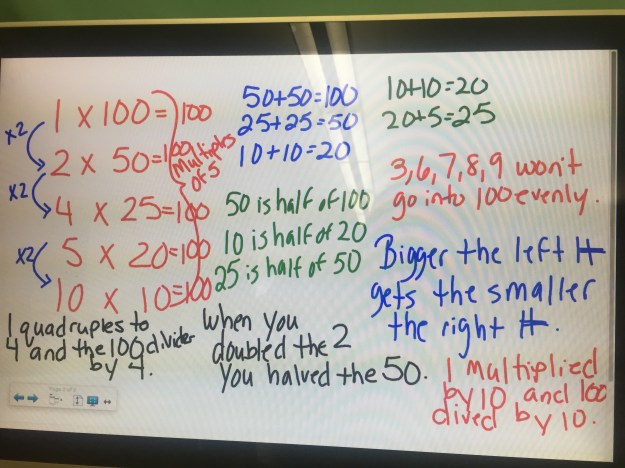
The last one led perfectly into asking about the ways the ants rearranged themselves. I wrote the combinations they recalled from the book and asked them to chat with a neighbor about patterns they see.

IMG_2509 (1).jpg

The discussion started with the 50+50=100, 25+25=25 and 10+10=20. Another student said they had the same things but it sounded different because she saw 50 was half of 100. They moved away from that and went to divisibility by the numbers that did not show up like 3,6,7,8, and 9 and pointed out that all of the second factors were multiples of 5. At this point they were focusing primarily on the second factor until someone pointed out the increasing and decreasing pattern happening. Then we got into the doubling and halving, quadrupling and dividing by 4 and multiplying and dividing by 10 of the factors.

I asked them if that would work with any number I gave them. They were quiet so I threw a number out there for them to think about, 24. They had to move into another activity so I left them with that thought. Before I left, however, one student said yes for 24 because 2×12, 4×6,8×3. Another student said it could be sixteen 1 1/2s and then thirty-two 3/4s! Wow!

Tomorrow they are going to investigate this further to see if they can come up with a conjecture about this work! So excited!

Literature & Algebraic Reasoning

I read the book One is a Snail, Ten is a Crab to two Kindergarten classes this week. If you have not read the book, Marilyn Burns does a great post about it here. After reading aloud, making predictions and doing a notice/wonder, I placed 10 tiles in the middle of our circle in an arrangement like this:

Screen Shot 2016-06-07 at 6.45.10 PM.png

I asked the students who could be standing on the beach and they quickly guessed a dog, two people and two snails. I asked if they could give me an equation for the feet they see and they said 4 + 2 + 2 + 1 + 1 = 10. I asked if anyone had a different equation and they switched the order of the numbers, but agreed there was still 10. I did a few more arrangements before sending them back to their groups to investigate with the tiles. The directions were for one student to put out the arrangement, the groupmates guess who was standing on the beach, and write an equation for what they see. Their equations were all so different but the ways they were composing and decomposing the tiles to make new arrangements was really interesting!

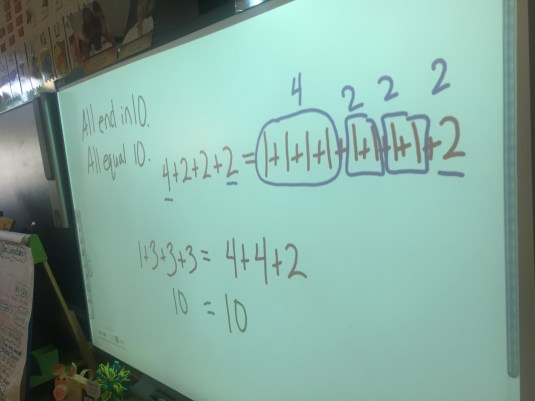
We brought them back to the carpet and asked what they noticed about all of their equations. They said they all ended in 10 and equaled 10, so I asked if that meant we could write the equations so they were equal to each other? I asked two groups to share one of their equations and I put them equal to one another on the board. I asked if that was true? How could be we prove it? Their first answer was like, duh, they both equaled 10 so yes. I asked if they could combine or break apart any of the numbers like they did with their tiles to prove it. One student talked about combing the 1’s circled in the picture below.

IMG_2493.jpg

They had to leave for lunch so I left them with an equation to talk about when they got back!

This lesson was such an amazing way of allowing students the space to think about equality and the meaning of the equal sign. It took one student talking about the ways he combined the numbers to open up the conversation and possibilities for future equations. I would love to see what the students could do if I wrote one equation on the board and asked students to write all of the different ways they could fill in the other side of the equal sign.

One Hundred Hungry Ants – 4th Grade

Next year, we are restructuring our RTI block to be a time when students are working in small groups in their classrooms. This is a really exciting change from our previous model in which students were pulled from their classroom for intervention. This change will shift our Learning Lab focus to planning small group activities, however the first, REALLY important, piece we need to focus on is how small groups work in the classroom. I think the K-1 teachers have a much better sense of how centers work within the classroom, although we still want to move from the current centers to more strategically planned small groups. So, with only a week and a half left of school, Erin and I are playing around with some ideas in the classrooms as a part of our planning! Fun!

Erin and I planned for a 4th grade class today where we were going to test out a small group scenario. We started in a way I imagine everyone could kick off the year next year, involving students in the process. We asked them what they needed in order to learn in small groups. Below are all of their great responses, most of which were accompanied by an example of something they had experienced during small group work.

IMG_2494 (2).jpg

I launched the small group task by reading One Hundred Hungry Ants aloud, pausing occasionally to ask for predictions. After the reading, I didn’t preview the task, but instead sent them off to work in their small groups. This was for two reasons: to see if the wording of the task was clear enough for students to follow independently and to see how they worked as a small group. We choose to give everyone the same task today to see how it went but we are trying different small group tasks tomorrow.

Each group had a journal, storyboard, and this task card:

Screen Shot 2016-06-06 at 7.57.14 PM.png

They worked for about half an hour and had some great conversations. I especially liked the conversation sparked by the third question because number choice is something I find so interesting. They also had to do some serious negotiating to decide which number they would do as a group since everyone had different reasons. In one group a student wanted to pick 2 because they would “get there faster,” another wanted 75 because “it could make a lot of combinations, but be less than 100 so they could still make it in time.” In another group, a student was saying he didn’t want any prime numbers because you could only do two lines with them.

This one was great because they changed the storyline from finding a picnic to getting to Dairy Queen, but when they get there they had forgotten their money so they still got no food. Different story, same ending.

This one was so interesting because, unlike the book, they used the commutative property, seeing the arrangements as different situations, which the book did not do:

This group saw a lot of doubling going on in their arrangements when they chose 50 instead of the 100 in the book:

We came back together and talked about the patterns they saw.

IMG_2495.jpg

While the math conversation was interesting and I can definitely see some great generalizations stemming from this work, tonight I am thinking more about the questions I am left with about small group work…

  • Could a teacher work with primarily with one group, realistically, without continuously checking in on the others?
  • How can we structure the work so everyone in the group is working on the recording at the same time and can see what is being written? We saw a lot of the journal or storyboard sitting in front of one student. Not that the others weren’t contributing, but they all couldn’t see what was being written. I think dry erase boards can work well here.
  • What type of formative checkin can we do with each group that doesn’t add to an already growing pile of papers to be graded or give feedback?
  • How do we control the noise? The students were not being purposely disruptive or off-task, they were just loud and began talking louder to hear one another.
  • What does this look like at other grade levels?
  • How can we keep this interesting for students to do every day while not making it a planning nightmare?
  • How can we embed more student choice in the task?

More to come tomorrow when we tackle these tasks:

Screen Shot 2016-06-06 at 8.22.29 PMScreen Shot 2016-06-06 at 8.22.41 PM