Tag Archives: writing

Math Journals as Formative Assessment

Whenever it snows, it feels so cozy inside that I just have the urge to read and write. And nothing inspires me more to write than student thinking. And there is no better place to see student thinking than in math journals!

When I was a classroom teacher, my fifth graders wrote in their math journals almost every single day. Sometimes they used them before a lesson to record estimates or predictions. Other times they wrote during class to capture their ideas as they worked through a problem. Often, they ended the lesson with a short prompt. No matter how the journals were used, they were always a safe, ungraded space for students to put their thinking on paper. And no matter the prompt, I learned something new every day about my students’ thinking simply by reading their entries.

Later, as a math specialist, I had the opportunity to see student writing in math classrooms across many grade levels, and it was so fascinating. I could see where it all begins in Kindergarten, when students are representing ideas with drawings and numbers, and how that thinking evolves through fifth grade as students’ written reasoning becomes lengthier and the prompts become more metacognitive. In every lesson I planned with teachers, we would build in a writing prompt. Those student responses, would always give us a new window into each student’s thinking.

For example, when I planned a lesson on arrays with a third-grade team, we intentionally designed an exit prompt that went beyond a simple right-or-wrong answer. The lesson began with a Dot Image, and students spent the rest of the time building arrays and writing equations to represent them. At the end of the lesson, we returned to one of the dot images from the launch. Instead of asking students to write an equation, we asked them to choose two mathematical expressions that had been shared during the Dot Image discussion and explain how those expressions were the equivalent using the image.

When we later looked through the student journal responses, they became the anchor for our reflective conversation. Each journal entry revealed something a little different: how students were making sense of multiplication, the connections they were noticing, and where their thinking was still emerging.

Math journals don’t just show us what students can do; they offer a window into how students are thinking. Let’s take a closer look at some of that student work based on broader mathematical understandings.

The Commutative Property

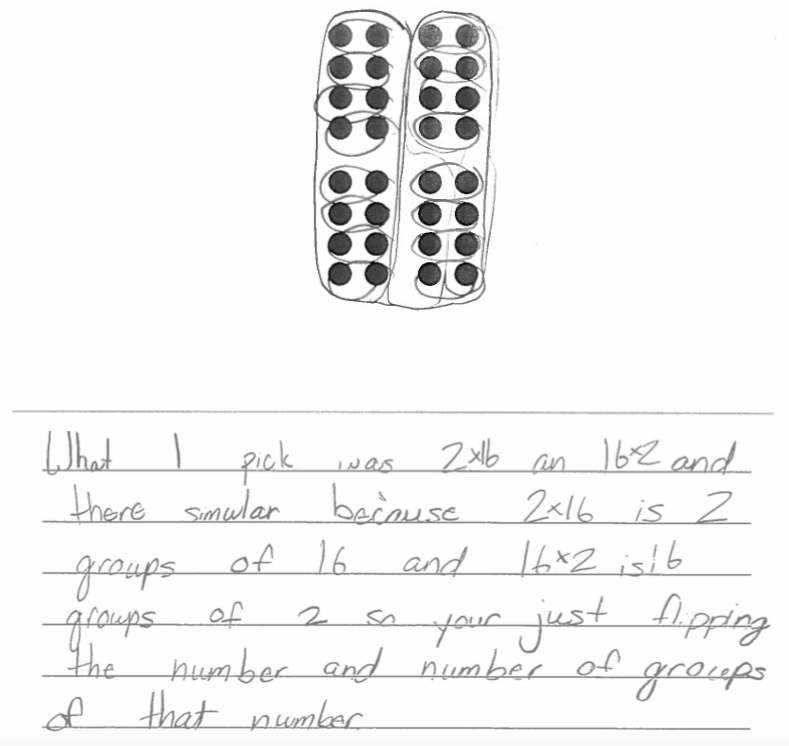
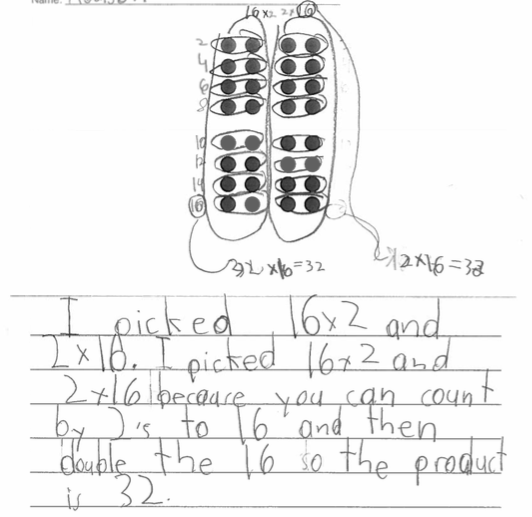
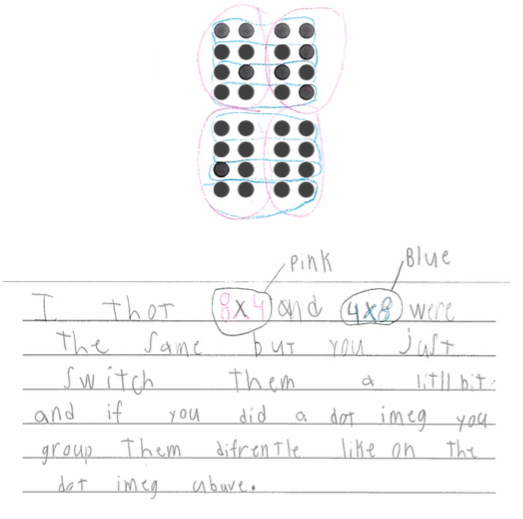
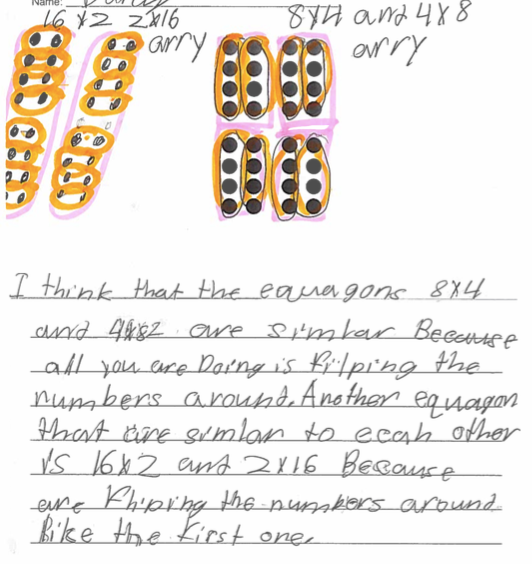
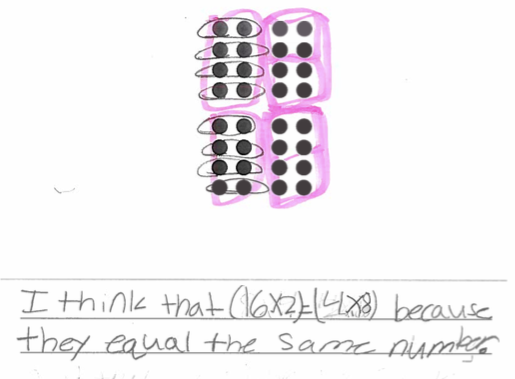
The majority of students chose two expressions demonstrating the commutative property of multiplication. Often students see that you can change the order of the numbers in a multiplication problem and the product remains the same, however in the journal entries, we were able to see student understanding of this property in a representation. 

16 x 2 = 2 x 16

8 x 4 = 4 x 8

16 x 2 = 2 x 16 and 4 x 8 = 8 x 4 

Changing the Number of Groups and Number in Each Group

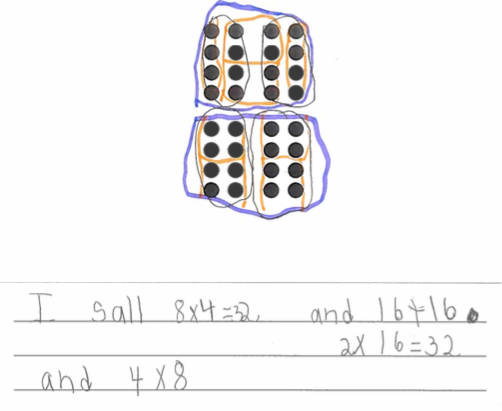
A few students noticed that when they changed the number of groups and the number of dots in each group, the product remained the same. While these students are not yet articulating how the groups are changing, this work provides a great opportunity to plan future conversations around this idea. 

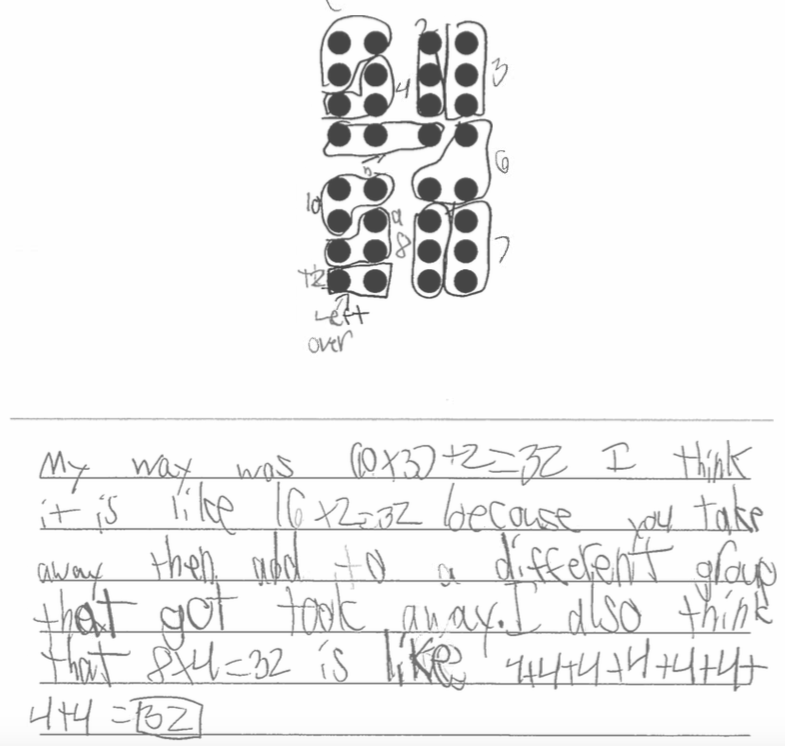
Rearranging the Groups

This response is very similar to the previous responses, however this student is beginning to articulate how the groups are changing. Instead of having 10 groups of 3, the student explains he took some dots away and added them to another group to make 16 groups of 2. 

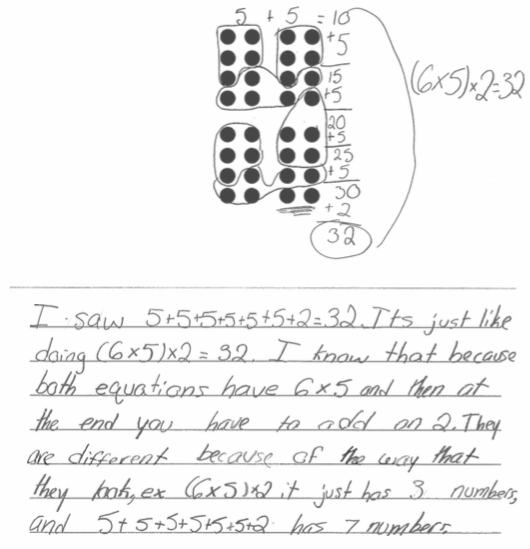
Relating Operations

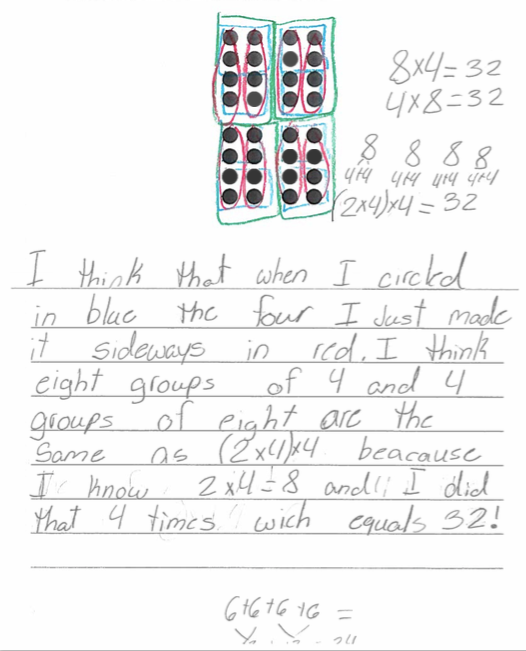
Some students related expressions based on what they understand about the operations and were able to represent these understandings in the dot image. 

While the team and I heard and observed so much interesting student thinking during the Dot Image discussion itself, the journal prompt allowed us to look more closely at each student’s understanding and see the connections they were making. It served as a important formative assessment, one that extended beyond what we could learn through discussion alone.

Math journals have transformed the way I listen to students’ thinking. I love seeing math journaling used across grade levels, from students who are just beginning to represent their ideas to those who are refining written explanations. Journals give students who may not feel comfortable sharing aloud a space for their voices to be heard, while giving teachers invaluable insight into how students are making sense of the mathematics. I encourage all math teachers to incorporate math journals into their classrooms—not just to see how students arrived at an answer, but to uncover the connections, understandings, and confusions that shape their learning. That insight truly informed every planning decision I made in my classroom and deepened my understanding of the not only the mathematics, but how students build mathematical understanding.

Now, off to make some more coffee, grab a good book, and then follow up with some Fortnite or Zelda gaming time:) Happy snowy Sunday all!

Adapting Lessons Part 3: Engaging with Word Problem Contexts

Word problems have always been challenging for me as a teacher and as a coach supporting teachers. I think part of the reason is that you can’t really teach word problems in the traditional sense. Solving them depends on students making sense of a situation and the question they are being asked to answer, and there are many factors that influence that sensemaking.

One factor is the context itself. I know how important it is for students to apply their understanding in both familiar and novel situations; however, every context will be a mirror for some students and a window for others, and when a situation is completely unfamiliar, I have seen it significantly impact how students approach the problem. Another major factor is the language of the problem itself. Many word problems include vocabulary, sentence structures, verb tenses, and multiple steps that shape how students make sense of the situation. These features require them to draw on things like reading comprehension, syntax, semantics, and sequential thinking, not just mathematical understanding and procedural skill. All of these elements influence the mental model students build based on the context and ultimately affect how they attempt to solve the problem.

Because of these complexities, it is not surprising that many students quickly grab numbers from a word problem and compute or search for key words. These strategies often worked for them in earlier grades, with one-step problems, or within curriculum units focused on particular operations. As a result, they do not always read the context as something that should make sense. Instead, they read while thinking, “Which operation do I need to use to solve this problem?” This reminds me of times when I am reading a book with something else on my mind. Even though I am technically reading the words, I can finish an entire page, or even a chapter, and realize I cannot remember anything I just read. I think this is similar to what happens when students read a word problem while also trying to figure out how they are supposed to solve it.

Understanding these challenges gives us important insight into the kinds of instructional adaptations that best support students in sensemaking. When we pause and give students an opportunity to make sense of a context before jumping in to solve, we set them up for more productive problem solving. And, the more we provide these opportunities, the more metacognitive those ‘sense-making structures’ become for students. There are some great math language routines out there, such as Three Reads and Co-Craft Questions, that are productive in a whole-group setting, but can take a lot of class time, require preparation, and may not transfer easily to a new problem for students. Because we sometimes can’t predict the problems that will be most challenging, I also like to have a few back-pocket, in-the-moment adaptations that promote the same type of reasoning and sensemaking.

These adaptations are all about helping students make sense of a word problem before they jump into solving. By giving them time to notice, wonder, visualize, and pose questions, we make the problem more accessible and give students the chance to build a strong mental model. This approach draws on both math and language skills, helping students focus on understanding rather than just grabbing numbers or looking for key words. When we use these adaptations in the classroom, students are more likely to engage in deeper, more productive mathematical thinking and problem solving.

For more ideas and examples, you can check out some related blog posts:

And of course, if you missed the first two posts in this series, you can find them here:

I look forward to hearing about what you might try! You can share here in the comments or over on IG: https://www.instagram.com/kgraymath/

Adapting Lessons Part 2: Structuring Group Work

Just like the launch of a lesson shapes how students access the mathematics, the structures we use during group work support what they do once they’re in it. In these moments, who talks, who listens, and whose ideas move the work forward can either widen or narrow the thinking that happens. Group time can be a place where rich, collaborative work happens, but it involves much more from the teacher than giving the directions ‘work with your group,’ ‘turn and talk,’ or ‘think pair share.’ While a curriculum can provide teachers with helpful suggestions, the uniqueness of each group of students places the responsibility heavily on the teacher, which makes sense. Only the teacher knows their students and the dynamics within each small group. Small shifts in how we organize students, position their ideas, and support their discussions can dramatically impact both the mathematical practices that students engage in as they work and the mathematical thinking that students bring to the whole group discussion afterward. 

After exploring ways to launch a lesson, the next opportunity for quick, high-leverage adaptations comes when students begin working together. From the moment we ask students to collaborate to the moment when we circulate and listen, the structures we choose can either uncover students’ thinking or unintentionally limit it. Thoughtful approaches to group work can support collaboration, build mathematical habits of mind, and strengthen the sense of community we hope to see in our classrooms. In this post, we’ll look at quick, in-the-moment ways to support group work so every student has an opportunity to contribute and every idea has a chance to surface.

Alternate Ways to Work in Groups

Instructional Challenges: When students jump into group work without clear structures for talking and listening, it becomes easy for one person’s ideas to dominate while others disengage. Without intentional support, some students simply “go along” with the loudest or quickest thinker, and opportunities for deeper reasoning are lost. Additionally, when students stay in the same assigned seats, groups can become static. While this consistency can help early in the year as a community is forming, it can also limit the range of perspectives and mathematical ideas students encounter over time.

Each of these routines require students to articulate their ideas and listen to the ideas of others. One routine I love to support these practices is Talking Points. It didn’t really fit with the others in the table, but I wanted to mention it here as I close out the post. This routine includes giving each group a carefully crafted statement (for example, a prompt about multiplication or division), and asking students to respond by agreeing, disagreeing, or saying they’re unsure while explaining why. Because everyone at the table gets a chance to voice their ideas, and then they collectively wrestle with different perspectives, students often reconsider or deepen their understanding about the topic at hand. Finally, when the groups come back together for a whole-class reflection, all students benefit from a wide array of reasoning. I have a collection of blogs about Talking Points  in the K-5 math classes here if you are interested in trying them out! 

Try it!

In your next PLC or planning session, review the activities in an upcoming lesson. As you read through each problem, discuss:

  • What questions should I ask students to discuss in small groups that will move their thinking toward the mathematical goal of the day?
  • What structures can I use to ensure all students have the opportunity to share their ideas and have their ideas heard by others in the class? 
  • Which of the four group work structures will you use to support students as they learn together?*

*If you’re planning with your grade-level team, each person can try a different structure and then compare the affordances of each. I’d love to see what you try! Share your ideas in the comments or on IG (@kgraymath)!

Next up will be routines for supporting student learning as they engage in problem contexts, in particularly word problem sense-making strategies.

Formatively Assessing Student Thinking

At the beginning and end of a curriculum unit, I find it valuable to learn what students already know and what questions they have, to help guide my planning and instruction. While pre- and post-assessments can provide useful information, they also tend to limit the range of students’ thinking, especially when students show minimal written work. Because of this, I began using a few key routines. One of these routines, which I call “Tell me everything you know and want to know about [topic],” invites students to share their ideas more openly.

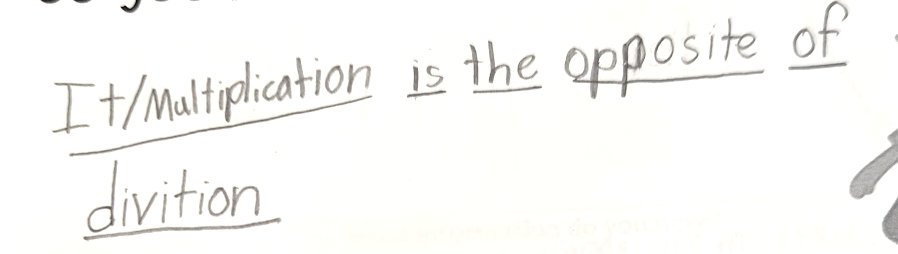
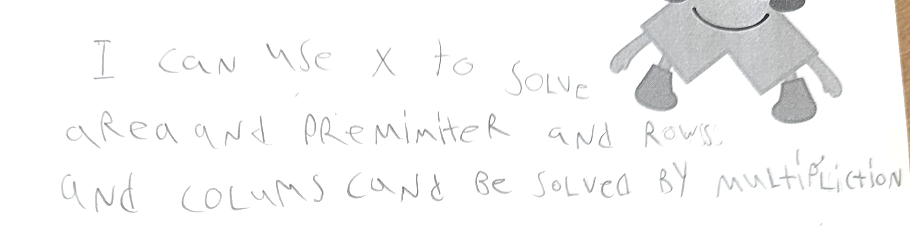
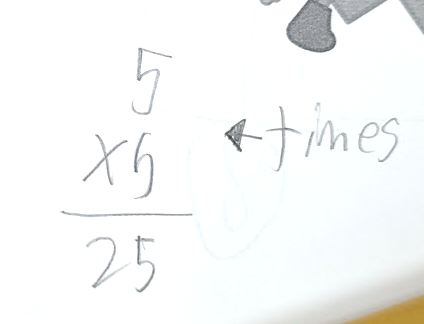
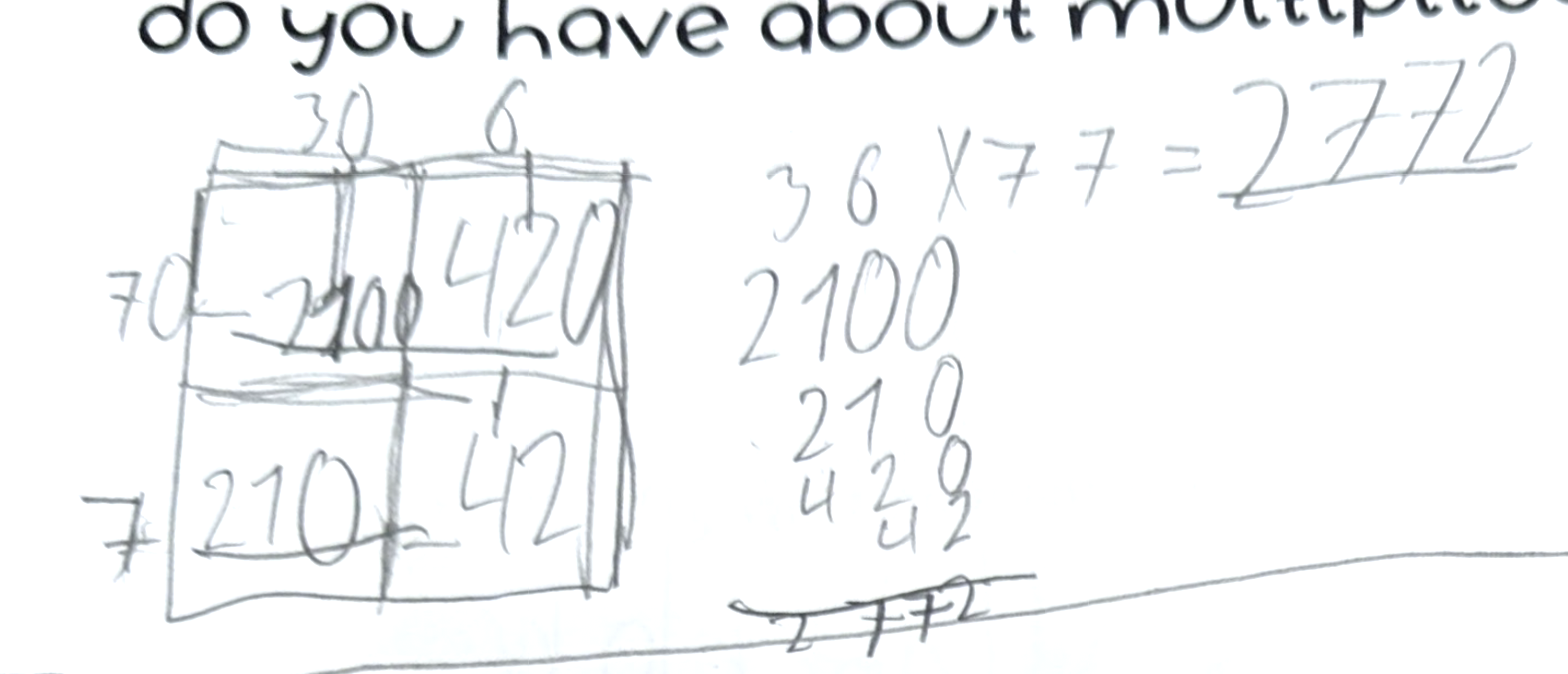
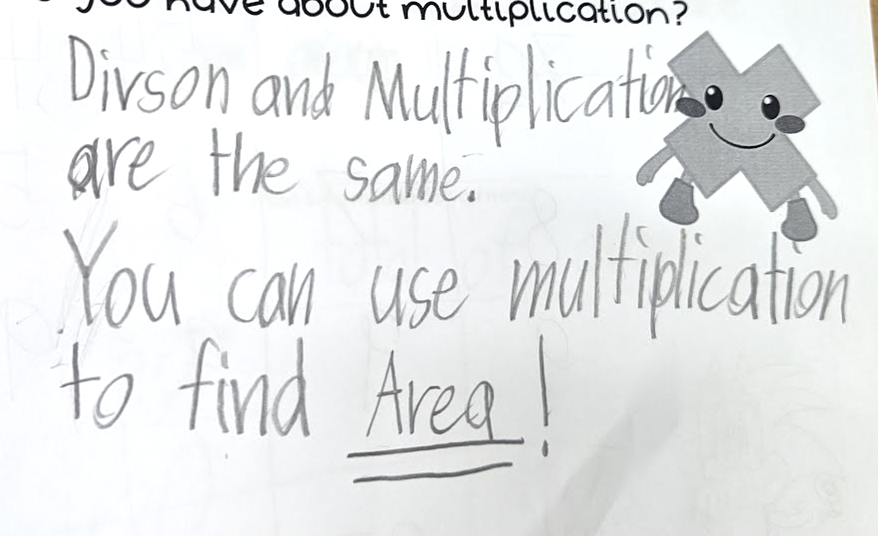
For example, after a 3rd grade unit on multiplication and division, Katie (an amazing 3rd grade teacher) and I wanted to gain insight into what students learned, in their own words. We wanted to give them some individual think time first, so we gave them this simple sheet to record their ideas. We decided to leave the page unlined so students could freely draw any representations that made sense to them. Their ideas definitely did not disappoint! (Click on each thumbnail to see the full page)

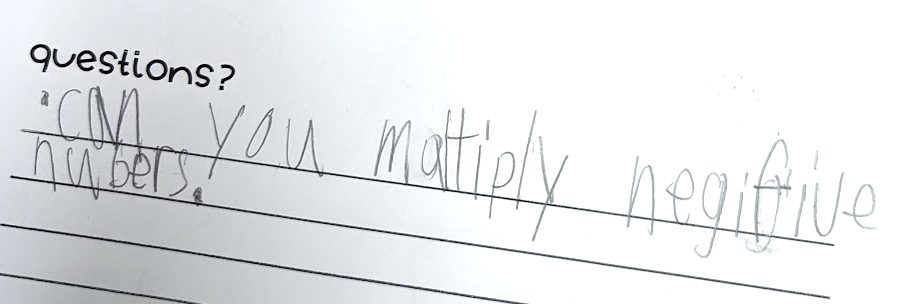
We only got one question, but it was such an interesting one!

I think since it was the first time doing this routine at the end of a unit, we didn’t get as many questions as we had hoped. I do wonder how changes in wording such as “What new questions do you have about multiplication?” or “What wonderings do you have about multiplication?” would impact the amount of questions we would get next time.

After students had their independent think time, we shared their responses as a whole class and recorded their ideas on chart paper to stay up as an anchor chart we could refer back to throughout the year!

If you would like to try this routine before the holidays to see what students have learned, I blogged the directions here. In my next blog post, I will explore another routine I love to formatively assess student thinking! Until then, I would love to hear some of your favorites in the comments!