In my previous post, I ran through some lessons I’ve learned about interactive read alouds and shared a few of my favorite books for K–1. And while many of those books can absolutely stretch up into grades 2–5, there are others that, because of their math content or overall reading complexity, are a better fit for this upper‑elementary grade band. So today, I’m sharing a set of book recommendations that support joyful exploration and productive mathematical discussions! These titles open space for noticing patterns, justifying ideas, engaging in debate, and connecting mathematical thinking to the world around them.
And if you’re working across multiple grade levels, you can always revisit my earlier K–1 read‑aloud list. Together, the two posts offer a collection of my favorite books that invite curiosity, support authentic access to the mathematics, and build a shared mathematical community from kindergarten all the way through fifth grade.
Concept
Book Suggestions
Number and Operations
Equal Shmequal by Virginia Kroll One Is a Snail, Ten Is a Crab by April Pulley Sayre and Jeff Sayre One Hundred Hungry Ants by Elinor J. Pinczes A Remainder of One by Elinor J. Pinczes How Much Is a Million? by David M. Schwartz 100 Mighty Dragons All Named Broccoli by Larochelle & Cho Dozens of Doughnuts by Carrie Finison Hello Numbers by Harriss and Hughes
Fractions
The Lion’s Share by Matthew McElligott Fry Bread by Kevin Noble Maillard Give Me Half! by Stuart J. Murphy The Doorbell Rang by Pat Hutchins How Many Ways Can You Cut a Pie? by Jane Belk Moncure
Measurement and Data
Spaghetti and Meatballs For All! by Marilyn Burns How Big Is a Foot? by Rolf Myller The Penny Pot by Stuart Murphy Curious Comparisons by Jorge Doneiger Coa Chong Weighs and Elephant by Songju Ma Daemicke Greater Estimations by Bruce Goldstone Actual Size by Steve Jenkins Which Would You Rather Be? by William Steig
Geometry
This is Not a Maths Book by Anna Weltman (not really a children’s book, but it is sooo good!) Which One Doesn’t Belong? by Christopher Danielson Shapes, Shapes, Shapes by Tana Hoban Grandfather Tang’s Story by Ann Tompert
I hope this collection gives you fresh inspiration for sparking mathematical curiosity in your classrooms. The best way to know whether a read aloud resonates with yourself and students is simply to try it. You can see how your students respond, notice the ideas they generate, and decide how to leverage their thinking toward the learning goal.
Give these titles a spin, and let me know what mathematical conversations they open up for you and your students. I’d love to hear what you try!
I had always been a fan of bringing stories into math class; however, as a fifth-grade teacher, it was hard to convince a group of almost–middle schoolers that a children’s book could be full of interesting, grade-level ideas to explore. More often than not, when I began reading aloud, I could tell right away that the vibe was off and that they saw it as too babyish.
At first, I assumed the problem was the book itself. Over time, though, as I learned more about mathematizing from Allison Hintz and Tony Smith, I came to realize that the issue wasn’t what I was reading, but how I was framing the experience. I was making the book’s concept the thing, rather than centering the story and the mathematical practices involved in mathematizing. And while the concept is extremely important when choosing a book, the facilitation really can make or break the experience.
Around that same time, I was incredibly fortunate to step into a role as a K–5 math specialist, where I had the opportunity to partner with an amazing reading specialist, Erin. Together, we tried out different books across grade levels and content areas, reflected on those experiences, and took up interactive read alouds as a way to blur the lines between content, habits of mind, and capacities. Through this work, I not only learned a great deal about teaching ELA, but also came to understand mathematizing as a way to invite students to see mathematics everywhere, including within stories that don’t appear to be mathy at all!
The Why
Mathematizing is a process of inquiring about, organizing, and constructing meaning with a mathematical lens (Fosnot & Dolk, 2001). Through mathematizing, students:
have access to mathematics
see math when and where it may not be obvious
see mathematics as a way to make sense of things
see math as a way of thinking, not solely a way of doing
focus on meaning-making
The What: Books
Choosing a Book
If you are a K-1 teacher, I am sure you already have an expansive book collection! As you look through your library, consider how different stories might invite mathematical thinking. Some books center math directly in the plot, others offer rich illustrations to examine, and some simply create situations that spark mathematical curiosity—even if the math lives quietly beneath the surface.
If you are having trouble choosing, I have highlighted some of my favorite books in the table below!
Concept
Book Suggestions
Counting and Cardinality
I Spy a Dinosaur’s Eye by Jean Marzollo Truman by Jean Reidy Grumpy Bird One Is a Snail, Ten Is a Crab by April Pulley Sayre & Jeff Sayre Ten Black Dots by Donald Crews Ten Flashing Fireflies by Philemon Sturges Anno’s Counting Book by Mitsumasa Anno Ten Ways to Hear Snow by Cathy Camper One Fox by Kate Read How Many? by Christopher Danielson
Geometry
This is a Ball by Beck & Matt Stanton City Shapes Square Cat by Elizabeth Schoonmaker The Shape of Things by Dayle Ann Dodds More-igami by Dori Kleber Inch by Inch by Leo Lionni
Addition and Subtraction
The Doorbell Rang by Pat Hutchins There Is a Bird on Your Head by Mo Willems Double Those Wheels by Nancy Raines Day
Composing Decomposing Comparing Numbers
Lia & Luis: Who Has More? by Ana Crespo Dozens of Doughnuts by Carrie Finison (also great for counting & add/subtraction) 12 Ways to Get to 11 by Eve Merriam
Measurement and Data
Curious Comparisons by Jorge Doneiger The Animals Would Not Sleep! by Sara Levine
Other Lovely Books!
Count on Me by Miguel Tanco The Look Book by Tana Hoban Playful Puzzles for Little Hands by Taro Gomi
The How: Interactive Read Aloud
Now that you have a book in mind, it is time to structure the read aloud experience. Don’t worry, there’s no single path for engaging students in a mathematical read aloud. Instead, think of it as a series of intentional moments that help students notice, wonder, build curiosity, and explore the mathematics within a story. Here are some helpful lessons learned that helped me improve in my interactive read alouds:
Let the story be the story. The first reading is an opportunity for students to listen, imagine, and enjoy. Without pausing to analyze, students can make sense of the narrative and build a shared experience around the text.
Listen closely to students’ thinking. After the reading, invite students to share what they noticed or wondered. Their ideas, mathematical or not, offer important windows into how they are making sense of the story. Recording these thoughts allows them to remain visible and valued.
Revisit the text. Returning to the story, or to particular pages, creates space to look more closely at the mathematics that emerged. This second look helps surface relationships, quantities, and structures that may have gone unnoticed the first time. Allison and Tony give great structures for planning this in their book and in the Supporting Materials section on that same page.
Honor students as question askers. While we should have an idea of the math we want students to engage in from the book, it is also extremely important to encourage students to pose their own mathematical questions inspired by the text. When students generate the questions, the mathematics feels purposeful and connected to their own thinking.
Create time to explore the math. Follow the read aloud with an activity that either emerges from students’ questions or deepens the ideas you want to highlight.
Conclusion
Ultimately, an interactive mathematical read aloud is less about following a script and more about encouraging sensemaking. The goal isn’t to squeeze math out of a book, but to create conditions where students naturally notice, question, and explore the mathematics already living in the pages. Over time, these intentional moments help students see math as something they do and make sense of, not just something that shows up in a textbook. Try one of these ideas in your next read aloud, and let me know how it goes, I’d love to hear what your students notice and wonder!
Examples
If you want to check out some examples before jumping right in, I have blogged about it a bit in these posts! Next time I will focus on some of my favorites in grades 2-5!
I have always loved, loved, loved Jenna’s Slow Reveal Graphs! They provide such an engaging structure that encourages students to explore and reason about data. If you don’t know what Slow Reveal Graphs are, it might be helpful to read up on them here before continuing.
Sense-making is so front and center in a slow reveal activity that I think it could be interesting and exciting to extend this activity with problem posing! I have been learned so much about problem posing from my friend Jinfa Cai. Problem posing is an instructional approach in which students generate and solve their own mathematical problems. In doing so, students share mathematical authority in the classroom and position students as creators of mathematical inquiry rather than solely recipients. I wrote a bit about it in the new NCTM book, Teaching Mathematics Through Problem Solving (pg 73-74).
The Mashup
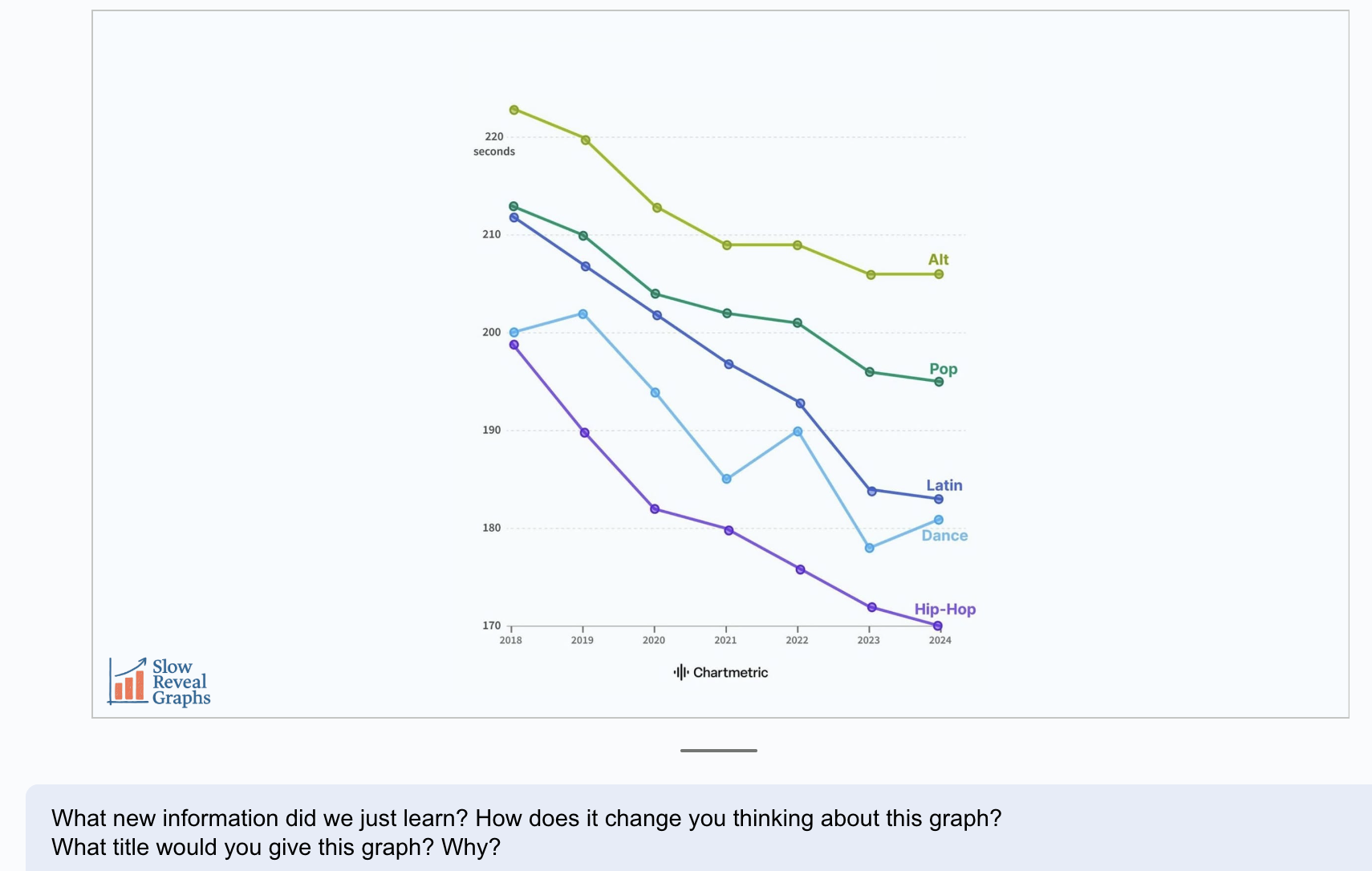
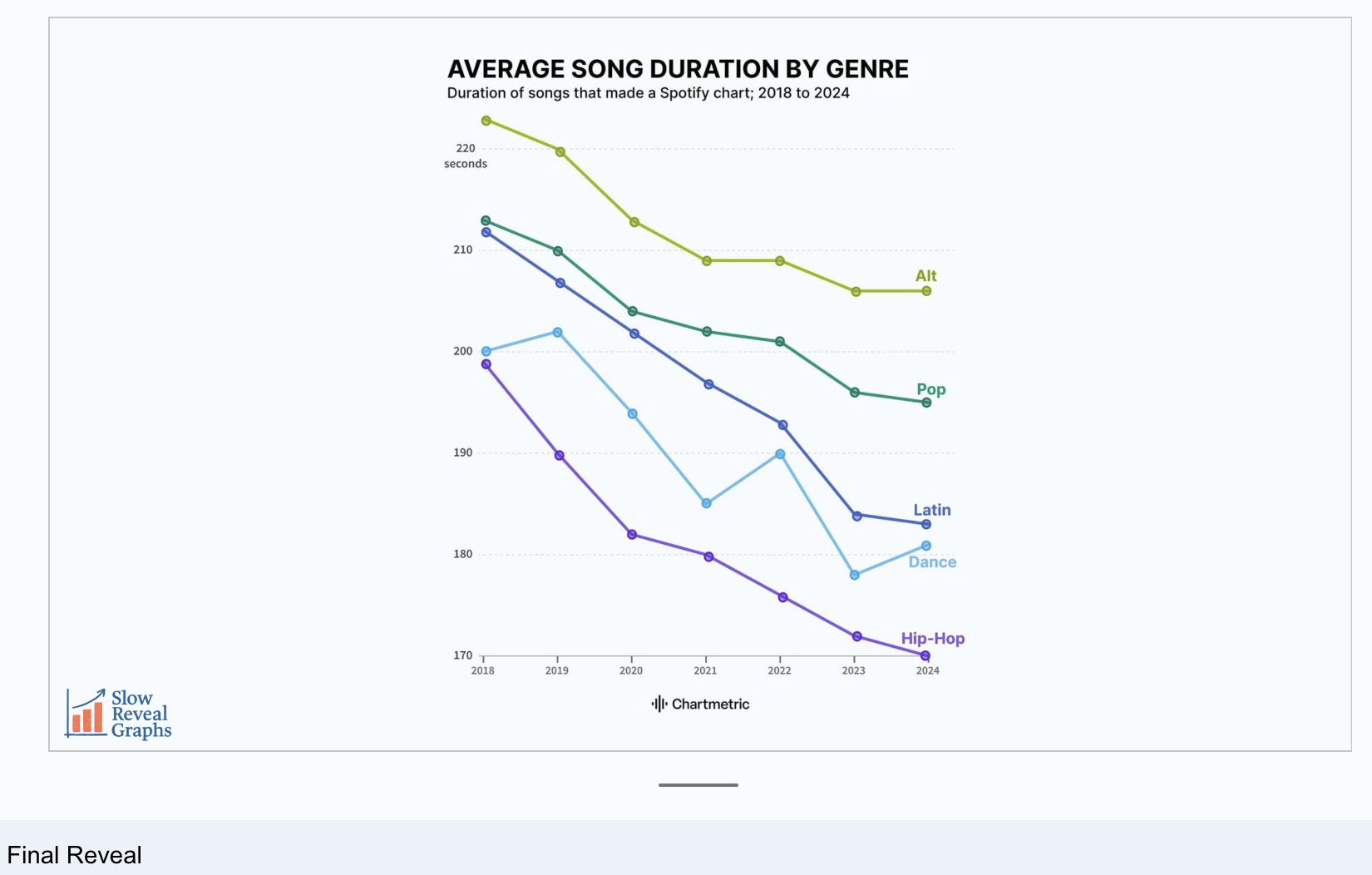
To think about what a mashup could look like, let’s go check out one of Jenna’s recent slow reveal graphs, Average Song Length by Genre. Which is so appropriate because Jenna and I love to chat 90’s hip hop artists;) Oh, and did I mention that Jenna creates a slide deck with notes for each one of these?!?
Step 1: Display the graph and ask students what they notice and wonder. (Slide 1)
Step 2: Display the graph with new information, ask questions that encourage students to interpret the new information, and make predictions about what is still missing…luckily, these directions are in the slide notes of Jenna’s slides. (Slides 2-3)
Step 3: Display the final reveal of the graph. (Slide 4)
Step 4: Problem posing: Ask students to pose problems that can be answered by information in the graph and record them on a piece of chart paper.
Students might pose many different types of problems such as:
Which genre had the longest average song in 2019?
About how much longer was the average latin song than hip-hop song in 2023?
About how much did the average pop song duration decrease from 2019 to 2024?
Which genre had an increase in average song duration? Between what years?
If you listened to a dance song and alternative song in 2022, about how many seconds would you be listening? How many minutes?
This list could go on and on, but you get the point. I know it could be nerve-racking to use a graph like this because there are not definite values at every point, but I think that actually increases the reasoning element and could raise some cool points for argumentation!
Step 5: Ask students to solve their problems.
This is a choose your own adventure — you could ask students to solve all of the generated problems or you could focus attention on one or two problems aligned to that day’s learning goal. I always lean toward the latter so the activity isn’t just a one-off random activity, but instead connected to what they are learning. This also leaves me a bank of ‘if you get done early‘ problems, which was always one of the biggest differentiation challenges for me, and helps me focus the whole group discussion afterwards.
Step 6: Synthesize the learning.
This step is really dependent on the learning goal of the day. After solving, you could have students do a gallery walk to compare solutions and solution methods, representations, and reasoning. Or you could decide to have a whole group discussion based on the monitoring that you did as students worked.
I have always been such a fan of numberless word problems, notice/wonder, and the 3 Reads MLR. Problem-posing feels like it pulls the most purposeful parts of each of these routines into one. Layering problem posing on Jenna’s slow reveal structure puts such an fantastic focus on data while also supporting other areas of mathematical focus. It is also so adaptable by grade level, which makes it so flexible!
Final Problem Posing Thoughts
When students have the opportunity to pose their own mathematical problems based on a situation, they must make sense of the constraints and conditions from the given information to build connections between their existing understanding and a new understanding of related mathematical ideas (Cai, 2022). And when teachers have the opportunity to listen to connections students make, understand the math students see in situations, and make teaching decisions on how to elicit, share, and move forward with student thinking, it shares the mathematical authority in the classroom and leads to deeper, more powerful learning for all!
I am sure we have all seen it happen at one time or another in math class. We give a student a story problem to solve and after a quick skim, the student pulls the numbers from the problem, computes them, and writes down an answer.
If the answer is correct, we assume the student has a grasp of the concept. However, if it’s incorrect, we’re left with a laundry list of questions: Do they realize their answer doesn’t make sense? Did they not understand the context? Did they simply pull the numbers and operate to be finished or did they truly not know what to do with them? Most importantly, we ask ourselves, how can I help students make sense of what they are reading and think about the sensibility of their answer in the context of the problem?
If we’re lucky, we can identify a mathematical misconception and work with that. Oftentimes, though, the answer isn’t even reasonable. Then what do we do?
Mathematically proficient students start by explaining to themselves the meaning of a problem and looking for entry points to its solution. They analyze givens, constraints, relationships, and goals. They make conjectures about the form and meaning of the solution and plan a solution pathway rather than simply jumping into a solution attempt.
The best way I’ve found to help students make sense of what a problem is asking is, ironically, to take the question out altogether. Inspired by the wonderful folks at The Math Forum, I do a lot of noticing and wondering with students in this fashion. Most recently, after reading Brian Bushart’s awesome blog post, I have started taking the numbers out as well! Instead of students thinking about how they’re going to solve the problem as they read, they are truly thinking about the situation itself. It’s been an amazing way to give every student entry into a problem and allow me to differentiate for all of the learners in the classroom, while at the same time provide insight into my students’ mathematical understandings.
Recently, I had the opportunity to work with a 3rd grade class. The class recently finished their multiplication and division unit and will soon be starting their work with fractions. In order for their teacher and I to see and hear how students apply the operations, make sense of contexts, and currently think about fractions, I thought it would be interesting to take a story problem from their Student Activity Book and take the question and numbers out.
The Planning
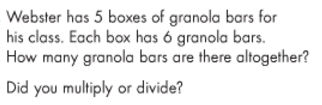
I chose the problem below and thought about what I would learn about a student’s mathematical understandings and sense-making after they answered the questions.
I was curious to observe how students make sense of problems based on the idea of removing the numbers and the question so I changed the problem to this simple statement:
“Webster has boxes of granola bars to share with his class.”
I anticipated the students would wonder about the missing mathematical pieces involved in an open-ended statement like this. I believed their wonderings could lead them to develop questions that could be answered based on the very information they were wondering about. I knew the mathematical ideas of multiplication, division, and/or fractional sharing would arise and that I would learn so much more about their thinking then if I had given them the original problem.
In The Classroom:
I launched the lesson by posting the sentence on the board and recorded things they noticed and wondered.
They noticed:
“We don’t know how many boxes of granola bars.”
“There is not enough information to know what is going on.”
“We don’t know if it is adding, subtracting, multiplying, or dividing.”
“There are multiple people in the class because it says boxes and share.”
They wondered:
“How many granola bars are in each box?”
“How many boxes he bought?”
“How many kids are in his class?”
“What kind of granola bars are they?”
Based on their noticings and wonderings, I felt everyone had a strong grasp of the context and sense of where this was going. Based on their noticing that there is not enough information to know what is going on, I asked what more they would want to know. They responded that they wanted the answers to the first three of their wonders: bars per box, number of boxes, and number of kids in the class.
I asked them what questions they could answer if I gave them those pieces of information and they responded:
How many bars does he have?
How many bars does each kid get?
How many does he have left?
At this point, I could have given them the information they wanted. However, I thought it would be so much cooler to allow them to choose that information for themselves. I was curious: how they would go about choosing their numbers! Would they strategize about the numbers to make it easier for themselves? Would they even think that far ahead? What would they do with the leftovers?
When I told them I was not giving them the information and that instead they were choosing their own numbers along with the question they wanted to answer, they were so excited!
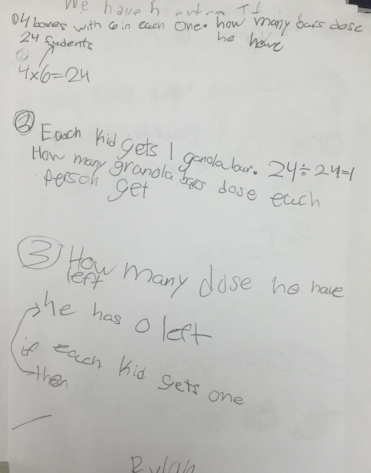
Some partners chose their numbers very strategically to make it easier for themselves. To me, this demonstrated a lot of sense-making and forethought of what was going to happen in their solution path. And as an added bonus, while only asked to answer one question, the group answered all three questions! (Teacher note: if students chose numbers strategically and therefore finished quickly, I gave them extra bars to factor into their problem to see how they dealt with the leftovers.)
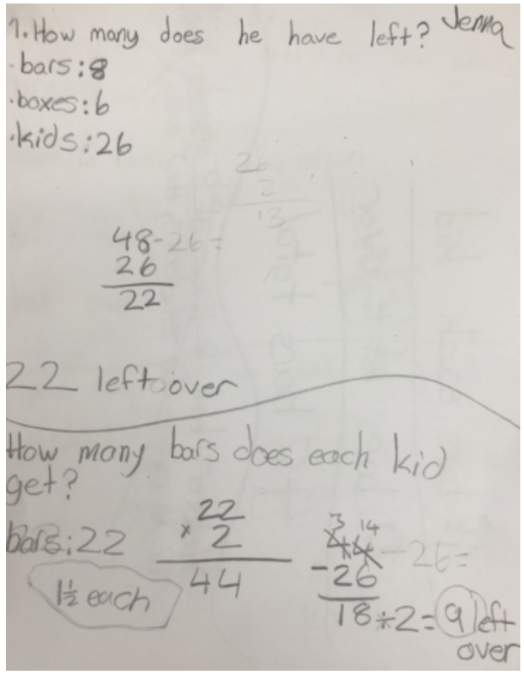
Other students chose the opposite route and strategically picked numbers to make it “harder for themselves.” Check out the way these two students showed strong reasoning and perseverance through division of numbers larger than any they’ve ever worked with.
Others chose numbers without much forethought and dealt with some amazing leftovers. This was a great way to formatively assess students’ thinking related to fractions before they began that unit.
And then there are always the surprises. Who would have thought third graders would reason about the leftovers in terms of percentages?
Reflecting on what the students would have been asked to make sense of and the work they would have had to do based on the original problem versus the reasoning and work they did related to this one simple sentence, I’m amazed by the difference. I learned so much more about what each of the students know beyond simply multiplying 5 and 6. Taking out the numbers and question allowed every student to think about the meaning of the sentence, the implied mathematical connections, and plan a solution pathway before jumping into a solution attempt.
I highly recommend everyone try this strategy with a word problem from your current text. It’s a wonderful way to give every student access to the math and freedom to think beyond just getting an answer.
If you know me or have ever read my blog, you know I could talk for days about student math work! You can visit my blog for a more detailed description of the work shown in this post as well as additional work captured from the lesson.
This past week, I had the amazing opportunity to work with an exciting group of elementary teacher leaders (lead learners if you will) from across our state. Over the course of the four days, we engaged in mathematics, discussed classroom pedagogy, and reflected on our practice while centering around the big idea of Developing Procedural Fluency through Conceptual Understanding. While I am still trying to digest all of the conversations, I thought it may be helpful to start with this initial list of thoughts and then expand on each at later times (immediate deep reflection is just not my forte;).
My thoughts…
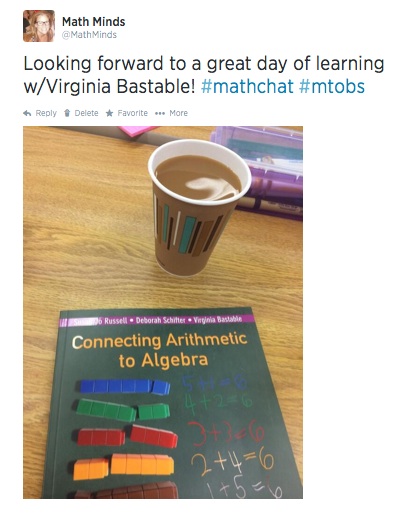
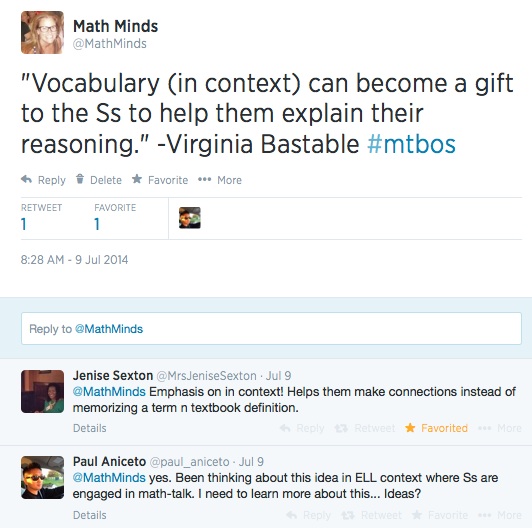
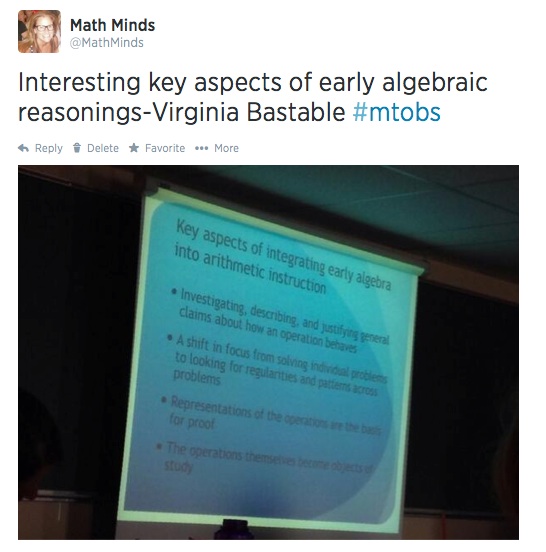
Virginia Bastable spoke around the topic of “Supporting Mathematical Reasoning Across Grade Levels: Helping Students Make Connections Between Arithmetic and Algebra.” She spoke, showed video and guided us through student learning in relation to developing algebraic reasoning in the classroom. She was amazing and left me with some things to really think about in terms of my teaching. I, of course, tweeted some things that really struck a chord during her talk..I particularly love the slide above due to the wording. The thought of regularity in their reasoning, not simply saying “patterns.” With regularity, comes irregularity in which I find intrigues students (and most adults) to dive deeper into the relationships of the mathematics. I love the feel of that so much better than “why doesn’t the pattern work?”…don’t get me wrong I love that question, but “irregularity” hits me a bit differently. I am sure I will be coming back to that as I use that with my students this year!
Virginia reinforced my belief that teachers should have explicit goals for each lesson, but that students should not have a specific question/objective that influences their thinking about the work before they engage in the math, ahem…Lesson Essential Question. Goodbye. Thank you.
The thought of vocabulary as a gift to explain reasoning is huge. In ELA, teachers are told not to front load vocabulary before reading a passage/story, students should learn it in context. So, why do so teachers not think the same thing applies in mathematics? Virginia was dead on…in context, give the students the math words to use to make their reasoning easier to explain.
Outside of Virgina’s talk, we did so much math around conceptual building of procedures that I cannot even list it all, however I did have some things come to mind regarding the math in every part of every day….the importance of equivalencies in ALL number work, how critical decomposition of number is in all facets of number work, how our work with Number Talks is invaluable in students explaining their reasoning and creating arguments, and how much geometry and measurement is embedded in our number work. All of these could really be (and hopefully WILL be) their own separate blog post!
When talking to the teachers, I noticed how much they appreciate learning the trajectory of the math and the seeing connections from what they do immediately in their classroom to where their students “start” or “end up” with the conceptual building. I think sometimes teachers do not see how critical it is for students to be flexible in making tens in Kindergarten because in the future those same students will rely on that understanding with decimals, fractions, equations and so on…..If a student understands why 3 + 7 = 10, they can reason that .3 + .7 = 1, 3 pieces the size of 1/8 (3/8) + 7 pieces the size of 1/8 (7/8) = 1, 3x + 7x = 10x (no matter what the x)….could go on and on….and this could all start with a 10 frame. Amazing.
Personally, as one of the presenters, I realized how much I LOVE hearing my students talk about math. I used some of their work samples & video in the presentation. I truly forget how awesome they are. We all get caught up in the school year craziness and forget to really listen, so it was nice to reflect back on that over the summer. They were comfortable making mistakes, talking to one another, and really worked hard on understanding the math. Made me proud to say I taught them. I encourage everyone to do it.
Also in the presenter role, I realized the connections between planning for adults in comparison to planning for my students. There must be an entry point for everyone, there must be an explicit goals, present ideas,not topics, working cooperatively in groups is so important, personal reflection is necessary, active engagement is necessary…..sooo many….
Lastly (for now), I am so excited to be working with such a dedicated and passionate group of educators who care as deeply as I do about impacting math instruction across our state. They remind me each day that every teacher is at a particular point in their journey, that continuous learning is so important, that my passion for what I do is exciting (because I do get a bit high strung sometimes …heehee), that change takes time (again, very hard for me to grasp:), and that we are a team. I love it.
So, whoever said teachers have the summers off is CRAZY! There is so much planning and learning happening in education over the summer, it is mind-blowing! Need proof, check out Twitter….#mtbos, #5hchat, #satchat
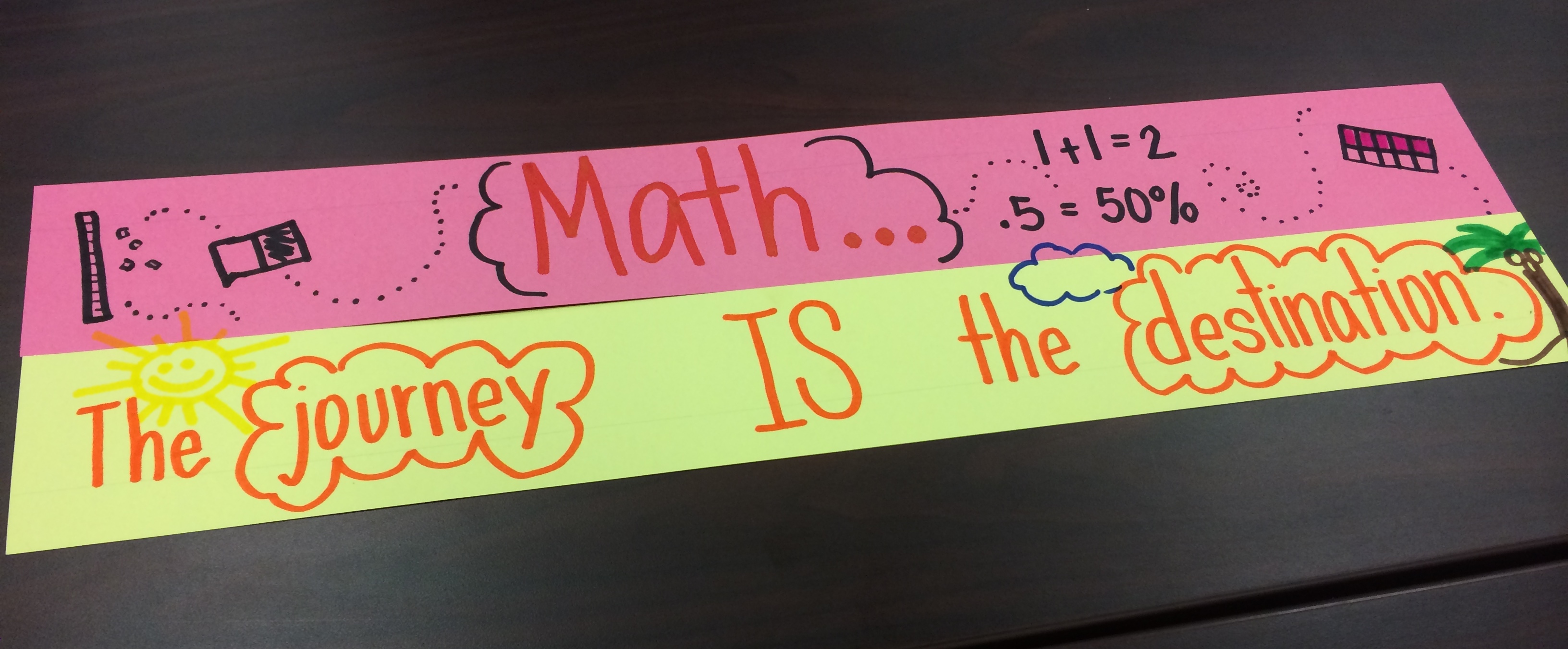
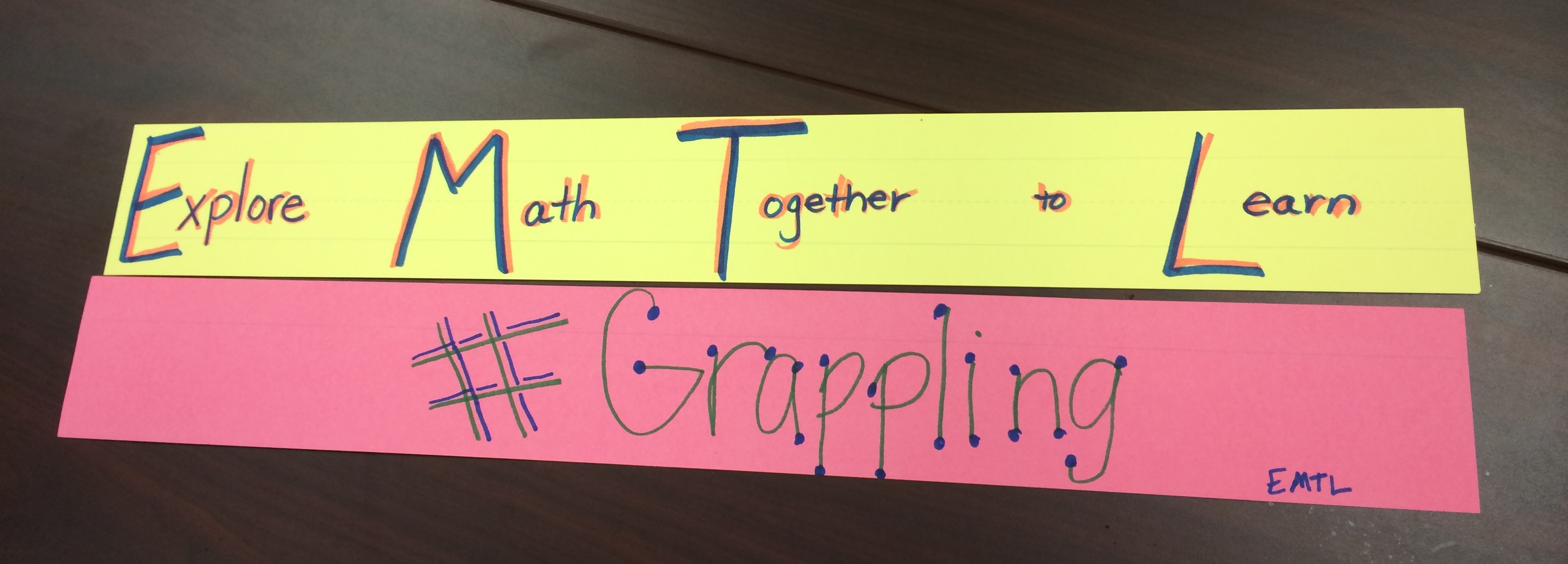
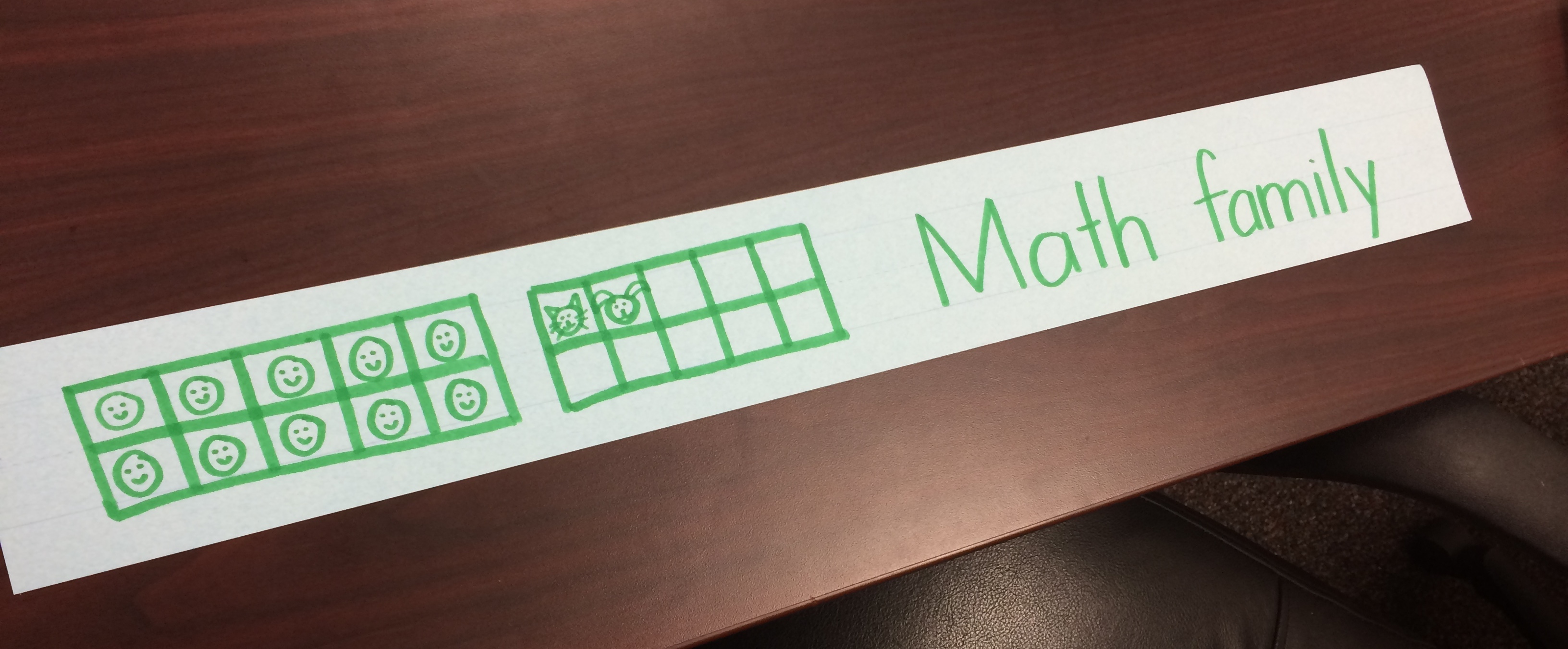
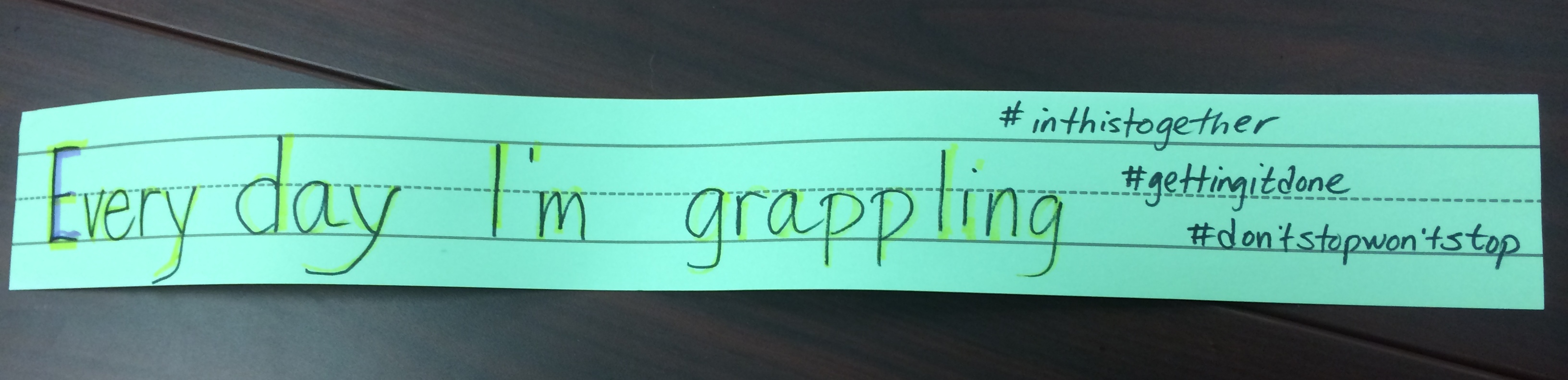
I have so many more things to reflect upon, but in the hopes of getting something else productive done today, I must stop here. I will leave you with some bumper stickers created by the participants at the end of the final day encapsulating their experiences over the course of the week….







 MathMinds