Tag Archives: Math

Number Talks – Fractions

Through doing Number Talks with students K-5, I started to realize that one thing I look for students to use in our whole number computation discussions is using known or derived facts to come to a solution. I feel like the problems I have been using are crafted to use the answers from previous problems to reason about the ending problem.

In the younger grades, I would like to see students using the double known fact of 7+7=14 to know 7+8=15. I want them using 23 + 20=43 to get 23 +19 = 42. I don’t want them treating every problem as if they have to “start from scratch” adding all or adding on.

An example in the upper elementary:

18 x 2

18 x 20

18 x 19

This progression leads them to use a known or derived fact (18 x 20) in order to solve 18 x 19. To build efficiency, I don’t want them to the treat the final problem in the progression as a “brand new” problem in order to reason about an answer.

Along these lines of thinking, as I observed students working the other day, I realized that students weren’t using this same use of known/derived facts when working with fractions. For example, a student was adding  3/4 +  7/8. He used 6/8 as an equivalent of 3/4, added that to 7/8 and ended with an answer of 13/8. Don’t get me wrong, I loves his use of equivalency and I am a fan of improper fractions, however I started wondering to myself if it would have been more efficient (or show that he actually thought about the fractions themselves) if he used a fact he may have known such as 3/4 + 3/4=1 1/2 to then add an 1/8 on to get 1 5/8? Or used 3/4 + 1 = 1  3/4 and then took away an 1/8? Is that the flexibility I want them using with fractions like I do with whole numbers?

I thought I would try a Number Talk the following day to see….

1/2 + 1/2

Thumbs went up and they laughed with a lot of “this is too easy”s going around.

1/2 + 1/4

Majority reasoned that 1/2 was the same as 2/4 and added that to 1/4 to get 3/4. Some said they “just knew it because they could picture it in their head” I asked if anyone used what they knew about the first problem to help them with the second problem? Hands went right up and I got an answer that I wish I was recording. It was to the effect of,”I know a 1/4 is half of 1/2 so the answer would be a 1/4 less than 1.”

1/2 + 3/4

Thumbs went up and I got a variety here. Some used 2/4 + 3/4 to get 5/4 while others decomposed the 3/4 to 1/2 + 1/4, added 1/2 + 1/2=1 and added the 1/4 to get 1  1/4.

3/4 + 3/4

Got some grumbles on this one, because it was “too easy” – 6/4…Duh! The class shook their hands in agreement and they were ready to move on to something harder.  I noticed that when the denominators are same, they don’t really “think” about the fractions too much. I waited….finally a student said, “It is just a 1/4 more than the previous problem so it is 1  1/2″ and another said each 3/4 is 1/4 more than a 1/2 so if you know 1/2 + 1/2 = 1 then you add 1/2 because 1/4 + 1/4 = 1/2.” I had to record that reasoning for the class bc it was hard for many to visualize.

3/4 + 5/8

Huge variety on this one and I thoroughly enjoyed it! From 6/8 + 5/8 = 11/8 to decomposing to combine 3/4 and 2/8 to get the whole and then 3 more 1/8s = 1 3/8.  There were many more students who used problems we had previously done.

What I learned (and questions I still have) from this little experiment:

– Students LOVE having the same denominator when combining fractions.

– Do they really “think” about the fractions when the denominators are the same? Can they reason if that answer makes sense if they are just finding equivalents and adding.

– Students can be flexible with fractions if you push them to be.

– Subtraction will be an interesting one to try out next.

– I would much prefer if I remembered to use the word “sum” instead of “answer”…. I tell myself all of the time, but in the moment I always forget.

– Using known or derived fact and compensation are invaluable for students when working with both whole numbers,  fractions and decimals.

– Are there mathematical concepts that present themselves later in Middle School or High School in which known and derived facts would be useful?

Happy Thanksgiving,

Kristin

Modeling Mathematics – Developing the Need

Today we were talking about things we noticed as we worked with finding a fraction of 1/2. Students are noticing things I expected: that the denominator doubles each time, the numerator is staying the same as the fraction you are dividing the half up into, some are starting to notice that the numerators are multiplying and so are the denominators, and some are just flat out complaining that they have to model it on the fraction the bar.

So the fraction of 1/2 was pulling some great noticings, however I wanted the students to feel the value of being able to model the mathematics, to show what was happening, so I asked them what would it look like if I had 3/4 of a candy bar and wanted to split it with two friends. What fraction of the whole bar would I get?

I was excited that some labeled the 3/4 on a fraction bar with 6/8 and then split that in half and labeled 3/8. They said they “knew half of 6/8 was 3/8” I asked why didn’t they work with 3/4, they explained that splitting the three was not working and 6 was easier because it was even.

Some said they had split the 3/4 in half and it looked about like a 1/3, so it was 1/3. I appreciated the estimations, but looking for them to dig further after they estimated.

I would say that a third of the class had written 3/4 of 1/2= 3/8 with a fraction bar 3/4 shaded and then split in half and labeled 3/8. When asked how the fraction bar modeled their answer, they told me that they didn’t “need” the fraction bar to find the answer, they noticed that you multiply the numerators and denominators. “Can’t we just give you the answer?” “It’s the right answer, right?”

We don’t “need” the fraction bar. Huh.

Then an interesting thought hit me….they see pictures as a tool they don’t need rather than a model of a mathematical situation. It almost seemed as if they viewed the bar as “baby-ish” to use. You know how certain things hit you as WoW?!? That is completely what that comment did. I immediately started to reflect on how I had made the fraction bar sound…did I just make it sound like a way to solve? Did I even use the word model? Am I placing too much emphasis on the modeling piece?

I can see why students view diagrams as a way to solve….when they learn to add, they draw pictures. When they first work with “groups of” they draw pictures. When they first work with arrays, they draw things in row and columns. Once they have learned how to add, the pictures aren’t necessary. When they have learned how to multiply, the arrays and groups of aren’t seen as a necessity.

In that moment, I wanted the students to appreciate how important (and difficult) modeling is in mathematics.  I pushed them to explain how to name that line drawn at half of the 3/4 and we had some great conversations about why this was more difficult than a fraction of 1/2.

In the end, I assured them that I sit with adults all of the time and we struggle (and find MUCH enjoyment) in making models of mathematical situations. They felt ok with knowing it wasn’t just tough for them and I felt ok that they could see a “need” for their fraction bars!

-Kristin

Fraction of Fraction Day 2

As I mentioned in my previous post: https://mathmindsblog.wordpress.com/2013/11/15/fractions-of-fractions/ 
I had wondered about fraction multiplication being introduced without a context when the students were coming from lessons in which a fraction of a whole/mixed number had a context. Feeling like the students had a solid grasp on how to find a fraction of a fraction on a fraction bar, I thought I would try having them develop a story context for fraction multiplication problem. They had free reign of the fractions they used and context they chose. Needless to say, it was a learning experience for me. Some showed understanding of what they were doing when finding a fraction of a fraction of something while others unveiled some things I need to go back and revisit.

I have included clips from some of their videos and what I learned from each…. (turn your volume up bc they whispered on these)

http://www.educreations.com/lesson/view/aiyana-fraction-bars/13628710/?s=fv1sHe&ref=link

This one was SO interesting (and a little humorous) because she cut the fraction bar to find 2/3s of 1/2, however when she is explaining her reasoning she used the commutative property. Saying that the answer is 2/6 because that is half of 2/3 was something I had never thought of exploring with students when reasoning about whether the answer made sense. I loved it and definitely added to my lessons for next week!

http://www.educreations.com/lesson/view/riley-s-breadstick-word-problem/13630693/?s=j3i9i5&ref=link

When she introduces the scenario, she says “1/2 of 1/4” so I don’t know if she misspoke or not really understanding the context. I can see she has the process but I don’t know if the understanding is there. I do love how she says “He wanted to find how much of the whole bread stick that was” because she is relating her answer back to the whole. This was difficult for many students. Maybe picky on my end, but I would have liked for her to label the pieces 1/8, 2/8, etc instead of by whole number, even though I know she is counting the pieces.

http://www.educreations.com/lesson/view/ab-word-problem/13627803/?s=Hr3zRv&ref=link

I was impressed how she used a class of students as the whole and did not get confused with the fraction of the class as opposed to the number of students. Many others got caught up in “How many students…” instead of “What fraction of the class.” One thing that just bothered me in watching it was the empty seat in the class! I just wanted to draw a person in for her!

http://www.educreations.com/lesson/view/kyra-s-problem/13628055/?s=aIYKAt&ref=link

This one has such a great context and division of the Hershey Bar that I was so excited, until the end. She seemed good with the context, decontextualized to solve, but then struggled to recontextualize to explain the answer.

I could post and comment all day, but needless to say there is other work to be done and papers to be commented on! It was a great first day with our 1:1 iPads using Educreations! I learned so much that now I must work on readjusting my math plans for next week!

-Kristin

Fractions of Fractions

This is day 1 of multiplication of fraction by a fraction and I can already see this will dramatically increase my blogging! So much to write about (for reflection, excitement and possibly confusion). With the implementation of CCSS this year, this is new in the Investigations curriculum and I am finding some things I love about it already and some things I am struggling with just a bit.

Before this lesson, students have worked in the context of a bike race of “x” number of miles and found a fraction of the race various bikers have completed.  Looked like this:

frac1This lesson went very smoothly and I found it was more of a struggle to have them model what was happening on the fraction bar since finding the fraction of the whole number was an action they could do mentally.  To some, it seemed like an unnecessary step and to be honest, I wavered between unnecessary and yet completely necessary to make their thinking visual. I knew how important it would be in fraction x fraction, so I made them construct the model of what was happening in the story.

Today we started fraction of a fraction. It incorporates the same visual image of the fraction bar, so I love that continuation from previous lessons. It did lack a context, which at first bothered me but as we continued working, and heard the discussions, I moved past that.  Tomorrow, I am actually going to have them come up with a story to go along with a few problems to see if they can contextualize the math they are doing.  We started with a fraction of a half and then a fraction of a third, writing the expressions (some equations) as we went:

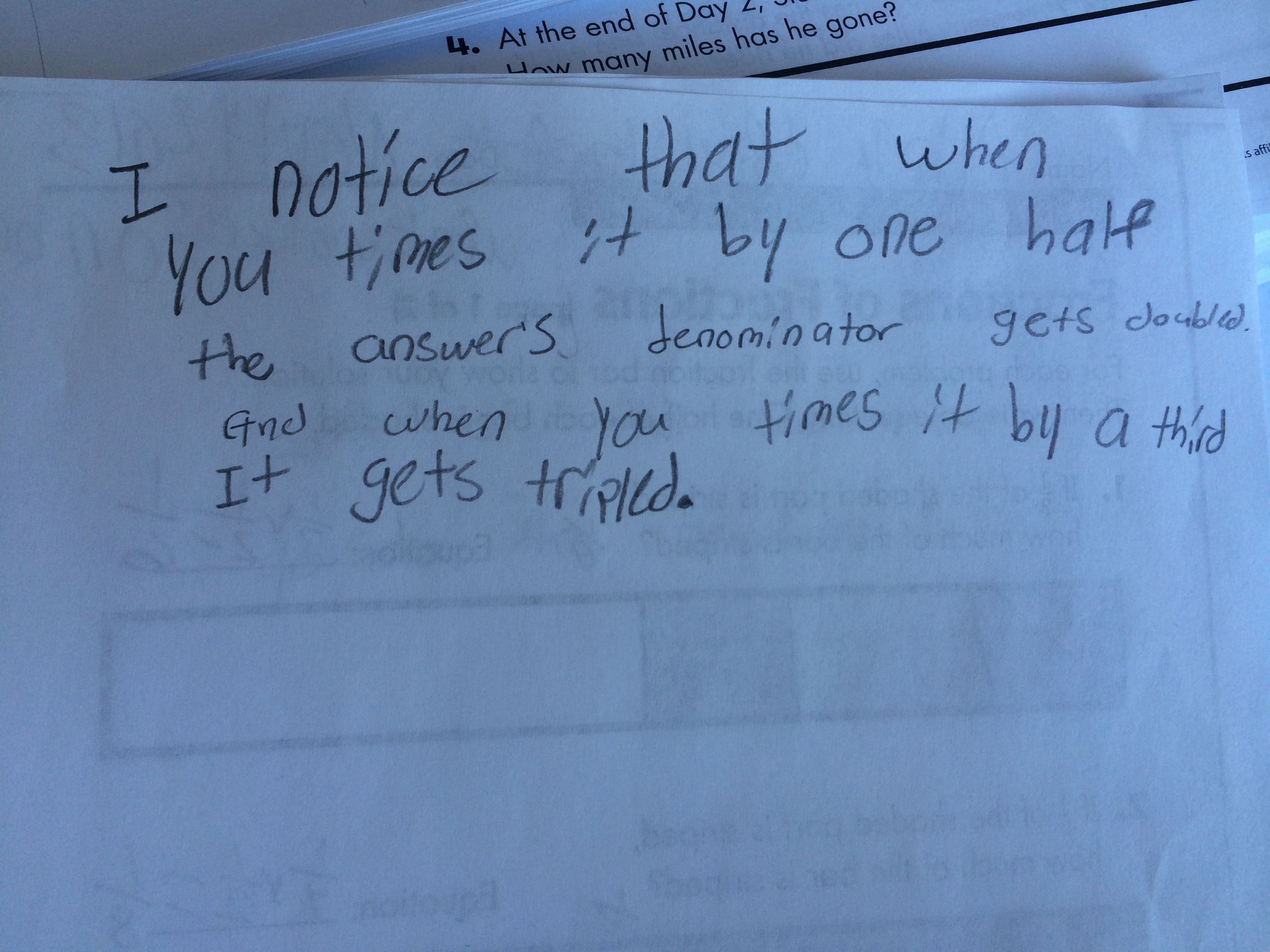
IMG_2426IMG_2411Of course, you always have the students who fly through the work and finish early as I am walking around and having discussions with the students who need some extra help, so I asked those who finished early to think about the denominator each time. Why is the product’s denominator changing from the denominators of the factors? Did you have an idea what the denominator would be before you used the fraction bar?  There thoughts were so interesting:

Absolutely LOVE all of this scratching out, changing her reasoning!

Absolutely LOVE all of this scratching out, changing her reasoning!

IMG_2413

This one brings up the issue of vocabulary….fours instead of fourths, eights instead of eighths. Something I have to bring out in our discussions.

IMG_2414

This one I struggle with because of the words double and triple. I know the number itself is doubling and tripling, but I would like to have them expand that is it happening because there is another half to split or two other thirds to split.

IMG_2415

I love that this makes the fractions factors and products are just like whole number factors and product.

IMG_2416

Again with the “double” word. Is it just me that struggles with this one??

I am thinking this will be one of MANY multiplication and division of fraction posts! I am just amazed at the ease the students work with the fraction bars and I like what Investigations has done thus far with these lessons. One tweak I would like made would be the directions…students are asked to “stripe 1/2 of the shaded portion” and it is becoming a tongue-twister for me 🙂 I keep saying shaded when I mean striped, minor detail but they keep correcting me!

These conversations are so rich and valuable for this understanding that it blows my mind that a teacher could just say “multiply the numerators. multiply the denominators. That is multiplication of fractions.” If I had learned fractions this way, it would have all made SO much more sense!

To be continued…

Reflecting on the Mathematical Practices

On Thursday, in the spirit of Halloween, I presented the class with a set of vampire teeth and the Pandemic lesson from @Mathalicious: http://www.mathalicious.com/lesson/pandemic. If you haven’t checked it out, you definitely should, great stuff on their site! Also, this post will not make much sense unless you understand the premise of the lesson 🙂

IMG_0196Being a 5th grade class, I knew we wouldn’t get into the exponential representation, but I wanted the students to reason about what was happening each week and look for patterns in the problem. They did not disappoint.

The students were very quick to jump right in…monsters, blood, vampire teeth…they were all in! The majority of the class were fairly quick at recognizing the number of vampires was multiplying by two each week. I found the biggest struggle for them was to keep the total population in mind.  For example, in Week 1 when there were 2 vampires, there had to be 138 humans because there always had to be a population of 140. The following week when there were 4 vampires, the students subtracted 4 from the Week 1 human population, arriving at 134 humans, but the total population would only be 138.  It was hard for them to realize they only needed to subtract the “new vampires” from the human population, not the current vampire population.  It was a struggle and some got frustrated when I would ask them if people left the town? Did you lose dots from your array? They wanted the answer, it drove them crazy and I loved it!

At the end of the lesson, I had two groups who had gotten through the world population piece (they were very surprised that it didn’t take them that long to get to 7 billion)! They predicted it was going to take them forever!

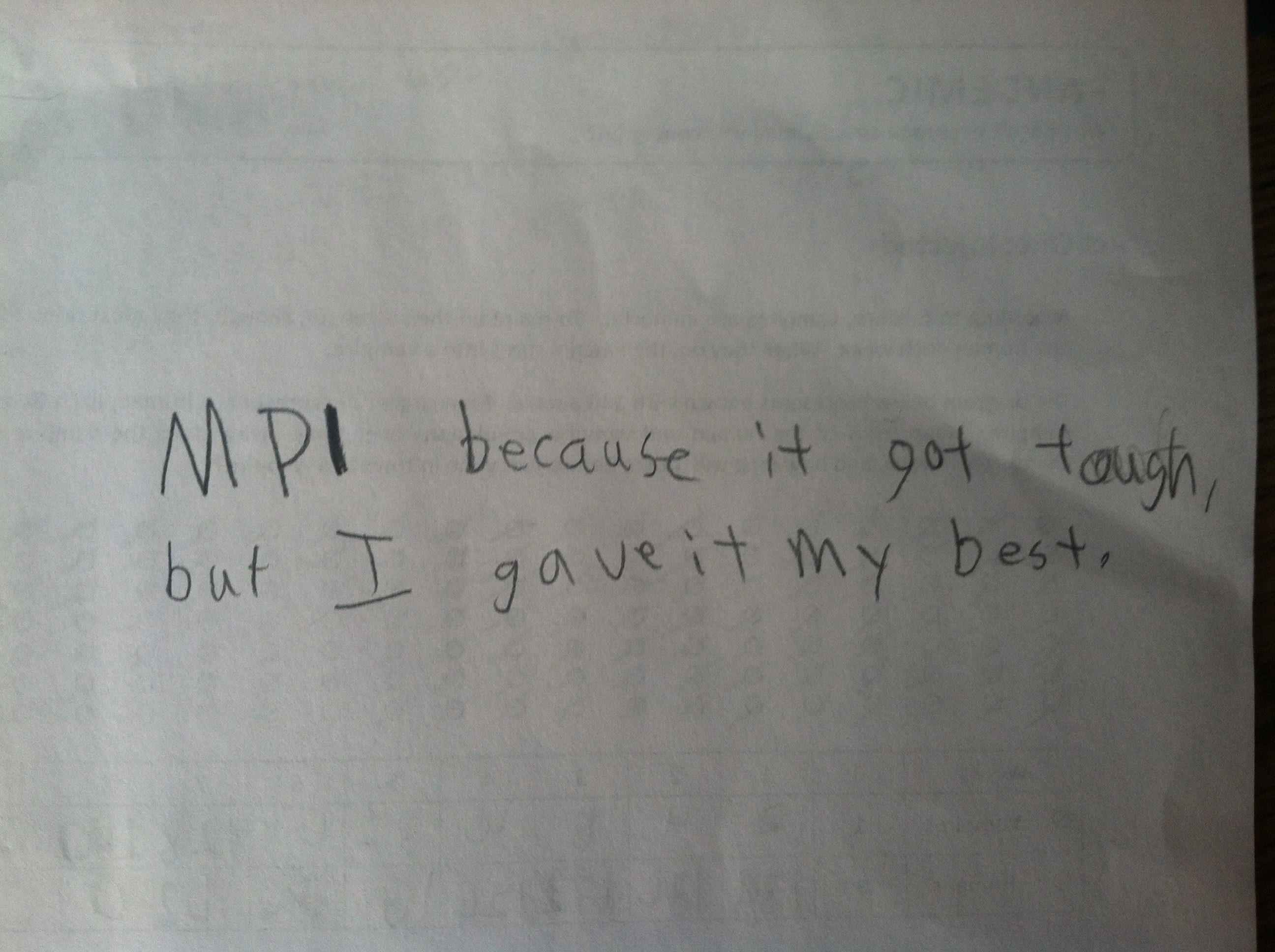
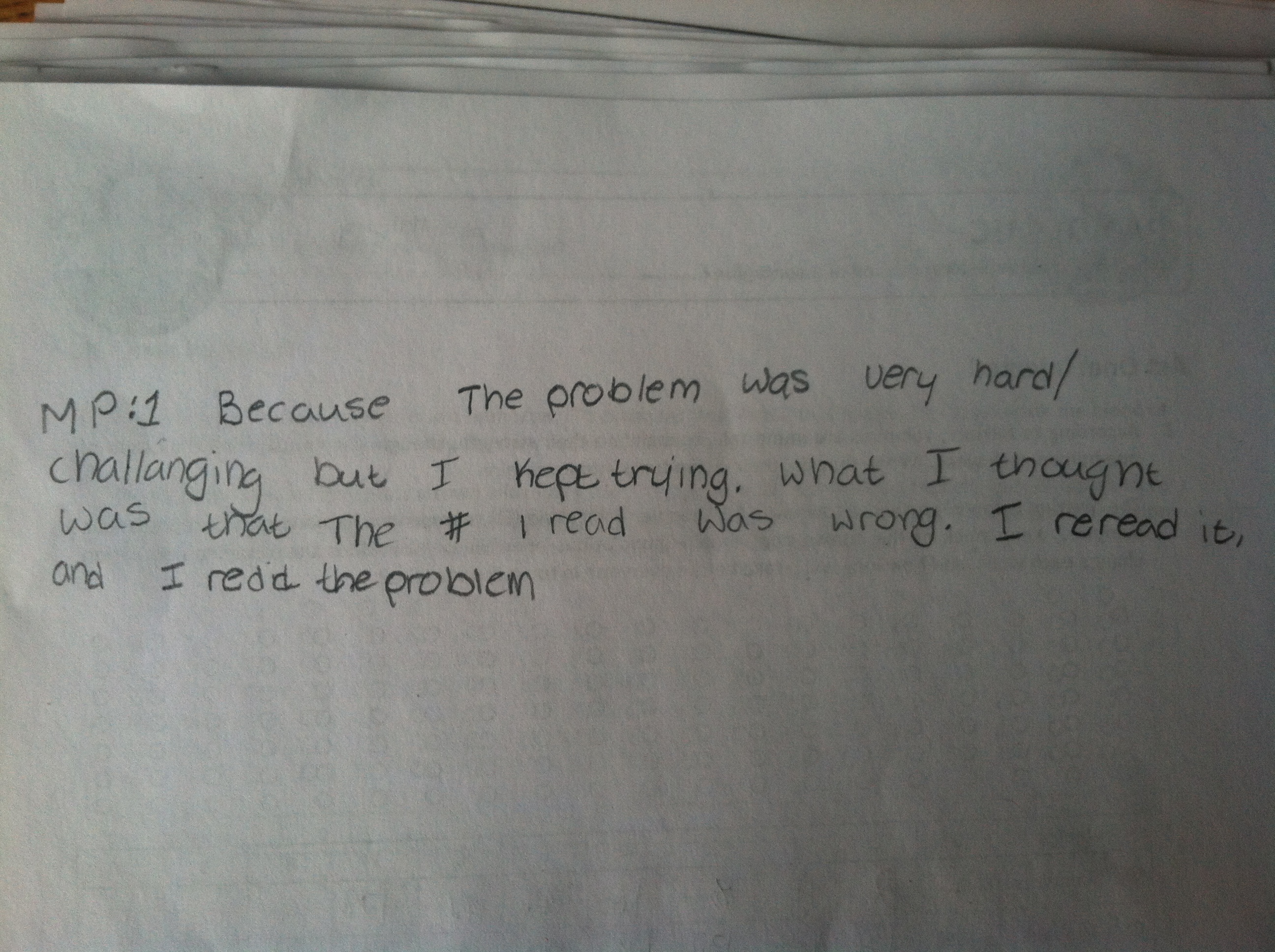
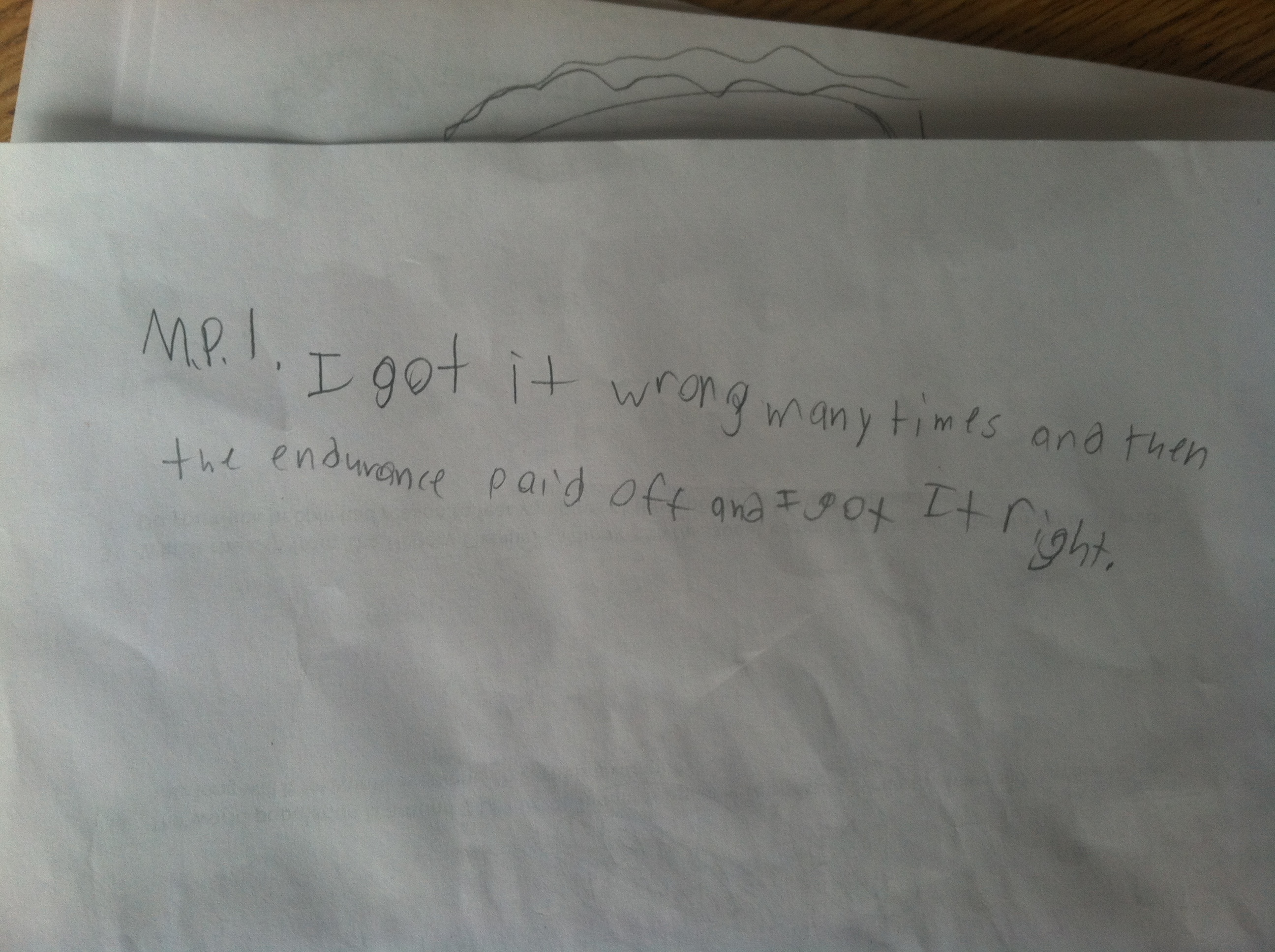
Before leaving, I had everyone reflect on which Math Practice(s) they felt they best reflected their work in math class that day and here are just a couple examples:

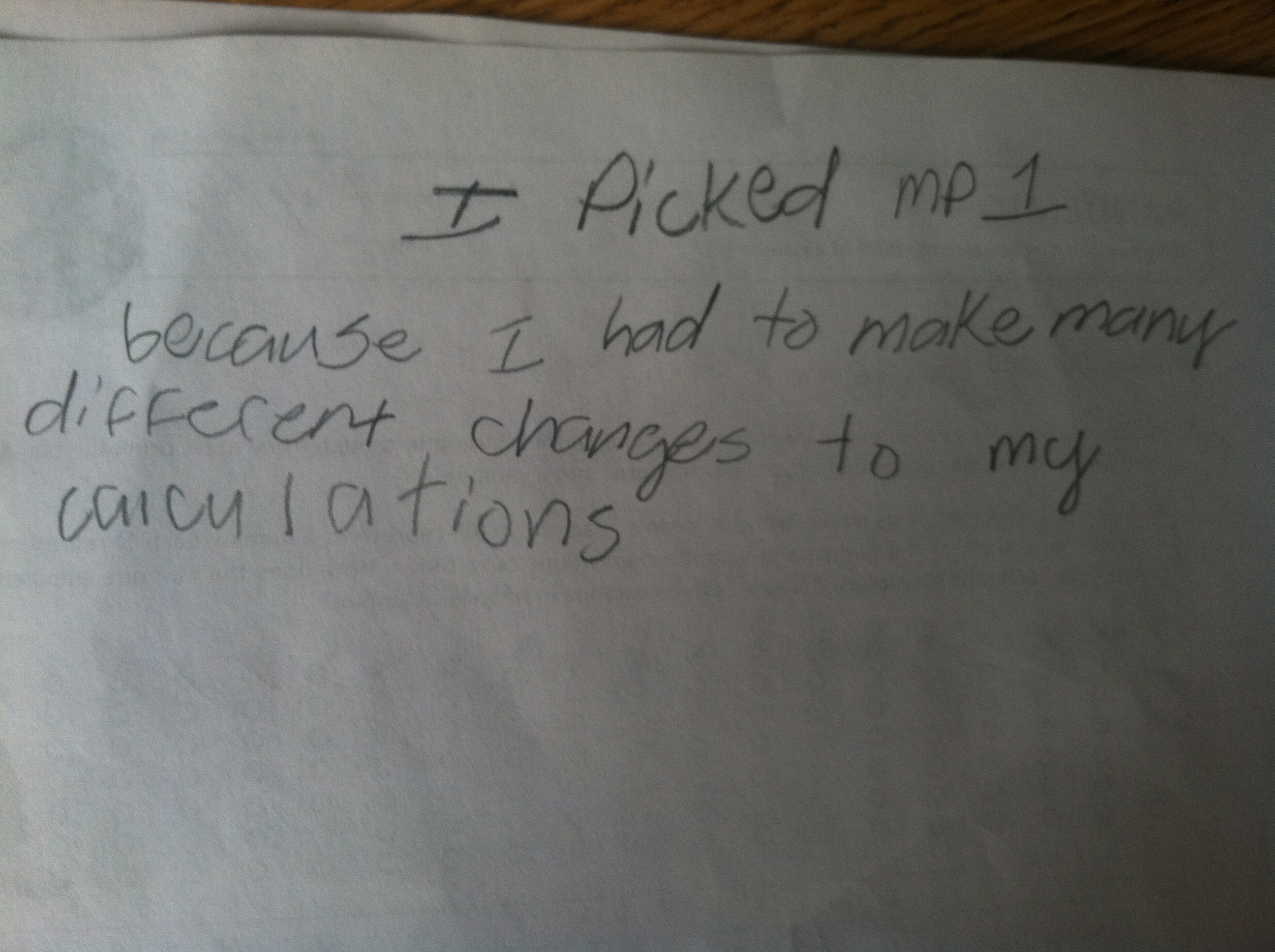
IMG_2369 IMG_2370 IMG_2371 IMG_2372Math Practice 1 was by far the unanimous choice because they felt the struggle of working through a math problem. I loved reading their reflections, and it made me realize that I need to really work on asking that question more often and push them to look at the other Practices in their work.

-Kristin

Why We Need Two Teachers in Every Classroom…

This job takes two brains to handle the thoughts of these students.

In class on Friday, one student made the comment that he didn’t really like adding fractions on the clock because it could only be used for certain fractions.  When I asked him to expand on that, he explained he could only do halves, 3rd, 4ths, 6ths, 12ths and 60ths easily and what if he wanted to do other fractions like 1/8 or 1/24?  He said he couldn’t do that without breaking the minutes up.  I am excited at this comment especially because this student is one whose parents have taken him to Kumon math for years for “extra help” and he is most comfortable memorizing procedures over thinking about the math. He thinks changing to “common denominators by multiplying the numerator and denominator by the same number” is faster and easier than this clock.

Upon reflection, I think it is interesting that he stayed with fractions of the fractions we were working…why not pull out 1/9 or 1/11? But my first train of thought in the moment was changing the whole. I wanted to see if he could put the clock in terms of a whole day, 24 hours, 2 rotations around the clock being the whole instead of one. That way 8ths and 24ths would be more apparent.

So I asked him if he could think of a way we could change the clock to do 1/8 or 1/24 without breaking up minutes? His first reaction was no, so I said “That is interesting because there are 24 hours in a day, so I feel like this should work.” Possibly leading him too much but at that point I could see the glazed look in some of the students eyes and I felt like I was losing the class’ attention. I told him that during math workshop that day he could chat with me about it or he could take that thought and work with some more for Monday.  He said he wanted to think about it over the weekend…I think mainly because he didn’t want to miss the Math Workshop activities, so we will see what he has for me tomorrow.

After school, I am recapping this lesson for Nancy and saying how difficult I thought it would be for them to grasp two rotations of the clock as the whole for the 24 hours that would allow for 8ths and 24ths more easily.  After listening to me ramble for about 5 minutes about this idea, she casually says, “What about military time?” UMMMmmm…DUH. Where was she during that class period??  This job really does take two brains.

So needless to say, I have amended my lesson for tomorrow. I am handing them this military clock and letting them talk about what fractions we can work with easily that are the same as our first clock and which one’s are different. Design addition equations we can solve with this clock that we couldn’t do on the other clock without breaking minutes.

Image

Don’t get me wrong, I still want to get to changing the whole on our original clock, but I think after working with this clock, it may be more accessible for more of the students. I will post later to update on this lesson to show how it went…but good or bad, the questions and thinking that led to this lesson are so worth it!

-Kristin

A Fraction of our Time in Math Class…

I absolutely love fraction work with my students because there is always something interesting that leaves me pondering the whys and hows of my practice….

Being a K-5 Math Specialist for a couple years offered me the opportunity to really see the trajectory of our fraction work. Now being back in the classroom, I feel I have a much better grasp as to the work the students have previously done within our math program.  In third grade, they work tremendously with halves, thirds, and sixths using polygons to represent fractions of a hexagon whole for comparison and addition/subtraction. In fourth grade, students use arrays and known equivalencies to compare and add/subtract fractions with unlike denominators by choosing an appropriate array that works for both fractions (common denominator). In addition, at each grade level, students in need of RTI enrichment, work in Marilyn Burns’ Do The Math Program which utilizes fraction strips to compare and add/subtract fractions. All of this work focuses heavily on the students’ understandings of equivalencies.

Knowing all of this still never prepares you for the power of a new model….time! I have to admit, I am a huge fan of fraction strips and array work, however today I felt the power of clocks in developing equivalencies.  I have taught this lesson in previous years and to be completely honest, never really liked it. It felt contrived, like a pizza divided into slices in another form. This year I have realized it was not the context that was lending itself to the “pizza feel,” it was me.

The class began with a discussion of a blank clock face. I asked the class if the minute hand stayed at 12 and the hour hand moved to the 1, what fraction of the clock did it turn? They said 1/12 and we chatted about how we can prove that, divided it up and went from there. Next I asked if the hands were reversed, would that give us a different fraction? Some said no, some said yes and we talked about the equivalency of 5/60.

The student questions that followed took my appreciation of the clock to another level:

“Is this the same as degrees since it is a circle?”

“Could we do the fraction for a whole day (24 hours)?”

“Can we split the minutes in half to do eighths?”

“What fraction does the clock go at the time we go to lunch?”

Holy cow, how many directions could I take this lesson??  I moved forward with having the students work with partners to find all of the fractions they could represent on the clock.  Then I asked them to use that model to add 1/3 and 1/4 on the clock. It was interesting to see the students who know how to “find common denominators” by multiplying the numerator and denominator by the same number were challenged to make a proof of their equivalencies on the clock face, while the students who needed the clock as a tool had it as their disposal to see that 1/4 is 3/12 and 1/3 is 4/12.  That clock face immediately went from something I saw as just one more pizza, to both a tool and model at the same time in my classroom.

The follow up activity is called Roll Around The Clock (http://tinyurl.com/p8sm7wa). It has fantastic variations to the game and I have student work on the positive/negative scoring system that I will post soon, it was the perfect extension for the students who needed it!

So today, in just a fraction of time, I found a new appreciation for the analog clock and hopefully improved my practice by a fraction!

-Kristin

Reversing the Number Talk

I am a huge fan of number talks and use Sherry Parrish’s book at least two to three times a week to conduct a number talk with my students.  Sometimes I pose just one problem for students to solve mentally and discuss strategies while making connections between them or I do a string of problems targeting a specific strategy.  Recently, I have been focusing on partial products and using friendly numbers as strategies to multiply. I noticed that as the string went along, they wanted to try and predict what the final problem (or “the hard problem” as my students would say) in the string would be. I started taking a few predictions each time and the conversation was really intriguing to me.

For example, the other day, the string was:

5 x 10

5 x 50

10 x 50

15 x 50

15 x 49

As they predicted the final problem, they actually made a more difficult prediction than the ending problem, 15 x 49. They predicted problems such as 15 x 47, 30 x 51 and 15 x 52.  Their reasonings were targeting the strategy of using friendly numbers without me having to outwardly say it.

So I thought it would be interesting (and fun) to go in the opposite direction and give them the last problem of a string  to see if they could develop the string of three problems that would come before it.  I gave them “36 x 19” and they ran with it.  Here are some ideas i captured from the journals:

Photo Oct 09, 12 50 16 PM Photo Oct 09, 12 51 15 PM Photo Oct 09, 12 52 40 PM

This is a great formative assessment for me to see their thought process through our multiplication problems. Definitely adding it to my list of favorite activities!

~Kristin

Number Talks by Sherry Parrish: http://store.mathsolutions.com/product-info.php?Number-Talks-pid270.html

Meaningful Math Conversations…

I am a true believer that content coaching is a necessity in the improvement and sustainability of math instruction, however we all know that finding time to even use the restroom during the course of the school day is close to impossible! So how do we find time for these important conversations to happen and more importantly, we need to be fortunate enough to have a position in our school that does just that, coach.

Last week, my class was working on finding fraction/percent equivalents using a 10 x 10 grid.  They did great with the fourths and eighths, but then we hit 1/3!  As I walked around and talked to the students, I saw a range of strategies: shading one out of every 3 squares, shading one out of every 3 rows, then squares, and some just knew that three 33’s was as close as they could get with whole numbers and had just shaded 33. No matter which strategy they chose, the “leftover box” was leaving many perplexed.

After quite a bit of struggling with what to do with this leftover box and some happy to just settle at 1/3 = 33%, Nancy (our math specialist, former 3rd grade teacher, and partner in crime with all things math) came into the room.  She helped me by chatting with a group about their thoughts on what do with this 100th box. Class, unfortunately, had to wrap up to go to lunch, and I wasn’t comfortable that some students had had sufficient time to think about it, so I left the class with that leftover box as food for thought that night.

Over lunch, Nancy and I were talking about what she had heard from the students and she made the statement, “It is amazing how they don’t make connections to all of the sharing brownie work we did in 3rd grade when trying to count off by 3’s in the grid..” For those who use Investigations, you will  know the exact lessons to which she is referencing, for those who don’t you can probably infer the context 🙂 We discussed the difference of the contexts for students, the array work they do in 4th grade and then tried to figure how to make that connection for my afternoon class. Tall job for the 15 minutes left of lunch, AKA speed eating.

I typically start my class with some type of number talk, so we sketched out a number talk that focused on the brownie problems of years past. Lunch ended and when the class came in the classroom, they headed to the carpet for a number talk.

I did the following sequence of problems, sharing strategies as we went:

How can four people share one brownie?

How can four people share 6 brownies?

How can four people share a pan of 21 brownies?

They did an amazing job and were very confident in their strategies and I definitely put them into a “fraction state of mind.” We then went into finding our percentages and even the strategies for finding the percents equivalent to fourths and eighths seemed smoother and then when we hit 1/3 and that leftover box was much less mysterious.  There were still a few who struggled but I definitely could see more perseverance and entry points at problem solving. They seemed to make a connection to the brownie problems at the beginning of the lesson.

This entire rambling of my thoughts really boils down to one thought….Improving instruction is about finding time to have those meaningful math conversations. Had I not had that conversation with Nancy and changed my number talk for the second group, the lesson was going to have the same fate as the first.  That conversation helped me make math connections that I could then make my students. Would I have loved to have more time to think out this lesson and retry it the next day, of course, but did Nancy and I improve it…absolutely!

~Kristin

Fraction Talk

It has been forever since I have blogged, and although I have been so inspired from many things I read this summer, nothing inspires me like talking to my 5th graders!

As we begin our venture into fractions, I have to first give some props to my 4th grade teachers. I have never heard so many “Yeah, fractions” and “I love fractions!” ever.  I attribute this to a lot of hard work and dedication by Nancy (math specialist), the fourth grade teachers, and the Marilyn Burns’ Do the Math fraction units.

Yesterday in class, to get a feel for what my students know about fractions, we did a “Show What You Know” with problems involving writing, comparing, and adding fractions. They seemed very comfortable with writing fractions, comparing fractions using benchmarks, and finding fraction of a group.

Then we get to the problem asking students if the expression 2/3 > 2/6 is True or False. As they shared their reasonings, I heard many anticipated strategies such as “2/6 is equivalent to 1/3 so 2/3 is bigger than 1/3” and “The pieces are bigger in 2/3 and you have the same amount of each so it has to be more.”

As the conversation was coming to an end, one student raises her hand and sets my wheels spinning.  She said “I know that if I just subtract the numerator from the denominator, whichever fraction has the the smallest difference is the larger fraction. But it only works when the numerators are the same.” Huh. I asked her why she thought that worked and she said she didn’t know but proclaimed it would work every time.  I told her we would think through that one and revisit it soon because I needed time to think it through. Being the thoughtful student she is, I had this work from her by the end of the day:

IMG_2186 IMG_2187I was proud she gave examples and tested even and odd numbers to be sure that didn’t effect the outcome.

So my next question for myself (and anyone else who is reading and feels like offering some advice) was what to do with this…

Nancy and I sat and talked about why this works…here are some points to our discussion:

– When you subtract the numerator from denominator you could finding the fractional piece the fraction is from a whole, assuming you put it back over the denominator.

– But since the denominators are different this would not give you a piece of information that would make this “trick” valuable.

– As the denominator gets larger and the numerator stays the same the fraction gets smaller.

– So the bigger the difference between the numerator and denominator, the smaller the fraction.

– Does it work with improper fractions? Yes.

– Is it worth revisiting in class yet because some students may pick up the “trick” and not be ready for the reasoning behind why it works.

– But isn’t it really simple? 3/4, 3/5, 3/6, 3/7…and so on…the difference of the numerator and denominator is getting greater, so the fraction is getting smaller.

So in closing I have no answer of what to do with this information. I am thinking I will revisit it with the student alone because she is anxious for why this works. I may save it for the rest until I have a better grasp on where they are with their understanding of numerator/denominator relationships, but am I being too cautious? I just don’t want “tricks” to be used because they are easier for some students than the reasoning piece.

Would love any thoughts!

-Kristin