Tag Archives: Fractions

Fractions As the Denominator

As I was organizing my student work pictures this morning, I realized I had tweeted out this awesome work, but never blogged about it.

My students are very comfortable with putting fractions in the numerator. They use them all of time when decomposing, adding and comparing fractions like in these two examples…

IMG_8910_2 IMG_8300

The other day, two of my students finished early and as an aside asked me if there could be a fraction as the denominator. I asked them to try it out and see what they thought.

They wrote their question and then started playing around with some fractions in the denominator. At first they were writing a bunch of fractions with a fractions as the denominator in attempt to find one that jumped out and made sense to them. They tried drawing some pictures of them along the way to see if they could illustrate what it would look like.

The first one they drew was 1/1.5 in which the rectangle was cut into thirds and had 1.5 shaded. When I asked what they would name what they just drew, they said 1.5/3. Hmmmm, back to the drawing board. They moved to 1 / 2/8, drew a rectangle cut into 8ths and shaded 2 of them. After shading, one student wrote 1, 2, 3, 4 over each 2/8 and said that there were four of the 2/8’s in his picture, so 1/ 2/8 must be 4. I asked what the whole was in the picture and left them to play around with that idea for a bit.

IMG_9035_2

I came back to these additions to the work:

IMG_9037_2

When I came back they said they realized that 1/ 2/8 was really a fraction more than 1 since 2/8 / 2/8=1. When I asked them to show me where that thinking was in their representation, they said since 2/8 was really 1 in their picture, it took four of them to make four wholes. I especially liked how they multiplied the numerator and denominator by 4 (the reciprocal of the denominator) to get to 1 in the denominator. Interesting to think about the algorithm for dividing fractions at play here.

As others in the class finished their work, they started to mess around with this question, trying to make sense of it. This student attempted to put it into a context using the meaning of a fraction we use a lot, “a pieces the size of 1/b,” however with b as a fraction, it is not helpful here.

IMG_9040_2

One student wrote this as his thought about the fraction as the denominator.
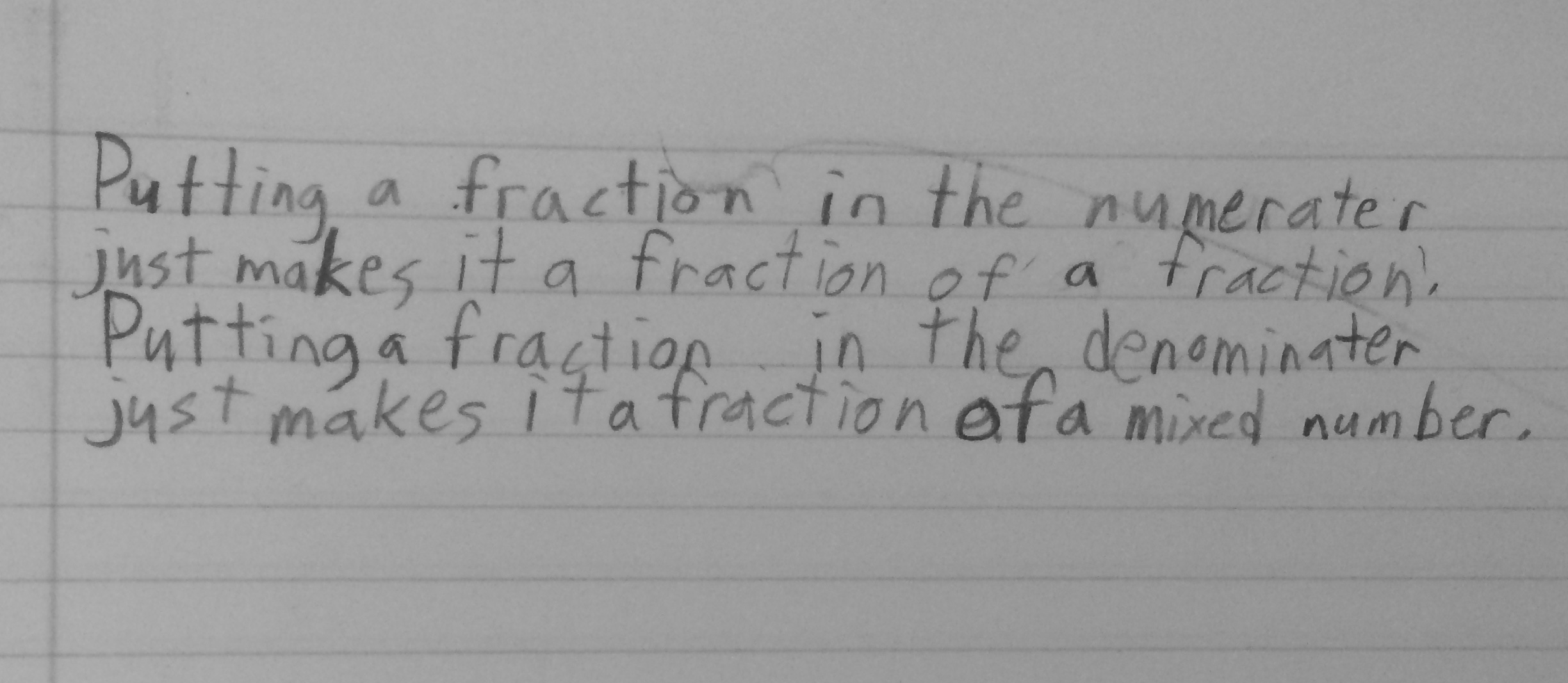
IMG_9038_2

I am left thinking a lot about the progression in which students learn complex fractions.

You Never Know What They Know Until You Push Their Thinking….

Last Friday, at a state math meeting, we had so much fun diving deep into a fraction lesson of a 6th grade teacher. The lesson was on multiplying fractions by fractions and while the conversation started with thoughts about the lesson itself and areas for discussion for the math coach, the lesson really brought to light the fraction progression. I cannot even begin to recap all of the insightful discussion points such as using models and the importance of the representation in mathematics, teacher pedagogy and mathematical understanding, vertical articulation across grade levels….I could go on and on, but I had one brief conversation that leaked its way into my classroom the following Monday.

While we were “doing the math” the students would be doing in the lesson video, a colleague and I were talking about where our 5th graders leave off with fractions and how that is built upon in 6th grade. She made the comment that if the students truly understood taking a fraction of another fraction and fraction of a whole number (both 5th grade standards), then they could reason their way through mixed number times mixed number, which is introduced in 6th grade.  She quickly drew out 3 1/3 x 3 1/3 and we talked through the context in which our book uses and how students could reason about that problem.

So, of course, I have to throw it out to my students on Monday because I am curious at this point if they could work their way through the problem and the various ways they would think about it. This is where that “engaging” vs “not engaging” or “real world” vs “not real world” conversation seems void. I used no context, no real world example, I simply said, “I was talking to some middle and high school teachers at my meeting on Friday about your fraction work and they were wondering how you guys would solve this problem. 3 1/3 x 3 1/3.” They went to work and I started walking around to chat with them.

Here are some strategies I saw…

Image

She started with 3 1/3 x 3 and then added another 3 1/3 and found 1/3 of that to be 1 1/9.

Image

He used partial products. When I asked him how he figured that out, he wrote the 25 x 25 and explained how he gets his partial products there so he did the same thing with wholes an fractions. Wow. Did not expect this one!

Image

Same partial products, just a bit neater!

Image

She used separate bars for each 3 1/3 and then divided the bottom up to find the 1/3 of 3 1/3.

Image

I was so impressed by the work of these kiddos and they were so proud of themselves! They connected understandings of whole number operations to fractions, applied properties of mathematics, used what they knew conceptually about fractions to model the situation, and most importantly persevered through the problem and constructed arguments about their answer.

Don’t get me wrong, it wasn’t all picture perfect….I did have some who initially gave me 9 1/9 (as I anticipated they multiplied the whole numbers then the fractions and put them together) but that led to a great “reasonableness” conversation. A context in this case helped some students see that if you did 3 laps that were 3 1/3 miles long it was 10 miles, so if you did a 1/3 longer, can your answer be less than 10?

Needless to say, I don’t know how anyone doesn’t just love hearing students talk about math and reason about problems. I find it energizes me, my students, and the climate in my classroom. So, thank you to MSERC (University of Delaware Math & Science Education Center) and the Delaware Math Coalition for all of the hard work that is put into making these professional development opportunities so rewarding for both myself and my students! I think you all are AMAZING!

-Kristin

Math & Minecraft Day 1

After many days of discovering my HUGE learning curve with Minecraft, I am finally starting to feel relatively comfortable in Creative mode…I can build a house without flooding it, planted a few trees and I no longer have random blocks floating in the sky around my world!  My class has been staying with me during recess to teach me how to play and I am amazed at how fast and detail-oriented they are in their designs, such as putting lava rocks under the water blocks to form a hot tub and putting glass windows in their new greenhouses. I just kept thinking that I would love for them to use this same precision and perseverance in math class.

I must have Minecraft on the brain, because I as I was planning this weekend for the upcoming week (multiplying fractions w/arrays), all of the scenarios were about planting on an acre of land.  For those who may not know, Minecraft is based in cubes that can be planted in the ground to show a square, perfect for our gardens. I came up with this scenario…

mc

I honestly lost sleep last night anticipating student responses because I knew some students would look at it as fraction of a group of blocks in this scenario, when I wanted it to be fraction of a one whole. Ideally (whatever that really is) I students would build the garden, split the fourths and divide 3 of the fourths in half to result in 3/8 of the garden (being the whole) being melons.  But as they got into groups today, hopped into each others worlds and went to work it was quite a variety of outcomes.

As I expected, many students did it as fraction of a group of however many squares were in their garden. Here is an example of this: http://www.educreations.com/lesson/view/sammy/14346123/?s=sXGl7c&ref=link

This one was interesting because they did a combination of staying with the garden as a whole and then in the end went to the number of blocks were planted with melons: http://www.educreations.com/lesson/view/steve-s-garden/14349675/?ref=link

This one was great because they brought back the fraction bar model we had been previously working with and had it next to their Minecraft garden. (Plus you have to Love their answer): http://www.educreations.com/lesson/view/garden/14361270/?s=tk0bLr&ref=link

Ignore my loud voice in the background on this one, but it is a very great build (and with a key): http://www.educreations.com/lesson/view/dylan/14361243/?s=Qt3Ws8&ref=link

When they completed their garden, I gave them a square and told them that it was one acre and I wanted them to represent the same scenario but on the open square.  I immediately saw confusion in the students who had saw the garden as 16 blocks vs the students who saw it as one whole garden.

Here are a few example answers:

http://www.educreations.com/lesson/view/kurtis/14360404/?s=xWw8UW&ref=link

http://www.educreations.com/lesson/view/riley/14361043/?s=FbOohc&ref=link

This one has some interesting talking points (a little long). You can forward to minute 3:00 for the blank array: http://www.educreations.com/lesson/view/steve-s-garden-kyzei-and-aiyana/14360241/?s=hRV0CF&ref=link

*We also had some great conversations about deciding about the dimensions of the garden and the denominator being a factor of the dimension since we couldn’t split the blocks. For example, many students built a 5 x 5 and went to break it into fourths. They said, “four is not a factor of five so we can’t.”

Lots of sharing to do tomorrow and discussing strategies, notation and the whole in the problem….stayed tuned for Minecraft Day 2…

-Kristin

Number Talks – Fractions

Through doing Number Talks with students K-5, I started to realize that one thing I look for students to use in our whole number computation discussions is using known or derived facts to come to a solution. I feel like the problems I have been using are crafted to use the answers from previous problems to reason about the ending problem.

In the younger grades, I would like to see students using the double known fact of 7+7=14 to know 7+8=15. I want them using 23 + 20=43 to get 23 +19 = 42. I don’t want them treating every problem as if they have to “start from scratch” adding all or adding on.

An example in the upper elementary:

18 x 2

18 x 20

18 x 19

This progression leads them to use a known or derived fact (18 x 20) in order to solve 18 x 19. To build efficiency, I don’t want them to the treat the final problem in the progression as a “brand new” problem in order to reason about an answer.

Along these lines of thinking, as I observed students working the other day, I realized that students weren’t using this same use of known/derived facts when working with fractions. For example, a student was adding  3/4 +  7/8. He used 6/8 as an equivalent of 3/4, added that to 7/8 and ended with an answer of 13/8. Don’t get me wrong, I loves his use of equivalency and I am a fan of improper fractions, however I started wondering to myself if it would have been more efficient (or show that he actually thought about the fractions themselves) if he used a fact he may have known such as 3/4 + 3/4=1 1/2 to then add an 1/8 on to get 1 5/8? Or used 3/4 + 1 = 1  3/4 and then took away an 1/8? Is that the flexibility I want them using with fractions like I do with whole numbers?

I thought I would try a Number Talk the following day to see….

1/2 + 1/2

Thumbs went up and they laughed with a lot of “this is too easy”s going around.

1/2 + 1/4

Majority reasoned that 1/2 was the same as 2/4 and added that to 1/4 to get 3/4. Some said they “just knew it because they could picture it in their head” I asked if anyone used what they knew about the first problem to help them with the second problem? Hands went right up and I got an answer that I wish I was recording. It was to the effect of,”I know a 1/4 is half of 1/2 so the answer would be a 1/4 less than 1.”

1/2 + 3/4

Thumbs went up and I got a variety here. Some used 2/4 + 3/4 to get 5/4 while others decomposed the 3/4 to 1/2 + 1/4, added 1/2 + 1/2=1 and added the 1/4 to get 1  1/4.

3/4 + 3/4

Got some grumbles on this one, because it was “too easy” – 6/4…Duh! The class shook their hands in agreement and they were ready to move on to something harder.  I noticed that when the denominators are same, they don’t really “think” about the fractions too much. I waited….finally a student said, “It is just a 1/4 more than the previous problem so it is 1  1/2″ and another said each 3/4 is 1/4 more than a 1/2 so if you know 1/2 + 1/2 = 1 then you add 1/2 because 1/4 + 1/4 = 1/2.” I had to record that reasoning for the class bc it was hard for many to visualize.

3/4 + 5/8

Huge variety on this one and I thoroughly enjoyed it! From 6/8 + 5/8 = 11/8 to decomposing to combine 3/4 and 2/8 to get the whole and then 3 more 1/8s = 1 3/8.  There were many more students who used problems we had previously done.

What I learned (and questions I still have) from this little experiment:

– Students LOVE having the same denominator when combining fractions.

– Do they really “think” about the fractions when the denominators are the same? Can they reason if that answer makes sense if they are just finding equivalents and adding.

– Students can be flexible with fractions if you push them to be.

– Subtraction will be an interesting one to try out next.

– I would much prefer if I remembered to use the word “sum” instead of “answer”…. I tell myself all of the time, but in the moment I always forget.

– Using known or derived fact and compensation are invaluable for students when working with both whole numbers,  fractions and decimals.

– Are there mathematical concepts that present themselves later in Middle School or High School in which known and derived facts would be useful?

Happy Thanksgiving,

Kristin

Fraction of Fraction Day 2

As I mentioned in my previous post: https://mathmindsblog.wordpress.com/2013/11/15/fractions-of-fractions/ 
I had wondered about fraction multiplication being introduced without a context when the students were coming from lessons in which a fraction of a whole/mixed number had a context. Feeling like the students had a solid grasp on how to find a fraction of a fraction on a fraction bar, I thought I would try having them develop a story context for fraction multiplication problem. They had free reign of the fractions they used and context they chose. Needless to say, it was a learning experience for me. Some showed understanding of what they were doing when finding a fraction of a fraction of something while others unveiled some things I need to go back and revisit.

I have included clips from some of their videos and what I learned from each…. (turn your volume up bc they whispered on these)

http://www.educreations.com/lesson/view/aiyana-fraction-bars/13628710/?s=fv1sHe&ref=link

This one was SO interesting (and a little humorous) because she cut the fraction bar to find 2/3s of 1/2, however when she is explaining her reasoning she used the commutative property. Saying that the answer is 2/6 because that is half of 2/3 was something I had never thought of exploring with students when reasoning about whether the answer made sense. I loved it and definitely added to my lessons for next week!

http://www.educreations.com/lesson/view/riley-s-breadstick-word-problem/13630693/?s=j3i9i5&ref=link

When she introduces the scenario, she says “1/2 of 1/4” so I don’t know if she misspoke or not really understanding the context. I can see she has the process but I don’t know if the understanding is there. I do love how she says “He wanted to find how much of the whole bread stick that was” because she is relating her answer back to the whole. This was difficult for many students. Maybe picky on my end, but I would have liked for her to label the pieces 1/8, 2/8, etc instead of by whole number, even though I know she is counting the pieces.

http://www.educreations.com/lesson/view/ab-word-problem/13627803/?s=Hr3zRv&ref=link

I was impressed how she used a class of students as the whole and did not get confused with the fraction of the class as opposed to the number of students. Many others got caught up in “How many students…” instead of “What fraction of the class.” One thing that just bothered me in watching it was the empty seat in the class! I just wanted to draw a person in for her!

http://www.educreations.com/lesson/view/kyra-s-problem/13628055/?s=aIYKAt&ref=link

This one has such a great context and division of the Hershey Bar that I was so excited, until the end. She seemed good with the context, decontextualized to solve, but then struggled to recontextualize to explain the answer.

I could post and comment all day, but needless to say there is other work to be done and papers to be commented on! It was a great first day with our 1:1 iPads using Educreations! I learned so much that now I must work on readjusting my math plans for next week!

-Kristin

Why We Need Two Teachers in Every Classroom…

This job takes two brains to handle the thoughts of these students.

In class on Friday, one student made the comment that he didn’t really like adding fractions on the clock because it could only be used for certain fractions.  When I asked him to expand on that, he explained he could only do halves, 3rd, 4ths, 6ths, 12ths and 60ths easily and what if he wanted to do other fractions like 1/8 or 1/24?  He said he couldn’t do that without breaking the minutes up.  I am excited at this comment especially because this student is one whose parents have taken him to Kumon math for years for “extra help” and he is most comfortable memorizing procedures over thinking about the math. He thinks changing to “common denominators by multiplying the numerator and denominator by the same number” is faster and easier than this clock.

Upon reflection, I think it is interesting that he stayed with fractions of the fractions we were working…why not pull out 1/9 or 1/11? But my first train of thought in the moment was changing the whole. I wanted to see if he could put the clock in terms of a whole day, 24 hours, 2 rotations around the clock being the whole instead of one. That way 8ths and 24ths would be more apparent.

So I asked him if he could think of a way we could change the clock to do 1/8 or 1/24 without breaking up minutes? His first reaction was no, so I said “That is interesting because there are 24 hours in a day, so I feel like this should work.” Possibly leading him too much but at that point I could see the glazed look in some of the students eyes and I felt like I was losing the class’ attention. I told him that during math workshop that day he could chat with me about it or he could take that thought and work with some more for Monday.  He said he wanted to think about it over the weekend…I think mainly because he didn’t want to miss the Math Workshop activities, so we will see what he has for me tomorrow.

After school, I am recapping this lesson for Nancy and saying how difficult I thought it would be for them to grasp two rotations of the clock as the whole for the 24 hours that would allow for 8ths and 24ths more easily.  After listening to me ramble for about 5 minutes about this idea, she casually says, “What about military time?” UMMMmmm…DUH. Where was she during that class period??  This job really does take two brains.

So needless to say, I have amended my lesson for tomorrow. I am handing them this military clock and letting them talk about what fractions we can work with easily that are the same as our first clock and which one’s are different. Design addition equations we can solve with this clock that we couldn’t do on the other clock without breaking minutes.

Image

Don’t get me wrong, I still want to get to changing the whole on our original clock, but I think after working with this clock, it may be more accessible for more of the students. I will post later to update on this lesson to show how it went…but good or bad, the questions and thinking that led to this lesson are so worth it!

-Kristin