Which One Doesn’t Belong?

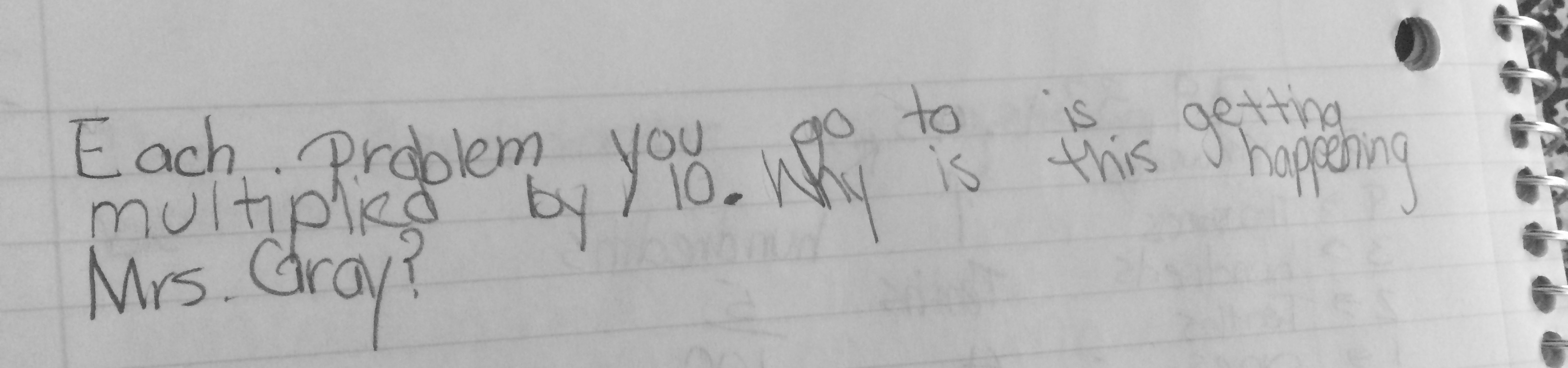
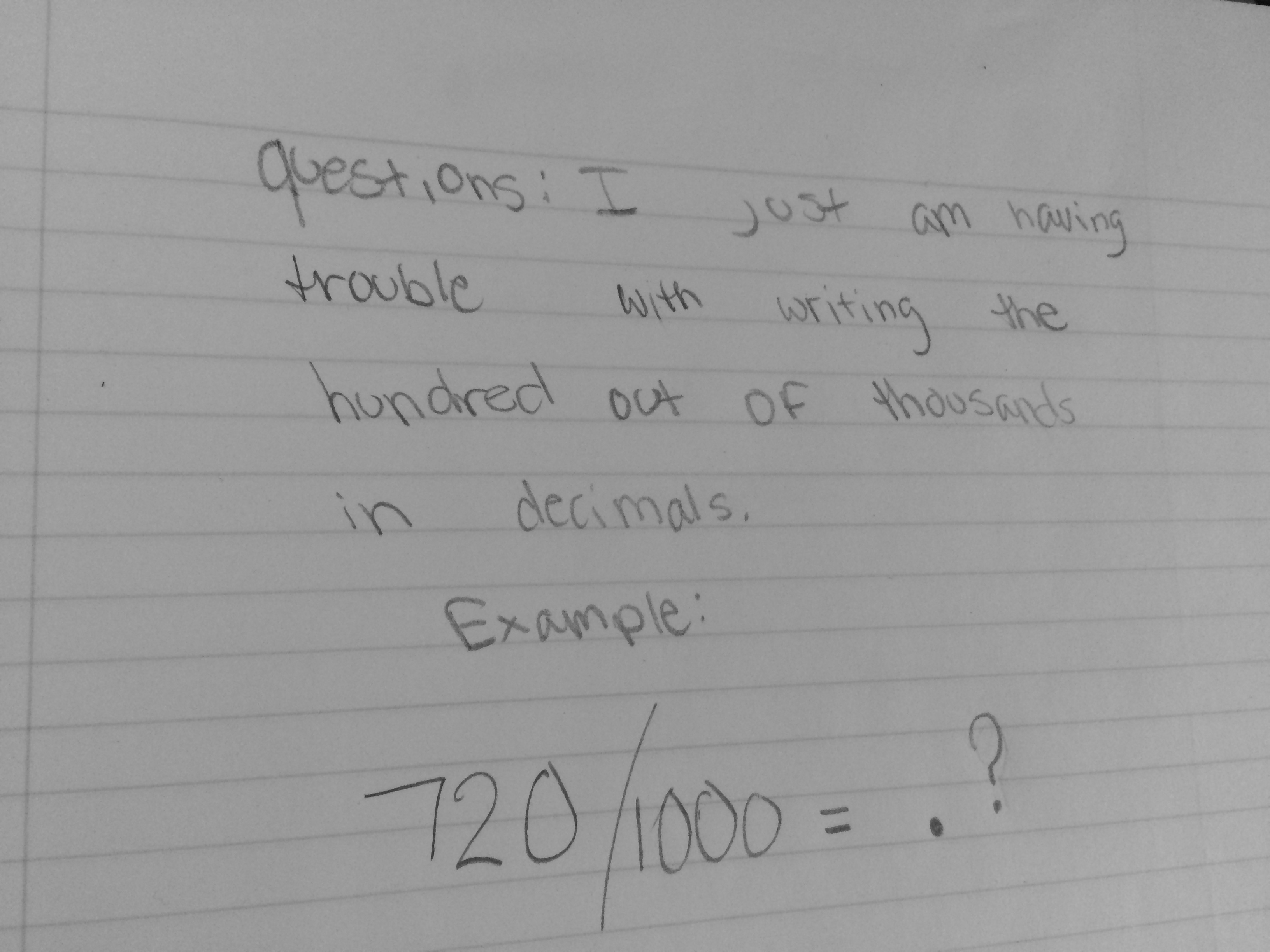
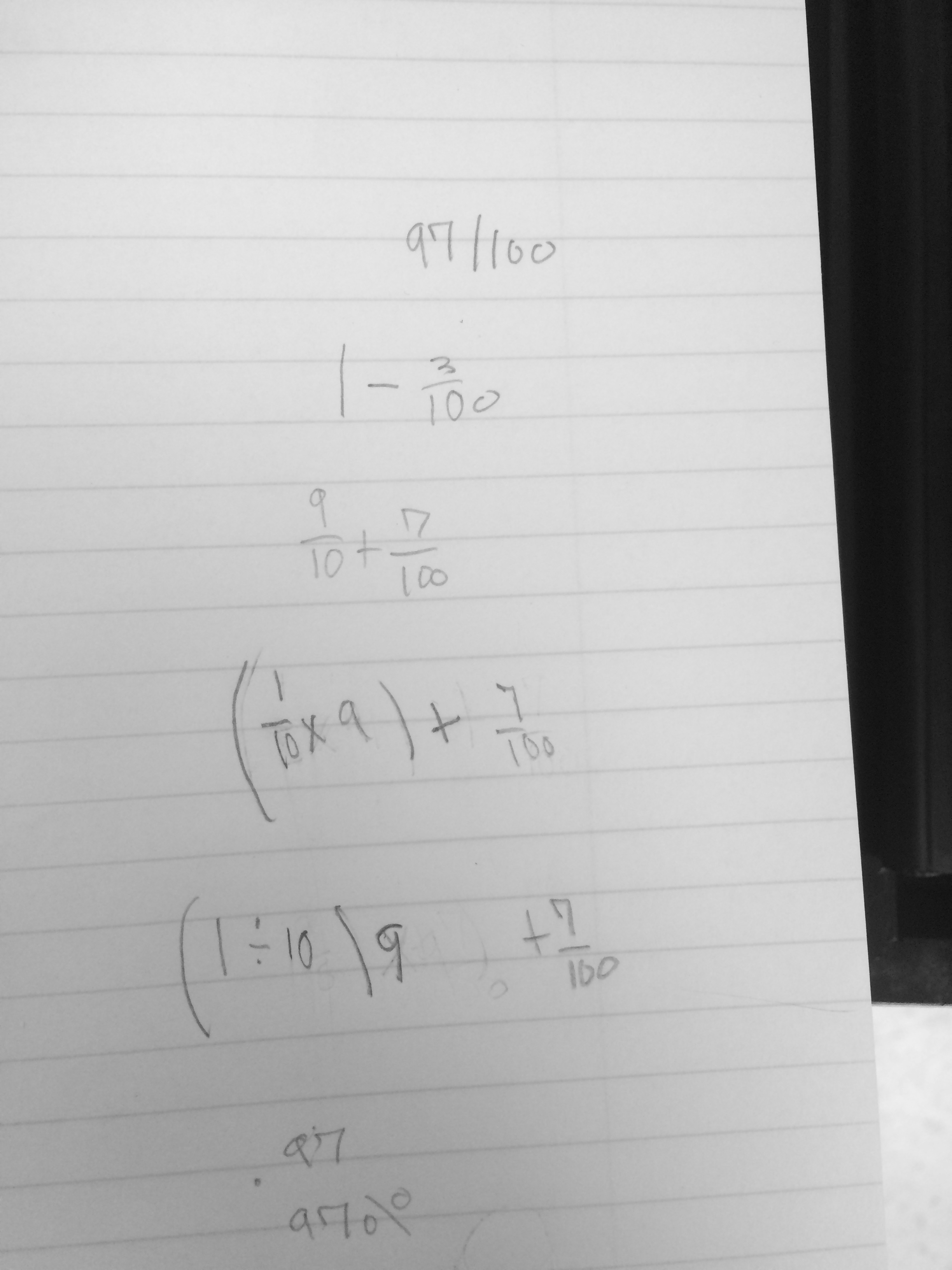
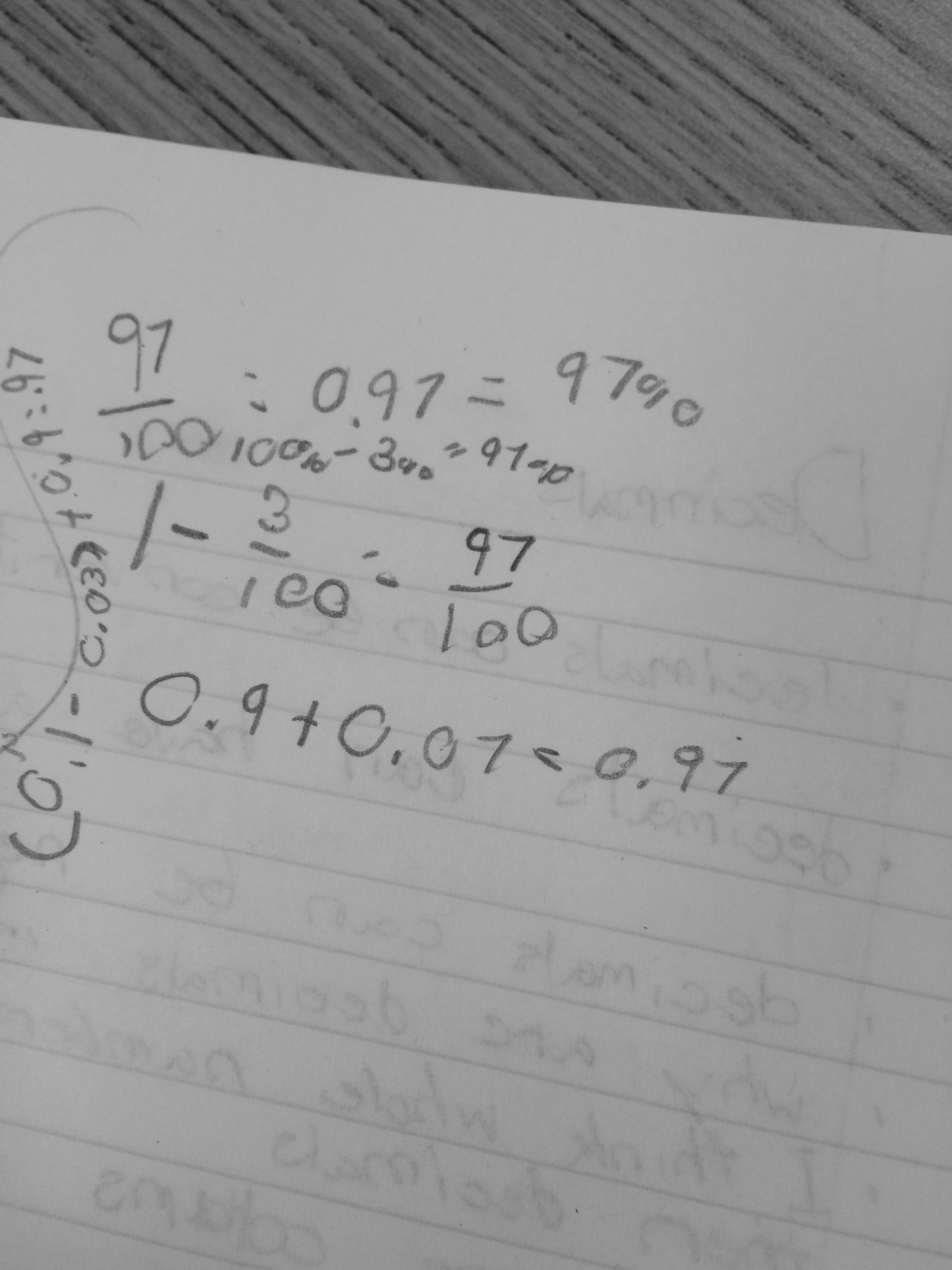
After all of the interesting conversation around Christopher’s (@trianglemancsd) Shapes Book and a conversation with Faith (@Foizym), I thought it would be fun to take this thought about “Which One Doesn’t Belong” into my students’ decimal work. With these decimals, I wanted to draw out reasonings about closeness to benchmarks, equivalents, and properties of numbers in relation to decimals. It did all of that and more! I wrote the following four decimals on the board and had students talk about which one they thought didn’t belong:

woIn brainstorming these decimals beforehand, I knew that 0.49 would be the most obvious because it is the only one that went into the hundredths, so I go that out of the way as the sample response and asked them to see if they could find another reason for 0.49 or any of the other three decimals. They brought out some pretty great stuff and definitely gave me insight into how they think about multiplication of decimals! It was also so nice to hear, as I walked around during their talk, the freedom students felt expressing their ideas when they knew there was no right or wrong answer!

-Kristin

Consecutive Sums – 5th Grade

We did Fawn’s Visual Pattern #8 today! http://www.visualpatterns.org/

vp

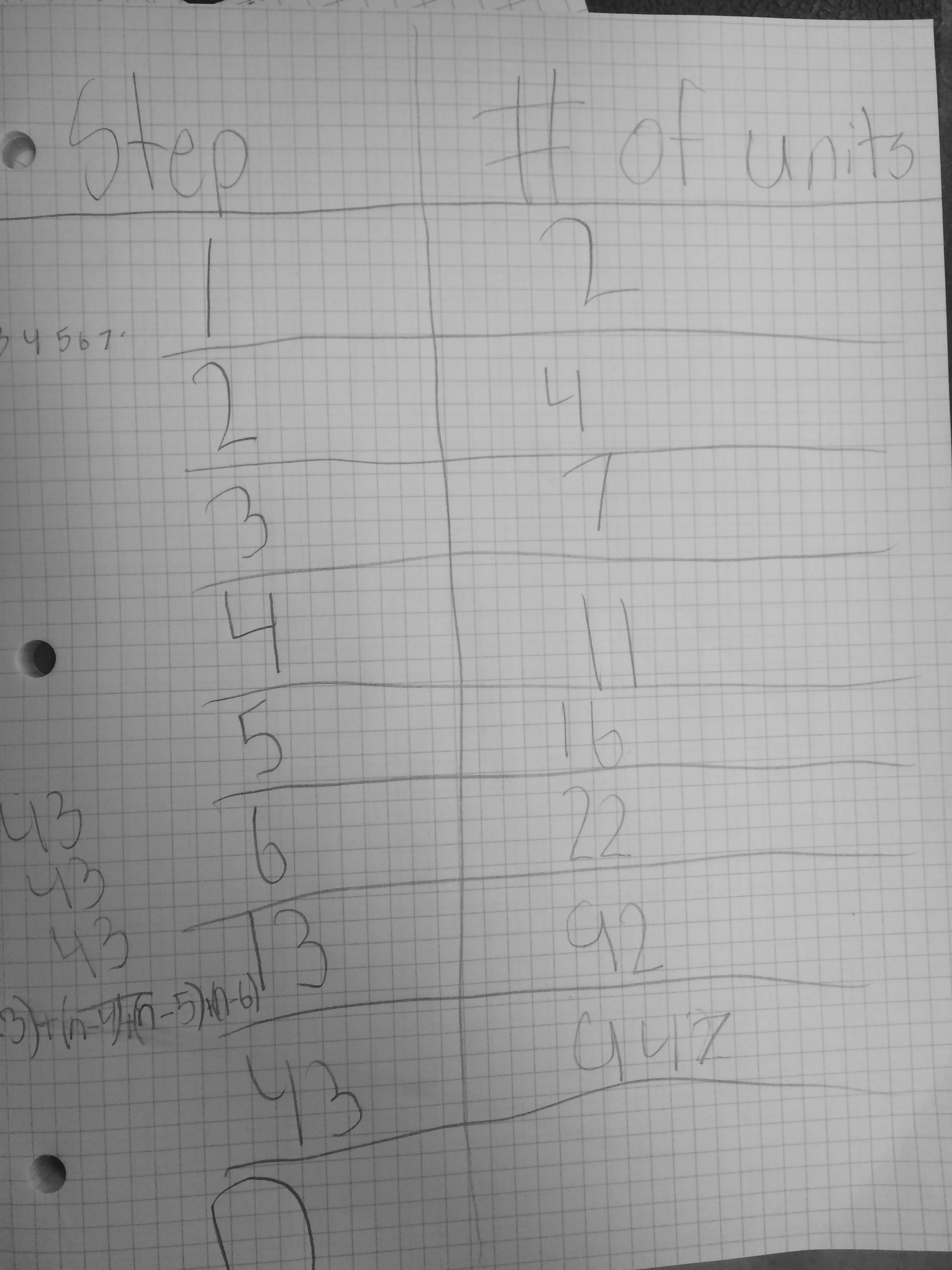
After completing steps 1-4 the class quickly saw that each time, the step added with the previous step’s unit count to get the new unit amount. From there, they struggled to get to the nth expression. They tried a bunch of different things, as you can see on this paper and saw various ways it was growing, but could not come to an agreement on this one!

IMG_9106On their calculator they could get the 43rd step, but if I asked about the 100th, they would just continue adding on the calculator. In their explanations, they kept saying that they would visually “set that one penguin on the bottom row aside and then it would be 3+2+1 or 4+3+2+1…etc” And then one student came up with this at the bottom of their paper..IMG_9107

This group also had some very nice work toward the nth expression…

IMG_9103IMG_9104IMG_9105They wanted me to tell them what it was, but of course I would not:) I will let them sit with that overnight and do a Notice/Wonder about consecutive numbers tomorrow to start our day together. I am thinking after some noticing, they will be able to apply it to this work!

-Kristin


What DO they know?

I love reading and giving feedback on my students’ journals,  I make time for it every day. But the mere thought of grading papers (feedback or not) makes me world’s biggest procrastinator. Unfortunately, my reality is that I need grades for progress reports and report cards, so I make the best of it. I try to make the assignments valuable for both the students and myself in their learning, however  I always wonder why I don’t approach the papers the same, they are both student work right?

I had a realization yesterday while I was grading, as to why I make time to read their journals vs the aversion I have to grading papers. While I was grading, my mind was focused on what the students DON’T know, what they aren’t getting, aggravation at the careless mistakes, aggravation that I didn’t “reach” that child and why they don’t all have 100%. As I graded, I was busy making notes in my own journal of the students who were missing certain items so I could make my plan for next week to help them better understand the material. And while I know this is invaluable in planning to better teach my students, I realized I was completely glancing over what they DO know. I was checking off the problems they were getting correct and focusing solely on the wrong. Don’t be mistaken, I LOVE mistakes in math, I love analyzing what students could have been thinking, misconceptions and/or misunderstandings, but when grading, the feeling is still not the same.

This focus on “wrong” wasn’t the only thing that bothered me though. I also wasn’t “feeling” my students’ voices in the assignments, like I do their journals. Maybe it is because I love hearing them talk about math so much, their journals are the next best thing when they have left class for the day.  Maybe it is the freedom for them to take more chances in their journals or simply say, “I don’t understand it from this point on..” that makes them so much more enjoyable. Or maybe it is the mere fact I don’t have to put a grade to their thinking. As I read their journals, I am looking at everything they DO know and how that led them to where they are instead of the other way around.

Their journals feel more like the way we learn then grades do. We try, we make mistakes, people help us along the way with advice, we try again, we test things out, we look back at what we did to build on it….no number is attached to that, so why grades? I would like to think I try my best to not have grades be a focus in my classroom and instead be a snapshot of where students are right now in their learning, but those assignments still do not hold the same value that their journals do for me.

Maybe someday standards based grading will make its way into our district but until then I will continue to read their journals for things just like this…

IMG_8986_2– Kristin

My Student’s Curriculum…

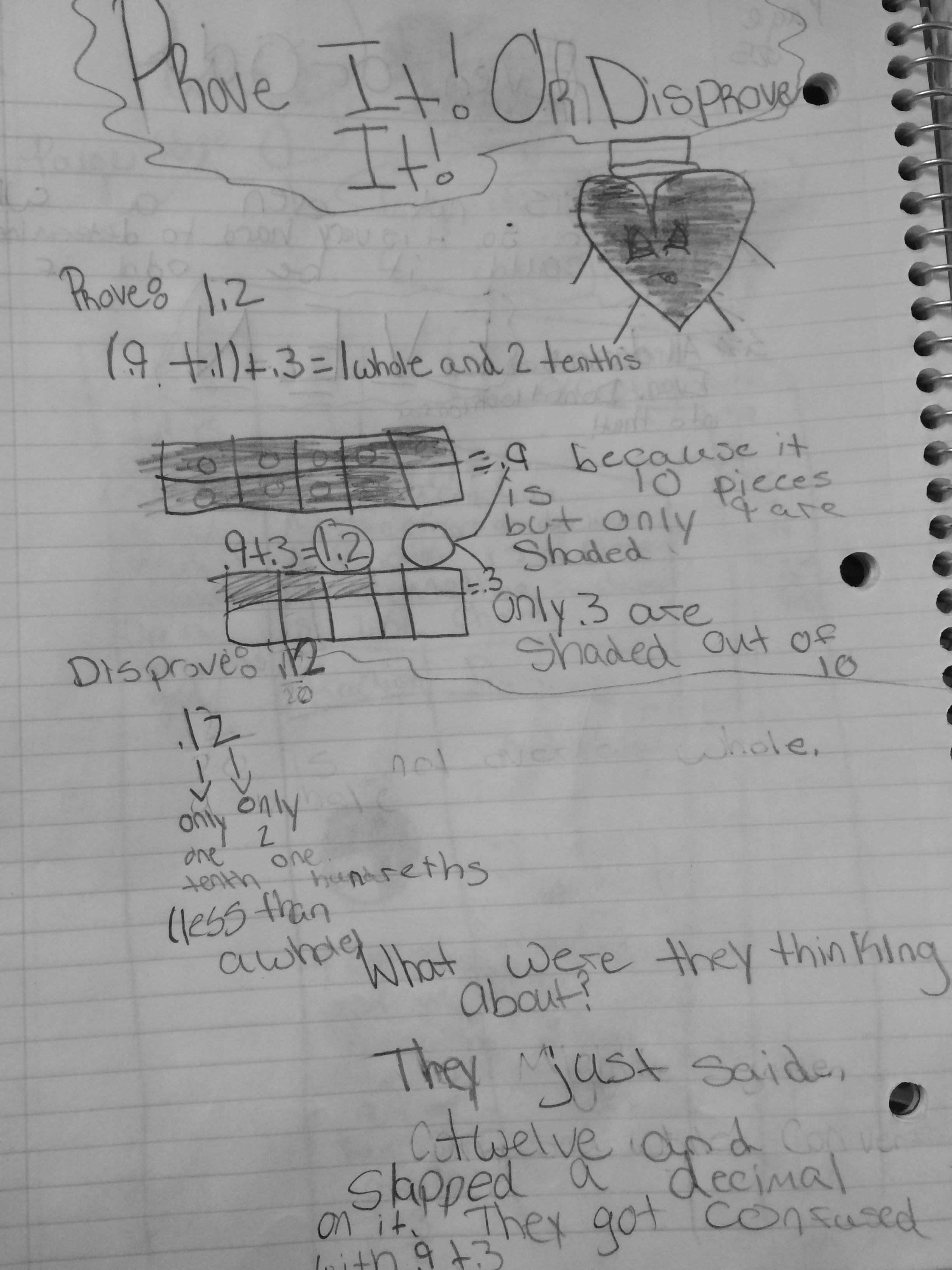
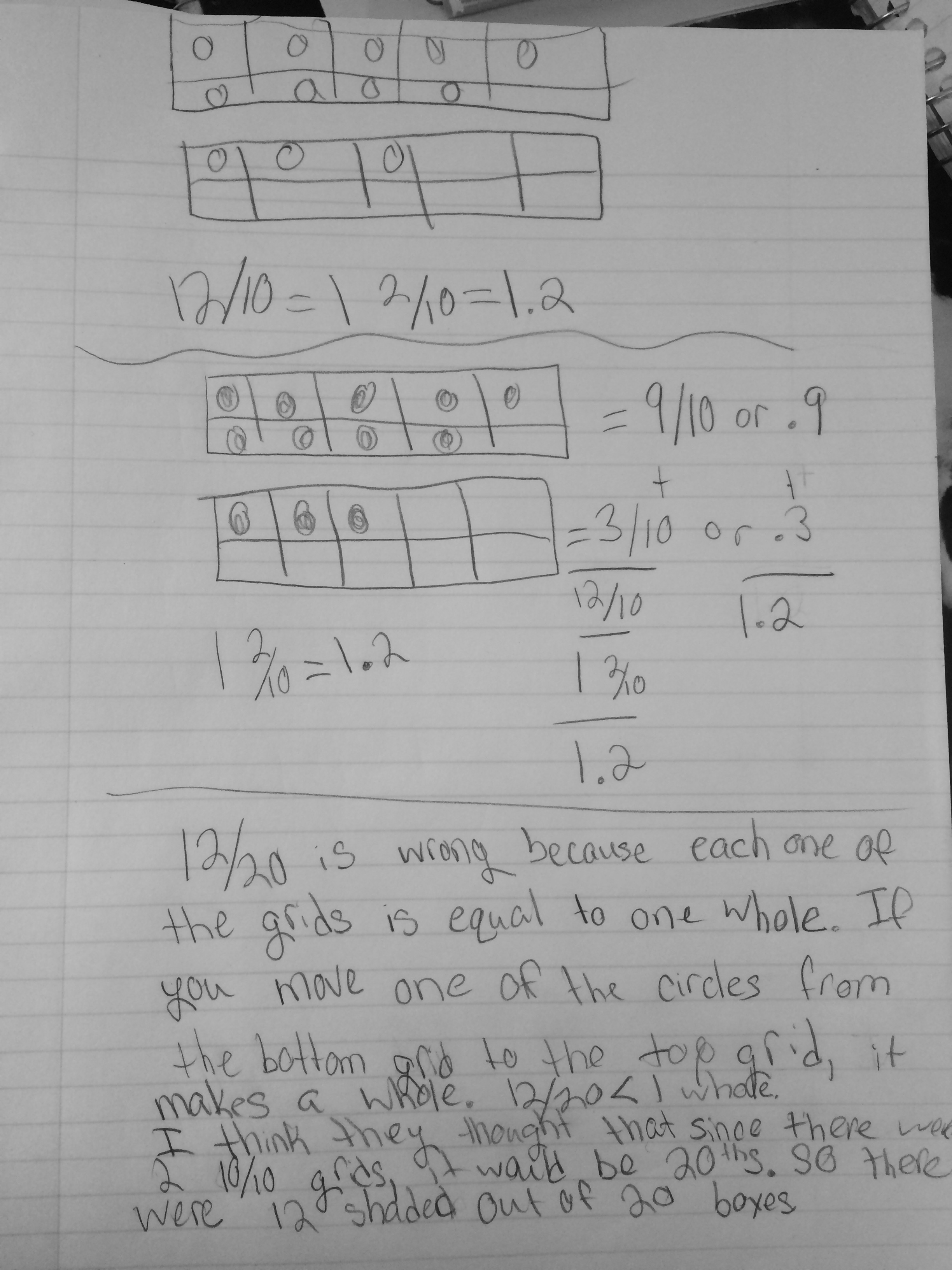
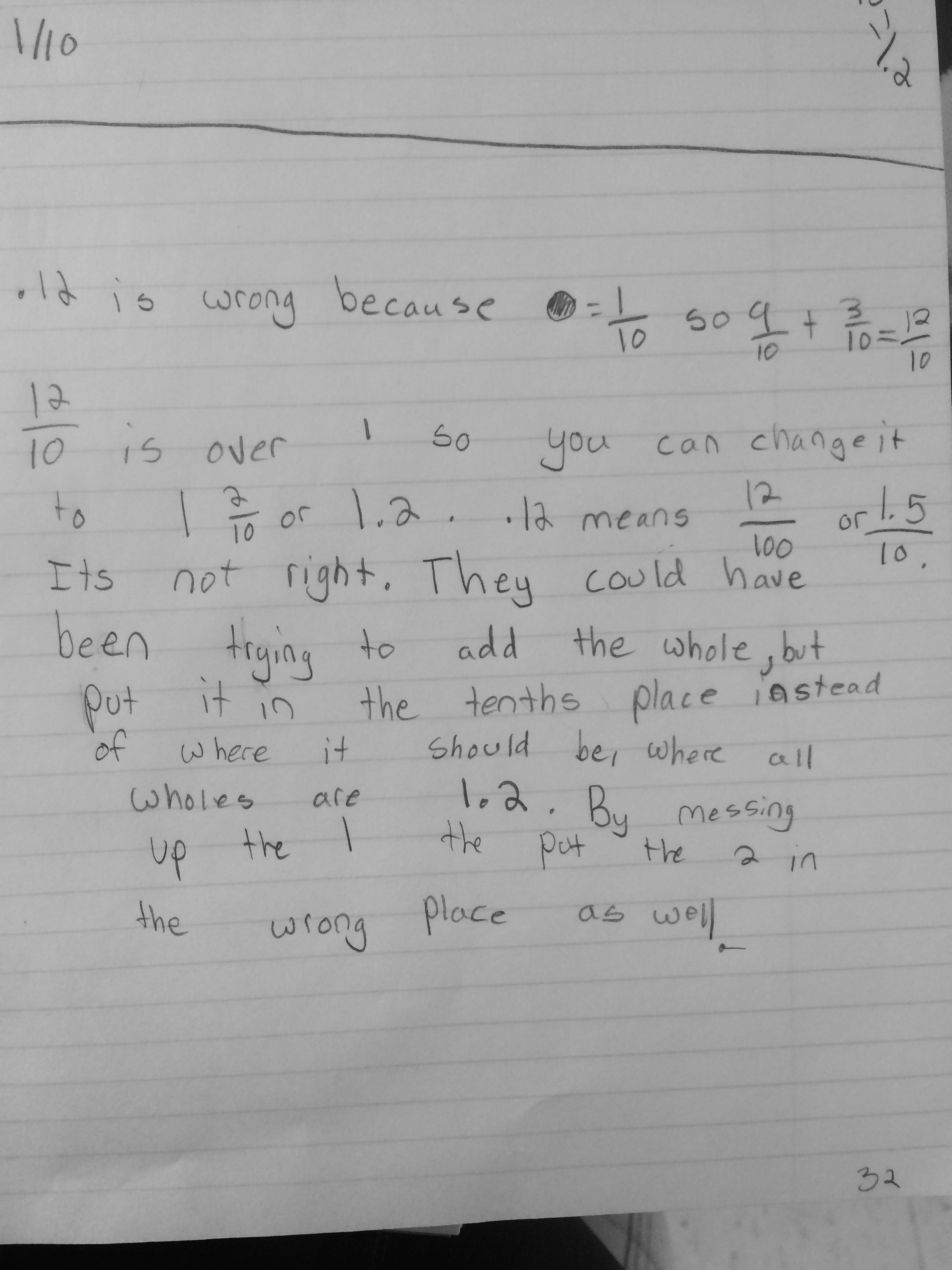
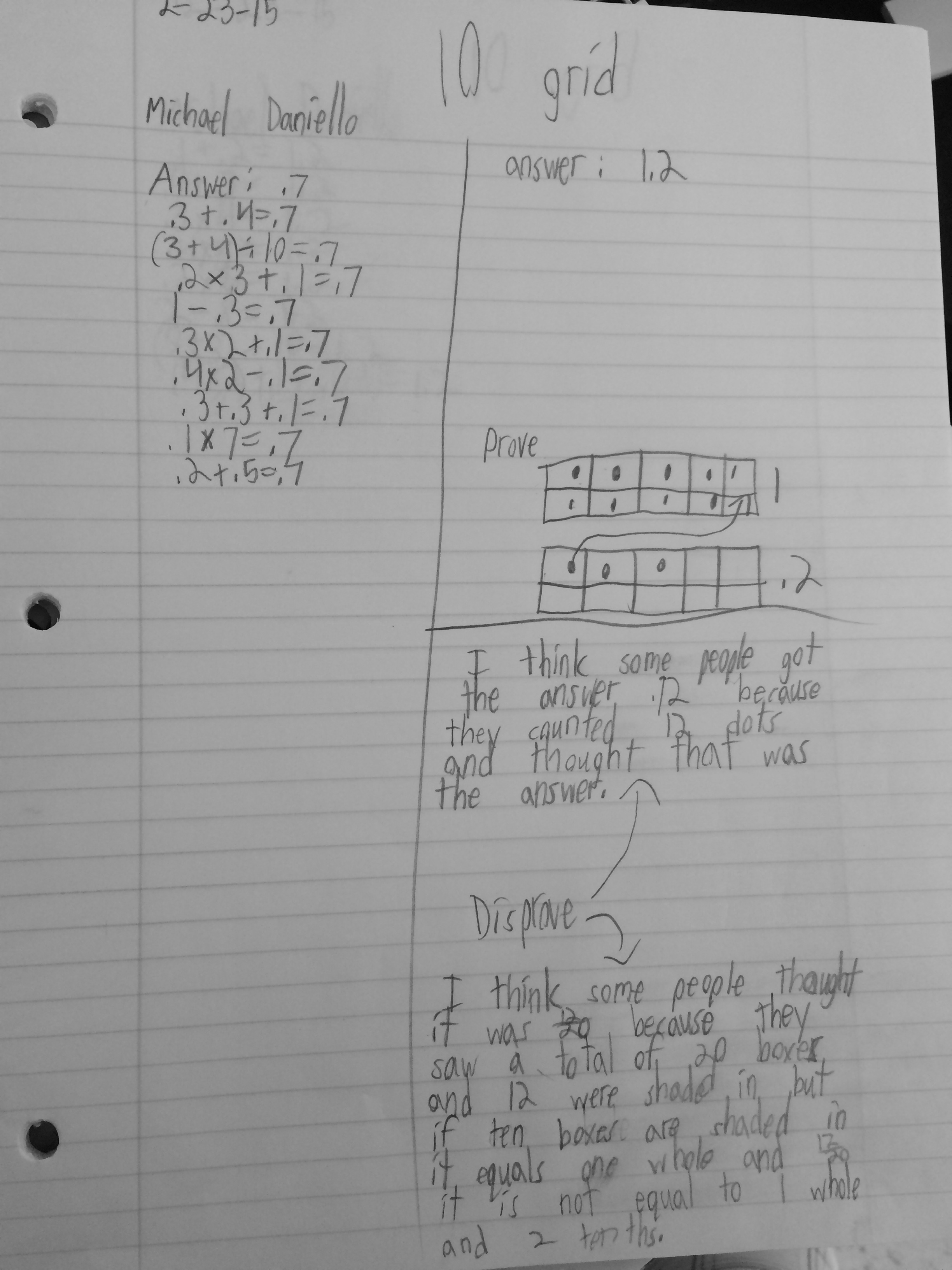
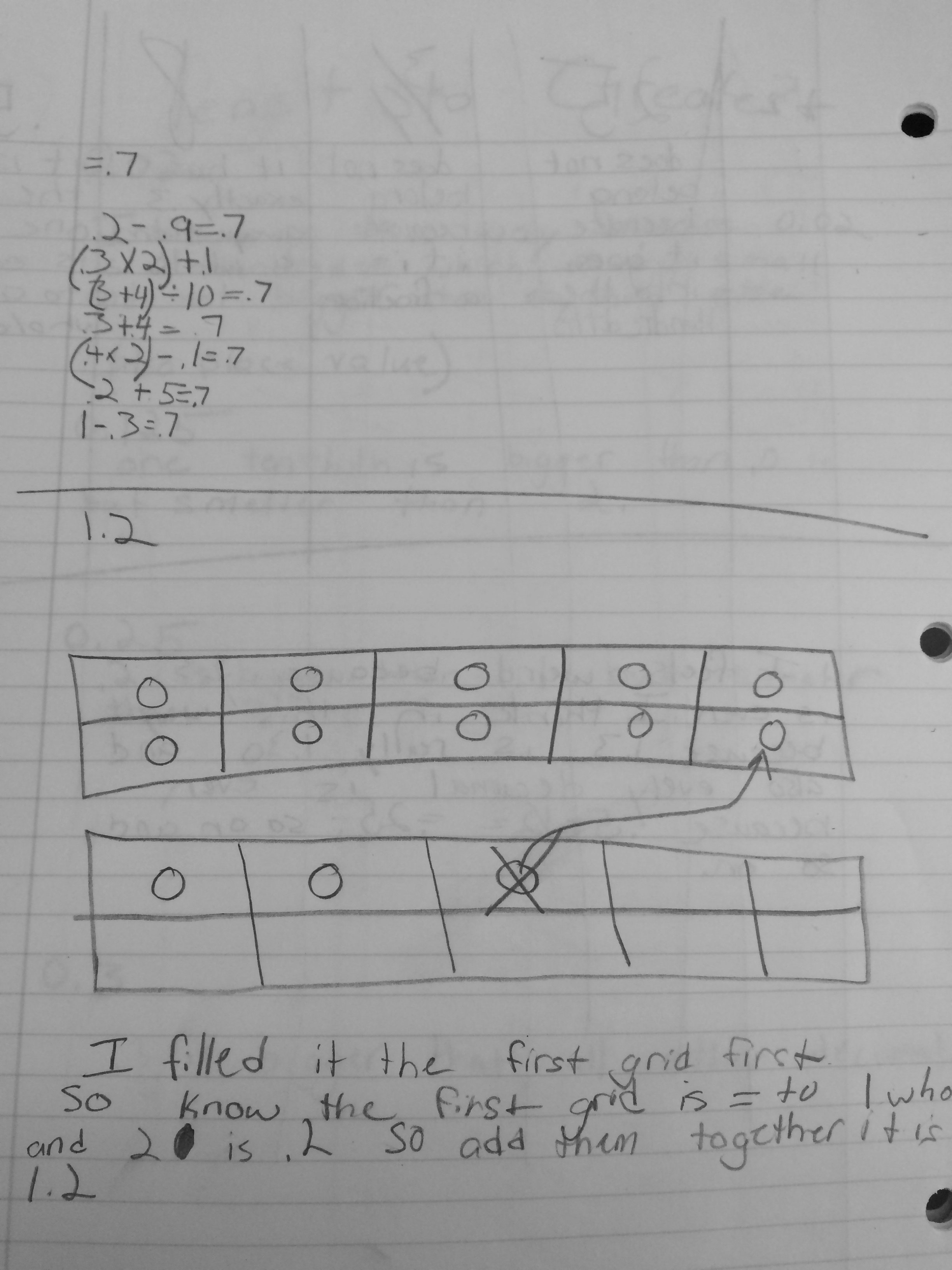
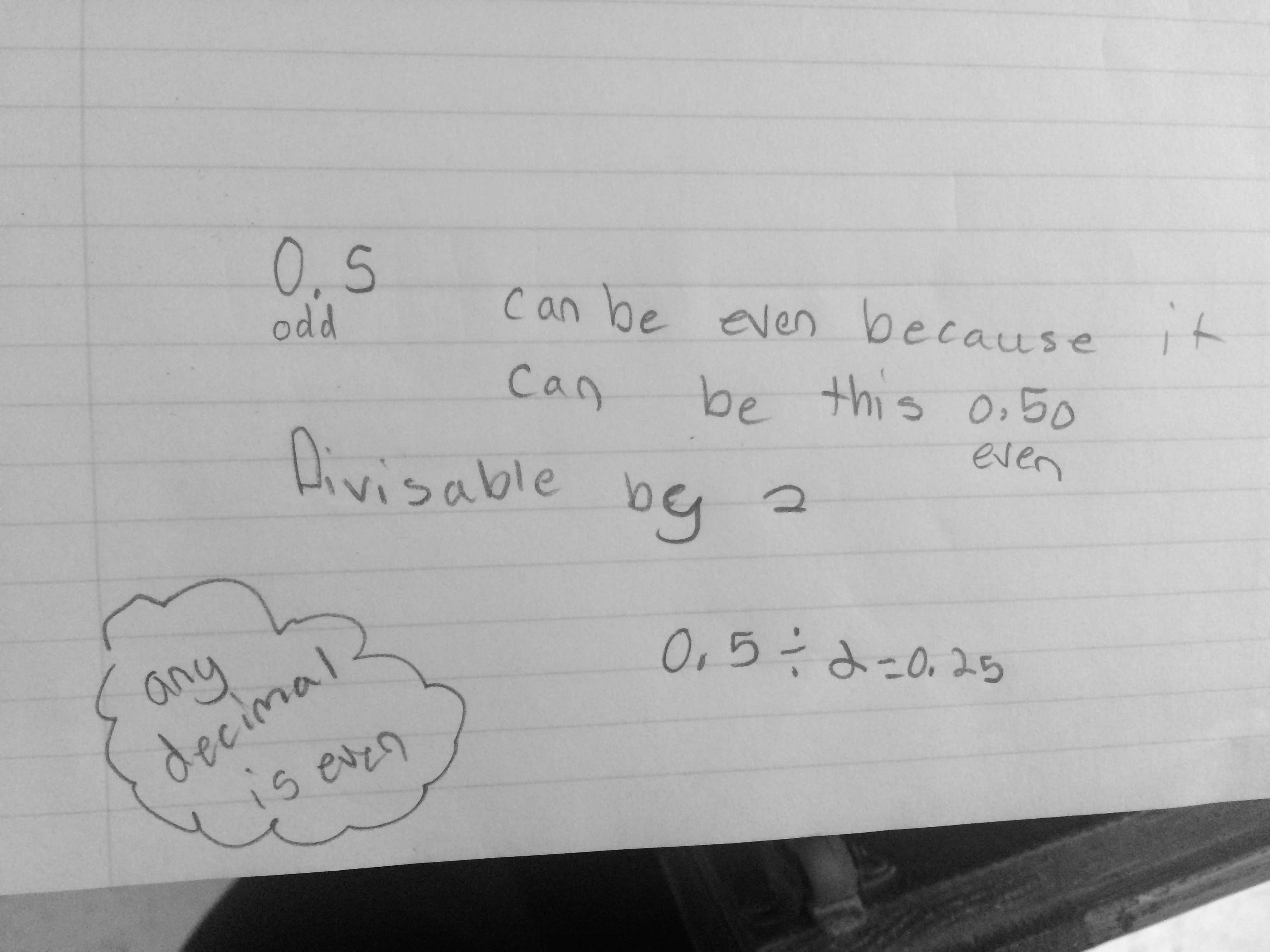
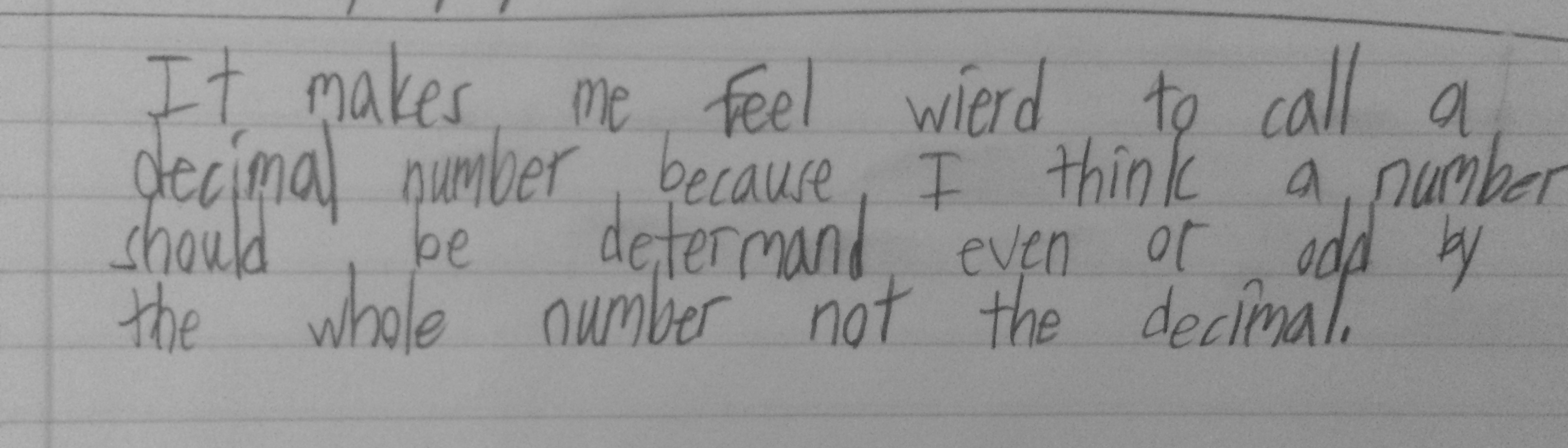
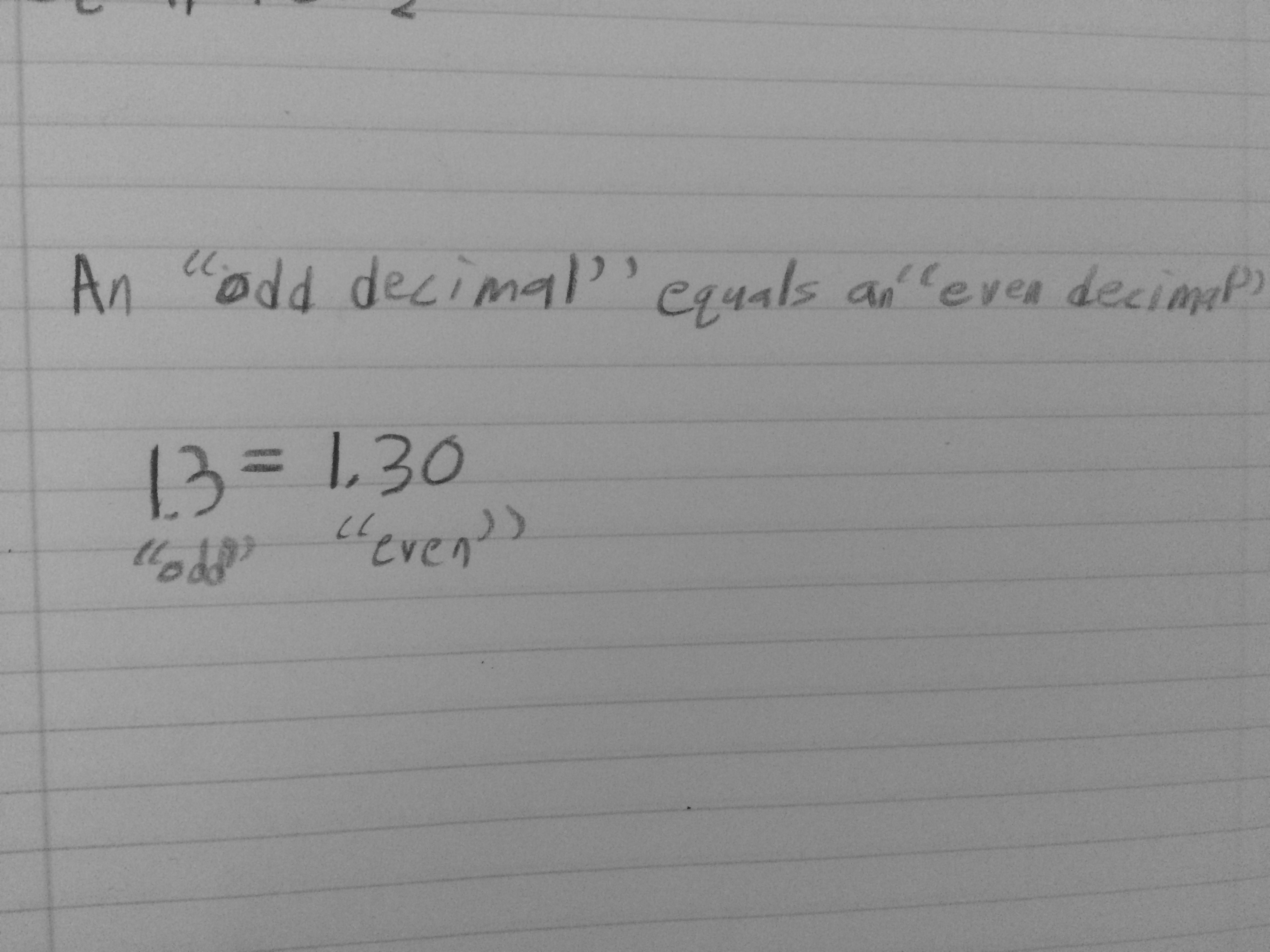
I am convinced that my students have another idea of what they want the 5th grade curriculum to be:) No matter how much I plan, they will always send me in a different direction, which I love. It started yesterday with these two grids and responses…

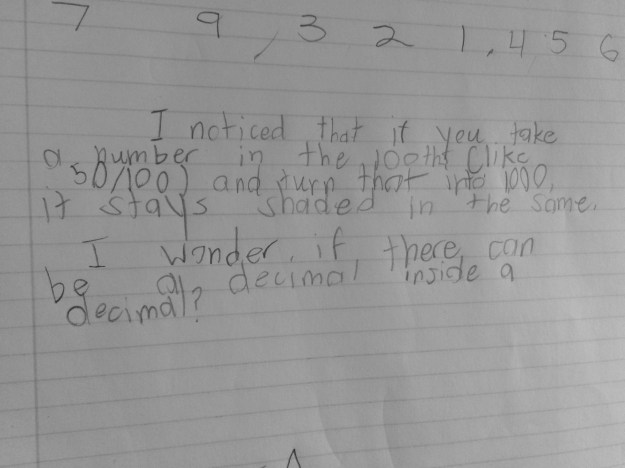
IMG_9034_2That led to these journal entries and our conversation today….

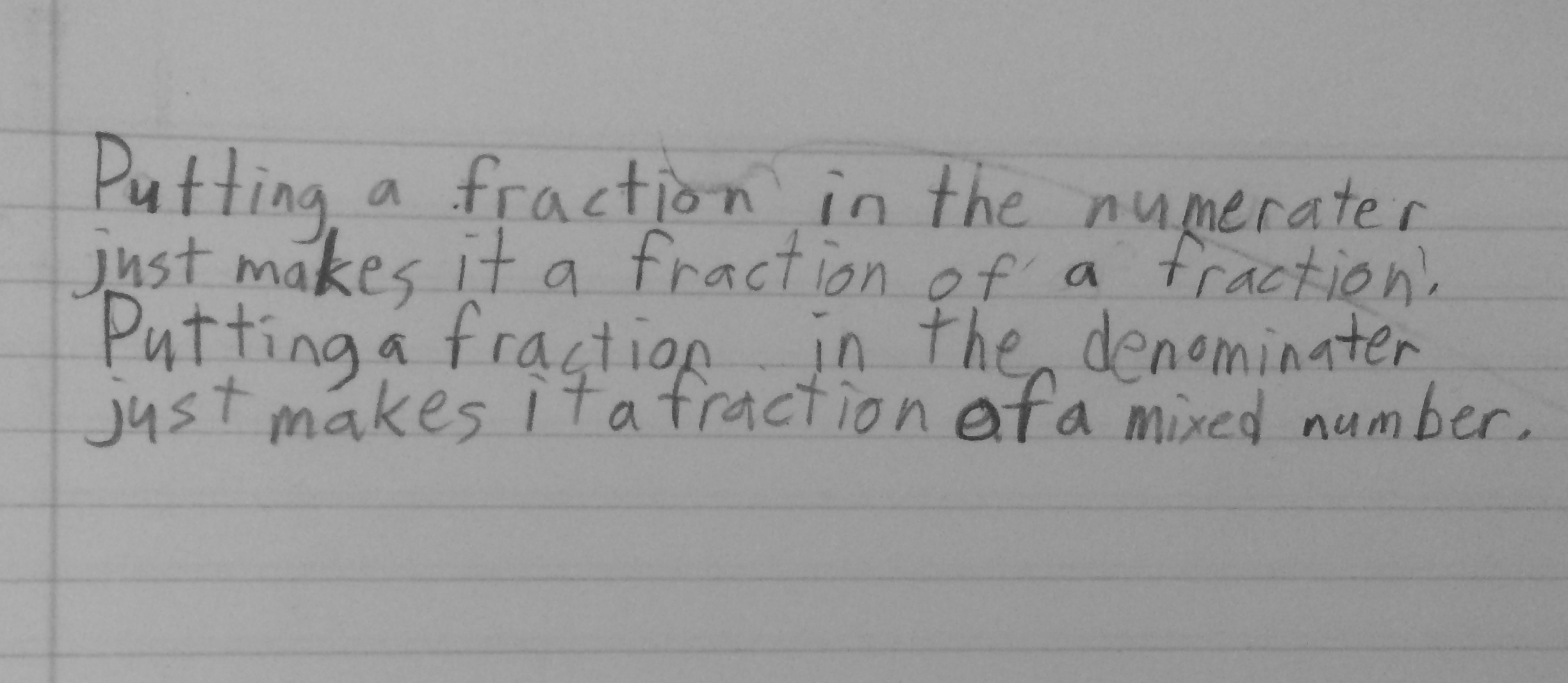
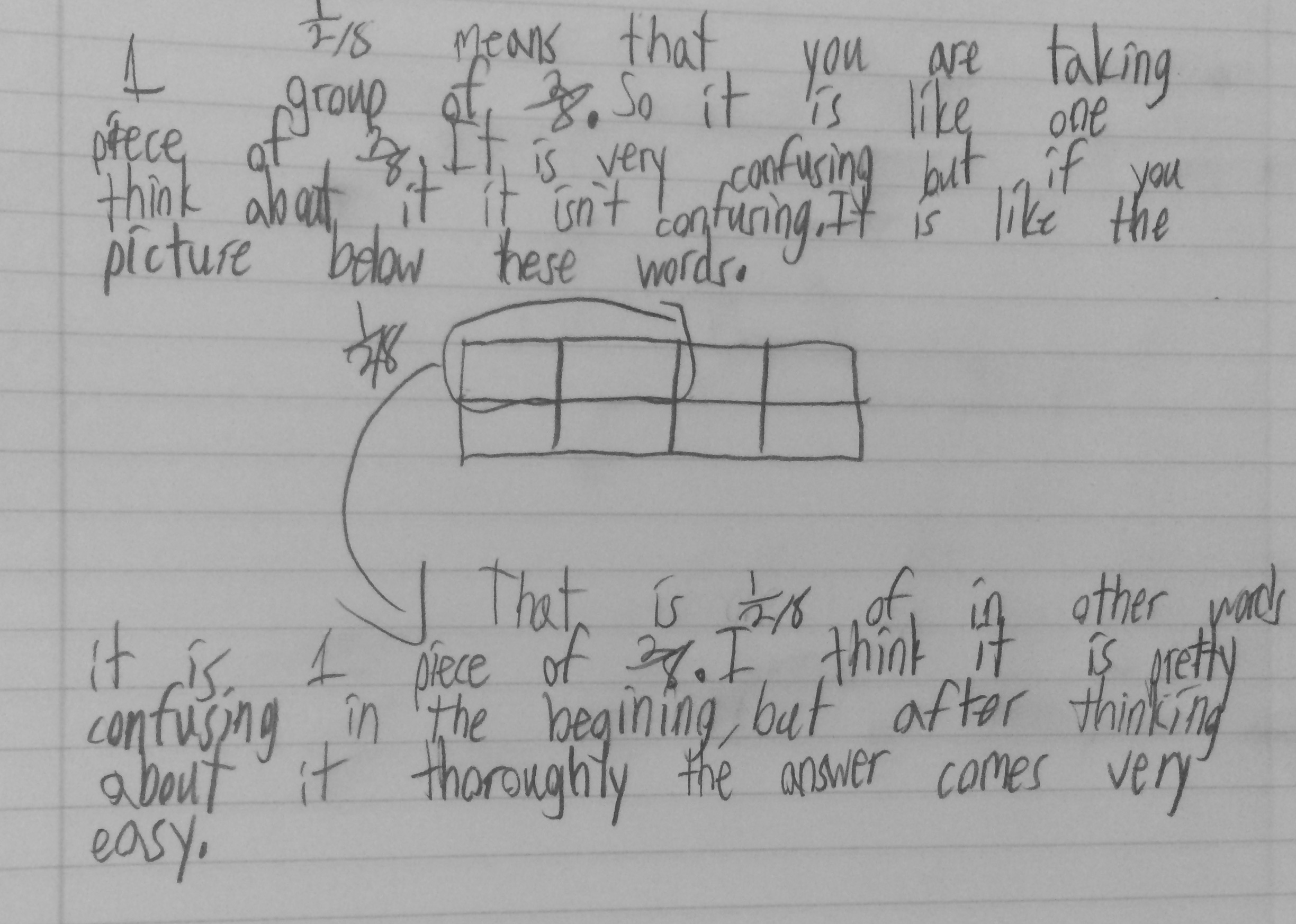
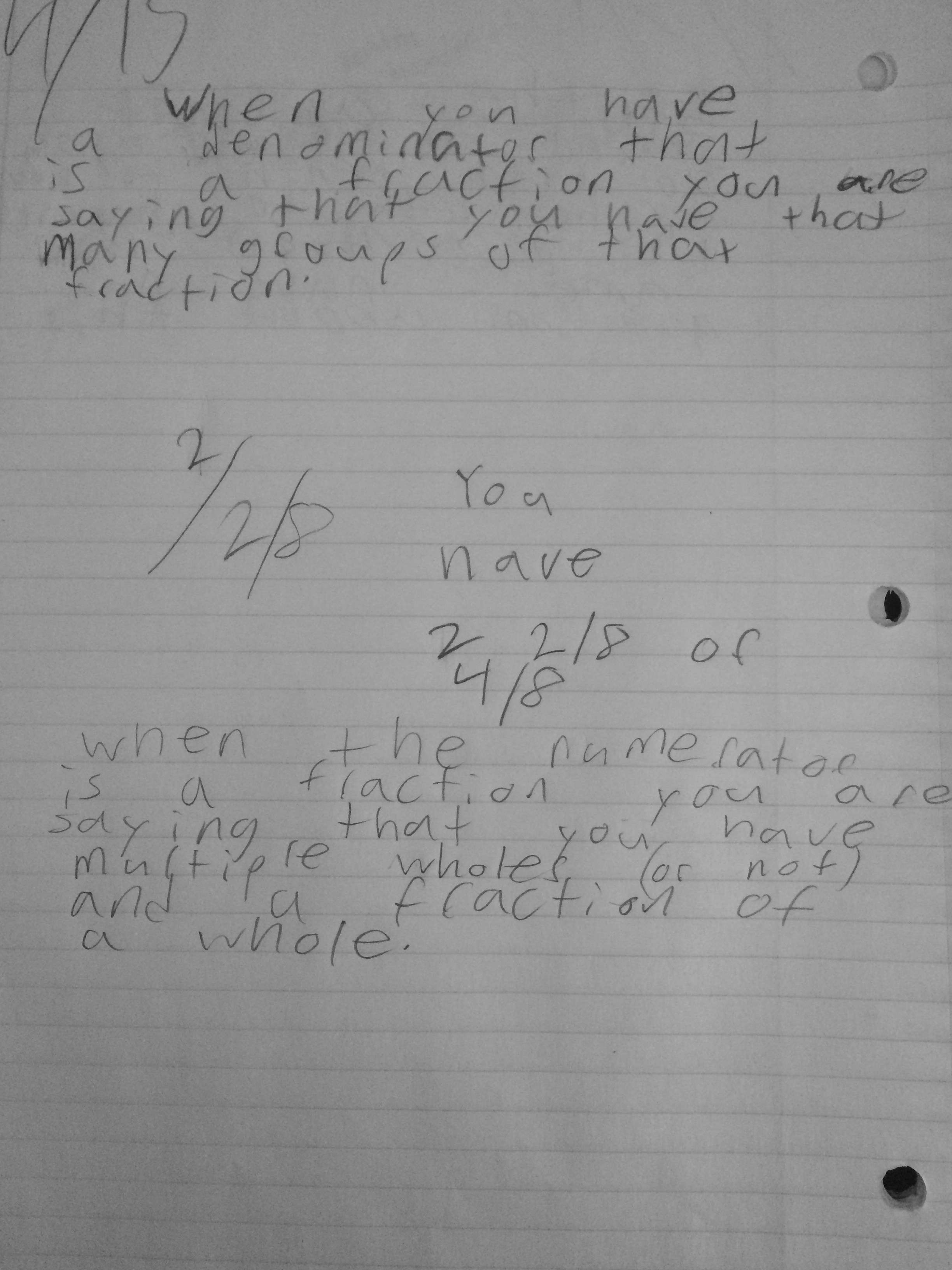
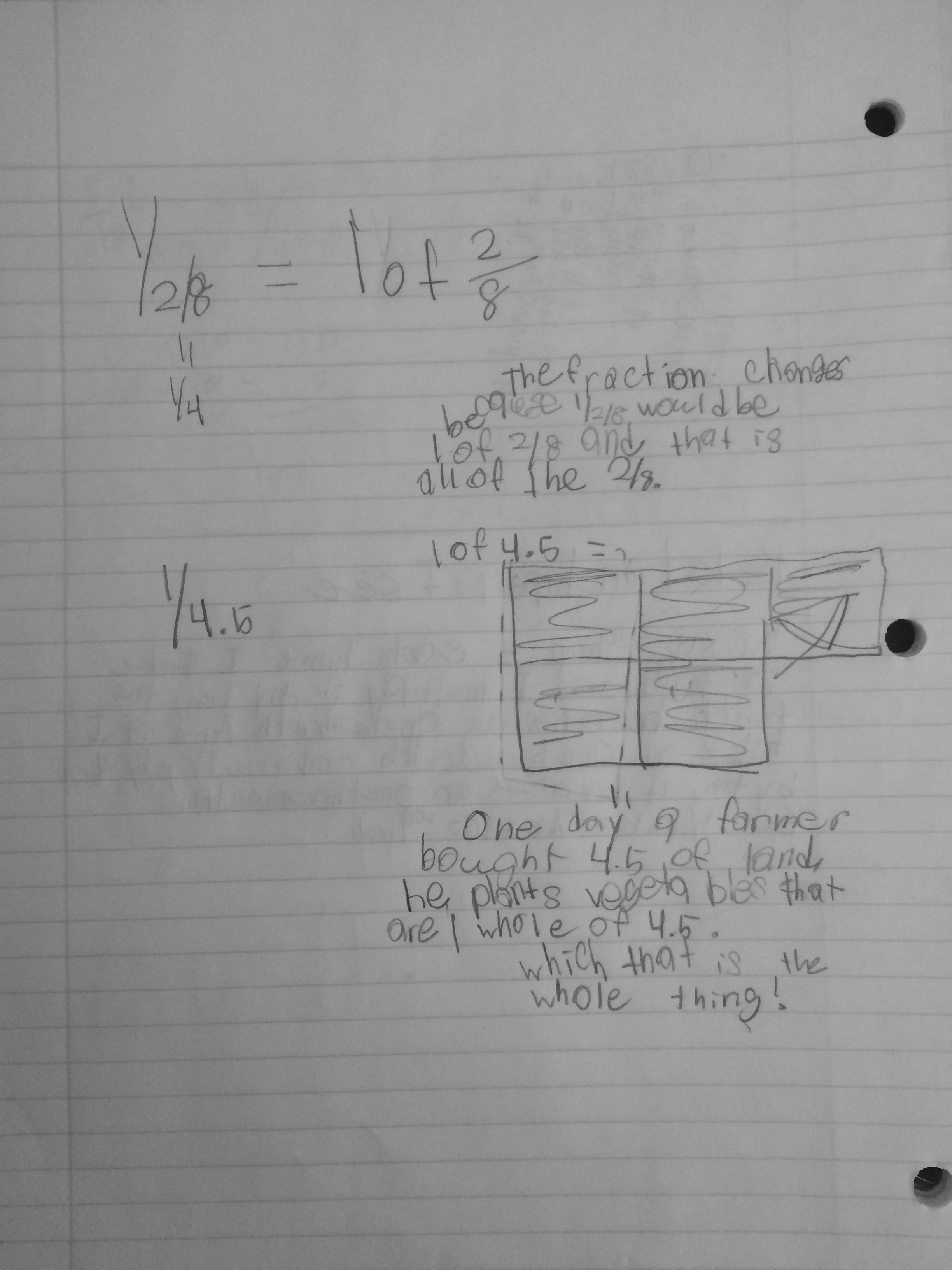
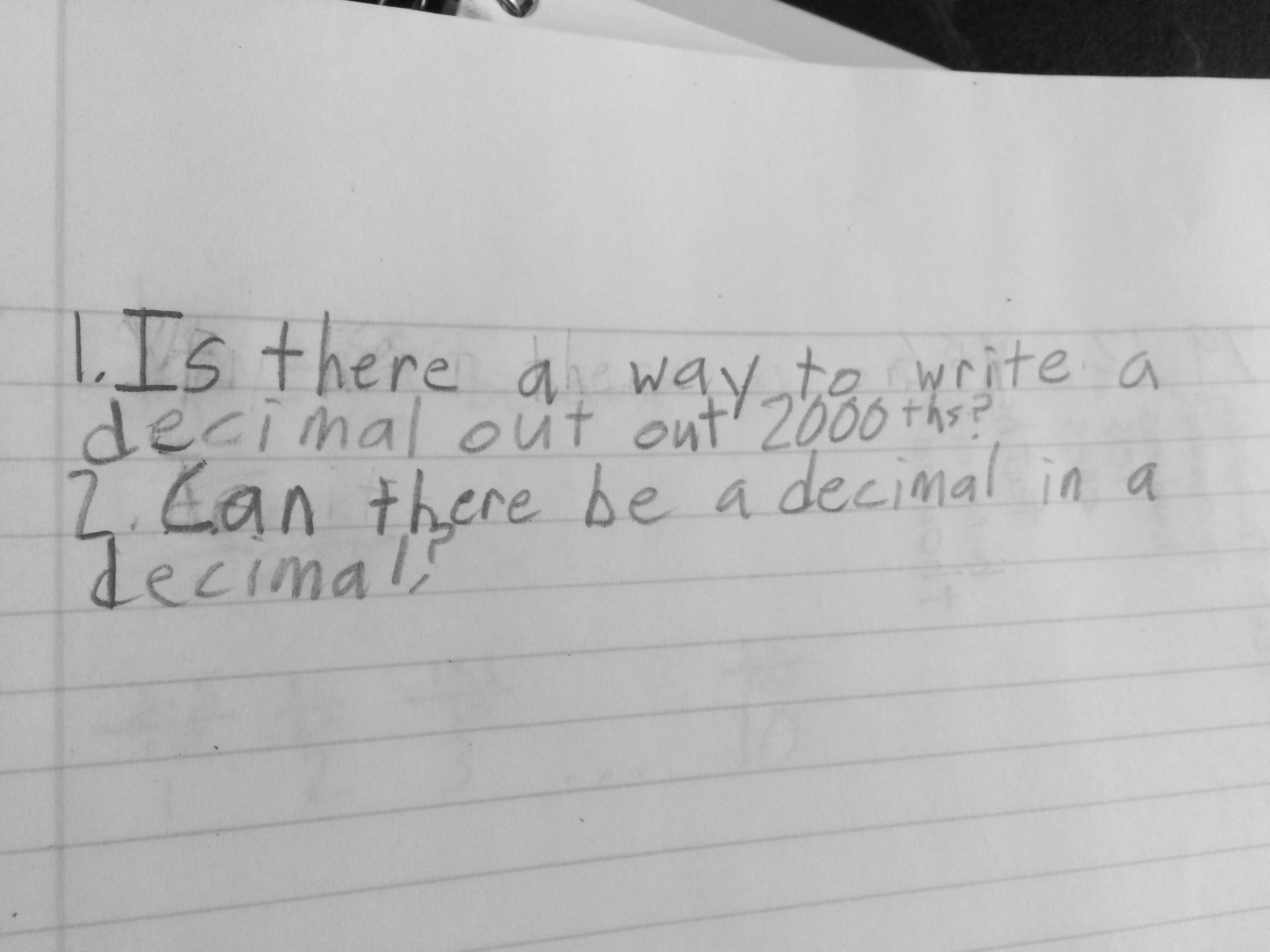
I led with thinking about the fraction (or decimal) in a decimal. We did some more grids and the students were seeing the thousandths like taking a fraction and breaking it into smaller pieces to still have equivalents, like 1.5/4 = 3/8. Then a group of students who were done with the grid work, asked me if there can be a fraction or decimal in a denominator…..here we go…

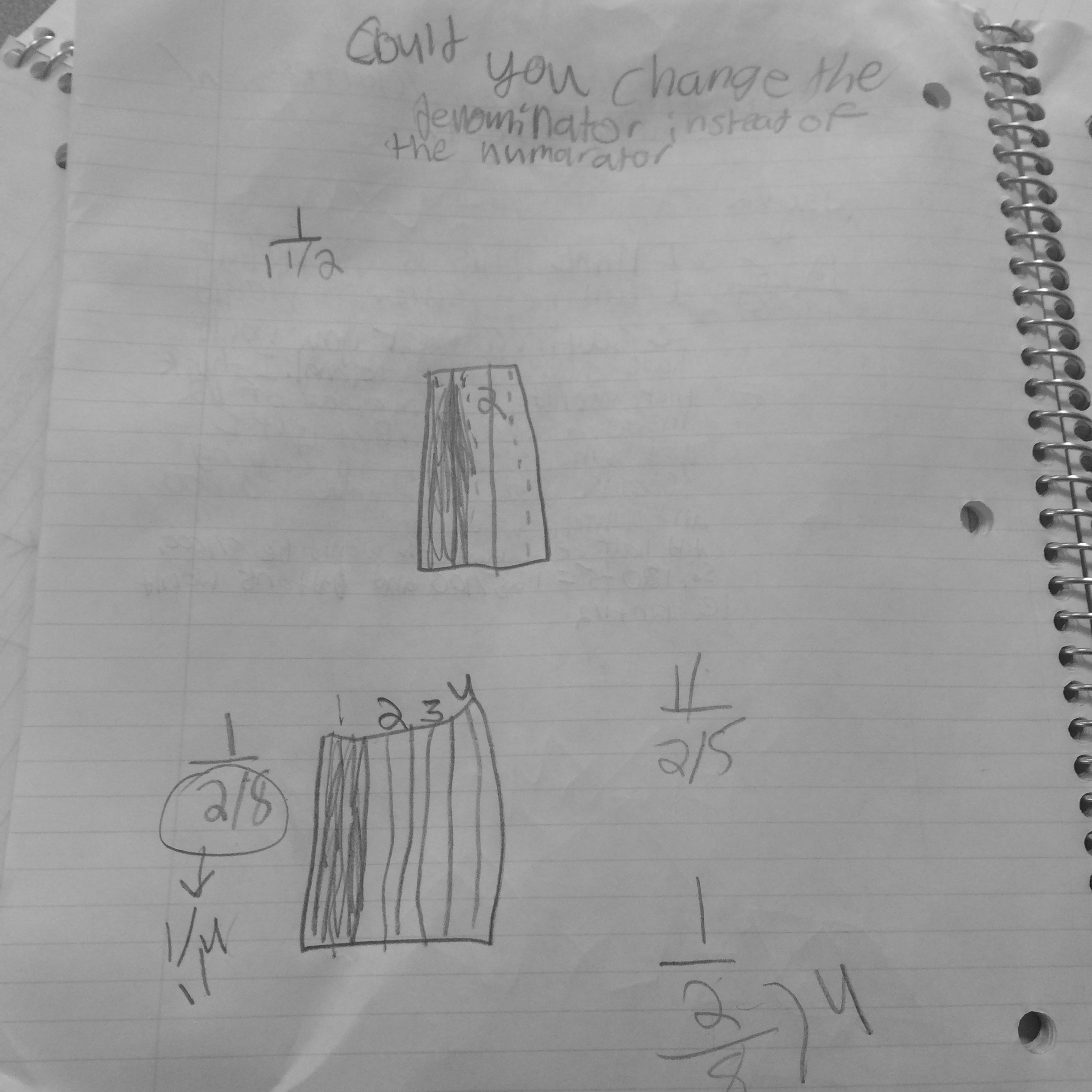
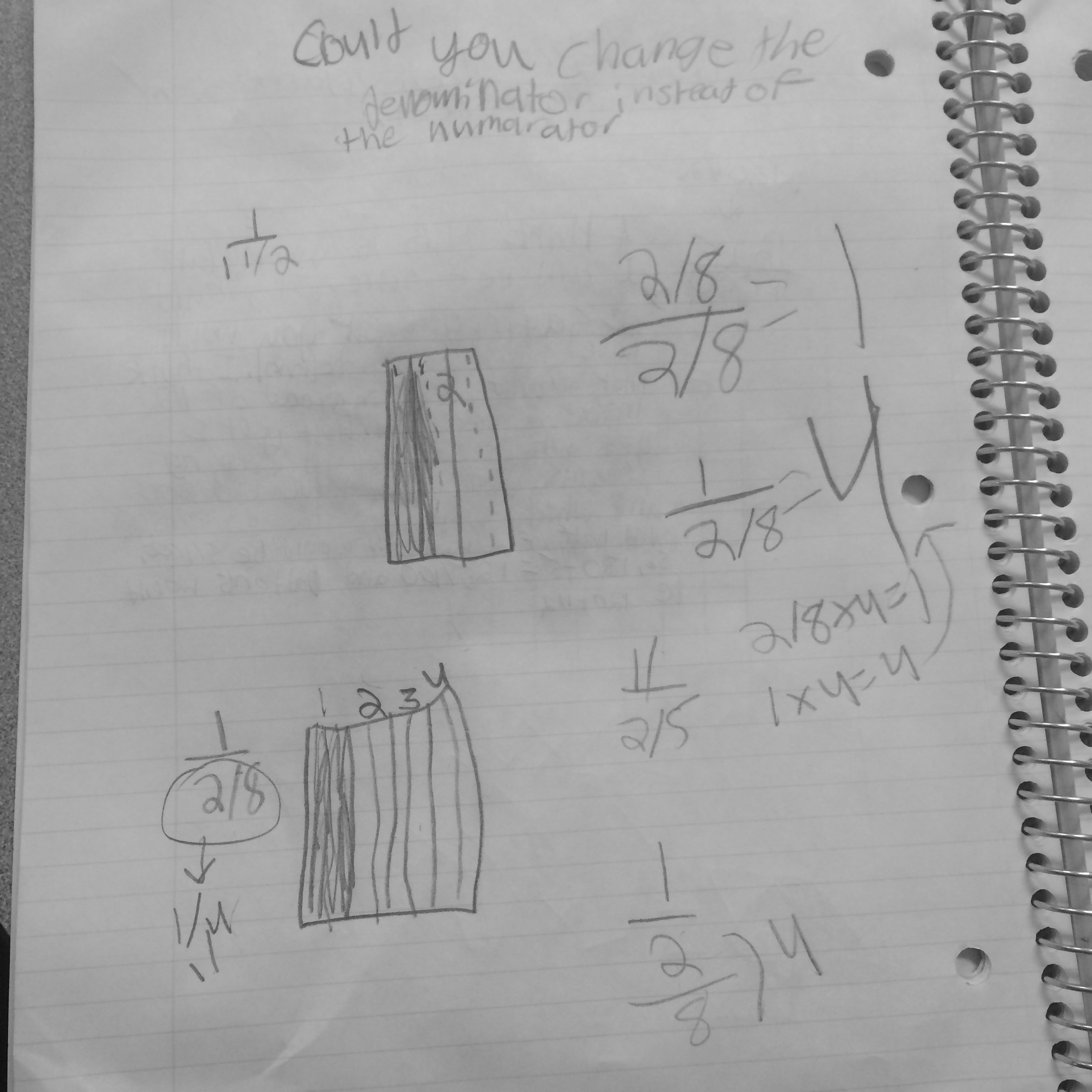
I asked them what they thought it meant and this is their starting point. They jotted some examples and started playing around with 1 / 2/8. He drew it with 2/8 size pieces, came out with 4 but said that looks the same as 1/4.

IMG_9035_2I asked him if it could be, and his intuition was saying no, but he couldn’t figure out why. I asked him what happens when a denominator number gets smaller, he says piece gets bigger. So he started with 1/4, 1/3, 1/2, 1/1, said 2/8 / 2/8 = 1. From there he realized that 1/ 2/8 was improper. Here is where he ended because class ended.

IMG_9037_2I had another working with 100 grids trying to figure percentage-wise is 1/4.5 fell between 1/4 and 1/5 and here are a few others…

IMG_9038_2 IMG_9039_2 IMG_9040_2 IMG_9042_2So much to chat about, but after a long day, my brain needs a break:)

I just love how a thousandths grid lesson can lead to this, I want my students to publish a “Kids Curriculum” as a supplement to mine, because they obviously have so many amazing curiosities! (Or maybe, Christopher, we can name it Kids Kurriculum)

-Kristin

Tenths to Thousandths Decimal Journey…

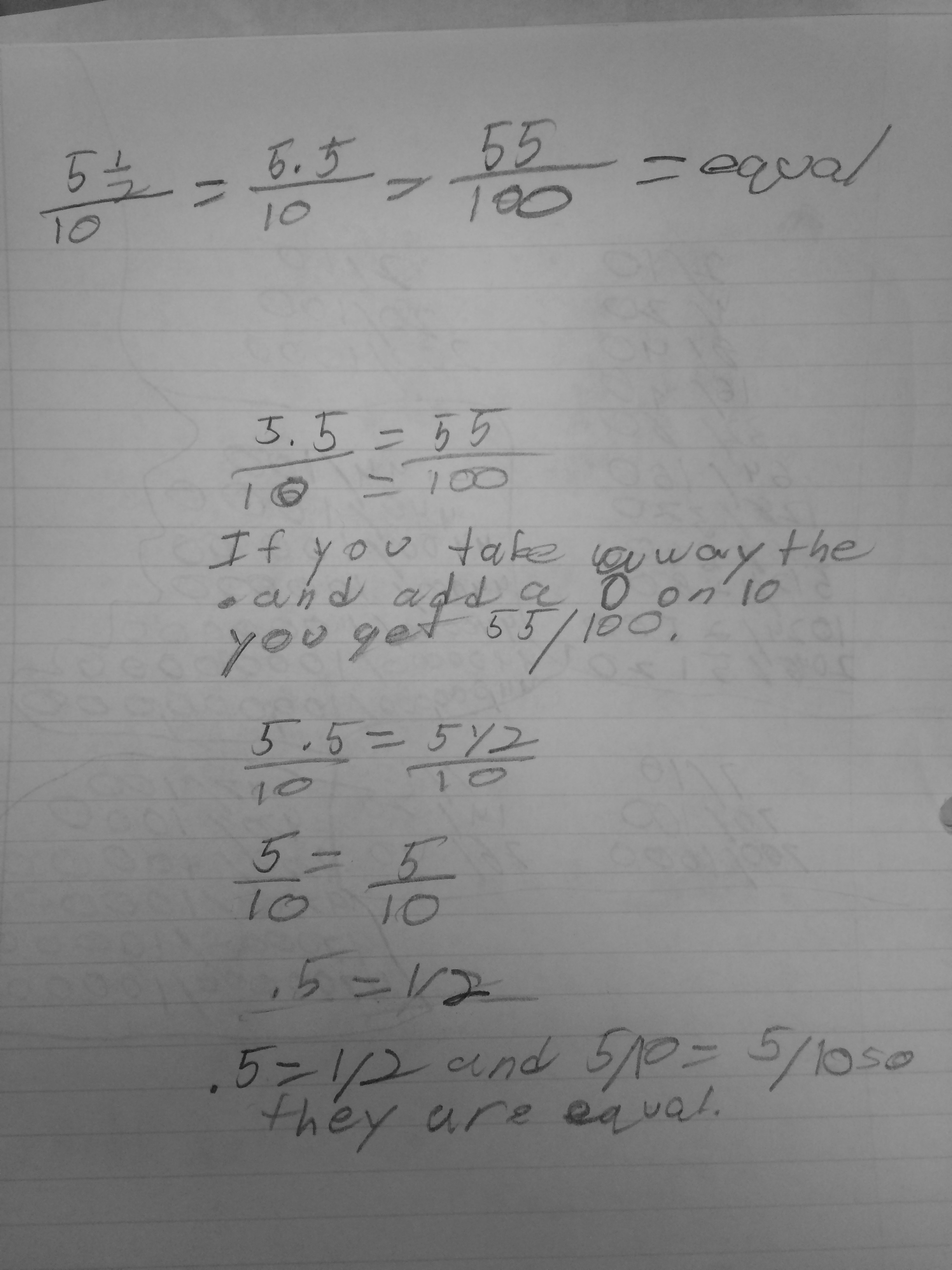
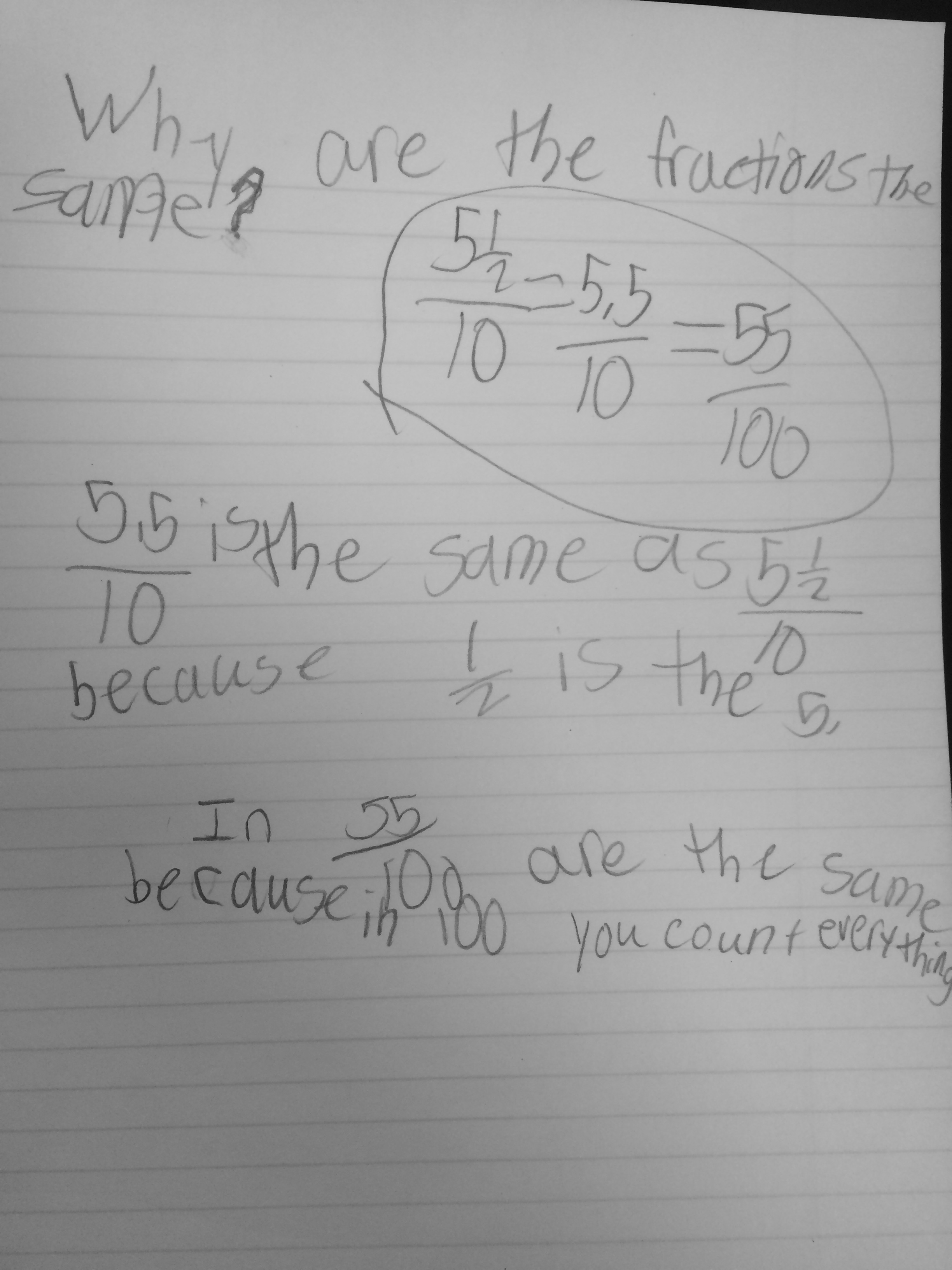
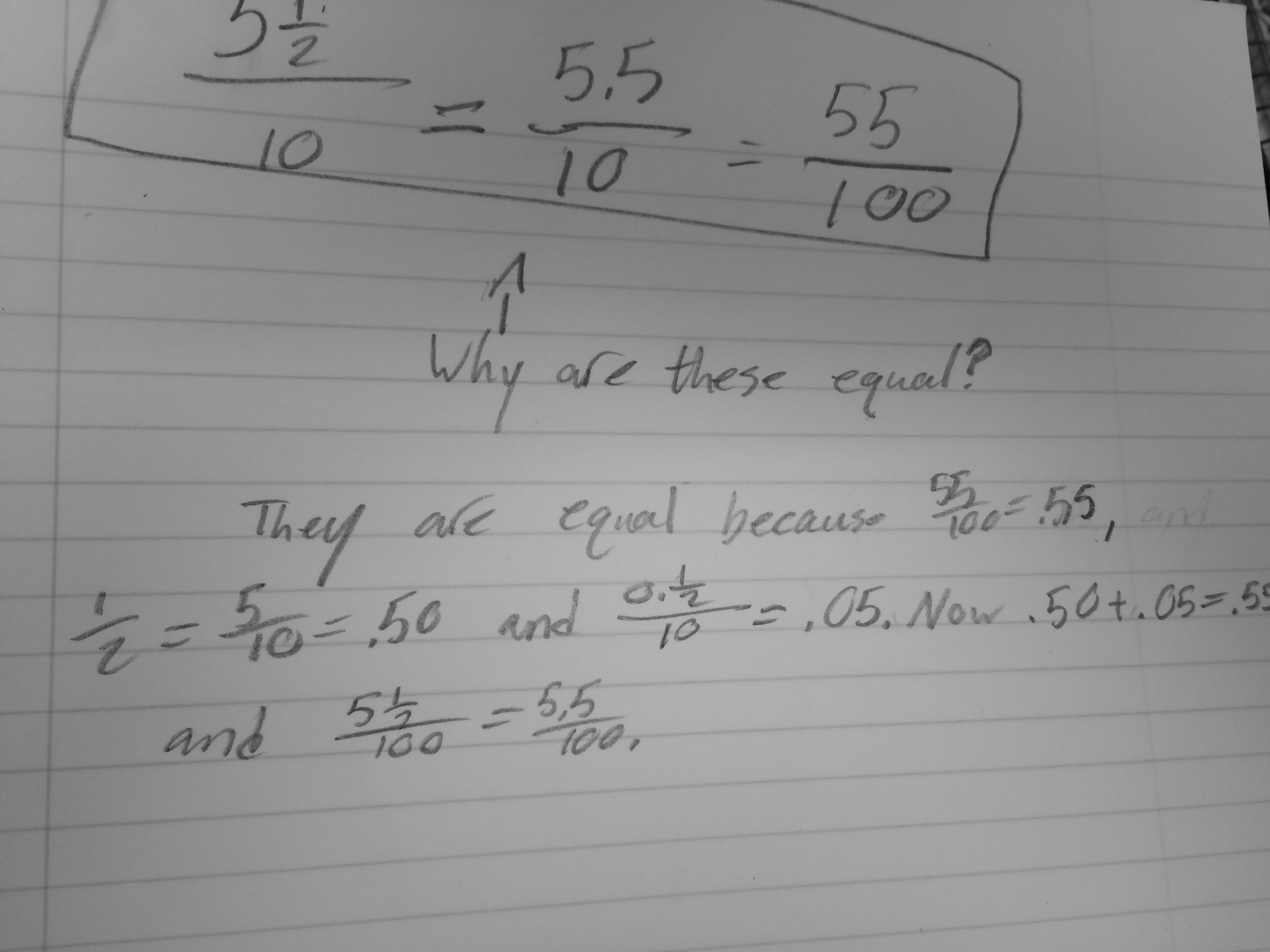
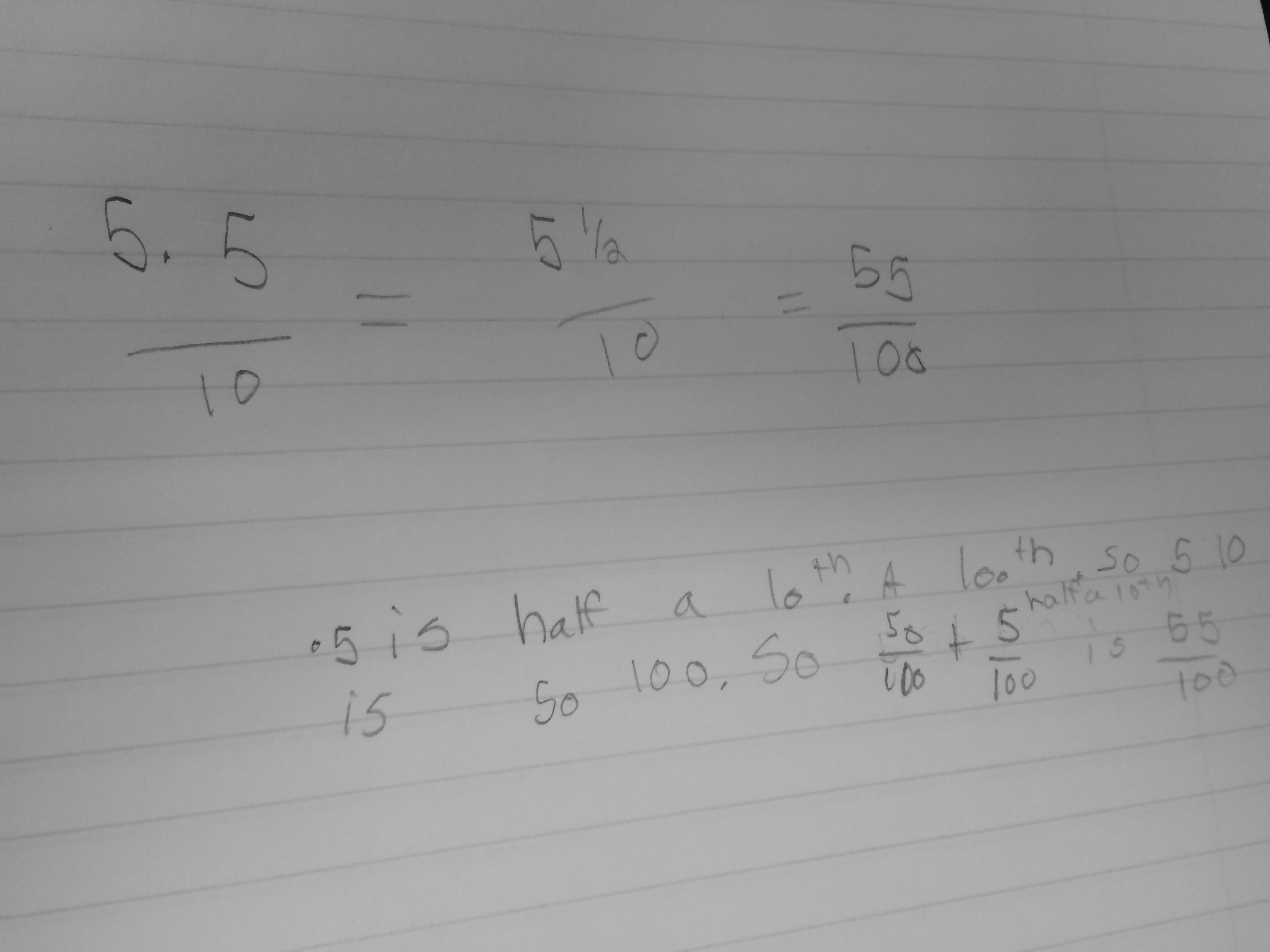
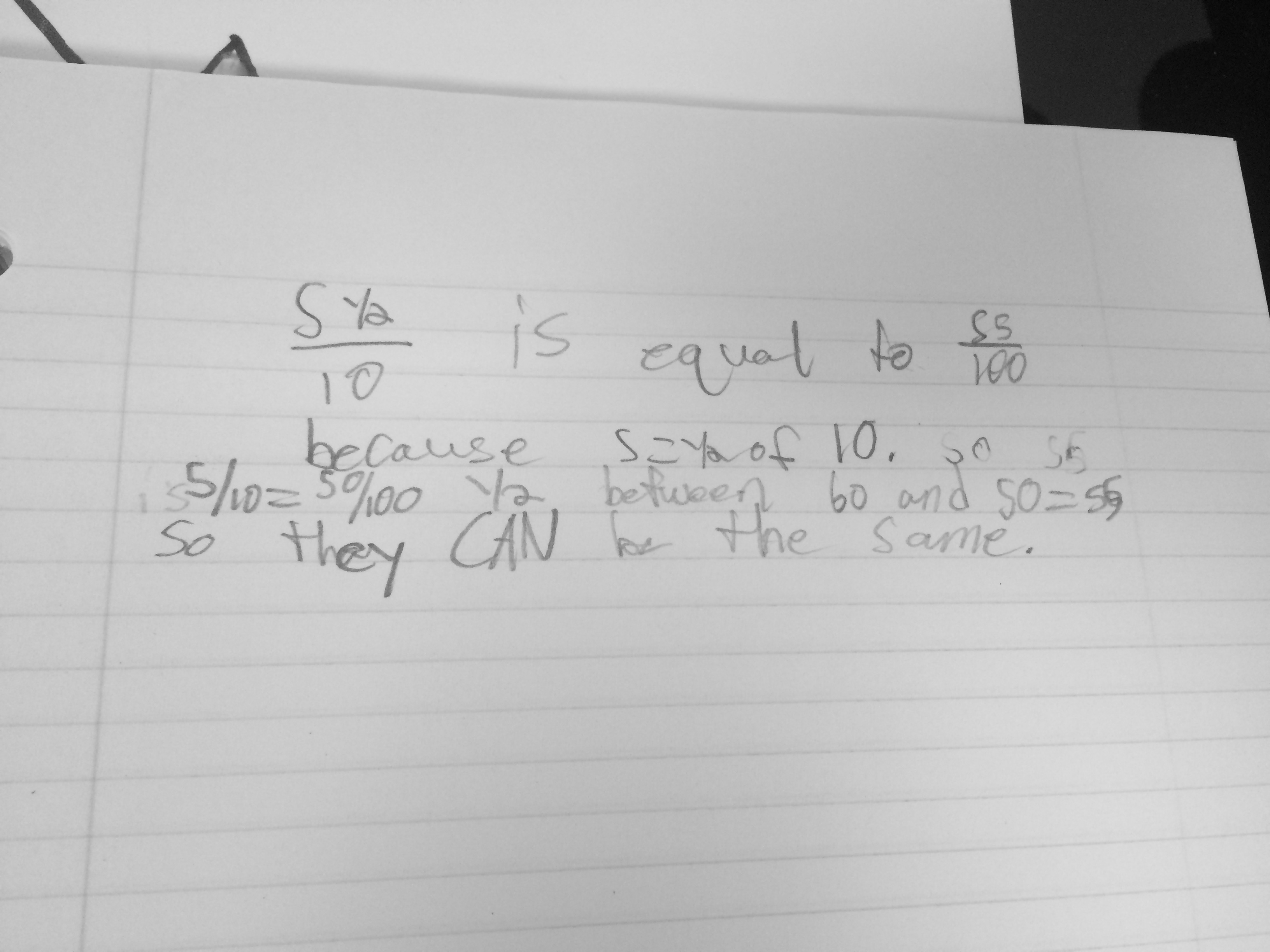
After our quick images, we moved into pre-shaded grids for students to look at equivalencies of decimals shaded on tenths and hundredths grids. We flew through until we hit the tenths grid with 5 1/2 tenths shaded and hundredths grid with 55 hundredths shaded. The students could see they were equivalent by the pictures, but many had a tough time explaining why. When someone did say “A half of a tenth is 5/100” another student said, “But I thought a half of a tenth was 1/20?” What a cool conversation! They left class yesterday with this question still lingering so I had them just jot what their group had talked about in relation to these pictures…

IMG_8997_2 IMG_8998_2 IMG_8999_2 IMG_9005_2 IMG_9007_2At this point students were starting to have trouble thinking about writing a decimal that was a half of the place value to the right, so they stayed in fractions where they comfortably can represent half a fractional piece.

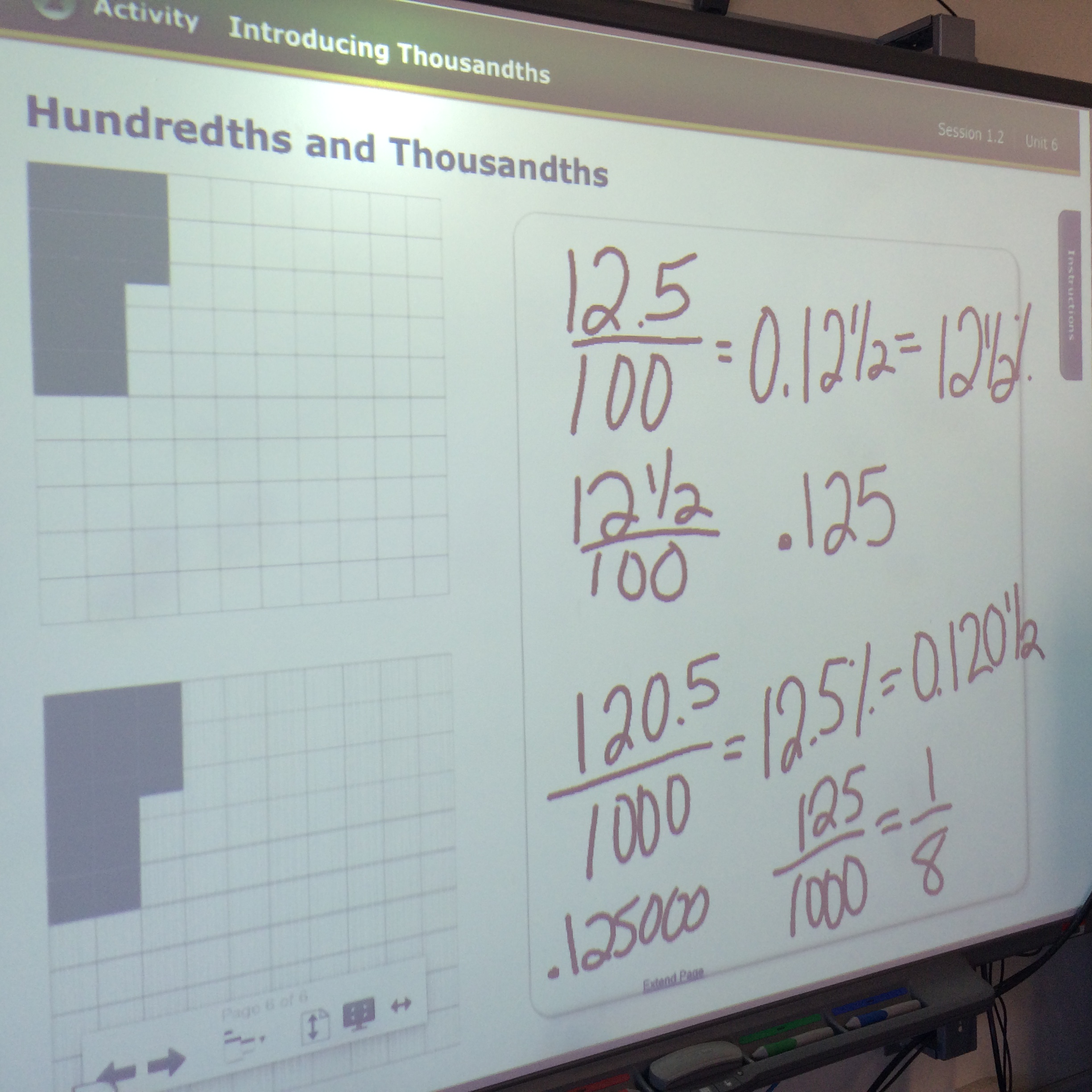
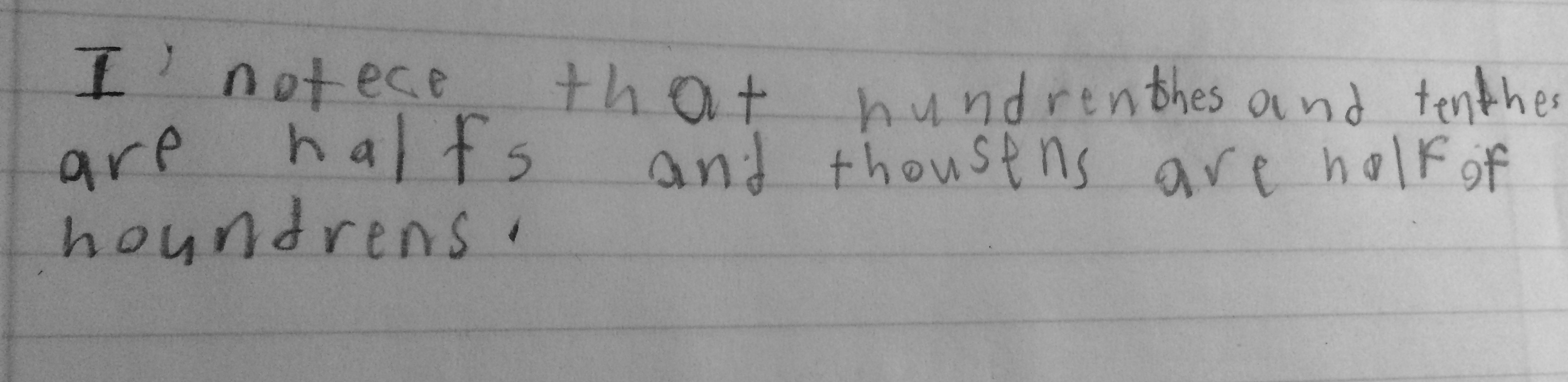
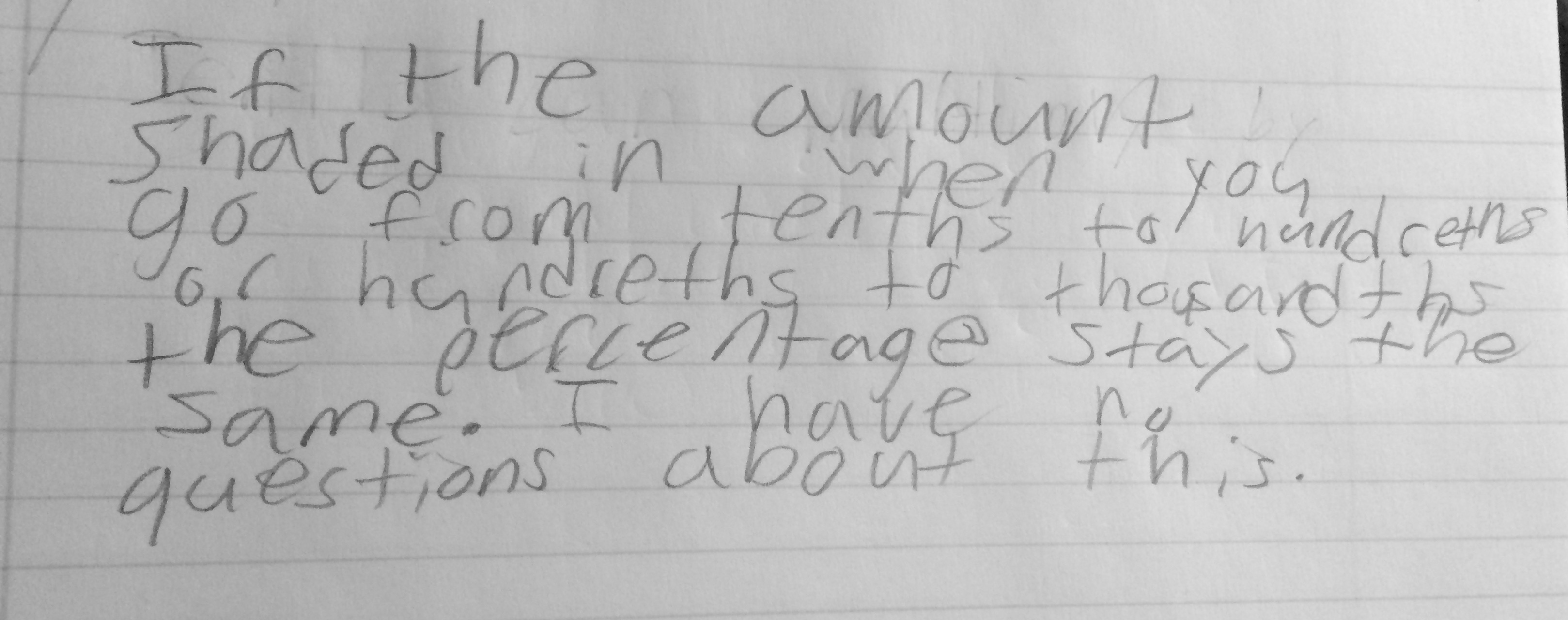
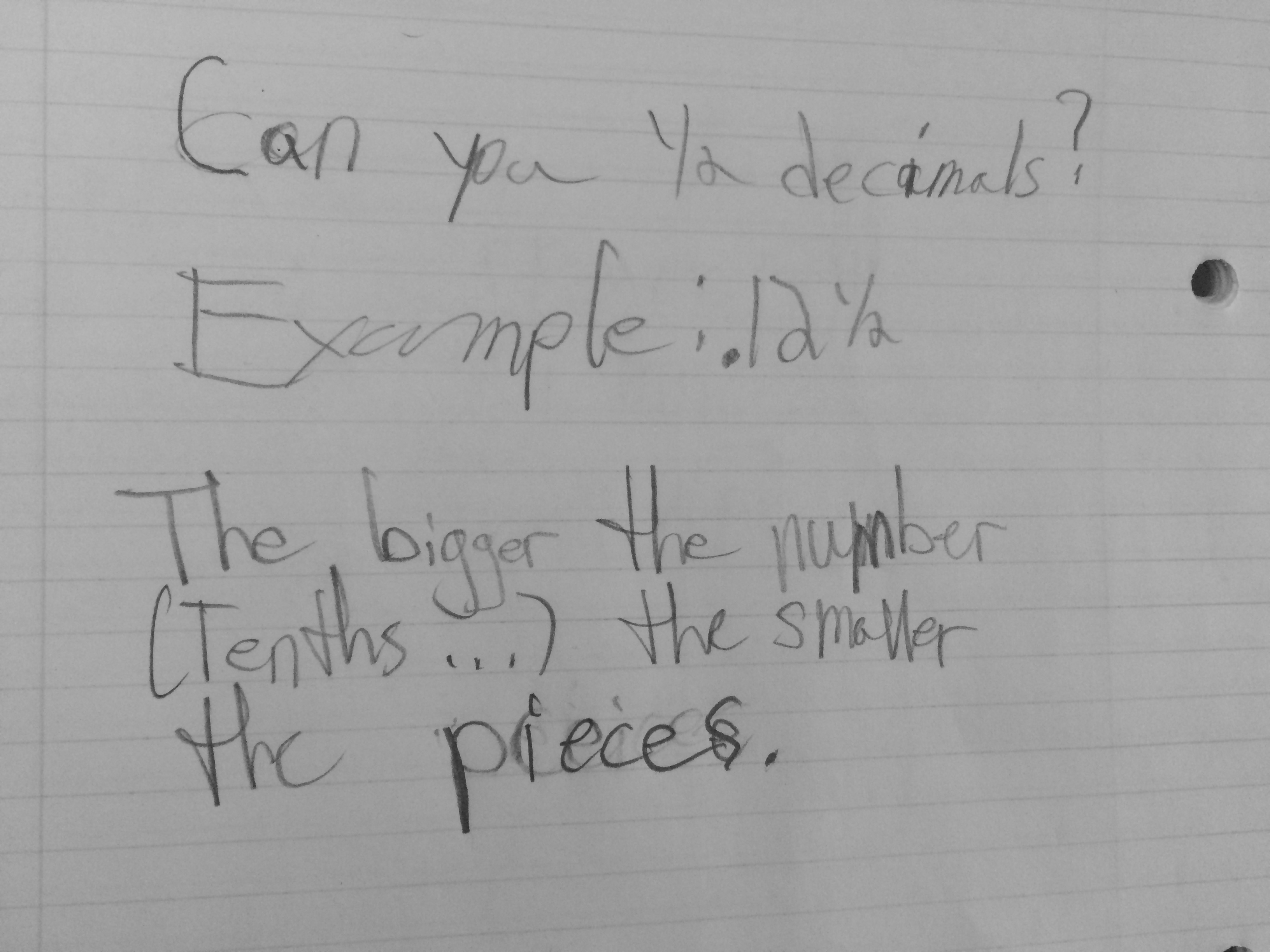
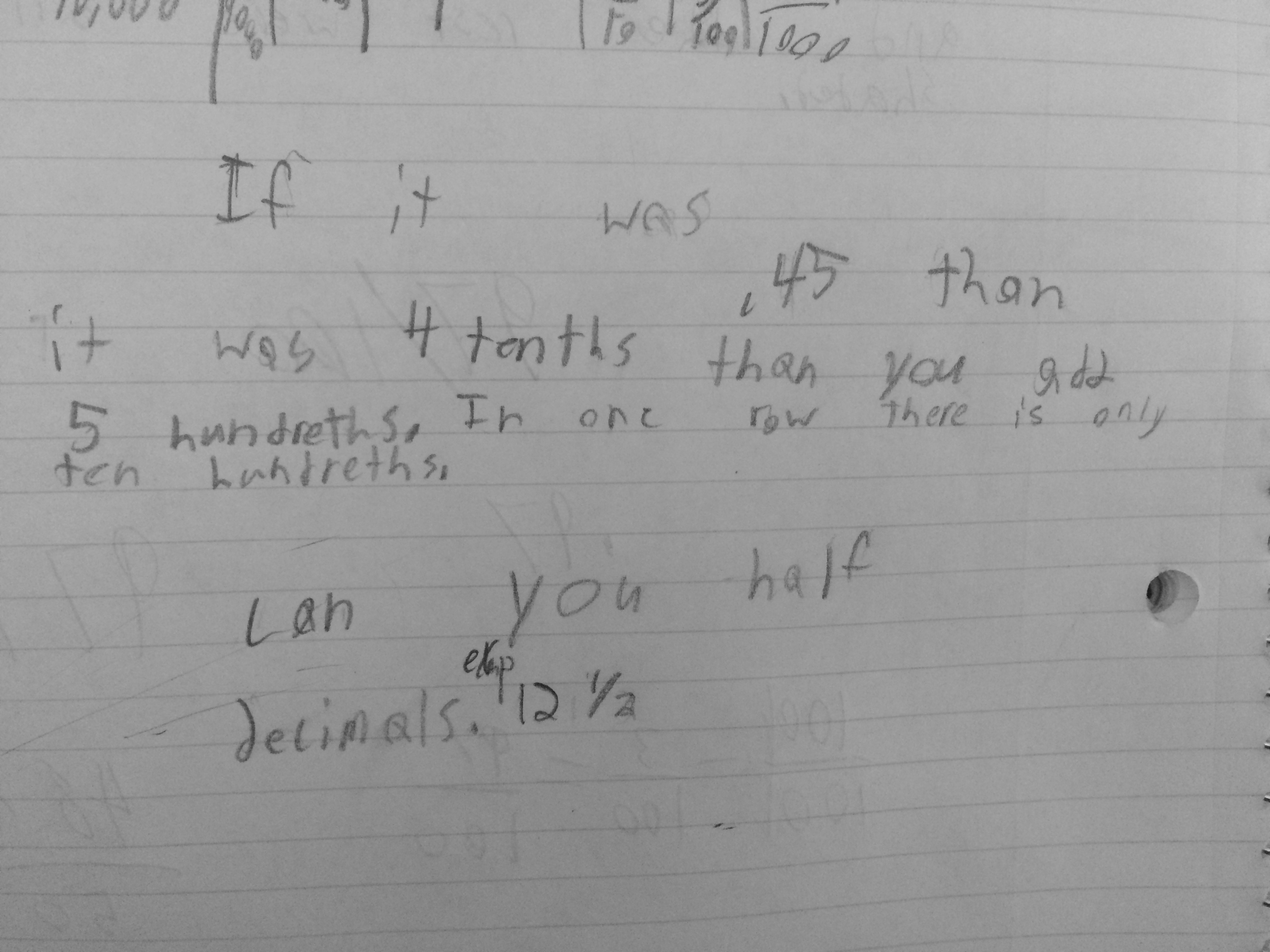
We started our conversation with this today and broke up the grids to prove that 5/100 is equivalent to 1/20 and equal to 1/2 / 10. Students were comfortable with the half of a tenth represented in the hundredths, however they made it perfectly clear that they much preferred the hundredths grid because it was much easier to read:) So, of course, then I pushed them into the thousandths grid. We started with 1/4 shaded on a hundredths grid and 1/4 on a thousandths grid. They comfortably wrote 25/100=250/1000=25%-.25=.250. Then we went to a hundredths and thousandths grids with 1/8 shaded. Great convo that we will have to build on tomorrow, but as always, I need more math time!! I had them leave on a reflection prompt about what noticings they had during our work today. For the students who could easily see these equivalencies, I told them to write me some wonderings they may have. I got quite a range of great things. The predominant question was about the fraction/decimal in a decimal. I struggle with how to address this because it visually is not as appealing to me as the fraction/decimal within a fraction. I am comfortable writing 1 1/2 /4 = 3/8 but to write the fraction in the decimal does not work. I never really thought about it much before, but how funny that we can write a fraction of a fractional piece and it is readable, but to try with decimals, not so much. The only way I see to address this is to do many more grid shadings to get comfortable with these equivalencies, but I do so appreciate their curiosity about it!

IMG_9018 IMG_9013 IMG_9014 IMG_9015 IMG_9020 IMG_9022 IMG_9023 IMG_9026 To use the word differentiation here is an understatement. The range of thoughts in my classroom (and many many others) amaze me on a daily basis, in the most wonderful way!

And I especially love these last two because it gives me the feeling that I have created a safe place for my students to put confusion out there. I LOVE LOVE LOVE this ❤

IMG_9019 IMG_9024

~Kristin

Decimal Quick Images

In Investigations we do Quick Images of dots, 2D and 3D figures. I thought we could incorporate this same routine into our decimal unit to talk about fraction/decimal/percent equivalents. I told the students that each grid equaled 1 and that it was broken into 10 or 100 pieces (just to save time of them counting to verify it). I flashed the grid image on the screen for 3-5 seconds and had students give me a thumbs up when they know how much of the grid was shaded. I asked them to signal with their fingers if they had more than one way to name the amount or an equation of how they saw it.

These were the first images that I did (one at a time) and after each we discussed what they saw. After they said their answer, I was sure to ask “How would you write that?” to be sure if they were seeing it as a fraction or decimal.  It was interesting, but not surprising, that every student gave a fraction.

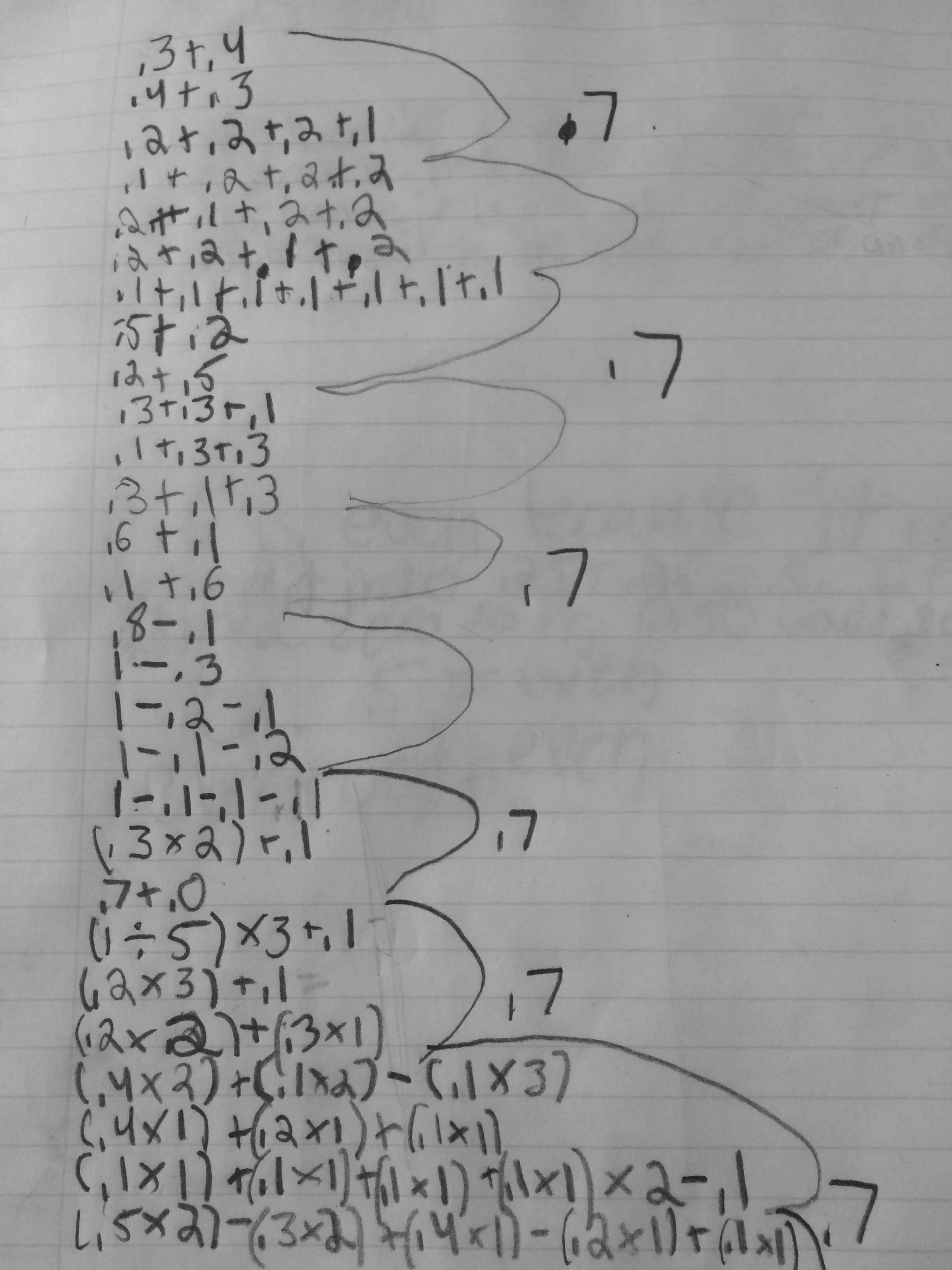
g1The first one elicited the 2/10, 20%, every equivalent fraction of 2/10, and eventually 0.2. I asked about the zero in front of the decimal to be sure everyone knew that meant there was not a whole filled. The second elicited much of the same, but also came with 10/10 – 3/10 = 7/10 as the way they remembered how much was there. “It was easier to count the white part.”

The next two went into hundredths and followed the same routine.

g2We did the first aloud in a Number Talk type setting and then I sent the students back to their seats to write what they could for the fourth image. Here is what they came up with…

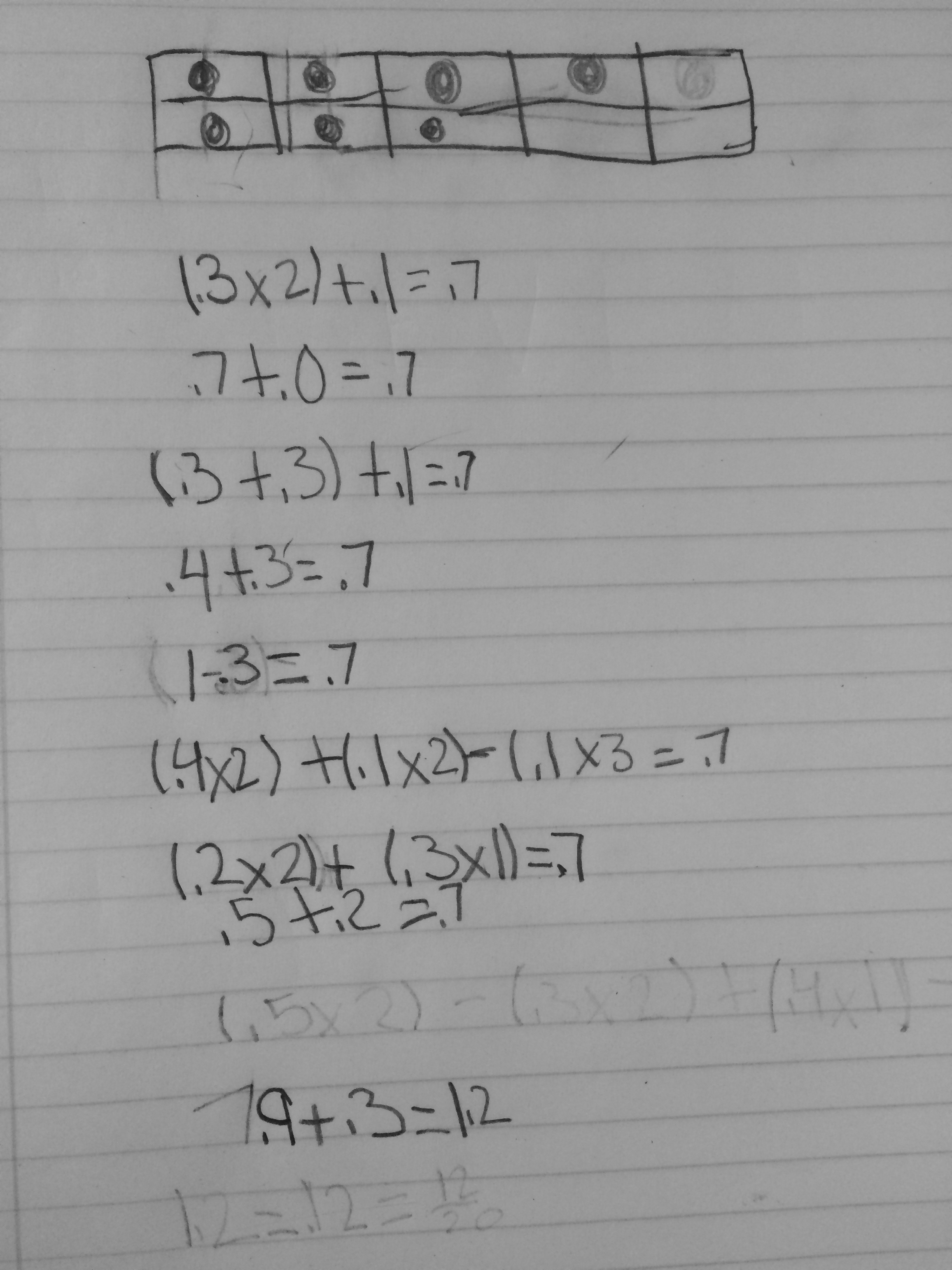
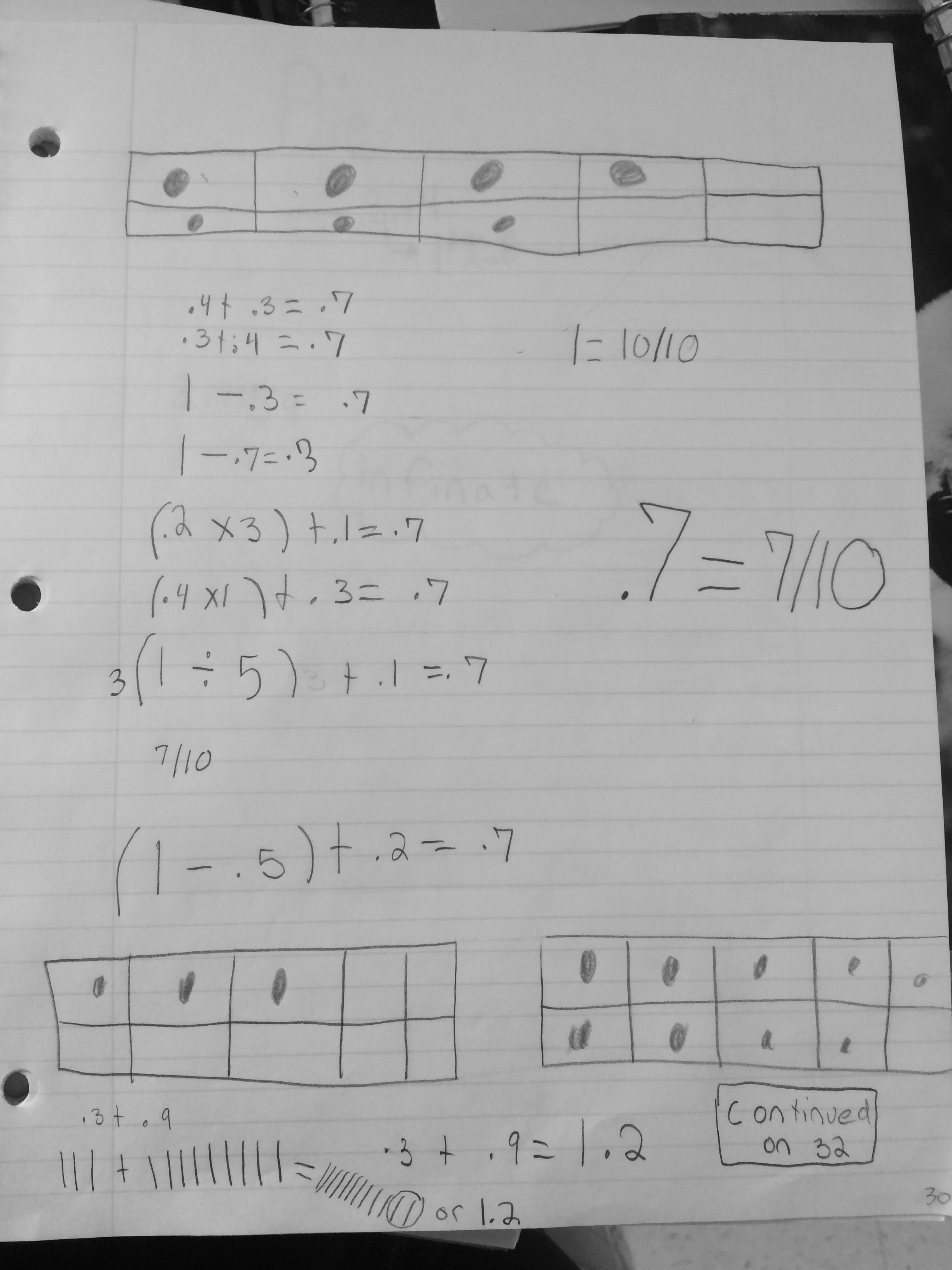
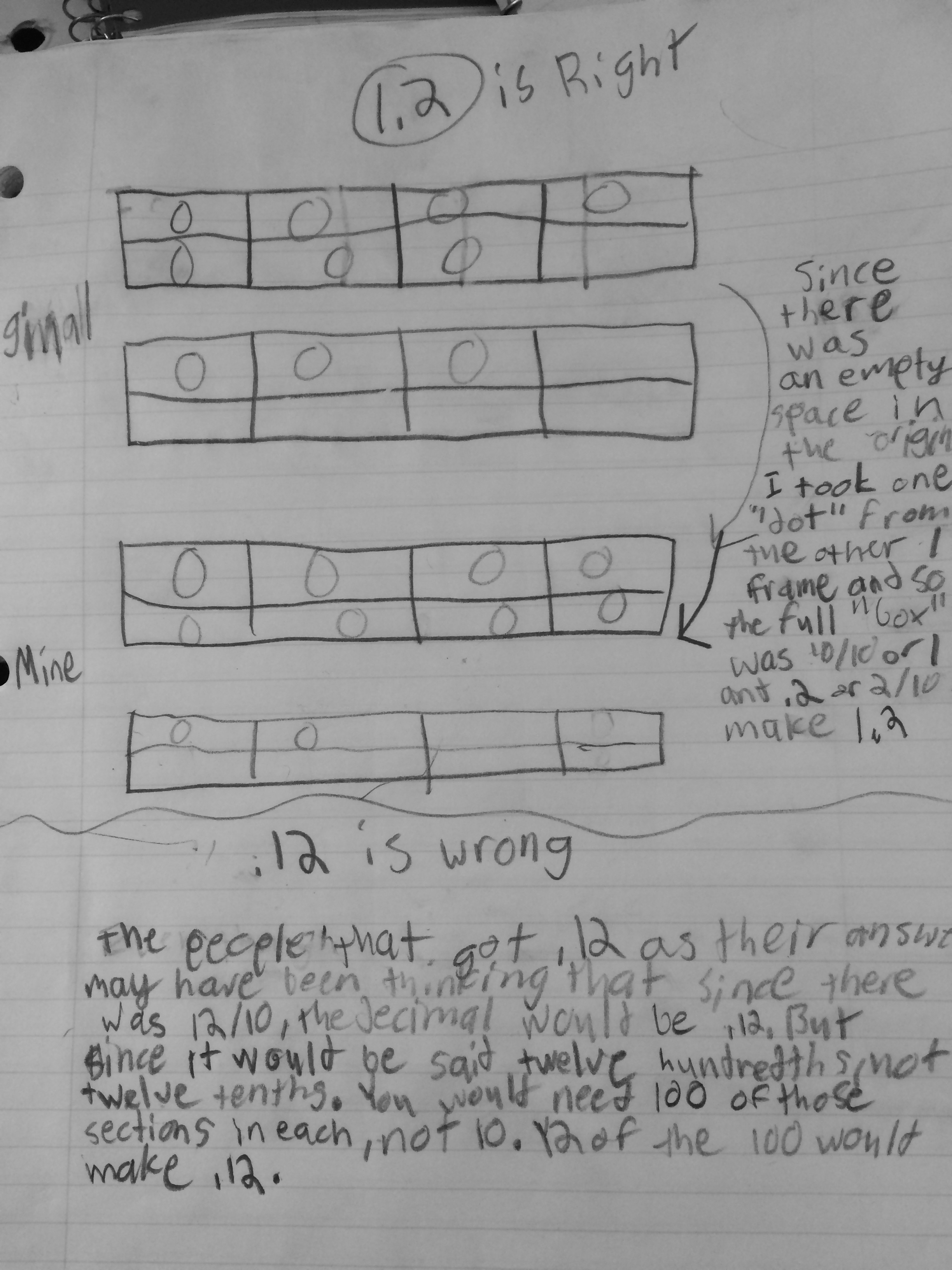
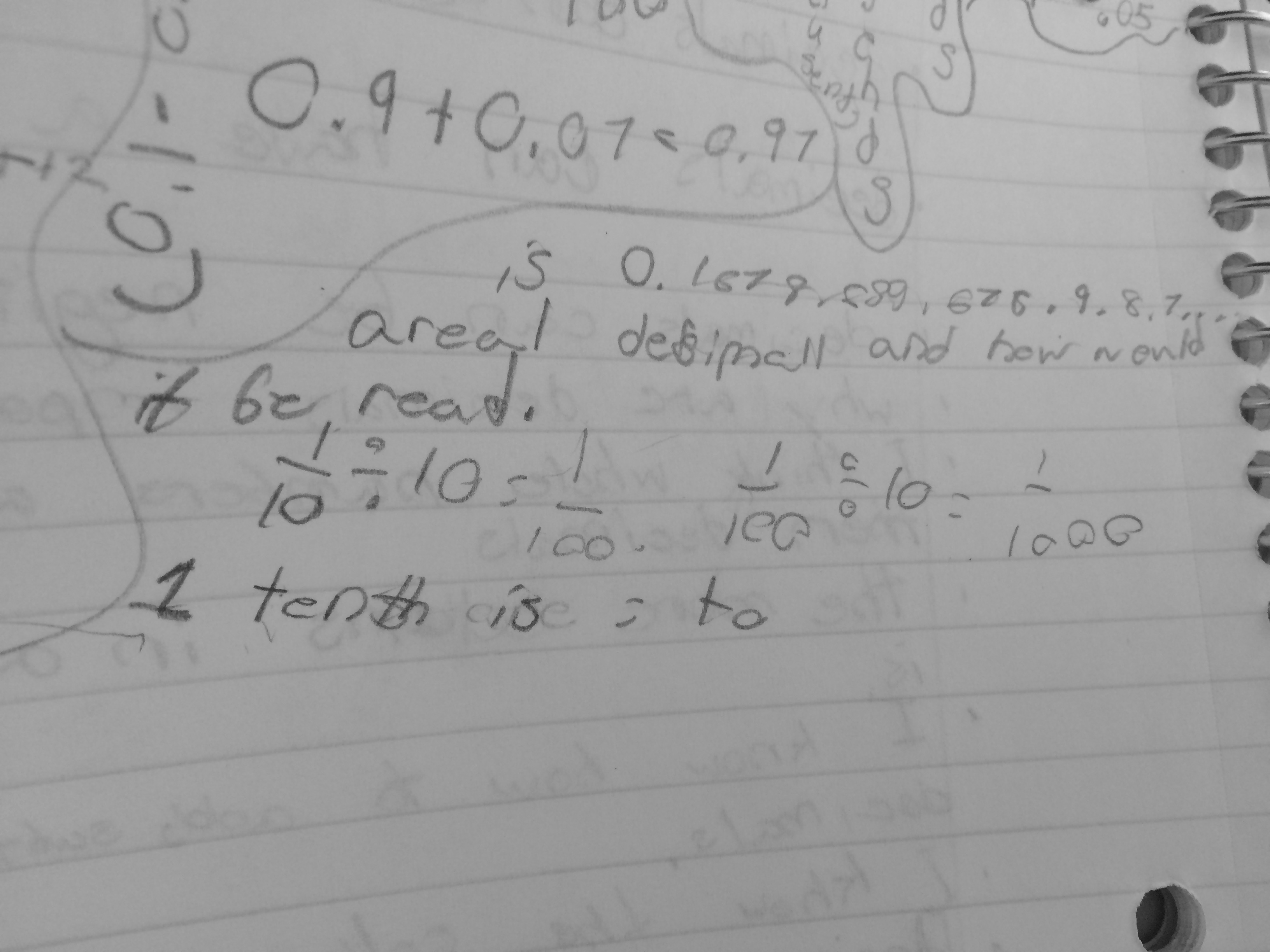
IMG_8995_2 IMG_9001_2 IMG_9004_2 IMG_9008_2 IMG_9011_2This is a wonderful jumping point for starting Fill Two game tomorrow! I plan on bringing up some of the examples with .9 + 07 to start our classwork!

-Kristin
Decimals – The Very Beginning…

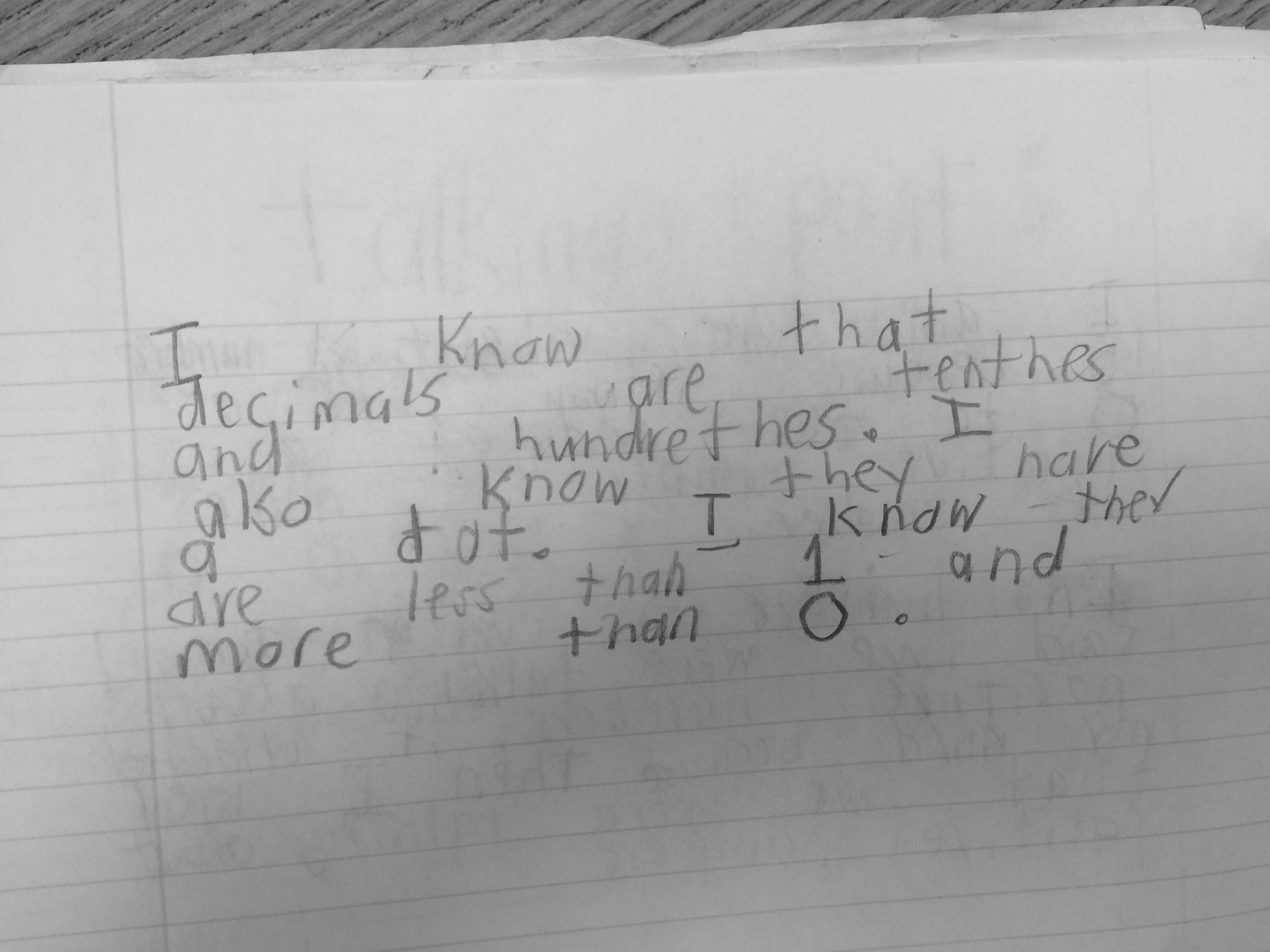
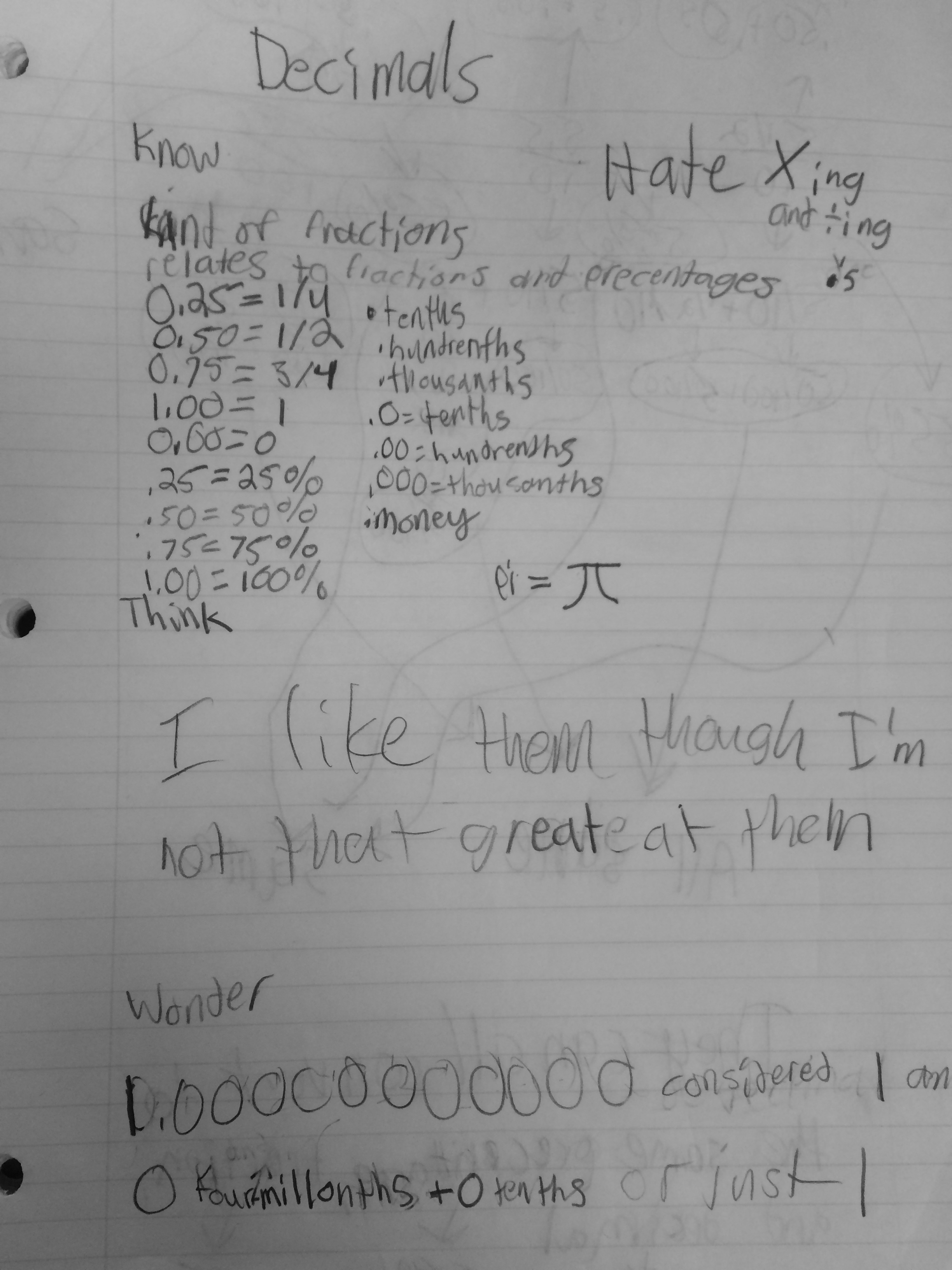
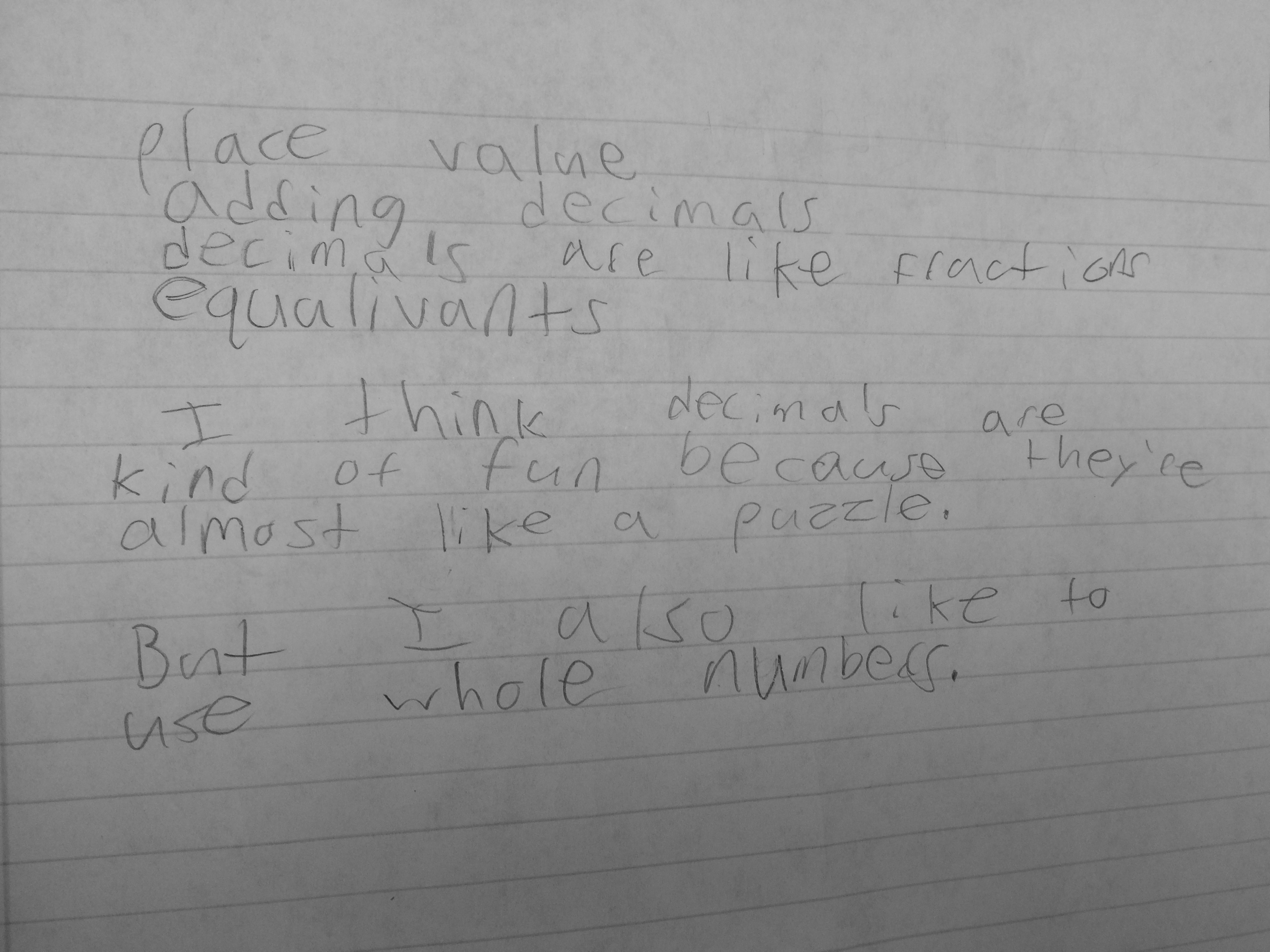
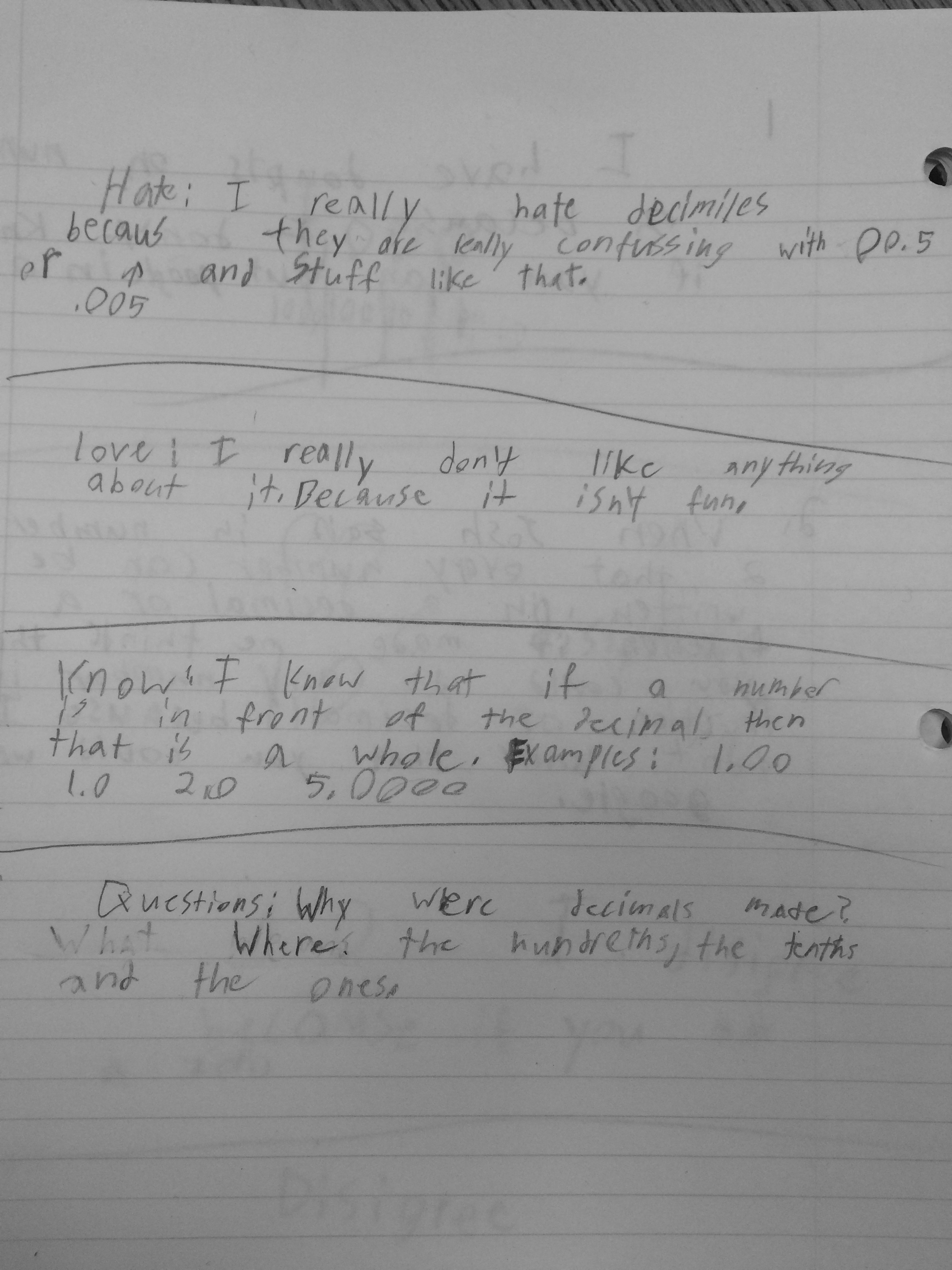
Last week, I asked the students to tell me everything they know, like, don’t like, confused about, wonder, feel…etc, about decimals. I used these responses in developing the decimal unit as far as where I should start and what types of things I was sure to address during the course of the unit. The responses were really interesting and reinforced a lot the common misunderstandings/ misconceptions I think students have around decimals. I am surprised to hear that the majority of students like fractions much better than decimals!

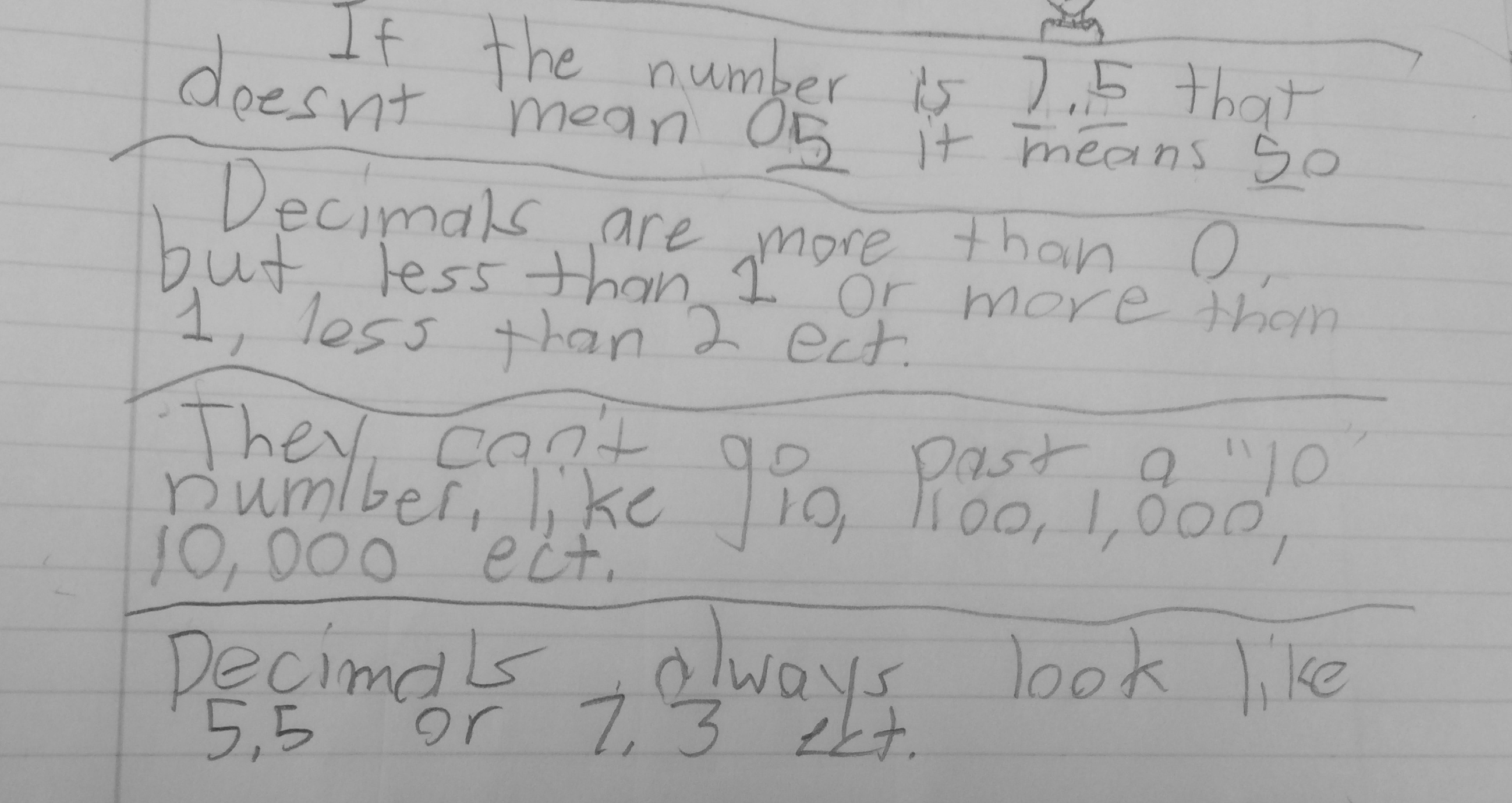
IMG_9010_2Love that this student knows that decimals fall between whole numbers and I am assuming the “10” number talk is about the place values. Also interesting that the student says the five isn’t 5, it is 50. Is this because they are taught to put them into hundredths to compare easily???

IMG_9012_2This one reminds me of the 1st one, however this student only sees decimals as less than 1 but greater than zero. This is a common misconception students have about decimals.

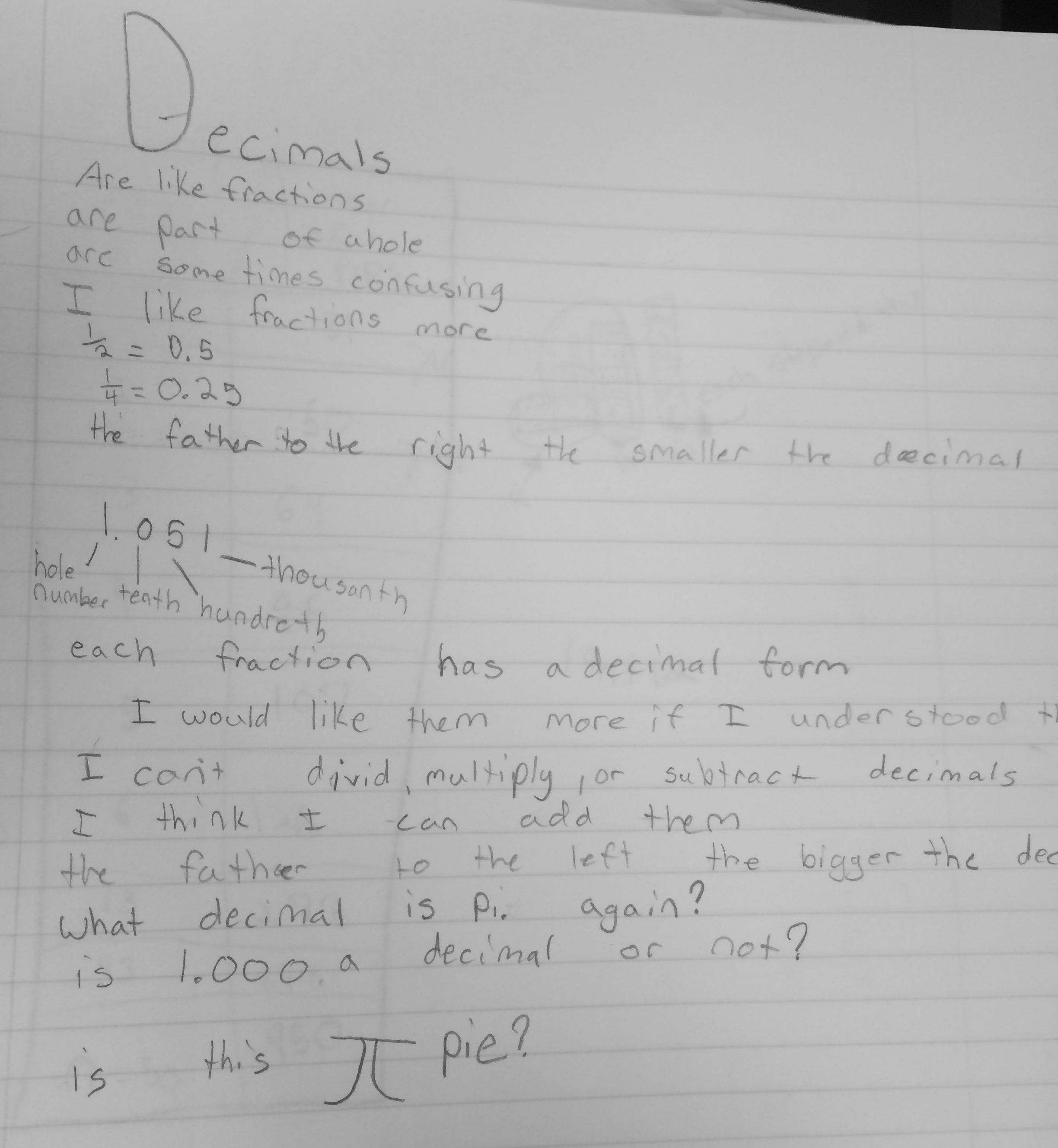
IMG_9003_2Love SO much about this one! All of the beginning is lovely but especially love the “farther to the right, the smaller the decimal.” This statement is what I put in my decimal talking points (https://mathmindsblog.wordpress.com/2015/01/27/talking-points-decimals/) that I want to keep revisiting. I am assuming this student meant the value of the digit, but instead said decimal, which sounds like the number itself, which is not correct. Love the wonderings at the bottom as well! Pie:)

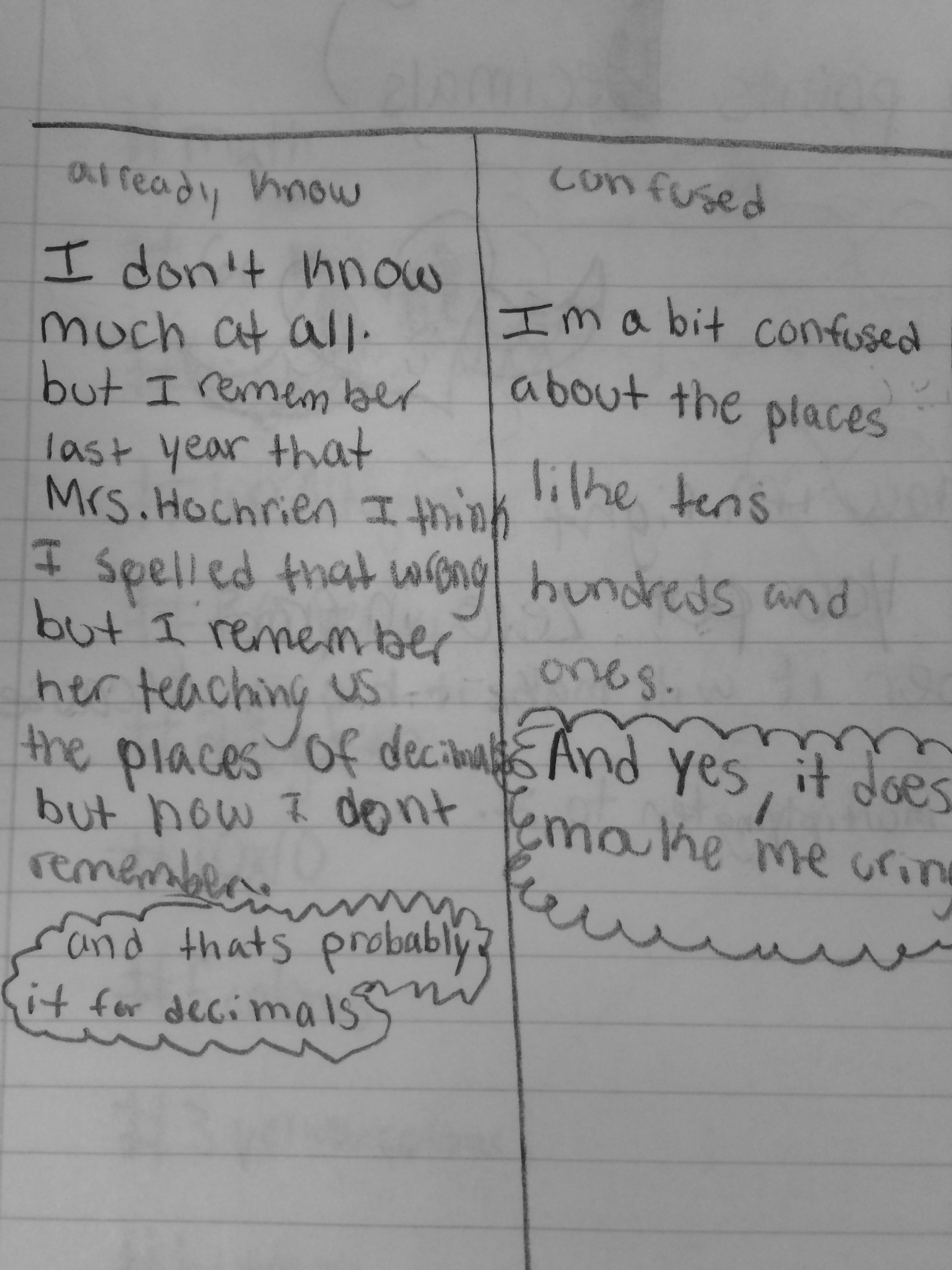
IMG_9002_2This seems to be the general feeling of decimals…it is about places and they make them cringe:( We will change that this year!

IMG_8996_2

I love the wonder here about the zeros continuing after the decimal point, do we have to acknowledge them or not.

IMG_8992_2

Love that they are “almost like a puzzle.”IMG_8993_2

I think the honesty in this one is beautiful. So much confusion that I cannot wait to work through!IMG_8994_2Wow, really doesn’t like them at all! It looks like the zeros after the decimal point is a confusion point for this student because they are comfortable with the fact that a number before the decimal means more than one whole.

-Kristin

Talking Points – Decimals

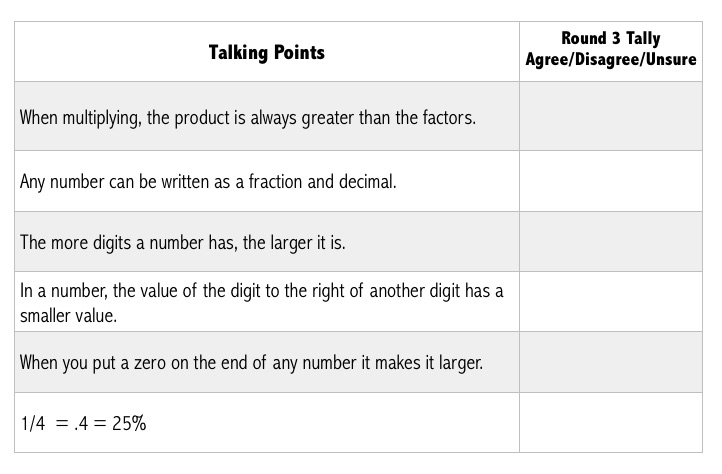
This week, we are beginning our decimal unit. I decided to start with Talking Points today to hear how the students are thinking about decimals before we dig in. In developing the Talking Points, I asked the #mtbos for some ideas on decimal misconceptions/misunderstandings they see students have each year. Thanks to @MikeFlynn55, @AM_MathCoach, and @MsJWiright2 for  your thoughts! Of course as the students were talking today, I wanted to tweak my wording of the statements!  Here are the points I used, my intended purpose of the statement, what I noticed and possible rewording for future use…

tp1TP1 – My goal in this statement was to hear if students were thinking about multiplying by a number (fraction or decimal) less than one. The first thing I realized is that I have a class obsessed with negative numbers! Then the next thing that other groups talked about a lot was multiplying by zero or 1. I did have some students think about fractions, like in the example below. In future wording, I would probably adjust it to, ” When multiplying by a number other than 0 or 1, the product is greater than the factors.”

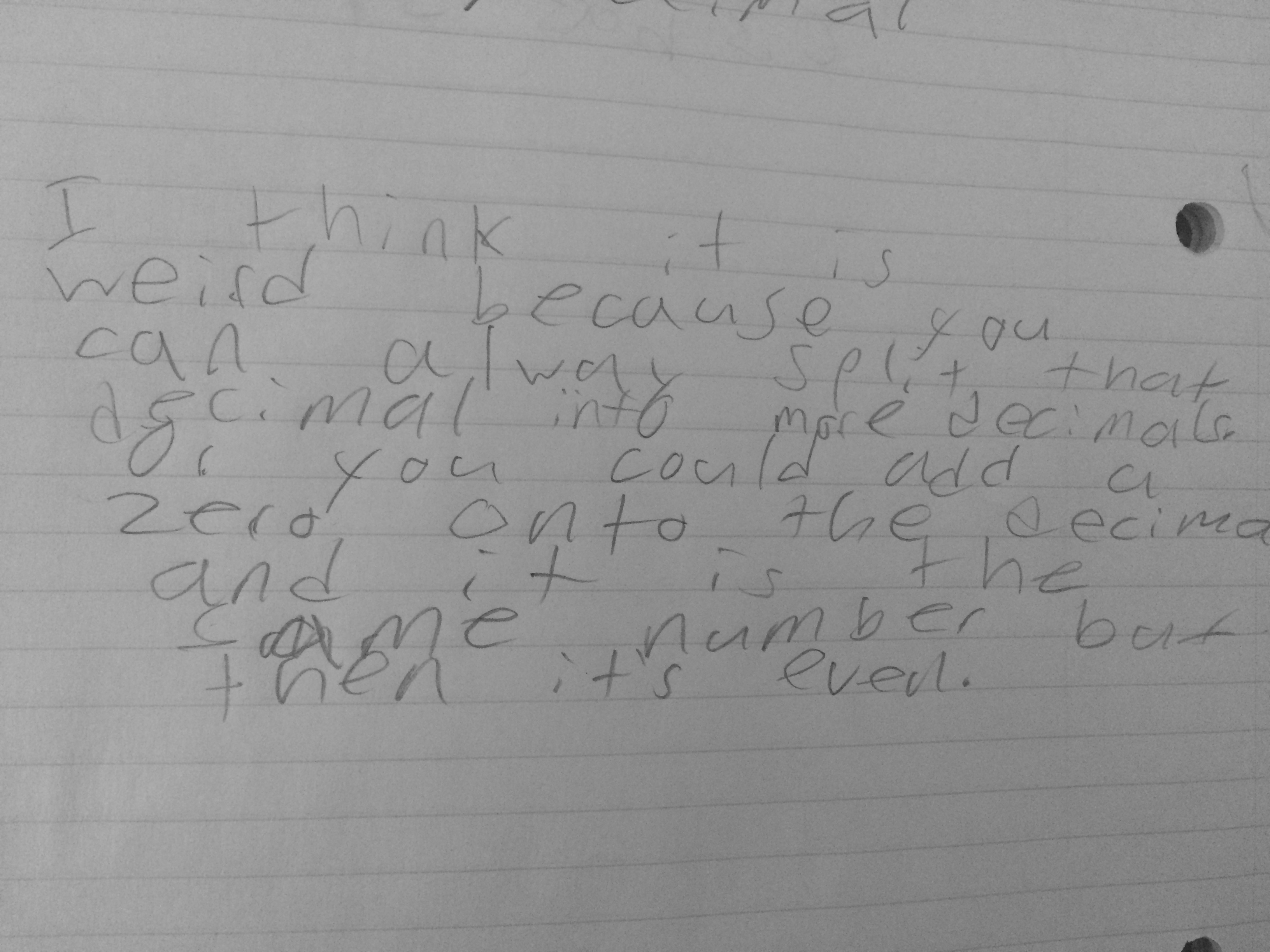
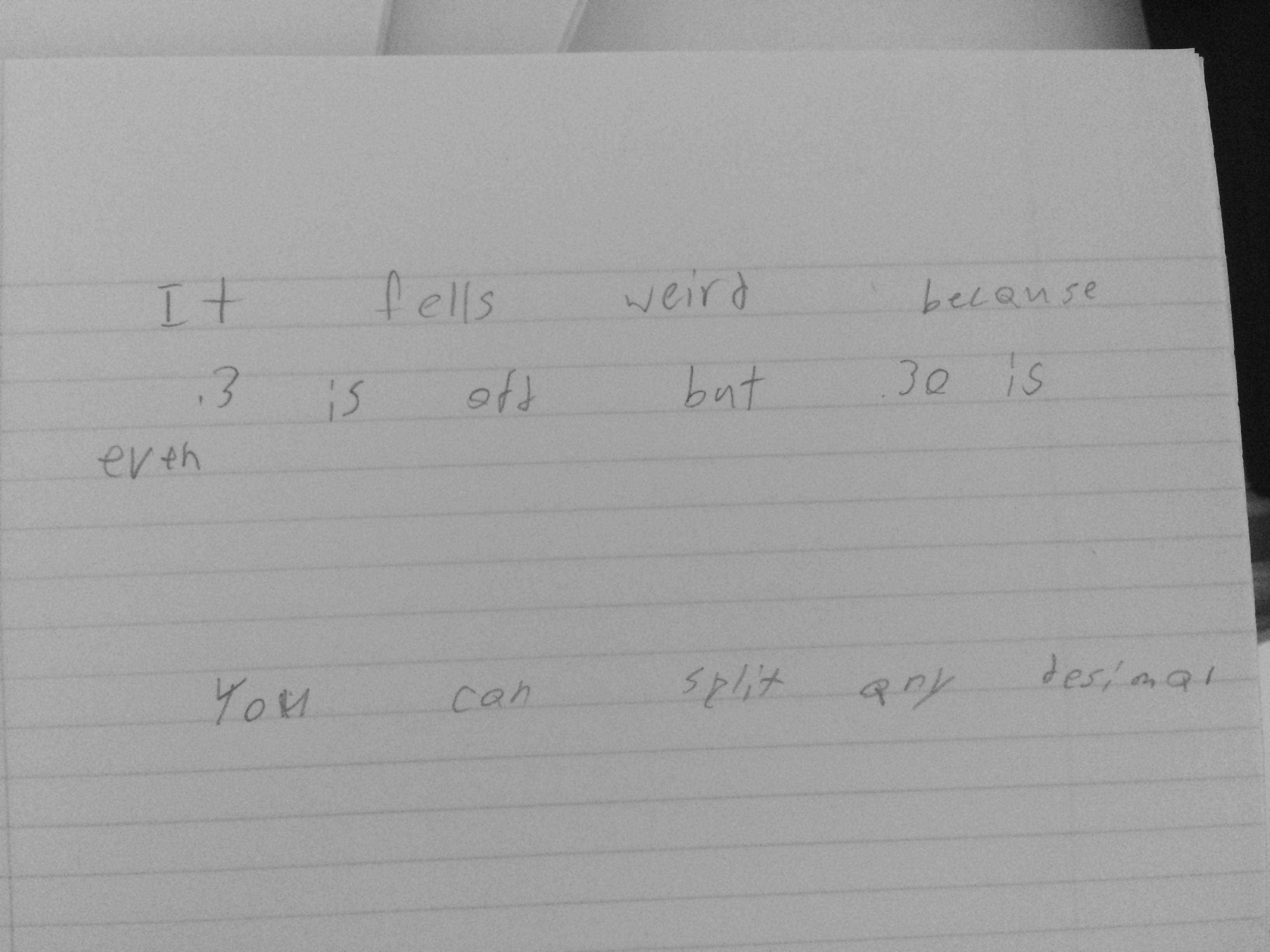
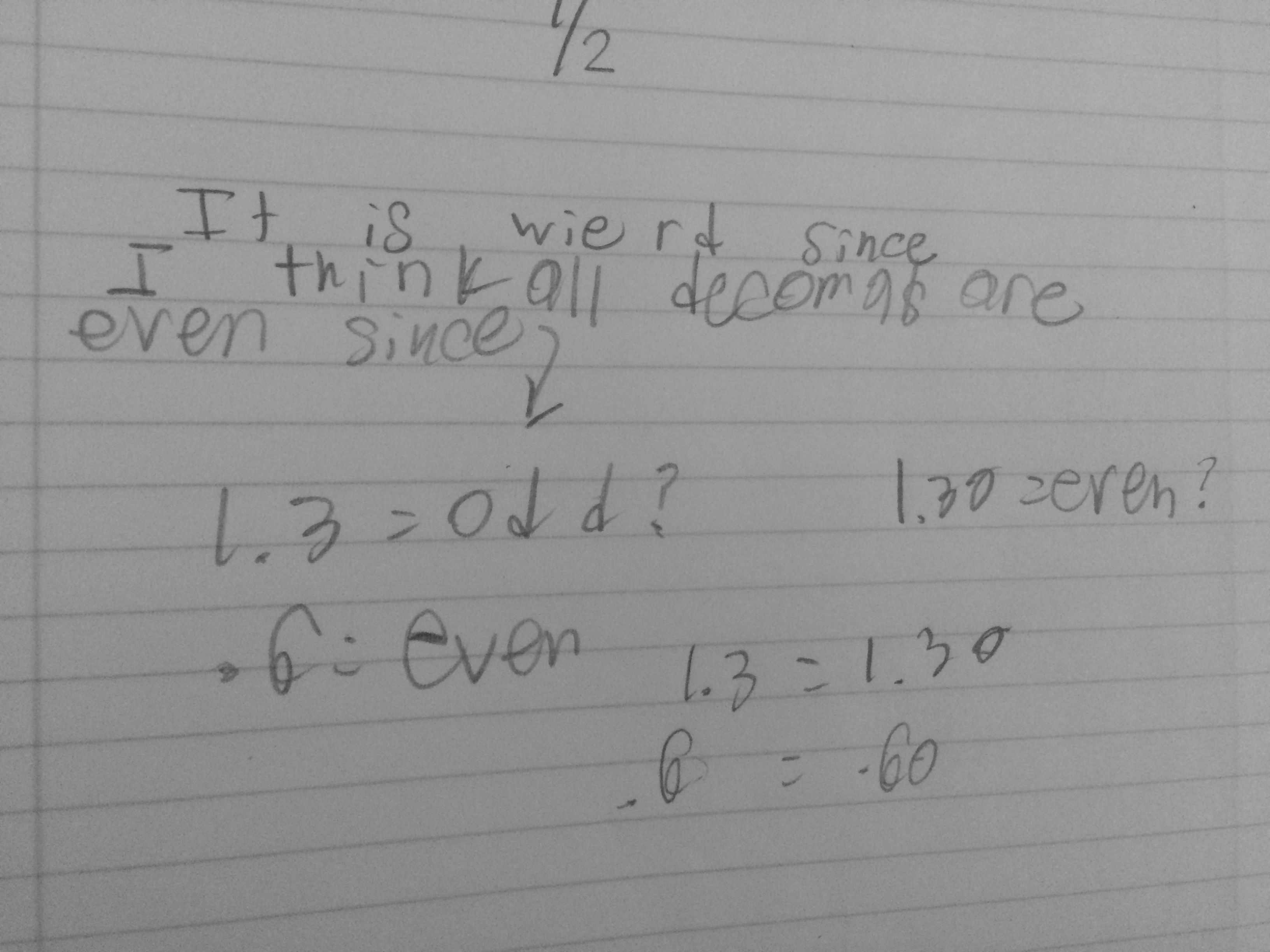
IMG_8968_2TP2: My goal with this statement was to hear if students thought about taking any number and make equivalents. My initial thought was just fraction/decimal equivalents like .3 = 3/10, but I did run into some great conversations about 3=6/2=3.0. The problem was that some were agreeing because they were just taking any number and writing it a fraction, not equivalent, just plopping it into a random fraction, like 7 can be 1/7 can be .7 can by 7/8, as long as there was a 7!  Possible rewording would be “All numbers can be written as equivalent fraction and decimals.”

IMG_8976_2TP3: This one was to elicit conversation about a comparison problem in which I see students often having a misconception. In comparing, students will think that 0.35 is less than 0.1245 because it has more digits. This one blew up in my face, of course:) The negative numbers arose again, which was interesting however, the some very clever students wrote 00000001 and said it is smaller than 12, but it has more digits. They were right, my statement was bad. Possible rewording, “The more digits a number has after the decimal point, the larger the number is.”

TP4: This one was really to plant a seed for the unit. I wanted students thinking about the place of the digit and its relationship to the digits surrounding it. So often when we decompose numbers, we deal with place values independently but I want to really focus on how the value changes as we move within the number. This one elicited great points made by the students and I plan on revisiting this one often throughout the course of our work together. This is one student’s reflection afterwards about this point:

IMG_8973_2TP5: My goal was to see if students thought about equivalency between decimals such as .3 and .30. The talk at each table was interesting and it was definitely one that was a split decision at many tables. I would leave this prompt the same based on the student responses, it was a nice mix and the mention of decimals came out vaguely. Student reflection on how another student changed his thinking:

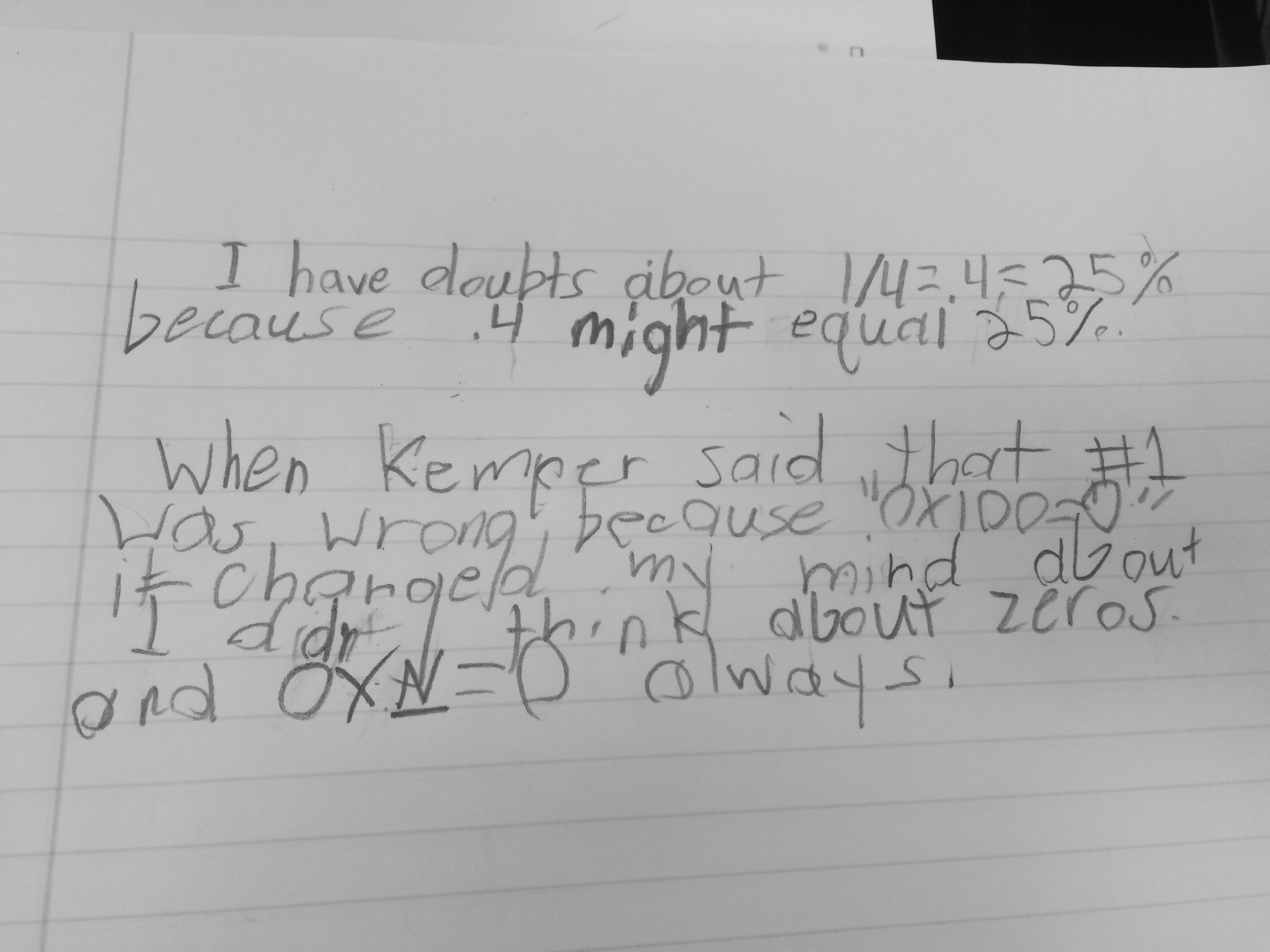
IMG_8977_2TP6: I used this point to check for equivalency understanding of fractions and percents (because we have worked with them) and then to see any connections to decimals. A lot times, student will take the fraction denominator and put that right behind the decimal point to make equivalents. This one was eh. I like that students knew 1/4 = 25% so the conversation focused on the meaning of the decimal in relation to the other two. I may reword this to, “.4 = 4%” and leave it at that.

After the points, I had the students reflect on two prompts…

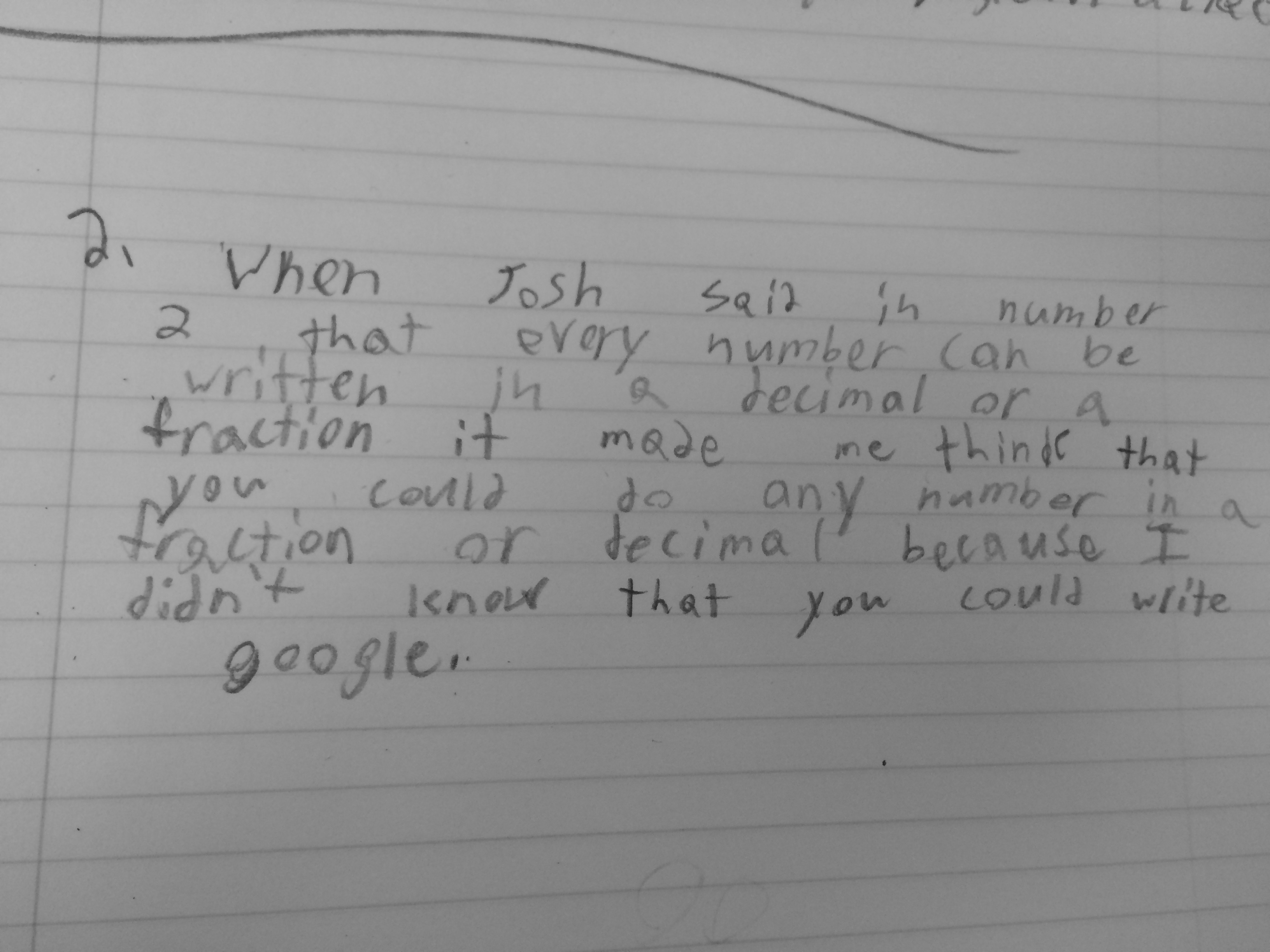
“I am still having doubts about Talking Point __- because….” and “When (insert person’s name) said ___________ it changed my mind about Talking Point ___ because…” Some samples of these are above and here are a few more….

IMG_8969_2IMG_8970_2IMG_8971_2IMG_8975_2

Visual Patterns Fun!

Each day, I start class with a math routine. Whether it is a Number Talk string, If I Know Then I Know, Closest Estimate or Quick Image, those first 10-15 minutes are always my favorite math conversations of the day! Today I added Fawn’s (@fawnnguyen) Visual Patterns into the mix.  I spend a lot of class time having students look for patterns and regularity in their math work, but this visual brought a wonderfully different “feel” to their work. As Fawn had previously blogged, the Visual Patterns have an entry level for everyone and every student in my classroom engaged immediately with the images.

I chose this one to kick off our work today:

vp1 I asked the students to work as a group to find the number of unit for Steps 1 – 6, 13, 43, and then n. Being their first time, we had to deal with what the “n” meant and after the initial “Is this algebra?” followed by numerous stories of siblings who are doing this math with letters, they were on their way. It was interesting to see some students go straight to drawing each image, others started looking for what was changing as the steps progressed, and then there were the students who love going straight for an expression for finding 13 and 43. After they all had the table completed, we came together to fill it in. I was so impressed with their work and their ability to find the expression for the nth shape, however the BEST part of the conversation was taking that expression and connecting it back to the images. Why was n doubling? Why is that 1 being subtracted?

I love how this student used a specific example to connect his expression (or almost an expression, we’ll get there:)

Photo Jan 26, 9 29 51 AM

This student found the equation and decided to use “a” to stand for “answer.” I loved how she then tested it with other numbers. Photo Jan 26, 9 31 39 AM


These two students then put a different spin our our work. Every group in the room came to the expression n x 2 -1, and as one student was explaining how the 1 needed to be subtracted because it was being double counted, another student exclaimed that his group figured out that if you just split that block in half and made each said a mixed number you just had to multiply that by 2. For example on step 4, if you made each side 3 1/2 x 2, you would arrive at the same answer. How awesome!

Photo Jan 26, 9 31 49 AMPhoto Jan 26, 9 31 23 AMI am excited to make this a part of my daily math routines, thanks Fawn for sharing, awesome stuff! I had students asking for another one before they left class that day, they loved it!

-Kristin
Geometry Is Worth The Extra Time…

As I am sure many teachers can attest, there is a constant struggle each year between covering content and the precious amount of time we have to engage the students in learning. Prior to the past two years in the classroom, this guilt always seemed to creep up most during our geometry units. I used to feel that once the students could find area, perimeter, and volume, we would move back into our fraction and decimal work because that always took SO much time to develop a deep, foundational understanding. While geometric representations such as an area model support the fraction and decimal work, it is still not the 2D or 3D unit work.  Right or wrong, I felt I had to prioritize to make use of the little time I had for the best of my students. Over the past two years, however, my geometry units have been taking longer and longer because I have started to see things evolve in my geometry units that has me  wanting to kick myself and go back in time to give my past students a different learning experience. From the connections to number and operations to the development of proofs and generalizations have been eye-opening.

As all of these math connections were going through my head, I see this tweet from Malke (@mathinyourfeet)…

mrahhh, it felt like validation in some weird way.

After this Twitter conversation, I started to dig back into my students work to find examples that makes these connections visible.

After doing a dot image as our Number Talk one day, I asked students to see if they saw any connections between the image and our volume work that day. This work shows how students see the commutative property in both, multiplication as groups (like layers in volume) and most importantly puts a visual to how multiplication and its properties “look” in both 2D and 3D.

IMG_7754IMG_7755IMG_7763IMG_7765IMG_7764Then volume led into some great generalizations about how multiplication “works” through looking at patterns, which is extremely important in mathematics in and of itself.  In keeping constant volume (product), students realized they could double one dimension (factor) and half the other. In doubling the volume (product), the students realized they double one dimension (factor) and leave the others the same. T

IMG_7795_2IMG_7797This volume discoveries later let to this claim on our claim wall:

IMG_8148The students extended this area and volume work to fractions/decimals that showed that fractions/decimals act as numbers in operations as well, supporting the structure of our number system.

IMG_7632IMG_7980While we classified polygons, I saw my students develop proofs for angle measures and our always, sometimes, never experience was invaluable. This work in connecting reasonings through visuals of the polygons explicitly supports the Mathematical Practices of using models, perseverance, and repeated reasoning.

IMG_8280_2IMG_8283_2IMG_8423Then our work with perimeter and area solidified the importance of students creating a visual in building number is so important. In a problem with equal perimeter and different area (moving into greatest area), students created a beautiful visual for the commutative property as well as supported students in seeing the closer two numbers (with the same sum), the greater the product.

IMG_8854IMG_8866IMG_8867-Kristin