3rd Grade Subtraction Number Talk

So, this year is tough….getting to know students and content across all grade levels is so exciting but always leaves me with so many questions! As much as I use the CCSS as a guide, I go in to every class wondering what students at this grade know, wondering how they talk about it, and wondering how to structure activities to encourage connections. These are all things I took for granted as a 5th grade teacher.

Today I went in and did a subtraction number talk with a 3rd grade teacher. I did a string starting with the problem: 23 – 19 and all of the other problems were subtracting a number with a 9 in the ones place. I thought I could possibly get adding up, removal and/or compensation strategies. For this problem and the following two, I got at least 3 or 4 different answers and a lot of strategies, some correct others not. The most common was subtracting tens (20-10 = 10) and then incorrectly subtracting ones (9-3=6) and arriving at 16 as their answer. Correct or not, I absolutely loved their openness to sharing and looking for errors in their thinking, it was fantastic! Their thinking was definitely not anything I could even begin to really string together because they were really all over the place so all I can focus on now is where to go from here?

The only common thread I saw was the majority of the students were “number pulling and operating” without seeming to think about the numbers first, what was happening or reasonableness. So, my question now is, Is there a type of number talk that would take the focus off of the numbers for a bit and allow students to think about what relationship the pictures have? I don’t know if this makes much sense but I am playing around with these images, but struggling with the wording…

IMG_0657 IMG_0658

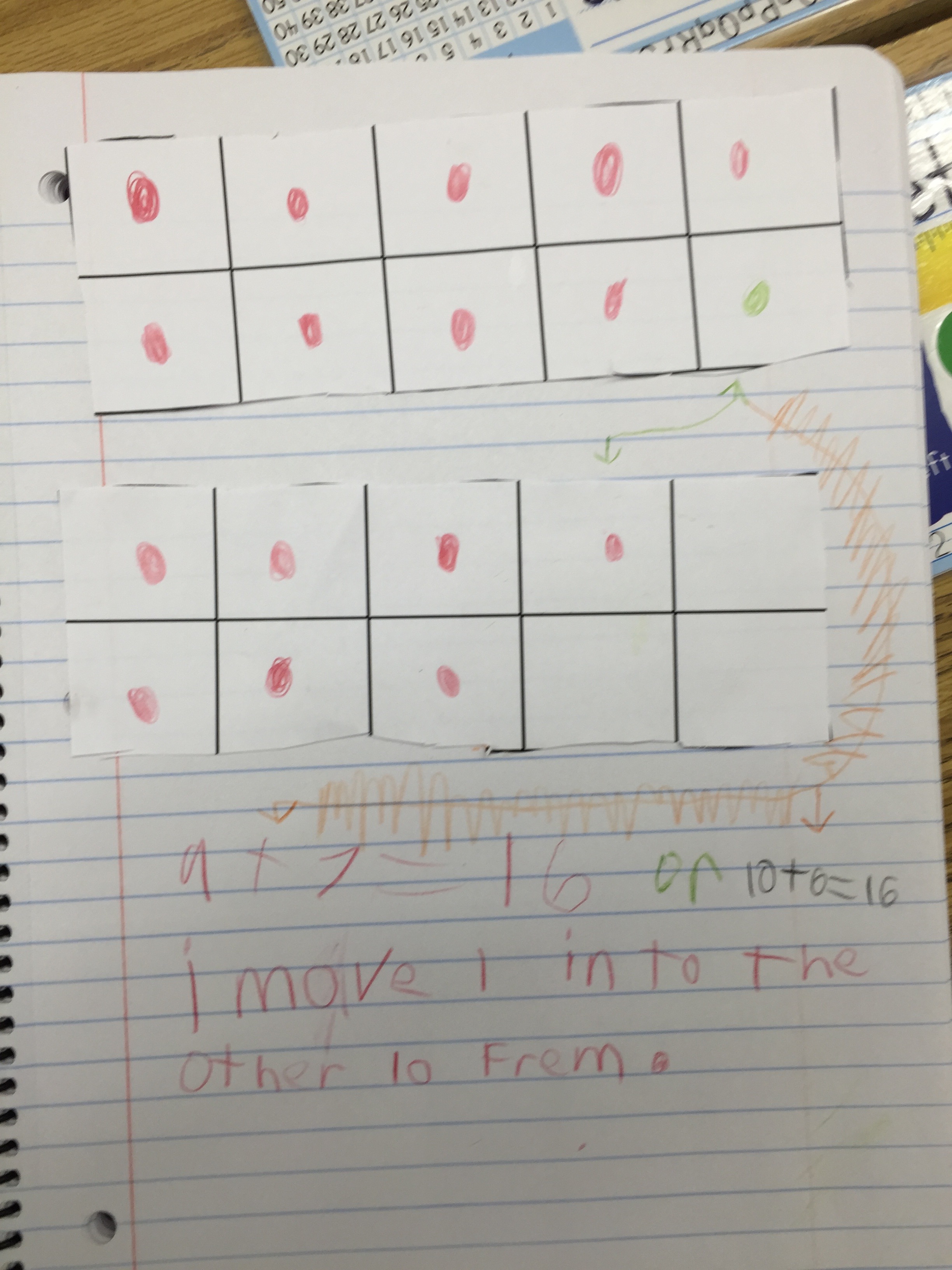
If I flashed the first one, How many did you see? How did you see them?

Flash the second one, What changed? What is the difference? <—–(I like this one suggested by the awesome 3rd grade teacher) Can you write an equation to represent the change?

I am thinking we could get 20 – 5 = 15 or 15 + 5 = 20.

Next this..same questions.

IMG_0659 IMG_0660

Now on this one, 30 – 11 = 19, I think I may bring up the strategy they used today, 30 – 10 = 20 and 1-0 = 1, leaving us with the answer of 21 and see what they think? I can’t tell if that would be helpful or not?? Would love thoughts.

Also, I cannot decide whether to end with a number expression and ask them what the first image looked like and what is different in the second and what the equation would be? Still thinking on this one too.

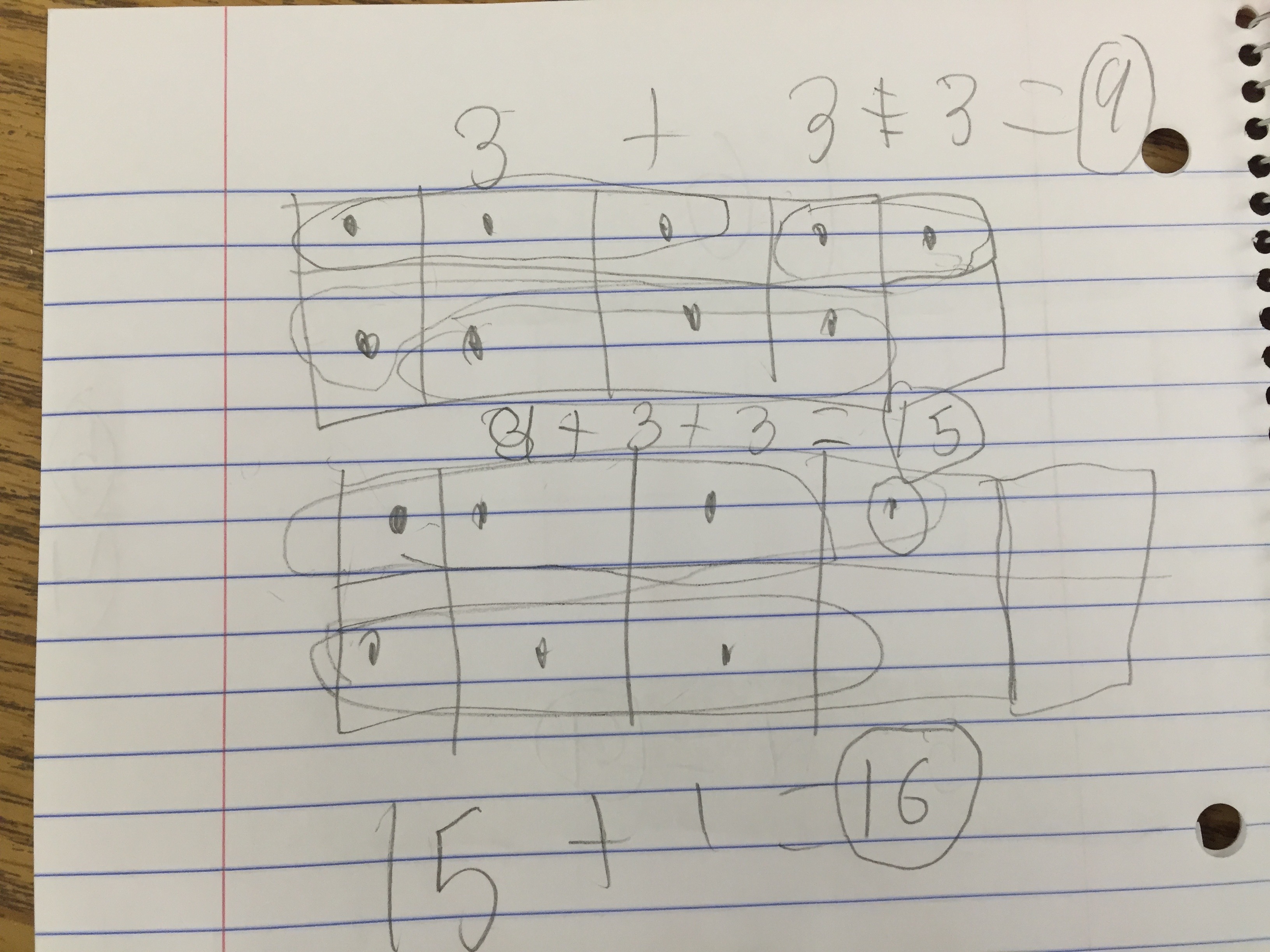
Trying it out tomorrow and will keep you posted, however I couldn’t sign off without one piece of student work that I loved. I left them today with 36 – 19 in two ways if they could. This student originally got 23 (by the means I described above) but then did the number line and arrived at 17. He went back to the first and realized that 20 and -3 gave him 17, not 23. IMG_0661

When I asked him how he knew it was 17, he said it was like having something 20 feet above the ground and it goes down 3 feet. It has 17 above ground still. I asked him to try and capture that and this is the beautiful piece of work I got…

IMG_0662

Looking forward to seeing this bunch tomorrow!

-Kristin
1st Grade Ten Frame Number Talk

I had the exciting chance to do a Number Talk with a 1st grade class last week! Looking back to where these students ended the year, I was fairly comfortable starting with ten frames and entering into talking about teen numbers within this context.

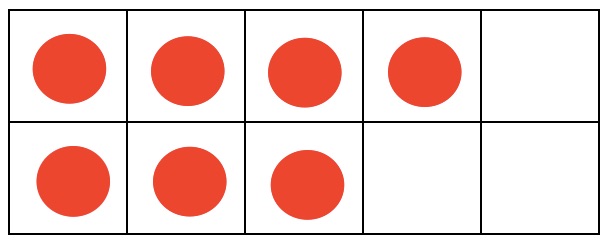
I started with the same ten frame I did in 2nd grade, that I talked about here. Looking back, I wished I had started with a full row of 5 just to talk more about how they saw it or just knew it in relation to the 10. Next time:)

1

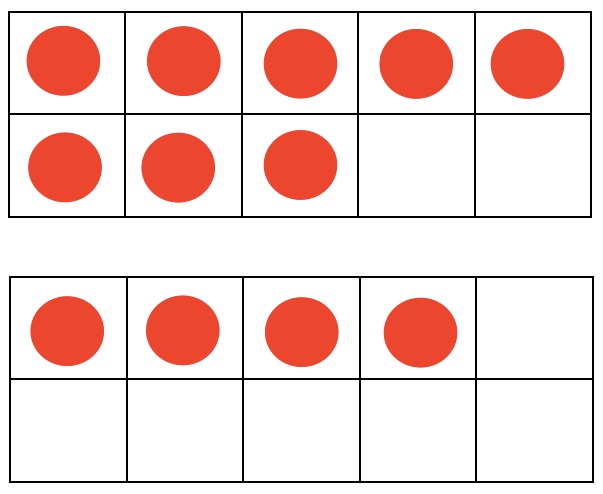
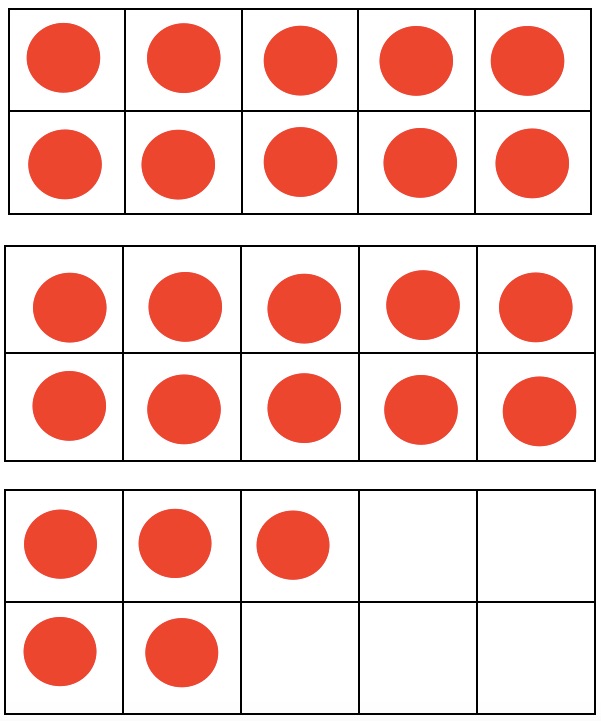
I then wanted to see how they thought and talked about a full ten frame and teen numbers. Did they count on from 10, just know 10 + 5, and/or talk about teen numbers as 10 and some more? So I posed these ten frames:

2

The students had some wonderful explanations of how they saw the dots and established how they just knew the ten if it was full. Some added on by ones to 15, some knew 10 and 5 was 15, some counted by 5’s to 15 and then one student some creative grouping vertically by 6,6,and 3. So I then pushed them a bit on how they recorded the equations and I was excited to quickly get 10+5= 15 and 5+5+5=15.

My brain right now is algebraic reasoning all they way so I could not pass up the opportunity to do this:

10 + 5 = 5 + 5 +5

I asked them if they thought their teacher would mark that right or wrong and why? I had them turn and talk to a partner and after a quick raise of hands, I could see the class was split on whether it was right or wrong. I asked those who said it was wrong why and got what I was expecting…

“After the equal sign can only be one number, no plusses. If you changed those lines (equal sign) to a plus, then maybe it would be right.” In reading Thinking Mathematically and Connecting Arithmetic to Algebra, I am finding this is a huge misconception that students build from K.

I asked the students who thought it was right to explain why and I got two uniquely different ways of thinking algebraically about this equation.

“They are the same because 10+5 is 15 and 5+5+5 is 15 so they are the same.” This student is looking for balance, this side equals that side so it is equal. I could assume that given 12 + 6 = _ + 5 + 6, this student would think they need 7 more in the blank to balance both sides.

The second student said this:

“The 10 is a 5 and a 5, so it is the same as the other side.” This seemed quite different to me. It felt like a symmetrical way of looking at equations. He decomposed the numbers to prove they were equal by the way it looked. I could assume that given 12 + 6 = __ +  5 + 6, this student may decompose the 12 to 5+7 to find 7 is the number that goes in the blank to make it look equal. A bit different and something I really hadn’t thought about until now.

Thanks to Michael Pershan to making me think (obsess) over the ways in which students think about these in such different ways 🙂

These were the last two in my talk that I did not get to because these 1st graders had so much to say about the first two and I had so much to learn!

 34

Looking forward to working so much more with these kiddos!

-Kristin
Second Grade Number Talk

This was the first week of school and the very first number talk these students had done this year! From the excitement in the room and this poster on the wall, however, you can tell they have done them before…

IMG_0583

This string was to see some of the strategies they had used before and how they were thinking about organization, decomposition and notation. I included my reasoning for choosing each one under the image.

Image 1:

image1

I was curious to hear so many things in this first one. I wanted to see if the students saw the numbers in particular ways such as: 4 on top and 3 on bottom, subitize the die 4 to the left then the 3, or 6 and 1 more. After they saw them, how do they combine? Do they “just know” 4+3 or 6 +1, do they count up, do they count all? I was also curious to hear if any students reorganized the dots to fill the five on the top row to create 5 +2. And then do they combine them 5,6,7 or do they know 5 and 2 more is 7 right away?  I was so impressed to hear the students do all of the things I anticipated very quickly and were very comfortable with writing equations, explaining the thinking, expressing where they made a mistake and talking to one another. Yeah K and 1 for building that community, it showed! 

Image 2:

image2

On this one I was curious to hear all of the same things from the first one, but to also hear how they see/think about teen numbers. Do they move the dots to make the 10 and why do they do that? Do they know 8+4 and don’t think about moving the dots? How do they know it is 8 and 4…is it because of 5 and some more or because of the missing boxes to make the 10 or the 5?

Again, all of the things I anticipated came out, however one little girl started explaining how she started by counting the empty boxes so I completely thought it was going to be 20 – 8 =12, however it did not go there.  She did get to 8 empty boxes but then said, “so then I moved two up to make 10…” Ha, not where I saw that going!

Image 3:

image3

Building on what I learned from the first two, I wanted to see if and how they combined 10’s and then added on the extra dots. I didn’t make the 5 a neat row on the bottom because I wanted to see how they organized them. I was excited to see that as soon as I flashed the image the first time, all of their eyes went right to the bottom ten frame. That let me know that once they saw a full ten, they could just keep going and it would be easy to add that on at the end. The students shared their thinking and then I wanted to focus on the 20 + 5 = 25 and 10 + 10 + 5 = 25. Having recently read/reread Connecting Arithmetic to Algebra and Thinking Mathematically, I am really interested in how students in the younger grades build this foundation for algebra. So I told them i was going to write an equation and I wanted them to tell me whether it was true or false and give me a thumbs up or thumbs down on it. I wrote 20 + 5 = 10 + 10 + 5. I was completely anticipating the majority to say false because they are used to seeing one number after the equal sign, so I was SO excited to see more than 75% of the class with their thumbs up. I asked them share why and many students said because the 10 and 10 are the same as the 20 on the other side and the five stayed the same on both sides. Others said because it is 25 on both sides so that is the same. This was such an interesting thing to think about for me…some student look for balance (equal on both sides) while others look to make them look the same on both sides (the 20 is the 10 + 10), a little bit different in my mind. 

After the talk, I was SOOOO excited to see that Miss Robertson was starting math journals this year so we came up with a double ten frame (the first one with 9 dots and the second with 7 dots) for the students to explain how they think about the dots? What things to they look for or do to find the number?

Here were some of their responses that I thought we so interesting and leaves me wanting to chat with them about their work!!

IMG_0590

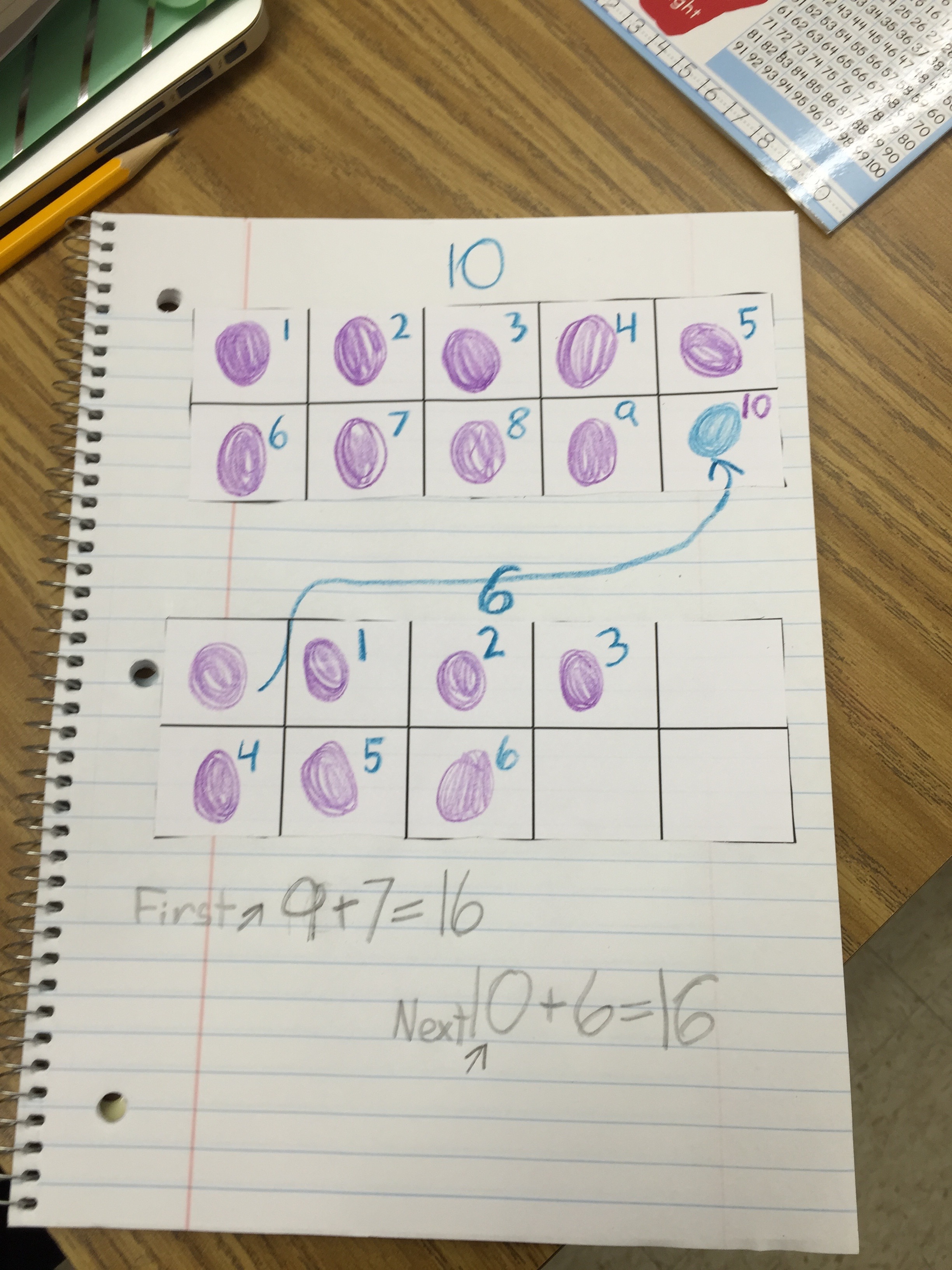
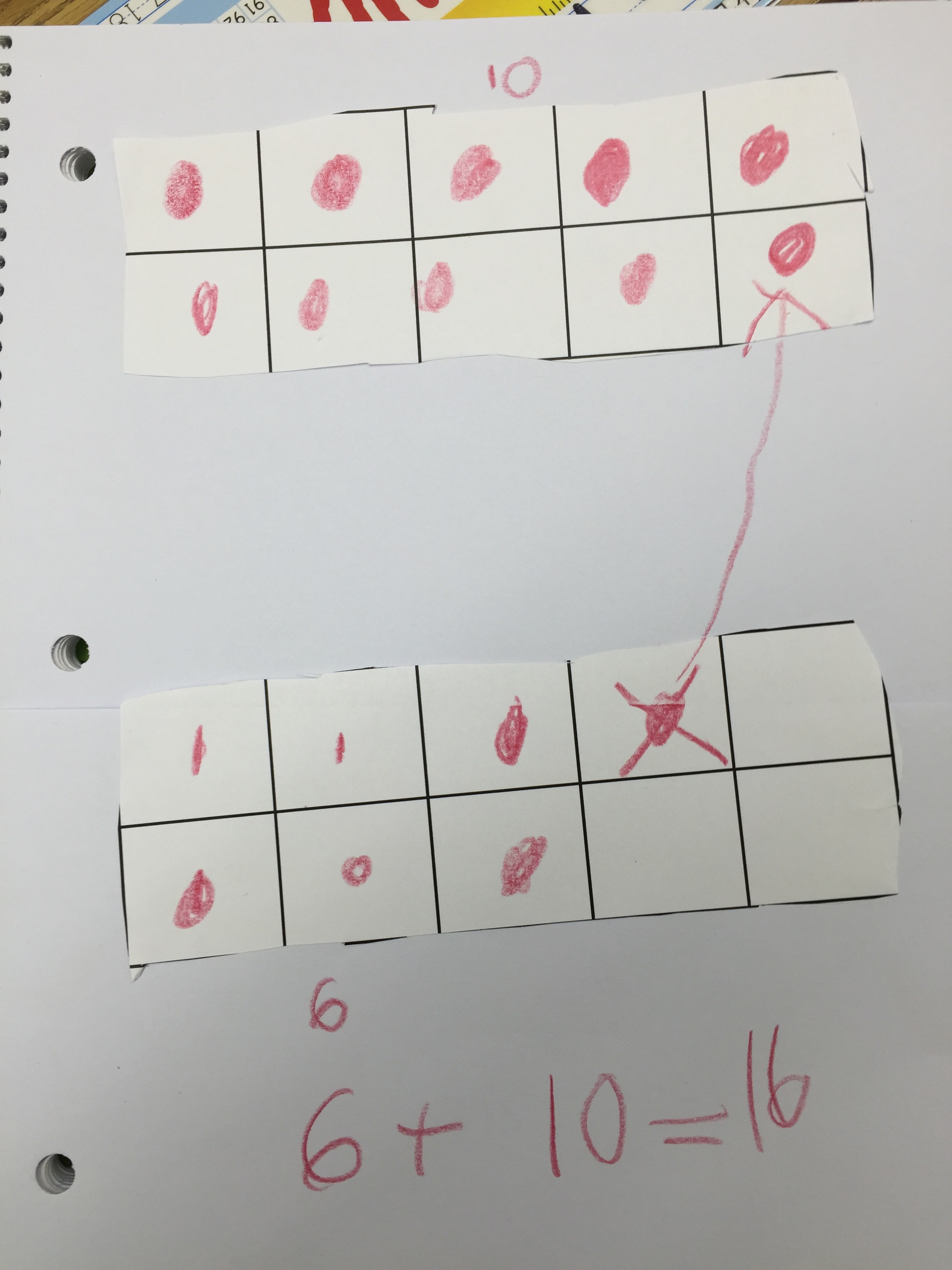
I loved so many things about this one. The “10” in a different color makes me feel like that student thinks there is something really special about that 10. Although she numbered them by ones, I don’t think that is how she found the 16, but I would like to chat with her more. I wonder if she wrote 9+7 but then filled in the answer after she moved and solved the 10+6=16? 

IMG_0585 (1)

This was so exciting because it was one of Miss Robertson’s ELL students and look at all of that writing!! While there is no answer, there is the expression, 5+4+4+3 at the top which shows me how he is seeing the dots. He went on explain about a 10, but I did not capture the back of the paper…grrrr… stupid me. I will have to go back to this one! 

IMG_0588

I was amazed to see so many students write both equations and with such an articulate explanation of the process. I expected, if a student moved a dot, to just see 10+6=16 written. Like this:

IMG_0589

But it was interesting the student in the first one wrote both! I am so excited for Miss Robertson to try a number string with them without the ten frames to see what they do with that! 

IMG_0587

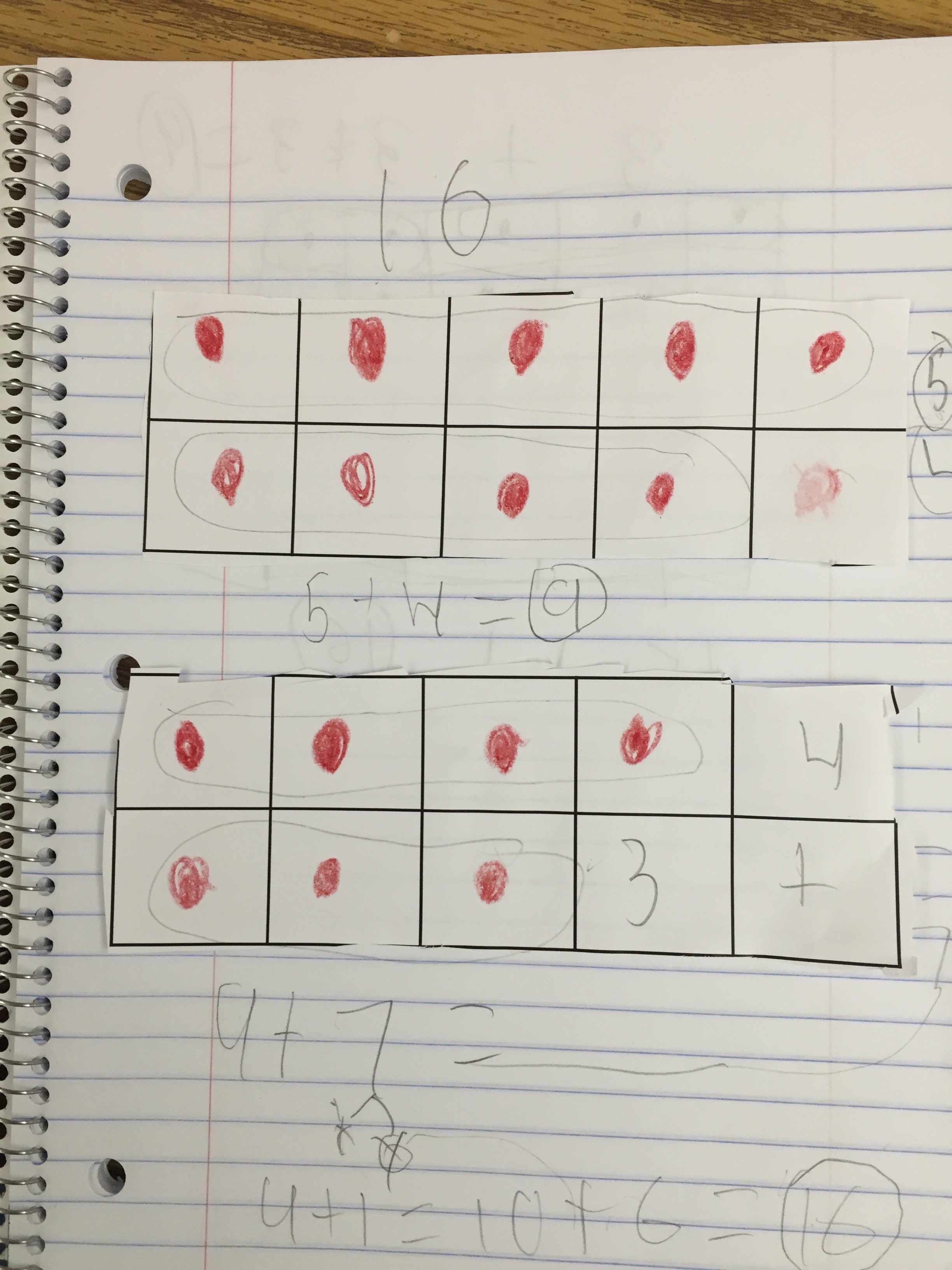
This student showed how they thought about the dots in each ten frame and then at the bottom shows beautifully how he combined 9+7. Under the 7 you can see the decomposition to 6 and 1, how lovely. The bottom thought string needs to be something to think about moving forward as teachers. Making explicit the meaning of the equal sign. 

IMG_0586

Ok, I am obsessed with this one and I need to talk to this student one more time! I am so curious why this student chose 3’s. Did he see 3’s to start or did he know something about 9 being able to be broken into 3’s? I  could completely see that if the top ten frame looked like 3’s or they were circled like the bottom one and the 3’s to the right were grouped together, however they are circled like he was counting off by 3’s by going down to the next row. Would he have done the same thing if the top ten frame was 8? In my head I am feeling like the student knew that 9 could be three 3’s, thirds, by the way it is circled. I don’t know if that is something students think about at all, so I am so curious. Or do students “see” threes but then circle them in a different way then they saw them?

Now, onto my 1st and 5th grade experiences yesterday….I am not going to be able to keep up with these K-5 blogging ideas this year…so much great stuff!

-Kristin
Making Number Talks Matter – Book Study!

I honestly cannot talk about the teaching and learning in my classroom, or across our school, without highlighting Number Talks. I cannot recall the very first time I started Number Talks, but now I cannot imagine my math class without them. My Number Talk journey began with Sherry Parrish’s book and had continued to grow through reading Cathy Humphreys’ and Ruth Parker’s most recent book, Making Number Talks Matter. I implement Number Talks on a regular basis, reflect through writing blog post after blog post and have presented at both NCSM and NCTM around Number Talks. I simply cannot say enough wonderful things about them!

For this reason, it was not surprising when I had the opportunity to meet my fellow Teaching Channel Laureates this summer, that Crystal (@themathdancer) and I struck up an immediate conversation about Number Talks when we began chatting instruction. As an elementary school teacher, I often have middle and high school teachers ask what Number Talks could look like in the secondary classrooms. Would the setting be the same? What would example problems or strings look like? How does the content focus change? How do we get students at that age to engage in these mathematical conversations?…etc. So many questions that I still am trying to wrap my head around.

Fortunately for me, Crystal is a middle school teacher using Number Talks, so our conversations gave me great insight as to how they look and feel in the middle school. We talked extensively about the Number Talk course she had taken with Ruth Parker and shared students’ conversations during Number Talks in our classrooms. It was so exciting to see the connections between our students’ experiences and the path Number Talks can take after my students leave me and enter the middle school.  While I would love the opportunity to plan and observe Crystal’s classroom, and her to visit mine, she lives in Washington state while am on the east coast in Delaware, so our opportunity to collaborate face to face is not a reality.

Enter the wonderful world of technology, amazing resources available through The Teaching Channel, incredible teachers around the world wanting to learn and grow every day, and Ruth and Cathy’s new book Making Number Talks Matter!  Now, Crystal and I do not have to be on this amazing journey alone, but instead we have the opportunity to create an experience in which other educators everywhere can join us!

Together, we have planned and structured a book study unlike any other! Flexible to fit your needs, full of valuable resources, and completely FREE!

Beginning October 5th, each week will be dedicated to one chapter of the book. Conversations will happen on Twitter and Facebook, videos will be posted in our Teaching Channel Teams group, and we will even have a guest appearance by Ruth Parker herself! It is guaranteed to be an amazing learning experience that can only get better with your participation!  

For more information and to register for the book study, follow the links below:

We look forward to learning with you and Getting Better Together!

Check out Crystal’s Number Talks journey here!

-Kristin

Establishing a Culture of Learning …The First Hour

Every year, we as teachers work so hard to establish a safe, open place for our students to learn. My goal in moving out of the classroom year and into a math specialist role is to also establish this same culture among our staff. A culture where teachers talk about instruction, math problems, and student ideas, feel ownership in their lessons and the lessons of others, and can comfortably visit one another’s classrooms. It becomes a norm. It is not easy and definitely cannot be done alone. I am SO incredibly fortunate to have a wonderful principal, Jenny (@PrincipalNauman) and district supervisor (@EducatorKola) who support the vision and are always open to new ideas, a great ELA counterpart Erin (@EGannon5) who helps me focus and thinks about the important details I miss in my excitement about things, incredibly caring, motivated colleagues who always want to grow and learn, and all of the amazing educators in my face-to-face and online (#MTBoS) networks who I mention throughout this post.

Yesterday was Erin and my first opportunity to talk with teachers. We only had one hour to work with the full staff, so we had to truly prioritize and make the most of every minute! We decided it was most important to set the tone for the year and our work together with the teachers. We wanted to begin establishing a culture of learning. The best part was, we were not starting from scratch! Our staff is so wonderfully open to new ideas and really took Number Talks and ran with them over the past few years, however there is always room to grow and improve upon what we were already doing. PLCs are part of that room to grow. While they participated and did everything asked of them, teachers were not feeling that time was based on their individual needs as much as it should be. Being one of those teachers last year, I put myself in that group.

Establishing a Culture of Learning

Establishing a Culture of Learning (2)

Instead of telling them what a learning culture could/should look and feel like, we wanted them to experience and reflect on it. What better way to do that than Talking Points? (shout out to Elizabeth @cheesemonkeysf) We designed the Talking Points to give teachers a range of ideas of how they could be used, whether around content specific statement or ones around mindset.

Establishing a Culture of Learning (3)

I have never been in a PD where Talking Points are not a hit during the activity itself, but the reflection afterward is twice as valuable! We asked them how this activity would promote a culture of learning in a classroom. We tried to quickly list ideas as they responded so the list doesn’t truly capture the appreciation teachers had for students talking and listening to one another!

IMG_0551

When talking to my colleague Faith (@Foizym) about our plan for the hour, I really stressed how I wanted to make my work with teachers valuable this year. I wanted them to want to talk math with me and want me in the classroom and not see me in any type of evaluative role, I wanted our work together to be about their needs in order to best meet the needs of their students. She suggested having them write goals for themselves and their students. So, we asked them to complete these questions to know what each of their goals were…

Establishing a Culture of Learning (5)

We got amazing answers that really spoke to the thoughtfulness of our staff. I would love to post a few but I have to ask for some permissions first:)

Now we moved into how we were visualizing this culture permeating through our work together. Knowing we were introducing Learning Labs and Teacher Time Outs to them soon, we wanted to have them brainstorm words they associated with the word “Lab” and “Time Out” to set the stage. These slides did not have the words/ideas around it when they saw it, we put those up after they brainstormed.

Establishing a Culture of Learning (6)IMG_0549

Establishing a Culture of Learning (7)IMG_0550

Now we described our shift from PLCs to “Learning Labs” and the use of Teacher Time Outs. If you have not heard of Math Lab or Teacher Time Outs, I will point you to Elham Kazemi (@ekazemi) and her University of Washington peeps who are doing AMAZING work with this. Here is her ShadowCon speech that gives a wonderful description. Elham has been so generous in thinking this through with me and has given me wonderful advice, much of which I will continue to need I am sure!

Establishing a Culture of Learning (8)

Establishing a Culture of Learning (10)

Establishing a Culture of Learning (9)

I hope we captured it as she intended, but sadly at this point we were running out of time. There were many questions about the timely structure (that we honestly are still trying to hammer out) but overall everyone was really excited about this work! We received so many positive comments and offers to be the first to try out whatever we wanted to do!

I left completely excited about this work…even more excited than I was to start, if that is even possible! Once Erin and I work through the time constraints and the crazy schedules we know everyone keeps as teachers, I cannot wait to see the work that awaits all of us!

-Kristin
The Clothesline Number Line

The other day Andrew tweeted this post about the use of the clothesline in math class…

 “Clothesline is the master number sense maker.” says @timsmccaffrey according to @MathProjects. Good call Tim! pic.twitter.com/bVvvJz7CtX

— Andrew Stadel (@mr_stadel) August 19, 2015

I love the clothesline activity and have used it with students in the context of fractions, decimals and percents. When I first started using it, it would be up with pre-marked benchmarks on it and as we talked about relationships and equivalencies we would add them in relation to the appropriate benchmarks. For example, 0 and 1/2 would be already up on the line and in class the students realize that 1/4 is half of that distance, we would put the 1/4 on the line between the pre-marked 0 and 1/2. It was always a work in progress and it was a nice visual, but static.

After designing a PD with Jody Guarino, I realized the power in having the pieces be constantly movable. So we started with an empty number line and students drew fraction cards to put on the line one at a time. Now, there are two ways to launch this… either the students know the range of the cards they are using or they do not. I prefer the do not, but I see benefits and places within grade levels/units that each would be appropriate.

Let’s say the students did not know the range of the fraction cards (and they can have whole numbers mixed in there too) they were pulling. The first student is almost a blind guess because they do not know where this line starts or ends, but from there, there is constant adjustment to do.  It is a bit hard to describe in words so I hope this makes sense…

Student 1 draws 1/2 and places it in the middle of the clothesline assuming that possibly the line goes from 0-1. We ask why they placed it where they did and hope to hear something like “I think the line goes from 0 to 1 so 1/2 is halfway between those.”

Student 2 draws a 2, places it at the end, but then has to adjust where the 1/2 is placed because now 1 must be in the middle of the clothesline. Makes the necessary moves. We of course as why they adjusted the way they did and how they determined how close to place the fractions to the other cards.

Student 3 draws 3/2, no adjustments are necessary at this point, but the student must estimate where 1 would be and do half of the distance to 2 and place the card OR take the 1/2 distance and replicate that three times. Either is awesome. Of course, we ask all kinds of questions about their placements.

…and play continues, but if a 3 is drawn, then things shift tremendously…the fun part is students don’t know so they cannot have their spot pre-planned and everything is adjustable!

After Andrew’s post, I started thinking about two things…what could this look like with whole numbers and what are the differences between starting with a set on the line to move around vs drawing cards and placing them where they go?

I tried to sketch out a few moves and think about what students could be thinking about as they went. I am sure I have not captured all of the possibilities, so I would love to hear ideas in the comments!

First sketch, numbers 0-6 placed randomly on the line to start (top line)

IMG_0499So, we could be looking for students to place the beginning and end (0 and 6) first and then I would be curious to see if they placed the middle number before dealing with the other numbers (line 2). Or, would students order left to right, least to greatest (line 3)? Would be interested how they think about spacing the cards in this situation, do they touch? Is there the same distance between each? What would they think about if we gave them a card with 10 on it after they finished arranging them on the line?

Now, what if we started with just a zero at the left and didn’t tell students what range of numbers we had?

The first card they could draw would be a 2, they place it in the middle. We asked why they placed it there and maybe hope to hear something like “I think the line goes to 4, so 2 is the middle of 0 and 4.” (Line 1)

IMG_0500

Then, let’s say the next student draws a 6. They place it at the end, again assuming it is the highest number and then has to adjust the 2. We ask what their thinking was and hope to hear something like “Since 6 is the end now, 3 must be in the middle and 2 is less than 3.” There could also be some questions around how close the 2 is placed to the middle versus toward the 0. Cool stuff. (line 2).

Next student draws a 10, now the 6 shifts left, just right of the halfway point though because that would be 5. Then the 2 has to shift because the 6 did. Now, interesting questions about all of those moves come out..How did you decide where to place 6? Why did that affect the 2? How does the distance to the 2 relate to the distance to where the 5 would be? to where the 6 is?

Andrew played around with the clothesline with his son here. Great stuff and so many ways to think about how we could use this in our classrooms across all grade levels!

Thanks for the inspiration to blog this Tim, Chris and Andrew!

-Kristin

//platform.twitter.com/widgets.js

Making Schools A Safe Place for Teachers Too.

I so appreciate the fact that our district this year is focusing on really trying to make our PLC and PD time productive and meaningful for all of our teachers. We are finally having K-12 conversations around instruction and coherence of content, it is an exciting change! As we talked yesterday, I continue to realize how difficult it is to put systems in place that support teacher learning that, in turn, impact student learning experiences in the classroom.

All morning we discussed things such as:

  • where we (as teachers, schools and districts) are in terms of understanding the standards
  • how teachers are using standards in planning
  • how we are currently assessing those standards
  • student awareness of the standards
  • how we are reflecting on our teaching

…etc. All very important things.

We then talked about how we improve upon where we are and necessary structures to make improvements happen. In that discussion, I heard these types of things…

  • Teacher ownership because they see the need for change
  • Small changes
  • Have a plan
  • Accountability
  • District dedication of time to the effort (PD days)
  • Less mandates
  • Admin role

…etc. Again, all very important conversations to have.

Then we watched this clip:

The question, “What’s Your Leaf?” was posed. What do we see as the biggest obstacle in our way of growth/change? I can list a number of things that I would anticipate are justified obstacles for many teachers, however I keep coming back to one thing….Fear. I see fear as the leaf. Fear of being vulnerable, fear of opening up classrooms, fear of exposing what we don’t know, fear of repercussions of mistakes…etc.

So, how do we truly make change and improve teaching and learning?

Make our schools a safe place for teachers as we try to make them for students.

I would love to see schools be more like the blogs I read and conversations happening on Twitter. I want teachers to feel they have a voice and have important things to say. I want the conversations among teachers during the day to be about content, teaching, student work. I want them to challenge each other’s thinking and not be ok to always agree to disagree.

Someone recently asked me how I became so openly reflective about my own teaching and the answer is simple…I realized a had a voice, people were interested in what I was saying and I finally became ok with not knowing. It is hard to be vulnerable in teaching because it is such a personal thing for us, our job is not just a job, it is us.

My goal this year in working with teachers is first and foremost creating a safe place where math conversations around teaching and learning are the norm.  Where we can be comfortable saying “I don’t know” and it is ok and there are no negative repercussions.

-Kristin

A Teacher & Mathematician Mash Up

One of the many things I love about Twitter is the diversity of the group in which I have the opportunity to interact. Every day, Twitter provides the space for me to move outside of my classroom happenings and connect with others of varying perspectives and insights on teaching and learning. While these perspectives are so interesting to me, if I am being completely honest, they can also be quite intimidating. Not intimidating in the sense that one person’s point of view is “better” than another, but more in the sense that sometimes math conversations go to a place content-wise or philosophically that I cannot even engage. Not because I don’t feel like I don’t belong, but simply because I don’t even know what the heck to say because I don’t understand what they are talking about or it is so far removed from where I am in the classroom, I can’t relate.

The way I feel in those situations feeds my preconceived notions I have about mathematicians. Not the type of mathematicians I would call my students because they are doing great math, but mathematicians as in, that is their job title, you know, those mathematicians. I so admire the way in which they think about math, however given a choice, I would probably shy away from a conversation with them out of shear nervousness of saying something that sounded silly, or even worse, completely wrong mathematically. That was, until I started my work with Illustrative Mathematics.

Throughout my projects with all of the wonderful people at Illustrative, I have truly seen such incredible value for the perspective each and every person, whether a teacher, a math coordinator, a mathematician, or math specialist brings to the work we do in working to improve teaching and learning. From developing tasks, to facilitating professional development, the work is such an amazing collaborative effort in which I learn SO much. During this learning, my confidence in what classroom teachers bring to a math conversation grows, as does my appreciation for our different perspectives.

Most recently, a mathematician at Illustrative, Mike, and I have been working collaboratively on tasks to be reviewed for the IM site. It has been such an amazing learning experience for me. He is wonderfully thoughtful about the math, open to any ideas and/or questions I have and possibly the quickest email responder I have ever encountered:) Throughout our work together, I felt we were on the same page as far as the content of the task as well as in our thoughts about what students would do with the math of the task. I didn’t feel at all like I was “just” speaking from experience and he was talking from this “mathematician world” in which I couldn’t relate, but that we were both thinking deeply about the math and how it looks in a classroom, it was a beautiful thing.

After our first task, I thought to myself how odd it was that we thought so much alike. I was completely anticipating having these eye-opening mathematical revelations after our conversations together. However, during our second task, the revelation(s) came rolling in and the difference in our perspectives was really interesting and valuable.

The task centers around the commutative property of multiplication with fractions in the context of wrapping packages with riboon, 6 x 2/3 and 2/3 x 6.  In my classroom, I am so wary of students strictly computing without making sense of problems that I make a conscience effort, probably to almost an extreme, to connect their representations to a context. For example, in the problems above, I really want students to “see” the story for each differently. I want them to see 6 group of 2/3 for 6 x 2/3 and 2/3 x 6 as 2/3 of 6 or an area model with 6 and 2/3 as the dimensions. My biggest concern as a teacher, is the students connecting the problem to the context and then noticing patterns that show commutativity. My questions primarily focus on connecting their representation and notation back to the context. Everything to me is focused on context because of my fear of them number-crunching their way through an algorithm they don’t have a contextual visualization. Did you happen to catch that I care about context in that paragraph:) I even blogged about it here: https://mathmindsblog.wordpress.com/2015/03/29/commutativity-in-fraction-multiplication/

Mike and I both agree all of this contextual work is super necessary and important. This past year, I think my students did a beautiful job seeing the commutative property come out through patterns and repeated reasoning, however, after talking more with Mike about this commutativity, I realized I missed such an important piece. A piece that would have really solidified the commutative property in their work through their representations themselves.

I wanted students to match one of those two equations to a context and develop a more appropriate context for the other, however that just shows they come out to the same answer. In my mind it doesn’t really show how they can be commutative within the same context. I had never thought of that so much until Mike emailed me this statement…

“… if someone arranged the pieces of ribbon appropriately they could argue for either equation. I think that what we are after is to match an expression with some kind of reasoning. In other words, the real question to ask the students is to explain their expression via a picture that accurately models the situation.”

This is the point where I completely wish I could reteach this lesson. I would do everything the same, but add this piece. I would love to see if students could see one representation in another for both 6 groups of 2/3 and 2/3 of 6. Have them defend their reasoning and/or find their reasoning within someone else’s work. That really would have proven to students how the  commutative property looks versus just seeing I get the same answer no matter the order of the numbers. Which is kind of how I felt I left it this year.

This has been, and will continue to be, such a wonderful learning experience for me. I SO appreciate the diversity of people I have worked with at Illustrative as much as I appreciate the wonderful mix of people I get to learn from on Twitter. It is enlightening to me that as open and addicted as I am to learning, there are still so many things that I have a classroom perspective on that can be improved and extended through conversations with people who I may typically have shied away from in person. Knowing they appreciate my perspective is such a wonderfully empowering thing for me as a learner. Thank you to all involved in my journey!

PLC Brainstorming

As I move back into the math specialist position at my school this upcoming year, I have really been thinking a lot about the way in which our district PLCs are structured and, as a whole, how we treat each subject area as separate professional development entities. As an elementary classroom teacher, we either participate in a math PLC or a language arts PLC twice every week during our planning time. While it feels like it would work content-wise for the teachers who are K-3 and teach everything, it becomes a bit trickier when teachers are departmentalized in 4th and 5th grade.  Not that there isn’t a need for everyone to be involved with both content areas due to everyone teaching RTI groups, however it still feels like there is a disconnect and sadly can lead to the “waste of my time” mantra because it doesn’t feel applicable to what they are doing in their core classroom work.

So, the question I am working through, is how can we do this better?

The more I engage in math conversations around the book Connecting Arithmetic to Algebra, the more I begin to see the structure of  future PLCs evolve. (To catch up on those convos, @Simon_Gregg did a nice recap here: http://followinglearning.blogspot.fr/2015/06/mathematical-reasoning.html) It may seem odd to pull other content area ideas from here because the book is about amazing math reasoning and thinking, but I really see huge potential in this idea of “Making Claims” across all content areas. Thinking about this, I dug into the ELA CCSS, found these standards and started thinking about how this process sounded similar to our book discussions:

ccss

Upon further reading I came upon this ELA unit on Making Evidence Based claims: https://www.engageny.org/resource/making-evidence-based-claims-units-ccss-ela-literacy-grades-6-12

Then I moved into the Next Generation Science Standards and in a quick search I found this…

ngss

I just see so many potential connections here to have everyone engaged and leaving feeling like the PLCs were worth the time invested.

There is much more learning to be done on my part in the content areas, but I am seeing a way to structure our PLCs so they are not so much “by subject area” each time, but more “by ideas and reasoning process.” Questions I am thinking about….

– Could we center PLCs around ideas such as “Making Claims?” Talk about what students do during this process, how we foster the environment and share with each other content-focused work to look for similarities/differences?

– Could we center PLCs around various purposes for writing, or my favorite “Journals”? Discuss how and why we use them and share student work to discuss?

– Could I use the PLC time for this “Idea work” and have content knowledge come out more during coaching and hopefully some type of Math Lab as Elham has talked about?

As usual, not many answers and many more questions! Would love thoughts around this so I can work on making it useful and applicable for everyone next year!

-Kristin

My Questions Around Professional Development w/Video

When I read this blog post by Grace, and the comments that followed, I noticed some things…

1 -The wonderfully open, honest way in which Grace put herself out there and responded to each of the comments.

2 – The amount of incredibly thoughtful and thought-provoking comments.

3 – The community desire to have more of these videos for us to have discussions around.

4 – I reflect and learn so much through these interactions.

*At this point of reading, If you do not already follow Grace’s blog, you must do that ASAP*

My noticings led me to these questions around the types of video we, as a math community, would like to have available for either individual or group professional learning experience:

1 – What time range do you prefer when watching an classroom video clip? Is it different in a professional developmet setting vs at home?

2 – Do you like an open Notice/Wonder format when watching/discussing a video or prefer having a “focus question” when watching/discussing?

3 – What focus questions would be most helpful for you to either think about or discuss after watching a video?

4 – What makes you want to comment on a video or blog after watching/reading?

5 – What makes you NOT comment on a video or blog after watching/reading?

If you have any thoughts, answers, or suggestions to any of these questions, I would love your thoughts here: Google Form

Thanks so much!

Kristin