Category Archives: Uncategorized

Intuition in Learning Math

Yesterday, Malke tweeted this…
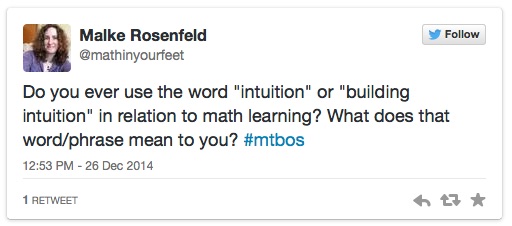
i3…and it led to such an interesting conversation that I honestly can say, I had never really given much thought. The conversation is here if you would like to read it now, or you may want to save it until after you read my rambling thoughts. 🙂

At first read of the tweet, my initial thought was how hard it was for me to make a distinction between intuition and making sense of problems. What makes them different? The amount of time it is given? The context of the situation? The math experience behind it? My questions could go on and on. I needed time to process these thoughts and let them sit with me for a bit. I tried reading some of the links to works about intuition in learning, but until I could figure out how I was thinking about intuition and put it in the context of my classroom experiences, the readings were not making much sense to me.

Luckily, I had a lot of car-riding time yesterday to think about this and jot some thoughts down. Disclaimer: these ideas are quite scattered, do not form a cohesive string of thoughts, and you will probably be left with more questions than answers by the end, however it is really fun to think about all of the ways “Intuition” takes shape in learning.

I thought it would be good for me to start with a definition and work from there. First, I tried Webster and got this one:
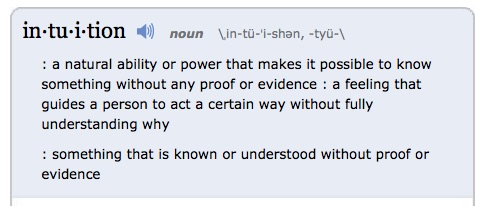
i2eh. I didn’t like the “without any proof or evidence” piece of this because I feel that our intuitions do come with proof or evidence, they are maybe not explored or articulated yet, however I think they are there. Then I found this one that I felt I could work from a bit better:
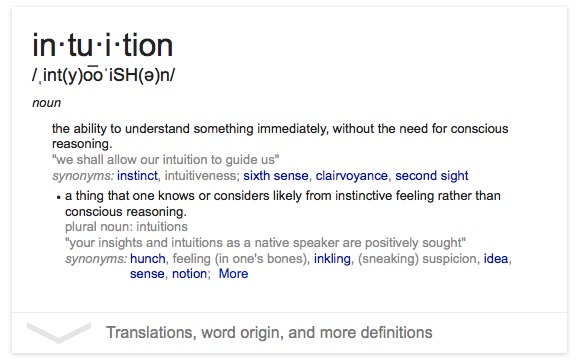
iThis definition by no means encapsulates how I envision “intuition”, however it had some really interesting points that led me to more questions….

– Does our intuition mean we have an “understanding”?

– Where does our “conscience reasoning” come from?

– Is our intuition always what is “likely“?

– Where do I see these hunches, inklings, notions in my students’ learning of math?

– Where do I see these same things in myself as a teacher?

Up to this point, I was gaining more questions than answers, so I began thinking about these questions in terms of my students and myself as a teacher. I am a person always in need of examples, so I needed to form some “example cases” to start to clarify these thoughts.

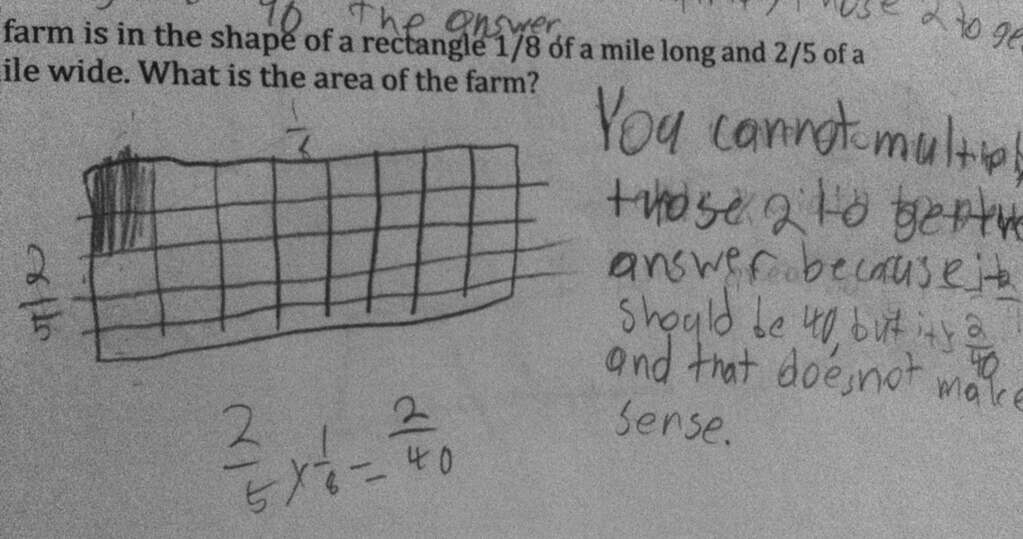
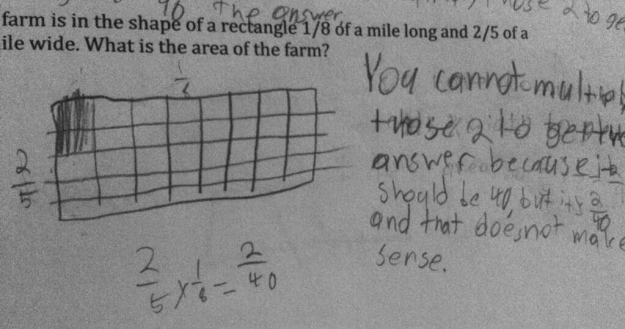
In this first example, from an Illustrative Task, the student was asked to determine if the answer to the problem could be solved using multiplication. Although the student came to the correct answer of 2/40, his intuition is telling him it still doesn’t make sense. Is this intuition based on previous experiences? Are all of our intuitions based on past experiences or non-experiences? Has he never seen an area less than 1 so it can’t make sense? The array has to be whole numbers? For me, the use of miles intuitively feels weird when I read it. Even as an adult, I hear miles and think of distance, bars, and do not like it so much with area.
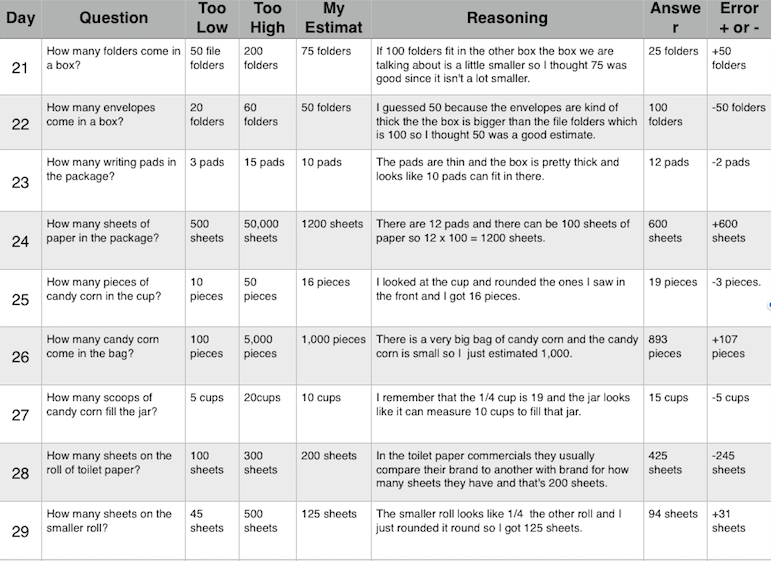
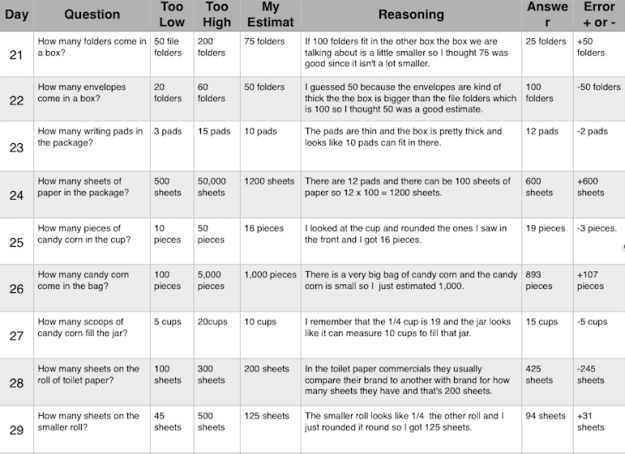
Bb3AJhpIQAA1EexIn class each day we do Estimation 180. In this example, I specifically look at Day 23. I never really thought much about this, but I think it is intuitive of the student to look at the size of the item being packaged in another when thinking about capacity and volume. The student doesn’t look at the color of the paper or types of lines on it, but instead intuitively looks at the size of each part. It is something that happens so fast, that perhaps these are the quick, small moments in my classroom where students are acting intuitively.
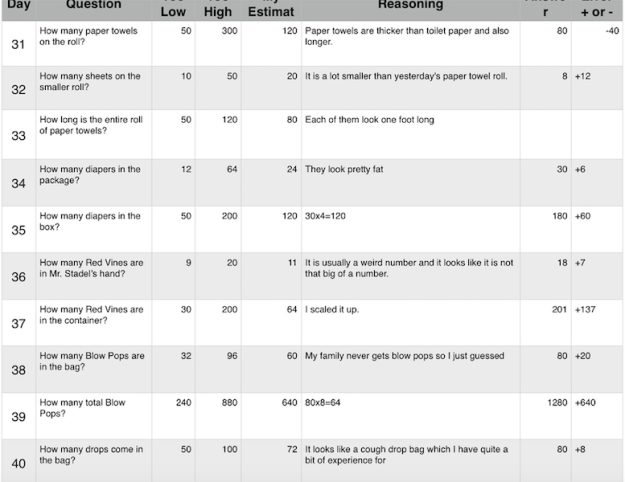
i5On Day 36 in the example below, a student’s reasoning is that it is “usually a weird number” and on Day 37 says “My family never gets blow pops so I guessed.” Both of these seem to stem from experience/non-experience.  The student has noticed that in previous days the packaging numbers have not been “friendly numbers” so the students is intuitively thinking it is a non-friendly number. If he/she was given this problem on the first day of the estimation questions, would their intuition have led them in a different direction? Day 37, shows a glimpse into, what I call, non-experience. This student intuitively goes to guessing because of never having them at home before, however is still only 20 off. This then leads me to question, that if a student doesn’t intuitively think of a reasonable estimate, do they then move into a more concrete strategy? To be within 20, I feel like the student used counting in the picture to some extent.
i4In this second grader’s work, I see such an interesting intuition in the second part of this question…
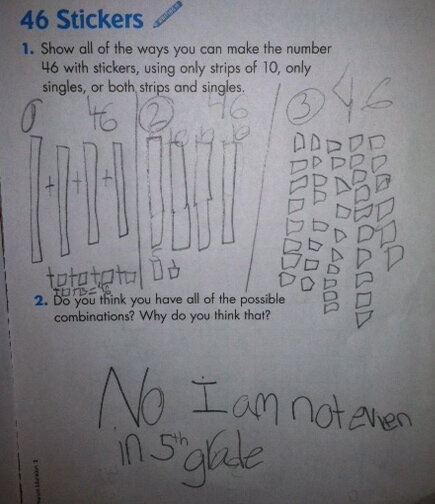
BEG7yU8CcAAsz00She seems to think that she cannot possibly know all of the possibilities because she is not older. She associates getting older as getting closer to knowing “all” of something. Little does she know that as you get older, you find you know less of “all” than you originally thought 🙂 Ha!

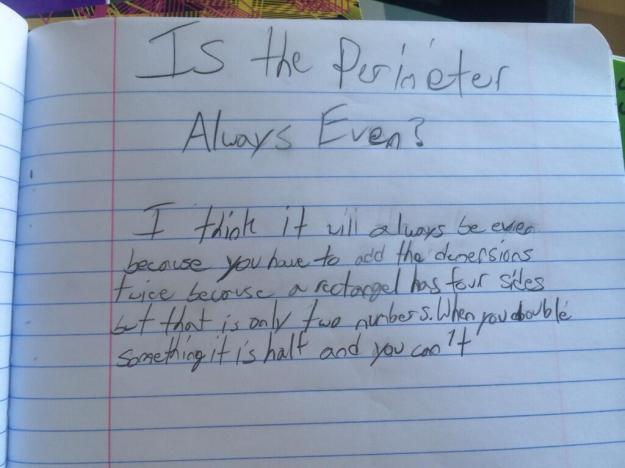
Here is where I get muddled between intuition based on experience and making sense based on prior knowledge. I asked this question to my students last year and here is one example of a student who went beyond yes or no and started to give a proof. I would love to hear others thoughts on intuition here….
BfUryAZIUAAM-Kk

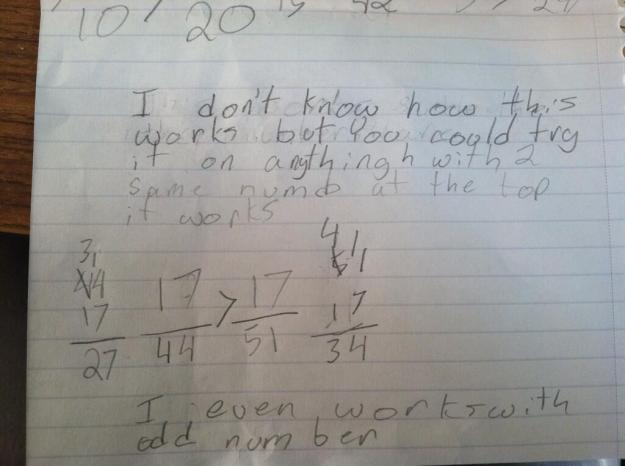
This example below makes me think about how conjectures are made by students. Do conjectures stem from intuition and proofs that we can’t fully explain? The student said that when comparing two fractions, with the same numerator, she can subtract numerator from the denominator and the smaller difference is the larger fraction. Is this false intuition in dealing with the numerator and denominator as whole numbers? Thinking you can just pull them apart and operate with them as wholes?BVcOikSIgAA5AT1
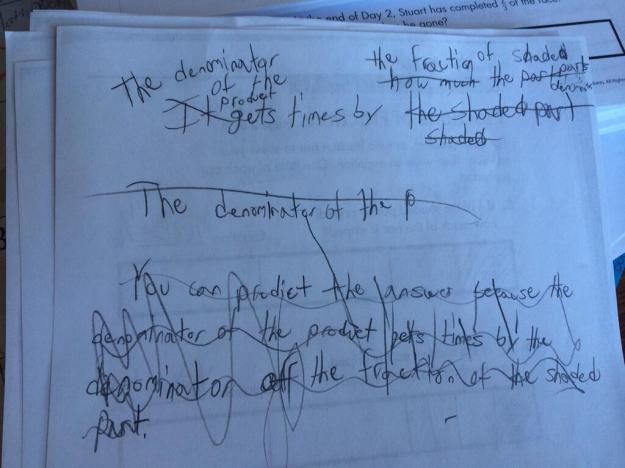
This one may not be an example of intuition, but it is how I think about my own intuitions in learning….I try to explain them, prove them, revise them, edit them….. I would love every student paper to look like this…
BZDqeF9CEAEBU0B

In writing so far, I am really thinking that a student’s intuitions in learning math come from a “conscience reasoning” based on  prior experiences and exposure. I could truly rack my brain over this for a while, but before I do, I wanted to think about myself as a teacher also. How much do we do as teachers that is intuitive? How does that intuition change as we evolve as educators?

There are many things I do during the course of the school day that just feel like routine or habit. The hard part is deciphering where it is not just habit or routine, but instead intuition.

When writing my lesson plans, I would say I use my intuition often in the respect of anticipation.  From the minute I read the lesson, I have intuition on how I feel the lesson will “go over” with the students. I have a gut feeling if they will be interested in it, which students will be able to easily enter into the problem and which will struggle, and what strategies will emerge. All of these anticipations are based on my experiences with the students. So are these anticipations, intuitions?

As the lesson is happening, I think so much of my questioning is based on my intuition. I could not possibly have a list of questions to ask students during the course of every lesson, I have to rely on my intuition. As a student is explaining something, I am thinking to myself, “I think it would be interesting to ask _______.”  This is something that has definitely evolved based on my experience, however because of the “newness” of every day and every class, I have to rely on intuition of similar case scenarios. Something like, “I asked this question the other day and it got me nowhere, how can I ask it differently to push student thinking?” This inner dialogue during a lesson happens in an instant which makes me believe it is intuitive.

If all of this is true, then I would say that when I first started teaching, my intuitions were not as fine-tuned as they are now. Does that makes sense, can you fine-tune intuition?  Is there a point beyond thinking something is a good idea/bad idea or makes sense/doesn’t make sense that is still intuition but a more detailed, specific intuition? Intuitively, I think there is:)

A lot to think about still….Thanks to Malke, Tracy, Simon, Bridget, Kassia for a great (to be continued) conversation!

-Kristin

Area/Perimeter – My homework over vacation

It is always fun when I can look back at my past blog posts, see what I learned from a lesson, and reflect on student reasonings before I teach that same lesson again. This past week we were working on this lesson from last year: https://mathmindsblog.wordpress.com/2014/01/27/area-and-perimeter-of-squares-student-noticings/.

The lesson unfolded in much the same way, with the class patterns looking like this:

IMG_8589_2

I anticipated all of them, however, like last year, there always has to be one that throws me a curve ball and leaves me math homework over Christmas vacation:)
The 5th statement looked like this in his math journal:

IMG_8587_2

With these other noticings below it…

IMG_8588_2

His explanation focused on the pattern of the fraction the perimeter is of the area. The numerator stayed a two and the denominator went up by one on every even dimension. I honestly didn’t know what to ask him because the question “Why is that happening?” seemed way to broad. He played around with building the squares and was not getting anywhere. I am thinking, after chatting with Christopher (@trianglemancsd) on Twitter, that focusing on the meaning of the fraction first may be the way to go??

Basically, I first have to sit down and reason about his on my own…gotta love math homework on vacation!

Finding Angle Measures

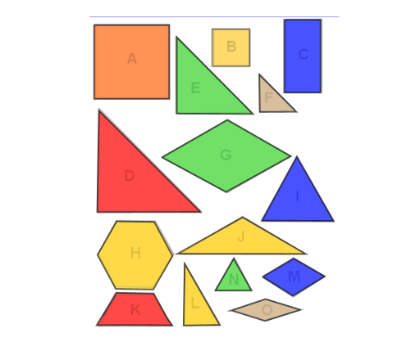
In our 2-D geometry unit, we have been classifying polygons based on attributes of sides and angles.  This week, the students were using what they know about angle measures and polygons to find the measures of other angles.  These are the polygons students were working with:

0001

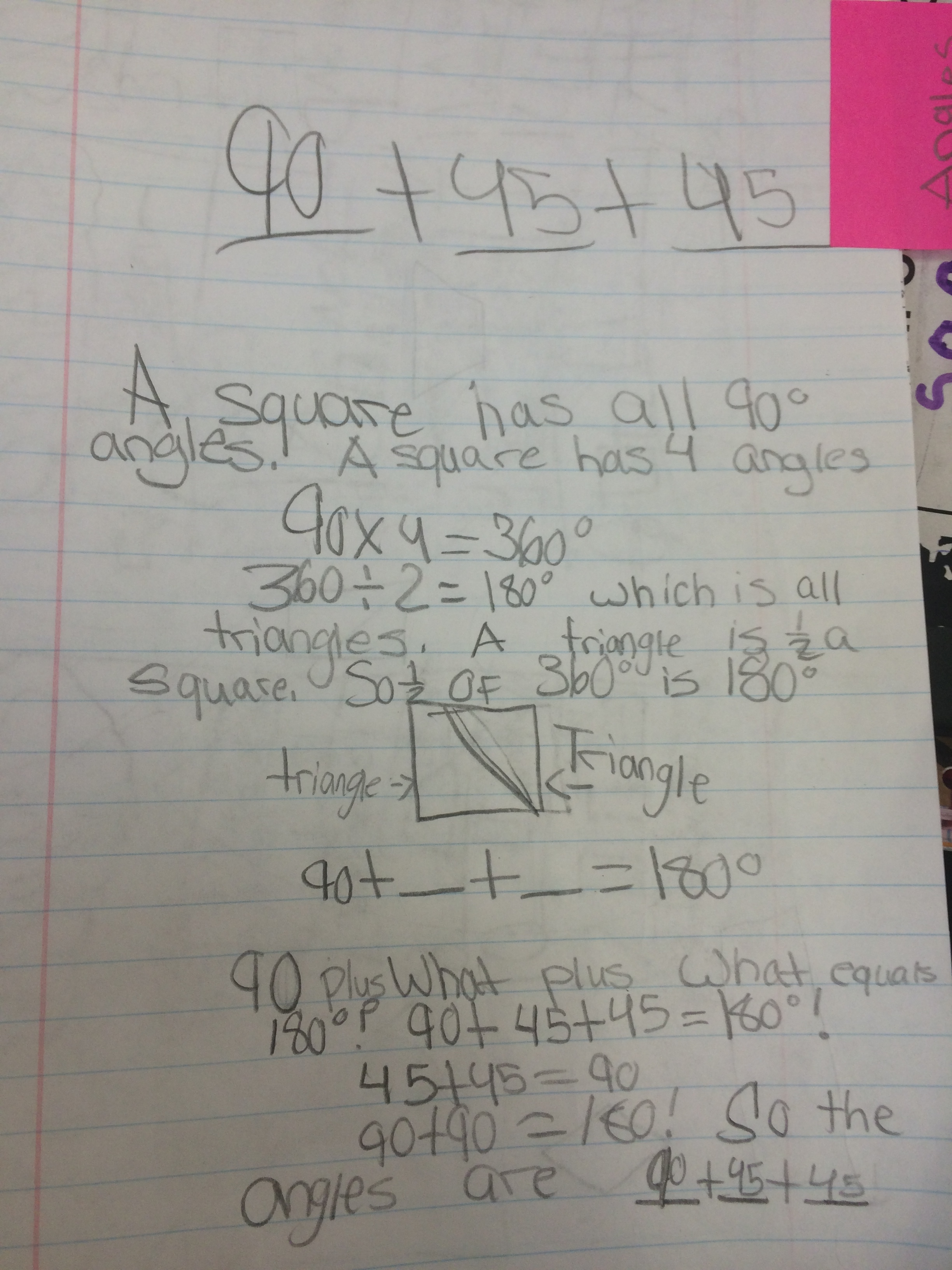
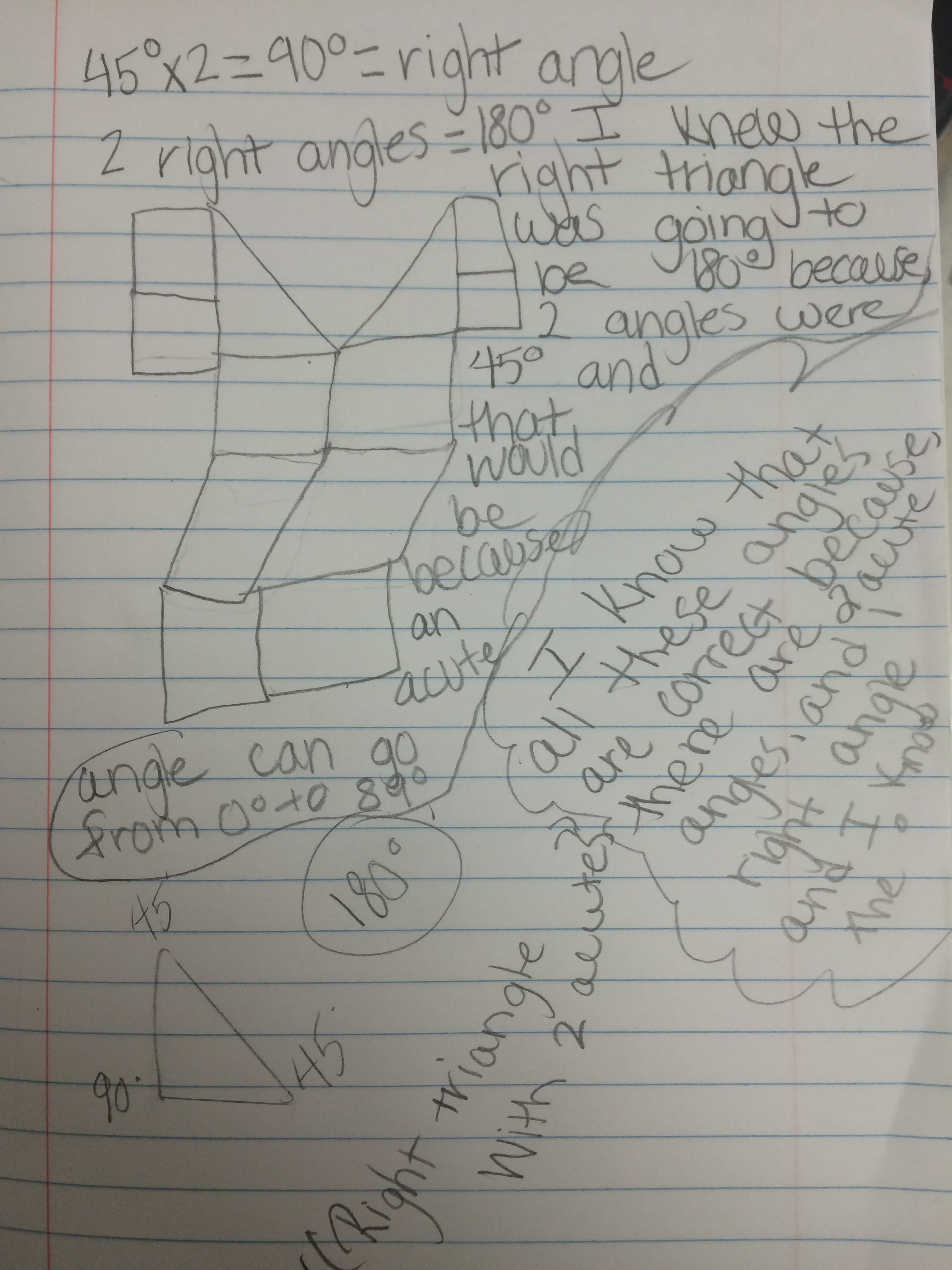
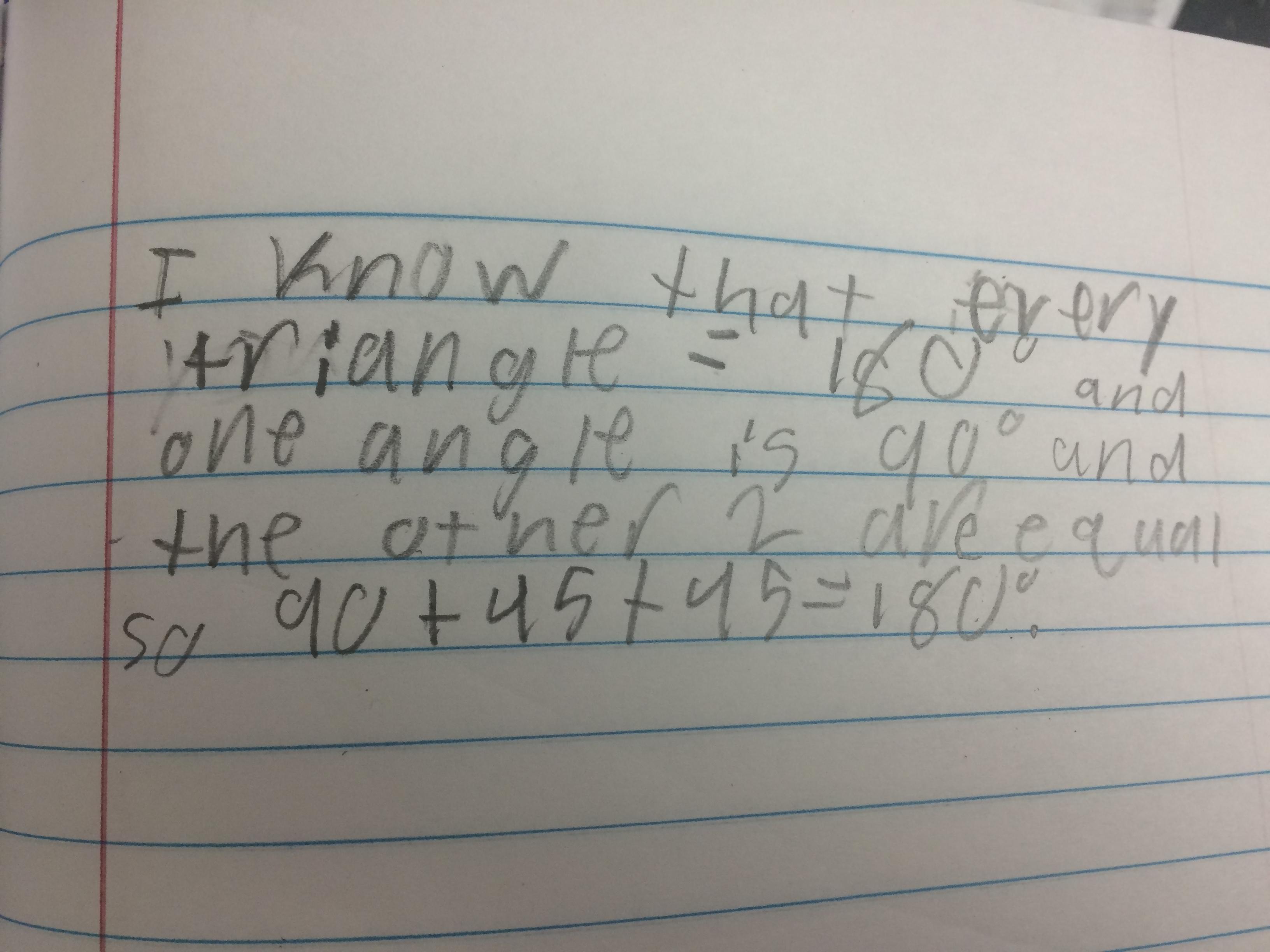
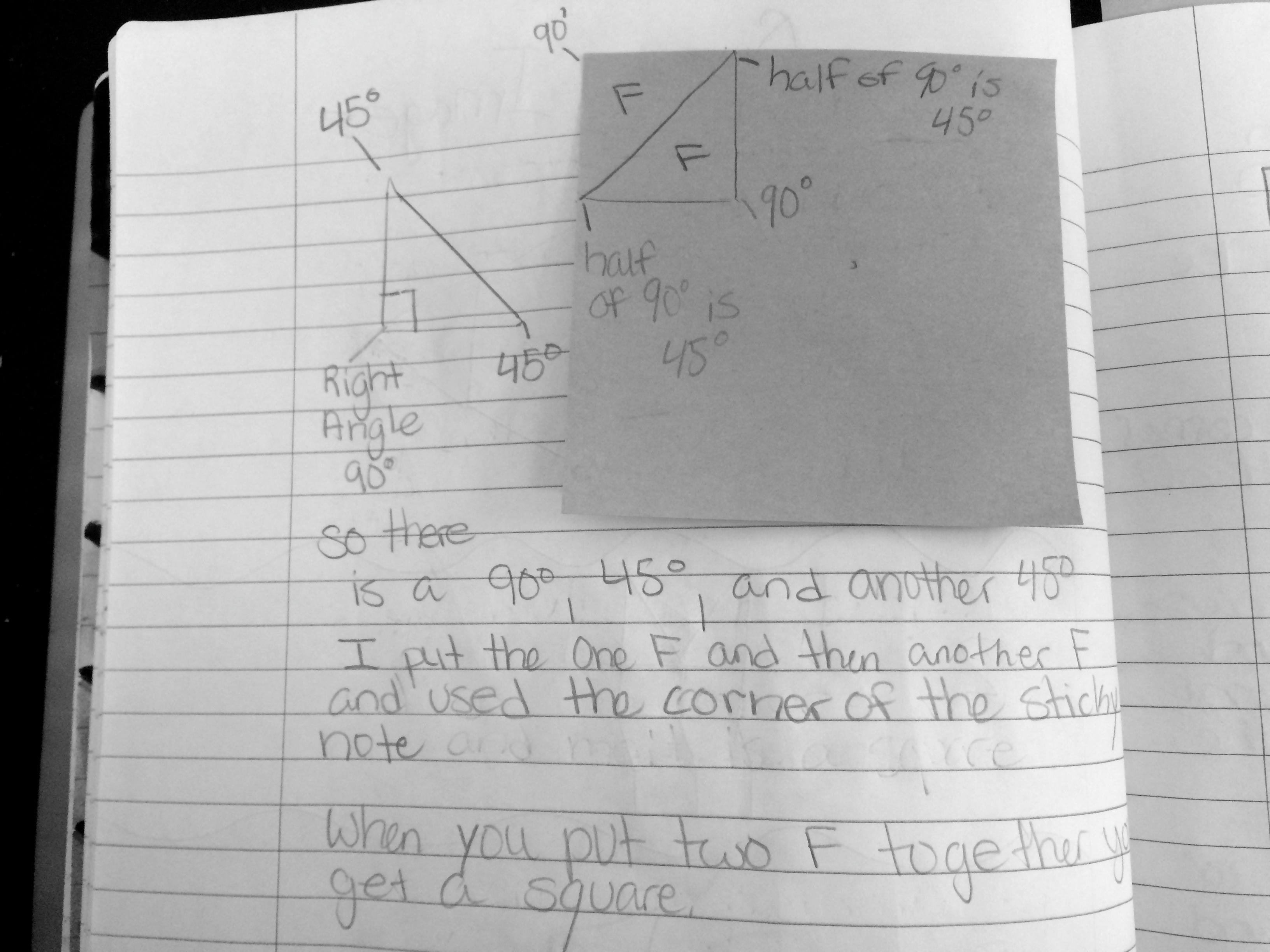
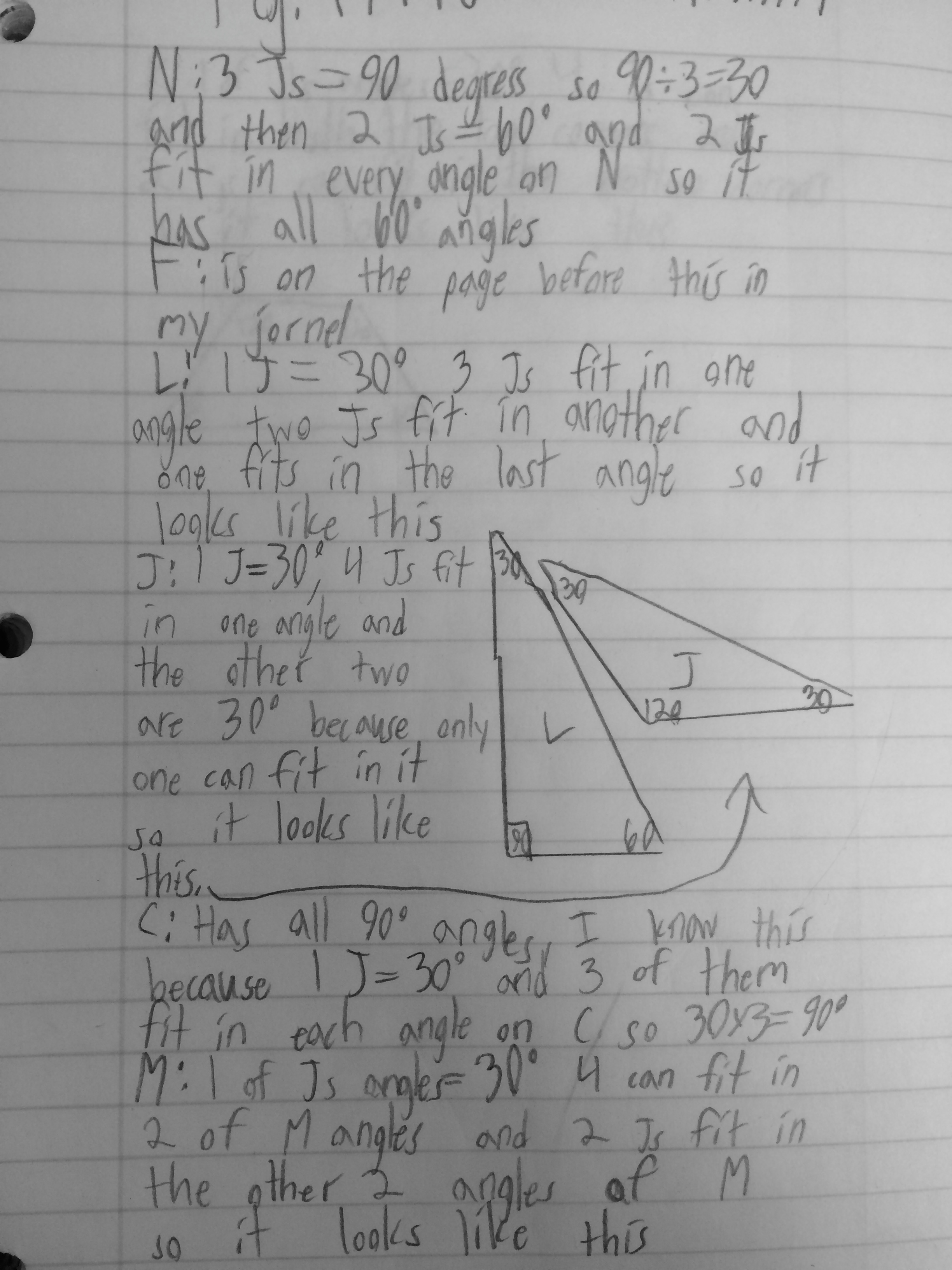
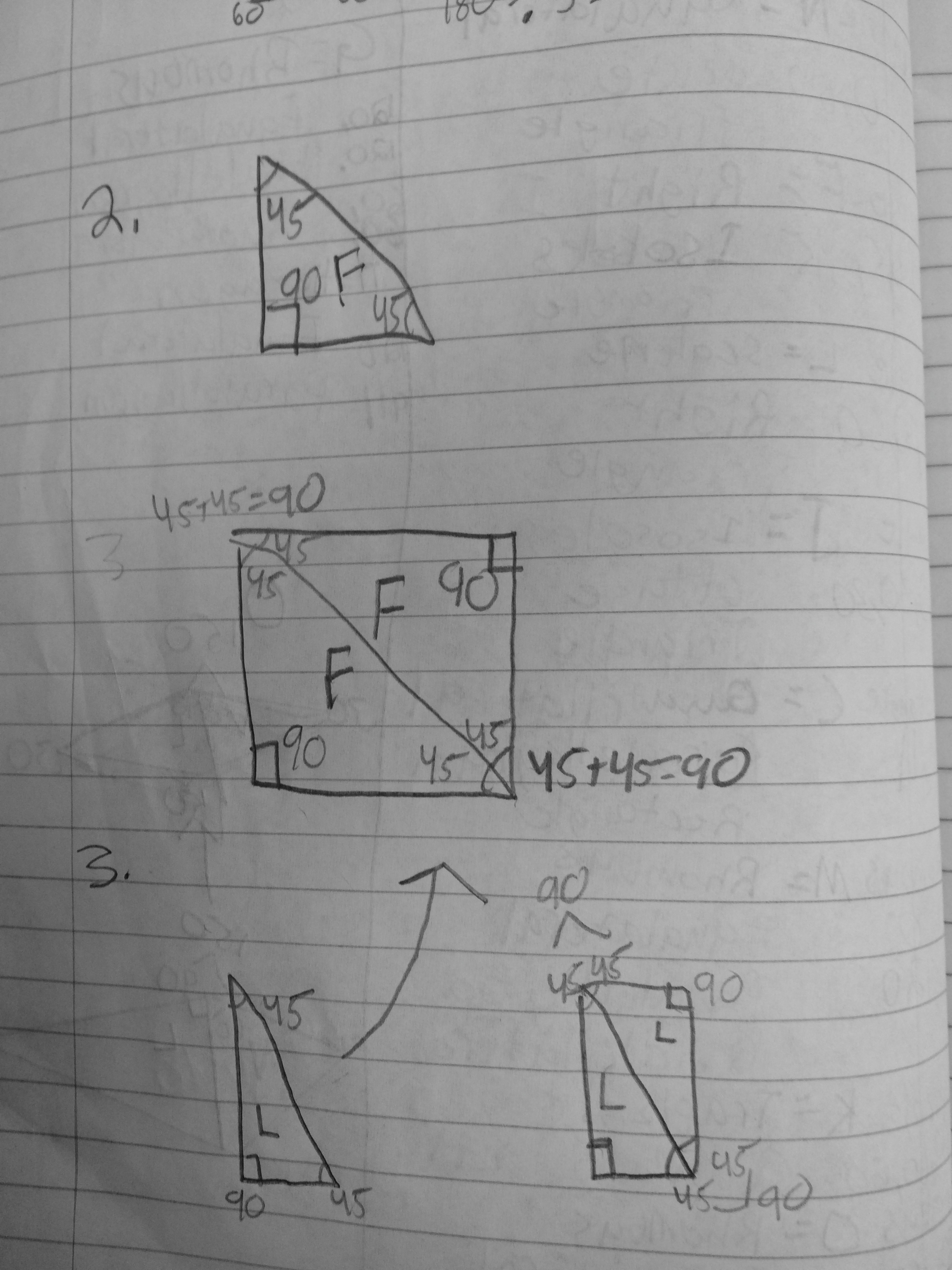
The first day, I put polygon F on the whiteboard and asked tables to develop a proof for the angles in F. I was excited to see they had worked with this in 4th grade and were comfortable in being able to prove it was 90, 45, 45. Here are a couple of the proofs from that day’s work…

IMG_8423 IMG_8422IMG_8417IMG_8457

It was interesting to my colleague and I to really think deeply about what the students were saying in their explanation. We had to ask ourselves if they were really thinking about the angle itself when they were saying “A triangle is 180º because it is half of a square which is 360º.” Their proof with the polygons looked like an area model, so were they thinking about the angles or thinking that the area of the triangle is 180?

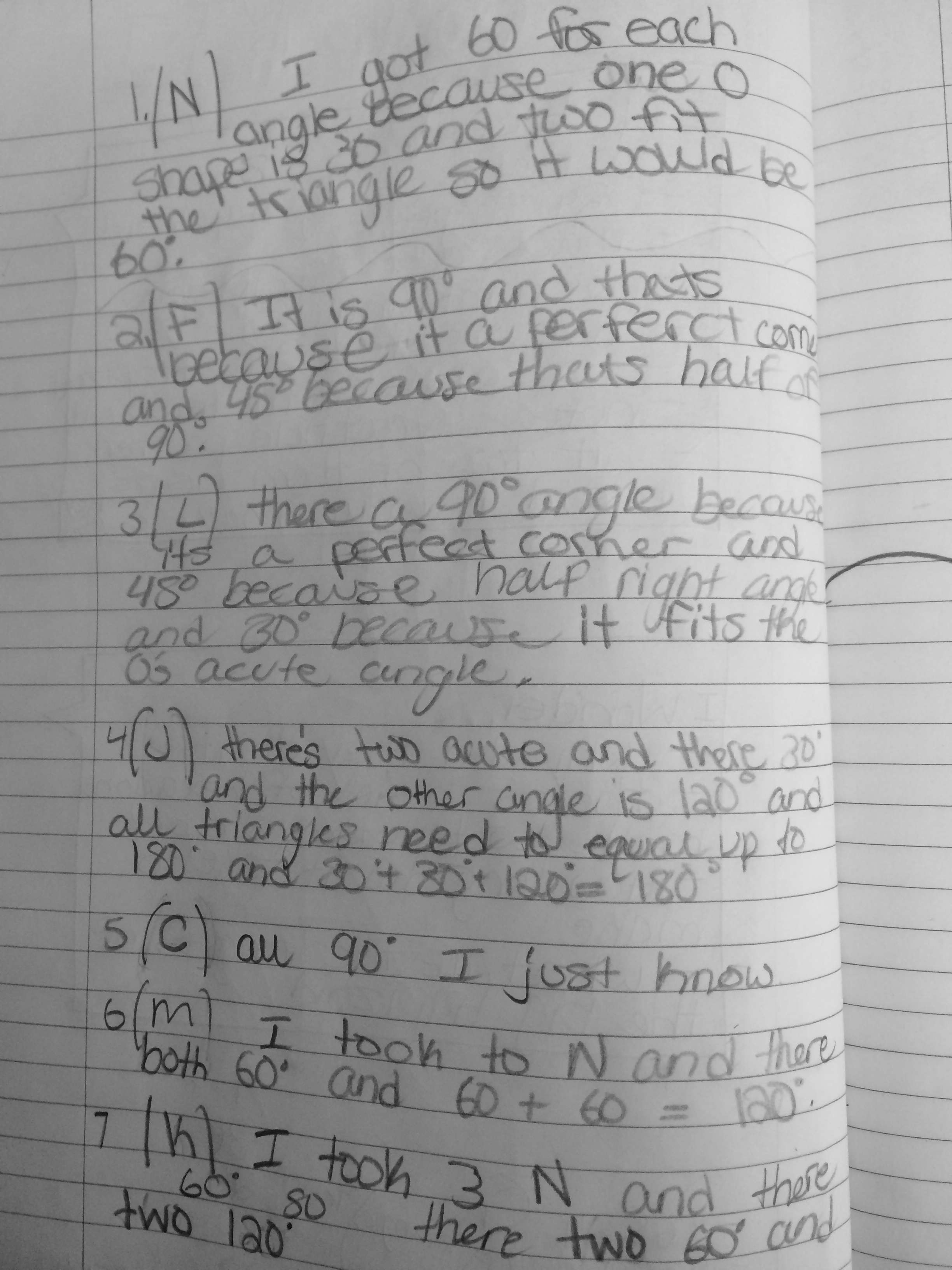
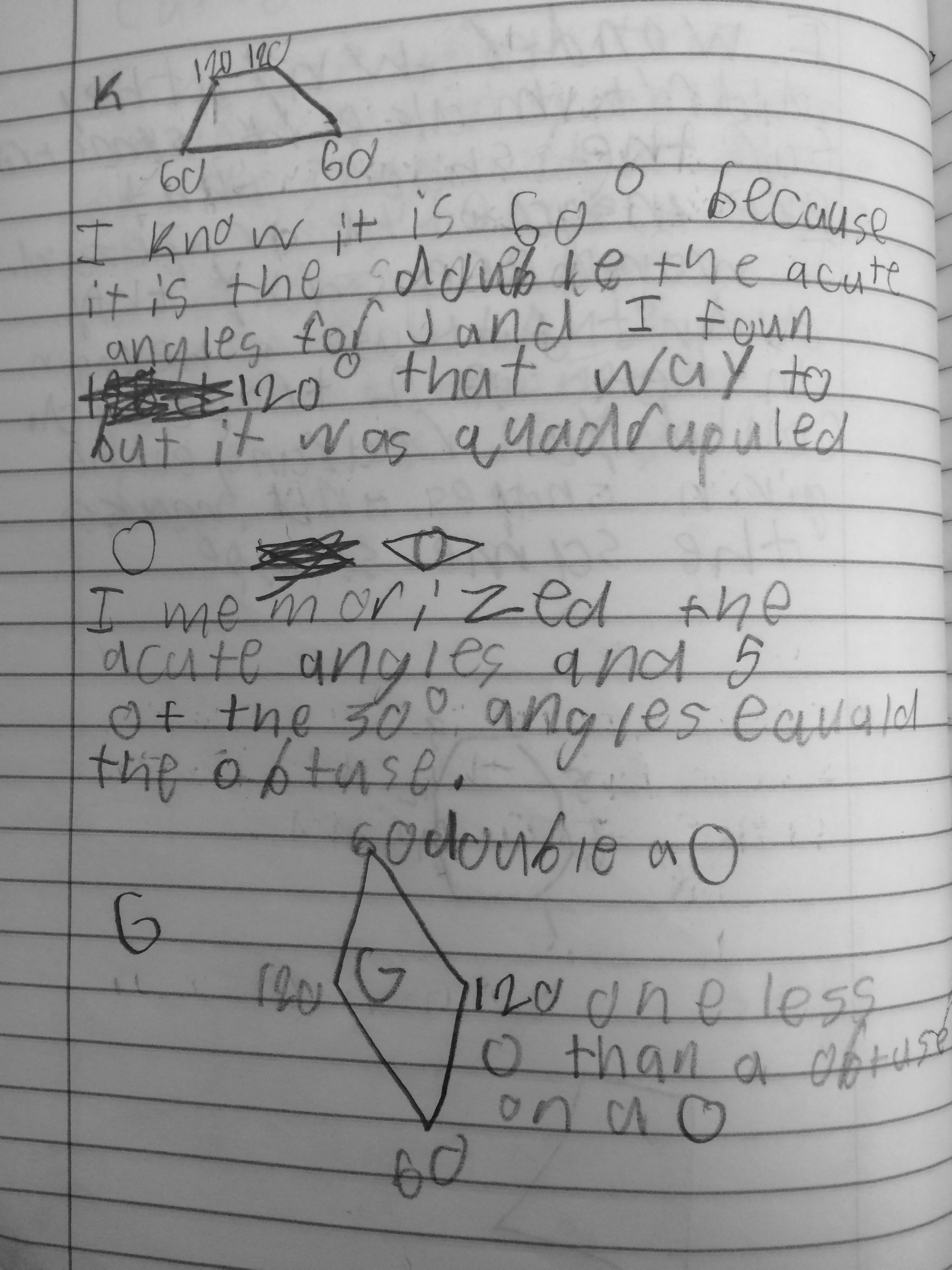
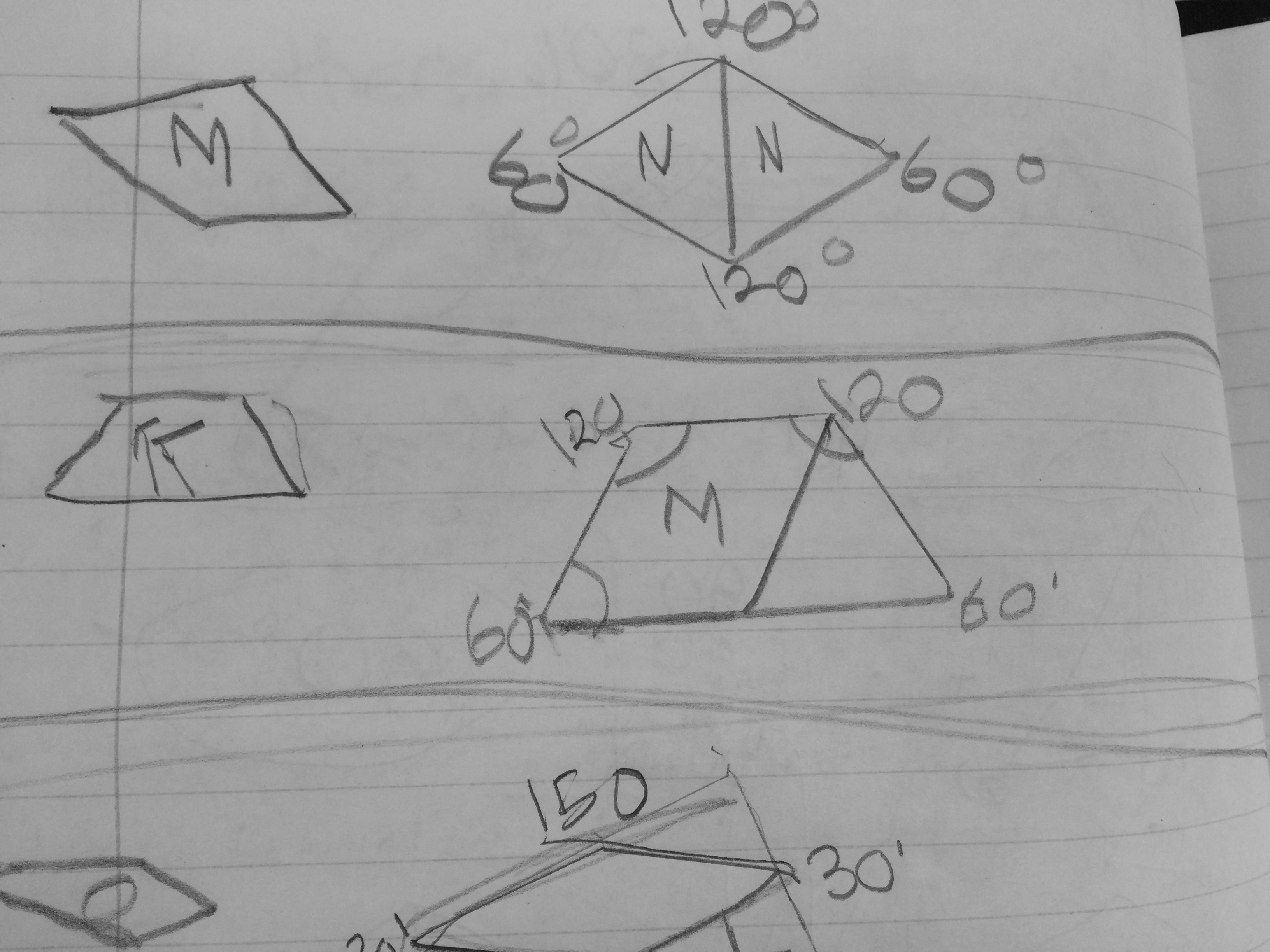
In the next activity, I really wanted to focus on students composing and decomposing the angles themselves. They worked in groups to find the angle measures of the remaining polygons on the above sheet. Here are a few of their proofs that we shared as a class.

IMG_8458 IMG_8459 IMG_8460  IMG_8462IMG_8461

After sharing our proofs today, I felt very comfortable with student understanding of finding missing angles and thought it would be interesting to move into construction of these shapes in Hopscotch (a coding app). This is one of those things that is not explicitly in the curriculum, but something I just think is so great for students to explore. It is wonderful for students to see angles as turns and explore supplementary, interior and exterior angles.

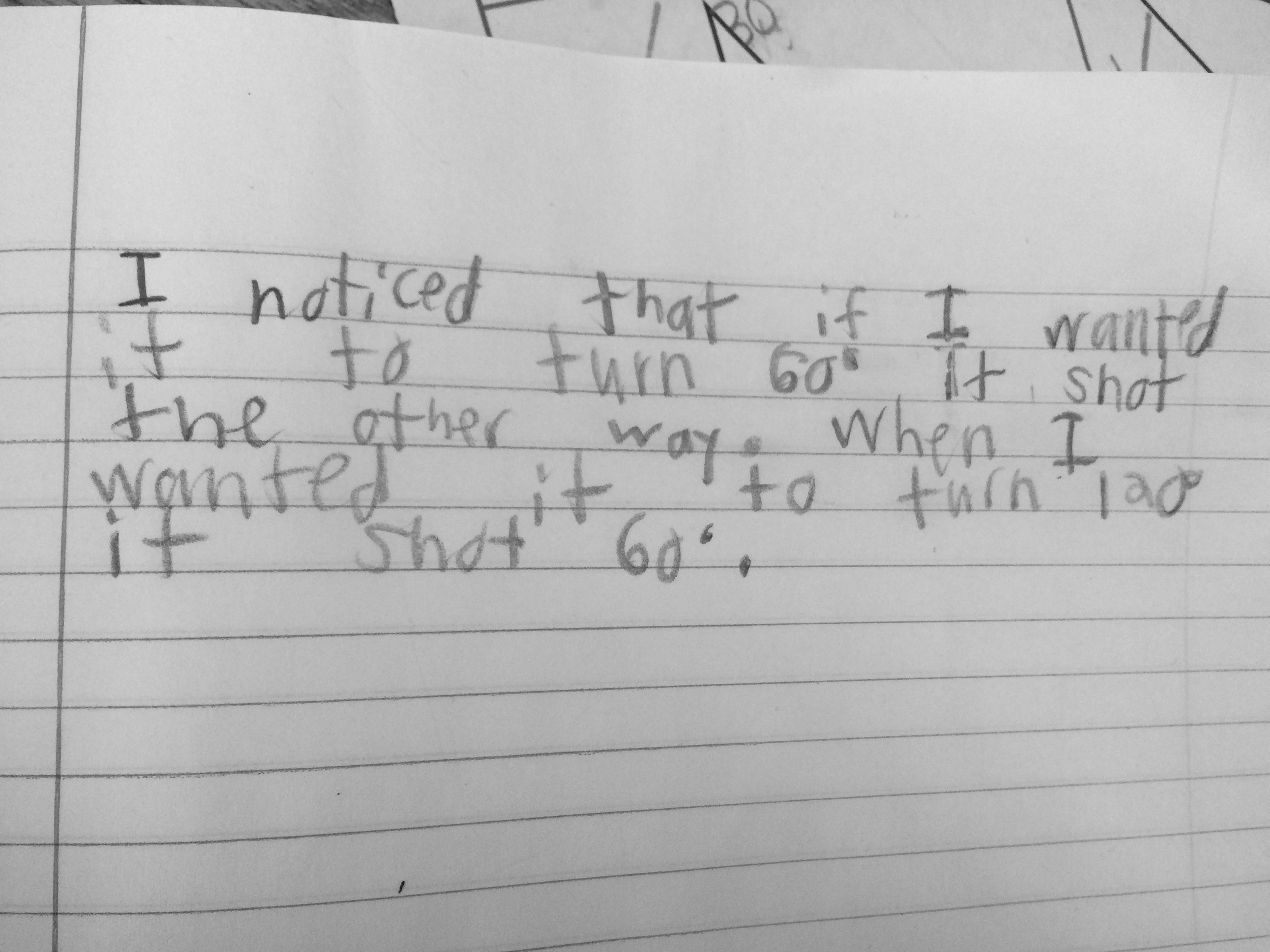
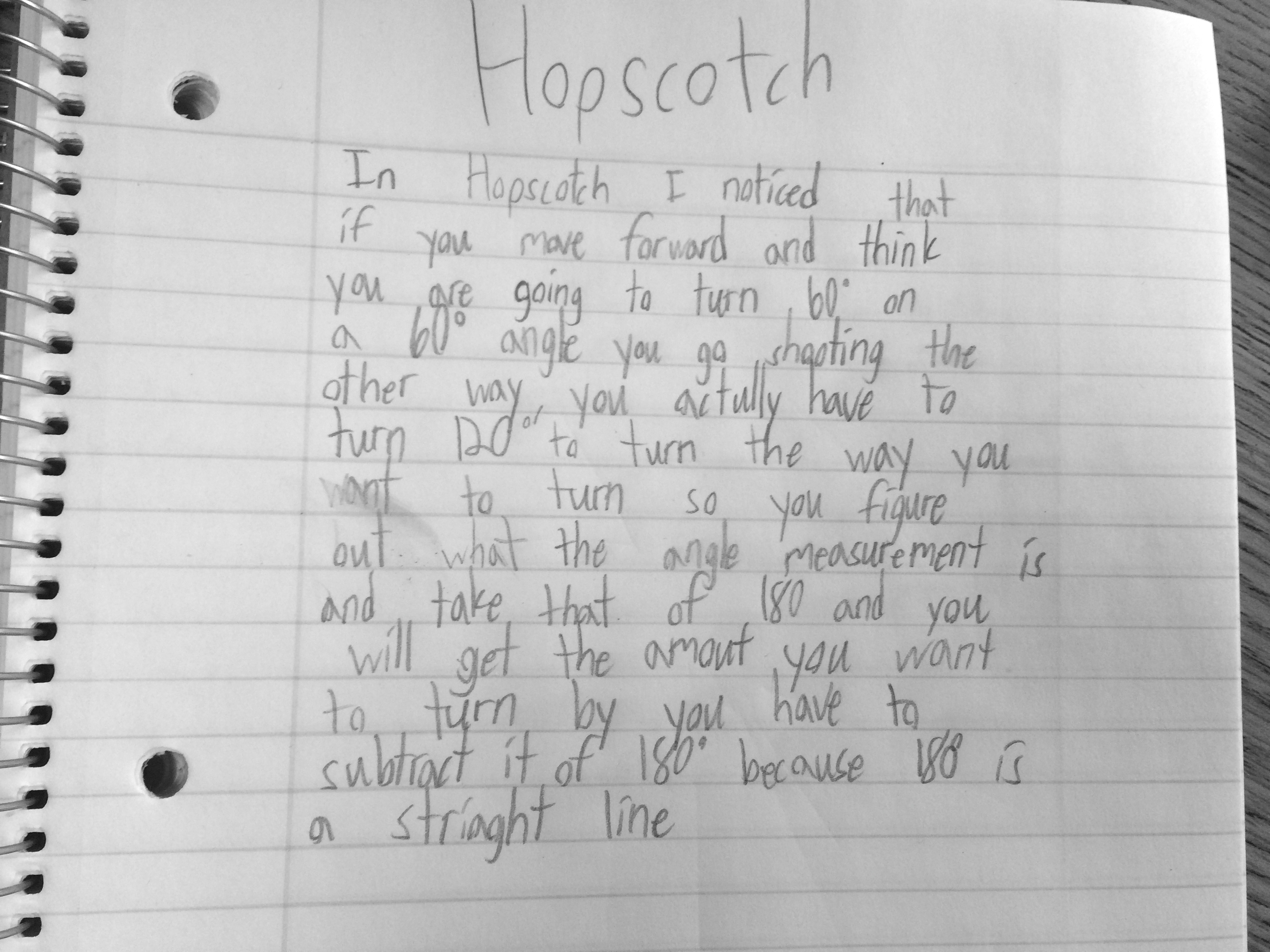
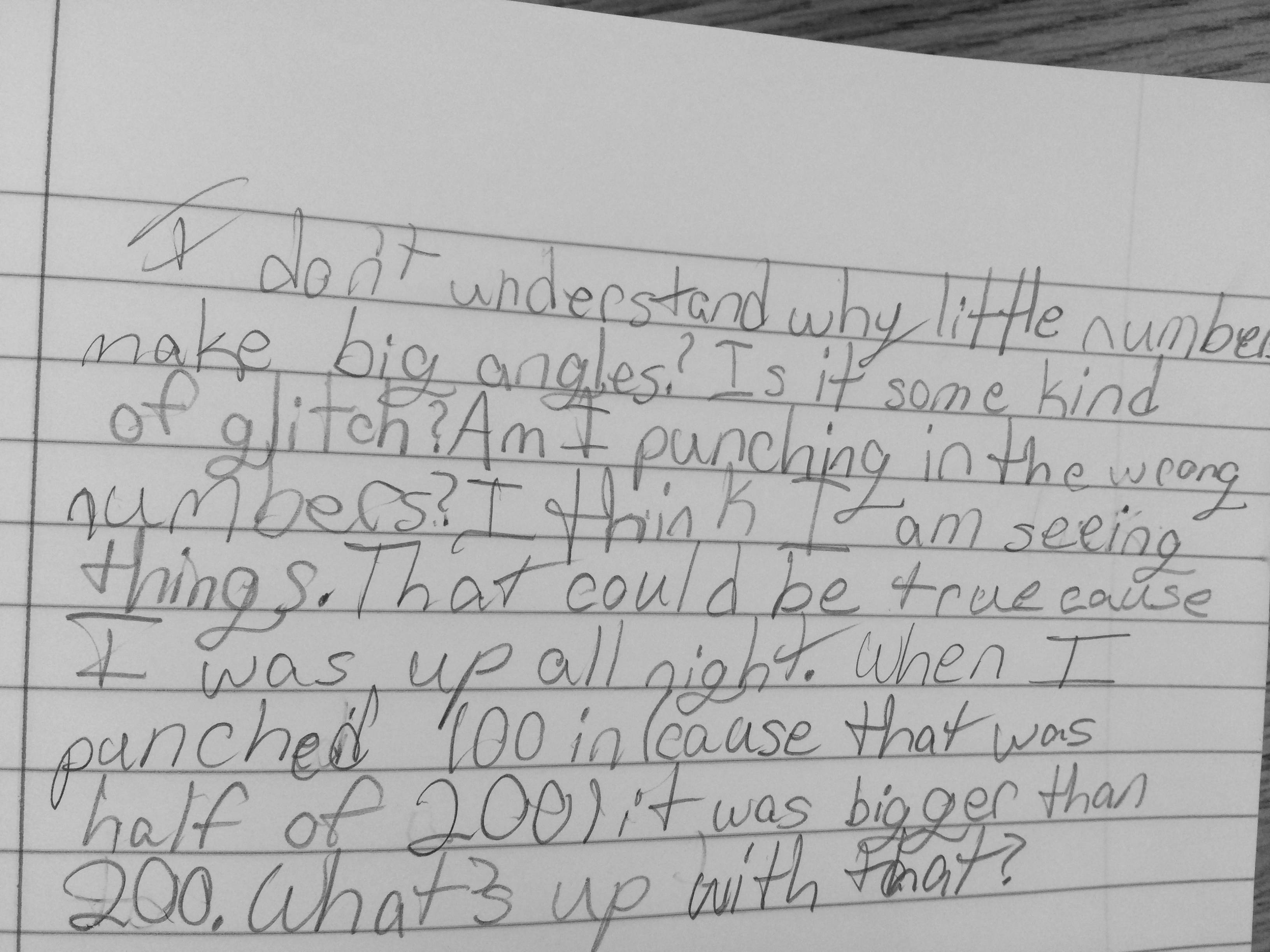
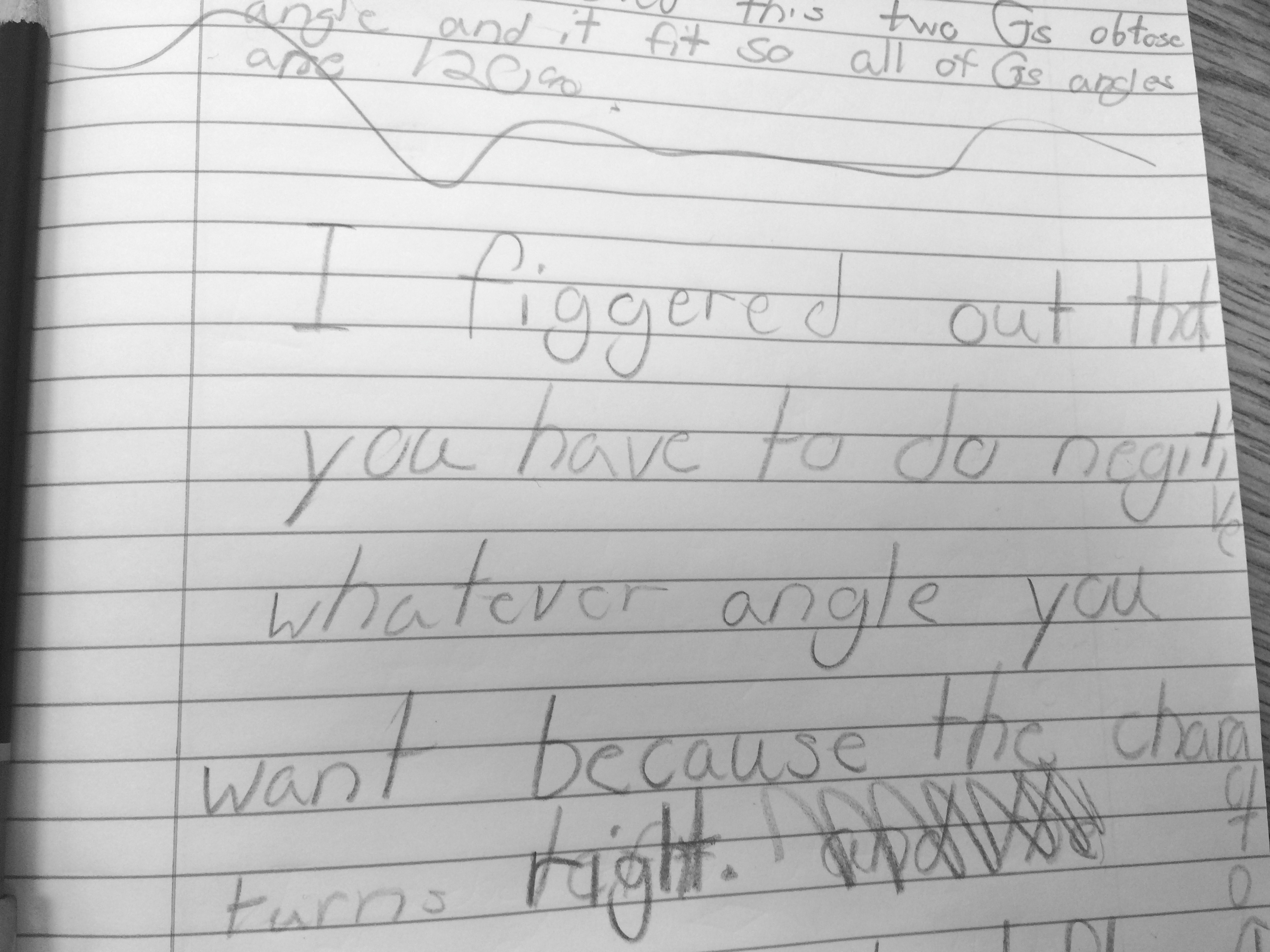
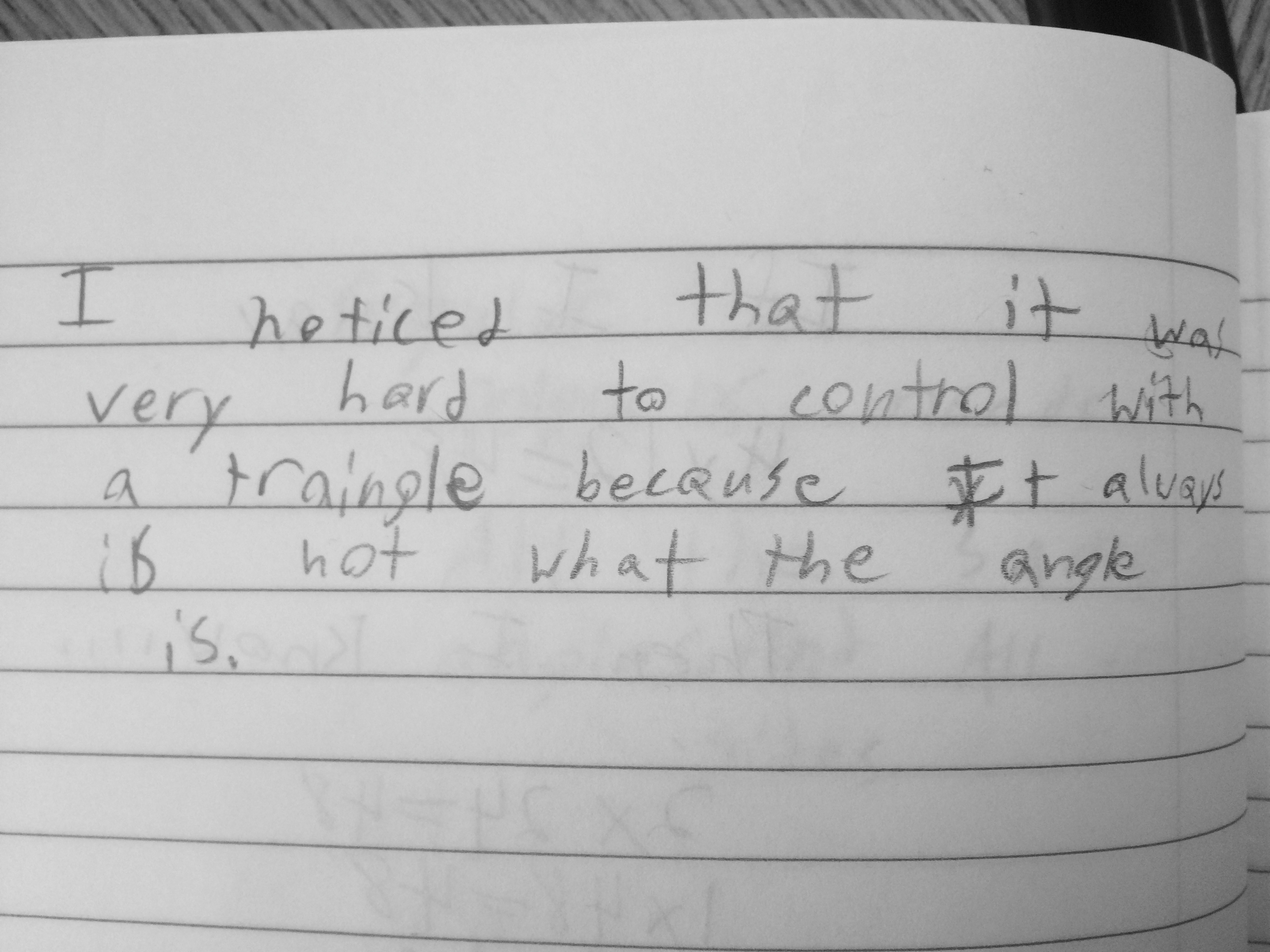
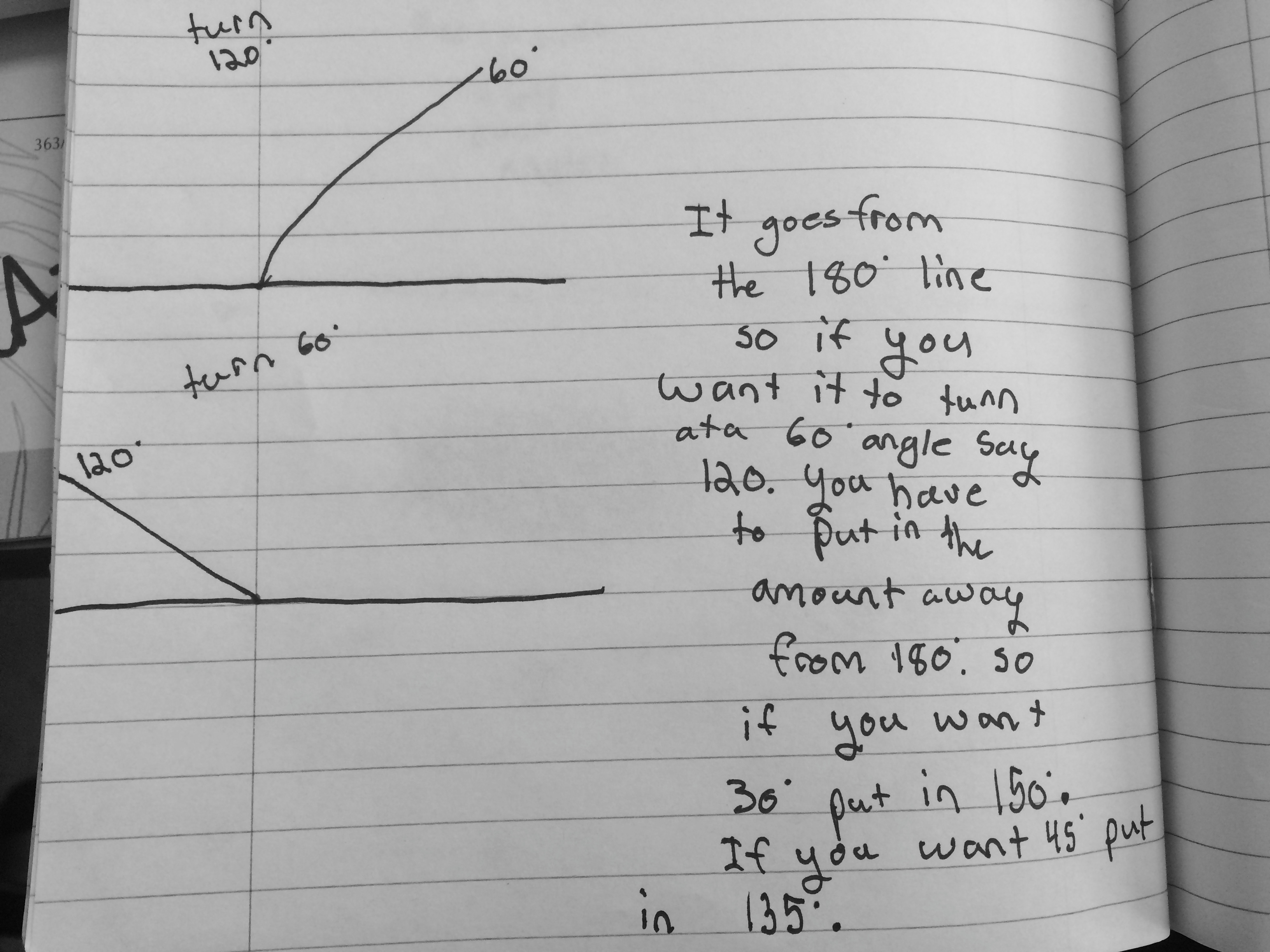
We practiced making a square together to be sure everyone had an understanding of how the codes worked and then I sent them off to build the triangles. You can imagine the surprise as they punched in 60º for the turn to make an equilateral triangle and the character shot off in the wrong direction. I let them work their way through it and then reflect in their journals after. Here are some of their thoughts…

IMG_8451 IMG_8452 IMG_8453 IMG_8454 IMG_8455 IMG_8456

They left me with so much to think about for Monday’s lesson. I love the idea of a negative number makes them turn the other direction, the relationships to 180º, and the two angles adding up to 180º. Interesting stuff!

-Kristin

Fraction Flexibility in Number Talks

In my RTI (Response to Intervention) class, I use Marilyn Burns’ Do The Math program, which is wonderful for building conceptual understanding of fractions through the use of fraction strips. Students use the fraction strips to build equivalencies, make comparisons and add/subtract fractions. It does not take long for students to be able to “see” the equivalencies without having the strips in front of them and develop fluency and flexibility with fractions. In addition to this module, I do Number Talks with the group. I do a combination of whole number operation talks and fraction number talks.

This Thursday, I did a Fraction Number Talk in which I wanted students to think about the fractions and make friendly combinations when adding. I never like to pose a problem with one solution path, so each can be solved using another strategy, however my goal was making friendly combinations. Next to each problem I put my thought in brackets so you have an idea of what i was thinking:) This is the string I planned:

2/4 + 2/3 + 6/12      [(2/4 + 6/12) + 2/3]

2/3 + 1/4 + 1/4 + 2/6  [(2/3 + 2/6) + 1/4 +1/4]

1 3/8 + 5/10 + 3/4  [(5/10 + 1/2)+1 3/8 + 1/4]

They did so wonderful with these and some began whining that these were too easy and to give them something really hard. So I gave them my final problem:

2/3 + 1/2 + 3 + 1/4

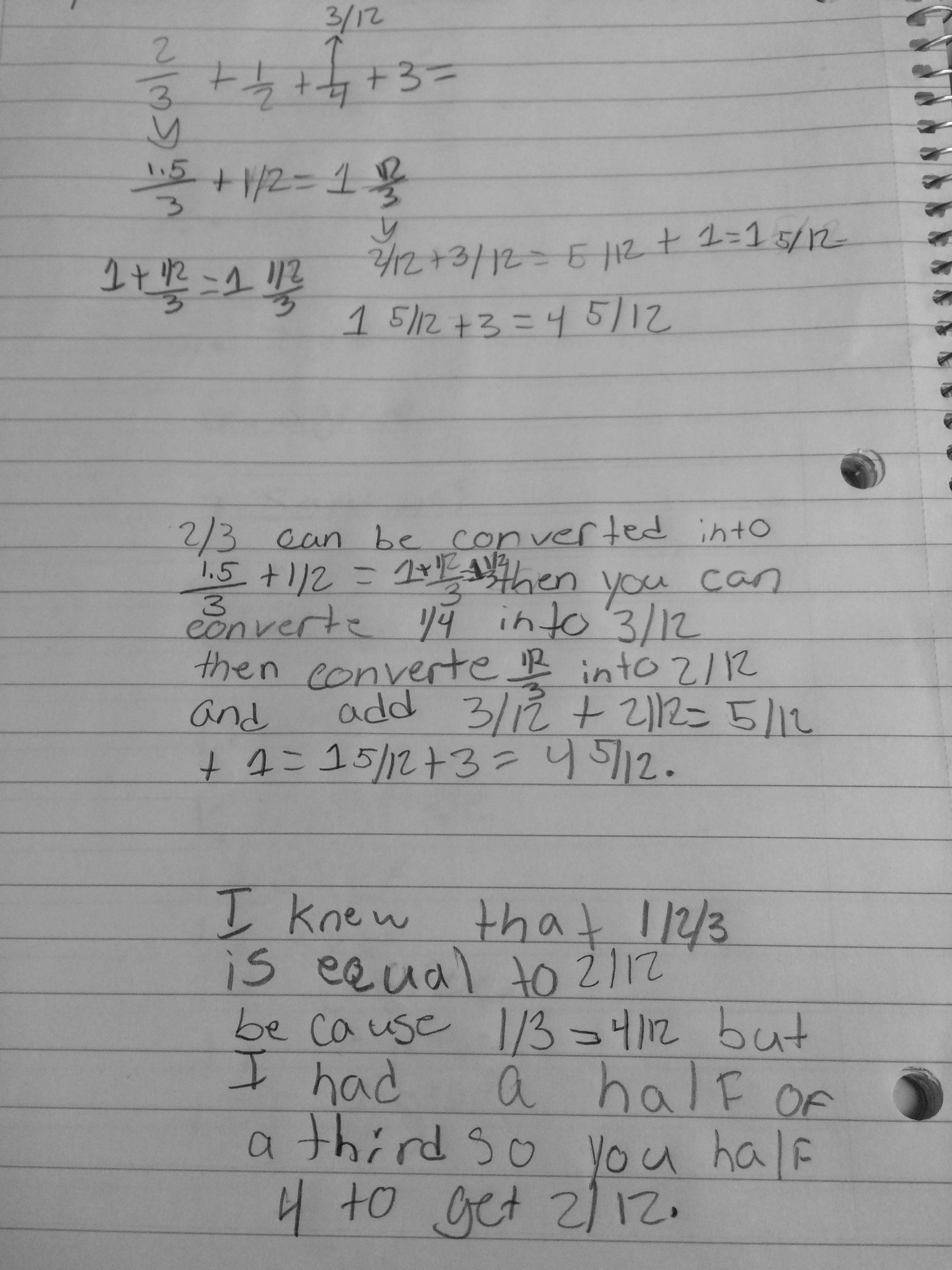
There were a few groans and “this isn’t hard“s because they went to 12ths and had the answer quickly. I told them if they had the answer, to try to use the strategy they had used in the previous problems to see if they got the same answer. I was thinking they would use a piece of the 3 to make the 1/2 and 1/4 a whole, but of course there is always one who surprises me! He had a beautiful explanation so I asked him to write it down for me so I could remember. He got a little mixed up in his wording, so I will do a translation after you check out his reasoning.

IMG_8300

He took 1.5/3 from the 2/3 to add to the 1/2 and make a whole. He then added the 1/2/3 to the 1/4. I, of course, asked him how he added that and his response was so beautiful as he explained it to me. I mean how amazing is it that he knew 1/2/3 is equivalent to 2/12…and this was all mentally!

Let me assure you that this student CAN add these fractions in a much more efficient way, and this was him challenging himself to play around with the fractions. THIS is what I would consider flexibility in operations and also where I want students to see math as fun…playing around with numbers!

– Kristin

Always, Sometimes, Never….Year 2, Part 2

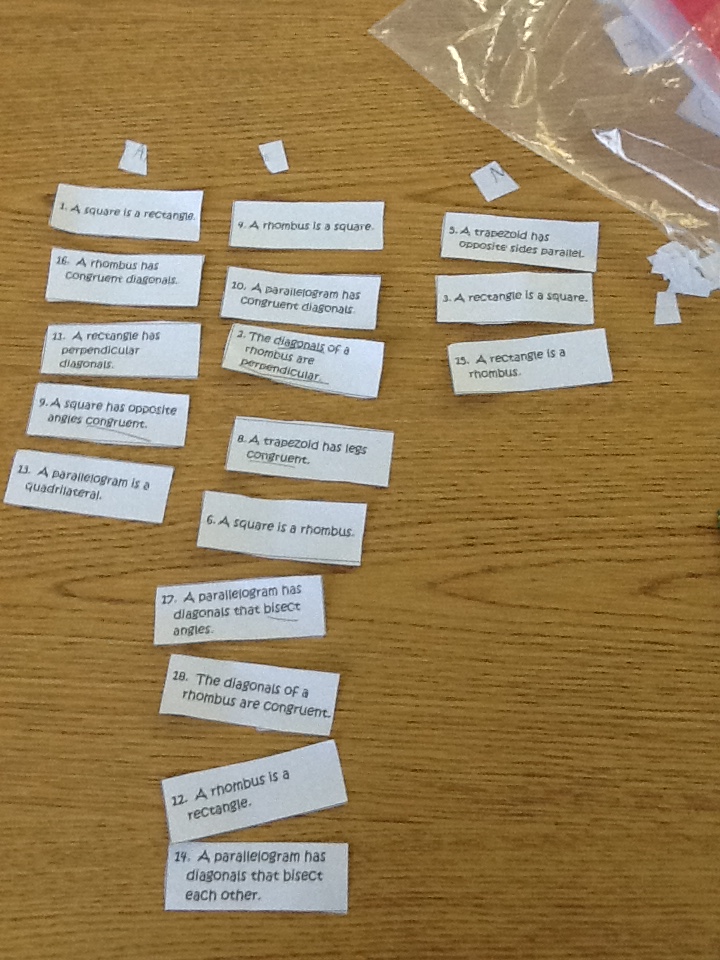
In my previous post: https://mathmindsblog.wordpress.com/2014/11/26/always-sometimes-never-year-2/ the class organized the quadrilateral cards into A/S/N columns and today we continued that work.

I switched the groups up so I had students entering a new set of cards with differing views. Always fun stuff for some great mathematical arguments. I had them discuss differences they saw from their previous table and decide if they want to move any cards.

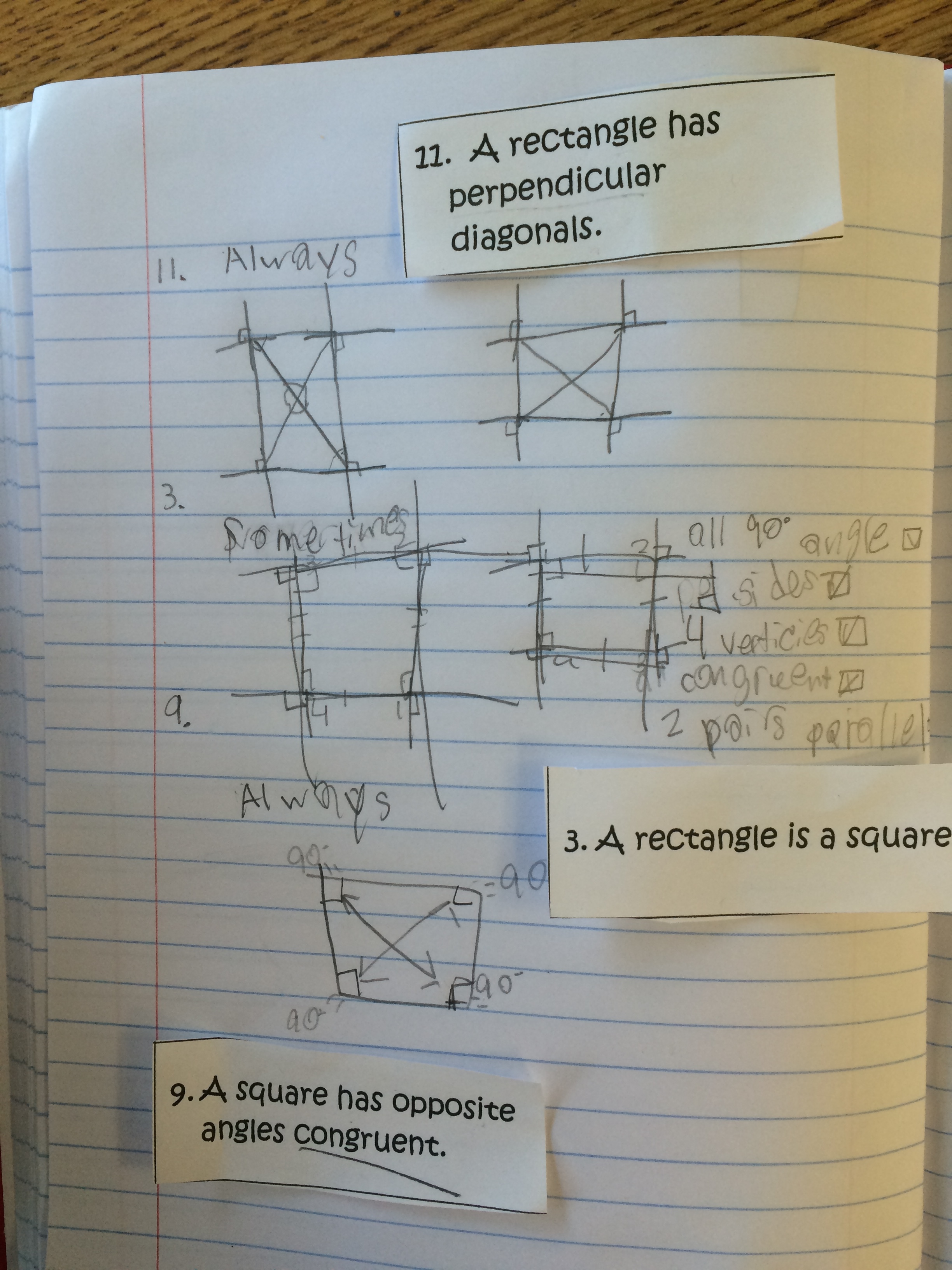
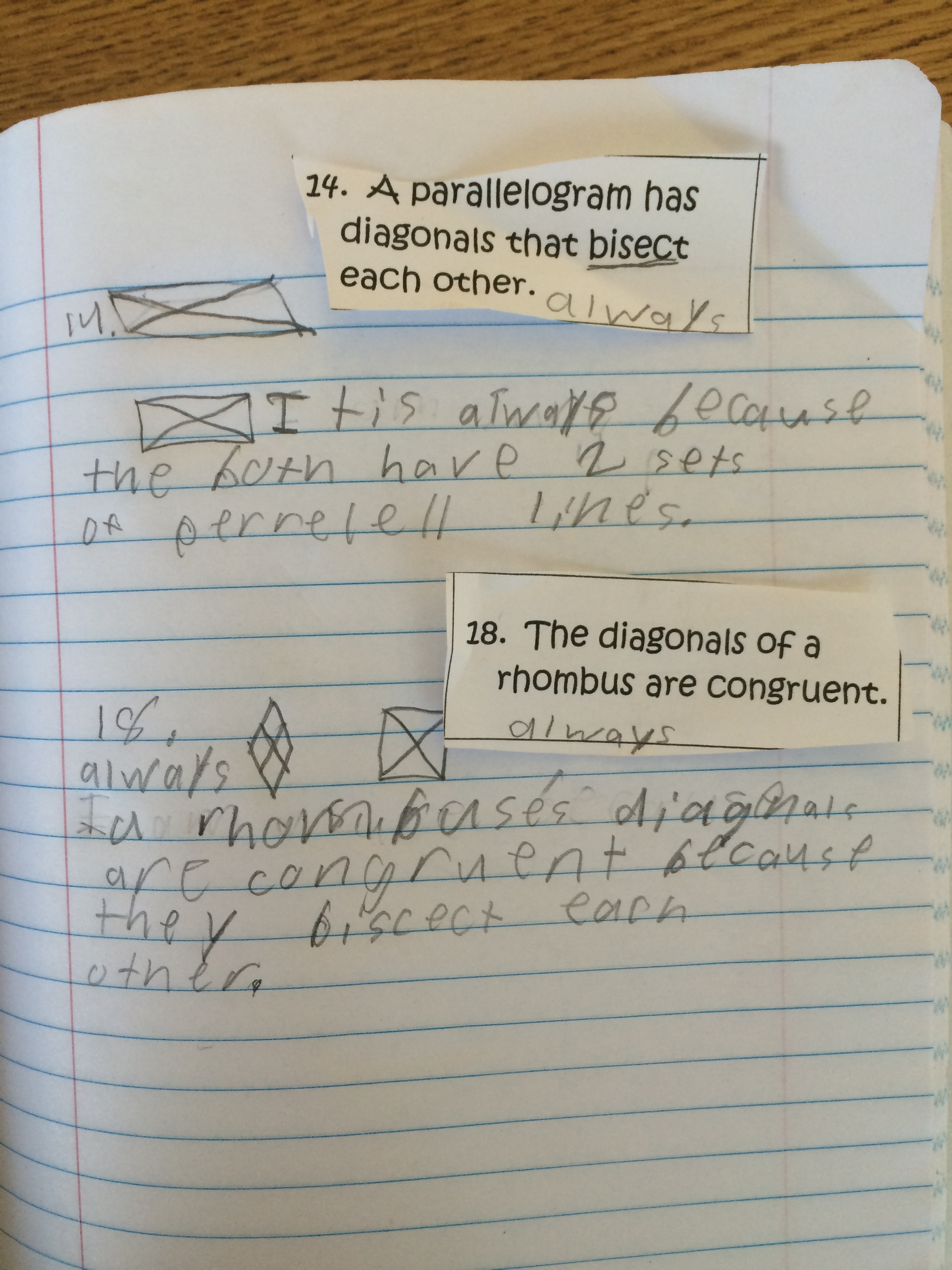
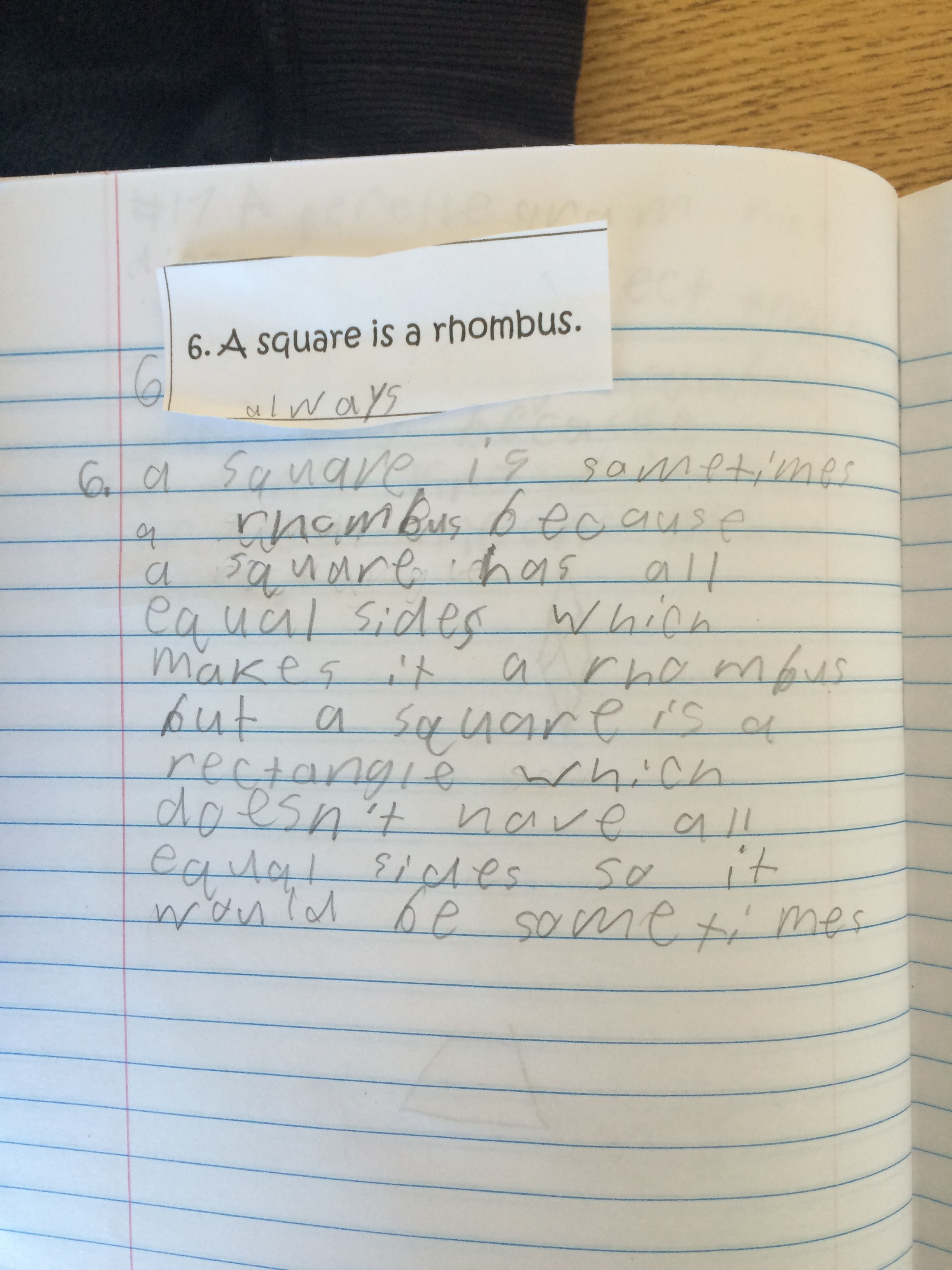
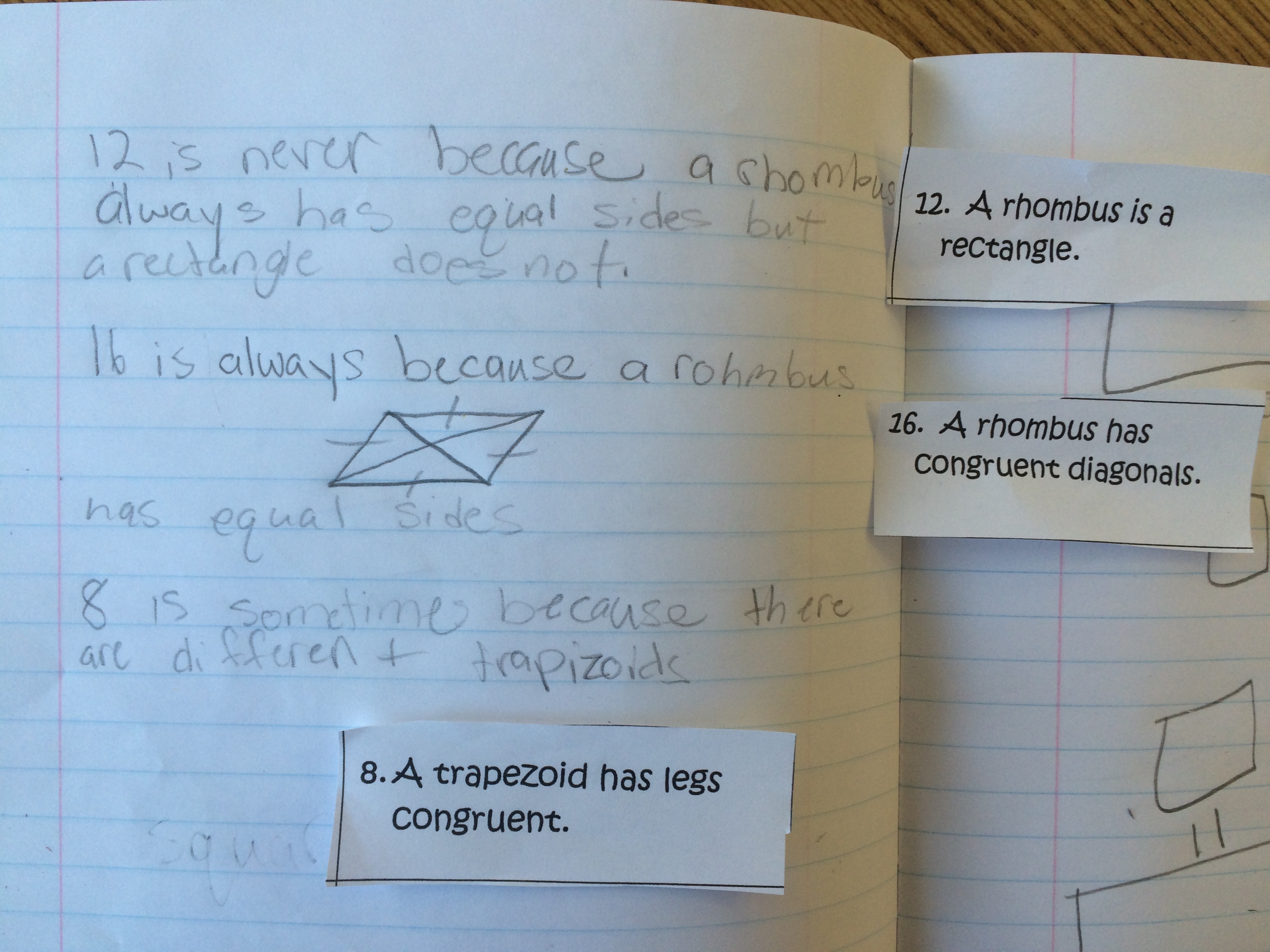
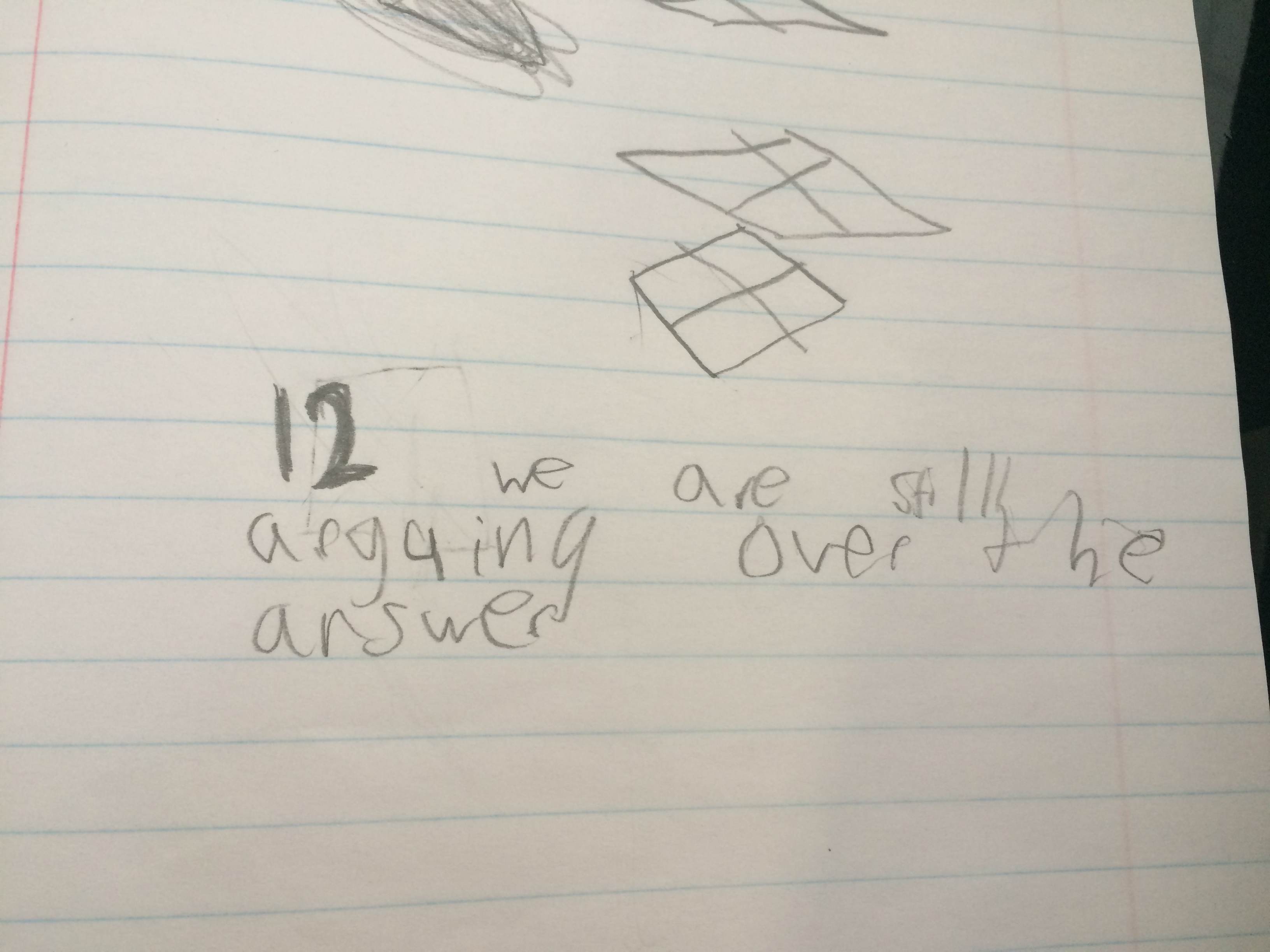
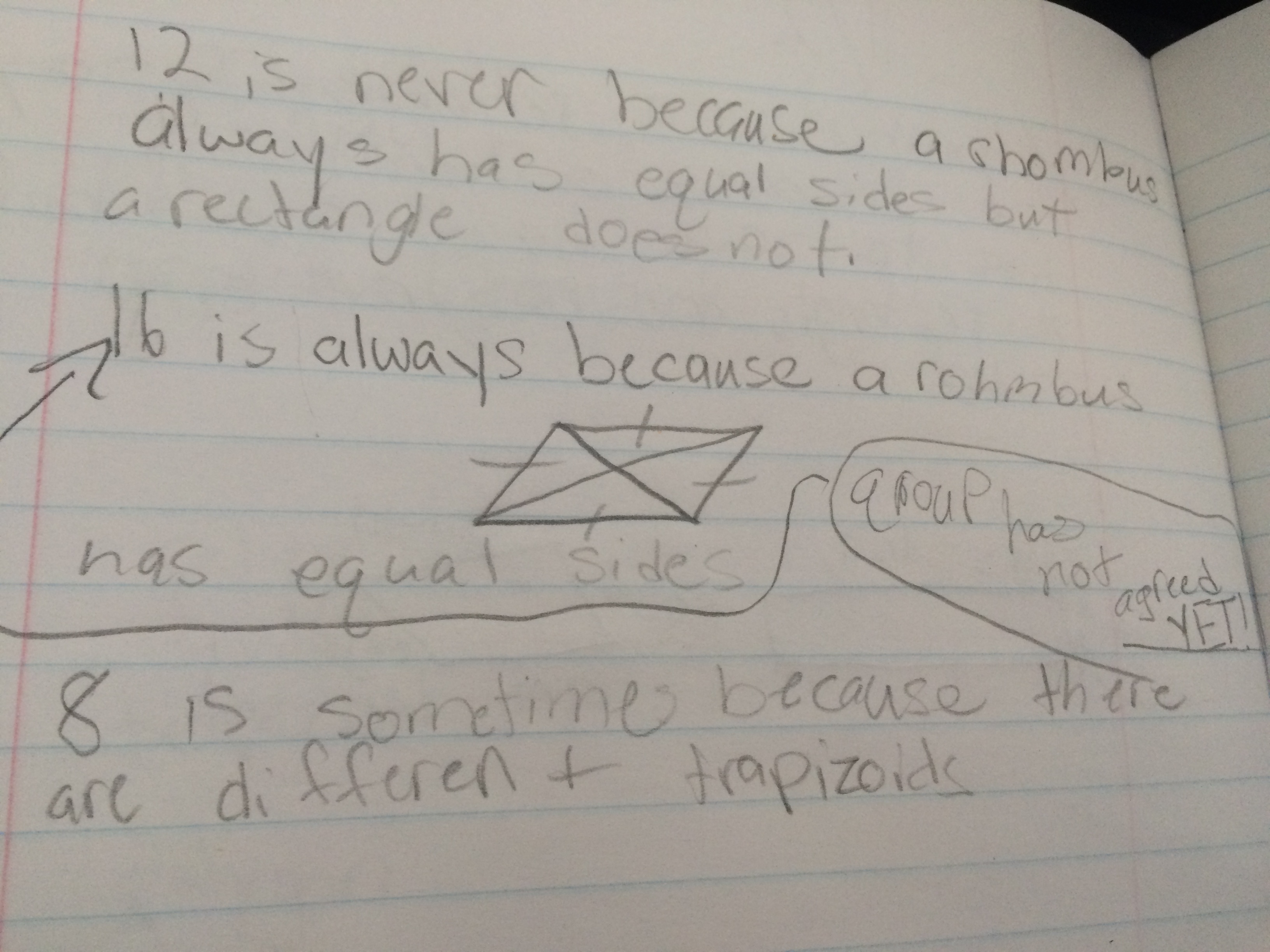
Having each group do a written proof for all 18 cards seemed overwhelming, so I gave each table 3 of the cards to focus on proving within their group. I had them write their individual thoughts about the 3 cards in their journals before starting to work together. In class tomorrow they will prove the placement of their 3 cards to the class (aka jury). Here are the beginning workings of their proofs:

IMG_8253_2 IMG_8254_2 IMG_8255_2IMG_8257_2 IMG_8256_2

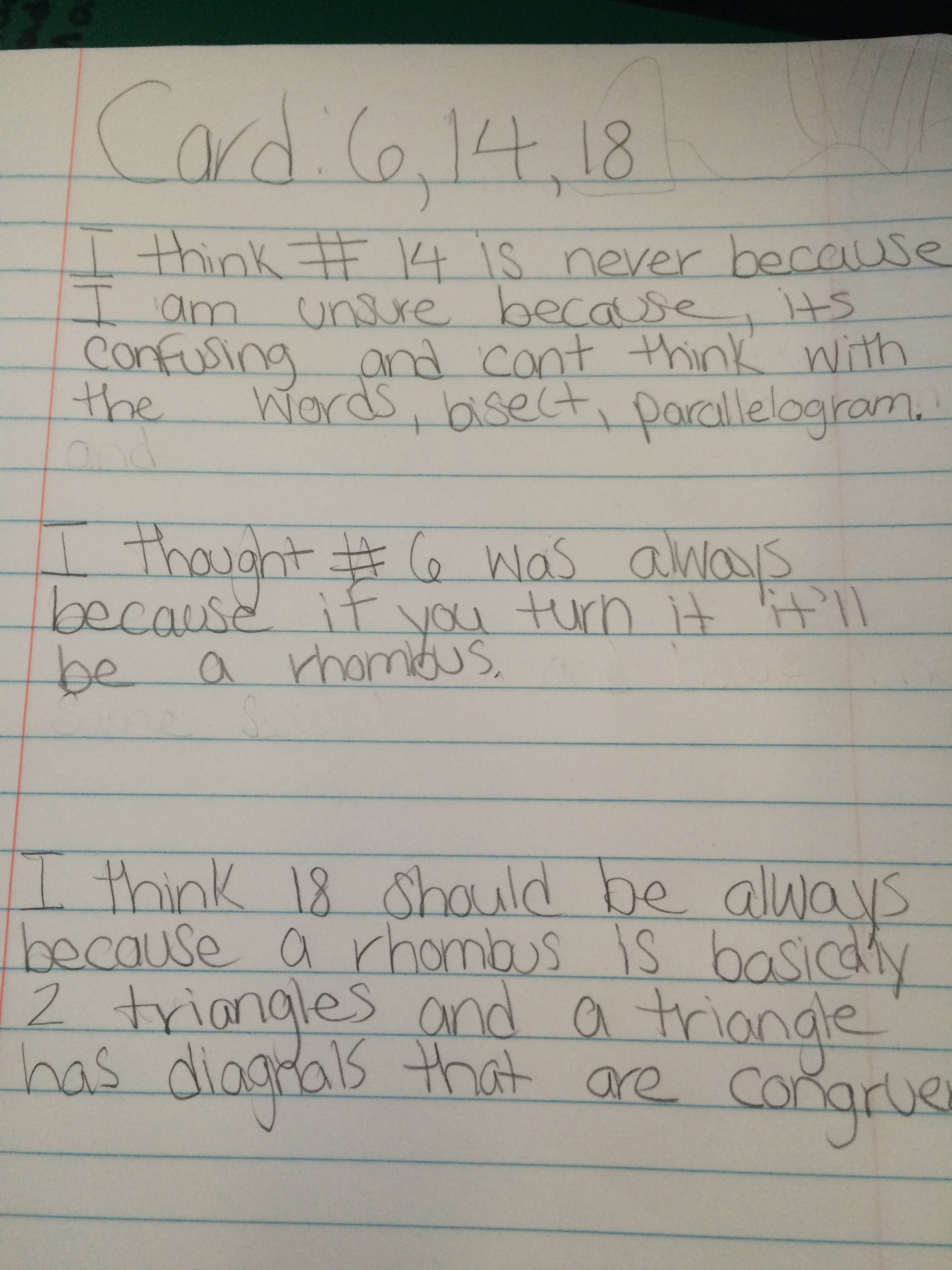
Before we left for the day, I asked them to reflect and write about any changes they made because of their discussions or any cards their group was still thinking about. Here are a couple before and afters…LOVE the argument ones!

IMG_8258_2 IMG_8259_2 IMG_8260_2-Kristin

Always, Sometimes, Never….Year 2

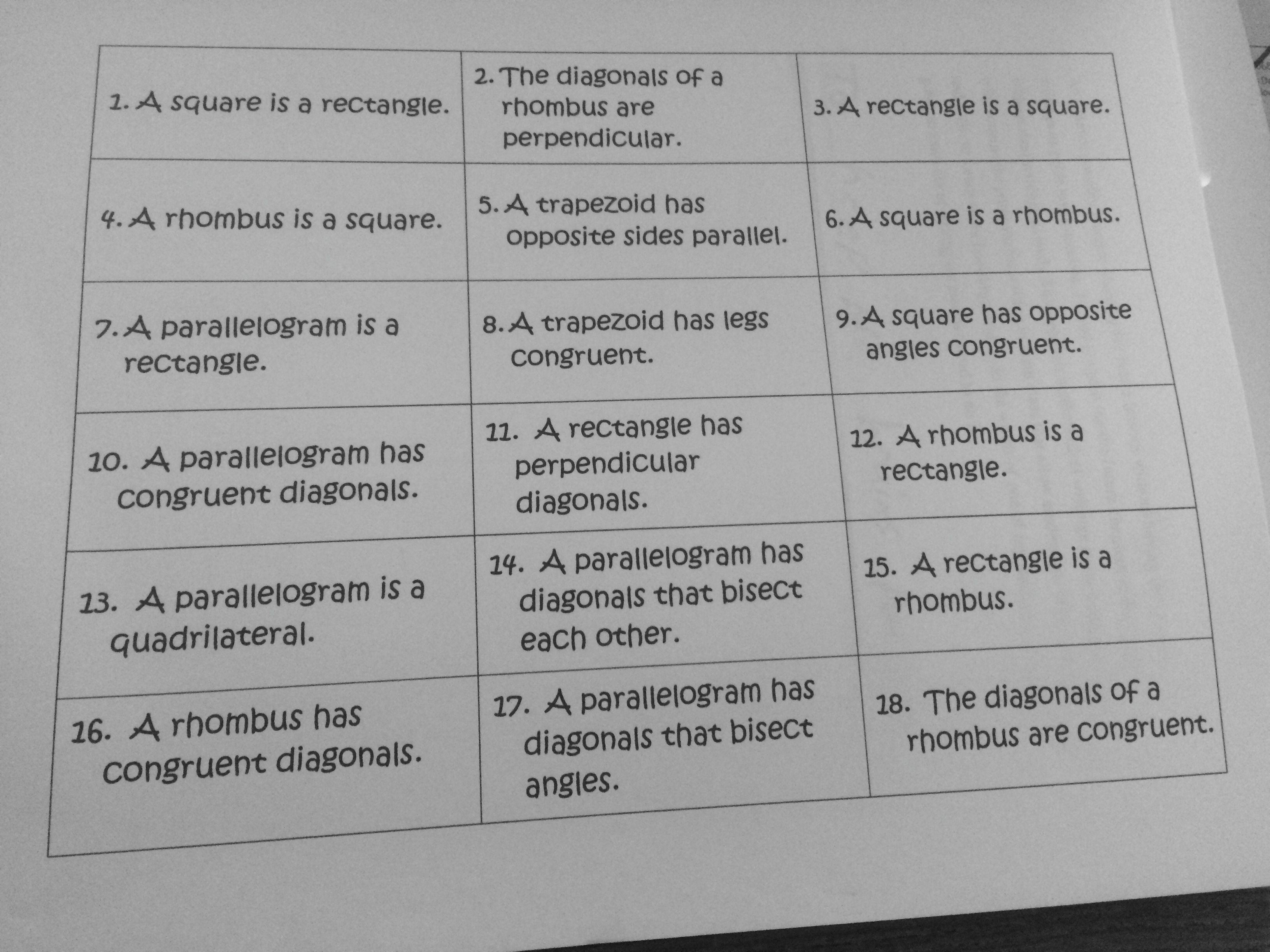
Last year, I used this activity with my 5th grade students and blogged about it here. This year, I used the same activity, however tried it a bit earlier in the unit than last. Based on our Talking Point activity before the unit began, I found the students had very good understandings that would emerge naturally in the Always, Sometimes, Never activity. I wanted to see how using the activity before a lot of our classification work would affect the outcome, if it would differ from last year’s.

This year, we had played “Guess My Rule” the day before in which students use attributes to choose two quadrilateral cards that fit their rule and one quadrilateral card that does not, while their partner tries to guess the rule. It is great for thinking about classification by sides or angles and vocabulary building. At the end of class, we did a few rounds together, and chatted about some vocabulary that was helpful and talked about our classification by sides, angles, or both.

Being the day before Thanksgiving, you never know how it was going to go, but they were so engaged in the work. Here is a copy of the cards that I used:

IMG_8190_2

I gave them time to individually read them and underline any words or wording in which they needed clarification. Although I was surprised that some students asked about words we had discussed in prior class periods, I was so much more happy they felt safe enough to ask for clarification. This is a prime example of not making assumptions in what our students know just because we have talked about it before in class.

They cut them out and went to work. As expected, they would have a brief conversation with their group and place them quickly into the appropriate column on their desk. I let them do that on my first round around the classroom and then as I heard some debates starting, I suggested that maybe using their journals to show their proofs may help their argument.  For those who were quickly done, I said, “If it falls in the Sometimes category, you should be able to show when it does happen and when it doesn’t happen, right?” I also pointed out the reasoning for Always never being able to be disproved and the opposite for Never. This had them really go back and take a deeper look at the cards and got their conversations going.

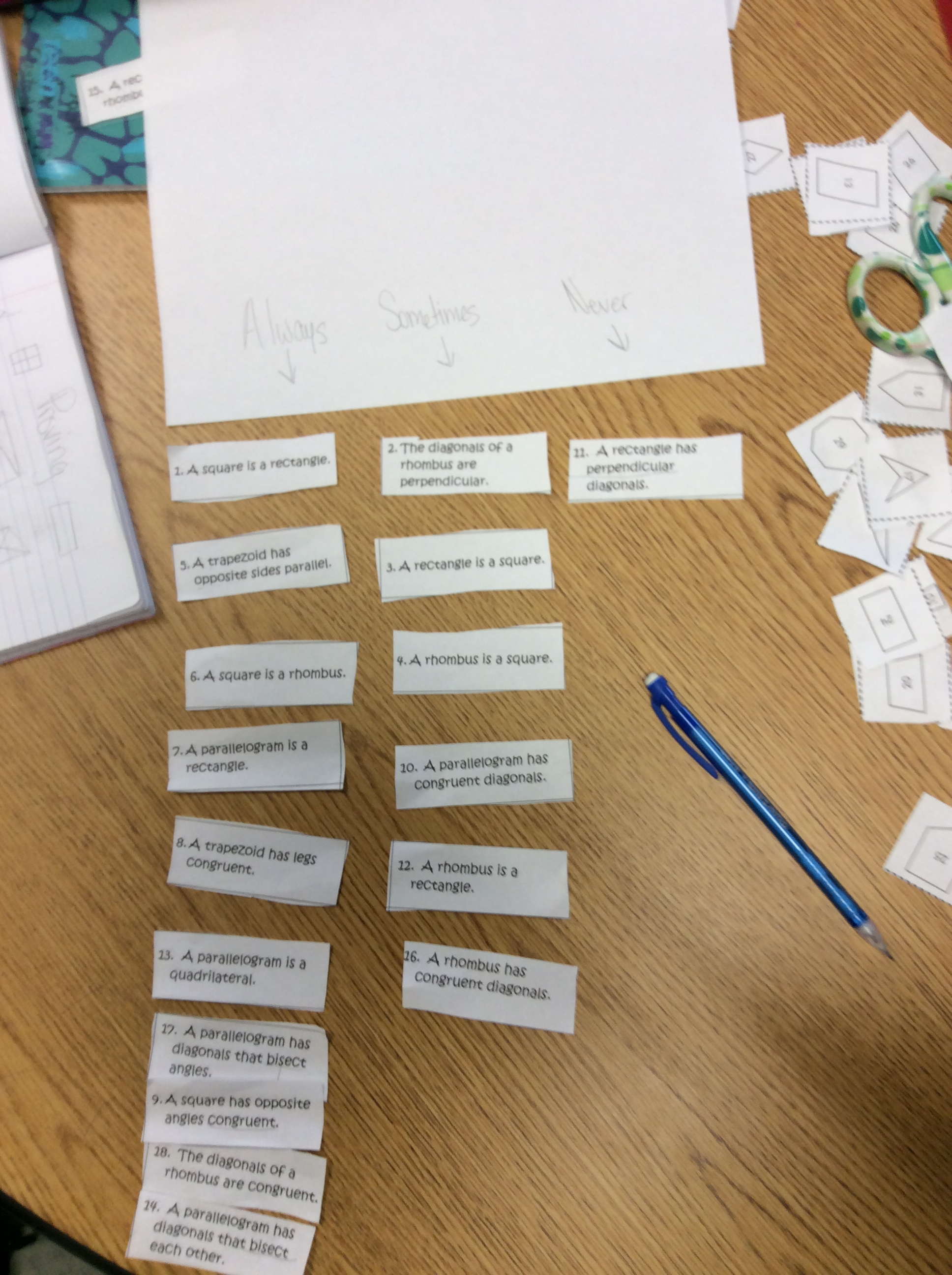
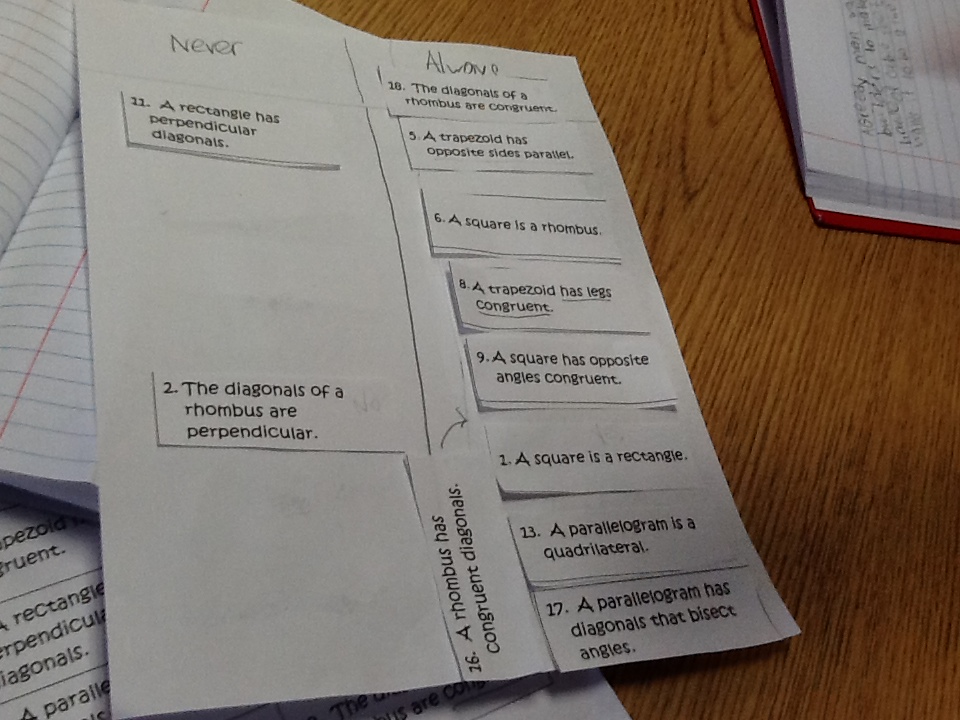
Of course, we did not get to come back together as a group and come to consensus but here were the table card arrangements as the class ended:

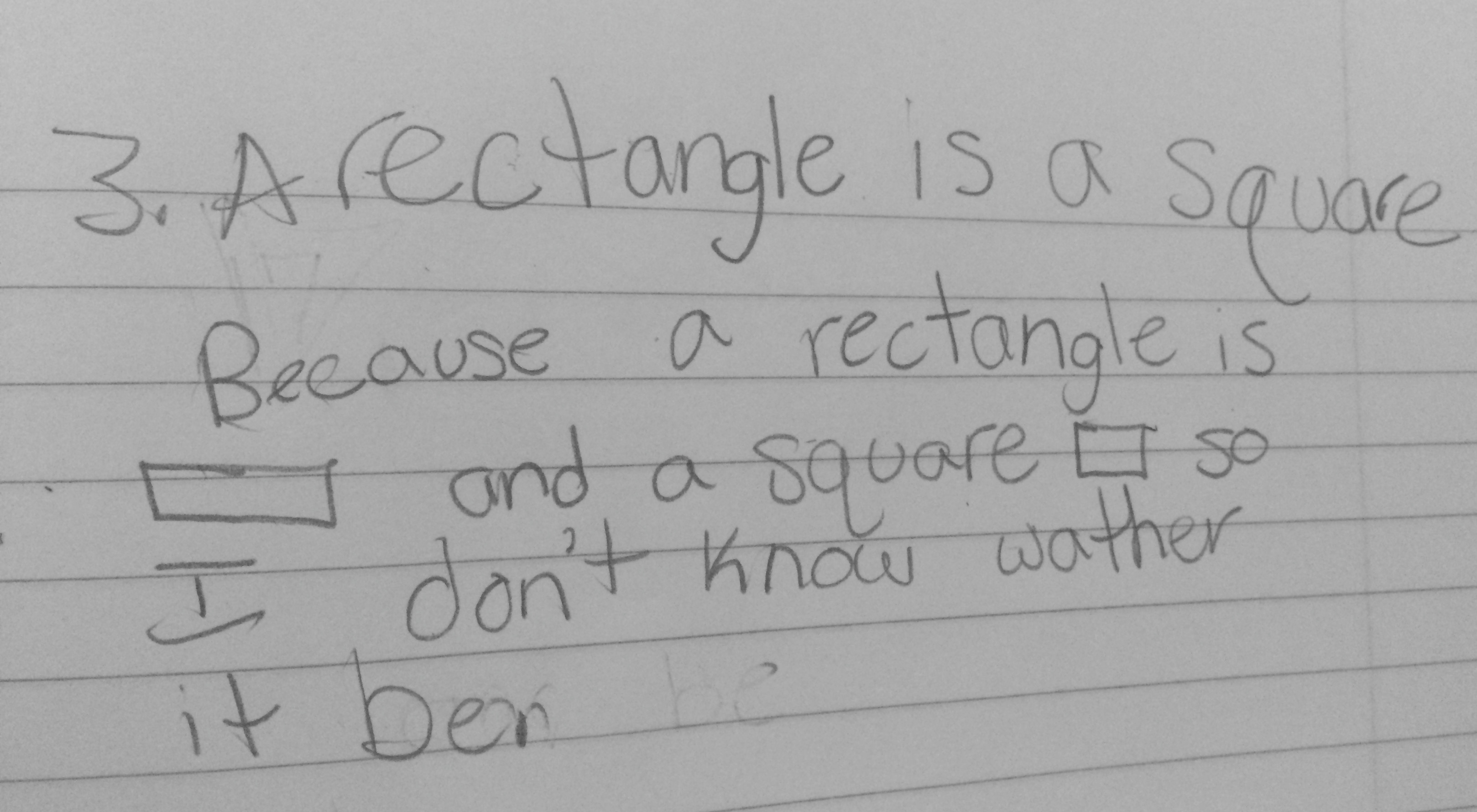
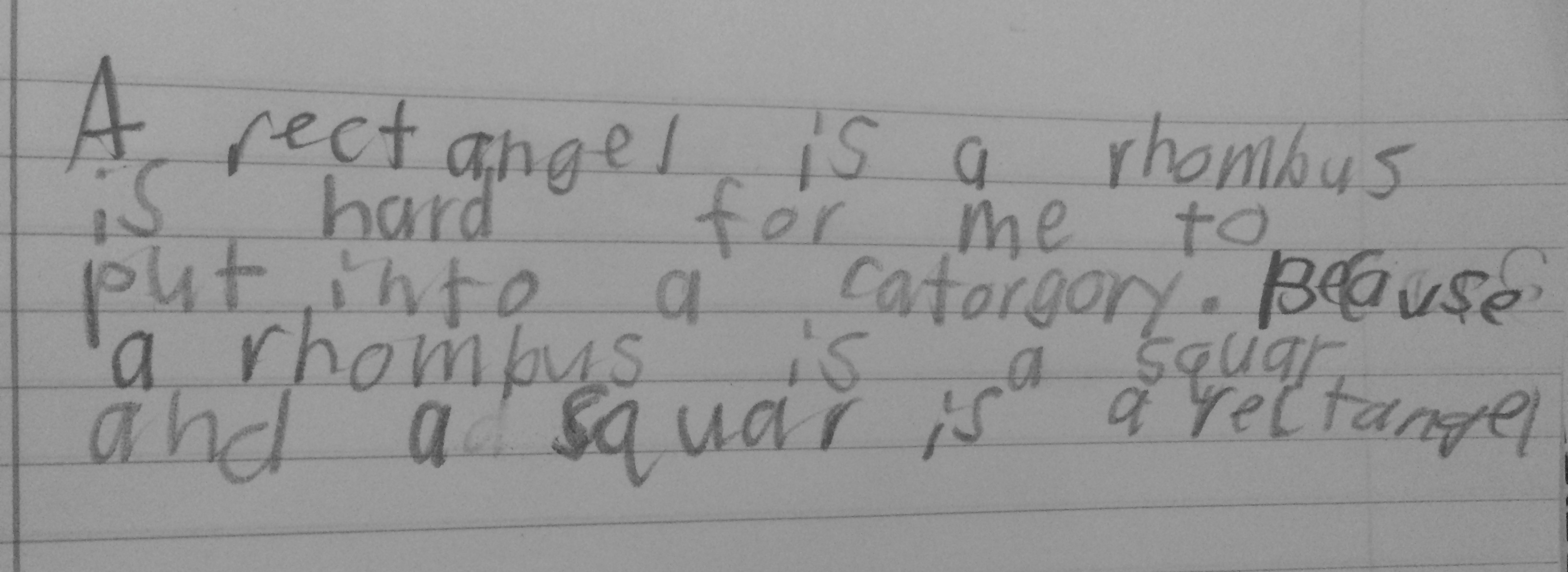
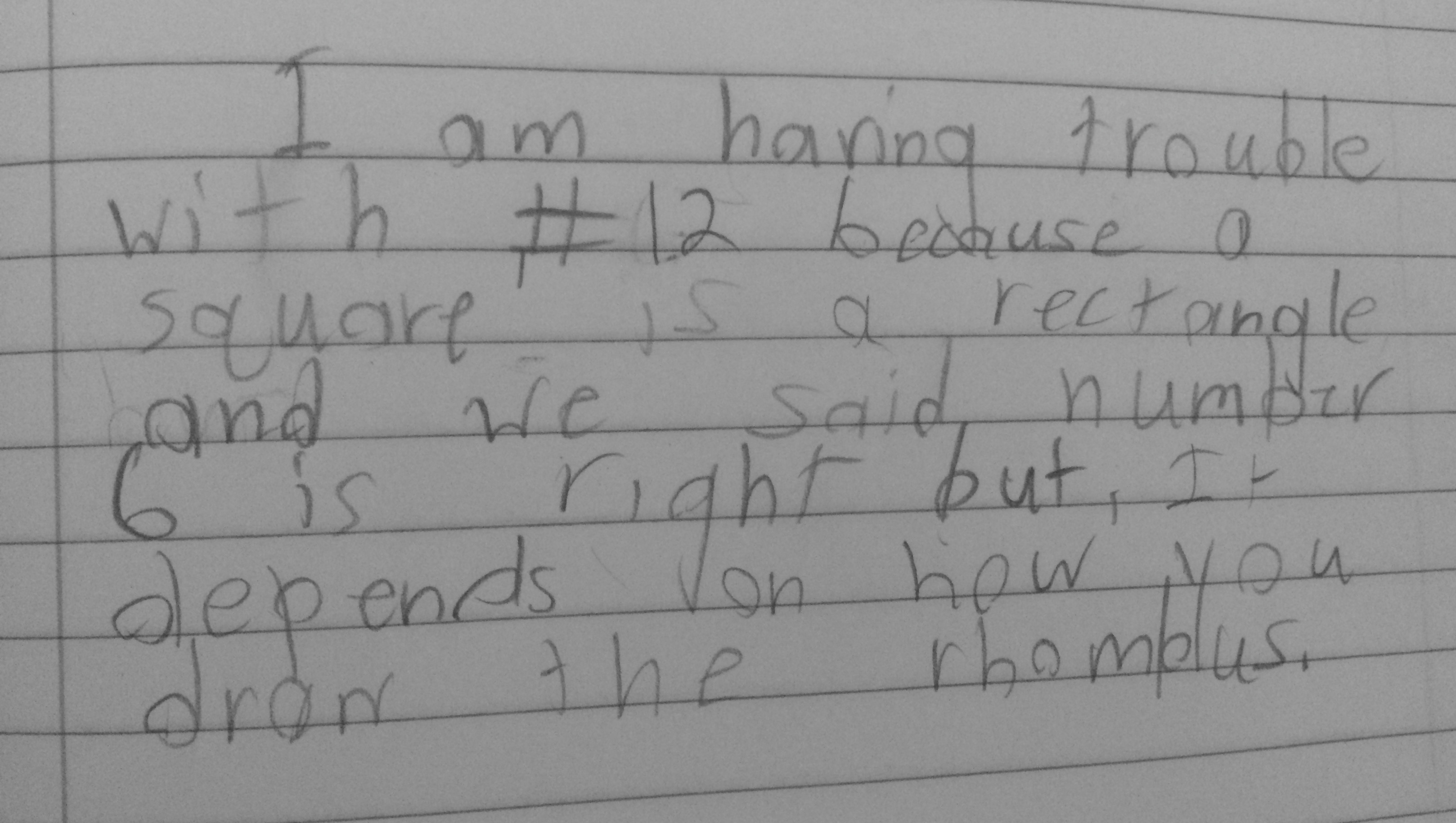
Photo Nov 25, 11 23 46 AM Photo Nov 25, 11 23 57 AM Photo Nov 25, 11 24 37 AM Photo Nov 25, 11 24 49 AM Photo Nov 25, 11 24 56 AM Photo Nov 25, 11 25 19 AM Photo Nov 25, 12 11 19 PMI had them do an individual reflection on which card they are still really struggling with and these responses are going to help in framing how I proceed from here on Monday after vacation:

IMG_8193_2

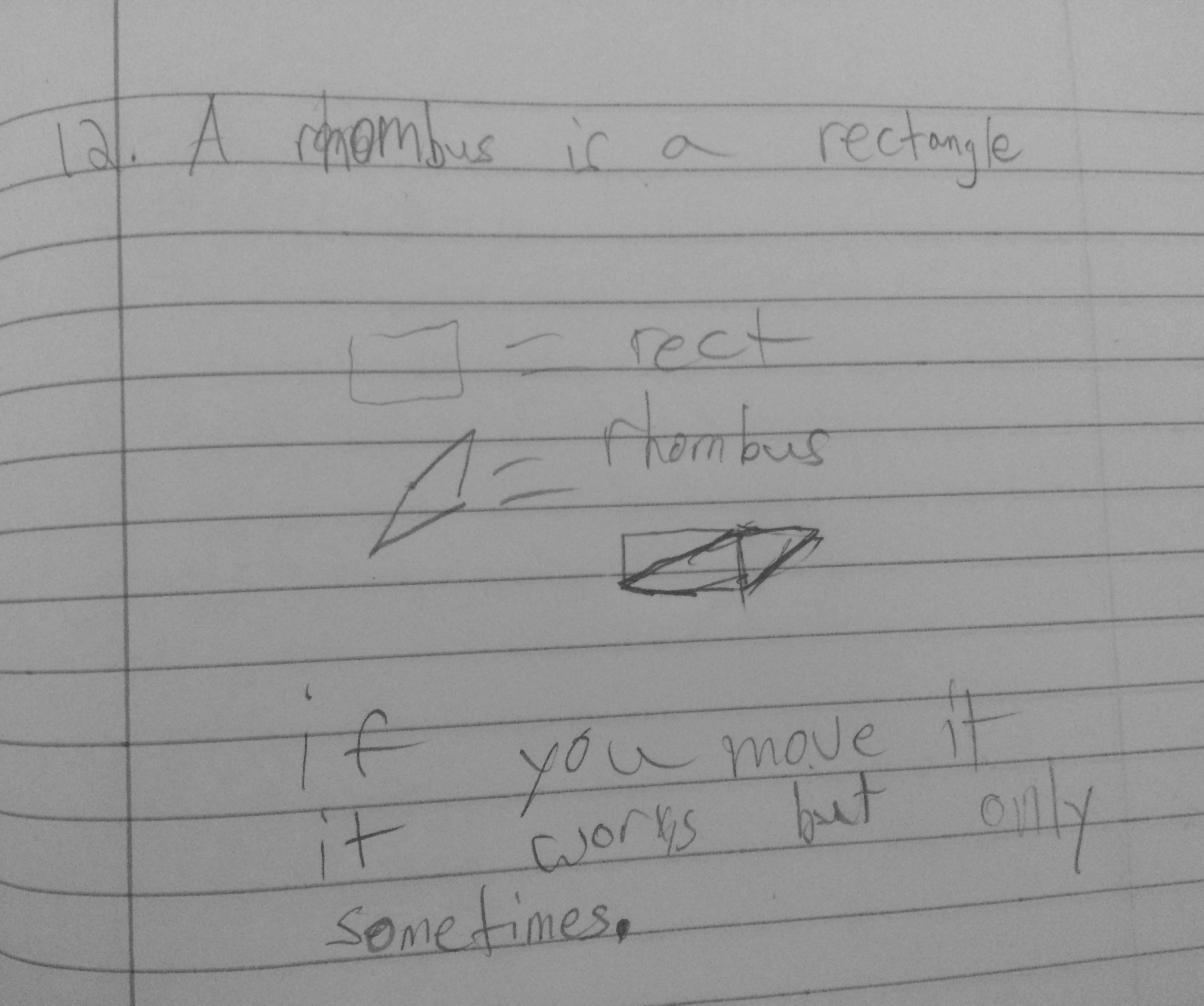
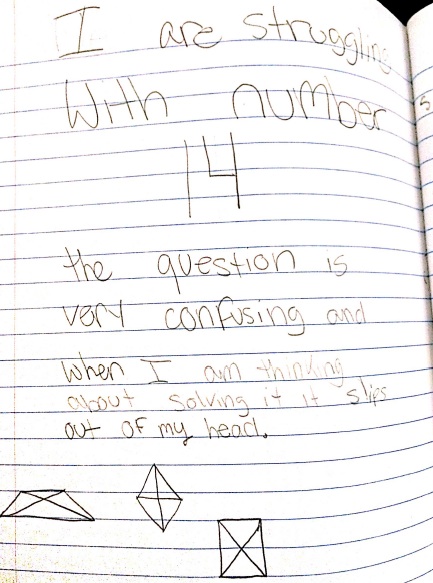
IMG_8194_2IMG_8195 IMG_8196_2 IMG_8197_2 IMG_8198 IMG_8199_2 1It is really interesting that for some students the orientation of the shape makes the biggest difference, others strugglw with the vocabulary, and, like last year, that rhombus one is blowing their minds. It is so interesting to me that a student can apply shape attributes to make a conclusion that a rhombus is a rhombus, but then to take that reasoning and apply it to another shape, is extremely difficult. This led to a very interesting conversation between a colleague (who was in observing) and myself about students knowing definitions versus descriptions….still wrapping my own head around that one…will probably be a blog post coming soon:)

With all of this information from the students, on Monday, I plan on putting them in groups based on the related cards they were left grappling with. I think rearranging the groups will lead to interesting conversations and more detailed proofs. Each table will get three cards to create an argument for the placement of that card. They will present their argument to the class and we will try to come to consensus as a class. Last year we did this share as a whole class, and I didn’t feel like it “wrapped up” and things were left hanging out there that needed to be a bit more solidified in future classification work, so hopefully this will be change that.

Happy Thanksgiving all!

-Kristin

Articulating Claims in Math

This summer I was fortunate to hear Virginia Bastable keynote about the work in her book Connecting Arithmetic to Algebra. If you have not read this book, it is a must! It explores the process by which we have students notice regularities, articulate claims, create arguments and representations, and make generalizations.

9780325041919It is something, as elementary school teachers, we need to really be thinking about more in our math classes. Are we creating environments that encourage students to think about the math behind the strategies and make generalizations based on the properties of operations? I have taken this recent reading and made it a priority in my classroom.

I always have students notice and discuss patterns and regularities but I don’t often have them create generalizations for us to revisit as we move through the year. For example if their claim works for whole numbers, shouldn’t I revisit that as we work with fractions? Does your claim still hold true?

As a class routine, I posted this on the board and asked students to fill in the blanks to make it true:

12 x 4 = ___ x ____

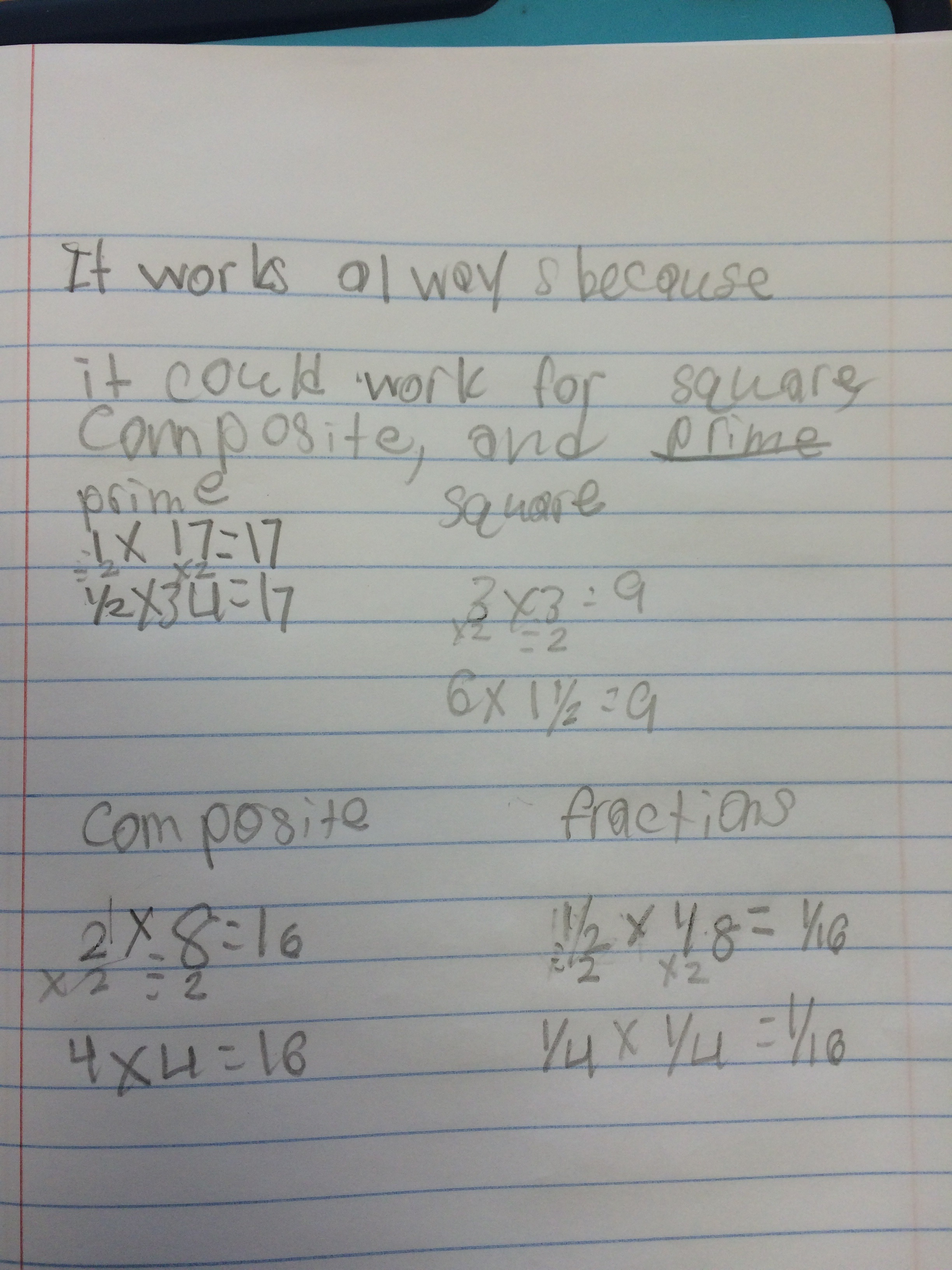
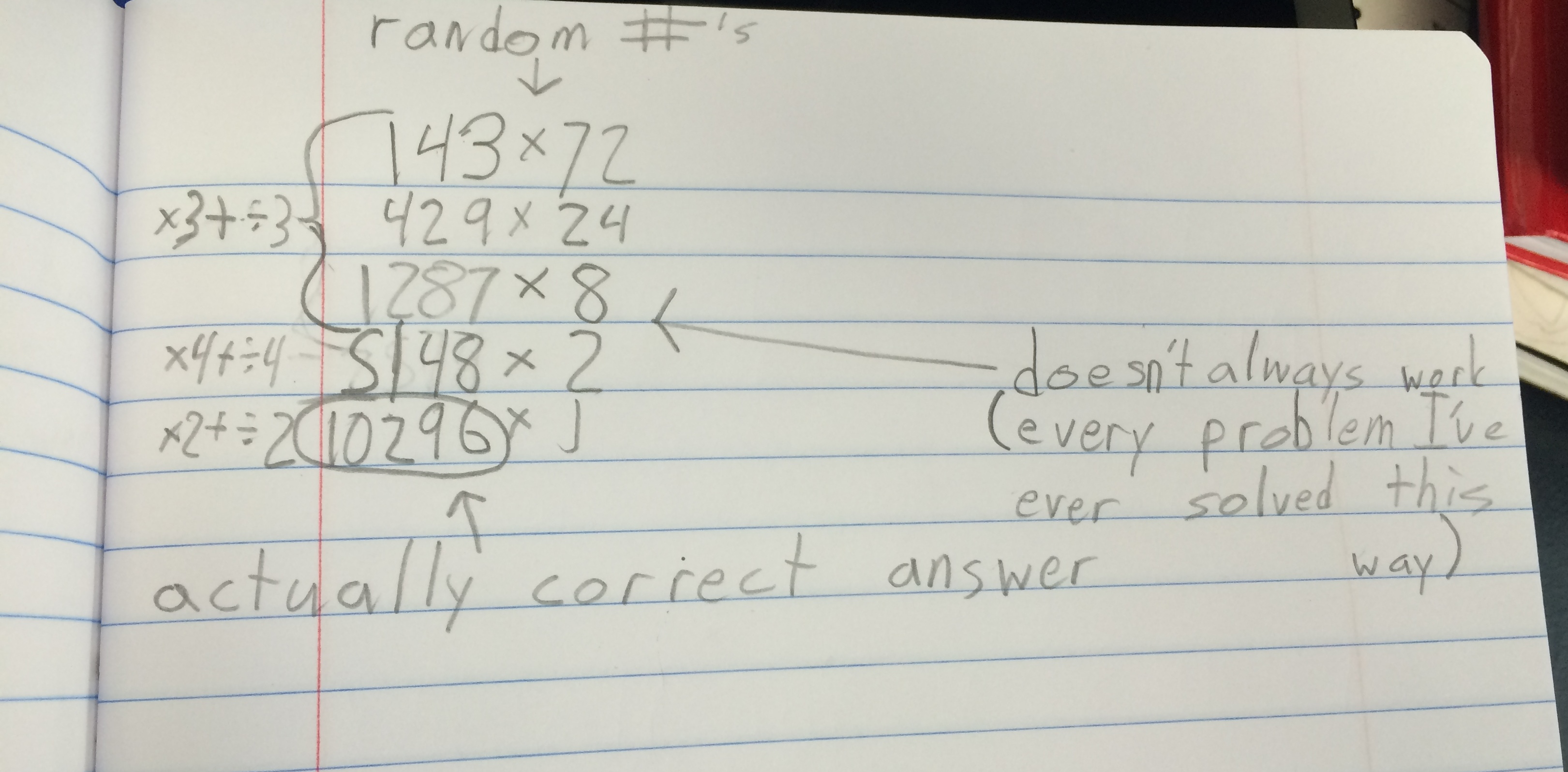
Quickly, students wrote down answers, had their hands up, and one student blurted, “This is easy, you don’t even have to solve it!” Typically blurting out answers before others are done thinking drives me a bit crazy, but this time I was thinking…Yes! I asked who else thought the same thing. I had at least one hand up at each table so I asked them to discuss with their table how that is possible. We came back together and each table said they could double/half to fill in the blanks. I took answers on the board and got the expected: 6 x 8, 24 x 2, 48 x 1, 3 x 16 and then I even had a 96 x 1/2 and 36 x 1 1/3! I asked about the 48 x 1…did you get that by double/halving from the original problem? What is happening there? They noticed that it was x 4, ÷ 4, and then the same with 3 x 16. I asked them to take some individual time to see if they thought their strategy would always work and could prove it with a representation. They then talked at their tables and I asked each table to write a claim, something they think is true about this work.

I got some who kept solving problems to prove it works:

IMG_8128IMG_8103IMG_8132IMG_8139

I had a couple try out the representation (exclaiming how hard it was to draw what is happening:)

IMG_8130IMG_8140_2

Here are some of their claims:

IMG_8135IMG_8099IMG_8138

IMG_8125IMG_8102

This is the class list from my second period class. I especially liked that one of them said it only worked with multiplication. How fun to revisit!

IMG_8107Instead of losing these, I started a Claim Wall to post and have students add to and revisit throughout the year. I am trying to think through how to have students comment on them, possibly agree/disagree post its?

IMG_8127

If you would like more information about Virginia’s work, there are courses available here: http://mathleadership.org/programs/online-courses/ Check it out, great stuff!

-Kristin

Talking Points – 2D Geometry

We are about to start out work with Polygons, so I decided to kick it off with Talking Points. If you have never read about them before you can check out my post or Elizabeth’s post to learn more.

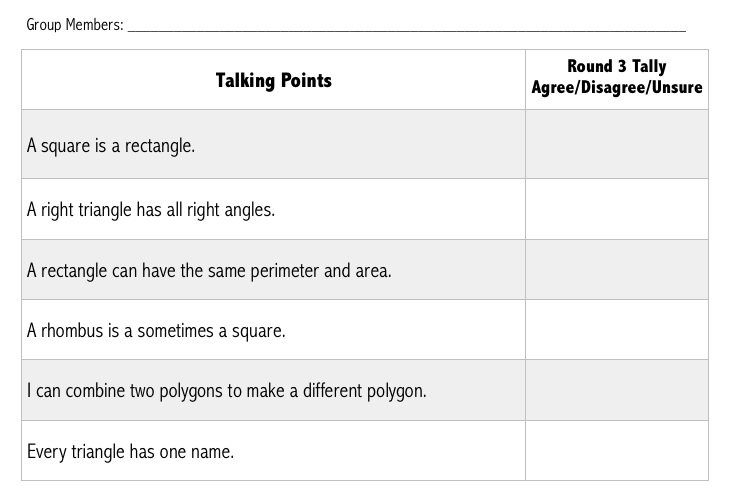
Here were the points my students were discussing:

tpgI had gotten these points by looking back at their fourth grade geometry unit work and thinking about what misconceptions or partial understandings students have each year when we start this unit.

This time, I made a few changes from past experience. In each group I had a facilitator to be sure that everyone got a chance to speak without interruption during Round 1, and a recorder to keep the tally for the group. Also, after the first talking point, I had advise from a math coach in the room filming with me to add individual think time after the reading of the point. LOVED IT! During think time, they were jotting in the journal and getting their thoughts together. I got things like this from just the think time:

IMG_8057 IMG_8059 IMG_8062 IMG_8069 IMG_8070

It was nice to see them take ownership with their journal without being told to write anything down. They were working on proofs before they started. After the six talking points, I posed three questions on the board for them to reflect upon individually:

1 – What talking point are you sure you were right in your answer? Explain your reasoning.

2 – Which talking point are you unsure about your answer? Why?

3 – Which talking point did your group agree upon easily? Why do you think it was easy for your group to agree on that one?

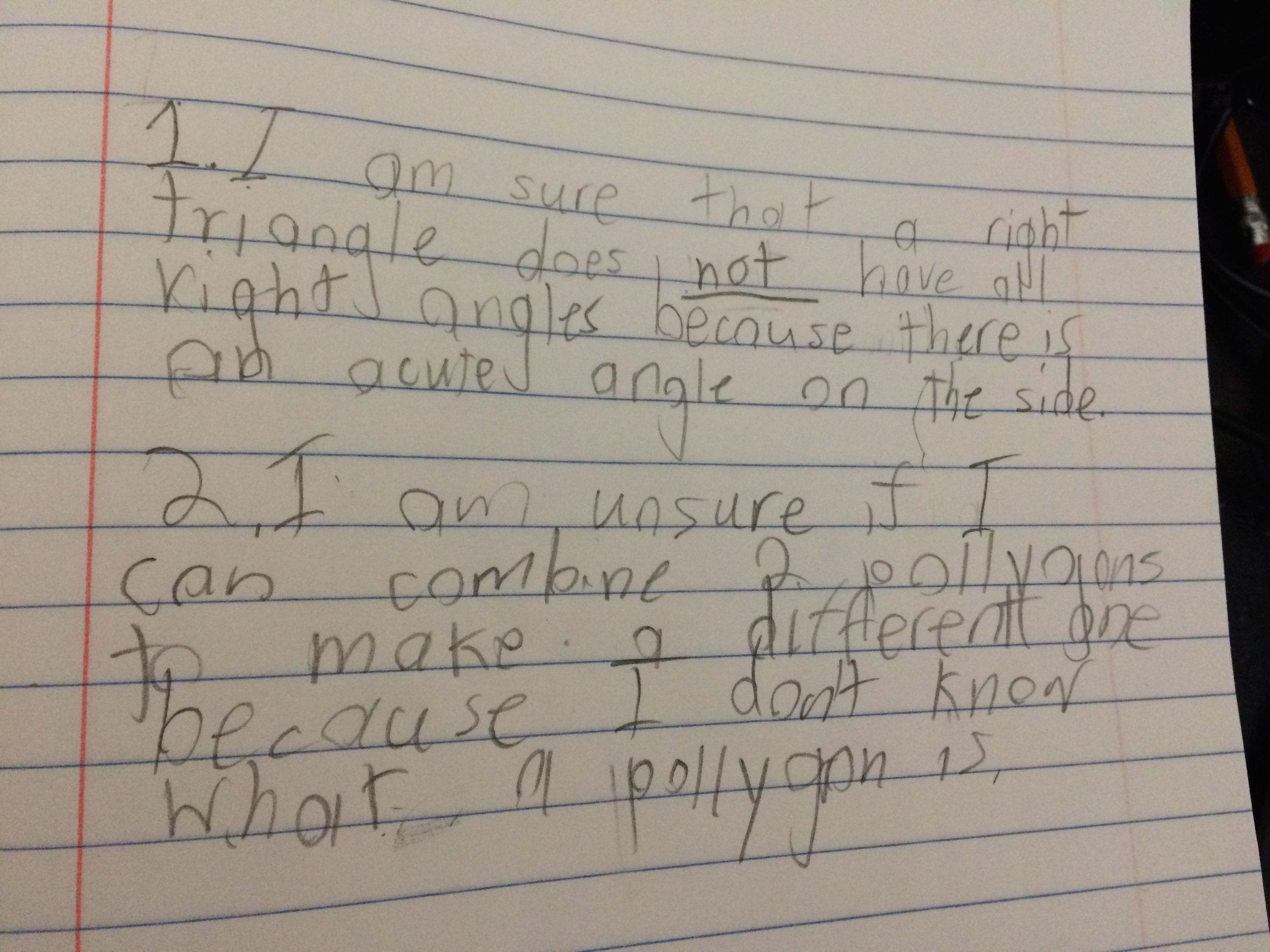
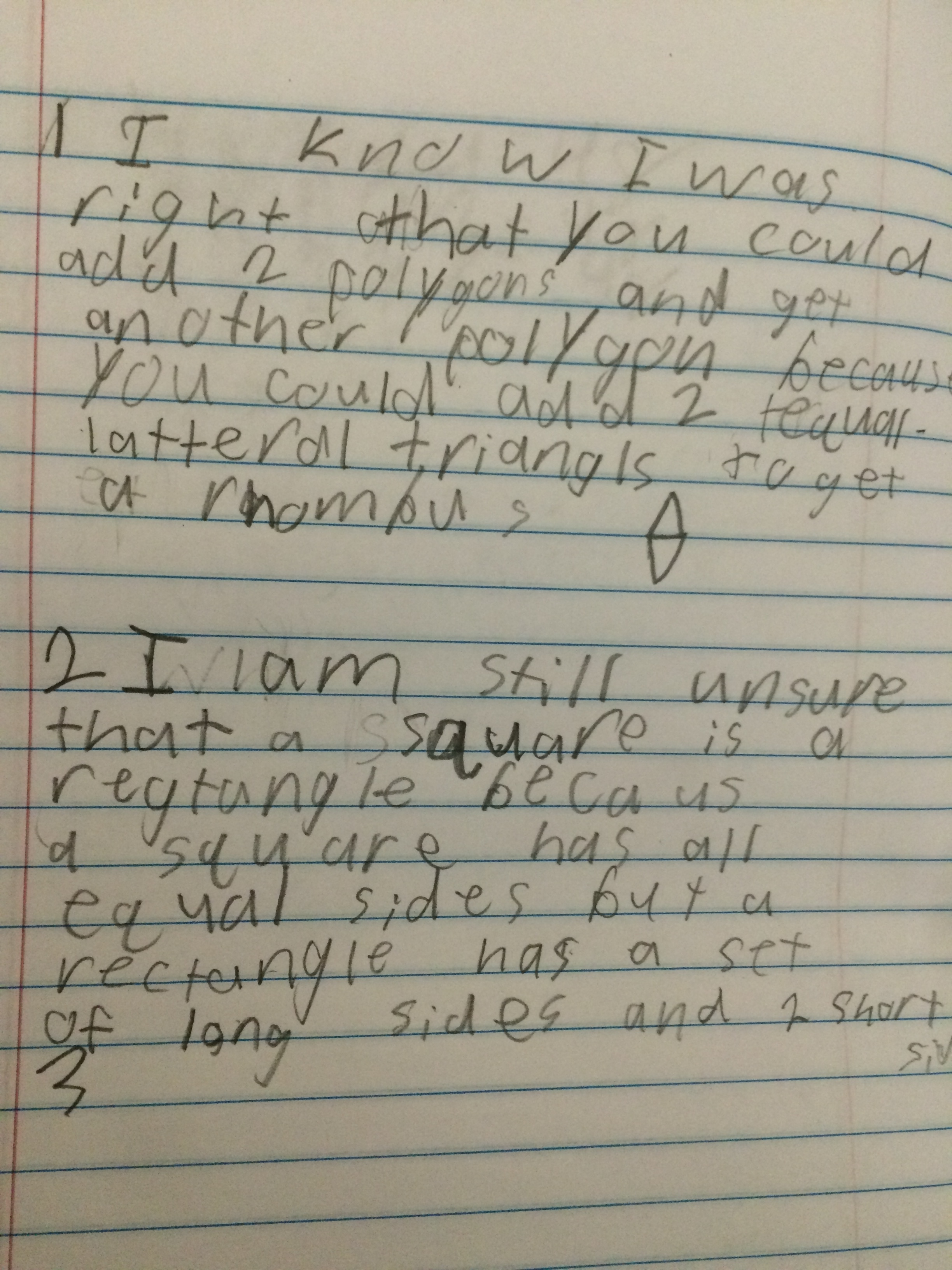
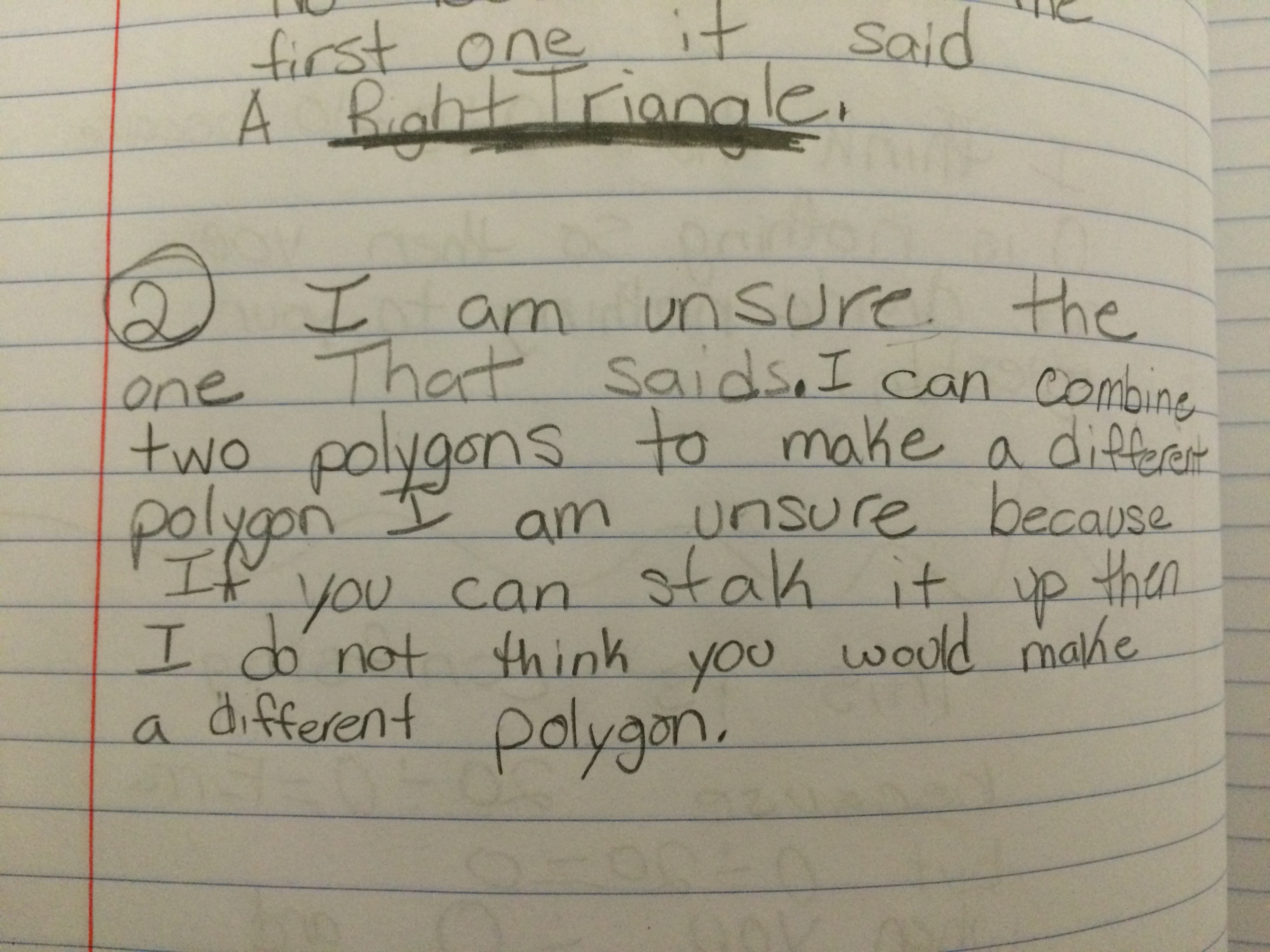
Here are their reflections:

IMG_8039 IMG_8041 IMG_8043 IMG_8046 IMG_8048 IMG_8049 IMG_8053  IMG_8055IMG_8054 IMG_8060 IMG_8061 IMG_8066 IMG_8068

Never anticipated so much “left angle” talk in my life 🙂 I learned SO MUCH about their understandings and wish I had time right now to add my comments to each journal, but I will very soon!

So, I have a moment here at lunch to reflect on what I learned from these talking points:

TP1 – As I anticipated, this one is always a source of confusion. Every year it seems as if the students know the sentence goes one way or the other but can’t remember it because there is little understanding of the WHY piece. Later on in the unit after we have done more classifications, I do more of these statements with Always, Sometimes, Never, so this is a something I wanted to see how students were thinking about it. Most tables said something to the effect of “I remember last year we said a square is a rectangle or a rectangle is a square, but I can’t remember which one.” Another conversation I heard was that a rectangle has to have two short sides and two long sides.

TP2: I loved this question and was really pleasantly surprised to see some trying to draw it and ending up with unconnected sides. One thing I was so surprised about was the “left angle.” They were not thinking the degrees changed so much from the left to the right angle, but more the orientation of the angle (left side, right side). Interesting.

TP3: I got a great sense that most students knew what area and perimeter were and the best part was that if they didn’t remember, someone at their table did and gave an example. Regardless if they knew they could be the same, I was excited to see a great understanding from most here.

TP4: This one was great. I saw some students drawing a square on their paper, showing the group, rotating the paper and saying, “See, now it is a rhombus.” They all seemed to be in the mindset that a rhombus is a diamond shape, but really not reasoning about the attributes that make it a rhombus.

TP5: They did a very nice job with this one. A lot drew examples of combining two shapes, while I heard others asking their group if the “inside connected side counted” when they were trying to name it.  Also realized that the term polygon was not familiar to most students. I am wondering what they called them in earlier grades? Pattern Blocks? Shapes?

TP6: Interesting one here and it is where we start our 5th grade work with polygons, classifying triangles. Again, the left angle reappeared:) I did hear a few struggling with the name of the angles, obtuse, acute, right but then I had some that said there are other 3-sided shapes that aren’t called triangles. Hmmm, can’t wait to find out what they are! Of course, you always have your comedians who say agree because it could be Bob or Fred.

Can’t wait to start planning this weekend!

-Kristin

What Happens When You Divide by Zero?

This question got thrown out on Twitter the other day (full conversation here). It was something I had never thought about and struggled to think about where in our curriculum or standards it showed up. As always, I thought I would ask my students the following day what they thought happened when we divided by zero. Here are some responses:

IMG_8005  IMG_8008 IMG_8009 IMG_8012 IMG_8013 IMG_8016 IMG_8006IMG_8021 IMG_8022

It was interesting because most went to breaking into groups, but depending on how they reasoned about it,resulted in different answers. Sharing something between zero people or putting things into zero groups was either zero because there was nothing to put the number of things in OR it was that beginning number because they weren’t put anywhere and were leftover.  Some also thought about inverse relationships which was nice and that is when our conversation got really confusing and people started questioning what in the world it was! One student punched it into his calculator and got Error, even more confusing while another asked Siri and got this, which they wrote in their journal…

IMG_8014

Fawn tweeted a piece of student work that was really interesting in which the student had said 5 divided by zero was the same as 5/0, so (trying to quote this as accurately as I can) you cannot take five pieces of something with an area of zero. I am thinking that was like thinking something like 5/6 is 5 pieces when the unit is broken in to 6 pieces. In his case, it is five pieces with the unit cut into zero? Fawn, please correct me if I completely mess that one up!!

Very interesting and something I want to be sure I keep in the back of my mind. I love when a tweet can spark something I had never thought of before in elementary math work! Thanks Tina!

-Kristin

#ElemMathChat

This Thursday (11/13), I am excited to be moderating #ElemMathChat on “Writing in Math Class.” The chat will be 9:00 – 10:00 EST and our discussion questions are below. Hopefully, you will be able to join us, but if you cannot, I would love to hear your thoughts in the comments section!

-Kristin

Q1: When do you use writing in your math class? How often?

Q2: What is the purpose of this writing, for the student?
Q2a: Can you give an example?

Q3: What is the purpose of this writing, for the teacher?
Q3a: Can you give an example?

Q4: What type of feedback do you offer students on their writing?

Q5: What struggles/obstacles/questions do you have about writing in math class?

Q6: (If time or a thought to leave with and post on h/t later): What do you learn about this student’s understandings from the following writing? What would your feedback be?

Student work: Are 6/10 and 60/100 equivalent? Show your reasoning.

IMG_6478IMG_6484IMG_6476IMG_6486IMG_6489