Category Archives: Fractions

Fractions of Fractions

This is day 1 of multiplication of fraction by a fraction and I can already see this will dramatically increase my blogging! So much to write about (for reflection, excitement and possibly confusion). With the implementation of CCSS this year, this is new in the Investigations curriculum and I am finding some things I love about it already and some things I am struggling with just a bit.

Before this lesson, students have worked in the context of a bike race of “x” number of miles and found a fraction of the race various bikers have completed.  Looked like this:

frac1This lesson went very smoothly and I found it was more of a struggle to have them model what was happening on the fraction bar since finding the fraction of the whole number was an action they could do mentally.  To some, it seemed like an unnecessary step and to be honest, I wavered between unnecessary and yet completely necessary to make their thinking visual. I knew how important it would be in fraction x fraction, so I made them construct the model of what was happening in the story.

Today we started fraction of a fraction. It incorporates the same visual image of the fraction bar, so I love that continuation from previous lessons. It did lack a context, which at first bothered me but as we continued working, and heard the discussions, I moved past that.  Tomorrow, I am actually going to have them come up with a story to go along with a few problems to see if they can contextualize the math they are doing.  We started with a fraction of a half and then a fraction of a third, writing the expressions (some equations) as we went:

IMG_2426IMG_2411Of course, you always have the students who fly through the work and finish early as I am walking around and having discussions with the students who need some extra help, so I asked those who finished early to think about the denominator each time. Why is the product’s denominator changing from the denominators of the factors? Did you have an idea what the denominator would be before you used the fraction bar?  There thoughts were so interesting:

Absolutely LOVE all of this scratching out, changing her reasoning!

Absolutely LOVE all of this scratching out, changing her reasoning!

IMG_2413

This one brings up the issue of vocabulary….fours instead of fourths, eights instead of eighths. Something I have to bring out in our discussions.
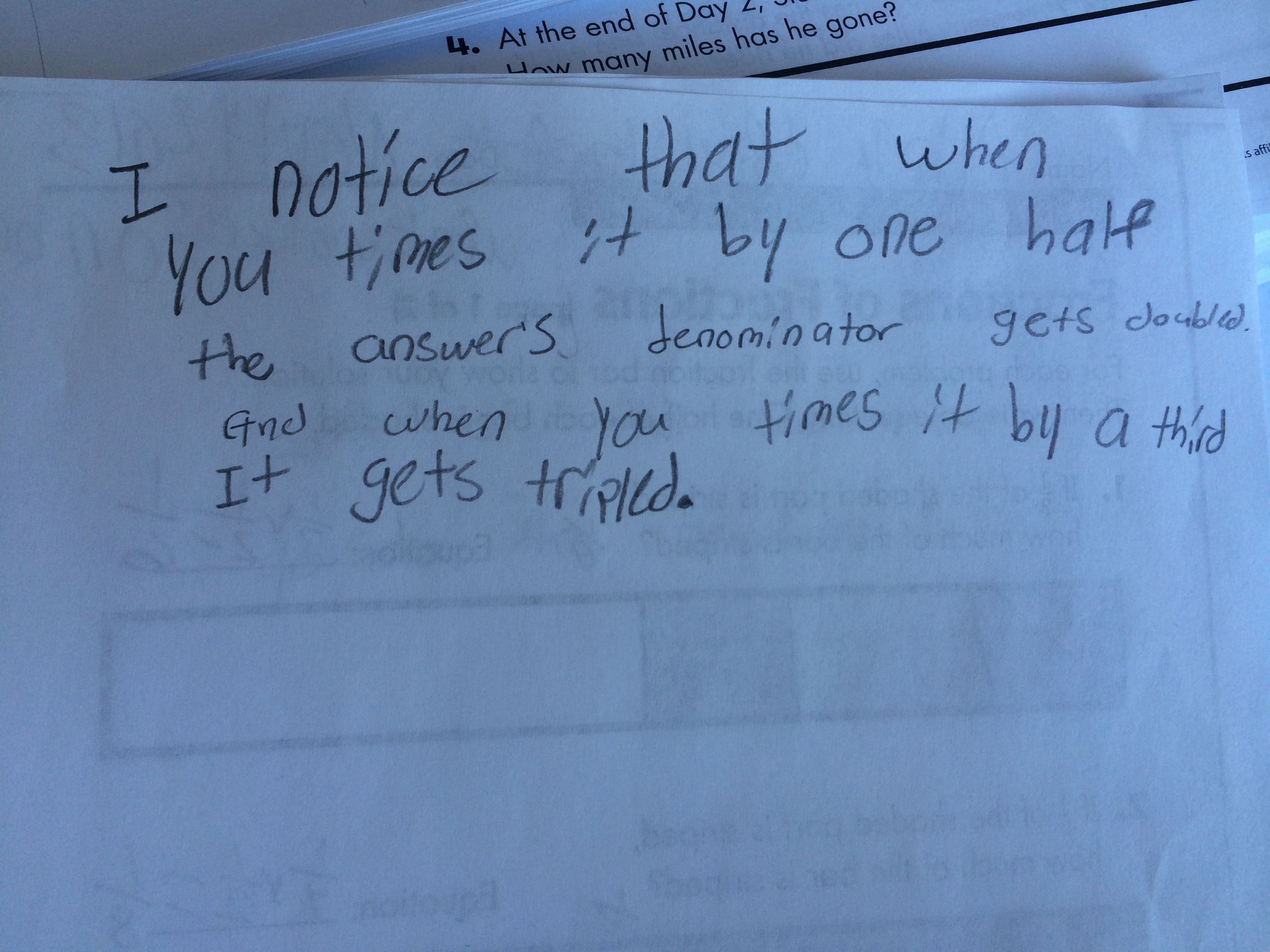
IMG_2414

This one I struggle with because of the words double and triple. I know the number itself is doubling and tripling, but I would like to have them expand that is it happening because there is another half to split or two other thirds to split.

IMG_2415

I love that this makes the fractions factors and products are just like whole number factors and product.

IMG_2416

Again with the “double” word. Is it just me that struggles with this one??

I am thinking this will be one of MANY multiplication and division of fraction posts! I am just amazed at the ease the students work with the fraction bars and I like what Investigations has done thus far with these lessons. One tweak I would like made would be the directions…students are asked to “stripe 1/2 of the shaded portion” and it is becoming a tongue-twister for me 🙂 I keep saying shaded when I mean striped, minor detail but they keep correcting me!

These conversations are so rich and valuable for this understanding that it blows my mind that a teacher could just say “multiply the numerators. multiply the denominators. That is multiplication of fractions.” If I had learned fractions this way, it would have all made SO much more sense!

To be continued…

Why We Need Two Teachers in Every Classroom…

This job takes two brains to handle the thoughts of these students.

In class on Friday, one student made the comment that he didn’t really like adding fractions on the clock because it could only be used for certain fractions.  When I asked him to expand on that, he explained he could only do halves, 3rd, 4ths, 6ths, 12ths and 60ths easily and what if he wanted to do other fractions like 1/8 or 1/24?  He said he couldn’t do that without breaking the minutes up.  I am excited at this comment especially because this student is one whose parents have taken him to Kumon math for years for “extra help” and he is most comfortable memorizing procedures over thinking about the math. He thinks changing to “common denominators by multiplying the numerator and denominator by the same number” is faster and easier than this clock.

Upon reflection, I think it is interesting that he stayed with fractions of the fractions we were working…why not pull out 1/9 or 1/11? But my first train of thought in the moment was changing the whole. I wanted to see if he could put the clock in terms of a whole day, 24 hours, 2 rotations around the clock being the whole instead of one. That way 8ths and 24ths would be more apparent.

So I asked him if he could think of a way we could change the clock to do 1/8 or 1/24 without breaking up minutes? His first reaction was no, so I said “That is interesting because there are 24 hours in a day, so I feel like this should work.” Possibly leading him too much but at that point I could see the glazed look in some of the students eyes and I felt like I was losing the class’ attention. I told him that during math workshop that day he could chat with me about it or he could take that thought and work with some more for Monday.  He said he wanted to think about it over the weekend…I think mainly because he didn’t want to miss the Math Workshop activities, so we will see what he has for me tomorrow.

After school, I am recapping this lesson for Nancy and saying how difficult I thought it would be for them to grasp two rotations of the clock as the whole for the 24 hours that would allow for 8ths and 24ths more easily.  After listening to me ramble for about 5 minutes about this idea, she casually says, “What about military time?” UMMMmmm…DUH. Where was she during that class period??  This job really does take two brains.

So needless to say, I have amended my lesson for tomorrow. I am handing them this military clock and letting them talk about what fractions we can work with easily that are the same as our first clock and which one’s are different. Design addition equations we can solve with this clock that we couldn’t do on the other clock without breaking minutes.

Image

Don’t get me wrong, I still want to get to changing the whole on our original clock, but I think after working with this clock, it may be more accessible for more of the students. I will post later to update on this lesson to show how it went…but good or bad, the questions and thinking that led to this lesson are so worth it!

-Kristin

A Fraction of our Time in Math Class…

I absolutely love fraction work with my students because there is always something interesting that leaves me pondering the whys and hows of my practice….

Being a K-5 Math Specialist for a couple years offered me the opportunity to really see the trajectory of our fraction work. Now being back in the classroom, I feel I have a much better grasp as to the work the students have previously done within our math program.  In third grade, they work tremendously with halves, thirds, and sixths using polygons to represent fractions of a hexagon whole for comparison and addition/subtraction. In fourth grade, students use arrays and known equivalencies to compare and add/subtract fractions with unlike denominators by choosing an appropriate array that works for both fractions (common denominator). In addition, at each grade level, students in need of RTI enrichment, work in Marilyn Burns’ Do The Math Program which utilizes fraction strips to compare and add/subtract fractions. All of this work focuses heavily on the students’ understandings of equivalencies.

Knowing all of this still never prepares you for the power of a new model….time! I have to admit, I am a huge fan of fraction strips and array work, however today I felt the power of clocks in developing equivalencies.  I have taught this lesson in previous years and to be completely honest, never really liked it. It felt contrived, like a pizza divided into slices in another form. This year I have realized it was not the context that was lending itself to the “pizza feel,” it was me.

The class began with a discussion of a blank clock face. I asked the class if the minute hand stayed at 12 and the hour hand moved to the 1, what fraction of the clock did it turn? They said 1/12 and we chatted about how we can prove that, divided it up and went from there. Next I asked if the hands were reversed, would that give us a different fraction? Some said no, some said yes and we talked about the equivalency of 5/60.

The student questions that followed took my appreciation of the clock to another level:

“Is this the same as degrees since it is a circle?”

“Could we do the fraction for a whole day (24 hours)?”

“Can we split the minutes in half to do eighths?”

“What fraction does the clock go at the time we go to lunch?”

Holy cow, how many directions could I take this lesson??  I moved forward with having the students work with partners to find all of the fractions they could represent on the clock.  Then I asked them to use that model to add 1/3 and 1/4 on the clock. It was interesting to see the students who know how to “find common denominators” by multiplying the numerator and denominator by the same number were challenged to make a proof of their equivalencies on the clock face, while the students who needed the clock as a tool had it as their disposal to see that 1/4 is 3/12 and 1/3 is 4/12.  That clock face immediately went from something I saw as just one more pizza, to both a tool and model at the same time in my classroom.

The follow up activity is called Roll Around The Clock (http://tinyurl.com/p8sm7wa). It has fantastic variations to the game and I have student work on the positive/negative scoring system that I will post soon, it was the perfect extension for the students who needed it!

So today, in just a fraction of time, I found a new appreciation for the analog clock and hopefully improved my practice by a fraction!

-Kristin

Fraction Talk

It has been forever since I have blogged, and although I have been so inspired from many things I read this summer, nothing inspires me like talking to my 5th graders!

As we begin our venture into fractions, I have to first give some props to my 4th grade teachers. I have never heard so many “Yeah, fractions” and “I love fractions!” ever.  I attribute this to a lot of hard work and dedication by Nancy (math specialist), the fourth grade teachers, and the Marilyn Burns’ Do the Math fraction units.

Yesterday in class, to get a feel for what my students know about fractions, we did a “Show What You Know” with problems involving writing, comparing, and adding fractions. They seemed very comfortable with writing fractions, comparing fractions using benchmarks, and finding fraction of a group.

Then we get to the problem asking students if the expression 2/3 > 2/6 is True or False. As they shared their reasonings, I heard many anticipated strategies such as “2/6 is equivalent to 1/3 so 2/3 is bigger than 1/3” and “The pieces are bigger in 2/3 and you have the same amount of each so it has to be more.”

As the conversation was coming to an end, one student raises her hand and sets my wheels spinning.  She said “I know that if I just subtract the numerator from the denominator, whichever fraction has the the smallest difference is the larger fraction. But it only works when the numerators are the same.” Huh. I asked her why she thought that worked and she said she didn’t know but proclaimed it would work every time.  I told her we would think through that one and revisit it soon because I needed time to think it through. Being the thoughtful student she is, I had this work from her by the end of the day:

IMG_2186 IMG_2187I was proud she gave examples and tested even and odd numbers to be sure that didn’t effect the outcome.

So my next question for myself (and anyone else who is reading and feels like offering some advice) was what to do with this…

Nancy and I sat and talked about why this works…here are some points to our discussion:

– When you subtract the numerator from denominator you could finding the fractional piece the fraction is from a whole, assuming you put it back over the denominator.

– But since the denominators are different this would not give you a piece of information that would make this “trick” valuable.

– As the denominator gets larger and the numerator stays the same the fraction gets smaller.

– So the bigger the difference between the numerator and denominator, the smaller the fraction.

– Does it work with improper fractions? Yes.

– Is it worth revisiting in class yet because some students may pick up the “trick” and not be ready for the reasoning behind why it works.

– But isn’t it really simple? 3/4, 3/5, 3/6, 3/7…and so on…the difference of the numerator and denominator is getting greater, so the fraction is getting smaller.

So in closing I have no answer of what to do with this information. I am thinking I will revisit it with the student alone because she is anxious for why this works. I may save it for the rest until I have a better grasp on where they are with their understanding of numerator/denominator relationships, but am I being too cautious? I just don’t want “tricks” to be used because they are easier for some students than the reasoning piece.

Would love any thoughts!

-Kristin