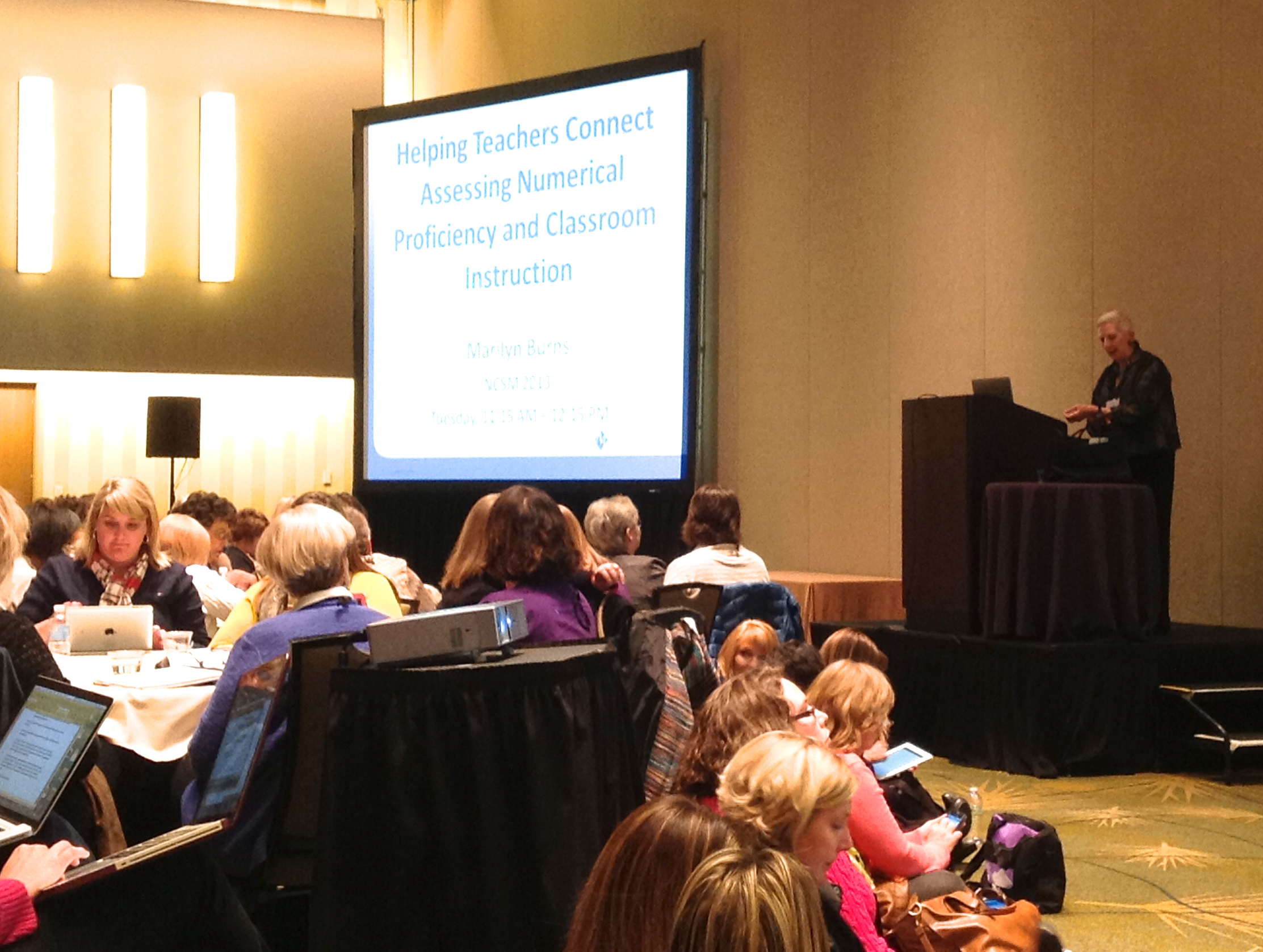
 As you can see from the picture, it was a packed house! After waiting in line for fifteen minutes, I was so lucky (and excited) to get a seat to hear Jo Boaler speak, even if my seat was in the next to last row.
Jo opened the presentation with Dweck’s research on mindsets. “In the fixed mindset, people believe that their talents and abilities are fixed traits. They have a certain amount and that’s that; nothing can be done to change it. In the growth mindset, people believe that their talents and abilities can be developed through passion, education, and persistence.”
Jo states that the fixed mindset contributes to one of the biggest myths in mathematics: being good at math is a gift. She referenced her book, The Elephant in the Classroom (added it to my reading list) and showed the audience various television/movie clips that continue to perpetuate this mathematical myth.
Jo then moved from Hollywood to the science behind the learning. She briefly discussed brain plasticity, the capacity of the brain to change and rewire itself over the course of one’s lifetime. When learning happens, synapses fire and create connections. These synapses are like footprints in the sand, that if not used, wash away. To illustrate this plasticity, Jo showed the variation in two child brain scans, one child from a loving home and the other living in extreme neglect. At this point, the neuroscience has me completely transfixed, so interesting.

Jo went on to discuss the London “Black Cab” Drivers. To become a Black Cab driver, one must pass a test called “The Knowledge” consisting of 25,000 streets and 20,000 landmarks. I had to Google it to find the image because I thought DC was bad…

Brain scans have shown that Black Cab drivers have a larger hippocampus after studying for and passing this test, demonstrating neuroplasticity, the brain changing/rewiring as new things are learned.
She shared a letter from a high school math department against using algebra II as a graduation requirement. The letter, in so many words, implied that certain students can’t learn, whether it be because they are minorities or due to lack of maturity, and would not be able to pass this requirement. The reasoning in the letter goes against brain research that shows that every child can excel in math. I am so impressed with Jo’s use of research to dispute the comments we hear all too often, even at the elementary level. Research shows that every learning experience changes one’s “ability,” yet we used fixed ability language often, “high kids and “low kids.”
Jo read a quote by Laurent Schwartz, “What is important is to deeply understand things and their relations to each other. This is where intelligence lies. The fact of being quick or slow isn’t really relevant. Naturally, it’s helpful to be quick, like it is to have a good memory. But it’s neither necessary nor sufficient for intellectual success.” I think that needs to be a poster every classroom wall!
So how does mindset impact how students view themselves? Jo shared 7th grade data in which students with a growth mindset outperformed fixed mindset students. Growth mindset students demonstrated more persistence in challenging situations and the gender gaps were eliminated in SAT levels.
Jo posed the question to the audience, “What do you think encourages a fixed mindset in a student?” As we discussed our thoughts, I checked out Twitter only to find there were a few folks tweeting about this particular session, so we shared our ideas:

Jo suggested that student grouping, assessment & grading, and the math tasks we use in our classroom all contribute to creating a fixed mindset in a student. She presented this block pattern to the audience:

Typically, teachers would ask how many blocks will be in a certain figure number, leading to an input/output table response. Jo suggested asking students, “What you see happening?”” How do you see it growing?”
She showed video of a group of students working together for over an hour, sharing how each saw the pattern growing/changing. They were engaged, following different pathways through the problem, creating arguments, and persevering. Ah, the Math Practices again…I do love seeing them in action! She suggests that when tasks are open and engaging, a growth mindset is developed.
I have to confess, I was reading some tweets about Jo’s session from other #NCSM13 participants at this point. I heard Jo mention Gauss and Cathy Humphries, so I jotted them down to check out later.
My attention was quickly drawn back in when Jo said, “Grades are not that important.” Thank you and thank you! She stated that diagnostic feedback of classroom observations leads to higher achievement in students. Then, the popular topic of timed tests arose. According to neuroscience, math should never be associated with speed. She shared numerous honest, yet sad, student reflections regarding timed tests. A 4th grader said he/she feels,”nervous because I am scared I will not finish or make a mistake.” A 2nd grader said he/she feels “that I am not good at math.”
Mistakes are good, mistakes grow synapses and yet students are pressured to NOT make them. Why? Jo stated that students have been brought up in a performance, not learning, culture. Jo ended with the message that teachers and students should be encouraged to have a growth mindset and how we teach will impact each student’s mindset. Awesome session!
Jo Boaler: http://www.joboaler.com

 MathMinds