Category Archives: Problem-posing

Slow Reveal Graph / Problem Posing Mashup

I have always loved, loved, loved Jenna’s Slow Reveal Graphs! They provide such an engaging structure that encourages students to explore and reason about data. If you don’t know what Slow Reveal Graphs are, it might be helpful to read up on them here before continuing.

Sense-making is so front and center in a slow reveal activity that I think it could be interesting and exciting to extend this activity with problem posing! I have been learned so much about problem posing from my friend Jinfa Cai. Problem posing is an instructional approach in which students generate and solve their own mathematical problems. In doing so, students share mathematical authority in the classroom and position students as creators of mathematical inquiry rather than solely recipients. I wrote a bit about it in the new NCTM book, Teaching Mathematics Through Problem Solving (pg 73-74).

The Mashup

To think about what a mashup could look like, let’s go check out one of Jenna’s recent slow reveal graphs, Average Song Length by Genre. Which is so appropriate because Jenna and I love to chat 90’s hip hop artists;) Oh, and did I mention that Jenna creates a slide deck with notes for each one of these?!?

Step 1: Display the graph and ask students what they notice and wonder. (Slide 1)

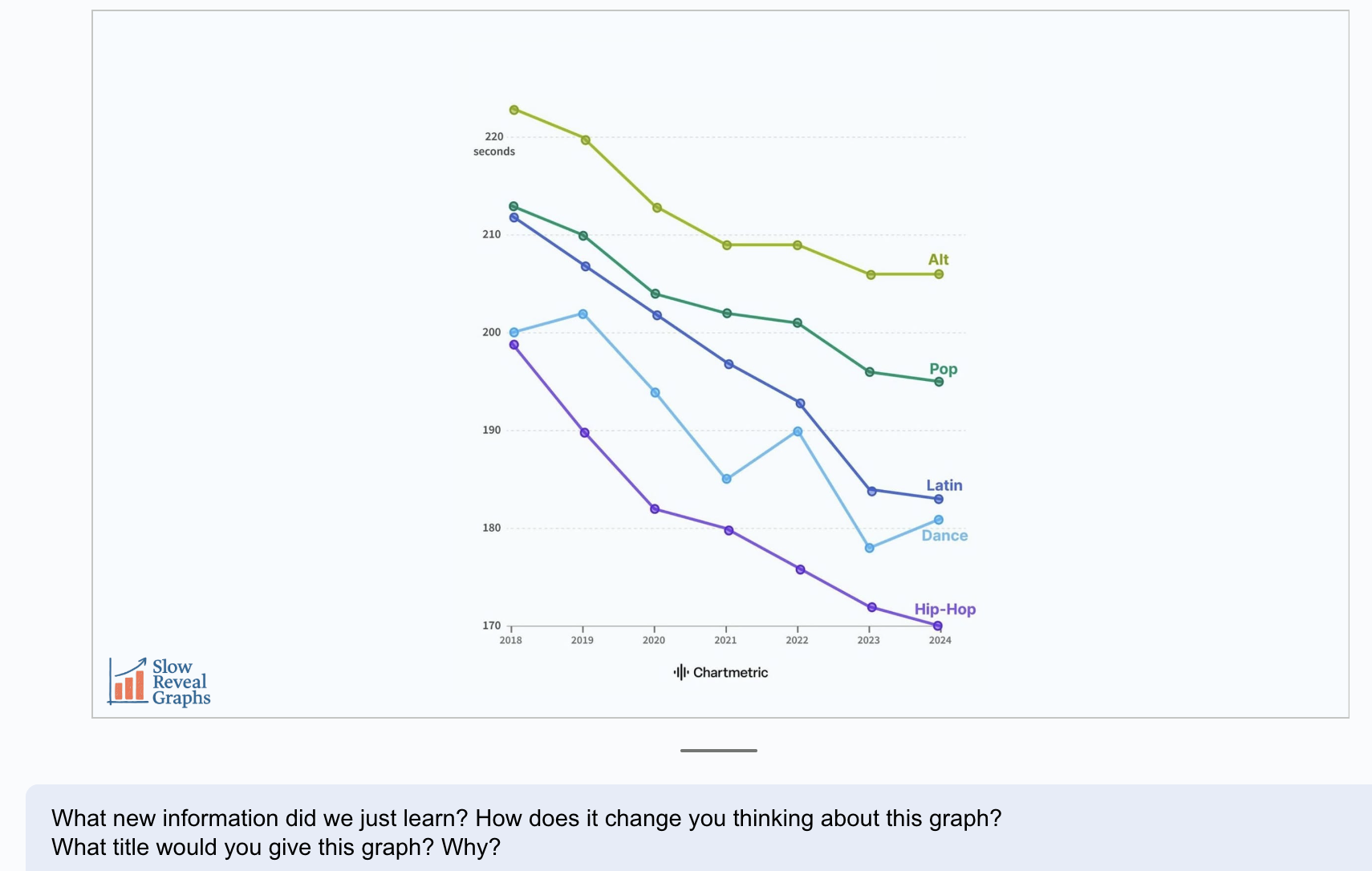
Step 2: Display the graph with new information, ask questions that encourage students to interpret the new information, and make predictions about what is still missing…luckily, these directions are in the slide notes of Jenna’s slides. (Slides 2-3)

Step 3: Display the final reveal of the graph. (Slide 4)
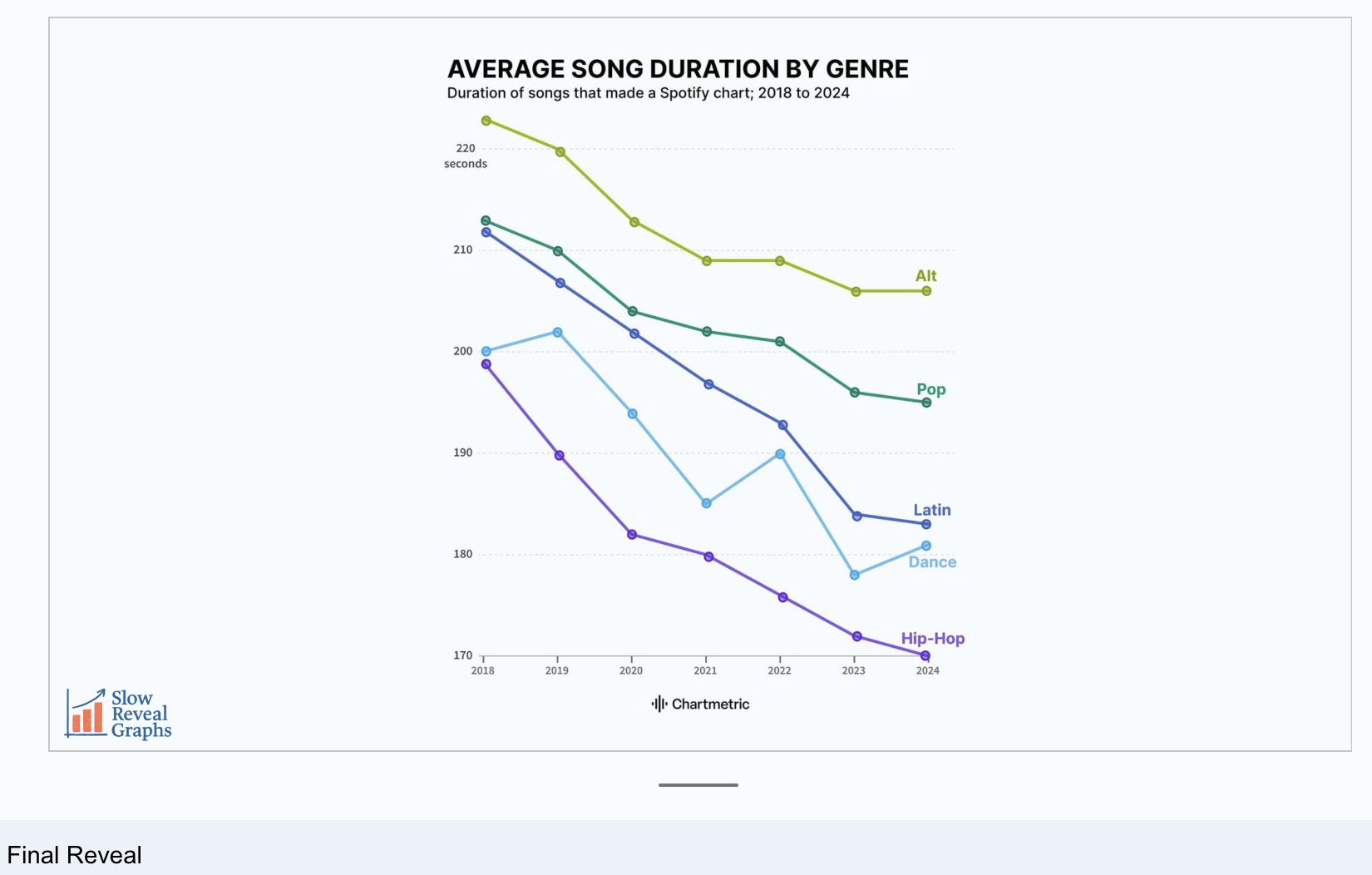
Step 4: Problem posing: Ask students to pose problems that can be answered by information in the graph and record them on a piece of chart paper.

Students might pose many different types of problems such as:

  1. Which genre had the longest average song in 2019?
  2. About how much longer was the average latin song than hip-hop song in 2023?
  3. About how much did the average pop song duration decrease from 2019 to 2024?
  4. Which genre had an increase in average song duration? Between what years?
  5. If you listened to a dance song and alternative song in 2022, about how many seconds would you be listening? How many minutes?

This list could go on and on, but you get the point. I know it could be nerve-racking to use a graph like this because there are not definite values at every point, but I think that actually increases the reasoning element and could raise some cool points for argumentation!

Step 5: Ask students to solve their problems.

This is a choose your own adventure — you could ask students to solve all of the generated problems or you could focus attention on one or two problems aligned to that day’s learning goal. I always lean toward the latter so the activity isn’t just a one-off random activity, but instead connected to what they are learning. This also leaves me a bank of ‘if you get done early‘ problems, which was always one of the biggest differentiation challenges for me, and helps me focus the whole group discussion afterwards.

Step 6: Synthesize the learning.

This step is really dependent on the learning goal of the day. After solving, you could have students do a gallery walk to compare solutions and solution methods, representations, and reasoning. Or you could decide to have a whole group discussion based on the monitoring that you did as students worked.

I have always been such a fan of numberless word problems, notice/wonder, and the 3 Reads MLR. Problem-posing feels like it pulls the most purposeful parts of each of these routines into one. Layering problem posing on Jenna’s slow reveal structure puts such an fantastic focus on data while also supporting other areas of mathematical focus. It is also so adaptable by grade level, which makes it so flexible!

Final Problem Posing Thoughts

When students have the opportunity to pose their own mathematical problems based on a situation, they must make sense of the constraints and conditions from the given information to build connections between their existing understanding and a new understanding of related mathematical ideas (Cai, 2022). And when teachers have the opportunity to listen to connections students make, understand the math students see in situations, and make teaching decisions on how to elicit, share, and move forward with student thinking, it shares the mathematical authority in the classroom and leads to deeper, more powerful learning for all!

I have blogged a bit about problem-posing if you are interested in learning more: https://kgmathminds.com/2023/09/23/embedding-problem-posing-in-curriculum-materials/ and https://kgmathminds.com/2023/05/06/problem-posing-fun-in-fourth/.

Leveraging Digital Tools for Problem Posing

I have blogged a few times about problem posing using print materials and lately I’ve become really interested and excited about the potential for digital tools in this work!

If you are new to problem posing, below are a few slides from Jinfa and my NCSM presentation for background – each image is linked to an associated research paper.

What is problem posing?

Many activities can easily be adapted to provide opportunities for problem posing by removing task questions (left) and replacing it with different prompt options (right).

How can digital tools enhance problem-posing experiences?

Being relatively new to both problem posing and digital lessons, I have learned so much trying things out in math classes this year. As always, the more I learn, the more questions/ideas I have. Below are two digital lessons that involve different flavors of problem posing.

Lesson 1: Our Curious Classroom

You can click through the lesson screens to see the full flow, but in a nutshell, students answer questions about themselves and explore different data displays.

After answering the first survey question, we asked students for problems they could answer about their class data and recorded their responses (sorry for the blurry image, I had to screenshot from a video clip:).

The students then worked at their table to answer the questions based on their choice of display.

The lesson continues with more survey questions, data display exploration, and ends with students personalizing their own curioso character (see bottom of post for unrelated, cute idea).

Things I learned:

  1. Student responses can be collected and displayed so quickly with digital which saved us more instructional time for posing and solving problems.
  2. The capability to see data displays dynamically change from one to another enhanced the discussion about which display was most helpful to answer the problems and why.
  3. Students were so motivated to answer questions about themselves, learn about their classmates (audio clip below), and ask and answer questions about their own class, not a fictitious one.
“What did you like about the lesson?”

Things I wonder:

  1. While having the teacher record the questions on the board worked perfectly, I wonder if or how younger students might digitally input their own questions w/o wearing headphones for voice to text or having spelling errors that are challenging for others to interpret? Maybe something like a bank of refrigerator magnets to choose from?
  2. During the lesson, could the teacher input student questions onto cards in the Card Sort in Desmos so they could then sort the problems based on structure before solving?

Lesson 2: Puppy Pile

In this lesson, students generate a class collection of animals, are introduced to scaled bar graphs, and create scaled bar graphs. This one has a different problem-posing structure than the the first lesson which was interesting!

In this lesson, students use the Challenge Creator feature. In order to pose their problem to the class, students create their own set of animals (left) and then select a scale and create a bar graph (right).

After submitting their challenge, students then pick up one another’s problems and solve them.

Things I learned:

  1. Students were extremely motivated to create their own problems and solve the problems of others.
  2. This version of problem posing allowed students to have more control over the situation around which they were formulating problems, which they really enjoyed.
  3. Challenge Creator is an amazing tool for repeated practice that is MUCH more engaging than a worksheet of problems.

Things I wonder:

  1. How could this activity structure support or extend the problem posing experience in Lesson 1?
  2. What other K-5 math concepts would be great candidates for a Challenge Creator problem-posing activity?

Final thoughts

I think problem posing is such an important instructional structure whether done in print, digital, or a hybrid of the two. It is important, however, to also consider the math, student motivation, and amount of time students spend engaging in the problem-posing process when choosing the format we use.

I would love to hear about what you try, learn, and wonder whether you try these lessons or adapt other lessons for problem posing!

Unrelated by Adorable Idea…

After Lesson 1, Katie printed out their personalized Curiosos for the wall;)

Embedding Problem Posing in Curriculum Materials

In mathematics education, problem posing refers to several related types of activities that entail or support teachers and students formulating and expressing a problem based on a particular context, such as a mathematical expression, diagram, table, or real-world situation (Cai & Hwang, 2020).

Because problem posing is so dynamic, multi-faceted, and varied between classrooms, I understand why it is hard to write into published curriculum materials. However, understanding and trying out the structure of problem posing makes it a really impactful teacher tool for adapting curriculum materials.

Why adapt ?

Curriculum activities typically require students to jump right into solution mode which explains why many students pluck numbers from word problems and operate without first making sense of the context. However, when students have the opportunity to pose their own mathematical problems based on a situation, they must make sense of the constraints and parameters that can be mathematized. They then extend from that sense-making activity to build connections between their existing understanding and the new context and its related mathematical ideas.1 This provides opportunity for increased student agency and sense making in any lesson.

How to adapt?

Last week, the third grade teachers and I planned for a lesson that involved students answering questions about data in a scaled bar graph from the prior lesson. Here is the data and graph they were working from.

Instead of asking students to jump right into answering the questions in their workbook, we removed that day’s warm-up to make time for problem posing and adapted the activities that followed.

First, we displayed the graph and asked students “What math questions can we ask about this group of students?” Below are 2 different class examples.

Having such a rich bank of questions, we could have asked students to jump into solving them, however we decided to spend some time focusing on the structure of their questions. We asked them to discuss, “Which questions are similar and why?.” The discussion ranged from similarities based on the operation they would use to solve, whether they could just look at the graph and answer the question without any operation, and the wording problems had in common or not. Such great schema for solving future word problems!

Now that students had made sense of the context and problems, we asked them to solve as many problems as they could. As they solved, we asked them to think about which problems they solved the same way and which ones they solved differently. As we wrapped up the lesson, we shared student solutions and focused on their solution strategies leading to an amazing connection about using addition or subtraction to solve the ‘how many more or less’ problems.

What was the original activity?

If we had followed the curriculum, these are the questions students would have solved. As you can see the students came up with similar, if not the same, questions and SO much more!

  1. How many students are represented in the graph?
  2. How many students chose spring or fall as their favorite season?
  3. How many more students chose summer than winter?
  4. How many fewer students chose spring than fall?

While having solid curriculum materials is extremely important, they can be made so much better by adapting lessons in ways that provide the space for students to make sense of problems and have ownership in the problems they are being asked to solve. I am so grateful for the teachers, admin, and Jinfa’s partnership in this work and look forward to sharing our work and learnings at NCSM DC!

  1. (PDF) Making Mathematics Challenging Through Problem Posing in the Classroom(opens in a new tab) ↩︎

Problem Posing Fun in Fourth

Recently, I have been learning a lot about problem posing from my friend Jinfa Cai, in particular how to infuse these opportunities within the use of curriculum materials. Because, while there are rich problem solving experiences in a good curriculum, we do not often see explicit use of problem posing, especially in K–5. The Notice/Wonder routine is probably as close as it gets.

Since I am in classrooms this year, I get to try some problem posing around curriculum activities and follow up with Jinfa. As with all learning, the more things I try, the longer my list of questions for him grows! After last week’s lessons, I was left with two questions that I can’t wait to discuss:

  1. How do we honor all of the posed problems within the timing of a lesson?
  2. How do we infuse opportunities to reason about the problems that can and cannot be answered with the information in the situation?

The curriculum task

The lesson focused on addition of fractions with like denominators. As an adaptation to the curriculum materials, I only showed students the bolded part of the task and asked them to share things they noticed and wondered. Because their ideas were all falling into the ‘wonder’ column, I quickly pivoted to the problem posing work.

Problem-posing launch

In their journals, I asked students to take a couple of minutes to write mathematical problems they could pose about this situation. They shared their problems as a whole class and I recorded.

It was so interesting, yet not surprising, that they asked the exact same problem the curriculum task was posing! I had them work as a group to solve that problem and told them that if they finished before we came back together as a group, to re-read the other problems on the board to see if they could answer them as well.

Problem solutions

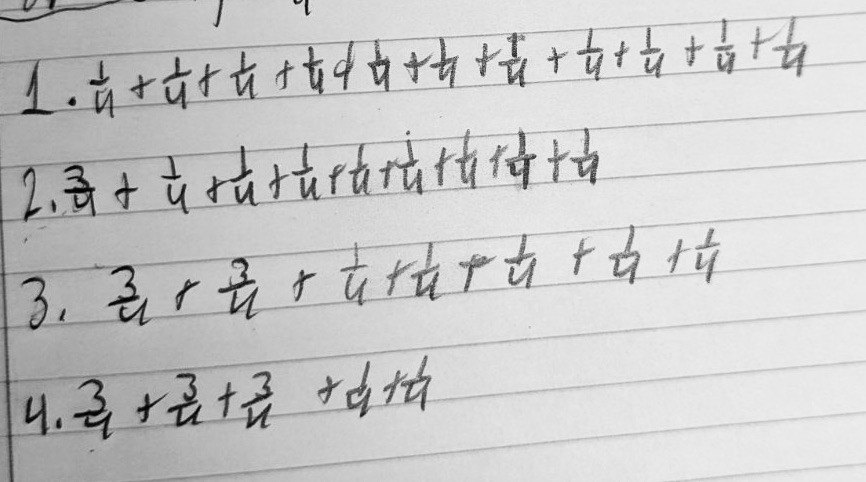
Students represented their solutions in many different ways as they leveraged their understanding of fractions, addition, and multiplication. It was particularly interesting that you could see in their work how they used one expression to derive subsequent ones. Here are a couple of examples:

Additional problems

As a whole group, we compared and connected student work like in the 2 examples above. Discussing questions such as:

  • Where are the ¼ cups in the expression? 
  • Where are the ¾ cups in the expression?
  • Where is one expression in the other?
  • How did knowing this expression help you with another?

At that point, our time for the lesson was over so I quickly went around and snapped pics of the problems they posed independently at the launch.

I saw so many interesting problems that didn’t get shared during the whole group time, which made me wonder how I could have done that better next time and led to my two wonderings:

  1. How do we honor all of the posed problems within the timing of a lesson?
  2. How do we infuse opportunities to reason about the problems that can and cannot be answered with the information in the situation?

Embedding problem-posing experiences in the curriculum and answering the teaching questions that arise is such powerful learning for both students and teachers.  When students have the opportunity to pose their own mathematical problems based on a situation, they must make sense of the constraints and conditions from the given information to build connections between their existing understanding and a new understanding of related mathematical ideas (Cai, 2022). And when teachers have the opportunity to listen to connections students make, understand the math students see in situations, and make teaching decisions on how to elicit, share, and move forward with student thinking, it shares the mathematical authority in the classroom and leads to deeper, more powerful learning for all.

The other exciting part, that I wish happened more often in general, is through these experiences, Jinfa and I continually learn how research can inform practice and how practice can inform future research.