Category Archives: 5th Grade

Inspired Thoughts on Number Talks

During the majority of the professional development planning I have been doing this summer, I feel like one of the common threads is Number Talks. After each conversation, more and more questions start spinning in my head….questions about how often to implement, questions about teacher recording, and most importantly, questions about their purpose.

I wasn’t inspired to write them all down until I read @gfletchy’s post: http://gfletchy.com/2014/07/22/on-you-marks-get-set-number-talks/.  BTW *If you do not follow his blog, you most definitely should, great stuff*

Questions/Thoughts about Number Talks:

1 – Through the math conversations, it fosters a safe, collaborative culture in my classroom.

2- Their conversations embody the Mathematical Practices in my eyes. Their use of structure of the number system, creating viable arguments, critiquing the reasoning of others and repeated reasoning is always music to my ears.

3 – I struggle with purpose…is the purpose a particular strategy? That is how Parrish’s book frames it. There is a string, centered around a certain strategy. Not that other strategies do not emerge, but the numbers are such that they lend themselves to a particular path. So, my conclusion is this – When doing a number talk string, I  am not pushing a certain strategy, but instead, encouraging the students to truly think about the numbers before simply “computing.” I do want students to think that if they are multiplying 39 x 45, to think about 40 and taking a group away rather than breaking both numbers to get 4 partial products. In thinking about the numbers more deeply, they call on their conceptual understandings to develop fluency.

4 – Is the purpose to generate connections between strategies? I do think there is a benefit to putting up one problem and recording all of the strategies to make connections between them. I use that as a formative assessment as to what my students know and also to identify misunderstandings/misconceptions that emerge.

5 – Fawn’s blog has sparked an interest to branch into more visual patterns to switch it up a bit. What that would look like in my 5th grade class, is something I need to work through but I think the algebraic reasoning behind them would be intriguing.

6 – I Completely agree with Graham, they must be a daily routine, they build computational fluency (based in conceptual understanding) and must not just happen on Fridays! Also, it is important for students to use their Number Talk reasonings in other math work.

7 – Teacher recording is something I am still trying to improve upon daily. Recording their thinking is harder than one would think! Also, I find WHAT I write can change the direction of the talk itself.

I am a huge proponent of Number Talks and would love to see our elementary work with them to start to move into the middle/high school classrooms!

-Kristin
 

Decimal Multiplication

This is a quick lunchtime post, so not much time to reflect or analyze, but wanted to throw it out there..

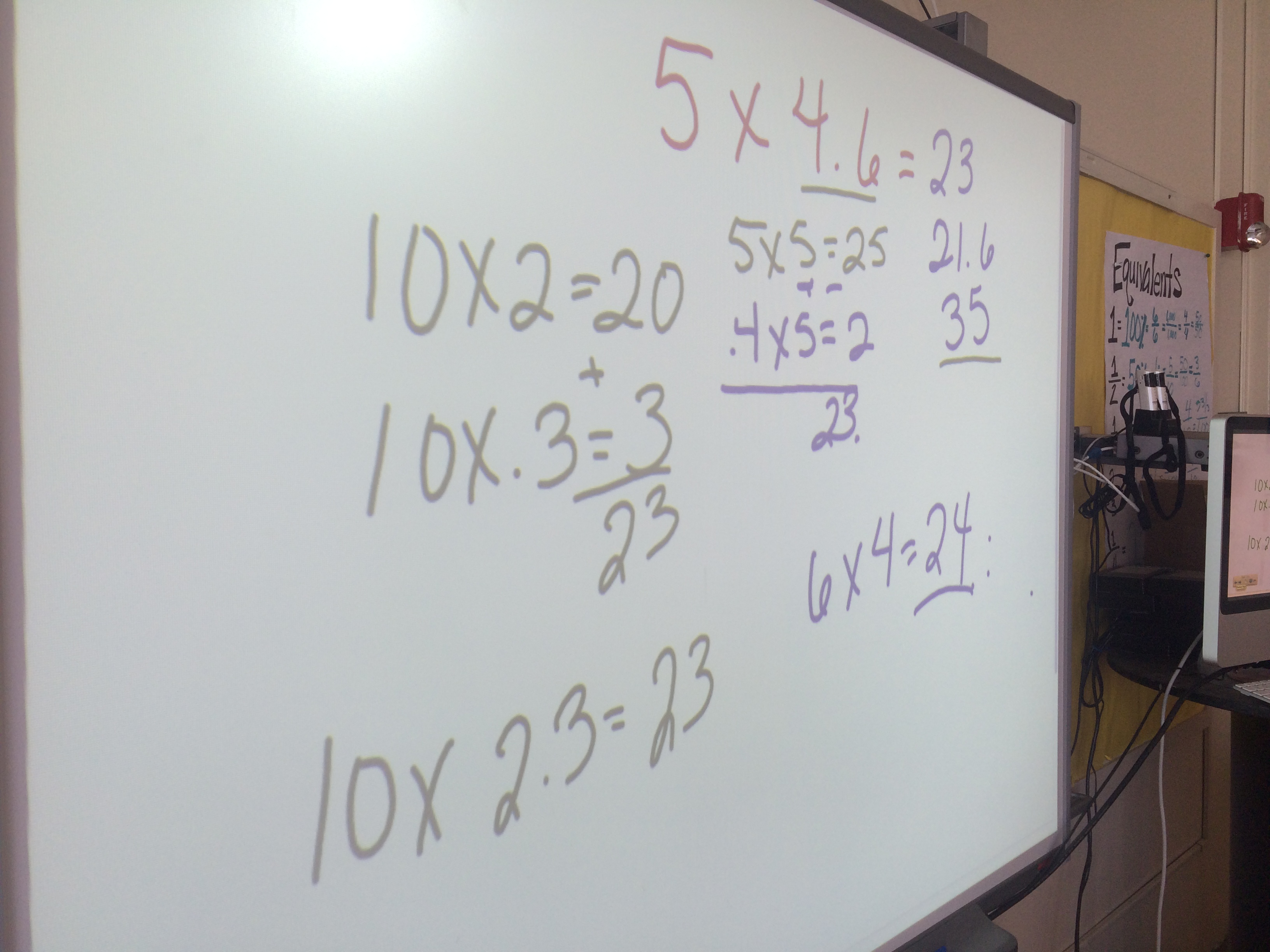
We did a Decimal number talk today and ended with the problem 5 x 4.6

I had students double half, use partial products, and use friendly numbers. (Incorrect answers were also written in case you are wondering about the 21.6 and 35…we looked for errors also)

Image

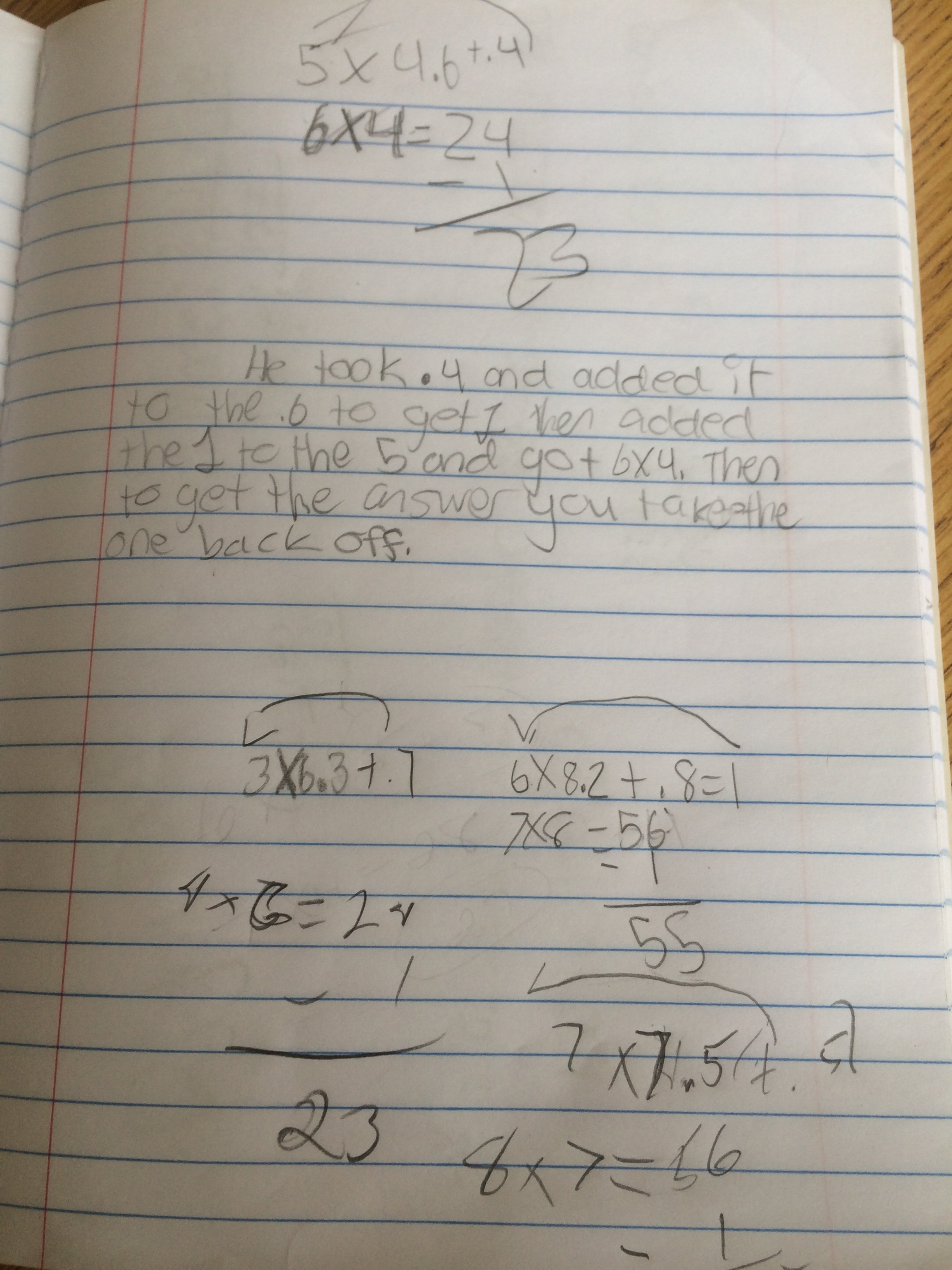
Then one student said that she bumped the 5 up to 6 and did 6 x 4 because she knew that faster, however she couldn’t figure out how to adjust her answer based on what she did. We had already had someone explain how they adjusted from 5 x 5, but this was not the same. She knew that she needed to subtract 1 (because we had already established 23 was correct) but where was that 1 coming from?

I sent them back to their groups to talk about it.

One group had this idea…

Image

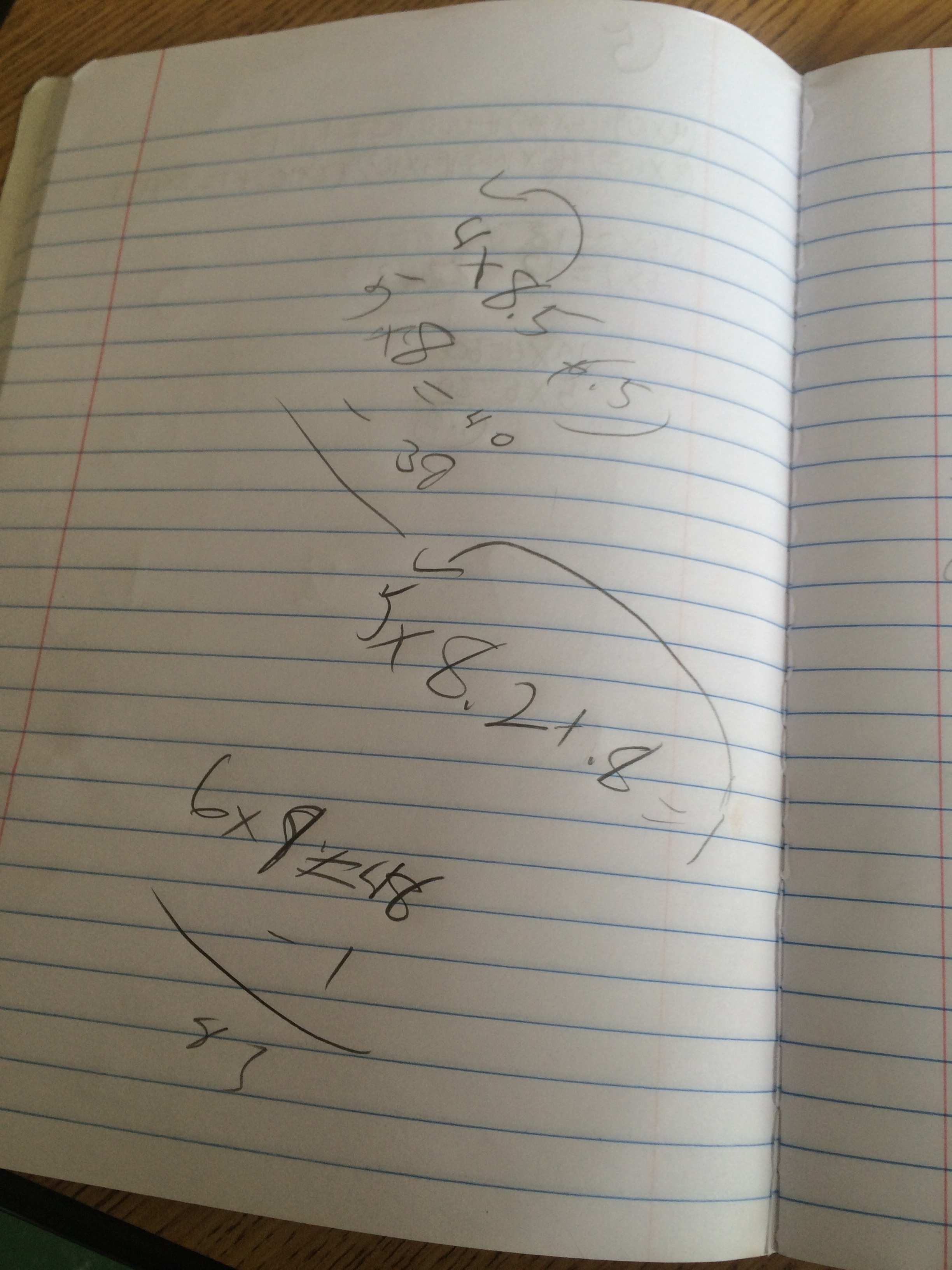
I asked them if it always worked so they tried some more problems at the bottom that did not. They tried some more….

Image

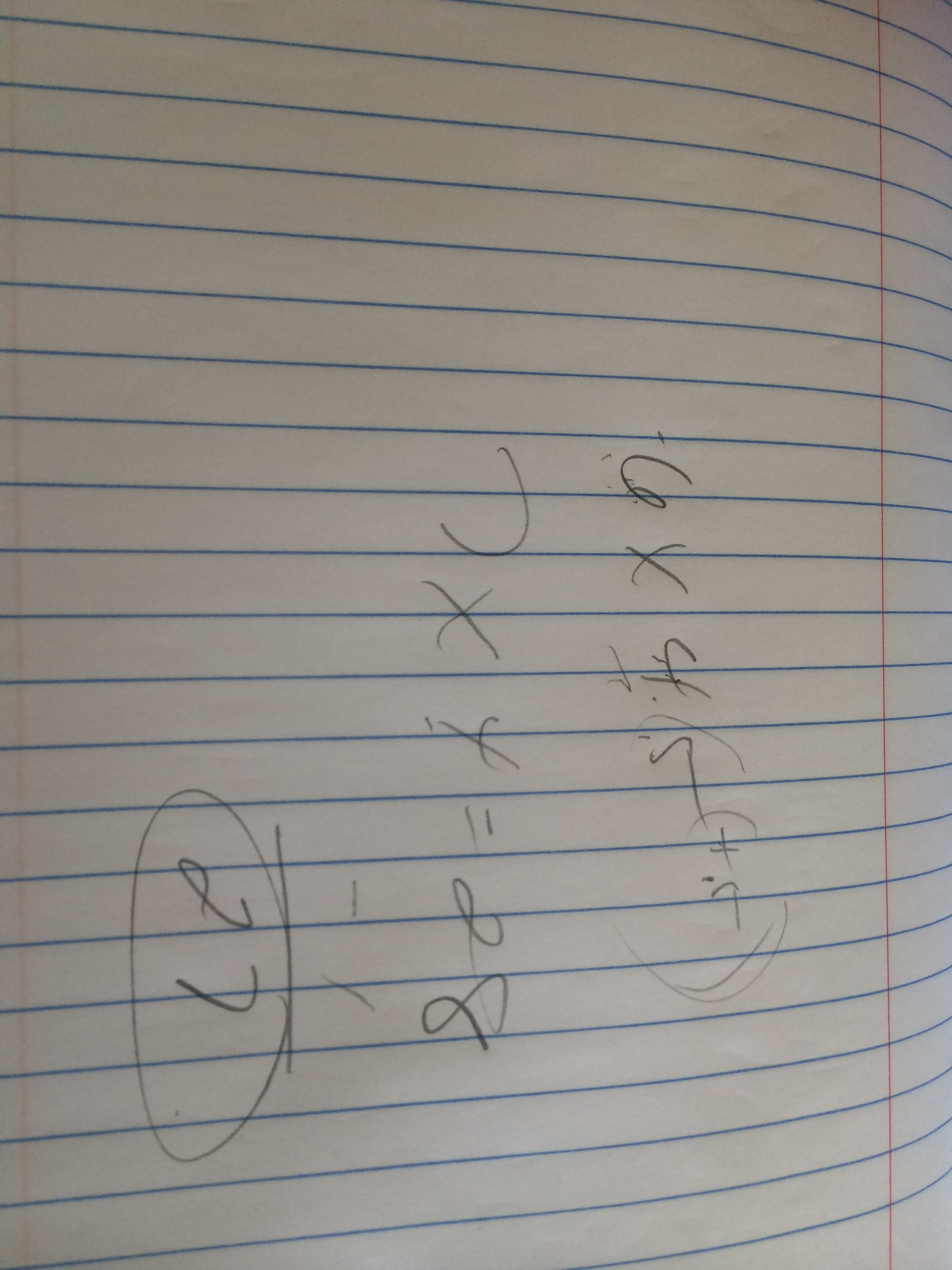
They found one that worked….hehe..

Image

The class had to leave for lunch, but I will keep you posted what they come up with…

-Kristin

Fraction-to-Decimal Division Table Noticings

Last week, I did an investigation on identifying fraction/decimal equivalents and interpreting fractions as division.  In previous years, I have to admit, I never fully appreciated this lesson. I could never get a grasp on how to not lose all of the great understandings students have about fractions and make it about division with the calculator. However after last week’s work, I have a new appreciation for the conversations it brought out in the classroom.

Throughout the year, we have worked with decimals, fractions and percents, so I feel my students are very comfortable moving between the three notations. They see the relationships between the decimal and percents for the /2s , /3s , /4s, /5s,  /6s , /8s, and /10s and know the percents for many (if not all) of those fractions because of our work on the 10×10 grid.

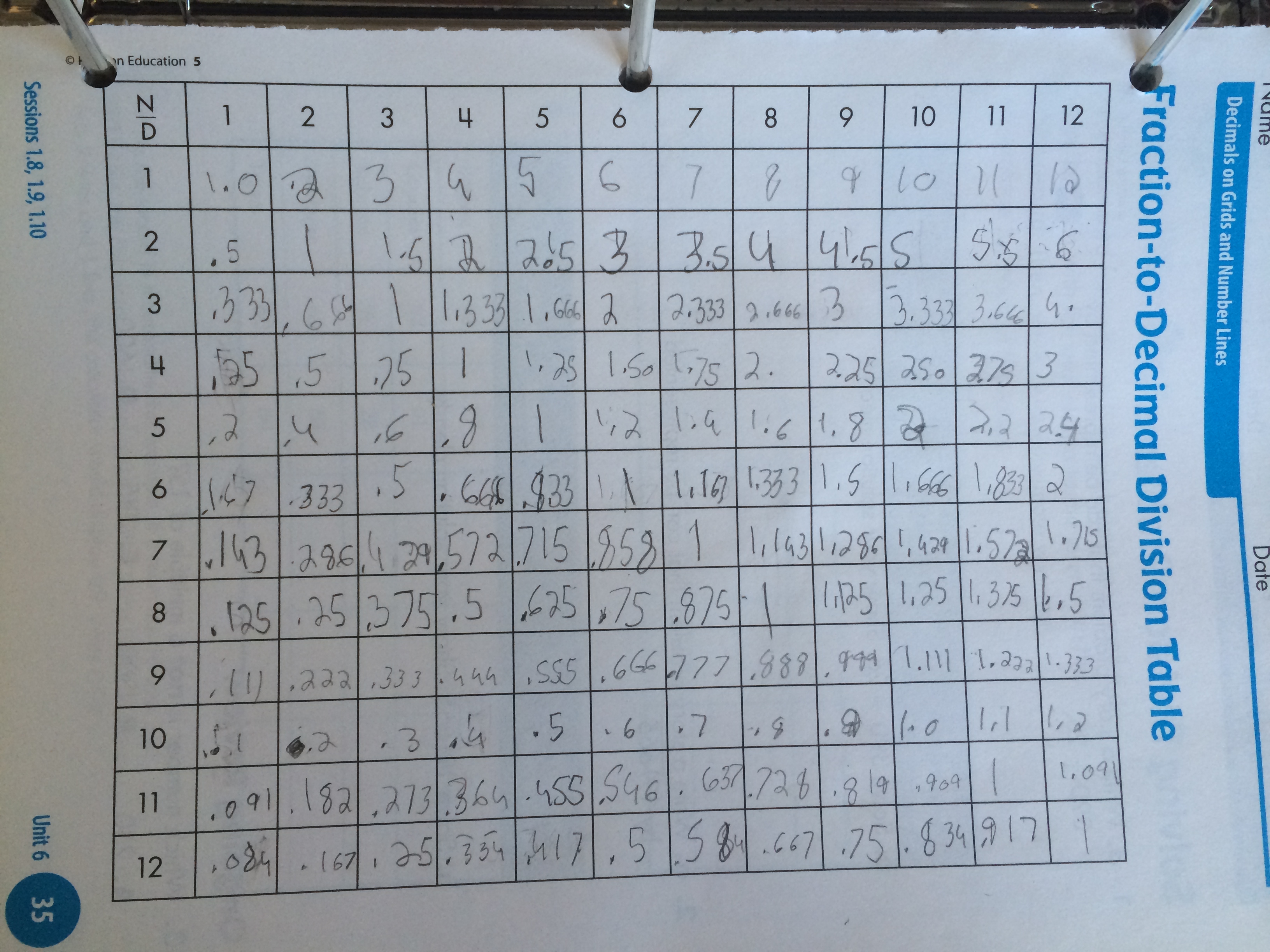
I opened this lesson with a fraction I was sure they knew the decimal for, 1/2. I asked them how they think we could use a calculator to find the decimal if we did not know it. They played around for a while and as I walked around many students could tell me they divided the numerator by the denominator. I asked if that same method worked for 1/4? As a class, they agreed it worked every time, so I asked why they thought that was so. Why are we getting a decimal? Many said with 1/2 we had “one whole divided into 2 pieces, so each piece has to be .5 so they both add to 1 whole.”  Another said we only get a whole number when “it is more on top then the bottom.”  I felt comfortable after a lot of talking from the class that they were seeing the fraction bar as division. So, we moved along to the division table. I had a student explain how a multiplication table works and then explained the numerator and denominator row and column in this decimal table. We looked at 1/2 and filled in the 0.5. I asked where else that decimal would show up in the table and they filled in the equivalents of 2/4, 4/8…etc. From there they worked with their partner to complete the table.

I teach two classes of math (thank goodness) so I can change up things that didn’t work as expected the first time. In the first class, I let them use their calculator from the start of the table. I realized as I walked around that students were completely losing their sense of fractions and it became a calculator exercise…exactly what I was afraid was going to happen. I saw students filling in by column and using the calculator in the tenths row! Big Fail on my part. I stopped all calculators, told them they had 5 minutes to work without the calculator to complete all of the decimals they could. The conversation took a dramatic turn for the better! They started to see that working in rows helped them see patterns and used their knowledge of equivalents to complete other cells and honestly moved along much faster! Needless to say, I started the next class without the calculator and the students liked the challenge of trying to reason about the empty cells without the calculator. Here is a sample of one of my student’s completed table:

IMG_3604

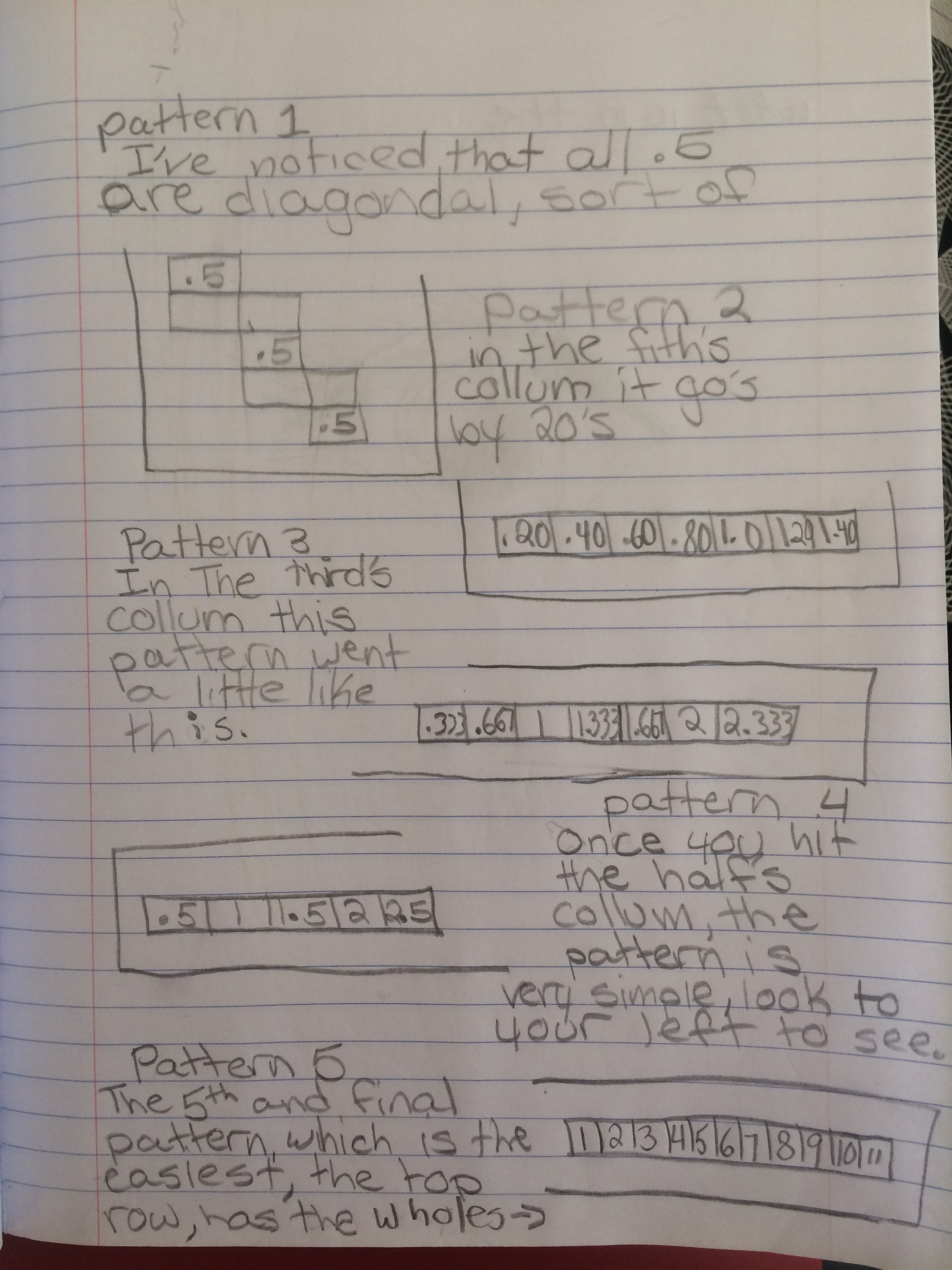
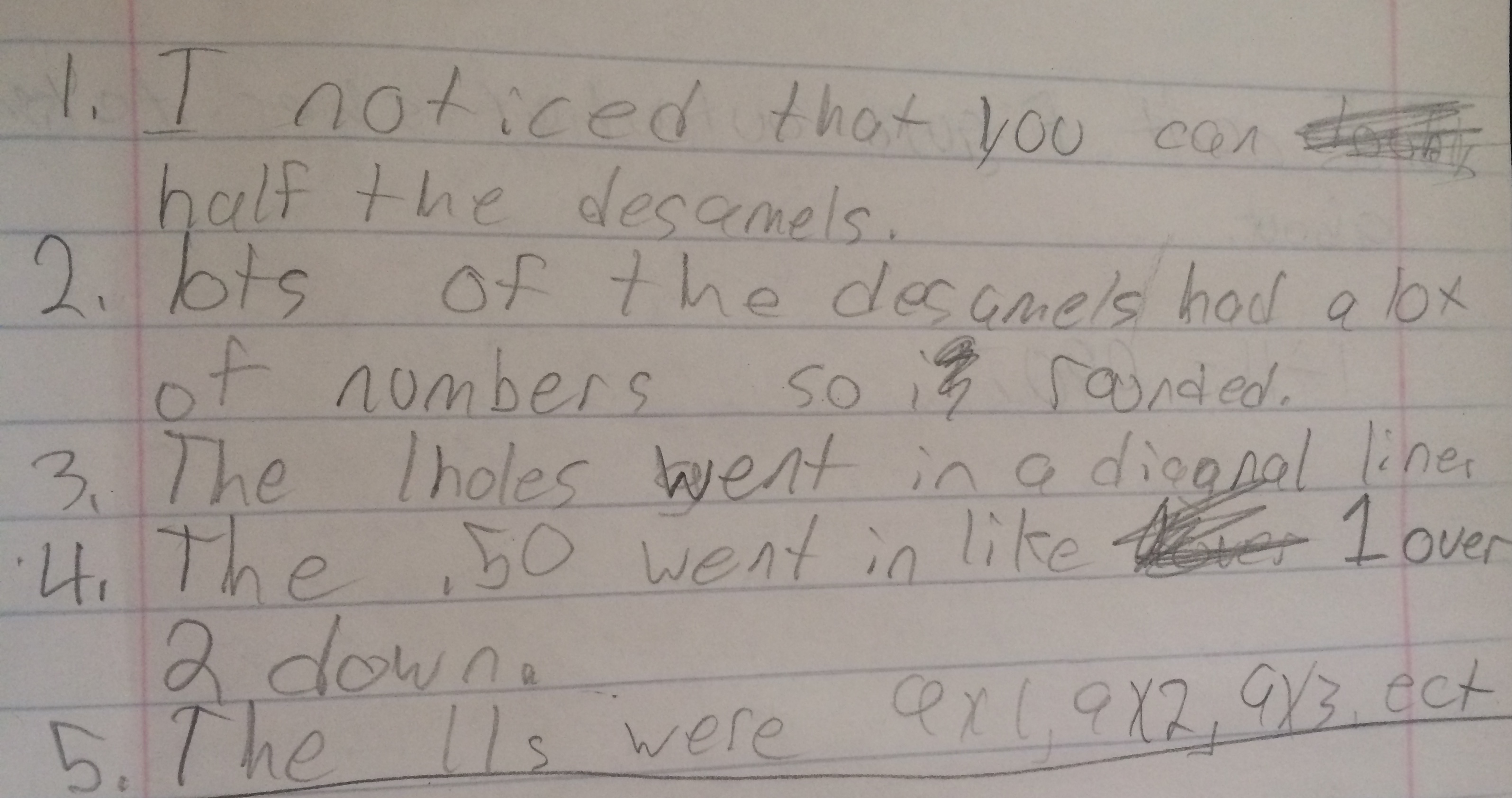
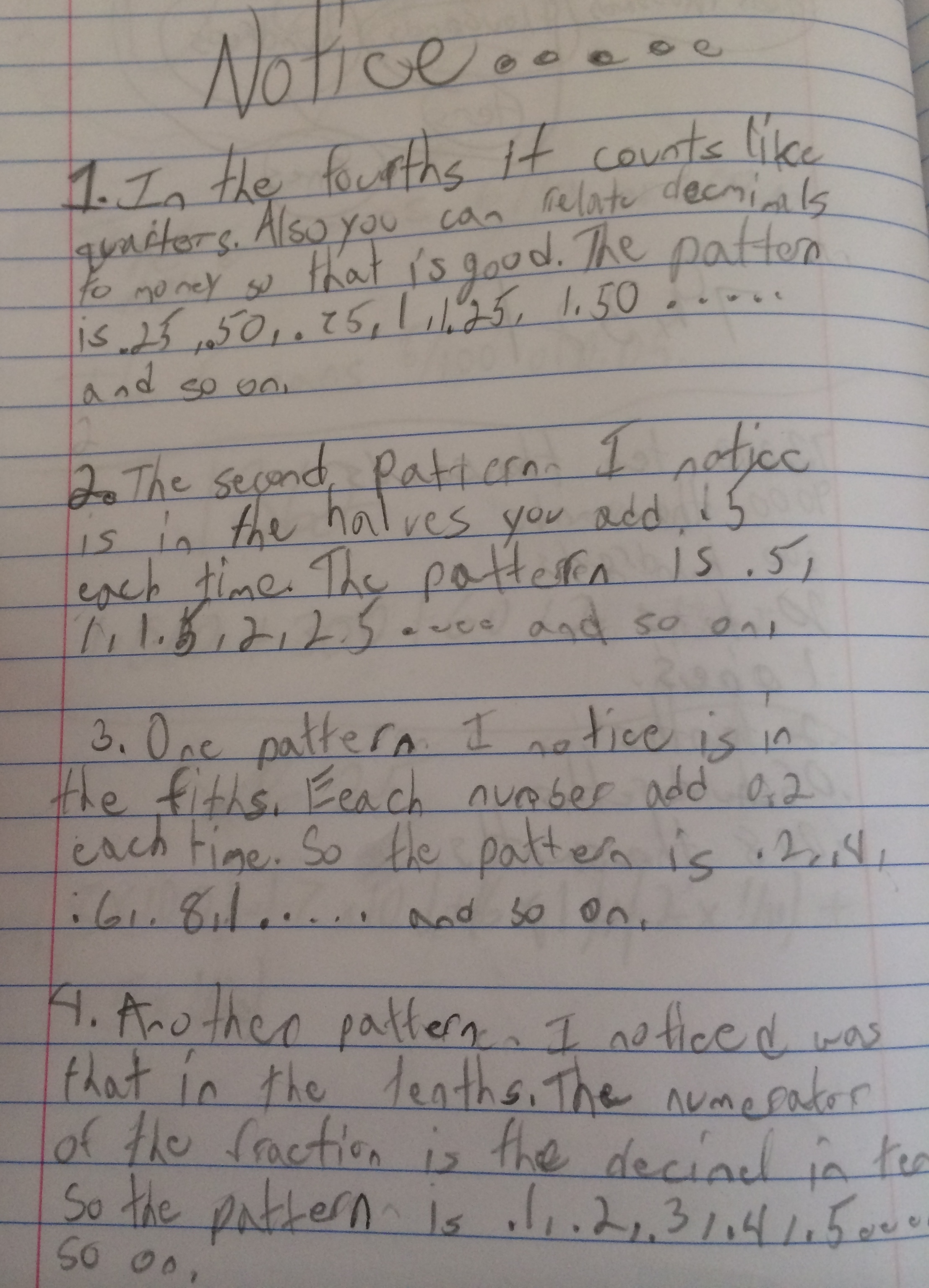
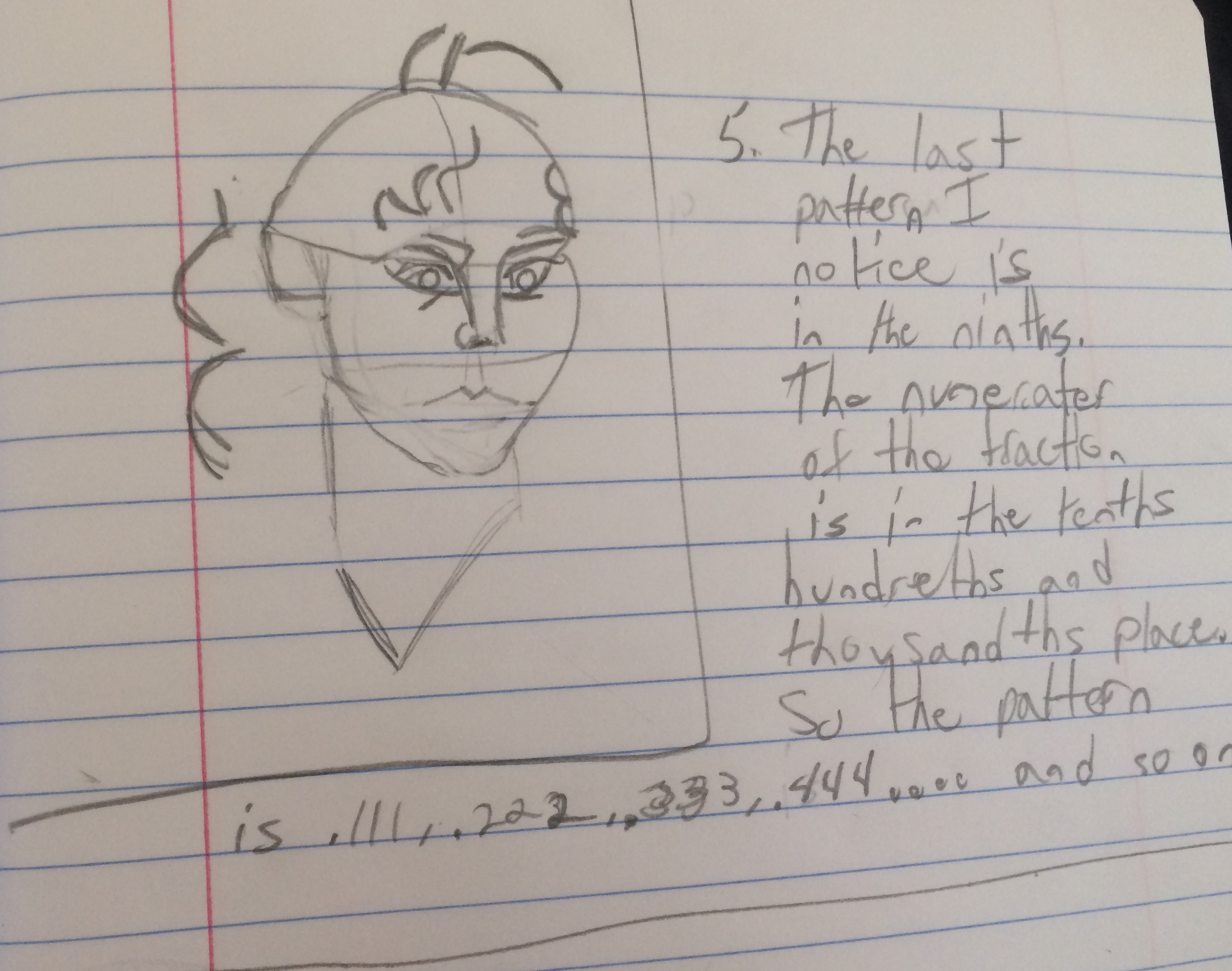
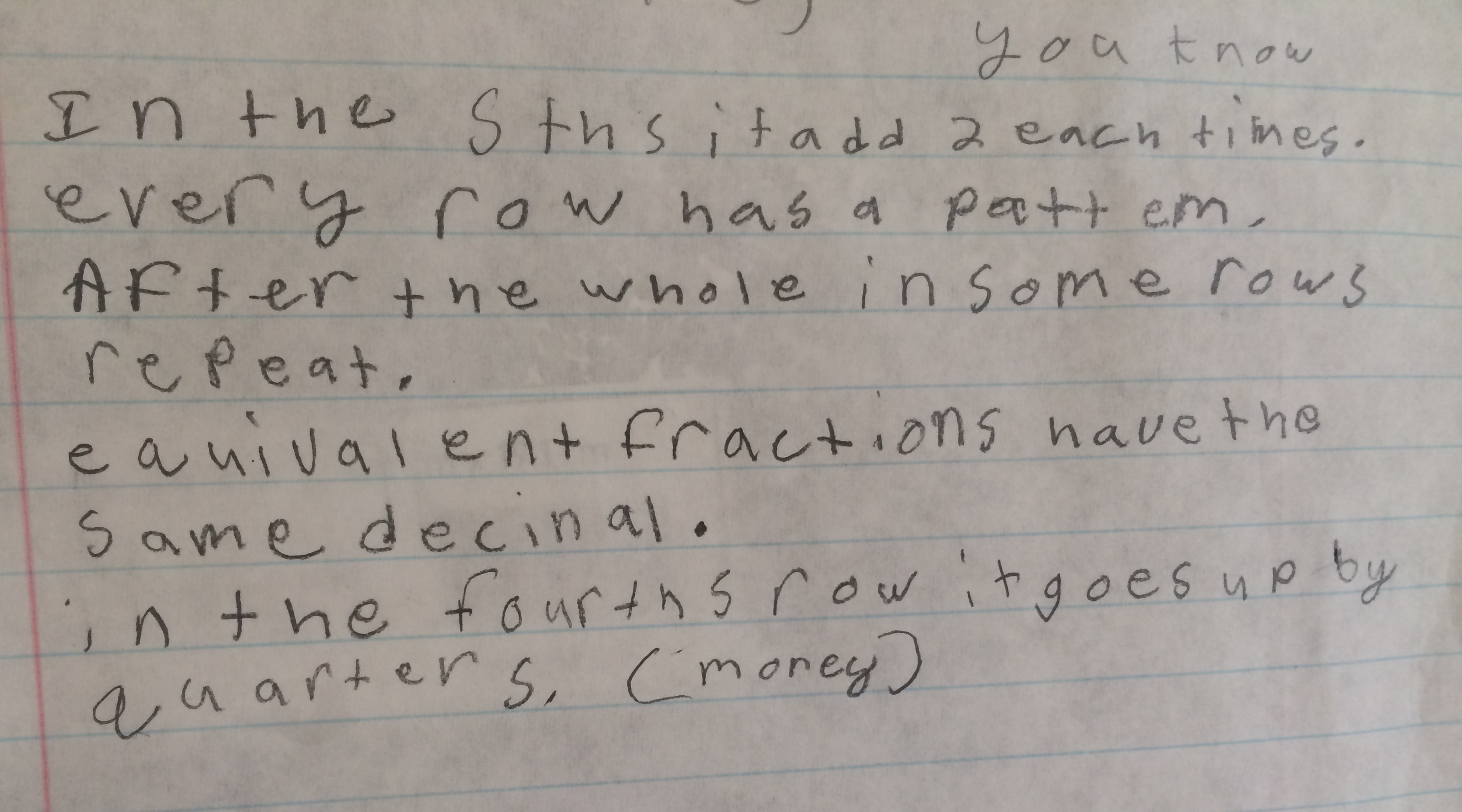
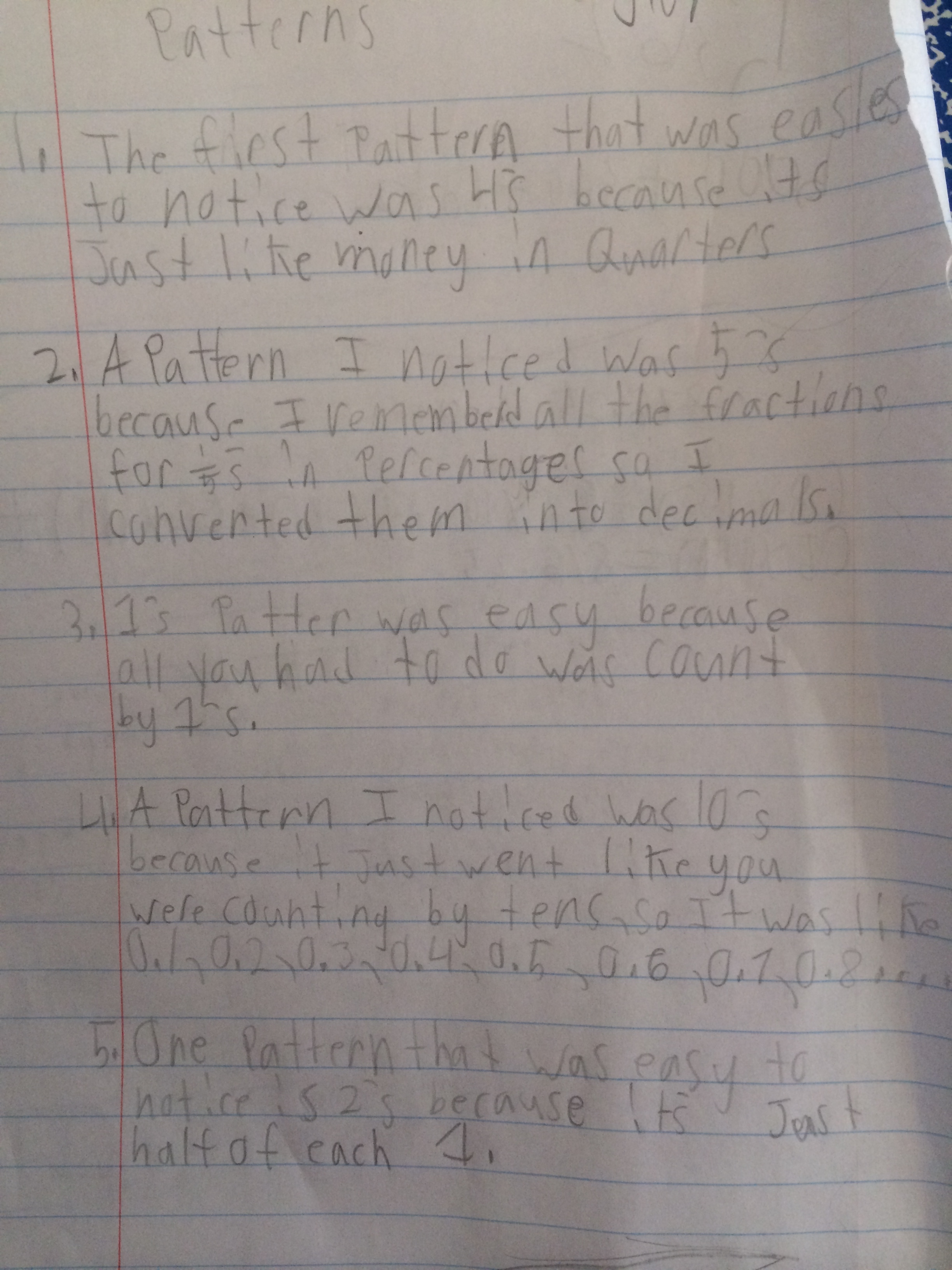
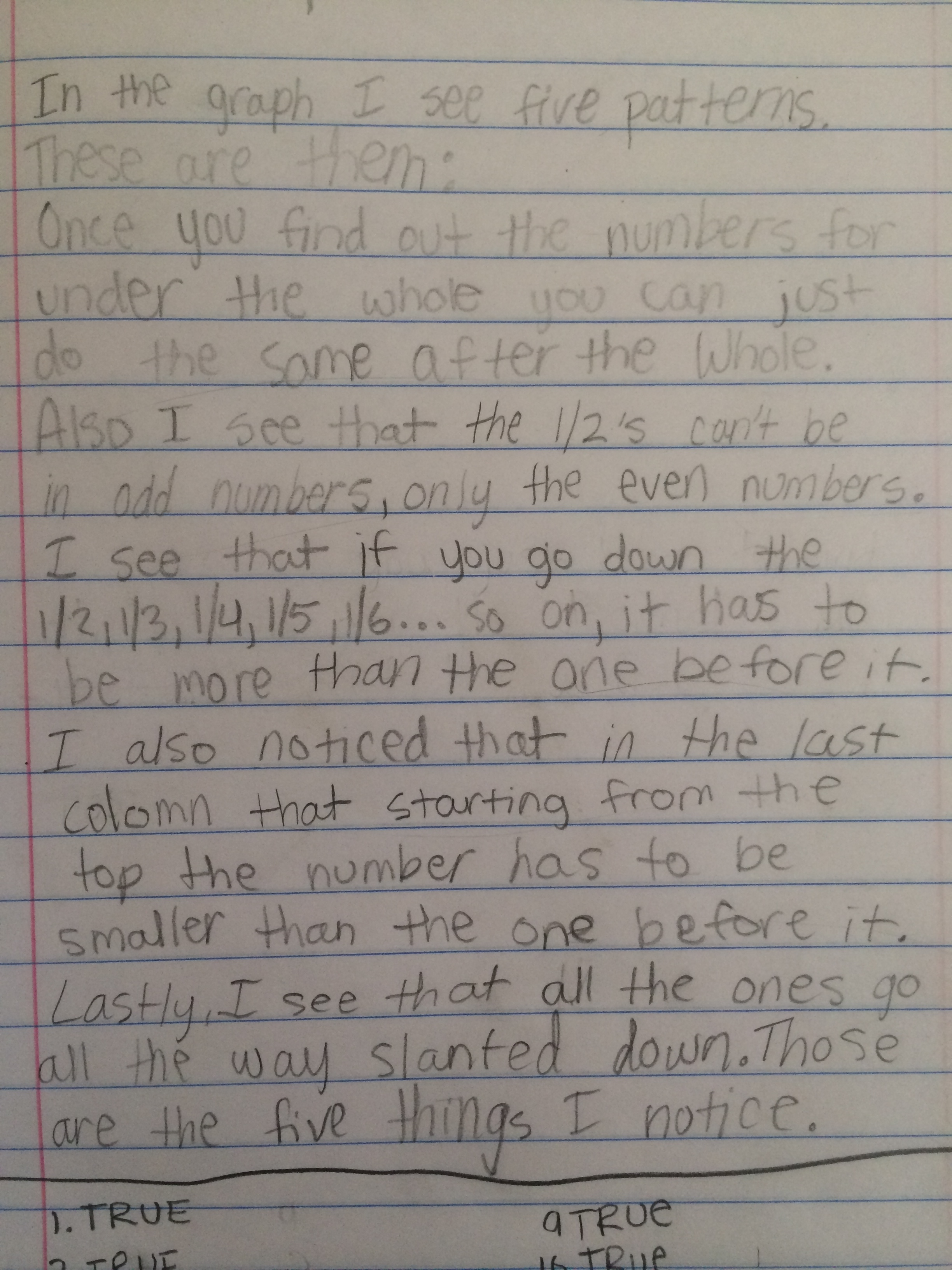
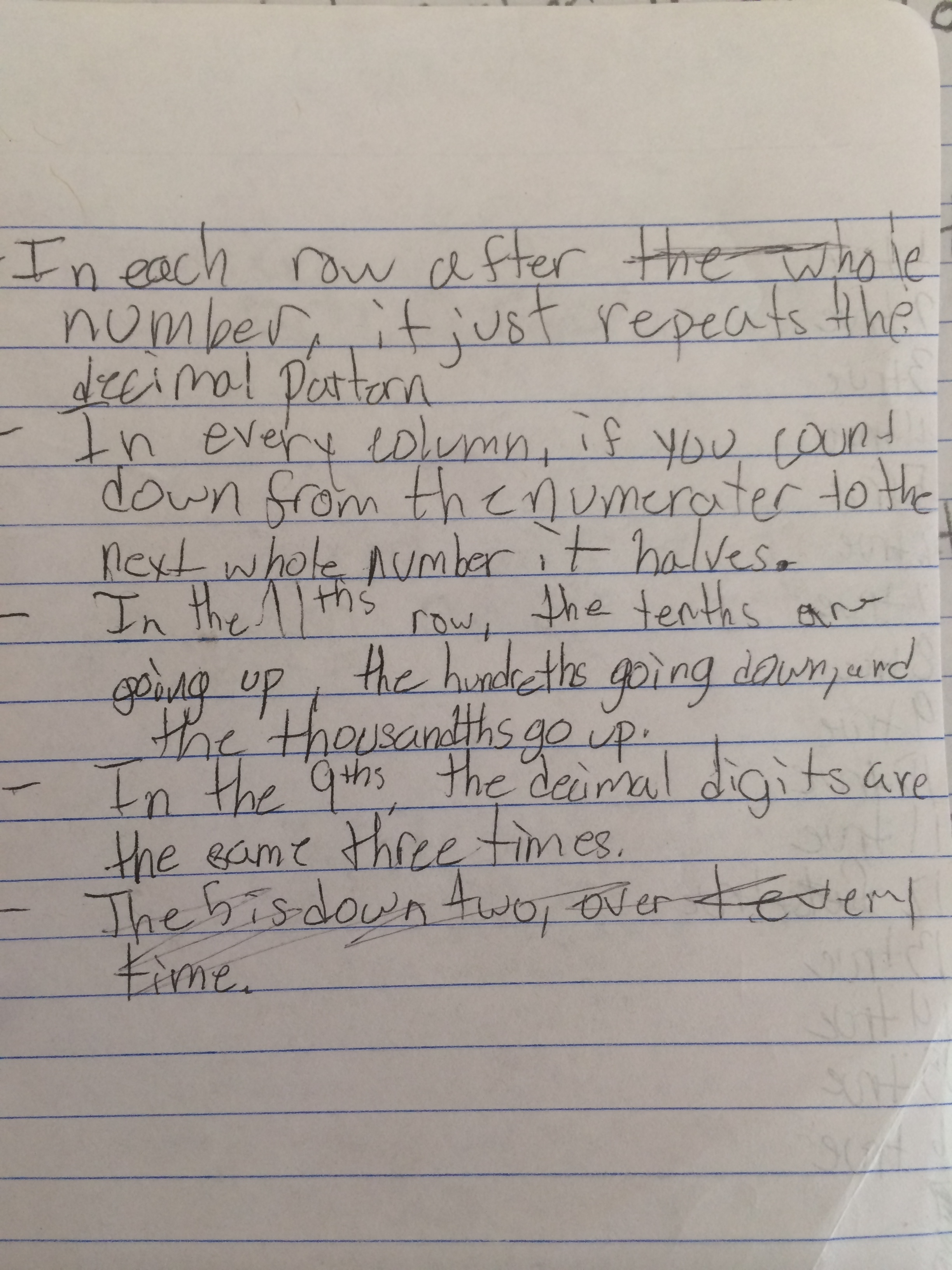
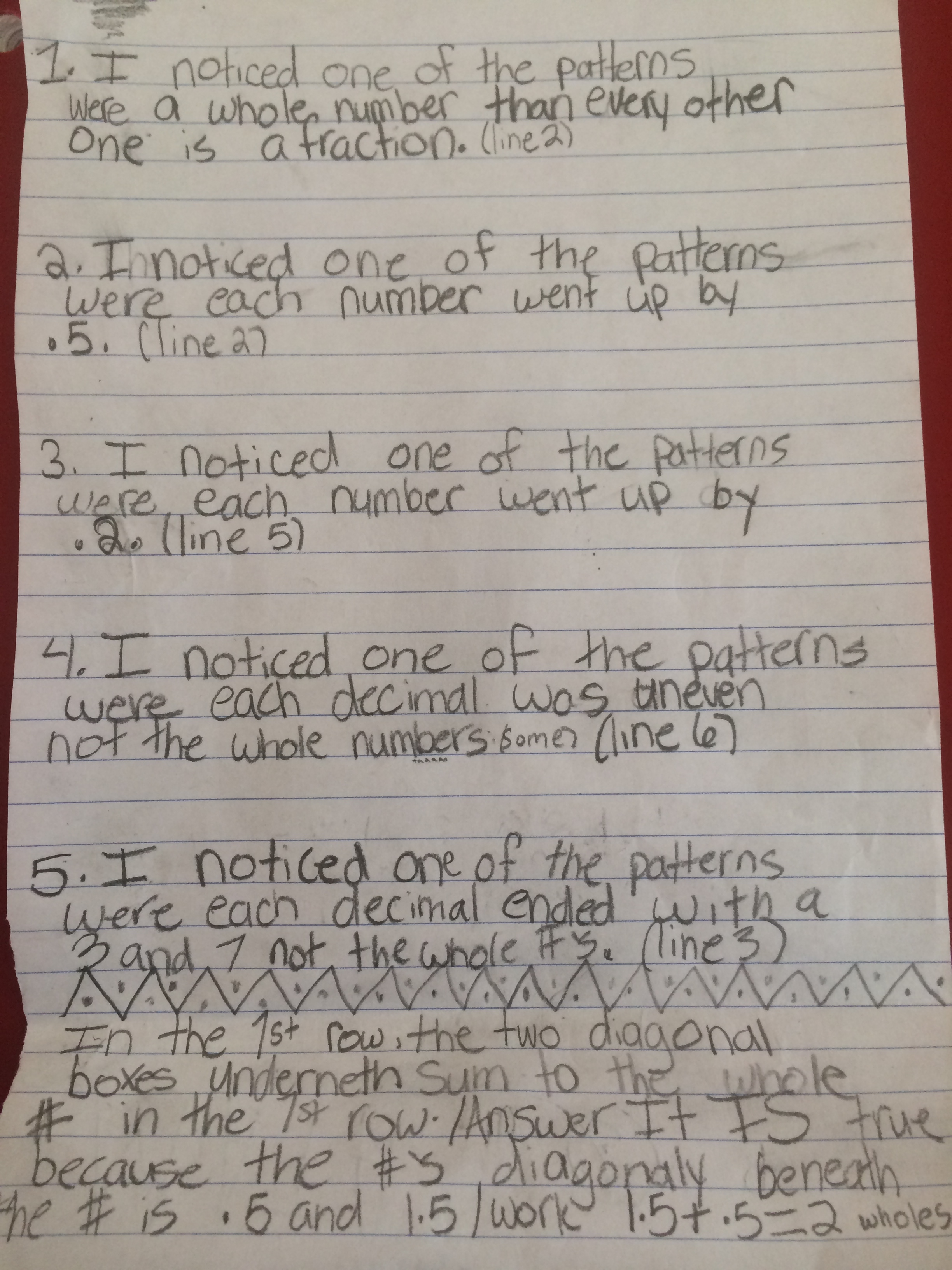
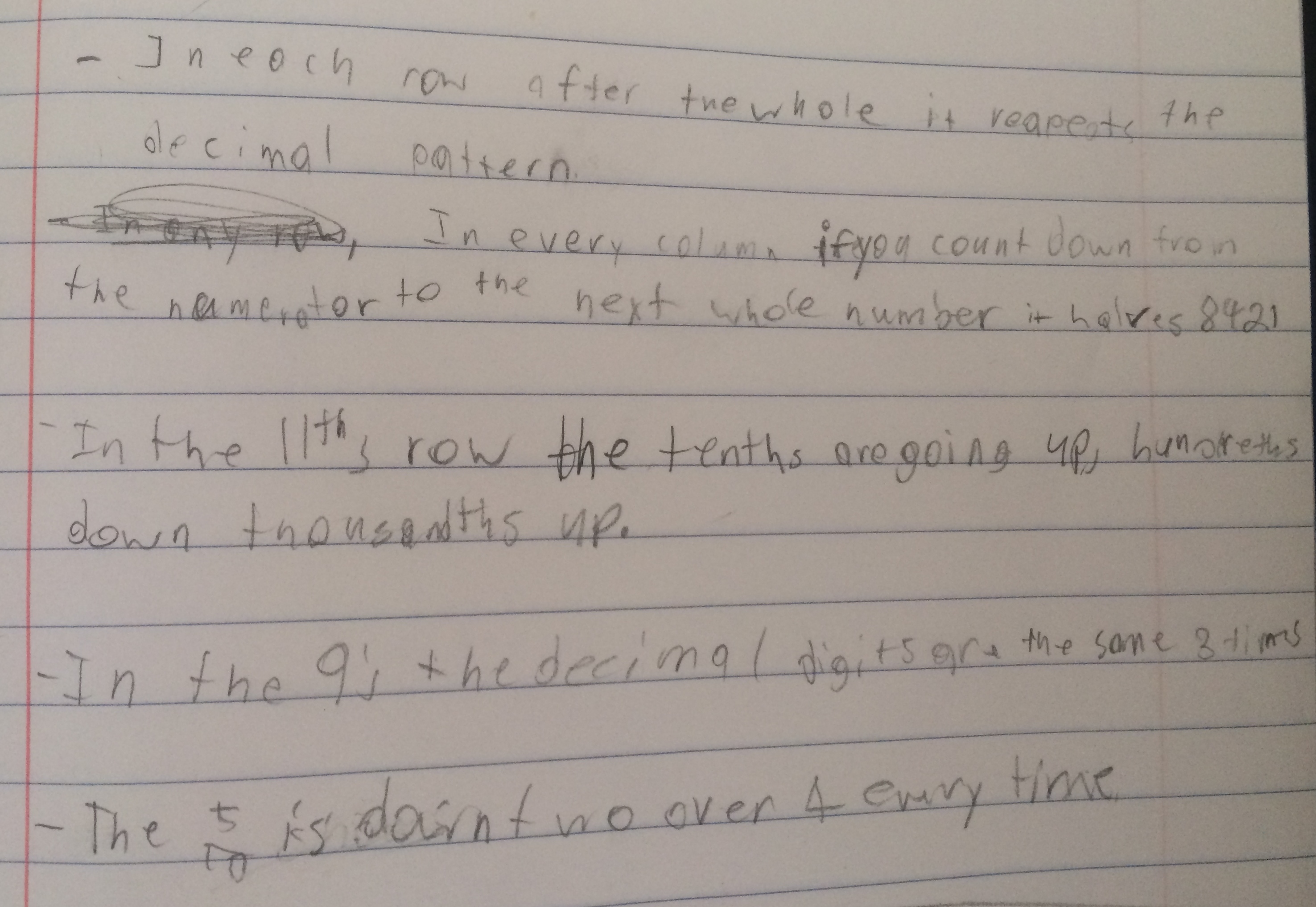
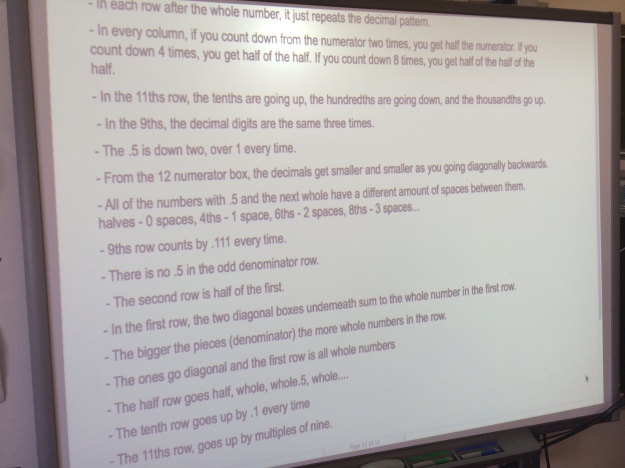
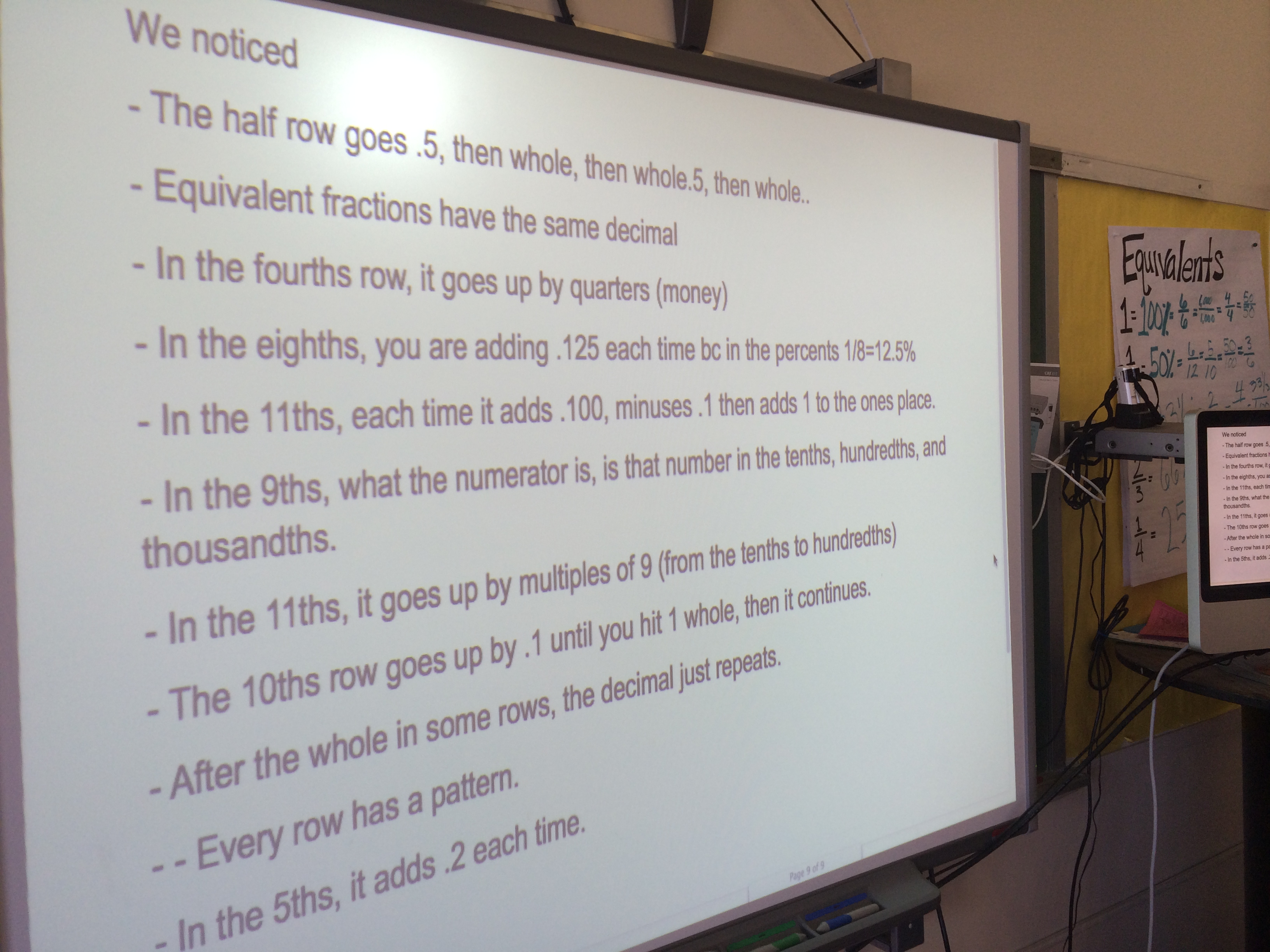
For homework, I asked the students to write at least five patterns they saw in the table, either as they were completing it or after reflecting back on it. Here are some journal entries:IMG_3662 IMG_3661  IMG_3659IMG_3660 IMG_3658 IMG_3657 IMG_3656 IMG_3655 IMG_3654 IMG_3653As a class, we came back together the next day and collected our noticings on the board:

Period 1:IMG_3605

Period 2:

IMG_3603

We had some that we agreed on, some we disagreed with and others we had to reword to make it agreeable for everyone. I found in that class period the meaning of this lesson for me…it wasn’t so much about completing the table by using division, which was my previous aversion to this lesson, but instead about finding patterns and digging into why those patterns were happening.

I would love to go through each one and tell you about our discussions, however to be honest, I have so many other things I have to get done before class tomorrow! I hope to follow up with a future post on our decimal discussions.

However I do have one thought/question I am still grappling with that I would love some thoughts on..

One student noticed that the elevenths “goes up by multiples of 9 in the tenths and hundredths.” They clarified by writing the decimals (rounded to the thousandths) on the board for us: 0.091, 0.182, 0.273, 0.364, 0.455…etc. The class could see where the multiples of 9 were showing up. Then one student noticed that the tenths was going up by one, the hundredths was going down by one, and the thousandths up by one.

At that moment, this sounded like the multiples of 9, the ones place decreasing by one and the tens place increasing by one. Now with the whole numbers you are adding a ten and taking one away to add the 9, so I see that…and for the elevenths, you are getting one more piece then tenths, so are you adding a tenth and then taking a hundredth away? Is that for the same type of reasoning? Then the thousandths? I will be busy procrastinating other work to play around with this tonight 🙂 Any thoughts welcome!

-Kristin

Decimals in a “One Frame”

After reading @ChrisHunter36’s post: http://reflectionsinthewhy.wordpress.com/2013/06/09/more-decimals-and-ten-frames/ I could not believe I had never thought to use 10 frames when working with decimals.

Today we began our unit on decimals and I decided to use the 10 frame (now called a “one frame” in my room) as a quick image to get a feel for how my reason about decimals as a part of a whole and the types of equations they could write to represent the way they viewed the frame.

I started with this frame:

1frameI had to explain how we used this as a visual in K-2 to build combinations of ten and later use more than one frame for students to think about addition and subtraction strategies. One student then asked, “Um, how are we going to use them in 5th grade?” Perfect intro. We came to the conclusion that in the younger grades each box is equal to one making  the whole frame equal to ten, hence the name.

Me, “Well, what if the whole frame was 1? What would each box be?

Student, “1 tenth.”

Me, “Great and how can we write that?”

Student, “1 over 10 or point 1.”

Me, “So what decimal does the frame on the board represent?”

Student, “Five tenths.” Everyone gave a quick shake of their hand in agreement. (The signal in our number talks)

Now that we had the basic understanding, I did a quick image flash of this frame:

1frame1I got thumbs up right away, agreed there were 9 tenths in the frame, and then students shared equations for how they viewed the frame. The said…

1 – 0.1 = 0.9

0.5 + 0.4 = 0.9

9 x 0.1 = 0.9

Then of course the comedian that just loves to make me write more than necessary… 0.1 + 0.1 + 0.1 + 0.1 + 0.1 + 0.1 + 0.1 + 0.1 + 0.1 = 0.9 He would laugh to think he now got me to type that out as well 🙂

We were moving fast through this so I thought I would throw out two frames to see how they reasoned about going over the whole. I know from past experience that some students will line .9 + .3 up vertically and add straight down to get an answer of .12, it is the most common mistake that I think using the one frames will be helpful in minimizing  by providing students the concrete visual of a whole.

I flashed this quick image next and asked students to write what number is represented by the two frames and equations that represent how they “saw the dots.”

7Here are some responses (right and wrong):

Loved how they visualized the dot moving to make the whole.

Loved how they visualized the dot moving to make the whole.

IMG_3342

This equation was great!

This equation was great!

The mistake I was expecting.

The mistake I was expecting.

I saw 1.2 and 0.12 in journals as I walked around, but then a student shared out that he thought it was 12/20. I LOVE when a student does this…makes it so much more interesting. I wrote all three answers on the board. I asked them who believes their answer is correct, they all raised their hands (confident bunch), so I told them to choose one of the the other two answers and explain what the misunderstanding is that led to that answer. I got some great work that we shared out and agreed finally on 1.2.

Here is what they said…

IMG_3341

This one is great because she realized she made a mistake as she was trying to disprove another answer. Then the reason that 9+3 is more than 10 so .9 +.3 has to be more than one. Interesting to revisit later.

This one is great because she realized she made a mistake as she was trying to disprove another answer. Then the reason that 9+3 is more than 10 so .9 +.3 has to be more than one. Interesting to revisit later.

Understand the thinking, just need to be sure to focus on the whole being broken into 20ths vs 10ths, not 20 and 10.

Understand the thinking, just need to be sure to focus on the whole being broken into 20ths vs 10ths, not 20 and 10.


She had to get her Fun Dip finger in the pic:)

She had to get her Fun Dip finger in the pic:)

IMG_3367

So, thanks so much to Chris. I can see many One Frames in my future number talks!

-Kristin