Category Archives: Professional learning

Adapting Lessons Part 1: Launching an Activity

As a math teacher and coach, I’ve always adapted curriculum materials. I am sure we all have—it’s part of knowing our students and wanting to provide them with access to the math in ways that make sense to them. And while we have the best of intentions, sometimes the choices we make can unintentionally take the math out of students’ hands, disconnect from what they already know, or even reflect assumptions and expectations we didn’t realize we were holding.

Adapting activities is challenging for many reasons: some decisions require extensive prep, others happen in the moment, and all of them must be balanced with the pressure to keep pace while still giving students the time and space to share the incredible ideas, experiences, and mathematical thinking they bring into the classroom. I also found it difficult at times to know exactly what to look or listen for mathematically, and I sometimes interpreted students’ responses through my own assumptions and expectations. While a high-quality curriculum can provide problems that elicit student thinking, the deeper work of examining what we notice, what we value, and how we interpret and leverage students’ ideas extends far beyond even the most comprehensive teacher guide.

While thoughtful planning ahead of time is ideal, we all know it isn’t always possible. Because so much can get in the way of planning and prep time, I think a lot about how to make quick, in-the-moment adaptations based on what students are saying and doing—and on what I still need to learn about their thinking. I often wonder: What if our adaptations did more than simply “fix” a lesson? What if they opened space for deeper student thinking, a stronger sense of community, and richer mathematical understanding?

These questions keep pushing me to look closely at the flow of a typical lesson and identify the moments where even small adaptations can make a big difference. I’ve found that there are five points in a lesson where a few quick, minor changes can have a big impact:

  • Launching an activity
  • Working in small groups
  • Engaging with contexts
  • Sharing ideas
  • Synthesizing the lesson.

While it would be wonderful to have a single “right” adaptation for each of these, the reality is that different classrooms and moments call for different routines or structures. In the next series of posts, we’ll take a closer look at each of these opportunities and explore practical, in-the-moment ways to adapt them.

Ultimately, the goal of these small adaptations isn’t just to adjust an activity or lesson; they’re meant to open up richer mathematical experiences for students and provide increased insight for teachers. My hope is that these structures encourage sense-making and increase access to the mathematics; provide every student opportunities to share the amazing ideas they bring; create space for questions about one’s own or others’ thinking; build a stronger mathematical community; and support teachers in reflecting on why they’re adapting an activity and how those choices best serve students.

In this post, I’ll outline a few alternate ways to launch a lesson, and in subsequent posts, I’ll explore each of the other lesson moments listed above.

Alternate Ways to Launch a Lesson

Instructional Goal: Provide students with an entry point into the activity. 
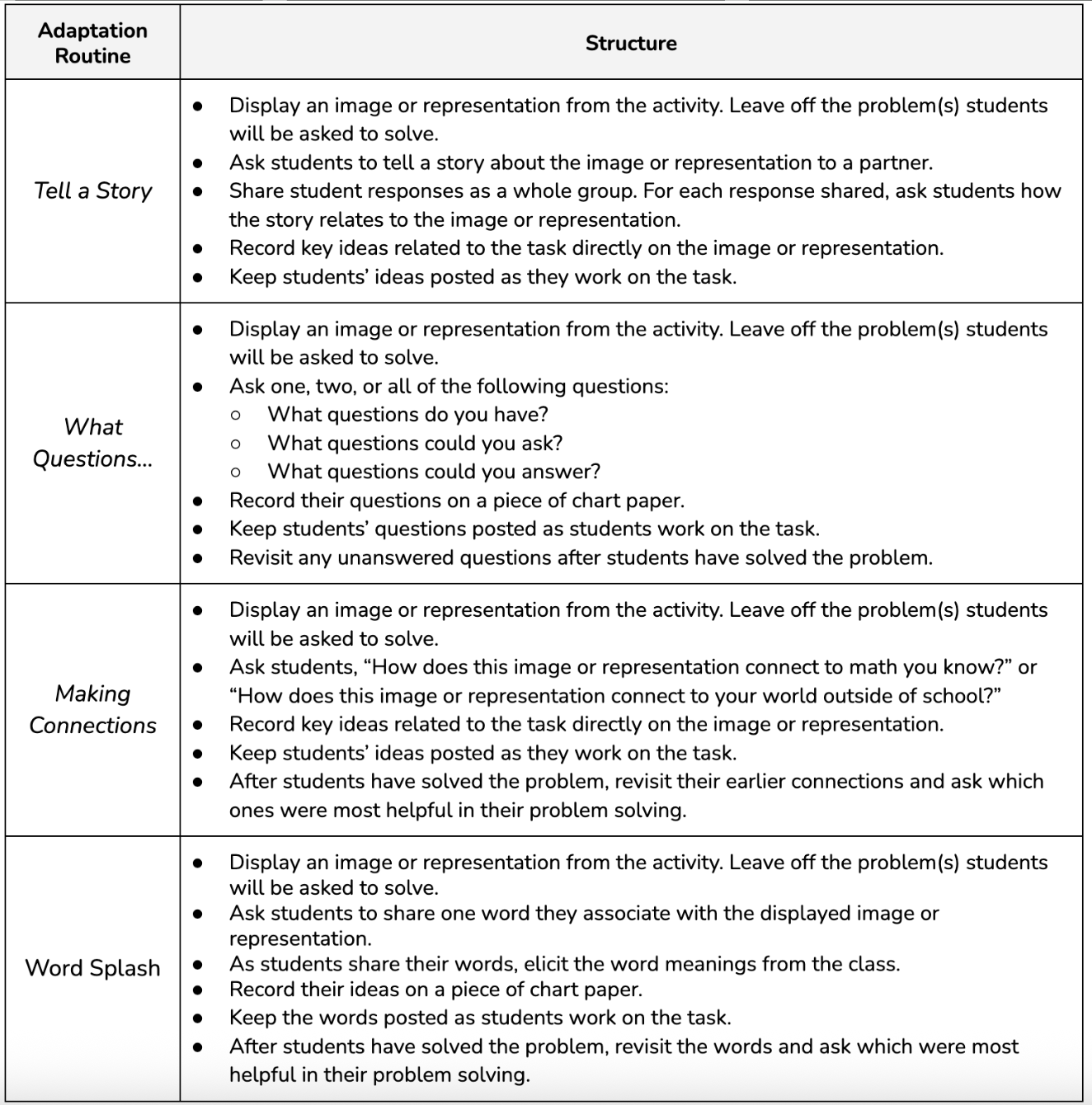
When deciding which adaptation to use, it is helpful to think about what aspect(s) of the task might make it inaccessible to your students. For example:

  • If the context or representation of the problem might be unfamiliar to students, you could use the Tell a Story, What Questions, or Making Connections routine.
  • If the activity relies on a prior knowledge from earlier in the year or prior grade levels, it might make sense to use the What Questions or Making Connections routine.
  • If the language (including math language) adds a layer of complexity to the activity, you could use the Word Splash routine.

Try it!

There isn’t one “right” adaptation for any classroom scenario; each is an opportunity to learn more about your students. In the end, it’s not the routine itself that matters as much as what the routine affords—the ways it reveals student thinking, provides an entry point, and supports problem solving. The only way to figure out what works best is to try these structures out! Fortunately, they require little materials prep. All you need is a piece of chart paper or whiteboard and an image from the problem students will be solving.

In your next PLC or planning session, review the activities in an upcoming lesson. As you read through each problem, discuss:

  • What knowledge and experiences are your students bringing to the problem?
  • Is there an activity where students might not have access to the problem? If so, what specifically is inaccessible and why?
  • Which of the four routines will you use to launch the activity?*

*If you’re planning with your grade-level team, each person can try a different routine and then compare the affordances of each one. I’d love to see what you try! Share your ideas in the comments or on IG (@kgraymath)!

Part 2: Supporting student learning as they work in small groups

Focusing Teacher Learning Around Students

When I was teaching, I often felt overwhelmed by my own learning. The list of things I needed to know and be able to do felt never ending. And then, as I chipped away at my list, it seemed like the more I learned about teaching math, the more I didn’t know.

I think David Cohen describes the root cause of my feeling perfectly:

‘To teach responsibly, teachers must cultivate a kind of mental double vision: distancing themselves from their own knowledge to understand students’ thinking, yet using their knowledge to guide their teaching. Another predicament is that although attention to students’ thinking improves chances of learning, it also increases the uncertainty and complexity of the job.’

Cohen, D. K. (2011). Teaching and Its Predicaments. Harvard University Press.

As a coach, it feels much the same way when trying to decide on areas of focus for our lesson planning and PLC sessions. With a finite amount of time for teacher learning, prioritizing is so hard when everything feels equally important. So, this year instead of the principal, the teachers, and me planning the year-long instructional focus solely based on what we think it should be, we wanted our decision to also be informed by students’ math experiences. Then, to determine if the things we are learning and trying improve student learning as evidenced by assessments (formative and summative), we also wanted to know if they impacted students’ math identity, feelings about math, and ways in which they viewed learning math.

Student input

The Practical Measures work grounded our design of a quick 5–10 minute student survey that encompassed students’ feelings about math and experiences in math class. We looked at the data in our first PLC and there was so much great discussion sparked by comparing responses within and across grades. So much so that this will probably be multiple posts as we continue to aggregate the data in different ways, pair the question responses, and give the survey a few time across the year.

In our PLC, the first thing we did was notice and wonder about a pair of responses from our 3rd-5th graders:

One thing we wondered was why a student might like math but not like solving problems no one has shown them how to solve. We discussed things such as student confidence, worry about not getting the right answer right away, and the ability to transfer their understanding to a novel problem. We also hypothesized that if their prior math experiences have predominately included being shown how to solve problems with no time for revision of ideas, there could be a perception that they can’t solve problems until someone shows them what to do and that the answer they get to a problem is their ‘final’ answer.

Launch problem

Whenever we do this work together, I like to shift from hypotheses and theory to focus on an action we can take, try, and reflect on. One actionable thing we decided we could do was launch with the problem, let students try, learn from what they do, and use what we learn to adapt rest of the lesson. This often means not following the lesson plan to the letter or jumping in to rescue students by showing them what to do, but instead allowing them to use what they know, revise their ideas, and connect their ideas to others.

Here is an example of that in action from 5th grade:

The original problem: A city is designing a park on a rectangular piece of land. Two-thirds of the park will be used for different sports. One-half of the land used for different sports will be soccer fields.

In the workbook, students were given a square that represented the park and then stepped through how to think about the situation: 1) draw a diagram 2) write a multiplication expression and 3) find how much of the park will be used for soccer fields.

While that could be a great way for students to think through the problem, it is not the ‘novel problem’ experience we wanted them to have. So, we didn’t use the workbooks and instead asked student to work in their journal by themselves first. As we monitored, we noticed a variety of approaches so we asked them, as a group, to compare where they were in their thinking and finish out the problem together on a whiteboard.

As they did a gallery walk, we asked them to focus on what was similar and different in the ways groups approached the problem and then go back to their tables and make any revisions they wanted to make to their own work. For some this meant a complete revision, while others added on new connections they made.

Student thinking

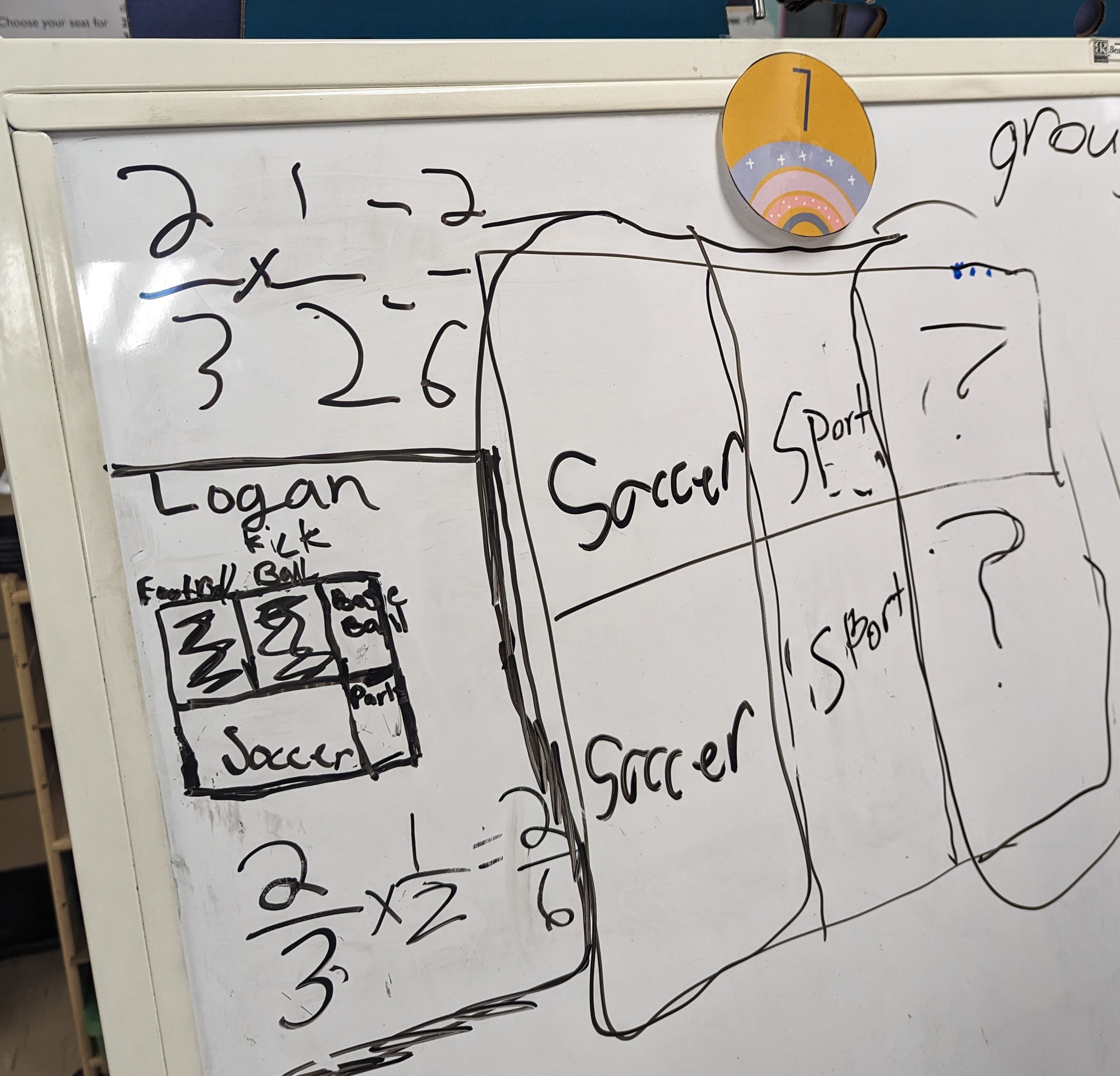
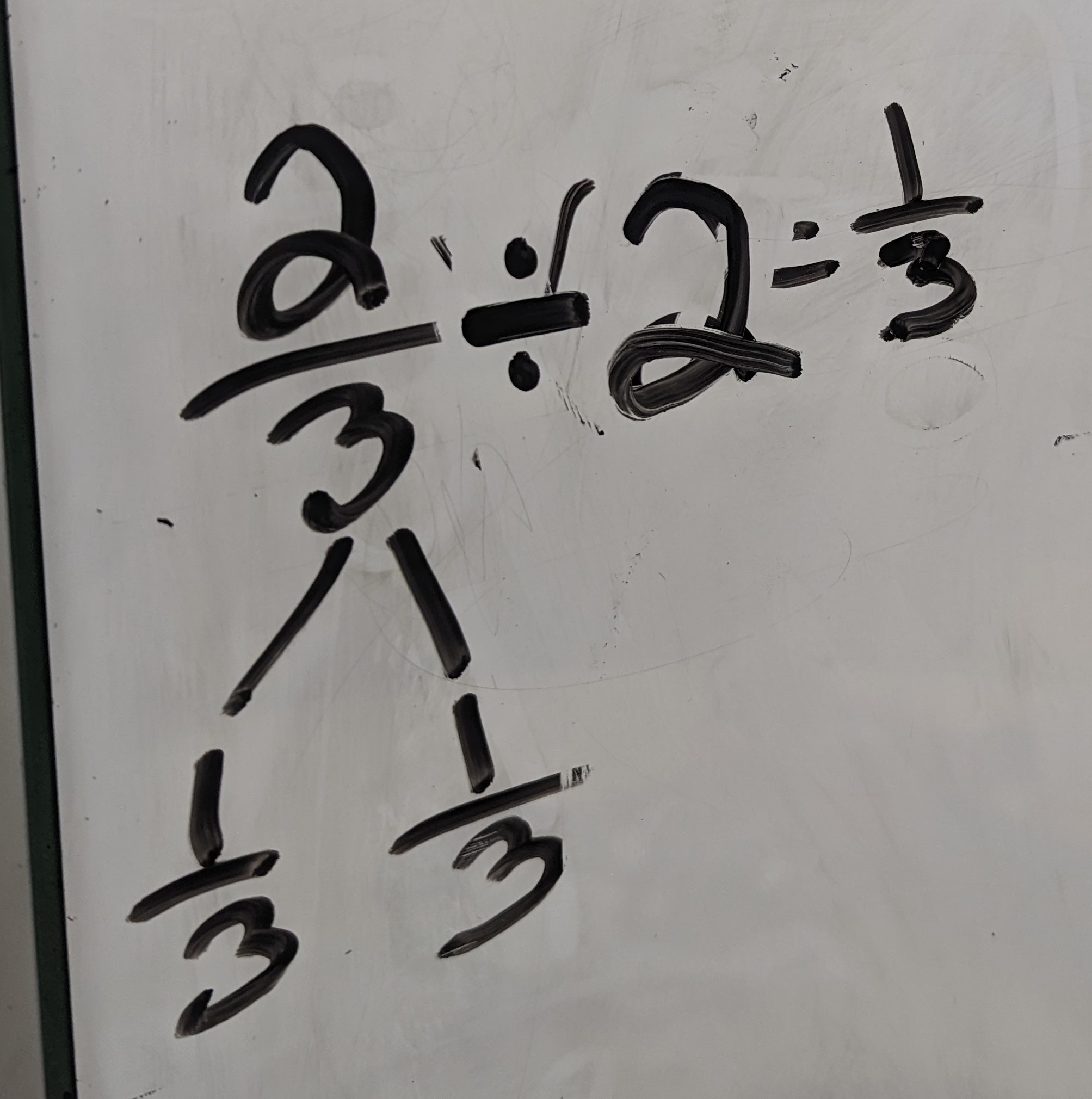
Here are a few of the boards:

What I love about this when thinking about the survey prompt, ‘I like solving problems no one has shown me how to solve.’ is the multiple diagram types, the different ways students arrived at 2/6 with the same type of diagram, the multiplication and division expressions, and the equivalent answers of 1/3 and 2/6. And although the workbook problem didn’t exactly tell them what to do, it did scaffold it in a way where I could imagine their responses would have looked very similar.

For the rest of the lesson, we used their thinking to discuss their approaches, how they connected to one another, how they knew to use multiplication or division, things they noticed about their expression and product, and places where they changed or revised their thinking. We skipped Activity 2 altogether because this discussion was so interesting and important and reflected how we work through problems no one has shown you how to do or think about!

Next steps

Like all things teaching and learning, it takes time. I don’t expect this one experience to be the thing that shifts students like or dislike in solving problems w/o being told what to do nor do I expect every lesson to play out like this one. However, with repeated experiences similar to this, I hope students feel more confident in attacking a problem they haven’t been shown or scaffolded through and teachers refine their ‘double vision’ in a way that balances their own understandings and student thinking.

The best way we will be able to see if this has an impact is through students’ voice, which I look forward to digging into throughout the year in the surveys.