Category Archives: Equal Groups

Adapting Lessons Part 1: Launching an Activity

As a math teacher and coach, I’ve always adapted curriculum materials. I am sure we all have—it’s part of knowing our students and wanting to provide them with access to the math in ways that make sense to them. And while we have the best of intentions, sometimes the choices we make can unintentionally take the math out of students’ hands, disconnect from what they already know, or even reflect assumptions and expectations we didn’t realize we were holding.

Adapting activities is challenging for many reasons: some decisions require extensive prep, others happen in the moment, and all of them must be balanced with the pressure to keep pace while still giving students the time and space to share the incredible ideas, experiences, and mathematical thinking they bring into the classroom. I also found it difficult at times to know exactly what to look or listen for mathematically, and I sometimes interpreted students’ responses through my own assumptions and expectations. While a high-quality curriculum can provide problems that elicit student thinking, the deeper work of examining what we notice, what we value, and how we interpret and leverage students’ ideas extends far beyond even the most comprehensive teacher guide.

While thoughtful planning ahead of time is ideal, we all know it isn’t always possible. Because so much can get in the way of planning and prep time, I think a lot about how to make quick, in-the-moment adaptations based on what students are saying and doing—and on what I still need to learn about their thinking. I often wonder: What if our adaptations did more than simply “fix” a lesson? What if they opened space for deeper student thinking, a stronger sense of community, and richer mathematical understanding?

These questions keep pushing me to look closely at the flow of a typical lesson and identify the moments where even small adaptations can make a big difference. I’ve found that there are five points in a lesson where a few quick, minor changes can have a big impact:

  • Launching an activity
  • Working in small groups
  • Engaging with contexts
  • Sharing ideas
  • Synthesizing the lesson.

While it would be wonderful to have a single “right” adaptation for each of these, the reality is that different classrooms and moments call for different routines or structures. In the next series of posts, we’ll take a closer look at each of these opportunities and explore practical, in-the-moment ways to adapt them.

Ultimately, the goal of these small adaptations isn’t just to adjust an activity or lesson; they’re meant to open up richer mathematical experiences for students and provide increased insight for teachers. My hope is that these structures encourage sense-making and increase access to the mathematics; provide every student opportunities to share the amazing ideas they bring; create space for questions about one’s own or others’ thinking; build a stronger mathematical community; and support teachers in reflecting on why they’re adapting an activity and how those choices best serve students.

In this post, I’ll outline a few alternate ways to launch a lesson, and in subsequent posts, I’ll explore each of the other lesson moments listed above.

Alternate Ways to Launch a Lesson

Instructional Goal: Provide students with an entry point into the activity. 
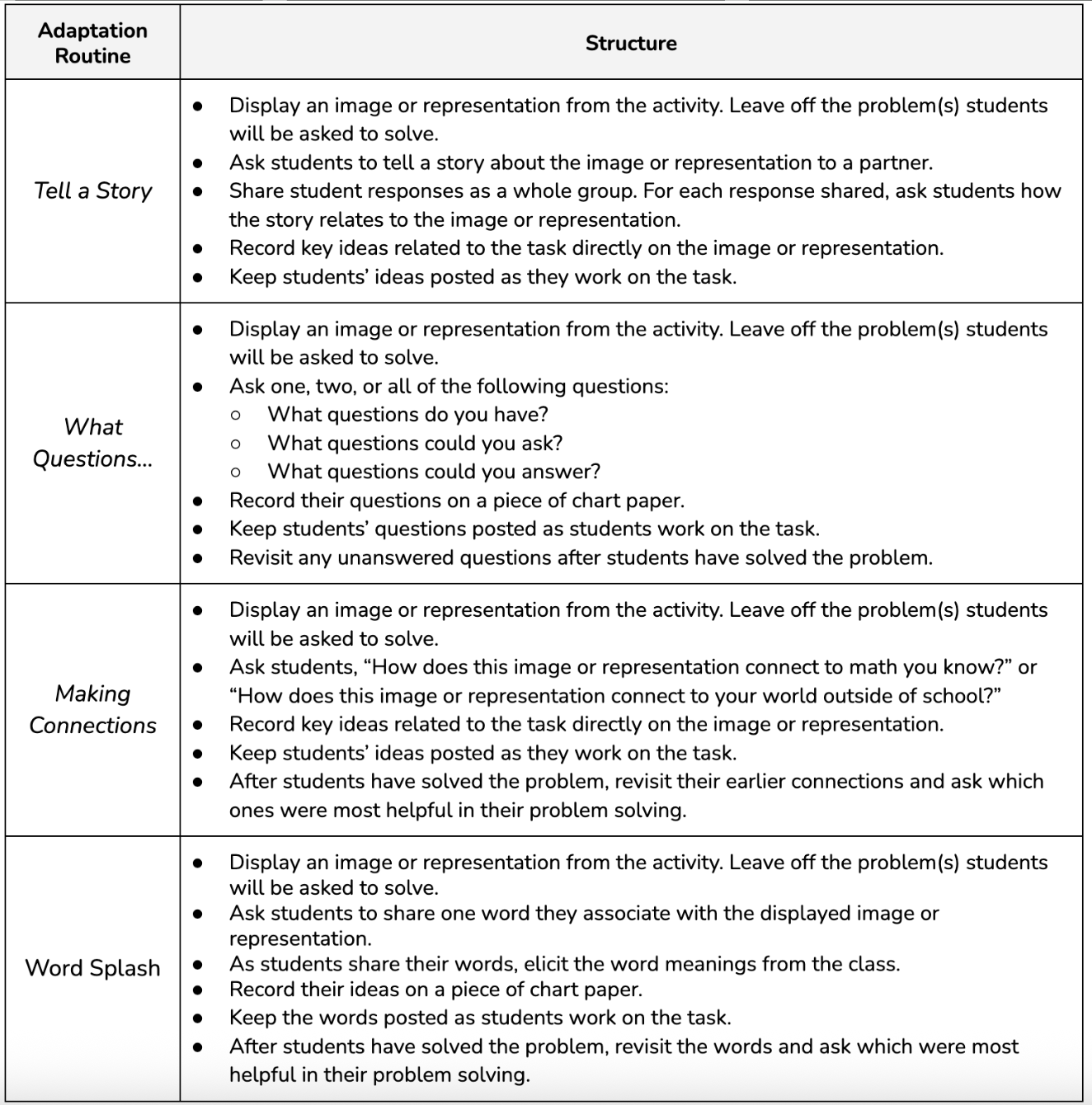
When deciding which adaptation to use, it is helpful to think about what aspect(s) of the task might make it inaccessible to your students. For example:

  • If the context or representation of the problem might be unfamiliar to students, you could use the Tell a Story, What Questions, or Making Connections routine.
  • If the activity relies on a prior knowledge from earlier in the year or prior grade levels, it might make sense to use the What Questions or Making Connections routine.
  • If the language (including math language) adds a layer of complexity to the activity, you could use the Word Splash routine.

Try it!

There isn’t one “right” adaptation for any classroom scenario; each is an opportunity to learn more about your students. In the end, it’s not the routine itself that matters as much as what the routine affords—the ways it reveals student thinking, provides an entry point, and supports problem solving. The only way to figure out what works best is to try these structures out! Fortunately, they require little materials prep. All you need is a piece of chart paper or whiteboard and an image from the problem students will be solving.

In your next PLC or planning session, review the activities in an upcoming lesson. As you read through each problem, discuss:

  • What knowledge and experiences are your students bringing to the problem?
  • Is there an activity where students might not have access to the problem? If so, what specifically is inaccessible and why?
  • Which of the four routines will you use to launch the activity?*

*If you’re planning with your grade-level team, each person can try a different routine and then compare the affordances of each one. I’d love to see what you try! Share your ideas in the comments or on IG (@kgraymath)!

Part 2: Supporting student learning as they work in small groups

Focusing Teacher Learning Around Students

When I was teaching, I often felt overwhelmed by my own learning. The list of things I needed to know and be able to do felt never ending. And then, as I chipped away at my list, it seemed like the more I learned about teaching math, the more I didn’t know.

I think David Cohen describes the root cause of my feeling perfectly:

‘To teach responsibly, teachers must cultivate a kind of mental double vision: distancing themselves from their own knowledge to understand students’ thinking, yet using their knowledge to guide their teaching. Another predicament is that although attention to students’ thinking improves chances of learning, it also increases the uncertainty and complexity of the job.’

Cohen, D. K. (2011). Teaching and Its Predicaments. Harvard University Press.

As a coach, it feels much the same way when trying to decide on areas of focus for our lesson planning and PLC sessions. With a finite amount of time for teacher learning, prioritizing is so hard when everything feels equally important. So, this year instead of the principal, the teachers, and me planning the year-long instructional focus solely based on what we think it should be, we wanted our decision to also be informed by students’ math experiences. Then, to determine if the things we are learning and trying improve student learning as evidenced by assessments (formative and summative), we also wanted to know if they impacted students’ math identity, feelings about math, and ways in which they viewed learning math.

Student input

The Practical Measures work grounded our design of a quick 5–10 minute student survey that encompassed students’ feelings about math and experiences in math class. We looked at the data in our first PLC and there was so much great discussion sparked by comparing responses within and across grades. So much so that this will probably be multiple posts as we continue to aggregate the data in different ways, pair the question responses, and give the survey a few time across the year.

In our PLC, the first thing we did was notice and wonder about a pair of responses from our 3rd-5th graders:

One thing we wondered was why a student might like math but not like solving problems no one has shown them how to solve. We discussed things such as student confidence, worry about not getting the right answer right away, and the ability to transfer their understanding to a novel problem. We also hypothesized that if their prior math experiences have predominately included being shown how to solve problems with no time for revision of ideas, there could be a perception that they can’t solve problems until someone shows them what to do and that the answer they get to a problem is their ‘final’ answer.

Launch problem

Whenever we do this work together, I like to shift from hypotheses and theory to focus on an action we can take, try, and reflect on. One actionable thing we decided we could do was launch with the problem, let students try, learn from what they do, and use what we learn to adapt rest of the lesson. This often means not following the lesson plan to the letter or jumping in to rescue students by showing them what to do, but instead allowing them to use what they know, revise their ideas, and connect their ideas to others.

Here is an example of that in action from 5th grade:

The original problem: A city is designing a park on a rectangular piece of land. Two-thirds of the park will be used for different sports. One-half of the land used for different sports will be soccer fields.

In the workbook, students were given a square that represented the park and then stepped through how to think about the situation: 1) draw a diagram 2) write a multiplication expression and 3) find how much of the park will be used for soccer fields.

While that could be a great way for students to think through the problem, it is not the ‘novel problem’ experience we wanted them to have. So, we didn’t use the workbooks and instead asked student to work in their journal by themselves first. As we monitored, we noticed a variety of approaches so we asked them, as a group, to compare where they were in their thinking and finish out the problem together on a whiteboard.

As they did a gallery walk, we asked them to focus on what was similar and different in the ways groups approached the problem and then go back to their tables and make any revisions they wanted to make to their own work. For some this meant a complete revision, while others added on new connections they made.

Student thinking

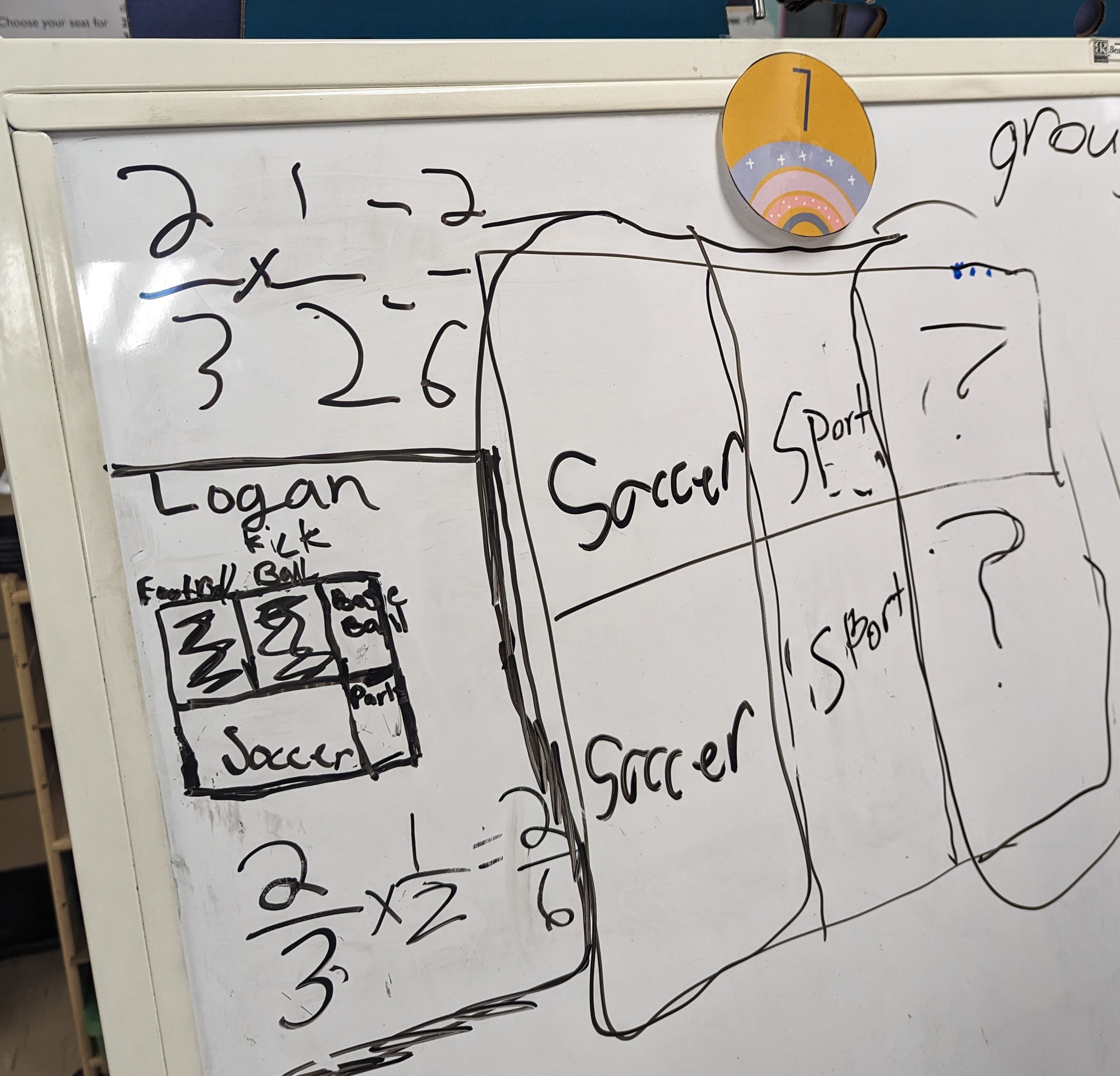
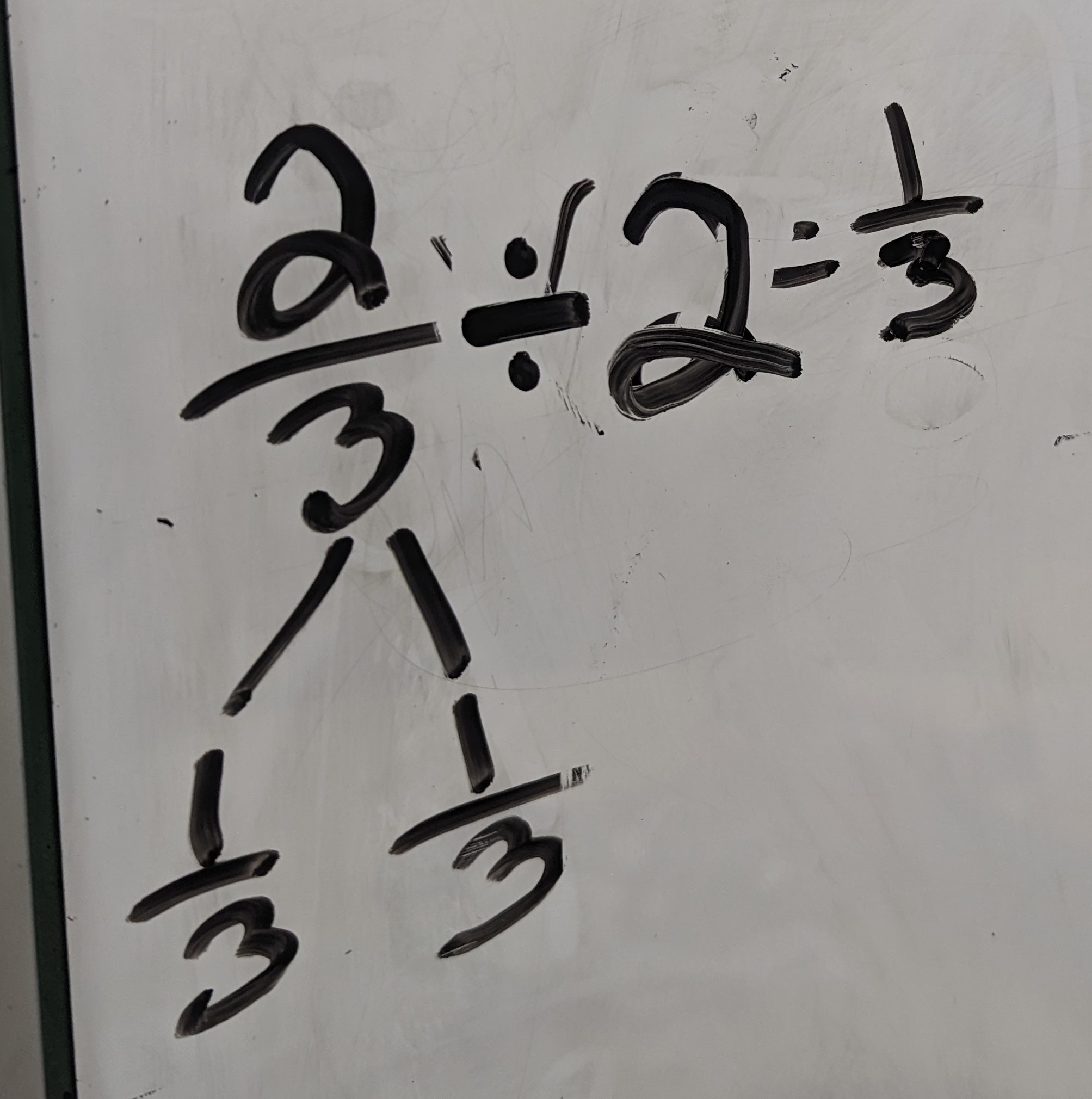
Here are a few of the boards:

What I love about this when thinking about the survey prompt, ‘I like solving problems no one has shown me how to solve.’ is the multiple diagram types, the different ways students arrived at 2/6 with the same type of diagram, the multiplication and division expressions, and the equivalent answers of 1/3 and 2/6. And although the workbook problem didn’t exactly tell them what to do, it did scaffold it in a way where I could imagine their responses would have looked very similar.

For the rest of the lesson, we used their thinking to discuss their approaches, how they connected to one another, how they knew to use multiplication or division, things they noticed about their expression and product, and places where they changed or revised their thinking. We skipped Activity 2 altogether because this discussion was so interesting and important and reflected how we work through problems no one has shown you how to do or think about!

Next steps

Like all things teaching and learning, it takes time. I don’t expect this one experience to be the thing that shifts students like or dislike in solving problems w/o being told what to do nor do I expect every lesson to play out like this one. However, with repeated experiences similar to this, I hope students feel more confident in attacking a problem they haven’t been shown or scaffolded through and teachers refine their ‘double vision’ in a way that balances their own understandings and student thinking.

The best way we will be able to see if this has an impact is through students’ voice, which I look forward to digging into throughout the year in the surveys.

2nd Grade Counting,Unitizing, & Combining

The other day, I began writing up my lesson plan for a second grade class I was teaching today. I drafted the lesson, got feedback, revised and ended with this plan, around the 5 Practices, going into the classroom today.

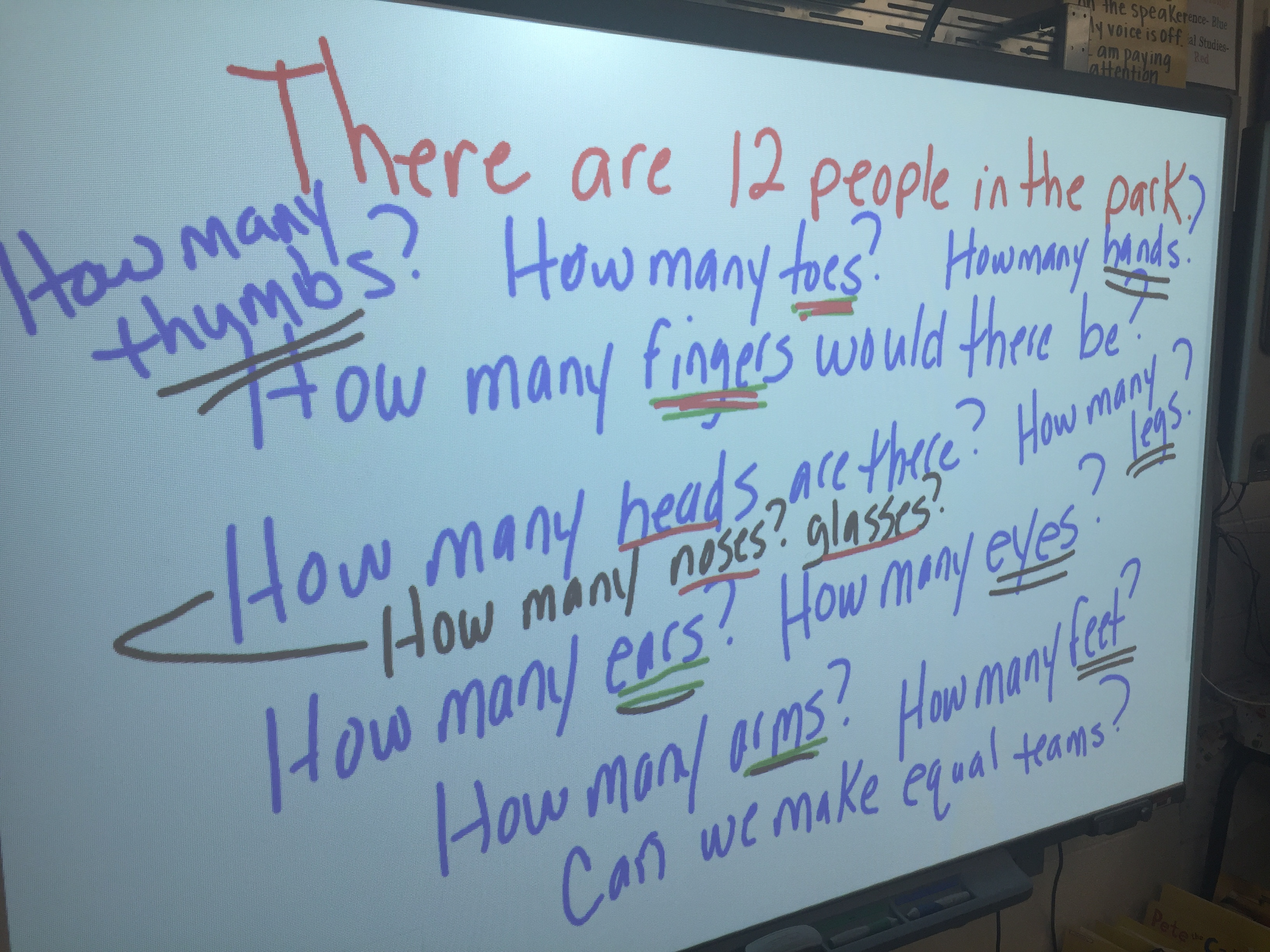
I started the lesson, as I planned, with the students on the carpet like they typically are for a Number Talk. I wrote the sentence “There are 12 people in the park.” on the board and asked them to give me a thumbs up if they could give me a math question I could ask and solve from that statement. A couple students shared after a bit of wait time and I was getting a lot of even/odd talk or questions that involved adding more information to my original sentence. I asked them to turn and talk and one little girl next to me said they could find the number of legs. When I called the group back together I asked her to share her conversation with her partner and after that, hands shot up like crazy. It ended with a board that looked like this…

IMG_1101.JPG

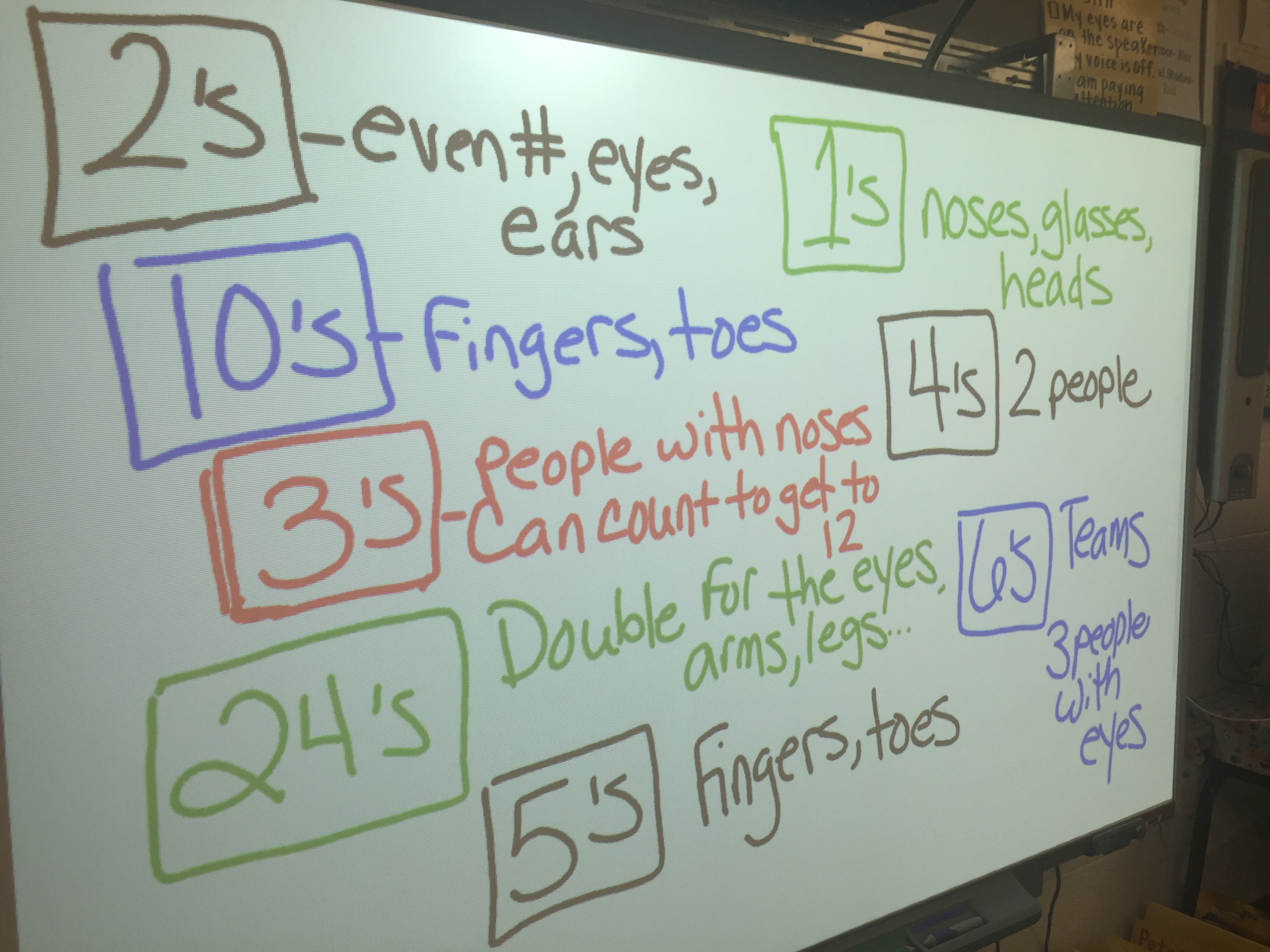
I asked them if we could think about any of these in the same way? I tried to underline the “same thoughts” in the same color, but they started making connections that is got a bit mixed. A lot of there conversation turned to numbers and so I started a new slide and asked what numbers they thought of when they read those problems and why. I recorded what they were thinking…

IMG_1100.JPG

I really liked this opening talk (15ish minutes) and really didn’t want to let them go when it was time for their recess break in the middle of math class. So, they lined up and left for 30 minutes.

When they got back, we recapped the numbers and then I gave two groups question #1 and the other two groups question #2. They had individual time to get started and then they worked as a group to share their thinking. Knowing that I was going to be trading seats at groups for them to share their problem with another table, I was walking around looking for varying strategies so I didn’t trade seats and have a whole table who solved it all the same way.

They did a beautiful job working in their original group. I saw students who had different answers for the same problem talking out their strategies and arriving at a common answer. I saw students practicing how they were going to explain it to the new table they visited. I saw students who were stuck working through the problem with their tablemates. I can tell there is such a safe culture established by Lauren, the homeroom teacher. They trade seats, shared their problem and then I had to readjust my plans.

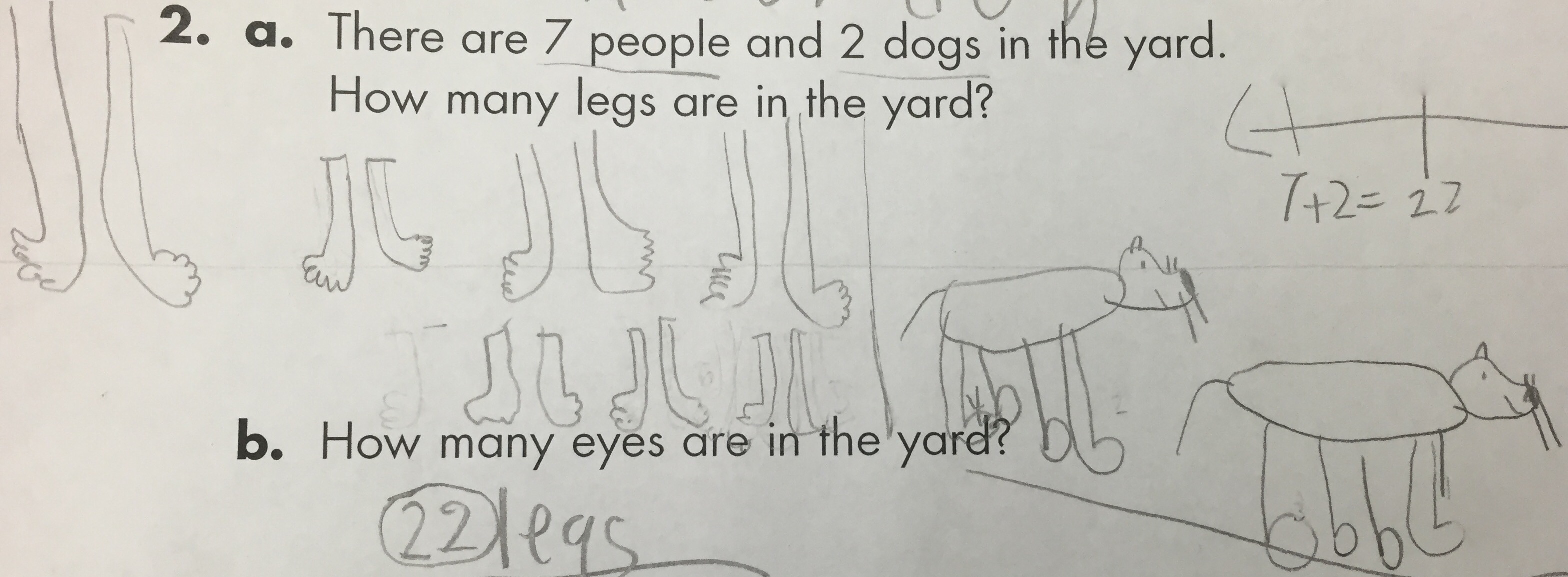
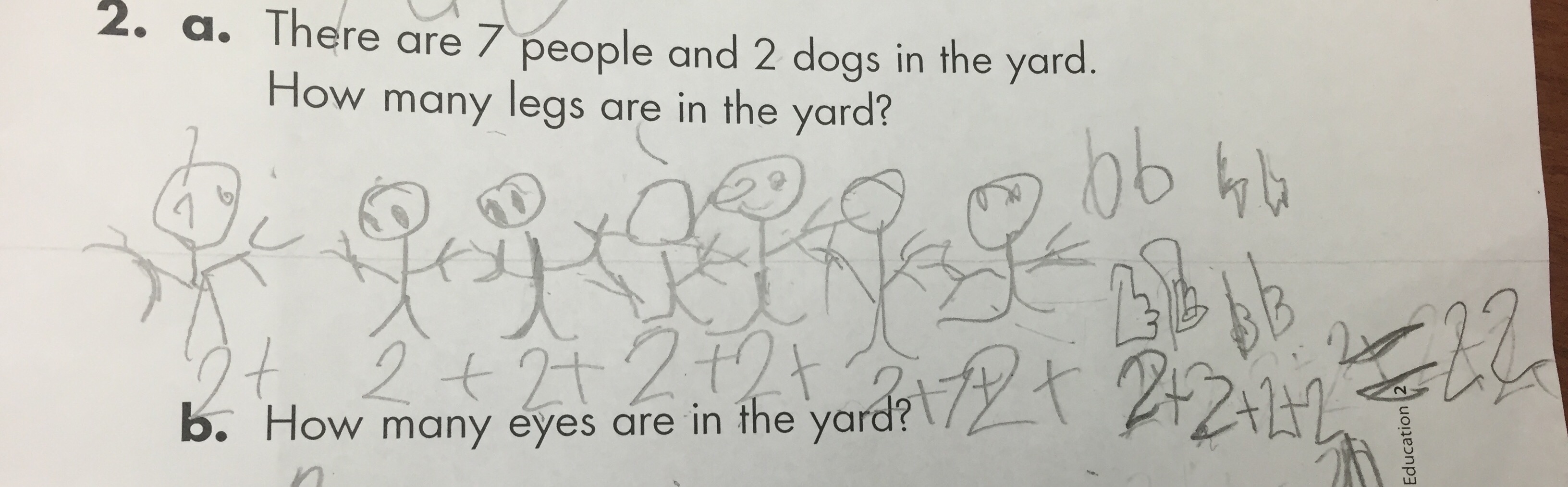
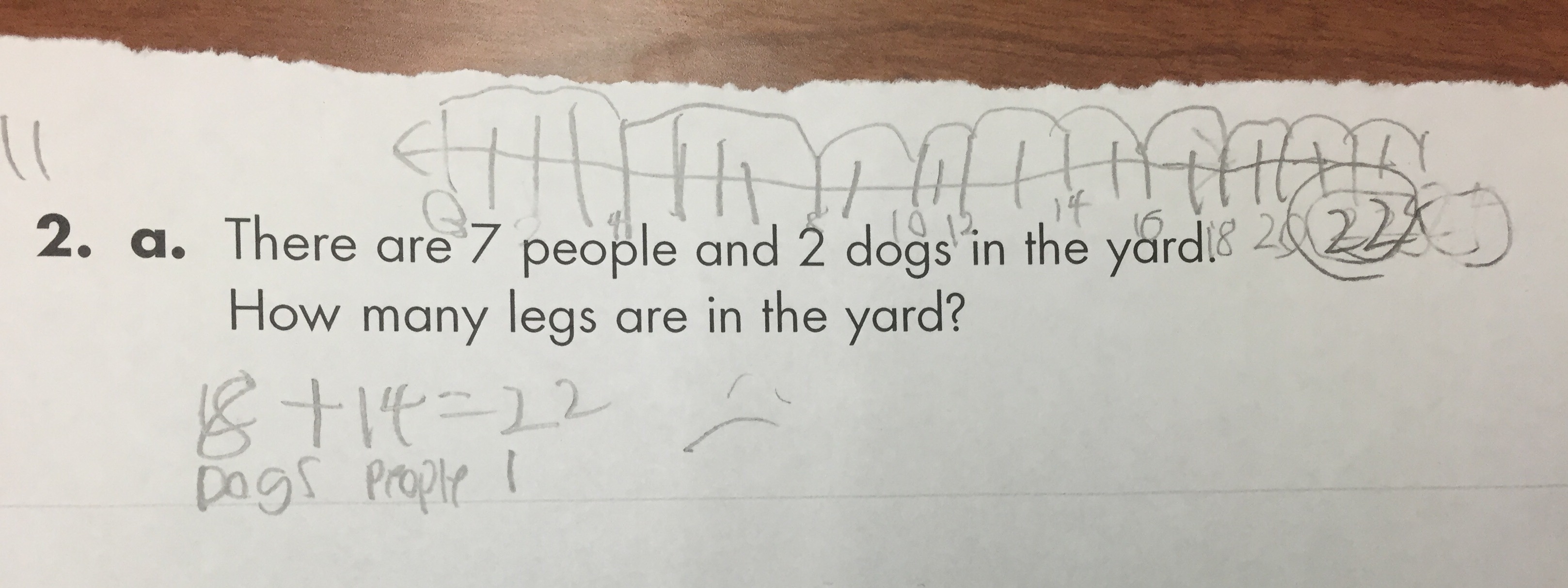
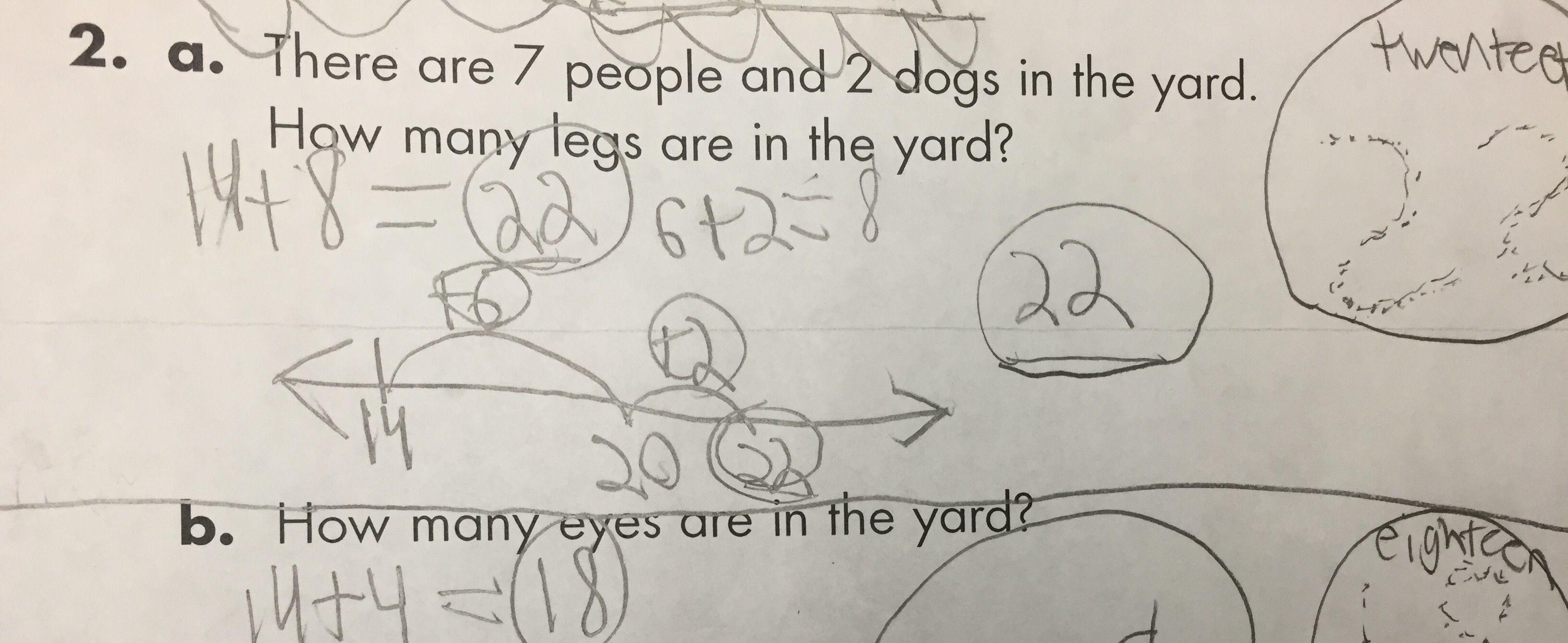
At this point, I wanted the tables talking about what was the same and/or different about the two problems but I was running out of time. In order to pick up with that conversation tomorrow, I decided to have them come to the carpet and I chose two papers (of the same problem) that had the same answer but different strategies. I asked the students privately if they would want to share and they were both excited so I put them both under the document camera and had them explain their work. I thought they was similar enough for students to easily see they both drew the figures out but as I walked around I heard the 1st student counting each one by ones and the 2nd student counting by twos after he wrote the equation. I had them explain their work and asked the class to think about what was the same and what was different and we discussed it. Here are the two I chose:

FullSizeRender 10.jpgFullSizeRender 12.jpg

They pointed out all of the similar things such as feet, people, two’s (but were counted differently), and the same answer. The difference was the equation which was an important thing to come up. I saw quite a few students with the correct answer but incorrect equation. A lot arrived at 22 by counting by wrote 7+2 as their equation so that was an important thing that a student pointed out.

I only had 5 minutes left, so I decided to collect their papers and pick up with the sequencing and connections tomorrow. Which I kind of love because it gives me time to be more thoughtful about how they should share them and also time to talk to their teacher about what I saw today.

So, from my previous plan, I am picking up here:

Practice 4: Sequencing

In the share, after each group has presented to the other groups, we will come to the carpet for a share. The sharing will be sequenced in the way I discussed in the Selecting part, asking students during each student work sample how it is similar and different than the ones we previously shared.

Practice 5: Connecting 

The connecting I see happening through my questioning as we share strategies. I am still working on writing this part out and looking for the connections that can be made, aside from the picture to number representation connections.

The connections I would love to see students making throughout the work and sharing, is how we can combine equal groups. For example I would like the student who is drawing ones and counting them all to move to seeing those ones grouped as a 2 or a 5 depending on the context. I would love the student who is seeing the five 1’s as one group of 5 to now see that if they have 2 of them it will make a 10 and if we have 4 of them we would have 20 and really start looking at different ways to combine those groups. 

The problem I am seeing in this plan is the differences in the two problems. As I sit here with the papers all over the table, I am struggling to make a sequence involving both problems. So, do I sequence a set for each problem and give each 1/2 of the class time to talk about the similarities and differences? or just choose one problem and go with that?

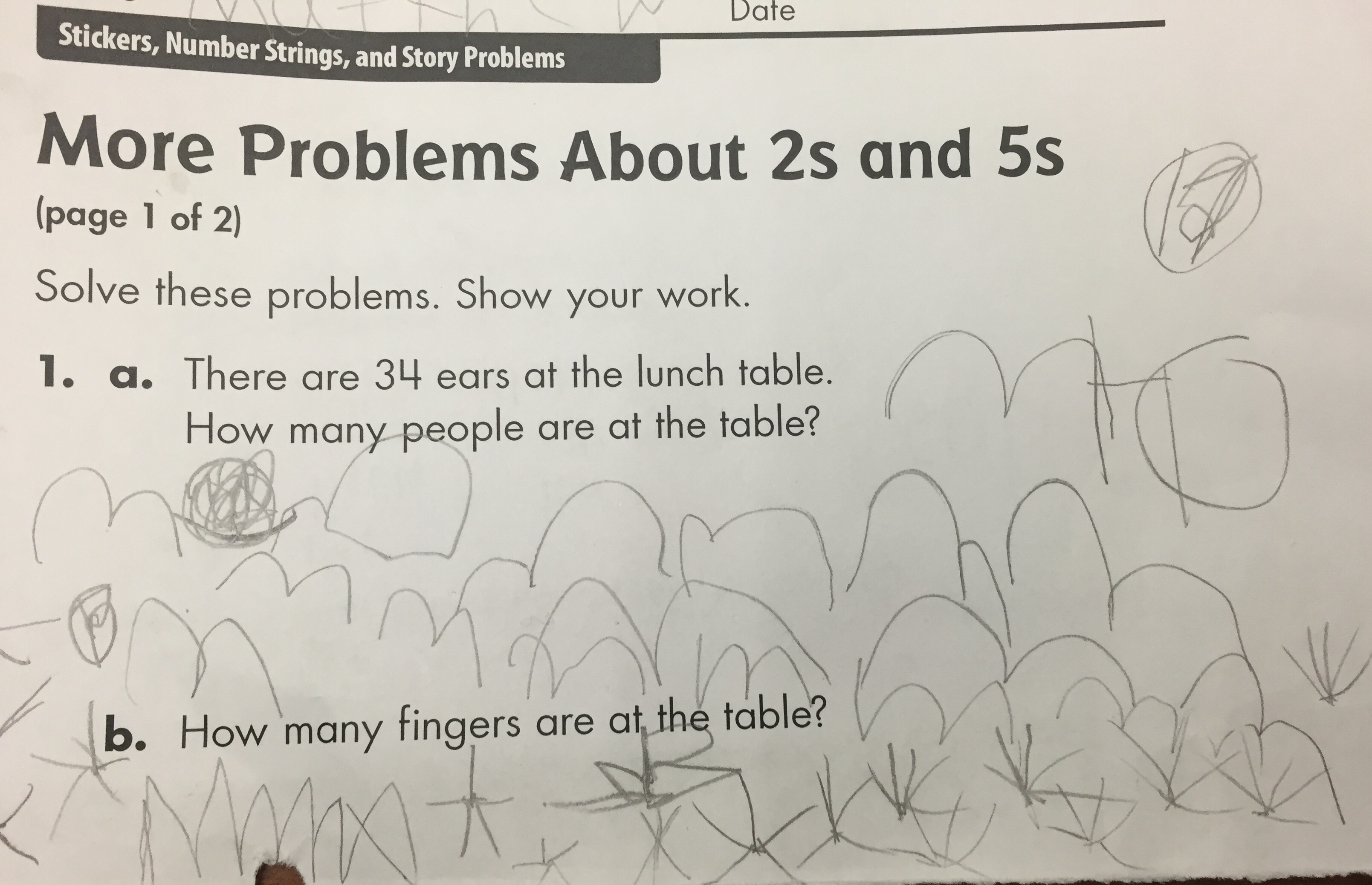
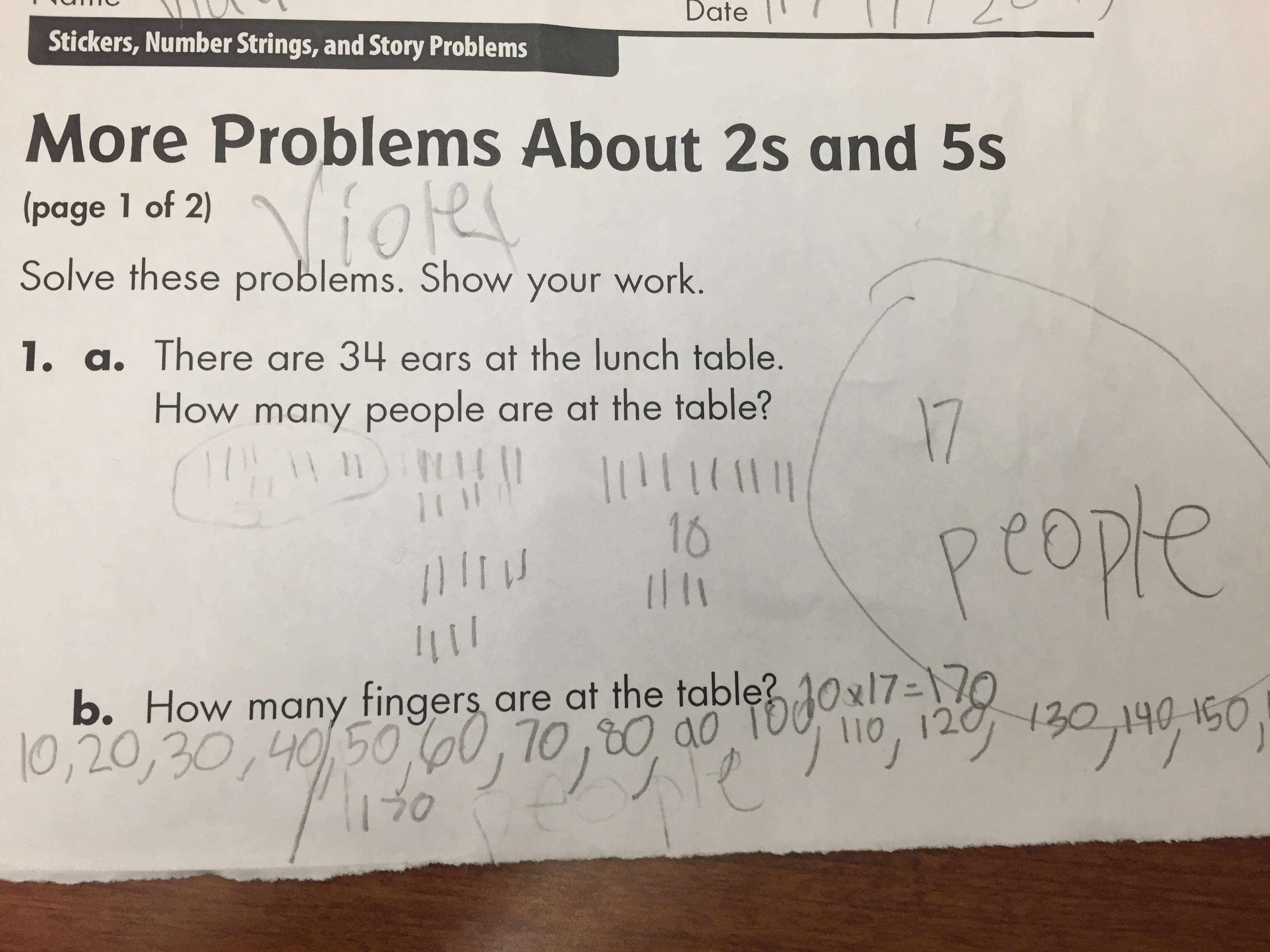
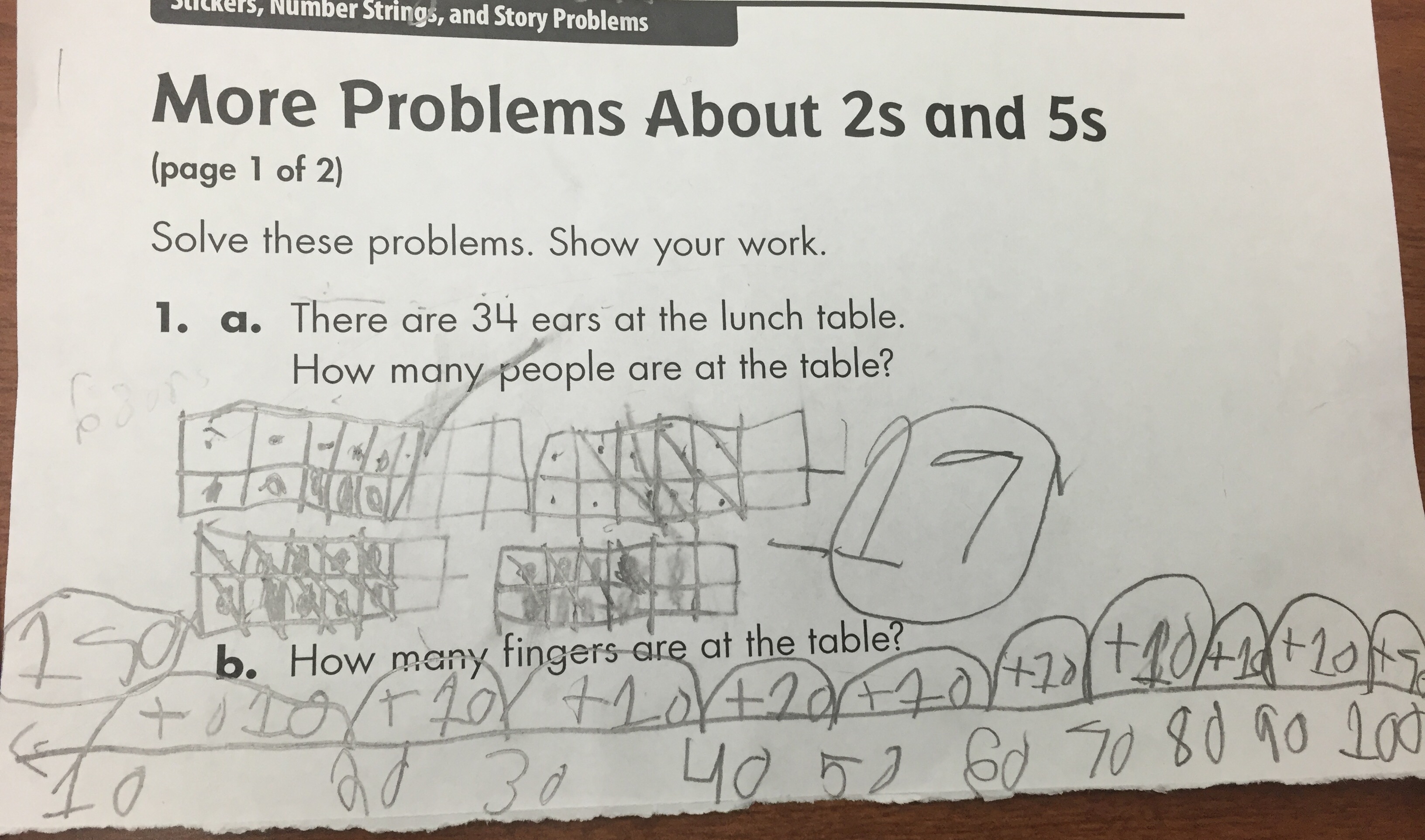
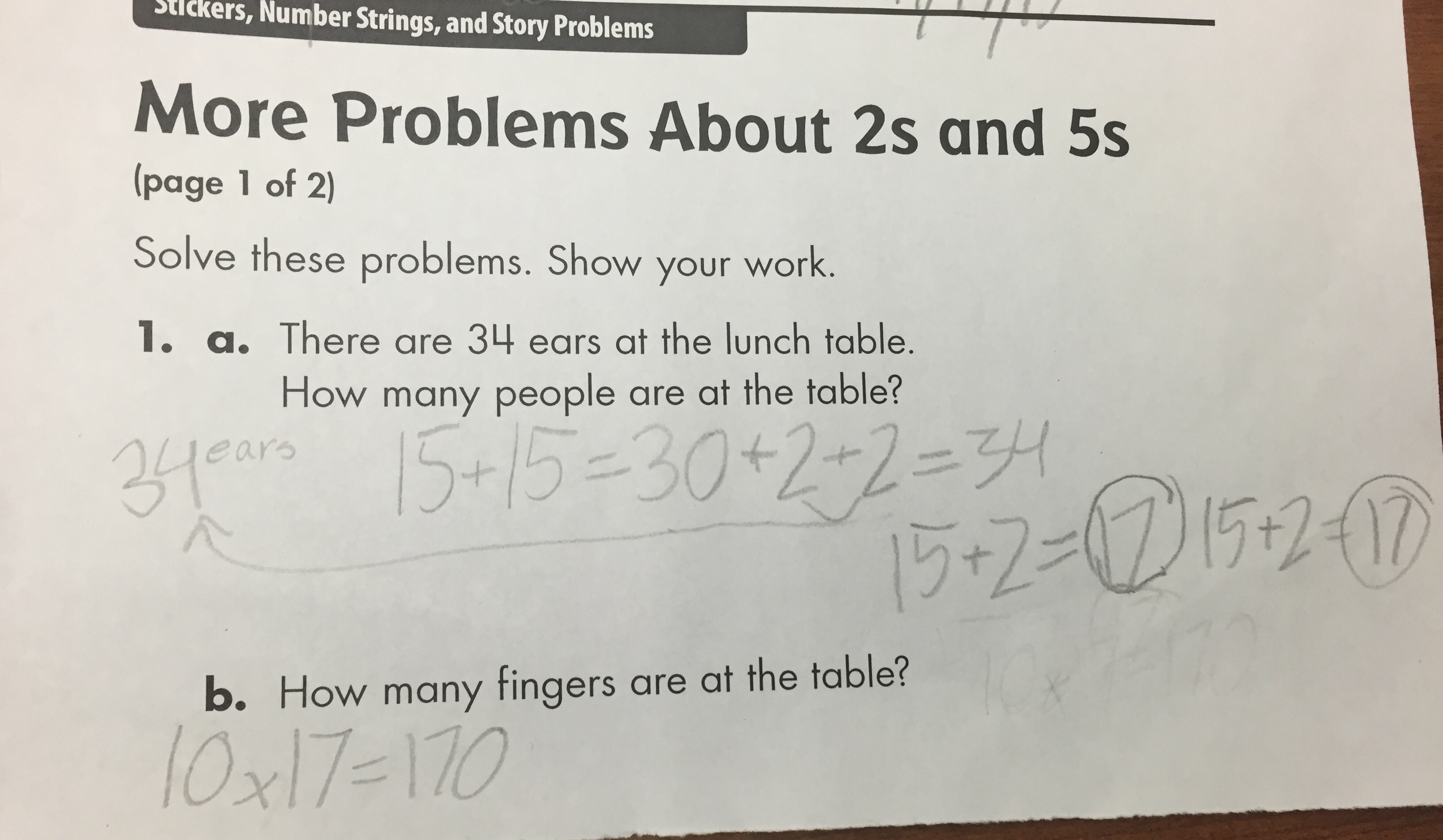
For problem 1, I like this sequence in moving from counting by 1’s to grouping them and then to the finding half of 34.

FullSizeRender 16FullSizeRender 15FullSizeRender 14FullSizeRender 13

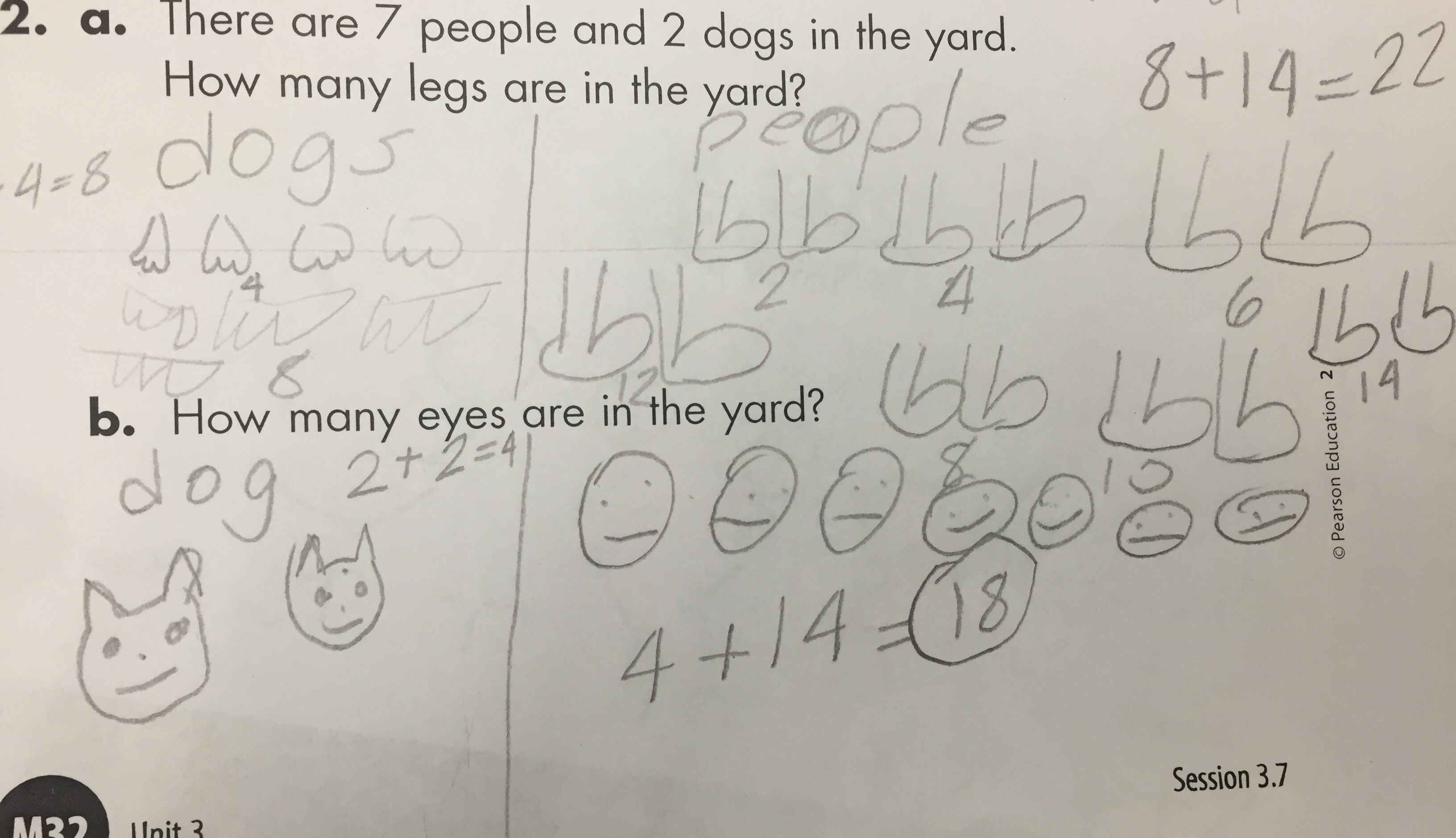
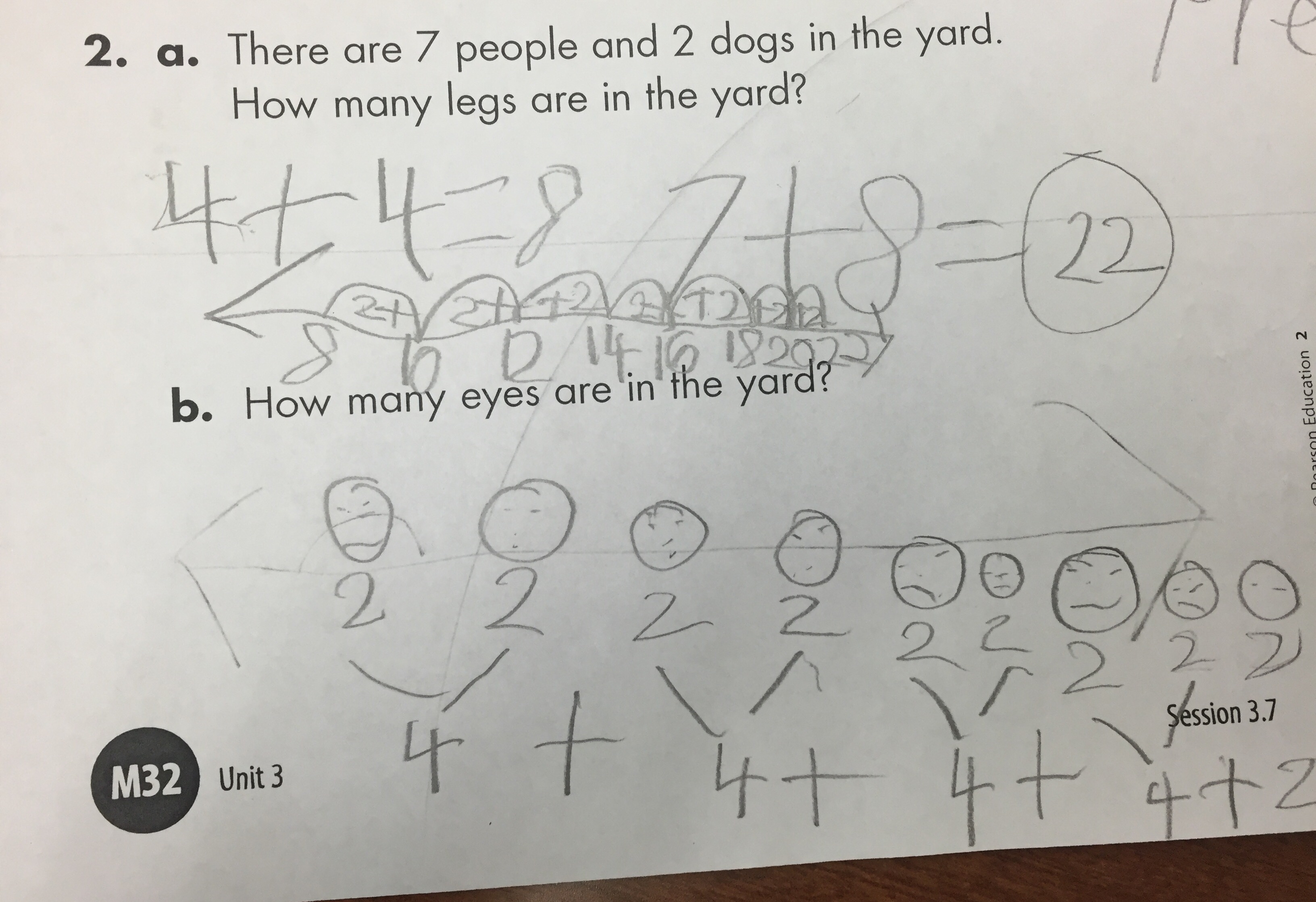
For question 2, I see this sequence from pictures to grouping them by people and dogs, the third shows the 8 composed but broken apart on the number line and the paper before it, and the last one starting at 14.

FullSizeRender 17FullSizeRender 18FullSizeRender 19FullSizeRender 20

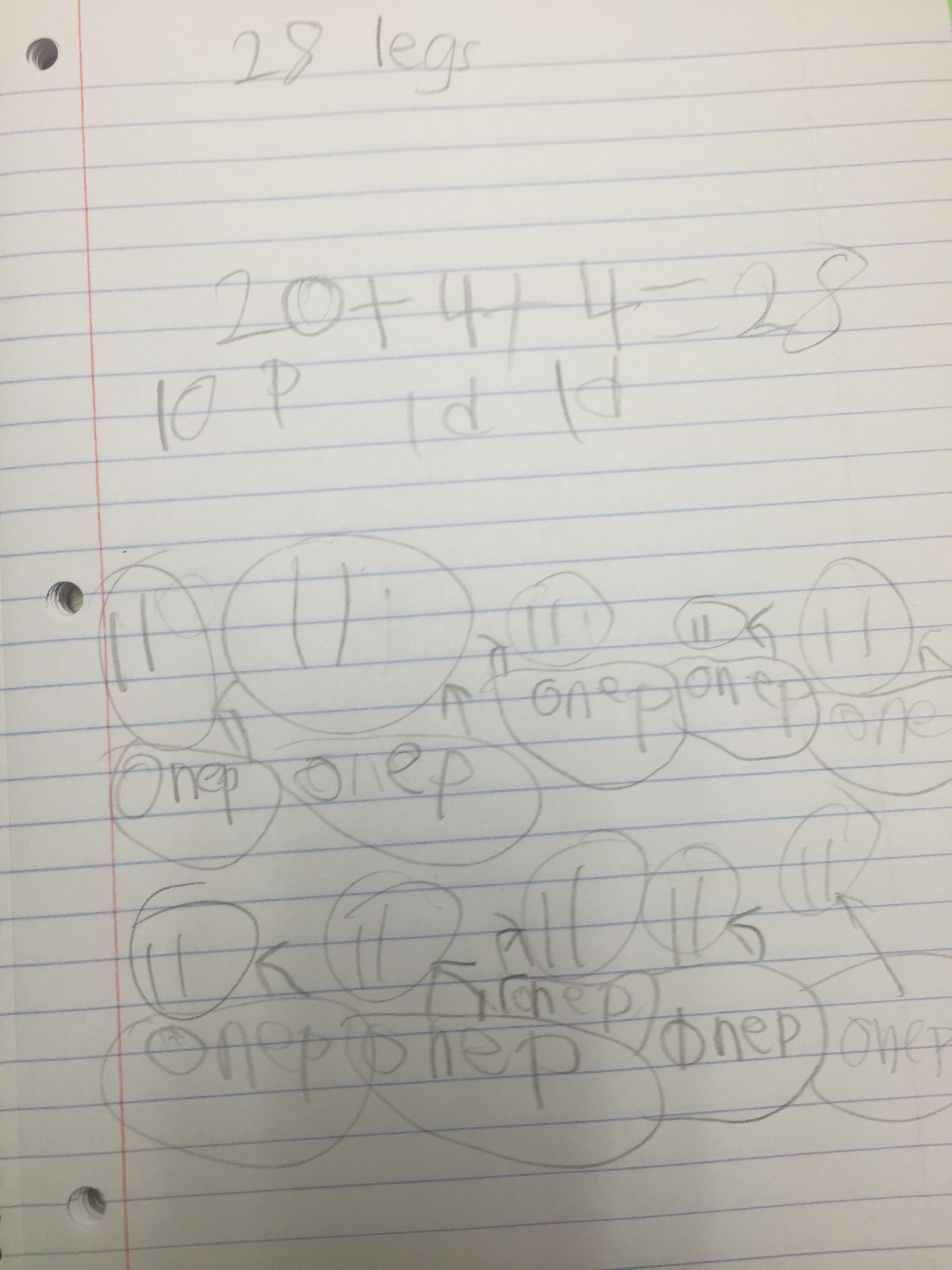
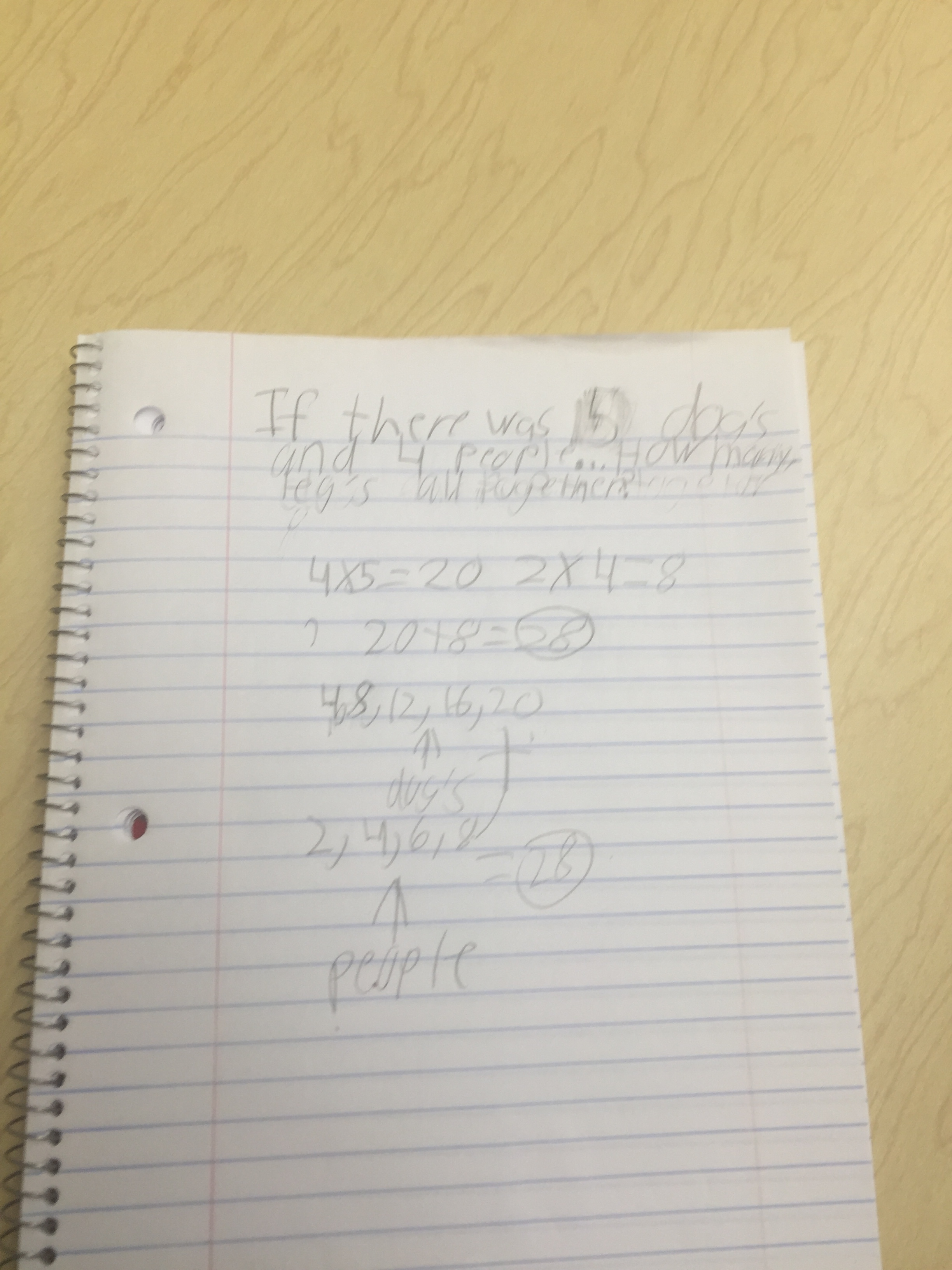
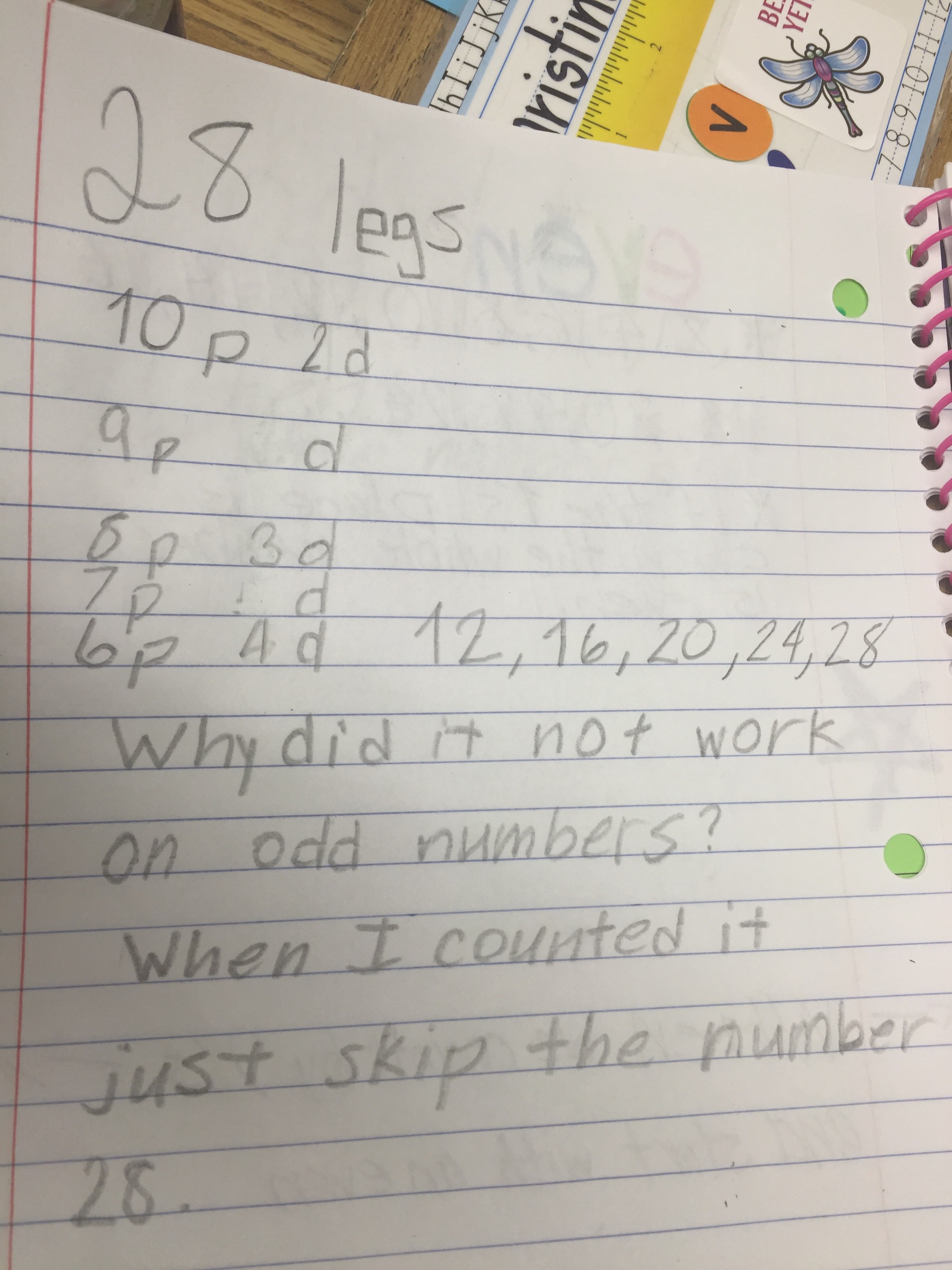
I collected their papers and asked them, in their journals, think about how many people and dogs there could be in the park if I just told them there were 28 legs. I thought that after their share tomorrow of this problem it would lead them into a nice problem from which some great patterns could arise. Here were a few I grabbed before I left:

FullSizeRender 9.jpg

IMG_1103.JPG

and this last one was getting at some really great stuff as she got stuck at 9 people and couldn’t figure out the number of dogs. I asked her to write what she was telling me!

FullSizeRender 8.jpg

Looking back, I would have probably chosen just one problem to work with to make it more manageable in sequencing and making connections during the share. Having two problems was nice as far as having them explain it to others, so I like that, but I am wondering if we did #1 through this process and then split for questions for #2 and #3.

I look forward to hearing how it goes tomorrow!

~kristin


2nd Grade Collaborative Planning Using the 5 Practices

This Tuesday, I am teaching a 2nd grade lesson for a teacher who will be out that day. I offered to this for all of the teachers if my schedule permitted. I thought it was a great way for me to learn more about each grade level, possibly plan and teach it with other grade level teachers for that lesson, and it saves having to use a “sub plan” lesson which we all know either leaves us with more papers to grade or even worse, having to redo when we return. After doing this same type of thing for a 3rd grade classroom last week, and getting great suggestions in the comments after the lesson, I thought this time I would try throwing it out there before I taught it. I would love to see how this lesson could take shape with the input ahead of time!

Lately, I have seen a lot of tweets regarding using the 5 Practices when planning. Now, while I don’t use them to the extent the book lays out for every lesson (because, you know, time), I do always have them playing in the back of my mind when I plan. So, I am going to plan here, one piece at a time, using the 5 Practices. I will pose my questions where I have stopped and look forward to feedback in the comments!

Here is a little background information…

The Investigations Unit Summary:
Screen Shot 2015-11-15 at 1.45.19 PM

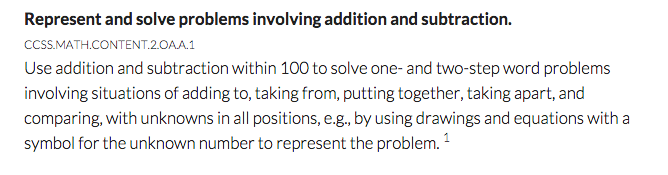
I see the CCSS highlighted most in this lesson:

Screen Shot 2015-11-15 at 1.58.21 PMScreen Shot 2015-11-15 at 1.58.32 PM

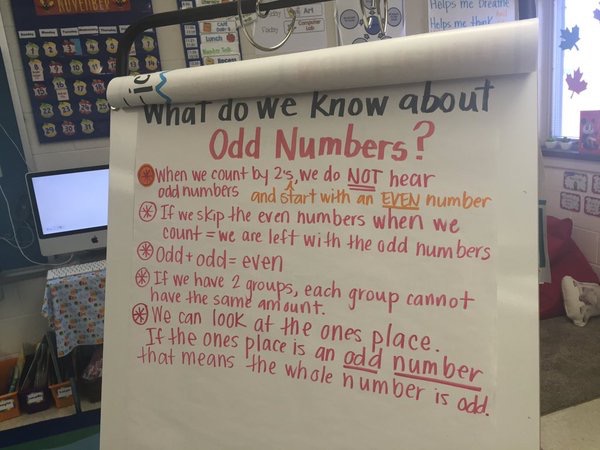
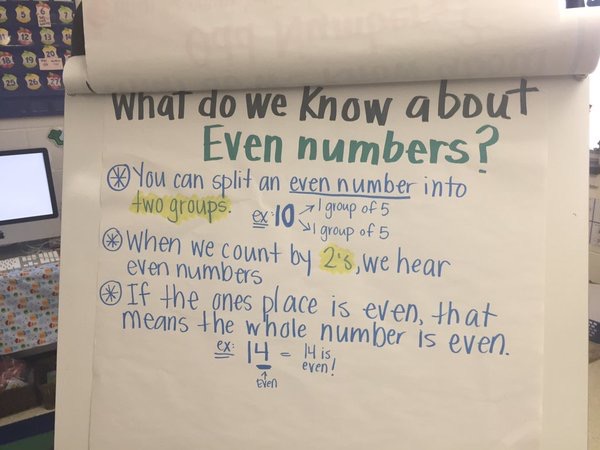
Up to this point the students have been doing a lot of addition/subtraction story problems and sharing of strategies, counting by equal groups, and working with evens/odds. In their work with evens/odds they have been deciding if numbers can form two equal teams or if they allow each person to have a partner. As of a week ago, this was the class noticings around even/odd:

CS6C0fkW4AAqjTR CS6C0ckWsAA2Flz

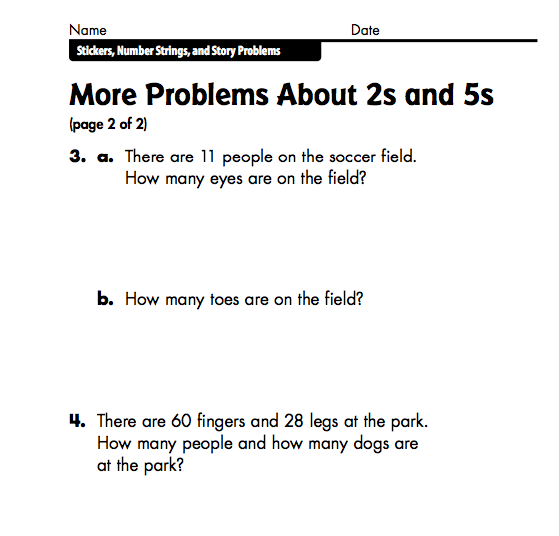
The lesson I am planning is structured as a workshop in which one piece calls for the students to individually solve the following pages, however I am thinking I want to turn these two pages into the lesson because I think they could lead to some amazing thinking!

Screen Shot 2015-11-15 at 12.09.34 PM

Screen Shot 2015-11-15 at 12.09.25 PM

Practice 0: Mathematical Goal

[Planning 1]Students use equal groups when thinking about a context. I am not sure if this is too broad, but there is so much here. What I would really love to see is students moving beyond drawing each one out and counting by 1’s but I am also so interested to see how multiplication and division show their beginnings here! 

[Final Plan] After a conversation with a colleague, my goal for the lesson is for students to begin unitizing the equal groups when combining the groups. I also have this subgoal of proportional reasoning when thinking about people/eyes or dogs/legs.

Practice 1: Anticipating 

IMG_1091IMG_1092

[1st Planning Thought] Before moving on here, I need to decide whether to focus on both pages or just focus my planning on one or two problems. Although they all involve equal groups, I am wondering if focusing on a particular one brings out more conversations and connections between the ways in which we can count? I am leaning to #4, but I it would be helpful for me to also see how they think about 1-3 before thinking about the share of #4. OR, do I leave 4 for the next day after gathering info and sharing strategies together for 1-3?

[2nd/Final Planning] I am thinking now that I am going to launch with a simple sentence of “There are 12 people” and ask student what problems we could solve based on that sentence. Talk about ears, eyes, fingers, legs…etc and then how we could represent our work. I am thinking to not actually DO the math but write the ways as a reference back at their seats. For example, “Draw pictures, Use numbers, Use cubes, Write equations, Use words, Use tables…etc” In planning with another 2nd grade teacher today, we saw that “show your work” at the top pushed some students back to pictures when they were not necessary.

After this, I am going to have 1/2 of the class working (in groups) on problem 1 and the other half on 2. Before they jump right into group work, however, I will ask them to take individual think time to get into the problem. After the groups have arrived at an answer, I will  have a couple students swap seats and explain to the new table how they arrived at their answer. They will then discuss what was the same and different about their problems and ways they solved their problems. After they share among tables, I will bring them to the carpet for a group discussion about these similarities and differences. 

Practice 2: Monitoring

During the work at their seats, I will be walking around, and asking questions when necessary to generate conversation (I don’t know this class as well as I would my own so I do not know what to expect as far as conversation) and looking at strategies.  Questions: How did you arrive at your answer? Does everyone at the table agree ? Where do you see [the ears, people, eyes, fingers] in your work? Is there an equation to match your work? 

Again, after discussing this with a colleague, I will not only be monitoring student understandings but also monitoring for which students to switch and share. I would not want students with the same strategies to switch and not have anything to build upon so this is a great opportunity to structure a better situation for conversation.

Practice 3: Selecting

I will choose papers based on a variety of strategies that build along a trajectory. I would like to see students who drew out the problem by 1’s, 2’s, 4, 5’s or 10’s, then others who used one group to represent the 2’s,4’s, 5’s, or 10’s (unitizing), then students who used equations or number operations w/o the pictures. 

Practice 4: Sequencing

In the share, after each group has presented to the other groups, we will come to the carpet for a share. The sharing will be sequenced in the way I discussed in the Selecting part, asking students during each student work sample how it is similar and different than the ones we previously shared.

Practice 5: Connecting 

The connecting I see happening through my questioning as we share strategies. I am still working on writing this part out and looking for the connections that can be made, aside from the picture to number representation connections.

The connections I would love to see students making throughout the work and sharing, is how we can combine equal groups. For example I would like the student who is drawing ones and counting them all to move to seeing those ones grouped as a 2 or a 5 depending on the context. I would love the student who is seeing the five 1’s as one group of 5 to now see that if they have 2 of them it will make a 10 and if we have 4 of them we would have 20 and really start looking at different ways to combine those groups. 

For the journal, I will give them the scenario that there are people and dogs in the park and 28 legs, how many of each could there be? This will offer multiple solutions (Thanks Simon) and allow for them to see some great patterns the following day!

I will let you know how it goes!

Follow up Post #1

Follow up Post #2


~Kristin