“The widespread utility and effectiveness of mathematics come not just from mastering specific skills, topics, and techniques, but more importantly, from developing the ways of thinking—the habits of mind—used to create the results.“
Cuoco, Al & Goldenberg, Paul & Mark, June. (2010).
Math curriculum lessons are often aligned to the Standards of Mathematical Practice. These practices can provide opportunities for students to develop the mathematical habits of mind described by Al Cuoco, Paul Goldenburg, and June Mark.
Mathematical Habits of Mind
- Students Should Be Pattern Sniffers
- Students Should Be Experimenters
- Students Should Be Describers
- Students Should Be Tinkerers
- Students Should Be Inventors
- Students Should Be Visualizers
- Students Should Be Conjecturers
- Students Should Be Guessers
The thing I love most about these habits of mind is the fact that as I read them, I can picture the math content and activity structures that could provide opportunities for students to develop these habits. I also really like the connectedness of them, where I can easily imagine how one habit leads students to engage in another. And because my favorite Math Practice is SMP7, look for and make use of structure, I am particularly drawn to the habit of conjecturing in math class. Excitingly, last week 5th graders were engaging in a topic that provided a perfect opportunity to conjecture.
Fraction Division
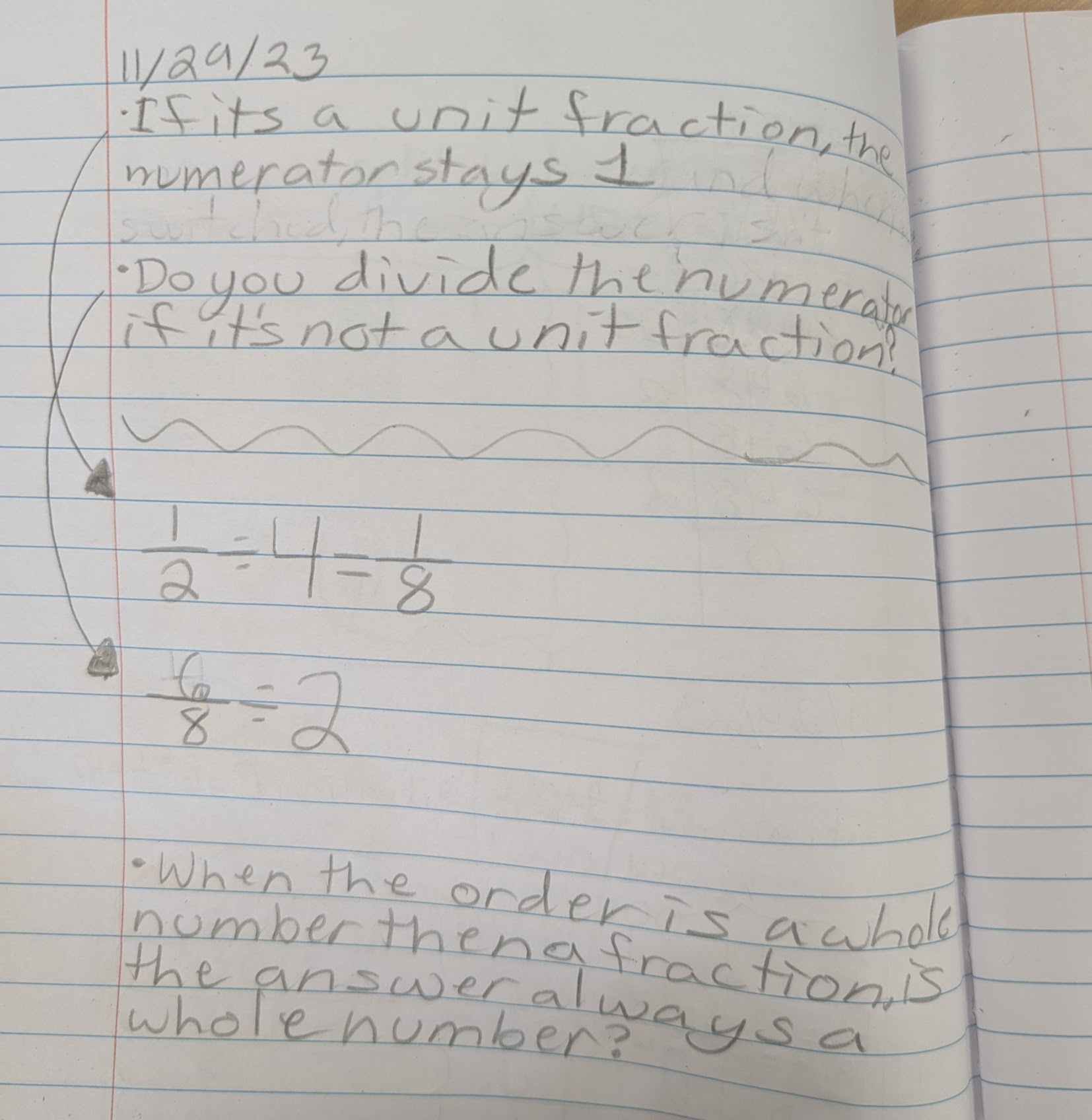
This past week, 5th grade students were dividing unit fractions by whole numbers and whole numbers by unit fractions. If you have ever taught this, you probably immediately picture students overgeneralizing these two different situations. In the vein of answer-getting, they often think the quotient will either always be a whole number OR always be a unit fraction – both including the product of the denominator and whole number in some way. And even though students have engaged in a lot of the habits within this work, it was with the two situation types separately.
To address the overgeneralization, we wanted them to engage in mix of the situation types in order to compare them. We launched with the following 2 problems, purposefully choosing the same numbers to elicit the difference in what is happening in the situation and the resulting quotients.

Student Thinking
As anticipated, we saw wonderful diagrams that generally matched each situation, but we could tell by the shading and erased work on Situation B that students were thinking that because they were working with fractions, their answer had to be a fraction.


We focused our discussion on the questions, “Where is 1 cake in your diagram?”, “Where are the people in your diagram?”, “Where are the servings in your diagram?”, and “Where is your answer in the diagram?”. Through those questions we saw a lot of labeling revisions to their work to make it clearer.

Mathematicians Talk Small and Think Big
“The simplest problems and situations often turn into applications for deep mathematical theories; conversely, elaborate branches of mathematics often develop in attempts to solve problems that are quite simple to state.”
Cuoco, Al & Goldenberg, Paul & Mark, June. (2010)
While the discussion was productive and we saw a ton of sense-making, visualizing, describing, and revision, I was left wondering how this moment transfers to the next time a student engages in one of these division situations.
I love this idea of tinkering around with smaller ideas to conjecture about larger ideas as a great way for students to deeply understand a concept and be able to transfer their understanding to the next time they engage in that concept.
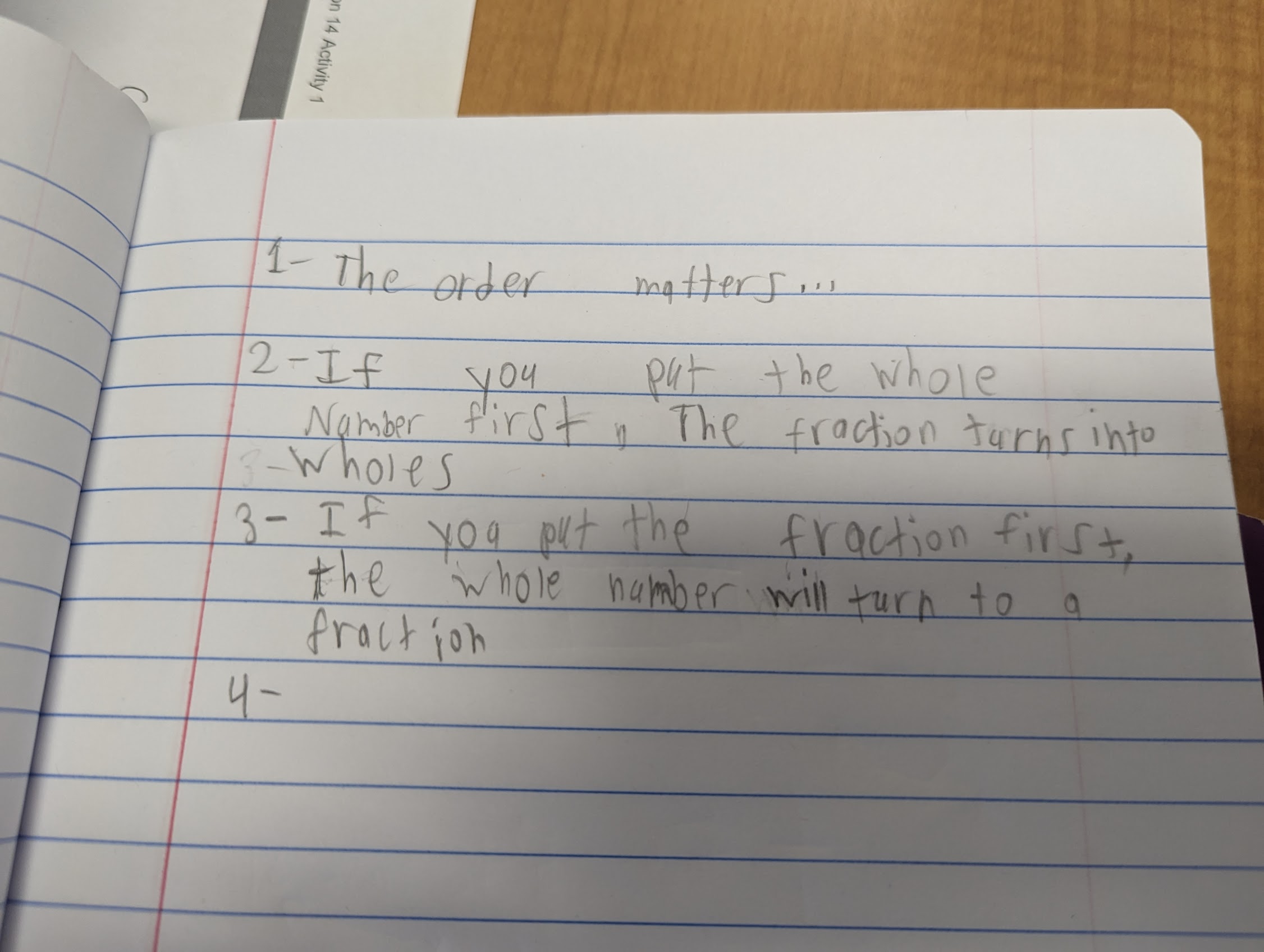
So, for the tables done their discussions early, I asked them to write things they think are true about the division and lingering questions they might have. Here are a couple examples:
Next Steps
The question I am always left with after students have such amazing insights and questions is, ‘How do I keep this math conversation alive?’ With the pacing of curriculum, it can be challenging to dig into each of these moments for an extended period, so we need ways to let this thinking extend across the year.
One thing we could do is ask students if we can launch the next class period with their ideas. For example, I might ask the first student if I could post, “The order matters in division.’ at the start of class the next day and have the class discuss if they think that will always be true and why. This would be a great way to elicit the difference in quotients when we divide a whole number by a fraction and vice versa.
Another option that I used in my classroom, was posting the ideas on what I called a Class Claim wall. When students make a claim or conjecture, we posted them on the wall and then anyone could revisit them at any point and time.
I think both of these options are a wonderful way for students to continually think small and big about concepts while allowing us the opportunity to communicate to them that just because a curriculum unit of study wraps up, the learning about that concept continues.
-Kristin
If you want to read a bit more about claims and conjectures, I was kind of obsessed with it when I was teaching and blogged a lot:

 MathMinds