When I was teaching, I often felt overwhelmed by my own learning. The list of things I needed to know and be able to do felt never ending. And then, as I chipped away at my list, it seemed like the more I learned about teaching math, the more I didn’t know.
I think David Cohen describes the root cause of my feeling perfectly:
‘To teach responsibly, teachers must cultivate a kind of mental double vision: distancing themselves from their own knowledge to understand students’ thinking, yet using their knowledge to guide their teaching. Another predicament is that although attention to students’ thinking improves chances of learning, it also increases the uncertainty and complexity of the job.’
Cohen, D. K. (2011). Teaching and Its Predicaments. Harvard University Press.
As a coach, it feels much the same way when trying to decide on areas of focus for our lesson planning and PLC sessions. With a finite amount of time for teacher learning, prioritizing is so hard when everything feels equally important. So, this year instead of the principal, the teachers, and me planning the year-long instructional focus solely based on what we think it should be, we wanted our decision to also be informed by students’ math experiences. Then, to determine if the things we are learning and trying improve student learning as evidenced by assessments (formative and summative), we also wanted to know if they impacted students’ math identity, feelings about math, and ways in which they viewed learning math.
Student input
The Practical Measures work grounded our design of a quick 5–10 minute student survey that encompassed students’ feelings about math and experiences in math class. We looked at the data in our first PLC and there was so much great discussion sparked by comparing responses within and across grades. So much so that this will probably be multiple posts as we continue to aggregate the data in different ways, pair the question responses, and give the survey a few time across the year.
In our PLC, the first thing we did was notice and wonder about a pair of responses from our 3rd-5th graders:

One thing we wondered was why a student might like math but not like solving problems no one has shown them how to solve. We discussed things such as student confidence, worry about not getting the right answer right away, and the ability to transfer their understanding to a novel problem. We also hypothesized that if their prior math experiences have predominately included being shown how to solve problems with no time for revision of ideas, there could be a perception that they can’t solve problems until someone shows them what to do and that the answer they get to a problem is their ‘final’ answer.
Launch problem
Whenever we do this work together, I like to shift from hypotheses and theory to focus on an action we can take, try, and reflect on. One actionable thing we decided we could do was launch with the problem, let students try, learn from what they do, and use what we learn to adapt rest of the lesson. This often means not following the lesson plan to the letter or jumping in to rescue students by showing them what to do, but instead allowing them to use what they know, revise their ideas, and connect their ideas to others.
Here is an example of that in action from 5th grade:
The original problem: A city is designing a park on a rectangular piece of land. Two-thirds of the park will be used for different sports. One-half of the land used for different sports will be soccer fields.
In the workbook, students were given a square that represented the park and then stepped through how to think about the situation: 1) draw a diagram 2) write a multiplication expression and 3) find how much of the park will be used for soccer fields.
While that could be a great way for students to think through the problem, it is not the ‘novel problem’ experience we wanted them to have. So, we didn’t use the workbooks and instead asked student to work in their journal by themselves first. As we monitored, we noticed a variety of approaches so we asked them, as a group, to compare where they were in their thinking and finish out the problem together on a whiteboard.
As they did a gallery walk, we asked them to focus on what was similar and different in the ways groups approached the problem and then go back to their tables and make any revisions they wanted to make to their own work. For some this meant a complete revision, while others added on new connections they made.
Student thinking
Here are a few of the boards:
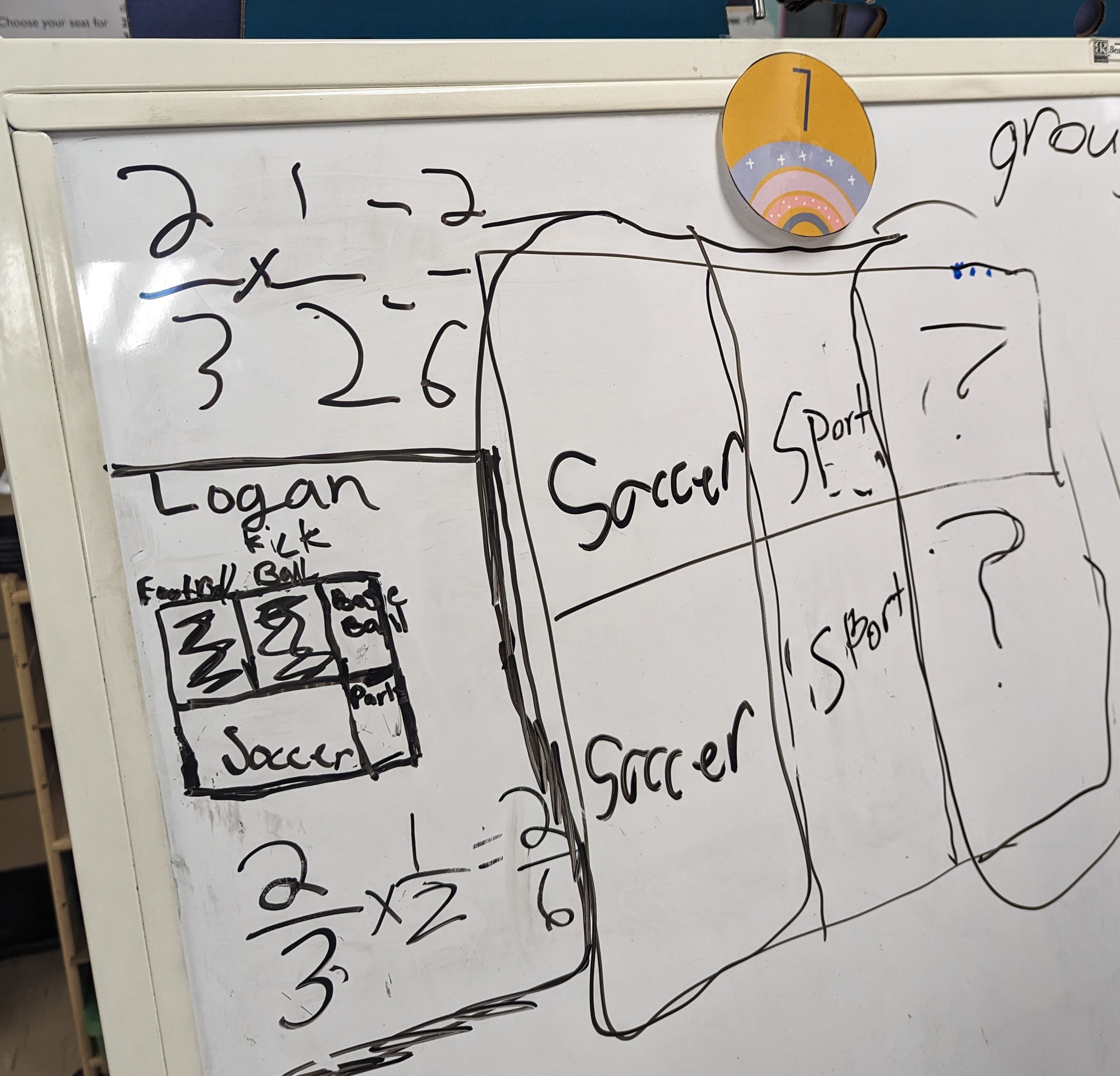

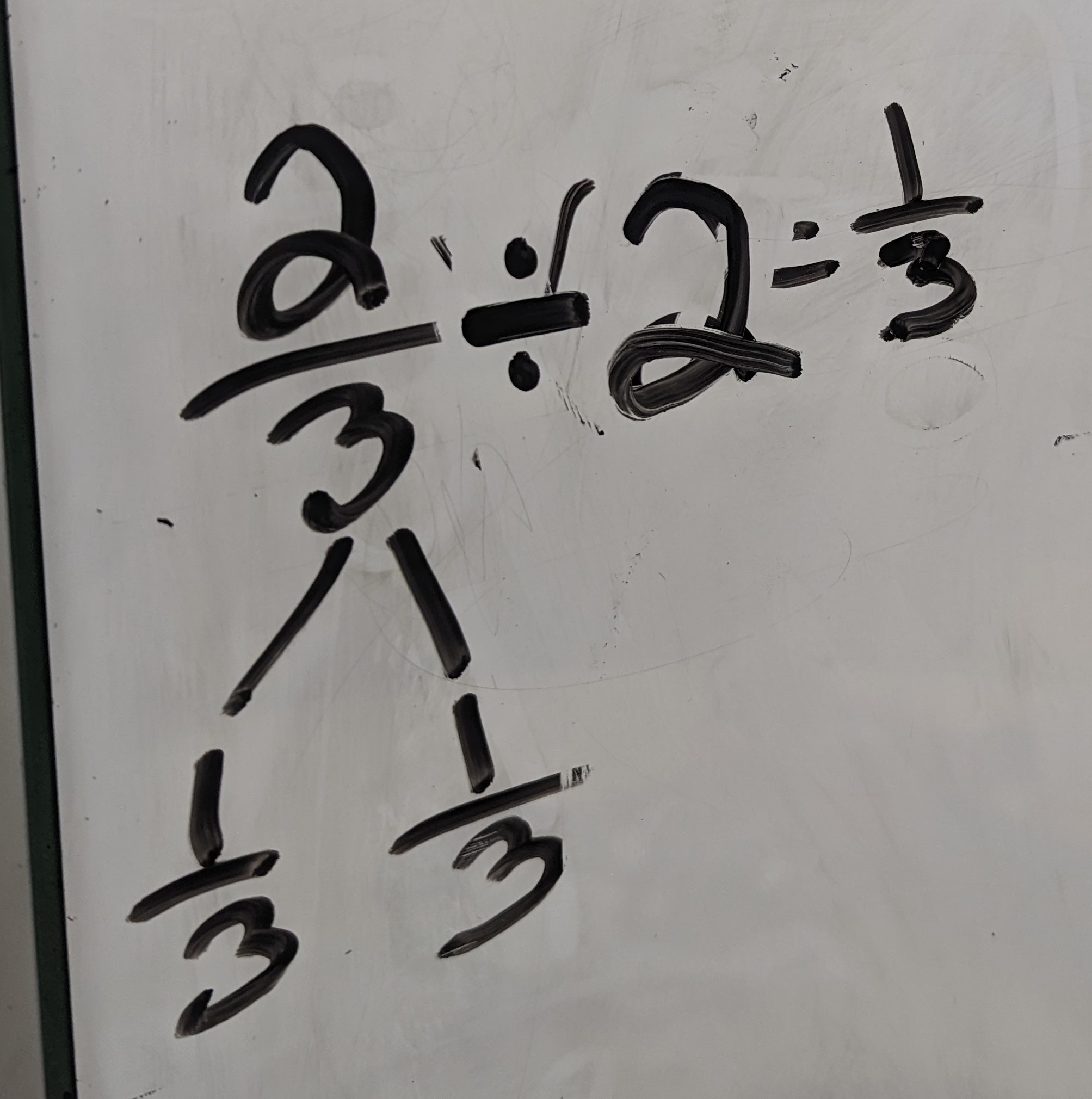
What I love about this when thinking about the survey prompt, ‘I like solving problems no one has shown me how to solve.’ is the multiple diagram types, the different ways students arrived at 2/6 with the same type of diagram, the multiplication and division expressions, and the equivalent answers of 1/3 and 2/6. And although the workbook problem didn’t exactly tell them what to do, it did scaffold it in a way where I could imagine their responses would have looked very similar.
For the rest of the lesson, we used their thinking to discuss their approaches, how they connected to one another, how they knew to use multiplication or division, things they noticed about their expression and product, and places where they changed or revised their thinking. We skipped Activity 2 altogether because this discussion was so interesting and important and reflected how we work through problems no one has shown you how to do or think about!
Next steps
Like all things teaching and learning, it takes time. I don’t expect this one experience to be the thing that shifts students like or dislike in solving problems w/o being told what to do nor do I expect every lesson to play out like this one. However, with repeated experiences similar to this, I hope students feel more confident in attacking a problem they haven’t been shown or scaffolded through and teachers refine their ‘double vision’ in a way that balances their own understandings and student thinking.
The best way we will be able to see if this has an impact is through students’ voice, which I look forward to digging into throughout the year in the surveys.
 MathMinds
I can’t wait for the followup posts!
LikeLike